Tommy Metz III:
Hello and welcome back to yet another episode of All the Feelings: Still Adulting.
Pete Wright:
Welcome back to yet another episode of [unclear].
Tommy Metz III:
I’m Tommy Metz III, and who’s that over there?
Pete Wright:
It’s Pete Wright.
Tommy Metz III:
Oh, fantastic. And you are here for a very special grab bag episode. We’ve got two ideas that we are talking about that are both very important for adulting and have nothing in common together. Well, I guess —
Pete Wright:
We’ll see.
Tommy Metz III:
A little bit, maybe. We’ll see.
Pete Wright:
We’ll see.
Tommy Metz III:
We’ll see together.
Pete Wright:
Yeah.
Tommy Metz III:
Yeah.
Pete Wright:
Yeah.
Tommy Metz III:
Pete, do you have any thoughts before you begin this episode?
Pete Wright:
Well, I’m gonna be talking about social media as an adult. My thoughts are — you’ll see — we’re men of a certain age, we’ve been around, we’ve seen some stuff.
Tommy Metz III:
Mm-hmm. Couldn’t be more vague. I love it. We’re men of a certain age, we’ve been around, and stuff has been seen. Yes. Boy, oh boy, what a trailer. Thank you everybody for joining us for another episode. Should we go ahead and just jump right in and get started?
Pete Wright:
You’re not gonna tell the people what you’re talking about? This is the teaser part.
Tommy Metz III:
Oh, but I thought we’d like to make it a little surprise. Well, for all of you good boys and girls out there, I’m going to be talking about pet ownership.
Pete Wright:
Well, you can go back to the —
Tommy Metz III:
As an adult. And I know that y’all know that I have a dog named Foster, and we’re gonna get into it.
Pete Wright:
We are. We have been doing this for a long time. That’s what is clear by this intro — we’re well practiced. We’re doing great. Let’s talk about my stuff.
Tommy Metz III:
So smooth. Silky smooth. All right. Let’s get to it.
ATF Intro:
Subset one:
Enthusiastic Announcer:
The Woes of the Social Internet
Pete Wright:
Okay, Tom, do you remember your first computer?
Tommy Metz III:
I do, actually. We lived in Vienna, Virginia, and it was a PCjr. Do you remember — does that phrase mean anything to you?
Pete Wright:
Yeah, it does.
Tommy Metz III:
It was built for children. And I remember you turn it on, and it said, “Hello,” and it blew my mind. I was like, oh my God, I have a new best friend. I remember it being very user-friendly. And you sort of park a little bus into this little thing and that means you start the computer, and it was very cool.
Pete Wright:
Oh, that’s really adorable. I never had one of those.
Tommy Metz III:
Thank you. Yeah.
Pete Wright:
I had the cassette-based — I had like the TRS-80 — and I could make the square rotate. Go to ten, echo, hello. And so I could write BASIC.
Tommy Metz III:
Oh, so you had like the eight-track of computers.
Pete Wright:
Yeah. And you’d have to load the whole program by watching the cassette play, and it had to be at just the right speed. And if it was too slow, the instructions said: just speed it up until the computer recognizes it, and then you’ll know it’s perfect. There was no — it was all like jazz.
Tommy Metz III:
What is it?
Pete Wright:
Running a computer was like jazz. Right, right.
Tommy Metz III:
It really makes the difference.
Pete Wright:
And I remember the first computer my dad was using at work had the big — ten inch? Eight inch? — anyway, they were the giant floppy discs. And then the first one I had was the Apple IIe with the five-and-a-quarter. And then I got the IBM PS/2, which had the three-and-a-half inch floppy drive, which was actually in plastic and confused everybody because it was hard, but it really was still floppy. And then I found the social internet.
Tommy Metz III:
Oh. Uh oh.
Pete Wright:
I was sitting in my bedroom. It wasn’t the internet. Let me just tell you, it wasn’t the internet at the time.
Tommy Metz III:
Oh.
Pete Wright:
It was just — you remember.
Tommy Metz III:
Download.
Pete Wright:
The modem.
Tommy Metz III:
Or the modem that makes the sound.
Pete Wright:
Right.
Tommy Metz III:
Yeah. So you’re in your bedroom, you’re —
Pete Wright:
I was on my 1200 baud modem, and I was playing the game The Bard’s Tale.
Tommy Metz III:
Oh yeah, I know that one.
Pete Wright:
On my Apple II. God, those three games were great, especially Bard’s Tale 3: Thief of Fate.
Tommy Metz III:
Okay.
Pete Wright:
Oh, I love those games so, so much.
Tommy Metz III:
Oh, sure. Yep.
Pete Wright:
And I found that there was a little phone number in the back. And it said, if you dial this phone number with your modem, you will be able to join our BBS — the bulletin board system — for hints and clues. And it was just like a forum where you could go get support from other people who were playing the game, but you had to pay for it. You were billed through your phone line. And then weeks later my dad walked in the room, he got the phone bill, and he was like, “Do you know why there is a $400 bill?”
Tommy Metz III:
Oh no. Oh my God, Pete, you were really barding it up.
Pete Wright:
Yeah. Yeah. This was — I was barding it up. This was 1983, maybe.
Tommy Metz III:
And you didn’t know how it was working.
Pete Wright:
I did not have any concept. Yeah.
Tommy Metz III:
Yeah.
Pete Wright:
And I said, jokes on you, old man. You’re the one who put the computer in my bedroom, right?
Tommy Metz III:
Yep.
Pete Wright:
Anyway.
Tommy Metz III:
He was just assuming you were in there playing with your three-and-a-half-inch floppy.
Pete Wright:
Yeah. That’s a joke that couldn’t come too soon or too late.
Tommy Metz III:
I had to. Okay.
Pete Wright:
That was just perfect.
Tommy Metz III:
Okay.
Pete Wright:
So anyway, I went to college, and I started my college life at Drew University, and it was one of the first schools to have a one-to-one program. So when you register, you get there and they give you your room key and your meal ticket, your ID, and a computer.
Tommy Metz III:
Oh wow.
Pete Wright:
And everybody had their own computer.
Tommy Metz III:
Wow.
Pete Wright:
It was just part of your tuition over four years, and we were expected to use the heck out of it. And we did.
Tommy Metz III:
Wow.
Pete Wright:
It was fantastic, absolutely fantastic. So then, messaging apps start showing up and I was all the way in. I was on ICQ and AIM and MSN Messenger and Yahoo Messenger and IRC, the chatrooms, and then GeoCities and Usenet and Six Degrees. Six Degrees was like the first real social network, which you’ve probably never heard of because it died in 2000.
Tommy Metz III:
Yeah.
Pete Wright:
And LiveJournal — don’t forget LiveJournal — and Xanga and Friendster and MySpace, obviously. And Flickr and Delicious — I loved Delicious — and Digg, both the podcast and the website, and Last.fm. And Blogger, before Google bought it and then suffocated it. And I was there for the first wave of Facebook, the day they dropped the .edu email requirement to sign up. And there was a great migration when they opened the doors and said, well, I guess everyone’s invited. And I had a Twitter user ID below four thousand, which was very exciting. Every Twitter user in the early days was assigned a numerical ID that you could find in your profile.
Tommy Metz III:
Oh, so you were one of the first four thousand people.
Pete Wright:
I was on my cell phone, texting, when Twitter was texts, right? And I loved it.
Tommy Metz III:
Okay.
Pete Wright:
I loved it. I loved it. And I would go to like the XOXO conference, and it was just really fun to tweet and stuff.
Tommy Metz III:
Is that the Gossip Girl compass?
Pete Wright:
Yeah, kind of.
Tommy Metz III:
Yeah.
Pete Wright:
And now social media seems to be — I don’t know. It’s more people than Trader Joe’s on a Sunday afternoon in Portland. There’s just a lot of people on social media now, and they’re all posing.
Tommy Metz III:
Yeah.
Pete Wright:
And so, as I was thinking about this conversation, I feel like we are kind of founding residents — residents of the early social web — just because of when we were born.
Tommy Metz III:
We as a generation, right?
Pete Wright:
Yeah, as a generation. You and me, together.
Tommy Metz III:
Yeah.
Pete Wright:
And you were just out cutting logs for the fire.
Tommy Metz III:
Yeah.
Pete Wright:
And I was tweeting.
Tommy Metz III:
Uh-huh. Yeah. Yeah.
Pete Wright:
Yeah.
Tommy Metz III:
I was churning something.
Pete Wright:
So what is your history of the social web?
Tommy Metz III:
Maybe butter.
Pete Wright:
Did you embrace it early? I have a hard time imagining the answer to that is yes, but I want to be surprised.
Tommy Metz III:
I remember having America Online — AOL — and being on, when I was in Colorado living with my parents, on what I guess would be message boards. And typing and meeting some people.
Pete Wright:
Mm-hmm.
Tommy Metz III:
I’ve never been an early adopter of anything. And I remember getting on to Facebook fairly early because friend of the show, Scott Lamb, always had his finger on the pulse, and he invited me back when you still had to be invited.
Pete Wright:
Mm-hmm. Right.
Tommy Metz III:
He also invited me to Google. He invited me to all these things. To wit, every single time I probably said something like, “This’ll never last.” Like the non-fortune teller that I am. I remember feeling — by the time I had MySpace — because I remember slightly agonizing over who was in my top —
Pete Wright:
Yeah, I’m replaying —
Tommy Metz III:
What? Didn’t you choose like eight people?
Pete Wright:
Yeah.
Tommy Metz III:
Seven people? Something like that? And I remember I think I had famous people in my eight. Like Steven Spielberg, as if he would be like, “Oh, I made the cut.” I don’t remember a lot.
Pete Wright:
I don’t remember a while.
Tommy Metz III:
I’ve never been very good at it.
Pete Wright:
[crosstalk]
Tommy Metz III:
I’ve never been super avid about it. And then at one point — and I’m sure you’re going to get into it — it became nothing but an obligation. An absolute hassle that I didn’t want to be a part of.
Pete Wright:
Yeah. Yeah.
Tommy Metz III:
And knowing me, I was probably a little bit ahead of the game of wanting to kick it to the curb. I just use it now for advertising things. On Facebook, if I’m going to be in a show or if a friend has a show, I’ll just forward that announcement to people, and that’s really it.
Pete Wright:
Like one of the things that we’re going to do.
Tommy Metz III:
Did that answer your question?
Pete Wright:
Yeah.
Tommy Metz III:
Kinda, sorta.
Pete Wright:
It did. And I think it’s interesting the way you use it now. That’s also largely the way I use it too, right? Except for with a couple of caveats. Because it’s changed from the early days, when — and I think it’s important that we all sit with this — when it started, it felt democratic. In the most genuine sense of the word. You had this corner of the internet and it was yours. You wrote what you wanted. You found weird communities of people who cared about the same weird stuff that you loved at the time.
Tommy Metz III:
Yeah.
Pete Wright:
The whole apparatus felt built for you — for the individual. It was to connect and to share and be heard. And the best —
Tommy Metz III:
It’s what the internet was supposed to be.
Pete Wright:
Yeah, right. The best voices were in the weirdest little corners of the internet, when the internet still felt like it had corners. One of my very favorite publications on the early internet was Boing Boing, and they were publishing “dispatches from the digital frontier,” and there were some really, really smart people behind that.
Tommy Metz III:
Yes, right.
Pete Wright:
The Creative Commons movement was arguing that ideas wanted to be free. I was a huge supporter of Creative Commons. The Electronic Frontier Foundation — the EFF — was out there directly fighting for our rights online. Who knew that back then the EFF would be so prescient as to really lodge the complaints that we struggle with today?
Tommy Metz III:
Wow.
Pete Wright:
Like, it was a civil liberties organization for a country that had no borders. That was the weirdness. And it wasn’t that these people were naive — they had real vision.
Tommy Metz III:
Yeah.
Pete Wright:
They were coherent and principled and they really stood up for what network communication could be. And then so much money came into the picture. And one acquisition at a time, a terms of service update one after another, one algorithm tweak at a time — they just took it. They took the internet that I feel like we, through our participation and sweat, built.
Tommy Metz III:
Yeah.
Pete Wright:
And that is the issue that we exist in — having experienced the internet when it started and fallen in love with it there, and now we have what we have, and we get to live with the gap. Some days I want to be an Eternal Sunshine of the Spotless Mind, you know — I want to have that gap erased. Because I think I’d be much more comfortable in my skin if I didn’t remember how good it used to be.
Tommy Metz III:
Oh, that’s what’s causing you angst — you remember what it was and then what it’s become.
Pete Wright:
Right, right.
Tommy Metz III:
And so —
Pete Wright:
Wouldn’t it be easier if we just forgot the good parts? Just felt like our baseline was this, because this is all we have.
Tommy Metz III:
Yeah. I guess I wonder if we have a word for that. Oh — children. Yeah, if we could just be a child.
Pete Wright:
Yes. Yeah.
Tommy Metz III:
Yeah.
Pete Wright:
Right. So — I mentioned Boing Boing — one of the writers over there is a guy named Cory Doctorow. And I’m a big fan of Down and Out in the Magic Kingdom.
Tommy Metz III:
Down and Out in the Magic Kingdom. One of my favorite books.
Pete Wright:
He is a fantastic writer and activist, and he coined a word for what happened. I believe we have talked about it on the show, but I’ll just very briefly — the word is “enshittification.”
Tommy Metz III:
Oh, right.
Pete Wright:
And the American Dialect Society actually named it the Word of the Year in 2023. Australia’s Macquarie Dictionary followed suit and gave it Word of the Year in 2024. It made the dictionary, man. It made the dictionary.
Tommy Metz III:
Oh wow.
Pete Wright:
That’s how thoroughly the internet broke its promise to us and to humanity. So here’s how Doctor O describes the pattern. First, platforms are good to their users — we’re talking about Facebook and Twitter and all of the platforms, the gated communities of the social web. Then they abuse their users to make things better for their business customers. So suddenly now we have business pages.
Tommy Metz III:
Yep, shareholders.
Pete Wright:
And then they decide, “Oh goodness, you know who we can get more out of? The business customers.” So they abuse them and claw back all the value that we let people build on the social web for themselves. And then eventually, says Doctor O, they die. See: MySpace.
Tommy Metz III:
Mm-hmm. Friendster.
Pete Wright:
So it’s like a three-act tragedy performed by people in hoodies. So none of this is an accident. Doctor O says this isn’t built into the iron laws of economics or great forces of history. The Romans weren’t enshittifying their conquests. This is just a very specific policy made by really powerful people who have ignored every warning about the consequences of the decisions they’ve made.
Tommy Metz III:
Right. Yeah.
Pete Wright:
All of that comes back around to me just thinking: nobody is building anything for us anymore. Every new tool that has come out, I am naturally circumspect — suspicious — because I want to know who’s getting the value in my participation in this thing. And now we’re talking not just about the social internet. We’re talking about AI, and my participation with AI models and those tools that are being built around my energy and time.
Tommy Metz III:
Yeah.
Pete Wright:
And one of the things that makes this a story about being a grown-up — and not just a story about tech bros — is that no one, no one taught us, right? There’s no parent, no teacher, no guidance counselor who taught us about the moment you realize that the system you trusted was never actually designed with your interests in mind. And that is a huge weight to that awareness. Because it’s not paranoia — it’s pattern recognition.
Tommy Metz III:
Yeah. It’s true.
Pete Wright:
Do you know —
Tommy Metz III:
Yeah. It’s not paranoia if everyone’s actually out to get you.
Pete Wright:
Yeah.
Tommy Metz III:
That makes a lot of sense.
Pete Wright:
Right.
Tommy Metz III:
And especially it wouldn’t be naturally occurring to you, because you and me are the main characters of our story.
Pete Wright:
Yeah.
Tommy Metz III:
We’re the protagonists all the time, no matter what we’re doing.
Pete Wright:
Yeah. Right.
Tommy Metz III:
And so of course — like, how I firmly believe that when I go to sleep, everyone else just pauses or disappears.
Pete Wright:
Yeah.
Tommy Metz III:
That everything should be made for me and not use me as a paycheck.
Pete Wright:
Right. And that gets back to your point earlier when you started talking about how you use social media today, right?
Tommy Metz III:
Mm-hmm. Right.
Pete Wright:
What you, as the superstar, as the star of your story —
Tommy Metz III:
Transactional.
Pete Wright:
— when you post something to share your involvement in something, your expectation is — check me if I’m lying — that everybody you’re friends with is going to see this thing. And you’re posting it as an act of graciousness to let people know what you’re up to. And the reality is wildly different from that.
Tommy Metz III:
Yeah.
Pete Wright:
Right now, the algorithm has spoken against that level of accessibility. When you’re promoting something, the odds are very few people are going to see it. And yet we, because we grew up with that, it’s hard to disabuse ourselves of that experience — of that feeling that when I post something, people will see it.
Tommy Metz III:
Because it started as like a village.
Pete Wright:
Yeah.
Tommy Metz III:
And then it became —
Pete Wright:
It started where I could poke you. I could literally poke you. And somebody told me on Facebook, the poke still exists somewhere — you can still find the setting that allows you to poke somebody. And I think that was maybe one of the most delightful features of the early social web: being able to click a button and poke someone as an indicator that I am thinking about you right now.
Tommy Metz III:
Right. Yeah.
Pete Wright:
You are on my mind. And we’re using this weird, artificial arm across the universe for me to say, “You were just poked.” But that was frivolous and delightful.
Tommy Metz III:
Yeah.
Pete Wright:
And now the only way for me to tell you that I’m thinking about you is for me to pay for the privilege to do it, because I serve at the whims of an enshittified organization. That’s lame, right? But social media — these big tech companies — did not invent this kind of betrayal. The health insurance that you thought was your safety net. The retirement account that your employer said was super generous. The platform where you built your entire professional presence, your entire social life, your entire archive of who you were in your twenties — one day the algorithm just decides that you’re no longer a product worth serving.
And this has happened in every one of our modern human organizations, our modern human sets of infrastructure that somehow fail us at some point. We’ve talked a number of times about the tragedy of raccoons that lived under my house. We filed a claim to have our house repaired. We’ve been on the same insurance for 27 years. The first time we file a claim, they say, “We’re gonna accept this claim, and then we’re canceling your policy.”
Tommy Metz III:
Yep, yeah.
Pete Wright:
That is an enshittified organization if I have ever seen one. And that’s not social media. That’s just business right now.
Tommy Metz III:
Right.
Pete Wright:
So I say all that because I’m a huge doomer, apparently, and I just want this to be a eulogy for me. You’re never gonna find me again.
Tommy Metz III:
Yeah, I’m getting a real Network vibe.
Pete Wright:
Yeah.
Tommy Metz III:
Peter Finch vibe.
Pete Wright:
Isn’t that funny? I’m mad as hell. I didn’t expect it to be so ranty. But I am on a couple of social media platforms actively.
Tommy Metz III:
Yeah.
Pete Wright:
I’m on Bluesky and I’m on Mastodon. And I’ve steadfastly refused to join TikTok, like a real old. But not because I’m afraid of it somehow, because it’s foreign — it’s not.
Tommy Metz III:
Mm-hmm.
Pete Wright:
It’s my native language of the internet.
Tommy Metz III:
Right.
Pete Wright:
But because I feel like I’ve seen this movie enough times to know how the third act goes, and I am deeply not interested in auditioning for the role of product. I’m just tired of it.
Tommy Metz III:
Yeah.
Pete Wright:
So I want to talk just a little bit about the Fediverse. Have you heard about the Fediverse?
Tommy Metz III:
Nope.
Pete Wright:
Yeah.
Tommy Metz III:
Britney Spears’s ex-husband? And I was like, what are we doing?
Pete Wright:
That’s it. Is that his?
Tommy Metz III:
Oh wow!
Pete Wright:
No, that’s a lie. That’s all a lie.
Tommy Metz III:
He’s doing great. Oh, well.
Pete Wright:
He’s doing great.
Tommy Metz III:
Yeah.
Pete Wright:
So the Fediverse is an umbrella term that refers to this ecosystem of interconnected, open-protocol social networks. And open protocols are really important because it allows everyone to see inside the technology that runs it. Mastodon, for example, runs on the Fediverse. That means it isn’t a single giant organization — it is an expanding ecosystem of interconnected services where users aren’t stuck using something they don’t like just because their contacts are on it. Think of it like email. Email is federated. You can have an email account at Gmail. You can have an email account at Hotmail or MSN. You can have an email account at tomsdiner.com.
Tommy Metz III:
And they all talk to each other is what you’re saying.
Pete Wright:
They can all talk to each other.
Tommy Metz III:
I see. You’re not locked into one thing.
Pete Wright:
Now, if you take that model and apply it to social media, that’s what the Fediverse is all about. You have the ability to sign up for a Mastodon account on any number of different servers. Maybe there’s a server that’s run by somebody who is just interested in hosting conversations about movie lovers. You join there, you can talk easily to the people who are only talking about movies, but you can also connect your account there and find other people in different communities. But they’re all running the same platform.
There are a ton of different apps that have been developed that run on top of the Fediverse, which is delightful. Just like you don’t like one email client and you can download another one and plug your same email address into it and get the same email — just like that, with Fediverse apps, Mastodon apps, Bluesky apps — all of these federated services allow choice. And that’s huge, because that’s the original promise. It is not perfect. It doesn’t come without its own complications. But it is really oriented toward the user as a person rather than a data point. And that’s the thing I connected to the most about the changing social web and why I’m not on TikTok and why I don’t look at Instagram. I would prefer to put my attention to areas and networks where I feel like I am still a human being, even though they are smaller. And in fact, smaller can be a lot better.
Tommy Metz III:
Sure, of course.
Pete Wright:
Doctor O again has this prescription that is really based on two core principles. First: uphold the end-to-end principle. Platforms should transmit data because users asked, not because the algorithm decided. And second: guarantee the right of exit. You can leave any time without losing everything. The right of exit.
Tommy Metz III:
Interesting.
Pete Wright:
Because if you delete your Facebook account, you can at this point jump through all kinds of flaming hoops to get all your stuff out.
Tommy Metz III:
The right of exit.
Pete Wright:
But then what do you do with it? There’s no other platform that says, “Hey, import all your Facebook data and you’ll have a social media account with us.” That doesn’t exist.
Tommy Metz III:
Right. Yeah.
Pete Wright:
So I think it’s important for adults who exist on the social web, who develop communities and are part of communities and want to embrace those communities electronically and remotely — because we know what good it does to your brain and your existence to have people in your life — to understand what these platforms are doing. I have so many people who are like, “Well, I’m still on Facebook because that’s where my family is.” Well, then tell your family to get off Facebook.
Tommy Metz III:
Okay.
Pete Wright:
Right? Let’s move. That is the one digital literacy skill that I think can really help — that nobody taught us, but I think we’re learning — that smaller networks are actually a really good home. The alternative to “I’m on Facebook because that’s where the family is” is that they actually find a really good home using smaller apps. And that is a huge trend right now: moving family groups to Signal, or just iMessages, right? Just shrinking. Just being part of the group chat that isn’t hosted on a major platform serving you algorithmic stuff, but is just what you see — exactly what people posted when they posted it. And that’s realizing the dream that we had twenty-five years ago of the early social web. Just show me what my friends are posting when they’re posting it. And that’s kind of delightful.
So that’s it. I believe deeply that something was taken from me, and I suspect that if you’re listening to this at a certain age, you might even say that too. Even if you can’t quite name it. That feeling that technology was at one point on our side, and the internet was awesome and weirdly improbable — it was a place you could just find your people and say the thing you wanted to say when you wanted to say it, and nobody could take it away. And it turns out people really, really tried to take it away.
So I actually spun up my own website, my personal website. It’s mepete.com. There are no trackers on it. I just post film reviews, you can find my books there, and it’s just my place to write stuff that I want to write. And it feels like going back in time a little bit. I don’t think anybody visits it, and that’s okay. It’s just my stake in the ground.
Tommy Metz III:
Sure.
Pete Wright:
And I don’t think that’s cynicism. I think it’s just being an adult.
Tommy Metz III:
Realistic. Yeah.
Pete Wright:
Yeah. What do you think? How do you feel right now after my rant? I’m sorry this was such a rant.
Tommy Metz III:
It wasn’t too much of a rant. I mean, it makes sense. I don’t —
Pete Wright:
[crosstalk]
Tommy Metz III:
Yeah, I don’t spend a lot of time thinking about the way that things used to be. Not because I’m disinterested or think it’s not important. But maybe because it makes me sad.
Pete Wright:
Yeah.
Tommy Metz III:
And so I don’t like to think about that kind of stuff. But it always makes me think of Ready Player One. The movie.
Pete Wright:
For sure, yeah.
Tommy Metz III:
I read the book, but the idea of once Magoo gets in charge of the Ready Player One universe — I don’t remember any product names — but either way, he wants to all of a sudden put ads in, and you know, “We could still have like 10% of view if you cover 90% of the thing with pop-up ads.”
Pete Wright:
Yeah. Yeah.
Tommy Metz III:
It just seems like there’s no remembering. Once you’re in that place, there’s no remembering what it was like to be human.
Pete Wright:
Yeah.
Tommy Metz III:
And the human experience is just robbed out of it, which is very disheartening.
Pete Wright:
Yes. And I think that’s where we are right now. And I think there are people out there who are doing really good work to help bring it back and give me hope. So if you want to find me, find me on Mastodon or Bluesky. Those seem to be places where I have more of a spark of interest in the social web.
Tommy Metz III:
Yeah.
Pete Wright:
So that’s that.
Tommy Metz III:
And you can find me on my PCjr. Find a PCjr in your latest garbage dump, open it up, and I’m just there.
Pete Wright:
Uh-huh.
Tommy Metz III:
I’m just hanging out.
Pete Wright:
That’s so good.
Tommy Metz III:
Weirdly, my website is also mepete. It’s the only one I could get.
“Social media gives legions of idiots the right to speak, when they once only spoke at a bar after a glass of wine without harming the community. But now they have the same right to speak as a Nobel Prize winner. It’s the invasion of the idiots.”
Pete Wright:
Umberto Eco. “It amazes me that we are all on Twitter and Facebook. By we, I mean adults. We’re adults, right? But emotionally, we’re a culture of seven-year-olds. Have you ever had that moment when you’re updating your status and you realize that every status update is just a variation on a single request? Would someone please acknowledge me?”
Tommy Metz III:
Former podcaster Marc Maron.
Pete Wright:
Okay, I just spent an entire segment explaining why the algorithm is a con designed by people in fleece vests. I can’t think of a better transition to a story about scrolling a golden retriever named Biscuit opening a birthday present.
That’s it. It’s just that. I watched the whole thing, and then I watched it again, and then I clicked the little heart icon and sent it to a bunch of people via text message. And Biscuit has — I later learned — 400,000 followers. Biscuit has a manager. Biscuit has brand partnerships. Biscuit, a dog who cannot read, has more influence over consumer purchasing decisions than I do, and I’ve been on the internet since before Biscuit’s grandparents were born.
And here’s where it gets worse, because I did what I always do when something makes me feel unhinged: I read about it. One in four pet owners has created a dedicated social media account for their animal. It is an entity that cannot consent. It cannot type, it cannot read the terms of service or the comments, and it is in most jurisdictions legally classified as property. Twenty-five percent of pet owners looked at their cat and thought, “What this creature needs is a personal brand.” And it’s working, apparently.
The pet influencer industry — and I want to pause here because “pet influencer industry” is a phrase that should not exist, and yet here we are, adults in a world — the pet influencer industry is currently valued at $24 billion. For context, Iceland’s entire GDP is around $30 billion. Your neighbor’s Cockapoo is, economically speaking, closing in on a Nordic nation.
The internet — the same internet that was supposed to democratize information, liberate the public square, and give ordinary people a voice — has been substantially colonized by animals who do not know they’re on it. And 63% of pet owners follow at least one pet influencer. That means if you own a pet and you’re listening to this podcast, there is a better-than-even chance that a portion of your daily media diet is curated by something that also licks its own butt and considers that a complete grooming routine.
But here’s the thing. Researchers — peer-reviewed, published, actual scientists with actual credentials — conducted a study on pet influencers versus human influencers. And what they found was that people engage more with pet influencers. They trust them more. They are more likely to buy what they are selling. More credible than humans. And I sat with that for a little while, and I thought about all the platforms we’ve watched degrade over the years, all the humans I’ve watched use the internet to mislead and manipulate and monetize every single pixel of genuine connection until there is nothing left but the ad — and I thought about Biscuit opening his birthday present, with his four hundred thousand followers, who came back every single day, not because the algorithm told them to, not because Biscuit had a content strategy, but because Biscuit was just there. Consistently, joyfully, uncomplicatedly there.
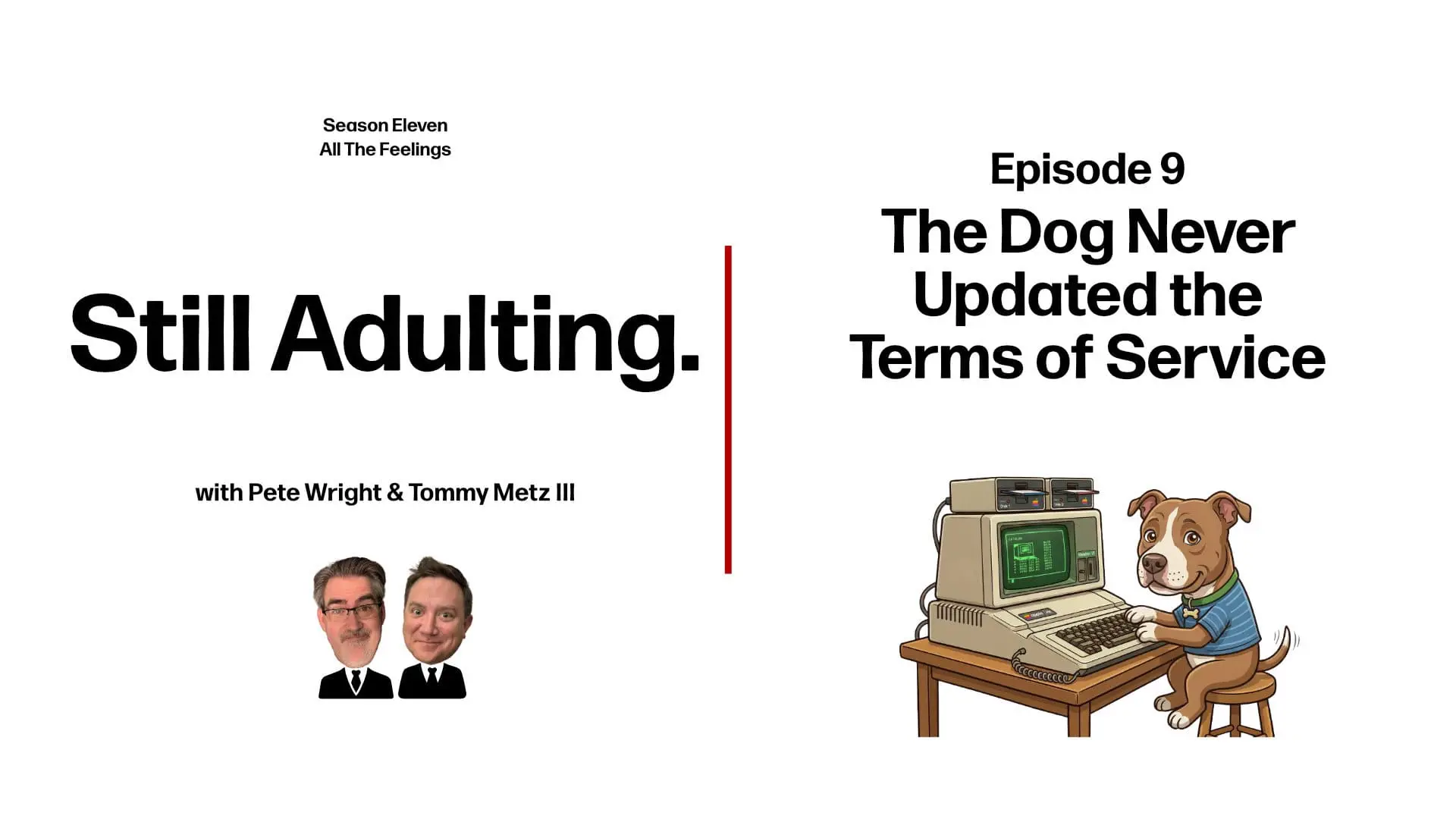
The dog never promised anything and never broke any promises. The dog never updated his terms of service. The dog never pivoted to video. The dog never sold your data to a third party, never buried your posts behind a paywall, never replaced your friends’ actual updates with promoted content from brands you’ve never heard of. The dog just showed up every day doing dog things, and somehow, in the wreckage of everything we built and watched get taken apart, that turned out to be enough.
Wanna pay to be in a club with a couple of diehard pet owners who would never pivot to video without consent? Become a feeling friend today for just thirty-five dollars — twenty-five renewing — and you can become a valuable supporter of All the Feelings without writing a single letter. Plus, you get access to your very own members-only podcast feed, chocked full of extended editions of our episodes, members-only episodes, our trailer archives, so much stuff. So jump in now, support the season, and know you’re also supporting Pete and Tom and Foster and Gambit and Percy in our journey toward that first sweet, sweet brand deal. Gross. Visit allthefeelings.fund to learn more, and thank you for your support.
And now, back to the show.
“Another Reason I Don’t Keep a Gun in the House” by Billy Collins.
Tommy Metz III:
The neighbor’s dog will not stop barking.
He is barking the same high, rhythmic bark
that he barks every time they leave the house.
They must switch him on on their way out.
The neighbor’s dog will not stop barking.
I close all the windows in the house
and put on a Beethoven symphony, full blast,
but I can still hear him, muffled under the music,
barking, barking, barking.
And now I can see him sitting in the orchestra,
his head raised confidently, as if Beethoven
had included a part for barking dog.
When the record finally ends, he is still barking,
sitting there in the oboe section, barking,
his eyes fixed on the conductor,
who is entreating him with his baton,
while the other musicians listen in respectful silence
to the famous barking dog solo,
that endless coda that first established Beethoven
as an innovative genius.
ATF Intro:
Subset two:
Enthusiastic Announcer:
Get a Pet, Heal Your Life
Tommy Metz III:
Pete, I have an important question for you.
Pete Wright:
I am ready to answer.
Tommy Metz III:
Have I ever mentioned that I have a dog? No, of course. His name is Foster — aka Buppy King Foster, aka the Dog Who Lived. No, the real question is: do you remember Foster’s origin story?
Pete Wright:
I think I do. It involves you being snookered by sweetness.
Tommy Metz III:
Really? We will get there. That’s exactly right. For those that maybe aren’t as avid listeners, I would like to briefly tell Foster’s origin story. It is quite a tale — spelled T-A-I-L — and it has parts both triumphant and, dare I say, what, Pete?
Pete Wright:
Harrowing.
Tommy Metz III:
Harrowing. Here we go. The year was 2015. The night was July 4th. On said evening, with fireworks exploding like bombs bursting in the air, all American-like, a small puppy of mysterious age and origin was found wandering the streets of Los Angeles. No collar, no chip, no regrets.
Pete Wright:
No problem.
Tommy Metz III:
We’re not sure how or why Foster chose this day for his freedom, but we do know that he picked July 4th because above all else, he is a good boy. And a good patriot. He was picked up by persons unknown, dropped off at a shelter, and then picked up and delivered to Mayday Rescue by the founder herself, the amazing Natalie Garcia, who has been rescuing dogs since 2010. He was taken to the rescue shelter and promptly given the incorrect yet weirdly accurate name Vinny. And if you see my dog, you’re like, I see it. Vinny.
Enter me. The year was still 2015, and yours truly had finally decided that now was the time to foster a dog. In his somewhat new apartment in the San Fernando Valley. Some of my friends scoffed at my ability to foster a dog and not end up adopting it, but I scoffed at their scoffing — and it was a real scoff-off — because they didn’t realize that I was going into this situation like a reverse Kubrick because my eyes were wide open. Because even before I clicked on a single link, I decided upon three rules.
Number one: I wouldn’t foster a puppy less than two years old, because they don’t need my help. Number two: I wouldn’t foster a pit bull, because my apartment building did not allow it. And three: I wouldn’t adopt the first dog I fostered. And those rules were written in blood.
Okay, we’re getting there. Still 2015. I’ve been given the website address for Mayday Rescue from a friend who trains animals for movies and television. And when I clicked on it, that was the first time I laid my eyes on Vinny. He had the regal, noble look I am drawn to in dogs — a large square head, smooth fur, and almost human, light brown eyes. I was interested and signed up for a home visit.
Flash forward. Natalie and Vinny show up in my apartment for the visit, and I am immediately struck by two things. Number one: he was clearly a pit bull mix — something that was not made clear on the website. Number two: he was clearly mixed with nonsense, because he was very short and very long, but his head was already somehow full grown. So he looked like the dog from the movie The Mask. I approved of him, Natalie approved of me, and so we began our lives together.
During his first vet visit under my care, I was told that he was potentially less than a year old — something else that was not listed on the website. Four months later, I informed Natalie that I was — what I now know is called — a foster failure, because I was adopting the now-named Foster, forever. That’s right. I adopted a one-year-old pit bull mix that was also the very first dog I fostered. I guess I’ve always been a real bad boy. A rule breaker at heart.
To round out this origin story, here are a few random things I’ve learned since. Foster’s lack of height comes from the fact that he has canine dwarfism, exhibited by his inward-turning front paws. A DNA test — yeah, right — a DNA test reveals he is 50% Staffordshire Terrier, which is fancy talk for a pit bull.
Pete Wright:
I did not know that. When you look at him, you just know.
Tommy Metz III:
25% Chihuahua, which totally tracks. And 20% Siberian Husky, which does not track at all. Whoever his parents were, it was a weird night. And anyways, that is Foster. And yes, I left out five percent. Five percent, I assume, is squirrel.
Okay. I’m not insane, so I won’t call him my best friend, because he’s not human, but I would call him my favorite friend.
Pete Wright:
[crosstalk]
Tommy Metz III:
And that’s no disrespect to my human friends, but none of them will lay upside down on my chest and let me scratch their bellies, so take it.
So that is one eighth of the origin story of Foster, which I’m saving the rest of in case I ever have to give some sort of speech when I take office. Would you — I know that you have more than one pet — but would you tell the good people how you came to live with your dog, Gambit? I don’t actually know this story at all.
Pete Wright:
Yes. He’s another interesting mutt breed.
Tommy Metz III:
I’ve met Gambit. Mm-hmm.
Pete Wright:
I grew up a dog person.
Tommy Metz III:
Uh oh. Yeah.
Pete Wright:
My mom was a cat person and had a cat that might still be alive today. When I left for college, it was like 22 years old. It was a white Persian cat named Buffy, and that cat was around a long time. It may have died before I was born and just inhabited the house. But I was raised with dogs. We had a big black Lab named Stormy. My dad had a connection at the kennel that breeds police dogs for the Colorado Springs Police Department.
Tommy Metz III:
Cool.
Pete Wright:
So we had a German Shepherd puppy named Gunner that I grew up with, and he was my faithful friend — giant. His favorite toy was a steel-belted radial from a Volkswagen that he would carry around the backyard, this giant tire.
Tommy Metz III:
What.
Pete Wright:
Yeah, he was an extraordinary animal. But when I moved in with my wife in Portland, we couldn’t have dogs. So I went out one day — I think it was Valentine’s Day — and I went to a place for animals. What do they call them? A pet store.
Tommy Metz III:
Shelters? Oh, a pet store.
Pete Wright:
I just went to a mall pet store. And I found they had this litter of kittens — all black kittens.
Tommy Metz III:
Great. No.
Pete Wright:
And in Portland there is some sort of legislation where you can’t — they don’t sell black kittens in the holiday months, because a lot of people buy them as props for Halloween.
Tommy Metz III:
You what.
Pete Wright:
But in February they had just started selling them again. And I’ll never forget, I looked at the woman who was helping me and I said, “These are really adorable. What’s their breed?” And she looked at me and said, “Domestic.” Whatever.
Tommy Metz III:
Perfect.
Pete Wright:
So anyway, we ended up getting two of them — sisters, two little kittens, Cleo and Cassie. And we lived with them for many years and went through the whole life cycle. They were around when my kids were born, and then they died, and it was very, very sad. Horrible. So then we decided maybe it’s time for a change. And my wife started looking at dogs at shelters and found Gambit in a shelter in Tacoma. There was no information on breed. Gambit had just been found and shipped up to Tacoma for some reason, but had been found in Texas, on the Mexico-Texas border.
Tommy Metz III:
That’s right.
Pete Wright:
Yeah. And so we have this whole headcanon about Gambit’s origin story — that he was a drug mule and was swimming across the Rio Grande as a puppy, bringing drugs back and forth between Mexico and Texas. That of course is not true and it’s incredibly derogatory that I would even say it, but that’s the headcanon. Gambit’s seen some stuff.
Tommy Metz III:
Yeah.
Pete Wright:
And so he ends up in Tacoma.
Tommy Metz III:
Street dog.
Pete Wright:
We find him in this crazy foster situation. And I show up the day — the woman who ran this foster out of her home had like thirty dogs in her backyard, all going crazy. She comes out to give us the interview. I drove up with both kids. And she said, “My personal dog is dying right now. I can’t talk to you. Here’s Gambit. Good luck. Godspeed.” And we walked away.
Tommy Metz III:
All right.
Pete Wright:
And Gambit — covered in lice, bugs, whatever — you could see them crawling in his fur. Little puppy, gets in our car, and lice all over the kids in the backseat. But he ends up being the most amazing, snuggly, wonderful animal.
Tommy Metz III:
Okay.
Pete Wright:
We did do the DNA for Gambit. He is 41% small poodle. He is 37% Chihuahua.
Tommy Metz III:
Yep. Yep.
Pete Wright:
He is 7.7% Papillon. He is 7.1% Cocker Spaniel. And 5.8% Supermutt.
Tommy Metz III:
What’s that?
Pete Wright:
I will tell you all of that checks out. He’s all of that. It’s like Ashkenazi Jew — like everybody has just a little piece of it in their DNA.
Tommy Metz III:
Sure, yeah.
Pete Wright:
And so that’s him. He’s kind of an agility dog. He’s very fast. He has a small body but very long legs. So he’s kind of like an orange on a bunch of toothpicks. But his personality — we take him to the dog park. He’ll find the huskies, he’ll taunt them and make them chase him, because he’s faster than all the huskies.
Tommy Metz III:
Yep.
Pete Wright:
And he’s like a little greyhound, and he’s extraordinary, and we love him and love him and love him and love him.
Tommy Metz III:
Wonderful.
Pete Wright:
That’s the whole story.
Tommy Metz III:
I like that you brought up that you’ve written a backstory. Because I’ve written many backstories for Foster, but one of them —
Pete Wright:
Yeah.
Tommy Metz III:
— is because the thing that drives him the most insane is skateboards. People on skateboards.
Pete Wright:
Oh, okay.
Tommy Metz III:
He just barks — he cannot stand them. But I can’t tell — if I took him off leash, he might just run and jump on the skateboard with the guy instead of attacking him, because he seems both happy and crazy. I think — it’s interesting that you brought up the drug mule thing — because I think he was actually part of an undercover drug ring. But it was with a gang of skateboarders. And they were committing all sorts of crimes.
Pete Wright:
That’s what it is. Yeah.
Tommy Metz III:
And he was undercover. And let’s just say they lost a lot of good boys. And so he’s so angry at all skateboarders because it brings him back. Like PTSD. And the D stands for dog.
Pete Wright:
Yeah.
Tommy Metz III:
Anyways. Well, good. Great. That’s a wonderful story. Gambit and Foster are two of the best dogs that we have.
Pete Wright:
They are, truly.
Tommy Metz III:
And when we talk about owning a pet as an adult, one of the things that the internet likes to tell you is it’s legitimately good for you.
Pete Wright:
Yeah.
Tommy Metz III:
Like, not just good emotionally, but good physically. I’m not gonna go through everything, but I do want to say that the Human Animal Bond Research Institute — or HABRI, I don’t know if they go by HABRI, but they should —
Pete Wright:
But they will now.
Tommy Metz III:
Pet ownership saves the US healthcare system roughly twenty-three billion dollars yearly. That’s like most of Biscuit’s income.
Pete Wright:
Yeah, I was just gonna say that’s almost the entire pet influencer economy.
Tommy Metz III:
That’s right. Twenty-three billion, due to fewer doctor visits, less obesity, and better mental wellness. Another study found that 75% of doctors would actually prescribe a pet if they could, to improve a person’s overall health.
Pete Wright:
Oh, that’s cool.
Tommy Metz III:
That’s adorable.
Pete Wright:
Yeah.
Tommy Metz III:
You just write that on a script.
Pete Wright:
Just yeah, Biscuit.
Tommy Metz III:
What I’m not going to go over is all of the basic ways that it is good for you. Some of them were extremely obvious, like it helps with loneliness and stress. Of course, if you have an active pet like a dog, it improves physical activity because you take it on walks. Of course, it helps release good-feeling hormones while decreasing cortisol. Of course, it lowers blood pressure. Bread pressure — that’s what it’s called.
Pete Wright:
Yeah.
Tommy Metz III:
All of those. There were two that I found that were less obvious to me.
Pete Wright:
[crosstalk]
Tommy Metz III:
Of course, very obvious once I realized it. But I just never thought about it this way. This first one is huge for me. Pets give us a sense of purpose through daily activities like feeding, walking, and playing.
Pete Wright:
Really?
Tommy Metz III:
Quote: “Having another living being to focus on and give attention to on a daily basis is really important, especially for older adults living alone,” end quote, Benson explained. Wait, who’s Benson? Oh no, I copy-pasted very lazily. Hey Benson, I’m so sorry you were not getting your shout-out, but we appreciate it. Oh no. And I gave him a quote and everything. Hey Benson, keep it up.
I really agree with that, because as I’ve gotten older I rely on structure to really keep me grounded, especially because I — like you — don’t necessarily have a nine-to-five. Sometimes I’ve learned that if I have a plan and it gets canceled day-of, it kind of spins me out. It kind of risks making the entire day a snow day. Where instead of “Oh well, now I have time to do those other things,” instead it’s Mad Max times, and I’m just on the road doing whatever I want.
Pete Wright:
Mm-hmm.
Tommy Metz III:
So having Foster and having a schedule with him is enormous, of course.
Pete Wright:
Yeah. Routine, God.
Tommy Metz III:
Number two — which never occurred to me — pets help us stay socially connected. Having a pet is an automatic icebreaker.
Pete Wright:
Because everyone’s got animals.
Tommy Metz III:
It inspires us to chat with others during walks, vet visits, and so on. It can spark new friendships and stronger social networks. For people who are shy, they say pets provide a shared interest that makes it easier to start conversations and build relationships. Never occurred to me.
Pete Wright:
Yeah, me neither.
Tommy Metz III:
Number three — and this is more for you than for me — children. One study found that dogs can help children with ADHD focus their attention.
Pete Wright:
I did not know that. You’re making that up right now.
Tommy Metz III:
Yeah. Researchers enrolled two groups of children diagnosed with ADHD into a 12-week group therapy session. The first group of kids read to a therapy dog once a week for 30 minutes. The second group read to puppets who looked like dogs. Kids who read to the real animals showed better social skills and more sharing, cooperation, and volunteering.
Pete Wright:
No.
Tommy Metz III:
They also had fewer behavioral problems. I like the idea —
Pete Wright:
Wait, they made the children read to puppet dogs, Tom. Can we stop and litigate that, please?
Tommy Metz III:
Wait — I love the idea and what they learned from it, but I hate the study. You know who wasn’t in charge of that study? Benson. Benson’s a rock star.
Pete Wright:
Do you think the poor puppet kids are looking through the two-way mirror at the kids who actually get to play with puppies?
Tommy Metz III:
Weird that they showed both study groups to each other.
Pete Wright:
Like, that is the meanest —
Tommy Metz III:
It is really weird. That’s a terrible —
Pete Wright:
No wonder the puppet kids did not have as good attention — because they’re watching the kids with puppies.
Tommy Metz III:
Oh, yeah.
Pete Wright:
That’s all they can think about.
Tommy Metz III:
Yeah, I don’t like that study. I wish I would have re-read that before. It’s a very bad study. And then they sat there while they tried to feed the puppets, so they’re just not eating.
Anyways. So pets are good for you. Pets are good for you. Pets are good for you. Are we able to move on, or are we still picturing a bunch of children reading to felt?
Pete Wright:
I think so. Well, that’s never gonna leave my mind, but yeah, okay.
Tommy Metz III:
Yeah. I do have to mention — and it’s at risk of bringing the pod down a bit — there is one thing.
Pete Wright:
[crosstalk]
Tommy Metz III:
The downside of having a dog who is an adult, as I am also an adult. Puppy King Foster is approximately already 77 years old in dog years.
Pete Wright:
Yeah.
Tommy Metz III:
He’s not really showing it, but I honestly can’t stop my brain from having occasional day-mares about the future when he will no longer be with me. It’s sad and terrifying. And it feels earth-shattering.
Pete Wright:
Yeah.
Tommy Metz III:
So I try not to think of it. But it is sort of in the back of my mind. No spoilers, do not worry. But I did start crying when I saw Project Hail Mary — no spoilers — but a certain character does get hurt at one point. And I couldn’t help but personify that character for some reason. My awesome brain — I’m enjoying this movie, having so much fun — and my brain was: “Oh, what if that character was Foster?” Why? Why am I doing that in a theater? And it hurt really deeply.
Pete Wright:
And now every Ryan Gosling movie is ruined.
Tommy Metz III:
Oh my god, I cannot watch Drive without just bawling my eyes out.
Pete Wright:
When he gets hurt.
Tommy Metz III:
Yeah. Whenever he runs over someone in his car or whatever happens in that movie, I’m like, wow, Foster. Okay.
Pete Wright:
No spoilers, but there really are like two characters in Project Hail Mary.
Tommy Metz III:
Yeah. But I really tried to be very vague.
Pete Wright:
See if you can figure out the one that got hurt.
Tommy Metz III:
That I might personify.
Pete Wright:
Yeah.
Tommy Metz III:
It’s not the cold scientist that I was like, “There’s Foster in a nutshell.” Anyways. But I just want to touch on that. I did not do research on how to deal with that. That will be in the future. Because I don’t want to talk about that right now.
Instead, to bring this back up — I will say, even at his advanced age —
Pete Wright:
Yeah.
Tommy Metz III:
— Foster still thinks the wind is a game, and that I’m somehow in charge of it. When a big gust happens on a walk — I’ve said this before, I think — he kind of jumps up and barks, and then he looks at me like, “Make it happen again.” He sometimes howls when a fire truck goes by with its siren on, but then he stops and looks embarrassed. Like he looks around, “Nobody saw me do that, right? That was not a choice.” And he is the tiniest thing in my life that somehow manages to take up 80% of my bed every single night when we sleep.
Pete Wright:
Yeah.
Tommy Metz III:
If any of our listeners have a pet, I would say: why not? Just pause this recording and give them a little scritch behind the ears, or a pat on the head, or whatever. And do it just because you can. And maybe they’ll think it’s a game and want you to do it again. And when you do, tell them Vinny sent you.
Pete Wright:
And then think about those poor kids doing the same thing to their felt puppets.
Tommy Metz III:
And then just think about those poor kids, reading to a dumb puppet. Now I’m angry at the kids. Is that weird?
Pete Wright:
Thank you all so much for joining us for this episode. This week’s tune is “Internet Girlfriend” by Asher Postman. Coming up next week, Tom, what do we have?
Tommy Metz III:
Oh, we’ve got — some would say — a real grab bag. We’re gonna talk about, as an adult, gift giving: the idea of how do you give gifts and what is appropriate in the age of Venmo.
Pete Wright:
We’re gonna talk about average.
Tommy Metz III:
And Pete, what are you gonna be talking about?
Pete Wright:
I’m going to be talking about my mouth parts, Tom. We’re going to be talking about dentistry and our relationship with the dentist as an adult.
Tommy Metz III:
That’s right. And avid listeners of What’s That Smell? will remember that Pete started going to the dentist when he had like two numbers in his age. And that is crazy. So we’ll see how everything’s holding up inside.
Pete Wright:
It’s bad. Spoiler. Until then, I’m Pete Wright.
Tommy Metz III:
And I’m Tommy Metz III. Thank you so much for joining us. We will see you next time, next week, on All the Feelings: Still Adulting.