Announcer:
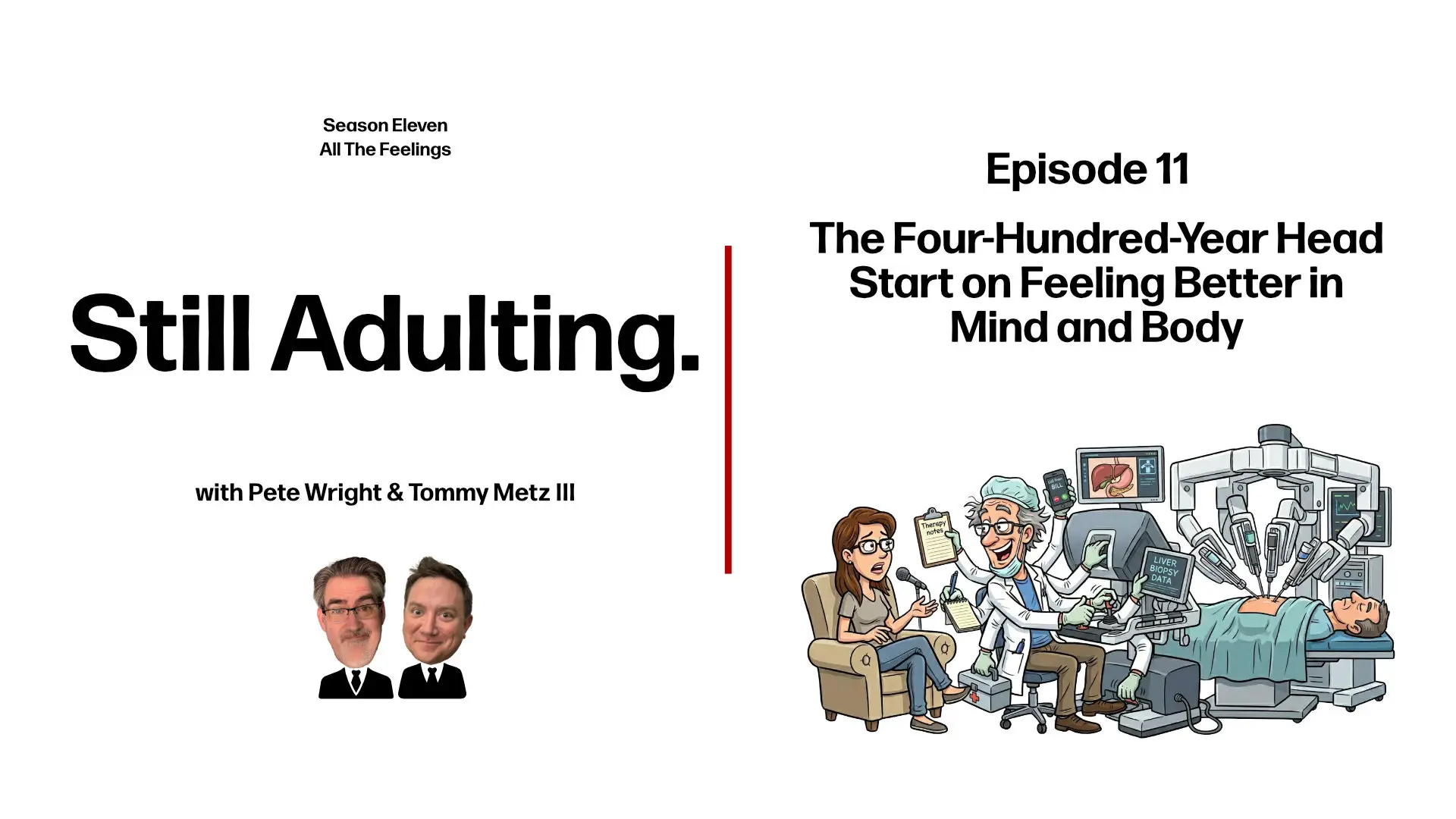
All the Feelings presents Still Adulting. This episode: Surgery and Mental Health.
Pete Wright:
Hello everybody, welcome to All the Feelings: Still Adulting. I’m Pete Wright, and I’m here with Tommy Metz III.
Tommy Metz III:
That’s me. I’m here the whole time.
Pete Wright:
It is episode eleven, Tom.
Tommy Metz III:
Thank you for having us.
Pete Wright:
That means episode eleven out of twelve. We are eleven-twelfths through this season — the Year of Our Lord 2026. And we are ending it with — I’d call it a bang, right?
Tommy Metz III:
Yep.
Pete Wright:
These last two episodes are wow.
Tommy Metz III:
These last two, everyone’s going to be talking about them.
Pete Wright:
Wow.
Tommy Metz III:
We’re probably going to put them on the internet. Like, that’s how excited we are. We’re probably going to record these.
Pete Wright:
We are so thrilled and excited to be here with these episodes today. We’re going to be talking about surgery and mental health, and all of that is just ripe for comic good.
Tommy Metz III:
I’m legitimately scared about your segment on surgery.
Pete Wright:
You should be. I’m scared about my segment on surgery because of my level of enthusiasm for it. Believe me. This is weird.
Tommy Metz III:
Because — just to give people a little peek behind the curtain — we had decided on preventative health care and mental health care. And you said, “Yep, surgery.” Like you leapt toward surgery. So you clearly have something up your medical sleeve, which I’m excited to hear about.
Pete Wright:
Yeah, I do. But I don’t get to talk about that first, because Tom —
Tommy Metz III:
Do you want to talk about mental health first?
Pete Wright:
I want to talk about mental health. You’ve got to get your head right before you get your body right.
Tommy Metz III:
I love it. All right.
Announcer:
Subset one: Mental Health.
Tommy Metz III:
Pete, I have a short story to tell you about a conversation I had somewhat recently that has to do with my segment topic. Would you like to hear it?
Pete Wright:
Tom, first — can you tell me, is it harrowing?
Tommy Metz III:
It is not. This is the one that is not harrowing. Instead, I believe it is heartening. The biggest villain of “harrowing” is “heartening,” is what I’ve decided.
Pete Wright:
Is heartening. Yeah.
Tommy Metz III:
Yeah, I think this is a happy one. And that’s good, because we’re talking about mental health and I’d hate to just start crying. Okay.
So the person that I was talking to — who will remain nameless, out of an abundance of caution — has been dealing a lot with anxiety, and it’s been getting slowly worse over the last year or two, it sounded like. And they described times, especially when traveling, where their hands would start shaking and their breathing would get all rapid and they would start swirling emotionally. It sounded like panic attacks, really.
And during our talk, they repeatedly said that they had to get it sorted. At one point they jokingly said that they needed to rub some dirt on it and walk it off. That was sort of their way of talking about it.
Pete Wright:
I don’t think that’s hygienic as a metaphor.
Tommy Metz III:
Rubbing dirt on — what, on your brain?
Pete Wright:
A little bit, though.
Tommy Metz III:
Pete. You’ve never done a little dirt dunk? Okay, anyway.
Pete Wright:
I don’t care for it.
Tommy Metz III:
I asked them if they had ever thought about talking to someone — like a therapist — and it seemed like it hadn’t really occurred to them, which is totally fine, but they wanted to know more about how they would do that.
So for the next ten minutes, I explained the potential benefits of talk therapy, perhaps mixed with medication, and shared my story, my testimony. Along the way, I kind of realized I was reminding myself why I think therapy can be so important, especially as an adult.
These are things that I’ve said before to people, but I don’t think I’ve said a lot of them in kind of years. So I liked the idea of sharing some of them with you.
I told the person — and some of these are just cliches we’ve said nine hundred times on this podcast — but I talked about the fact that therapy is a gift that you give yourself. I talked about that having an objective person who is only there to listen to you and try and help figure out what the underlying issues are that you’re dealing with can be life-changing.
And when they asked about psychotropic drugs — this is the part I haven’t said in a long time, but I trot it out. I think I came up with this years ago, or I read it and immediately took credit for it.
Pete Wright:
Took credit for it.
Tommy Metz III:
I honestly do not know. I think so. If this has been in a movie or something, my apologies. Either way — when you ask someone why they take cold medicine, a lot of times what do you think they say?
Pete Wright:
Oh.
Tommy Metz III:
No — it’s “to get better,” is what they say.
Pete Wright:
Yeah.
Tommy Metz III:
You take cold medicine to get better, but that’s not really true. That’s not what cold medicine does. Cold medicine helps you manage the symptoms while your body does what’s needed to get you better.
Pete Wright:
Yeah.
Tommy Metz III:
Like NyQuil doesn’t have any vitamin C in it.
Pete Wright:
Right.
Tommy Metz III:
It’s all antidepressants — I’m sorry, antihistamines.
Pete Wright:
No. Right. Okay. Just so you know, that is staying in.
Tommy Metz III:
Yeah. Is it weird that I’ve been self-medicating with NyQuil and I’m wondering why I’m a little tired today? It’s all pain reliever and antidepressants and decongestants.
Pete Wright:
Yeah.
Tommy Metz III:
So when my therapist — the good and true Bonnie, who has come up on this podcast before — suggested that I start taking mental health medication, it was for that reason. It was to take the edge off of the heightened anxious state that I was in so we could do the real work in talk therapy. I needed the ghosts in my head to shut up a little bit so I could hear, so I could listen to reason.
And then I shared one last thing with this person — and then I’m a thousand percent turning to you, I promise I’m not just going to talk like this the whole time. For me, this is the most important thing I can ever tell anyone who is dealing with any kind of mental crisis like anxiety or depression, because it was the hardest thing — but the most valuable thing — for me to learn.
I run the risk sometimes of anthropomorphizing my anxiety — making it into an actual thing. And I’m going to do that here, even though I probably shouldn’t. Your depression or anxiety will try and convince you that you should solve it on your own and not look for outside help. In other words, “rub some dirt on it and walk it off.” That was what my anxiety told me for a really long time. I think — if I anthropomorphize it — it’s because it wants to stay alive. The best way that anxiety can stay alive is to tell me to figure it out on my own, because I can’t. And so I have mental health therapy.
Pete Wright:
Yeah, right.
Tommy Metz III:
Pete, what is your walk with therapy? Can you remind us? We’ve talked about me and Bonnie quite a bit, but I don’t remember the last time we really checked in with you.
Pete Wright:
I’ve been through so many — I mean, I’ve just burned the clinic down. I’ve seen every therapist in it. There’s just no one else to see.
Since I was a kid. I started going to therapy when I was fourteen, fifteen — freshman year of high school, whenever that is.
And I saw a therapist in college. I was diagnosed — weirdly, nobody really officially diagnosed me with ADHD and OCD until I was twenty-nine.
Tommy Metz III:
Wow. Is it because we weren’t good at it yet?
Pete Wright:
Yeah, well, when I was a kid, the kids with ADHD were super noticeable — because the only thing we were really addressing with ADHD and OCD were the kids with hyperactive type. We didn’t know how to talk about inattentive. We didn’t know what spiraling thought patterns were at the time. We didn’t know how to talk about that in regular quiet kids in the classroom.
Tommy Metz III:
And I feel like we weren’t talking about spectrums yet.
Pete Wright:
Right.
Tommy Metz III:
Everything was just on or off.
Pete Wright:
There was no fluidity. Yep.
Tommy Metz III:
Yeah.
Pete Wright:
So by the time I was twenty-nine, I was actually in marriage therapy. I’d been married for a year and we went in for just a one-year tune-up with a therapist who was new to us.
Tommy Metz III:
Hmm.
Pete Wright:
And after six sessions, the therapist said, “You guys are fine. But Pete, if you’re interested, I’d love to talk to you about your ADHD and OCD. Do you have somebody to talk to about that?” And I was like, “I don’t have that.” And he said, “Sure, sure. Maybe come back next week — just you.”
Tommy Metz III:
Huh.
Pete Wright:
And so I started a relationship with a new therapist, and that got the ball rolling.
Tommy Metz III:
Wait, real quick — what tipped him off? Do you remember?
Pete Wright:
Patterns in the conversation, and what I’m focusing on over and over again, and being unable to let go.
Tommy Metz III:
Interesting. Yeah.
Pete Wright:
And that started a really nice relationship with somebody who gave me — and this is where I was going with that — a new dictionary of language that I could use to describe myself. To describe experiences that I’d had all my life, but now I could talk about using precise language that felt like home to me. That felt like it wasn’t just “I don’t feel good in my head.”
I can tell you what obsessive thought patterns are. Because for me, it’s not about turning lights on and off — that’s not my OCD. It’s very internal. Just like my ADHD, it’s very, very internal.
And when you talk about medication — interestingly, I’ve been on and off medication for ADHD. I’ve done stimulants, I’ve done non-stimulant. But weirdly, because OCD and ADHD are best friends — I mean best friends, like roommates, they went to school together, they study how to impact people together — because they are in such a close relationship to each other, and particularly with my kind of inattentive ADHD, taking care of and medicating my OCD actually gives me a massive platform for addressing the accommodations that I need practically for my ADHD.
And so figuring out what to treat, when to treat it, how to treat it, what molecule, what dose — that’s been a lifelong dance.
Tommy Metz III:
That’s really interesting — the interrelation between those. Because I mentioned anxiety and depression. Those two things don’t seem to have a lot in common, and yet the same medication —
Pete Wright:
Same medication, yeah.
Tommy Metz III:
It seems to be the same place in the brain. Because yeah — I’m on antidepressants. Do you find me to be a terribly depressive person?
Pete Wright:
Well, are we talking about today or generally?
Tommy Metz III:
Well, I am a little under the weather today. But usually you don’t say “depressive person” and start laughing — if that’s a good sign.
Pete Wright:
Not at all, right?
Tommy Metz III:
Yeah. What can my antidepressant do for my double chin?
Pete Wright:
I mean — and this is actually not my metaphor, this was my kiddo’s metaphor — when they started meds in middle school, they described it as: it feels like when I’m sitting at my desk in my bedroom, no matter what I’m trying to do, there’s always a party outside and I can’t close the window. And the meds allow me to close the window. So again, to your point earlier, addressing symptoms just creates a platform to be able to deal with the real issues.
Tommy Metz III:
Right. And it’s easy for me to talk like a big therapy head, but I had a huge self-stigma against going on medication at first. When Bonnie suggested it — I mean, I was at enough dire straits that I was willing. It was probably the best time, in the way that I was willing — I was looking for any kind of parachute.
And it can be tough. I think a lot of people sometimes get afraid of taking medication because they’ll lose their highs, or they’ll just seem lobotomized or something. I was never afraid of that. It was just straight-up stigma. And I think it just comes from — I don’t know — I don’t have people in my family that I know that are on things.
Pete Wright:
Everybody is, yeah.
Tommy Metz III:
Exactly.
A lot of this is very self-evident, but just in case — if you are thinking about going into therapy, remember that you are not auditioning for them. You are trying them out. The first session should be short, but it should be free. And if at any time it doesn’t seem like a good fit, then bounce.
There are more therapists out there. To wit — I talk about the good and true Bonnie, who has changed my life. Before Bonnie, I had some real problems. I don’t mean my problems — I mean with other therapists.
One of the first therapists that I saw as an adult-ish was in college. We both went to school where the health center there was Wardenberg — known for excellence. It only sounds like a prison, Wardenberg. I was suffering from anxiety. This was my freshman year, and I went in to talk to someone. And after about twenty minutes, she let me know that she was a student — it turned out I didn’t know this. She said her grade was dependent on whether or not I was getting better.
Pete Wright:
Oh my God.
Tommy Metz III:
And she said, “So, how are you feeling?” And I said, “Great.” And I left and I never came back. I know that’s an extreme situation, but that’s one of them.
Pete Wright:
I can’t beat that. Mine is so stupid by comparison. I sat down and we started having a conversation. About three minutes in, he got up and started whiteboarding. And I knew then — I’m done. He picked up a whiteboard marker and you could tell he just needed whiteboard therapy. And I couldn’t take it. That was the stupidest one for me.
Tommy Metz III:
We have a friend of the show who will remain nameless, whose therapist fell asleep in a session — with them, just right across from them. That’s terrifying to me.
And I’ve told you my second — probably the worst one. I went in to see a therapist before Bonnie. And she diagnosed me because she took a call during our introduction session, the free session. I guess I was a little snippy to her, and she diagnosed me with rage disorder. Do you remember I’ve told you about this? She said, “How long have you had rage disorder?” And I was like, “What?” And she said, “This is what we will be focusing on. Let your rage out in more productive ways, because this is clearly something you’ve dealt with your entire life.” And I was like — I am out.
Pete Wright:
Oh my God.
Tommy Metz III:
Yeah. Maybe she had something going on.
Another thing to remember if you’re ever thinking about therapy — since the pandemic, telehealth really exploded. Connecting with a therapist through your phone or computer versus in-office is easier than ever. Programs like BetterHelp — they are everywhere on every podcast. And Wirecutter, I just looked it up, recommends MD Live and Amwell — A-M-W-E-L-L. All of these programs can go through insurance or self-pay.
To end my segment — back to this person that I was talking to. I have no idea if they will end up getting therapy. I don’t think following up is necessarily needed at this point — I feel like I said my piece. But the discussion really did help remind me why I’m so glad that I have therapy. So it worked great for me.
Pete Wright:
Yeah, right.
Tommy Metz III:
It was only when I looked up and realized they’d walked out of the room that I don’t even think they brought up therapy. I think I just started talking about it.
Pete Wright:
Are you sure you’re actually in a therapist’s office? One day your accountant says, “Tom, we need to change our relationship.”
Tommy Metz III:
Yeah. “I do not care that you’re having trouble sleeping as a child. You are broke.”
Pete Wright:
“I’ve been giving you my medication for eight years.”
Pete Wright:
Feeling Friends — right now, as I’m talking to you, there are human beings walking around with pig kidneys inside of them. Not metaphorical pig kidneys. Actual, genetically modified, once-oinked, now-filtering pig kidneys, sewn into the abdomens of living humans who are, as I understand it, feeling pretty okay about it.
The first one happened in March of 2024. Since then, a handful of others have followed. The FDA approved the first real clinical trials just last year. And I want to take a moment to sit with the fact that we are alive in a window of history where your friend could text you and say, “Just got a pig kidney, feeling great,” and that is a real sentence.
But to understand how we got here, we have to go back in time. All the way back to 1667. A French physician named Jean-Baptiste Denis decided that what a sick person really needed was a transfusion of calf’s blood. So he did it. The patient briefly survived. Denis got charged with murder, and France banned putting animal parts into humans for about two hundred years — which, fair.
In the 1920s, a surgeon named Sergei Voronov made a fortune transplanting slices of monkey testicles into wealthy older gentlemen to — and I quote the medical literature — “restore vigor.” This was real. This was in journals. Men lined up and paid.
In the 1960s, they tried chimpanzee and baboon kidneys. In 1984, a newborn known as Baby Fae received a baboon heart and lived twenty-one days.
Every single attempt ended the same way, because the human immune system, it turns out, is a very committed nationalist. It sees a foreign organ and goes, “Absolutely not,” and it kills it — and it kills you.
For nearly four hundred years we tried to put animal parts into humans. For nearly four hundred years, it killed the humans. And then, in the 2010s, a tool called CRISPR showed up, and scientists figured out they could just rewrite the pig’s DNA. They could take out the genes that trigger rejection, and they could add in the human ones. And in our lifetime, in the last two years, it started working.
And here’s the thing I can’t stop thinking about. Somewhere tonight, there is a person sleeping peacefully because a pig gave them a kidney. They are alive because of four centuries of doctors who tried and failed, and tried and failed, and showed up the next morning anyway. That’s what progress actually looks like — not the miracle, the four hundred years before the miracle.
Want to be part of a group of people who don’t probably have extra organs from animals? That’s dumb. Become a Feeling Friend today for just thirty-five dollars — twenty-five to renew. You can become a valuable supporter of All the Feelings without taking on a single pig part. Plus, you’ll get access to your very own members-only podcast feed full of extended editions of our episodes, members-only episodes, our trailer archive, and so much more. So jump in now, support the season, and know you’re also supporting Pete and Tom as we launch our GoFundMe to onboard our own synthetic or animal-based organs. Visit allthefeelings.fun to learn more. And thank you for your support.
Announcer:
Subset two: Sweet, Sweet Surgery.
Pete Wright:
Tom, hi.
Tommy Metz III:
Hi, Peter.
Pete Wright:
Last week we talked about dirty dirty dentists overtreating us for profit. Do you remember that?
Tommy Metz III:
I do.
Pete Wright:
So dark. I was really leaning in on the dental industrial complex coming for your molars last week, and I want to —
Tommy Metz III:
Big Teeth.
Pete Wright:
Big Teeth. Yeah. Definitely a Big Tooth episode. And I acknowledge that there is some whiplash. So I want to formally apologize for last week, because this week I am here to tell you that modern medicine is in fact a miracle, and I am a believer.
Tommy Metz III:
All right.
Pete Wright:
How do you feel about that?
Tommy Metz III:
This is a wonderful turn of events.
Pete Wright:
So here’s my confession.
Tommy Metz III:
Uh oh.
Pete Wright:
I am weirdly — maybe some would say inappropriately — pro-surgery.
Tommy Metz III:
Well, all right. I mean, that’s a little Cronenberg-y, but — I don’t know if someone says they’re pro-surgery — pro the things that surgery can do, sure.
Pete Wright:
Yeah.
Tommy Metz III:
I think there’s something weird going on.
Pete Wright:
That’s where I should just stop talking?
Tommy Metz III:
Yeah. What you said.
Pete Wright:
That’s the line. I have that same line. I don’t cross it.
Tommy Metz III:
Yeah.
Pete Wright:
So — I’ll just say out loud — I have not been the subject of some very, very challenging surgeries that people have had. I have had some surgical things done. I had a vasectomy — that was kind of a surgery, right? They’re sort of messing around down there.
Tommy Metz III:
Sure.
Pete Wright:
But you’re awake for that. I had guests. My wife was there for that.
Tommy Metz III:
Wait — you’re awake?
Pete Wright:
And they just do it while you’re there. She’s holding my hand and watching the whole time. In fact, after they did the first one, she actually turned to the doctor and said, “I think I could do the second one.”
Tommy Metz III:
Was that something you elected to do, or are most people awake during it?
Pete Wright:
No, most people are awake. It’s an awake thing.
Tommy Metz III:
Wow. I just assumed because it was in your downstairs bathing suit area that you’d be out.
Pete Wright:
Nope.
Tommy Metz III:
Okay. All right. So vasectomy, what else?
Pete Wright:
I had my gallbladder out two years ago now, and that’s a little bit more — because they put you out and they drill holes in you — and the recovery was horrible. I’ll just say that. The recovery was just stupid. I did not care for it.
But the surgery itself is such a mystery box. You go to sleep and you’re a person with a gallbladder and you wake up and you’re a person with holes, and there’s just no experience there. It’s just like a gap in your biography. And there was a guy with his fingers inside and robot tools inside looking around, and then I came up — and I had no gallbladder.
So I wanted to spend a little bit of time today talking about the part I do remember, which can be summarized as: holy crap, they can do this now.
Tommy Metz III:
Okay.
Pete Wright:
That’s the theme.
Tommy Metz III:
Yeah.
Pete Wright:
So about six hundred thousand people every year get their gallbladder removed in the US alone. Did you know that?
Tommy Metz III:
I did not, and I don’t know much about gallbladders. Is that where we make something gross?
Pete Wright:
The gallbladder doesn’t actually make anything. The gallbladder stores bile. Bile comes out of the liver — I think the liver creates it? — and it goes into the gallbladder and sits there, and then the gallbladder spurts it out so the bile can go to town on fatty foods.
Tommy Metz III:
Okay.
Pete Wright:
But it can also create stones, and those stones can be very, very painful when they try to pass through the duct. So it is a very common abdominal surgery. It’s called the cholecystectomy. And it is one of the most common abdominal surgeries performed in the world.
The very first successful gallbladder removal was performed by Carl Langenbuch in Berlin in 1882.
Tommy Metz III:
Oh, that’s even earlier than I’d expect.
Pete Wright:
It’s so early. He first did this on a cadaver, and then performed a cholecystectomy on a man who had suffered from gallstones for sixteen years, and cured it overnight.
Tommy Metz III:
Wow.
Pete Wright:
Just cured it. Sixteen years the guy is in agony — and the pain is so consistent that by the end you’re just begging to be cut open with a rusty knife, whatever.
Tommy Metz III:
You don’t care, yeah.
Pete Wright:
It is so painful. So it is a nice reminder that for most of human history, if your gallbladder decided to start collecting stones, your options were suffer and die. That’s it.
Tommy Metz III:
Right.
Pete Wright:
So in 1985, a gallbladder surgery still meant a big open incision. Big problem, big surgeon, big incision. They cut you open, they dig around in there, they slice it out. Very difficult to recover from, and you’re resting for on the order of months, because your abdomen has been so violated.
Tommy Metz III:
Oh, man.
Pete Wright:
So that brings us to the thing that is so amazing — the core wonder moment of our story. In September 1985, a German surgeon named Erich Muhe built a custom instrument that he called the Galoscope — because of the incredible naming convention they picked. I think that is just a stunning bit of marketing there.
And he performed the first — and this is the next big word of our conversation — laparoscopic cholecystectomy.
Tommy Metz III:
Okay. Oh, all right.
Pete Wright:
So instead of cutting you open and rooting around in your organs —
Tommy Metz III:
I don’t think that’s what they call it.
Pete Wright:
They do call it that. They teach that in med school — “rooting around.”
Tommy Metz III:
The Root Around?
Pete Wright:
This is Rooting Around 101.
Tommy Metz III:
Okay. Yeah.
Pete Wright:
Removing the gallbladder through tiny, tiny holes instead of one big incision.
Tommy Metz III:
Oh.
Pete Wright:
Right? And now the way they perform gallbladder surgery — they actually poke one, two, three, four holes in your abdomen. One in your belly button, and I think that’s the one that pumps air into your abdominal cavity to fluff it up so they have room to maneuver. And then two others — one for light and one for the equipment, the little robot arm that goes in and does the snipping. And then a fourth one at the top, right above where the gallbladder sits, that they actually take the gallbladder out through.
But those are tiny incisions. So tiny you regret that you don’t have a more badass scar after it.
Tommy Metz III:
Yeah. That is an interesting mix of revolutionary — but there’s something a little analog about making a hole for light.
Pete Wright:
Yeah.
Tommy Metz III:
Like, if there’s one last hole and it’s used to mop the brow of the robot.
Pete Wright:
Yeah, like mops the brow.
Well, this takes us to — things start progressing very quickly. In 1987, a French surgeon named Philippe Mouret did the first video-assisted laparoscopic cholecystectomy, almost by accident. A fifty-year-old woman asked if, while he was in there doing a gynecological procedure, he could also take out her gallbladder. He said, “Sure, why not?”
Tommy Metz III:
Oh.
Pete Wright:
According to Philippe Mouret, the first cholecystectomy was performed quite naturally, without premeditation. He just — this is like a “hey, while you’re up, grab me a coat” kind of moment. He just took the little laparoscopic arm, went all the way up to the gallbladder, snipped it, and brought it back out.
Tommy Metz III:
God. I’m assuming he lost his license.
Pete Wright:
It’s stunning.
Tommy Metz III:
That sounds crazy.
Pete Wright:
Well, reportedly, on the first day he goes to see her after the operation, she chewed him out. She said, “Why didn’t you take my gallbladder as you promised you would?” She did not know that he had removed the gallbladder, because he did it so smoothly.
Tommy Metz III:
That’s how smooth it went.
Pete Wright:
That’s how smooth it was.
Tommy Metz III:
Oh my God. And he just holds it up in front of her.
Pete Wright:
“You mean this gallbladder?”
Tommy Metz III:
Yeah.
Pete Wright:
So the evolution of the laparoscopic cholecystectomy took place so suddenly and on such a large scale that in the history of surgery, the last decade of the twentieth century is remembered as the laparoscopic revolution. It was driven in large part by the market — by patients — because it started having this reputation for “band-aid surgery.”
Tommy Metz III:
Hmm.
Pete Wright:
Band-aid surgery. You can go in and do this thing and have a band-aid over it.
Tommy Metz III:
Yeah.
Pete Wright:
So people started demanding it, and the media had a lot to do with that growth of laparoscopy. These reports spread so fast. For a hundred years we accepted that the big incision was necessary because it was a big surgery. And then one surgeon has this one idea, and this one Frenchwoman does a combo deal, and within five years the entire field reorganized itself.
Tommy Metz III:
Wow. To move that fast.
Pete Wright:
That’s bananas.
Tommy Metz III:
To move that fast after moving so slow. That’s just an enormous leap forward.
Pete Wright:
Yes, right. Really interesting.
Tommy Metz III:
Okay.
Pete Wright:
So where are we now? We have single-port surgery. They can now do prostatectomies and kidney surgeries through one tiny access point. It is a new surgical era.
Mohammed Alaf, MD, is at Johns Hopkins and says, “We’re seeing right now — we’re in this wave of the miniaturization of surgery. We can do things with such small parts now that minimally invasive is taking on a whole new meaning.”
Tommy Metz III:
That’s incredible.
Pete Wright:
Right? So the first fully robot-assisted cataract surgery on a human was performed this year. Foresight Robotics has a platform they call JASPER that enables fully robot-assisted cataract surgery in human patients. Incredible.
And telesurgery — surgeons operating robotic arms remotely from the other side of the planet.
Tommy Metz III:
That used to be in a commercial about AT&T or something.
Pete Wright:
Yeah, it was a 5G ad.
Tommy Metz III:
Was that what it was?
Pete Wright:
Yeah, a 5G ad.
Tommy Metz III:
I remember that.
Pete Wright:
Because what is happening is — in Cleveland, they’re at the Cleveland Clinic eating a sandwich and performing surgery on somebody in Iceland.
Tommy Metz III:
Oh no. And then you forget which gloves do which and you’re spreading mayonnaise all over the patient.
Pete Wright:
Yeah. The mayonnaise — that is actually a part in the manual. Beware of mayonnaise, because everything on the robot is white. You’re going to get very confused.
Tommy Metz III:
Oh no. Yeah.
Pete Wright:
High-intensity focused ultrasound — have you heard of this? This is crazy. They strap you into this machine and they point ultrasound guns at cross-points around a thing like a tumor, and they shoot high-pinpoint ultrasound waves to break up tumors, kidney stones, all kinds of stuff.
Tommy Metz III:
Whoa.
Pete Wright:
Yeah, crazy stuff. It’s surgery without surgery. Sound is doing the surgery now. It’s incredible.
So this is the thing I just keep coming back to — this mystery box of surgery. The gown and the IV. And the anesthesiologist who says, “Count backwards from ten,” and I say, “F you, man, I’m going to make it all the way to zero,” and I make it to like eight and a half.
Tommy Metz III:
Yep.
Pete Wright:
And then you have the recovery that is miserable, and it feels like you didn’t even earn it because the surgery was so easy. And at the same time, somebody just rearranged my body in some way. It’s almost to the point where the technology is wild, but what’s even more wild is the trust. That we — adults who can barely be trusted to send a birthday card — will voluntarily hand ourselves over to strangers with robot arms and just say, “Knock me unconscious and have your way.”
Tommy Metz III:
Would you, Pete — if you were given the option of a human surgeon, or we can have a robot do it, and the robot can do it a week earlier — would you be equally interested in either one, or do you have any fear about robot doctors?
Pete Wright:
I think context is everything for this question. When I got my gallbladder out, I was in the emergency room, and I had been living with gallbladder attacks for months, and I was in an extraordinary amount of pain. Had you come to me in that emergency department and told me the same thing, I would have said, “Do whatever you need to do.”
Tommy Metz III:
Well, that’s parallel with me taking psychotropic medication.
Pete Wright:
Yeah.
Tommy Metz III:
I was in so much mental pain that I was like, “Let’s go.”
Pete Wright:
Yes.
Tommy Metz III:
Interesting. Yeah.
Pete Wright:
Right. So today, if I had a chance to plan a surgery in advance, I think I might wait for the doc. I think I’m fine getting on his calendar. But yeah — if push comes to shove, context matters. It’s huge.
Tommy Metz III:
That’s a very good point.
Pete Wright:
It is stunning to me that a hundred and forty years ago, Carl Langenbuch had to practice on a cadaver before doing the first gallbladder surgery, and then forty years ago we were still splitting you open for it.
Tommy Metz III:
Right.
Pete Wright:
And now six hundred thousand people a year walk in, take a nap, and walk out without a gallbladder. That is something to really celebrate. It’s extraordinary what is possible.
Tommy Metz III:
Yeah. That’s a nice word.
Pete Wright:
And so much about healthcare is broken. But the advent of these tools is extraordinary.
Tommy Metz III:
Right.
Pete Wright:
And do you know why the surgeon brings a pencil?
Tommy Metz III:
Oh, probably to draw blood, I would assume. But — do you know what a surgeon’s favorite type of music is?
Pete Wright:
What?
Tommy Metz III:
Hip-op.
Pete Wright:
Yeah, that makes sense. All right. Do you know why the dog went to medical school?
Tommy Metz III:
To become a labradoctor, duh.
Pete Wright:
Yeah, that’s exactly why.
Tommy Metz III:
Peep, peep, peep, watch out.
Pete Wright:
Thank you all so much for joining us on this episode. This week’s tune is “Dr. Juice” by Leon Laudenbach.
Tommy Metz III:
Ew. Wait a minute — isn’t that the guy that did one of those surgeries? Laudenbach?
Pete Wright:
That’s Carl Langenbuch.
Tommy Metz III:
Oh well, I’m sure he had his own Dr. Juice situation.
Pete Wright:
I’m sure they at least knew each other.
Tommy Metz III:
Yeah.
Pete Wright:
Tom, what’s coming up next week?
Tommy Metz III:
Oh boy. Well, we wanted to do something really special because it’s our last episode of the entire season. So I’m going to be talking about trash and recycling. Woo!
Pete Wright:
And I’m going to be talking about something that really plagues our adulting reality, and that is seasonal stuff, Tom.
Tommy Metz III:
Seasonal stuff and trash and recycling — I just think everyone wants to go to bed. Like, speaking of anesthesia, they just want to fall asleep right now and wake up when it’s next week, because that’s how excited people are for episode twelve.
Pete Wright:
I think you’re right. They cannot get enough of this. And if you don’t drop the right rules for using the number four on the bottom of your recyclable containers, and those arrow symbols get straightened out like Robert Langdon in The Da Vinci Code, then we’ll have done our job wrong.
Tommy Metz III:
You’re welcome, America. So until then, I’m Tommy Metz III.
Pete Wright:
And I’m Pete Wright. Thanks for downloading. We’ll be back next week, we promise. With All the Feelings: Still Adulting.