*This transcript is produced using transcription software and reviewed for quality. Despite our best efforts, some passages may be incomplete or contain errors due to audio quality or software limitations.*
Megan Hunter
Welcome to It’s All Your Fault on TruStory FM, the one and only podcast dedicated to helping you with the most challenging human interactions, those involving someone with a high conflict personality. I’m Megan Hunter, and I’m here with my co-host, Bill Eddy.
Bill Eddy
Hi, everybody.
Megan Hunter
We are the co-founders of the High Conflict Institute and ConflictInfluencer.com, where we focus on training, consulting, coaching, classes, and educational programs and methods all to do with high conflict. And we’ve been doing this since 2008. Today we’re talking about whether a mental health diagnosis should mean a lighter sentence in a criminal case, or even no criminal responsibility when someone commits a serious crime. The Lindsay Clancy case here in the US has brought this question into the spotlight, raising difficult issues about mental illness, accountability, and justice.
Where do we draw the line between explaining someone’s behavior and excusing it? Should, you know, a mental health diagnosis mean a lighter criminal sentence? This question has been at the center of the Lindsay Clancy trial in Massachusetts, where a mother admitted to killing her three young children, and her defense argued that she was suffering from postpartum psychosis and wasn’t legally responsible for her actions. Prosecutors argued that she understood what she was doing and knew it was wrong. The trial ended in a mistrial after the jury could not reach a unanimous verdict. It’s a heartbreaking case, and one that sparked enormous debate about mental illness and accountability, and it divided the country. So here’s the bigger question: when someone commits a horrific crime, how much should a mental health diagnosis matter? Does it explain the behavior?
Does it excuse the behavior? And where should we draw the line between compassion and accountability? Welcome, listeners. Thank you for joining us while eating pasta.
All right, Bill, so we should explain to our listeners that we did take a week off, and it’s because we were each traveling similar parts of the world, you and Alice off in Greece and Turkey, and Paul and I in Italy. So maybe our planes passed somewhere in the sky, I’m not sure, but did you have a nice time?
Bill Eddy
Oh yeah, we had a wonderful time.
Megan Hunter
I mean how could you not?
Bill Eddy
Yeah. Not only are they beautiful countries with great people, but we really got to see a lot of the history. We’re talking thousands of years ago. And I love looking at how humans have gotten along or not over the years. And there you look back, you know, over the millennia. So it was a really good time.
Megan Hunter
Mm. Nice. Well, we had a great time, too, and our view was a week’s worth of looking at Mount Stromboli, an active volcano. So that was a little bit like unmanaged emotions and extreme behavior. Constantly.
Bill Eddy
Right.
Megan Hunter
It was always smoking.
Bill Eddy
All in one spot.
Megan Hunter
Exactly.
Bill Eddy
Yeah.
Megan Hunter
So it was beautiful. Anyway, well, we are back and we’re going to talk about this situation of criminal responsibility. So kind of let’s start with the biggest question, Bill. Should having a mental health diagnosis automatically mean someone should receive a lighter sentence for a crime?
Bill Eddy
We really have to look at two main different categories of mental illness. So traditionally, people have thought of mental illness as someone who’s not in touch with reality, someone who doesn’t have control over their thoughts and their actions. Most commonly people think of schizophrenia, where people may hear voices that aren’t there, may see… have delusions, see people that aren’t there. And that’s been understood for centuries really as kind of explaining why someone may have done a terrible act and not have been aware of the reality of the act and able to control themselves. So when you think of mental illness, generally you think of things like that. And psychosis is maybe the category. Years ago, 100 years ago, they had two categories, psychosis and neurosis. Neurosis was, you know, depression, anxiety, what they call the worried well.
Megan Hunter
The worry well?
Bill Eddy
The worried well. It’s like we’re okay, but we’re worried, and in touch with reality, and able to control one’s actions, whereas the psychosis was out of touch with reality, unable to control one’s actions. And so for throughout history really there’s been kind of special understanding because most crimes you really need to have an intent to commit a crime. And so you can’t form the intent if you’re psychotic is the basic fundamental thing.
Megan Hunter
Mm.
Bill Eddy
So in more recent years, you go to like a psychiatric hospital, which may be your sentence rather than to an ordinary prison.
Doesn’t mean you get out, but it may mean you’re not in the heavy environment of an ordinary prison with other, quote, “normal” prisoners. So that’s the main difference. Mental health diagnoses cover a wide range, but it’s the psychosis that traditionally has been considered an excuse, because it’s true. They never planned to do what they did.
Megan Hunter
And it’s… I think this was the crux of the debate in, you know, conversations around the world really about this case. You know, here was a seemingly very rational person, a loving mother, a great wife, a wonderful employee, a caring person, carried out life activities, life administration so successfully and was on, you know, the telephone with her husband moments before this occurred and then afterwards threw herself out of a window, purportedly to end her own life. So, you know, in those intervening moments, could there have been psychosis? And I think this was the big conversation. Can someone look normal and act normal and rational for a bit and then go into psychosis and commit some horrible crime, and then they’re out of psychosis again? So we’ve heard some about wax the psychosis waxes and wanes.
Altogether, it makes the conversation and decisions around this so difficult. So, you know, what does happen with psychosis? Is it a constant state or is it a waxing and waning?
Bill Eddy
Well, let’s say like the example of schizophrenia, if someone’s on medication, they may be in touch with reality, be able to manage themselves, and then they go off their meds and they do weird things and the psychosis takes over. Without meds, a lot of people might say someone with schizophrenia is always in a state of psychosis. And for some that may be true, but that’s schizophrenia, which is kind of a condition that persists. Postpartum psychosis is very specific. And let’s, let me just say I’m not familiar with cases of psychosis where someone pops in and out in the space of a couple hours. So that, to me, that’s more of a fact-based question.
Megan Hunter
Mm.
Bill Eddy
Now she could have made seemingly rational decisions that really weren’t, like jumping out of the window or whatever it was, that could have easily been part of the psychosis. So it’s, it’s so fact-based and so hard to know because no one else is there watching or there’s no video cameras or anything.
Megan Hunter
Right. I guess, you know, I did keep up with the case. Now that, you know, these cases are shown, the trials are shown on YouTube, you can watch them in real time. It was such a fascinating case. I think one of the important things that came out of it was the conversation and specifically for women, having conversations about what postpartum life means, postpartum depression, postpartum psychosis. And I know for myself, I, you know, I hadn’t even realized that I had had some postpartum things going on until… I mean, I knew I did, but I didn’t have a name for it necessarily or a reason until I listened to all of this testimony in the case. And I think that has been really helpful for a lot of women in this country to have this acknowledged or around the world really. And of course Lindsay’s went to a level that the majority of people will never get to, fortunately.
But okay, so let’s go back then to the state of mind, particularly in this situation. There was, you know, a lot of disparity between the mental health clinicians’ testimony and what they thought, you know, if she could have been, should be held responsible for this or not. So I don’t think it’s easy for us to get into, you know, a discussion about that. But the question really is then how do we expect a jury to decide this if we have such disparate information being presented to a jury?
Bill Eddy
I mean, this is always the challenge for a jury, is to sort out the nuances of this. And if you think of the baseline of someone not being aware of their actions and in control of their actions, then you should be able to look at facts that indicate which it was and which it wasn’t. And let me give you an example of the Unabomber, Ted Kaczynski. He did a plea deal, I guess, so he wouldn’t face the death penalty, but he did a plea deal, so he didn’t have a trial. But I remember reading reports of psychologists differing over whether he had been psychotic, like schizophrenia, or if he was not psychotic and instead had perhaps a paranoid personality disorder. And they disagreed. Some said he had schizophrenia, some said he didn’t. But the key thing that I found interesting was that they said he really planned what he did, that he wrote extensively about his opinions about big business and government and all of that. And that people with schizophrenia don’t have the organized thinking that he had, even though his thinking was quite paranoid and, like, on the edge of out of touch with reality, but in a sense what he was saying was an opinion about reality, rather than not knowing what reality was. And after reading a lot about this, I became convinced that he was not schizophrenic, that he did have a conscious awareness of what he was doing, and that it was wrong. He would get in trouble for it. He just believed in his cause. And in many ways he was more like a political person than a psychotic person. In other words, I view industry and government as dangerous and terrible, but I understand that, you know, sending bombs in the mail to harm these people may have consequences. You know, you think of, like, nonviolent protesters, Martin Luther King and all that. He knew he’d get arrested.
He knew he’d go to jail. And that’s a different political approach than a violent approach by someone that actually is in touch with reality.
Megan Hunter
Yeah, a decision was made by that person in full knowledge of potential consequences, which is different. So that leads me to, you know, you brought up personality disorders, which is kind of our jam. This case caused me to think a lot about personality disorders and particularly borderline, I think.
Bill Eddy
Mm-hmm.
Megan Hunter
I suppose a lot of people don’t really understand what personality disorders are, so perhaps you can briefly describe that. But part of borderline personality is large mood swings, big emotion dysregulation, which happens just in the, you know, blink of an… less than the blink of an eye. What is it, six ten-thousandths of a second, can be in complete react brain rage and unable to control themselves because the brain is doing something so large and not being stopped by the parts of the brain that are supposed to stop it. So it makes us think then, what, there’s probably many, many, many, many thousands of people in prison who potentially are there because of maybe borderline personality disorder.
Agree? Disagree? Thoughts?
Bill Eddy
It’s very interesting because the word borderline came from the struggle to diagnose people 100 years ago, whether they were psychotic or neurotic. And that’s where they came up with borderline. They said, “Well, there’s people that seem to be on the border with both. Some of the time they’re just neurotic, you know, depressed or anxious, whatever, and part of the time they’re out of touch with reality.” And I had a divorce case where there was a psychological evaluation, and the evaluator went to meet with the mother at her house with the child. And when the evaluator, the evaluator told the lawyers this afterwards, says, when the evaluator met the mother, the mother says, “What do you think of that prostitute that was standing in front of the father’s house?” The evaluator knew there was never anyone standing in front of the father’s house.
And this was kind of a psychotic moment, he thought, for that mother. That’s a delusion. You see somebody who isn’t really there. And yet she was, you know, reasonably functioning, held a job, but was furious about the divorce and had all these distortions about him. So she was, like, on both sides of that line. And I’m thinking in prison are probably people that have been on both sides of that borderline. A borderline rage is a common term, and many people get killed during a borderline rage, especially a jealous lover type of situation. And so it’s really, to me, fact-based.
What was going on? What shows, what level of planning did somebody have? The Betty Broderick case, which many people may be familiar with, because there’s three movies made out of that, made for TV movies. And I actually got to meet her before she killed her husband. I spoke at her daughter’s high school and she came up to tell me about her awful case afterwards.
Megan Hunter
Oh, wow.
Bill Eddy
Yeah. And I thought to myself, “This person is really obsessed. She could probably even be dangerous, but she’s tied up busy with a divorce case, so that’ll keep her busy.” Well, like a year, year and a half later, she kills her husband. Both sides said that she had borderline personality disorder.
They had psychologists on both sides. But I don’t think they said that she didn’t know what she was doing. She had been doing target practice, I think, for months before that event. She was in court saying what an awful person he was. And she says that the day that she killed him and his new wife that she didn’t even realize that she was shooting, but she went to his place with a gun and she was furious with him. I think that it was she went there to kill him and that was a thought-out process and that was murder. So I think she’s an example of someone who maybe there were moments, but not when she killed him, because that was really part of a long-term plan.
Megan Hunter
Yeah, it had some planning involved. So let’s go, you know, one step deeper into that. Let’s say it is purely emotion-driven. Someone is in a big emotional, emotional dysregulation, meltdown, rage, and truly do not have control of their emotions. And they commit a crime, you know, against another person. Where is that line of responsibility there? And I mean, we know the answer. We have to hold people accountable.
But it really does beg the question, what do we do? How do we think about this?
Bill Eddy
Well, first of all, I want to say all adults should be accountable for their actions. That we don’t say, “Oh, you’re not accountable.” The question is, what should be done? And so someone in a state of psychosis needs to be society needs to be protected from their psychosis. And so they need to be in many ways restrained either in the prison system or a mental health system that’s locked. So to me the biggest question isn’t really that big. It’s like they need to be protected. Society needs to be protected from their actions.
Megan Hunter
Right.
Bill Eddy
Whether they can be rehabilitated depends a lot on the nature of their disorder. And we know that some people can overcome borderline personality disorder with really good therapy and enough time.
And so many, most prisoners aren’t in prison for life. And so they can be rehabilitated and society gives them a chance in some places or in many cases. I think of the Netherlands as very advanced with their criminal justice system that they give people skills, they put them in prisons that aren’t horrendous that they put them in prisons that are comfortable but away from society. So they’re not punishing them as much as separating them and treating them as human beings, which we don’t always do. So there has to be consequence. The question is what’s the appropriate consequence?
Megan Hunter
Yeah, so what is the appropriate consequence? Let’s say with personality disorders, you know, we have to hold people accountable, but let’s say the person goes to prison and does not receive treatment. They get out. This hasn’t magically gone away.
Bill Eddy
Right. I mean I believe in appropriate rehabilitation, and that people with personality disorders, there’s a wide range. There’s a lot with antisocial personality disorder, which is hardwired for a lot of people. So that’s not going to change with therapy and classes and stuff like that. And they probably should stay in prison depending on the crime they’ve committed. But let’s say borderline personality, there’s, there’s a lot of hope for that personality disorder. And if they get some kind of therapy, and if they get some kind of training, they can do well after they get out. And let me give the example of a case in Australia for our Australian listeners.
There’s a case, it’s the Brown case from about 2020, something like that, give or take a year, if anybody there wants to look it up. There was this young woman who had been in, I think she’d been in some kind of institution.
Megan Hunter
Maybe a juvenile.
Bill Eddy
Maybe a juvenile hall, juvenile institution. And she aged out. She turned 18. She was really depressed and frustrated to not be in the community that she had been in, and when she was institutionalized. And she, in her borderline way of thinking, decided, “If I set some fires, I’ll get arrested and put in back into a, like a prison setting.” And so she set some fires on a Sunday morning. No one was around, at some buildings, I don’t know, business or office buildings, set some fires and then sat and waited for the police.
At least that’s my memory of this.
Megan Hunter
Yeah.
Bill Eddy
Anyway, in Australia as in the US, personality disorders are not considered a mental illness. And it’s because of that idea that they can control, they’re in touch with reality, can control their behavior. Thing about personality disorders is their thinking is distorted. So it’s a distortion of reality, but they’re still in touch with reality. But the reality is, like with borderline, that sometimes they’re not in touch with reality. And so the judge in that case said, “Even though I’m not supposed to consider personality disorders, I think in this case it’s appropriate to consider personality disorders in deciding the sentence.” In other words, she should be sentenced to a mental health institution rather than to a normal prison.
And the case was appealed and the court of appeals agreed and said, “Didn’t say we’re going to count personality disorders as a mental illness, but they should be treated in the same manner,” which means an expert should evaluate her and recommend a sentence. And so that kind of broke the taboo of treating personality disorders as sometimes out of control, which I think is appropriate based on the facts. So the facts of that case fit that. The facts of many antisocial, part of antisocial personality disorder is justifying that you can kill people and hit people and do all these things, and people do a lot of planning around that. It’s part of their personality and they need to be locked up to protect society.
So whether they can change like borderline may be able to, like this young woman, or can’t change like a lot of antisocial personalities. To me, that’s the question.
Megan Hunter
Mm.
Bill Eddy
But they all need to have consequence and society needs to be protected.
Megan Hunter
It also brings to mind a case in the last few months of a young woman in, I think it was Ohio, who two or three in the morning was with her boyfriend and a friend of the boyfriend was in the backseat. She was driving the car. You know, the facts show through video footage and I suppose, you know, the car diagnostics that, you know, she was driving very normally for a portion of this drive. And once a corner was turned, then the gas pedal was hit and I think she got up to maybe close to 100 miles an hour, something like that. Never slammed on the brakes before hitting a brick wall at the end of a long, long street. So she’s going very fast. The two young men were killed in the accident and she survived. So, you know, in thinking of that, like, why it wasn’t the vehicle, you know, she had a history of some pretty destructive relationship patterns.
Bill Eddy
Mm-hmm.
Megan Hunter
And it made me wonder, you know, was there a conversation happening in that car that caused her to kind of snap, maybe a jealous rage? And of course with some personality disorder behavior we see some rage driving.
Bill Eddy
Yeah.
Megan Hunter
Could she have snapped then hit that gas? I mean in my mind that makes a lot of sense because there’s… it’s distorted thinking, right? That, you know, this person is being mean to me, they’re punishing me, and I’m going to… all of a sudden it’s just out of control, and maybe vindictiveness. Part of it. So it’s, it’s an interesting one because she could have also easily been killed in that accident right along with them. So I don’t know. What do you think?
Bill Eddy
Well, I think we have to err on the side of protecting society. And so I can have empathy for someone like that, and they may have been in a, like, a borderline rage and out of control of their own behavior at that moment. To me, that doesn’t get them off having consequences. I would love to see the prison system have a lot more rehabilitation built in. I’d like to see it have therapy built in. But also reality built in, that some people can change and we should give them a chance and some people aren’t going to change and we probably shouldn’t waste resources on trying to change them when it’s just not possible. So the key is assessing when change can happen and when it can’t. That’s the part, and that’s that case from Australia, is you have to look at the facts of each case and have experts say, “This is a case where they slipped out of touch with reality, and this is a case where they always knew what they were doing.”
Megan Hunter
Yeah, and then it’s still, who knows, right? Because we have so many differing opinions amongst the experts. So…
Bill Eddy
One thing I want to say though about the Lindsay Clancy case is, as I understand it, and maybe you know more on this, the jury, all but one person, had agreed, were sympathetic with the psychosis argument. And one person wasn’t, and was just like pretty strict, “Let’s punish this person. This person deserves to be punished.” That’s what we need to change in our criminal justice system is to stop thinking in terms of punishment and think in terms of protection. Because punishment borders on being vindictive back, that we don’t want a system that’s just hurting people because we’re angry at them. And that’s where, like I said, the Netherlands seems to have a very much more empathy-based but safe prison system. We focus sometimes too much here on punishment to get kind of that feeling of being in control and feeling powerful and someone else is beneath us. And I think in a society of equals that we need to have empathy even for people who’ve acted badly, as long as we’re safe from them and to give people who can change a chance, especially young people, I mean, like that 18-year-old young woman. If she could get some treatment and maybe put her life together, maybe she can contribute to society.
And there’s many programs with people who are coming out of prison who do well and do contribute. So to me the bottom line is protection rather than punishment.
Megan Hunter
Mm. That’s a very important, important distinction. Yeah. And, by the way, the young woman in Ohio seems to be living her best life in, from behind bars. Unfortunately, she’s, she’s enjoying it maybe a bit too much.
Bill Eddy
Well, and just like Betty Broderick, she had chances for parole, but she never quite made it. She actually passed away, I think, a year or so ago.
Megan Hunter
Yeah. Didn’t she kind of enjoy holding court in prison?
Bill Eddy
Yes, yes, she did. I’m glad you mentioned that. They said that she really loved being the center of attention. And in many ways that’s what she wanted when she killed Dan Broderick, is she wanted to be the center of attention and when he divorced her she lost being the center of attention. So ironically, she was rewarded even when she was supposed to be punished.
Megan Hunter
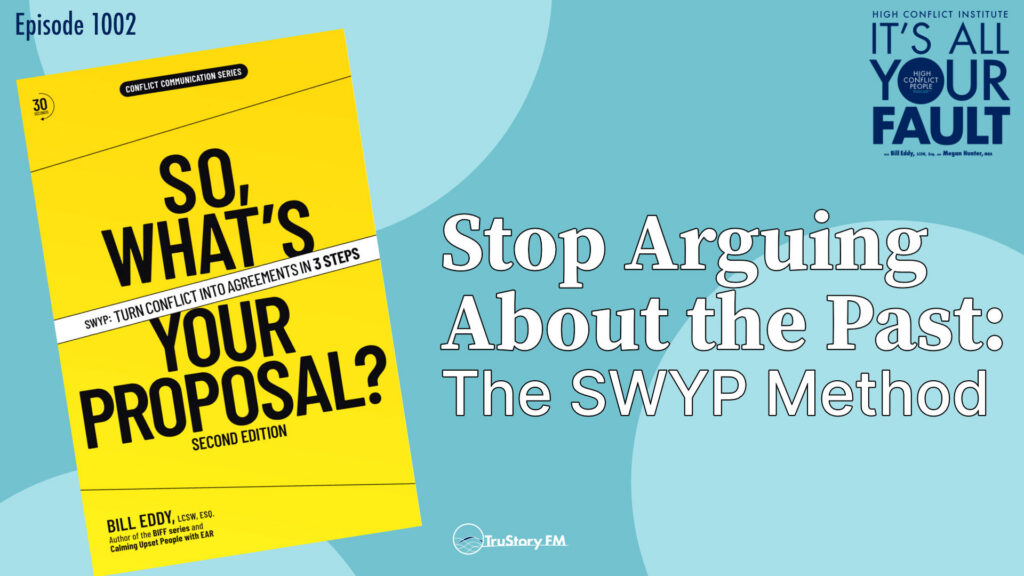
Right. Well, it’s a topic that received a lot of, a lot of press, a lot of conversation, and made many people think and probably argue quite a lot. But hopefully, listeners, this has been helpful for you. I know it’s been helpful for me, just to think of it in terms of protection. Gives us all something to think about. So thank you for listening today. Just so you know, Bill has a brand new book coming out in November, which is called So What’s Your Proposal? It’s the second edition of this book, and I think you’ll really enjoy it because it’s expanded so much on the original book, including the use of an acronym.
What is it, Bill?
Bill Eddy
It’s SWYP… S-W-Y-P, and guess what it stands for?
Megan Hunter
Hmm, so what’s your proposal?
Bill Eddy
So what’s your proposal?
Megan Hunter
Exactly.
Bill Eddy
And it’s, it’s reaching agreements…
Megan Hunter
Turning conflicts into agreements in three steps. I know, I was having a hard time with the subtitle, too. I was hoping you would remember it.
Bill Eddy
Right. We worked on that, but I like the one we ended up with. It’s just remembering what it was.
Megan Hunter
I know, I know. Subtitles are hard.
Bill Eddy
Yeah, but three simple steps, three simple steps.
Megan Hunter
You can order that now and it will ship in November. So we want you to order it now because pre-orders are where it’s at.
So, until next time, if you’re looking for training or consultation about a high conflict training or any kind of consultation for your organization, visit us at HighConflictInstitute.com. And if you have a high conflict situation in your personal life, visit us at ConflictInfluencer.com. Keep learning and practicing skills. Be kind to yourself and to others while we all try to keep the conflict small and find the missing peace.
It’s All Your Fault is a production of TruStory FM. Engineering by Andy Nelson. Music by Wolf Samuels, John Coggins, and Ziv Moran. Find the show, show notes, and transcripts at trustory.fm or HighConflictInstitute.com/podcast. If your podcast app allows ratings and reviews, please consider doing that for our show.