*This transcript is produced using transcription software and reviewed for quality. Despite our best efforts, some passages may be incomplete or contain errors due to audio quality or software limitations.*
Megan Hunter
Welcome to It’s All Your Fault on TruStory FM, the one and only podcast dedicated to helping you with the most challenging human interactions, those involving maybe someone with a high conflict personality. I’m Megan Hunter, and I’m here with my co-host, Bill Eddy.
Bill Eddy
Hi, everybody.
Megan Hunter
We are the co-founders of the High Conflict Institute and ConflictInfluencer.com, where we focus on training for professionals at High Conflict Institute, and educational programs and methods and classes for anyone — all to do with high conflict. Today we’re talking about reaching agreements, especially in high conflict situations, with something called SWYP, S-W-Y-P. What is often a really big, seemingly impossible mountain to climb — reaching agreements with someone with a high conflict personality — might become possible with SWYP.
So we’ll learn how as we discuss your new book, Bill — your book being released, the revised and updated edition of So, What’s Your Proposal?, otherwise known as SWYP. So welcome, listeners. Thank you for joining us during your dominoes game.
All right, so Bill, you wrote the first edition almost ten years ago, and I guess we can kind of start there — why did you write the original book, which was titled So, What’s Your Proposal?, shifting from blaming to problem-solving in thirty seconds or less?
Bill Eddy
Well, it was — I actually wrote it in 2015, and I think it was published in 2016, so it is ten years ago. It was in the thick of doing a lot of mediations and a lot of mediation training. The thing I had learned with high conflict people is that there are four things you just don’t do that make it worse, and one of the big ones is focusing on the past. You just get stuck — especially with high conflict people, they’ll never agree on the past. They’re also stuck in the past because they don’t grieve and heal loss the way most people do, so they’re constantly talking about the past, trying to rewrite history. The solution seemed to be focusing on the future, focusing on proposals, because proposals are about the future and nothing’s gone wrong yet, so people don’t have to be defensive about what they did last week or last year.
So I had learned, after many years of mediation, that with high conflict people — and it could be one or both parties in a dispute — you just focus on the future. Forget about the past; you’re not going to resolve the past. And it really developed into a three-step technique: one person makes a proposal, the other asks questions about it, and then says yes, no, or “let me think about it.” I’d been refining that method from about 2010 to 2015, and so it was time to write a book — and that was So, What’s Your Proposal?
Megan Hunter
So you mean you had a couple of weekends free to write a book? Our listeners probably don’t know how quickly you write books.
Bill Eddy
Yeah.
Megan Hunter
I mean, you kind of have them stored up in your head. I’m sure they take a long time to form, but you get them out pretty quickly.
Bill Eddy
Well, that’s the thing — I think about it for a year, and then maybe it’s two, three, or four weekends to write it, but I do think about it a lot. So it’s kind of downloading it; it’s the actual writing that goes pretty fast.
Megan Hunter
Yeah. This book has sold very well. We’ve used the So What’s Your Proposal technique in our trainings. We’ve trained thousands of people over these ten-plus years, as part of the mediation model you created, New Ways for Mediation™, but also just for any ordinary dispute. So one of the questions I’ve had from people is: can you use this — do you have to have two parties, or could you use this as a manager with an employee who has a complaint?
Bill Eddy
Yeah, and this is one thing I tell managers in training: when people come to you with a complaint, tell them to bring a proposal or two for solving it. Right at the start, you want to get people thinking in terms of proposals, in terms of solutions. So even one person could come to you as a manager and say, “This is a horrible schedule, you have to do something about it,” and as a manager, it’s not that hard to say, “Well, what do you propose? I’ll see if we can do something along those lines — we may need to discuss it, and I might not be able to do it, but what’s your proposal?”
There’s another part I didn’t say about this: that puts people, I think, into their left-brain problem-solving. The right brain — defensiveness, emotions, all of that — is often what takes over, and you’re not going to resolve that, especially with a high conflict person. So focus on the solution, on what to do. When people are focused on proposals, they’re thinking. They’re solving problems, and they’re less likely to be reacting and upset. So you switch people over from emotional reactions about the past to proposals for the future. It helps manage people by getting them to think about the future and think solution — really being solution-focused helps everybody.
Megan Hunter
So what percentage of people would you surmise really don’t know about using proposals, or how to have a very constructive agreement-making process? From my experience, most people — even very reasonable people — can get into arguments because they get a little reactive, they get heated, they want to defend their positions. I know I’m going all over the place a bit here, but we’ve talked about BIFF a lot on the podcast, and we talk about BIFF in our trainings, and BIFF is kind of everything to do with the High Conflict Institute. It’s such a nice little hack for emails and any written communication. I think SWYP is equally effective — if people knew this simple hack, just like BIFF is a hack. It’s not rocket science, but think if people could just use proposals in their marriages, or in their working relationships — I think it would just absolutely alleviate so much stress, so much friction. So do you think eighty percent of people enter into arguments instead of using a proposal-type process, or more?
I know that’s kind of a random question.
Bill Eddy
Yeah, I think it could actually be more — I think it’s all of us, that our instinct is to argue. Part of it, I think, is today’s culture. Over the last thirty or forty years, we’ve made emotions very important — “Well, how do you feel about this? How do you feel about that?” And how you feel takes people back into the past. It’s “How do you feel about what happened yesterday, last week, last month?” Couples certainly — I did a lot of couples therapy, the twelve years I was a therapist.
Couples are always rehashing: “I did this and you shouldn’t have done that. I was right, you were wrong.” We’ve wanted to value emotions because if you go back to the 1950s, emotions weren’t something we valued talking about, but starting in the 1960s and ’70s, with a lot of people using therapy, and certainly the internet, gets people to be emoting. People are all about comments on other people’s behavior and feelings. This really shifts you out of that culture and out of the instinct to defend yourself and fight, and instead focuses on problem-solving. So we always say it takes a while to learn these skills — like you mentioned, BIFF, brief, informative, friendly, and firm responses in writing. That takes a little bit.
Well, this also takes a little bit of practice. Recently I’ve been talking about developing a BIFF muscle — people need to write their own BIFF responses. If they have AI do that, they don’t develop a BIFF muscle. Same with proposals — you have to practice doing that, because the instinct to argue otherwise takes over. So I really think this part is all of us. High conflict people are more prone to staying stuck in the argument, but I think for most of us, the first instinct is to argue. Then the first person who says, “So, what’s your proposal?” —
suddenly, for most people, let’s say eighty percent of people, now you’re getting into problem-solving, and they can do that. The ten to twenty percent are the ones who really get stuck.
Megan Hunter
It’s quite shocking for people to be asked the question, “So, what’s your proposal?” rather than “Tell me your complaint.”
Bill Eddy
Right.
Megan Hunter
“What are your issues? Tell me what’s going on. How are you feeling?” It’s such a clever way to live life — a very much conflict-free way of living life. I think about — I was just recently in Australia, where I was informed that a new law has been passed that places quite a high responsibility on the employer for the employee’s psychosocial needs. That’s my word — I’m not sure what the actual words in the statute are — but it’s putting a lot more of this on the employer.
And I can imagine, as an employer trying to train managers or management teams, leadership teams: what am I going to do — do I have to take care of their feelings? I think it’s teaching SWYP, it’s teaching BIFF, it’s teaching SLIC, it’s teaching EAR — which we should talk about, what all four of those are. You’ve talked about BIFF already, which is for written communication — brief, informative, friendly, and firm — which you can use pretty much in any area of life, not just written communication. We have SLIC Solutions, which is what, Bill?
Bill Eddy
Setting Limits and Imposing Consequences — because often today, you set a limit and people ignore it unless they know there’s a consequence. “You keep talking to me this way, I’m going to hang up. I’m going to end the conversation.” “Oh, all right, well, I won’t talk this way.” That kind of thing. We’re less clear these days about what the rules are of ordinary behavior, so we need skills like these, and we like to make them into acronyms so they’re easy to remember. Fortunately, all of them kind of sound neat —
EAR, BIFF, SLIC, and SWYP are easy to remember because they sound like other words.
Megan Hunter
And they are simple. Once you start actually practicing these techniques — which are absolutely necessary when dealing with high conflict situations, disputes, personalities — it’s such a stress relief for you, and for the other person, for the other parties, because it’s exactly what you said: it’s helping people get into the whole brain. It shoves people right into that left, logical-thinking brain, and out of the defensive, resistant position that most of us, like you said, can be in often. So I think of a world where we’re doing SLIC, BIFF, EAR, and SWYP —
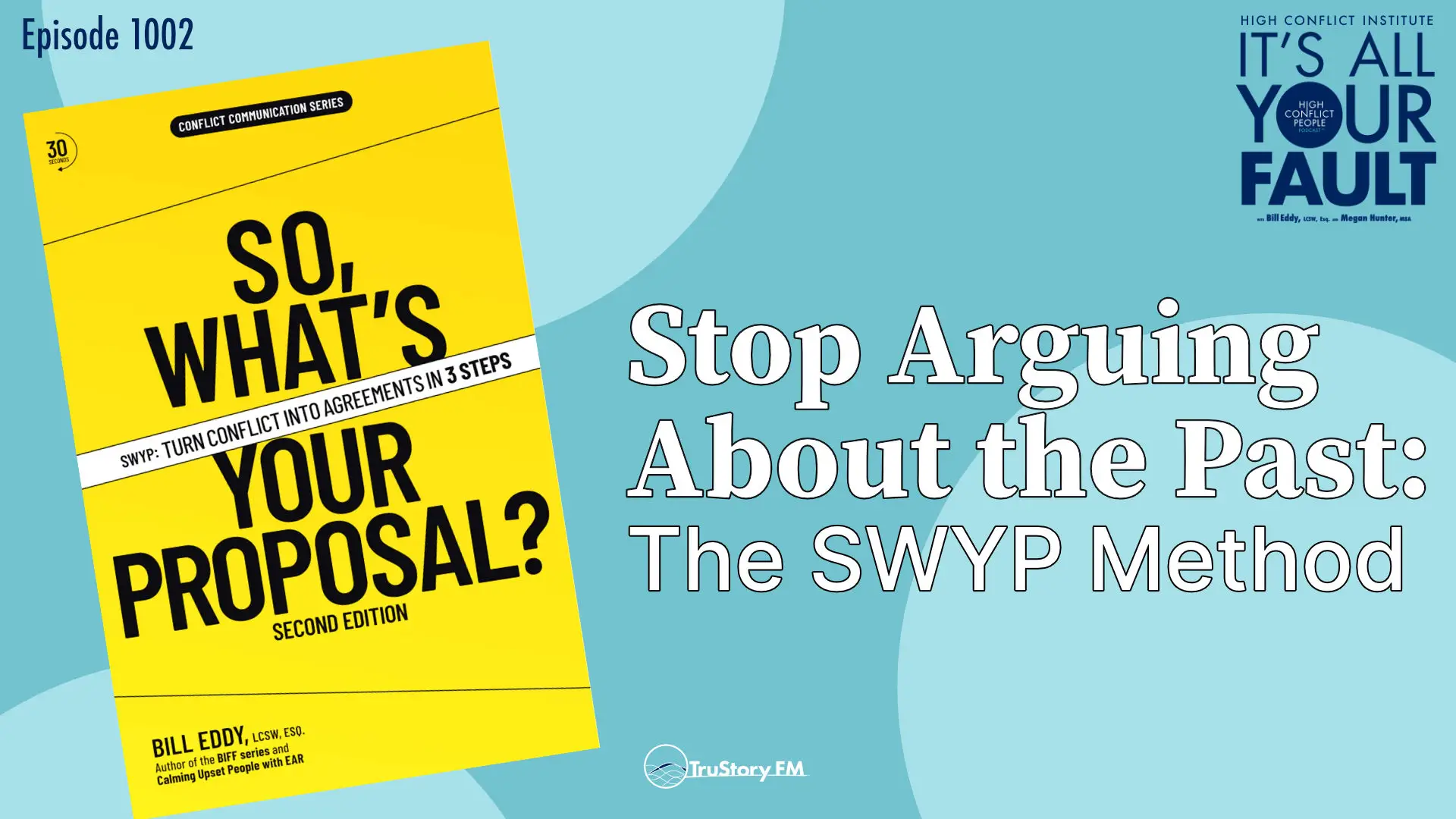
it makes life much, much easier. So, SWYP: let me share my screen quickly for those of you watching on YouTube — you can see what the book cover looks like. Kind of unusual. For those listening on the podcast, it’s a yellow background with black lettering, which is really unusual for books to be a really bright yellow — it’s a beautiful, lemon yellow. We’re pretty excited about it. This book is coming out in October, coming up soon here in 2026.
So let’s get back to the meat of SWYP. You’ve created the CARS Method, and the C of CARS is connecting with EAR statements — something that shows empathy, attention, or respect — and of course this is, again, frame-related. The analyzing part is where we fit SWYP in, right? So, what’s your proposal in helping people analyze their options? How do you see those two things connected together? How do they integrate?
Bill Eddy
Well, it really does fit with this brain idea — you give someone an EAR statement, some empathy, attention, and respect: “Wow, I can see how hard this is.” That’s attending to some of the right brain’s need for nurturance and emotion. But then you switch over to, “So, what’s your proposal? How could we solve this going forward?” That makes people think — they have to think of different options.
Let’s take an example. In divorce mediation, I’d often have someone say, “You never picked up the kids after school and took them to karate class on Wednesdays — I always ended up doing that.” And the other person says, “Yes, I did — I remember last month, and two months ago.” And I’d say, “Hey folks, what’s your proposal?” “Oh, my proposal is that he picks up the kids after school on Wednesday, takes them to karate, and then brings them to my house” — or keeps them overnight, or whatever it is. It shifts the whole mood from an argument and defensiveness to a business meeting — it’s planning. Simply saying, “What’s your proposal?” — or, “So, what’s your proposal?” — really just shifts the mood.
I’ve been in many, many meetings — in organizations you have staff meetings, board meetings, all kinds of meetings, and people get stuck arguing about the past. You just say, “Well, so what’s your proposal?” and the whole mood shifts. The person who’s complaining now has to think. Some people need more help with that than others, but the idea is to use your thinking brain — and even high conflict people have a thinking brain, I think that’s the left brain, but they have to be guided to go there. In mediations, I found this so effective, over and over.
As soon as they start calling names and slipping into the past, you say, “So, what’s your proposal?” and now we’re back on track. A lot of problems that feel hopeless and unsolvable can be managed by looking at what your proposal is, and when you do that, you look at different options for proposals. So that’s the first question.
Megan Hunter
I can think of some decision-making meetings I’ve been involved in and have used this technique in. I’ve found that when there’s high conflict involved in a decision-making meeting, especially with two parties, it can quickly run away from me — I think the reactivity, the defensiveness, just going right back to the past, comes up so quickly. So my question for you is, how do you avoid that? Can it be avoided — that runaway train where the argument just comes straight in? Someone goes back to the past: “You didn’t lock the door, and then you didn’t do this, and then you didn’t put me in the will, and it’s all your fault.” And now the other person is defensive, and the argument is in. So does it take a certain kind of person to set the stage early on, so this doesn’t happen?
Bill Eddy
Absolutely, that’s the key. Whether it’s a committee meeting, a mediation, or a conversation to solve a problem, someone has to say, “Let’s have some structure to this discussion — let’s focus on the future and what we can do, rather than on the past.” For example, when I start my mediations — with or without high conflict people — I ended up starting them all the same way, the last five years of mediating. I would just say, “We’re going to focus on the future, and if you start talking a lot about the past, I’m going to try to bring you back to the future.”
Megan Hunter
Yeah.
Bill Eddy
You can make a movie called that.
But — back to the future, because that’s where we can solve problems. “I can’t mediate the past,” is what I tell people, “I can only mediate the future” — help people discuss, make proposals, discuss them, and reach agreements. That does help, because people’s instinct, like I said, is to just start arguing when someone says, “Here’s a problem.” “Bill, you’re doing it wrong.” “No, I’m not doing it wrong.” It’s like, “Well, what’s your proposal?” “Oh, yeah, I could probably do that.” But I don’t have to admit wrongdoing to try a new approach. When people make proposals, it just shifts so much.
But you have to start the discussion, I think, by saying, “Let’s focus on the future, focus on proposals.” This goes against the history of mediation, because for the last forty years, mediation has been what they call interest-based mediation, where you explore each other’s interests: “What are you looking for? What are your concerns here?” The trouble is, especially with high conflict people, they can’t just objectively talk about their concerns — “My concern is that he needs to never do that again, and let me tell you what he did.” The interest-based approach has dominated the last forty years, and it’s brilliant, and it works well with eighty percent of people.
But with high conflict people, it just falls back into the argument, the past, the emotions. So if we start with, “What’s your proposal?” the high conflict person — or really anyone — is busy thinking, and it’s much more effective problem-solving. So you structure it from the start so that it’s going to be about the future and about proposals.
Megan Hunter
Yeah. Now I have done that, Bill, and sometimes it still runs away from me.
Bill Eddy
Yeah.
Megan Hunter
And you have a ton of experience doing this, and our listeners — yeah, you hear Bill’s very gentle, calm approach to life. This is how he is. He doesn’t have a fierce bone in his body. So you might think that just saying those words at the start of a mediation or a meeting, out of someone who isn’t fierce, will kind of land on deaf ears and things will really get away from them. So how is it that you manage to preempt an agreements meeting or a mediation with that type of language, and then get people to follow through with that and keep to your process, your structure?
Bill Eddy
You have to nip it in the bud, and you have to be fast. I’d say the biggest thing was practice. I ended up doing mediation for forty years, from 1979 to 2019 — actually I don’t really do mediation now, I teach it a lot, and I play in role-play exercises. But you have to nip it in the bud. That’s part of what I put into the SWYP book, the second edition — you’ve got to be fast to say, “Hang on, hang on,” when they start slipping into that stuff.
In worst-case scenarios — I think I did this three times out of a couple thousand cases — I couldn’t get them to stop arguing, so I stood up, slammed my hands down on the table, and screamed, “Stop!”
Megan Hunter
Interesting.
Bill Eddy
And I did it in a very neutral and balanced way.
Megan Hunter
Interesting.
Bill Eddy
But I yelled it, and they stopped. Beneath this meek, mild-mannered exterior is a little bit of an obsessive-compulsive guy who really keeps people on track. That’s what you have to do. A lot of mediators — I do mediation training — a lot of mediators are kind of like deer in the headlights when high conflict people start arguing. One or two of them just listen and think, “Okay, they’ll get this off their chest, then we can get back to business.” High conflict people never get it off their chest.
Megan Hunter
No, it’s a landline.
Bill Eddy
Yeah, so you have to interrupt them with an EAR statement: “Wow, I can see how important this is to you, to both of you. Now, how I can help you today is to focus on proposals.”
So, who’s got a proposal ready? And if you don’t, let’s take a break and think through what your proposals might be. It’s staying on top of it — it’s not just telling them once. At the end of a two-hour mediation, I may have redirected them twenty times, because they started slipping backwards. But I don’t let them get going with that. It’s like, “Hang on, hang on, we’re not going into the past here — we’re going to really focus on what to do.”
So let’s develop this proposal. That’s where the second step of the proposal process really comes in. The first person says who should do what, when, and where. The second person has to ask questions about it — logistical questions. Often high conflict people just react to it — anyone who’s upset may just say, “That’s a horrible proposal, I hate that,” instead of asking questions. Don’t respond to it yet — ask some questions. What would it look like? When would it start? Who would do the pickup? Who would do the drop-off? So that you have both people thinking. I call that the magic moment in mediation — when people start asking questions and getting answers. Now we’re doing problem-solving, now we have a business meeting. But unless you’re on top of it, it’ll slip away right there when they start saying, “That’s a terrible proposal, I can’t believe you ever said that.”
Megan Hunter
I’ve been very successful using this technique. The biggest barrier to success with it, I guess — one of them — is getting stuck in our own old habits and traps, like just letting people run with it: “Oh, they need to get this off their chest,” something like that. As you said, high conflict folks are not going to reach resolution that way. But it’s like you said — practice, practice, practice. And it takes some courage, and understanding SLIC also, setting limits — preempting the meeting with the instructions, saying how we’re going to do this differently, focusing on the future, and then having the courage to stick with that throughout, and not caring if anyone likes you or not.
Yes, it’s not about making friends, but it’s not about being mean, either. It’s being neutral and getting people through to resolution. We talk about this with mediation — it’s critical in mediation, but in business, in the workplace, it’s so very helpful. I think a lot of leaders and managers get into a place of problem-solving because we’re all at work to problem solve, and if we’re problem-solving for someone with a high conflict personality, we’re going to be problem-solving full time.
This SWYP technique shifts the problem-solving into a new kind of realm for you, because now you’re not trying to come up with some solution for this person who isn’t interested in your solutions even when they say they are — it flips this person out of complaining and into, “I have to think about something and come up with a solution myself.” In the workplace, people have been trained for years about being solutions-focused and problem-solving focused. It’s easy to say that and do that with eighty percent of people, but with maybe ten to twenty percent of people, it’s harder to remember to do that in those moments. But it’s so very useful. We can use it in the workplace, with our teenagers, with our toddlers, with friends — in a dispute anywhere.
It’s very simple to do. So instead of getting upset and running off at the mouth, you can say, “Okay, I see there’s an issue here — so, what’s your proposal for how to handle it?” It’s really brilliant. So now let’s talk for a moment on bullies — you’ve included a chapter in the book on negotiating with bullies. What did you find there?
Bill Eddy
Negotiating with bullies — first of all, you need to be really clear beforehand about how far you’re willing to go in negotiating with them, and when it’s time to stop, because bullies often push you past where you’re willing to go, and afterward you’re upset with yourself. A lot of people are like, “I can’t believe I gave in to that bully,” or, “The only thing I could do was give in — I gave him the store, so hopefully they’ll leave me alone now.” No — bullies want more. So you’ve got to be good at saying, “I can move in the direction you’re asking for, but I can only go this far. I can’t go further than this.” Part of it is really knowing what your bottom line is, and knowing what your best alternative to a negotiated agreement is — you might go to court.
I’ve had mediation cases where I’ve met separately with the parties and they’re still just stuck, and I’ll say, “This isn’t really a hard issue — a judge will resolve this issue in ten or fifteen minutes, so maybe you should just go to court.” I’m not going to help a bully bully the other person into agreeing just to avoid going to court. In most places today, really worldwide, there are a lot of standards, and in mediation, some people say, “Oh, I can get more just because I’m going to be a bully about it.” I’ll say, “I’m not going to be part of one person dominating the other person. I’m not going to help this couple get an agreement if it’s this way — you’re going to need someone looking out for a balanced approach involved, like a judge.”
So that’s one thing — know how far you’re willing to go, and what your alternatives are. A second thing is being matter-of-fact. Bullies like to get you emotionally upset, and the more you can be matter-of-fact about it, the less power they have over you, because their power is to get you flailing, to get you in tears, or to get you really angry — I call it helpless anger. When you’re dealing with a bully and you have helpless anger, you might be venting, but you’re not getting anywhere.
Megan Hunter
The bully themselves has helpless anger, or you?
Bill Eddy
No, you — the other person. Bullies are more skilled at using anger as a tool and intimidating people, and they know it, and they vent a lot. A lot of bullies feel like victims — they think they’re being taken advantage of, so they actually take advantage of other people to balance things out, which most people would see as being a bully. So you want to be emotionally matter-of-fact. Try not to do the anger thing with them, because they can do it much better than you can, and now you’re on their turf.
Megan Hunter
On that point — last week I was giving a training to HR professionals, and a woman approached me afterward and said, “I try to tell my team that HCPs are so good at this — they’re better at this than you ever will be, so you have to be prepared and you can’t take the bait.” So, yeah, you’re on their turf.
Bill Eddy
Yeah.
Megan Hunter
So they have a lot of practice, and you don’t have a lot of practice with these types of skills.
Bill Eddy
And that’s a good thing.
Megan Hunter
Yeah.
Bill Eddy
That’s a good thing. You don’t want to be someone that’s always arguing with bullies.
Megan Hunter
Right, right. So it really implies you need a lot of practice using SWYP, BIFF, and EAR. So, when you are on their turf, [inaudible], because they are so experienced and skilled — this is who they are. This is their operating system.
Bill Eddy
Yeah.
Megan Hunter
So we have to have those.
Bill Eddy
And you’re not helping bullies by giving in to them, either, because the next time, they’re going to expect even more. I’ve had many people say, “I’ll just give them everything they want, and then they’ll stop bothering me,” and I tell them, no, they won’t — they’ll ask for more. So you’ve got to be reluctant to make agreements once you’re getting near your bottom line. You’re thinking, “Maybe I’m not going to go further” — be aware of that, and say, “I can move on this issue, but I can’t move that far. I can only move this far.” Matter-of-fact, but make it clear.
I know, when I do mediations and there are lawyers involved, lawyers want to lean on their clients to get to an agreement, so you need to work closely with your lawyer beforehand so it doesn’t look like they’re going to lean on you to accept something you don’t accept. There are a lot of nuances to it, but the basics are: know how far you’re willing to go before you walk into negotiations, be emotionally matter-of-fact, don’t let yourself get really upset, and be willing to give on some issues. When you make your initial proposals, ask for more than you can live with — it often helps to ask for what you want, but know what you need. You can say, “Okay, I’ve heard what you had to say, and I’m willing to make a concession on this issue, but I can only go that far.”
So have something — bullies like to know there’s something you gave them because you heard them, that they’re feeling heard. Bullies don’t feel heard. Like I said, a lot of them feel like victims, but it’s their own cognitive distortions.
Megan Hunter
Counterintuitive.
Bill Eddy
Yeah, yeah. The worst bullies think they’re being bullied, and that’s what drives them. They say, “I have to show you,” and it’s like, no, you don’t — you’re at the advantage here.
“I’m actually your victim here, so don’t feel like you have to run me into the ground because I did that to you — I didn’t. You just feel that way because of how you grew up, because of your genetic tendencies, the culture you lived in. It doesn’t mean I really bullied you.” But bullies often feel like they were bullied, and now they have the right to bully other people — but no one has the right to bully other people.
Megan Hunter
Good point, and a good place to ask — do you have anything else to say about SWYP, your new book?
Bill Eddy
Just a couple quick things. One is — it’s three steps, and that’s on the cover. One person makes the proposal, the nuts and bolts of a proposal: who would do what, when, and where. The second person asks logistical questions about it — the questions get the other person thinking, and they’re never “why” questions. “Why” is a criticism in disguise. So you ask logistical questions, and both people start thinking — once that starts happening, that’s the magic moment. The third step is saying yes, I agree; no, I don’t agree; or let me think about it.
And if they say, “Let me think about it,” how much time — five minutes, five days, do you need to make a phone call, whatever that is? That’s all you need to say — you don’t need to explain why you’re saying no. Instead, you make a new proposal. That keeps it very structured, and frankly, it’s almost fun — everybody has fun once you keep shifting between the proposal, the questions, and the response. Sometimes we’ve ended up laughing in mediation sessions, because we know it’s so easy to get into the argument, but when you actually follow this structure, you can reach agreements, sometimes very quickly. People say, “Thanks for keeping us from getting stuck.” I had one couple say, “Thanks for keeping us from acting like three-year-olds.” That was a couple in their late sixties or early seventies — one was a doctor, and the other was a professional administrator, so these are people you don’t think of as arguing like three-year-olds, but at times they were. I redirected them to the future, and they caught on and felt good about it.
The very last thing I want to say is that SWYP can become a verb, a noun, an adjective. I’m remembering a conversation when I started working on this second edition — you and I had a conversation, I had a suggestion for something, and you said, “Well, SWYP me with that.” When I got back, I wrote something up and sent it to you as a proposal. So now it can be a verb — SWYP me, and send me a SWYP. Hopefully that’ll get into the vocabulary at some point, and that’ll help us think in terms of, “So, what’s your proposal?”
Megan Hunter
Yeah, I mean, look — it worked for Tinder: swipe left, swipe right, swipe right now. I’ve never been on Tinder, so I don’t know if it really works that way, but I’ve heard it, that’s what it is. So this is not that kind of swipe, but this is a very productive, productive swipe for humans in relationships.
So, thank you, Bill. We do have a favor to ask you, our listeners: if you’re considering purchasing this book, we’d love it if you would pre-order it now, and here’s why. Most books have their highest sales before the publication date. What that does is signal — even though you don’t get the book in advance, you’re ordering it in advance — it signals to retailers like Amazon, Barnes & Noble, and universities and libraries all around the world about what books are going to have some popularity, and then they place more orders, bigger orders, for their warehouses and their organizations. So we’d love it if you do that. We’re going to put the link to Amazon — that’s probably the best place to get it right now as a pre-order. Don’t buy it on our website yet, because those numbers don’t count in the big system. We’ll put that in the show notes.
I’m also going to put the link to your book about bullies, Bill — Our New World of Adult Bullies — because we did talk about that a bit. We’re just thrilled about this book.
Thank you for listening today, thank you for joining us. Until next time — if you’re looking for training or a consultation for your organization, especially about high conflict, because that’s what we do, visit us at HighConflictInstitute.com. If you have a high conflict situation in your personal life, need some skills there, or just want to build some relationship and conflict communication skills, visit us at ConflictInfluencer.com. Keep learning and practicing skills.
Be good to yourself and to others while we all try to keep the conflict small and find the missing peace.
It’s All Your Fault is a production of TruStory FM. Engineering by Andy Nelson. Music by Wolf Samuels, John Coggins, and Ziv Moran. Find the show, show notes, and transcripts at TruStory.fm or HighConflictInstitute.com/podcast. If your podcast app allows ratings and reviews, please consider doing that for our show.