*This transcript is produced using transcription software and reviewed for quality. Despite our best efforts, some passages may be incomplete or contain errors due to audio quality or software limitations.*
Andy Nelson:
Welcome to Movies We Like, part of the Next Reel family of shows on TruStory FM. I’m Andy Nelson, and that over there is Pete Wright.
Pete Wright:
Confirmed, it’s Pete Wright.
Andy Nelson:
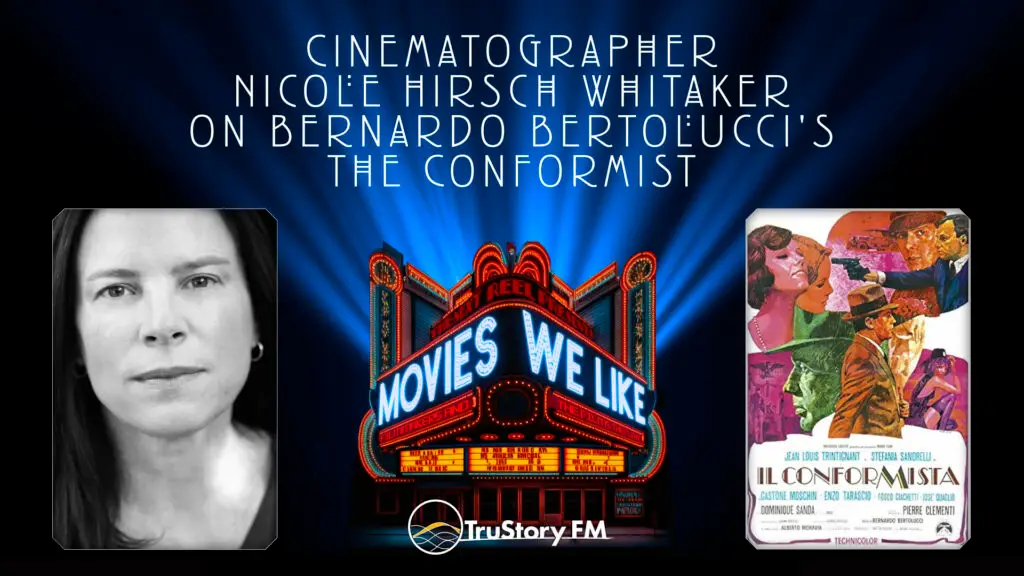
On today’s episode, we have invited cinematographer Nicole Hirsch Whitaker to talk about The Conformist, a movie she likes. Nicole is an ASC cinematographer whose recent credits span the first two episodes of Netflix’s record-breaking One Piece and the feature film Dust Bunny, which earned her a Best Cinematography nomination at the Film Independent Spirit Awards. Nicole, welcome to the show.
Nicole Hirsch Whitaker:
Thank you.
Andy Nelson:
We are thrilled to have you to talk about all the multitudes of amazing projects you’ve been a part of. Before we do, let’s start with just getting a sense of you and your background, how you got where you are as a film lover, as an image maker. You started in still photography, is that right?
Nicole Hirsch Whitaker:
Yeah. When I was in high school, I was lucky enough to go to a great creative high school where they taught photography and video art and all kinds of really fun, quirky, creative subjects, including also my English teacher would have us read a book and then we’d watch a movie. We would read Moby Dick and then he’d show us The Conformist, and then we’d read Lord Jim and he’d show us an Antonioni movie. He was this incredible film buff who decided to incorporate film into his English and literature class. So as I was studying still photography, I also got this sort of crash course on European films, which I’d never seen before.
Andy Nelson:
Yeah.
Pete Wright:
Did you know as a still photographer that at some point you were going to be drawn into videography? How did transitioning to motion pictures work for you?
Nicole Hirsch Whitaker:
I think because I hadn’t seen films like the films that he was showing us when I was in tenth grade — I think it’s also just an ignorance in terms of American filmmakers, that you think of them as not being as cinematic as European filmmakers, unless you saw The Godfather or Apocalypse Now. The films that I grew up on were very much popcorn movies, so I didn’t really know that in my country there were filmmakers out there making the kind of films they were making overseas. So I stuck with still photography for a long time, thinking that was more of an art medium that I wanted to go into, because of the way I like to frame and I liked shooting in black and white. I didn’t really see much of a transition into filmmaking as a black and white cinematographer. But I loved film. When I applied to college, I applied to Tisch. I ended up going to film school, almost switched back to the photography department just because I didn’t really know how to tell stories and so my films were kind of boring. They were pretty, but they were boring. As my Russian film teachers told me, very boring. I was like, well, maybe I’ll just be a commercial cinematographer, which is what I ended up doing for fifteen years and dabbling in narrative. Then realizing what I loved about film was telling stories. So I kind of did maybe a little bit of an opposite career track to most people. I did a backpedal back into narrative storytelling and basically don’t do commercials much at all anymore. I tried to just find my way. It took a while, but eventually I feel like I’m now doing what I should be doing.
Andy Nelson:
That’s fantastic.
Pete Wright:
Hey, don’t sleep on those Nespresso campaigns. Those will pay the bills, am I right?
Nicole Hirsch Whitaker:
I gotta tell you, I definitely made more money when I was shooting commercials. That’s for sure.
Andy Nelson:
Yeah.
Nicole Hirsch Whitaker:
I didn’t have to work the crazy hours I work now, which is the problem — I should have done that when I was younger and stopped when I got older.
Andy Nelson:
Right.
Pete Wright:
Yeah.
Nicole Hirsch Whitaker:
So that’s what I’m saying. I had a reverse osmosis in terms of — I definitely made the wrong decision.
Andy Nelson:
You also spent time working in documentary, and that’s another interesting fold in the different directions you were pushing — projects like Girl Rising and Montage of Heck. The tonal differences you were using and exploring in all these different things, shifting between commercials, which have a very specific look, and then documentaries, which have their specific look, and then going into narratives. What’s your process in shifting from mode to mode?
Nicole Hirsch Whitaker:
Well, I never shot like a traditional documentary where you just get a camera and throw it on your shoulder. Girl Rising was scripted and Montage of Heck was scripted. So we created a look for them, and it’s a little different than traditional documentaries. I get called sometimes for documentaries and I’m like, I am so the wrong person. I’m not one of those people who sees something happening and spins the camera around, because I’ll be like, “No, the light’s not nice, so we’re gonna spin back this way,” and they’ll be like, “But you missed them just then.” I always tell people when they call me for documentaries, unless it’s controlled, I’m really not the right person for it. But still, even with Girl Rising, we packed up cameras and hiked into the middle of nowhere in Ethiopia and spent many days with the script trying to find the most beautiful shots. There was no dialogue, so for me, coming from still photography, I was creating these beautiful still images with some movement — very little camera movement. We did Ethiopia, Haiti, and Egypt. So again, I took some of what I learned in every single type of filmmaking to bring it into what I’m doing now, which is definitely more structured, scripted work.
Andy Nelson:
I will say I was talking to my son about who I was going to be talking to today, and I was rattling off the different projects, and when One Piece came up, that was the one where he just said, “Oh my God, so cool.” He was so excited that I was going to be talking to you because of your work on One Piece. What is the process of going from a massive manga and anime — so much work that’s already out there — and building that visual world so that it’s still honoring everything that had come before it while also working as a live-action project?
Nicole Hirsch Whitaker:
That was a lot of pressure on that project, for sure. The first reason is because my kids were huge fans.
Andy Nelson:
Okay, it’s the kids.
Nicole Hirsch Whitaker:
It’s the kids. My older son has a tattoo from the show on his chest.
Andy Nelson:
Nice, nice.
Nicole Hirsch Whitaker:
Big fan. So I had worked with Marc Jobst, who is a director — I’d done another superhero show called Jupiter’s Legacy with him, and then Netflix brought One Piece to him and asked him to develop it. He called me while I was working on Bad Sisters, which is obviously a totally different kind of show, and asked me if I could leave the show early to come do One Piece with him in Africa. I said I can’t say no because my children will never speak to me again, first of all. And it was a little scary because I felt like every IP before that in that genre had not really been accepted by the fans — not necessarily that they weren’t good, it just didn’t resonate with them as being something that felt as good as or better than the anime or the manga. So we talked about it a lot, and Marc was very adamant and had a strong opinion, with the showrunners and the producers, about keeping it really grounded so that at the core of the project it wasn’t about the visuals being the most incredible part — it was about the story of the Straw Hats. We talked about how to come up with a visual style that would honor it. We did a ton of R&D. We prepped in Africa for four months. Prior to that, we prepped for about six months coming up with the look of the show. We built lenses for the show from scratch.
Andy Nelson:
Wow.
Nicole Hirsch Whitaker:
So that we could have an anamorphic feeling, but we still needed close focus and deep focus. So Hawk built us a hybrid lens. We also wanted large format. So we got to develop lenses, and then we developed a LUT based on a photographer that we both loved and just rolled from there. But at the end of the day it was really about, obviously, lots of visual effects, lots of stunts, lots of special effects. We tried to do as much in camera as we could. It was definitely the most fun project in terms of being involved in developing something that had never been done before.
Pete Wright:
It’s an extraordinary piece. I can’t think of a higher compliment I can give you other than my wife also loves it.
Nicole Hirsch Whitaker:
Oh, that’s—
Pete Wright:
Right? That’s something big. She usually comes to the stuff I watch with a real brush-off kind of attitude. She sat down with me for One Piece and just had a blast. It feels so extraordinarily practical. And first of all, how do you tell Sharon Horgan you’re leaving early after working on two shows back to back with her? Does she hold grudges? Do you ever work with her again?
Nicole Hirsch Whitaker:
[laughter]
Pete Wright:
We’re in love with Shining Vale and Bad Sisters. Absolutely extraordinary. But then going from One Piece to how you land in Dust Bunny — these properties have visual style to burn, Nicole. These are unbelievable worlds that you create. There are so few cinematographers, to my eye, working at this level of visual exuberance. I feel like I could spend the next hour just showering praise on the somatic experience I get watching this stuff. It’s incredible. Where does that come from? One Piece — I’ll jump to Dust Bunny — being able to capture… Andy and I were talking about how it feels so much like a Jean-Pierre Jeunet film. I imagine we’re actually looking at a very young Amelie, except there’s the mob and monsters.
Andy Nelson:
You’re right.
Pete Wright:
It has that exact vibe. And I’m just curious what goes into capturing that tone that is so foreign and so familiar for those of us in the audience.
Nicole Hirsch Whitaker:
Thank you so much. Cinematography is so important to me, but at the end of the day the most important thing is the story — capturing the right way to tell a story through the photography. That’s why it’s so fun to jump around and do something like Bad Sisters, which is more grounded. But it really comes down to the director, and letting me have fun and wanting to take that journey. All three of those directors — we had lots of conversations about what films we liked and what we wanted the end product to be. One Piece obviously had a lot of visuals from the anime. Dust Bunny — Bryan Fuller created Hannibal and American Gods, so he’s just this crazy visual person. He had done concept drawings for Dust Bunny and we immediately talked about Amelie and City of Lost Children and Spielberg and all these filmmakers we loved. But it takes that person to jump on board with it, because none of them were safe. Even Bad Sisters — I got some complaints at first that it was too dark.
Pete Wright:
I don’t think it was the cinematography that made that show dark, principally.
Nicole Hirsch Whitaker:
Well, yes. And it’s funny because the first things we shot were the funeral scenes. I was like, well, yeah, it’s not light and bright and cheery. It was a funeral, but it was still funny.
Pete Wright:
Right.
Nicole Hirsch Whitaker:
Sharon and I joked about that a lot because she was just like, “You’re taking me out of my comfort zone.” But yeah, for me it’s — I just want people to have fun when they’re watching what I do. I think part of that whimsy in the camera and the lighting comes from — I’m just a kid at heart and I want people to go to the movies or turn on the television and just be like, “This is something I’ve never seen before. This is so much fun.” It’s one of the reasons I don’t work probably as much as I used to, because I have a hard time finding those projects and those people. I wish it was like the old days where you had a director and that was the only person you worked with, so you really were able to create that visual language together and just grow together and get better and better. One of the things that’s hard about television is when you have multiple directors or you’re jumping onto something or there are a lot of voices, it’s harder to do that. But all three of those projects — two were television, one was a film — had directors that were very supportive. That’s kind of where that comes from.
Andy Nelson:
Well, it has an amazing look and I love everything about Dust Bunny. One thing I’m really curious about — a lot of this comes from Bryan Fuller, but I think a lot of it is decisions that the two of you are making as far as trying to figure out how you’re going to capture this look. The fact that you went so widescreen — three to one as far as an aspect ratio, which I hadn’t heard of before. I was looking at it on the screen trying to figure out, is this cropped right? And it was such a fascinating thing to look at, because the idea of the floor being such a key part of the story — not wanting to touch the floor, that floor-is-lava mentality — it made for such an interesting visual element. What were the conversations about creating this world with that specific aspect ratio?
Nicole Hirsch Whitaker:
When Bryan and I were in LA, we went to ARRI to test lenses. I tried to keep it simple. I brought out three different lenses for him to look at. The lenses we ended up using were the ARRI Alphas. I had shown him some images from Batman that Greig Fraser had shot. He loved it. One of the things about these lenses is they’re very detuned, so we’re going to have to be center-punched most of the time, or get a slightly less detuned version of them. But he just fell in love with them. Then as they were changing the crop — I said we can either shoot widescreen or we can shoot two to one — he asked, “Well, what happens when you don’t have the crop on at all?” And I was like, “Well, nobody does that. Two-two-four is pretty much industry standard. You can go VistaVision or two-seven-seven, but that’s usually if you’re shooting film.” And he said, “Well, let’s just not crop it. Look at all that beautiful fall-off that you lose from the lenses.” And I said, “Great. That’s so fun.” But then I said, “The studio is gonna freak out, especially when it goes to streaming.” And he was like, “Let’s just try.” I was like, I love this. I suddenly have the crazy captain that I love.
Pete Wright:
Yeah.
Nicole Hirsch Whitaker:
So we chose the lenses. One of the techs from Berlin came down and ARRI was great — they gave us two sets. One set was super detuned, with major fall-off, so even if it got cropped to 2:40 we’d still have some of that quality. The other set was less detuned, where you could still hold two people inside the 2:40, just never on the sides. I had this incredible focus puller, Chris Summers, who literally knew that if Sigourney moved like this she’d be out of focus. He mapped out the lenses and knew exactly when someone would go soft.
Andy Nelson:
Wow.
Nicole Hirsch Whitaker:
He was so instrumental in helping me figure all of that out. So anyway, long story short, we went to Thunder Road, our studio, and asked if we could shoot three to one. They went back and talked about it and said yes. We protected for 2:40 for streaming, but they’re showing it in three to one.
Andy Nelson:
Awesome.
Pete Wright:
It is so cool. There are shots that just jump out. Mads Mikkelsen is on the ceiling and the camera tilts down and turns sideways as the gunman comes through the door, and my mind just fell right out of my face. It was such a cool shot. Second shot: she’s in the bed, the camera pulls out, and it’s just bed springs all around.
Andy Nelson:
The whole thing.
Pete Wright:
The whole thing is bed springs. It is extraordinary, the effect this has on the visual experience of this movie. I also watched it in my Vision Pro as big as I could possibly get it, and it was extraordinary.
Nicole Hirsch Whitaker:
It definitely changed the way we boarded the movie. I was so lucky on all of these projects because we had almost three months to prep in Budapest. Bryan, the production designer, the costume designer, visual effects — we all started together. I’m used to arriving with sets already designed and things already decided. But we literally brought in viewfinders and framed up to make the windows the right size, to make the hallway the right size, so that everything would fit into the aspect ratio. Things were actually even designed around how we were shooting, which is a real luxury these days. Bryan wouldn’t settle. If he didn’t like a wallpaper that was printed in Denmark, he’d send it back. Every costume was designed to match the set. Bryan would see things in the corner of the frame that even I would look at and say, “What are you looking at?” He’d go over there and say, “I don’t like that color.” So he and I were just peas in a pod — we literally just linked arms and we were like, we’re just crazy, nutty filmmakers and we’re just going to have a great time.
Andy Nelson:
I love it. And it’s like throughout the entire film, whether it’s the costumes blending together with the production design, which blends together with all the camera design and the way that you’re lighting things — there are a number of times where you have very specific lights over people’s heads, the shot is perfectly symmetrical. Thinking about how all of that came together, including these lights that are over people’s heads or the windows that are framing them perfectly paired with their costumes — it’s just magical watching all of that. And in a story that is in some sense a children’s fantasy, in some sense a fairly violent film, it all kind of comes together and fits in this other world that you’ve created. Kudos to the entire team for capturing something that really brings a lot of magic to this world.
Nicole Hirsch Whitaker:
Yeah, and then it’s getting everybody on board. The production designer was designing lights that we knew were going to be used for that purpose, and there was this theme of circles — all the windows were circles. You felt kind of like you were in a strange boat, or in this world where… when we got to her bedroom, the window was a lot smaller. Bryan and I turned to Jeremy and said we want the window to be bigger. And Jeremy just took out his tape measure and literally cut out another piece of the wall and made the window bigger. Then we came back and said, “Could it be a little bigger?” We just kept chiseling away, trying to push everything a little too far. So it made you feel a little uncomfortable, and it also felt more like it was in her head. Like when you’re a kid and you see everything as being bigger than it really is — in reality, her window would have been a normal window, but when you’re little, things seem magical. That was one of the things we liked about Jeunet-Caro and some other filmmakers. Bryan is very heavily influenced by Spielberg — that whole sense of how do you see the world through a kid’s eyes. We really tapped into that and tried to never settle on something being normal, whether camera, lighting, whatever we could do, which is really fun.
Pete Wright:
We’re talking about Dust Bunny, it’s so great, but I just have a question about your worldview when it comes to shooting for the smaller screen — particularly projects like One Piece, Bad Sisters, Truth be Told. What goes on in your head when you realize you’re responsible for setting the tone of what could be a very long-running series and your name is on season one, episode one?
Nicole Hirsch Whitaker:
I don’t think I approach it any differently than I would for a film because I look at it as a little mini movie — most of the time I’m only doing one block, maybe a couple episodes. I just think about what’s right for the story. I always find it amazing how even if there are twelve directors and seven DPs, these TV shows still feel like there’s a thread running through them. I’m just really happy that I’m not pigeonholed as one type of cinematographer — people actually come to me for different types of looks, which is fun. I know some people who say they only get called for horror or only for comedy. I’ve tried to keep it diverse enough that I can wiggle into any genre out there.
Pete Wright:
Well, it doesn’t hurt to have Sharon Horgan’s work with Bad Sisters and then Taylor Sheridan. Talk about somebody with a firm hand on a look and an aesthetic.
Nicole Hirsch Whitaker:
Yeah, I just finished season three.
Pete Wright:
Excellent.
Andy Nelson:
Wow, nice.
Nicole Hirsch Whitaker:
That’s going to be fun. This season looks very different than the first season. I get to jump in helicopters and be super macho DP, which is so much fun.
Pete Wright:
That’s so awesome.
Andy Nelson:
Nice.
Pete Wright:
Those will be great for your BTS shots on your IMDb page.
Andy Nelson:
Exactly right.
Nicole Hirsch Whitaker:
I can’t put them up yet, but I have some great ones. My director this year is DJ Caruso, who’s an amazing feature director. He’s actually in Wales right now doing a movie with Anthony Hopkins and Catherine Zeta-Jones. He and I took so many pictures because we were just like, nobody shoots in helicopters anymore with real Wescams, flying around with helicopters dipping down. We were like little kids, giggling and laughing and not wanting to get out of the helicopter. So yes, at some point I’ll be able to put some of those on there.
Pete Wright:
That’s so good.
Nicole Hirsch Whitaker:
Yeah.
Pete Wright:
So good.
Andy Nelson:
Oh, that’s fantastic. I love it. Well, let’s shift gears and start talking about The Conformist. This is the movie that you picked for the show. I’m fascinated by it, especially knowing that — I’m assuming — the first time you saw this was in your English class in high school. How did you kind of step into this film and find a love for it? Because it’s a film that requires some homework as far as understanding what’s going on in the story. Bertolucci gives you this movie and you kind of have to understand what’s happening in history to appreciate the film. How did you first step into this film and find that it was something you were drawn to?
Nicole Hirsch Whitaker:
I have a memory — you know, like people say they remember the first time they walked, their first steps. I remember sitting in that class, and there’s a scene where they’re driving down this line of trees and the leaves are blowing and the windshield wiper is wiping. I just remember something physically in my body changed, where I was like, I want to do that. I want to be able to create images like that.
Andy Nelson:
Wow.
Nicole Hirsch Whitaker:
It was so beautiful. It was like the perfect light on her in the car. Just the most stunning scene, and it stuck with me when I went to film school. And obviously Storaro is just a huge influence for me — Storaro and Bertolucci both. Some people ask, who’s your favorite celebrity? I’m like, Storaro. And they’re like, who’s that? I’m like, oh — you meant an actor. I was at a film festival once and everybody was running over to try to talk to some celebrity, and I was running after Storaro.
Andy Nelson:
That’s awesome.
Nicole Hirsch Whitaker:
We watched a lot of Italian films, a lot of German films. I was just so blown away by the use of color and then the film noir lighting and everything. It’s kind of like a textbook in filmmaking, because it has so many genres packed into one film. And like you said, it’s not exactly a perfect story — it’s a little confusing and a little out there. But at the end of the day, when you think about the actual through line, it’s a very simple story. It’s just Bertolucci made it complicated. It is a thriller, a psychological thriller. And I can get into all the films that I felt were influenced by it over the years as I started watching more films — in film school and then in Europe — and seeing how those influences crossed over and how revolutionary what they did really was.
Andy Nelson:
I think it’s really interesting because the film takes place at a very particular point in time in Italy, and I think pairing with the visuals, it’s the fact that they went to these brutalist-style locations, these real locations, to actually film in these places. I can’t help but, in my mind, pair the visuals of the fantastic cinematography with the spaces they film in. When he walks into somebody’s office and there’s a person sitting at a desk on the far side of this giant room — it felt very much like the kind of brutalist, fascist styling they were living in at that time. Filming in these real spaces to enhance the visual storytelling, I think that’s one of the things that made Storaro’s shots stand out so much and made the story so stunning to watch, because they were filming in spaces that were such a key part of this point in history.
Nicole Hirsch Whitaker:
Yeah, and I think that’s one of the things I took away from it as well, because most of my still photography was like finding bridges or different environments. I always had a model — I didn’t just take pictures of architecture, but I liked to use the architecture and then put people in it. When I saw that film, I was like, oh my gosh, he’s actually taking what I love about photography and putting it into film, which I hadn’t seen before. Over these decades I’ve been shooting, I’ve always kept that in the back of my mind — the symmetry, the wide shots. I will go as wide as possible, especially for television, until they’re like, “Wait a minute, don’t forget people are watching it on their phones.” And I’m like, “Oh, okay.”
Pete Wright:
That sounds like a them problem.
Nicole Hirsch Whitaker:
Maybe, yeah. A thumb problem. Except when I see my kids watching my shows on their phones.
Andy Nelson:
Yeah.
Nicole Hirsch Whitaker:
But then when you go shoot a movie, and if it’s too close, people are like, “Please get wider when you’re in a theater.” I think about that all the time — the way that people learned to be cinematographers and how to shoot has had to change because you have to imagine… you couldn’t shoot a film all in wide shots anymore because when it goes to stream, you’re not getting close enough to your characters. I think about that all the time when I’m shooting and when I’m watching things now.
Pete Wright:
That is such an interesting observation. I just caught Marty Supreme and it was that same experience. That movie is uncomfortably close for many of the character shots. I know that’s a Safdie staple, a thing they want to create. And yet I find it deeply disconcerting — not enough variety. Like an oppressive sort, especially when you watch it on a smaller screen for streaming. It becomes uncomfortable, unsettling.
Nicole Hirsch Whitaker:
I was just having this conversation about a project I might be doing, and we were talking about driving footage. There’s very little time to do practical driving footage anymore. When you’re seeing a lot of car work now, it’s because it’s on stage or on a volume. It’s just close-ups. You’re losing that scope that we used to get when everyone had to shoot driving practically. Or you can have a lot of fun and go back and watch Dr. No and the car is ten feet too close behind him in the rear projection and it’s hilarious — they’re reacting to something that’s not even behind them.
Pete Wright:
Yeah.
Nicole Hirsch Whitaker:
It’s like there’s all these different kinds of driving moments. It’s something I think people just forgot about a little bit — getting that breath, pulling back so you can see more scope. You don’t always have to cut in. In television we’re always battling that, especially with guest directors who are nervous about not doing the coverage. Taylor Sheridan actually just told the director on one of our last episodes, “You don’t need to cut in so close all the time. I like those wide shots. I wanna see the sunsets and I wanna see the helicopters in wide shots. Why would you cut into a close-up in the helicopter when there’s a beautiful sunset?” It’s so true because it is more cinematic.
Andy Nelson:
Yeah.
Pete Wright:
Watch any Taylor Sheridan show and you’ll see exactly that worldview.
Nicole Hirsch Whitaker:
Yes.
Andy Nelson:
But it is a really interesting point, because it made me think of — I think it was Matt Damon who was just talking about the experience that he and Ben Affleck had when they were making The Rip and how they were being told by Netflix that they need to repeat the plot more, because people are getting distracted. There are so many things people are paying attention to on their phones these days that they need those reminders of what the story is. They were kind of forced to build those elements into the plot. I think that also speaks to camera and all the different things you now have to think about, which Storaro didn’t have to think about when he was shooting The Conformist because they were shooting for a movie theater — the one place people would watch it. They were focusing on the theatrical image. And now you’ve got to think about the theatrical image, the phone image, the streaming image, and all the different things people are paying attention to.
Nicole Hirsch Whitaker:
Yeah. And think about it too — how dark some of those films were, but they were in a theater with the lights off. If you’re watching something at home with even just a little bit of ambient light, it’s going to look too dark. A lot of people are watching on planes, on trains, in their kitchen. If you go too dark they’re not going to be able to see anything. For television I used to love to shoot things very dark, but I tend not to go quite as dark as I used to when I was a little bit younger, just because of how people are watching things. My husband and I watch in a closet because that’s how we want to see it, but otherwise unless you’re in the theater, you’re never going to see it the way it was intended. A film like The Conformist — there are inky blacks, it’s very contrasty, and I don’t think that film would have translated to streaming as well. Something about going back to see those films. We’re so lucky in Los Angeles — we have the Cinematheque, and we can go see film prints. We’ve got the Vista and all these amazing theaters showing things on film. But then sometimes even at the Vista there are films shot digitally and they don’t do the expensive film prints and they look terrible. All these different formats — it’s a lot to juggle.
Andy Nelson:
Yeah. And then you have filmmakers shooting in multiple formats because they want the IMAX experience, but they’re also making sure they can crop it down to all the different sizes.
Nicole Hirsch Whitaker:
Yeah. And I think it takes away a little bit, but—
Andy Nelson:
The structure of The Conformist — it’s non-chronological, which I think is one of the elements that makes it a little harder to get into. You’re trying to figure out what’s going on and what Marcello is doing as far as this job he’s been given — to go kill this former professor of his. We’re jumping back and forth in time, and Bertolucci doesn’t give you a lot as far as what’s going on story-wise. I had to do some research on what was happening in Italy at that particular point in time. I thought the non-chronological element actually worked quite well for me as far as the way it built the story to where we were going. How does that work for you? Did you find that it plays, telling this particular story non-chronologically?
Nicole Hirsch Whitaker:
I think it not only plays, but I think they use the visuals to accentuate that as well. Certain colors and certain times in his life — where things were more colorful, things were darker when leaning into the fascism, and all of that as things start to get more dark. It was like the films I was talking about that I felt were influenced by this — Blade Runner, Apocalypse Now — how they used color and light to create a mood and a psychological feeling in the viewer. I felt like I hadn’t seen that as much before, because this is still in the early period of color filmmaking. They did this thing where some scenes are very black and white, very desaturated, and then you have these very colorful scenes. I loved how they used that in terms of the story jumping back and forth.
Andy Nelson:
Yeah, there’s some beautiful color differences throughout the story. It’s very warm in his past and in Rome, and then Paris is very cool, very blue. And then also tilting the camera, which I thought was pretty interesting. There are some driving shots in particular where you’re watching a car go by and you’re getting these Dutch angles, which I think they were using psychologically throughout the course of the film.
Nicole Hirsch Whitaker:
Yeah, just like Orson Welles did. It’s the same, right?
Andy Nelson:
Yeah, yeah.
Nicole Hirsch Whitaker:
It’s all psychology. And obviously The Conformist — on the outside it’s much more, I don’t know if I want to say modern, but if you put it next to Touch of Evil, there are so many similarities. All these filmmakers — and then because of the color it creates another mood, which is so beautiful. Even just letting the windows go so blue outside, it almost looked like blue screen sometimes.
Andy Nelson:
Yeah, right. Like they were putting blue filters over the windows or something.
Pete Wright:
Yeah.
Nicole Hirsch Whitaker:
I tried to ask Storaro a couple of questions. I speak Italian, so I was speaking Italian with him, and he just doesn’t want to talk about it really. [laughter]
Andy Nelson:
Oh, you’re like, “Come on.”
Nicole Hirsch Whitaker:
Yeah. I think he still did not understand that I was a cinematographer after our entire conversation, to be honest.
Pete Wright:
[laughter] I’ve waited so long for this moment, please.
Pete Wright:
There’s another piece of the film I think is — I just couldn’t stop focusing on. First of all, it’s a very sexy film. Watching him walk down the street in those suits with the hat tilted just right — everything is so straight and perfect. And then he captures the implicit sensuality of the two women dancing together in the group. It is captured so perfectly with light and shadow off of the curves of their backs and their shoulders, the way they look at each other. It ends up being a wildly progressive experience that flies directly in the face of so much of the authoritarian, fascist worldview that the film is critiquing. It’s just so easy to get lost in the world of these people trying to figure out where their bodies and minds belong in this universe. And how Storaro manages to lock that down in the frame — wow, juicy.
Nicole Hirsch Whitaker:
No, you’re right. Being in school as a tenth grader watching this movie with all the guys I probably had crushes on in my class — it was sexy. It’s really sexy. And then seeing two women together — I remember some of the guys going, “Oh,” you know, and then the ones who weren’t interested in that just thought it was really cool.
Pete Wright:
Yeah, right.
Nicole Hirsch Whitaker:
But it was also the first time I’d seen a movie that felt sexually visual and beautiful at the same time. Whatever they did — and I always sometimes think, how much of it is really the photography? Because there’s such a mix of what the actors are doing as well. They’re contributing to it. I’ll never forget, growing up in California where everybody was blonde, she was this gorgeous brunette with short hair, and I was like, “That’s so cool.” Do all the women in Italy and France look like that? They looked so different. Going back to those tropes of film noir and his suits and the symmetry of everything and how perfect everything was when his world was unraveling — you know that’s all on purpose. But it comes across naturally. The thing I noticed right away was that it wasn’t necessarily the film I remembered throughout my career as being the most visual film I’d go back to. But as a whole, it made sense across the board from start to finish.
Pete Wright:
So much of it feels improvisational almost, right? The moves they make, the walking, the way they cross the street, the way they get into cars. I found myself really ruminating on Bertolucci’s boards. I’d like to see what he envisioned before they actually committed it to film. That’s an ongoing curiosity.
Nicole Hirsch Whitaker:
I haven’t done a deep dive into that. Now I’m going to, because you wonder — how many days did they have? If someone made that film now, they’d probably give them twenty-five days or something.
Pete Wright:
Yeah, right.
Andy Nelson:
Right, right.
Nicole Hirsch Whitaker:
Did they have fifty days? Because it was so much harder to do things, to get that kind of visual work done — slower film, all of that. I always look at those films and think about the fact that they didn’t have the tools we have now. I try to think about that sometimes when I’m like, “I can’t get a technocrane with a matrix head to do the shot I want, it’s not in the budget, so we gotta think of another way.” That’s what we have to do now. And back when they were shooting these films, they didn’t have those tools. And they were still so incredible.
Pete Wright:
Yeah.
Andy Nelson:
Well, at least we know that the Italian films were still being shot with no sound on set, so they were able to move a little faster without having to worry about that, and then they could record all the audio later.
Nicole Hirsch Whitaker:
Well, yeah, especially when you go there and you’re like, “Oh my god, why is everybody speaking so funny in one language?”
Andy Nelson:
Yeah, right, exactly.
Pete Wright:
Right.
Nicole Hirsch Whitaker:
Dubbing. Dubbing. It’s still every film, still dubbed. It’s amazing.
Andy Nelson:
It’s such a fascinating element.
Nicole Hirsch Whitaker:
Yeah. And I always find it fascinating because it’s so important to me to hear the actual voices of these actors. When you go overseas and these movies are dubbed, you think about how different they must be to those people. They never see them in English, so they don’t know any better. But yeah, that’s a whole other podcast for you guys sometime.
Pete Wright:
For sure.
Andy Nelson:
A whole other world. It’s a fascinating one though.
Nicole Hirsch Whitaker:
Yeah, it really is. There is a great script that was out there for a while called Dubbing De Niro — it was all about the guy who dubbed De Niro for all the De Niro movies in Italy, and he was a huge celebrity because he was Robert De Niro. Nobody ever heard Robert De Niro’s actual voice. They only heard him.
Andy Nelson:
Yeah.
Pete Wright:
Wow.
Andy Nelson:
Our guest last month is from Brazil and he was talking about how the dubbing work down in Brazil is so high-end that he often prefers watching the American films dubbed into Portuguese because he thinks those performers sometimes give better performances.
Nicole Hirsch Whitaker:
Oh my gosh. I hope he didn’t say they were better actors, because they’re never gonna want to work with him. I’d be like, yeah, I like Meryl Streep’s Italian voice better — no.
Pete Wright:
Yeah.
Andy Nelson:
Yeah, right, right. Watch out who you’re talking about.
Nicole Hirsch Whitaker:
That’s what I mean — this guy was more famous than De Niro. It’s crazy. But they had never seen these movies in English, so they don’t know any better. And it really must be so different.
Pete Wright:
That’s fantastic.
Andy Nelson:
That’s so funny.
Andy Nelson:
This film has such an interesting — the way that the ending plays. The way that they shoot that sequence in the forest is again speaking to just beautifully shot sequences that give so much to the mood and the tone of what we’re seeing. We have this really moody forest with these roads winding through the trees, and it’s just beautifully shot. I’m curious your thought on how that fits into the scope of everything else we’re watching, because so much of the story is in cities and buildings and beautiful places, sometimes these very fascistic designs. And here we are in this completely natural place for the climax of the film. Does that play into the psychology, as far as their decision to do that? How have you read that?
Nicole Hirsch Whitaker:
I think it was just to really have a change of space, so that you felt like you were outside of that world where he had so much control. And I hate to keep jumping to filmmakers that were influenced by this, but I remember that sequence so well, and then I saw Miller’s Crossing and I was like, wow — that sequence in Miller’s Crossing is so incredible, how much it feels like that sequence but taken from a different perspective. That was when I started realizing all the filmmakers that were influenced by Bertolucci — Wes Anderson, Ridley Scott. Nobody ever talks about the Coen brothers being influenced by Bertolucci or Storaro, and how much Deakins was influenced by Storaro. When you look back at those types of sequences and you realize how it makes you feel psychologically — that you’re in a forest and there’s nowhere to run. That’s finite, unless someone changes their mind. You’re going down. Like every mob movie: you go to the forest, it’s your time to go.
Andy Nelson:
Yeah.
Nicole Hirsch Whitaker:
You’re no longer in your element.
Pete Wright:
I’m so glad you brought up Deakins, because he’s another one who has a real eye for capturing the conflict that exists in endless open spaces that feel like the end of experience. The forest is a beautiful natural environment where, all things being equal, you should be able to run until your legs fail you, be free forever — and yet here you are. It’s the end. It is finite. He did the same thing in Blade Runner. He’s been creating those kinds of experiences. And I think that is a Storaro lineage.
Nicole Hirsch Whitaker:
It’s just what always stuck with me and why I wanted to talk about this film — the scope for a very simple story. Whenever I meet with directors on films, they always say, “The thing I feel I’m missing in my last project is scope.” And I’m like, it’s not about the money. It’s about being brave enough to say we’re going to shoot really wide and then really close. You have to get rid of your sensibility of medium shots because it doesn’t fit. You don’t want to jump from a super wide to a medium shot because then you’re just doing coverage. In The Conformist — these big wide shots, and then you get these beautiful close-ups, and you feel like you’re in his head in that moment when he’s trying to come to terms with the fact that he has to kill him. That type of filmmaking is something you come up with together with your director because you have to be prepared for it in terms of the lenses you choose. Every time I get onto a project, I always have lenses that I’m not sure the director will like because they’re so wide. I love wide lenses. And then I always end up using them. The directors are always happy. They say, “Oh, no one’s ever shown me that lens before.” And I’m like, I know, it’s really wide. But it gives you a different feeling. I tend to resonate with wide lenses — probably because of my photography background. I’d have one or two lenses, so it was either pull back or go in tight with your wide lens. I’ve always liked that and tended not to use long lenses very much in any of my work.
Pete Wright:
Oh, it’s beautiful.
Andy Nelson:
Fantastic. I mean, it’s a great place to end this conversation. It’s a wonderful film. Thank you so much for bringing it onto the show. It’s one that does require some homework just to understand the context of the story and what’s going on, but it is a stunning film to watch, and the way it comes to that finale is just kind of—
Pete Wright:
Truly.
Andy Nelson:
A little bit of a shocking ending, that final little twist. Thank you so much for bringing this one to the show.
Nicole Hirsch Whitaker:
I always say to people: think of elegant darkness when you want to watch this film. That’s the best way I can think of to describe it. There’s dark for dark, and then there’s elegant dark — which is this film, or The Godfather, or Citizen Kane. A lot of films. I always tell people to go watch The Shining. So much of it is in daylight and it’s terrifying.
Pete Wright:
Still terrifying. Yeah, right.
Nicole Hirsch Whitaker:
Still terrifying. Yeah.
Pete Wright:
Outstanding.
Andy Nelson:
Have you had a chance to see this on the big screen? Have you seen a film print of this before?
Nicole Hirsch Whitaker:
Not since I was in high school. I have not seen a film print of it since I was in high school, and I—
Andy Nelson:
Wait, your English teacher showed you a film print of it?
Nicole Hirsch Whitaker:
That’s all there was. Yeah.
Andy Nelson:
Wow.
Nicole Hirsch Whitaker:
There probably was a VHS copy of it somewhere.
Andy Nelson:
That’s fantastic. I love it.
Nicole Hirsch Whitaker:
He had a film projector and had someone come in and actually project for us. He was amazing. I think we did watch a couple things on VHS as well. But The Conformist was film. We had a tiny little auditorium where they had the theater, and they did bring this one in on film. I have not seen it projected in a long time. It’s funny because I actually took my son to see The Godfather projected at the Cinematheque recently, and he just — it was such a different movie for him to see it projected than to see it on television. He really felt the difference in the experience.
Andy Nelson:
That’s great.
Nicole Hirsch Whitaker:
So yeah. I have to get them to do The Conformist there.
Andy Nelson:
Yeah, absolutely.
Nicole Hirsch Whitaker:
Yeah.
Andy Nelson:
Well, Nicole, thank you so much for coming on the show. Do you have any projects that you want to plug? Obviously Dust Bunny people need to check out — it’s streaming right now. Any other things coming up that people should keep an eye out for?
Nicole Hirsch Whitaker:
Nothing yet that I can talk about. I love Lioness, so I’m excited for season three to come out. My other projects — not yet. But hopefully soon. There’s another Netflix show coming out and some other things.
Andy Nelson:
Awesome. Do you have any socials to plug? Any place on the internet where people can find you?
Nicole Hirsch Whitaker:
I’m pretty much just on Instagram. It’s nicolewhitaker.dp. I keep it simple. Otherwise I don’t have time.
Andy Nelson:
And people can follow you there to learn about some of these upcoming projects as well, right?
Nicole Hirsch Whitaker:
Yeah, I haven’t posted anything yet because I can’t until they come out. But when I do, yes.
Andy Nelson:
Right. Excellent.
Pete Wright:
Very exciting.
Andy Nelson:
Awesome. Well, Nicole, thank you again so much.
Nicole Hirsch Whitaker:
Thank you, thanks for having me. It was fun.
Andy Nelson:
If this episode sent you down an Italian cinema rabbit hole, costume designer Jenny Beavan joined us to talk about The Leopard — Visconti’s 1963 masterpiece about the decline of the Sicilian aristocracy, which is visually and morally almost the opposite of everything The Conformist is doing. If you want to follow Vittorio Storaro specifically, cinematographer Paul Cameron joined us to talk about Apocalypse Now — another film that defines what Storaro can do with light and moral ambiguity. And if you want to stay in Bertolucci’s world, The Next Reel covered Once Upon a Time in the West — he co-wrote the story with Sergio Leone. Same period, completely different genre, and worth the comparison. Thanks again to Nicole for joining us today. For everyone out there, we hope you enjoyed the show and certainly hope you like the movie like we do here on Movies We Like.
Andy Nelson:
Movies We Like is part of the TruStory FM Network and part of The Next Reel family of film shows. Our theme is Chonklap by Out of Flux. Find us at trustory.fm and follow @thenextreel on Bluesky, Instagram, and Letterboxd. You can also watch full episodes on The Next Reel YouTube channel. If you’d like to learn about becoming a member of The Next Reel family of film shows, visit trustory.fm/join. That’s t-r-u-s-t-o-r-y.fm/join. If you’re enjoying the show, we’d love your rating and review wherever you listen. See you next time.