*This transcript is produced using transcription software and reviewed for quality. Despite our best efforts, some passages may be incomplete or contain errors due to audio quality or software limitations.*
Andy Nelson:
Welcome to Movies We Like, part of the Next Reel family of shows on TruStory FM. I’m Andy Nelson, and that over there is Pete Wright.
Pete Wright:
It is confirmed, Pete Wright.
Andy Nelson:
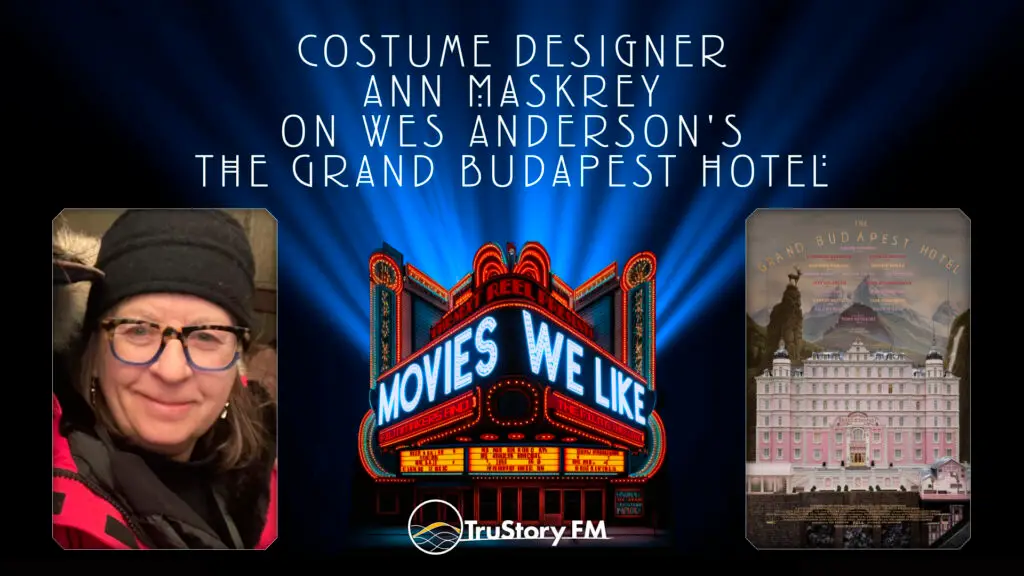
On today’s episode, we have invited Ann Maskrey to talk about the Grand Budapest Hotel, a movie she likes. Ann began her career in costume departments of theater and opera before moving into freelance costume work for film and television. eventually designing for productions including all three Hobbit films and most recently the Magic Faraway Tree.
Ann, welcome to the show.
Ann Maskrey:
Thank you very much for having me on it.
Andy Nelson:
we’re thrilled to have you here to chat about all the amazing work that you do and and the fantastical projects that you’ve been such a part of. To get started, let’s talk a little bit about you and kind of how you got started with your background starting in kind of theater and opera, moving into doing costume-making freelance, and moving into designing. What’s what was that journey like for you?
Ann Maskrey:
I think it’s been a little different to a lot of other costume designers and In a sense, I think it’s helped me a great deal as a designer now because I’ve kind of gone through every single type of journey to get to this point, you know. So My first love was theatre and I did a theatre design course at college But I’d always love movies. Oh and gone to movies as a child, gone to the theatre as a child, but then as I sort of got older and was a teenager I’d take myself to the movies ’cause I like that big panoramic view I like the tur to me now I know they’re a theatre purist, but I like the complete immersive thing of being in the dark. hopefully nobody coughing and sneezing and walking past me, but just sort of like seeing a widescreen, wonderful, immersive image with everything there too believe in hopefully. So I did theatre design at Wimbledon Art School and then I did initially get a job with a television company, but my I lost my father just as I was doing my finals, so I went home.
to be with my mum and I worked in a local store just to earn some money and then once we’d settled out a bit I kind of took a little walk to the local theatre and knocked on their door and went Hello. Is are there any jobs? I’ve done this and this is what I want to do. And they took me in as a dresser on a fantastic musical called Chicago. And they kind of didn’t let me go then. They sort of said, Oh, come and do this scene cloth and come and do this. And so I kept doing bit a bit and a bit of bit until they eventually went come and join us. But it was a rep company.
Well it still is. So I’d worked there from September till March And then they’d have and they still do have the World Snooker Championships ’cause it’s theatre in the round and it’s a perfect setting And so after the first year I was like, well, I still like doing this and I want to do more of it. I then went to Glyndebourne Opera in Sussex. So I’ve then flipped for a couple of years between Glyndebourne Opera, which is a beautiful setting, just outside Lewes in East Sussex, and a whole different world of working in rep theatre, and absolutely loved it. So I kind of did that, bobbed back and forth for two, three years and then took over the theatre that I was working in it to the department in the theatre that I was working in and did that for like three years and then went, There’s more to life than this, I want to go freelance.
I’d been cutting anyway, but then I realized there was a world where I could actually earn a living doing freelance cutting and making. So I kind of set up my own shop and stuff. And it developed from that really. I mean it I’m making it like a really short potted story so that
Pete Wright:
Right.
Andy Nelson:
That’s a little more complicated, yeah.
Pete Wright:
Right. It it it sounds like it happened all over about six weeks.
Ann Maskrey:
Yeah, I don’t want to just s stay on that, but yeah, I loved the opera more than I loved the rep company in time because I love opera anyway. And then it was just bigger and it was just it just grew and it was time to go bigger, you know. So that it was like always a step up and a step up when I went from doing freelance costume making to actually I got sucked into the film while doing freelance making and then they went, We don’t want you to go come with us on location. come and do this and then and then I was an assistant costume designer and then gradually a designer. So it was a journey.
Andy Nelson:
Yeah, yeah.
Ann Maskrey:
Slowly upwards, never back.
Andy Nelson:
Slowly upwards. Right, right, right. What was the first film that you ended up working on? What was that film that got you sucked into the industry?
Ann Maskrey:
Well, on location, I think it was restoration.
Andy Nelson:
Yeah.
Oh, okay. Okay.
Pete Wright:
It wasn’t last of the Mohicans. Well, I’ve got you on. I’ve just opened IMDb and Mohicans comes up as number one.
Ann Maskrey:
I don’t think it was that. I could be wrong
Andy Nelson:
Yeah, yeah.
Ann Maskrey:
You know, like the dates on the films are sometimes not in order of how you worked on them.
Pete Wright:
Yeah, they’re not quite right, right.
Ann Maskrey:
Yeah, so I Last time I he comes I went and did like six or seven weeks there. But I think that was I don’t know, I can’t be sure.
Andy Nelson:
Gotcha, okay, okay.
Ann Maskrey:
It’s just that restoration is the one that I remember for like making stuff in my own workshop, going to do fittings. It got m I got given more to do and then I went to do fittings at Shepperton and then they all went on location and w me and this other girl did all the notes on the fittings and then I went, let’s put them in order for when they come back And they went, Oh my God, you’ve lined up which is I didn’t even know what that meant at the time, but it was all ready to put on people’s backs for when they started shooting.
So that was like a l each thing was a little learning thing
Andy Nelson:
Yeah, yeah
Ann Maskrey:
And then they won’t come to come on location with us and come and work on the set. So I worked at Shepperton on the set and it went to Wales with them and it was just and then that designer asked me to assist him on his next film, which was Wind in the Willows.
Pete Wright:
When the Will is beautiful and and you end up in this you you sort of end up in this universe where you you’re doing a lot of of fantasy, sometimes science fiction fantasy, high fantasy. You’re working on the the Star Wars prequels. You’re going from opera, which is classical live action very large. Moving into to costuming that is super intimate And not seen from a proscenium, right? You’re you’re working in a situation where you have people where the cameras are going to be right up on your work all the time. And I’m curious when you get to something like The Fifth Element, something huge or or or th you know, The Phantom Menace when you’re doing something where so many eyes are going to be on every possible detail of the character design.
I’d love you to wax a little bit on on some of the lessons you learned there, on on the lessons that exist in the gap between live action to these massive and and super intensely scrutinized productions.
Ann Maskrey:
Yes, a really interesting question. And I sort of learned it over time from other clever people, really. I mean, I’d like to say that at Glyndebourne, although that’s seen from a distance, it is quite an intimate theatre, I did start learning how to do what I would call quirky, rather weird costumes So that took me into like how to deal with fantasy things rather than just straightforward period stuff. Because I did this huge like sixty foot high There’s a sixty-foot higher blow-up darlin for the love of three oranges, and she had to have a costume that matched the actual singer
Andy Nelson:
Wow.
Ann Maskrey:
So I had to they had to blow this thing up, which filled the stage, and I had to make a costume that went on this sixty-foot-high figure.
Pete Wright:
Oh my god
Ann Maskrey:
And I’ve always liked doing things that aren’t in a textbook where you’ve got to figure it out. So I would say there were things at Glyndebourne that led me towards working on slightly weird, unconventional things where you have to go, well, how am I gonna do this?
But also at Glyndebourne I met a woman called Annie Hadley who was a very good cutter. And she was very precise about how she went into things and she started doing things for freelance. for films while she was working at Glyndebourne. I mean she shouldn’t have done it, it was a bit naughty, but she’d take on a group of costumes to supplement her income and like she’d never miss a date or anything, she’d always do the work. But she’d like if the boss went out, she’d pull stuff from under a desk and we’d all start working on these film costumes, which we all knew had to be more detailed. Finely detailed because you knew they were gonna be on a huge screen. So I kind of learnt in bits like that you know, this has got and but then also you learn more how to make things and you take a greater pride in making it more beautiful or as beautiful as you can. within the time restraints, which in movies is the thing.
It’s like, can you make it good for the money in the time
Andy Nelson:
A lot of tricks.
Ann Maskrey:
There’s a lot of tricks to learning to do that and then, you know, going, well, it’d be nice to beautifully bind off the seam allowances, but no one’s ever going to see that because she’s never taking it off on camera. So we’ll let that bit slide.
Pete Wright:
Yeah, yeah.
Ann Maskrey:
You know the bit that everyone’s gonna see is this and that’s got to be gorgeous.
Pete Wright:
And everything else, r rough hems and loose you know, loose pants and things.
Ann Maskrey:
Well never if you can help it, you know, you never do that. But sometimes it’s like I mean, I’m back on the Duchess I had to Make several things in a great rush on that, to the point where there was quite a bit of shouting from me, I think, at one point, going, Why didn’t you tell me this before? you know, the designer would come in and say, I need another like I need another frock for Keira and I go, Wem for and he’d go, tomorrow
Andy Nelson:
Oh jeez.
Ann Maskrey:
And I go, Where’s the fabric? In the shop
Andy Nelson:
Oh no
Pete Wright:
It’s good to keep him scared a little bit.
Ann Maskrey:
It’d be like that and I’d be like, right, okay, we can do it. Go get the fabric. And then split the work up between people. So you’d do the sleeves, you do the frill, you do the petticoat, you do the bodice, you do the quilting you to lace.
Andy Nelson:
Oh my goodness.
Ann Maskrey:
You know, nine people and one frock. Which is not what you want to do, but I don’t think you’d be able to point to that movie and go, that was the one that was made in nine hours.
Andy Nelson:
No, yeah, right, we wouldn’t know.
Ann Maskrey:
But you would if you looked inside it.
Andy Nelson:
Oh we could see
Ann Maskrey:
So yeah.
Andy Nelson:
I see. Well that speaks to the nature something that is important to you. And I mean obviously in the world of film production, it’s all about your team and the crew and everybody that you’re working with. Knowing that when you have a situation like that that comes up where like, okay, you can handle the lace, you can handle the seams and everything and kind of get your team all working. I mean, talk about the importance of having a good team. that you’re working with whether whether you’re on it as like the cutter and you’re kind of working with the the costume designer and the rest of the team or you’re the costume designer and you’re kind of like managing all of that
Ann Maskrey:
It’s essential to have skilled people around you that you get on with. I mean, none of us would be anywhere without a good team. You know, and the difficult thing or one of the difficult things is if you suddenly get a job abroad, which I have done, obviously even going to New Zealand, and you go and everybody is a complete stranger to you. And then also, because we’re all freelance, you might like I have got a little core group of people that I’d like to use. I mean, if we do another Magic Faraway Tree, which we all hope I’d love to bring those people back on board, but they may be on another project and we all get scattered. So yeah, it’s tricky. I mean, if you can have a build up relationship full of people and you’ve got a shorthand and you get on, then that’s an added bonus. But sometimes you find lovely surprises
Andy Nelson:
Yeah, true, true. New perspectives.
Ann Maskrey:
In a place that you’d le in a place you’d least expect it
Pete Wright:
So w I wanna I definitely want to get to the magic faraway tree. The core of the movie, the story is So sweet
Ann Maskrey:
I agree it is sweet. And I think it’s the sort of film that everybody needs to see nowadays because it’s so lovely and heartwarming
Andy Nelson:
I mean it’s I I’m curious your perspective of that because it’s like based on a novel that’s been around a series, right, that’s been around for quite some time. And coming into a project like that for you, and I mean you could say the same thing with The Hobbit or any of these, but This one is like there’s a lot of people who are are fans of the work. Do you end up carrying, like feeling extra responsibility when you come into that and you’re like, well, I have to make sure saucepan man looks just right. Like do you find that you you feel an extra sense of pressure when you’re jumping into a project like this?
Ann Maskrey:
In all honesty, I don’t let it worry me. I particularly wanted to honour Pippa Harris’s vision or honour what she hoped that it would be, because I know it was a much loved project of hers and she’d been trying to get it together for a number of years. So I would say it’s m it was important to me to make sure she was happy with it and try not to worry about the
Andy Nelson:
And and this is Pippa Harris, the producer that you’re talking about, right?
Ann Maskrey:
Yeah, try not to worry about the wider world because someone’s always going to have an issue with something that you’ve done and go, I wouldn’t do it like that.
Andy Nelson:
Yeah, yeah.
Ann Maskrey:
I mean Saucepan Man was particularly tricky to pull off. As soon as I kind of thought about it, like at the beginning, I was like, well, how are we gonna do this without k without him wrecking the sound recording forever and m it being an absolute nuisance. And so that was my first practical thought about it and and sort of several weeks later the director sent me a little WhatsApp video with some little measuring measu measure cups from his kitchen and jangled them and went, How are we gonna deal with this? And I went, it’s okay, this is how we’re gonna deal with it. I am quite practical about that. It was like that’s something to deal with first. And then find the right people to make it, which thankfully I did.
Pete Wright:
I’ve got a couple of checklist characters that I want to have you comment on that I thought were really fun. One is is Moonface, non so nocy. the is his headpiece is What’s his headpiece?
Ann Maskrey:
That’s hair. That’s that was that is hair.
Pete Wright:
It was hair. It was it looked like a knit. It was it was wigged.
Ann Maskrey:
It’s a wig
Pete Wright:
The beards on the Know-Alls
Ann Maskrey:
they were shortish wigs and then VFX.
Pete Wright:
Okay, outstanding
Ann Maskrey:
Yeah, so the the Know-Alls were like completely encased from the neck down in a like a big blue screen cape against a blue screen sitting on stairs that were all painted blue So the extra length of beard was VFX because you cannot possibly find hair that long.
Pete Wright:
Yeah, that’s a lot of a lot of hair. A lot of hair.
Ann Maskrey:
That’s a lot of hair, and a lot of money would go on that hair if you could find it.
Pete Wright:
Yeah, for sure. Ca I did adore that Judi Dench is the fridge, obviously, is just the voice, but I I there is a there is a universe in which Judi Dench in my head was actually in the fridge. That made me very happy to imagine. Andrew Garfield, you’re making Andrew Garfield, a guy who has has been in so much and has donned the the Spider-Man uniform and you make him look like an everyman. In one sequence he’s wearing the most banal goofy dad shorts and boots. I it was just delightful. So when you’re going into Claire Foy and Andrew Garfield and thinking about how do we make them look like they’re completely out of place.
What do you go what goes into making these just absolutely delightful and very polished people look like they’re one with the land?
Ann Maskrey:
It’s it was a discussion between the director, the producers and the actors because you had to find I I said to them, they haven’t got an iron, they haven’t got a washing machine, they’ve got to look slightly put together, they’ve got to find things that are in the barn that they wear. And so all those little elements were talked about. Yeah, and then Andrew himself said could I have some sort of vaguely hippie type garment and that’s was the shorts. And then on the day of filming that when he had the shorts and the wellies on He said, Can I have a hat? And I went, I think you should wear I think you should wear Claire’s hat. And he went, Oh yeah.
Pete Wright:
Yeah, it was perfect.
Andy Nelson:
So yeah, right.
Ann Maskrey:
Because, you know, she’s the only one that has a how.
Pete Wright:
Yeah.
Ann Maskrey:
So yeah, it’s a collaborative chat as you go along and do fittings. And you know, we tried loads of things on all of the actors that aren’t in the tree just to kind of get the right vibe.
Andy Nelson:
Right, right, right. Well and you’re you’re creating a balance between the real world, we’ll just call it, right? Like Creating a look for the family, creating a look for all the villagers who live nearby, the farmers who own the land and all that, of the mother. So we’ve got that world. But then you’re also jumping into all of the different people, beings that live up in the tree. And each of them ends up feeling so much bigger and more fantastical. And and much more unique in kind of the scope and everything.
And I think that’s I I don’t know, I imagine quite a bit of fun for you to dance between the real world and the fancy, the fanciful one, where you get really get to kind of like kind of kind of explore both sides and put it all into one space.
Ann Maskrey:
Well it’s the perfect project really. You get the best of both worlds. You do a bit of a contemporary, which is carefully thought about. you know, even like Beth had a T shirt on, which was he didn’t really see it a lot, but we designed a T shirt that was kind of a bit anti countryside and had barbed wire and birds trapped in fencing and things. It was part of her vibe. And so you could explore interesting things like that, and then grandma had to look more expensive and quite hard
Andy Nelson:
Which Jennifer Saunders carries off perfectly.
Ann Maskrey:
Yeah, although she’s not at all like that of course in real life. That was nice to reconnect with her because years ago I used to do freelance work for the BBC and made a lot of French and Saunders costumes.
Pete Wright:
Oh, have fun.
Ann Maskrey:
So and I don’t so I haven’t seen her for like 30 years, I don’t think.
Pete Wright:
There’s something about let’s see, Billie Gadsdon. I’m looking at her and I’m thinking okay, she’s she narratively, she’s our bridge into the faraway tree. Her costume was also felt intentionally like a bridge into the faraway tree. She already is wearing this sort of sweater with the the kind of the blue fringe and i it looks already like she’s wearing something vaguely fantastical. I couldn’t help but wonder, is that because she’s of an age where she naturally would wear that? Or was there some thinking that she’s going to be the first one who’s in the tree? who gets to explore this kind of universe for us. Is there that kind of thinking that goes into it, or am I completely overwatching this this bit?
Ann Maskrey:
I don’t think I consciously thought that, but the when she first goes to the tree, she’s wearing a red cardigan with different like a different colour collar. band, cuffs and I designed that. It was handmade for her. So it was like she’s got to show up against the green. There were practical things. She got to show up in the wood She’s got to look like a character that’s a little bit like a toy. She was more of a toy thing in my head. It’s just a lot to be real, of course, and believable. And it’s quite funny because out of all the costumes that we did for the movie, I thought a lot of people would ask about the fantasy costumes and in fact I’ve had messages on Instagram about Andrew Garfield’s clothes and Claire Foy’s clothes more than I’ve had about Moonface and Silky, which is kind of nice because I thought that would never happen.
Pete Wright:
Yeah, yeah.
Ann Maskrey:
But you know, people are like wanting Claire’s embroidered shirt that she wears at the end, which is in fact made from a embroidered teeth off.
Andy Nelson:
Wow.
Ann Maskrey:
So the it’s not available to buy. I’d like to say that now.
Pete Wright:
Yeah.
Andy Nelson:
It’s very dry.
Pete Wright:
Link not in the show notes
Ann Maskrey:
It’s not in the shops.
Pete Wright:
Yeah.
Ann Maskrey:
So it’s quite interesting because there were quite a few little makes for all of the family that I think led it towards being a fantasy film, even though they were the real characters.
Pete Wright:
For sure, for sure.
Ann Maskrey:
Does that answer your question?
Pete Wright:
Yeah.
Andy Nelson:
The real characters also get costume changes. you know, they’re changing clothes throughout the story. And everyone in the tree, unless I’m r misremembering, but they’re all essentially always wearing kind of their outfit, right? Like that’s kind of like who they are, right?
Pete Wright:
Except for Nicola, right? Spa Nicola gets the when she turns into the fairy, she get gets a change.
Andy Nelson:
Right, she gets the sh yeah, so she has a new look.
Ann Maskrey:
Yeah, she changes completely. Moonface has a smoking jacket when they’re all sitting on the balcony at night. He did have a lovely cloak that didn’t get seen, but maybe it will in another movie, I don’t know. but mostly they stayed the same.
Andy Nelson:
Yeah.
Ann Maskrey:
‘Cause you y you kind of want the audio to go, Oh, there they are again.
Andy Nelson:
Right, yeah, exactly. It it’s kind of a sense that the it’s it’s a the sense of space that kind of always just is living in kind of its own time.
Ann Maskrey:
Yeah, and that their time’s very short really.
Andy Nelson:
Yeah, yeah.
Ann Maskrey:
Like the kids come back and they’ve only gone a few at a few hours.
Andy Nelson:
Right, hardly any time at all. Yeah. How much design work did you have with each of these characters? Because they all have very unique looks, very specific looks. were they based on sketches from the books? Were they based on like did the director bring a lot of of thoughts forward, Ben Gregor, the director, as far as like what he wanted to see with the looks of each of these? people or was it really just kind of you free reign like what if we do this for Moonface? What if this is what Dame Snap looks like?
Ann Maskrey:
Sub variety of things. I mean, Ben with Moonface, Ben came up with the idea of having the crescent hair.
Andy Nelson:
The moon, yeah.
Ann Maskrey:
And he thought of that in the very early days. I don’t recall him pushing me in a certain direction with Moonface, but I might be wrong. Because in fact I did start working on it a lot further ahead than when I was officially employed. And I started sketching out different ideas. And I and then I just presented them to him and I went, you know, this is the coat that he has. I don’t know whether everyone notices, but it’s got a dark side and a light side of the moon.
So everything on it was like moon related, like the printing was all crat raised craters, and the collar was like some specially made felt that had craters on it. So It was just all part of a major discussion. Saucepan Man you kind of just have to cover in saucepans. It was me that went, it could be more interesting if they’re copper, colour-wise.
Pete Wright:
They weren’t actually copper. What w we right, I mean he couldn’t have walked around with
Ann Maskrey:
No, there it would have fallen over and been
Andy Nelson:
Yeah, right.
Ann Maskrey:
very annoying and noisy. But no, they were a combination of polyurethane and leather.
Pete Wright:
Okay.
Ann Maskrey:
And and vacform plastic, sorry, three 3D printing.
Pete Wright:
The other on my checklist was w what what sort of scaffolding is going on in Rebecca Ferguson’s headpiece
Ann Maskrey:
That’s a hair question again.
Pete Wright:
That was a hair question. Okay. So that was hair. I d actually I didn’t know if it was a hat. Like it it felt like a it felt like a hat, but that’s supposed to be her hair.
Ann Maskrey:
That is her hair.
Andy Nelson:
Wow.
Ann Maskrey:
Well, it’s a kind of like sculptural wig. I don’t think the the top half isn’t real hair. I don’t know what it is, but you’d have to ask the hair and makeup people. But it wasn’t it came from an idea that came from an idea of from Ben, because he saw a Korean hairstyle that he liked. And then my idea was to shove pencils and rulers in her hair
Pete Wright:
It’s so good. Well, and and so, you know, I’ve a a couple of these I recognize our hair questions, but there is this you you are working on costuming in i in a universe in which hair and costumes and fabrics all have to to work d deeply intertwined with one another, right? Because, you know, r Rebecca’s outfit is of a piece. They cannot stand alone and the thinking of making of of making her character sort of come to life in in fabric She’s our evildoer, for sure. And I I’d love to hear some thinking about what went into m making her look and diabolical so that when that scream comes out, it all works together.
Ann Maskrey:
First of all, I’m sorry I don’t think I’ve fully answered your previous question, but ask me again if I miss something. But she In particular with Dame Snap, I did do quite a lot of different designs because they had different ideas about who to cast. Initially, and it was very, very late in the day that we actually got Rebecca and what a godsend she was. And then there’s once I knew that, that I then had to kind of like rethink it slightly. So it was rather last minute. I just wanted it to be like a school like a weird school mystery. which is why I should like a pencil course and a meter rule for a sane. And just be kind of quite stark.
And the bit that I kind of fought for ’cause she’s it’s kind of a little bit based on a tailcoat. And then the tails at the back are done up like a bustle. And there’s one shot in the movie where you see her run to the edge of the power of the castle and you see the tails of the tailcoats and it looks like a forked tongue. Now I never knew Ben was going to do that shot, but I was really happy because I can afford to have the extra long tails. Which you don’t really see in any other shot
Pete Wright:
Totally plays You know expanding from her, right?
Andy Nelson:
It plays, yeah.
Pete Wright:
You’re also dealing with her I I don’t know what you call them, her minions, right? The people who work in the the goblins, okay, who work behind her and
Ann Maskrey:
Oh yeah, the Goblins.
Pete Wright:
They do feel of a piece together, like they’re all sort of uniformed in piece, but if you’re changing Dame Snap’s costume, you know, around, what is the impact on the entire sort of universe of the scenes where it that take place in the school. Did you find you’re needing to constantly rejigger others’ costumes that work with her, or were were they pretty stable?
Ann Maskrey:
But I had done s quite a few ideas for them before we knew who were Dame Snap was going to be. And so I had done a sort of line up with a different Dame Snap, which was still black and red, but sort of fuller in skirt was fuller and the body sort of different and it was so sort of heavy initially th I thought it was going to be a leather coat, but then we found out we were going to shoot in Malta in the summer and it was like, well that’s not going to work, is it?
Pete Wright:
Yeah, misery.
Andy Nelson:
Right.
Ann Maskrey:
So Yeah, that was a rethink. But now the goblins are kind of there. I think I might have done about six or seven variations on them. So They were kind of agreed on and close.
And then it all came together once we knew it was her and just went, Well, okay, that’s that, that’s that. They have this, they have and the colours stayed the same. So no, didn’t have to change them too much.
Pete Wright:
Well, the the whole thing is just beautiful. I mean, for you, it just the the whole film feels like a runway piece, right? What a what a showcase of such variety and originality. I I imagine it feels very lucky to to work on a on a show like this.
Ann Maskrey:
Really a delightful project to have. And not only is it a lovely piece to design and work on, but crew and the cast were uniformly lovely.
Andy Nelson:
That’s fantastic.
Ann Maskrey:
You know, so very often you might get a good project and there’s somebody that kind of disrupts it or there’s difficulties behind the scenes. And you know, one can only say it comes from the top. Neal Street are very nice company to work for. Ben’s really easy and funny. He’s very good with the children And so, you know, everything was quite lovely really.
Andy Nelson:
Well that’s great.
Ann Maskrey:
How often do you hear that?
Pete Wright:
I guess not very
Andy Nelson:
How much time did you have on the project?
Ann Maskrey:
I worked on it officially I worked on it from March to October But I have to say Ben and I had been dialoguing a long time before that and throwing ideas back and forth Because once I know I’m doing something, I do like to kind of tinker and get going.
Andy Nelson:
Yeah.
Ann Maskrey:
‘Cause it serves me well in the end because then by the time you get to start and you’ve got a team together, you can go, this is what we want.
Andy Nelson:
True. Yeah, very true.
Pete Wright:
A special shout out to Simon Farnaby who worked on the adaptation and was our duplicitous accented farmer, which was I I thought was was a nice joke.
Ann Maskrey:
Yeah, yeah
Pete Wright:
That was a nice joke at the end. Yeah.
Andy Nelson:
That was that was a great joke.
Pete Wright:
On little Easter egg.
Andy Nelson:
Well, let’s take this opportunity to shift our conversation and start talking about the Grand Budapest Hotel.
Ann Maskrey:
Oh yeah, I forgot about that.
Andy Nelson:
This is The movie Yeah, the movie that you picked we’re gonna chat about. I mean, there’s a lot I want to talk about with this movie, but in all fairness to you, I think it’s Let’s start with the costuming and just like the world of Wes Anderson that he creates because I think that this is I mean yet another fantastic film of amazing production design, amazing costume design. the hair makeup wardrobe like everything comes together in a in a brilliant piece paired with his direction, the actors, everything else. I mean The costumes in this jump through several decades. I mean, what stands out for you as far as like what makes the costumes in this work as well as they do?
Ann Maskrey:
Oh well I have to say I’ve in admired Milena Canonero’s work for a while, and if she hadn’t won an Oscar for this, I would have been stamping my foot. ‘Cause I just think it’s perfect. So it’s even down so I love the fact even that like you’ve got the lobby boy and Monsieur Gustave in purple, and I love the fact that they pretty much stay in those outfits when they go on the train and when they go to Castle Lutz. You know, they only really change when he gets to the prison
Andy Nelson:
Yeah
Ann Maskrey:
There’s lots of little details to like like Willem Dafoe has got that fabulous leather coat on and he’s got the pocket with the drink and the gun and it’s like little details like that and
Andy Nelson:
Seeker pocket, yep.
Ann Maskrey:
There’s much to like in it. Saoirse Ronan’s got a sweet outfit. You know, the colours of the cake shop and the van all go together.
Andy Nelson:
And then the police officers, you’ve got Edward Norton and the other police officers in their little cute little cop outfits.
Ann Maskrey:
Well, sure, and I mean there’s so many favourite actors in that, like Edward Norton, some guy I really admire Willem Dafoe, also Jeff Goldblum, Adrien Brody. I like Saoirse Ronan, Tilda Swinton’s in it. She’s got some fabulous clothes, even though she’s in it for m you know, minutes. But I even like the sort of three relatives who are at the reading of the will you know, those three women.
Andy Nelson:
Right, the three sisters, yeah.
Ann Maskrey:
Yeah. And kind of to a lesser degree, ’cause it’s not my taste so much, you know, like Jude Law’s Tweed Suit in the early part
Andy Nelson:
Is it that because it’s the period that you’re not as much a fan of, or yeah?
Ann Maskrey:
Yeah, it is, ’cause I ’cause you know, I’ve lived through looking at the period like that and it’s so it’s not my favorite.
Pete Wright:
Everything’s so drab, but boy, does it ever fit into the universe of the drab era of the hotel.
Ann Maskrey:
Yeah. I mean the design the production design is also spectacular.
Pete Wright:
Yeah.
Andy Nelson:
Yeah, yeah.
Ann Maskrey:
I mean, and then they must have so cleverly worked together. I don’t know if they all worked together before, but it just mells completely. You know, and even you know, I love the little animated bits and
Pete Wright:
Right, the elevators and the Yeah.
Andy Nelson:
Right, right. The little stop motion bits. It’s a fun movie in that the Jumping through time, right? Like we start with Tom Wilkinson as the older Jude Law talking about the book that he wrote And I also love that Wes Anderson changes aspect ratios each time. And actually I should say step back even further. We start with a girl going to the cemetery to put some keys on his on this author’s gravestone and then read the book about the Grand Budapest Hotel.
Ann Maskrey:
Yeah.
Andy Nelson:
And then we jump back to Tom Wilkinson.
And then we jump all right to Jude Law.
Ann Maskrey:
Yeah
Andy Nelson:
Then we go back. It’s just fantastic structure.
Pete Wright:
Every time I talk about the movie, I forget how many time sort periods we’re in. It is four, right? Technically.
Andy Nelson:
Yeah, you’re right.
Pete Wright:
Yeah, it it is it is all put together with such precision, you know, in addition to changing the aspect ratio, the way they change from Tom Wilkinson to to Jude Law, F. Murray Abraham, to Revolori, like they the way the the voices changes so so seamlessly, so precisely. I you know, I look at Milena Canonero and and just her her long career working with Wes Anderson, there has to be such extraordinary shorthand in terms of of how to build a universe that ties so deeply to you know, production design to costumes. Like you bring up the purple, I couldn’t help but think of the entire palette of the the Grand Budapest Hotel is it all exists in this very narrow range of of reds and pinks and purples and and we just live there and it is exuberant and warm and just just absolutely beautiful and burns itself on my sense memory of this movie.
Ann Maskrey:
Yeah, it does.
Pete Wright:
One of the things that makes it unforgettable is the fact that it’s It’s those colors are seared into my eyes. We spent so long with them.
Ann Maskrey:
The colour’s wonderful and you know, they must have like a kind of shorthand of speaking together and just to sort of say, you know, this kind of cake and these kind of colours and and work out, you know, and and then you start having those small conversations and that leads to Well the box has got to look like this for the cake. And then like the only splash of colour really in the prison is the cake box coming through to be examined.
Andy Nelson:
Yeah, yeah.
Ann Maskrey:
But I love their script. I love the dialogue and I love Ralph Fiennes’ delivery of the dialogue. You know, that’s like my favorite bit I think is when they’re on the train journey going to Castle Lutz and he’s like it says something about there being some small amount of civilization in this barbaric slaughterhouse. Can’t remember all of it. But then I’m not an actor.
So it’s like And then he delivers a bit more of it and then he just goes, Oh fuck it. And you kind of go, has he forgotten his lines? Or is that part of the script? And it’s just funny and it’s delivered in a funny way And he does another speech when he’s just escaped from the prison and he’s quite racist in it. And then he goes, Oh, I’m so sorry, my dear boy.
Andy Nelson:
Right.
Ann Maskrey:
And and it’s just I just love his performance in it
Andy Nelson:
Oh, he’s so good in the film. I my favorite bit is when when the he goes to talk to the police. And is just like, oh, I suppose you’re here to arrest me or whatever. And then he just turns and runs.
Ann Maskrey:
It just runs, yeah.
Andy Nelson:
Just like funniest, the funniest, funniest moment.
Ann Maskrey:
Yeah. His physicality is really great in it. He’s got a very particular walk, you know, right at the beginning when he’s directing people in and out of a room. You know, it’s like the luggage and all the rest of it. It’s just this precise walk. And then run running too.
Andy Nelson:
Well, what I think is so fascinating is that the film is saying so much more than you realize, right? Like the there’s a lot more going on with this story about like fascism and the rise of the Nazi Party and everything.
Ann Maskrey:
Yeah,
Andy Nelson:
And and I don’t know. it an first glance you don’t necessarily think that that’s what the story’s really about. Like it’s a Wes Anderson film. It just feels kind of just light and fun and everything. But then when you start looking at it, you’re like, wow, there’s it’s a much darker story of everything kind of going on. It’s not necessarily about all of that, but it’s always going on in the background, right?
Ann Maskrey:
Yeah, it’s like here’s old Europe and this is what it looked like, and then this is New Re new Europe and how it’s how it changed, you know. So It’s like, you know, the hotel looks like a cake at the beginning and there’s so many buildings in Europe like Austria, Czechoslovakia, oh sorry, Czech Republic is what I should call it. You know, where there’s these ornate buildings that you kind of If you’ve traveled to Europe, that’s just so familiar, they’re part of the structure. And then you get stark communism coming in in certain places and a whole different style of architecture that’s brutal. And so it has a sense of that, you know, of of a changing middle Europe. It doesn’t name it
Pete Wright:
Yeah, and and the the the sort of rise of fascism in the film is treated s for for most of the film as like a tonal intrusion into the bright story unt right up until it’s not. And I I think the the the pair of sequences on the train where the first one we have this the bit have it treated like the state police treated as pol an issue of rudeness and politeness. and protecting one’s own to the very end where we we get the sequence where we’re no longer polite, right? This the now tonal intrusion is complete. and it’s going to lead in the death of of one of our principal lovely principal characters. This movie is is playing sort of an emotional sleight of hand. And when the grief finally hits, it hits hard and very, very quickly. It feels like they’re going to get away on the train just like normal, but in fact we we slap back forward in time a little bit and realize this is where his life changed forever.
It it’s really smart, smart, smart filmmaking.
Ann Maskrey:
It is, I love it. I could watch it again and again, and I think I must have watched it about five times already over the timescale it’s been out, you know, and I’d go back to watch it again even after speaking to us now, and I only watched it last week just to refresh my mind. So I like the music too. There’s not a thing I dislike really.
Andy Nelson:
Wes Anderson is one of those filmmakers who certainly has been accruing, not just kind of a a troop, an acting troupe that he likes to kind of bring along with him, but certainly it also seems like a crew that he really has. And Alexandre Desplat seems to be kind of one of his like go to composers that he he brings on quite a bit and the music is just phenomenal, as is so many elements of it.
Ann Maskrey:
Well, it’s evocative.
Andy Nelson:
Yeah, yeah. It really feels kind of of this Eastern Europe at this particular point in time. You know, kind of got a little bit of Russian dance feel kind of going in there and everything, it it plays well with the whole scope of the film.
Pete Wright:
Where where do you stand with with Wes Anderson sort of more broadly? I mean, this is a is really a canonical film in his collection, but I mean, you know, m Moonrise from Moonrise Kingdom to Asteroid City to The Phoenician Scheme, when you look at at how at the precision with which he approaches films What is it that stands out for you as his as as his touch?
Ann Maskrey:
I don’t know, it’s a visual in it’s a visual attraction initially, although there’s not a lot visually setwise in Moonrise Kingdom, but I love it, nonetheless. I love Bill’s Bill Murray coming up and going, Beige Lun calling them all Beige Lunatics, yeah. Just that’s my favourite line, I think, from that. Haven’t seen that in a while, but There’s a kind of sweetness about that. It’s it’s always a little bit childlike.
Andy Nelson:
There’s an element, but it also is a little like there’s a line of being childlike, but also like having an adult. feel thread through it like a darker tone.
Ann Maskrey:
Yeah, yeah.
Andy Nelson:
You know, whether it’s kind of like the murder plot that we have, or like we said, kind of the rise of what it seems to be like the SS, the the Nazi party that we have and kind of the darker elements there. Also just the deaths that that end up happening. We find out that the tragic end of Saoirse Ronan’s character later in the story and and the way that we kind of learn these bits, it’s just like, God, it’s I what I really like about it is it’s a film, like it I don’t know, it reminds me of like the sorts of films that they used to make. Like back when I was a kid where they didn’t necessarily feel like they had to make everything safe for younger viewers, you know, it felt like younger there’s a little bit of darkness. And as younger viewers, I think sometimes that’s a good element to kind of take in and go, wow, yeah.
Ann Maskrey:
Well that’s life, isn’t it, really?
Andy Nelson:
Yeah, right, right.
Ann Maskrey:
You know. So it encompassed they all encompass a lot of things. I like the The Darjeeling Limited as well.
Andy Nelson:
Yeah.
Pete Wright:
Totally, it’s so interesting to look at like Fantastic Mr. Fox and Isle of Dogs, right, with exactly that eye. Like, here’s a guy who is making something that is that now is not just you know, colorful. It’s l literally in a in an animation style that by all means should appeal to kids. It should be the thing that that is considered completely safe. And it is both of those movies are chalk a block of grief and and loss and discomfort. Not to the point where they’re adult films, but they are they are films that that challenge people of all ages.
I think it’s really quite beautiful.
Ann Maskrey:
Yeah, no, you’re absolutely right.
Andy Nelson:
Even his yeah, even his Roald Dahl adaptation, the other like the other ones that he did, like with Benedict Cumberbatch like that whole batch is also there’s some real dark threads going in those stories.
Ann Maskrey:
That’s true. Yeah. I haven’t seen Asteroid City and I don’t know why, but I’ll give it a try now.
Andy Nelson:
It’s one of my favorites. I know it wasn’t for everybody, but you know, I think this is Wes Anderson for you. Like some people love one and they’re like, well that one wasn’t my favorite, but Asteroid City, Isle of Dogs. And the Grand Budapest Hotel are like my three favorites of his that I just adore to pieces.
Pete Wright:
Well those are I mean you’re talking about that’s more of his experimental era, right?
Andy Nelson:
So
Pete Wright:
The asteroid city. It’s got some stuff going on. I I quite enjoyed it, but for me it’s The Phoenician Scheme all the way down. most recent is is absolutely my favorite. I know, right?
Andy Nelson:
Fascinating. Interesting. That’s what I need to see again. And did you see that one, Ann?
Ann Maskrey:
No.
Andy Nelson:
Yeah.
Pete Wright:
Okay, add that to the list.
Andy Nelson:
Okay.
Pete Wright:
It’s
Andy Nelson:
It’s
Ann Maskrey:
That was a short answer, wasn’t it?
Andy Nelson:
Well, I mean i mean as a fan of Wes Anderson, it’s I mean definitely check that in Asteroid City out. I think they’re fascinating films. He’s doing a lot.
Ann Maskrey:
I will do, yeah.
Andy Nelson:
Yeah, yeah, really interesting stuff going on in in those ones.
Ann Maskrey:
And The French Dispatch, I quite like that too, that’s intriguing.
Andy Nelson:
A lot of really interesting stories going on through that one too.
Ann Maskrey:
Yeah.
Andy Nelson:
Yeah. That’s what I need to revisit also. Like I don’t remember that one nearly as well as some of the other ones.
Ann Maskrey:
Me neither, actually
Pete Wright:
It actually it reminds me very much of Asteroid City. I think I could watch those back to back and get the same vibe, right? We’re gonna try some things here that are extraordinary even in the scope of Wes Anderson’s approach to filmmaking. And I I I love it.
Andy Nelson:
Yeah, yeah.
Pete Wright:
I can’t get my family to really get on board with my appreciation of Wes Anderson
Ann Maskrey:
Oh no, I’m the same. I’m the same. Like my partner, I said I’m gonna talk about Grand Budapest Hotel. My partner went, oh yeah. And I went, you weren’t that keen, were you? And he was like, I didn’t like the colour.
Pete Wright:
What?
Ann Maskrey:
And I went, what?
Andy Nelson:
What?
Pete Wright:
That’s a personal affront.
Ann Maskrey:
I’m like, I love the colour
Andy Nelson:
Right.
Ann Maskrey:
I was like, oh, I’m just not gonna speak to you about it then.
Andy Nelson:
Oh my goodness, no kidding. That’s so funny
Ann Maskrey:
I mean I nearly picked Chinatown, which is a whole different kettle of fish. But like we we both really like that film and I’ve liked it for years and so it’s a just a excellent film. But then on a lighter note, I also like Amélie and that’s It’s very colour oriented, it’s a very restricted colour palette, which I love about it, apart from liking the story
Pete Wright:
Yes.
Andy Nelson:
Yeah
Ann Maskrey:
So I don’t know, you know, I just plumped for Grand Budapest Hotel and then stuck with it. But then I was like, ooh, maybe I should have spoken Chinatown. Then I was like, well, that makes me sound a bit older. Maybe not everyone’s heard of it. Grand Budapest is a bit closer to home years-wise, you know
Andy Nelson:
Yeah, right, right, right. Well, it’s a it’s a fantastic film. And you know, this is it’s a great example of a movie where every department and you know this I actually love to hear a little bit about this from you. as far as like your working experiences, but every department really needs to kind of lock in together to capture this this unique vision. of a world being created.
Ann Maskrey:
It’s essential.
Andy Nelson:
And I think I mean that really speaks to what you were saying about teams, because it’s not just your team, but it’s again you as the costume designer having a a strong working relationship with the production designer and the hair and makeup team and the director and all and the and e cinematographer. Like all of you need to be working on the same page to kind of Make sure that that vision comes to life.
Ann Maskrey:
Yeah, I’m pulling in the same direction
Andy Nelson:
Yeah, yeah.
Ann Maskrey:
Yeah. So on Magic Faraway Tree, I had worked with Ben before, so we did have an understanding. And Neal Street people I’d worked with before also, but there was a producer on it that I’d worked with on a film years ago that she’d left, but you know, it was kind of nice to link back with her. But creatively, I didn’t know the production designer and I didn’t know the hair and makeup person beforehand. But the hair and makeup lady, Karen Hartley Thomas, has become a close friend now and we work together very well and we need to on especially on something like that. So, you know, it was it’s good to find those relationships ’cause, you know, hopefully we’ll work together again.
I don’t know if the whole team will or not, but you all have to agree colour palettes and who you know Years ago when we were on Phantom Menace, I remember saying something that I shouldn’t have said when I walked on a set and commented on some cushions and upset the set decorator. But I kind of well I shouldn’t have opened my mouth, but actually I was right ’cause they just looked alien compared to the rest of it. And they did get changed. But I was it’s the first time when I kind of opened my mouth and thought, well I shouldn’t have, but in this sense I should have as well because it it just just you know when something on the set just attracts the eye and it shouldn’t
Andy Nelson:
Yeah.
Ann Maskrey:
‘Cause you want the whole thing to work. You don’t want to suddenly go, what’s that extra wearing in the background? Action should be strong enough anyway to run it But if it’s a quiet scene and suddenly you see something in the background that’s not right, then it doesn’t work.
Andy Nelson:
Yeah, I imagine that takes a lot of forethought as far as like planning everything, but also I imagine it also requires everybody be on their toes for quick changes. If somebody if the director is suddenly like, oh, you know what? That shirt is popping too much. Can we quickly change that background actor’s
Ann Maskrey:
Yeah, you’ve got you’ve got to be ready for things like that. But also hopefully with principles you’ve gone through the motions of, you know, approv getting things approved. We certainly I pushed for that on The Magic Faraway Tree when people weren’t really thinking about it. I go, who’s going to approve this? You know, you’ve all got to go, yeah, that’s it. like even as far as designs before we start making things. And but then just if you look at crowd in general, you know, there’s a kind of if you’re doing modern crowd, contemporary crowd, you’ve got to kind of give a you know, a remit to the people that might be bringing their own clothes, but you’ve got to have like a stock of spare stuff because if you give them a description of what the scene’s meant to be and they misinterpret it, then you’ve got to kind of have a backup, you know, and you’ve got to have a crowd team that you trust ‘Cause everybody goes off and get dressed and then they all come out for a lineup and somebody’s wearing a bright fuchsia pink sweater and you go, Well, that’s gotta go because everyone’s got to kind of like
Pete Wright:
Listen,
Andy Nelson:
Yeah.
Ann Maskrey:
you know, or someone’s wearing a hideous nineteen seventies shell suit ’cause you said tracksuits, but you meant now, tracksuits now, not tracksuits from the nineteen seventies or eighties
Andy Nelson:
Yeah.
Ann Maskrey:
So yeah.
I mean I’d had a horrible time on I wasn’t designing it, I was a supervisor on it and I had to ring up a load of people and say it’s a gentleman’s club come and dressed as you would for lunch in a posh London Gentleman’s Club and quite a few people weren’t English and they just picked up on like there are a lot of people that had just become supporting artists and they were from a Europe, say And so they just picked up on the word club, not knowing what a gentleman’s club
Andy Nelson:
Oh
So they’re dressed to go clubbing, right?
Ann Maskrey:
it’s like in a s so just to go clubbing and you were like, oh no, you know it’s not not a lot of spare stuff got used that day
Andy Nelson:
Yeah.
Not quite, not quite.
Oh my goodness. Wow.
Ann Maskrey:
Yeah, that was frightening.
Andy Nelson:
Well, it’s also challenging because you’re like, I hope I have enough to dress all of these people and to make this change.
Ann Maskrey:
I oh
Andy Nelson:
Yeah.
Ann Maskrey:
And ’cause you can’t just run out to the shops and buy extra stuff, not when they’re standing there at seven a. m. in the morning about to go on the set.
Andy Nelson:
Yeah. Oh my gosh.
Ann Maskrey:
Yeah, that taught me to be carefully worded
Andy Nelson:
Yeah, right.
Pete Wright:
I the the film does Revolve around boy with apple. What would it take for you to hang boy with apple in your home, I wonder. It is currently hanging in in the museum design museum in London. as a part of Wes Anderson the Archives ex exhibition. It it does still belong to Wes Anderson. It’s a it’s a real piece commissioned by British artist Michael Taylor in 2012. yeah.
Do we do we believe do we believe that it is truly priceless?
Ann Maskrey:
Yeah
Pete Wright:
Part of the fantastic joke is is that the the piece is is quite strange. It was modeled credit to dancer, London-based dancer Ed Munro. so it was all done as a real a nice real sitting attributed to fictional Renaissance artist Johannes Van Hoytl the Younger. So good.
Ann Maskrey:
I know it’s the perfect kind of like mock up of, you know, that type of portrait. But I I love the joke that they d they takes that painting off and puts like I think it’s either a Klimt or an Egon Schiele provocative.
Pete Wright:
Yes, right.
Andy Nelson:
Yeah, right.
Ann Maskrey:
painting up and then Adrien Brody comes and sees it and goes, What is this shit? Or something like that.
Andy Nelson:
Rips it off the wall and smashes it.
Ann Maskrey:
And rips it off the wall, breaks it
Pete Wright:
That how long did it have to sit with people just not acknowledging that that was the picture that was hanging above the mantle, that it was Adrien Brody who get we got to wait for to get the notice. Brilliant.
Ann Maskrey:
It was a few seconds, wasn’t it?
Andy Nelson:
They’re fileing.
Pete Wright:
Yeah. ‘Cause the sisters had been sitting in the room under it for some time.
Andy Nelson:
Yeah.
Ann Maskrey:
It wasn’t there, yeah.
Yeah. Oh yeah, but I don’t think their dice they d say anything.
Andy Nelson:
No, exactly, exactly. It plays so well. Well, I mean Grand Budapest Hotel is such a fantastic movie, and thank you for coming on the show to chat about it.
Ann Maskrey:
My pleasure
Andy Nelson:
thank you for coming on the show to chat about The Magic Faraway Tree and all your wonderful work on it.
Ann Maskrey:
Thank you
Andy Nelson:
Absolutely. The film is in will be in theaters right around the corner from the time this episode is out. So check it out. Take your kids, enjoy the enjoy with the whole family. everybody’s gonna have a fun time at the magic that they’re gonna see on screen.
Ann Maskrey:
I sure hope they do, but it’s certainly doing very well here. People love it.
Andy Nelson:
That’s fantastic. Do you have any place online that people can follow you and check kind of track what you’re up to and and your new projects?
Ann Maskrey:
people do seem to find me. I am on Instagram. I have a website, annmaskrey.net.
Andy Nelson:
Gotcha. Instagram and threads, I think you’re at @annmaskreycostume, right?
Ann Maskrey:
I don’t know about threads.
Andy Nelson:
Instagram. It basically is another version of Instagram.
Pete Wright:
It’s like autoposting your Instagram, yeah.
Andy Nelson:
So they they they kind of just say, oh, you’re also on that too, if you’re on Instagram.
Ann Maskrey:
Oh, okay.
Andy Nelson:
Instagram. So but it I I won’t put it in the I won’t put it in the show notes if you’re not using it.
Ann Maskrey:
Okay.
Andy Nelson:
We’ll just leave the Instagram up.
Ann Maskrey:
No, I don’t use it
Andy Nelson:
So yeah. Fantastic.
Well Ann, thank you once again.
Ann Maskrey:
Very nice, it was very nice to speak to you, very enjoyable, thank you for having me
Pete Wright:
If this conversation sent you deeper into costume design or into Wes Anderson’s world, here are three episodes worth your time. The Film Board covered The Phoenician Scheme, Anderson’s newest, so that is the most direct next click. For more costume design conversation, go back to our Movies We Like episode with Antoinette Messam on Amélie. A different director, but the same instinct for a world that only exists inside the film. And for the elegance and decline thread that runs through the Grand Budapest Hotel, The Next Reel’s episode on Barry Lyndon is exactly where to go next. Thanks again to Ann Maskrey for joining us today. For everyone out there, we hope you enjoyed the show and certainly hope you like the movie like we do here on Movies We Like.
Movies We Like is part of the TruStory FM network and part of the Next Reel family of film shows. Our theme is Chonklap! by Out of Flux. Find us at trustory.fm and follow at The Next Reel on Bluesky, Instagram, and Letterboxd. You can also watch full episodes on The Next Reel’s YouTube channel. If you’d like to learn about becoming a member of the Next Reel family of film shows, visit trustory.fm/join. That’s T-R-U-S-T-O-R-Y. fm slash join. If you’re enjoying the show, we’d love your rating and review wherever you listen.
See you next time.