Carol Cone:
I’m Carol Cone and welcome to Purpose 360, the podcast that unlocks the power of purpose to ignite business and social impact.
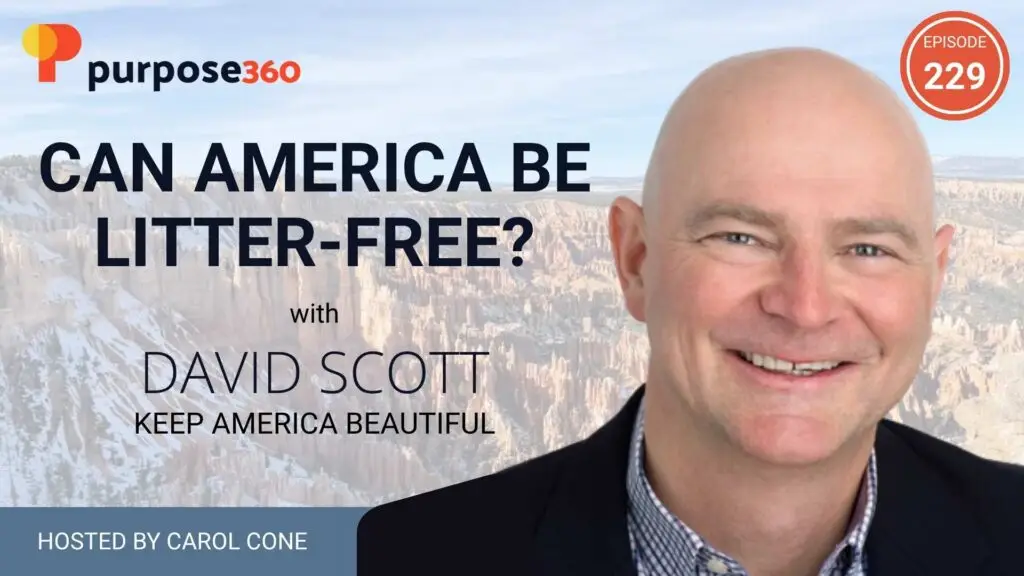
Today we’re exploring a question that every purpose-driven leader wrestles with. How do you inspire people to take small actions that create meaningful change at scale? As America prepares to celebrate its 250th birthday, it’s a fitting moment to reflect on the shared responsibility that we have for the places we call home. Few organizations have studied that challenge more deeply than Keep America Beautiful, the 70-year-old nonprofit. To comprehensively understand litter and its impact in our communities, cities, and towns, it started fielding a comprehensive national litter study in 1968 to track not only what Americans litter, but why, and what it takes to change behavior.
Joining me is David Scott, Senior Vice President of Data and Research at Keep America Beautiful. Together, we unpack The findings from their newest national litter study, which reveals a remarkable and very exciting 34% decline in litter since 2020. But while that’s encouraging news, unfortunately, there remains more than thirty-two billion pieces of litter that are scattered along America’s roadways, waterways, our streets, in our cities, in our towns, all over our communities. In this conversation, we’ll explore what’s driving progress, where new challenges are emerging, from coastal litter to discarded tires and packaging waste, and why cleaner communities are linked to stronger local economies, safer neighborhoods, and greater civic pride. Whether you’re leading purpose programs, engaging employees, or building community partnerships, you’ll discover how data, behavior, and collective action can help create a cleaner, more beautiful America. So let’s get started.
So welcome to Purpose 360, David Scott. I am so thrilled to have you on the show. I’ve gotten to know you because we work with Keep America Beautiful for the last couple of years and you are the — dare I say — the guide, even the data god. So please introduce yourself and I want to know why do you do what you do? Why do you love what you do?
David Scott:
Oh, I’m so happy to be here, Carol. It has been such a joy working with you, and I’m so happy to have the chance to chat a little bit more about it with you here. So yeah, as you said, I lead data and research at KAB and what that means at the organizational level is we’re bringing national scale evidence to understand how to make our communities cleaner and more beautiful places — and thriving places — for people to live and work and play in. So why do I do what I do specifically? What really fascinates me is human behavior. Why people do what they do, both good and bad, I have to say. And that’s what led me to this work, both at Keep America Beautiful and previously, really trying to get to the heart of that. Because at the end of the day, whether it’s at the organizational level or at the individual level, making better decisions is where we get to better solutions.
I love to hear people’s stories. It’s not just about the data. It’s about how they live their daily lives, what’s happening in their community. And we use data to understand what’s working and where we need to make improvements.
Carol Cone:
Great. So today we’re going to talk about the litter study. And I’d love you to go back because there is a baseline that Keep America Beautiful — I guess it was 1968, which is, oh, that was a very tumultuous year, by the way — that the organization conducted the first study. And you told me in our prep that you go back and you frequently look at it. So what did you learn from that as a baseline?
David Scott:
Yeah, so as you know, Keep America Beautiful was founded in 1953 as an organization and almost immediately started conducting research. And then as you noted, in 1968 and ’69, the organization completed what really became the benchmark for litter study research around the world. And in that original work, it looked at why people were littering, what it was that they were littering, and where they were littering. And we have expanded so far beyond that, but that really remains at the core of the work.
So today, just like we did back in the late ’60s, we are still looking to understand — just from a metrics level — like how much litter is there per mile along roadways? But now we do so much more. In fact, the one we’ve just completed is our fourth major national comprehensive litter research study. And each time we’ve done it, we’ve added a new component to it.
Carol Cone:
Yeah, and congratulations because the last one you did was 2020. And this one — litter overall is down 34%.
David Scott:
It is.
Carol Cone:
That’s a huge jump. Albeit there’s a lot of litter left. We should talk about that. But how do you feel about the result of this study?
David Scott:
Yeah, we are thrilled to see what we found with the study. And this is a very rigorous study that we conduct. We send professionals out into the field and to hundreds of sites around the country. 700 sites to be specific. And these are all engineers and scientists who are trained in the methodology of understanding what litter is. So we went back to the exact same sites that we went to along roadways and waterways from 2020 so that we would have a true apples-to-apples comparison of the two studies from 2020 and this year.
And like you said, we found a 34% reduction along roadways and waterways in litter. To put a number on that, that was about fifty billion in 2020, down to thirty-two point six billion here. So we are thrilled with the progress. We had no idea whether litter would be up or whether it would be down. So we were thrilled that it was down. But also 32 billion pieces of litter is still an unbelievable amount of litter. So it’s definitely progress, but we have not won the fight by any stretch of the imagination.
Carol Cone:
Now, billions — that’s really hard to even fathom. But what’s the pieces per person now?
David Scott:
Yeah, so in 2020, it was along roadways and waterways 152 pieces of litter per person, and this year it’s ninety-six pieces of litter per person. But we want people to understand — it doesn’t matter if you run a large corporation or if you’re just a regular Joe in your community. Everybody has a role to play here. And at a hundred pieces per person, we all can make a difference here.
Carol Cone:
One piece every three days gets it done.
David Scott:
And the other thing that’s really important that I want to note: litter is really easy to ignore until you’ve started picking it up. Once you see litter, you can’t unsee it. So immediately you become an advocate for your community when you start doing this work. That’s another empowering feeling — knowing that you are doing the right things for your community. We don’t always do the right things for our community, right? We all get lazy. But this is a moment where you can really take control.
Carol Cone:
Absolutely. So let’s talk about — you always talk about a new element of the research. And this year you added coastal areas. So can you talk about that and why coastal is different than waterways and rivers?
David Scott:
Absolutely. Yeah. So we wanted to add coastal areas for a couple of different reasons. One, we have become so aware in the past ten to twenty years about just how damaging waste is in our waterways and in the ocean. Everybody’s heard of the Great Pacific Garbage Patch, and there’s nothing more devastating than going into nature. And there’s something about the coastline in particular that’s particularly devastating.
And so we went out there and we literally counted litter. Now the coastline is really interesting for a couple of different reasons and very different from waterways and roadways. First off, there’s just far less coastal mileage than there is roadway and waterway mileage. So in that sense, it’s less daunting. But on the other hand, there are very few solutions being deployed that are focused on the coastline, even though we’re so focused on litter in the ocean and along our coastline. So we wanted to enumerate how much litter is on the coastline because there’s no estimate out there of how much litter there is — this provides the first estimate of how much litter there is along the coastline.
And I just wanted to note: along waterways and roadways, we’re talking less than 3,000 pieces of litter per mile along roadways, less than 2,000 pieces of litter per mile.
Carol Cone:
Is that good?
David Scott:
Oh yes.
Carol Cone:
Is that good?
David Scott:
Well, when you compare it to along the coastline, we estimate that there are nearly 17,000 pieces of litter per mile along the coastline. And that’s just an eye-opening number — to know that there’s multiples higher litter along the coastline. The other thing that’s really interesting — and we want that to be a siren to everybody in America — is getting people to understand that the coastline looks really different than probably what you imagine. Most of us, when we think about the coastline, we think of beaches. That’s how we engage with the oceans.
Everybody wants a clean beach. But beaches only represent ten percent — less than ten percent — of the coastline. Nearly three quarters of our coastline are what’s called vegetated. So that’s mangroves, salt marshes, things like that. And there’s far more litter in those mangroves and salt marshes than you find along beaches. And the litter along beaches isn’t representative of litter in America, whereas the litter in those mangroves looks a lot more like the litter that we’re finding along roadways. So the problem is we need new solutions to address coastal litter, because the stuff that we’re doing along roadways and waterways isn’t working.
Carol Cone:
Okay. So let’s just talk. Things that are down: plastic’s down 24%, paper’s down forty-five percent, glass is down thirty-four percent, metal down thirty percent, organics seventy-seven percent, smoking and tobacco products down sixty percent. But then there’s some up. There are two areas that are really interesting and I want you to talk not just about what is up — what are the numbers that are up — but what might that reflect in terms of our consumption and engagement in our lives?
David Scott:
The one dark spot was the category that we call tire and vehicle debris. And that was up significantly. Tires alone — like an entire tire, not a shredded piece of tire, but a whole tire — whole tires are up nearly eighty percent in littering in this study. That’s tremendously problematic because tires are just terrible for our environment. They’re breeding grounds for mosquitoes. They can leach pollutants into the water. And they’re incredibly costly to deal with after the fact. And why they’re up — driving is definitely up in the past five years, but that doesn’t fully explain the increase.
The thing that gets really interesting as another example is cardboard. Cardboard is up 50% in the past five years. Now, that one is easier to tie to consumer behavior, because in the past five years, we have all become online shoppers.
Carol Cone:
You got it, yeah.
David Scott:
And it is important to recognize that waste and litter is just unmanaged waste. That is literally the definition of litter — it’s unmanaged waste.
Carol Cone:
Unmanaged waste.
David Scott:
And so when we consume something and we consume more of it, it is more likely to end up in the waste stream. And so not surprisingly, cardboard litter is up because consumer consumption of cardboard is up. Also the challenge — as we all know, well, I don’t know that we all know this — cardboard is incredibly recyclable. It is one of the most valuable products in the recycling stream. So when I see cardboard out there in the piles of litter, that’s literally cash sitting on the ground.
Carol Cone:
Cash on the ground. We still have 35 billion pieces of litter out there. So is there such a thing as a litter bug? I mean, I remember growing up, like in the PSAs — it said don’t be a litter bug. Is there a type of person that just litters?
David Scott:
We all have a propensity to do either the right or the wrong thing. We are all at risk of littering at some point in our lives. So the work that we need to do in our communities and across the country is: it’s a lot easier to reduce the probability that anybody’s going to litter than it is to say, aha, there is the litter bug.
Carol Cone:
Okay. So what is the impact of cleaner places?
David Scott:
Oh my goodness, this is so exciting to talk about. The good news about litter — or solving for litter and making our communities clean and more beautiful — is no matter what you are passionate about or what you care about, doing this better will address your interests and your values.
So if you’re an environmentalist, keeping waste out of our natural environment means that we’re keeping our waterways cleaner, the drinking water that we’re drinking is cleaner, the air that we’re breathing is cleaner, the animals who inhabit that space are safer. But not everybody focuses on those things. So maybe you’re a local business person who relies on tourism. Well, we know that tourists want to go to clean and beautiful places. They improve property values. They improve traffic in commercial districts. Studies have shown that cleaner places are safer places. Crime is reduced when spaces are clean and green. And the investment that we make to clean those spaces up is returned multiple fold in the reduced costs to the community. So it’s cheaper to keep your community a safe, clean place. Whether it’s safety or tourism or businesses or property values or the environment, keeping our communities clean and green and beautiful benefits everybody.
Carol Cone:
Oh, that’s very well said. I love that. If you and Jenny are going to go up to Capitol Hill and you’re going to have a breakfast for government leaders who have to address community issues, what are the one or two key messages you’d want to share?
David Scott:
Yeah, at Keep America Beautiful, we strongly believe that we have a proven solution to litter to deploy. And we actually have the evidence. To use one example, our cigarette litter prevention and recycling program — where it’s deployed, cigarette litter decreases by over 50% in that area.
And what these proven solutions are built around are a few important things. You need folks to be educated about the issue, about why it matters and what they need to do to make the right decision. They need to be able to make the right decisions — so there needs to be infrastructure there so that they can. Littering is called a crime of inconvenience because people do not want to walk —
Carol Cone:
A crime of inconvenience, yeah.
David Scott:
— a little bit further to do the right thing with their waste. You have to not only have that infrastructure in place, you’ve got to have the services to keep it clean and available to folks. So an overflowing wastebasket on the street is not helping keep the community clean — you’ve got to empty it. So education, infrastructure, and servicing of that — and tracking progress over time is really important. You know, it is not the field of dreams. It is not build it and they will come. We need to continuously work on this. And that’s where understanding that this is not any single person or group’s responsibility — it’s all of our responsibility. We have a shared responsibility to do this as individuals, as corporations, as governments, and as communities.
Carol Cone:
I’m curious — okay, so you’re in New York City and you’ve had a lovely Italian dinner. And you’re walking down a street, not in the middle of town, but where the buildings are lower and it’s very residential, and someone litters. What would you say to that person?
David Scott:
Yeah, we actually ask people this sometimes when we’re doing research.
Carol Cone:
Okay, okay.
David Scott:
I think everybody’s answer to this is different. For me, I like to think of myself as a polite person.
Carol Cone:
You are.
David Scott:
So I would probably say something like, oh my goodness, I think you dropped that there by accident —
Carol Cone:
I know you — you dropped that. Oh my God.
David Scott:
— and just diffuse the situation and, you know, treat them as if it was a total accident. And obviously if it’s not dangerous or disgusting, pick it up and hand it to them and say, oh, I’m sure you didn’t mean to do that. There you go. That’s how I would manage it.
Carol Cone:
Oh, thank you. I know that there’s a trend now where young people are getting together and they’re picking up trash together and it’s like a social thing to do. And I’m wondering how do you feel about that? And what is it about being with a group of people? And again, it goes back to the satisfaction question that I asked. Is that hopeful for us for the situation?
David Scott:
We have so many examples of people doing that intentionally, like you just talked about — creating their own groups, which is wonderful, to go out and take care of their community. A lot of our affiliates — we have over 700 Keep America Beautiful affiliates around the country — they will hold events like this. Not just a regular cleanup, but they’ll do things like go do a cleanup in the neighborhood and then meet at a local watering hole afterwards and the first drink is on us. And to young people, that’s a way to go out there, be with people, do something that’s good for the neighborhood, and then also do something that they probably were going to be doing anyway, but just do something good.
So it is incredibly encouraging. It’s something that we need to do more of. Encourage people to do more of. It’s something that we are very focused on at Keep America Beautiful in the coming one to five years — really trying to get people back out there into their community.
Carol Cone:
And for those of you in companies — whether you know it or not, this is such a great employee engagement event. \ But getting outside around the factory, the plant, the streets leading up, the parking lot, the parks, the schools near you — and for two, three hours getting together. And I know that Keep America Beautiful has these cleanup kits. They’re really inexpensive. You can get them, you can share them with your teams. And it’s just instant satisfaction. \
We unfortunately have to wind this down. This has been a lot of fun and interesting because this is more than litter. It’s a socioeconomic issue. And it’s a people issue, and it’s a pride issue and a satisfaction issue. So I always like to leave the last words to my guest. So David Scott, how would you like to leave it?
David Scott:
Oh, it’s been so fun — thank you for the opportunity. It’s been so fun to chat with you, Carol, and to share with others what I get legitimately fired up about. I would just encourage the folks listening to the podcast to know that the work that we do at Keep America Beautiful — litter, as one example; we also do lots of work around greening and planting and things like that — but focusing on litter, it is just a great way to engage everybody at every different level. Youngest of the young to the oldest of the old. The folks who want to do it by themselves versus the folks who are searching for community. And like you said, a great team building opportunity to go out and do something together.
It is an easy on-ramp to addressing so many of the challenges that we face in our communities and in our society. And we really want folks to just take the first step, whatever the first step is for you. You can sign up for an email. We’ll send you stuff to help you get started. If you’re ready to start cleaning up, we’ll tell you how to do that. There is a place that we can meet you to help you reach your goals, whether you’re a large corporation or just one individual in a community wanting to make a difference. So go to kab.org and see what you find.
Carol Cone:
It has been wonderful. And please go to kab.org and see what you can do to really feel great about your community, your neighborhood, and just doing beautiful things. And for Purpose 360, thank you, David Scott, for the conversation. It’s been great.
David Scott:
Thank you.
Carol Cone:
This podcast was brought to you by some amazing people, and I’d love to thank them. Anne Hundertmark and Kristin Kenney at Carol Cone On Purpose. Pete Wright and Andy Nelson, our crack production team at TruStory FM. And you are, listener. Please rate and review us because we really want to be as high as possible as one of the top business podcasts available, so that we can continue exploring together the importance and the activation of authentic purpose. Thanks so much for listening.