Carol Cone:
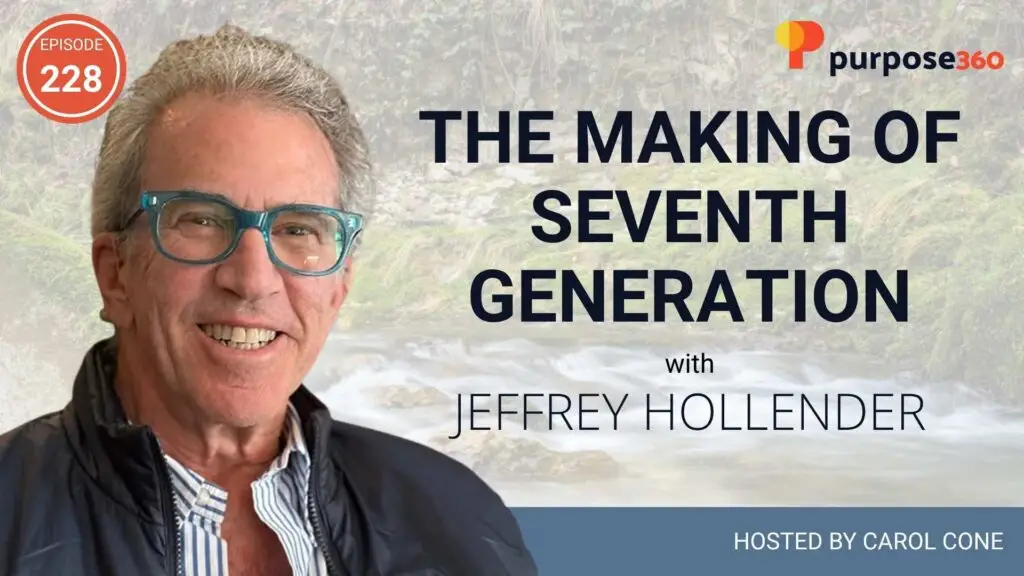
Welcome to Purpose 360, the podcast that unlocks the power of purpose to ignite business and social impact. I’m your host, Carol Cone. In today’s episode, we welcome one of the true pioneers of purpose-driven business, Jeffrey Hollender, co-founder of Seventh Generation and author of the new book Built for a Better World, which is his eighth book over his career. Jeffrey and I first met back in the early days of the social responsibility movement, when purpose-led business was still considered unconventional, even risky. In the eighties and the early nineties there were only a handful of us working to convince companies, investors, and consumers that business could stand for more than profit alone. It was a lonely field at times, and Jeffrey faced many of the same challenges that I did: proving the value of purpose, defending long-term thinking, and pushing for transparency and responsibility before those ideas became mainstream.
In this very candid conversation, Jeffrey shares the remarkable rise of Seventh Generation and the deeply personal lessons behind building a company rooted in values. We talk about the realities of scaling a purpose-driven business, navigating investors and boards that don’t always share the same mission, maintaining culture during rapid growth, and the emotional toll that can come when leadership and values collide.
What I’d like to do now is read a little bit of the first page of his book. It sucked me in and it will to you too.
On a cold night in late October I was sobbing hysterically in the Seventh Generation subterranean parking garage in Burlington, Vermont. The tears alone were surprising. Crying has never been a go-to emotional response for me, and I certainly never shed a single tear over anything work-related. But this was not an ordinary night. Minutes before the Seventh Generation board of directors had adjourned, to say the meeting had not gone well would be a monstrous understatement. It had been a hot-button session of heated debate, and I was overwhelmed by the fear that the company I had fought so hard for was about to get seriously burned. The trouble had been brewing for almost a year, and it all started when I made a deal with a benign devil.
This is a book that reads a little bit like fiction, but it’s not. It’s nonfiction. Jeffrey explains such incredible insights about almost losing Seventh Generation, building Seventh Generation, and then being fired, very candidly. I trust that I have gotten you intrigued by this conversation. It’s amazing. So let’s get on with it. I know that it will be a conversation that will help you in your business, in your efforts, and in your deep impact. So let’s begin.
So welcome to the show, my old friend Jeffrey Hollender.
Jeffrey Hollender:
Happy to be here. Great to see you again.
Carol Cone:
It’s just a delight and we should have done this sooner, so I apologize, but I’m glad to have you here. Now I want to just read a little bit about your background because you’re pretty extraordinary. You’re the co-founder and former CEO of Seventh Generation. A prolific author of eight books, an adjunct professor of sustainability at NYU Stern School of Business. You’re an activist — actually, in the book he talks about being arrested, I think a couple times at least. And I will say a serial entrepreneur. So of all of those things, Jeff, as we start out, what’s your favorite role in your entire career and lifespan?
Jeffrey Hollender:
Tough question to answer. I am going to give you two things because there’s two things that are critically important.
Carol Cone:
Okay, that’s fair.
Jeffrey Hollender:
One of them is being a teacher and an educator. I think in many ways that’s my fundamental purpose in life — is to take the things that I’ve learned and to share them with other people. But also being an activist is critical. We were very, very active against the Vietnam War and the Civil Rights Movement. And we have lost some of that momentum that we used to have. And it’s critical, particularly at this time and what’s going on in our country now, that we find a way, find our voice, make sure that we’re doing everything we can to keep the country headed in the right direction.
Carol Cone:
Excellent. And I’m glad you mentioned the Civil Rights Movement and the Vietnam War because we’re peers. And I grew up around that, and that’s what led me to have the career I’ve had in terms of helping to create purpose as business strategy over forty years. And so I’m glad you stated that, but there’s so many other things and we’ll get into that in a moment. I always like to ask: in your upbringing, in your early years, what may or may not have contributed to the path that you are on over the last years?
Jeffrey Hollender:
Well, it wasn’t my parents. And it really was growing up in the environment of the war and the civil rights movement. And having the experience of doing something that aligns with your values and your purpose — it’s sort of addictive. Once you start doing that, you feel like you have a responsibility to continue. And the more able and comfortable you are, the bigger your responsibility.
Carol Cone:
And I have to say to our listeners, you’ve got to buy this book. This book is almost — dare I say — I almost felt like it was a fiction book because you had a wild youth, surfing, and you had one of the first adult education businesses, which was crazy. And then I love the fact that — well, I don’t know, but you were arrested in Canada because of immigration — you know, you had papers that were wrong or something like that.
Jeffrey Hollender:
My family still won’t travel with me into Canada because I still get pulled aside and put in one of those little offices.
Carol Cone:
So —
Jeffrey Hollender:
And interrogated until they discovered that this is something that happened in 1978 and they let me go.
Carol Cone:
Yes. Well, I’m glad they let you go because you had a lot in your journey to contribute to the world. So let’s get into Seventh Generation. You founded Seventh Generation in 1988, long before sustainability became mainstream, maybe even a word. But explain to our listeners — what was the company? Why did you call it Seventh Generation? Let’s start with the beginning.
Jeffrey Hollender:
Right. Well, we happened into this because there was a mail order catalog called Renew America that sold water and energy efficient products. And coming out of the first book I wrote, How to Make the World a Better Place, a beginner’s guide, I talked about this catalog as a way in which you as individuals can make a positive contribution to helping the challenges we face environmentally. This was a very, very new idea, and the catalog that we were given by this nonprofit was doing nothing but losing money. And we had the same experience because it was way too early. People just didn’t think of themselves as — everybody can be an activist by what they buy and what they support. And it took a long time.
And so we basically got into the business of selling more environmental products than anyone had ever seen because we sold sheets and towels and pillowcases made from organic cotton. We sold t-shirts that were also made from organic cotton and underwear that was made from organic cotton. And we also sold toilet paper, laundry detergent, and all kinds of household cleaning and personal care products. And of all the strange things, the toilet paper was the best seller, and it was the biggest gift that was given at the holidays. And that ended up being the foundation of the business — those household cleaning and paper goods products that we all use every day, that no one realized were having negative effects on our health and the environment. And that’s why I say education is so important to me, because if we weren’t good educators, the business would never have succeeded.
Carol Cone:
Absolutely. And you actually used the toilet paper to communicate, didn’t you.
Jeffrey Hollender:
Yes, we were very concerned about the adverse effects of bleaching paper with chlorine, which creates a chemical called dioxin, which is highly carcinogenic, much more so than Agent Orange, even. And so we printed rolls of toilet paper that said facts about chlorine to scare the crap out of you. And the facts were pretty scary.
Carol Cone:
And you also ran an ad down the road that I love the headline. Do you have a toxic waste site under your sink? So again —
Jeffrey Hollender:
And most people did.
Carol Cone:
I know. And so talk about what it was like. I found it was really lonely in those early years. What was it like for you?
Jeffrey Hollender:
It was really hard because we weren’t making money and we were endlessly raising money to cover the losses we had. Things were up and down and highly unpredictable. At one point we had 120 employees, had to let 60 of them — half the whole team — go because we missed our sales goals. And most people had no idea and no understanding of what we were doing. It was just so foreign to people. And it’s really hard, as you know, Carol, to sell something that people don’t know they need and don’t even understand what it is.
And it took years and years and years, largely with the help of environmental NGOs who helped that education process along tremendously. And as the awareness grew, largely, mostly with the organic and the natural food industry, people started thinking about what they’re buying and what they’re bringing into their home. And that really opened the door for them to think not just about what they’re eating, but what they’re putting on their skin and in the air that they breathe.
Carol Cone:
And so I’m sure you have a dozen favorite Seventh Generation stories. But first, we didn’t explain why it is called Seventh Generation.
Jeffrey Hollender:
We had a Native American woman working for us. And she said, Seventh Generation, because from the Iroquois, it means in our every deliberation, we should consider the impact of our decisions on the next seven generations. And we thought, what a beautiful, beautiful aspiration to have. One that we’ll probably never live up to, but one that is wonderful and is a great vehicle for telling stories that people remember.
Carol Cone:
And you were in the earliest group of purpose-at-the-center companies. Because our listeners are fairly young, or middle management or such. They don’t know the history. And I think it’s really important for them to know, because you took such tremendous strides to shape the entire green products industry. So explain what it was like in those days.
Jeffrey Hollender:
Well, people didn’t understand the total lack of regulation that guided the manufacturing of household products. And so they had no idea that it was just okay for people to make products that were carcinogenic and highly toxic and ship them off to consumers’ homes. And people thought that that just couldn’t happen — must be looking out for us — but that just unfortunately wasn’t the case. So again, it was educating people about the dangers of these products and the fact that they could make a difference for their health and the health of their family and the health of the environment. But it was lonely, as you said, because there were a handful of people doing this.
Carol Cone:
So you’ve written your eighth book, Built for a Better World. Your first one was in 1985. And so you take people behind the curtain. There’s a lot of hard stuff in that book. So why did you write the eighth book now?
Jeffrey Hollender:
Well, I wanted to share the life I had had in the story of Seventh Generation, really for my grandchildren first. But I also was deeply concerned about where the movement was and that it had yet to accomplish — decades later — many of the things that it set out to do. And part of the book is about why hasn’t it made those accomplishments, and what do we have to do differently going forward to have the impact we need to have to keep the world a safer and better place?
Carol Cone:
And in the book, you spend a really solid chapter or two about the eight imperatives for socially responsible business. I mean, really saying, if you really want to have a values-driven business, you want to have radical transparency as one of your tenets. But what are the maybe two or three of those imperatives that you want anyone listening to take away?
Jeffrey Hollender:
Well, so two are related. The first one, which is a little complicated, is the idea of negative externalities that businesses have. So if you’re a strawberry grower and you’re growing traditional strawberries and using pesticides and herbicides and causing all kinds of soil erosion, you’re having a negative effect on the water, on the health of the farm workers, maybe even the school in your neighborhood that can no longer drink the water or safely breathe the air. But that’s not my responsibility as a traditional strawberry grower. I can dump all of those negative impacts on society and the environment and not have to pay the price for doing so. That is what has gotten us into the huge mess we’re in.
If companies took responsibility for those negative impacts, organic strawberries would actually be very, very inexpensive. Because traditional strawberries would be too expensive to buy if they had to pay the costs of those externalities. So this whole notion of externalities is a critical concept. And it’s related to another idea that you can look up online, which is about the true cost of products. What should they really cost if you had to pay for the full impact of their effect? So that’s one idea.
And the other idea you’ve mentioned already, which is radical transparency. It is not fair to the consumer that companies hide all the things that they hide. If you’re going to bring something into your home, you should know whether it’s going to put your family at risk, whether it’s going to pollute the air you breathe. But companies don’t like to talk about those bad things. They don’t like to talk about what they don’t do well. They’re sort of like someone who goes on a date and all they want to do is tell the date how wonderful they are and how beautiful they are and how smart they are, and they can’t quite bring themselves to talk about the things that they don’t do well, the mistakes that they’re making, the negative impact they’re having. And it was really that transparency that created such loyal customers for Seventh Generation, because no one else was telling them the truth.
Carol Cone:
Fascinating. So off of that, there must be a couple stories.
Jeffrey Hollender:
Okay. Well, I’ll share the Albertsons story because it’s a little bit more succinct. Albertsons, which is out on the West Coast, was the first traditional grocery store that we ever were able to sell our products in. Before Albertsons, we only sold in relatively small natural food stores. So it was a really big deal to get into Albertsons. Albertsons was also going to sell our products at a lower price because they took less markup. They were going to reach people that we had never reached before, so it was a really exciting moment for the company.
As soon as the products got on the shelf, there was a labor strike at the store. Management was getting rid of many of the healthcare benefits that they had provided to their staff to try to save money because healthcare costs were going up. And that created a conundrum for us. And many people would say, well, why would — what does it matter to you? You’re just sitting on the shelf selling toilet paper. What does it matter if the people in the store are on strike? But we said, we don’t want to support a company that is doing something that we wouldn’t do ourselves, that we thought was wrong. We don’t want to make money in that way.
And the salespeople said, you can’t pull the products off the store. No one else will do business with you again. Because if they think that you might behave in that way, why would they want to mess with a company that is going to behave in an unpredictable and potentially erratic fashion?
So we debated whether to take the products on the shelf or off the shelf, and one of the staff members came up with what was a brilliant idea, which was: keep the products on the shelf and give the benefit to the consumers who can buy them. But take all the profits that we made from those sales and donate them to the Workers’ Strike Fund so that the workers would have a longer period of time they could continue their strike and hopefully get back the healthcare benefits that they were losing.
And the mere fact that we had that conversation was unusual. The mere fact that that conversation involved the entire company and that everybody was able to weigh in — and it wasn’t my decision, because I would not necessarily have made the best decision. It was the decision of the staff, who were all at that point shareholders of the company, and they were not just concerned about hurting the value of the stock that they owned. They were more concerned about doing the right thing and maintaining our values and living up to our vision.
Carol Cone:
That’s wonderful. So this leads me to the next question. It’s perfect, which is: what is the role of employees in a socially responsible company?
Jeffrey Hollender:
They need to be — just like we used to have citizens in a democracy — they need to have a voice, they need to have a vote. They need to be heard, whether you like what they have to say or not. They need to have that voice. The employees who were not treated with that level of respect end up being demotivated about working for the company. I mean, we have terrible, terrible — if you read the Gallup studies —
Carol Cone:
Oh, so it’s twenty-one percent engagement, I think, right now.
Jeffrey Hollender:
It’s terrible.
Carol Cone:
It’s horrible.
Jeffrey Hollender:
People don’t like their managers, aren’t proud of their companies, and that has a terrible effect on the performance of most businesses.
Carol Cone:
Yeah.
Jeffrey Hollender:
So we involved everybody. We wanted to hear those voices. And because we were creating an environment where — and as a matter of fact, there was an employee representative on the board of directors, for example, which is a common practice in Europe and Germany, but not in the United States. Most people do not want an employee sitting in on the conversations that happen at the board level. They’d be embarrassed if anybody knew about what they were talking about. But we had an employee sitting in on those meetings, which is a critically important thing to do. We made them all shareholders of the company so they had an ownership stake. And we gave them a voice on a regular basis to talk about what was on their mind, what they liked and didn’t like about what we were doing. And that’s not for the faint of heart. I had many, many things said about me that I didn’t particularly enjoy hearing, but they made me a better manager.
Carol Cone:
Yes, this was pre-internet days. Can you give our listeners a little bit of the trajectory of the size of the company from its earliest days? And then you also went public — I think in ’93 — but then you also went private. I think you said you’re one of the first Vermont companies that ever went from public to private. Why did you go through those machinations?
Jeffrey Hollender:
Well, we were losing money and we had to keep finding more money to keep ourselves going. And I had run out of my friends, I’d run out of my doctors and lawyers and dentists. I mean, I had harassed all these people for money for years. No one was left that I hadn’t asked that I knew. So really the only option we had was to take money from a venture capital firm, which scared the hell out of us because we thought we would lose control of the values and vision of the company. So we did something that was a crazy thing to do for a company that was really just about 10 million in sales. We took the company public. And we decided we would rather have thousands of very little shareholders than one big shareholder who could really boss us around.
And I think it was the right decision at the time, but it was a tough thing to be a public company. It was very expensive. And the stock price, after going up a little bit, did nothing but go down because we were not growing as fast as our customers and shareholders would like. We weren’t making enough money. And the stock price, which was originally $5, dwindled all the way down to about 40 cents. And we decided this is not a good way to do business. We’re not taking care of our investors the way we should. So we bought all the stock back from our public shareholders at twice what the stock was worth at the time. So it was not $5, but it was better than 40 cents. And raised money from private equity, from venture capital, from hedge fund managers to get the company going back on a growth mode, which it did and grew from — in 2000 from about 10 million — till ten years later at about 150 million. So we had a tremendous growth burst, again at the time that natural foods and organic foods were being first really introduced to a broad market.
Carol Cone:
So in the book — you had this spurt of growth, significant growth, and then you added a significant amount of new employees, and in the book you talk about — but they weren’t of the same ethos. They weren’t of the original culture, and there was perhaps a clash of cultures. So what recommendations, in hindsight now, would you have for listeners — future, current, social entrepreneurs, etc. — about growth? Because you say growth is good, but growth may not be so good.
Jeffrey Hollender:
You have to moderate growth because — first of all, growth is addictive. It’s exciting. You’re making more money. It’s sort of like drugs. You can’t get enough of it. But it is dangerous in terms of maintaining your values and your vision because, as you said, we were growing so quickly we kept bringing people into the company who came from very traditional backgrounds in consumer products companies. And at one point, the average employee — half of the company — had only been at the company a year or two and didn’t have that whole experience that most people had had.
And what I discovered after making many mistakes, hiring people that I thought were much smarter than they were and much more committed to our values than they were, was that we were much better off investing in the growth and development of our own staff than going out and trying to find people who we thought knew a lot more than we did. Because that staff that had been with us historically — and our turnover rate was next to zero, people didn’t leave once they came.
Carol Cone:
So you want to hire the right people. You might want to moderate growth a bit. Any other insights — because you’ve got investors and they’re still egging you on, and you’ve got the public, and now you’re getting into mainstream retail. Any other insights to help companies maintain their values and their mission?
Jeffrey Hollender:
Be very, be very careful who you take money from. Do more due diligence on your investors than on your employees. If you’re going to get money from a venture firm, find three CEOs that have taken money from that firm and find out whether things went the way they wanted them to go. How did things go when business wasn’t hitting the goals that it had? And if I had done that kind of due diligence, I would have taken money from some different people than I did. I did not do that due diligence. And it is critical for purpose-based companies to make sure that the money that you take is aligned with your mission and vision. Otherwise, you will have a board that will not support the things that you’re doing and particularly many of the risks that you’re taking to discover new ways to have a positive impact on the planet.
Carol Cone:
So great. That’s a great segue. I want to talk about boards, but I want to talk first about when you became an activist company. You know, first you were an eco-products company. But then you started — you were on the board of Greenpeace, you were doing some — I think you did some blood testing on yourself — but you did some things truly that you didn’t do them for doing them. You did them to educate and bring consumers along. Can you give some of those stories about some of the activist things that you did that you felt really worked?
Jeffrey Hollender:
Sure. Well, what we were learning was that it’s not good enough to play by the rules and do the things that you like and even be an exception to the rules. What really matters is changing bad rules so that everybody has to behave appropriately — don’t be an exception to the rules, change the rules that you don’t like. So as you said, I joined the Board of Greenpeace, for example, for 13 years. I was probably the first business person that they ever let onto the board; usually they were used to fighting them, not sitting in the same room with them. And that was an incredible experience.
And it led to one of the most wonderful things that we did. Consumer products companies all have these sweepstakes where people win stuff. You win a trip to a NASCAR race, you win a trip on a hot air balloon. Well, that’s not in keeping with who we are. So we had a contest where what you won was a week in Washington to be trained by Greenpeace to become an environmental activist.
Carol Cone:
Great, love that.
Jeffrey Hollender:
And that was a very, very different way to build relationships with your customers. And we felt that much of the things that companies do don’t really support their values. We wanted to make sure that everything we did, as best we possibly could, was aligned with who we were and aligned with the world that we were trying to create.
Carol Cone:
So that was great, very smart. I don’t know if that was your idea or one of your colleagues’, but you created the culture to come up with those ideas. That was great. You started getting a little more radical with some of your activist actions. I’d love you to share them because your board started getting uncomfortable — let’s say — with those actions. Let’s talk about what those actions were.
Jeffrey Hollender:
Well, one of them was demonstrating in Washington about the lack of action on climate change. And this was during the first Bush administration. And unfortunately, I got arrested and put in jail along with a whole bunch of other people. And that wasn’t the first time. And some members of the board were not comfortable with that. They didn’t like the idea that their CEO was in jail. They thought that sent the wrong message. And I said, no, it sends exactly the right message. That we’re so committed and passionate about what we believe in that we’re willing to stand up for it and if necessary go to jail as a result of those commitments. So I thought I was doing the right thing, but clearly they did not, and they were not happy and excited the way the staff was cheering me on. And you know, that created tension.
And it was just one of many things that we did. I mean, when we introduced feminine care products, for example, we did something that was a little crazy. We allowed our consumers, our customers, to donate product that we paid for to their local women’s shelter. And we had tens of thousands of people doing this. And it was like — the board didn’t understand — how are you not supposed to give stuff away? You’re supposed to sell it. And again, we said this builds the kind of relationship with our consumers that leads to tremendous loyalty and commitment.
Carol Cone:
And imagine today that’s like de rigueur. You just — it’s done. It’s expected. It’s kind of like a baseline. But it’s amazing that your board — you know, their furrowed brows and things like that. I want to talk about boards. And you are very transparent in the book about: be careful about who is on your board, cultivating your board, working with your board. Talk about your board, because it eventually became a real problem for you.
Jeffrey Hollender:
Yeah. Well, and to be fair — even though I took money from people whose primary motivation was to make more money, not solve the world’s problems, that’s not what they were doing. That’s not how they became wealthy and had money to invest. They got there because money-making was what was most important to them. So I did a lousy job in selecting the people I took money from, which was the beginning of the problem. And I did a lousy job educating them about why things like employee ownership were so important — and don’t worry about the dilution that your stock will have if we give some of it away to our employees, because them as owners will make the company worth more money more quickly than if they were not owners.
But I didn’t explain some of these things to my board and I was impatient and didn’t want them to get in my way, because I was not the kind of person who was stopped easily. And we at one point hired — I got to the point where I sort of wanted to get out of the day-to-day of the business so I could write more and speak more. And we brought in someone who was very, very traditional, someone who came from a large consumer products company, who said all the right things, seemed like a really nice guy. And when push came to shove, he was not as aligned as we thought he was. And I was irritating the board. The board liked this guy. The board knew that this guy knew how to do business the way they had done business and were comfortable. Turned out they liked him a lot more than they liked me. And push came to shove — I got thrown out of the company and he became the leader of the company for a very short period of time because the board discovered six months later that he was not as good as they thought he was, and it was a mistake, I think, to have hired him.
Carol Cone:
And I want to share with our listeners how candid you are in the book. I just want to give you a lot of credit and kudos for the transparency of the commentary in this book. That’s why it’s such an important book for everyone to read. So how — okay, so you got terminated, and oh my god.
Jeffrey Hollender:
Yes, on a Saturday morning, by phone, by phone.
Carol Cone:
By — wasn’t it a friend, like your friendly lawyer that you knew? And so you thought —
Jeffrey Hollender:
So I thought —
Carol Cone:
And can I just ask you — you must have felt — I mean, I’ve had bad things happen in my business, but that is like severely bad. How did you feel? You must have just gone numb.
Jeffrey Hollender:
It was traumatic. It was traumatic. It was almost as bad as my brother passing away, which I also talk about in the book. It was horrible. And I thought it was not even possible that that would ever happen. It was out of my consciousness. I didn’t really pay attention to the fact — then when I no longer owned 51% of the company, I became an employee. Even though I was the founder and the CEO, I was an employee of the board, and they could let me go whenever they wanted. Governance is important. You have to make sure that you don’t just do the right thing, but you set up the governance of the company that makes sure the wrong things can’t be done.
But anyway, it took me honestly about two years to recover from that. It was horrible for my family. The headline of the local Burlington Free Press was, you know, “Hollender fired from Seventh Generation.” And of course everyone assumed that I had some illicit affair with someone or I had stolen some money. You know, it was hard to explain to people what had happened, and it was very hard for my kids to explain to the kids that they ran into at school who were wondering how bad their dad really was.
Carol Cone:
You had a nondisclosure. You could not say anything. You could not disparage them. So your hands were tied, but that must have been horrible. I think in the book you say it’s like losing a child. It was your other child.
Jeffrey Hollender:
It was, it was. And I had poured my heart and soul for 20 years into this business. It had not been easy.
Carol Cone:
And you say in the book that — and I love that the dedication is to your wife, Sheila — that Sheila was there with you, but she continued to work because she had a seat on the board, I think.
Jeffrey Hollender:
She did.
Carol Cone:
Yeah. But talk about the role of family in business. And then you started Sustain. And your daughter was also part of that. And so maybe that was part of the — well, there is a bright light on the horizon. I can do it again. So talk about the role of family and a little bit about Sustain.
Jeffrey Hollender:
So after what I experienced in Seventh Generation, I said, I’m never going to put myself in a position again where I’m not in control of my company. My family will control the company. My family will ensure that nothing bad happens to me unless Sheila and I get into a bad fight. But luckily that didn’t happen. And it was challenging to work with my wife and my daughter. It was not easy. The three of us ended up in therapy a bunch of times trying to work out some of our problems.
Carol Cone:
So you get a call from a board member, you’re driving around, whatever, and they say, hey Jeff, how are you, etc., etc., just want to let you know — we sold Seventh Generation to Unilever. How did you feel when you heard that the company was sold to Unilever?
Jeffrey Hollender:
Well, you know, I had said many, many times that I never wanted the company to be sold because I couldn’t imagine selling it to someone who would keep it headed in the same direction. But of all the companies in the world that it could have been sold to, Unilever was really the only one that I could feel good about because of Paul. Paul was a very, very unique CEO. He had an incredible mission, an incredible vision for where he wanted to take the company. And I thought, hey, this is a trip that I want to go along for the ride on because I think that we have found a buyer who will not only make sure we stick to our values, but will make them stronger, better, and more effective over time.
And the day the company was sold, Paul called me up and congratulated me on the sale and reinforced to me how much care they would take of the business that they bought, and got rid of most of the board and invited me back to join the board.
Carol Cone:
There you go, that’s great.
Jeffrey Hollender:
I’m still on the board today. And I thought, wow, what a wonderful, brave thing to do, because he was basically inviting this crazy lunatic back onto the board of the company. And I thought, man, he’s a brave guy as well as being a very nice and wise one.
Carol Cone:
An incredible gentleman. So as we’re winding down, I wanted to go back to today. And what are companies getting wrong about purpose at the center of their organizations?
Jeffrey Hollender:
I think the two things they’re getting wrong: one is that they compartmentalize the good work that they do. So they focus on their packaging or they focus on an ingredient or they focus on giving money away to their community. Unfortunately, that’s not what we need. We need a systemic approach to doing what we need to do. We need to look at absolutely everything we do as a company — our entire supply chain, the way we treat our employees. And we have to do that with the same purpose that we bring to making our products better or our packaging better. But it needs to be holistic in its approach. And it needs to be what we call net positive. So instead of being less bad — which unfortunately most sustainable businesses are; they’re doing a couple things good while they’re doing many things that they shouldn’t be doing — you need to be holistic in your approach to thinking about how to be a purpose-based business. That’s critical.
The other thing they’re doing is not taking this notion that we talked about earlier of radical transparency to heart. They’re still not willing to open the kimono and let people know what’s inside. And you can’t build trust. You can’t build the kind of commitment you want from your employees, the kind of loyalty you want from your customers, if you can’t be transparent and tell them the truth. They don’t expect you to be perfect. It’s hard to believe that you’re perfect, but nevertheless, that’s the way most companies still behave today. And it’s a hard thing to change. I remember when we did our first corporate responsibility report at Seventh Generation, I almost gave our lawyer a heart attack when he read it, because of the things that we revealed. And I say that if your lawyer doesn’t almost have a heart attack when he reads it, you’ve done something wrong.
Carol Cone:
Great. Well, that’s excellent guidance. So as we wind this down, I always like to have these little fast, brief questions I want to ask you, which is kind of a fun sort of thing, and then we’ll give you the last word. So what’s one word that best describes your work today?
Jeffrey Hollender:
Authentic.
Carol Cone:
Okay, wonderful. What keeps you hopeful on the days that this work feels heavy?
Jeffrey Hollender:
You know, I spend most of my time today mentoring young entrepreneurs who want to create positive businesses. And I do it for free, I don’t charge. And the hundreds of people that I’m talking to day after day after day, who all are committed to doing the right thing with their business, makes me hopeful that the next generation of business leaders will do a much better job than my generation has done.
Carol Cone:
And young people today truly do want to bring their values into their work, not leave them at the door. What’s one small action people can take today to advance purpose or create impact in their own communities?
Jeffrey Hollender:
When you go to buy anything, make sure the B Corp certification is on the label. You know you’re buying from a company that shares your values and is doing the right thing in the world, and it’s how I guide my own shopping.
Carol Cone:
Super. So I always love to give the last words. Those were pretty good last words. But I love to give the last words to my guest. So what would you like to share with our Purpose 360 podcast listeners that you haven’t said already in this wonderful conversation?
Jeffrey Hollender:
So there’s a book coming out in September. Unfortunately, it’s not coming out till September. That is the best guide to being a regenerative business that I have ever seen in my life. And it’s called Impact Entrepreneurship.
Carol Cone:
And who’s it by?
Jeffrey Hollender:
And I can’t pronounce his last name. His first name is Lori. But this book is absolutely incredible. It opened my eyes to new possibilities of doing the right thing that I had never even imagined. So it is the best roadmap for entrepreneurs to continue to grow their positive impact in the world.
Carol Cone:
Well, I will definitely invite him to be on Purpose 360. So for our listeners, we’ll put it in the show notes. We’re going to put, of course, Jeffrey’s wonderful book, Built for a Better World. And it’s just fabulous. And I am so thrilled that you shared this time with us on Purpose 360.
Jeffrey Hollender:
It’s my pleasure. Thank you so much for giving me the opportunity. And you know where to find me if there’s anything at all I can do to help.
Carol Cone:
This podcast was brought to you by some amazing people, and I’d love to thank them. Anne Hundertmark and Kristin Kenney at Carol Cone On Purpose. Pete Wright and Andy Nelson, our crack production team at TruStory FM. And you are the listener. Please rate and rank us, because we really want to be as high as possible as one of the top business podcasts available so that we can continue exploring together the importance and the activation of authentic purpose. Thanks so much for listening.