Carol Cone:
I’m Carol Cone, and welcome to Purpose 360, the podcast that unlocks the power of purpose to ignite business and social impact.
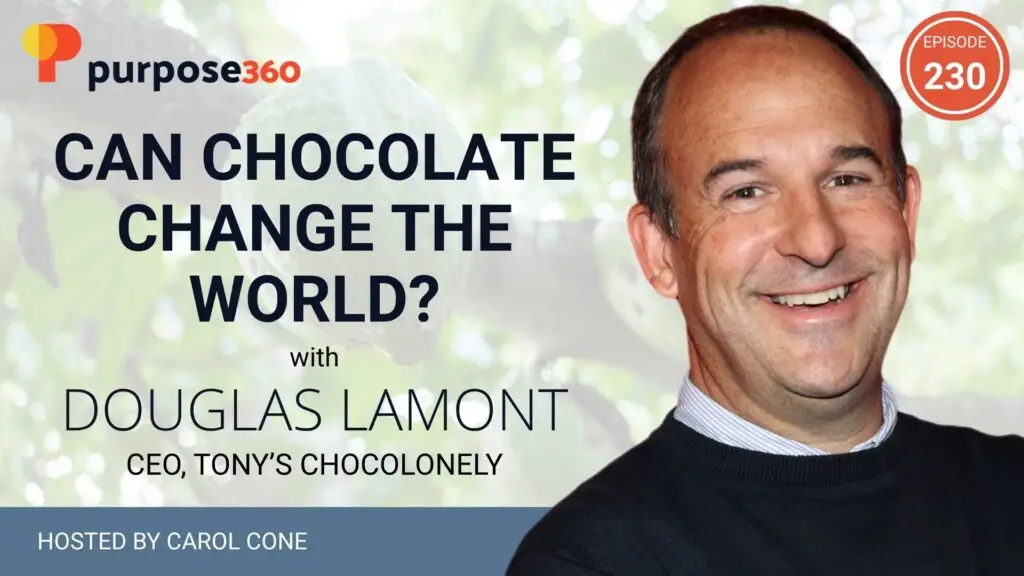
Welcome to Purpose 360, and today we have a very, very special conversation. You know, our mothers always said don’t talk with your mouth full. Well, today I have the delicious opportunity to talk with Douglas Lamont, CEO of Tony’s Chocolonely, and during our conversation, I am going to be munching on some of their absolutely fantastic and delicious chocolate.
Today’s conversation isn’t just about a favorite treat. We know we all love chocolate. It’s a conversation about how one company is using chocolate as a catalyst for systemic change. The company is called Tony’s Chocolonely because of their mission to end exploitation in the cocoa supply chain. “Right now, there is illegal labor on cocoa farms in West Africa with more than 1. 5 million children involved in child labor in Ghana and Cote d’Ivoire.
In our conversation, Douglas shares the extraordinary journey of a company that wasn’t founded by entrepreneurs looking to sell chocolate, but by journalists determined to expose injustice in the cocoa industry. It’s a fascinating beginning story. You will be blown away by it. In my conversation with Douglas, we’ll explore what happens when a purpose comes before a business plan and how Tony’s has transformed that original act of advocacy into a global brand with a scale and influence to challenge an entire industry. Douglas discusses the leadership lessons behind preserving mission while driving growth. They have key principles he will discuss, and how they contribute to building a unique and powerful business model that serves impact rather than just the other way around—and while proving that purpose and profitability can coexist—that is essential to creating lasting change. For leaders, entrepreneurs, and anyone building an impact-driven organization that can scale to evolve an industry towards greater humanity and impact, our discussion shares powerful lessons how Tony’s has stayed true to its roots while growing its exceptional influence. It’s a delicious, inspiring, candid, and wonderful conversation.
So let’s get started. So welcome to the show, Douglas.
Douglas Lamont:
Thank you, Carol. Great to be with you.
Carol Cone:
So I always love to ask, when you were growing up, you know, we’re always influenced by our parents. And so prior to Tony’s, you were at Innocent Drinks for how many years?
Douglas Lamont:
Yeah, sixteen.
Carol Cone:
So you’ve got this social impact, purpose-driven company in your blood. But did something happen as a child growing up that influenced your leaning in this direction for your career?
Douglas Lamont:
For sure. My parents were both entrepreneurs.
Carol Cone:
There you go.
Douglas Lamont:
So I sat round the kitchen table listening to business conversation, because it was a family business with the two of them running it. And so I think I was just influenced. And I think where the social side of that came in is they were both very focused on the culture of the company and how they — you know, they weren’t the biggest, they weren’t the best, but they knew that they could keep really good talent if they created a really good environment. And my father in particular was very focused on that. And so I think how you created good culture just seeped into me as, yeah, that sounds like a pretty sensible thing to do.
And then obviously over time I had that in me. And then when I joined Innocent, this is 2005, 2006, the sustainability — the combination of good culture and good sustainability — kind of merged in me, and from that point forward has sort of been a driving force of how I want to lead and the types of companies I want to be involved in.
Carol Cone:
And that’s amazing. Was there a point in time when you were like eight years old or nine years old and you said, I want to be an entrepreneur? You remember anything like that happening?
Douglas Lamont:
Yeah, I was the kid that set up the school sweet shop, and you know, I was always sort of doing that kind of thing. Interestingly, I haven’t become an entrepreneur.
Carol Cone:
Okay.
Douglas Lamont:
Both Innocent and Tony’s had some meat on the bone, so to speak, when I joined. So taking something that’s already formed and then helping it really grow — it seems to have been the kind of blend that I picked up from that young experience of light and dark of the life of an entrepreneur.
Carol Cone:
Speaking of light and dark chocolate, I’d love to ask you — put you on notice — what’s your favorite flavor of the range of the brand?
Douglas Lamont:
It does move around, and obviously we’ve just launched some new filled bars, which I would say currently I’m enjoying. Oh, there you go, you’ve got one right in front of you. They’re pretty incredible. But yeah, I have to say I love our everything bar, because it means I don’t have to choose. So the everything bar is the best of the top six selling flavors combined into one bar. So it’s for the indecisive person.
Carol Cone:
Okay. So there’s an amazing origin story for this company. And whenever I share it with colleagues, they’re like, you know, gobsmacked. So can you talk about how it began? Because it didn’t begin as a chocolate company. It began as an advocacy journey.
Douglas Lamont:
Yeah, absolutely. The three journalists, of which Teun — aka Tony — is the most famous, but Roland Duong and Maurice Dekkers were the three. And they had a TV show in the Netherlands that investigated different things. And I guess the closest analogy with a US example is a kind of an early prototype of the John Oliver show — that’s what the show they had in the Netherlands in 2005 was like.
And so they decided — they’d read about this Harkin-Engel Protocol, which was the big chocolate companies committing to address child labor in the supply chain, which they recognized was there in 2000. And so in 2005 they decided to say, well, let’s go and see. And by making that commitment through that protocol, they avoided the law being legislated against. So they said, well, let’s go and see whether anything’s been done. And so they went to West Africa and realized nothing had been done and there were still over two and a half million children working in child labor in West Africa. And they were really shocked, to their core.
They did the TV show on that and nobody paid any attention. It was a nice episode. But it really got under their skin. So they’re like, we’re going to do another episode on this, and we’ve got to wrap this up in a different way. So what they did was Teun, who was the front guy, the man in front of the camera, basically walks into a police station and says, you need to arrest me because I’ve committed a crime. And the policemen are like, okay, who’s this nutter?
Carol Cone:
Right, nutter. Okay.
Douglas Lamont:
Because under EU law, if you’re complicit in a supply chain or a consumer product that you know has been done illegally, you’re committing a crime. And so he was like, well, I know that there’s child labour in this chocolate bar and I’m eating them and therefore I’ve committed a crime. You need to arrest me.
Carol Cone:
Arrest me, arrest me, right.
Douglas Lamont:
And then it went to the court. They managed to fly over some West African kids who had been involved in child labor. And so that really then caught the imagination. The way they were telling the story — and they were journalists, they were storytellers — caught the imagination of the Dutch public to say, yeah, there is a real issue here. We should think about this.
And then the third episode, the third element of the series they did was to say, well, if none of the big chocolate companies are going to do anything about this, we need to set it up for ourselves. So then, the equivalent of the Apprentice or Shark Tank, they went and said, well, how could we do this? And it was a stump. They weren’t thinking of setting up a business. They literally rang around to find out how they could make a bar, how they could get ethically sourced cocoa.
And Charlie and the Chocolate Factory — the Johnny Depp one — was being launched in the Netherlands in 2005. They set up a guerrilla stall next to that premiere, told everyone they were going to be there, and of course they had a massive queue. They sold 5,000 bars on day one. Everyone was saying, can we have bars? And they thought, actually, yeah, let’s really put our money where our mouth is and set up a company and do this for real. And that’s where Tony’s was born.
But I think the really important thing is that the impact and the mission came first, before even the business. So the business wasn’t even in the picture at the beginning, and then obviously the business came as a way to serve the mission. And I think that’s a really important fundamental and why we say we’re an impact company that makes chocolate, not a chocolate company that makes impact.
Carol Cone:
You know, you’re very much the model of The Body Shop. Anita Roddick, you know, bless her soul. She left us way too soon. But she always said she wanted to use The Body Shop as a framework for people who were from indigenous cultures that were making all these incredible products and needed to have fair wages and things like that, and give them a soapbox. And that’s what the early years of The Body Shop were.
So kudos to you. How many years did it take for Teun, who then became Tony — easier for us to say — to become a real company that had policies and procedures and sourcing?
Douglas Lamont:
Yeah, so I think the first four years were pretty chaotic, particularly as three journalists didn’t know how to run a company — they knew how to do TV programs. But they got it off the ground, and then in 2010 they sold a portion of the company — a significant portion — to Henk-Jan Beltman, who had actually worked with me at Innocent previously.
Carol Cone:
Oh, that’s a connection.
Douglas Lamont:
Who was based in the Netherlands, and who saw the opportunity to say, I can take this amazing purpose and put some professionalization around it — FMCG best practice — to scale it and make sure that we deliver on the mission. And so I think it was the combination then of the founders and Henk-Jan, who post-2010 you really started to see the business scale in the Netherlands. And then the international journey beyond the Netherlands started in around 2016, 2017 — in the US, in the UK, and in a few other markets.
Carol Cone:
So your approach — you’re at Innocent, you’ve got a great business. I mean, it’s huge, it’s global, wonderful product, great ethos. And then you’re approached about Tony’s and it’s not that developed. Can you share — you said that when you told your son that you were leaving, it’s a wonderful little anecdote.
Douglas Lamont:
Yeah. Obviously my son used to get a lot of kudos from me being CEO of Innocent, because it’s far more interesting. Most of the dads were lawyers or bankers or whatever, and no one knows what that means when you’re eight years old. But if your dad’s CEO of Innocent — cool drinks product that’s in their fridge — you get a lot of kudos. So when I told him I’m leaving, his bottom lip started to wobble and he was looking a bit sad, but I quickly followed up with, but don’t worry, I’m going to be the CEO of Tony’s Chocolonely. And he sort of punched the air and was very much over it within about five seconds. So I think he still continues to get the kudos of me turning up with a chocolate every now and then at the school gate.
Carol Cone:
Oh, nice. Nice. So you say in your materials — and I have to say to our listeners, and we’re going to put this in our resources — you have amazing social impact reports. Yours was like 291 pages, and it reads beautifully. So you say that traceable cocoa is the foundation for addressing the root causes of cocoa farmer poverty. I would love you to share with our listeners — because there’s two parts to the company: there’s the delicious chocolate and then there’s the marketing of it, and we’ll get into that in a bit. But there is the supply chain and it is tough. So can you bring it to life for our listeners, where you’re making a dent? And you also expanded — it was child slavery and now it’s exploitation at large.
Douglas Lamont:
So I think two things are important. We talk about being an impact company rather than a purpose company, because for us it’s about being able to measure the impact. There are a lot of people who have purpose and visions and whatever. They sit on the wall, but unless you’re actually making an impact, those statements are worthless. So we definitely call ourselves an impact company. And I describe myself as being CEO of the mission, not of the brand. And that’s really important.
Because ultimately our mission is to do two things. Prove that there is a sourcing model in West Africa that allows farmers to earn a living income and ultimately get out of this exploited poverty cycle, which includes therefore not getting their kids working on the fields but sending them to school. We’ve got one and a half million children still working in child labour today in West Africa. How do we break that cycle of poverty?
And we’ve basically — the number one priority is to establish sourcing principles and a way of working that prove that you can do that. And that’s what principally the work for the last 20 years has been about: editing and trying and making mistakes and learning and doing it again and restarting again, based on five sourcing principles. And maybe as we go we can unpack those. But once you’ve got those, and what we see is the data — and we’re very data-led — we can see that they’re working. We can see that child labor rates are going down from an average of kind of 40, 50% down to less than four percent in our long-term co-ops.
Carol Cone:
Significant. Huge.
Douglas Lamont:
We haven’t eradicated child labor — we don’t make that claim — but a 90% reduction with a bit of focus is really important. We see that our living income rates relative to other co-ops are significantly better. And it’s that blend of five sourcing principles that does it.
And traceability — knowing your farmer, knowing where the cocoa comes from, and making sure you can trace that through — because then you can commit to paying a high price, and we commit to paying a living income price, whatever’s going on in the world market. Which means typically we’re paying somewhere between forty and eighty percent premium to the world market price to the farmer.
And then the key — because this isn’t about handouts or charity, this is about changing the mindset and the capabilities on the ground. So it’s about building strong farmers, and that’s helping them build cooperative structures, building their own businesses. And so if you create strong co-ops, you give them long-term contracts. As part of that, we basically commit to them: we will buy cocoa at a living income price for five years. But if you get a better offer from someone else, you don’t have to sell it to us. So we’re not locking them into us. We’re locking ourselves to them, but we’re not locking them to us.
And again, as prices spiked in the last two years, we saw that they could get more elsewhere and they chose to do that, and that’s fine. And now the cocoa has come crashing back, they’re back with us saying, oh, sorry about that. Maybe next time we’ll stick with you. Because you know you’re there for the long term. And that then allows them to invest in productivity, invest in quality, invest to send their children to school, because they have the confidence they’re going to get the right price for their cocoa rather than having to ask their children to work on the farm because they can’t afford to hire labor.
So that model is working. You then need to scale that model, because otherwise the big guys pat you on the head and say, well, it’s really nice, Tony’s, but you’re a micropilot and we’re big proper companies and it won’t work at scale. So that’s where the rest comes in. That’s where Tony’s Open Chain comes in. It’s like, well, okay, I’ll prove that I can scale this by scaling a brand that requires lots of beans.
What we realized — and great credit to my predecessor, Henk-Jan — in 2018 and 19, he realized that however fast Tony’s was going to scale, even if we got to a billion dollar brand, we wouldn’t be big enough to prove that the model worked at scale. So he set up this thing called Tony’s Open Chain, which said, actually, anyone can have our beans. If you’re a competitor, if you’re a private label provider, source your beans through us and we can scale faster and prove this change model works at scale.
And so that’s what’s happened. Obviously Tony’s has scaled a lot. But more importantly, so has our open chain partner. So whether it’s Ben & Jerry’s, whether it’s big retailers like Waitrose in the UK or Albert Heijn in the Netherlands, they all source their cocoa through us. And as a result, just about 40% of our cocoa is sourced for other people. And we’re almost twice as big as we would be otherwise, which is how you get to prove it.
And that’s what impact looks like. Collaborating in the supply chain rather than just trying to maximize it and keep it as your own secret source is really what we’re about. That’s what an impact company does.
Carol Cone:
Right, a very expansive mission.
Douglas Lamont:
Exactly.
Carol Cone:
And I love the fact that you are about the relationships that you build with your farmers. So can you share the five principles? Because I think they are very intentional.
Douglas Lamont:
Yeah, so just running through the headlines. It’s traceability. It’s paying a higher price, committing to a living income price. It’s building strong farmer networks through the cooperatives. It’s committing to them for the long term, but an asymmetric contract so they don’t commit to you. And it’s having quality and productivity programs. And whilst it’s not a sourcing principle, what we do alongside that is child labour monitoring, to make sure that if you do that bundle, does it increase their living income and does child labor go down?
So those are our two key output measures from applying those five sourcing principles. And what we see is that model is working, but as you say, very intentional, very dedicated. I’ve got 25 people on the ground in West Africa working directly for us. So we’re not at a distance. We’re hands-on in this, building those relationships. We know those farmers. We visit every household every year ourselves. So it’s pretty deep.
Carol Cone:
It comes through in the taste of the product. And you’re very soulful, which is you know what Tony’s is all about. I would love your reporting, by the way — it’s incredibly transparent. And you report on good and you report on bad. Why do you do that?
Douglas Lamont:
Because what we’re trying to do in our change model is talk about the issues, because only until you talk about the issues, shine the light on them, can you do something about them. So yeah, we talk about the fact that we find child labour cases. And we happily publish and say we found 1,200 cases. But this is what we did about them. This is how we’ve remediated them. This is how quickly we’ve addressed the issues.
And by talking about them, what we hope is it normalizes it as a conversation, so that then the big guys — who will also be sitting on much worse numbers, but are so fearful of the backlash if they ever acknowledged it — don’t say anything about it. And therefore they don’t act on it, because it’s like, well, if the problem doesn’t exist, what are we acting on?
So my wish for all big companies — and this doesn’t apply just to cocoa — is that there’s this amazing moment where we have a moratorium and everyone gets to put their shit on the table and say, right, this is our starting point. Our only commitment from now forward is we’re going to improve. The world will be in a much, much better place.
Carol Cone:
That’s great. I want to talk about the role of a CEO in building a social impact brand. many of our listeners want to be Douglas Lamont in some years. They want to be at a company like that. So what’s your advice to them on how you are managing and growing the company to make it real and authentic?
Douglas Lamont:
Yeah, so I think two things. As I said earlier, I see myself as CEO of the mission, not of the Tony’s Chocolonely brand. And that’s really important because it drives the kind of decisions that I make as the leader of the company. But I also have to prove that Tony’s Chocolonely is a profitable company. Because otherwise the other objection is, yes, the supply chain scales, but you don’t make any money. You’ve got lots of revenue, but you don’t make any money because all your supply chain stuff is so expensive. That’s another reason for others not to act. So my job is to remove the barriers.
Carol Cone:
You have so many structural things that you do, it’s very fascinating. You have two governance tracks. You have Mission Guardians, which I love, and Seth Goldman is one of them. And we’ve had him on Purpose 360 — his iced tea, fabulous product. And then you have a supervisory board. Why do you have the two?
Douglas Lamont:
So the supervisory board is what anyone would consider a classic board. It’s a mix of your shareholders and some non-execs, with the senior management team. So that’s kind of normal. It’s just in Dutch it gets called a supervisory board.
The mission lock is something different again. What we said as an impact company — we wanted to make sure that was protected for the long term, because this is about long-term change and a long-term mission. And you know, me coming into Tony’s, I don’t want to work really hard for five years on something I’m passionate about, and then the shareholders change or the board changes and they say, actually, we’re not about this anymore.
How do you give reassurance to employees, to your consumers, that you mean it and you mean it forever? So the mission lock basically — and again, all my shareholders supported this, including my private equity backers — gave a golden share to three Mission Guardians whose only governance responsibility is to look after the mission. And the mission is quite tightly defined against the five sourcing principles.
So it’s not completely open-ended, but it’s saying Tony’s five sourcing principles and the mission to end exploitation are fully served, and you can’t legally change the director’s duties without our permission. So if we wanted to say, no, we don’t need those anymore, they can block them and say, no, legally you can’t change those. So there are escalating powers if management go in the wrong direction and legal powers to make sure that the mission as written doesn’t get changed unless they agree with it. So that’s pretty powerful.
Carol Cone:
That’s it, yeah. It’s very parallel to Patagonia and what they did when they sold the company to the purpose trusts, where their only shareholder is planet Earth. And you’ve done a mission lock to protect what you’ve created.
Douglas Lamont:
Yeah, exactly. I like this because I think if we’re going to change things in the world, we have to be realistic that unless there’s economic return for investors, the world won’t change as fast as we want it to. So I like this construct because it has some protection for the mission, but it still allows investors to get economic return at a normal rate.
Carol Cone:
I want to flip a little bit, to pivot to marketing. Because you don’t buy a lot of ads. You have a very small ratio, what 3%, 2%?
Douglas Lamont:
Yeah, two point seven percent.
Carol Cone:
But you talk about little bits of magic that sometimes become rockets. And you would talk about giving freedom to your creatives and that anybody can have a great idea. I’d love you to talk a little bit about that kind of cultural attitude and then tell a story or two about what’s your favorite, because you do some really irreverent things which are pretty funny. So maybe you’ve got one or two that you go, wow, here’s a bit of magic that just took off.
Douglas Lamont:
Yeah, I think one of my marketing heroes, Adam Morgan, who wrote Eating the Big Fish — the challenger brand book, he was kind of the godfather of the challenger brand world — he wrote another book called A Beautiful Constraint. And I think the lovely thing about having no money to do marketing, because we’re paying farmers the right price in the early days, is that it just forces you to be creative.
At Tony’s, it’s always been about how do we tell stories in a bold, earned way? That journalistic DNA was like, well, we’re good at telling stories and how do we encourage people to tell stories and communicate? I guess some of the best examples — again, the bar itself. And for those who’ve never had a bar of Tony’s, when you open it, it’s unequally divided.
So why is it unequally divided? Because the cocoa industry is unequally divided. And also even within that, there’s a hidden map of West Africa within those unequally divided pieces. So it goes to the origin story of where we source the cocoa from. And some of these hidden gems that we don’t act on and tell people about, but then someone discovers them and tells their friend, and then they feel like they’re part of our club. Because it’s a bit about discovery. It’s about clear storytelling that tells, but also hidden things that feel like discovery and therefore connection. That’s the sum of things we do.
I guess one of the more upfront ones we do is we have an advent calendar every year, and on day 10 we leave out the chocolate on day 10. So when the person buying the bar — or the kids — open it on day ten, there’s no chocolate inside. And of course, outrage. Like, I’ve paid for this thing. But of course what we do is we explain the cocoa industry is unfair, we tell the story.
And in the first years we didn’t have another one in there, and we got so much coverage. But we decided the following years we would put a second one in to help them catch up the day after. But again, we haven’t gone, oh, let’s be really nice to the consumer and make it a seamless consumer experience. We jab things in to make people pay attention. And yeah, we get lots of positive and negative coverage for that advent calendar every single year. The tenth of December every year, the right wing UK press, for example, are up in arms. GB News is like, you know, it would be Fox News equivalent — oh my God, this woke company doing this thing. But it creates a conversation.
We have this framework: create awareness, lead by example, inspire to act, and create awareness by putting friction in the system. And the unequally divided bar — some people hate it. They’re like, it breaks badly, and you’ve done it because you want me to eat more. And please, if you change one thing, just make it normal squares. And I’m like, over my dead body. When exploitation is finished and all the big chocolate companies are paying a living income, then I might think about it. But while the industry is unequally divided, it’s just great storytelling. It’s about creating conversations rather than telling. It’s about creating a reaction. That’s our marketing model and why in the US we’ve gone from nothing in 2017-18 to over a hundred million of sales now. And we spend about a million to a million and a half dollars on our marketing in the US.
Carol Cone:
I will be remiss if I don’t ask this question. I always thought it was Chocoloney. And then when I realized it’s Chocolonely, can you explain why it’s Chocolonely? And then I’ve heard you’ve had some really cool promotions around that. Like asking people on the street what they think of it.
Douglas Lamont:
So yeah, the reason it’s Chocolonely is because Teun and the other two journalists, Maurice and Roland, felt like they were on a lonely journey to change the chocolate industry. And so that was the origin. Actually, as part of this TV film, they went to see Ben & Jerry’s, and Ben & Jerry’s were like, for whatever you do, don’t call it Teun’s Chocolonely. Because if you want to be a global brand, no one knows what Teun is — Teun is the Dutch name for Tony. Call it Tony’s. And then they came up with Chocolonely about that lonely journey of change.
Obviously our job is to become less and less lonely over time. And that’s what open chain and our mission allies are all about. We call the people that join mission allies. And open chain is our whole part of becoming less lonely. We don’t want to stay lonely forever. The whole point is to change the industry and have more and more people applying the five sourcing principles, either through us or for themselves.
Carol Cone:
So I can’t wait for the day when you change the name of the company to Choco No Longer Alone.
Douglas Lamont:
Exactly. And if we ever got there — and I think it’s a long road — we might think about it, because why not? That would be more storytelling, right?
Carol Cone:
That’s great. As I said earlier, there are a lot of young people or mid-career professionals that would love to work in a really authentically purpose-driven company like Tony’s. Or they ultimately want to rise up the ladder to your job. What advice do you give them early in their careers so that they can get on this interesting road?
Douglas Lamont:
So the advice I give to everyone who started their career, aged between 20 and 35, I would say: don’t think about going fast up one stream. Think about it like a career climbing wall. You’re way more valuable to me in what I would call a mid-tier entrepreneurial company, if I know you can turn your hand to a number of things. And so I’m not interested in people who have risen to level forty-two in their corporate jargon. I’m interested in people that have done six or seven different types of roles during their early twenties.
So go for variety rather than height in your twenties. Because whilst it feels important — and yes, your friend will have one higher rung on the company car scheme because he’s got promoted and you haven’t — if you’ve done three jobs at one level, you will go past them. So build variety of experience in your 20s. It will pay huge dividends, and particularly if you want to join a mid-tier company, because basically what I look for is smarts and capability and some experience in a particular thing, but I look for people that have rolled their sleeves up and can roll their sleeves up.
Carol Cone:
Roll their sleeves up. Okay. I like it.
Douglas Lamont:
Because otherwise people go really high up, go fast up a ladder, and then they go, oh, but yeah, I want to come and do marketing at Tony’s.
Carol Cone:
Yeah.
Douglas Lamont:
And they arrive and say, well, what time’s the limo picking me up to take me to the agency? It’s like, no no no. You’ll write the brief. You’re doing the work. So again, it’s not a glamorous world that we live in. It’s an everybody in together, everyone round the table, make this happen kind of world. And you’ve got to be ready for that. Because it’s not executive dining rooms.
Carol Cone:
Okay. That’s great advice. A long time ago. Okay. How about someone who wants to become a social entrepreneur? They want to create a purpose-driven, you know, an impact company. What one or two things — I mean, there’s many things and you’ve shared many, thank you — but what are one or two things they really should keep as their North Star when they’re on this path?
Douglas Lamont:
Yeah, I think really tightly define what you’re trying to achieve. I think missions that fail or don’t resonate are too broad or too loose, or, well, we’ll kind of work it out. So I think be quite narrow in it. And having said that, yeah, we’re going to change the chocolate industry — that’s not narrow. But it wasn’t be good and be kind. It had a sharpness to it. So have some edges to what you really mean, so one, you can communicate it really effectively, and two, it’s a useful decision-making tool for you.
Carol Cone:
Great. Okay. As we wind down we ask these really brief rapid fire questions. So don’t overthink them. Here we go. What’s one word that best describes your work?
Douglas Lamont:
Impactful.
Carol Cone:
Okay. What keeps you hopeful in the days this work is heavy?
Douglas Lamont:
I don’t know whether it’s hopeful, but certainly determined. That conversation we had about West African farmers — they live very different lives to us, and supporting them, but also inspiring wider change — if there’s a lot of people looking at Tony’s, if we don’t make it, I think that’s deflating. And I’m inspired by inspiring other people.
Carol Cone:
Oh, love that. Okay. What’s one lesson you’ve learned from Tony’s that you couldn’t have learned anywhere else?
Douglas Lamont:
That we all need to wake up — if we want to lead the world to a more sustainable future, we just all have to get over collaborating in our supply chains and then compete at shelf. But let’s not compete all the way through, because otherwise supply chains’ positive impact further up the chain, whether it’s on carbon or whether it’s on exploitation, just won’t change fast enough. So collaborate in your supply chains with your competitors.
Carol Cone:
Collaboration, yeah. And that takes courage and vision and generosity.
Douglas Lamont:
Yeah, all of those things.
Carol Cone:
Yep. What’s one small action people can take today — just an average person — to advance purpose or create impact in their own communities?
Douglas Lamont:
I think: start. Start small. Do one thing better. Make one thing in your community better. Don’t be ambitious. Try it. I think the dopamine you’ll get from that means you’ll do more of those. Or make or buy one thing better — which is the store down the road that’s actually a B Corp. Buy one of those. Buy a muffin from the B Corp, not from the one that’s doing it a different way. Start small — small actions have big consequences.
Carol Cone:
Super. And if you could leave listeners with one idea or feeling today, what would it be?
Douglas Lamont:
Well, you referenced her earlier — Anita Roddick. She’s sort of one of my inspirations. I think her famous quote is, you know, if you think you’re too small to make a change, have you ever tried to go to bed with a mosquito?
Carol Cone:
A mosquito.
Douglas Lamont:
People, you have power. And I think in this world people feel like they don’t have power. But keep acting and keep believing and keep being the annoying person, because then you know change does happen. Find your collective, and in itself that has power.
Carol Cone:
Fantastic. I always love to give the last word to my guest. We’ve covered a lot, but this has been a spectacular conversation. So over to you, Douglas.
Douglas Lamont:
Oh wow. A big drum roll finish. I look, I’m super — the world feels a bit, if you’re in this space and you’re a B Corp or ESG, where everyone’s a bit like, oh God, is it all over — I’m completely the opposite. I’m half glass full. If you study change movements over time, they all take time. Take the suffragettes. That took a hundred years. And there were many moments where it looked like the vote would be given and then it went backwards and then it went forwards.
Our job, our passion, is to make sure that the next time the tide comes in on these topics, it goes higher up the beach and the breakthroughs really happen and legislation really happens. There’s lots of good companies raising the ceiling. If we prove that this is the right thing and the smart thing to do, the floor will get raised eventually. So stay positive. Let’s show that the path we’re on is the right one to lead the world to a fairer and more sustainable future.
Carol Cone:
Fantastic. Douglas, this has been an amazing conversation. And I trust that our listeners will be so inspired to take a small action — ideally, buy your product — and to be very authentic and engaged. So thank you so much for bringing your incredible wisdom, passion, and just delightful personality to Purpose 360.
Douglas Lamont:
I’ve really enjoyed it. Great to chat to you.
Carol Cone:
This podcast was brought to you by some amazing people, and I’d love to thank them. Anne Hundertmark and Kristin Kenney at Carol Cone ON PURPOSE. Pete Wright and Andy Nelson, our crack production team at TruStory FM. And you, our listener. Please rate and rank us, because we really want to be as high as possible as one of the top business podcasts available, so that we can continue exploring together the importance and the activation of authentic purpose. Thanks so much for listening.