Pete Wright
Hello everybody and welcome to Taking Control the ADHD podcast on TruStory FM. I’m Pete Wright, and I’m here with Nikki Kinzer.
Nikki Kinzer
Hello everyone. Hello, Pete Wright.
Pete Wright
Oh, Nikki, do you know how to read?
Nikki Kinzer
I do, I do. I learned at a very young age.
Pete Wright
I don’t know about that. Not according to our guest today, famously who thinks nobody knows how to read. Uh, but that’s okay. She’s here to help us learn how to read and how to read a special kind of book. Oh, I’m very excited about this today. Before we dig into the show proper, I want to tell you about our Patreon community because if you’re a regular listener, this is your next move. Members to this uh fine podcast get ad-free early access to every episode, access to members-only channel and our dis channels in our Discord server, and a seat in the live stream recording of the show where you can ask questions directly to us and our guests as we chat. Plus, we’re throwing in special events all the time throughout the year. But honestly, the thing you need to know the most about this is that it is a community in and of itself. It is a group of real amazing people, all living with ADHD, who all show up for each other in a way that’s pretty hard to find anywhere else.
If you have ever wanted To be more than just a listener. This is where it happens. And you can do that yourself by visiting patreon. com/slash the ADHD podcast. That’s Patreon. dot com slash the ADHD podcast to learn more and join us. And if you’re not ready for that yet, that’s fine too. You can find us at take controladh. com, connect with us on the socials, join the Discord, the free part Or sign up for the weekly email newsletter.
We would love to have you wherever you land.
Okay, everybody. Now I this it’s unfortunate today that our guest is also a friend of mine, uh because I there are probably gonna be things that that I uh maybe there’ll be some some jokes nobody’s gonna get. That’s okay. uh because uh my dear friend Misty will get it. Uh Misty is a fantastic podcaster in her own right and she’s uh she Uh her podcast, I I don’t know, we’re gonna have her talk about why she she decided to do this. She she decided to do a podcast where she reads hundreds upon hundreds of self-help books. uh like a maniac, like some sort of sociopath. And uh not like the rest of us who buy the self-help books and then stack them up on our bedside table to prop up the laptop. And uh so she’s here to teach us how to read.
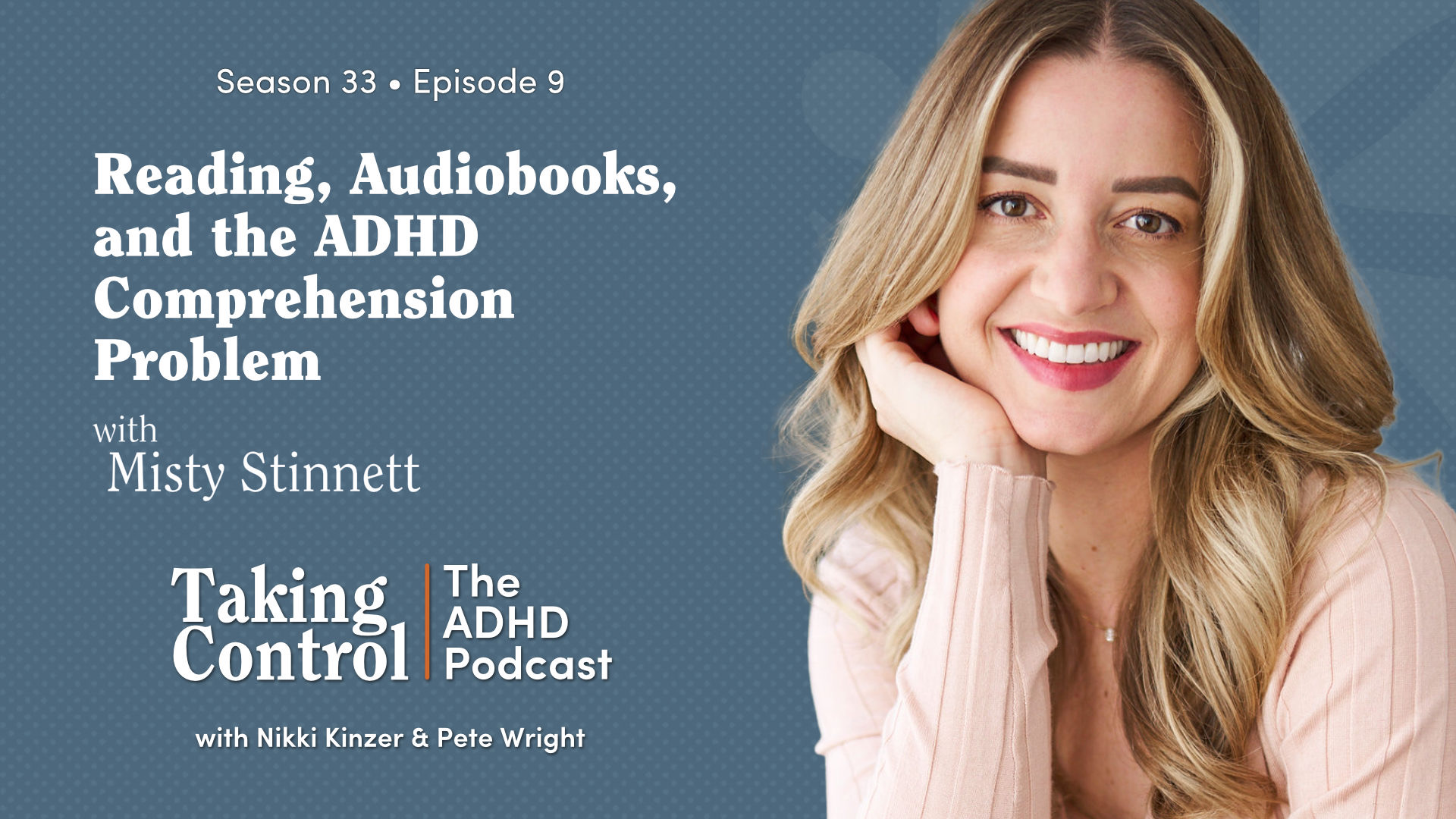
Specifically, we’re going to be talking about reading and audiobooks and the ADHD comprehension problem. Misty Stinnett of Go Help Yourself of the Mark Manson Organization. Welcome to the ADHD podcast.
Misty Stinnett
Thank you so much for having me. I am psyched to be here.
Pete Wright
Are you psyched?
Misty Stinnett
I am psyched and I’m like clutching my favorite self-help.
Pete Wright
Are you though?
Nikki Kinzer
Yay
Misty Stinnett
I say I say bless the baby.
Pete Wright
That’s the baby.
Misty Stinnett
I’m holding Nikki and Pete’s book, unapologetically, ADHD, for those who are not on video.
Pete Wright
Oh
Misty Stinnett
Fantastic.
Pete Wright
Fantastic.
Nikki Kinzer
Yay
Misty Stinnett
Yes, yes. I carry it with me wherever I go.
Pete Wright
Thank you.
Nikki Kinzer
Oh, we love that.
Pete Wright
Yeah. Yeah. Carry a couple and just hu start hucking them at people.
Nikki Kinzer
Just give ’em two people, yeah.
Misty Stinnett
Yeah, yeah, yeah.
Pete Wright
That’s great.
Misty Stinnett
I like to kind of virtue signal all the time.
Pete Wright
Yeah. Right.
Misty Stinnett
It’s my favorite thing.
Pete Wright
This uh so this conversation uh well actually Nikki you should probably start. Where did this this conversation come from? You run into this all the time.
Nikki Kinzer
Oh, personally and you know with clients. Yes. I have I I started buying self help books back in like my early twenties Right. And I still have some of them from back then that I haven’t been able to let go of because they mean something to me Um, but no, it’s definitely, yes, personally and with clients, especially with ADHD, right? There’s so many ADHD books, but then there’s a lot of other books that are self-help that you are interested in, but it’s harder even to wrap your head around those when they’re not written for ADHD. So you’re trying to pull things out that, you know, are relevant for your for you and your brain and So yeah, it’s it’s definitely, I think uh more people have have them set up as decoration than anything.
Pete Wright
Mm-hmm.
Misty Stinnett
Yeah, yeah.
Pete Wright
I it that w Misty, just give me a ballpark. How many self-help books have you gotten through for your show and beyond?
Misty Stinnett
Oh my gosh. I would say on the show we have at least 150 reviews of the most popular self-help books. And then because I have a sickness um for reading self-help books, I I think I must be in in the hundreds. It must be at least, you know, 50 or 100 more than that.
Pete Wright
Yeah yeah, that’s a that’s so much help.
Misty Stinnett
Yeah, my own world.
Pete Wright
Like do you ever th sit back and think I’ve I’ve been helped enough
Misty Stinnett
Oh, I will say there is 1000% a thing is too much self-help. There’s too much self-help. There’s too much swirling. There’s too much like and and also I’ve I’ve wondered a lot, what am I signaling to my brain if I’m constantly going to I’m not enough. I haven’t figured it out yet. Let me outsource my wisdom. Let me, you know, am I telling myself you’re not enough?
Pete Wright
Yeah
Misty Stinnett
You are. So yeah, this is something.
This is something I think about a lot.
Pete Wright
Well, I think about it a lot in in the context of social media, right? There’s so many conversations about social media going on right now. But any you know, I I am I’m prepping for another show right at the same week about so what is social media has done to fitness. And it’s straight up nonsense what social media has done to fitness. And and being a human being looking for how to get fit in this in in that case in your body, in this case in your brain, it is kind of a a self-deflating uh uh cycle because you can never land on an answer, right? There’s no such thing as the end of that. There is so much fractured information and shorts and podcasts and all of these things, not to mention the the industry, the publishing industry that keeps churning out these books.
And I think so many of us have uh, you know, pick up self-help books and engage with them largely By maybe looking up the author on the internet and finding, well, they’ve done like 30, 60 second videos about their book. Surely that’s enough. And and so we engage right.
Misty Stinnett
I can trust them with my internal world.
Pete Wright
Right. We we engage in such chunk behavior. I we want to go back to back to form, right? How do you How do you essentially read as part of your living? And how do you get through a book that you have to explain on a mic a week later?
And uh I will say as a as a disclosure for you and us, you’re not an ADHD expert, yeah?
Misty Stinnett
Uh correct.
Pete Wright
Okay, right?
Misty Stinnett
Yep.
Pete Wright
And so we’ll handle that part, but I would very much like to know how you Read. How do you start?
Misty Stinnett
Well, it starts with uh pronouncing each letter one by one.
Pete Wright
Uh-huh. Uh-huh. So we go back to phonetics.
Misty Stinnett
Yeah. And you have a string of words.
Pete Wright
That’s what we’re doing.
Misty Stinnett
Yeah, we’re gonna start at the beginning.
Pete Wright
Yeah.
Misty Stinnett
No, it’s it’s a great question.
Pete Wright
Okay.
Misty Stinnett
And I will say I think it’s really important, especially given the entire theme of your podcast. Brains are built differently. Right. And I, according to the Clifton Strengths Personality Assessment, have you ever heard of this or taken it?
Pete Wright
Oh yeah.
Nikki Kinzer
Yes.
Pete Wright
Yeah
Misty Stinnett
Yes.
Nikki Kinzer
Mm-hmm.
Misty Stinnett
So my number one strength is strategic. So that means the way that my brain and perception are built is I can kind of see the whole the whole system at once and the whole strategy. So I will say that just the way my brain is built. is already setting me up for success when I’m reading a book, right? So I’m I’m sitting here, I’m trying to orient to the entire system What is this book about? Why is it valuable? And then I think my brain stays engaged because every single chapter or concept starts to fill in the gap of of that kind of sketch of the system And that’s something that’s really satisfying for me. So I just want to call that out about my own, the way I’m built.
Pete Wright
Okay, and I and I think Nikki too, what I’m he I’m I’m hearing some things. I think mirroring that, knowing that that is for many people with ADHD a fundamental weakness uh or a deeply hyper focused strength, right?
Nikki Kinzer
Right, right.
Pete Wright
Like we we’ve got to figure out how to break that down because I do think that is the a number one sort of skill to approaching a a a book that’s designed to help you is to be able to somehow understand its structure. Yeah.
Nikki Kinzer
I I think that i i when you think of like self help books, especially Like when you when you’re reading fictional, right? It’s uh there’s a clear beginning to end. You really can’t I mean you can go to the end if you really don’t want to read everything in the middle and figure out what the story was and and leave it. But with self help books, it’s really easy to scan and skip and try to just get to the answers that you’re looking for and not really follow whatever method or framework, you know, is in the book. So I think part of it is a simple like attention span. It’s just hard to sit and read something that is kind of boring, even if it’s interesting to you, parts of it is going to be boring about the explanation.
You want to get to whatever it is that you want to get to.
Pete Wright
So let’s talk about chunking, because I think chunking is is kind of an important concept, especially because the way many self-help books are written, they’re not written prosaically. Like they’re written in blocks with lots of headers and things like that. Do you read in chunks, Misty? Do you find you you’re reading blocks and then giving yourself a break? Or do you just devour the whole thing? You just eat it?
Misty Stinnett
Oh oh gosh no chunking for sure. Um I also love audiobooks So when we say read, we’re we’re using the term, you know, loosely here, but I because I I’m actually a slow reader. So I’m a very slow when I have a book in front of me, I’m reading very slowly, but my comprehension is through the roof. So when I listen to an audiobook, it allows me to get through it faster because I’ll listen to it on maybe one and a half times speed. But I am also a completionist. I like to hear the the complete thought. So I’ll try to do an entire chapter before I pause, right? Before I take a break to go from there.
And I also need time to let things settle. If I’m like rushing to get a book read for the podcast and I only have two days and it’s like a 15 hour audiobook. It’s it’s I’m not gonna retain as much. It’s not gonna actually make sense in my brain and my body the way that it would. But I will say I’m so glad that Nikki brought up fiction because what really works, I think, for fiction books is that the stakes are so clear. The characters have something at stake. We’re invested in the good thing that will happen if they reach their goal or the bad thing that will happen if they don’t, right? Any great story is going to have that really simple building block. So as far as staying engaged in nonfiction self-help books, I think it’s really important or can be really helpful for you as the reader to go, you know what?
What is the problem I’m trying to address? What is at stake for me if I don’t improve in this area of my life? And what is the good thing that will happen if I do reach that goal of improving the area in my life? So I think that there’s there’s kind of an upstream effect even before chunking. that can be helpful of how am I connecting to this material? Why does it matter for me? Because if it’s kind of like Uh listen, for example, there’s like a billion self-help books about just basic productivity, right? You can do a Pomodoro timer and you can organize your tasks in this way. And I know that you guys talk a lot about ways to work.
But I find that it’s really helpful to connect to a very specific problem and even seek out a self-help book that’s even more specific to that problem, right? Like I might find a book on uh friendship interesting, but then maybe The Art of Gathering by Priya Parker about how do I actually bring people into my home and help them connect. would be a lot more specific and meaningful to me and keep my attention, even if it’s just 10% more
Pete Wright
That’s interesting. It sounds like a l like you’re you’re functioning at a level just a little bit deeper than the breadth of the overall topic that that exists in your head.
Nikki Kinzer
Yeah, it is
Pete Wright
Because I can see If I if I get a book that that is talking to me at the level where I already am, I would find myself drifting off.
Misty Stinnett
Exactly. And I think my answer is like, as I’m if I’m going to like if I’m thinking about what do I want to read next, right?
Pete Wright
Right?
Misty Stinnett
My question is gonna be like So what? Right?
Pete Wright
Yeah.
Misty Stinnett
Like, okay, I’m picking up this book and so what? What why does this matter? And I think if you’re finding that like you’re really not connecting to any of the books or you’re putting them down right away. I might dig deeper and maybe ask yourself upstream, like, what really what’s I mean like Pete, you and I have said this before, like when we’re talking about scripting or writing. What’s the note behind the note?
Pete Wright
Mm-hmm.
Misty Stinnett
Right? If somebody’s saying like, oh yeah, I don’t know, what if your story took place in space? Or what if you rewrote it like this? It’s like, well, hold on a second. What’s the note behind the note? It’s not that you want something in space. It’s that you you want a way to make the story more engaging. So like why, why are you gravitating to that subject and what is at stake for you and how can you Yeah, how can you connect to it before you pick it up?
Nikki Kinzer
Remember your why.
Pete Wright
Yeah, like there is a perceived outcome and and you’re you’re trying to get your idea of that perceived outcome to meet the new things that you’re engaging in. I I find my my biggest struggle is knowing when to stop reading, uh especially in self-help, because I’ll read a chunk And I will find myself wandering off the page or my mind wandering uh off the you know, off the the content in an audiobook. And My number one skill in that area is saying, okay, I know I’ve read this page twice. I’m going to just stop reading. I’m not going to force myself. I’m going to bookmark it and I’m going to come back. And clearly, If I can only focus on a paragraph today, then maybe that’s all I need to settle on because my brain is not gonna work with me.
I’m gonna be fighting it. Um and it takes me back. You know, you had asked for my favorite episode of our show to listen to before. And I sent you Kuroshtini’s The Visit because I one, I adore him. I want to grow up to be him. And uh and and that concept has become uh important to this show, The Visit, right? When we we return to hard things and and just put our mind on them for a little bit, put our fingers on the work that needs to be done. And if that’s all we can do, that’s all we can do. And we’re not hard on ourselves, we just walk away and come back another day when we’re ready.
The same thing goes for me for reading. If I am, I need to visit the book if I’m gonna make my way through it. I don’t know what day it’s gonna trigger, but I need to read a paragraph a day, a couple sentences a day, maybe a couple pages. in order to start feeling like I’m making some progress and internalizing the messages if I’m gonna get anything out of it. I don’t know. Does that resonate with either of you?
Misty Stinnett
It definitely does. And and I’ll say, I think what I’m hearing, Pete, is that there’s also an assumption baked into everything you’re saying. which is I need to read the book from start to finish in order for it to be fully valuable. Like there’s sort of, I’m hearing like a completionist tendency or like it it’s it’s bad or it’s not as optimal to skip around. Or if I had Yeah
Pete Wright
That’s definitely no, that’s definitely a thing. I’m working on it. Bless the baby. I’m working on it.
Misty Stinnett
Yeah, and I I would just say that I think the number one thing I have learned about reading all of these self-help books Is let what’s not gonna stick fall away and let what’s gonna stick stick, right? I don’t remember everything about every single self-help book that I’ve I’ve read, but I find that It is okay to give yourself permission to have the book work for you. You don’t work for the book. The book did not hire you. You were not on the clock for the book. The book works for you. And so if you’re like, oh my God, I really can’t get through this paragraph. I’m not connecting to this, this topic or, you know, this specific idea.
It’s okay to skip around and see what works for you. I will say the publishing industry is incredibly flawed, and the people who get book deals these days. Sometimes it just means you just have to have a big enough audience on Instagram, right? And so it’s really important to also have a critical eye of siphoning like, is this valuable for me? Not like, is this is this something that the world thinks is valuable? For example, there are a few books that are some of the most best-selling books on the planet. that my co-host and I have deemed as a dumpster fire. Do not read it. It will make you feel worse when you are done reading it than when you started.
Pete Wright
Oh God!
Misty Stinnett
Right?
Like, um For example, the book You’re a Badass by Jen Sinchero, we find it incredibly problematic. Um there’s a lot. Like men are from Mars, women are from Venus, trash, right? Uh and and nothing is ever just We don’t we don’t like to paint with a super broad brush like that. There’s always context and nuance. I’m always trying to pull the golden nuggets out of each episode and uh have a critical eye. But the point is, sometimes people are just trying to be They’re trying to make like a splashy counterintuitive point to sell more books.
Or they’re or a lot of times like let them by Mel Robbins feels like it could have been two paragraphs. And it is like hundreds of pages long. Sorry to anybody who’s listening and I’m I love that book.
Nikki Kinzer
No, I agree. It’s a big book. It’s so big.
Misty Stinnett
It’s a huge book.
Nikki Kinzer
Yeah
Misty Stinnett
And like we so I would say if you’re like, oh my God, I’m just not connecting to this, like sometimes there is filler, there is fluff, it is okay. to move on to the next thing. And I would say if you get one thing that helps you from a self-help book, even if it’s 500 pages long, one thing. That is success. One thing that reframes something positively for you, that gives you a little bit more freedom in your mind, you know, that lets you go, oh, oh my gosh, okay, I have another tool now. Then it’s worth it.
Nikki Kinzer
So I have a question for you. So you get you you read that sentence or that paragraph that Does that for you. And I’m a highlighter. So I’m going to highlight that, right? Either physically or even just on my iPad. I’m going to highlight it. But then how do I go back and remember it? How do I do anything with it?
Misty Stinnett
It’s a great question. And I would say it goes back to adult learning principles. It goes back to learning styles. I think uh I’m a kinesthetic learner. So when I physically write things down, that really helps it stick in my brain. Um, I have the built-in urgency and the built-in high stakes of needing to remember. So if I’m listening to an audiobook, I will um be clipping things and writing notes about it. I will be actively writing notes in a document that I’ll then read as an outline. And I I don’t think most people listening to this are gonna listen to a book and write down what they like, right?
Or if it’s your Kindle, you can highlight, you can go back. But I think one of the best ways to learn is to teach. So I would say, Nikki, in your case, like I wonder if you were to call up Pete. And say, hey, I want to make sure I’m reading this book. I really like it. I want to make sure I understand the principles. Can I just explain this thing I learned to you earlier?
Nikki Kinzer
mm, mm, right
Misty Stinnett
And then say it to him. And if he has questions, see if you can answer them. And if you and if you didn’t, maybe it’s time to go back.
And now that you’ve got those kind of open, active, dynamic questions, you can fill in the blanks. So that that would be one.
Nikki Kinzer
Mm-hmm. Mm-hmm.
Misty Stinnett
Way. Um, but yeah, everybody’s different. Sometimes you’ve got to say it out loud. You’ve got to write it down.
Nikki Kinzer
Mm-hmm.
Misty Stinnett
You’ve got to read it again. You’ve got to make a a flash card. But I just think a conversation with a friend is the easiest way in.
Nikki Kinzer
Can make a big difference, yeah.
Misty Stinnett
Yeah, yeah.
Pete Wright
There’s there’s some really interesting uh research if we take a research sidebar. around how reading impacts ADHD brains. And uh, you know, uh first and foremost, uh you’ll probably agree, everybody listening to this, that this is settled science. Uh ADHD symptoms tracked closely when reading to spontaneous mind wandering and not deliberate. mind wandering. And those are two clinically different things, right? In Misty’s case, you can kind of hear this idea of taking a concept that you’re reading and your mind is moving deliberately through ideas about how to remember and how to implement and how this is going to integrate into your life. Spontaneous mind wandering is I am reading a passage right now, but my God, I’m thinking about my next jumba juice, right?
Like that’s spontaneous, unwarranted mind wandering, and that’s very challenging. So we we get that Uh uh and the whole eyes moving brain elsewhere is fatiguing to us, right? Adults with ADHD take longer to read and go back to reread individual words far more often than control groups. and uh uh that uh the first pass of of rereading words, eye movements look less like reading. Eyes will skim over words and processing does not happen if that’s the case. So here is an interesting trick. If you’ve ever tried a uh a speed reading app, right, there are apps that take material that you want to read. and will flash it to you.
And a study uh that was uh a very recent study from the Journal of International Neuropsychological Society said that the one word at a time approach for ADHD brains is very, very effective. That when giving this to undergrads who have to read a lot of nonfiction material words flashed one at a time in the center of the screen. It’s called RSVP, so no eye movement has to happen. The ADHD group understood and retained more on the first pass That is a a non-trivial observation if you’ve never considered uh looking at an app to help you engage in material that will actually flash. uh words at you, uh that might be one of the things that would help Nikki.
Nikki Kinzer
So it’s so interesting you bring this up because my daughter who has ADHD, she’s a junior at U of O at the university, and um she sent me a text on Saturday and she said, is this a real thing And it’s a passage that says, I’ve never read so fast with ADHD. And it’s a it’s a new hack which is being held as a blessing for people with attention deficit hyperactivity disorder, can help people read books almost twice as fast as with more focus. Using this method, the reader only concentrates on the initial letters that have been highlighted, which allows the reader’s brain to fill in the rest of the world or the word. So the whole passage, that’s what it’s done, is it’s um it’s highlighted just the first couple of letters in each word. And so she’s asking me if it’s a real thing. And um I said It worked for me. Like when I read it, I read it completely fast, you know, a lot faster.
And she said she did too. I I I feel like I’ve never read faster. Like
Pete Wright
Yeah.
Nikki Kinzer
I don’t know. I’ve I mean that’s another hack. I mean, I don’t know if these things it seem to work.
Pete Wright
Well, that’s the I think that’s the idea. And I have read that people who read on like a Kindle and on their, you know, iPads, whatever. if if you try to make it look like a book, you’re not going to get a lot of the benefit of reading on an electronic device. But if you make the typeface really b like absurdly large so that your eyes don’t have to move so much. you you kind of break free of I I think of it as like I’m hypnotizing myself, right, when I’m reading. But if I go to the big print version, then my eyes don’t move so much and I can just bust through concepts very, very quickly. It’s a very similar thing to to allowing you to ingest quickly to the point that you’ve reduced friction at getting the information from the page to the brain. And we talk about friction all the time.
This is a case where reducing friction is the whole game.
Nikki Kinzer
Yeah, yeah
So interesting.
Pete Wright
Look, look at that little sidebar.
Misty Stinnett
That’s incredible. It feels like your brain is like solving a puzzle. You know, like each word it gets to solve a little puzzle.
Pete Wright
Yeah.
Nikki Kinzer
Right, right.
Misty Stinnett
Yeah.
Pete Wright
So let’s let’s talk about the audiobook question.
Nikki Kinzer
Yeah.
Pete Wright
Uh w as we were getting started, somebody posted, you know, what do you say? Do you quote read an audiobook? And I my response is is generally pretty flippant. Yeah, I’ve kind of moved on from I I listened to a book. I just I read a book. If I listened to it, I read it, I engaged in it. I got through it. I I sweated through it. Whatever.
I read a book. And uh and I’m I’m curious how you approach audiobook listening when you have no visual indicator. to b by which to chunk.
Misty Stinnett
Yeah, it’s a great question. And in defense of audiobooks, I I always get a little defensive because it’s like I don’t like this idea that somehow if I’ve let’s say I’ve listened to 25 audiobooks in a year. That’s a big feat. I’m really proud of that. And if someone’s gonna come along and be like, oh, but you didn’t read them. I’m gonna say, my king, I’m multitasked, A, and B, I don’t know why I made it a a dude.
Pete Wright
Yeah. I was just gonna say thank on on behalf of the dudes, we appreciate that.
Misty Stinnett
It could be so wonderful. I know
No, but um, but also keep in mind that the way humans pass down information for hundreds of thousands of years was the oral tradition. Right. So audiobooks, audiobooks and podcasts are our modern ways of passing down wisdom and ideas through the oral tradition.
Pete Wright
Yeah.
Misty Stinnett
So everybody calm down. Audiobooks and podcasts are a hundred percent legitimate.
Pete Wright
Yeah
Misty Stinnett
But I mean, honestly, Pete, like again for for me personally, right? I don’t ever want to say this will work for everyone or that won’t work for everyone, but it is easier for me to listen and have a conversation, even if the conversation is one-sided by an audiobook than to sit down and read slowly word by word. Um I also I was texting you yesterday, Pete.
I was like, you know I’ve never been diagnosed, but everything you describe about ADHD really hits home for me. Um, and I think for me, I actually take in information better. If I’m on a walk, if I’m doing the dishes and I’m listening, it’s almost like one part of my brain needs to be occupied for the ideas to slip into the other part. So the multitasking really helps me in some ways and I don’t know about you guys, but I just don’t have hours of dedicated free time to sit down and read a book, uh, a physical book. So if I can listen while I’m in the car. If I can listen while I’m walking, while I’m running errands, while I’m cleaning the house, that’s really helpful for me. And I do find actually that if I get bored by one book, sometimes switching to another book for an hour or something will allow my brain to then come back to the other book.
So sometimes I’ll have two going at the same time. I know that’s a lot.
Pete Wright
Mm-hmm.
Misty Stinnett
I know that’s a lot. Um I also have a lot of reps in of ingesting information. I would say I’m faster at it, you know, 350 episodes in than I was uh when I first started. So it’s a muscle that gets that gets stronger.
Pete Wright
Well, interestingly, the the the in 2022 the um uh review of educational research on This is a big meta-analysis, and they found that, hey, guess what? Reading and listening comprehension between books and audiobooks were not reliably different. Right. You you get the the the results say you can listen to a book, you can read a book, you’re fine. You get it’s the same result Uh and uh the same thing with an e-reader. Reading on an a screen is there is no significant comprehension difference between reading, listening, or doing both at once or doing it on an on an electronic device. So I personal preference is one thing. You might find you engage more when you’re t reading the Dead Tree edition, but functionally, you could listen to it, you could ebook it, you’re fine.
Uh and that that is interesting to me. I didn’t I don’t know what I what I expected. I know kind of what I wanted, which was Audiobooks are the bomb, man. Uh, and the fact is, none of them win. So that’s good. That’s good for people.
Nikki Kinzer
You know, it it’s interesting because when you talk about retention, I know when I work with college students, one of my recommendations or kind of strategies is that you m you change the location of where you’re reading. Because a lot of times you’ll remember what you read based on if you were in the library or in your room or in a living room or a park. And I can imagine that would be the same with audio. That and what, you know, to your point, Misty, is that, you know, you’ll you’re doing the dishes and you’re listening to something and you’re gonna tie that into when you did the dishes. and remember it, the retention is probably higher, you know, because of of the change of environment.
Misty Stinnett
It’s so funny that you say that because uh a hundred percent that’s been my experience and I find that even when I’m just like working, I’m working on something, I’m working on my laptop, working at my job, I f I tend to feel like I have used up spaces sometimes. Like I’m like, I cannot type another word at my kitchen table. I have to leave the house. I have to go somewhere because I’m physically unable to concentrate in a space where I you know, that’s my terminology, that I feel like I’ve used it up. And then I have to go somewhere else for novelty, for a change of scenery. And then after a couple of days, it’s like, I got no problem sitting back down at my kitchen table. But I do think because so many of us work from home, read from home, live at home, like to seek out other places to go learn
Nikki Kinzer
Yeah, I don’t know.
Misty Stinnett
I is or read a book or do any kind of work.
I love that. I love that idea.
Pete Wright
I just I I just caught this one more statistic, I promise. Uh according to an NPR Ipsos uh uh survey in 2025, last year. 40% of US adults say audiobooks don’t count as reading. Forty percent. I I mean Nikki, do clients think audio is cheating?
Nikki Kinzer
I’ve never heard that before.
Pete Wright
Then you have the sixty percent.
Nikki Kinzer
I I I have the 60%, I guess.
Pete Wright
That’s awesome.
Nikki Kinzer
Yeah. I I’ve never heard of people feeling like it’s cheating. I I hear people have a preference. I like the physical book. I like the book on iPad or you know, your e-reader or I liked audiobook. I hear it more as just a preference of how you like to get the information.
Pete Wright
Yeah.
Misty Stinnett
What do you guys think? Pete, do you think it’s cheating? Do you think it’s cheating, Mickey?
Pete Wright
No.
Nikki Kinzer
No, not at all.
Pete Wright
No, God, no.
Misty Stinnett
Yeah.
Nikki Kinzer
You’re still getting the information. I mean, uh, who cares if you’re reading it or listening to it or watching it, right?
Pete Wright
Yeah.
Yeah.
Misty Stinnett
Also, I have I have to say it’s kind of like, okay, I chopped 30 vegetables by hand and it took me two hours, or I used a food processor.
Nikki Kinzer
Like we’re
Misty Stinnett
And I still made the meal?
Nikki Kinzer
Right
Misty Stinnett
Like why I don’t know, I just think there’s too much ego forty percent.
Pete Wright
I use a food processor and I listen to an audiobook at the same time.
Nikki Kinzer
Yeah.
Misty Stinnett
That’s right.
Nikki Kinzer
At the same time, right
Misty Stinnett
And I I put my my physical book in the food processor.
Pete Wright
Yeah.
In the food processor, we put the meta in metaphor.
Misty Stinnett
That’s I that’s how I that’s how I ingest my self-help as I eat it.
Pete Wright
Yeah. Oh my god, you are the wrong guest for this show.
Nikki Kinzer
Yeah
Pete Wright
I had no idea. You literally eat your books.
Misty Stinnett
E eat your books, you guys. That’s the that’s the kitty
Pete Wright
Oh my god. Okay, Misty, do you what do you feel when you open up a book and you realize this book is
Nikki Kinzer
Mm
Pete Wright
f for me, how do you know the book is is really great and how how often do you run into it?
Misty Stinnett
I love this question so much. So I think for me Wait, do you guys swear on the podcast? Can I swear? No, we don’t swear on the podcast.
Pete Wright
I’ll beep it.
Misty Stinnett
No, no, no, no, no.
Pete Wright
Yeah, I’ll give it to the live stream.
Misty Stinnett
No.
Pete Wright
Let ’em have it
Misty Stinnett
No way, when I open up a podcast and within like a page or two, I go, oh shoot. Okay, right. It’s just something about So so for me, some of the things that keep me really engaged are anything that helps me see something I couldn’t before Anything that puts language to something I felt that I’ve never been able to articulate myself and anything that’s really funny.
So if the if any of those three elements are present in the first couple of pages, I’m like, let’s freaking go, right?
Pete Wright
Wow, wow, wow.
Misty Stinnett
So for example, one author I adore is named Oliver Berkman and he wrote a book on productivity called 4,000 weeks.
Nikki Kinzer
Oh my god.
Pete Wright
Yeah, we’re fans.
Nikki Kinzer
That’s what I was gonna say. That is the one, that is the book that I would say is my absolute favorite.
Pete Wright
Yeah.
Misty Stinnett
Absolute favorite.
Nikki Kinzer
Yes
Misty Stinnett
And I think number one, he’s so funny. He’s got this British sense of humor in his writing and in his speaking. That really just makes you feel like you’re chatting with a friend. He’s humorous, but he’s not afraid to go dark and say, listen, 4,000 weeks is about how the average person, if you live to 80, you get 4,000 weeks. And guess what? If you’re reading this book in your 30s, you’re kind of screwed already because your 4,000 weeks, like time is ticking.
Nikki Kinzer
Yeah
Misty Stinnett
So that that immediately made me go, oh shoot. Right.
And that’s setting up those personal stakes for me of like, oh wow, my time is running out. This is a book about productivity. Now he’s made it life or death.
Pete Wright
Yeah
Misty Stinnett
Thank you, Bollinger Berkman.
Nikki Kinzer
Yes.
Misty Stinnett
And then he sets up in the first chapter how time we never used to go through our days based on time. What time is it? Has it been 15 minutes? It’s 9 a. m. So I should make my coffee.
Rather, we had task orientation to life, not time orientation. Task orientation is like, well, do the cows need milking? Are there udders full?
Nikki Kinzer
Mm-hmm.
Misty Stinnett
Have the crops grown enough for us to, you know, process them. And so those things, there was humor personal stakes. He made me say, oh shoot, you know, in the first thing.
Pete Wright
Yeah.
Misty Stinnett
And that he he blew my mind with task orientation versus time orientation. And I was like, I’m in. So really it’s it’s those few elements.
And yeah, it it’s more rare, right? Because I when I first started reading self-help, uh, Nikki, I was also in my twenties. And I was voracious. It was like, oh my gosh, every book, every author, what do they have to say? I’m absorbing all of it. And now as I I feel very complete on self-help 101, they’re like
Nikki Kinzer
Mm-hmm.
Misty Stinnett
I feel like I’ve I’ve really, you know, mined that. So now my my taste is is calibrated to, okay, I’ve read hundreds of books. what’s going to stand out amongst those. So I do find that anything that’s more nuanced, that’s a little bit more mature, maybe books on grief, books on midlife crises.
Pete Wright
Okay.
Misty Stinnett
Things like that are, you know, it’s it’s it’s about where you are in your personal development journey as well.
Pete Wright
Tell me how old you are without telling me how old you are.
Misty Stinnett
Yeah.
Listen, I I understand that I look younger than I am, but we’re getting up there, you guys
Pete Wright
Now that you’re healthily in your sixties.
Misty Stinnett
Yes. I am 60. I have I have 1,000 weeks left. That’s it. That’s that.
Pete Wright
Oh my god. I uh all right, Nikki, you answer the same question. How do you know when when the book is is uh really hitting home? Did Misty just answer the whole thing?
Nikki Kinzer
Oh, it’s the same. Well, yeah, and I and it’s just i I love that we have the same book.
Pete Wright
Yeah.
Nikki Kinzer
Like that is exactly the one I was gonna say. And It is. It was it was uh transformational and um and I share it with my clients and and I just want to say I think that, you know, one of the things that we were thinking about with an ADHD book is that we didn’t want it to just be about ADHD and we didn’t want it to be just about all the aspects of ADHD. We really wanted to zero in on one one piece of ADHD that that people struggle with and struggle every day.
Pete Wright
Yeah.
Nikki Kinzer
And to me, you know Back in the day I started following GTD, David Allen, and that was a big influence on me.
Um But it’s not always ADHD friendly. And so when Pete and I started writing this book, I’m thinking, well, how do we how do we do something that is kind of GTD method kind of m you know, framework inspired, but for ADHD specific, you know, and having it be specific because
Pete Wright
Inspired, yeah.
Nikki Kinzer
That’s the problem is that you can pick up a lot of books that have a lot of general information and can have chapters of this is what you can do for planning, this is what you do for organization, this is what you do for distraction. But it’s just these little bits and pieces. It’s hard to grab anything out of it. So when you do get a book like 4,000 weeks and it’s like, no, this really resonates. And I hope that our book resonates with people who are looking for planning. um frameworks that, you know, you you keep it and you put little marks, you know, little sticky pieces on it and you write in it and you highlight it and you refer back to it.
Pete Wright
Yeah, what about the way?
Nikki Kinzer
And It doesn’t happen very often. It really doesn’t.
Pete Wright
So I, you know, I I think pivot that question because I think that the other side of it is one is yeah, I connected to it when I was when I was reading it. It was amazing, it was funny, it it told me something in a way that I hadn’t I didn’t expect. You know, I’ve I’ve said before, my entire life is a search for better metaphors that help me understand what I’m going through right now. And uh, you know, often the books that I connect with are books that offer that. So You’ve got 4,000 weeks. How do you find you are able to make the experience actionable? What is it about your read of 4,000 weeks that actually changed something for you practically? Can you name it?
Misty Stinnett
Yeah, it’s a it’s a great question. And I think, you know, I again have this advantage of how I’m going and reading these books because I’m already asking myself what is most actionable for my audience, what’s actually gonna be useful. So I’m actively thinking about that for them. And as I’m reading the book. And so I’m sitting here going, okay, like what’s nice to know? And then what is really practical. Um and so I think for four thousand weeks The biggest thing that stood out to me, and I think it’s really just because it strummed a cord in my soul and it really scared me.
It really scared me.
Pete Wright
Yeah.
Misty Stinnett
So there was that emotional connection to it, was that you’re not going to get everything done. that you want to do in this lifetime and you actually need to grieve that. And, you know, the it it it it was sort of a counter argument to like you can do and be anything you want to be. And there’s plenty of time
Pete Wright
When you have three thousand weeks left, you can.
Misty Stinnett
Yeah. Yeah, that’s right.
Nikki Kinzer
You have to make some hard choices.
Pete Wright
Yeah.
Nikki Kinzer
You have to make some choices.
Misty Stinnett
Some hard choices and and this was a larger concept, right?
Nikki Kinzer
Yeah.
Misty Stinnett
This isn’t it’s not the same as like, okay, you’re gonna set a timer for 15 minutes and that’s how you’ll work today. This was a larger reframe for my life, but to really look at if you died tomorrow, what is the most important things that you would want to accomplish and then kind of only have those three or four things on your list and be ruthless about everything else. Kind also I and I I thought about that too and I was like, whoa, that’s kind of the same for friendships for me. I want to start because I my schedule was packed with just catching up with everybody all the time. But when I really looked at who fed my energy and who I really lit up around, I was like, oh. Let me set less catching up, you know, dates with acquaintances and pour more time. into being with my best friends, the people that I really connect with, my quality of life went way up.
And I will say that also with the tasks, it’s like, okay, I’m now no longer focusing on like 10 things, it’s gonna be it’s gonna be these three things. But now I’m seeing more progress in those three things. And it’s it’s hard calls. It’s hard calls I’ve had to make. I mean, Pete, you and I used to host a podcast together called Craft and Chaos
Pete Wright
Yeah.
Misty Stinnett
And after season one, I had to make a hard call and step away from Craft and Chaos. And I loved it. I loved it. I didn’t want to give it up, but I knew that I couldn’t succeed.
at like the really big things that were going on in my life if I kept it up and I also wouldn’t s succeed at crafting chaos. Um yeah, so that’s that’s kind of a personal example.
Pete Wright
Yeah.
Nikki Kinzer
Yeah, yeah.
Misty Stinnett
Yeah.
Pete Wright
Nikki, what about you?
Nikki Kinzer
Yeah, I mean I think that it ha it it it’s one of those things that I mean just even yesterday I had to think about How I was gonna spend my evening. I had my brother-in-law coming into town and I was deep in a work project. And if he hadn’t come to town, I probably would have continued doing the work project. And there was a little piece of me was like, well, do I do the work project anyway? Cause I know that, you know, my husband can talk to ’em, my kids are here, whatever.
Pete Wright
What more can you learn from him anywhere at this point anyway?
Nikki Kinzer
And I thought
And I thought, no, no, this can wait. Like I I, you know, I what are my values? My values are family, friendships, connections. This needs to Be important, this other thing can wait. So, you know, I didn’t specifically think of 4,000 weeks when I was making that decision But I definitely think there’s an influence there from after reading that book of you have to make hard decisions and you can’t do both.
Pete Wright
Yeah.
Nikki Kinzer
So where do you want to put your attention in this moment?
Pete Wright
Yeah.
Nikki Kinzer
And uh and that, you know, I definitely think is more personal. I’ve made these kinds of choices or decisions with business, with my business.
All the time, because you want to say yes to everything, but you just can’t. You can’t.
Pete Wright
I just told Siri my birthday and asked how many weeks do I have left? Based on your birth date, you have already lived approximately 2,809 weeks to calculate how many weeks you have left. Subtract the number from a standard life expectancy such as the U. S. average of roughly 4150 weeks. Note It didn’t do that math for me, I think, because it knows it’ll be depressing. It wants me to go through the next step. You have to do this on your own, Pete.
Misty Stinnett
Yeah
Nikki Kinzer
You have to come to your own terms.
Pete Wright
Yeah, yeah.
Misty Stinnett
Yeah.
Pete Wright
It’s fascinating.
Misty Stinnett
Well, Pete, I I would love to to bounce that question back to you.
Nikki Kinzer
Yeah. Yeah.
Misty Stinnett
How do you know when a self-help book is good for you? And how do you stay engaged and actually take practical steps away from it?
Pete Wright
Well, for me that book, I mean 4,000 weeks was huge. And I read I after that I read all of the Berkman books. But because both of you have said it, I’ll go to my Very close, number two, which was Big Magic by Elizabeth Gilbert. Um, and I I had not r really ingested much of Elizabeth Gilbert before I read that book. And and um Oh, and I guess I should say in the same vein um on writing by Stephen King. Because both of those books gave The same kind of permission you’re talking about, right? And I think that’s interesting that these are books across domains that are just reminding you: here’s what’s important.
Right here. And and you know who determines what’s important? You do. This is an exercise that determines how you create, what you create, and the only person to define what that is is you. And in Stephen’s King Stephen King part uh King’s part, it is, uh, hey, I was hit by a car and my life was turned on its ear. And I decided that in spite of that adversity, the physical recovery, the cr the, you know, cognitive recovery, that it was still important to be a writer. And That’s the thing that you, dear reader, get to decide.
What is your identity around creating things? Elizabeth Gilbert, very similar vibe, right? It’s it is This sort of expansionist thinking that I knew immediately reading those books, these books were for me. The time was right in my life when I read those books, and as a result, they have stuck with me. um, you know, ever since in a in a really sort of tangible way. Uh I and I I do. I mean, I think that’s interesting that they took something that I thought it was gonna be Stephen King was like, how do you write scary stuff? And it turns out Stephen King’s life is enough. And um and and that I get to decide what writing means in my life.
I get to decide and define without uh without a bunch of sort of prosaic to-dos and checkboxes. I get to decide what how I want to embrace craft. So those those are the two that stick out to me. And I knew it was the same thing. You know, in the first three pages, this is the thing I’m going to read every word of.
Misty Stinnett
Yeah. A hundred percent. And I think it goes back to this idea that there is an upstream thing that needs to happen. And I think to deeply engage with with self-help and personal development to explore your values and get clear or clearer because values can evolve over our lifetime. I don’t want anyone to ever think they need to be stuck where they are. Um, if you decided something you can change at any time. But if you can get even, you know, 10, 15% more clear on your values and what matters to you and Have a healthy sense of memento mori, right?
Like this is all finite and I’m not on the planet forever I think that is the upstream filter that can really help you connect to any book, right? Including knowing when to put a book down, which is something we touched on earlier, which is like You know what, this isn’t quite serving me. I can’t quite connect. I only have, you know, uh 1,452 weeks left.
Pete Wright
Yeah.
Misty Stinnett
Maybe I put this down. and try and find something else. Maybe there are so many answers to the problems you want to solve, so many ideas for how to optimize what you want to optimize.
Nikki Kinzer
Yeah,
Misty Stinnett
Um, so I think, yeah, those upstream connections are really important.
And then I want to share this other thing that I saw the other day, which is we talk a lot about like becoming our best self and this word best. Let’s just throw that word out the window and let’s just use favorite. I’m becoming the favorite version of myself. I’m aiming towards a favorite version of myself because that leaves room. for evolution. That leaves room for you to update what you think your favorite is, right?
Nikki Kinzer
Right
Misty Stinnett
As opposed to I’ve got to reach this this pinnacle I mean, like, favorite version of Misty five years from now is gonna be really different than favorite version of Misty today. So I think the language really matters here. And I also think this is why podcasts, books, and actual courses are much more important than social media.
when it comes to self-help, because we can have these conversations in context, right?
Pete Wright
Mm-hmm.
Nikki Kinzer
Mm-hmm.
Misty Stinnett
You can get an idea on social media and it can be potent and it can help you remind you of things that you’ve learned. But like everything is in context. Wisdom is knowledge in context. If you just have knowledge, okay, you know, it can be kind of misguided sometimes
Pete Wright
Yeah.
Nikki Kinzer
Yeah.
Pete Wright
Well, uh uh Misty, uh you’re a gem. Thanks for for hanging with us today, especially on short notice. Uh and you already plugged go help yourself. Gohelpyurself. co Uh it’s been on a bit of a hiatus, but you tell me it’s coming back. You and Lisa are doing more stuff.
Misty Stinnett
Yeah
Pete Wright
And there is a an exhaustive catalog of episodes to listen to. You guys are very funny. It’s totally worth listening to this podcast.
And and what’s nice about Go Help Yourself is you can is you can listen to it as a as a library, right? Pick the books that you’re reading and Listen to those episodes. You don’t have to start from scratch, even though I know there are a lot of completionists in our audience who will start at episode zero. Uh, that’s okay too.
Misty Stinnett
Myself included.
Pete Wright
All right.
Misty Stinnett
And yes, it’s meant to be you just pick a book that you’re interested in reading and you listen to it. And you see if you like it. So it’s kind of an evergreen catalog.
Pete Wright
Yeah
Misty Stinnett
Yeah. I just want to say for those of you who are new to Pete and Nikki’s podcast, if you have not bought unapologetically ADHD, yeah. I mean, these two are filled with so much wisdom, so much practicality. You can hear the care and the inclusivity at which they approach. Um so many aspects of ADHD and support them and buy the book.
And it’s not, it’s it’s long enough to have a ton of great information, but it’s not an overwhelming length. It feels so good in the hand. It looks so good on a nightstand and a coffee table. And I cannot wait to have both of you on for uh for reviewing your book.
Pete Wright
Yeah. Well, we’d love to be there.
Nikki Kinzer
Thank you.
Pete Wright
Thank you, Misty.
Misty Stinnett
Anna.
Pete Wright
That’s very kind. All right, everybody.
Nikki Kinzer
Very kind
Pete Wright
Thank you. We appreciate you downloading and listening to this show. Thank you for your time. and your attention. Don’t forget if you have something to contribute to the conversation, we’re heading over to the Show Talk channel in the Discord server.
And you can join us right there by becoming a supporting member at the Deluxe Level or better patreon. com slash the ADHD Podcast. On behalf of Nikki Kinzer and Misty Stinnett, I’m Pete Wright, and we’ll see you right back here next week on Taking Control, the ADHD podcast.