Pete Wright
I’m Pete Wright.
Andy Nelson
And I’m Andy Nelson.
Pete Wright
Welcome to The Next Reel. When the movie ends, our conversation begins. Big Eyes is over. Please clear out the clutter before the taste police arrive. Here we go. Andy, this is the last one. It’s been a long month of dealing with liars and fakes and frauds.
Andy Nelson
Oh my goodness, so many shenanigans.
Pete Wright
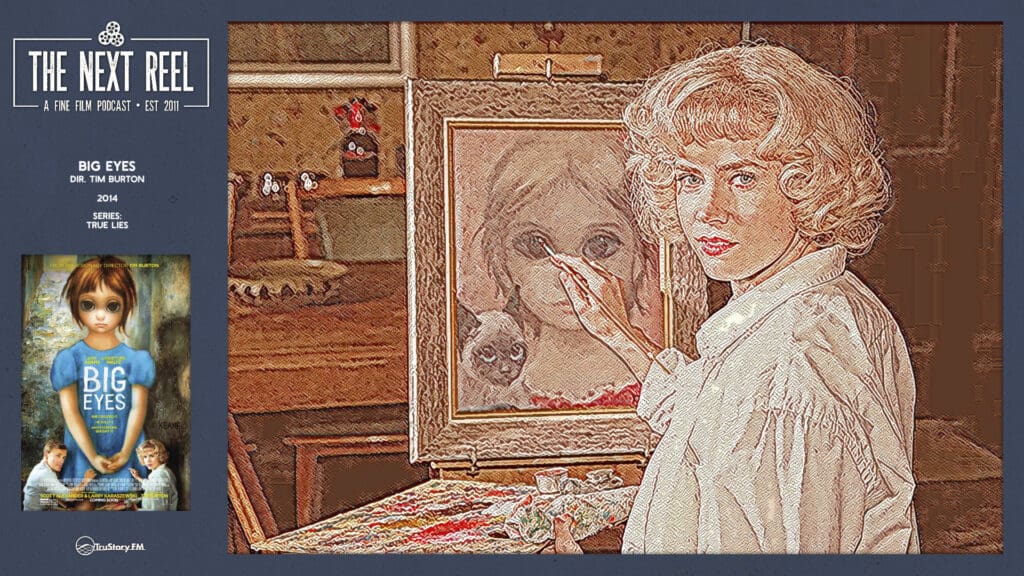
Yeah. We have been tracking liars and frauds and fakes, and we’ve talked about Lee Israel forging letters and Stephen Glass fabricating stories and Clifford Irving conning a whole publisher and Charles Van Doren taking answers to play his quiz show. And now we are addressing Amy Adams struggling with Christoph Waltz, who, let’s just say, made some choices in this movie. And we’re going to address why these people make the choices they make. Why does Christoph Waltz—how does he and Amy Adams in their characters here of the Keanes actually get themselves embroiled in such a horrible situation in Big Eyes, directed by Tim Burton. What’d you think? Had you seen this?
Andy Nelson
This is the only one I had not seen walking into this series.
Pete Wright
You and me both.
Andy Nelson
Yeah. Well, and it’s interesting, and actually I’m glad that we’re ending here because all of the other ones, the lie really became who they were. And that was a key part of it, whether the truth came out or not, that they were the lie. Like that was a huge part of them. This one is interesting because it’s less about the lie. I mean, it certainly is a big lie that Walter has that he’s the one who’s painted all these paintings, not her. But she didn’t necessarily choose it. She was really kind of pushed into it by, I don’t know, what sort of high conflict personality he has—narcissist, histrionic, you know, there’s something going on with this guy. And he, regardless, he’s very controlling. And she felt trapped and felt she had to do it. And then we’re watching a story about her fighting her way back to what is truth. So for this series, it’s actually nice to see one of these characters actually reclaiming their name and using truth as a way of healing. And that was a nice element of this in this entire series.
Pete Wright
And Amy Adams plays this character really beautifully. Like, she exists in the version of this movie that I really want to exist. She’s awesome. And I have other thoughts about some other parts of the movie, but she is one that I’m right with you. This movie is every bit about the complicity that comes in these complicated marriages that are also embroiled in the culture wars themselves, right? That this marriage, her marriages, let’s say, happened at a time in our history when we were also dealing with partners’ places in the relationship and the wife’s place was deeply stereotypical through the fifties and sixties. And she was dealing with that too, which makes her sort of complicit in the architecture of the scam. And, you know, I think you can be on the fence about whether or not she deserves any sort of blame for this. I can see how some people get there, but that context for me is everything. And, you know, I think Margaret Keane, Margaret Hawkins, deserves more credit than that. This is a movie about relationships gone sour, about her ability to choose good men, and about, you know, the troubles that she gets wrapped up into when greed strikes her partner.
Andy Nelson
Strikes or was always there. Like that’s an interesting element with Walter where, and honestly, something in the film I’m not completely sure. I don’t know. I don’t know if I buy it. I don’t know where we’re meant to kind of go with the way the story unfolds because we see that, I mean, it seems that, okay, she is a painter. She’s in the—it takes place in the fifties into the sixties. She’s divorced and so it’s difficult to get a job. So she’s just kind of working at a furniture factory painting images onto the ends of beds and such. But painting is her life. So she’s painting at, you know, a kind of a park where all these artists meet to paint and sell their art and everything. And she meets Walter, or I should say he meets her and is drawn to her and her work. And so we get this sense that, okay, he’s an artist, he’s passionate, he’s excited. And as their relationship develops, there’s a moment where, you know, they get their art on display, his art and her art on display in this jazz club. And it’s painted as a moment for him when he consciously makes the decision due to an accidental mislabeling of him as the artist.
Pete Wright
Yeah.
Andy Nelson
He goes with it and says, yeah, it’s mine. And, you know, he’s got his reasons that he pitches to Margaret later, like, you know, no one’s going to buy it if it’s a woman’s name on it. Like that’s not the world we live in. It’s—we’re better off doing this. And it’s for both of us. It’s for both of us. But then as the film develops, you find out he’s always been lying. He’s never been painting. All of these paintings that he says are his that has his name on them, she discovers are actually attributed to a different artist. And he later says, oh no, it’s just me. That’s just a nickname people called me. And she’s like, you know what? Then you would have been smart enough to know what paint to use to paint over the name as opposed to the wrong paint. And so it’s just lie, lie, lie, lie, lie. So it’s like, okay, wait a minute, has he just always been complicit? And like that moment in the film that paints him as a deciding point to start doing this, it makes me question the reality of that moment, or, you know, based on his personality, because clearly this is somebody who’s got like a narcissistic type of personality who’s just like, it’s all about me. Just kind of like, has he been planning on steamrolling over her the entire time?
Pete Wright
That’s a really good question because you’re right. In that moment in the bathroom hallway in the jazz club, there is a beat where Waltz plays this as if he’s just now making the conscious decision to pass this art off as his own, to go along with the misunderstanding, as if he is naive to what’s really going on inside himself, in his heart, in his head, whatever. But maybe what—you know, maybe that motivation on rewatch is, oh my god, it’s happening again. I’m going to do this again. I’m totally aware of my problem and I’m going to do it anyway. It’s like I can’t not eat the Oreo cookie. It’s right there. I have to eat the Oreo cookie. I have no—I’m addicted to this feeling of being noticed, of being thought of as great. And that’s actually—that’s an interesting way to rewatch the movie knowing how it ends and knowing that once the secret is out, he never produces another painting. He never, quote, produces another painting. It’s fascinating to watch that again and look at him come to terms with what he is doing because maybe it’s Waltz who’s giving this character too much credit, right? As if this is a new thing. It’s that performance that’s saying, oh, you know, I don’t even know what I’m doing. It’s out of control. I just went with the moment. Maybe he’s actually believing that that’s the truth when the movie says factually, that’s not the truth. You knew what was going on all along.
Andy Nelson
Yeah, and that boils down to the script, the direction. I mean, that’s something that Tim Burton should have been conscious of. And it’s as if they designed it in a way to give him that character turn when in reality I just don’t know if he actually would have had that. You know, it just doesn’t come across as authentic. And so it’s a tricky moment in the way that he is written and the way that the film treats him because I certainly, especially as the film goes on, I have little sympathy with anything going on on his side of the story, and all my sympathy is with her. And this is less a story about a liar and more about somebody who is trapped by a liar and can’t get out. In some ways it’s kind of what we had talked about last week when we talked about The Hoax. Like, give me the story about Alfred Molina’s character.
Pete Wright
Yes.
Andy Nelson
Like that could have been a much more interesting story of this person who’s going along with it and sees the problems and kind of agrees, like, hey, I want co-author credit on this book, yet he also is feeling like, I can’t do this. It’s ruining my life. Like that seemed like it would have been a more interesting story. And it feels like that’s kind of what we’re getting here. I mean, albeit one that is wrapped in a story about an abusive relationship.
Pete Wright
Yes, yeah, a domestic coercion story. That’s when it thrives. That’s when it is truly alive. And those moments where we see that she is, you know, as their fame grows, as their wealth grows, they have—she has these secret rooms where her daughter cannot go into because that would out the secret that, you know, he is not painting all of these paintings, but she’s up there squirreled away in an attic, suffocating on turpentine fumes, just churning out this factory of big-eyed waifs. Those—that’s when the film is really alive and threatening, when he’s shoving matches through the keyhole in the door is an extraordinary sequence. And then the movie becomes a courtroom comedy where he’s doing this like double act representing himself. At the end we’ll talk about the courtroom scene, I know, but it’s just the movie swings from really strong to almost almost great. And I find that those swings frustrating on watching this movie.
Andy Nelson
Yeah, it definitely—well, and I genuinely enjoy the films that Scott Alexander and Larry Karaszewski, the screenwriting team, have written in the world of their biopics, right? Ed Wood, The People vs. Larry Flynt, Man on the Moon, Dolemite Is My Name. I enjoy the stories they’re telling, yet I often think that the films themselves aren’t actually that great. But I think what they’re great at is finding interesting people to tell the stories of. Like every one of those films I thought were just fascinating characters and absolutely worth telling their story. But I don’t know. I just feel like maybe the way that Scott and Larry write their scripts, it just feels very kind of like standard biopic. Like there’s nothing really exciting. And that’s like—I mean, this is Tim Burton, and he did Ed Wood with them, which I definitely like more than this, because it actually felt more like a Tim Burton film. This one does not feel like a Tim Burton film. And I don’t know if that’s their writing, his directing, the way that he chose to approach it, but it’s just like it made for something that ended up feeling very standard and by the books and, you know, like a Lifetime movie about a domestic abuse situation that a woman’s trapped in. Like that’s kind of where, sadly, it feels like it’s going most of the time. And you’re right. Like with the way that the film ends, it just suddenly takes this shift. And I’m just like, okay, I don’t know. I mean, this surely is what actually happened, but it just kind of took a lot of the steam out of the stress of the relationship, the way that she was being treated.
Pete Wright
Okay, so the courtroom scene. It is a funny bit because we go into the courtroom scene, and I’m watching this with my wife, and I deeply want to take credit for this joke because, or this reaction, because it made me laugh very, very hard. But because this movie is what it is, I have—I’m going to give her full credit. It would be really dark for me to take credit for my wife’s joke while talking about Big Eyes. They go into the courtroom and I mean within seconds she screams, “Paint-off!” And I got so excited by that. I thought, you’re right. There’s only one way. I did not know they were going to a paint-off. And when the judge says there’s only one way to do this, we both screamed, “Paint-off!” Like how exciting is that? And then it happens and you realize, oh God, this is so boring. Watching people paint, watching him go, oh my shoulder, my shoulder—was so boring.
Andy Nelson
Well, and it just—it was like honestly like the most obvious resolution for all of this that like—
Pete Wright
How else would you possibly do it?
Andy Nelson
Yeah, like I was saying that before we even had a court situation. Like once she’s, you know, agreeing to paint for him and stuff, I’m like, dude, just like show people that you do the paintings. And then you’re free. Like you don’t need to go through all this. But again, this is—she’s a woman who’s been trapped in an abusive relationship and is learning how to actually survive that. And so it’s a survivor story, really. And she does make it through. But yeah, all of the stuff with the paint-off and everything, I’m just like, oh, this is like, it’s so expected. It really was just so expected.
Pete Wright
Well, again, I don’t know how you make the expected unexpected when it’s the expected that happened, right?
Andy Nelson
Well, I don’t either, but I think that’s—like you’ve got to do it in a way, and this is what I was thinking. I’m like, find ways to do the story in a more interesting way. Like, I mean, this is—we talked about this a lot in our member bonus, earlier member bonus episode for this series when we talked about The Informant! and how Soderbergh found a really unique way to craft and tell that story. This is Tim Burton who has some amazing visual style and I mean man at the beginning of the film when it was the suburbs when she was leaving her first relationship, I’m like, oh, we’re in the Edward Scissorhands world of Tim Burton, where it’s just like all the colors are these like primary colors that are popping. Everything is just—just kind of like the suburban synchronicity between the neighbors. Like I was like, okay, I love where we’re going with this. And then it was gone. We didn’t come back to that. We had a few moments where people had big eyes as she kind of was, you know, feeling her lies kind of overwhelming her and she just walking through the grocery store and everyone had those eyes. But find a way to do this story, I mean, I don’t know what it would have been, but could Burton and the screenwriters have found a way to give us what actually happened, but do it in a way that made it unique and interesting, visually interesting.
Pete Wright
I think that’s exactly right. I mean I really—I was sort of baiting you with that last comment, but I think you’re exactly right. And I think when you look at Burton, like what had he been doing for the last decade, right? He was working on Charlie and the Chocolate Factory. He was working on Alice in Wonderland. He’s working on Dark Shadows, Frankenweenie, like he’s been spending time in more big effects-driven films. And you look at this one and it is so restrained for a Burton. But in a way, this is where Burton’s brand is a boat anchor on this movie, the Burton brand boat anchor, because I expected it to be much more sort of frivolous and fun and exuberant in the telling of this story, and it ends up being remarkably bland.
Andy Nelson
And it deserves more Burton.
Pete Wright
Absolutely. Right? That’s why I show up. It deserves more Burton. I feel like I was betrayed a little bit by the Burton brand boat anchor in the trailers because I think they lean heavily in on the big eyes and the clips of the big eyes and you think, oh, he’s going to do something crazy. What’s he going to do? And he does not do it.
Andy Nelson
No, and that I think is the film’s biggest problem because I think—I mean, we’re looking at her interior spaces in those—I mean I think it only happens twice, is that right? Maybe three times—the once in the grocery store when everyone around her has the big eyes. And then later in the film when she’s looking at herself and she has the big eyes.
Pete Wright
Yes, you’re right.
Andy Nelson
Those are the two that I remember.
Pete Wright
You’re right. I’d forgotten that.
Andy Nelson
I can’t remember if there’s a third, but it’s like, okay, you’re portraying her interior world of, I mean, that’s how I read it, right? Where she’s overwhelmed by the lies that she’s telling and she just can’t handle it and it’s like these eyes that are the windows of the soul that she sees and she paints this way are now all looking at her and judging her as if everyone sees her as this—not necessarily a phony, but maybe, you know, as somebody who’s just unable to admit the truth. And I think—I don’t know. I love that we get this performance from Amy Adams because it’s an incredibly strong performance depicting a woman who’s trapped in this situation and can’t figure out how to get out. But then give us more of that Burtonian elements of feeling that way, you know, it’s few and far between.
Pete Wright
Yeah, this movie lives in a pocket universe where nothing is abnormal in Burton’s cinematography, like in Burton’s filmography. Like I wanted this movie in the Batman universe. I wanted this movie in Edward Scissorhands or Ed Wood. I wanted this movie to live in the fantastical. Actually, Edward Scissorhands is a great example because of so much that is—that exudes sort of the conflict between design elements. There are things in Edward Scissorhands that are normal and by which normal is compared against this crazy Scissorhands character that becomes exuberant and extraordinary. There is nothing in this movie that is extraordinary. And I just aspire to see that in this movie. It was sad.
Andy Nelson
Yeah, absolutely. And I think honestly, I think that’s the thing that makes it feel the most or the least interesting. Like of this series, I think that she’s the most enjoyable protagonist because she’s somebody we can actually really side with through the course of the entire film.
Pete Wright
Yeah.
Andy Nelson
But it also ends up and I won’t say it’s the most bland, but I think that it’s up there as far as being a pretty bland, feeling very like made-for-TV movie type of biopic. And that’s disappointing coming from Tim Burton.
Pete Wright
Yeah, it really is.
Andy Nelson
Yeah. All right, we are going to take a quick break, but first, you can find the show on YouTube, and you can join us live when we record. We will even take your questions in the post-show chit chat. Live, everyone’s welcome, and members get the replay and the extended cut. Subscribe to The Next Reel on YouTube. The link to this episode is in the show notes. We’ll be right back.
Pete Wright
I want to talk about Christoph Waltz. We’ve already talked about how Amy Adams is great. What’s going on? What’s going on with Christoph in this movie? What is happening?
Andy Nelson
Yes, explain to me what you’re meaning with that. Like as far as the character, are you feeling like his performance you’re not enjoying, or where are you coming from with that?
Pete Wright
I think it’s his performance. I think it’s his performance. I think he’s just completely—the oversaturated smiles, the—he actually it feels like he’s trying to be his own visual effect. And I find him—I never buy it. I never buy what he is doing. And I think that final sequence in the courtroom scene where he’s representing himself, he is—he and he starts running back and forth between his lawyer’s table and when he puts himself on the stand and he runs back up to the stand—that moment sort of exemplifies not just what he’s doing, because that has to be based somehow in reality, but how he’s doing it. I just never got on board with Christoph Waltz, an actor I adore, right? I just really adore. And maybe it’s because I’m so accustomed to him being diabolical in a more stereotypical black hat way, but pretending to be or masking as the doting husband, I just never bought into it.
Andy Nelson
He’s an interesting actor because I do feel that obviously Tarantino has figured out how to tap him for fantastic performances. Like the pairing of a Tarantino script and direction with a Waltz performance, I just think that it melds beautifully. Outside of Tarantino, I do find myself thinking about Waltz and where he works well, you know, and I don’t know—of villains, like, you know, he’s a villain here, certainly. He is a villain in, was it Water for Elephants? I mean the latest season of Only Murders in the Building, he’s villainous. And often in those, other than Water for Elephants, there’s a comedic element to the way that it plays. And I think he is an actor who can handle the comedy villains a little, but like maybe that works better when it’s with Tarantino.
Pete Wright
Yeah, I mean, what’d you think of him as a Bond villain, right? He was Blofeld in No Time to Die.
Andy Nelson
Right. And I think that he works well there. I mean you can say what you want about how they—
Pete Wright
The movie.
Andy Nelson
—wrote Spectre into all of that and, you know, the choices with some of the story, but I think that he does villainy largely well. I think when there’s a comedic element to it, I feel like that it works best when Tarantino is involved. And weirdly, I mean, just as a note, like this was at the Golden Globes, Amy Adams won for actress in a musical or comedy. I was like, this isn’t a musical or a comedy. Like I don’t know where they’re getting that decision to call it that, other than Tim Burton’s directing it, but why would that make it a comedy?
Pete Wright
Eyes are funny.
Andy Nelson
Eyes are funny. Big eyes. Oh my gosh. But that’s like an interesting element. And I don’t know if that’s one of the things with Christoph Waltz’s performance in the film, is that at times it feels like he’s taking it from a comedic villain approach. Right? Like there’s something that seems a little—a little bigger than it needs to be for his performance.
Pete Wright
Like mustache twirly.
Andy Nelson
Yeah, I mean I don’t think it’s always bad. Like I’m not saying it’s bad, but I think—and this is something again, I think it boils down to the way that it was written, the way that it was directed. Like I think all of these people involved should have been able to figure this out before it got to the point where he was actually performing in it. But I think that he does well with some of those moments. Like I kind of actually bought the moment when he consciously decided to manipulate and just like, yeah, oh yeah, that’s my painting. Like I actually bought that moment. And then later I find out that it wasn’t true. And I’m like, mm. So I don’t know. I think that it’s a struggling performance because I don’t think that they actually knew how, like what the story, how it’s supposed to feel. And it just comes across as a little unrealistic, you know. Again, if he’s histrionic, then maybe that’s not the case. He certainly feels like the histrionic personality type.
Pete Wright
Yeah, yeah. I look at the original model of this movie, and this was before Tim Burton was even on board. I think Scott and Larry were going to direct it, and Burton came on as producer. At that point Ryan Reynolds and Reese Witherspoon were attached to play these parts. I think there’s some—I say what you will about Ryan Reynolds. Like he’s—he is a caricature of himself at times. But there’s something about this guy that I think I could believe his sincerity more than I ever got close to believing Christoph Waltz. And I think that makes him even more diabolical as a character, as a person, as a husband, as a sort of betrayer in this movie. And I wonder if that’s a part of it. That—it just to me—I maybe I got stuck imagining Reynolds in this film, and I could never quite come around to Waltz.
Andy Nelson
And before those two, it was Kate Hudson and Thomas Haden Church. Of the pairings, that actually is the one that I think could have made the most sense.
Pete Wright
God, you’re right. That’s really true.
Andy Nelson
Like the Ryan Reynolds, I don’t see him helping.
Pete Wright
But Thomas Haden Church, God, that’s a really—he would have been so good.
Andy Nelson
Thomas Haden Church would have been great. Yeah, Christoph Waltz is—I mean, I enjoy him as an actor, but he’s a big actor, and I think it might have been just too much of an actor for this performance. I don’t know. Yeah, it’s a tricky one.
Pete Wright
You know, interestingly, you look at movies where he’s played sort of the caring character and the one—the only one that comes up, which I think he was—he was the scientist in Alita: Battle Angel. Right? The surrogate father figure, he kind of nailed in that movie, which, you know, again, say what you will about the movie. It’s crazy and it just seems to stop—it stopped being a movie at some point rather than actually ending. But I think they capture a really good relationship between father-daughter. And that—that’s the thing I think that’s missing is because I never believed his sincerity apart from that moment in the hallway where you kind of see him twist, like you said. The rest of the movie, I just—there was always something—it just was too much. He was too much on around every corner.
Andy Nelson
It’s interesting because we’re already watching a story where—I don’t know, the way the film sets it up is we’re kind of in Krysten Ritter’s court. Krysten Ritter is—she plays Margaret’s friend DeeAnn, right? And we’re kind of with her where like, whoa, this was a fast relationship. You just met this guy and you’re already getting married. Slow down a little bit. Like this is a guy, as she tells her, like, this is a guy who’s slept with all the women who worked down at the art park. Margaret’s response is, hey, that’s my husband you’re talking about. It’s like, yeah, but are you listening to what she just said? Like he sleeps with all of the women. And then—and so she—and again, I don’t want to judge Margaret and the character too much because I totally understand like this is—this happens a lot with people who are caught in a relationship with a manipulator, a liar, somebody who twists things, a narcissist, and they feel trapped and they can’t get out. And it’s very difficult to find a way out of that once you kind of get yourself into it. And so to a certain extent, I don’t want to say is it doing a disservice to her story, but is it making him seem so kind of comic booky and, as you said, mustache twirling that it’s diminishing the actual the actual threats, you know, because I mean we do get some threats from him. I mean he says if you tell people I’m going to put a hit out on you.
Pete Wright
I know.
Andy Nelson
Like he says that.
Pete Wright
God, where does that come from? Look, here’s part of the thing. I think if this movie were more Burton, I think Waltz is performing at Burton’s usual level. And Burton is performing very, very bland. So I sort of want to retract any performance criticism from Waltz and just say this is on Burton not showing up and making a Tim Burton movie. And the same goes for Elfman’s score. Like what are they doing together? God, it’s just—they have too great a reputation, each on their own and working together, to have shown up and made this movie as milquetoast as it ends up being. I’m getting riled up.
Andy Nelson
That’s very frustrating. It really is, yeah.
Pete Wright
It really is.
Andy Nelson
Yeah.
Pete Wright
Because as a fan, like I just want to say, as a fan, when I feel like I know in my heart of hearts what this movie could have been, even though I could never have made it, I just wish it had lived up to that expectation, to the expectation of what I have as somebody who loves their work genuinely.
Andy Nelson
Yeah. I don’t—I mean we don’t know why Tim Burton chose to direct this the way he did, but it certainly feels like he—it was a miss on his part to just kind of take it the way that he did. So any other scenes that stand out to you? I—the one that I thought was interesting was when she’s—she’s left him. She’s now entered this decision to not tell the truth, and he will allow her to divorce only if she paints him one hundred new paintings that he can continue to sell so that he can keep his lifestyle going long after they’re divorced. She wants out, so she agrees. But you get this point, this crisis point, where a pair of Jehovah’s Witnesses come to the door and talk with her and suddenly, like that is a—for me that was actually a really interesting character shift to have this moment where faith and truth collide, and she finally realizes I can’t live this lie anymore. And again it’s a little convenient the way that everything is handled, but I genuinely liked this journey for her as a way to kind of like work through all of this.
Pete Wright
I love the moment where Jane, the daughter, they’re all sitting in a room together, and Jane says, “What does Jehovah say about suing?” And I thought that was so good.
Andy Nelson
Yeah.
Pete Wright
Those little moments were just perfect. Just perfect little moments. So I agree with you. I think that moment, even though the movie kind of ends a couple of times, I think her escape from him—there’s still like a half hour left in the movie, and you don’t get the feeling of reward that she escaped this. But it does feel final, especially because the shot of her and Jane and her reaching over the back seat of the car to hold Jane’s hand is a mirror shot of, you know, the shot of her running away from her first husband in the very beginning of the movie. It feels like that cycle is complete, even though it’s depressingly yet another cycle. The fact that she goes to Hawaii and gets to have this reward, if only reputational reward, is really satisfying. And I think it may be, you know, once Waltz is kind of out of the picture and she is just reclaiming her life, and we get to see her being a mom to a kid who is troubled from all of the stuff that she’s been going through. I think it’s really quite lovely. And then of course the retribution. The true story is he never produced another picture after this court scene. He forced an injury in the paint-off, was not able to paint anything while she painted a picture in fifty-three minutes. That was lovely. She called it—what was the title of it?
Andy Nelson
Exhibit two sixty-five, or whatever, yeah.
Pete Wright
Exhibit two forty-seven or something. Yeah. Yeah. Which is really funny. She was awarded four million dollars in settlement and he never paid, not a penny. He died in 2000 having never claimed anything other than he was the original painter. He just retired and was done. He was the original painter and that was the truth. And he was going to take that to his grave, which he did. And she lived out her life. I think she died in 2022 and ended up doing okay. I mean, I wanted the movie to tell me—to let me watch Christoph Waltz perform decay. I kind of wanted to feel more about that.
Andy Nelson
Yeah, right, right, right.
Pete Wright
But I think the way the movie ended was, you know, sweet, didn’t linger on sorrow, and we got a win.
Andy Nelson
Yeah, although again it sets elements up that also I just don’t feel like we ever really quite complete. I mean, I agree. I would have loved to have that Godfather III moment of Walter sitting in a chair all by himself just sadly dying alone in poverty.
Pete Wright
Yeah.
Andy Nelson
Like that would have been great. Not necessary. But what I did need, and what kind of irritated me, was that we have this head-butting relationship established between an art critic. Terence Stamp plays this art critic.
Pete Wright
Oh yeah, right.
Andy Nelson
Like we’ve kind of established that, like, you know, I really like Terence Stamp. He’s John Kennedy and he completely dismisses the big eyes art as just a joke. And Walter Keane is, you know, nothing but kitsch. And Walter like pushes back and fights him and like goes on TV to speak out against it and all of this sort of stuff. And at the end we see a moment where Kennedy gets a fax, you know, a wire coming through that tells the truth that she’s the one who’s done all of these paintings. And that’s the end of the story. It’s like, well, what did he think? Did it change his opinion of the paintings at all? I don’t know. I would have liked to at least find out, like if that meant anything and if that felt—if there was any sort of validation for him, but we get nothing out of that moment other than just he gets the information and it’s like, well, fizzle.
Pete Wright
Yeah, you’re right. That—that’s a really good point. It almost feels like Stamp had a day to come over and shoot and and not really a part. And there is this weird unrequited justice moment where Walter actually attacks Stamp with a fork and Stamp blocks it and holds his wrist. But that shot where he’s holding his wrist—the fork is like an inch and a half from Stamp’s eye. Like that is—he almost blinded him, if not much, much worse. And it shows what a badass Terence Stamp is in the form of this critic. But to what end? Like that just seems like a brand new expression of rage from Walter that we had not seen before. And that was not paid off in any real respect.
Andy Nelson
Right. Like, did that lead to a lawsuit, you know, for attempted assault? Anything like that, you know?
Pete Wright
I mean, I guess he then goes and lights his—lights the office on or the painting studio on fire unintentionally in the locked door. I love it that the next shot we see him is like six months or a year later and clearly the studio has been fixed. It didn’t burn the house down. I kind of wanted to see what happened. What was the degree of damage that he did to his own house?
Andy Nelson
Right, because then at that—by that point he’s just lounging around with beautiful women all over the place.
Pete Wright
Right. Yeah.
Andy Nelson
So yeah. That’s an interesting element, and I again I wish they would have developed it more. One of the relationships though that we do get, and I think it’s the strength and the core of the film, is the relationship with Jane, her daughter. And it’s—I think the moment where Jane comes into the room and finds her mom sleeping on the floor and the admittance that it’s all been me and Jane admits that she’s always known. And like that is finally the first moment that Margaret is able to kind of let that wall down and let some of that shame out and find comfort in the fact that she’s not looked down upon, but still loved. And I think that was a great turning point in the film. I really enjoyed the relationship that we had between mother and daughter as it was depicted in the film.
Pete Wright
I did too. Just about every time. I really, really did too. I loved it. And I think Madeleine Arthur does a great job as a young actor playing this kind of complicated role. I think she’s really, really great.
Andy Nelson
Yeah. Did you know much about Margaret Keane before, like the trailers for this film come out? Like had you—like were you familiar with the works?
Pete Wright
No, and I should say that that was a really interesting part of this story, which, you know, the fact that her works and Walter Keane, the Keanes sort of established this—people don’t care about art. They just, you know, about originals. They just want things that the art that moves them. Let’s do postcards and posters and all these kinds of things. That that was an really interesting part of this business that I did not know and I kind of found myself wanting more of. Like there’s another movie that isn’t filled with all the fraud that just tells about an artist finding their audience that I really would be interested in watching.
Andy Nelson
Well, and that’s, I think, if anything, that—that could have—like that’s something that you could have gotten some real Burton elements with of just like that mass production.
Pete Wright
Oh God.
Andy Nelson
Of all of these things kind of cranking out.
Pete Wright
That guy does a factory, am I right?
Andy Nelson
Yeah, right, right. Another element that we haven’t talked about that, you know, I’m definitely curious with you, and I know your feelings about things like this, but we’ve got Danny Huston playing a local reporter and he’s telling the story. So we’re getting voiceover as he’s walking us through things. I know how I feel about it. I’m curious how it works for you.
Pete Wright
It’s so dumb.
Andy Nelson
Okay, we’re on the same page.
Pete Wright
God, it’s so dumb.
Andy Nelson
I was like, why—why are we getting his point of view in this? Why is it him that is telling this story?
Pete Wright
Because yeah, because we get his point of view because he has a good voice and he’s hardly in the movie. Like the movie never commits to his actual role until the very end when they’re talking about him and saying, oh, we can have him flack this thing for us, right? It’s so—his role in their relationship is so stupid subtle that you don’t even know it’s happening. Why is it his voice? I don’t get it. I don’t care for it. I didn’t need it. In fact, had you put him more in the movie, and had him, you know, had his perspective be more represented than just the voiceover and the occasional scene at a party, I think we might have actually been able to make something of his relationship to them. But as it stands, it’s bad news. I don’t care for it.
Andy Nelson
Well, it’s setting up the voice of the film. So, you know, he’s the—he is our window into this story. We’re setting it up as this—I never really got a sense of what type of reporter he was, but he doesn’t seem like he’s a great reporter. Like he’s the one who ends up working with Walter, his old buddy Walter, to kind of create these moments to help blow up these paintings. Like he finds out, oh hey, there’s this big prominent political figure is going to be in town and just in time for Walter to be there presenting a painting to this person. Like, so I’m like, okay, so is it just like some sort of reporter scam artist that is—that is the type that we’re following here? And I was like, why—why of all the people is that the voice that helps this story.
Pete Wright
The voice of the movie. I know, it’s so just weird-headed.
Andy Nelson
Yeah.
Pete Wright
So yeah, and I, you know, I don’t know. If he played a major role in their story, I think that’s one of the things they could have fleshed out and not used because it didn’t—we didn’t need it. They even have a sequence later where Walter starts talking about the members of the press that he’s meeting, right? Who could act in service of them. They could have left him—left this singular guy, the voiceover of the movie, as a mention, right? Because it’s fine to know that they’re working with journalists who will help them flack their stuff and let them know where the celebrities are, when’s Joan Crawford going to be at a restaurant.
Andy Nelson
Yeah.
Pete Wright
But man, they made just, just too much of Huston.
Andy Nelson
Well, and it’s like, okay, this is Margaret’s story. Like she’s the protagonist of the film. So and he has like little connection to her. So it’s like, is it meant to be in some way some defense? I don’t know. It kind of infuriates me the more I think about it. Like it’s just the worst way to enter this picture. I’m curious because Margaret was alive when this film was made, and we see the picture of her sitting with Amy Adams at the end of the credits.
Pete Wright
And she’s in the movie.
Andy Nelson
She pops up in the movie. And so I’m curious, like, what did she think of the way that they chose to tell that? Like, I don’t—I’m sure she would have kept it to herself or maybe just kind of like privately mentioned it to them, but that’s—I don’t know. It just seems like such a strange entry point for this, for an audience to like try to figure out why is this—why this direction for this story.
Pete Wright
Yeah. I think it’s interesting that she—I guess she kept her—she kept Keane the name, which is strange, speaking of boat anchors.
Andy Nelson
Well yeah, but I guess it’s like become the brand and so it’s on all the paintings, so—and smartly it was always just Keane, so it’s—so she could still attribute all of it to her.
Pete Wright
So there is that terrific moment when he starts opening the hundred paintings as they start showing up and she has her M. D. H. Keane on it instead of just Keane. I do love that bit.
Andy Nelson
Yeah, that was really great.
Pete Wright
Love that bit.
Andy Nelson
That was great.
Pete Wright
Yeah.
Andy Nelson
Well, it’s an interesting film. It has stuff that I do really enjoy, primarily in Amy Adams and their portrayal and the darkness in the way that this relationship was portrayed. You brought up the moment when he’s pushing lit matches through the keyhole into her art studio to try getting her out of there. Like that was—that was a tense moment. Like it was well done, well crafted, and scary. Those are the moments that work the best. And I just think too often we’re not quite getting more than that.
Pete Wright
Yeah. But overall, I mean it’s a—it’s a middling movie with some really standout elements, and particularly Amy Adams, I think she’s fantastic.
Andy Nelson
Yeah, yeah. All right, time for the back half. But first, let’s take a quick break.
Pete Wright
The Next Reel is a production of TruStory FM, engineering by Andy Nelson, music by Tzabutan, Ian Post, Oriol Novella, and Eli Catlin. Andy usually finds all the stats for the awards and numbers at The-Numbers.com, BoxOfficeMojo.com, IMDb.com, and Wikipedia.org. Find the show in the full archive at TruStory.fm. You can follow us from there too and learn about membership. Check out our merch store at TheNextReel.com/merch. And if your app allows ratings and reviews, please consider doing that for our show. All right, Andy, it’s award season. Let’s go back to award season. How is this movie doing?
Andy Nelson
It did okay for itself. Three wins with eighteen other nominations. At the BAFTAs, Amy Adams was nominated for Best Actress, but lost to Julianne Moore in Still Alice. And it was nominated for Best Production Design, but lost to The Grand Budapest Hotel. The Casting Society Artios Awards, nominated for Best Casting in a Studio or Independent feature comedy, but lost to The Grand Budapest Hotel. Already talked about the Golden Globes and the head-scratching nominations. Amy Adams was nominated for Best Actress in a musical or comedy, which this is not. And she won. So I don’t know. I’m sure the other nominees feel a little resentful about that.
Pete Wright
So weird.
Andy Nelson
Christoph Waltz was nominated for Best Actor in a musical or comedy, but lost to Michael Keaton in Birdman. Lana Del Rey’s song “Big Eyes” was nominated, but lost to “Glory” from Selma. Oh, and then at the Film Independent Spirit Awards, it was nominated for Best Screenplay, but lost to Nightcrawler. Last but not least, at the Women’s Film Critics Circle Awards, Worst Male Images in a Movie was nominated, but lost to Dumb and Dumber To. The Invisible Woman Award was nominated but lost to The Imitation Game. And last but not least, the Karen Morley Award, which is an annual prize presented by the Women’s Film Critics Circle to a film that best exemplifies a woman’s place in history or society, often highlighting a courageous search for identity, honoring the legacy of 1930s actress Karen Morley, who was blacklisted for her political convictions. Lost to the film Belle. Oh, and then I did add this one. The Yoga Awards, which are Spain’s Razzies. Christoph Waltz was nominated for Worst Foreign Actor, sharing with the film Zero Theorem, and he won. So that was one of the other wins.
Pete Wright
It was sharing with his performance in Zero Theorem?
Andy Nelson
Yeah, so his—so Worst Foreign Actor, Christoph Waltz was nominated for Big Eyes and Zero Theorem. Basically saying he just sucked all year.
Pete Wright
Jesus. This is a rough year for Christoph Waltz. Oh man. We may have been a little too hard on the guy. I generally love his work and I think he does—he’s a really interesting actor and this was not the movie. This didn’t connect. All right, how did you do at the box office?
Andy Nelson
Well, Tim Burton’s story about Margaret Keane and her husband had a budget of ten million dollars, or thirteen point four million in today’s dollars. The Weinsteins saw this as a potential awards buzz movie, so released it Christmas Day, December 25th, 2014, opposite Night at the Museum: Secret of the Tomb, Annie, Unbroken, Into the Woods, The Gambler, and The Interview. And that’s not to mention the limited releases of Selma, Mr. Turner, American Sniper, Song of the Sea, Two Days One Night, Leviathan, and more. Needless to say, it was a very crowded holiday weekend. To that end, that’s perhaps why this opened in 20th place?
Pete Wright
Oh my God.
Andy Nelson
This did—this did creep up to 13th over the next few weeks, but it never really found its audience, ending up earning 14.5 million domestically and 14.8 million internationally for a total gross of $36.6 million in today’s dollars. So it did make its money back with an adjusted profit per finished minute of $219,000, but never was quite as big as the Weinsteins wanted it to be.
Pete Wright
Man, troubled, troubled Weinsteins. Just—
Andy Nelson
Yeah, yeah.
Pete Wright
Couldn’t happen to a nicer couple of dudes, right? Am I right?
Andy Nelson
Yeah, yeah, no kidding. But it is interesting and it does make me wonder, do you think like our complaints about the film, it wasn’t Burton enough, is one of the reasons that it didn’t connect with audiences?
Pete Wright
I wholeheartedly agree with that. I think it really was. I think by this point in Burton’s career, people know what they are getting. And when they meet with something that isn’t that, if it’s got to just really find another pair of socks, because one’s going to be blown off, kind of a movie. And this was not—this was not it. This was not the kind of dramatic swing that I think sparks word of mouth, and it needed flamboyance.
Andy Nelson
Yeah, absolutely. Just as a note, since we’re talking about biopics, Scott Alexander and Larry Karaszewski, Tim Burton—we already mentioned that this pairing all worked on Ed Wood together. Do you feel that in another biopic, that one in particular, that we’re seeing more Burton elements? And I know, I don’t know, it’s been a while that I’ve seen that one. I don’t know how long you last watched Ed Wood.
Pete Wright
That’s been a long time, yeah.
Andy Nelson
But I’m wondering, like, is it a biopic thing? Like I’m trying to remember that film. And I know it was black and white, and I know like some big performances because obviously Ed Wood himself is a big crazy character. You’ve got—
Pete Wright
Landau.
Andy Nelson
Landau in there. Like a lot of big performances. And I just am wondering if that’s just a biopic element that like I feel like now I need to rewatch that one to see how it lines up as far as what really feels Burtonian.
Pete Wright
Yeah, I think so. The one that comes—that keeps coming back to me, which we’ve already talked about, is Scissorhands, but I think I think you’re right. I think just the act of telling Ed Wood’s story in the style of a picture of the period that he worked on is—is the meta statement that Burton was making. And I think that sets the table for a movie experience that is different, that is unique, that is the Burton-ish kind of thing that we come to expect. At least at the time we were still kind of learning Burton. Now we know, and how do we end up with this just right across the bow kind of unsurprising movie? I think there is possibility that Burton can tell a biopic in a way that really is transcendent. And this isn’t that.
Andy Nelson
Yeah, I go back to The Informant! as an example of what Burton could have done with this, found a way to make this unique. I mean, even something like the Elton John Rocketman that we had a couple years ago. Like that was more interesting, you know, cinematically.
Pete Wright
You know, there’s a lot of stuff.
Andy Nelson
We were talking about the Robbie Williams, where he’s a monkey.
Pete Wright
Yeah, what a fantastically surprising film.
Andy Nelson
Outstanding, just God—transcendent experience, truly.
Pete Wright
Hundred percent.
Andy Nelson
So yeah, I just—I think this is—this missed something that we all know is in the capabilities of the filmmakers.
Pete Wright
Yeah, yeah.
Andy Nelson
That’s it.
Pete Wright
Well, I will say, just reiterating my point, with all of these liars that we had in this series, that made it honestly a difficult series to watch because it’s just like characters that you really don’t like following, right? Like some difficult ones. We finally get a great character that is struggling and we get to kind of watch her survivor story as she figures a way out of all of this. And I like that in this series of True Lies that you built, she really is kind of this moral center. It’s not out of ego or greed, but out of fear and coercion that we are seeing her story here. And she is the one who actually is able to kind of reclaim her identity. And I like that. I’m frustrated about the way that Burton chose to tell it and the way that Scott and Larry chose to write it. She’s a very fascinating character, but they all—it was made very predictable. But it’s—I mean, it’s really Amy Adams that makes this worthwhile. And in the end, I’m glad that this is where this series is ending because I think it’s a strong final place to kind of see someone who deserved to make it through.
Andy Nelson
Yeah, I’m really glad to hear you say that. And I agree with you. I think we’ve—I think we’ve built up in terms of character likability and relatability from the beginning. I think we built into a character that offers us more of a reward to watch them succeed than the others. I will say these—Quiz Show is still at the top of my list that we have one more member bonus that yet to come that will fit this series. So if you are a member of The Next Reel family of film shows, you’ll get us talking about Catch Me If You Can, which is chumming the water for Tom Hanks for Andy. I mean, just wait. He’s going to—he’s going to show up dressed like him in that smart 1950s suit. Like it’s going to be really great.
Pete Wright
That’s right.
Andy Nelson
It’s at the—it’s at the dry cleaners right now.
Pete Wright
Yeah.
Andy Nelson
Getting ready. Yeah. No, I’m very much looking forward to it.
Pete Wright
One more, one more left to knock off in this particular series. But I have found it a really rewarding series. I’m so glad that we talked about it. And, you know, here’s moving on.
Andy Nelson
Yeah, great series, really interesting character studies. And I think that’s what you get out of this is like these are—it’s human nature and it’s just fascinating to watch stories about these people at their worst. And I just—I think that it’s fascinating. Hard films to watch, but fascinating, fascinating stories. Absolutely.
Pete Wright
Yeah.
Andy Nelson
All right, well that is it for our conversation about Tim Burton’s Big Eyes. And it is the end of our True Lies series. Next week, we are actually returning to our Rocky series, which really should now be called our Rocky/Creed series to add the most recent entry. That’s right, we are talking about Michael B. Jordan’s directorial debut from 2023, Creed III, starring Michael B. Jordan, Tessa Thompson, Jonathan Majors, and Phylicia Rashad. All right, let’s do our ratings.
Pete Wright
Letterboxd.com/TheNextReel. That’s our HQ page over on Letterboxd. We love Letterboxd, and you can head there for all of the reviews and ratings. And that’s where we’re going to apply our stars and hearts this week. Andy, what are you going to do for this movie?
Andy Nelson
This is definitely not getting a heart. And I’m torn. Like Amy Adams, the work with her daughter, all of that was very strong. Does that warrant me going—like I’m—I don’t know. I’m inclined to say two stars, but I’m wondering if those performances warrant me going up to two and a half. I don’t think so. I think I’m going to leave it at two stars. Incredibly strong performance. I love Amy Adams. Very interesting story. I really enjoyed learning about Margaret and Walter Keane, but it just wasn’t a film that really stood out in any way.
Pete Wright
That’s interesting to me. I’m—I think I’m going to go a little bit higher. I agree with you on the heart. I don’t think I’m going to give it a heart. It’s—it might be tricky for me to watch this movie again. I don’t think it’ll just come up in my rotation of, hey, let’s watch Big Eyes. But I think I will land at three stars, no heart.
Andy Nelson
Okay.
Pete Wright
That feels about right.
Andy Nelson
All right, no heart at all for this one. That averages out to two and a half stars, no heart. And that’s where it’s going to land over at our account on Letterboxd at TheNextReel. You can find me there at SodaCreekFilm, and you can find Pete there at PeteWright. So what did you think about Big Eyes? We would love to hear your thoughts. Hop into the Show Talk channel over in our Discord community where we are going to talk about the movie this week.
Pete Wright
When the movie ends.
Andy Nelson
Our conversation begins.
Pete Wright
Letterboxd giveth, Andrew.
Andy Nelson
As Letterboxd always doeth.
Pete Wright
All right, what do you got? Is it funny? Is it fun? Is it long? Is it short?
Andy Nelson
It’s not too long. Stephanie, three and a half stars. It says, “Nobody. Walter Keane. I studied in Paris. I lived in Paris. I was in Paris. I painted in Paris. I made friends in Paris. Don’t you get it? Paris is me and I am Paris. Margaret Keane. Are you done yet?”
Pete Wright
Oh dear. I ended up with James Schaffrillas who says three stars. “I didn’t think Christoph Waltz gave a particularly good performance in this, but I guess I should count myself as lucky Tim didn’t cast Johnny Depp instead.” Badoom boom, this could have been a Johnny Depp movie. It could have been Johnny Depp and Helena Bonham Carter.
Andy Nelson
Ah, there you go.
Pete Wright
Now that’s a different experience. That is the full Burton. He could have given us full Burton. Andy, I might have actually loved that movie. Like low-key. Helena Bonham Carter could pull off Margaret Keane.
Andy Nelson
Yeah, yeah. She can do no wrong.
Pete Wright
She could pull off anything.
Andy Nelson
Yeah.
Pete Wright
She could—she’s incredible.
Andy Nelson
Could—would Johnny Depp be bigger than Christoph Waltz though?
Pete Wright
I don’t know if he’d be bigger, but he’d be different.
Andy Nelson
He’d be different and it certainly would—
Pete Wright
And we know Johnny Depp can channel some rough marriage energy.
Andy Nelson
Oh, it got too real too fast.
Pete Wright
Wow. Hey. Thanks, Letterboxd.