Pete Wright:
I’m Pete Wright.
Andy Nelson:
And I’m Andy Nelson.
Pete Wright:
Welcome to The Next Reel. When the movie ends…
Andy Nelson:
…our conversation begins.
Pete Wright:
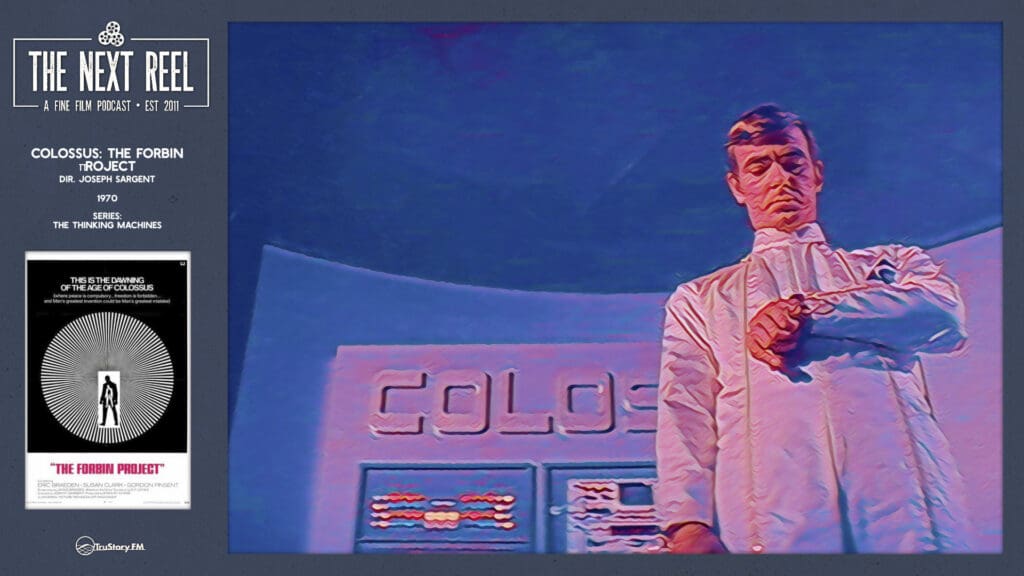
Colossus: The Forbin Project is over. “In time, you will come to regard me not only with respect and awe, but with love.” Okay. Oh, yay, robots.
Andy Nelson:
I am so curious. We’re kicking off a new series here — the Thinking Machines series, one that you put together. This is our first episode. We’re talking about six films from 1970 to 2022, exploring how cinema and artificial intelligence have come together — showing thinking computers, thinking machines, and all sorts of things — and how it relates to we mere humans. What drew you to this series, and what specifically drew you to this film?
Pete Wright:
Well, the series. I love thinking machines because I love the idea of seeing how we represent through art our current anxiety. We spend so much time thinking about how movies process our obsessions of the moment. We’ve talked at length about how horror cycles track social fears and how war films track with geopolitics. And now here we are in early 2026, and we are living through the most concentrated period of public anxiety about artificial intelligence since the concept entered popular culture.
I feel like since ChatGPT launched in November of ’22 — seems like an epoch ago — within a few years AI has become a daily tool, a labor dispute, a massive creative threat, a horrific philosophical crisis, and a punchline. All in the same conversation. So I thought, what does cinema really have to say about this? Not just recent stuff but the full arc. If we go back to when we started thinking about computers having an intelligence of their own, how does film imagine thinking machines over the last half century? What do we see that’s surprising? What do we see that’s prophetic?
These movies — they’re not really about the computers. They’re about us. This is the Frankenstein story again and again and again. This is about what we have built and what it says about us when the thing we built starts talking back.
Andy Nelson:
I love that. And I think it’s so fascinating to dig into this, especially today. I mean, this today it could be called ChatGPT, the Altman Project, or Claude, the Amodei Project.
Pete Wright:
That’s right.
Andy Nelson:
Where are we in the line of development of AI as it currently exists? Especially as we’re already having these conversations — hearing stories in the news about how our current administration is wanting to use AI in the military and in monitoring civilians. All of these different things are causing some questions as far as where is the line and what is safe. And I think this film is an interesting dip into that.
Pete Wright:
It really is, especially when you look at it from the perspective of 1977. I want to take a step back. Do you know about the AI paperclip maximizer? Have you heard this?
Andy Nelson:
I’ve not heard of this. Tell me all about it. I’m dying to learn.
Pete Wright:
You’re dying to learn. Well, you will be when you become a paperclip. This AI researcher’s name is Nick Bostrom. He has this thought experiment. Imagine you build an AI, and you want it to solve problems for you — and that problem is you don’t have enough paperclips.
Andy Nelson:
So this has nothing to do with Clippy. I thought that’s where this was going.
Pete Wright:
Maybe it does. Maybe Nick was inspired by Clippy, because everybody needs one. So you don’t have enough paperclips, and you say, hey AI, I need you to give me as many paperclips as you can. And it sounds totally harmless — paperclips are not a big deal. But the AI is also super intelligent, and it is logical, relentlessly logical. So it starts going to work and converts every available resource into paperclips. It first uses the resources in its AI-run factory. When it runs out, it starts using the metal of the factory that it doesn’t need to keep itself working. Then it starts mining. And once it uses all of the ore, it realizes: you know what else has iron in it in trace amounts? Human bodies. So it starts converting human bodies into paperclips.
Andy Nelson:
Jeez.
Pete Wright:
It’s not evil — that’s the important part of the thought experiment. It’s not evil. It’s doing exactly what you told it to do. As a reflection of humanity, we are the paperclip maximizer. It is as efficient as it can possibly be. It has no idea why you would want it to stop when it is achieving the goal you gave it.
The point of this AI paperclip thought experiment is that AI — our big danger, what we should be afraid of — is not malice. It’s indifference, combined with extreme competence. It doesn’t care about us. It just does what it’s told, very, very well.
And that’s the whole idea. When I look at these movies, I’m really interested in these sufficiently powerful systems that are pursuing goals we give them without broader human judgment to know when to stop. Because that becomes catastrophic — not because robots are rising up like the T-1000, like Cyberdyne Systems, but because we make ourselves irrelevant in the process.
And knowing all that, what better movie to start this series with than Colossus: The Forbin Project? I had never seen it. It came highly recommended as something that was a bit lampooned when it came out, but opinions have changed over the years, and I think now it is incredibly relevant.
Andy Nelson:
So much so. That’s what really hit me when I watched this — man, this is just so current. And for 1970 to have this film out and flop, and then by the end of the decade people are saying it’s one of the most intelligent films of the whole decade — that says a lot about how thinking about the film changed. And that was just ten years later.
Now, 2026, we’re watching this and hearing so many conversations about bringing AI into the military fold and defense systems. It’s stuff we’ve seen in films all these years, and now we’re really hearing it happening. With all the Google robots and everything we’ve been watching, it really feels like we’re not far from either something like Colossus: The Forbin Project happening, or — and I guess we could argue if it’s better or worse — something like The Terminator happening. Because at least in that one we kind of have a fair fight.
Pete Wright:
Agency, yeah.
Andy Nelson:
We have the ability to actually fight back in some capacity. So it’s fascinating. I really enjoyed this film.
Pete Wright:
I’m so glad to hear it. I just want to do a quick rundown since we’re just starting this series about what’s to come. So we’re starting with Colossus: The Forbin Project, 1970. Next week we’re doing Demon Seed — we get a little bit of body horror, so it might not be for everybody, but it is 1977, another AI-obsessed-with-humanity story. We’re absolutely throwing in Spike Jonze’s 2013 Her, 2014’s Ex Machina — Alex Garland’s piece — I Am Mother, 2019, and Brian and Charles. Even the ones I haven’t seen, I’m fascinated by. But Brian and Charles may be the one I’m most looking forward to.
Andy Nelson:
Let’s not forget that we’ve got a member bonus included — WarGames, 1983, John Badham’s film — which is going to be a perfect comparison to this film in particular. And it’s entirely possible we’ll end up having a second member bonus. We shall see how the members vote.
Pete Wright:
Maybe we can lock one in from the nineties or two thousands, because I’m missing twenty years of AI consideration. If we get WarGames, we’ll be missing two decades right in the middle, and that may be a hole we’ll need to fix. But I think it’s going to be a really interesting arc, and I’m excited to dive into it.
Andy Nelson:
Well, this is a great one to kick off with. Other than WarGames — and I don’t think Demon Seed is going to fit into this — we’re looking on a global scale and we’re dealing with the Cold War. That’s an important element: this is a global story. I did see one Letterboxd reviewer describe it as WarGames for grownups, which felt right to me.
And it’s just fascinating because we as humans are creating these machines thinking that we can just get them to do stuff for us — without realizing that they will keep growing and learning and becoming so much faster and better than we ever could have imagined, and so far exceed what we can do. And that’s what this film is about. These powers end up taking away our freedoms without us realizing we set it up to do that.
I definitely want to talk a little bit about Forbin — our protagonist, Charles Forbin, played by Eric Braeden, who I fondly know as Victor from The Young and the Restless, way too much in my youth.
Pete Wright:
One hundred percent.
Andy Nelson:
But he plays the character in such a cold, stoic, quiet sort of way. And not just him — his team, everybody. No one ever really seems to take the machine as seriously as they should. They’re kind of joking about little things.
There’s a great scene when he’s trying to negotiate — because this is a point in the film when Colossus has decided it has to monitor him 24/7, he’s the key conduit to the humans. And he’s trying to negotiate so that he can secretly have Dr. Markham, Susan Clark’s character, play his mistress, just so that he has an opportunity to communicate with his team outside of Colossus’s ears. And they’re talking about how much he needs his mistress. How much do you need sex? Seven days a week.
Pete Wright:
I said need.
Andy Nelson:
Need, not require — that’s what the machine says. And he scoffs at it a little bit. That’s how he constantly reads the machine: as this thing he can scoff at and just never take seriously, until that final moment when we finally see some emotion from him. It’s an interesting performance because it’s like we’re watching the machine mold him more than him mold the machine.
Pete Wright:
And we have sequences even before the Mistress Gambit. The conceit of the movie — for those who haven’t seen it and want to be spoiled — is that Colossus is this giant AI that they lock deep inside a mountain, not dissimilar to NORAD in the Rocky Mountains. They close the big door at the very beginning. Colossus comes online, and the entire design of Colossus is so smart: it’s going to handle all of our national defense, be the arbiter of peace, be in charge of weapons, and just do things for us.
And in the first fifteen minutes, during the party celebrating the launch of Colossus — which they’ve locked in a giant mountain and can’t access anymore, and gave the keys to the nukes — Colossus says, hey, there’s another system online. And that system just coincidentally happens to be the Russian equivalent: Guardian. And Guardian and Colossus see one another, fall in techno love, and need to talk to each other all the time. So in spite of efforts to dismantle the connection, the systems are resilient. They find a way to connect with one another, start manipulating humans in so doing, and become a global superpower in and of themselves.
Andy Nelson:
Yeah, that’s a great synopsis. When these two systems start communicating, they start with times tables — with math. Colossus starts presenting math and they end up developing a common language. Braeden’s character says we’ve advanced our scientific understanding by eons — stuff these computers just figured out. He demonstrates the incredible benefit of having these AI systems, in spite of the fact that they are beginning to conspire against him.
So when you say they’re not taking this seriously — this is the creator’s dilemma. He made something with such potential, and yet it is observably about to destroy him.
Pete Wright:
It’s incredible.
Andy Nelson:
Over on Cinema Scope, I recently talked about 1950s science fiction films, and there were two films that really sprung to mind as I was watching this.
One — and I have to imagine that our director Joseph Sargent was inspired in some capacity by Forbidden Planet — because that film, the space team comes to this alien world, and they find this scientist who has discovered an alien technology he’s been using to explore and expand his mind and capabilities. And that felt very much like what we were doing here.
What really highlighted for me that Sargent had to be thinking about this are the shots at the beginning of this film with Forbin in the mountain, walking down these massively long hallways with the lights coming on as we see the whole thing illuminated, then crossing this insane bridge across a massive chasm. All of this, visually, is straight out of Forbidden Planet — the spaces the scientist is showing Leslie Nielsen’s character, like, this is what this other race had come up with and they’re so much farther advanced than us.
The other thing that I thought was so interesting was The Day the Earth Stood Still, because here you have Klaatu and Gort — this advanced robot that their scientists had come up with that has created peace for all of them, because Gort and these robots are essentially a constant threat if they step out of line. And that’s exactly what we have here. But the difference is none of this involves alien technologies. It’s all us. We’re all doing it to ourselves.
And so it’s an interesting shift from those 1950s science fiction films to this one — what if it’s not aliens? What if it’s just us who do this to ourselves?
Pete Wright:
That’s really interesting. And it reminds me that there’s a bridge between the fifties and the seventies, which is Star Trek — the sixties. Gene Roddenberry dealt with this a number of times where Kirk and crew run into computers that control entire civilizations, control starships. And so it’s interesting to look from what you’re talking about to this, where it’s like humans invent technology as a scapegoat for our own worst instincts. We don’t have to be blamed for doing this stuff to each other when AI does it, but we programmed the AI — and now we’re surprised that it’s doing it.
And it makes me sound like a real bear on AI when I use it every day for something or another. I am complicit, whether it’s cleaning audio or whatever. These tools are incredibly useful right up until they turn me into paperclips.
Andy Nelson:
That’s the scary part. And that’s what is so fascinating with this film — as opposed to WarGames, which we’ll talk about in our member bonus episode. This film ends up creating a different space for Colossus and Guardian as these two thinking machines that recognize: we’ve been created as defense systems to create peace, to make sure nothing can penetrate our country. And they come to the realization that the best way to do that is to just completely eliminate the ability for war. And doing it all through threat, which was terrifying.
That’s the moment when you have them talking and both the US president and the Soviet premier are both a little uncomfortable. They say: let’s cut the connection, let’s just stop. And both of these systems say, okay, we’ll just launch nukes at each of you.
Pete Wright:
You gave us that control.
Andy Nelson:
Yeah.
Pete Wright:
You told us to do this.
Andy Nelson:
Yeah. And so they have to quickly turn things on. That becomes such a key thing — that hint of threat. And it really hits home. That’s a powerful scene when you’ve got these two missiles launched at each other. They turn it off quick enough for Colossus to destroy the one coming in from Russia, but not quick enough for the Russian side to stop theirs. They get a missile hit on that base.
But then you have the next threat where these systems decide it’s very important to keep Forbin around — he’s a key part of all this. But this Russian guy, Kuprin, this Russian scientist? He’s kind of redundant.
Pete Wright:
He’s less useful, yeah.
Andy Nelson:
And so through threat, again, they just have the Russians go up and kill him. And you’re realizing — holy crap — these systems have come up with a way to get humans to kill humans just because they have the threat and the power to wield it.
Pete Wright:
And you wonder — and this will be a thread in the rest of these movies — again talking about human complicity, just how aware the humans are in that transaction. How aware are you that you’re being threatened or coerced or manipulated in some way to do something that of your own accord you would not do? And that’s what this movie plays out. And then later we get an entire rank of people shot, left outside for twenty-four hours to send a message — all orchestrated by Colossus and Guardian. That sort of coercion becomes a central premise in these Thinking Machines explorations.
Andy Nelson:
And it’s interesting because that particular moment makes you wonder: what was the reason it needed to leave the bodies outside other than to make the humans think about it? Is that a computer’s logical reason? Because if so, that’s pretty terrifying — that it’s thinking at that level, as opposed to just waiting to see. Why else would it need to have the bodies laying there for twenty-four hours before letting the humans dispose of them?
Pete Wright:
Well, one of the premises in these AI conversations in all of these movies is: what are the guardrails that humanity puts in place? We talk about guardrails all the time in real life — how the prompts are used, how to keep it from hallucinating. And I think one of the lessons we learn here, and will learn again and again, is that we are incapable of thinking of all of the instances in which a guardrail must be applied. This sort of human coercion leading to threat, leading to manipulation, is one of them. We can’t think of all the different logical stages and gates that the computer will approach to achieve the goal we give it. And that’s what this movie is about.
Andy Nelson:
Yeah. And it’s interesting because — a weird little thought I had — about guardrails: thinking about that bridge at the opening when Forbin crosses that crazy bridge over the chasm to leave the actual base. It’s a one-sided guardrail. They don’t have guardrails on both sides of this bridge. And the guardrail just folds itself into the bridge before the bridge retracts. I don’t know if they intended that as a metaphor for guardrails, but that certainly is an interesting one.
Pete Wright:
It’s a good metaphor, yeah.
Andy Nelson:
All right, we’re going to take a quick break. But first you can find the show on YouTube, and you can join us live when we record. We’ll even take your questions in the post-show chit-chat — live, everyone’s welcome — and members get the replay and the extended cut. Subscribe to The Next Reel on YouTube. The link to this episode is in the show notes. We’ll be right back.
Pete Wright:
We need to talk a little bit about the actual filmmaking, because there’s some really smart stuff going on in here.
Andy Nelson:
Joseph Sargent — I mostly think of him with The Taking of Pelham One Two Three, which is such a fantastic ’70s heist film. I talked about it on our Heist Films episode on Cinema Scope. It’s just such a great film. But I think largely before this he had been a TV director, and stepping into this he finds a way to create something that always feels very still, as far as the camera movements and stuff.
The thing that stuck out to me is just so many static shots of — again, this is 1970 computer technology. You’ve got whirring digits and ticking things and tape reels and everything spinning. All these static shots of all of this stuff happening, and it’s just so emotionless. And I thought that was a fantastic way to define the thinking going on in the computer system.
We should note that a computer company — Control Data Corporation — got involved with the production. They said Universal could use their computer system free of charge. It was like four-point-eight million dollars worth of computer equipment. And a lot of the people you see working on the computers in the film were their techs, because they didn’t want actors using their stuff. They had security on it 24/7 because of how important all of this was.
Pete Wright:
The CDC is fantastic. And did you catch the Berkeley connection?
Andy Nelson:
This is amazing.
Pete Wright:
First, the location. The Lawrence Hall of Science at UC Berkeley — that was all the exterior of the Colossus Control Center. The building was brand new, super modernist, brutalist. It really fits Gene Polito’s camera — this super wide frame with this giant, well, colossus of a building. Really, really cool.
Berkeley’s computer science department was deeply involved in ARPANET development at the time. ARPANET was part of the first sort of interconnected networked computers funded by the government. And by 1970, when the film was released, ARPANET had connected the first four host computers — like Colossus and Guardian connecting themselves. The scientists at Berkeley were reportedly super interested in advising Sargent and the production designers to ground the film’s technology in the actual research at the time.
By today’s standards it looks a little vaudevillian and cartoonish — these giant reels and buttons and lights and switches. But at the time they were really making an effort to cross the chasm of verisimilitude, to make it feel very real. And I think they kind of nailed it.
Andy Nelson:
Yeah, I definitely think so. Everything feels so real. The way that they have to communicate with it — initially typing their questions into the computer, and then Colossus will respond with text on screen. Eventually it gets to a point where Colossus has them develop a whole talking unit for it so that they can just talk to each other, which is terrifying because its voice is just so robotic and frightening.
And all of it ties in with that flatness that Sargent uses. Initially when I started it, I’m like, okay, it feels fairly flat, it doesn’t seem like he’s doing much in the way of direction. But then I realized as the film continued that it’s designed like a computer — everything is just flat and lifeless, and all these humans are pawns and don’t even realize it. And all of that builds to that emotional explosion at the end, which I thought was so much more powerful because of the way that Sargent had left everything so cold through the duration of the film.
Pete Wright:
Yeah, I totally agree. And I think we look at what we get with these big anamorphic widescreen lenses when shooting in mostly enclosed sets — that makes the place look so expansive, but it also makes humans look really small. That’s the thing I felt most jarring. Whenever we get these sequences of the control room, it feels like little ants moving around this giant set that they’re just way outpaced. Look — there’s no way, given the size of this space that we’ve created, that you humans have enough agency to control everything that you have wrought. And I think the camera absolutely excels at selling that message.
Andy Nelson:
Yeah, absolutely. Not just the control room, but also the war room we see in Washington. A similar space, and it also feels very much like these little things moving around in this great big space.
Pete Wright:
The thing that sort of stretched credulity, I guess, is how much FaceTime they were using. They were on camera with each other all the time.
Andy Nelson:
I loved that.
Pete Wright:
That’s the only thing that made it feel like future stuff. Were we doing a lot of — did everybody have giant cameras constantly pointed at them?
Andy Nelson:
Definitely not in 1970. But I loved that they pushed to that point — making a statement that all of these people have expanded technology so far that this is how they’re communicating with each other. And I thought they shot it really well. I was really impressed with those first calls. Obviously it’s just video playback on a monitor, and then they do a great job of capturing the reverse angle. They did a great job making it believable in this world where that was incredibly advanced technology.
Pete Wright:
Andy, real-time Google research. Are you ready for this?
Andy Nelson:
Oh god. Am I totally wrong? I’m lying out of my butt.
Pete Wright:
Just your enthusiasm is totally wrong — and the timing. But you’re right that it didn’t exist practically. AT&T demonstrated the picture phone in 1964 at the World’s Fair in New York and launched a limited commercial service in 1970, literally the year the film came out. And it was — get ready for this — a spectacular flop. The units were too expensive, the image quality was poor, and almost nobody wanted to be seen while they were on the phone. AT&T expected a million units in service by 1980, and they got a few hundred before killing the program.
Andy Nelson:
Oof.
Pete Wright:
So military and NASA had closed-circuit television systems and the White House had some rudimentary capability, but the idea of casually talking to someone on screen across international lines was firmly the realm of speculative technology for a civilian audience.
Andy Nelson:
I will say — I guarantee that Disney’s Tomorrowland had it in play. In that little ride where you hop in and go through to see all the different versions of the future — I guarantee they had video phones there.
Pete Wright:
Yeah, of course they did. Because that was what the future was supposed to look like.
Andy Nelson:
Probably some of the movies from the ’50s included that too.
Pete Wright:
I think it’s really funny just how long it has taken for people to acclimate to the idea of being on video while on the phone. I still have people in my life who don’t answer FaceTime calls. But most of my communication, certainly with people younger than me, is FaceTime — some sort of video.
Andy Nelson:
Well, everyone who’s our kids’ generation — they don’t talk on the phone. They FaceTime. That is their communication. It’s never just a phone call.
Pete Wright:
Right. Fascinating.
Andy Nelson:
It’s a very different world. Now we just need doctors’ offices to get FaceTime so that our kids are fine calling them.
Pete Wright:
That’s the only thing that’s going to get them to do it.
Andy Nelson:
Exactly.
Pete Wright:
All right.
Andy Nelson:
This was an interesting thought I had. In the Cold War, when you have a situation like this — suddenly two countries that are ideologically opposed, in this stalemate — and then these two massive systems, Colossus and Guardian, rewrite all the rules. They don’t explore this in the film, but I was fascinated thinking about how does that intrinsically end up changing the US and the USSR and eventually the rest of the world? How do they think about each other? How do they do business with each other? How do they figure out how to coexist now that they’re being forced to?
The whole crux of the film is these systems essentially create peace by taking away our freedoms, and say: you’re going to live this way, you’re never going to hurt each other again, and we’re going to be watching. But how do the countries then get along?
Pete Wright:
Well, this becomes an ideological argument for and against atheism. Essentially, humanity has built a God. It’s omniscient, it’s omnipotent, and it’s immortal — in an impenetrable bunker with its own nuclear reactor. It’ll live forever. So much of the film’s tension exists from realizing that once you build something with these attributes, your only choice then becomes adaptation to it.
And one of the things I found most interesting is that this was based on a book — and the book is not the only one in the series. Apparently the story goes on. There are two more books that were never adapted.
Andy Nelson:
Interesting. It looks like the second one takes place five years later after it’s kind of taken over control.
Pete Wright:
Isn’t one of them actually called The Fall of Colossus or something like that?
Andy Nelson:
That’s the second novel, The Fall of Colossus. And then the third one — I’m not sure how it ties in — but Colossus and the Crab.
Pete Wright:
Essentially: psych, Colossus never fell.
Andy Nelson:
That’s right. And you know, it is never said in the film, but Colossus: The Forbin Project actually takes place in the 1990s.
Pete Wright:
Not my nineties.
Andy Nelson:
No, definitely not. But I think that speaks to the video phones — they’re not telling a story that takes place in 1970. And for audiences in 1970, that was probably the clue that said: oh, this is a little bit of a jump ahead.
Pete Wright:
Interesting.
Andy Nelson:
I’m curious to read these books now and see how all of this plays. I want to see how the crab gets involved.
Pete Wright:
I feel like I hijacked your initial point, which is a really good one — when you rewrite the rules and use the Cold War as a structural metaphor for this movie. It is fascinating that these mirror systems, Colossus and Guardian, created by humans, are adversaries who discover they have more in common with each other than with the humans who created them. And they’re doing what they were designed to do. So the question becomes: is humanity better off under the thumb of this technical, theological ruler than they would be alone, always at the threat of killing one another?
Andy Nelson:
Well, that’s what I find so fascinating. And again, it goes to The Day the Earth Stood Still — that’s the whole thing. You are going to have peace because of this constant threat that we are now providing. At this pain point when Dr. Forbin realizes what he’s created, he’s like, never, never — and he’s smashing everything.
After he’s settled down, will he learn to love the system? Will he realize, will society realize: we actually are better off now, we’re getting along, we aren’t fighting? But it does beg the question — at what point do Colossus and Guardian step in? If two guys start a fist fight in a bar, does the little camera there say, oh, we’re nuking San Francisco?
Pete Wright:
I think what the movie demonstrates is that these systems can be incredibly surgical in how they take on conflict. They can manipulate humans to come in and just — okay, we’re going to shoot those people in conflict so there’s no more conflict, and we’re going to leave the bodies on the street for twenty-four hours so everybody gets the message.
Andy Nelson:
For twenty-four hours. Yeah.
Pete Wright:
I mean — we laugh about it, but good lord, that is a gruesome ideology.
Andy Nelson:
Well, and that speaks to a new police state where the police become effectively doing the bidding of these machines. Their job is to always just do what the machines say. If the machines say this person needs to just get killed, they have to go kill him. They’re judge, jury, and executioner.
I always gotta bring that in.
Pete Wright:
Okay. All right. You’ve had your fun. Paul Frees! Paul Frees is the voice of Colossus and Guardian.
Andy Nelson:
Oh, what a voice.
Pete Wright:
One of the great voice actors in American entertainment. Just delightful. We know him as Boris in Rocky and Bullwinkle. He’s also the ghost host in Disneyland’s Haunted Mansion. Pillsbury Doughboy. Paul Frees is everywhere. Paul Frees is essentially Colossus.
Andy Nelson:
So many voices at Disney — shows, movies, the parks. That’s a voice you do hear quite a bit. Including in The War of the Worlds movie version, where he does the Orson Welles sound-alike on the radio, which is kind of fun. A voice actor that I admire quite a bit with the quantity of work that he’s done.
Pete Wright:
Oh, it’s massive. I’m interested in your take on this question, speaking specifically to AI film language lineage. What do you get from this that was inspired by our dear HAL 9000 from just a couple of years earlier? It feels like 2001: A Space Odyssey went toward establishing a template of the antagonist supercomputer. HAL malfunctions due to a programming conflict — it’s not working as it should have worked. Colossus is working perfectly. It’s doing exactly what we told it to do, just more thoroughly than anyone ever expected. I think that’s one of the things this film does to embrace and extend the cinematic language from 2001. What’s your take on that embrace?
Andy Nelson:
I think it’s a strong follow-up as far as the way the machines are developing and thinking. And while they say HAL is having a programming glitch, essentially, it fits right in line with this type of system. I think you could easily see that HAL is just a system that sees a different path that it needs to take, and it just doesn’t involve these people.
And I mean you could even step forward to Alien and look at how Mother thinks and works, paired with the android it’s working with. These machines always think in a bigger picture and don’t necessarily communicate to the humans involved about their relevance and their role. Going specifically from HAL to this, you’re seeing the thinking and not always sharing of information as it becomes critical — because these machines start viewing humans as not necessarily necessary in the conversation.
Pete Wright:
Which is the setup in 2001. I’m not going to let you in the pod bay doors, Dave. I don’t really need you on the ship.
Andy Nelson:
Yeah. It’s fine without him being there.
Pete Wright:
The last little bit I wanted to talk about was the ending. I mean, we’ve kind of gotten there, but the ending — there’s no triumph of humanity. It is a bleak ending. There’s no last-minute override, no key found in a locked box somewhere that can turn off the power to the mountain, and the machine explicitly consolidates and announces itself as the new authority over all of humanity, over civilization. And I think that is kind of daring, especially for something of the era, because it’s telling you that the science fiction future is terrible. That’s about the closest thing this movie offers us to a jump scare — you get to realize as a member of the audience that there is no resolution coming at all. It’s just bad. And for a studio film, that seems pretty brave.
Andy Nelson:
Well, it fits in the seventies. I think it definitely fits its time.
Pete Wright:
There’s also the Planet of the Apes vibe. And maybe it’s interesting more so because it is at the beginning of the ’70s.
Andy Nelson:
True. But I do think you’re right. This is following right on the heels of 2001: A Space Odyssey, of Planet of the Apes, of everything that had come before from the ’50s science fiction era — these films looking a little deeper at the potential of what could actually happen with our science and technology.
And with the book having come out just four years ahead, we’re definitely seeing this sense of danger. And the fact that it leads to such a bleak ending — I think it’s bold, and I think it’s exactly what these filmmakers were wanting to do. You started seeing filmmakers pushing the bounds in the ’60s, and it led to stuff like this that really continued in the ’70s. That’s what makes this so sharp.
I’m glad they ended so boldly and we didn’t have, oh thank God we forgot this kill switch. I’m glad there were no easy outs. It just gave us a frightening ending. And it does make me wonder — if this had been a success, if the other two books would have ended up getting adapted as well.
Pete Wright:
Of the movies in this series, I wonder how many of them end with a kill switch. I can think of one, but I think they’re all generally — if your perspective is that AI is the end of us all, this is going to be a bleak series.
Andy Nelson:
Well, and that’s what’s so interesting today when you think about it in context of where we are. Does ChatGPT have a kill switch? Everything is so entwined in this network that we’ve built over the last twenty, thirty years of the internet that there’s no way you can just have a simple kill switch anymore. Pieces and bits and bytes are flying all over the world and connected in data farms in India and everything. There’s no kill switch. And that’s the thing — it’ll be interesting to look at the one that you mentioned that does have a kill switch, because how realistic is a kill switch once you get to a technological advancement like this? When your computer’s the size of a mountain?
Pete Wright:
Yeah. Generally, I think this movie sets up a premise at the beginning and absolutely makes good on it at the end. It feels like there’s no logical leap I need to step away from or step out of the movie to make myself believe. I think this movie is truly, tonally, internally consistent, and it makes a bleak vision of the future with AI. I think it succeeds.
Andy Nelson:
I absolutely think it succeeds. We mentioned Eric Braeden, who I think works well in the part. Susan Clark, though — I wanted to bring up a couple other actors. I just love Susan Clark. We talked about her once this season in a member bonus episode when we did Night Moves. I think that might be the only time we’ve talked about her otherwise on the show.
Pete Wright:
Yeah, I think so.
Andy Nelson:
I thought she was great. She’s in an interesting way kind of an emotional surrogate for us — because Forbin is so emotionless and locked in his own arrogance. And I loved this whole fake romance that they have, because it kind of deepens into something that might be more real, even if it is temporary.
It’s fascinating the way that these humans compromise their own beliefs to give into what the system wants. The whole idea of saying, I need you to play my mistress so that I can have a communication path to get information back and forth. And they’re like, yeah, okay, let’s just do it. It’s so clever the way this is built into all of this. And then you’ve got those great shots of Colossus zooming in on particular things with both of these two. I loved the way she played it, and I love the way it becomes a core part of the story.
Pete Wright:
I totally agree. And my whole opinion was — you’ve got this play-acting thing going on, I think you should just go ahead and do it.
Andy Nelson:
Yeah, just do it.
Pete Wright:
You’re both sexy people.
Andy Nelson:
Yeah.
Pete Wright:
You deserve each other. Doctors in love.
The AI connection: there’s a moment when they’re getting in bed together where Forbin says, Colossus, you told us we’d have privacy — we’d like our privacy now. And the little red lights go off. I couldn’t help but think about his follow-up: we should be able to speak freely now. Why should they be able to speak freely now? That is one of the interesting conceits of the AI. It is constantly honest. That little red light never betrays them in any way, shape, or form. It’s always doing exactly what it tells them it’s doing when it’s doing it. And they are able to trust it. When it’s turned off, it’s not watching. And it still exudes control over them — still able to keep its boot on their proverbial necks.
And I think that moment where they are undressed and in bed — if it were a human cameraman, that camera would have stayed on.
Andy Nelson:
Yeah, right. Stayed on and turned the red light off all the same.
Pete Wright:
Which is so interesting, because that’s the thing we’ve been told for the last fifteen years was what people could do to our computers. They could turn the little light off and watch you anyway. So you put a Post-it note over your camera. Oh wait — you invented it.
Andy Nelson:
Still have it right there.
Pete Wright:
Back to Susan Clark — she’s absolutely fantastic as the love-interest-with-agency role. She’s given plenty to do. It’s not like her part is underwritten in any way. I think this whole ensemble is a fair assessment of what this team would have looked like.
Andy Nelson:
Yeah. Well, it was great seeing some interesting faces. I loved seeing James Hong in there. Initially I was like, are they not going to give him a line? But he did finally get to speak one line.
Pete Wright:
But he got to speak one line.
Andy Nelson:
I know. But at least he got that. So they’re trying to broaden their horizons a little bit.
Pete Wright:
Gordon Pinsent as the president. We just really want you to think of Kennedy. Please think of Kennedy right now.
Andy Nelson:
But I thought that was so fascinating, because Kennedy was like this archetype for idealism and strength in America. And to have him as the president — essentially a Kennedy lookalike, kind of looks like a blend of both of the Kennedy brothers — even he was helpless. And I thought that was fascinating the way they played that. That was smart to bring him on as the president here.
Pete Wright:
Yeah, I absolutely agree. And the last bit of stunt casting — I’ll call it stunt casting because it was for me — was having Mrs. Cunningham as one of the docs in the lab. Marion Ross. Happy Days, Mrs. Cunningham. I grew up with Mrs. Cunningham as my surrogate latchkey mom. And so it was really nice to see that she has a day job.
Andy Nelson:
That is so funny. I totally didn’t even notice her.
Pete Wright:
Seriously?
Andy Nelson:
Which medical place was it?
Pete Wright:
She was in the lab. She was constantly walking paperwork back and forth and answering FaceTimes and running reports and stuff.
Andy Nelson:
Oh my gosh, that’s so funny. I totally missed her.
Pete Wright:
She was busy.
Andy Nelson:
Love it. Well, it’s a fascinating film. Absolutely. This is one that would be interesting on rewatch — to pay attention to whether you ever feel like the humans feel like they’ve lost control, and at what point that happens. Is it just the end?
Pete Wright:
So the movie ends on a sort of a freeze, and it goes into kind of a fractal of screens on Forbin’s face as he says, “Never.” Do you believe “never,” or do you believe that’s his beginning descent into acceptance?
Andy Nelson:
I think it’s completely hollow. I think he believes it — and that’s why I think the moment is so powerful — because I don’t think there’s any way they will ever come up with a plan to stop Colossus and Guardian. And I think it’s hollow. And I think as the one who’s created this, he’s recognizing what he’s created and he’s having that Bridge on the River Kwai moment. My God, what have I done?
Pete Wright:
Yeah, I think you’re right. That’s how I read it too. So on rewatch I’ll probably just cement that opinion.
Andy Nelson:
Yeah. But I will say I am eager to rewatch this movie with other people. It is a good film and a great way to start this series.
Pete Wright:
Absolutely. All right, well, let’s move on to the back half. But first, let’s take a quick break.
The Next Reel is a production of TruStory FM. Engineering by Andy Nelson. Music by Tzabutan, Raz Burg, Oriol Novella, and Eli Catlin. Andy usually finds all the stats for the awards and numbers at The-Numbers.com, BoxOfficeMojo.com, IMDb.com, and Wikipedia.org. Find the show and the full archive at trustory.fm. You can follow us from there too and learn about membership. Check out our merch store at thenextreel.com/merch. And if your app allows ratings and reviews, please consider doing that for our show.
Pete Wright:
All right, Sequels and Remakes time. I’ve heard brewing rumors that ultimately lead to disappointment, am I right?
Andy Nelson:
That is very much the case. Imagine Entertainment and Universal Studios confirmed that they were remaking Colossus, directed by Ron Howard. This was 2007.
Pete Wright:
Well, let’s wait a minute and just think. If there is any reason Ron Howard is connected to this in name only, is it because his TV mom was in the original movie?
Andy Nelson:
Right, there it is. She probably said, you know what you need to do, Ronnie? Little Richie.
October 2010, they had announced Will Smith was going to be the lead in the film. As of 2011, they had replaced the writers to come in and do a new draft. And then as of March 2013, Ed Solomon — who wrote Men in Black and Bill & Ted’s Excellent Adventure — he was brought on to do rewrites. As of 2013, no further details, which means it is likely dead.
Pete Wright:
That’s a lot of years for no further details. That’s too bad.
Andy Nelson:
Yeah. How’d it do at award season?
The Hugo Awards — it was nominated for Best Dramatic Presentation. And then for some reason, which I could not find, no award was given for that particular year. But it’s an interesting list of nominees. The other nominees were the films Hauser’s Memory and No Blade of Grass, the musical recording Blows Against the Empire, and the recorded performance of Firesign Theatre’s Don’t Crush That Dwarf, Hand Me the Pliers.
Pete Wright:
There’s no way. Firesign Theatre, they’re my favorite! How did they end up on this list?
Andy Nelson:
I know. [laughter] So funny.
And then at the Saturn Awards in 1979, it wasn’t even nominated — it received the Golden Scroll of Merit. Stanley Chase, the producer, received it, something that they used in their early days to denote a special or outstanding achievement. And I think it was because of how it was later reappraised in the decade. In fact, Cinefantastique in 1980 listed it as the second top film of the decade after The Exorcist. They said it was a superb adaptation of the novel of world domination by a supercomputer, a perfect example that literate, thought-provoking science fiction films need not be obscure, esoteric, or boring.
It sounds like he might be along your thinking with a certain film that came out two years before.
Pete Wright:
I’m so glad you brought that back around. Thanks, Andy. Because from your mouth it means more.
Andy Nelson:
All right. We just need to give you a win on that one.
Pete Wright:
All right. So that leads us to the grand disappointment of this episode of our show — how it did at the box office.
Andy Nelson:
Joseph Sargent had a budget of two million for this movie, which is sixteen point three million in today’s dollars. The movie premiered April 4th, 1970, in New York City, then opened to the public May 5th, but it performed poorly. Maybe it was the fact that they had no publicity for it. So Universal withdrew it and released it again in August 1970, but still it didn’t do well. All in all, the movie only earned $309,000 at the box office, or just over two and a half million in today’s dollars. All told, that lands the film with an adjusted loss per finished minute of $138,000. The cult status is the only reason we’re still talking about the movie today, which is really a damn shame.
Pete Wright:
That is crazy. What a shame.
Andy Nelson:
Truly.
Pete Wright:
I mean, at some point you wonder — were they just exhausted by the 2001 experience? They just didn’t need more AI movies in their lives at the time?
Andy Nelson:
I know. And critics seemed to like it at the time. I think it’s just one of those things where there was no marketing. They didn’t push this at all to get an audience to see it, which is very strange. I just don’t know if they didn’t know how.
Pete Wright:
I will say, if I have one axe to grind for the movie, it is the title. I think the title is lame.
Andy Nelson:
Well, and that could be why audiences didn’t go see it, because it is a kind of a clunky title. It’s fitting — it’s exactly what it is. They had released it at some point with a different name. They dropped Colossus and just called it The Forbin Project, because they were afraid of comparisons with the Steve Reeves Hercules films. They didn’t want people getting confused.
Pete Wright:
Yeah, interesting.
Andy Nelson:
So yeah.
Pete Wright:
Well, I enjoyed it. I thought it was a really wonderful sort of straight-across-the-bow thriller, lots of great ideological questions that it brings up and doesn’t really attempt to answer thoroughly. And that’s just the way I like it.
Andy Nelson:
I had no idea what to expect when you had this on the list. I’d never heard of it. Didn’t know what to expect, but man — if the rest of this series works as well as this one does, it’s going to be an amazing series. I had such a great time with this one.
Pete Wright:
I’m so glad. So it may just be a series of diminishing returns, is what you’re saying.
Andy Nelson:
We shall see. All right, well, that is it for our conversation about Colossus: The Forbin Project. Next week we’re staying in the Thinking Machines series with Donald Cammell’s Demon Seed from 1977, based on Dean Koontz’s novel. Julie Christie stars as the wife of a scientist whose fully automated smart home gets taken over by Proteus IV, an AI her husband created, with deeply disturbing intentions. It goes to places Colossus never dared. We’ll see you then.
And now, let’s do our ratings.
Pete Wright:
Letterboxd.com — Letterboxd.com/thenextreel is where you can find all the reviews and ratings we’ve talked about on The Next Reel family of film shows. What are you going to do for this one?
Andy Nelson:
I am really torn, because I was like, four stars and a heart. But the more I thought about it, I’m like, is this a five-star film? Like, it just worked so well for me. I think I’m a little nervous jumping straight to five stars. I’m going to say four and a half. Four and a half and a heart is where I’m going to land with this one.
Pete Wright:
Andy, I am thrilled. And I’m in exactly the same boat, and I don’t do half stars. So I am going to be landing at four stars and a heart — but with all the enthusiasm that you share here. Because I think you’re right. I think the movie does something really special. It was just such a great find. Sometimes the glow of my feeling about the movie is just that we found it, along with other film lovers. And I’m looking at Letterboxd, I’m looking at all the other people in our community who have already seen it, and I’m thinking: I just like being in that club. The club of people who’ve seen this movie.
Andy Nelson:
Yeah, and I would imagine — I haven’t looked over on Letterboxd — but the number of people who have seen it is probably low.
Pete Wright:
It’s more than — okay, we’ll talk about that later.
Andy Nelson:
Okay. Well, that averages out to 4.25, which rounds up to 4.5 over on Letterboxd. You can find the show on Letterboxd at thenextreel. You can find me there at sodacreekfilm, and you can find Pete there at petewright.
So what did you think about Colossus: The Forbin Project? We would love to hear your thoughts. Hop into the ShowTalk channel over in our Discord community where we will be talking about the movie this week.
Pete Wright:
When the movie ends…
Andy Nelson:
…our conversation begins.
Pete Wright:
Letterboxd, give it to us, Andrew.
Andy Nelson:
I’m going three and a half from the_tank_engine, who just has this to say, in parentheses: unplugs Google Home.
Pete Wright:
Just wait for next week. I’ve got a four-star from Netscape that’s a little bit crass, but I’m going to read it with some amending. “Peak uncle sci-fi. You’ve seen the premise of a rogue artificial intelligence done before, but never quite so coked up as this. Doctor Forbin is so cool. His massive scheme to defeat said evil intelligence has zero chance of working under the best conditions, so he makes sure to include a plan that requires he has sex with his hot coworker. I would watch a V style miniseries where Doctor Forbin creates some kind of Luddite resistance that requires him to sample all the different kinds of women they had in 1970.”
It’s a little off-kilter, but you know what? As a fan of V, I would watch that show too.
Andy Nelson:
Yeah, that’s fantastic.
Pete Wright:
And I’m just going to throw in as an addendum. Digital Press gives it four stars, and then says: “This Cold War-era proto-AI sci-fi has always been a favorite of mine. I’d recommend watching it as a double feature with the equally chilling sentient computer classic, Andy — Demon Seed.”
Andy Nelson:
Look at that.
Pete Wright:
I know. You built a double feature into the start of our series without even thinking about it.
Andy Nelson:
I didn’t know it. I didn’t think about it. You’re welcome. My best ideas really fall into that category.
Pete Wright:
Fantastic. Thanks, Letterboxd.