*This transcript is produced using transcription software and reviewed for quality. Despite our best efforts, some passages may be incomplete or contain errors due to audio quality or software limitations.*
Pete Wright:
I’m Pete Wright.
Andy Nelson:
And I’m Andy Nelson.
Pete Wright:
Welcome to The Next Reel. When the movie ends…
Andy Nelson:
…our conversation begins.
Pete Wright:
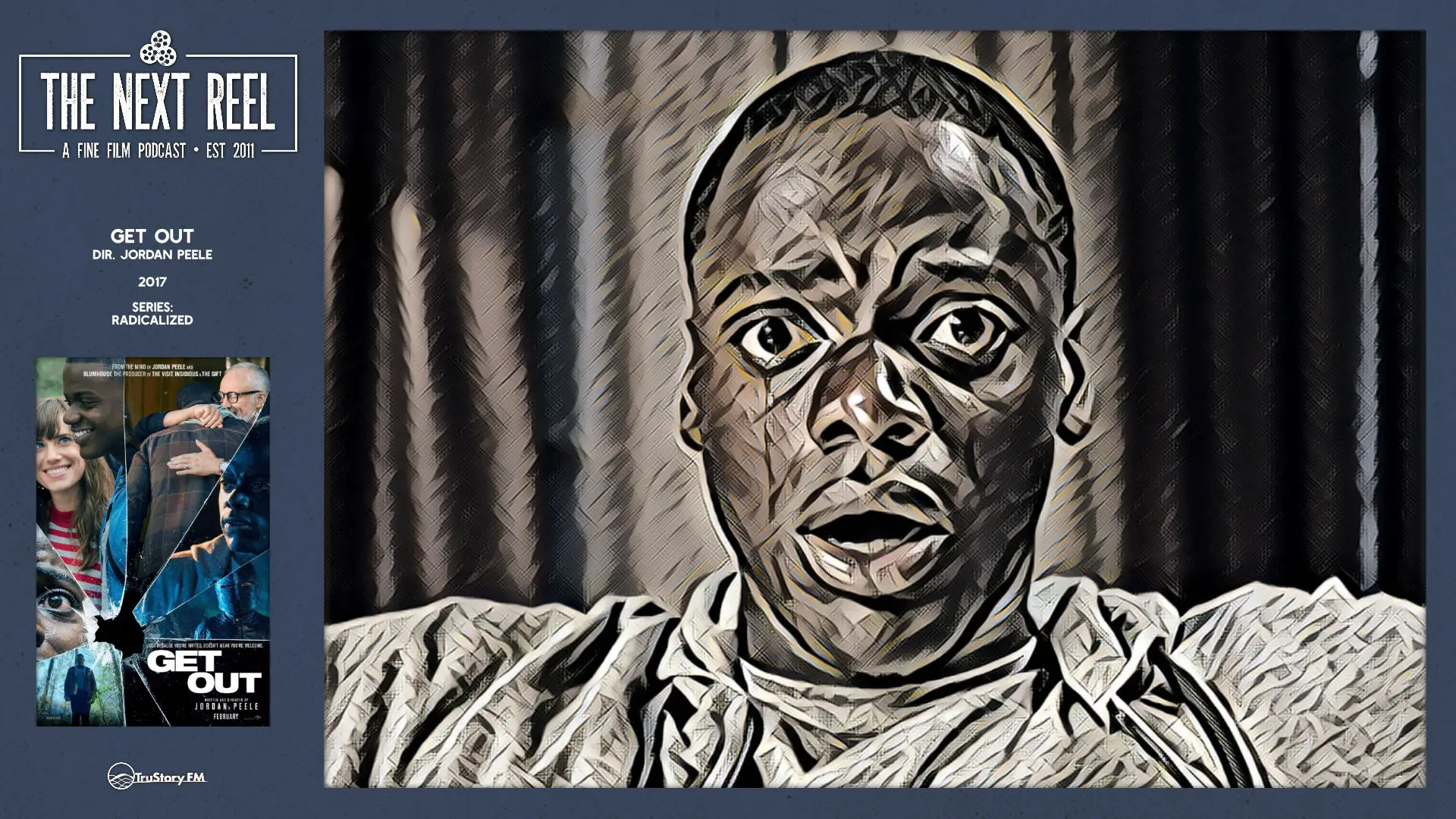
Get Out is over. “A mind is a terrible thing to waste.”
Andy, I’d like to start with something that is adjacent to the movie specifically, but deeply related to the movie, and that is the films of Jordan Peele.
Andy Nelson:
Okay.
Pete Wright:
We have three of them: Us, Get Out, and Nope. Do you think that Jordan Peele is out to get me? I feel targeted by his whole collection. Do you think he’s out to get me? And do you know why?
Andy Nelson:
I’m not sure where to go with this. Are you saying he’s addressing certain fears that you have? What is it — why do you feel he’s out to get you? Are you afraid of sheets floating in the wind?
Pete Wright:
Yeah, but that’s not the point. The point is, as a filmmaker, he is a grand antagonist. No, let me be more specific. As a film titler, he’s a grand antagonist to my entire movie-enjoying Gestalt.
Andy Nelson:
Mm-hmm.
Pete Wright:
Do you understand where I’m going now?
Andy Nelson:
Well, yeah, but that’s like the — you know, Erin Brockovich. Oh no, they say Erin Brockovich in the movie.
Pete Wright:
Hey, had it happened once, it would be okay. But he’s done it three times, where I think he’s intentionally titled movies words that are, by God, inescapably scripted into the characters’ voices.
Andy Nelson:
Yes.
Pete Wright:
They have to say “nope” in the movie. Of course they do. That’s “us” they say in Us. He’s just toying with me. He wants me to rage against his use of the titles in the film, but I can’t. And that is, I think, why Jordan Peele is evil.
He has set it up for me to hate, but he knows that I cannot. And for that, he will be on my enemies list forever.
Andy Nelson:
Wow. So much for the “friends who haven’t met me yet” list.
Pete Wright:
Andy, I contain multitudes. He’s on both lists.
Andy Nelson:
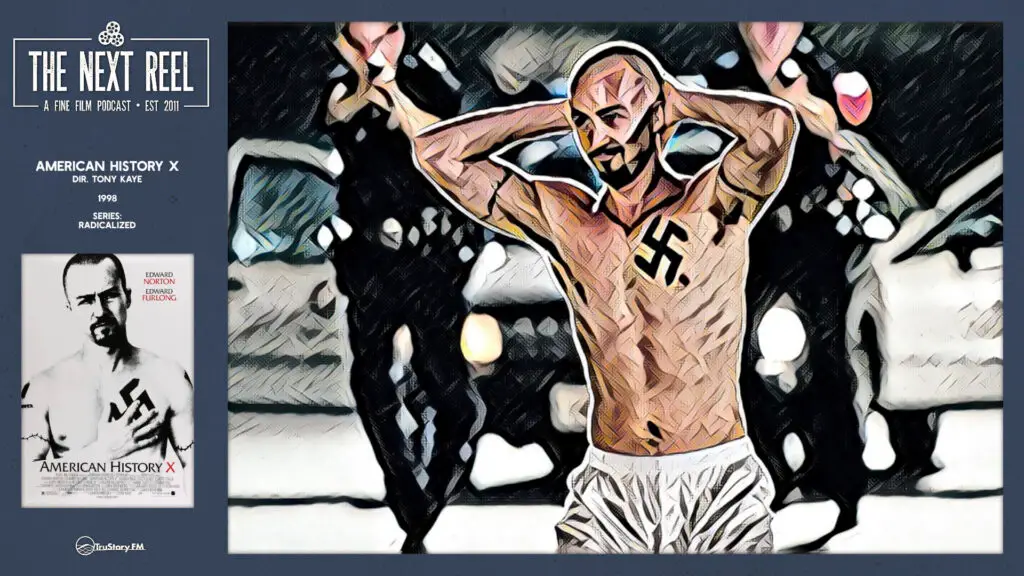
Oh, wow, okay. He’s a friend of mine. It is interesting. I mean, I will say, yes, the character does hear “Get Out” said in the film. It’s not as egregious as hearing, “I’d like you to write a paper, and it’s going to be called American History X.”
Pete Wright:
American History X — you’re right. This is, I guess, an improvement. What’s next? Should I gird my loins for “The Order is ready” next week?
Andy Nelson:
Right. That’s really funny. I have to think about if they even say that in the movie. I don’t think they do. I guess we’ll find out next week.
Pete Wright:
Oh, okay.
Andy Nelson:
Next week.
Pete Wright:
So, Get Out. We talked about this on Film Board when it came out. It was you and me and Tommy and Darnell. I think, after going back through that episode, it’s fair to say that this movie has improved with age for me. If you believe it, it’s actually better.
Andy Nelson:
I am glad you listened to that again, because I haven’t re-listened to the Film Board episode. But as memory serves, I think I might have only given it four out of five.
Pete Wright:
Yeah, you gave it four stars, and you called its issues story-construction issues about plot logic. And we’re gonna talk about those.
Andy Nelson:
Interesting.
Pete Wright:
I’m gonna test you against your own past, Andy.
Andy Nelson:
I’m thrilled that you have taken it to this place. This is great.
Pete Wright:
Andy, I’ve been very sick.
Andy Nelson:
That’s right. You gotta come up with something to keep yourself busy. Oh my gosh. So, just to kind of recap the series: this is Radicalized. We’re looking at three films. American History X, which, as I said last week, was kind of the most overt version of what we’re seeing as far as the white supremacist and radical activities. This film, Get Out, is really the most covert.
You don’t even know that these white people are going to be a problem. I guess you could say Rod might, but largely you don’t really suspect anything. And then The Order, which is based on a true story, is really kind of — you’re seeing overt actions and covert actions kind of existing together, but also kind of a shift between them going into different directions. So I think it’s pretty interesting. This is an interesting example because here we’re following an African American character as our protagonist, and in this particular case it’s also a genre film. So this is a character who is trapped by this covert group and is trying to essentially survive, because they want his body, and it’s a pretty dark concept that they have. It’s the horror version, you could say, of Being John Malkovich. I just wanted Orson Bean to be in that crowd as one of these people who was trying to get into him.
Pete Wright:
It’s also sort of the racially smoldering version of Eyes Wide Shut. Although I have to say, I don’t think I’ve heard anybody say “I’m gonna throw a Get Out party” recently.
Andy Nelson:
Oh man. Yeah. But I mean, this is a great film. How many times have you seen it? Do you know — a number of times?
Pete Wright:
Well, yeah, I mean, I obviously — the first time I watched it, I bought it. It’s a movie I come back to reasonably often. It is some great filmmaking, and I really enjoy introducing people to it. I really enjoy watching people watch this movie, and that sounds so sadistic. It sounds actually like I’m trying to throw a Get Out party. But I’m gonna try to make that a thing by the end of the show.
Andy Nelson:
Yeah, I know, you really are.
Pete Wright:
If people aren’t saying, “Anybody want to throw a Get Out party?” as a way to describe something horrible, then I will not have done my job. So I’ve probably seen it six or eight times.
Andy Nelson:
Okay. And I do think it’s also just fair to say that you’re growing into the Bradley Whitford stage of your looks here in life.
Pete Wright:
Oh my god. We’ve known each other a long time. I don’t think you’ve ever said anything nicer to me. Ever.
Andy Nelson:
Well, this was my fourth time watching it. And I think, pretty much every time Jordan Peele has had a new film out, I have returned to this and kind of re-watched his catalog each time he’s had a new film. So this is the first time actually going back to it without seeing any other of his films that he’s done. But it is a film, as you said — it’s only gotten better with age for me. Every time I re-watch this film, I’m finding more interesting things to think about, more themes, more concepts. I really like what he does with this movie.
Pete Wright:
Me too. So how would you like to walk through the movie, Mr. Radicalized?
Andy Nelson:
Well, that’s a good question. Why don’t we talk about the way the film is dealing with race, as far as the white supremacist, the white views in the film, as opposed to our Black character and the world he is coming into. Because it’s an interesting setup in that here he has this girlfriend, Rose, a white girl, and they’ve been together long enough to have a fairly serious relationship. It’s at a point where they are going upstate to stay with her parents for the weekend so that he can meet the parents. And one of the first questions that he asks her in that conversation is, “Do they know that I’m Black?” Because that’s a concern that he has. And it’s a very fun and playful conversation as they are talking about it.
And you kind of get a sense that, from her perspective, her parents are kind of like just the normal white people who are probably gonna say some things that come across wrong, like, “Hey, I would have voted for Obama a third time if I could have.”
Pete Wright:
Which makes for an outstanding callback later.
Andy Nelson:
Yeah, exactly. So you get this sense that, okay, it’s gonna be one of these things. And when you meet them, they seem like essentially nice, white, liberal family — they seem kind of like good people. Maybe there’s a little bit of sketch going on with the son, but otherwise Mom and Dad seem genuinely like okay people. But then things start getting weirder. And it’s an interesting exploration in a culture like this — they have a lot of money, it’s a family of doctors, and they basically look at Black people as — it’s interesting.
They look at them as people who are stronger, better physical specimens, but they don’t see them as people still, right? They see them as somebody who — “I’m getting old, I need to take myself out of my body and put myself into a better body. I’m gonna pick Chris’s.” And that’s kind of the way that the story plays out.
Pete Wright:
It’s a really interesting way to approach sort of modern slavery, right? Because fundamentally this is a slavery story.
Andy Nelson:
Absolutely.
Pete Wright:
And — we might have owned slaves. Bradley Whitford and Catherine Keener, their characters obviously would have definitely owned slaves had they been alive and working several generations ago, and now, because of technology and culture, they have decided that the next best way to own a person is to become them — to use them as a shell, to not value their identity anymore, to not value their personhood, but just value their mechanical being. I think that is a really fascinating way to look at this movie. And in looking at some of the reviews, I haven’t heard that part enough. I’ve heard a lot of people say that this is the new horror, that the reason it’s scary is because they want to swap brains.
But I haven’t heard it really referred to as a slavery-coded experience. And I appreciate the movie on that level. For good or ill, I think that is an element of the horror that is screaming out of this movie.
Andy Nelson:
Yeah, it is fascinating and terrifying. And I think, as you know, we’re following Chris, who’s our audience surrogate — we’re seeing the way that they behave around not just each other and him, but also these African Americans who are working for them, Georgina and Walter. And eventually, when we meet Logan, who we find out used to be Andre, we’re meeting these people who don’t act ostensibly like they are an African American person. And on top of that, when he sees how Dean and Missy, the parents, treat them, it comes across as, “Okay, you say that you are kind of these normal people, but here you are, you have these people working for you.” And they even call it out — they’re like, “I know what it looks like.”
“We have these Black people who are working for us,” and stuff, but it still comes across as something strange is happening. It just reeks of a split in how Chris is able to interpret what’s going on.
Pete Wright:
Yeah, because around every corner there’s a rationalization that makes it okay. “I know what it looks like, but—”
Andy Nelson:
Yeah. They’re very good at that.
Pete Wright:
“These people took care of my parents before they died, and we couldn’t fire them. They’re part of the family.”
Andy Nelson:
What does he say? Because it’s such an interesting line — it’s essentially, “We couldn’t part with them.”
Pete Wright:
Yeah.
Andy Nelson:
It’s like he’s talking about his parents, really. So it’s kind of creepy when you really think about it. He’s not — he doesn’t care about Georgina or Walter at all. He’s just thrilled that he was able to find a place his mother and father could end up going.
Pete Wright:
Yeah. We had a theory in our original conversation that his parents, Georgina and Walter, had a Disney mode, where when people were over they became like animatronic humans, but when they weren’t, when they were alone, they would be able to act like his parents. Weirdly, that is a conceit that has aged well for me watching this movie again — it does feel like the conflict comes when the parents have to pretend to be servants and they can’t handle it. They can’t handle being in that mode and everything breaks apart. And I think that comes from both directions. One is the Black identity, the Black cultural, racial history, erupting from being forced to be in this role of servant in this house for white people — and the other, the white people who are co-embodying this shell who can’t adapt to being servants for others.
That is what Georgina and Walter kind of represent, this amalgam of conflict at the idea of serving others, and how it doesn’t matter how you get there — it’s a horror movie either way.
Andy Nelson:
It’s really funny that they ended up going this route with Georgina and Walter — as far as, “So we can keep them around, let’s just have them be essentially employees who work for us,” as opposed to Logan, Andre — LaKeith Stanfield’s character — who’s essentially married to this older white woman. That’s kind of a different perspective. The Armitages could have come up with a different spin on it, like, “Oh, we’ve grown up with this family, we’ve always been together, and they are part of us, essentially,” so that they didn’t have to play those servile roles.
Pete Wright:
Right. Like the Armitages, the only reason that they could justify having two Black people living with them in their home is to make them servants. That’s pretty telling.
Andy Nelson:
Yeah, you’re right. That’s all I do. It’s very funny — very interesting.
Pete Wright:
Okay, so can we walk through the mechanic of how — if we were gonna put together a downloadable guide to go with this episode, that might be called “How to Host a Get Out Party” — let’s walk through what they go through to make a Get Out party happen.
Andy Nelson:
You’re just gonna keep going with that, aren’t you?
Well, there’s gotta be bingo.
Pete Wright:
There’s definitely bingo, but it’s weird racist bingo.
Andy Nelson:
Yes, it’s the weird racist bingo version, exactly.
Pete Wright:
It starts with acquiring the raw material. They acquire the raw material in what seems to be any way they can, but really this is the young Armitage generation that seems to be responsible for this.
Andy Nelson:
Yeah, they each have their own method. We find out — well, obviously, at least it seems like Rose’s version probably takes some time, because she’s gotta find a guy, start dating him, date him long enough to get to a point where it’s, “Okay, now we’re gonna go meet my parents,” and then they go do that. Whereas when you look at Jeremy, his version is just like, “I’m just gonna drive around until I see somebody walking by himself, and I’m just gonna kidnap him.” So that’s probably, in the scheme of things, faster and more effective than the amount of time that Rose takes.
Pete Wright:
For sure. And yet that was actually your criticism — one of your first criticisms lobbed at the film — that the opening abduction doesn’t fit, you said. If Rose lures men home, why just snatch Andre off the street? And we all came back at you and said you’re wrong. And that was fine. But I’m curious if that’s changed for you over the years.
Andy Nelson:
Oh, yeah, it has. I feel like I’m understanding better the different ways that they’re drawing people in to do these sorts of experiments and have these sales with these different people. And I imagine, in the scheme of things, like I was saying, Jeremy’s method is going to get people a lot faster. And I wonder — I guess the question that I would have is, I wonder if the way that they end up getting brought into the fold ends up creating something in their head that makes it harder or easier for the transition to happen. Because with Jeremy’s, you’re essentially kidnapped — you’re already a hundred percent going to be in panic mode, you’re gonna wake up in the chair, and then next thing you know, you’re laying on the surgery table getting your brain swapped. Whereas hers is so much more subtle in the way that it happens, and eventually it builds to that same terror, but I don’t know — I think there’s a possibility.
We see it with Missy, when she first hypnotizes Chris — that could have theoretically been the last moment that he had before he woke up in the chair in the basement. He ends up having an entire other day.
Pete Wright:
And why did they do it that way? That’s a thing I wonder.
Andy Nelson:
Well, I guess in the scheme of things, it does make sense for them to be — well, that’s a good question. The crowd comes and meets, everybody gets to meet Chris, talk with him, get a sense of him, check out how strong he is, all of that. Everybody gets a sense as to who Chris is at that party. How do they go about doing that with Andre? Is he just tied up and they’re all coming up and looking at him?
Pete Wright:
Or is he already hypnotized? Is he just hypnotized into a mode of compliance?
Andy Nelson:
Yeah, right.
Pete Wright:
I mean, he’s obviously a spirited fighter when it comes to keeping other people out of his brain. But with Chris, I think you’re right — maybe Chris represents the best-case scenario, where they get to catch this guy and he’s in a mode of willing compliance, and then they’re able to have the auction after everybody has sort of sampled the material. And it’s gross. But when you look at the transition into the third act, after he wakes up tied to the chair and the TV comes on and it tells the story, the presentation from the Armitage generational authority is one that says, “We’re doing you, young Black person, a favor.”
“We are gonna make your life better by taking you out of this shell and replacing you with one of us, that’s going to improve your circumstances. You may not be wholly around to experience it, but trust me, this is good for you. We’re doing you a favor.” It’s out of the kindness of their hearts and wills that they’re able to do this.
Andy Nelson:
Which again falls into that covert way of thinking, where they’re doing it in such a secretive way — you have to be hypnotized, really, for all of it to work. And I think that plays in an even more terrifying way, because you feel like you should be at least safe in some capacity, but then you find out what they’re doing, and you’re like, there is no safety at all here for me in any way, shape, or form. So it’s an interesting element. And it does make you think, because they do talk about how the person is still there — they’re just now perpetually going to be in the backseat. They can only be watching forever what is going on through their own eyes.
Obviously there are times where they break through, whether it’s with a flashbulb or whatever the case may be, where they’re glitching a little bit, I guess you could say. We see it with Georgina. We see it with Logan at the party. And actually, with Walter at the end — that’s how he gets Walter off of him, is he flashes him, and that’s when Walter finally turns, and you get to see the real person turn around, clearly with a little animosity for Rose, and go after her. And the way that plays is pretty interesting.
Pete Wright:
I wanna stay on the victims for one point, which I think — I think this criticism maybe runs right into practical, budgetary issues with the making of the movie, and it is another one of your criticisms from the early round, and it hit me before I even went in and listened to the original episode. Given the stack of photos of past victims that Rose has stashed away in the Malkovich closet, doesn’t it feel like we should have experienced more than just four Black characters in this movie — or people in the actual process who’ve been taken over — where there are too few actual victims?
Andy Nelson:
Interesting. I guess I didn’t remember that as a point. And maybe it’s because now it doesn’t bother me so much. I feel like the people who are coming to these events, to the auction, are, most of the time, other than Logan — who you wonder why he and his wife are actually here, unless it’s just because they were the most recent and it’s kind of a chance to show off and see everybody again — but otherwise, you think that the people who aren’t coming probably are all the ones who already have gone through this process and have now
Pete Wright:
They’re on cruises.
Andy Nelson:
—replaced — yeah, they’re on a cruise.
They’ve replaced the husband, the wife, the child, whoever it is that they needed a new body for. They’ve replaced that.
Pete Wright:
Because they’re not shopping anymore.
Andy Nelson:
Yeah, they’re not shopping, exactly. So we’re only seeing people who are pretty much here to shop.
Pete Wright:
Yeah, I don’t know how much of it is a criticism versus just a fascinating thought experiment, to imagine Peele and crew walking that line. Because if you add too many Logans — too many recent people — then it becomes deeply suspicious, or you think it’s a different movie. It teases a different movie — it’s just old white couples where one of the couple is an old white person and the younger Black person. We didn’t get any couples where it’s two young Black people who are acting like old white people, and I found that to be a chillingly humorous thought as I considered it. I wish they had given us two young Black people acting like old white people.
Andy Nelson:
Yeah.
Pete Wright:
But at some point you realize that they have to draw a line with introducing this, or it becomes almost too suspicious, or it’s maybe not suspicious enough in the right way. That is a really interesting exercise.
Andy Nelson:
The fact that you brought that up, I think, is an interesting point, because eventually, if you keep going down that road, you could turn into The Stepford Wives, where suddenly it’s like everybody in the community seems to have a spouse and the other one is African American. You turn it into this situation where it’s like, “What kind of place am I living in? This is crazy.” And I know The Stepford Wives was an influence on Peele as he was coming up with this. But I think he didn’t want it to turn into something that felt like that. And likewise, you don’t want it to turn into Invasion of the Body Snatchers, where suddenly it’s just more and more people, and by the end of the movie everyone’s African American — but are they?
Pete Wright:
Yeah.
Andy Nelson:
It can suddenly cross a line. So I think it was a delicate line, and I think Peele — I didn’t end up having problems with it, I didn’t even think about that, but it is an interesting point.
Pete Wright:
I think your reference films nail the point, because if they had done too many Black people, it would have been a different kind of suspicion and a very different kind of movie. And, you know, Don’t Worry Darling is another one you might put into that category.
Andy Nelson:
Oh, sure, yeah.
Pete Wright:
I think you would lose the severity of Peele’s approach to this particular dark, dark satire. And this makes it better, for sure.
Andy Nelson:
Yeah. All right. We’re gonna take a quick break, but first — you can find the show on YouTube, and can join us live when we record. We will even take your questions in the post-show chit-chat, and members get the full post-show conversation and always know what to listen to next. Subscribe to The Next Reel on YouTube. The link to this episode is in the show notes. We’ll be right back.
Pete Wright:
All right, Rose. Everything kind of hinges on Rose, and particularly the sequence where he’s trying to get out and he just needs the keys.
Andy Nelson:
The keys, yeah.
Pete Wright:
And she’s also the character who is most responsible for having a good rewatch of this movie. Once you’ve seen the turn once, it’s great — but can you watch it again and still feel the intensity of that sequence? For my money, it hinges on her portrayal of Rose and, “You know I can’t give you the keys, don’t you, babe?”
Andy Nelson:
Yeah, that plays so well. And it’s interesting, because she’s so sweet and loving through the first part of the film, and then has that turn at that point, and from then on has the ponytail. So she’s got into severe racist mode. She had a lot of people who would come up to her and say, “Oh, but you were brainwashed, you were hypnotized” — they had all these excuses for her specifically as a character. And she’s like, “No, I’m just — I’m an evil character. That’s who I am.”
“And I’m just acting.” And people had a hard time buying that, and I find that to be a fascinating element with that character. And I think that is why it works so well, still, every time.
Pete Wright:
I think we’ve adopted the wrong word for her transformation. It’s not actually a turn, it’s a reveal. Because a turn implies that she was brainwashed or something, but really it’s a reveal of her own character’s reality.
Andy Nelson:
True intentions, yeah.
Pete Wright:
And for me, it works every single time. I think she’s just fantastic. It made me not trust her in M3GAN.
Andy Nelson:
You had a hard time, like, “I don’t know if I can believe you, Allison Williams.”
Pete Wright:
Yeah. Allison, you’ve sullied your reputation in Get Out. I think you revealed your true character.
Andy Nelson:
That’s funny.
Pete Wright:
Now every character spins off of the Get Out universe.
Andy Nelson:
That’s just who you are, yeah.
Pete Wright:
Yeah.
Andy Nelson:
Wow, poor Allison Williams.
Pete Wright:
I know. And she’s delightful — I really like her, but now everything she does is pretend.
Andy Nelson:
Well, she said she had a hard time, when they were filming, and she switched — all the stuff that she was filming when she was playing — Jordan Peele had different character names for her, I can’t remember what they were, but Rose was the loving girlfriend, and “Ro-Ro,” I think, was the one who was a little more harsh. And when she played that character, she tried to stay that way — she would eat separate from the rest of the cast and crew, and she tried to keep herself separate, because she needed to stay in a totally different headspace. And she said it made it really hard when she was with Daniel Kaluuya, because they had become good friends, and by that point it was hard for her to perform that. So I think that’s interesting, that it was hitting her so much.
Pete Wright:
Do you think she still eats cereal separately?
Andy Nelson:
That is probably the most evil thing that she does in the film. It’s just so twisted and weird to eat one Froot Loop at a time and then take a sip of milk through a straw. That is just — there’s some clear psychosis going on with her.
Pete Wright:
Yeah, it’s pretty good. That Froot Loops controversy in this movie.
Andy Nelson:
Yeah. That is just crazy. It’s such a weird thing. But you know what, it is a great reveal, because so much is happening at that point in the film with Chris getting out finally — listening to the title of the film — and he’s already killed Dad and Mom, and he’s fighting with Jeremy by the front door, and he’s running out of the house. And it’s only at that point where we cut to her and we realize she’s been sitting upstairs this whole time. But she has her headphones on, she’s listening to music, and she’s doing research for the next victim.
She’s looking up NCAA, the top leads for players. And I thought that was actually a great reveal, because I was just like, where is she? Why is she not hearing any of this? And then you cut to that and you’re like, oh, okay, that was perfect and so creepy.
Pete Wright:
This was the first time — I can’t believe it, in all the years that I’ve owned the film — that I have ever watched the alternate ending.
Andy Nelson:
Really?
Pete Wright:
Yeah.
Andy Nelson:
Okay.
Pete Wright:
Yeah. Now, the alternate ending, for those who haven’t seen it, is the ending that you would have expected the movie to have, because ultimately Chris does murder some white people in a really rich neighborhood, and what happens when a Black man murders some white people in a really rich neighborhood — he’s incarcerated. And the final scene is him talking on the phone to Rod, and he says, “Stop doing this, stop investigating, TSA.” What is really interesting is to hear the commentary about why the ending was changed, because when Peele was working on the movie, it was the Obama administration, and his point was, not all is “yes we can” out there in the world, and we need to have a dose of reality at the end of the movie. And by the time the movie was actually produced, the message of the movie needed to be one of a little bit more hope. What’s your take on that?
This was the thing we did not know when we first talked about the movie when it came out.
Andy Nelson:
No, we didn’t. I think that it was the right decision to make. I think having a more uplifting, positive ending instead of police pulling up at the end as he’s essentially over Rose with his hands on her throat — and we think that it’s the police, and then we find out, oh, it’s Rod, it’s TSA, and he’s here to save the day. And it’s funny and it’s uplifting, and you just feel a sense of relief — in the scope of a horror movie, that’s a great way to end it. But in the larger scheme of things, it is kind of what we needed. We needed to see some African American characters having a victory in these sorts of situations, because in the real world we were seeing some pretty awful stuff as far as Black people getting killed by police and things like that.
And I think Peele recognized that there’s a lot of this stuff happening, and having the movie follow that same path — it definitely would have taken it to a darker place. And I think people needed something a little more positive and uplifting at that particular point. And still to this day, I think that it’s the right way.
Pete Wright:
I look at this ending and I think it serves many needs. One, the ending as it was released maintains the spirit of the fable of this horror story — it stays inside. Two, it allows Rod, who has been the comedic relief valve for the entire film so far, structurally, to have a last laugh — to be the source of a last release that we get in the movie at a time of great intensity. And finally, it is almost more sadistic a commentary on the police relationship with Black people, because we all know instantly how this would have gone.
We don’t need to see him incarcerated to know how it — because that ending played out the moment we saw the red and blue lights. We didn’t need it. So I think this ending is a stroke of brilliance at the end of this movie, as punctuation at the end of this movie. It is absolutely perfect.
Andy Nelson:
Well, and in the scope of watching Chris as a character, with his character arc growing over the course of the film, I think it also ends up being important, because he is a character who is kind of staying back. He’s never really putting himself forward as the protagonist of our film. He is a man of inaction. He couches how he acts and reacts — like when the police officer at the beginning is talking to them about the deer, he knows the game and he’s just playing along, and the cop asks for his license and he’s just ready to give it to him. And it’s Rose who stands up for him. In retrospect, when you know the movie, you realize that she just doesn’t want any paper trail — she doesn’t want anybody to recognize that he was with her once he’s disappeared.
Pete Wright:
Oh my god, Andy — what did I say, eight times? That’s never occurred to me.
Andy Nelson:
Yeah, it’s interesting. She’s just — you can’t have that record.
Pete Wright:
Outstanding.
Andy Nelson:
So he freezes up. His whole backstory is when his mom doesn’t come home — what does he do? He can’t go out and look for her. He just freezes up and watches the TV the whole time. He literally is unable to do anything when he falls into the sunken place. And so he becomes a man of action. And it’s funny — he literally becomes somebody who’s picking cotton in order to save his life, as Jordan Peele pointed out.
And I think that’s fascinating. And I think at the end he doesn’t strangle her. He’s becoming a man of action by that point, and he’s trying to strangle her, but doesn’t — but he does actually, knowingly, with Rod now that Rod is there. But before he knows it’s Rod, what is he doing? He’s going back into that mode again, where he’s just putting his hands up — “I have to go back and play the game.” And then, once he realizes it’s Rod, he’s given a chance to become that man of action again. And he does it in a fascinating way, where he’s a man of action by leaving. And in a way, he’s also reflecting the man of inaction.
He’s not actively killing Rose at this point, but he is inactively killing her by leaving her bleeding out in the road. And I think that’s a fascinating play on his character — this man of inaction who becomes a man of action but doesn’t actually kill her.
Pete Wright:
So has he changed at all as a character?
Andy Nelson:
Oh, I think absolutely.
Pete Wright:
He’s a man of inaction who becomes a man of action and then doesn’t, again.
Andy Nelson:
Yeah — but it’s an active inaction, that’s the twist, see?
Pete Wright:
It’s a real roller coaster.
You got me.
Andy Nelson:
Oh yeah.
Pete Wright:
You got me.
Andy Nelson:
So interesting.
Pete Wright:
Just a little bit on Rod, because I know we’re getting toward the end, but we gotta talk a little bit about Lil Rel —
Andy Nelson:
Lil Rel Howery.
Pete Wright:
He’s absolutely hysterical, and the perfect man in the chair who eventually transcends the chair because, you know, he’s TS-f’n-A.
Andy Nelson:
Yeah. It’s so fun. I love Lil Rel Howery in this role. He’s clearly having a lot of fun. And again, in these sorts of horror movies, it helps to have a character who can see everything so much more clearly than our protagonist does. And he is the one who’s just like, “I told you.” And even at the end, he’s like, “I don’t want to say it, but I told you so.”
Pete Wright:
I know he gets literally the last line. He was our Cassandra the entire time.
Andy Nelson:
Yeah.
Pete Wright:
Because when he says, “She hypnotized me — what, you’ve got to get out of that house” — he knows exactly what it’s all about.
Andy Nelson:
Yeah, yeah.
Pete Wright:
And I think the other bit — sex slaves.
Andy Nelson:
Sex slaves.
Pete Wright:
The other really interesting structural element that he serves in the movie is that all the other — I’d start with Black characters, but really any character that interacts with him — it’s an excuse for the film to explore code-switching, in a really practical way.
Because when Chris is talking to him, they’re speaking like two Black people, really great friends, talking to one another, and their language changes, their demeanor changes, their shortcuts change. When Rod goes to talk to the detective, and he’s holding the dog and he starts talking to her, you can tell he’s code-switching a little bit. But is it racially motivated code-switching, or is it professionally motivated code-switching, because they’re both in law enforcement? And then the other two detectives come in, and they are not white, but they’re also not Black. And they get a chance to explore how language changes in that context.
And I find all of that really expertly written. It really feels like his monologue is walking that line for this character who is exceptionally good at knowing how to communicate, just instinctively, depending on where he is.
Andy Nelson:
That’s a great point, and that’s one of my favorite scenes — when he’s talking to the detectives and he’s spinning this story, and the way he is trying to figure out how to pitch the story in a way that they’re gonna believe him, because when you tell the story, you can get a sense that it does sound a little crazy. Once you bring up sex slaves, the whole thing gets a little crazy. And also, on the surface, it’s just, “I’m looking for my buddy. He went with his girl, his white girlfriend, to her parents for the weekend, and he’s missing.” “Are you sure he’s missing, or is he just enjoying his time up on this vacation?”
Pete Wright:
So the conversation is between Rod and Detective LaToya. “But Chris say he is acting real different,” Rod says, about Dre. “Different how? This dude is from Brooklyn — he didn’t dress like this.” And Detective LaToya says, “I didn’t used to dress like this.” And we get this moment where these two Black characters, in very different contexts from where they grew up, it’s implied, are able to actually find a place of commonality. And I think that’s interesting, even though Rod becomes the brunt of a joke and it’s perfectly set up.
It’s absolutely key-and-Peele. If anything, Rod is the expression of what we used to get from Key & Peele. And a perfect release valve for so much of the tension in the movie. But I think this scene is actually saying something more compelling than just a comedic beat.
Andy Nelson:
Yeah, I definitely think so too. There’s a lot going on with the way these characters are interacting. And I think, in the balance, there is a real energy that is similar in horror films and comedy films. And I do think that Jordan Peele, having done so much in comedy with Key & Peele, understands the way comedy works, and by doing so also understands how setups and payoffs all play in a horror film. And you can see he delivers it so well, and understands that having that release valve in a horror film can really help — you end up creating those moments where, oh, you needed a moment of levity. And I think that’s a very smart thing to deliver with Rod, all the way up through the end. I think it’s just a very smart way to tell this story.
Pete Wright:
Absolutely.
Andy Nelson:
Yeah.
We haven’t mentioned at all in this conversation that Catherine Keener is in this, and I think we have to, because I love her so much as Missy. I think she plays that character so well. She’s the psychiatrist in the house, and I think she is not what you’d expect at all. And the way she comes at Chris in that moment where she’s having the conversation with him, and he’s thinking, “Is she working on me here? Are we just having a conversation?” — and the way she drops him into the sunken place — it plays in such a surprising way. It’s an expert delivery of the scene. And I think Catherine Keener just nails it.
Pete Wright:
I do too. She is diabolical. Catherine Keener and Bradley Whitford together — when you look at the approach to the brain, they’re software and hardware, and I think it’s a really interesting pairing, that she is sort of in control of the sunken place. And the fact that the sunken place is — to me, it’s the perfect interpretation of the experience of, for me, it’s always like this is what I feel like I see when I go under anesthesia, when they say countdown.
Andy Nelson:
Yeah.
Pete Wright:
This is what I imagine. I don’t know that that’s what I’m really experiencing — mostly because I’m fighting hard to prove the anesthesiologist wrong. But this is what I think of when I think about it after the fact — that you just watch the world, in a frame, just disappear, and it makes the sunken place so haunted. Even though it isn’t filled with horrible demons and visions of evil — it’s just empty.
And that is all the scariness we need.
Andy Nelson:
Yeah. And it’s the way the effects team depicts it — all of that stuff, it plays in such a terrifying way. And it’s even more terrifying that all you end up seeing of reality is a little tiny TV window, way in the distance, that is just this tiny little thing. It really is freaky.
Pete Wright:
Well, and back to Keener — when she leans in close, there is some intention to making it feel like she can look into his eyes and see the sunken place. That is awful. That is so mean.
Andy Nelson:
Right. Like, “I see you in there, way down deep in the bottom of your pupil.”
Pete Wright:
Yeah.
Andy Nelson:
Yeah. It’s pretty terrifying. All right, well, shall we keep moving on?
Pete Wright:
Yes, let’s do it.
Andy Nelson:
Well, let’s move into the back half, but first let’s take a quick break.
Pete Wright:
The Next Reel is a production of TruStory FM. Engineering by Andy Nelson. Music by Tzabutan, IamDayLight, Oriol Novella, and Eli Catlin. Andy usually finds all the stats for the awards and numbers at The-Numbers.com, BoxOfficeMojo.com, IMDb.com, and Wikipedia.org. Find the show and the full archive at TruStory.fm.
You can follow us from there too, plus you can find out how to become a member and go further with every episode. Check out our merch store at TheNextReel.com/merch, and if your app allows ratings and reviews, please consider doing that for our show.
All right, Andy, how’d it do at award season? So many awards.
Andy Nelson:
This one, yeah — really, really, really well. 154 wins with 215 other nominations, and Pete, we’re doing all of them.
Pete Wright:
Oh my God.
Andy Nelson:
All right, maybe not — that’d be too many. But let’s start with the Oscars. Nominated for Best Picture, but lost to The Shape of Water. Best Actor, Daniel Kaluuya, but lost to Gary Oldman in Darkest Hour. Best Director, lost to Guillermo del Toro for The Shape of Water. And Best Original Screenplay, he did win. Fun Oscar facts:
Peele became the third person to earn Best Picture, Director, and Screenplay nominations for a debut film, after Warren Beatty and James L. Brooks, and the first African American winner for Best Original Screenplay, and fourth overall nominated, after John Singleton, Spike Lee, and Suzanne de Passe. It also became the sixth or seventh horror film to be nominated for Best Picture, after The Exorcist, Jaws, The Sixth Sense, The Silence of the Lambs, and Black Swan. And I said sixth slash seventh because this was the same year as The Shape of Water. So, Shape of Water — man, I tell you, just between those two, Get Out would be the one I would single out. I mean, I enjoy The Shape of Water, but it wasn’t the best picture of the year.
Pete Wright:
And I didn’t — it’s one of those movies I don’t talk about often, because it didn’t hit me the way it hit, I think, the vox populi.
Andy Nelson:
Yeah.
Pete Wright:
I didn’t get it.
Andy Nelson:
Yeah. At the Saturn Awards, it won Best Horror Film. Kaluuya was nominated for Best Actor but lost to Mark Hamill in The Last Jedi. Also lost Editing and Writing to The Last Jedi. Writing to The Last Jedi. Let me just re-emphasize that.
Pete Wright:
No, everybody heard you, Andy.
Andy Nelson:
Everyone heard that, yes.
Pete Wright:
Everybody heard you.
Andy Nelson:
All the way to their souls, yes.
Even the sunken place could hear that one. And then Peele was nominated for Best Director, but lost to Ryan Coogler for Black Panther. At the Casting Society of America Awards, it was nominated for Outstanding Achievement in Casting for a Studio or Independent Feature — Comedy, but lost to Lady Bird. At the Golden Globes, it lost Best Motion Picture, Musical or Comedy, to Lady Bird, and Best Actor, Musical or Comedy, for Kaluuya, to James Franco in The Disaster Artist. This was one of those things where people are like, “horror film in Musical or Comedy?” But it was just one of those funny things — even Peele was just like, “Well, there’s a lot of comedy in it, I guess.” At the NAACP Image Awards, Kaluuya won Best Actor, won Best Directing.
It was nominated for Best Motion Picture, but lost to Girls Trip. Supporting Actor Lil Rel Howery was nominated but lost to Idris Elba in Thor: Ragnarok, and it won Best Writing. And then, over at the Film Independent Spirit Awards, it won Best Film. Kaluuya lost Male Lead to Timothée Chalamet, Call Me by Your Name. Won Best Director. Lost Screenplay to Lady Bird. And it lost Editing to I, Tonya. Just a few other interesting lists it’s landed on: in 2021 the WGA ranked the screenplay the greatest of the 21st century so far. In the critics poll that the BFI puts out of Sight and Sound every ten years, in 2022, it was tied for 95th greatest film of all time. In June 2025, it ranked number 8 on The New York Times’ list of the 100 Best Movies of the 21st Century. And in July 2025, it ranked number 22 on Rolling Stone’s 100 Best Movies of the 21st Century, and number two on The Hollywood Reporter’s list of the 25 Best Horror Movies of the 21st Century — behind Under the Skin.
So, lots of love all over the place for this one.
Pete Wright:
Well, haven’t we talked about Under the Skin yet?
Andy Nelson:
Yeah, no kidding. We need to build that into a series. That is a creepy little movie.
Pete Wright:
Alright, well, how’d it do at the box office with all those wins?
Andy Nelson:
Well, for Peele’s debut feature, he had a budget of five million, or about six and a half million in today’s dollars. After premiering at Sundance, the movie opened February 24th, 2017, opposite Rock Dog and Collide, two movies I don’t remember at all. What are these movies? Anyway, this movie opened in the number-one spot, bumping The Lego Batman Movie out of the lead, and it stayed in the top ten for eight weeks, going on to earn 176 million domestically and 79.4 million internationally, for a total gross of 329.5 million in today’s dollars. All of this success made Peele the first Black writer-director to cross the hundred-million mark with his debut movie, made the film the highest-grossing film domestically directed by a Black filmmaker — at least for two weeks, until F. Gary Gray’s The Fate of the Furious broke the record — and led it to become the highest-grossing debut film based on an original screenplay in Hollywood history, beating the two-decade-long record of 1999’s The Blair Witch Project.
With all the accolades showered upon the film as well, it’s fair to say it was a huge success. All told, the movie ended up with an adjusted profit per finished minute of 3.1 million, earning back more than fifty times its budget. That is very impressive.
Pete Wright:
Wow.
Andy Nelson:
Yeah.
Pete Wright:
Very impressive. Sometimes there are good movies, Andy, and they don’t do well at the box office. I don’t know if you’ve heard that.
Andy Nelson:
That’s true.
Pete Wright:
I don’t know if your spreadsheet calculates that.
Andy Nelson:
It does happen.
Pete Wright:
Sometimes it happens. This is one of the rare times where a good movie actually did pretty well.
Andy Nelson:
It’s very rare. So rare.
Pete Wright:
It’s pretty rare.
Andy Nelson:
When is the last time a good movie made money? Oh my.
Pete Wright:
I really enjoyed re-watching this movie. As we close the loop here, how well does it hit home your thesis of Radicalized?
Andy Nelson:
I think it’s an interesting one to throw into this mix. It’s very different in the scope of how they’re depicting — essentially, the whole ideology of white supremacists and the neo-Nazi stuff that we saw in American History X — we’re not seeing that so much. You could argue Jeremy is getting pretty close to that. But largely, what you see here, and we talked about this at the very beginning, is essentially this horrific version of modern slavery. That’s why it’s even more terrifying. They seem like nice people, but in reality they don’t see any of these Black people as people who matter. Who they are does not matter.
All they see is a vessel for them, in which they can become a better person when their body gives out. And I think that’s what makes it so terrifying — as you said, it’s just this modern slavery. It’s really, really frightening.
Pete Wright:
It is. And part of the joke is that this version of white supremacy is just rooted in jealousy. This is why white supremacists exist — because they’re just jealous of what they aren’t.
Andy Nelson:
Yeah. Right. It all started because Jesse Owens beat grandpa at the Olympics.
Pete Wright:
A hundred percent. Is that not the perfect rationalization for why this kind of behavior exists? I think it’s really astute.
Andy Nelson:
Yeah, that’s very interesting. I just want to throw one last thing out. There’s a book out there that Greg Falla wrote called Sado Mass Essayist: Certified Loverboy, Certified Cinephile. And he said that Jordan Peele’s film was the start of a new era of horror that he dubbed Nu-Wave American Cerebral Horror, explaining that the movement is categorized by absurdist premises framing social narratives. And, you know, we have this whole thing with elevated horror, that whole term that just drives me nuts, that came out around, well, I don’t know, 2011, 2010, somewhere around that point. And I’m wondering if this is a better way to describe this type of horror film — Nu-Wave, N-U Wave, American Cerebral Horror — as opposed to elevated horror. I don’t know. How do you feel about that?
Pete Wright:
I’m trying to figure out why we had to call it Nu-Wave Cerebral Horror. Don’t we — I mean, is that somebody who’s just come up with a word and wants attention? I feel like we have words that describe this kind of horror. Like social horror, for example. We’ve had social horror for years — generations.
Andy Nelson:
No, yeah, we definitely have had them for a long time. And that’s why elevated horror always drove me nuts. That’s kind of what horror has been. When you’re making good horror, so often it is going to have some deeper themes and different psychological elements in them that isn’t just going to be like the next Nightmare on Elm Street film. And so that’s why elevated horror kind of drives me nuts. But I’m just looking up Nu-Wave American Cerebral Horror — core characteristics: social commentary as the monster, absurdist premises, and cerebral and psychological dread are three of their core characteristics. I don’t know, I’m not a hundred percent convinced that I like it, but it is interesting.
They also put other films on the list, like Hereditary, Midsommar, and The VVitch.
Pete Wright:
Who picks that?
Andy Nelson:
Yeah.
Pete Wright:
Peele himself doesn’t call this a horror movie either — he calls it a thriller. I think he calls it, actually, a social thriller. And that’s how he gets away with putting the movie in the same category as Guess Who’s Coming to Dinner and The Shining. And The ‘Burbs — your favorite, The ‘Burbs. This movie is in that heritage, but also it’s why I think it’s so hard to categorize when it comes to award season.
Andy Nelson:
Yeah.
Pete Wright:
Nobody gives awards for best social thriller. So anyway, I’m not crazy about Nu-Wave Cerebral Horror. I think that’s an attention grab in an attention economy.
I don’t think we need new words like that.
Andy Nelson:
I don’t mind it. I’m always curious about new directions of things and people trying to recognize—
Pete Wright:
But is it a new direction of things?
Andy Nelson:
It is. That’s the only way to fly, Pete.
Pete Wright:
Okay.
Andy Nelson:
Only way to fly.
Pete Wright:
Yeah.
Andy Nelson:
Yeah, so I think it’s interesting. Regardless, I do think that Peele does a great job of playing in the genre, so I’m very happy to see what he’s doing in whatever genre we’re calling it, if it’s a social thriller or whatever. But you brought up an interesting point, because when the film was up for the Oscar, and they were doing all the promotions and everything, there were people who felt that the filmmakers and everybody involved was trying to play the race card to get people to vote for the film.
There’s a quote here where, you know, these anonymous Oscar voters who told The Hollywood Reporter that they felt alienated by the Oscar campaign. And they said, in one of the luncheons, the lead actor Kaluuya, who is not from the US, was giving us a lecture on racism in America and how Black lives matter. “And I thought, what does this have to do with Get Out? They’re trying to make me think that if I don’t vote for this movie, I’m a racist. I was really offended.” And I just — it struck me that I still don’t know if people actually get what the movie was trying to say. And that was fascinating to me, that I think some people still are just gonna look at this as, “Oh yeah, it’s just a horror film.”
Pete Wright:
Yeah, alright. I don’t know, that is enormously frustrating and kind of exhausting. What does that have to do with Get Out? Well, let’s see — number one, everything.
Andy Nelson:
Yeah, right. That’s the movie. What did you watch? Oh man.
Pete Wright:
Okay.
Andy Nelson:
I tell ya. Alright. Well, that is it for our conversation about Get Out. Next week we’re closing out our series with Justin Kurzel’s The Order. It is the true story of a white supremacist group in the 1980s that turn to robberies and violence to try to start a race war, and the FBI agent trying to stop them, with Jude Law as the agent and Nicholas Hoult as the group’s leader.
And now let’s do our ratings.
Pete Wright:
Letterboxd.com/thenextreel — that’s where you can find our HQ page over on Letterboxd, where we are reviewing and rating all of the movies that we’ve talked about across The Next Reel family of film shows. Andy, what are you gonna do?
Andy Nelson:
I mean, it’s an easy five stars and a heart for me.
Pete Wright:
I’m looking at the notes, and I note that you have already given it five stars and a heart, and I didn’t even say anything yet. That’s a little—
Andy Nelson:
I looked at your Letterboxd review, and you put it in there.
Pete Wright:
Damn it, Letterboxd.
Andy Nelson:
What am I supposed to do? You gave it away.
Pete Wright:
Damn it. Yeah, it’s five stars and a heart. Originally I’d given it four stars, I think, and you did too, obviously. And that was a mistake, and we’re okay admitting that sometimes we change our minds. We contain multitudes.
Andy Nelson:
We do contain multitudes. Yep. All right. Well, that averages out to five stars and a heart. And you can find that on our account over on Letterboxd at @thenextreel. You can find me there @sodacreekfilm and Pete at @petewright. So, what did you think about Get Out? We would love to hear your thoughts. Hop into the Showtalk channel over in our Discord community, where we will be talking about the movie this week.
Pete Wright:
When the movie ends…
Andy Nelson:
…our conversation begins.
Pete Wright:
Letterboxd giveth, everybody.
Andy Nelson:
As Letterboxd always doeth.
Pete Wright:
Yeah, it’s hard to pick a bad one.
Andy Nelson:
It is, yeah.
Pete Wright:
Where’d you go? What was your category?
Andy Nelson:
I was just right at the top of five stars and a heart, and I went with jeaba, who said, “The most psychopathic thing in this whole movie is that everyone uses Bing for some reason.”
Pete Wright:
So many Microsoft Surfaces.
Andy Nelson:
Too valid.
Pete Wright:
And Microsoft phones — do they even make phones anymore? That’s amazing. I went with four stars and a heart from tildafan19, who says, “Aggressively straight white boy into sports, killed in a wrestling match. White dad who said he loves when deer die, impaled by antlers. Evil psychiatrist mom, killed in her office. Psycho girlfriend who earlier pretended to care that Chris felt responsible for his mom’s hit-and-run, left to die by the side of the road.” That’s called poetry, mother effers.
Andy Nelson:
Nice.
Pete Wright:
Yeah, outstanding. This is a good reading list of reviews for this movie.
Andy Nelson:
Yeah.
Pete Wright:
Yeah. Alright. Thanks, Letterboxd.