*This transcript is produced using transcription software and reviewed for quality. Despite our best efforts, some passages may be incomplete or contain errors due to audio quality or software limitations.*
Pete Wright:
I’m Pete Wright.
Andy Nelson:
And I’m Andy Nelson.
Pete Wright:
Welcome to The Next Reel. When the movie ends…
Andy Nelson:
…our conversation begins.
Pete Wright:
American History X is over. “Has anything you’ve done made your life better?”
Avery Brooks, man. What are you gonna do?
Andy Nelson:
I was thinking about that, because I bet that’s probably Pete’s favorite part of this, because of Star Trek.
Pete Wright:
Yeah. A hundred percent.
Andy Nelson:
Yeah.
Pete Wright:
Benjamin Sisko is my black savior.
Andy Nelson:
Yeah.
You know what’s funny? I shouldn’t admit this to you — I’m sure I did when we did our Star Trek series — I don’t think I’ve maybe seen one episode of Deep Space Nine.
Pete Wright:
I’ve given up feeling hurt about that.
Andy Nelson:
I know, I know.
Pete Wright:
I moved on.
Andy Nelson:
I do feel a little out of touch, because I feel like I should have seen it by now. But oh well.
Pete Wright:
Yeah. Same thing with Strange New Worlds. That one, honestly, is the more ridiculous. You gotta watch that. I’m gonna stop.
Andy Nelson:
Is that the animated one?
Pete Wright:
No, it’s the brand new one.
Andy Nelson:
Oh, okay, sorry. I don’t know.
Pete Wright:
It’s so good.
Andy Nelson:
I stopped at Star Trek a long time ago.
Pete Wright:
Oh my god. I can’t.
Andy Nelson:
I’m sorry.
Pete Wright:
I can’t even.
Andy Nelson:
I’m the worst. I’m the worst. Let’s talk about this movie instead of Star Trek.
Pete Wright:
Do you wanna?
Andy Nelson:
Oh, I think we should.
Pete Wright:
This was your pick. This is a new series, and this is your pick. I mean, they are all — all our series are starting to blend together with their issues, man.
Andy Nelson:
There’s a little bit of that. Although we’re not looking so much at the politics — Institutions Eating Themselves — but we’re certainly looking at organizations and groups. This series is Radicalized: the idea of how people get pulled into white supremacy, and then also, in some capacity, how the movement learned how to hide. I think that’s an interesting thing we’ll kind of walk through as we look at these movies. We have three movies we’re talking about. American History X is where we’re starting things off — definitely the more overt version of the white supremacy. Then we have Get Out, which you could say is a much more covert version of the story.
It’s gonna be an interesting one to throw in here. And then The Order, which is based on the true story — kind of real history of some of the covert and overt operations, and how they realized that by being more covert they can actually get farther along, I suppose you could say. So it’s gonna be an interesting conversation as we explore the series. Across all three, though, I think we’re gonna find that there is, in the scope of radicalization, you’re embraced by the organization and then it changes you, and then, in some capacity, it’s dangerous to leave. So — I guess maybe we’ll talk about this when we get to the end — but it feels like perhaps it’s more embedded in our society today than we even realize. It’s certainly something worth looking at and exploring.
Pete Wright:
Well, and that — honestly, as we get into the overarching experience watching the movie structurally — that point makes this movie weirdly quaint and dated watching it in 2026 eyes, because it is talking about a point in time. It’s similar to watching movies about the Klan, straight up the Klan. Or dare I say the Revolutionary War, when particular ideologies were worn externally through clothes, right? Like, we know what you believe by what you wear. You’re a redcoat, you’re a bluecoat. You wear the sheet, you don’t. You sport the tattoos and shave your head, and it puts you in a particular ideology. And here we are now, where some of those trappings of ideology no longer really matter.
They no longer define you, and you can walk out on the street and look to your neighbors to the left and your neighbors to the right and not really know where they stand by their outer appearance. And that has made just living in this country right now, kind of, maybe more terrifying, because of that level of uncertainty — and less comforting, that you know where you stand with people when you talk to them. This movie is so overtly bifurcated in beliefs through most of it that I found it like, oh, isn’t that sweet? Oh, he starts shaving his head — isn’t that cute that we know where he stands now?
Andy Nelson:
Right, right. Has hair, doesn’t have hair.
Pete Wright:
Has hair, doesn’t have hair.
Andy Nelson:
Pretty clear, yeah.
Pete Wright:
Yeah, giant swastika tattoo, no giant swastika tattoo. Got it.
Andy Nelson:
Pretty clear delineation.
Pete Wright:
Yeah.
Andy Nelson:
Yeah.
Pete Wright:
And where it gets fuzzier is when they’re in prison, which has its own entire sort of ideological universe — which is interesting to me. So anyway. Quaint. American History X: quaint. Pete, The Next Reel.
Andy Nelson:
Yes. Get that quote up on the poster.
Pete Wright:
Right.
Andy Nelson:
Holy cow, yeah. This is an interesting film, and it’s definitely a hard film to watch. I think — researching it, it looks like this has become quite a popular film in classes that study society and look at kind of social groups and things like that. And I think, in the scope of our conversation, it’s a valuable film to look at and discuss. I think it’s absolutely a bravura performance by Edward Norton — I think he’s just incredible in the film. But all that being said, I do think it’s also important to step back and talk about it in the larger scope, because I do think there are elements within the film that make it a little easy on our characters.
And I think that’s a trick with the movie that I don’t know if I noticed so much initially, but watching it today, it definitely stands out. So —
Pete Wright:
Andy, this is why we podcast together. I was nervous coming in that this was going to be — that we were gonna have to duke it out. But just hearing the way you open your perspective on the movie, I stand relieved. And I watched this movie exactly once.
Andy Nelson:
Twice now.
Pete Wright:
Twice now, right. No — once. Everything else I’m talking about is from 20-year-old memory. Get ready, it’s a real roller coaster.
So I didn’t want to watch it again. I was done — I watched it once and I was like, okay, I get it, I was done. But what I realized watching it again was: the reason I didn’t care for watching the movie again was not necessarily because of the issues it takes on. It wasn’t necessarily because of the complicated relationship this country has with race. It wasn’t because of the ending of the movie, which I actually celebrate, for reasons we’ll talk about. It was because of the curb stomp.
Singularly because of the curb stomp. I found that motion, and the way it was performed and the way it was captured, to be absolutely disgusting, and I did not want to watch the movie again. And in my memory — and I don’t think I’m alone — I think that act of violence, that singular act of violence, became an eclipse over everything else going on in the movie. And what else is going on in the movie isn’t such a tight ship — it’s pretty messy. Watching it again, I expected to have the experience of the violence and then be washed in the perils of racial indignity and be forced to confront my own inner demons, and I got none of that, because I kept thinking: this thing is paste-weird.
I hate the voiceover. What’s going on with that dinner scene? It felt a little bit more stapled together than I remembered. And then I read about the complications of actually getting the movie made, and it started to make more sense.
Andy Nelson:
Yeah, I think there’s definitely struggles with that, which will be an interesting thing to talk about for sure. I want to talk a little bit more about — I kind of want to stay on this, because it’s an interesting element to the story. I’m curious where we’re going to land as far as where we each have our own struggles with the movie. I don’t mind the pacing and the cutting and the cinematography — I think it all works. The cinematography is funny, because we’ve got color for all the present-day scenes, black and white for all the flashback scenes, barring one flashback toward the end of the movie, of when they’re children, that’s 16-millimeter color.
So it’s a nice way to divide the film up, so you know what section you’re in. You could also say it’s a little on the nose — we’re following maybe Derek’s worldview as kids: it’s colorful, it’s bright, it’s kind of old memories, 16-millimeter. Once he falls into the trappings of these new beliefs with Cameron and this white supremacist group, he only sees things in black and white. He goes to prison, he gets out, now he realizes there are so many more perspectives in the world.
Pete Wright:
So many colors.
Andy Nelson:
You could say it might be a little on the nose. I still like it.
I don’t like thinking about it too much — that’s one of those frustrations I have with the cinematography.
Pete Wright:
Yeah.
Andy Nelson:
And the dinner scene, I definitely want to talk about, because I think it’s one of the strongest scenes in the film — a really fascinating glimpse into his life. I think where the film stands is it spends a lot of time talking about the beliefs as he’s growing into this white supremacist kind of leader in the Venice Beach community under the wing of Cameron. And the dinner scene is a perfect example of him spewing all of his new beliefs. Both he and his girlfriend are very vocal and very angry and very talkative, and don’t want to listen to anybody else.
They’re pushing at every other person who brings up any point at all. This film spends a lot of time in the first half getting us into the mindset of these white supremacists. And then he goes to prison. I was trying to compare movies where we have a shift of mentalities in prison, and the one that came to mind was Malcolm X. He goes to prison and spends a lot of time — he learns from some other people there, he reads a lot of books, and you’ve got him going through a lot of books and changing his whole outlook on life while he’s there, through some really important montages that show how he is reshaped. What do we get here when he’s in prison?
He hangs out with his laundry buddy, who happens to be African American, and he learns that the police are unjust to him. Mostly it’s talk about basketball and goofy jokes, and suddenly they’re buddy-buddy. I never got a sense — we see him, once he separates himself from the white supremacists in prison, he’s reading a lot, but we never spend time on him learning anything. The film spends a lot of time on the learning side of the white supremacy, but when it comes to escaping that world, it’s just about love and it’s about friendship, and that’s kind of all we get. I wish we had more of that conversation on the other side, so he could actually see that. Same thing with his brother, Daniel.
He has a 24-hour turnaround in the film. Really? Does he just love his brother that much that his brother’s just going to tell him his journey and everything will be okay?
Pete Wright:
Yeah. Well, when I say pacing issues, that’s you just described what I mean. Structurally, the thing is messy, and the dinner scene — actually, the one I wanted to talk about wasn’t the one you just mentioned. I agree with everything you said about that, but I think you described why my dinner scene is not palatable: it’s the dinner scene where he’s radicalized by his dad, in flashback.
Andy Nelson:
Oh, okay.
Pete Wright:
Right? He’s radicalized by his dad in one scene. His dad talks about how people of other races are taking jobs
over the white guys who are his peers and are probably more experienced, in his view, and that’s no way to live. He has an affirmative-action perspective that is so illuminating to brilliant young teen Edward Norton, in a wig, that he’s radicalized over about seven minutes? It seemed so fast. I don’t know that I ever believed how he got to where he was. And the problem with that, structurally, is that had they not inserted that dinner scene in flashback, I would never have asked the question — I would never have even thought about it.
Andy Nelson:
Here’s a question. My sense is the way they were trying to put that together — the first thing we see as it relates to Derek and his father is the news clip when Dr. Sweeney goes to volunteer at the police station as a guest speaker, to talk about the kids and everything that’s happening. They play a news clip after Derek’s dad has been killed. He was a firefighter, and he was killed in a neighborhood where there were drugs and other issues. Derek is pretty angry, understandably, because his father’s been killed, but also very vocally racist about the people in the neighborhood where his father was killed. My sense is: we have that scene, and then this scene is designed to show us the start of Derek’s thinking that leads to where he is when that news interview happens after his dad has been killed. Because — correct me if I’m wrong — I don’t believe he starts following the road with Cameron and becoming a member of that white supremacist group until after his dad has been killed, right?
Pete Wright:
As far as I understand, like you, he starts that road at the death of his dad.
Andy Nelson:
Yeah, so I think that’s what they’re trying to paint — a path from there to there. And also, they’re just trying to say: how do we get here? It’s often passed down from father to son, from older brother to younger brother — we’re seeing this generational story. I think that’s kind of what they’re trying to say with it. I just think it ends up coming across as rushed and not very clean.
Pete Wright:
And the handoff, right? I think the next function is: death of dad, looks for a replacement dad, happens to find Stacy Keach. And replacement dad then begins to teach him the ways of the real world — this is a fight for our lives and all of that. So the degree to which you think Stacy Keach makes an able replacement dad is also, I think, up for question. Do we get enough of that relationship to believe that Stacy Keach is the guy these guys will follow?
We don’t get it with Derek. We get it with Danny — we see more of Danny’s kind of welcoming into the family, so to speak. So that’s what I mean — all of that feels a little slipshod to me. What I kept trying to come back to on researching was: how much of it is because I’m watching the Norton cut, and how much of it — would there be a brilliant movie hidden in the original director’s vision? I’m not assuming there is, but there is a case to be made.
Andy Nelson:
I kind of don’t think so, from just reading what Tony Kaye didn’t like about this edit. I think that’s the thing.
Pete Wright:
Yeah. So walk us through that.
Andy Nelson:
The editing process was complicated, because Tony Kaye turned in a 95-minute cut that he said was his final cut, and New Line didn’t like it, and they wanted him to spend more time editing it. He went in and did some edits, and it was taking too long, and they said, well, why doesn’t Edward Norton help you? Edward Norton came in and worked on it with him, and initially it sounded like Tony Kaye welcomed that — but we’ve heard stories about Edward Norton. I think what I’ve come to appreciate about Edward Norton is he’s an actor-slash-producer-slash-writer, really, who is very intuitive in how to do stories smartly. He works incredibly well with great directors who have a clear vision, who understand every aspect of the project they’re doing, and works well with them.
You see that in David Fincher, you see that in Wes Anderson — he taps into delivering excellence and doing what they’re really requesting of him, because they’re great directors. Miloš Forman, even. And I think the case with Tony Kaye, the way I read it, is maybe Tony Kaye’s focus, his direction, the style, the way he was working, putting stuff together, was a lot looser, and perhaps Edward Norton was kind of pushing back a little bit and trying to help create a strong vision for the final film. So we have a longer film. Tony Kaye seemed really disappointed with that, and was angry and wanted his name taken off, and they wouldn’t do it, because he had already put posts out in Variety
talking about how bad New Line Cinema was and everything — and once you’ve crossed that line, as far as the DGA is concerned, they will not let you put Alan Smithee or something. So he was gonna put the name Humpty Dumpty on the film, because he seemed awfully petty with all of that. What he said about the cut — because he was very disappointed when New Line decided to release the cut he didn’t want, which is a longer cut that theoretically was the one Edward Norton worked on — he said there was just a lot more hugging and crying. So I don’t necessarily think his version would have been stronger. I think it would have just pulled out a lot of the emotional connections we have with the characters, and maybe made it feel even more rushed as opposed to more streamlined and cleaner.
Pete Wright:
Yeah. It just feels like one of the things that makes a movie like this work is living in the conflict, or the constraint that exists between the coldness and the warmth. We need the family experiences. We need to see how Beverly D’Angelo’s character has changed over the years, in order to really understand the gravity of Edward Furlong’s fall. And we need to see that original dinner sequence, in order to understand why all the kids are sleeping in the same room, the same bed, same couch — because we have to see the cold, and the attempt at rehabilitating some sense of familial warmth. I think just stripping out the hugging and crying doesn’t actually fix that.
Andy Nelson:
No. And it hurt Tony Kaye in his directing career — I think he’s only made two or three other features, not a lot, and a documentary as well. It’s been a rough career for him since.
Pete Wright:
Wasn’t the documentary Humpty Dumpty X?
Andy Nelson:
No, actually that’s another documentary — he also did one about abortion, and all that. But Humpty Dumpty X, yeah, we’ll talk about that, because that just
Pete Wright:
So the —
Andy Nelson:
— premiered at Tribeca earlier this year. So I think there are arguments to be made with what works, what doesn’t work, what could have been done to fix this.
Honestly, I think it probably would have been — before they started shooting — finding a way to clean the script up a little bit. And I think that’s kind of where we sit with things, because I just don’t think the script was quite as clean — you have elements like the father espousing his beliefs at the dinner table and affecting Derek, which all felt kind of rushed, and that’s kind of how things move. While I think the film has some great performances, I think it’s still an absolutely emotional film. This is one of those movies where it’s like a Driving Miss Daisy sort of movie for me, where if I get wrapped up in these characters, I can totally go along for the ride. It’s a strong emotional story that draws me in. I appreciate the journey of the characters — Daniel seems to be our protagonist through the story, with Derek kind of the one reshaping him over the course of it, all the way to the tragic finale.
I think it plays, and I think it’s a really strong emotional film. But then you step back and you look at the structure and how it’s doing, and then you look at what it’s actually trying to say and how it’s doing that, and you realize — gosh, it really should have been a stronger movie.
Pete Wright:
Can we back up — I mentioned the framing mechanism, and I can’t remember if you had a comment about how the paper framing mechanism works for you or not. The structural piece is: Edward Furlong’s Danny had written his cultural-history paper on Mein Kampf. And Avery Brooks — kind of predictably, we’ve got Avery Brooks and Elliott Gould in a conversation together, and Avery Brooks is coming to the defense of the Mein Kampf paper — and Danny’s a troubled boy, and “we’re gonna have to interview him, and I haven’t given up on him yet.” But of course Murray, Elliott Gould’s character, has already had this experience with the family and these kids, and knows, and has too much baggage to be teaching history to this kid. That’s problematic. So anyway, stomps out of the room, Avery Brooks becomes the savior character, invites Danny in, says, “we’re gonna have class together, you and me, and it’s gonna be called American History X.”
Andy Nelson:
I knew as soon as I heard that, I’m like, oh, this is not a good use of the title in the movie. Pete is gonna be so mad.
Pete Wright:
Yeah, strike nine. And then we proceed to get the writing of the paper, and you hear that all of the voiceover is actually from the finished paper that he ends up
Andy Nelson:
Yeah.
Pete Wright:
trying to write, and almost turns in.
Andy Nelson:
Close, yes.
Pete Wright:
Almost. Okay, so where do you stand? I’m sure you agree with me fully that American History X, as the title used in the film, is terrible. And I don’t even — if you disagree, I don’t want to hear it.
Andy Nelson:
It was a bad use. I was kind of shocked that it popped up — I did not remember them calling out the title of the movie as, “we’re gonna call this history class I’m teaching you American History X.” Wow, okay — but the paper —
Pete Wright:
Yeah. Ugh, rough. The paper, the framing mechanism, the voiceovers — what do you think?
Andy Nelson:
I don’t mind it. I don’t mind the way they do it, because it also ties into the cinematography. My struggle with it is: why is it a 24-hour turnaround? Why does this whole story have to happen in a 24-hour period? That turns it into something I really struggle with. I would rather it had been a semester-long journey or something, so we could have actually seen this progress over time, as opposed to this one 24-hour period, where I just struggle to think that he can even get it written. It also, to make the mental turn — the character turn he has to make, to go from being this skinhead neo-Nazi to somebody who now, just because his brother told him his life story, has decided, “you’re right, I’m with you, let’s take all this stuff down and I’m gonna make the right decisions now” —
I struggle so much with that.
Pete Wright:
I do too. I think that’s it, and it forces the movie to do a lot of hand-wavy, timey-wimey discussion. Had we had a semester-long experience, we would have been able to chart growth through Danny while still exploring Derek as our central protagonist, and Derek’s story. But just allowing us to feel like time is passing allows us to feel like he had time to change — and I don’t feel like he had time to change. I feel like they had to shoehorn in that, oh, didn’t your brother get out of prison this morning? — those kinds of sleight-of-hand lines to actually remind you where — to ground you in time and where things are happening.
And then it just gets messier. He’s coming to the apartment to pick me up, I gotta go, I’m gonna go talk to this guy, there’s a party tonight — why is the party there? Well, the party’s in celebration of you. I didn’t know that was the reason for the party; that seemed like I didn’t learn that until he was at the party. There’s just a lot that they jam into this 24-hour period, so that when we get to the ending — we had this one beat, this bullying situation, where Edward Furlong steps into some other — there are some black kids picking on a white kid.
Edward Furlong comes out of the stall in the bathroom, and oh my gosh, here’s a white skinhead neo-Nazi and a black kid, and they have a standoff. And the next day — the next day — the black kid brings a gun to the school and kills the white kid. That is shockingly fast. I think, in isolation, its relevance to Derek’s story is important — the fact that the choices of his past life have much broader ripples in his life and others’ lives than he was ever selfishly aware of. He was so wrapped up in himself. We need that ending. On the whole, the ending is solid. I wish it felt earned.
Andy Nelson:
That’s the frustration — had it been — even give it a week, I just, anything more than 24 hours.
Pete Wright:
A week, I know. Hell, 48 hours.
Andy Nelson:
Yeah, right, right. Anything other than 24 hours. I struggle with that — it just makes that so hard. Again, like you said, it’s a solid ending, it’s the right ending for the story, it plays well. I’m glad they didn’t keep the alternate ending they were going to do, where you see Derek come back home and start shaving his head.
Edward Norton fought against that, rightly. I can’t believe that was something they had thought about doing.
Pete Wright:
Oh my God.
Andy Nelson:
So anyway, I’m glad they chose this ending. It’s just this 24-hour timeframe that is so ridiculous. And again, it’s one of these things — I don’t think either of us noticed it so much on our first viewing. It’s when you revisit the film and start thinking about it — like, seriously? 24 hours, and this kid suddenly changes his entire world perspective?
Pete Wright:
Well, and some of it — I think you already brought out the model I think this movie is leaning on when we’re talking about how we connect Derek’s relationship to his conversion to his dad. We get two beats — we get the interview on camera, and we get the dinner sequence, told in flashback. I think they’re trusting us as the audience to fill in a lot of blanks, and normally I’d say, that’s great, trust me, I’m a competent movie watcher. But I’m much more able to trust that experience when the movie doesn’t make me do it for every storyline.
Every single big emotional beat, I have to fill in so much. I just need a few more breadcrumbs for each of these characters’ arcs, in order to feel fulfilled. I don’t mind having to work as an audience member — I don’t mind it at all. This movie feels clumsier than it needs to be for its material. That’s the central problem I have with it.
Andy Nelson:
Yeah, that’s a little bit of a struggle. All right, we’re gonna take a quick break — but first, you can find the show on YouTube, and you can join us live when we record. We’ll even take your questions in the post-show chit-chat, and members get the full post-show conversation and always know what to listen to next. Subscribe to The Next Reel on YouTube — the link to this episode is in the show notes. We’ll be right back.
Pete Wright:
Did you want to talk about basketball? Did you know that the original title of this movie was White Men Can’t Jump? Had you not heard that?
Andy Nelson:
Very funny. Very, very funny. Yeah.
Pete Wright:
That must have been the cut.
Andy Nelson:
You know, I do like that you’ve got the thread of basketball throughout the film. It becomes something that ties these communities together — the black community, the white community, the prison community. You see that connection, and it becomes an interesting thread in the story. It becomes a key scene early on that sets up these white skinheads winning the courts — they decide to go whites versus blacks, and whoever wins gets the court, and the other race has to leave and not come back and not complain about it.
And then, later in the film, you have Derek playing basketball in prison — this is after he’s kind of left the skinhead group, and he’s playing with a whole variety of different races. He’s kind of realized that we can all just get along. And of course, he and his prison buddy, while they’re doing laundry, are talking basketball, arguing about which team is better, the Lakers or the Celtics. And just to tie things off even further — it’s at the basketball courts where that black kid points Danny out to his older friend, who is essentially his Cameron, as far as we know — his bigger brother, or whoever it is, who’s kind of pushing him into this world of violence. So a lot of this stuff centers around basketball.
I just thought it’s an interesting element — something that is a communal event that brings people together becomes such a point of division over the course of the story.
Pete Wright:
Okay, I totally agree with you, and you’ve made me think about Lamont.
Andy Nelson:
Prison buddy, yeah.
Pete Wright:
Our prison savior now. I really like Guy Torry — I think he’s funny. I don’t think he’s my Morgan Freeman. One of the things we’re missing, I think, in this movie — and you’ve already mentioned it — is just how fast the deconversion happens in prison. We have no effective sort of racial “book of the vampire” in this movie — it’s just underwear.
He’s just — stop smelling the underwear, okay, that’s like it. And again, this is an area where I think maybe I’m a little bit okay with the lack of breadcrumbs — the fact that what he learns is just through exposure and time. He is softening — he’s like rocks under the constant pressure of a wave, right, he’s eventually smoothing down the hard edges of his personality, of his identity. He becomes able to just understand and learn that jokes are funny no matter who says them — he can laugh at those things. But then we get to Lamont’s role as prison savior.
I don’t know that I expected Lamont to have been the guy who put a good word in with all of the other black prisoners, not to hurt Derek. That final conversation on Derek’s release, where he says, “I have a feeling you put in a good word for me,” and Lamont says, “I didn’t put in a good word for you” — I believed Lamont.
Andy Nelson:
Oh, really?
Pete Wright:
I have no other reason — I don’t have any other reason that he wouldn’t have been hurt in prison. But I feel like that was, once again, a breadcrumb too far — it was a surprise to me that it was. After the prison rape — he is raped in prison, in the shower, he is prison-troped right there in the shower — and the upshot of that is weeks and weeks of nobody touches him, and then we’re to believe that the comic guy from the laundry room has enough sway with the entire African American population in the prison that he could put in a good word and Derek would be safe.
I don’t — it’s just too — that was just too convenient. Don’t you think, a little bit?
Andy Nelson:
Yeah, I can absolutely see that. It’s something that — I think, again, all of these beats fit to draw you into the emotional beats of the story. We want it to be him, we want that connection there — that this man, both of these men, learned to appreciate the other, to the point where Lamont did put a good word in and actually saved his life, because he knew otherwise he was gonna get killed. We want that, because in the scope of the emotional journey of the story and the growth of our characters, I think we need that to pay off. But it doesn’t. I think that’s the struggle — these beats end up feeling, like you said, a little more slipshod. It comes across as ideas that are in here to get us where we need to go, without necessarily having the strength behind them as far as the way the characters are set up.
And that makes it hard. I think some of that ties into — I don’t know, tell me what you think — some of that may tie into the fact that it’s a tricky film as far as its protagonist. I think Danny is our protagonist — he’s the one who starts the story, his death ends the story — and Derek, in some sense, is kind of the antagonist of the story. He’s the one who has created this worldview that Daniel has adopted and now is pushing against him to change, as the story comes toward its end. We do see Daniel make that change, but we do spend so much time with Derek to really understand his story that I wonder if it’s a struggle in a film that’s trying to figure out who its protagonist is.
Is it Derek? Maybe that’s one of the reasons Derek’s scenes sometimes feel thinner — because he’s technically not our protagonist, but sometimes he feels like he is. So those scenes feel thin. Do you feel like there’s any logic there, as to why we’re struggling with some of this?
Pete Wright:
Yeah, man. It’s hard, because — even though I agree with you functionally, I think you make a good case for why Danny is our protagonist — as I’m watching the movie, I don’t want to spend time with Danny. I am uninterested in Danny. I am interested in Derek, in his conversion — he is far and away the biggest name in this movie. I don’t care how much you love Beverly D’Angelo, she’s not our protagonist. I am just vastly more interested in Derek’s story of change.
And Danny’s is weirdly too fast, and it’s part of a framing mechanism I already have disdain for. And I don’t think I ever really caught the bug for Edward Furlong at this point in his career. I know there were some people who really loved his work — I didn’t catch the T2 Edward Furlong bug. So in this movie he felt a little bit under-equipped to exist on the same plane as some of these other characters, for this kind of material.
Andy Nelson:
Yeah, Edward Furlong, I think — I like him, I think he does the job here. I just don’t think he stands out as much. Is that the fault of the script? Is that him as a performer? Is it just the fact that he’s working opposite Edward Norton, who is stellar in the film? I don’t know, but I do think there’s room for more, for him to actually make me want to watch more of his story. I think that becomes a struggle. And it’s hard, because, like I said, I feel like the story really sets him up as our protagonist.
It’s just as hard when you have Edward Norton in here, who — let me guess, nominated for best actor — he clearly is prominent enough to actually stand out as a lead performance in the film.
Pete Wright:
His sequence — and this is to the credit of the on-the-nose black and white, the on-the-nose black and white is beautiful — his arrest sequence is awesome, and that, I think, is — this movie is made of totem moments, those massive emotional moments that come kind of out of nowhere. And still, you just sort of feel — that arrest doesn’t come out of nowhere. That is a shocking experience, and it makes total sense in the context of the movie. I support it, and I’m here for it.
The black and white is gorgeous. The two brothers standing in front of the wall full of the racist icons and pulling them down — that moment itself, take all the other stuff away and watch that clip, that’s a powerful moment. I have enough of a sense of understanding to feel strongly there. This movie is full of those beats of unearned emotional moments that come from a movie that takes place on a sprint. And still, it has some strong impact. Going back to that arrest, his arms over his head — let me just say, Ed Norton, you did the work, son. You did the work.
Shredded, shredded physique. Much, much mad respect for that kind of shape.
Andy Nelson:
Putting on thirty pounds of muscle to get into shape for this, yeah.
Pete Wright:
That’s extraordinarily hard to do.
Andy Nelson:
That’s a lot, yeah. It’s easier when you’re that age, but yeah.
Pete Wright:
Don’t stop that. You’re telling me it’s hopeless — that’s what I hear right now.
Andy Nelson:
I’m telling you — I’m telling myself.
Pete Wright:
Stop it. We’re all on our journey, Andy.
Andy Nelson:
I’m telling myself. Yeah. So — a couple things there. I do think the cinematography is gorgeous in that scene. The other moment that really stands out for me with Edward Norton is after he and his brother have had their reconciliatory talk. Danny sits down to finish the paper, Derek goes to take a shower.
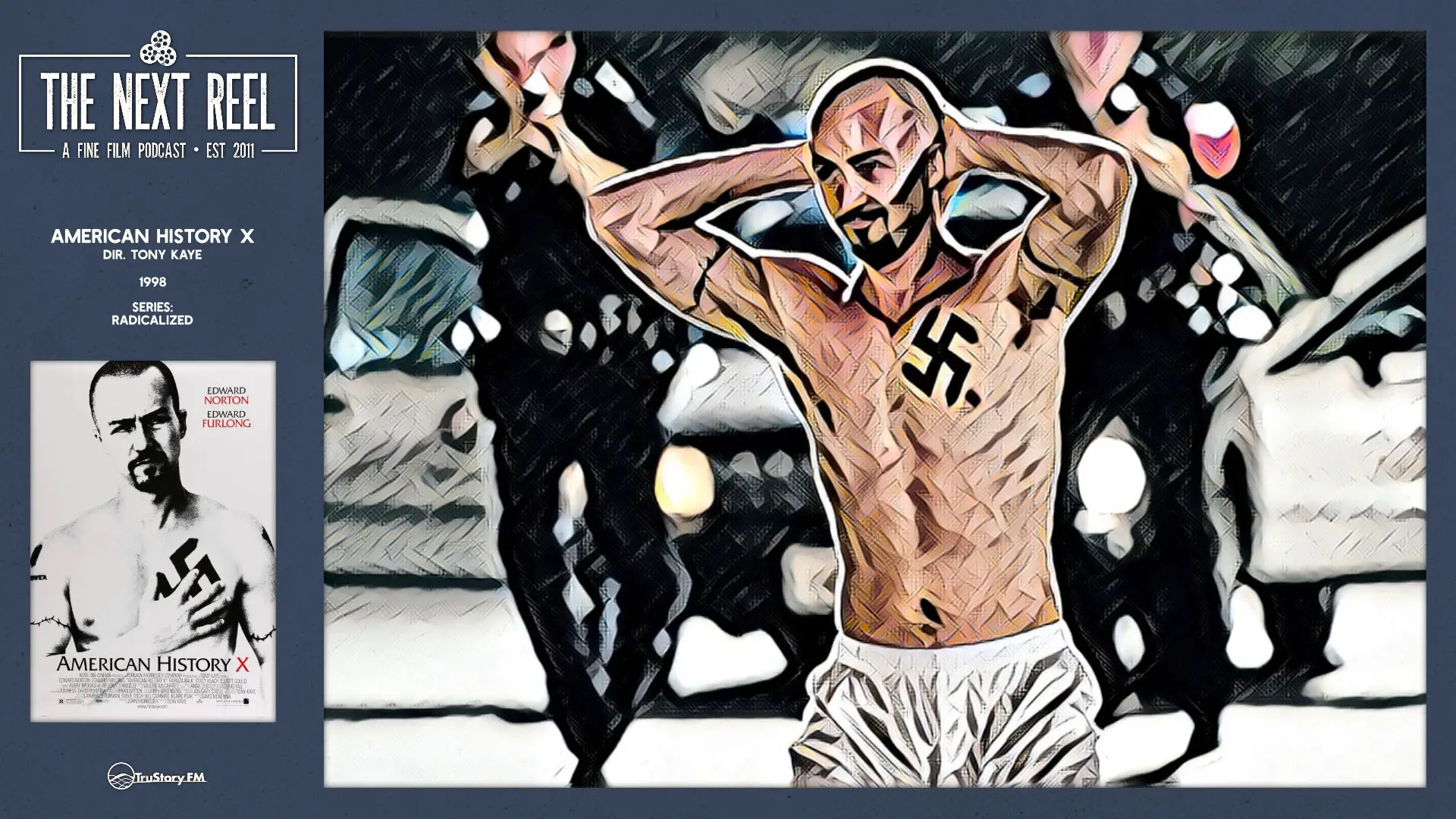
And when he gets out, there’s a moment where he’s looking at himself in the mirror. The way Edward Norton plays that, with such shame and sadness, as he’s kind of seeing who he is — it’s so powerful to watch that scene, and then he covers his swastika tattoo up with his hand. It’s a beautiful, beautiful scene. I loved how all of that played. I think all of that is great — I like all of those moments. Again, like you said, it’s a movie of some incredible moments.
And it’s an emotional journey — all of that works. But in the context of everything, when you really think about it, I think there’s more of a struggle with it. So —
Pete Wright:
I just want to make sure we’ve said the word Murray before, but I think, given our history of the show, we have to say the specific words: Elliott Gould was a heartthrob at one point.
Andy Nelson:
I love him in the movie. I think he plays great.
Pete Wright:
Yeah.
Andy Nelson:
He does the scene well — the couple scenes he has. Actually, I like the more senior actors we have in the film. Stacy Keach is great as Cameron. Beverly D’Angelo really kind of breaks your heart in this — I don’t know if she’s suffering from lung cancer or what it is she’s dealing with, but clearly she’s got some issues, which is going to be another thing this family’s going to have to cross the bridge with as they continue along. It’s a rough story for her and her family, and of course Elliott Gould.
So I like those performers. I think they do a great job with it.
Pete Wright:
Andy, can we do the IMDb game for Fairuza Balk?
Andy Nelson:
Oh no, oh no, oh geez. Wow, okay, I was not expecting Fairuza Balk there.
Pete Wright:
Out of nowhere.
Andy Nelson:
Okay, for Fairuza Balk, I’m gonna say The Craft, Return to Oz. Probably this. I’m blanking on Fairuza Balk films now — I was just not expecting this, came so out of left field.
Pete Wright:
Obviously — I’ll just tell you, you are not, because you’re so far, three for four.
Andy Nelson:
Wow, okay.
Pete Wright:
That’s incredible. I did not know that — I expected you to have a much vastly worse Fairuza Balk game. She’s got 54 credits as an actress, and you are in fact missing one.
Andy Nelson:
Give me a year or something. Let me see if I can come up with a two thousand —
Pete Wright:
Yeah, okay, two thousand.
Andy Nelson:
— so shortly after this one.
Pete Wright:
Very shortly, yeah. The Craft was ’96, this was ’98, and then the third is 2000. And Return to Oz, we should say, was ’85.
Andy Nelson:
Yeah, I was gonna say, that was back in the eighties.
Pete Wright:
So — oh, that’s gonna make it too easy.
Andy Nelson:
Give me some other cast or something with it.
Pete Wright:
Okay, all right, I can do this.
Andy Nelson:
Start low, start low.
Pete Wright:
Jimmy Fallon.
Andy Nelson:
Jimmy Fallon. Oh wow, are we going to something like Night at the Roxbury?
Pete Wright:
Nope.
How about — oh dear — Anna Paquin?
Andy Nelson:
Oh, oh, oh — Anna Paquin and Fairuza Balk in something together. Man, that really rings a bell. Let’s see.
Pete Wright:
It should.
Andy Nelson:
Oh, geez.
Pete Wright:
How about Philip Seymour Hoffman?
Andy Nelson:
Oh, oh, oh — Jimmy Fallon was in — who was he in that movie? I got him — blank — out of the same American —
Pete Wright:
It’s American —
Andy Nelson:
What the heck is the name of it?
Pete Wright:
That’s what you’re gonna go with? You know — that great Patrick Fugit,
Andy Nelson:
it’s what’s-his-name’s —
Pete Wright:
Kate Hudson, Billy Crudup film — Almost Famous.
Andy Nelson:
Almost Famous! Yeah, God. I had American Pie in my head, because of the — yeah, I don’t know.
Pete Wright:
Yeah, I can totally see how you got there.
Andy Nelson:
But yeah — oh my goodness.
Pete Wright:
Well played. That’s awesome.
Andy Nelson:
Yeah, okay. I forgot she was in that. She was one of the — the groupies, or they don’t call them groupies, they call them —
Pete Wright:
Yeah, with Penny Lane.
Andy Nelson:
Whatever they call themselves — not groupies. Yeah.
Pete Wright:
Yeah, all right, well, that was a fun little distraction.
Andy Nelson:
That was a tough one. That was tough, yeah. One other thing I want to talk about, because I think it’s going to be an interesting and important point to discuss over the course of this: there’s an interesting element to this. We talk about white savior movies — Dances with Wolves, Avatar, things like that. I was wondering, do you feel like a film like this — we have white filmmakers telling a story about white men, and in some way it does kind of fall into a white savior, because even though they’re all white — but it’s still, he’s pulling his brother out of the dangerous ranks of somebody who has so much racial hatred.
And I’m wondering — I guess the complaint largely about these kinds of white savior movies is that they don’t necessarily pull from the perspectives of the other side, and it kind of turns them into stereotypes. I’m wondering if this film is doing that in many ways, because — I hate to say it, but we have a lot of stereotypes when it comes to the way the African Americans, or any other races, even the Korean grocery store owner, are depicted in the film. We don’t really get to know any of them as characters. The only one we know is Dr. Sweeney, who you could say is portrayed kind of as the black savior character. I wonder if that is a problem with this film being told the way it is. Do you have any sense of that?
Pete Wright:
Well, I see this very much as a black savior movie, because what we get with Dr. Sweeney is immediate racial authenticity. That is the — he unlocks the door to racial authenticity and, for lack of a better word, purity. He is the beacon of reason and intellectual approach to our emotional shortcomings. He offers the resources, the books, to actually teach Derek how to get out from under the weight of his own pain — the pain that has driven him to this ideology that has not served him or his family. He gets the punchline for the movie — speaking of on the nose, it is really on the nose
for a punchline for the movie. I am so okay with it, because it’s Avery Brooks delivering it, and there are a small number of actors who could get away with it, just because of the gravitas they bring to the part. But it is one of those things that just bangs you over the head — that says everything the white people have done, they’ve done to themselves first, right? They have been horrible, horrible own goals of themselves, because they cannot see the world as one in which it is not a zero-sum game. So we need this — the black angel of Dr. Sweeney — to step in and poke Derek into the right direction, to make the right choices, and that’s beautiful. That’s one of those — the moment when Dr. Sweeney goes into the hospital after that horrible bathroom gang-troping, and actually gives him the wisdom to move forward, is a beautiful moment.
And so I don’t actually see this as a white savior movie. I see this as an “oh my God, look at what the white people have done to themselves again.” Thank God we have this outside black character who can come in and say, you know what, you’re full of it, and you need to straighten up, because this is no way to live.
Andy Nelson:
So it’s a black savior, white savior movie, because we’ve got the black savior and then Derek becomes the white savior.
Pete Wright:
I’m just saying, there are tiers — this is sort of a nesting doll.
Andy Nelson:
There it is. Right. It’s a Russian nesting doll.
Pete Wright:
And the outside biggest doll is black, and inside is white, and inside is whiter still.
Andy Nelson:
Yeah, right. Oh man.
Pete Wright:
The inside, the deepest, smallest one, is so white, man. It’s so white — it’s like you regret how white that is.
Andy Nelson:
It’s like looking at the sun.
Pete Wright:
It is like looking at the sun.
Andy Nelson:
Oh man. Wow. Yeah. Here’s my last question — or maybe my last, we’ll see where this goes — but okay, this goes back to my Driving Miss Daisy comment earlier. It’s like a story about humans, and it’s a beautiful story, because we have a connected story about this woman and her helper, her driver, who kind of grow together over time. It’s a beautiful story about a relationship as it develops. Then you step back and you look at it in the scope of the world in which we live, and suddenly you can see there are some problems with the movie, especially the time it was told and stuff.
This is a beautiful story about a man who has gone down the wrong path, has figured out the right path, and has pulled himself out, only to then lose his brother on that same path. It’s a heartbreaking story. It’s difficult, it’s very emotional, and it’s a powerful journey. But we’re talking about a Nazi here — a neo-Nazi, a skinhead. Is it fair to redeem him? Should we ever care about this guy, once we know he has become like this neo-Nazi leader? I like to believe everyone can change and everybody can turn a corner and stuff, but I think in the world, it’s always a fair question.
Because we just all want to see Nazis get punched, right?
Pete Wright:
Yeah, well, I used to believe that.
I think the movie partly approaches that question. And the scene where he looks at himself in the mirror and covers the swastika is Ed Norton performing his attempt at an answer to that question, which is a recognition that those symbols make him irredeemable. I don’t know that the rest of the movie is completely aware of that — because when we go to the Nazi Party, for example, they’re having way too much fun. I just look at it and I’m like, this is ridiculous — this is a ridiculous portrayal of the exuberance of hate. And that’s another moment I think is intentional, to make me feel that way.
And is it enough — is it enough for Derek to go to Cameron and punch him in the face and kick him? Is that enough to redeem him? Should we have any greater expectation of it? I don’t know. Some of it is shorthand, saying, well, of course I’m gonna redeem Derek, because it’s Edward Norton, and I just like him so much — he’s so magnetic.
Andy Nelson:
Yeah, sure.
Pete Wright:
Right? Because it’s the artifice of the fact that this is a movie.
Andy Nelson:
Well, and I think that’s always the struggle. We don’t see where the movie goes from here. I think probably the most important line that speaks to why we should continue caring about this character is when Derek expresses to Dr. Sweeney, “I just want to get out. I just want to go and run away and start over again,” essentially. And Dr. Sweeney says the only way you’ll find peace is to stick. I think that line says so much, because it’s the line that says: you’re gonna now have to fight on the other side, to make things better, and that is essentially your penance.
That is how you get through this. We don’t see it after the end of the film, but that’s where you ideally want to see Derek perpetually struggling to redeem himself for the rest of his life, by, I don’t know, speaking in schools, or whatever the case may be, as he continues going down that path. That’s the only way I think he would ever find any sense of peace.
Pete Wright:
Yeah, that’s huge, because — redemption only matters when you see someone do something good with it. In this case, we don’t actually get to see that. All we get to see is continued loss — the movie ends on a particularly sour note, with Danny in Derek’s hands, him crying in the urinal, at the loss of his brother because of his actions. That is such a direct callback to Sweeney’s conversation — she knows: everything relates to what you did. Everything about Danny relates directly to what you did. Of course it does. You cannot just run away —
that does not finish the job. And so, in that regard, I think the movie presents its intention and its heart well. Will we ever get an answer to: is it right to redeem him, after what he did? He did kill two people, right?
Andy Nelson:
Beat a number of people at a grocery store — that’s all we see, but surely there are other things, yeah.
Pete Wright:
Yes. That’s all we see.
Andy Nelson:
Yeah. It’s a trick. It’s a trick.
Pete Wright:
So —
Andy Nelson:
But again, that’s why Edward Norton is so great. I think he does such a great job in the film.
Pete Wright:
I do too.
Andy Nelson:
Because you buy into all of this darkness in his character that has changed.
Pete Wright:
Yep.
Andy Nelson:
All right, well, why don’t we move on into the back half — but first, let’s take a quick break.
Pete Wright:
The Next Reel is a production of TruStory FM. Engineering by Andy Nelson. Music by Tzabutan, Angelika Conrad, Oriol Novella, and Eli Catlin. Andy usually finds all the stats for the awards and numbers at The-Numbers.com, BoxOfficeMojo.com, IMDb.com, and Wikipedia.org. Find the show and the full archive at trustory.fm. You can follow us from there too, plus you can find out how to become a supporting member and go further with every episode.
Check out our merch store at thenextreel.com/merch, and if your app allows ratings and reviews, please consider doing that for our show.
All right, I’m not gonna lie to you — my instinct was to lead with a joke, an alphabetical joke. And then I actually read your note and realized that’s not actually a joke, so I’m gonna let you have it.
Andy Nelson:
Yeah.
Pete Wright:
Sequels and remakes, Andy?
Andy Nelson:
Strangely enough, there has been talk, I guess we’ll say — it’s fizzled, because it’s been six years ago now — but Tony Kaye was talking about returning as director to a follow-up to this called African History Y. He would return as director, co-writer, co-producer, with Djimon Hounsou. As of 2020, it was in development, but clearly has fallen off the radar. Wow, I don’t even know where to go with that one — what is this story, what are they doing?
Pete Wright:
Right — because it’s African, it would have to take place — I can only imagine it as a story that takes place in the complexities of South Africa, apartheid South Africa.
Andy Nelson:
That would be interesting, yeah.
Pete Wright:
That’s a story I could see — just the corollary to hate that happened elsewhere. Again, not good white people.
Andy Nelson:
Right. Right.
Pete Wright:
Right? That’s something that’s consistent all over the world.
Andy Nelson:
You still have that consistent thread. Yes, plenty of that, yeah. The other thing, which we already mentioned, is his documentary Humpty Dumpty X, that Tony Kaye apparently has been working on. I think he made it in 2007, to the point where he had interviews of people he’d been talking to, like Marlon Brando, as a potential choice to play Cameron — he has interviews with Marlon Brando in it. He talked to a lot of people for this film back in the nineties when they were trying to get it going, the early 2000s. He made it in 2007.
I don’t know if he’s continued fiddling with it all the way, but it just premiered at Tribeca earlier in 2026, and it’s had some positive reviews. It’s had some people say, I still don’t think this guy would have been able to direct American History X very well. It’s been kind of all over the map. So I’m curious to see it.
Pete Wright:
Right, interesting. Okay, how’d it do at award season?
Andy Nelson:
That did okay for itself — four wins with fifteen other nominations, a lot for the performances. Edward Norton was nominated for Best Actor, but lost to Roberto Benigni in Life Is Beautiful. Just to refresh our memories — earlier this season, in our first series, the first movie of the season, we talked about The Truman Show, and talked about how we would have liked to have seen Jim Carrey get a nomination instead of Roberto Benigni. With just those two, Edward Norton or Jim Carrey, who would you pick?
Pete Wright:
Honestly, the fact that a rewatch of this movie has made that complicated is interesting to me right now. I still think I would probably go for Jim Carrey, because it felt like such a transformational, out-of-the-box performance — it was so unexpected. Edward Norton shows up and I’m pretty sure what I’m gonna get. And what I’m gonna get is great.
Andy Nelson:
Well, but remember, this is his fourth movie, and he’d only been supporting before that — Primal Fear, where he did get an Oscar nomination as supporting actor. And Everyone Says I Love You, where he was one of the supporting characters in that Woody Allen movie, and The People vs. Larry Flynt, where he was a smaller part, but a prominent one, opposite Woody Harrelson. So it’s only the fourth time. Now, I don’t know — this was the same year that a few other films came out, like Rounders, and — what was the other film that came out that year? But anyway, I guess the point is, yeah, we’d been seeing a lot of him in kind of that ’96 to ’98 window.
So it’s entirely possible he was just on our minds, because he was just such a person who burst forth, really.
Pete Wright:
Yeah, yeah, that’s a really good point.
Andy Nelson:
‘Cause the next year after this is Fight Club, and that’s when suddenly it seems like, okay, everybody’s hiring Edward Norton now.
Pete Wright:
Yeah, yeah. And then, not long after that, Death to Smoochy, which everybody still talks about.
Andy Nelson:
Everyone still talks about Death to Smoochy, that’s right.
Pete Wright:
Yeah. Okay. Man, I feel like I’m gonna stick with Carrey.
Andy Nelson:
I feel like I might shift to Norton, after re-watching this. It’s really powerful — so many subtle things. I don’t know, I really liked it.
Pete Wright:
Some of it is marred by my feeling of the rest of the movie. Like — I see him as a bright shiny — you said, when you opened this conversation, you said this is a bravura performance from Edward Norton. And you’re absolutely right — in a middling-to-fair movie. And The Truman Show is, I would say, a bravura performance of Jim Carrey’s, in a great movie.
Andy Nelson:
Yeah. No, that matters. That does matter. I hear that.
Pete Wright:
All right.
Andy Nelson:
All right, let’s continue this. In the Saturn Awards, Norton was nominated again, but, just like Jim Carrey, they both lost to James Woods in Vampires. There’s the real complaint we should be complaining about.
Pete Wright:
That’s the — yes, can we just, let’s everybody agree that — yeah, Vampires is my friend.
Andy Nelson:
Oh yeah, exactly. At the Satellite Awards, Edward Norton did win Best Actor. Beverly D’Angelo was nominated for Best Supporting Actress, but lost to Kimberly Elise in Beloved. It was nominated for Best Original Screenplay, but lost to Pleasantville. And then, hey, the Political Film Society Awards are back, Pete — we had a number of those in our previous series. This was nominated for the Peace Award, but lost to the film Savior. And Edward Furlong was nominated at the Young Artists Awards for Best Young Supporting Actor, but lost to Michael Welch in Star Trek: Insurrection. That’s a funny one.
Pete Wright:
I’m glad it brings us back to Star Trek.
Andy Nelson:
That’s right, it’s full circle.
Pete Wright:
That makes me happy. All right, how’d it do at the box office? Is it an APPFM or an ALPFM?
Andy Nelson:
That’s right. For Kaye’s ambitious project, he had a budget of ten million. Then again, maybe it’s twenty million — both figures are out there.
Pete Wright:
What?
Andy Nelson:
So — I know.
Pete Wright:
What? That’s a pretty big split, Andy.
Andy Nelson:
I would have to assume — I know, I know — I’m gonna have to assume the production was ten million, and the prints and advertising another ten million. That’s about $38.8 million in today’s dollars.
The movie had a limited release October 30th, 1998, before opening wide November 20th, ’98, opposite The Rugrats Movie, Enemy of the State, A Bug’s Life, Celebrity, Babe: Pig in the City, and the limited release of Savior. This landed in thirteenth place, and New Line clearly didn’t seem to think it was worth investing any more in, as they dropped it from 512 screens the first week to 74 the next. Needless to say, this was a bit of a struggle at the box office. Domestically, in the end, the movie went on to earn $6.7 million, and $17.1 million internationally, for a total gross of $46.3 million in today’s dollars.
Luckily, the international market did help quite a bit, and the movie landed in the black with an adjusted profit per finished minute of $63,000. Still didn’t help Kaye with his directing career, but it did save the movie.
Pete Wright:
Wow, I’m actually glad it’s sort of on the redemptive side, by being a little profitable. I wanna go back, as we wrap up, and just have you talk a little bit about how you think this movie lives and exists inside of the series — because when we picked our series, we had not watched these movies again, and now that you have, how does it fit to open your Radicalized series?
Andy Nelson:
You know, I thought about this. When I put the series together, I just did it chronologically, and in retrospect, I wish I had put a little more thought into it, to kind of do a journey. But I do still think there’s an interesting way of looking at it — and again, I talked about this a little bit at the beginning. This film really is the one where it’s very overt in the way it’s depicting the white supremacy and the racism — you’ve got the neo-Nazis. This one, you may as well call it like a gang story or a mob story or the mafia, one of these sorts of things — “just when I thought I got out, they pulled me back in.” We’re seeing a lot of the same sorts of tropes here.
But it’s very overt. All the tattoos — ripping his shirt off at the basketball court to reveal all his hate-spewing tattoos that he has. I think all of that stands out quite a bit in where we’re going. And I think moving forward into the next two films, we’re gonna start seeing that shifting away from more of an overt expression to something that’s much more covert. Into our next one, with Get Out, I think that’s going to be the most covert of all of them, because it’s designed in a way — again, it’s a horror film, so it’s designed in a way that’s very specifically intentional in how exactly covert it is.
Pete Wright:
Yeah, right. Well, I’m really grateful for the rewatch. I’m grateful, first of all, because it gives me more perspective on my feelings about the movie, and the sort of gravitational pull of one scene in my sense memory, and how that is a strong scene, and it does not deserve to overshadow so much of the rest of the movie, which is not as powerful as I remembered it. It is a bravura performance from a central character, and kind of a messy middle, and a really strong bit of violence, and a dark ending that I support.
Andy Nelson:
Yeah, I think that’s where I land with it. It’s a strong and powerful film, ends in tragedy. But my struggle is: does it work on more than just kind of that emotional-movie-watcher level? I feel like, when I stop to think about it, I now find it probably comes across as a little too simple, even though I still celebrate many, many aspects of the film. All right. Well, that is it for our conversation about American History X. Next week, we are looking at Get Out. If this is the overt version, as I’ve said, with the shaved heads and the tattoos, Jordan Peele’s horror film is the covert one — the young black man welcomed into a white family with open arms, and the welcome that turns out to be nothing more than a trap.
And now let’s do our ratings.
Pete Wright:
Letterboxd.com slash The Next Reel — that’s our HQ page, where you can find the ratings and reviews of all the films we’ve talked about across the shows of The Next Reel Family of Film podcast. Andy, what are you gonna do with your complicated feelings for this movie?
Andy Nelson:
It’s a tricky one — I do have complicated feelings. I feel like, had I rated this beforehand, I probably would have given it four stars and a heart. I think now, with some of my issues, I feel like I’m at three stars, but I still give it a heart, because there’s just so much to celebrate within the film itself. Three stars and a heart.
Pete Wright:
Yeah, I’m exactly where you are on this — three stars and a heart, for the very same reason, so that’s boring.
Andy Nelson:
But there it is. Boring, but there it is, yeah.
Pete Wright:
Yep, boring, but there we are, yeah.
Andy Nelson:
Yeah. Well, that is three stars and a heart, which you’ll find over on our account on Letterboxd, @thenextreel. You can find me there, @sodacreekfilm, and Pete at @petewright. So what did you think about American History X? We would love to hear your thoughts. Hop into the ShowTalk channel over in our Discord community, where we’ll be talking about the movie this week.
Pete Wright:
When the movie ends…
Andy Nelson:
…our conversation begins.
Pete Wright:
Letterboxd giveth, Andrew.
Andy Nelson:
As Letterboxd always doeth.
Pete Wright:
Okay, what — there are some complicated reviews in the bag this week.
Andy Nelson:
A lot of love, a lot of hate, yeah.
Pete Wright:
As you might expect, Letterboxd is a hotbed of turmoil. Where’d you go this week?
Andy Nelson:
I landed at three and a half stars, no heart, by HansKJ, who has this to say: “Derek very clearly watched 21 jump street in prison.” I don’t know if that’s the TV show or the movie, but there you go.
Pete Wright:
Either way.
Andy Nelson:
Either way.
Pete Wright:
I also went with three and a half stars, for theo, who said, “huh, his hair grew back and he got de-nazified.” I did not know that it was very much a hair-related ideology — like it was causal, not correlational.
Andy Nelson:
Yeah.
It’s like Samson.
Pete Wright:
Yeah, yeah — it’s very much: becoming a neo-Nazi is the Delilah of social diseases.
Andy Nelson:
Watch out when you get your haircut — you just might turn into a neo-Nazi.
Pete Wright:
Yeah, be very careful. You might want to go no buzzers from this point on.
Andy Nelson:
Yeah.
Pete Wright:
It’s very dangerous. Oh, thanks, Letterboxd.