*This transcript is produced using transcription software and reviewed for quality. Despite our best efforts, some passages may be incomplete or contain errors due to audio quality or software limitations.*
Pete Wright:
I’m Pete Wright.
Andy Nelson:
And I’m Andy Nelson.
Pete Wright:
Welcome to The Next Reel, when the movie ends.
Andy Nelson:
Our conversation begins.
Pete Wright:
The Order is over. You must understand that, being in a cult like the federal government.
How is it that he’s not the worst thing in this movie?
Andy Nelson:
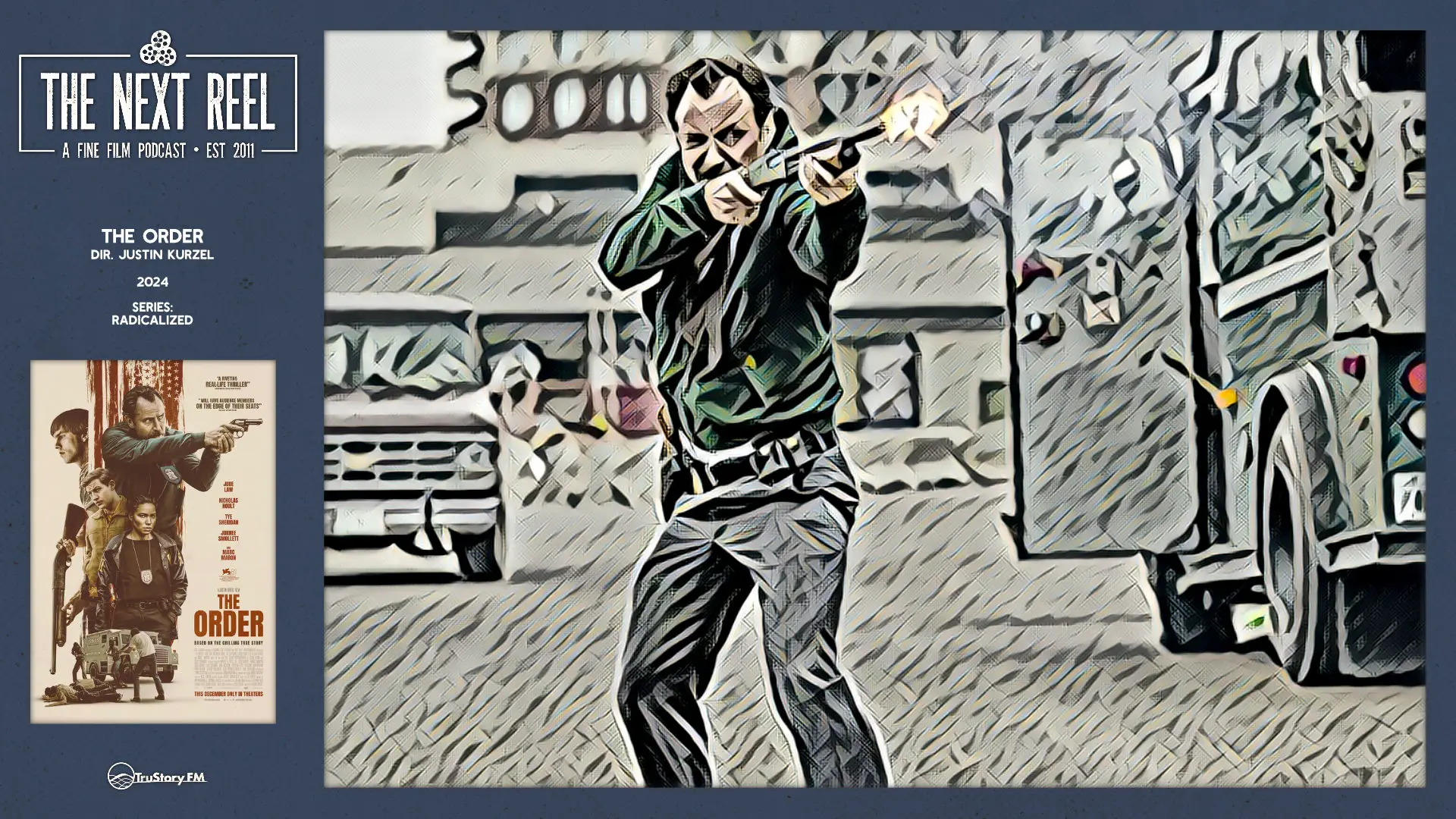
Yeah, right. Isn’t that isn’t that interesting? You’re talking, of course, about Richard Butler, founder of the Aryan Nation.
Pete Wright:
Man. And so how are you? You okay?
Andy Nelson:
Yeah I’m wonderful. I’m good. Why? Are you concerned because of my series?
Pete Wright:
Well, I mean this has been quite a trilogy that you’ve you’ve set us up with and I just want to make sure, are you okay?
Andy Nelson:
It’s been a really interesting trilogy to just look at and explore kind of the different aspects of white supremacy and the way that it is a part of our of our country here. And this one is such an interesting film because it really explores a period in time my only knowledge going into this film was as a young kid remembering the story of when Alan Berg got killed. Right. And I didn’t even really know anything about him other than a guy who was a talk show host on a radio show, on a radio network got killed. Like that was kind of my extent of knowledge of all of this. So I don’t know. I found it really interesting to kind of go back and explore kind of the history of the group behind all of that.
And it’s so but yeah, in context of the films, it’s definitely a dark dark series.
Pete Wright:
Yeah, yeah. Is it I thought it was it was fascinating first that that this is actually our second Alan Berg adjacent movie?
Andy Nelson:
Yeah, right.
Pete Wright:
What was the first one? I’ve already forgotten the name of it.
Andy Nelson:
Oliver Stone’s Talk Radio in our Oliver Stone in the 80s series.
Pete Wright:
Yes, yeah. Fantastic movie.
Andy Nelson:
Loved it. Yeah, we both came away giving that five out of five.
Pete Wright:
Yeah, right. And so here we are back into Alan Berg. I do think Marc Maron as Alan Berg is perfect.
Andy Nelson:
It’s so good. For a small part, he like completely brings everything to the table for that.
Pete Wright:
Yeah, yeah, he’s got what ten lines of significance, like he’s hardly seen. It is fantastic. I we’ll get into to our feelings with about how that fits into the movie in a bit. Did you, just to finish our preamble, did you at any point think about Nicholas Hoult and Jude Law, two Brits, being in this movie, playing these parts, and feel a little embarrassed?
Andy Nelson:
It was really fun, made by an Australian director, right? Not only that, like I was thinking about this. I’m like, it’s really funny. Like a lot of these movies. I mean, obviously we talked about American History X. But Daniel Kaluuya is a Brit and he was in our Get Out episode. And then over in Trailer Rewind, they talked about Skin, which had Jamie Bell, another Brit, starring as the lead. There was the one with Daniel Radcliffe playing a skinhead, you know, and then Romper Stomper with Russell Crowe. And now if that takes place in Australia, so obviously it’s you know, other countries also.
We’re not alone on this issue.
Pete Wright:
Right. It’s not like they don’t have something to poke at too. Like we get it, right?
Andy Nelson:
Right. Yeah. But it is interesting that a lot of these people have told American stories with you know, it’s like it’s harder for Americans to play these parts, you know. Which is maybe why we liked Edward Norton so much because maybe he was it was just a standout, you know, seeing an American playing play.
Pete Wright:
Yeah. It’s because he’s the only one.
Andy Nelson:
Yeah.
Pete Wright:
Yeah, right. Okay, so I feel like you need to give us a little bit of a setup for how you feel about this movie, given this is the final in your trilogy for Radicalized and what you want me to get out of this movie. This was my notably in this trilogy my first watch. This is the only one I hadn’t seen.
Andy Nelson:
Yeah. The whole thing with this series was just kind of looking at the kind of this the white supremacist movement and how it’s shaped people and elements within our culture over time. And as we talked about it, American History X was very much kind of the overt gang, you know, neo Nazi skinhead version of the story. Get Out was a little more covert at in the point where it’s like we’ve got these this liberal seeming white family who seems very kind, but in reality they are trying to essentially create another form of slavery. And then finally we end with The Order here, which is an interesting, there’s a really interesting window into the actual split between kind of overt operations and covert operations that we have depicted in this film between Richard Butler, again the Reverend who is kind of the founder of the Aryan Nation. And Bob Mathews, who was pretty pissed at the Reverend for just as he saw it, not taking action, just sitting back and doing nothing.
And Bob wanted to follow the Truman Diaries and very specific six steps to essentially work on kind of taking, I guess, you know, being, you know, not as they saw it, but terrorists and taking over the country back to the way that they saw that it should be. And so That’s it’s this is an interesting film that looks at real history and then we really see kind of the division within their own group as far as the people who think as the Reverend does, if we kind of stay back and I mean we can be out there and stuff, but we need to just fit into society because the real goal is to get into the Senate, get into Congress. Get into positions of power so that we can actually take over from within. And whereas the other side doesn’t see it that way. They’re much more active. And so it’s just interesting to kind of see how these two sides are operating.
And I think that’s what this film gives us an interesting glimpse into.
Pete Wright:
The first thing I notice about the film is just the look of it, and I am such a fan of True Detective on HBO that I thought, well, this movie was clearly made for me. And then I realized that the same cinematographer shot the first season of True Detective, Arkapaw, and so I knew that I was gonna be at home. It’s also you know, I mean it was filmed in Alberta But a lot of it, you know, takes place in and around my home territory. The cap the original story of the Capri Motel is the Capri Motel here in Portland, over on the other side of town. And so you know, I found a sort of landscape camaraderie with this movie. I felt very much at home, which is a real sadness that all this other stuff is going on here.
They did find a part of Coeur d’Alene that I’ve never seen. Coeur d’Alene is has like whenever I’ve been there, it’s been to like resort town Coeur d’Alene and That’s just me not being a local. It did not look like anything that I’d ever seen as they were part of it. But in general, the look and feel of this movie was absolutely wonderful. It was No Country for Old Men. It was True Detective. It was, it was Lanterns that just had its finale last night as I was—as we’re recording this.
It just that the incredible look and feel of the of the Pacific Northwest and the color timing, the framing, it was all really, really luscious and beautiful and a little cold.
Andy Nelson:
Well and you know, Justin Kurzel the director was when he wanted to tell this story and it’s set in the early eighties, eighty three, eighty four. But he kind of saw this as a kind of a gritty 70s action thriller is the way that he saw it. And I think we get that in the look of the film. I mean certainly again incredibly beautiful locations with all of Alberta substituting for the Pacific Northwest. I mean it’s just really kind of stunning to look at. But the like the grain, the tone, everything still feels grittier and a little grimer and it does kind of have this sense of 70s cinema. I think that was a smart thing to kind of tap into to kind of create this story that really kind of digs into a darker side of America, as it were.
Pete Wright:
What do you know of the adaptation process. The thing that I found most interesting about this was that all of the crimes and the members of The Order and the Aryan Nation are real, but all of the police are manufactured for the movie.
Andy Nelson:
Yeah, I mean largely they’re composites. I think it was easier to kind of come create some composite characters since I don’t think in the scope of the story, it wasn’t like the same person doggedly pursuing Bob Mathews over the course of the year. That this film takes place. And so I think it gives us a better sense of just having kind of these two these two people kind of pursuing or kind of just opposite each other over the course of the story. And I think I think it plays. I mean it was It’s based on a 1989 nonfiction book called The Silent Brotherhood, by Kevin Flynn and Gary Gerhardt. That talked about how The Order kind of sprang from the Aryan Nation again for the reasons that I’ve already mentioned and it kind of tracked kind of their progression.
‘Cause I mean, a lot of it came out after the murder of Alan Berg in 1984 in Denver. The KOA radio host who is Jewish and would get into arguments, very vocal arguments with anti Semites on his radio show and Bob Mathews and some of his men drove down to Denver. And assassinated him. And that’s kind of the where all of this where people started hearing about The Order and everything and led to the book getting written. And then It actually was a optioned several times, but nobody could figure out how to tap into telling the story. And so inevitably it just it didn’t ever it always kind of fell out of out of development until finally this latest round people figured out how to adapt it and work the story in a way that, you know, and I think probably it was the composite that we ended up getting with Jude Law’s FBI character that ended up helping able to kind of figure out how to how to tell this story the right way.
Pete Wright:
In talking about the characters, I think we should talk about Nicholas Hoult first. In the spirit of Radicalized This movie is interesting because we don’t have a central character who is Radicalized. He’s Radicalized already when we meet him. So the characters in the movie who actually I think even to some extent Torres, who’s the one who is sort of indoctrinated. Is already predisposed to be Radicalized, right? Like he was already in the mindset he’s just looking for a job The stuff that that I found so compelling in the movie on the side of the people who were in white supremacist land. Was just how effortless they made the radicalization of their children, having the like four year olds shooting guns and reading the Turner Diaries as a bedtime story. Those kinds of things, I think, really elevate the subtle cultural horror that is going on, or the not-so-subtle cultural horror that’s going on.
In this movie and I would love to hear how you how you saw that in the scope of this of your experience with this series. Is that that kind of what you were going for?
Andy Nelson:
Well no, I but I think that’s definitely a big part of it because it normalizes all of the stuff that these That’s what they want. They want it to be a normal thing. So as these kids grow up, that is the norm for them. They’re when a new car drives on to the compound, what do they do? They give them a Nazi salute. Like We see how it just becomes part of the everyday fiber for all of these people to grow up this way and think this way. And I think that’s the That’s the scope of their world and what they’re wanting to create.
And again, we even see just how genuinely like kind and conversational they can be. Even when they go to meet with Butler on the compound and They ask about the Turner Diaries, they see a copy. I think this is Jamie who sees a copy of is like what is this book? And they’re they’re telling it to them like, oh, you should read it. It’s really, you know, a really interesting bit of, you know, it’s it’s eye-opening. And the way they kind of just sell these stories and these little pieces of their world to other people. That’s the frightening thing, is it comes across as we’re here, we’re welcoming your curiosity into our world.
This could open your eyes to the realities of how things how things are. And I think that’s the element that we see. And even I think when you see the police or not the police, you see Butler’s right-hand man stop at Jamie’s house to drop off a cop a copy of the Turner Diaries, they’re not just giving him the address of where to find one of Bob’s men. Because that’s the whole reason they went there. It’s like Bob is a problem for you. We’re gonna make it a problem for you unless you help us figure out how to stop Bob. Essentially, that’s kind of how they spin it.
Pete Wright:
Yeah, there is a real enemy of my enemy is my friend for a bit by vibe.
Andy Nelson:
Exactly. But instead of just giving them the address, they also drop off that copy of the Turner Diaries. It’s really kind of disturbing because that’s how it is, right? It’s like, oh here, read this. And you can see this, it’s not just like this. A lot of different groups, that’s how they welcome people in. They give them a copy of their text and their pamphlets and everything. And guide them and welcome them and have these conversations with them. And I think we see that as it’s playing out there.
And, you know, Jamie is obviously smart enough not to buy into all of that. I think that he reads it and recognizes it for what it is, as opposed to probably what they were hoping is like reading it and recognizing I need to join too.
Pete Wright:
Yeah, I and I mean and I really appreciate that and I think the performance is really strong that and his line, you know, not all of us were born under a sheet here is a is a pretty powerful one, right? And especially to Jude Law’s character to Husk as an outsider kind of coming in with twenty-five years of experience dealing with ideological cult crime, whether it’s the mob or white supremacist, whatever. What’s so interesting about the Hoult side is that Like we said in the beginning, it makes the Aryan Nation almost sympathetic, right? Almost sympathetic because they’re not portrayed as the ultimate villain here. And the only thing that they say out loud is we want to clip Bob’s wings Well that could happen any number of ways, politically or otherwise, right?
And we want to just wait to get senators in Congress, because that’s how you make change. You know what all the other major political parties are trying to do? Get their senators in Congress to make change, right? So there is a certain pragmatism to the way it’s portrayed in this movie. And I, you know, personally I find that difficult to swallow because we have you know, because of what it hath it hath wrought. But the fact that it becomes something to further land Bob’s group and The Order on the side of just evil I think it I think it works. And I like the fact that it gives that it offers such sort of complex emotional fabric to work with.
I think the movie is structured really intelligently to make us feel so gross about seeing sympathy in this other group.
Andy Nelson:
Yeah, it’s it is really interesting the way that that plays. And as you said, it’s the enemy of my enemy. Is my friend sort of thing. And it’s I have a hard time saying that Richard Butler is actually Terry Husk’s friend, but still, like they’re working toward one goal. And I think Terry is somebody who is long recognized as somebody who dealt with the KKK back on the East Coast and everything, and here he is. He knows how difficult it can be ever pinning things to somebody like Richard Butler because these are people who generally play it safe and That’s the intent. They want to not necessarily put themselves in a position where they’re going to get arrested. Now, I mean, things would end up happening after this story with Richard Butler and all of his people that it didn’t go as cleanly as they probably would have liked, but it’s still like we can see that it did when looking at this story through today’s eyes, we can see how it worked for them.
But at the same time, what’s interesting is it’s not like Bob’s side didn’t work. I mean it didn’t work out for Bob and his group, but I think there are still people who see following the Turner Diaries, moving in those those circles where you’re following that six-step plan that leads to leads to the Day of the Rope. There still is a thinking that that is the right way. And I think we’ll find that there are still people out there who believe that. And I mean you look at something like January 6th and you see them building ropes, you know, having having ropes hung for hangings, it’s like—
Pete Wright:
Which is reportedly what Kurzel saw.
Andy Nelson:
Yeah, yeah. Yeah, it’s fascinating.
Pete Wright:
So, Nicholas Hoult, he’s come a long way since About a Boy. What’s going on with that guy? Is he okay? He’s he’s just shredded. Nice work, Nick.
Andy Nelson:
He just finished what movie did he just finish before he jumped into this? And then he went straight from this to Juror #2 with Clint Eastwood. Like it’s he was just on a streak of doing some oh is Nosferatu. So he went.
Pete Wright:
No, that’s right.
Andy Nelson:
He playing in Nosferatu straight to this, straight to Juror #2. I mean busy, busy man just making some really smart choices in the projects that he’s picking and performing. And I think he does an amazing job here delivering this role and Yeah, I don’t know. For me, I have a hard time with accents, as we’ve discussed on the show before.
I think both he and Jude Law do great in their roles. I really Like I buy them as these Americans in their different positions. And I Hoult I think just delivers the frustration with where he sees things going and also the there’s a real kind of disturbing sense in how how somebody like this sees How Christianity is so important to them, yet here he is with his wife, with a pregnant mistress on the side.
Pete Wright:
Which is okay with a lot of people.
Andy Nelson:
Yeah, nobody has a problem with that other than his wife. And this world that these guys live in, you really get a sense of the place for women in how they view things. And it’s not very high up. And so it’s It’s it’s fascinating the way he but he the way that he plays all of it, you just you can just you get a sense of how all of this is just normal for them.
Pete Wright:
Yeah. Yeah, I think he’s he’s done a really able job of To your point of normalizing this lifestyle, the picnics and cookouts and all of the things that are just fun summertime things to do in between porn shop and armored car heists.
Andy Nelson:
Porn shop bombings, let’s just say, not hanging out of the porn shop’s different thing.
Pete Wright:
Yeah, right. Right. Right. Porn shop bombings, bank bombings. You know, they found their way to explosives and that became a normal part of their fabric too. I think he was able, what surprises me was that Nicholas Hoult was able to perform a sort of American masculinity that isn’t dumb. I because I think it’s it’s easy to play an American tough guy.
And a lot of people play American Tough Guys because they can play it kind of dumb. There’s a wide range. Of American Tough Guy that you can play. And as long as you play it a little dumb, it’s believable because I get it. But I think Nicholas Hoult’s energy around this is more sophisticated than that in this performance. I think it’s more nuanced. And I just want to applaud that because it felt at home in this country, in this part of the country. In a way that I thought was really interesting. It was also deeply selfish, right?
She says, or it was a Jude Law at the end who says to the wife he’s not in it for you. He’s in it for himself, right? He’s he’s gonna save himself. And then she says later, You’re not gonna catch him alive, and smiles, right? Like he is so deeply self-serving and yet able to marshal the respect of the people who follow him. That sequence in the church when he stands up and gives his sort of proselytizing speech. And all of the men stand up in the room and start, you know, eventually chanting White Power was incredibly energetic and horrifying. And I did not once feel like Nicholas Hoult you know, wasn’t able to conjure that, like that it was scripted in somehow.
It felt very natural for his kind of energy on screen. I thought it was really powerful.
Andy Nelson:
Oh yeah. Yeah. I think he did a fantastic job with this role. Really kind of disturbing in the way that he portrays it.
Pete Wright:
So Jude Law then—
Andy Nelson:
Well, before we talk about Jude Law, we’re going to take a quick break. But first, you can find the show on YouTube and you can join us live when we record. We will even take your questions in the post-show chit-chat and members get the full post-show conversation and always know what to listen to next. Subscribe to The Next Reel on YouTube. The link to this episode is in the show notes. We’ll be right back.
Pete Wright:
So, Jude Law, then, I’ve always wanted to know what it’s like being the happier half of Michael Fassbender.
Andy Nelson:
That’s a funny way to describe him.
Pete Wright:
And yet he turns in a full Fassbender in this in this movie.
Andy Nelson:
Yes.
Pete Wright:
Yeah. And that sequence I mean, I was over the moon for his performance. I really was. This is the first time I’ve seen I’ve watched a movie and I thought, I need to try that mustache. I need to I need to try that for a day.
Andy Nelson:
That was a great mustache.
Pete Wright:
Just to see. So, anyway, the sequence when he’s got Torres, who was the indoctrinated newest energetic member of The Order.
He’s got him, and they’re in jail.
Andy Nelson:
They caught him because of the gun, and he he’s the one who bought it.
Pete Wright:
Yeah, because he’s it was all under his name. Smart. Because he’s got him. And he sits down on the bench next to him. And he starts threat nuzzling him. That was hands down my favorite edge of your seat sequence in this movie. That was so off the wall. Jude Law. I thought this is this guy just won the movie. That was absolutely fantastic.
It was threatening and intense. And then he started bleeding all over the guy from his nose.
Andy Nelson:
Right. Right. Yeah, his nosebleed, that that nosebleed in particular came at the most.
Pete Wright:
Yeah.
Andy Nelson:
Perfect moment because it just it amplified the horror of the way that he was like treating that prisoner, right? And just like crushing him up against the bars.
Pete Wright:
With his face.
Andy Nelson:
With his face like pushing into him, yeah, and then just pouring blood all over the guy. It was it was crazy how effective that was. And you can see why Tony Torres was like, yeah, you know what? I’m good. Let’s I’m gonna turn I’m gonna turn sides.
Pete Wright:
I got you, yeah.
Andy Nelson:
Yep.
Pete Wright:
I think, I mean, I just think again, as a performance, it’s just like I total completely unexpected. It is completely unexpected way to play. Like good cop, bad cop, nut cop. And Mm. I loved it.
Andy Nelson:
I wanted to chat a little bit. We’ve talked about Nicholas Hoult and Jude Law here, our protagonist and antagonist of the film. One of the issues that I have with this film, which I mean honestly, I really love this film. I I’ve this is the third time I’ve watched it now, and I just it always I just find just incredibly powerful. But one of the things that I struggle with is like as I and I was really thinking about it as I watched it this time, I’m like, is there a change character in this film? Or are do we just are we following a film with two steadfast characters. They both are dead set on their direction through the entire film. And because I don’t really feel that there ends up being a change character, or I guess we can say there’s an attempt to maybe make one of them a change character, but it doesn’t come through as well as I think. So it really ends up feeling like two steadfast characters.
It just kind of feels like sometimes the pacing just doesn’t feel as energetic, you know. And I think that’s one of the things with the story. And I wonder what your read on that is, because I do think that there are moments Where we’re looking at I mean we start the film with Jude Law’s character Terry as he’s leaving messages for his wife and daughters and it seems like, you know, it seems very friendly, like hey I’m gonna settle in. I can’t wait for you all to join me. Like there’s a couple of messages like that. And then we he calls and the line has been the number’s been changed and we get a sense, oh, okay, his wife left him and took their kids and wants nothing to do with him because he is a an FBI agent who only gives to the job and doesn’t give anywhere else.
And it never leads to anything. I don’t know. How does that play for you? Do you feel like there is any sense of like change with any of our characters?
Pete Wright:
No, I struggled with the same thing. And I think it’s some of those questions that open early that are never answered suffer in the third act, which ends up being a bit of a tidy reconciliation of you know, the two major arcs in a way that becomes obvious and not as compelling as I think the opening sequence. By the time Tye Sheridan’s character is killed And we do get a moment, we get a beat where Husk is running after and he turns around. And as you say, one of the great shots in the movie. Where he runs past Tye Sheridan’s already been shot, doesn’t know he’s been shot, and you watch him fall to the ground in bokeh. Like it’s it is a lovely use of horror in focus and out of focus.
And then he turns around and doesn’t know what to do. And I as I listen to you talk about who our change character is, I wonder is that a signal that he’s trying to change. Am I reaching? Like is he changing right now? No, I don’t think he’s changing. I think he’s I think he’s still the same guy who would have struggled in the first minute as he’s struggling now. So I don’t know that there’s a change character. I don’t know that that’s the that that’s necessarily the point of the story.
Andy Nelson:
No, no, yeah, I don’t know if it is either.
Pete Wright:
Yeah, and the and the final beat, right, the end of the movie resolves and Hoult’s character, mm Bob, makes good on a promise that he made earlier in the movie, like the only thing I know will come true is a dead man’s deeds will never die or something.
He says something about, you know, how his deeds will live on. And then he dies. And We end with our man Husk out trying to hunt the same animal, and we don’t ever know that he got it. But to me, it is kind of a tidy expression of hey, this stuff is still going on. It always has been going on. It always will be going on. And Husk will be there not pulling the trigger on this wild animal again and again and again.
Andy Nelson:
Yeah, I thought about that ending quite a bit as far as cutting to black. I don’t know if it’s as clean as it could have been. I think I don’t know, the way I read it is he is perpetually gonna be out hunting, right? And sometimes he’ll get what he’s after, sometimes he won’t, but it’s not gonna stop him. And I feel like if we did end with the gunshot at the end it would have felt like a resolution to him stopping all of this, you know. And so but again, I think it could have been cleaner. It But, you know, I mean, I think that regardless, I think I think the story is told well and it’s it’s a struggle because it’s like is probably the struggle of trying to adapt a nonfiction book that just kind of explored what The Order was all about, trying to figure out how do you how do you fit the police side into this.
How do you fit the it’s like as you already pointed out, all of the people in The Order are essentially who they are in the book. Like they’re all essentially the real characters. It’s the police side that’s largely fictionalized. This isn’t like Heat, where you’ve got an antagonist in Robert De Niro’s character who says you gotta be able to walk away from everything, and yet we see him then like falling for Eady and going after a guy that he shouldn’t and he’s making a lot of bad choices, which is what ends up getting him in the end. And in that case, it makes sense for the cop to be the steadfast character who pursues him and is able to get him because your prote your antagonist starts making mistakes.
Pete Wright:
Right. We never get that.
Andy Nelson:
Yeah, we don’t get that.
They’re just both very steadfast characters. And I think that’s That is a struggle I have. As much as I do enjoy the story being told here, and I think it’s just because it’s such a fascinating glimpse into history that I just really knew very little about.
Pete Wright:
Yeah, yeah. Speaking of knowing very little about stuff, what’s your take on Justin Kurzel as a director?
Andy Nelson:
This is the first of his films I have seen, and I feel I I’m gonna guess that you’ve seen one and I’m gonna guess that it’s Assassin’s Creed. I think that’s what I what I think you have what it.
Pete Wright:
Okay. I’m gonna give you half points on that. It’s not that’s not the only film I’ve seen of Justin Kurzel’s. It’s the only one I’ve seen multiple times. That’s right.
Andy Nelson:
Yeah. Why am I not surprised? Why am I not surprised? What else of his have you seen? Because I’ve seen nothing.
Pete Wright:
Just Macbeth. Just the 2015 Macbeth.
Andy Nelson:
Oh, you have seen his Yeah, you probably said, Why didn’t he just cast Fassbender in this role?
Pete Wright:
Yeah. Yeah. And so that’s why I have a real Fassbender Kurzel angle in my head.
Fassbender was already sad.
Andy Nelson:
He didn’t he didn’t need to make Jude Law sad.
Pete Wright:
He’s pre-sad. That’s what you get with Fassbender.
Andy Nelson:
Yeah.
Pete Wright:
So, but I am I am fascinated by by his because this is like both Assassin’s Creed and Macbeth are exuberant productions. They’re they are sizable productions compared to this. This very much that’s why I keep going back to No Country, because this feels like such an austere production compared to the other stuff that he’s done.
Andy Nelson:
Well you say that, but I think like the other films that you haven’t seen, Snowtown, True History of the Kelly Gang, and Nitr Nitram, Nitram Yeah, we’ll never know. But actually it’s Get Out connection, Caleb Landry Jones is the lead in that film. But those all are more like crime stories, and I think Because neither of us neither of us have seen those. And I think at least Nitram, I think, is a period one. Snowtown, I believe, also is. Oh, they’re all periods, so. So clearly he’s a filmmaker who aside when he’s not working with Michael Fassbender, he’s making period crime films. And so I feel like that’s what we need to be able to compare is like how do those films feel as compared to The Order.
Pete Wright:
Right, right. And what’s interesting about like I feel like I have more of the swing of what Kurzel does because I’ve seen Assassin’s Creed two times. That that this guy can do clearly do big budget, exuberant productions and also do this in a way that is extraordinary. And I am vastly more curious about his scope of work now as a result of these Of this film.
Andy Nelson:
Yeah. I gotta say, I mean, I largely I think the production style is pretty straightforward the way they’re telling it. I mean, I think it’s gritty, it’s straightforward, and by doing that it doesn’t necessarily hold back in the way that they’re depicting some things. But I will say the one moment that really stands out as incredibly creative And also incredibly powerful in the way that they used it is the murder of Alan Berg. In that moment, Alan Berg has left work. He’s driven home in his VW Beetle. And he’s parked up in his driveway, and then the camera is attached to the door of the VW Beetle. He’s he parks his car, he turns it off, and we’re on the door watching him.
He opens the door, the camera swings out and reveals one of Bob’s men standing behind him with a shotgun, right? Yeah, MAC-10, that’s right. And we see Alan get out and then just totally get blown away and collapse. It is it’s it’s a creative, beautiful shot that it was just like it put chills down my spine when I saw the door open, you see the guy just standing there. I mean it played really, really well.
Pete Wright:
I do think, I mean, just because it happened now so long ago, and the fact that we were kids when he was killed. Like we can’t underscore just how big of a deal that was to the community of journalists to lose, you know, Alan Berg. He was a big deal. And had had a sizable following both of supporters and grand antagonists. That was his whole bit as a you know an early shock jock was to bait Racists on the radio.
Andy Nelson:
Would you say that it’s it would be like a comparison for people now who aren’t as familiar, it would be as if somebody went and assassinated Howard Stern.
Pete Wright:
Yeah. I think any I think any of them right now.
Andy Nelson:
I mean it he feels maybe not quite as big, but still.
Pete Wright:
Well, just because the scale of celebrity has shifted, right?
Andy Nelson:
Yeah, yeah.
Pete Wright:
But relatives relatively speaking, and I don’t think anybody you’re not gonna say Alan Berg he was a Denver guy syndicated nationally and Howard Stern is global. Joe Rogan is global. Like they just there wasn’t an opportunity to be that kind of radio star, I don’t think, back then as easily. So it was just a culturally relevant in the in and around the profession and it shifted the way we think I about that kind of radio celebrity. And in that regard, it’s inclusion in this movie.
Of course, it’s included by necessity, because it was members of The Order who did it, right? And we know they did it. Although they were not actually convicted of murdering Alan Berg. They were convicted of something else stupid.
Andy Nelson:
Really?
Pete Wright:
Yeah. I I’ll have to find I don’t have it on me. It was like disturbing the quiet enjoyment of the home. It was something really stupid. Anyway, so it of course it has to be included, but the Alan Berg bit at the beginning begins it opens the movie as if it’s a framing mechanism. And then he’s killed kind of halfway through the movie.
And then we never kind of resolve the relevance, the sizable relevance of this guy. In the end of the movie. It feels like it was a bit of an appendix. And I to my eye, to my ear, it’s hard to make a casual mention of the murder of Alan Berg with a MAC-10 in his own driveway, and then go on and not and with the rest of the movie. It was just a this is what I mean by tidy. It was very tidy I know I’m speaking as someone who’s my dad was we’ve talked about this too extensively, so I’ll make it short, but my father was in the in the local news business in Colorado at this time and man when Alan Berg was killed My entire life up-ended. My dad was wrought.
The entire industry was wrought. So anyway, it made it easy.
Andy Nelson:
Yeah, well, and I can see that. It is tricky and it’s a really hard line to walk, right? Because it’s like how do you depict this huge cultural touchstone of the murder of Alan Berg as part of the story.
Pete Wright:
Would it have been easier to just make it a mention?
Andy Nelson:
Yeah, when it’s just when it’s such a tiny bit. But it also is important because clearly we see these guys Like listening to them. Like we see Bob and his guys listening to him on the radio and getting pissed at the things that he is saying and everything. And something that wasn’t depicted is one of these guys actually had been calling in and talking to Alan Berg and like was one of the people that was involved in actually killing him.
They were found of guilty they were found guilty of racketeering conspiracy and violating Berg’s civil rights.
Pete Wright:
Yeah, there you go. Quiet enjoyment of the home, you get it.
Andy Nelson:
Yeah, two of the four were indicted. Well, no, sorry, four of them were indicted on federal charges, and only two of them were convicted, and that’s why. So yeah, it’s interesting. Crazy. Just crazy.
Pete Wright:
So I you know, I don’t I don’t know how to make it less tidy, but or less you know, appear Either more I don’t want to say respectful. There’s nothing respectful about about what happened, and it’s an important part of the story. But would it have been better to show to hear him and never see him? Would it have been better to just say these guys are now in trouble because they went off and they did a thing and we don’t ever have to see it? Because the story we’re in right now is different than that one.
Andy Nelson:
That’s interesting. I wonder how that would play had we not seen that. Yeah, I don’t know. I don’t know.
Pete Wright:
So yeah, I did have my I did find myself armchairing a bunch about that. I you know, and then my therapist said your time’s about up. So—
Andy Nelson:
All right, well let’s real quick, Tye Sheridan, Jurnee Smollett, what’d you think of those two in the movie?
Pete Wright:
Loved him. I thought it was I thought it was great. I don’t actually have any complaints about anybody in the cast. I think everybody pulled tough duty telling the story. I really love that Jurnee Smollett ends up in the in the movie as the, you know, the hardened agent who just wants her turf not to be trodden upon. They understood the job.
Andy Nelson:
Yeah, I always love Tye Sheridan. I think he’s great. Jurnee Smollett, and I do wish there was a little more to her part, but I do enjoy her. It’s nice seeing her after Eve’s Bayou oh so long ago. It’s just nice to see her growing up and still and taking on some a nice role like this. So—
Pete Wright:
What what’s your take on Tye Sheridan? Like I feel like I saw Tye Sheridan in Yeah beep boop beep boop. What was that movie?
Andy Nelson:
Yeah, Ready Player One?
Pete Wright:
Yeah.
Andy Nelson:
That’s weird how I was able to figure that out from—
Pete Wright:
You did great.
Andy Nelson:
Your clue. Yeah. Tye Sheridan started, I think his first film was Tree of Life with Sean Penn and Jessica Chastain and everybody small part was one of the kids. And then he did Mud with Matthew McConaughey and Joe with Nicolas Cage. And then he became an X-Men, along with Nicholas Hoult, so we’ve got two X-Men in the movie here. He’s the newer version of Cyclops. And yeah, then I mean he pops in and out of things, you know, Ready Player One and—
Pete Wright:
Night Clerk.
Andy Nelson:
Films like this.
Pete Wright:
Yeah. I he’s got an inch it’s an interesting, interesting career that brings him to this movie. He it’s so funny to see him in this movie and like he I wonder if he’s got a little Paul Rudd going. Where it doesn’t seem like he ages.
Andy Nelson:
Yeah, he still feels very young.
Pete Wright:
Yeah.
Andy Nelson:
He’s getting some forehead wrinkles though. Yeah, I can I don’t know if he’s aging quite as well as Paul Rudd.
Pete Wright:
Okay. Well, who does.
Andy Nelson:
Who does, right? One other element that I really loved with this movie was the music. Justin Kurzel’s brother, Jed Kurzel, has composed music for all of his films. And man, there’s like this periodic like this minor key humming that happens, like this really deep humming throughout the film. And it man, it just it plays so well. And it really kind of helps build this world.
I think that that is one of my favorite things about this film is just how the music fills in the spaces.
Pete Wright:
Well, I think coming off of the score for Get Out too, right? I mean it they both have that sort of that same sort of drone not quite so overt in this one telling us to run but still that I mean it just captures the it is written for the landscape.
Andy Nelson:
Yeah, yeah, it works beautifully. Last little bit that I had, this was an interesting Note that the Aryan Nation compound that we see where Richard Butler has it was a huge like I was like twenty acres, something like that, is a big property north of the lake area where we are with Coeur d’Alene and everything. There was a lawsuit that they lost. There were a couple Native Americans who were their car broke down near the property and the security guards like took them in and beat them and stuff like that and they were found guilty and the whole property was sued and they ended up losing the land in the lawsuit And then the Southern Law Poverty Center helped these two Native Americans buy the property at like because they had to declare bankruptcy, so they owned it. Somebody somebody else came in and bought it from them and then donated it to the local university and turned it into a peace park And then they would invite firefighters to come in and use all the buildings as practice structures to burn down.
Pete Wright:
Oh my God, that’s outstanding.
Andy Nelson:
I was like this is really kind of a perfect fitting end for this property. And so yeah, so I guess it’s now just this I think it was actually recently sold again. So I don’t know. Where it is these days. But that was an interesting turn, I think, for this entire property.
Pete Wright:
It’s actually it’s probably been bought by a bunch of VC backed billionaires who are gonna make it their own private city for bionics and bee boops.
Andy Nelson:
Yeah. Yeah, all that fun stuff, yeah. Yeah, it’s very interesting to see how these things shake out. But it’s it like the I mean this film really only touches on Richard Butler and the Aryan Nation and Like that is not the story. The story is specifically Bob Mathews and their spin-off, The Order that they kind of created. But man, I spent a lot of time reading about what happened with Richard Butler and his crew and how it’s interesting you have a group like this and it’s amazing how much infighting that it ends up creating, you know? And that ended up kind of being the downfall of the Aryan Nation.
Now it still exists, but it’s like 20 different factions all around the country and all these different people not in a position where they can actually come together and work as one anymore. And so it’s interesting to see how that they just couldn’t they couldn’t effectively pull off what their goal was. I mean, again, looking at where we are today, there’s we still have plenty of problems. There are still people in high up positions who have likely been grown up with kind of this doctrine and this mentality, but I don’t think that they’re as they’ve created as effective a group as they wanted to back in 1984.
Pete Wright:
Yeah, yeah. I wanna I just wanna do a hard left turn because I texted you about a sequence that I don’t wanna forget to talk about it because it put me on a on sensory overload.
Andy Nelson:
Oh.
Pete Wright:
I don’t know why, but man, so Walter is shot by the boys at the very beginning of the movie, and he’s buried in the soft dirt of the forest floor. Very wet dirt in the forest floor. And later sad Jude Law and his people go into the forest floor. He’s with Tye Sheridan. Jude Law and Tye Sheridan, they’re crawling around. And they find where the body dropped and where it was buried, and they start scraping the mud away. And they find first the hand, Walter’s hand, and they start wiping the what mud away with their bare hands to expose his left hand and his ringed wedding ringed finger And then they move up and they find his head and they start wiping the mud away from his from his face.
And it was Oh my God. There was something like the texture of it, the viscosity, the sort of texture of the skin with the mud on it. I was like on the edge of my seat. With that sequence. It was it was just it was horrifying. So simple. So simple. But watching those guys do that with their own bare hands was incredibly effective.
Andy Nelson:
I think one of the things that makes it effective is you know I mean and Jude Law has told Tye Sheridan, just, you know, be careful as they are doing this. And as they’re digging around where the they think the face should be, we start seeing stuff that we’re like, I think that could be it. And they were like Oh my god, that’s a beard. Like it takes a minute to realize like what it is we’re actually looking at, and then you’re like, oh crap, that is his face.
Pete Wright:
Yes.
Andy Nelson:
It’s not just some roots or something. We’re looking at his beard and those are his lips and his nose. And it’s just like the way that that discovery happens where they uncover the kind of his chin area first and then the rest. It really does kind of get under your skin, how disturbing that is.
Pete Wright:
Yeah.
Andy Nelson:
Yeah, I completely agree. Glad you brought that up.
Pete Wright:
That’s it.
Andy Nelson:
Yeah. It’s just I mean it’s a really well-crafted film. It does have its issues, but I think largely it’s a fascinating glimpse into the story. So—
Pete Wright:
Me, I think so too. Me agree.
Andy Nelson:
All right. Well let’s move into the back half, but first, let’s take a quick break.
Pete Wright:
The Next Reel is a production of TruStory FM, engineering by Andy Nelson, music by Tzabutan, Lance Conrad, Oriol Novella, and Eli Catlin. Andy usually finds all the stats for the awards and numbers at The-Numbers.com, BoxOfficeMojo.com, IMDb.com, and Wikipedia.org. Find the show and the full archive at TruStory.fm. You can follow us from there too. Plus, you can find out how to become a member and go further with every episode.
Check out our merch store at TheNextReel.com/merch. And if your app allows ratings and reviews, please, please, please consider doing that for our show.
All right, Andy, the litany of sequels and remakes.
Andy Nelson:
You’d think yeah, this is definitely not like a movie that’s gonna be having a sequel. I mean they could. They could certainly continue the story. But there are plenty of stories that kind of are pulled from the annals of the writings about all of this. First up, we had a 1990 documentary short about the National Alliance founder William Luther Pierce called Dr. No question mark. It’s like a half hour documentary. I don’t know how easy it is to find.
I think it played on oh was a PBS. It was part of a series The National Alliance and William Luther Pierce, that was kind of what was around before Richard Butler. I think William Pierce actually wrote the Turner Diaries under a pseudonym and then he turned everything over to Richard Butler and who created the Aryan Nation from it. This book was then the source for a 1992 play about The Order called God’s Country. In 1998, this was interesting, Tom Martinez, who Tony Torres was based on, he wrote an autobiography, written by John Guinther. And that autobiography in 1999 was turned into a crime drama TV movie released it was very loosely based, we’ll just say, on his book, which was called Brotherhood of Murder. And it starred William Baldwin and Peter Gallagher. Peter Gallagher, I believe, played was he Bob or was he Richard Butler?
Anyway, it seemed like an interesting story, but from reading about it doesn’t sound like it was very good.
Pete Wright:
But Peter Gallagher.
Andy Nelson:
I know, right? That’s what made me like, oh, I kind of want to watch it even if it’s bad because I love Peter Gallagher.
Pete Wright:
I mean Billy Baldwin, I you know. I get he’s an acquired taste, but Peter Gallagher, come on.
Andy Nelson:
Yeah, right, right.
Pete Wright:
Alright, how did it do at awards season?
Andy Nelson:
This is not a big one at the award season. It only had four wins with eleven other nominations. At the Australian again, because Justin Kurzel’s Australian, a lot of it ended up being Australian. At the Australian Screen Sound Guild it was nominated for Best Sound Editing, but lost to Bring Her Back. Best Sound Mixing it did win. And Best Sound for a feature film it lost to Better Man, the Monkey Rock Doc, which I absolutely love.
Pete Wright:
Adore it.
Andy Nelson:
Yeah, the Satellite Awards, it was nominated for Best Motion Picture Drama, but lost to The Brutalist. The Cinema for Peace Awards, it was nominated for the Cinema for Peace Dove for the most valuable film of the year, but lost to a tie between the Brazilian film, I’m Still Here, and the Iranian film, The Seed of the Sacred Fig, both also ended up getting nominated for Best International Film at the Oscars.
Both fantastic movies. And last but not least at the AARP Movies for Grownups Award, Jude Law was nominated for Best Actor, but lost to Adrien Brody in The Brutalist.
Pete Wright:
Mm.
Andy Nelson:
Yeah, it really was. But man, it did make me think, man, because I would have pushed for Jude Law for Best Actor. I just thought his performance was just so great in this film. I just think that the problem was It was such a small release. It wasn’t something that created any buzz when it came out. People were afraid to release it because this it came out like right after the election. And so streaming services were not racing to pick it up, you know.
Pete Wright:
Well, eventually it found its way to where’d you where’d you watch HBO? I think I found it on HBO.
Andy Nelson:
No, Hulu.
Pete Wright:
Oh, so it was on yeah, so I watched it. I must have watched it on Disney Plus.
Andy Nelson:
Yeah.
Pete Wright:
Okay. So it has numbers. Tell me about them.
Andy Nelson:
For Kurzel’s film, he had an estimated budget of twenty million dollars, which is conveniently also twenty million still in today’s dollars. The movie opened December 6th, 2024, after premiering in Venice. It opened on a fairly small weekend opposite the Interstellar re-release, the anime Solo Leveling: ReAwakening. The Film Board hit Y2K And werewolves, as well as the limited releases of that Ralph Fiennes, Juliette Binoche Odyssey movie, The Return, and Paul Schrader’s Richard Gere, Jacob Elordi movie, Oh Canada. Even opposite those, this could not break the top 10, landing in 12th place. Interstellar actually did the best, ending up in sixth place. Of all of those. Man, rough weekend for movies. Anyway, this went on to earn $2 million domestically and a measly $260,000 internationally for a total gross of $23 million. As you can get, that lands this film with an adjusted loss per finished minute of just over 150,000. Not a great run for this one, but who knows? I just think it was a timing issue with the movie, and that’s where it sits.
Pete Wright:
They should not have opened opposite Y2K.
Andy Nelson:
A problem from the start.
Pete Wright:
I mean that’s just somebody who didn’t look at the calendar. You see Y2K, you move your open.
Andy Nelson:
There you go.
Pete Wright:
It’s like it’s like opening against Grand Theft Auto 6.
Andy Nelson:
So true, so true. Well, I love this movie. I think it really paints an interesting mirror into the kind of the US forty plus years ago that has kind of really led to and defined where we are now as a country, which is pretty sad. But It’s I think it’s helpful getting stories like this told so that we can you know, just get a sense of the world as it is.
Pete Wright:
Yeah, yeah. And I don’t think I’ve ever seen the Turner Diaries in our local library, so that’s a win.
Andy Nelson:
Yeah. It used to be I was reading about the Turner Diaries, it used to be something that you could only get by through their group. Like you had to they only published it like they self-published it.
Pete Wright:
Yeah, we self-published it.
Andy Nelson:
Yeah, but then a book of Barricade Books in 1996, they republished it, and they had a forward that disavowed the novel, but I guess they were just hoping to make some money off of it. I don’t know, but yeah, it still is in print though. You can still find it.
Pete Wright:
All right. Well, I am grateful to have watched it. This was a really interesting watch, a solid film, even in you know, in light of some tidy filmmaking at the end of the movie, I still really enjoyed these performances so much. Glad to have it on the list.
Andy Nelson:
Well, it’s definitely a film that will help you keep your eyes open to all of your neighbors up there in the Pacific Northwest.
Pete Wright:
You shut your mouth. I’m hanging up on you.
Andy Nelson:
Oh, oh yeah, last little bit, I forgot this. The Turner Diaries, it’s estimated to have influenced perpetrators in over 200 killings.
Pete Wright:
Ugh.
Andy Nelson:
Yeah.
Pete Wright:
Yeah, thanks for leaving that at the for the end.
Andy Nelson:
Yeah, right.
Pete Wright:
Yeah. Hey, anybody want an after podcast mint? Tastes like dirt and poo?
Andy Nelson:
It’s only wafer thin.
Pete Wright:
God.
Andy Nelson:
Alright, well that is it for a conversation about The Order and closing out our Radicalized series for now. Next week we’re kicking off a new series, Luxury Is a Trap. First up, it is Ben Wheatley’s High-Rise. Tom Hiddleston moves into a gleaming new tower block where the floors sort the residents by class, with Jeremy Irons’ architect living at the top. When the amenities start failing, the building turns on itself. Ben Wheatley adapts J.G. Ballard’s novel with Luke Evans, Sienna Miller, and Elisabeth Moss in the cast. It is the perfect opener for a series about luxury being the trap. And now let’s do our ratings.
Pete Wright:
Letterboxd.com/thenextreel. That’s where you can find our HQ page where we review and rate all of the movies we talk about across the films of the Next Reel film shows. Andy, what are you gonna do? You got five stars and one heart. Where are you gonna put them?
Andy Nelson:
I feel every time I’ve watched this, it always kind of lands at four stars and a heart. I really like the movie and I think, you know, I do have some issues, but I just think the strengths outweigh the weaknesses. So four stars and a heart is where I stand.
Pete Wright:
Well, it’s so boring. This is the next the next and I think a kind of a long run where we just are gonna agree on stuff. So four stars and a heart from me too for the same reasons. Still a little tidy at the end, and yet had a great time.
Andy Nelson:
Yeah. Yeah. All right. Well that averages to four stars and a heart over on our account on Letterboxd, @thenextreel. You can find me there @sodacreekfilm and Pete @petewright So, what did you think about The Order? We would love to hear your thoughts. Hop into the Showtalk channel over in our Discord community where we will be talking about the movie this week.
Pete Wright:
When the movie ends.
Andy Nelson:
Our conversation begins.
Pete Wright:
Letterboxd giveth, Andrew.
Andy Nelson:
As Letterboxd always doeth.
Pete Wright:
Okay. So just because we talked a little bit about it, I just wanted to cherry pick one review that kind of catalogs my general sense. The poison, this is from Joe A. Gives it four stars. The poison of white supremacy invading the mountains and rivers existing in the bedrock of American society. Funny how movies like this are usually at their best when they are made by a bunch of non-Americans.
Andy Nelson:
Oh true.
Pete Wright:
I don’t know if I got at their very best, but there it is a high point.
Andy Nelson:
Very true.
Pete Wright:
All right. And of course, we have five four and a half stars from cob, who says I wish Jude Law would push me against a wall like that. Threat nuzzle.
Andy Nelson:
And bleed all over you.
Pete Wright:
Yeah.
Andy Nelson:
That was so gross, man.
Pete Wright:
What do you got?
Andy Nelson:
Oh my gosh. I have a three stars and a heart by PalpatineFan18 who says this. Man was mad at minorities when he should have been mad at his barber. The F was that haircut?
Yeah, we didn’t even mention the fantastic bowl cut that Nicholas Hoult has of this, but man, it’s just so perfect.
Pete Wright:
That was very good.
Andy Nelson:
Yeah.
Pete Wright:
Thanks, Letterboxd.