*This transcript is produced using transcription software and reviewed for quality. Despite our best efforts, some passages may be incomplete or contain errors due to audio quality or software limitations.*
Pete Wright:
I’m Pete Wright.
Andy Nelson:
And I’m Andy Nelson.
Pete Wright:
Welcome to The Next Reel when the movie ends.
Andy Nelson:
Our conversation begins.
Pete Wright:
House of Flying Daggers is over. “We belong to two opposing sides. If we meet again, one of us will have to die.”
Andy Nelson:
Bum bum bum.
Pete Wright:
That’s how I sign all my emails to you.
Andy Nelson:
That’s true
Pete Wright:
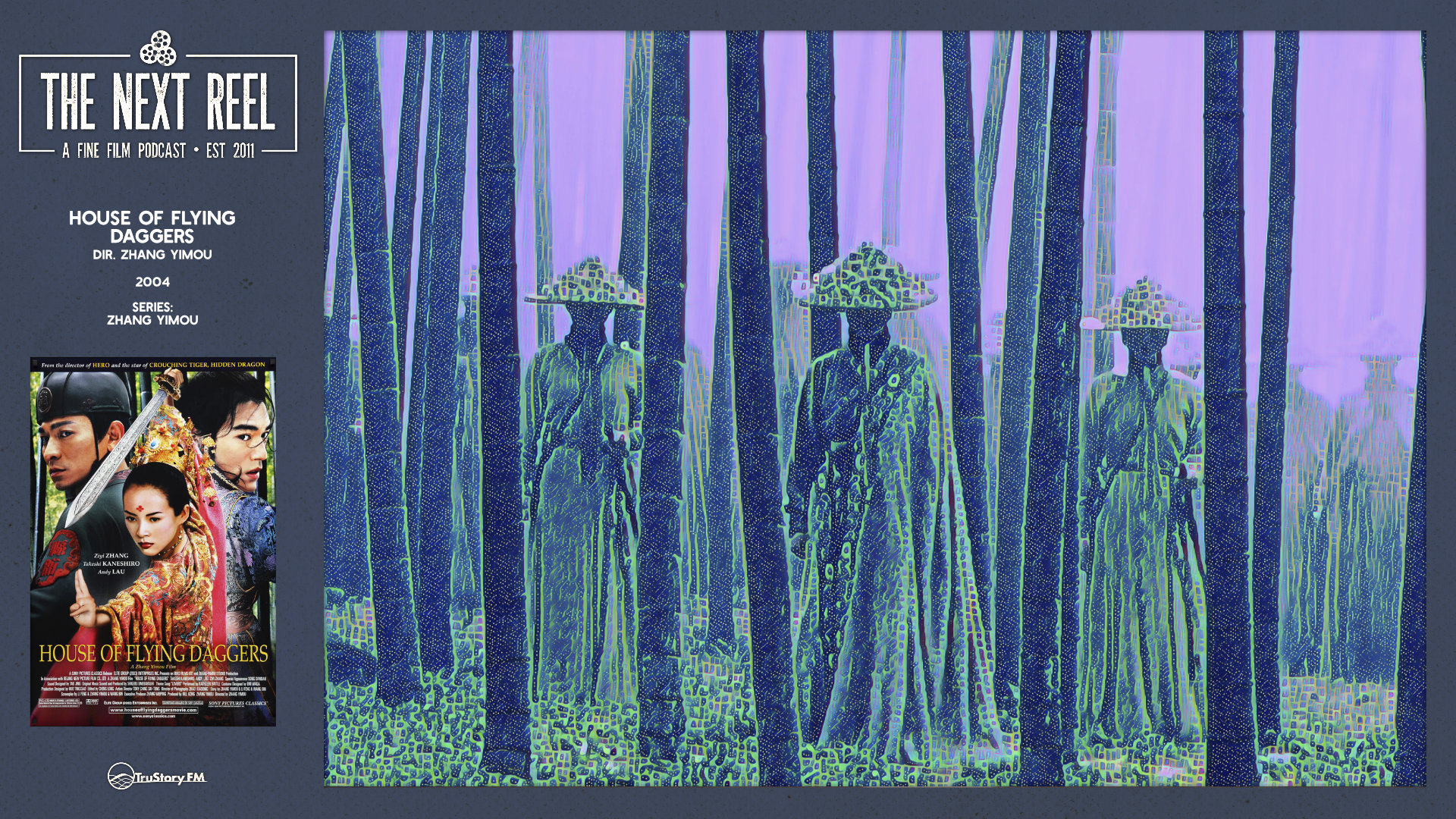
Okay, Andy. House of Flying Daggers. I found myself really, really looking forward to watching this movie again after To Live. Not because I didn’t care for To Live, I cared for it very much, but just because it has color in it. This is Zhang Yimou at his green maximalist era and it is so much color. Did the movie do anything for you besides palette
Andy Nelson:
This is an interesting one. And you know, I put this on the list because I you know, again, as we were Jumping back to our Zhang Yimou series, I wanted to kind of touch a few different decades of his work. And this was one that I saw when it played at the LA Film Festival back in 2004. Zhang Ziyi was there. I’m sure she answered questions about how it was to play a blind person, things like that. It was an interesting film to return to because my recollection of it was Yeah, we’ve got all the great wuxia stuff that Zhang already showed us he could do incredibly well with Hero a couple years before. And the colors are just explosive. My recollection was that it was a little bit of a soap opera as far as this love story and this love triangle that we end up having in the film.
Pete Wright:
Well, that’s absolutely wrong. It’s a lot of soap opera.
Andy Nelson:
It’s pretty much all soap opera. It’s a it’s a soap opera. Set in a wuxia world. Absolutely. Yeah, and so I don’t know. In retrospect, I kind of wish that I had picked something else like Curse of the Golden Flower or something, but I am glad to actually return to this one just because it is just so visually stunning. I mean it’s just an amazing film to look at. I’m surprised that they haven’t released like a four K version of this yet. And because it’s just so rich in the colors and just everything going on on the screen, I but it is a film that doesn’t stand up for me as well as some of Zhang Yimou’s other films that we’ve talked about in the series.
Pete Wright:
Do do you have you done an official count? of how many moles we have in this movie. Because it’s like moles all the way down. Everybody’s playing somebody else. Here’s a grand reveal every 10 minutes, it feels like
Andy Nelson:
You know, it’s funny that you say that because I was thinking about this yeah just this morning. I’m like, this is called House of Flying Daggers. The plot, which may as well be a MacGuffin, is that two police officers are you know, the government has this group, the House of Flying Daggers, that the opening titles, the opening crawl kind of tells us they act kind of like a Robin Hood sort of group, stealing from the rich, giving to the poor. And the government is trying to get these people and apparently has recently killed their leader and is trying now to track down who is running it next. The leader, of course, has a blind daughter, and they know that somebody new is working at the Peony Pavilion, this brothel, and So they say, okay, let’s go there and see if we can infiltrate. And so we have ostensibly a story of the government trying to infiltrate and figure out who with an undercover cop who you know where the House of Flying Daggers is, who this daughter is, who’s leading it now. They’re trying to figure all of this stuff out. That’s kind of the crux of the story. But it is very much not about that. And it’s interesting because the film is called House of Flying Daggers. But it’s like the title itself is a mole, right? Like like we’re that’s we don’t care about the House of Flying Daggers. By the time we get to the end of the story, it’s like, nope, none of that really mattered So it’s interesting in how it plays and I think Zhang Yimou is going for something based on the poem that they turn into a song that Mei sings the very first time that Jin comes to the Peony Pavilion and she’s blind, she’s posing as this courtesan who he says, okay, sing me a song. And she sings this song that is apparently i it’s a song from Chinese history Like i think it was written by like a somebody in a dynasty to an emperor about his own sister and how dangerous love can be and how it can destroy a city, it can destroy a nation. Watch out for love is basically what the song is all about. And that’s like she sings the theme of the movie at that point. And we and I guess that’s what the story is about. About These three people who all end up falling in love, and it doesn’t destroy a nation, it doesn’t destroy the House of Flying Daggers, but it does destroy all three of them. And I guess that’s In a large part, the mole, again, with the title that we have, kind of being sneaky and setting us up for something that is totally different than what we’re what we’re getting.
Pete Wright:
Right. Every principal character is a mole. It starts and don’t forget. So Jin, one of the the first undercover officer, go undercover and see if you can find the blind daughter. He’s the first mole, and he’s a real jerk at the Peony Pavilion and gets himself
Andy Nelson:
The men are terrible. The men are absolutely terrible.
Pete Wright:
The men are terrible. Well, and then we have Zhang Ziyi is Mei. She’s she is obviously playing the blind daughter. We find out she was actually a mole, to try and lure out the police, I guess. And she could see all along. Grandma, who runs the Peony Pavilion, turns out she’s ahead of the House of Flying Daggers. She’s also a mole. And Andy Lau, the police guy in charge of sending Takeshi Kaneshiro in to be a mole, is also a mole. He was in the House of Flying Daggers all along, and he was also a mole in The other movie that we love so much, he’s a he’s a mole all the way down, Infernal Affairs.
Andy Nelson:
Yeah, Infernal Affairs. Maybe Andy Lau is maybe he’s not even an actor. Maybe he’s just a government agent who’s a mole spying on the acting industry.
Pete Wright:
No, he’s a government agent. Okay, so the entire premise, the dramatic premise of this movie is bonkers. Like I’ll just say I didn’t I don’t connect with the with the melodrama of it all, and yet, and yet I’m in it for the color and some standout sequences that are so cool looking and so well performed acrobatically. Like the wuxia stuff is awesome. It the principal scene and the scene that I remember the most is the Echo Game. scene with the drums in the beginning where he’s chucking beans. This is Leo, Andy Lau’s character, is chucking beans at these at dozens of drums in a circle. And supposedly blind Mei is using extent like extendo sleeves from her beautiful silk outfits to hit the drums as she hears the beans hitting them just seconds before. And it ends up being Beautiful, impossible, chaotic. By the end he just chucks a thousand beans in the air and they all hit drums perfectly and she does this beautiful dance. And it just showcases so much of her as a performer. Most of the sequence was performed by Zhang Ziyi, and that’s very cool. And those sequences, like They had me. They hook me. They keep me watching this bonkers movie.
Andy Nelson:
I think that the wuxia stuff is really why people come back to this, because it’s built so strongly and Again, Zhang Yimou really proved himself somebody to watch in this world because when you see what he did in Hero just a couple years before It was stunning and everybody kind of fell for it. And so he really upped the game here. You get the bamboo fight and everything. I mean, it’s just it’s amazing to watch. what he does here. And in the tradition of wuxia, I mean, we’re getting bamboo forests and all the wire work and kind of this magical realism with the plot. I mean, especially how the daggers and everything fly around through the air. A lot of CG, 2004 era CG that can be a little rough to watch sometimes, but a lot of things flying through the air in completely unrealistic ways. But it still makes for a fun time But it’s interesting because I mean you certainly get a sense of kind of the wuxia elements within the story itself But I think the film also kind of departs from wuxia a little bit in the nature of the story where, you know, we’re we’re kind of w we have this romance which is so huge and often romance is in wuxia, but it’s not as front and center as we’re getting here. It’s more kind of the action adventure is. is kind of the core part of it. And so it’s interesting he does kind of flip things a little bit with kind of the structure of what he’s doing here. And again, I think that was He had designed this, he came up with it as a pair, a film to pair with Hero. And my sense is maybe that one was the one that was a little more grandiose in its political storytelling and this one is more it took that world but it narrowed it down to the romance and I guess it is probably gonna fall to personal preference as to whether you prefer kind of the you know, the taking down an empire empire or you know, three people stuck in a love triangle leading to death sort of story. I dunno. For me, I think the soap opera is a little heavy, and especially with a film that’s two and a half hours, I think you definitely feel it over the course of The length of it
Pete Wright:
Oh for sure. That is one of the one of the grand curses of the film, and I think you’re Absolutely right. I mean, yeah, I think you’re you’re probably being too kind to the romance being, quote, a little heavy. I it’s a lot heavy. But it’s a lot heavy in the absence of other substantive story, right? When I think of hero, I have just strong memories of the complexity of society, right? That things were were hard and they weren’t just about, you know, the r the romantic interests and this movie, there’s nothing else. There’s there’s just nothing else. Even the investigation, purported investigation, is forgotten so quickly in the narrative context that there is just nothing left but the great wuxia scenes. And I love the great wuxia scenes. I really do. I think they’re fantastic. And I think even the era of special effects They do a lot with a little. You know, they do a lot with the POV blade and arrow cams. There are a lot of POV arrow cams that I think are
Andy Nelson:
Yes, there are
Pete Wright:
They’re really fun, right? They’re invigorating. They’re exhilarating sequences to watch. The big sequences, obviously the Echo game. There are some great fight sequences in Tall Grass. as the police are chasing the crew across the across the fields. And of course the bamboo. But I do want to talk specifically about the change from fall to winter. in our final climactic battle, that I think I’m not sure how to frame what that symbolizes to me. It is I my understanding is it’s an accident that they ended up with this with this sequence what I’m describing here is the trio is handing off battle, right? They’re you know, they’re all threatening each other.
Andy Nelson:
Well, Mei’s already lying theoretically dead on the ground.
Pete Wright:
Right. Theoretically dead, although we do have one of the classic you’re dead, but I can still see you breathing scenes. which we’ve talked about before. And so she’s down already and the two guys are fighting each other now and there’s a real turnabout and then it starts to snow, and it snows so hard so fast. And they end up with this visual treatment moving from beautiful, beautiful reds and oranges to whites and now the blood red against the white, which is gorgeous. It is just gorgeous. I would love to hear how you feel about that sequence because it’s a thing that could be considered cinematically very heavy handed.
Andy Nelson:
Oh well, it could be. In the world of Zhang Yimou, I suppose that it feels like it fits right in, especially with this story that really is punching up the color so much. Anyway, and here we have you’re right, they were filming in the mountains in Ukraine and this snowstorm suddenly blew in much earlier than they were expecting and Zhang was just like, you know what, this is actually really interesting. Let’s go with it. And so He decided to write that into the story. And I think what it does is it creates it further pushes the magical realism of this wuxia world that this fight between these two men battling over the love of Mei is so epic that it spans seasons. Like it’s kind of left space and time and become this fight for the ages. And I think that’s really what Zhang ended up kind of creating by allowing himself to play w to take advantage of the snow and use that white and the white also is interesting because visually it drains this world of all of its color and it’s kind of symbolizing everything that has been lost up to this point. And now we just have this almost kind of like a no man’s land or purgatory sort of realm that they have entered and are now just fighting literally to the death because I mean, Zhang has said, I mean, we get to the end of the film and it seems like are any of these people alive? It seems like some of them may be kind of alive by the end of the film, but he said in the commentary and stuff that After the credits, everyone’s dead. Like none of these people survive. You kind of you kind of get that, but that’s where it’s definitely going.
Pete Wright:
Those those were marching orders of the movie. Everyone’s gotta die.
Andy Nelson:
Right, exactly. And so I think I think that the visual metaphor that he used really helped. And for me, I love it. I think it’s just a stunning and unique twist on the way that the story was crafted.
Pete Wright:
I do too. I do too. It’s again, it’s one of these this is one of those crazy movies where I think if it weren’t for those beats, the story itself is just fleeting frivolity. But the theme of this eternal struggle for love and loss is one that plays out so beautifully visually that I think he’s he it just ends up being a winner by the end. It’s I’m so it’s so evocative. And I think, you know, just camera alone, right, when you look at as you say it’s This desaturates everything, makes everything super bright, but no color, and yet contrast is increased because every time blood hits the snow, we get such a striking visual and I think Mei dying as she stands up and she you know, hobbles over to the boys who are doing boy things and prepares to pull the sword out or the dagger out of her own chest. knowing, because they tell us that when she pulls the boot the dagger out, she’ll bleed out, that’s going to happen. She gets to die on screen in a completely unadorned fashion, right? She’s just She’s just gonna die in the blood with no sound, no music, just the quiet of the snow, and it’s great. It’s really great
Andy Nelson:
Everything in the ending makes some of the kind of the slog of some of the relationship back and forth. worth it because it’s it is kind of an epic end to this love story with all three of them. And the question of like You know, she can throw the dagger and kill Liu, right? Or which is kind of what we think she’s gonna do. But as it turns out, no, she’s actually gonna throw the dagger and it her intention is to hit the dagger that Liu throws at at Jin. But of course, the big surprise, Liu never threw the dagger. And so all of that plays so well and a beautiful way to kind of surprise us and just give a sense as to the dynamics in this relationship. So it’s just it’s a great ending to the film. That takes a long time to get there.
Pete Wright:
There is can I just tell you the I did have a this movie is not known for its comedy. And yet there is a laugh out loud moment for me. Did you have any laugh out loud moments?
Andy Nelson:
I’m trying to remember what that would be. I don’t recall having a laugh out loud moment, but now I’ll have to hear what what made you laugh so much.
Pete Wright:
Okay, I’m gonna give it to you. They she and Jin are sitting in the old broken down barn. She has not yet come out as seeing, right? He still believes she’s blind. She gets very upset at something that he says. And the camera is close on his face. We see her stand up. And she’s holding her arms out because she’s trying to get the lay of the barn. It’s an unfamiliar space. And she says, I don’t need you. And she starts, she leaves camera right. And the can’t we go close up on his face and then we hear just crashing sounds off camera as if she just like walked through a wall of cardboard boxes and it is so funny to me, I had to stop the movie and tell everybody in the house how funny it was and make them come watch it because it’s just so fast, but so funny every time.
Andy Nelson:
I don’t recall it being quite that funny or quite that loud of a crash, but I may have to check again.
Pete Wright:
I don’t know if you’re ever gonna watch it again, but it’s like she just walked through a wall and I think that was great. And now knowing later that she’s actually a seeing person, y you know, clearly she was clowning.
Andy Nelson:
Yeah.
Pete Wright:
And I think that’s smart, smart clowning.
Andy Nelson:
I’m really gonna get ’em. Yeah, exactly.
Pete Wright:
Yeah, yeah, he’ll he’ll surely he’ll believe this.
Andy Nelson:
All right.
Pete Wright:
There is another movie that’s straight up vaudeville with the same characters and everything.
Andy Nelson:
Which is funny because Zhang has certainly directed comedy. In we haven’t I don’t think we’ve really talked about any of his funnier movies.
Pete Wright:
Yeah.
Andy Nelson:
in this in any of our episodes, but there’s there’s some comedy that he’s tackled. And so it’s interesting that in this particular case that he wanted this to be as comedy-free as possible, except that like accidental comedy that apparently tricked you up there.
Pete Wright:
Oh, there is no accident.
Andy Nelson:
So
Pete Wright:
Somebody put sound in here where there was no because we don’t see her do it. Somebody intentionally dropped effects in here. to make this beat work and it’s perfect.
Andy Nelson:
all right, we’re gonna take a quick break, but first you can find the show on YouTube and you can join us live when we record. We will even take your questions in the post-show chit-chat. And members get the full post-show conversation and always know what to listen to next. Subscribe to the Next Reel on YouTube. The link to this episode is in the show notes. We’ll be right back.
Pete Wright:
Andy, when I tell people about who you are, I often refer to you as the wind? Are you playful? Are you fickle? Are you untethered? How do you define yourself as the wind?
Andy Nelson:
I was trying to I was thinking about that a lot as I watched this because Jin, I don’t know, is it his name he goes by when he’s at the brothel? Everybody calls me Wind. I don’t know. It was kind of funny, but it’s an interesting thing because it’s it relates to him as a character and he’s this one who ends up kind of falling for Mei over the course of the story and in this kind of story about the wind and steadfast versus fickle and all this in relation to kind of their love story and also in his job, I mean Does he seem like he’s the wind when it comes to work? Like he’s gonna he’ll sacrifice everything for love. You know, screw the police.
Pete Wright:
He does it so quickly too, right? Like it’s not very far into the movie where he’s standing up to his buddy in the in the the bamboo forest and saying, I quit, I’m done. Like he’s he falls in love fast.
Andy Nelson:
Well, here’s a question. In the moment there’s a there’s a moment in the film where Mei realizes that she dropped her little pouch of daggers. And he’s like, don’t worry, I’ll run back and find it. He goes off, darts through the trees to see if he can find it. Meanwhile, four guards sneak up on Mei and with daggers and everything, and they start this big dagger fight. And it’s Again, the choreography is stunning throughout this film. I mean it’s just beautiful. I think it’s Tony Ching Siu-tung who did the action choreography in the film. It’s just magical watching these fight sequences. And she’s fighting these four guards who are coming at her with spears. They end up kind of in this big puddle area. and they’re all splashing around and she’s kicking people in the face. I mean, they look like they’re getting really hurt. And then he finally makes it back, having found her daggers. He sees them, and we know he appear is apparently a great archer. He does his little Robin Hood trick and he pulls the arrows and goes dunk dunk dunk dunk. Four arrows shoot so fast they all somehow line up together and hit their targets all simultaneously. He goes and rescues her, makes sure she’s makes sure she’s okay, and the two of them run off together to continue their escape. Then we come back to the four guards because I was like, damn, okay, he really has changed sides. Here he is like he’s just like, I’m gonna kill all of you guys who are attacking my woman. We come back and all four guards kind of sit up and look around to make sure no one’s watching. And they pull they pull their arrows out of like he shot them through like the fabric of the of their shoulder or their side.
Pete Wright:
Honey
Andy Nelson:
Yeah, I guess there are moments of humor that Yimou throws into the film here, but it was a weird moment. I mean, did it Did it make you like what how did that play for you? Did it seem like is it meant to be funny? You’re like what what are we meant to think with these moments? Do the guards know they’re supposed to play dead?
Pete Wright:
I think they do. I think they do. I think that’s but that’s the reveal. And I and I was snookered again. I’ve seen this movie before and I realized, oh, right, this is the gambit. This is the this is where we’re supposed to believe he’s still a dutiful cop. It’s only later and they’re very serious later when he to after he quits and then he starts fighting with the guys who are like, you know, I’m on your side, but they were sent by the general. And they’re a different team of do-gooders, and he has to lay them out that we see there’s blood actually, right? There is there is splashing neck blood, you know, some of it drawn by by her, by Mei, some of it drawn by him, but they take those action scenes very, very seriously. I thought it was great. Even in a gambit like this. The reveal that they are not really dead can be played seriously or it can be played comedically When he shows them sit up in an extremely long shot, that’s funny That is to me intentionally comedic.
Andy Nelson:
It was pretty funny.
Pete Wright:
And then it cuts in to show you that they were hit through their robes, through their uniforms, and not through their flesh. I think that is played for laughs. And it is a good trick. It’s a trick that works on me.
Andy Nelson:
I it has to be the intention because it is pretty comical the way that played. It just seemed like it was meant to be kind of silly.
Pete Wright:
Yeah.
Andy Nelson:
So. No, he’s he’s throwing it in, I guess. He’s getting getting his comedy in here.
Pete Wright:
He’s throwing it in, peppering it in. The grandma, yeah, I think she’s another character that could be played for comedic effect. She’s it’s not overtly comedic, but she is a caricature of this sort of madam of the peony, and then when we see her again she’s a very different person in the green robes. She’s she’s much more sober, strong. She’s tough. She assigns Mei to go kill a cop. Like she definitely has agency in that way in the House of Flying Daggers. What did you think of her transformation in this light?
Andy Nelson:
In the scope of kind of the wuxia world, I mean it totally makes sense. You have people who are or playing different roles and I it was kind of fun to see her show up and all of the people, all of the women who work at House of Flying Daggers. In fact, did we even see men who are part of House of Flying Daggers other than Liu? Or are they all women?
Pete Wright:
I think they’re all women.
Andy Nelson:
Now I think it’s I think it’s all women. which is interesting. other than their former leader who had been killed. I mean, maybe it’s a larger group than we realize, but at least what we’re seeing here, it’s just all women. And it plays it’s pretty interesting the way that it plays. And I liked It made sense. It fit for me that the Peony Pavilion was actually the House of Flying Daggers, and they were actually right in the middle of town in a great opportunity where they can basically eavesdrop on everyone, all the captains and guards and everyone who comes through town who stops there. to philander with the women and I’m sure some of them probably have loose tongues and spill too much information and they’re able to use that. I think that’s actually a really smart way to play that. I liked it.
Pete Wright:
Did wait a minute. I think I might have missed something. I think you just taught me something. I think I’ve assumed all along that Yee and Mei were themselves plants somehow in the Peony Pavilion. But what you’re saying the Peony Pavilion is just like an office of the House of Flying Daggers.
Andy Nelson:
I think so. Oh, I don’t know. I guess I can’t guarantee it, but my impression was all of the women from the Peony Pavilion were actually members of House of Flying Daggers.
Pete Wright:
Oh, I like that. I actually like that better. That’s better than what I had in my head.
Andy Nelson:
Maybe maybe I’m misreading it, but that’s what I was thinking, yeah.
Pete Wright:
No, no, I that’s good. I that’s better.
Andy Nelson:
Well, it certainly gives the police if if anyone doesn’t die it gives them a big a thing to expose, right, to the government. Like if neither Liu well, we know Liu was actually House of Flying Daggers, but if if Jin hadn’t died and he hadn’t fallen in love with Mei That’s like big information that he can report to the government to really, you know, enact their goal of bringing down the House of Flying Daggers.
Pete Wright:
Can you explain to me what Liu’s motivation is? He is House of Flying Daggers. What is his motivation for leading an investigation against the House of Flying Daggers?
Andy Nelson:
He’s not l he’s he’s being told to lead it. Like the government told them they need to do this investigation. I think that’s right at the beginning of the film. They were assigned this investigation. The two of them because specifically their group had been the one that killed the leader. And again, as he reveals to Leo later on in the film He tried he wanted to save the leader’s life, but he had been assigned some in some other district at the time and so wasn’t even around. So Yeah.
Pete Wright:
Right, right, right. I that’s interesting. Performatively how well does he you know, on rewatch in terms of the rewatchability factor, how well does he do you feel that in his performance, that he is a conflicted in-between?
Andy Nelson:
I mean he has to torture his girlfriend.
Pete Wright:
Yeah.
Andy Nelson:
Like the they catch her and they put her in the in the all the different torture devices. So I mean he’s really deep in his undercover, right? You know, it’s like the scene where you have mob people in a you know, FBI agents as moles in mob. situations and they have to like cut their own friend’s finger off to stay undercover. It’s like that.
Pete Wright:
Yeah, yeah.
Andy Nelson:
Yeah, he’s he’s in it. I mean, but that’s the thing. This would be an interesting film to re-watch. Remember I didn’t remember any of the details about the fact that they were that he was a mole also. Like that came as a surprise to me on the rewatch. Now that I remember all that, it would be interesting to go back through it and see how it plays. Like, does it actually play like he is a mole? This is always the we’ve talked about this in many of the films where where people are spies or they’re meant to be alone and like how does that actually play when you know the secret? Does it make sense? Or does it just feel like it’s cinematic artifice?
Pete Wright:
Yes, I that is that’s exactly my my thinking too, because I did not watch this movie twice, but I have seen it before and I also didn’t remember the layers of moles. And I think that’s interesting because you’re right that potential torture scene where they put the bamboo sticks in the in the rack and crush them as he’s explaining how she’ll never dance again because he’s gonna snap her legs off. That’s pretty diabolical and he is he is believably in the part.
Andy Nelson:
Yeah, he really is. And then again, it’s it would be interesting to watch like when Jin breaks her out. covertly because at this point he’s he’s just he we know he’s a cop, but she thinks he’s just this guy from the brothel And when he breaks her out, is he really killing all these cops? Like what is he doing as he like takes out the cops to rescue her and flee? I need to watch it again to see is he actually like Hurting them, or are they all gonna be able to get up and shake it off?
Pete Wright:
Yeah, I don’t think there’s any I think it’s all kicks and knocks in the head, right? I don’t think there’s any there’s any bloodshed
Andy Nelson:
And she’s, meanwhile, pretending to be blind while watching him feign all of this.
Pete Wright:
Yes. That’s what struck me. But of course he’s masked when he comes in. And we don’t have any of the cops. like seeing him and s and saying, like, what should I be real quiet now? She do do you want me to ooh ow ooh right?
Andy Nelson:
Yeah.
Pete Wright:
Because she’s blind, which is, you know, bully for them. That’s smart. But I did I did wonder if that was ever a game they were gonna play for us that she was actually able to see everything that was going on, but pretending to be blind and noticing that he was a cop you know the whole time. They didn’t ever go in that direction, but I thought that was an easy track.
Andy Nelson:
Yeah, that’s I mean it’s funny because I mean I think Zhang Ziyi actually plays the blind person well. You know, it’s just that the Al Pacino-esque sort of thing where you’re just kind of like you pick a point, a focal point, and you’re just always staring there no matter what you’re doing, and it plays. It works well. But I think that’s an interesting element to see also in relation to like we just talked about with the cops. But yeah, how does she do as far as playing into the fact that she actually knows everything that’s going on, right?
Pete Wright:
Yeah. Right, right.
Andy Nelson:
Like all of these people know what’s going on. It’s like
Pete Wright:
It is a very inefficient movie. Like one person just needs to get everybody sitting around a table and saying, like, let’s get it all out.
Andy Nelson:
What’s common?
Pete Wright:
We’re all we’re all on the same page, right?
Andy Nelson:
Yeah, exactly.
Pete Wright:
Yeah.
Andy Nelson:
In our last episode, we talked about To Live, and you brought up the sense of kind of the female characters of this particular set of films that we’re doing. To Live. House of Flying Daggers, and next week we’re talking about Shadow. You were talking about kind of the relationship of the women in their stories, and I’m curious if you wanted to speak to that at all as far as like the the role of the of the woman character in the story.
Pete Wright:
Well, this movie is interesting because it’s it you know, it in it seems like in our trio here at least, Yimou has a really interesting way of sort of entrapping our female characters. And it’s more of a social construct in To Live, she’s she is trapped by you know, civic duty, she’s trapped by familial duty, she’s trapped by culture. In this she is trapped by her role in what it amounts to a cult, right? I mean we can call it a gang. It’s pretty culty, right? There’s this like celebrated cult leader, this man, surrounded by women, and they all you know, they all wear the same clothes and It’s a cult, the cult of flying daggers, and she is trapped in her allegiance, her perceived allegiance to this cult, and her efforts, just like we have the efforts of our female character in the last movie to get out are all thwarted we don’t actually have a sense that I mean she feigns an effort to get to break free of this sort of allegiant and cultural cage that she’s in, but she can’t. The only way out is ultimately death And I think that’s a really interesting thing. It’ll be interesting to see how the capture of our principal female characters in these two movies mirrors what we see in Shadow, which is another really interesting and creative martial arts film and to see what what this particular sort of avatar character is forced—how they are forced to live—because I think there’s a connection between the three of them. The cage looks a little bit different in each one, but they are all equally trapped
Andy Nelson:
Hmm. That’s really interesting. And it it’s interesting because it does make you wonder if Mei ever like at what point does she feel like she’s in a trap in this film? Because we know she’s hardcore with House of Flying Daggers. She’s going undercover to play this blind leader. And as it turns out, she’s not, but she is just another one of the troops who happens to be beautiful that Leo uses often to seduce police or whoever they need to get information from. And she ha really seems to have no conflict at all with the group, what they’re doing or anything. The only issue that she actually has is the fact that they say, take this cop out and kill him.
Pete Wright:
A hundred percent.
Andy Nelson:
Like that’s it. And then and then she lets him go. And she’s like, just go, I’m gonna go back. And of course the love story, neither of them can actually go back. And that’s when Liu pops up to change the direction of the final act of the story, but really it just boils down to love and love bringing down potentially It doesn’t even bring down House of Flying Daggers. It just brings down her as far as her role as a, as it turns out, relatively minor player in the House of Flying Daggers.
Pete Wright:
Right, she’s a thug for the House of Flying Daggers, but but she’s a thug.
Andy Nelson:
As is Liu, right?
Pete Wright:
Yeah, right. And I think that’s what’s so i interesting about her entrapment. Like she closes her own cage door when she realizes that she’s going to let him go. When she’s when she takes a swing of her sword and cuts all the ropes perfectly without marring any stitch in his silks underneath extraordinary second time that trick is used Yeah, for sure.
Andy Nelson:
Have you been practicing that? I bet you’re practicing that. Yeah.
Pete Wright:
And you know, when she does that, she realizes she is in a cage. I think that’s the moment she realizes she’s in a cage. She didn’t know she was in a cage, but she hasn’t been free at all the entire time. just because she’s been, you know, taking action of her own accord, does not mean she was free. When we see her show up in the green robes, very striking reveal, by the way, beautiful reveal When she shows up there and then has to pour tea for Yee, that’s a sign she’s in a cage. She’s not free, and she has to go kill a guy that she realizes she loves. She is not free. She pulls the cage closed. and knows immediately that she’s going to go back, having violated the terms of her agreement, of her sort of capture, and puts her—takes her own life and puts it at risk. just as she has done for him by letting him wander off. That’s the That’s the ultimate I think cage that I’m talking about in this movie is that when she realizes she is trapped is the first time that she actually gets to express any of her own initiative.
Andy Nelson:
That’s pretty interesting. It and it you know, it speaks to the nature of the group. Like it again, stealing from the rich, giving to the poor at the beginning. I mean, you know, for anyone in the world who’s familiar with Robin Hood, they make it sound like a very much a Robin Hood-esque sort of group. But the rules and regulations that they clearly have within the group make it sound like it’s its own governmental system that is very controlling of its individuals as far as what they can and cannot do and how they lord over them. And it makes makes you wonder if they ever were in a place where they actually were able to stop the government and take over, although it never sounds like that’s their intention. But if they were, they might end up being as controlling and dictatorial as the government was. Like it doesn’t actually sound like a better group, other than perhaps they’re trying to actually help poor people.
Pete Wright:
Right. Although what’s interesting about it is that we never get any evidence of them actually doing the job that they are purported to be doing.
Andy Nelson:
Yeah.
Pete Wright:
No, story doesn’t care.
Andy Nelson:
Yeah, right. It’s just about love. It’s very interesting.
Pete Wright:
It’s interesting. It’s interesting that we watch this movie. And I can still say this was a great watch. Like I really enjoyed it. And I enjoyed it not for any of the really the story that it was about. It was all melodrama, but I just loved how it told the story so much that, you know, that it I could see why it’s held in high regard.
Andy Nelson:
Well, and I think you know, we have to acknowledge that Zhang Yimou knew the story he was telling. abandons the actual conflict between the government and the House of Flying Daggers, the entire premise of our story. Like that’s what the story’s about. He abandons it for the love triangle and he doesn’t apologize. Like he’s just like, this is what the story is This is the story I’m telling. There’s mystery, there’s intrigue, but really it is about this love triangle and how it’s a destructive force in the nature of these three people’s lives. I mean, that’s really kind of the extent of what he went for. And If you’re in the bag for it and you can ride along with it, I mean I think you’re still gonna have a great time with the movie. It’s a very fun film and it’s a beautiful film. Again, we’ve talked about that, but It’s different. And I guess that’s the thing. Is like if you’re expecting a story about the actual police force and the government entities tracking down and destroying the House of Flying Daggers, that’s not the story you’re gonna get with this film.
Pete Wright:
That I think is probably all things being equal the story that would have been written for me. Right? More of the
Andy Nelson:
That you would have enjoyed a little more.
Pete Wright:
Yeah. You know, I don’t know how much of the beauty of the of the bamboo forest and the you know the gang of flying dragon drag dragon daggers dragons Everybody flies. I don’t know how much of that they capture in that story. Maybe I just need to go watch this and then Infernal Affairs and I’ve got exactly the movie that I wanted. But there there is no doubt this is gorgeous. So
Andy Nelson:
Would it have worked better if it was called like the wind and the flower?
Pete Wright:
Well, w would I have seen it?
Andy Nelson:
I don’t know.
Pete Wright:
I don’t know
Andy Nelson:
I mean, that’s the thing. House of Flying Daggers is a damn exciting title.
Pete Wright:
It’s a it’s a great title, yeah. Yeah. I and would the wind and the flower have been a betrayal for people who are showing up for like a garden movie and suddenly you have this beautiful young woman hacking away at dudes necks.
Andy Nelson:
So many people so many people out there wishing that they could go to more garden movies.
Pete Wright:
I know, but
Andy Nelson:
That’s all It’s a whole quadrant that is just not being dealt with yet.
Pete Wright:
Yes. They call that the fifth quadrant
Andy Nelson:
And then there’s the gardening movie fans.
Pete Wright:
Yes.
Andy Nelson:
We’ll just
Pete Wright:
Yeah. I just that needs to be a question at the end of every pitch. What about the garden movie fans?
Andy Nelson:
Oh man, so funny, so funny I mentioned it. We talked a little bit briefly just about like the behavior of the men. And I’m just curious if that does anything to throw off anything that you feel about the romance with the characters. Jin and his behavior at the brothel when he’s when he’s first shown up there, he’s the undercover cop and he’s there to try to figure out who is the new person here who may be a member of the House of Flying Daggers. He kind of attacks Mei. I mean, he doesn’t kind of. He does attack Mei. He throws himself on her and all of the like the madam and everyone else is trying to pull him off. I mean it’s pretty rapey throughout the film. I mean, granted, he’s at a brothel, but still, it definitely plays like dark. And we’re like questioning should we be liking this guy? Like why is it why is this somebody that is supposed to be charming afterward? Later in the film, Liu also does the same thing. Like Mm he and Mei get to reunite finally in the forest. And it’s a love scene where, again, it plays actually it’s a mirror of the love scene that we have between her and Jin earlier in the film where they start kissing and then suddenly she stops and she kind of pushes him away. But Leo is just like, -. I’m gonna get some and starts like ripping off her clothes and everything until Leo and the House of Flying Daggers leader show up to tell him you don’t do that. It’s, I mean, it’s we’re definitely getting that with both of these. And so are we meant to actually be rooting for these men or in some way are we actually glad that they end up getting killed at the end?
Pete Wright:
Well, I so practical questions. First, what is his motivation in the brothel to get all rapey to attack her?
Andy Nelson:
That’s a good question. I don’t know.
Pete Wright:
Why does he do that? What I mean, does he need to have the police come for some reason to pull him out? Is that part of the investigation? I don’t understand that. Is he just burying s himself in this undercover part? Is he going full Rush? That’s right. It’s been a long time since I’ve dragged Rush.
Andy Nelson:
Well,
Pete Wright:
I it seems ill advised for for him to do that. I don’t understand it. But I would also say that later when they’re kissing, it’s not exactly a romantic kind of event in the woods with Leo and Mei. It doesn’t feel welcome. It feels incidental, right? That she’s just gonna sort of put up with him. I never quite believe that that they’re like you know, she’s like as into it as he is Because he and that he’s a big baby at the end, right? She pushes him off and he’s like stomps away and it doesn’t doesn’t make him look very good. So I think it makes men in this movie look like they only have one tool. It’s sex or pout. And that’s the binary thing, right? They’re just this is the only thing they turn to when their emotions get hot is they just have to find the nearest vessel for sex and just you know, exercise their their demons and then if they can’t get it, they act like, you know, petulant children. So I don’t I mean, I everything when when When he sits up at the very end and the dagger gets lodged in his in his shoulder and Yee says don’t take that or not Yee, the leader says, Don’t take that out. That needs to be a memory of what you did here. Like that’s the comeuppance we want. I wanted I needed him to have a dagger in the shoulder. He didn’t represent well. I don’t think we should be rooting for any of these guys.
Andy Nelson:
Well, I mean certainly they all die, and maybe the point is like should we have been rooting for Mei all along? Was she the one we should have been caring about? But she’s the one who’s fallen for both of these. Like she’s she’s loved Liu all this time until she falls for Jin. And now that she’s fallen for Jin, Liu gets very upset and you know, if I can’t have you no one will sort of mentality and kills her. And that’s kind of where the story goes. And then like they all three end up just bloody messes in this field. And I don’t know. It’s a dark ending, but I feel like it’s interesting because even Takeshi Kaneshiro, who’s just, I mean, very charismatic actor. I love watching him. Andy Lau is great. But both of them, it does make me question how much Zhang Yimou should have been actually making us feel like we cared about these people when they both Yeah, I don’t understand why he had to play so rapey from the beginning. It’s just strange.
Pete Wright:
I don’t either. I don’t either. And maybe, maybe it’s a thing that we wouldn’t have even commented on when we saw this movie in the theater, right? Maybe this is just, you know. Times change and this is this ends up being a part of this film’s identity that is very dated.
Andy Nelson:
That’s very true, yeah. Which is interesting because it’s also a period piece. So for all we know, his intention could have been showing us something that was more likely to happen all the way back in the Tang Dynasty.
Pete Wright:
Yeah, it’s a good point.
Andy Nelson:
You know, who knows?
Pete Wright:
Tang dynasty is known as the rapiest dynasty.
Andy Nelson:
This is the rapiest of all of them.
Pete Wright:
I checked I’m sure that’s what Wikipedia says.
Andy Nelson:
It’s I’m sure all right. Well I think that’s it. So let’s move into the back half, but first let’s take a quick break.
Pete Wright:
The Next Reel is a production of TruStory FM. Engineering by Andy Nelson. Music by Tzabutan. Annie Zhou, Oriol Novella, and Eli Catlin. Andy usually finds all the stats for the awards and numbers at The-Numbers.com, BoxOfficeMojo.com, IMDb.com, and Wikipedia.org Find the show and the full archive at TruStory.fm. You can follow us from there too. Plus, you can find out how to become a member and go further with every episode. Check out our merch store at thenextreel.com/merch. And if your app allows ratings and reviews, please consider doing that for our show. All right, Andy, it’s award season. You take yourself back to 2004, 2005. You start hearing the little bell that rings every time a new award season is announced. How did this film perform?
Andy Nelson:
Wow.
Pete Wright:
Is that not how it works for you?
Andy Nelson:
That was actually kind of the the most magical way to describe that. It was really funny.
Pete Wright:
Yeah, yeah, it’s a real wonderful life vibe.
Andy Nelson:
Every time a bell rings
Pete Wright:
An Oscar gets its wings.
Andy Nelson:
And a new a new award season has started. Oh my gosh. This film actually did pretty well for itself. 26 wins with 74 other nominations. So you know, about a quarter of its nominations it ended up winning. At the Oscars it was nominated for Best Cinematography for Xiaoding Zhao, but lost to the Aviator. Which I was like, that’s a weird one to win. And I’m like, oh right, that was Scorsese doing that kind of like recreating the different technical or processes over the decades. that story was told. So I’m like, okay, I can give it to that, even though I kind of like prefer this one. At the Saturn Awards, it was nominated for Best Fantasy Film, but lost to Spider-Man 2. Zhang Ziyi was nominated for Best Actress, but lost to Blanchard Ryan in Open Water. There’s a shark movie that people don’t talk about much these days.
Pete Wright:
For sure
Andy Nelson:
Zhang Yimou was direct nominated for Best Director but lost to Sam Raimi and Spider-Man 2, and Best Costumes was nominated but lost to Sky Captain and The World of Tomorrow. At the MTV Movie and TV Awards that was nominated for Best Fight, this was Zhang Ziyi versus the Emperor’s Guards, which I think is the one I was talking about, where they’re all in that big puddle and they’re attacking her with a spear. But it lost to Kill Bill Volume 2, the trailer brawl between Daryl Hannah and Uma Thurman. And over at the Taurus World Stunt Awards, it was also nominated for Best Fight. This time for the final fight in the field in the snow, but again lost to that same scene in Kill Bill Volume 2. So you know it had its share of recognition, a lot of technical categories.
Pete Wright:
That and that Kill Bill win. I mean, m if there’s not a lot going on in, you know, snow action with blood accents, it’s gonna go to Kill Bill. in every category.
Andy Nelson:
I was surprised that the bamboo fight wasn’t one that got nominated in either of those categories. Because for me that was the fight that just really stood out. Just the people moving through the trees and just like the different attacks and then kind of the way that they chop all the bamboo and throw it at them to kind of imprison them. I just thought that was a fantastic sequence. I really loved that one.
Pete Wright:
It’s incredible. Okay. Well, I have to imagine that you had some success with the budget of this movie. This was a big movie, it was it was an international hit. Somebody has to report numbers somewhere.
Andy Nelson:
That’s right. I did have better luck with this one than I did last week with To Live. For Yimou’s epic follow-up to Hero, he had a budget of $12 million, which seems a bit insane for actually what he accomplished. insanely low. I mean it seems like he accomplished a lot for just twelve million. That is about twenty point one million in today’s dollars. The movie premiered at Cannes, May 19th, 2004. Then opened limited December 3rd before opening wide a few weeks later. It opened in 20th place opposite Closer, Blade Trinity, and the limited release of I Am David. It went on to earn eleven million domestically and eighty one point eight million internationally for a total gross of one hundred fifty six million in today’s dollars. That lands the film with an adjusted profit per finished minute of one point one million, showing that this period of Yimou was a huge success.
Pete Wright:
Okay. That’s great. I love it. It’s in the right place. Well, this movie, again, I Just this is one of those that it’s okay to show up for a story that I’m not so keen on, but it is just scene after scene glorious to watch. And I will say it’s another movie that I am delighted to report. Looks great in The Vision Pro, the headset. Big screen, gorgeous. Totally holds up.
Andy Nelson:
It’s it is a gorgeous film. That is really the thing that stands out with this one is just how beautiful. I mean, pairing the costume design and the hair design, hair and makeup with The production design, the locations that they found, like that bamboo forest is just gorgeous to look at. And again, amplified to be extra green. And the cinematography, everything just makes it just such a stunning film to look at. Even if the heart doesn’t quite beat as strongly as it should. The romance just kind of doesn’t completely do it for me, but I still enjoy watching this film.
Pete Wright:
Me too.
Andy Nelson:
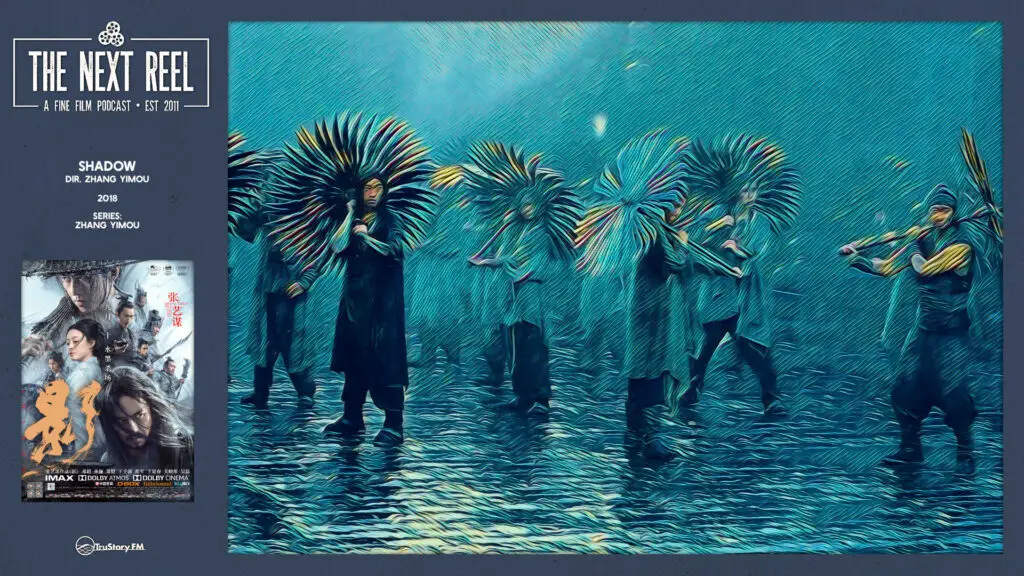
All right, well that is it for our conversation about House of Flying Daggers. Next week we are wrapping up this return to our Zhang Yimou series with his 2018 film. Shadow, a wuxia that makes a radical visual pivot from everywhere we’ve seen in this run, where House of Flying Daggers explodes with saturated color. Shadow drains it all away, shot almost entirely in black, white, and grey, like a moving Chinese ink painting. Palace intrigue, body doubles, blade bladed umbrellas, and Yimou at his most politically sharp. We are excited. to dig into that one. And now, let’s do our ratings.
Pete Wright:
Letterboxd. com slash The Next Reel, that’s where you can find our HQ page where we rate and review all the films that we talk about on the Next Reel family of film shows. Andy, what are you gonna do?
Andy Nelson:
This is one that I mean I really do enjoy to watch. It’s a fun film to watch, but yeah, y it does bog down with the length in the and the romance. So it’s hard to go above three stars, but it’s absolutely got a heart still.
Pete Wright:
Yeah, I’m in the same place. Three stars in a heart and I it is again, it’s so visually invigorating after To Live and I’m just so excited for you to watch. You know, of Zhang Yimou, he’s like, hey, I’m known as the color guy, right? wait till they get a load of this and then he makes shadow. Like I am so excited for you to see what he was able to do with that movie visually. Whatever you think of the cockamamie story and all the crazy umbrellas This is gonna be this is gonna be really fun.
Andy Nelson:
I cannot wait. I cannot wait. Well, this averages out to three stars and a heart, which you can find our show over on Letterboxd @thenextreel. You can find me there @sodacreekfilm and Pete. @petewright. So what did you think about House of Flying Daggers? We would love to hear your thoughts. Hop into the Show Talk channel over in our Discord community where we will be talking about the movie this week.
Pete Wright:
When the movie ends,
Andy Nelson:
Our conversation begins.
Pete Wright:
Letterboxd giveth, Andy.
Andy Nelson:
Yes, it does, as Letterboxd always doeth.
Pete Wright:
I know it does, often it giveth I what did what did you where’d you go? High, low, in between?
Andy Nelson:
I ended up at two stars. Where’d you go?
Pete Wright:
Oh, a little bit low. And no heart, I assume. Heart free two stars.
Andy Nelson:
No heart.
Pete Wright:
All right, what you got?
Andy Nelson:
Two stars by Dom, who has this to say. Everyone in this was so effing attractive, and I’d let each and every one of them stab me with all of their little flying daggers.
Pete Wright:
I have one that shares a similar vibe, but it goes where we did three and a half stars and a heart from yung0besity. A movie that looks and sounds so good and a plot that makes me go, surely there was an easier way to go about winning this war. Zhang Ziyi shines in a movie about a blind girl who isn’t really blind but actually kinda is, along with her two boyfriends, who are also each other’s boyfriends It’s so that should have been on the poster. A movie about a blind girl who isn’t blind but kinda is, and boyfriends, who are also their boyfriends.
Andy Nelson:
That is perfect.
Pete Wright:
It’s perfect. It’s absolutely perfect. Thank Thanks, Letterboxd.