Pete Wright:
I’m Pete Wright.
Andy Nelson:
And I’m Andy Nelson.
Pete Wright:
Welcome to The Next Reel. When the movie ends.
Andy Nelson:
Our conversation begins.
Pete Wright:
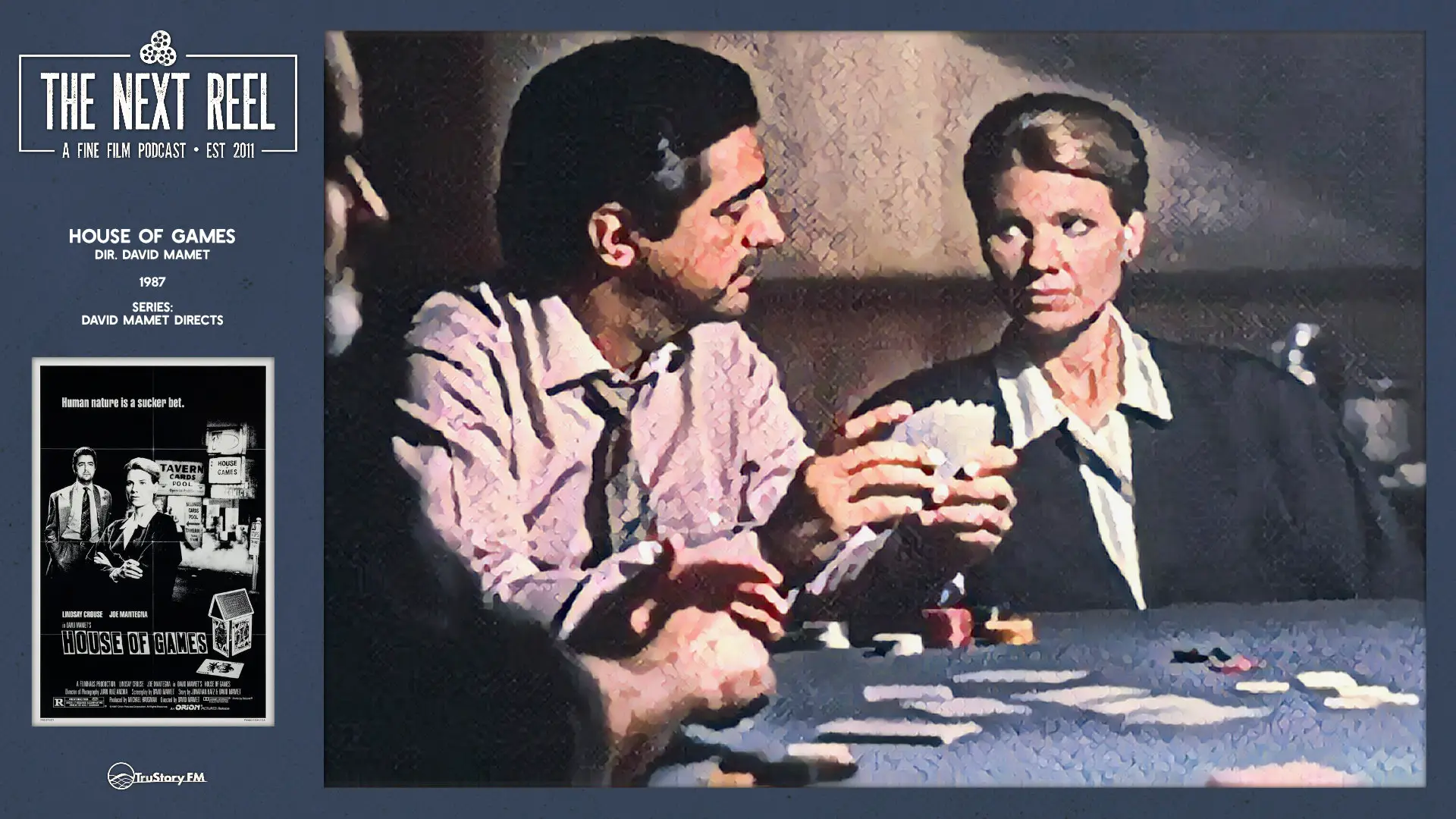
House of Games is over. “Years from now, they’re gonna have to go to a museum to see a frame like this.” That was even too emotional, that read. That was too much emotion for this script We are talking about House of Games. This is part of our we’re filling in another hole in our David Mamet Directs series, uh, in which we have already talked about The Spanish Prisoner and Redbelt Redbelt. Redbelt uh Redbelt, which is I think exactly gives you exactly what I like about David Mamet sometimes, it turns out
Andy Nelson:
As long as we’re not talking about him as a person, this is this is a great conversation.
Pete Wright:
Yeah. Okay.
Andy Nelson:
I’m kind of I’m kind of sick of Mamet, frankly.
Pete Wright:
I know.
Andy Nelson:
I think he’s he’s kind of made himself an ugly man and I just don’t like it.
Pete Wright:
You know what? I’ve I’ve been editing He totally has. But you know what? We at it uh we do so many shows across TruStory FM shows about entertainment where the people who created it th they’re just problematic human beings and they have they’ve made themselves ugly and it’s it’s getting hard to ha have to do the I acknowledge that we’re separating the art from the artist. So I feel like we need a blanket statement. We’re separating the art from the artist all the time, even the good ones. They don’t we they don’t get to be good or bad people. They’re just we’re just talking about the art. And let’s just move on. Cause you’re right. It’s not it’s exhausting to do that.
Andy Nelson:
Yeah.
Pete Wright:
So that’s what we’re talking about. This was, I thought I had seen this movie. I had not seen this movie. This was new to me.
Andy Nelson:
What?
Pete Wright:
Yeah.
Andy Nelson:
You of all people, you are the one who has driven the David Mamet Writes and David Mamet Directs series that we have done, and you have never seen this one?
Pete Wright:
I mean, maybe. I know. I know. I know. This one I hadn’t seen
Andy Nelson:
You the man who who sat me down in college and had me watch I can’t remember what No, it was Oleanna or something.
Pete Wright:
The Spanish Prisoner? No. Glengeri? What was it?
Andy Nelson:
What’s that name? Um Oleanna? Is that it?
Pete Wright:
I don’t remember. I don’t remember what what story we’re talking about.
Andy Nelson:
Okay.
Pete Wright:
Um, but that’s par for the course.
Andy Nelson:
It’s just another obscure David Mamet movie that you you sat me down to watch.
Pete Wright:
Yeah. Yeah.
Andy Nelson:
And this is the one you haven’t seen. That’s crazy to me.
Pete Wright:
It’s crazy to me too. Believe me. It’s crazy to me too. Especially because I had had it so firmly in the catalog. Like I I thought, oh, it’s Mantegna. Sure, I’ve seen it. Like it’s It’s the the the all the the the Mamet constant collaborators. Sure, yeah, bing bang boom. I’ve seen it. I hadn’t seen it. This is totally the memory was gone. If I’d seen it, I had not seen I didn’t remember it.
Andy Nelson:
Interesting. Well, I had seen it. I this is one that I I don’t know I rented ages ago and I watched it probably in a period where I was more interested in Mamet and trying to kind of watch some of the different projects that he had been part of. And and so I enjoyed it. But I I when I came into this one, I like really didn’t remember much about it at all. I remembered the basics. of the psychiatrist and the con man, but like any of the plot mechanics were completely gone from my mind. So it was pretty new for me also.
Pete Wright:
Good. Alright. So we’re we’re both pretty fresh.
Andy Nelson:
Yes.
Pete Wright:
One of us fresher than others. Okay. That’s fine. This is an interesting one. It was his directorial debut. He also wrote it. He was coming hot off of just his uh uh you know, he he’s a guy who was born and bred in the stage, and his plays are uh Legion and Legendary and uh actors love playing Mamet because there is he just does some interesting things with language. There are some who believe Mamet writes in the most human way. It captures dialogue in an incredibly human way. If you just stop and listen to how people talk. that Mamet captures that almost directly. And therefore it is almost impossible to deliver with the same authenticity. And that’s That’s one of the things that gives Mamet a bit of a stilted approach and makes him such a challenge to portray. And this movie is very much uh an exemplar of some of of that with regard to dialogue. It’s interesting how I feel like his first directorial note to the entire cast was, Whatever you do. Don’t show anything in your eyes. Everything is nose down. And the That that’s a weird note, but everybody took it except maybe J.T. Walsh, and this is the movie that comes out of it.
Andy Nelson:
Interesting, interesting.
Pete Wright:
What do you think of it?
Andy Nelson:
I go back and forth on Mamet and his dialogue.
Pete Wright:
Oh, I know, I know you do.
Andy Nelson:
Uh well and and it very much depends on who’s delivering it. I will definitely get that out there because as much as he uh loves Rebecca Pidgeon, who I think he’s still married to. I cannot handle listening to her deliver David Mamet dialogue. I just think that she is she she makes it hard for me. Joe Mantegna, I think, is great. But even in this film, I think there are moments where people are particularly in like back and forth, and it’s often with little words like Lindsay Crouse starts a line and then her doctor friend and she pauses and her doctor doctor friend Dr. Littauer is like, yes, like immediately And then Lindsay comes in and finishes her line. It’s like those little one-word interruptions and stuff that that are, I mean, they’re scripted. Those are absolutely I’ve only directed one play in my life, and it was a David Mamet play with high school kids. The Revenge of the Space Pandas or Binky Rudich and the Two Speed Clock, which was a lot of fun. But high school kids and Mamet is a challenge. But even in grown-ups, like you’re watching this and you’re seeing adults who who also It’s written in a way that I understand. It’s meant to feel natural, but man, sometimes it just doesn’t to me.
Pete Wright:
Well, this is the weird thing because those I I mean if you can imagine, if you can kind of put yourself in the headspace, same script, even same actors. but you tell them that their job is to interrupt one another, right? To constantly step on each other’s lines. Then those scenes start to make more sense, right? The way it’s delivered here, and weirdly the way he directed himself, his own writing was to s to have the actors constantly wait until the last second before or right after they finish a line and then the person starts with their line. But these are the these scenes work so much better when you think of them as that sort of rat-a-tat, people are stepping on each other all the time. And it’s supposed to be really, really fast. Like I’m jumping in on your thought You’re not even going to get your thought out before I’m saying yes, like go on. Then it makes more sense. And I think in uh on stage, you have this opportunity. to play with the way Mamet is i writes himself, right? To to actually give people the the chance to jump on top of each other a a at every turn. And that’s when Mamet, the the script writer is at its very best because I think he writes that those voices in his head and I am baffled why this movie comes off as stilted as it does Because it it’s not directed the way it appears so obviously to me to be written.
Andy Nelson:
And I mean, you know, I mean, uh he had written many, many plays before he got to this point. He’d also written three screenplays before he got to this point. And so he’s he had been behind many writings and already had a handle on his flow and pace and everything. And so I don’t think it’s unreasonable to think that this is a person who’s coming into a position where he probably had a handle on how to direct his own writing, right? Like he probably already sensed the the way that the pacing needs to be. And so it’s interesting getting behind the camera here with with actors in film that maybe it took more learning than he realized. Because it’s I mean, it is different than theater.
Pete Wright:
I mean, you look at uh Sexual Perversity in Chicago. That was it is a great comic play. It’s a Mamet romance, essentially, and Uh the opening sequence is a walk and talk and it’s just an incredible to see it on stage, not directed by Mamet, is extraordinary because this opening sequence is foul and funny and fantastic. And it’s these two guys talking about exploits, uh sexual exploits from the night before, and they are all over each other’s lines. They’re on top of each other. And then you see the movie About Last Night. And that opening sequence is between Rob Lowe and Belushi Jim Belushi. And it is it gives you that same sort of stilted, like these actors are waiting for one another, and it doesn’t seem uh it just doesn’t seem right. Like the number of of examples of Mamet writing directed poorly for screen, I think, is is higher. It’s actually changed my opinion a little bit about the Spanish Prisoner, which you know is one of my very favorite movies. But it has that some similar s of uh uh beats that are that of stilted dialogue. And I think uh Steve Martin and Ricky Jay. are happen to be two people who are very good at Mamet dialogue. Rebecca Pidgeon, I struggle with, uh probably not as much as as you do, but I definitely see it.
Andy Nelson:
But still, yeah.
Pete Wright:
And yet I think that’s another movie that could use some less gated, less strict approach to the words and more jazz, right? Just more allowing the actors to inhabit these words that actually make sense in a human mouth. Like they do make sense to me. And it’s just delivery is is tough. And I think that’s what makes this movie in particular feel as cold as it does, as you know, we’re going to strip out so much of the of the character sort of interiority. We’re just gonna see what is what’s actually happening and not give these people a chance to really act to do their jobs uh in service of the story and I I find that a distraction
Andy Nelson:
It’s a tricky one and and uh maybe some of it is also just the dialogue itself because I mean going back to that yes example, it’s like I don’t know. In my world, rarely is somebody I’m talking to so anticipatory of my next words that they’re saying yes right b right right before I like have had a chance to pause.
Pete Wright:
Yes. Go on, go on
Andy Nelson:
Right, right, exactly, exactly. Like it makes more sense. Like if I’m talking and I’m I drift and I pause and they’re waiting and then they’re like Yes. You know, and so there’s moments like that where it’s like his dialogue doesn’t even make sense as written. And I think that’s one of the things that Like a lot of people talk about how it feels so realistic and I’m like, not always.
Pete Wright:
It just doesn’t.
Andy Nelson:
Not always.
Pete Wright:
It doesn’t always. Right. Because y you know, I I I I think maybe had he directed the actors to be able to truly embody these characters, that conversation is a a great one because the elder doctor is just a placeholder for uh you know, any expert in the field. Like she does not have she doesn’t have any depth I don’t have I don’t get any idea uh who she is apart from a placeholder for Lindsay Crouse to bounce her own imposter syndrome off of. And maybe had Mamet tur like l let these actors off the leash to say, we’re gonna go ahead and make make a movie and you’re gonna you’re gonna play it. You’re really gonna play it. You’re not just a cog in the very precise machine. Uh, I think it would have it could have been something that I could connect to emotionally a little bit more robustly.
Andy Nelson:
Yeah, yeah.
Pete Wright:
I don’t feel like the doctor cares about the speech that what Lindsay Crouse is saying. And Lindsay Crouse is saying nonsense. Like she’s she is Because w I don’t get a sense of who she is as a doctor, the stuff she says to to th her mentor is uh i is just like empty calories.
Andy Nelson:
Well, and that was a weird bit in here that it happens, I think, three times. Over the course of the film, where Dr. Ford, Maggie, uh Lindsay Crouse’s character, twice she’s talking to Dr. Littauer, and You know, she has like I mean you could call it a Freudian slip or whatever it is, where she says mine instead of theirs like my father I can’t remember the situation, but like my father, blah, blah, blah, as she’s talking about a patient as opposed to her father. And she does that twice with Dr. Littauer, and Dr. Littauer both times says, You did it there. You said mine And it’s playing like some psychological thing, like she’s actually putting it into her own head. She’s taking her own troubles and and and putting her own issues onto the issues of the patient that she’s trying to examine. Like that’s how it kind of plays. And that’s how Dr. Littauer seems to read it both times. And then the third time she does it is in that final confrontation she has with Mike. Where she says m your pocket knife instead of the other guy’s pocket knife and gives herself away. And every time it’s like this, it’s I don’t know, is it like, is it meant to be just some some random issue that Dr. Ford has where she’s just that’s a thing that she does where she just says the wrong word without realizing it. Like I was trying to figure out like what the what the intention was of of how Mamet was designing that as coming from a psychiatrist
Pete Wright:
I a couple of things because I think you’re I think you’re on to something and I I was noodling on that too. One, I think it’s safe to say that Mamet does not personally have a terribly high opinion of therapy. of talk therapy.
Andy Nelson:
I wouldn’t be surprised.
Pete Wright:
Would you would you agree?
Andy Nelson:
Uh yeah, yeah.
Pete Wright:
Like this movie does not communicate a real rah-rah yay for mental health kind of an approach. And so given that and given that his his interpretation of therapy on screen is again gobbledygook I think we’re we’re trying to say that this woman is very deeply human and broken in her own way, and we’re going to to demonstrate how broken she is. and how ill equipped she is to be a vessel of support for anyone else, by showing all of these horrible things that no therapist would do, right, would get involved at this level uh with any of their patients, right? This all starts because she v just valiantly oversteps the patient doctor relationship. by trying to help this gambling addict addict and gets herself caught up in a con that she overestimates her ability to see her way through. That’s just bad. psychiatry, right? It’s just bad news all the way around. She’s not equipped to do the job that she’s doing. And I think it stems from Mamet’s position, personally, I’m guessing. And it it shows just and all of her little like flubs, her little, I don’t know, you call them malpropisms. I I don’t I I don’t know, something like that.
Andy Nelson:
Yeah, I’m not sure what yeah I’m sure there’s some psych psychiatric word for that.
Pete Wright:
Her little All of those represent just another layer of brokenness so that we never forget, audience, we never forget that she shouldn’t be where she is Whether she’s in the House of Games, whether she’s in bed with Joe Mantegna, or whether she is in the chair talking to somebody on the couch.
Andy Nelson:
Yeah, and I uh I struggle trying to figure out if it’s clever for Mamet to have named the book that she wrote, Driven, Obsession and Compulsion in Everyday Life Or if it’s just way too on the nose, because I mean that’s it’s basically the theme of the movie, right?
Pete Wright:
It’s the theme of the movie
Andy Nelson:
Like that’s basically where we are. It’s like Right at the very beginning we see a we see this this fan go up to her and hold the book out and just like nudge nudge wink wink This is what the movie’s about. It’s like, okay, she’s she’s uh she is obsessed and has her own compulsions that she is dealing with, and here we are.
Pete Wright:
Yes. Yes, absolutely.
Andy Nelson:
Yeah, this is pretty funny.
Pete Wright:
So let’s switch the tables to Mantena to and the House of Games. Mike is the gambler. Their first meeting is where she goes again, violating her relationship with her patient, and she goes to meet Mike. And she shows up she shows up really tough. Right? She’s using all the tough guy language. And uh we meet Mike. What do you think of Mike? Does he sell it as the con
Andy Nelson:
He sells it. I just before I get into him, I just want to say that I do think that’s An interesting way to write that scene because we’re writing her as this psychiatrist coming in who thinks that she really has a handle on How to operate with people. She understands people. She understands how people think, how people work. And so she walks into this situation. uh kind of dominating as far as I know Mike’s here, I know your Mike, uh and like feels like she kind of takes care of that whole thing, even through the the actual game that they play where she recognizes the the water gun, all of that plays in a way where she feels like, to some extent, the smartest person in the room. I think that’s really interesting. And now going to Joe Mantegna, coming in as as Mike, the con man who’s here set up at House of Games, where he’s playing this poker game in the back and I I think Joe Mantegna is fantastic in the role. I I uh just always enjoy Mantegna. I think he’s a a fun face to see on screen. And uh He’s somebody who has worked with Mamet uh quite a lot, I think like at least six times in various projects, and so has a handle on how to how to deliver the lines, how to play off of other people in these scenes. And I think when it comes to playing a con man, I think he taps into that perfectly well and understands the mission and what he’s what his aim is to do here. I think he I think he delivers.
Pete Wright:
I think he does too. I mean I I find him you know, uh Mantegna’s got a charisma, right? And this movie, he gets a chance to exude some charisma, even if he doesn’t get to show it in his eyeballs. he does get to show it in just the way he walks, the way he moves, uh the way he speaks. I think he I think he’s very, very good. I think that extends to his whole crew. Obviously Ricky Jay, you hire Ricky Jay, you get Ricky Jay. And again, you talk about long term collaborations. I I think Ricky Jay is is you know, their little relationship I think is very, very strong in the film. I think as the con, one of the things I think the that Mantegna pulls off really well is that th he is able to transition through really dialogue alone To sell when he’s when he’s in a con mode and when he is in this is my job mode, right And nobody takes it on the crew, led obviously by Mantegna, nobody takes it all very seriously when they’re trying to take her for six grand. and the jig is up. No everybody’s like, well, we tried shucks. And I I actually found that transition, that transformation when they start you know, uh actually processing their play and where did it go wrong? Well, you weren’t supposed to fill the water pistol, you idiot. Like those those moments I think were really strong. And we get those again sort of repeated as the stakes increase throughout the movie in a way that is that is, I think, satisfying. I mean you’ve you’ve seen it before. I hadn’t seen it before. How easy was it for you to call the shot? at the end to call the the the game. Do you think we’re supposed to have that to find it a mystery? A shocking reveal at the end?
Andy Nelson:
I don’t know, but I feel like in the world of movies that are about cons, it is kind of a trope to make the movie itself a con. Right? Like that, it’s just it’s part of the nature. And so I can’t I can’t, when I’m watching a movie that’s uh about cons, I can’t help but put myself in the place that this is all just a big con. Like I I’m constantly thinking that. And so I’m always looking for, okay, this is all fake. That guy’s in on it. And so that’s just how I end up watching con movies. So it’s ne it’s it’s a it’s a tricky thing. And I I I was wondering, I was thinking about that because I mean the sting, which we talked about on the show. Ages ago, as part of our Zanuck series, was such a perfect example of how to pull off just a great, great con as a film. as where you’re watching them pull off a con. It just plays so perfectly.
Pete Wright:
Yes.
Andy Nelson:
And I feel like every con film since then In some capacity, has had to struggle a little bit uh with the fact that, okay, but it’s a con film, and now there’s kind of a trope of us conning the audience, right? That’s just it’s just in the nature. And so What I think Mamet succeeds at with this film, which is again one of these con films, is that It’s not it doesn’t end with the big con and the reveal and her devastation and realizing she’s been conned That’s actually like the end of the second act. And we still have or maybe maybe not the second act, but it certainly is is at that point where we’re close to the climax of the film and we get a whole other act of her now figuring out how she can one up them And that actually makes this more of a success for me than some other con films because suddenly it shifts the mentality of the thinking of our protagonist. uh into somebody who now actively has to figure out how to how to get back at them.
Pete Wright:
Okay. I I feel like you’ve opened the door to the end of the movie, and I want to talk about it because this right here is where my stars fall on this movie.
Andy Nelson:
Okay. Yeah, and we haven’t said it, but definitely watch this movie if you haven’t seen it before really digging too much deeper into this conversation.
Pete Wright:
It is it such is it such a moment that we should actually take a break?
Andy Nelson:
We should actually take a break. Good point, good point. All right, we’re gonna take a break first You can find the show on YouTube and you can join us live when we record. We’ll even take your questions in the post show chit chat and members get the replay and the extended cut. So subscribe to The Next Reel on YouTube. The link to this episode is in the show notes. We’ll be right back.
Pete Wright:
All right. The the end of this movie, the third act, I guess so the bottom half of the third act of this movie, the transition. She As you say, she’s we’ve got the turnabout. And the expectation that I have, because again, of this is a con movie, and I have an expectation that the con movie is going to do certain things. What I expected was that she was going to turn the table on the con men. After all, she wrote the book on cons. She wrote the book on the obsessives. She is a therapist. She is supposed to have some sort of expertise in this field, right? That’s what we’re set up ostensibly to believe. In the end, she does not turn the tables on these guys. She doesn’t get eye-for-an-eye vindication. She doesn’t get her money back. She doesn’t con them at all. She’s just A murderer. She just kills the guy. That’s it. That’s her big big expression of oh my gosh, I got you. Bang, bang. I found that. a ridiculous letdown in this movie for this character that I thought we were gonna see some real one-upmanship on the thugs. I thought we were gonna get this kind of thing where she became an an expert, where we got to see that she was actually ahead of them in that final act. And I was deeply disappointed by that.
Andy Nelson:
Do you think that she went into that final situation planning to kill him?
Pete Wright:
Kinda, yeah, because what else they he gave us like he sort of wrote himself into a box, right? He gave us no other indication that there was an out. here. And I don’t know, she even left his uh sh I I imagined that he was carrying money in his satchel. And uh she left the satchel. She left the satchel. She didn’t even want the money.
Andy Nelson:
She did leave his satchel. Yeah, yeah. Well, i the way that I read it, and I don’t know if I don’t know if I’m right or not, but the way that I saw that whole scene playing out is she had come up with a way where she was gonna do something She was tricking him into thinking she had pulled her life savings out and it was in this bag that she was carrying. And It at some point I think that she was going to try switching bags with him and give him a bag that was full of dirty laundry or whatever, you know, the trope is, and make off with his bag of money. And I think the only reason that she failed is because of that weird tick that she has where she says the wrong thing and she calls it out that it’s his knife instead of the guy in the room’s knife. And that’s what clues Mike into that she um she’s leading him on. So I thought that She was trying to do something and she screwed it up because of that annoying thing that she does. And so her only solution at that point was to uh was to stop him and kill him. So I I I guess I didn’t think initially she was there to just kill him. But in the end that’s what she did and she forgave herself and moved on.
Pete Wright:
She boy howdy did she. She actually went to meet her mentor and and like work through some stuff.
Andy Nelson:
Yes, right.
Pete Wright:
I I think that’s a I I I mean that is certainly a a read on it, and I think that I I I was so disappointed in how he played this character uh in in the script that I it was hard for me to see anything else. I mean she shot him like fifty times. There were so many bullets in that gun.
Andy Nelson:
I think it was just six, but okay.
Pete Wright:
It was it was fifty if it was six and He did
Andy Nelson:
She used all six. Hey, he had enough time to quote a movie. That was something I wasn’t expecting a David Mamet movie.
Pete Wright:
To quote another movie. I wonder what they had to pay to get that quote in there. Yeah, it is it is kind of an extraordinary um to me it was an extraordinary uh uh sort of failing of the character, if not for the genre. So that this is the next question. Like, set aside all of my complaints about this character, and what I what I wanted was cleverness, and what I got was blunt object. does it fit the character and does it fit the sort of gestalt of this movie as a noir, right? It it has trappings of noir. How well does does it fit? How well does she fit?
Andy Nelson:
That’s interesting. I was I saw someone else describing this kind of neo-noirish, and I’m like, I don’t know if I would jump into the noir camp on this one just because it’s a crime story. It didn’t feel noirish. But I obviously other people think that. So I think it’s interesting that you bring that up because clearly it’s a thought people have. I felt that The way that the film ends, you know, it’s a it’s a con movie, crime movie, and does it find a way to step away from tropes? Does it pull into does it step into Noir maybe a little bit with her just kind of flat out killing him? I don’t know. Uh I I I guess I didn’t struggle too much with the way that the film ended. I thought it played okay. I don’t know if I loved it, but I think that it worked in context of of kind of what where we had been coming from, you know?
Pete Wright:
Yeah. Yeah, that that the guys what they ended up unlocking in her was her inner white hot rage machine being taken advantage of. And they, you know, while they just wanted to get six grand and then eighty five m because they felt like they could keep getting it what they really unlocked was, oh, she’s a murderess. She’s the she is our you know, deeply disturbed femme fatale. And We didn’t see that coming and she’s gonna be the one standing over him with a gun. And we’re gonna feel, we’re gonna try to make the audience feel a certain way, that maybe there was a thread of their relationship together that is worth longing for. And I never felt that. That was not a success to me, right? The fact that they hooked up in that in the random tuxedo man’s hotel room You know, I feel like I learned some things, uh, maybe in the eighties, how to get a free few hours in someone else’s hotel room. That was a nice trick. But uh I’d never felt like there was any relationship that I should expect to be legitimate between the two of ’em, never once. And I think maybe had I felt that way, had the movie given me any real emotion to work with in these people, I might have felt sadness when she shot him. And I did not feel any of that.
Andy Nelson:
Interesting. Interesting. I think it worked better for me in that regard. Like I I felt that I mean, I I guess the question is like, what is her draw to Mike? Is it something that she’s wanting to actually have a relationship with him? Is it just the fact that she’s excited by this world again, the the whole driven obsession and compulsion Is she drawn to everything that he represents because of it? And so is okay just like throwing caution to the wind in this relationship? Not necessarily thinking it’s gonna turn into marriage or anything like that, but just something that she’s doing for fun. It’s exciting and it’s introducing her to a side of herself that she’s she’s never fully explored, kind of this side that is a little bit okay with with crime and crossing the line and everything. And and and So I bought into her as somebody who was genuinely curious about like this darker side of herself. And I like the way that Mamet portrays that. Somebody who’s like. who may not fully understand why she’s drawn by this and pulled into this, yet fe has the compulsion and needs to do it. I mean, clearly it’s triggered something in her because at the very end of the film we see that she’s still she’s become a pickpocket now. She is stealing this lighter from this other lady.
Pete Wright:
Yeah, she’s just stealing stuff.
Andy Nelson:
Right, so she’s so she has has has found a thing with herself and probably also after she stole it said, I forgive myself.
Pete Wright:
Right.
Andy Nelson:
Right. That’s like the other probably not great lesson that she’s learned in this film.
Pete Wright:
Well, it turns out that was the lesson she knew all along as a therapist was you have to be able to veer that’s the only tool she can
Andy Nelson:
It’s like Yeah.
Pete Wright:
came into this movie with like we know she was deeply unsettled with her work at the beginning, right? She had admitted that she’s like, I can’t what am I even doing here? Right?
Andy Nelson:
Yeah, right.
Pete Wright:
This is not I’m I’m bad at this
Andy Nelson:
Why yeah. I’m not helping.
Pete Wright:
We’re not helping anybody with what we do. I can’t change anything. She’s deeply unsettled as a therapist. And so, you know, the movie uh uh it seems to be making the the the case that, you know, what she was meant to be, the hand to glove career relationship that she was meant to have all along is I should have been a criminal from day one. Like all the tools that I need to to be right with myself internally, I have thanks to my training as a therapist, and now I’m gonna go steal stuff from people. And occasionally off the bad ones.
Andy Nelson:
How long do you think before she goes and steals another car from a parking garage?
Pete Wright:
Yeah. Not long she made that look easy.
Andy Nelson:
Like she’s ready. Yeah. Yeah, she’s ready.
Pete Wright:
Yeah
Andy Nelson:
Yeah, it’s it’s a fascinating glimpse into the psychology. And so I don’t know, I guess that’s what I find fascinating is that Mamet chose to write her as a psychiatrist. Obviously, we’ve talked about the fact that he probably doesn’t seem to think too highly of the that particular field, but this is a person who has a lot of thought about how people think. And has now I I think now after looking at Mike and trying to figure out like she’s learning to doing research to write this book, like that’s the whole Premise that she has in kind of following him is to learn the world of the con, and so she can write a book about it, gets completely played and taken for a massive amount of money. gets revenge and now is in this place where I think she’s seeing it as being okay and like, you know what I I’m learning and I’m growing and I’ve I actually have a better handle on who I am now than I didn’t necessarily have before and I can move forward better. So I don’t know, going long way around to your question. I found more of a connection to kind of the emotional relationship. And so when she actually kills Mike, I was like I I I thought that was actually pretty interesting and and I I enjoyed the journey that she had been going on to get to that point.
Pete Wright:
That’s like a 10-minute walk around the block that you did to actually answer my question.
Andy Nelson:
I i I know. It was a very I yeah, a whole whole bunch.
Pete Wright:
That was extraordinary what you did. How many parenthetical asides did we have between the question and that? I I I just think that you I think the con it her con is the the the uh invisible con. which is, I’m gonna write a book about it, right? Like she was conning herself. I th I gotta always gotta ask who who are you lying to?
Andy Nelson:
Oh yeah. Oh totally.
Pete Wright:
Are you lying to the people or are you lying to yourself? She was lying to herself the whole long uh the whole time. The con was get her into this business. That that is in m many in many ways the con of the self help literature. business and I say that as somebody who’s actually contributed to the self help literature business. And and I I think that she you know, she uses that as a way to discover something about herself that she never that she never knew was in there all along. And I just wish that it had been directed by somebody who could get that out of Lindsay Crouse. My big complaint about her. summed up is that in order for her to be the change character in the movie, in order for me to feel something about it, I need some sense of of a beginning. And w what w what I get from her emotionally is she starts at kind of the same emotional register that she ends. And she just unlocks a how, but not a why. And uh we already know the why from jump. And I just didn’t find that. uh as compelling as I certainly as I’d hoped as a fan of other Mamet con stuff. And uh that was that was disappointing.
Andy Nelson:
Well, and I think that’s Mamet. Uh I don’t certainly don’t blake blame Lindsay Crouse. I think she is
Pete Wright:
No a hundred percent
Andy Nelson:
proven herself plenty of times as uh somebody who can do great performances, including The Verdict, another project, again going back to a Mamet project, but also one he didn’t direct. And so there I think we’re seeing what exactly you’re talking about play out.
Pete Wright:
Yes. Absolutely. Absolutely. The other the other guys, you know, we talked about um the uh Ricky Jay. Interesting, the the uh envelope and the buck or the 20 buck trick Apparently he invented that trick with the tongue on money, which was maybe the high point of horror in this movie. They made the guy lick money.
Andy Nelson:
Yeah.
Pete Wright:
You don’t have a you don’t have a problem with that like I did?
Andy Nelson:
Gross.
Pete Wright:
That was disgusting.
Andy Nelson:
Well, it’s an interesting w the story behind it though is interesting, which I think is funny because Ricky Jay we’ve talked about him a number of times. And the fact that he is a magician, he is somebody who is a very intelligent person, and in the scope of this film, one of the things that he was brought on to do was to because he knew all of these short cons. Like he he’s He’s in the circle of all of these people who pull all these sorts of things and knows the know how they do these sorts of things. And they asked him to do one. to do this twenty dollar swap thing for this particular thing. He felt too much honor, I guess. It it’s I don’t know. The Con Man code, is that like the magician’s code, apparently, according to Ricky, it is?
Pete Wright:
Yeah, right.
Andy Nelson:
He didn’t he didn’t want to give away how these con men actually do it. So he came up with a totally original con. And so that licking the dollar trick is an original Ricky Jay trick that he came up with to uh to pull that off.
Pete Wright:
And never used. Right.
Andy Nelson:
And never and well, actually somebody I think ended up getting caught either doing that or one of the one of the cons that they tried to do in the movie. It might have been the h hotel room swap or something.
Pete Wright:
Do you think it was the it was the Western Union con? Uh it was for the Western Union con and they and it’s because they did it in 2011, I’m sure, when Western Union wasn’t really doing much of that.
Andy Nelson:
Right.
Pete Wright:
That’s funny.
Andy Nelson:
With good old W. H. Macy. That was nice to see him credited as that.
Pete Wright:
Yeah. That was nice.
Andy Nelson:
W.
Pete Wright:
W.
Andy Nelson:
H. Macy.
Pete Wright:
H. Macy. Yeah.
Andy Nelson:
Yeah.
Pete Wright:
Distinguished.
Andy Nelson:
WH and JT both in this film together.
Pete Wright:
Yeah.
Andy Nelson:
Yeah.
Pete Wright:
Uh I J.T. Walsh was was sort of my favorite little incidental character in the movie because I s I kind of find J.T. Walsh uh I was working on my review. And I wrote that I think J.T. Walsh is Mamet-proof.
Andy Nelson:
He’s great. He delivers it well.
Pete Wright:
He’s great, and I don’t I don’t think Mamet can direct him to be i as emotionless as he he would have wanted him to be. Uh I feel like J.T. Walsh could see through and and it made him one of the most sort of unintentionally entertaining characters of intensity, uh, in the movie. I do think uh from an editing perspective, they may have used the wrong cut when they close the door and leave his body. presumably shot at this point. He is still breathing, and it’s pretty obvious that he’s still breathing.
Andy Nelson:
Yeah.
Pete Wright:
And that may have given away the con to us as the audience if you weren’t already in on it.
Andy Nelson:
It either gives away the con or it’s just what you expect in movies of certain eras where it’s like The person’s dead, but they’re still breathing, you just kind of go along with the fact that, you know, that’s that’s a tricky one because it’s like in the world of movies, it’s like so often we’ve seen movies where somebody is dead But you can still tell that they’re breathing. They’re trying really hard not to, but you can tell.
Pete Wright:
Yeah. They start quivering
Andy Nelson:
Yeah. So there’s a line, and I think that’s a that’s always a tricky one with film, but
Pete Wright:
Yeah, yeah.
Andy Nelson:
Yeah. Um but yeah, and and that and again, those are people that you’ve been bringing up who are kind of Mamet regulars, people who have recurred, including Lindsay Crouse, who was his wife at the time, popping in and out of of his different movies. And I think that’s uh it’s always kind of fun to see. Uh he’s certainly has drawn a a certain crowd of actors who love being in his films.
Pete Wright:
Yeah. Uh he shot this in Seattle, which was weird. It was originally set, it was written to be in Chicago, which is Mamet Town. It it surprised me to see it in Seattle, although I will say it’s a Poor Seattle. Like it’s not as if they used like locations for Seattle. Every i you know, this is This is one of those movies where it just feels uninhabited. You know, she gets to the to the bar, she and and there’s just no one on the street. Like that never happens. Uh this is the most filthy yet sterile interpretation of uh of a city. And so it feels like a set. It just feels like a wet street set. that they created, it does not feel like like Seattle to me. As someone who’s, you know, I’ve spent some time in Seattle and and, you know, live up here. It doesn’t feel normal.
Andy Nelson:
I assumed it was Chicago for a chunk of the film just because it’s David Mamet. I kind of walked in thinking Chicago the whole time. And then I think I there were a couple giveaways. One was like there was like a s a Washington license plate. And it was like, oh, maybe we’re in Washington. And then there was something else that uh there was a sign some signage that said Seattle and I’m like, oh okay, we’re in Seattle and then his pocket knife had the space needle on it. And so like those three things, I’m like, okay, this is Seattle. That was the last place I would have expected a Mamet film to be set, which yeah, just kind of struck me as funny that that’s that’s where it was. But Because it doesn’t feel like Seattle. Like nothing feels like nothing stands out as we’re in the Pacific Northwest. It’s just like Here’s a random building. Here’s a random street. Like you said, it it all felt uninhabited and nothing was like, here’s an iconic shot with a space needle in the background. Like nothing like that. So it just felt very generic as as far like i to the point where I was like, is he even wanting us to realize this is Seattle?
Pete Wright:
I really don’t think he cared. I think he went to Seattle because of the budget, and he could save money by going to Seattle, and he didn’t really care. It needed to be generic city. City was not part of it.
Andy Nelson:
Yeah, that’s kind of ended up how it how it felt for sure.
Pete Wright:
That’s certainly how it felt, yeah.
Andy Nelson:
Yeah, yeah.
Pete Wright:
What else, uh what else is hot on your list?
Andy Nelson:
A couple things. One, just thinking about this particular series, David Mamet Directs. As you mentioned earlier, we’ve covered The Spanish Prisoner and Redbelt. And I do think this is something that we see in his films, and I I I think it We could probably argue in the films that he has written. So if we looked at our David Mamet Wright series and expanded that a little bit, his stories, he really likes stories about a particular society and their codes. Right?
Pete Wright:
Yes.
Andy Nelson:
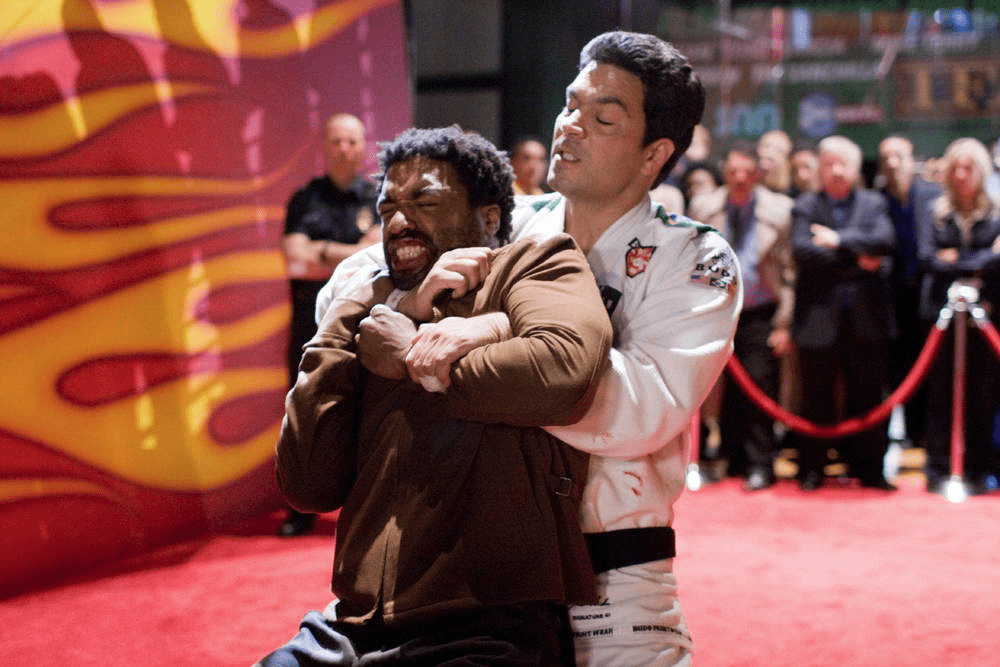
Like in both of the Spanish Prisoner and this film, both con films, we have these con men and their worlds and their rules and the way they play. Same thing in Redbelt. Totally not a con film, but very much kind of that I know it’s a Brazilian jujitsu uh sort of thing, whatever it was. Uh but it’s a but a very specific code.
Pete Wright:
Still codes.
Andy Nelson:
Exactly.
Pete Wright:
Yeah.
Andy Nelson:
I think that is something that Speaking of obsession like this the her book, I think David Mamet has a little bit of an obsession about codes. Like if you look at something like The Untouchables, the police, the the criminals. how people in their world r react and interact with others. And I think that’s very much very much part of his his gestalt as far as what he likes to explore.
Pete Wright:
The Chicago Way Yeah, I think that’s uh I think that’s spot on. And I I think this movie is a playground for exactly those kinds of things because it’s something that we r really, I I think can’t like there’s it’s so hard to see in real life. Like it’s it’s believable because I make it believable because I don’t exist in those circles, but I can j I can go to jujitsu tournaments. I can see those guys in real life. There are a lot of cops and you know investigators in the world who live the life of The Untouchables, who lived at that time and and have that experience. But this one, you can do whatever you want. because it it is it’s a playground. It’s a cultural playground that so few people actually live and know. Even Glengarry Glen Ross, right? Glengarry Glen Ross is a movie also about codes.
Andy Nelson:
Yeah, oh, hundred percent.
Pete Wright:
And Right? But it’s a movie where a lot of people have worked in sales at some point in their lives. A lot of people understand the pressure of hitting numbers. A lot of people understand Oh, I I met some arbitrary goal. I got a set of steak knives, right? Like uh that is a very familiar kind of landscape. for him to be playing and interpreting. And I think that’s what makes that movie such a great litmus test or that story a great litmus test for, you know, how you feel about that industry. this one just gets to play. And so it goes back to what is tropey and what is n what is not, right? I I I’ve said it time and time again. I don’t care about tropes. I care about how well the tropes are played in any given movie. And This one I struggle with. It feels like there are some tropes that are uh tropes of assorted films, assorted con films, and I struggle because I hadn’t seen it and when it was released. Is it an early marker of, you know, sort of first time of some of these tropes that I’ve just now internalized over the last you know, forty years, or is it uh is it just something that’s been playing the hits all this time of of much, much earlier movies? Um to me it hit as the latter and it was it was more disappointing than I’d hoped it would be.
Andy Nelson:
Hmm, interesting. Interesting. There’s definitely a lot going for this. It’s not like peak Mamet. And honestly, I generally find Peak Mamet to be projects that he’s written that he didn’t direct. Like I just don’t think as a director he’s as strong when he’s telling his stories.
Pete Wright:
Yes
Andy Nelson:
Like you brought up Glengarry Glen Ross. I think that is a great example of another director coming in directing Mamet dialogue in a way that felt so much more natural consistently.
Pete Wright:
Yeah. Yeah. I agree. I agree. Man, he’s such a prolific uh writer and has been around for so so long look at one of our one of our top performing downloads for such a weird movie, The Edge, written by David Mamet, directed by Lee Tamahori, is another excellent example of a Mamet script directed by someone else.
Andy Nelson:
Yeah, yeah.
Pete Wright:
The dialogue, you can, I can I can absolutely reinterpret the same script directed by David David Mamet, and it sounds a hell of a lot like House of Games, but in the edge, it actually reads like a complicated sort of action survival movie uh and a thriller and it it plays as such much better.
Andy Nelson:
I agree. I definitely agree. I only had one last note, and it was a interesting costume choice that Mamet chose to direct Or has Maggie dress more masculine, like always wearing pants, a pantsuit sort of look that she has going on, short hair, until she kills Mike? After that is when suddenly she when we see her next, she’s dressed more in a feminine way.
Pete Wright:
She’s she’s in a skirt the first time she sees Mike and the last time she sees Mike
Andy Nelson:
Oh, the fir—okay, first time also.
Pete Wright:
First time she’s on, she sits up on a stool and she has that is a femme fatale move. The way she sits up there, elbow on the bar, crosses her legs, lights a cigarette, and Cigarettes, Andy, have you seen so many cigarettes in any other movie?
Andy Nelson:
Oh my God I can’t believe that it took us this long to bring that up. I was like, has there been more smoking in a movie than this one? My God, it’s constant.
Pete Wright:
Oh my god. There there times it feels like they light a cigarette, they take one drag, throw it on the ground, and light another cigarette.
Andy Nelson:
That’s right.
Pete Wright:
Like the obsession was not with smoking, it was the act of lighting cigarettes.
Andy Nelson:
Yeah.
Pete Wright:
This movie had an extraordinary cigarette budget.
Andy Nelson:
Oh, it had to. My god. And the fact that the thing that she ends up stealing at the end, a lighter.
Pete Wright:
Crazy. Cigarettes. A lighter, right?
Andy Nelson:
Yeah, yeah, yeah.
Pete Wright:
That’s the last thing. Yeah, the lighter uh the lighter uh okay, just last point Did the lighter have any emotional weight for you? Right? Was was that supposed to be our Maltese Falcon that we’re tracking the lighter all the way along? Because they make a big deal about it in her first scene. with her mentor at the restaurant. Like they really they’re close-ups of it and it’s beautiful and they talk about it and then it seems like there are lighters placed throughout the movie. And then she steals the lighter at the end. Was I supposed to feel some way about the lighter? I never felt any way about the lighter.
Andy Nelson:
I never well, and then there because matches were another thing. You know, she runs out of matches at one point and has to find more matches and I don’t know exactly what the reasoning for all of that was as far as focusing so much on it and making such an emotional attachment to it. Because she talks about that with Dr. Littauer Littauer about like I love that lighter. I’ve always wanted to have a real lighter, you know, the something heavy that feels old, or I can’t remember what she says at the beginning, but there’s a whole thing, like a monologue that she has, a Mamet monologue. about about this lighter.
Pete Wright:
Would you call it a mammalog?
Andy Nelson:
MAMLOG. Weirdly, the only thing I could think about at the end when she stills the lighter is like What are the odds that that woman had the exact same lighter as Dr. Littauer? Like that was all I could think about. Like why why the exact same lighter? That made no sense to me. It’s like, come on.
Pete Wright:
Yeah. Yeah.
Andy Nelson:
Uh is it like that common of a lighter that I shouldn’t have thought about it?
Pete Wright:
I agree.
Andy Nelson:
Is this is this like the fancy the rich person’s bic
Pete Wright:
I I was never into like lighter culture, but it was a cool lighter. It had the thing where you you
Andy Nelson:
It was
Pete Wright:
you strike it s like the the roller or the flint or whatever it was, you strike sideways and the flame comes out the top so you don’t burn yourself every time you light it.
Andy Nelson:
It was cool. I did like that quite a bit.
Pete Wright:
It was cool.
Andy Nelson:
Yeah.
Pete Wright:
Yeah. That was cool.
Andy Nelson:
So well let’s move into the back half, but first let’s take a quick break
Pete Wright:
All right. The Next Reel is a production of TruStory FM, engineering by Andy Nelson, music by Tzabutan, SOURWAH, Oriol Novella, and Eli Catlin. Andy usually finds all the stats for the awards and numbers at The-Numbers.com, BoxOfficeMojo.com, IMDb.com, and Wikipedia.org Find the show and the full archive at TruStory.fm. You can follow us from there too, and learn about membership. Check out our merch store at thenextreel.com/merch and if your app allows ratings and reviews, please consider doing that for our show. All right, sequels and remakes, Andy. Can can we see it again?
Andy Nelson:
Well, there was a stage adaptation of this. It wasn’t Mamet who actually adapted it, which I think is interesting, but somebody else adapted it in 2010 for a London show. I think it was received okay. It didn’t seem like it really expanded much beyond that. Last but not least, this is interesting, 2025, Amazon Studios announced that they are doing a reimagining. Starring and produced by Viola Davis and Yahya Abdul-Mateen II. So I don’t know. I’m curious to see how that goes. Like how are they reimagining it? Are they gonna flip-flop who’s like is it gonna be She is the con man and he is the one who comes into the world, or is she the psychiatrist?
Pete Wright:
I I don’t know but I’m sure that it is. I don’t know, but I’m sure of it. Viola Davis is is going to be the con.
Andy Nelson:
I think she would sign on to be a con.
Pete Wright:
Yeah, right.
Andy Nelson:
Yeah.
Pete Wright:
That just checks out.
Andy Nelson:
So but but that was twenty twenty five. I don’t know if that’s still in active, you know, production or pre-production, I don’t know where it is, but we’ll it’ll be interesting to see if they do end up coming up with that.
Pete Wright:
How to do at award season.
Andy Nelson:
It did okay. Six wins, five other nominations. At the David di Donatello Awards, it was nominated for Best Foreign Screenplay, but lost to Au revoir les enfants.
Pete Wright:
Les enfants.
Andy Nelson:
Les enfants. I knew I was gonna say it wrong. Golden Globes nominated nominated for Best Screenplay but lost to The Last Emperor. And then at the Venice Film Festival, it won best screenplay. It won Best Film at for the Pasinetti Award, which is one given by the Italian film journalists. It was nominated for the Cinecritica Award. Uh sorry, it won, but it was a tie with Drachenfutter. This is a prestigious honor given at the Venice International Film Festival by the National Union of Italian Film Critics. And then it won Best Film, the Golden Ciak Award. This is one voted on by the readers of Ciak magazine. And it was nominated for the Golden Lion. This is the Venice Film Festival’s best uh picture award. But it lost to again Au revoir les enfants.
Pete Wright:
That was perfect. That was I think uh any of our French audience would say, yes.
Andy Nelson:
Goodbye, children. I’ll just
Pete Wright:
Bye bye, children. All right. Well, I so it it got some attention. It got a little bit, a little bit of attention, but how did it do at the box office?
Andy Nelson:
Yet another one where the budget information just is not available. Very frustrating. The film premiered October 11th, 1987, at the New York Film Festival before opening limited October 16th. It was a rough week for new releases, with only Hello Mary Lou: Prom Night II opening wide, landing in tenth place, with other limited releases of Weeds, Barfly, Hope and Glory. And this film landing below all of those. But when the box office was leading with Fatal Attraction, Like Father Like Son, The Princess Bride, Someone to Watch Over Me in Dirty Dancing, you could see why it was hard for anything to get in there. Anyway, this film’s limited release did not last long, and it ended up earning just two and a half million or 7. 2 million in today’s dollars. There’s a chance it earned its money back, but without knowing the budget, we just don’t know.
Pete Wright:
Well, uh that’s a bummer because I’d like to see where it stands on the APPFM and ALPFM list. But uh I you know, this movie, I I’m glad we watched it. I’m glad to have it in the catalog. Um it certainly earns its reputation for just its formal precision and I just wish it had given Margaret a resolution to me that was worthy of that transformation. And uh I think that’s a that’s a loss on this movie.
Andy Nelson:
Yeah, it’s I mean, I enjoy it. I I think it’s a fun film. I enjoy the con uh the different cons that are going on. It is one that like When you know it’s a con film and you can say, okay, how is she being conned? You can figure it out pretty quickly. But I still have fun with it. I agree. The Mamet-ness of it does leave it feeling fairly cold, and that can be a little frustrating, but I still think it’s a fun enough film to watch.
Pete Wright:
Yeah.
Andy Nelson:
Yeah.
Pete Wright:
Okay.
Andy Nelson:
All right, well that is it for our conversation about David Mamet’s House of Games. Next week we return to our Alien series. We finally catch up with Ridley Scott’s Alien: Covenant. We discussed it on The Film Board when it first came out, but never got to it on this show. This is gonna be the time for it, Pete.
Pete Wright:
Oh, Andy.
Andy Nelson:
I know. I know. All right, let’s do our ratings.
Pete Wright:
All right. I uh let’s see, where did I end up? I spent a lot of time working on my review uh for Letterboxd and Um, I think ultimately th uh this movie’s gonna land at a three star no heart for me because Uh well, because of the last hour of our conversation, it just doesn’t shine the way some Mamet shines for me. And um I don’t think I’m gonna come back to it. I think I’m I think I’m a one and done on House of Games.
Andy Nelson:
Interesting, interesting. I am at three and a half. I uh definitely enjoyed it more than you did, and I’m gonna give it a heart because I I s again I enjoyed it more than you did. I think there’s fun to be had with it. There’s uh moments that I really enjoyed. You know, it’s it’s never completely as great as some other Mamet films or other films that Mamet wrote and didn’t direct, but I still enjoy it. In the scope of con films, I have a good time with it still.
Pete Wright:
Good. That’s pretty good.
Andy Nelson:
That’s pretty good. That averages out to three and a quarter, which will round up to three and a half and a heart. You can find the show on Letterboxd at @thenextreel. You can find me there @sodacreekfilm. You can find Pete there @petewright. So what did you think of a House of Games? We would love to hear your thoughts. Hop into the Show Talk channel over in our Discord community where we will be talking about the movie this week.
Pete Wright:
When the movie ends
Andy Nelson:
Our conversation begins.
Pete Wright:
Letterboxd give it, Andrew.
Andy Nelson:
As Letterboxd always doeth.
Pete Wright:
I wonder since we’ve didn’t take the time to to talk about that, we were already prepared if we pick the same one. Would you like to go first?
Andy Nelson:
Uh yes, I will go first. Frances Meh.
Pete Wright:
Damn it! Okay, alright. I’m not gonna pick another one, but you get the first line, I’ll get the second one, or I’ll get this first line, you get the second one.
Andy Nelson:
Okay.
Pete Wright:
You pick.
Andy Nelson:
I I’ll just go with the first one. Frances Meh gives it two stars and has this to say: “The trailer: David Mamet, he’s got a feel for the way people talk.”
Pete Wright:
“The way people talk in this movie: ‘She says it is a lirg, it is called a lirg, and so if we invert lirg, a lirg is a girl, and so she is the animal.'” God, it’s so dumb. It’s so uh also David clearly David Mamet loves therapy Thank you, Letterboxd.