*This transcript is produced using transcription software and reviewed for quality. Despite our best efforts, some passages may be incomplete or contain errors due to audio quality or software limitations.*
Andy Nelson:
That is the question.
Pete Wright:
I’m ready.
Andy Nelson:
Were you born ready?
Pete Wright:
I was born ready. I don’t even that’s a that’s a trope. I don’t even know what that is anymore. What was that from? I was born ready?
What’s that where was the first time any that was said? Jesus.
Andy Nelson:
Just a guess. I wasn’t there. Okay.
Pete Wright:
Alright. How are doing,
Andy Nelson:
Andrew? I’m good.
Pete Wright:
I am I am sure glad. I look forward to this every week. Do you know that? Week I look forward to that. Really looking forward to this week because you and I, although we have talked, we have done a really good job, I think, of not talking about this movie this week.
Andy Nelson:
Yeah. Because you banned us.
Pete Wright:
I did. I did. There’s we have no we each saw the movie. We were gonna be talking about Prometheus. If you’ve been following along, we did Alien, Aliens, Alien three, Alien Resurrection.
We’ve done them all and now Prometheus. So that’s what we’re gonna be talking about tonight. We’re gonna do our very best. It’s going to be a surprise. Have no idea what you’re gonna say about this.
Not a one. And I have posted nay zero in any of my social networks on this film. I am tabula rasa. Blank slate. I am a doorknob.
I am a dumb, hasty doorknob. That’s it. The bar is there.
Andy Nelson:
Wow.
Pete Wright:
Been looking forward to talking about this movie. First of all, I need to say something. You know, the inimitable Megan Strand, who’s a dear friend and colleague and former host of a cohost of The Naked Marketers and now cohost of Cause Talk Radio on this very rashpixel.tv network. She brought something to my attention just minutes, nay, seconds before the show. Wow.
One of the things we talk about every week is please go to iTunes and leave us a comment. And she said, you know what? I’ve been saying people, they should go leave us a comment. I say that every week. People should go leave us a comment.
You know what? It’s not a comment. You can’t leave a comment on an episode of the show there. It’s not even possible to do. We’ve been instructing people to do it, you can’t do it.
Do you know why?
Andy Nelson:
Why is that?
Pete Wright:
Because it’s a review. A review.
Andy Nelson:
And it’s not a review of an episode. It’s a review of the show as a whole.
Pete Wright:
Exactly. It’s a review of the show as a whole. That does not change the fact that it is important to leave reviews. Reviews are good things and they help they still help other people discover the show, but we’ve been using the wrong language. Think we just get in the habit of, you know, talking about comments, but really, we need to ask you kind listeners, if you listen to the show, please leave us a review of the show as a whole and a kind rating would be terrific.
Andy Nelson:
Honest reviews are great. Five star honest reviews are even better.
Pete Wright:
Yes, that is the truth. Now if you want to leave a comment on a specific episode, really the best place to do that is on our Facebook page, facebook.com/rashpixel, and you’ll see all the shows, but the current week’s shows are usually right on top and you can just jump into the timeline there and leave a comment or review or a share and we sure do appreciate you commenting there as well. Hear, hear. Now, look, can we talk some trailers? Sort of surprised by trailers this week.
Go ahead. What do you wanna say?
Andy Nelson:
No. Was just gonna since you were in all that, I didn’t know if you were gonna jump into the rest of it, but maybe No. The end of this
Pete Wright:
No. No. I could do the rest. You know, I’m trying to I just never know. Okay.
Let’s do you then. Let’s do you first. No. You go. Oh.
No. It’s your no. You should do it now.
Andy Nelson:
Alright. People can find me soda creek film or on Facebook sodacreekfilm or Google plus I am there as well, and at Rashpixel.
Pete Wright:
Excellent. And we are I should say, we also have all the episodes are cross posted at the Rashpixel Google plus page. But it doesn’t have as clean a URL. It’s harder to say Google plus9747A17! At sign?equals one.
Andy Nelson:
They don’t make it as easy.
Pete Wright:
That’s dumb. But that is very true Soda Creek Film. You should go check out Andy because he’s a smart guy and post smart guy things and there you have it. We’re also on Stitcher Smart Radio. It’s a smart way to do internet radio and you, Andy, are still an avid devotee I assume?
Andy Nelson:
I am. I listen to it every day.
Pete Wright:
Fantastic. Yeah. Good stuff. So there you have it. That’s our that’s enough of our stuff I think for today.
I’m still playing with SoundCloud. I’m still playing with that. I still have hope maybe we might migrate few episodes to SoundCloud on a regular basis. Yeah, think that’s it. But be on the lookout on our Google plus or Facebook page because on we the cusp of beginning some late night movies we like Google plus Hangouts.
We’re close to figuring out what our plan is on that and maybe really, really close. So stay tuned.
Andy Nelson:
I’m very excited about that.
Pete Wright:
Me too. I’m very, very excited about that. Now let’s talk about trailer. I surprised myself with trailers this week. There are a lot of trailers I really liked that I discovered, and I think some of them are out that had been out.
They’re not new, but they just surprised me.
Andy Nelson:
Did they jump out at you?
Pete Wright:
They did. They jumped out at me.
Andy Nelson:
Well, the big one I don’t know if it’s a big one, but Django Unchanged.
Pete Wright:
That was yep. Top of my list. What do you think what do you think of this film?
Andy Nelson:
It’s it’s Quentin Tarantino. You know, it’s gonna be a fun a fun movie, and I’m looking forward to it. I don’t know if it’s gonna change the face of westerns, I am gonna have a great time with it nonetheless.
Pete Wright:
I’m really looking forward to it now that I’ve I have read the, you know, the thing we posted a couple weeks ago about the Tarantino universe, film universe.
Andy Nelson:
Right.
Pete Wright:
Right. It’s making me really wanna look at this movie much more closely than I had ever really looked at Tarantino’s films. And so I’m very excited about that. What do you have you have you caught up with three 60?
Andy Nelson:
I have not been as good with trailers this weekend.
Pete Wright:
Oh, this is gonna be dumb then. Well, let me just tell you what I what I’m really looking forward to. You go watch the trailers. Everybody should go watch these trailers, and we’ll meet here next week, and we’ll catch up on them. How about that?
Andy Nelson:
That sounds
Pete Wright:
great. Okay. Three sixty looks like it’s going to be absolutely terrific. It is the new, let’s see, Jude Law and Anthony Hopkins and Rachel Weitz and Ben Foster, and it looks like it’s a terrific Magnolia Entertainment kind of a you know what it is? It’s like that what is it, the sliding doors?
Was that the one with the subway and the doors? Yeah.
Andy Nelson:
That slide.
Pete Wright:
That slide. Yeah. It’s like that but much darker.
Andy Nelson:
Well, isn’t it Fernando Morey who Yes, it is. Corrected
Pete Wright:
It is. And so I’m very excited about that one. It looks great. The Perks of Being a Wallflower.
Andy Nelson:
Mm-hmm.
Pete Wright:
So this one really surprised me. It looks like a really you know, it’s kind of the same not at all to be related in terms of the same tone of the film, but the what was the one with the girl next door? The porn star one?
Andy Nelson:
Oh, okay.
Pete Wright:
That movie kinda came out of left field for me. Like, I thought it was gonna be, you know, sort of an old school thing, and it and it ended up really having a lot of heart, and I quite enjoyed that movie. And so this one, Perks of Being a Wallflower, it’s kind of a high school story, and I found myself really connecting to the trailer. It looks like a very sweet and movie with a lot of heart. So that’s worth worth checking out.
Cosmopolis, David Cronenberg’s new film.
Andy Nelson:
What? No.
Pete Wright:
Why do you say it like that?
Andy Nelson:
No, it’s a It’s Cronenberg. It’s that sort of a
Pete Wright:
You know, this one is an interesting one. It’s based on the Don DeLillo book of the same name where we have a 28 year old billionaire who’s on a trip across town to get a haircut in a limousine. It’s all the things that happened to him in the limousine. The tagline which I thought was interesting was, quote, the first film about our new millennium, end quote. So I thought that was a bold promise.
Andy Nelson:
Yeah. Interesting.
Pete Wright:
When I sort of thought, you know, Strange Days was the film about our new millennium. It was just made twenty years too early. So, you know, we’ll see kinda what this see how this holds up. But it stars everybody’s favorite brooding vampire, Robert Pattinson, who, you know, from the that series of films I haven’t seen.
Andy Nelson:
Trying to get into doing something a little more unique. Yeah. Well What was it that Daniel Radcliffe, the Broadway show he did, Equus?
Pete Wright:
Yeah. He did Equus. Did the nudie thing. Yeah.
Andy Nelson:
Mm-hmm. Well This is Patinson trying to pull one of those.
Pete Wright:
Yeah. And it you know, it looks like a really interesting film. I it was one that I was I surprised myself being quite caught up in. But you bring up Harry Potter. I should mention okay.
The three of them. Rupert Grint. What was Harry? And Hermione.
Andy Nelson:
Daniel Radcliffe.
Pete Wright:
Daniel Radcliffe. And Hermione was
Andy Nelson:
Hermione Emma Watson.
Pete Wright:
Emma Watson. So Emma Watson is in The Perks of Being a Wallflower and sporting a delightful American English accent. It’s quite charming.
Andy Nelson:
And I heard it’s pretty good.
Pete Wright:
Yeah, it’s pretty good, yeah. As an American, as far as you know, I think it’s pretty good. And then finally, the last one, the thing I’m I that really just hit me upside the head is people like us. And, yeah, people like us. Have you heard about this one?
Andy Nelson:
I think so.
Pete Wright:
This is Chris Chris.
Andy Nelson:
The TV ads for that one. Yeah.
Pete Wright:
Yeah. This has been out for a while, and I hadn’t taken it I hadn’t looked at it at all. Oh, okay. So Chris Pine, otherwise known as the new James T. Kirk,
Andy Nelson:
Oh, nice.
Pete Wright:
And it is not action or science fiction or I mean, there’s not it is a straight up family drama about and the story, I think, is it’s an interesting twist on the sort of estranged family thing. He’s, you know, Chris Pine plays this character who’s, you know, completely broken, and he comes into some money, an inheritance from his deceased dad, and there’s a letter with it that says, you know, I need you to take this money, a $150, and give it to your estranged sister that you’ve never met, the sister that from this other family. And she is, you know, she has a kid, and he has to kind of introduce himself. It’s like his journey to introduce himself through the, you know, the strife that has come between them over the years. Looks like a it has that same sort of Kurtzman and Orsie kind of bite to the language of the film, but it is the context is totally shattered.
It’s wonderful. It looks really great. I have high hopes for this to be a strong film. I hope they mess It
Andy Nelson:
looks like it’ll be a fun one. I hope you’re right.
Pete Wright:
Yeah. That’s all I that’s all I have on the trailers. I can’t believe what do you bring to the table for trailers this week? Nothing.
Andy Nelson:
I’m so sorry. You know what I do think looks fun?
Pete Wright:
Tell me.
Andy Nelson:
Is Rise of the Guardians.
Pete Wright:
Rise of the Guardians?
Andy Nelson:
Yeah. Have you seen the trailers for that? It’s an animated DreamWorks film that’s coming out at the holidays.
Pete Wright:
This is the one where Santa and the Yeah. Easter bunny and they’re superheroes?
Andy Nelson:
There is it’s like they’re yeah. These mythic warriors that while they’re not doing their holiday at the holiday time of year, they’re helping, you know, protect children and defend, you know, childhood and youth. And then, some, like, black, you know, creature comes and
Pete Wright:
tries to all
Andy Nelson:
things wonderful, they have to stop him.
Pete Wright:
So I don’t know. You think this is you think this is gonna be one that sweep sways people? Do you
Andy Nelson:
think I think it looks cool.
Pete Wright:
Do you think Santa no matter how many
Andy Nelson:
tattoos on Santa Claus. I think it’s pretty fun.
Pete Wright:
That’s what I was gonna say, though. You know? How many tattoos do you need before Santa Claus, becomes cooler than Iron Man on his best day? I don’t know if that’s possible.
Andy Nelson:
Come on. He’s got flying reindeer.
Pete Wright:
I like the Easter bunny. The Easter bunny cracks me up in that movie.
Andy Nelson:
That’s right. That’s right.
Pete Wright:
Alright. That’s all I have.
Andy Nelson:
I’m sorry.
Pete Wright:
That’s good. I like no. I’m you’re okay.
Andy Nelson:
Yeah.
Pete Wright:
Good good work.
Andy Nelson:
Thanks.
Pete Wright:
Okay. So how would you like to begin?
Andy Nelson:
Well, I think since you kept us from chatting about it, I wanna hear your thoughts first.
Pete Wright:
Don’t you think we should do, like, a like, a count? Like, one, two, three? I love it. I hate it. Yeah.
Like And then what?
Andy Nelson:
Score on one to 10?
Pete Wright:
Yes. Yes. Let’s do that.
Andy Nelson:
That’s hard. I haven’t really thought about what the score would be, but okay. I’ll Ready? Just I’m I’m gonna guess. Okay.
Ready? One two three four. Seven. This will be a good
Pete Wright:
chat. Oh, dear.
Andy Nelson:
Well, okay. I can totally see why you would give it a four. In fact, I probably should be closer to that end of the scale, but there’s a lot of things about it that I think work, and I still have to applaud them for what they tried. Now, that being said, I do have a feeling that it’s not going to age well with me. And I wouldn’t be surprised if in the coming years, I am drifting closer to the four.
Yeah. But right now, I there’s a lot of things that I think very interesting, and just the number of conversations I’ve had this last week about the movie and the interesting things I’ve read online, there’s a lot of things going on there that I think are that you don’t get normally in a in a summer film. And so, you know, I still give it a seven. Gonna stick by my seven.
Pete Wright:
Alright. Well, I think you just made a really key point, and for me, maybe, it’s just a discussion of half life of this movie. Like, the half life for me was much shorter than yours, because when I walked out of that movie, I was, like, I was stricken. Mm-hmm. And I think to you know, just to start off, I the movie is
Andy Nelson:
gorgeous.
Pete Wright:
Mm-hmm. There is I mean, I and I haven’t read anything that counters that. Of all the criticism of the film that I’ve I’ve read, some of which I agree with, some of which I do not, I haven’t read anything that says this movie is ugly and it’s cheap looking and it’s clumsy. Right. I thought the first, you know, what did you say?
The first two and a half minutes is really good. I mean, it’s just transcendent.
Andy Nelson:
Yeah. The opening in every way. The look, the music, the Everything. Tone, the effects. Yes.
Pete Wright:
Yes. Absolutely. Yes. And it and it makes you I mean, I you know, you find yourself before the Prometheus, you know, the title reveal, you find yourself just thinking, what the hell have I gotten myself into with this movie? I feel like this is this may be too big for me on this giant screen.
Like, is so it is it really is just a feast you just can’t you don’t know how you’re gonna digest.
Andy Nelson:
Right.
Pete Wright:
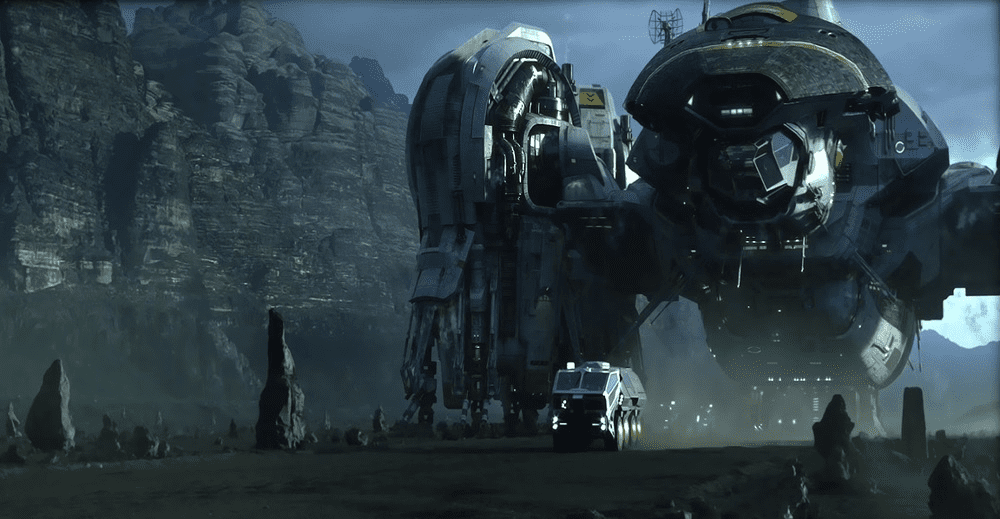
So on that front, think the movie is stunning. And I think that continues throughout. Think the next moment that I found myself really moved by just what I was trying to take in was the reveal of the Prometheus ship itself. Do you I mean, that not hit you like a wrecking ball? It starts on this stunning close-up of this reflection of a piece of just sort of metal, and you don’t really know what it is.
But the way the camera moves around the ship, around that sort of giant sort of carapace that kind of comes down over the main sort of pilot’s area Mm-hmm. And pulls back to reveal those giant the four engines of this ship. It was a really powerful reveal. I mean, I can’t remember. I think that the sort of the next best kind of sci fi ship reveal has to be the Star Destroyer, in the open of episode four.
You know, I mean, that’s it’s that scale of kind of awesome. Yeah. Or space balls, I guess. For maybe different reasons.
Andy Nelson:
Yeah. The yeah. And it’s interesting the way it’s revealed because it’s almost revealed as if it’s a planetary object. Yes. It has that same sun sunrise from space sort of look, like the sun rising over a planet, and you see and then you realize it’s not a sun, I’m actually looking at the engine and the light from the fire from the engine.
Pete Wright:
It was it was really one of the most unique sort of visual choices that I remember in terms of the way to characterize and I think it’s fair to say this, that the Prometheus ship ends up being as much a character in the film as the actors. And in some cases, gives a better performance. So I think was really I think overall, and that’s the general thread that I was left with the overall film, that it was brilliantly architected. Like, this movie was put together in visually, in a terrific way.
Andy Nelson:
Yeah.
Pete Wright:
Alright.
Andy Nelson:
It was. It was gorgeous. Yeah. The yeah. And, you know, kudos to all the technical crew members involved with that.
Dariusz Wolski, the cinematographer.
Pete Wright:
Pietro Scalia,
Andy Nelson:
the editor. Arthur Max, production design. All those people, you know, costumes, Janty Yates, just it was great. Everything about the look was gorgeous. So let’s get that out of the way.
Pete Wright:
We have to because because that makes this movie like because the next thing that happens for me in terms of the degradation of the movie over time is the, you know, the sort of the WTF moments that kind of come and creep back into your psyche after you allow the other stuff to wash over you. But it’s that other stuff that is so critical because that’s what makes it a joy even as you’re calling BS on, you know, whatever you happen to be calling BS on. It makes it a joy to see the movie again. And I mean, to see the movie two, three times in a very short space of time and not actually tire of it. But as you said, to have even more sort of interesting conversations about the film, I think says says a lot about it.
Yeah. And what it’s trying to do.
Andy Nelson:
Yeah. Don’t did you end up seeing it a second time? Yeah. Or did you just see it once? Yeah.
Just once. Yeah.
Pete Wright:
The sec no. The second. Yeah. Yeah. Yeah.
Twice. And, you know, have am fully intended to see it again. You know, just ran out of time.
Andy Nelson:
Yeah, right. Same here. Yeah, I think we both saw it twice three d and once in IMAX three d, right?
Pete Wright:
Yep. Let me say, the comment on the three d was this one, you know, I thought was I would say this was superior to Avatar.
Andy Nelson:
Really?
Pete Wright:
Yeah. And I would say that only because well, I guess they are different. In this movie, felt like this is likely the first movie that I remember seeing where the three d didn’t feel like the spectacle. Yeah. It felt as integrated with the sort of visual sort of story that I was being told, and not like, I’m seeing this movie in three d because it’s supposed to wow me.
Right. It wowed me, I think, because of what was on the screen, and the three d was simply an element of that story.
Andy Nelson:
And I love that sort of three d. I think it’s so powerful when it just makes you feel immersed in the story all the more.
Pete Wright:
That’s it. Avatar, I felt there were some sequences that you could feel they were trying to just wow me with the fact that it was three d. Like, they were just pushing an envelope and they needed to show off.
Andy Nelson:
Well, I think, you know, to their defense, I do think being the first real film that was trying to break that three d Yeah. Round, I think that was inevitable.
Pete Wright:
No. No. No. And it was great. It was a spectator.
It’s achieved its purpose. I that’s but that, I think, shows the sort of maturity of three d and why, you know, when I choose to see a movie in three d, and I don’t, I mean, see every movie in three d, this is one that is it makes it easy to say, you have to see this movie in the theater. You have to see it on the big screen with three d.
Andy Nelson:
Definitely. Definitely.
Pete Wright:
So okay.
Andy Nelson:
So okay. So all the prettiness aside, let’s jump into the story. Or should we try to figure out a way to structure this? Like, should we talk actors and performances first and then get into the story? Or should we just jump right into story?
Like, because if we talk actors first I’m trying to figure out if we if we do as much non spoilery stuff for a while, and then we can jump Well,
Pete Wright:
is there is there are we set is there kind of a rule set here? Are we I don’t know how we can have conversation about this movie where there isn’t where we don’t know.
Andy Nelson:
Maybe we should just
Pete Wright:
Here’s the thing. Starting now. Listen to this. Stop. If you haven’t seen the movie, stop.
Because at this point, we are likely going to spoil a lot. Yeah. Everything. Every yeah. It’s just gonna we’re gonna spoil it.
So starting now, go do your thing and then come back and start hit play again. That’s good.
Andy Nelson:
Yes. There you go.
Pete Wright:
Spoilers spoiler alert. Okay. So I wanna start at least for me, I feel like I have to start at a really high level.
Andy Nelson:
Okay.
Pete Wright:
It seems to me that and I’m I have to characterize this as sort of a grudge match between Spaihts and Lindelof and Ridley Scott. Right? You know? And I’m sure that’s not how it came out. But be because I like what Damon Lindelof does.
I like, you know, I like John Spade’s work. I have and I love Ridley Scott. I mean, I love like, I love these guys, all of them. And I and so it breaks my heart that I feel like this movie didn’t deliver on all cylinders. I feel like there is that there is so much mythos jammed into this movie, and so much, you know, beginning of life on planets story, that absolutely got in the way of what my of my expectation was, that I was going to see a science fiction horror film.
I did not see that film. I saw a thesis on philosophy, the philosophies of life on other planets. Right. I didn’t see a movie that scared me. I didn’t see a movie that thrilled me.
I saw a movie that was, as as likely in you know, with really minimal edits, as likely to be seen on the Discovery Channel as in on IMAX three d as, you know, part of the universe of Aliens. You see what I’m like, I was disappointed at that level. Wow. I felt like they, you know, they hurt me in that way. So now, I don’t at all wanna dismiss either one of those things.
This is this is like we’ve talked about it before. This is cognitive dissonance. This is like holding these two completely different, equally valid, ways to look at this at the story, but they directly conflict for me. High jump, low ceiling. Right?
Yeah. They don’t work together, and as a result, everything else sort of starts to fall apart. You it becomes easier to pull apart the little sort of plot holes. It makes it that suddenly aren’t so little anymore. It makes it easier to pull apart these weird character relationships that mean nothing.
It makes it easier to pull apart that, you know I actually had to be reminded that, Vickers was, Waylon’s daughter. I had to be reminded of that relationship because it meant nothing to me when I heard it. Yeah. And it and, you know, so those those sorts of human relationships in this movie that were so valuable, to the fear, building the fear in Alien and Aliens in particular, were just not present. Like, I didn’t care about any of these people.
I found them really annoying in some cases. Like, I don’t think there’s a way to, you know, to underscore enough how annoying the biologists and the geologists were. Like, they couldn’t have died soon enough for me.
Andy Nelson:
Yeah. And that’s definitely one of the big problems. And I, you know, I keep going through my head, is it the fact that they had too many people, and quite a number of them obviously red shirts, just clearly intended to die, or what? Because this the seven characters that they had in Alien, it was like a great number. You got to know all of them.
You cared about all of them. This was 17, and it never quite there were just way too many to pay attention to. You know, I never cared about the pilot and the navigator and their little, you know, kind of friendly banter
Pete Wright:
about Whatever that four was of about. Their And because you don’t care about them, then when they point that ship and burn that ion drive and turn that ship into a bullet, and at the end, they all do their thing where they say, hands up, and they put their hands out and sacrifice themselves, as, you know, the lambs to the slaughter sort of a thing. This is their their spatial crucifixion.
Andy Nelson:
Mm-hmm. It Which we saw in the trailer.
Pete Wright:
Right.
Andy Nelson:
Right. Which they gave it away in
Pete Wright:
the trailer. We don’t care about it.
Andy Nelson:
Right. Right. It’s it is unfortunate. And I you know, you brought up the, you know, Fifield and Millburn, biologist, the geologist. And it’s that I think is a perfect example of things that were done poorly in this film where they had opportunities to do some really great stuff all through the film.
And then you have these moments that are just with glaring stupidity in the script of this geologist who sees this alien body who’s been dead for two thousand years and is just like, oh, screw this. I’m out of here. Yeah. Leaves, you know, drags the guy he doesn’t like along with him. And then they get lost, even though the geologist is the one who sent out the little mapping devices and knows what they do, knows they’re in communication with the ship, they’re in communication with the ship, the trip ship’s tracking everybody.
How can they get lost? It’s such a glaring plot device. And then, to have Milburn see the little, you know, snake, you know, as some something I read called it a peanut vagina. As you saw this little thing, he’s just like, oh, cute little guy. Come here.
Pete Wright:
It’s like Now I now you wanna touch it? Like, you’re scared
Andy Nelson:
of dead alien. It’s been for two thousand years.
Pete Wright:
Yeah. And then you’re like, tickle, tickle, tickle. Is nothing about the pina vagina snake that makes that makes you think, oh, I wanna touch that like I wanna touch a kitten. There’s nothing about that thing that like, that looks at all welcoming. It doesn’t look welcoming.
No. It doesn’t. It’s horrifying.
Andy Nelson:
This looks like something you should not You should
Pete Wright:
not get close to. Because you know what? It looks like what it does. Right? That’s the problem.
Because when you like, you see a gun, you know that if you pick it up, you hold it a certain way, and you know what’s gonna happen when you pull the trigger, something’s gonna come out of the hole at the other end. Right? Thing looks like a giant suction cup with teeth on it, and that if it gets close to you, it’s gonna latch on and it’s probably not gonna let go. Why would you get close to that? Had they designed something that looked like a kitten and did something else, that might have been have helped me.
Andy Nelson:
There’s this is a really obscure and probably an inappropriate, yes, yet at the same time, appropriate comparison. Do it. Bring movie made in the nineties called, I think it’s called Mom and Dad Save the World or something like that. Sounds like a winner. It was it was yeah.
Yeah. That’s there’s that’s one way to describe it. It had a moment where it’s the same thing. These people find it. They end up in this cave, and they find these, like, cute little mushroom looking creatures that have these cute little cuddly puppy dog eyes, and they’re going and making cute little cooing noises, and the and that is a logical, cute looking creature for people to go up and touch.
And then of course they lift their little mushroom top and they’ve got these giant teeth. Okay, that I would be expecting. Exactly. See, it’s sad that I’m now comparing this movie to How Mom and Dad Saved the World, but, there you go. That’s the
Pete Wright:
that’s the that’s sort of the level. You need to find that clip in It’s
Andy Nelson:
in YouTube and put it in the show notes.
Pete Wright:
But see, that gets to my biggest challenge with this movie, that you see this film that is architected so visually wonderfully, and makes it a joy to see, and you think to yourself, this would be better watched on mute, because the rest of it is so pedestrian. The story, I mean, the holes in this story are are just it’s just too much. It’s a bridge too far, and so that’s my problem with it. And so my question for you is, you know, and I you had forwarded me the link to the sort of Mythos review who wrote that. It fantastic.
Andy Nelson:
It was a Cavalorn. Is the guy’s, you know, avatar on LiveJournal.
Pete Wright:
Prometheus Unbound Yeah. Is the name of it. Cavalorn on LiveJournal, and it is a long review with very detailed comments.
Andy Nelson:
And a lot of thought put into it, and the reasons behind why things may be the way they are. And I really liked it, because this is, you know, this is what I liked about this movie. We talked about the characters, I, you know, I think we can go on about bad character decisions made throughout the film, like, oh, I don’t know, running in a straight line when a ship is rolling toward you, instead of veering off to the That
Pete Wright:
was the thing that really frustrated me a lot, especially because usually when somebody’s crushed by a rolling thing, you know, you have two people in a movie and they’re crushed by a giant rolling thing. And it sounds totally arbitrary, but there are movies like this, you know. I mean, Transformers, you know, the latest Transformers movie. There are characters crushed by a large rolling thing because they can’t turn. That’s the problem.
But the bigger problem with this movie is one character does illustrate a turn.
Andy Nelson:
Right.
Pete Wright:
Is able to run, the other character cannot. Vickers cannot turn, but Shaw can. That Yeah. That’s it’s just dumb. Makes you say It’s just silly.
Andy Nelson:
It’s silly.
Pete Wright:
So go but said, we can we
Andy Nelson:
can go on and on about the characters because there’s a lot of issues all through with a lot of characters, and it’s unfortunate. But the reason that I still find the movie interesting is because it does pose a lot of these interesting questions, albeit unanswered. But it really has created a lot of conversation in my circles about what does all of this mean? Why is the black goo act different when the engineer drinks it at the beginning versus when they encounter it at the end? Why does the engineer want to come and destroy, all of humankind now?
Coincidentally, two thousand years ago, around the time of
Pete Wright:
Mm-hmm.
Andy Nelson:
Of, that we crucified Well Jesus Christ. And
Pete Wright:
that ends up being sort of one of the most interesting points about this, right? Which is the you know, because a lot of what Cavalorn is doing here is speculation based on mythos, know, based on the Prometheus myth, the religious myth, and it all works. I think it all, you know, it is one really good way to look at it. And then he brings up this conversation from an interview with movies.com and that movies.com did with Ridley Scott. And I think we need to read that passage because I think it well, I’m gonna read the passage.
I’m gonna read the whole thing. Yeah. With credit to Cavalor, and you people should go read his whole take on this because it’s really
Andy Nelson:
Yeah, which we’ll put in the show notes as well.
Pete Wright:
Alright. Movies.com says, You throw religion and spirituality into the equation for Prometheus though, and it almost acts as a hand grenade. We had heard it was scripted that the engineers were targeting our planet for destruction because we had crucified one of their representatives, and that Jesus Christ might have been an alien. Was that ever considered? And Ridley Scott says, we definitely did, and then we thought it was a little too on the nose.
But if you look at it as our as an, quote, our children are misbehaving down there, end quote scenario, there are moments where it looks like we’ve gone out of control, running around with armor and skirts, which of course would be the Roman Empire, and they were given a long run, a thousand years before their disintegration actually started to happen. And you can say, Let’s send down one of our emissaries to see if he can stop it. Guess what? They crucified him.
Andy Nelson:
Mm-hmm. It’s interesting, and that throws this whole notion of the space Jesus into it.
Pete Wright:
Yeah. And then we’re firmly entrenched in the space Jesus.
Andy Nelson:
Yes. Not that we want to start, you know, any sort of religious discussions or about, you know, people’s opinions of the reality of space Jesus or not. But we’re just saying that’s what a theory of Ridley Scott’s this movie.
Pete Wright:
Yeah. Which is interesting because, you know, you look at this is you know, I the thing I got from the first five minutes, you know, the first you know, maybe it’s three minutes. I don’t know. It’s very brief. Right?
Mm-hmm. Where we open on this gorgeous landscape, and we see this pasty colored giant humanoid kind of glowing humanoid creature or person Mm-hmm. Standing on the edge of the ship, and he’s running to the top On the edge of a cliff. On the edge of a cliff. Yeah.
And he sees the ship in the distance, and it’s a different ship. It’s not the kinda u u ship. It’s a it’s a sphere. Or not a sphere. It’s not
Andy Nelson:
a sphere. It’s a flat sphere. It’s a
Pete Wright:
flying saucer. It’s a saucer.
Andy Nelson:
Yep. And It’s it’s an it’s like an egg.
Pete Wright:
It’s like an egg.
Andy Nelson:
It’s a life giver.
Pete Wright:
And he, this pasty, thing, drinks this the black goo and In a very ritualistic ritualistic way, and then decomposes. Right? He disintegrates. Right? He doesn’t disappear.
He breaks down.
Andy Nelson:
Down at a at a DNA level. Exactly.
Pete Wright:
And he goes into the stream, he falls off this cliff into this waterfall and he is in the system. And in that way, he very much sort of resembled, for me at least, sort of the more biological context of a seed. Right? He was planted on this planet to seed life. Right?
Mean, was the feeling I got. And that’s one of the reasons I walked you know, I got out of that after the opening sort of title role thinking, wow, this is not the movie I expected to see. And so that’s the big question for me. Did this did this movie bite off more than it could chew in this universe, in this series? Like, you can’t sit there and tell me after we just spent the last month die sort of diagnosing the aliens movies.
Right? Yeah. And celebrating this fantastic creature, these creature films. Right? These movies are about the beast.
It’s about the fear of the beast. And this movie was not. It was not that movie.
Andy Nelson:
No. But, you know, I don’t know if I was expecting a horror film. Was expecting sci fi for sure. But I don’t know if I was expecting horror only because I think they had been saying so often that it was not a prequel to Alien. And so I wasn’t I didn’t feel like it had to be a horror film.
As long as it was a good sci fi film, whether it was a drama or an action or a horror, I think I was gonna be okay with that. And so the beginning, I felt Ridley Scott was really on the right the right track of doing something along the lines of, like, a 2,001 space odyssey type of story where we were going to be really looking at a lot of things while also dealing with life in this particular universe that did have these aliens. Now that being said, by the nature of it having to still somehow tie into this universe. Right?
Pete Wright:
Yeah. Okay.
Andy Nelson:
Is it Is that something that complicated the mix a little bit and made, you know, messed up the recipe?
Pete Wright:
Not a little bit. A lot. That’s the fundamental problem for me because once you let’s just say I grant you I grant you that. Okay. This is this movie is gonna be about the beginning of life and on planets.
Right? It’s gonna be a big philosophical movie. It’s gonna make people talk about religion. It’s gonna make people do I mean, it’s gonna be a thinker movie. Right?
Andy Nelson:
Yeah.
Pete Wright:
Okay. That’s great. And the last hour ends up being the most ham handed, schlock, shoehorned alien story into a movie that should have been something else.
Andy Nelson:
Well, see, I don’t I you’re okay. You’re you’re saying the alien story only because you’re specifically talking about our aliens as if they’re ours.
Pete Wright:
Oh, they’re ours.
Andy Nelson:
They’re ours by gum. The
Pete Wright:
You’re telling you’re telling me that at the end of the movie, when the when the alien comes out, that’s not supposed to be our alien?
Andy Nelson:
No. I know. And that was, for me, that is that is the one that felt the most ham ham handed, ham fisted. It that to me was just like, oh, why did we have to go there? Why did we need to feel like you had to tie that together?
I felt like that was just added on, and it was just inappropriate, and that just kind of messed things up. Because that, you know, I think threw out way too many more questions that should not have even been asked. That bothered me more than any of the other alien stuff in the movie, which I actually found pretty interesting. And I liked that it up until the ending, it didn’t feel like it had to tie together with the alien xenomorph creatures themselves.
Pete Wright:
And, you know, you may be getting to something that I you may be sort of getting to the crux of why I have such a problem with it, that I may have been okay walking out of that movie had they not shown me the alien that was so derivative of Yeah. The alien, and just let it let it go. Don’t show me the evolution. Because you know what? Resurrection showed me evolution.
Resurrection showed me what happens when we have this sort of, when we have the commingling DNA of the alien creature and a human. We see that. We get it.
Andy Nelson:
Mm-hmm.
Pete Wright:
Like, I didn’t need you to ram that down my throat. Let’s make this what it is. And it felt like they could that’s what gets back to what I was saying in the very beginning. That’s why this felt like a grudge match between Ridley Scott and Lindelof and Spaihts. Like, that’s how I have to visualize what ends up in my head being so much more of a disaster, that it was people who could not agree on an overall theme for this film.
Andy Nelson:
Yeah. And I agree. I because that ending is tacked on, which you almost just can’t you can’t really avoid it because they chose to put it there, it does kind of screw up a lot of what it had going for it. Because I think all the other alien stuff leading up to that is really interesting and interesting in a way where you don’t feel like it’s like they’re trying to shoehorn it into the Alien anthology. Despite the fact that in the wall, then the giant head chamber, you do have that back wall with the mural of the somewhat alien looking creature there.
Pete Wright:
So, I there’s yeah. The queen
Andy Nelson:
and the alien creature. Right. That, you know, that definitely ties in a in a way. But I think if they had left that in there, even though there’s way too much stuff unexplained about all of that, but if they had left that in there, hacked that little ending off, I think it would have made a much more interesting story because you’re getting the sense that there’s more to this creation that’s going on with these engineers that we don’t really understand and that she really is going to be learning a lot more by going off to their planet at the end of the film. And, a lot more of interesting things to learn.
As it stands right now, because all of a sudden, it is shoehorned into the alien life cycle somehow, it does take a little bit of that away, which is unfortunate. Yeah. Yeah. But I do think that there is a lot of interesting things going for it. And reading this article by Cavalorn, it, you know, it does show a lot of interesting things that they were thinking about and how how things work and the nature of the engineers and what they were doing and the nature of the black goo and a lot of things that I think are really interesting.
Now do you think that did you look at the so called Spaihts version of the script before Lindelof came on?
Pete Wright:
Which one did I no. I the one I sent you was Lindelof.
Andy Nelson:
No. The one you sent oh, yeah. The one you sent me was the one that No. They co wrote.
Pete Wright:
They co wrote. The one Lindelof came in and
Andy Nelson:
worked on.
Pete Wright:
Sent me two versions of it, right, that I have not had a chance to look at.
Andy Nelson:
Yeah. And I haven’t either.
Pete Wright:
Okay.
Andy Nelson:
And honestly, according to the Internet, it’s unclear if either of them are actual scripts or just, you know, fakes, but there’s one called Alien Harvest by Jon Spaihts
Pete Wright:
Right.
Andy Nelson:
Based on characters by Dan O’Bannon and Ronald Shusett that is kind of an I mean, I didn’t really look at it too much, but the gist of it seems to be instead of them calling engineers, they’re growers and they’re growing planets, and there’s some humans who are helping them. And it’s, you know, it’s kind of an odd story between these humans and then I think at the end one of them finds out that the other one is an android. But then the script that we had both read, I mean, there were some interesting changes to the script. And I don’t know if they’re really for the better or for the worse, but in the in the script that you had sent us or sent me, Vickers was an android, which we found out at the end. Right.
Which I thought was an interesting little thing.
Pete Wright:
Well, what I thought was so interesting about that is that they ended up building such a case in the in the final version of the film, the current. I’m gonna say current version of the theatrical release of the film, knowing full well there has got to, please God, be a director’s cut Okay. Sooner rather than later Yeah. Where where there really is a case to be made that Vickers could be, but they don’t you know, an android. But there is also a quite literally equal equally good case to be made that she is not.
Yeah. The fact that she’s such a cardboard performance is one of those reasons.
Andy Nelson:
Yeah. I don’t I didn’t have a huge problem with it, but I did feel like it was it was very similar to Snow White and the Huntsman. I was just like, wow. It’s like the same performance in both films.
Pete Wright:
Yeah. Well, you know, she’s on a roll.
Andy Nelson:
She is. I know ever since a young adult, she’s like, you know, the she’s Charlize grumpy face throne is the new
Pete Wright:
direction Because she’s she’s really quite hot.
Andy Nelson:
Yeah. And funny, and she’s a great actress. But yeah. So, anyway, that
Pete Wright:
I like how you just tried to redeem me. Tried to trying to
Andy Nelson:
help you
Pete Wright:
out with her. Nice. She is also and I hear she is she is quite bright. I have never met her. But that, I’m sure, is why I find her attractive.
Andy Nelson:
That’s I bet that’s why. Mm-hmm. But also interesting in the script is Holloway and Shaw were not together, but she was a virgin, and he actually rapes her in the script. And
Pete Wright:
it Yeah.
Andy Nelson:
And I don’t think she got pregnant, though. Did she? I don’t recall her getting pregnant. But it again, that tied into kind of this biblical, like, virgin situation, which I thought was more interestingly explored in the theatrical version.
Pete Wright:
Yeah. You know, again, though, with the ham handed, I mean well, you’re right. Okay. As long as we’re going down this road, let’s make it on Christmas. It’s kind of an arbitrary Christmas, and we’re gonna we’re gonna really hammer home the fact that she’s she’s not able to have children.
And Right. You know, just one one thing after another. I think, you know, it’s good. All these things sort of came came right together and well, go ahead. I feel I’m I could keep going.
I’m gonna stop.
Andy Nelson:
No. I mean, you’re right. It’s it is just it all plays a little, obviously. It’s I don’t know. It’s I still find it fascinating, though, and I guess I just I’ll just hold on to that for now.
Well Something something we haven’t talked about that I think is definitely warrants a conversation is Michael Fassbender as David, which I think is by far the most fascinating thing in this film. Yes.
Pete Wright:
I agree with that. He is the he is certainly the most fascinating character in this film. And he was it was kind of unreal. I know, the way he played the way he played this android character, the to be both the savior in many respects as he leads her on her final journey off the planet, right? You know, it’s his intellect and his direction that saves her, but he’s also what ultimately destroyed everything that she was working for.
And to do so, to play both sides of that line, I think he did really elegantly.
Andy Nelson:
Yeah. It’s a really interesting performance that’s generated quite a lot of conversation.
Pete Wright:
That yeah. That’s so what’s your take on the general buzz of about his performance?
Andy Nelson:
I well, I mean, I think his performance I mean, I think that his performance and then I think the character’s actions are two different things.
Pete Wright:
Yeah.
Andy Nelson:
Yeah. His performance, I think, was just unbelievably genius, and I really felt like he very well may have just been an Android version of Michael Fassbender that was made for this film because it was so haunting perfect and creepy and just fascinating. You know? It was a very interesting performance. And Yeah.
I find myself drawn to thinking about the about him and his actions and his role in the film probably more than most of the other elements in the film just because it’s just such an interesting character, and I really enjoyed watching him.
Pete Wright:
Yeah, I think so too. I think it’s one of those interesting things, like, when you sort of characterize how he fits. And how I mean, how would you do that? How would you characterize how he fits in his role, in with the legacy that has been sort of under the under the care of Ian Holm and Lance Henriksen and, oh dear god, Winona Ryder.
Andy Nelson:
Well, he’s certainly better than Winona Ryder.
Pete Wright:
But he’s yeah. He’s not even really better. But, you know, I mean, because each I think Ian Holm is probably the most the most direct corollary to the service that android character has in the film. Right? And I think that’s ultimately probably why, Ridley Scott has such an affinity for these androids that, you know, serve two masters.
Yeah. Right? Ian Holm’ performance of it was, just it went from being a kind of a scalpel to a blunt instrument very, very quickly. And I don’t think Michael Fassbender, his performance ever actually got to blunt instrument. It was just, precise.
Andy Nelson:
Yeah. It was. And it’s interesting the way that the android in this film, which happens, you know, thirty some years before Alien, was treated. This alien for the entire two years of the travel is awake, alert, watching people’s dreams like a stalker.
Pete Wright:
Yeah. That was creepy.
Andy Nelson:
Yeah. That was creepy. Playing basketball, watching Lawrence of Arabia and dying his hair, and learning all sorts of ancient languages. Yeah. Two years, he was just doing all of this.
Right?
Pete Wright:
Well, I thought that was really interesting because, you know, I mean, this is one of those things that you do. Right? And you know how it works. So think of the functions that you offload to your computer, right? So you’re working on a film in Final Cut or Premiere or whatever, and you’re done with your cut and you have to render it out.
So you push a button and then you leave. The computer does work for you. It’s processing. And that’s it feels like in so many ways the way they treated, you know, David in this film. We have a series of tasks that we need you to process for us while we are asleep.
While we go away, we need you to render. And that, in this case, is learn all these languages so that you can translate for us when we get there because it’s gonna be it’s way too big of a job for a human to do. Yeah. You’re the tool.
Andy Nelson:
Yeah. It’s very interesting in that aspect that is how they perceive him, yet at the same time, it’s very clear that it’s still a very awkward relationship that, I guess that this David model is so new to the market that people still have a hard time being in his presence and really understanding his role in things. Yeah. Particularly, what’s his name, Holloway?
Pete Wright:
Holloway to their detriment Yeah. Ultimately. Just for not understanding because clearly he had no you know, his agenda was that which he was given.
Andy Nelson:
Yeah. I think so.
Pete Wright:
And evolved because his agenda evolved as his as circumstances changed, but ultimately he was at the service of Weyland, and he did what he needed to do.
Andy Nelson:
And one of the interesting things that oh, going back though, to my point, but I forgot that I was making. The interesting thing about the androids between this film and Alien is in this film, they keep him like a like a computer just running the whole time that they’re sleeping so that he can kind of get all this stuff done. Yet in Alien, the company has now essentially decided to hide the fact that there is one of these androids on board and just build it into the crew as if it’s a regular crew member. And Ash is asleep for those two years or however long that the Nostromo crew is traveling. He’s not wandering the ship playing basketball.
It’s a pretty interesting change between those two films.
Pete Wright:
Yeah. That is interesting, actually. As if they learned something.
Andy Nelson:
As if they learned people are a little off put by these Androids. Yeah. Maybe we need to blend them in. But then again, by the time Bishop is rolling around, everybody kind of knows that he’s an Android.
Pete Wright:
Yeah. Yeah.
Andy Nelson:
So it’s it’s I hesitate to say that the android and whether they’re exposed or secret is only there to service the story. It does feel that way a little bit, but I’m But when
Pete Wright:
you put it that way yeah. When you put it that way, it almost it doesn’t. I mean, I think there’s there’s room to look at that as a cultural shift, and I sort of like the way you put that. I hadn’t made that connection.
Andy Nelson:
Yeah. It’s an interesting thing to think about Yeah. The nature of androids. But one of the things about David that I think most people seem to be talking about is why does he, you know, put why does he spike Holloway’s punch? Yeah.
You know, is that a direct order? I mean, how would Weyland have known that David had retrieved this black goo?
Pete Wright:
Well, I don’t necessarily know that’s a problem. Right? This is one of those things that computers take actions that we don’t understand all the time. Mm-hmm. Right?
In the service of the if I say, you know, I want the computer to draw a square on my screen, then I give it up that the computer’s gonna have to figure out how to draw four straight lines.
Andy Nelson:
Mm-hmm.
Pete Wright:
And if I tell David that I need him to go research these, the black goo and, you know, give me a full report on what it is, I take it on faith that he is going to take the necessary steps to give me that complete diagnosis.
Andy Nelson:
Right, to actually test it out and see what it does.
Pete Wright:
Yeah. Right. Maybe I’m rationalizing a bit too far on that one.
Andy Nelson:
Maybe Well, that’s that’s actually kind of that’s what I had kind of theorized as well, is that whatever he was doing, even though it wasn’t a direct order from Weyland, it was in some way there to a decision that David made in the efforts to achieve what Weyland was eventually looking for. Right?
Pete Wright:
Right.
Andy Nelson:
I do find it interesting though that it seemed it seemed to me anyway that David was almost like not going to put the black goo into Holloway’s drink unless Holloway specifically said that he would do anything to find out the truth. You know? You notice how he had it on the tip of his finger?
Pete Wright:
Yeah. Like, there’s a test clause. Like, yeah.
Andy Nelson:
Right. Right. He’s like, I’m not gonna do this to you unless you say yes. Yeah. And then Holloway says yes, and so he’s like, okay, then I’ll do it to you, and he Which drops it in the
Pete Wright:
makes it, you know, that again is, you know, another point in favor of this character and the way this character was written. I mean, this was a character we’ve talked about this before. When reach these characters that you find, you can tell the writers fell in love with.
Andy Nelson:
Mm-hmm.
Pete Wright:
And I get that about David. Like, I feel like Spaihts and Lindelof and Ridley Scott were in love with this character. And they gave him some of the most interesting and complex actions and objectives in this film, and I think they really did. You know, compared to Guy Pearce that they just covered in latex and made him sort of arbitrary, and compared to Logan Marshall Green, who they made just, you know, Holloway, who they just made him really you know, I mean, here’s a guy who’s the core of the expedition, with Shaw, obviously, and you’d think as a as an archaeologist, he might be able to get over the fact, as someone accustomed to looking at dead things and rock walls, that maybe his search for space for 20,000 year old creatures might end up looking at more rocks and walls and things. Instead, he becomes this just this idiot, this drunken idiot, because these things weren’t alive.
Andy Nelson:
Especially on their first trip into the first thing they found on the planet Exactly. In the first six hours. It’s like, that’s all the time you’re gonna give to explore is just like this less than six hour trip, and then all of sudden, you’re pissed, and screw it. They there’s nothing here. It’s all
Pete Wright:
a
Andy Nelson:
waste And of
Pete Wright:
and then he became a vessel. He became a tool for the story to get her pregnant, and then we were done, and to light him on fire.
Andy Nelson:
Yeah. You have to well, speaking about him real quick though, is it not strange that he looks just like Tom Hardy? Like, I was convinced when I saw the trailers that Tom Hardy was in this, and then I was like, who’s this Logan Marshall Green guy? Yeah. And I saw that it was him.
I’m like, I have no idea. They should’ve just cast Tom Hardy.
Pete Wright:
Tom Hardy. Right.
Andy Nelson:
But okay. So all of that being aside Yeah. What was your thought on the cesarean section scene? I was, frankly, like, on the edge of my seat. That for me was the, like, big horrifying moment in that film.
I mean, I really enjoyed that scene. It was terrifying. I certainly felt bad for any woman who happened to be pregnant while watching that scene, because I can only imagine the how awful it must have been, how much more awful it must have been for her. It’s a tough scene to watch, and I think that it was I think it’s one of the film scenes in the film that will just be talked about for a very long time.
Pete Wright:
Yeah. I liked it too. You know, I’ll tell you, I and I’ve read a lot of commentary on that scene that was really critical of Noomi Rapace’ performance, and more the sort of architecture of the scene. They kept saying, Well, you know, she hasn’t had any pain killer. I don’t know what they’re talking about.
How many times did she inject herself in the course of that five minutes? Like, she was totally shot up. Like, I mean, it was the technology was really cool. Like the robo bed, I mean, was one of those things that just the way the thing moved, it didn’t feel sort of arbitrary at all. It felt like I can see technology like this happening, you know, and I really like the idea of being able to program it.
And then, you know, I think what sticks with you, apart from all of the sort of pomp and circumstance of the scene and the tack, what sticks with you is the fact that it is the sensation that this woman is giving and anybody who gets into this capsule, right? This woman is getting in here and giving over her most sensitive, you know, core of her being, right, her body, and allowing this robot to cut inside of her. That part, more than the sort of gore of actually having the forceps kind of reach in and pull out the alien squid, that watching that happen, knowing that she’s just giving it over to this laser that’s cutting her in two, is the part that really sticks with me. Think that is it gets to the nature of sacrifice in the favor of life, and sort of the Jurassic Park philosophy that underscores Prometheus that life finds a way. Yeah.
That scene, I think, really celebrates that in a really horrifying, personally horrifying way. I think you’re absolutely right. I think that’s even more of a testament to the importance of this movie is that scene in particular is not scary by the fact that you’re running from a monster down a dark hall.
Andy Nelson:
Right.
Pete Wright:
Right. It’s scary because it’s out there. It’s not today, it’s not tomorrow, but it’s out there, and that’s us with an alien squid.
Andy Nelson:
It’s a good thing it wasn’t the gold finger laser. Yeah. I thought it was
Pete Wright:
just Other sliced her in lasers, not welcome in this table. The Death Star laser, also not welcome on this table.
Andy Nelson:
That’s right. Right. Although a storm trooper gun laser, that’s
Pete Wright:
not Maybe okay. See, there’s another list.
Andy Nelson:
It’s not gonna do much for an alien. Need another miss.
Pete Wright:
That’s odd.
Andy Nelson:
It’s gonna miss.
Pete Wright:
Oh, I’m not So you still say it’s a we gotta talk about the numbers a little bit because it’s not obviously, it’s not finished yet. The movie costs what I’m reading somewhere in the realm of 120 to $150,000,000 to make.
Andy Nelson:
And thus far, it has made and this is in one week, it’s made about 65,000,000, I’m looking at, on day six. 65,333,000.
Pete Wright:
The here’s the problem. Here is the problem with this. Madagascar three, Europe’s Most Wanted
Andy Nelson:
Mm-hmm.
Pete Wright:
Has outperformed Prometheus.
Andy Nelson:
Yep. Well, Prometheus is an r rated film and r it is it’s the number 12, I think, on the list for r rated openings. So it did well for an r rated film. It’s hard getting people to go see an r rated. I mean, there’s you know, limits your audience.
Pete Wright:
Yeah. It’s really that’s a very fair point. You’re right. You’re right.
Andy Nelson:
Yeah. And, three d, I don’t think, you know, helped that race between Madagascar and Prometheus because both of them came out in three d. So they were both competing with 3 d dollars.
Pete Wright:
Yep. Yep. Yep. Alright. Well, so I don’t know.
Does that but does that, tell you anything? Does that bode well or ill, one way or the other? Is it too early to tell?
Andy Nelson:
It’s, you know, it’s a little too early to tell. I think, internationally, Prometheus has already had a little bit more of a run because it opened a few weeks ago internationally. And so I think, I actually can’t find the international numbers for some reason. I wonder where it is, but I have a feeling that it’s going to end up making its money back and it’s going to do it’s going it’ll do fine. It’ll do well enough for them to cross our fingers, get a sequel made that will, you know, actually answer some
Pete Wright:
of our questions. Thing. I mean, did you read, Ridley Scott said I think it was in that same interview, said that there are that he sees three movies together I between don’t know how he could, draw that out after that last scene, with that alien. I mean, it seems like you could get there pretty quickly at the pace that he set in the last half of Prometheus.
Andy Nelson:
Yeah. I it’s unfortunate. I don’t think that again, I just think that alien just messed things up too much for me. Totally. But I really I think this next film is gonna be more about just the second or the actual alien planet, the engineer planet.
And, you know, I was somebody was philosophizing online that the reason, aside from Guy Pearce’s TED talk, which to me, even though it’s not even in this film
Pete Wright:
Was better than everything he did in the film.
Andy Nelson:
No. But it seemed to be the only reason Yeah. That they actually put the age makeup on him in the film. Right? Yes.
Because otherwise, there’s no reason that Guy Pearce was in the role. I mean, they could have cast many older
Pete Wright:
And that’s it. That my understanding was at some point, Guy Pearce ends up playing himself in a prequel to Prometheus.
Andy Nelson:
Well, and my understanding was that somehow he may be coming back in the sequels, but in flashbacks is
Pete Wright:
what Yeah. Okay.
Andy Nelson:
I don’t even know if these things are written, so it’s all speculative at this point.
Pete Wright:
Who knows? Yeah, I you know, I’m certainly not you know, I’m gonna see it again. You know, I feel like there’s a lot to talk about, and frankly, it’s a you know, the visual story that this movie tells, I still I think it’s a work of art. I think it’s beautiful to look at and that makes up for an awful lot in terms of this movie. Is it gonna be one that I just pop in and watch on a lazy weekend?
Doubtful. Yeah. You know, I’ll I’ll pick it up when it comes out, but it’s not gonna be one of the, you know, one of the repeats.
Andy Nelson:
Right. Right.
Pete Wright:
So
Andy Nelson:
Do random random bit of trivia. Yeah. Milburn, the coochie coochie coo. Yeah..
Yeah. He you know who he is? Who is he? He’s Rafe Spall. He’s the son of Timothy Spall, a great British actor, who was in Hot Fuzz and Shaun of the Dead.
Little tie in to some of our last chats. He was one of the Andes in Hot Fuzz. That’s fantastic. Yeah. So that makes me like him a little bit more even though I still
Pete Wright:
think that’s a ridiculous character. Not a great character. I think you, you know, I think you made a good point. I think there were too many I think the cast was too big Yeah. For this look.
Know, and that alright. I just gotta get it out. I just gotta get this out because, really, we’re gonna put all these people on this on the flagship exploratory spacecraft and send them across the universe for two years.
Andy Nelson:
Mm-hmm.
Pete Wright:
But we’re not gonna let them meet before they climb into the pods. They’re not gonna be allowed to shake hands, say, hey, see you in two years. Right. None of that. The first time they meet is after they’ve been sleeping next to one another.
Like, really? We’re gonna like, that wasn’t something that somebody caught?
Andy Nelson:
They don’t even yeah. It’s like what? They’re not even gonna meet while they walk in to lay down in the pods?
Pete Wright:
Like, the boss, Vickers, who makes a huge case about how how important it was for her to have hired certain people by just even saying that line to all of you that I hired personally. Welcome to all the others of you. What? She didn’t even know everybody on this ship? She didn’t know.
She’s the boss. Right. How did I just like, found myself just getting mad. I the I think that’s part of the reason people get so frustrated with this movie is because it insults it is an insulting story element. It’s because we feel like these guys who who we trust to tell us a great story, to give us to give their our money to them to in exchange for a good story because they are have a proven track record of delivering solid stories.
And they when they don’t, it’s an insult because we know they’re better than that. I think that’s actually a compliment. Has this, you know, has this soiled you on the experience for you for seeing, you know, anybody else’s or any movies that these guys come out with in the future? Lindelof?
Andy Nelson:
It hasn’t. I mean, I still feel like, you know, I have a hard time unless somebody really just makes bad things time after time after time, I usually don’t attribute it to that particular person. And I’m sure I’ll see stuff that any of these guys do. Again, the nature of making a movie, it’s so hard to get a movie made Yeah. That it’s I find it hard to blame any one person if something just doesn’t turn out quite right.
Pete Wright:
Which which is I think is exactly the point I was trying to make. I think that’s really true. I think all of these guys are really talented and that’s what is so frustrating about this movie, that it’s we know that they’re better than some of the choices that were made in this film. And yet, it was a beautiful experience. It’s still
Andy Nelson:
a Yeah. It’s it’s still better than most films that I’ll probably see this summer.
Pete Wright:
Yeah. Yeah. Well, that says a lot.
Andy Nelson:
Well, yeah, it does. It does. Okay. So last little note. Yeah.
Did you on that, Cavalorn article, did you, read down to the bottom and follow any of those links that he had on the bottom?
Pete Wright:
To the videos?
Andy Nelson:
Just above the videos, there’s a link. It said Cleo Linda Jones has done an m 15 m Prometheus post.
Pete Wright:
And you know, haven’t I read I have it in my I saved it to I did read them all in Instapaper, and so I’m looking at it right now, but I haven’t read it.
Andy Nelson:
It is you will love it. This is I think
Pete Wright:
I love this. After five minutes of Icelandic landscape porn Mm-hmm.
Andy Nelson:
Just let me read this bit here, which I just think is mean, all of it’s great, and I’m just randomly picking a random thing out of this to just mention, but it just makes me laugh. This is they’re in the what does she call it? The Temple Of The Giant Stone Head, which is filled with hundreds of sealed urns watched by a giant enigmatic, strangely human stone head, hence the name. So that’s the scene. And this is after they’re they’ve contaminated the area and Shaw says, hey, guys.
The mural is moving. The mural has noticed we’re here. Maybe we should go. Maybe we should go. And then Yannick on the radio.
Hey, guys. There’s a suit frying electromagnetic plot storm coming. I second to leave it. Yeah. She basically rewrites a whole movie in about fifteen minutes and in a very funny way.
And so I definitely recommend you everybody everybody go read this because it’s really, really funny.
Pete Wright:
That is great. Yep. Yep. Yep. Alright.
Andy Nelson:
So check it out. Enjoy. And I guess that’s it for this week.
Pete Wright:
That’s it. This is a this is a long time coming.
Andy Nelson:
It was. It wasn’t. It’s it I am a little sad that I wasn’t as enthralled by it as I wanted to be, but, you know.
Pete Wright:
That was fun. I’m glad we did that. What are we doing next week? Are we gonna talk about it?
Andy Nelson:
Yes. What are we doing next week?
Pete Wright:
You can’t really?
Andy Nelson:
Are are we
Pete Wright:
doing the keeper of the schedule. This is your role. You keep me in line and tell me what to do. You cannot hand that back. Well,
Andy Nelson:
I asked you these questions and you never responded. So then I’m just gonna say it then.
Pete Wright:
That is a presumed yes.
Andy Nelson:
Oh, okay. I know that now. So next week and the week after, we’re gonna be doing two Jason Reitman films. Which ones? We’re gonna do Thank You For Smoking, and we’re going to do Up In the Air.
We’re going to do the ones that he didn’t do with oh, what’s her name? What’s her name? I don’t like at all.
Pete Wright:
Because what was the what was the other movie that what was it? She did Juno and Yeah. Ellen Ellen Page?
Andy Nelson:
Not Ellen Page. I like Ellen Page. It’s the writer.
Pete Wright:
The writer.
Andy Nelson:
Yeah. Yeah. Diablo Cody. I just I don’t like Diablo.
Pete Wright:
Okay.
Andy Nelson:
So we’re gonna skip the two Diablo Cody, Jason Reitman projects, and instead we’re gonna do Thank You for Smoking and Up in the Air. Those will be our next
Pete Wright:
two projects. Very much looking forward to that. I think so next week, well, we’ve got we’ve got logistics. I’ll talk to you about logistics after.
Andy Nelson:
Okay.
Pete Wright:
Okay. Good talk. Hey. Thanks, Andy. This was fun.
Andy Nelson:
Indeed. Indeed.