Pete Wright:
I’m Pete Wright.
Andy Nelson:
And I’m Andy Nelson.
Pete Wright:
Welcome to The Next Reel. When the movie ends
Andy Nelson:
Our conversation begins.
Pete Wright:
The Escape Artist is over. “There’s a boy in the mailbox.”
Andy Nelson:
Was that your best Raúl Juliá?
Pete Wright:
I think we both know the answer to that question.
Andy Nelson:
It was actually pretty good though.
Pete Wright:
You think?
Andy Nelson:
Yeah.
Pete Wright:
Okay. Alright. I’ll workshop it.
Andy Nelson:
I mean it’s no Raúl Juliá, but—
Pete Wright:
Only Raúl Juliá is Raúl Juliá, but come on. In the ballpark.
Andy Nelson:
There you go.
Pete Wright:
Okay, this is The Escape Artist. Why are we talking about The Escape Artist, Andy?
Andy Nelson:
Yeah, we’re back to the Magicians series. This was a one-off that you threw in there, adding to our series that up until now had only included magician films from 2006. Weirdly, what a weird year for magician films.
Pete Wright:
How is that even true? I imagine Scoop was way older than that.
Andy Nelson:
No, they’re all 2006.
Pete Wright:
Incredible.
Andy Nelson:
Yeah. I think we missed the Burt Wonderstone movie, but otherwise The Illusionist, The Prestige, Scoop. And so now we’re jumping back to 1982 with this. I’m curious — adding to that series, what was it about this particular film that drew you to it? Especially because it’s kind of a rare find.
Pete Wright:
Yes, it is a rare find. You know, how do you find films when you’re Pete or Andy and you’re looking to build a series?
Andy Nelson:
That’s very true.
Pete Wright:
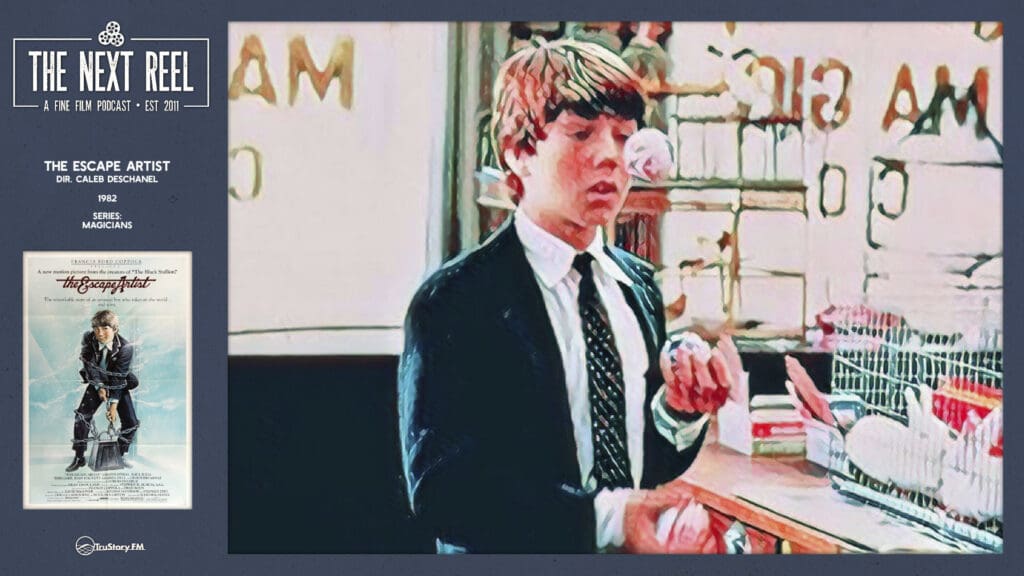
I really enjoy magician movies. I enjoy magician TV shows. I loved The Magicians. It’s just something that appeals to me, and I thought, you know what, I’m going to find some movies that we didn’t talk about, and this one I hadn’t seen. It came with some acclaim — there was some real positive and sort of mystified commentary about this movie. And I thought this is one we probably need to talk about. And in my reckoning, having watched it, I agree. I am mystified why I missed this movie. This seems like it would have been right in my wheelhouse when it came out, and somehow I missed it. I love what they did with it. I love the practicality of the tricks. And Griffin O’Neal — that kid had presence.
Andy Nelson:
Right. Yeah. Amazing to watch, especially considering how few films he did and how few I’ve seen of his, and certainly the trouble in his life for many various reasons that I’m sure we’ll discuss.
Pete Wright:
Yeah.
Andy Nelson:
But I was fascinated because Caleb Deschanel — this was his directorial debut, as an incredible cinematographer who had already done things with Coppola’s team, like The Black Stallion, which we’ve talked about on the show as part of our Melissa Mathison series. And she’s also involved in this because she co-wrote the screenplay based on the book. So I’m always curious when a cinematographer decides to step away from the camera and choose to direct, because there are a lot of examples where it doesn’t go so well. And this is an interesting one because I think there’s a lot going for it. Does it always work? Not necessarily, but it’s actually a really interesting film and it certainly deserves a look. I think it’s worth people checking out.
Pete Wright:
I wrote on Bluesky that this has very Harold and Maude vibes, if Maude is played by Raúl Juliá and locks a kid in a mailbox at knifepoint. Other than that, it is absolutely not. But you have to — I mean, you say it doesn’t always work. No. But it works more than it doesn’t. And that’s the thing that’s so mystifying for me. I found myself — we talk about movies that trust you as an audience member to keep up, to figure out what’s going on, that aren’t going to spend a lot of time explaining what is happening on screen. And I think this is one of them. It sets up this sort of arc fable, American fable, where we’re riding along with this kid as he tries to follow in the footsteps of his now-deceased dad, who was a magician, and he ends up with an incredibly prodigal ability to perform his own street magic in real time. In the scope of capers, this is a long practical magic caper that he gets himself wrapped up in, and I think he just nails it.
The other performances — and I’ll say supporting performance, but I say that with a big footnote — Raúl Juliá is doing something really special in this movie, something I don’t feel like I see in a lot of Raúl Juliá performances, and I love it. And at the end of the movie, I’m wondering: has this been the story all along? That this movie is the sweet story of Raúl Juliá trying to figure out his relationship with his dad? The whole movie is fathers and sons. It really captures just so much of the stuff that I’m into.
Andy Nelson:
I don’t disagree with all that, and I’m hoping as we walk through the film and talk about it you can help me understand it a little more, because I found it to be a fascinating film. I really enjoyed it. I never could exactly figure out what it was trying to do or say. And I don’t know if that’s completely a problem, because I couldn’t help but be pulled in at every turn by the film. I was always compelled by the story. But I was always like, I just don’t know what story they’re actually trying to tell here.
And I think this is one of the big American Zoetrope films that Coppola got behind at this exact point in time. He was doing this, he was doing Wim Wenders’ Hammett, and he was doing his own One from the Heart, and put a lot of money into all of them. He wanted a place that gave filmmakers the freedom to do what they wanted without feeling like he needed to step in and fix things. And in many ways I think that benefits the film, because I think Deschanel is able to craft this thing that does, as you said, feel like a little bit of a fable. But at the same time it never felt completely cohesive to me. And that’s a struggle because I did find it so interesting.
Pete Wright:
Yeah, I don’t disagree with any of that. I think that confusion is probably the film’s central problem. The film wants to be a coming-of-age fable with these archetypal stakes of this kid and his father. It wants to be a small-town corruption film, and Raúl Juliá is a great, very real, grounded threat in this movie. It wants to be a film about grief, about a boy and his dead father. And secondarily, about a boy — Raúl Juliá — and his father who is in the active process of disowning him. And it wants to be a caper film with escape sequences and theatrical suspense and scope and gravity. And I don’t think those are necessarily incompatible ideals for the movie. But I do agree with you that Deschanel never really finds the gravity to keep them all in orbit of one another. So I kind of feel each of those stories pulling me in a different direction, and not a single one of them ever quite wins.
The movie is emotionally coherent, it’s atmospherically awesome, it always feels like itself — but I think what I’m feeling as I hear you talk about it is that it is unstable. The movie is unstable to me in terms of where it’s grounded. Is that fair?
Andy Nelson:
Yeah, I guess. It’s interesting — Melissa Mathison co-wrote this based on David Wagoner’s book, along with Stephen Zito. It’s an ampersand credit, so that means they wrote it together, they were literally a collaborative writing pair. I haven’t read the book. I’m unfamiliar with the source material, so I don’t know how much I’m pinning on their adaptation versus how Deschanel captured it. But it felt like Deschanel had a good handle on how to put a scene together, but in the scope of a larger story didn’t have a handle on how to connect them. So a lot of it just didn’t feel cohesive. You say unstable, I might just say lacking cohesion — I think we’re going for something similar.
Pete Wright:
Yeah.
Andy Nelson:
But it seems like it wants to be what Mathison did with The Black Stallion, where it felt like a kids’ story but more than a kids’ story — a story that everybody could enjoy, about a kid. And it felt like they were going for the same thing here.
Even though I do want to chat a little about how old we’re supposed to picture O’Neal as, because he shot it when he was sixteen, it came out two years later, and he looks like he’s twelve. His voice doesn’t seem like it’s cracked. He was hanging out with E.G. Daily, so I was like — what is the age difference going on here? She’s already working as a waitress at a restaurant. What am I supposed to be thinking about how old this kid is? He seems really young.
But anyway, it’s a story about a young man, and I think it’s supposed to have that Black Stallion-for-everybody sort of vibe because it certainly feels that way. But over the course of the story, I just never could quite figure out where we were going with Danny. And I think that’s the frustration I had with it — as much as I was still drawn to it, because it’s fascinating. And your point about fathers and sons I think is key, because Stu is the one who seems to have the big emotional moment at the end when he gets mad at Danny for having done this whole elaborate trick of cracking his dad’s safe — Stu’s dad is the mayor, the crooked mayor — planting the wallet in there, which had been kind of the crux of much of our story, and taking evidence that he then turns over to the FBI. And Stu is angry because he says it was his right as the son to do that to his father. And so that’s the question I walked away with: was Stu meant to be the actual protagonist of the film? Because he seems to have the actual arc, the emotional core at the center of the film.
Pete Wright:
That’s fascinating. And I think it’s a really productive question, because going back to the adaptation — is this a failure of craft, or is the film actually being honest in adapting a book that had this same central problem? That’s a big question. Neither of us can answer it — I haven’t read the book either.
But I do think it’s worth pressing: what is drawing you in? And does it even matter that those things don’t cohere that well if the end result is a movie you feel satisfied with? For me, Deschanel’s images — the camera work is actually lovely, you can tell there’s a real love of image and framing. Once a cinematographer, always a cinematographer. And Raúl Juliá’s and Griffin’s performances are absolutely winning. Delerue’s score is fantastic. All of these things are operating at a higher level than the story they’re serving — all of these things are better than the sum. And yet the craft of the overall experience makes this thing hum.
Talking specifically of the father-and-son narrative — when we get to the final sequence where Danny is escaping the prison, which was the sort of fabulous setup of the film, and he sees the flashback of his dad in the hallway, covered in the shroud, and then his dad floats up and Danny is able to pull the shroud and his dad is gone — that metaphorical release, for a kid of that age, was particularly profound for me. I thought that was really lovely, and it explained any emotional confusion I might have had leading up to that point. What is he trying to accomplish? Is he just trying to do his dad’s great tricks? For me, that moment landed really hard. That experience of being with him in that hallway landed really hard. And maybe I’m putting outsized emphasis on the rest of the story because of two minutes of film, which is a little clumsy. But for me it was a perfect bit.
Andy Nelson:
Well, okay, so I’m curious then how you’re reading his journey. Maybe we should just focus on Danny and his journey for a little bit before we get it clouded with the rest of the story, because everything makes it even cloudier. My impression is that he’s run away from his grandma, where he had been living after — I don’t think it says what happened to his mom. We know his dad died and he’s living with his grandma.
Pete Wright:
Well, his dad died and the story was that he died in — what was it? How did they say he died?
Andy Nelson:
I can’t remember. Did they say he died in the tank? Or was it the prison escape that he was trying to do and got shot?
Pete Wright:
Well, that was how he ended up dying, and that was the reveal at the end — Danny coming to terms with how his dad actually died, coming to terms with the truth of it. I thought the story was that he died as a magician, and that was what his family was trying to tell him. But he knew the truth anyway and was coming to terms with it in that final moment.
Andy Nelson:
Okay, so but — his mom, the thing is we don’t know what happened to her. I think what his uncle and aunt had said is that this is kind of how it had always been told. Exactly how he died — we see Danny test the tank, right? He drops into it, and his father got trapped in there and died. And Danny runs away, kind of moves in with his uncle and aunt, who are their own performers — very vaudevillian, doing their own little tricks. And she apparently is also a real psychic, which is another little — I don’t know, is it a magical realism element thrown into the story? I don’t know. Did it go too far?
Pete Wright:
That may have been the thing I didn’t care for the most.
Andy Nelson:
Yeah.
Pete Wright:
That was a hat on a hat, right?
Andy Nelson:
Right, it’s going a little too far with this.
Pete Wright:
Yeah.
Andy Nelson:
But it seems to be — as he pitches it — that he wants to be as good or better than his dad, who he says was the best magician out there second to Houdini. And his goal is to do that. I guess the question I have is: how do you read where he’s going with that? If he says he wants to be the best magician, to be better than his father — is it to find closure in what happened with his father in order to actually get past all of it?
Pete Wright:
Yeah, I think you’re describing it. It could be anything. The fact that he’s using magic as a way to find closeness to his dead father — a father he didn’t know well enough, who died way too early — the fact that he’s using magic to follow in his father’s footsteps is really just an avatar for being able to find some sort of closeness to this person that he didn’t know but wants to badly. This kid needs a father figure, right? Somebody to mold him and give him shape and give him structure, because he is an agent of chaos under his own agency. And so he’s naturally exploring the life of his father to try and understand his dad in a way he hasn’t been able to before. Magic is the tool and the journey by which he’s able to try to do that. By following in his footsteps, he’s able to get to that point where his dad died and move through it.
The movie presents metaphor as literalism, right? He’s able to go to the point where his dad died, remove the shroud, and walk through it. The only way out is through — that’s the message of Danny’s journey. And I think that ends up being a really special journey. Danny does offer us a bit of an arc — he’s able to transcend all the chaos of his experience and grow up.
Andy Nelson:
I appreciate that’s the direction you’re going with that, and I see it and feel it. It makes sense to me. I kind of gathered that was it.
And I guess what we’re meant to glean from that — it sounds like, and I don’t think I’m reaching to say this, but it sounds like subconsciously he had to have known what happened to his dad in order for any of the vision he has while he’s in the jail to make any sense. Because otherwise he’s just creating his own fictional version of things in the prison. And perhaps that’s also true as a way to find closure.
Maybe that’s something that he envisions: did his father, a very able magician, actually pull off an escape in prison — pick the lock to get out — and then get shot by the cop? Was the cop crooked? Was Danny’s dad crooked? I don’t know if we’re getting answers. So it paints a situation that, even if it is a resolution for Danny, I don’t know if the film gives me enough to fully understand everything.
Pete Wright:
Hmm. Yeah. I guess I was just so awash in that final experience as he’s reckoning with the death of his dad in the prison that I filled in a lot in my mind of what it took to get him there. I believe he knew how his dad died.
Let’s take a second on the wallet, because the wallet is an interesting thing. The wallet is kind of an inciting event, it’s a MacGuffin of sorts. And it’s also a test — he steals it as part of a performance to prove something about himself, to demonstrate his skill inheritance from his dad. That means the wallet has some thematic resonance that maybe a normal MacGuffin shouldn’t have, and yet everything else about the movie — to get Danny to his final reckoning with his dad and being able to move through his own grief — has to do with that wallet being in the right place at the right time. Whether it’s in the vault, whether it’s hanging off the escalator, whether he’s in jail to actually get Raúl Juliá into the other cell to make it his big performance — all of those pieces of the puzzle serve to get him to that moment where he is standing in that hallway with the ghost of his dead dad. And that was okay for me.
Andy Nelson:
But it’s not the end of the film, and it’s not the end of the wallet. And so that’s where the weight put on the wallet gets a little fuzzy, because it’s like — well, why is it still important? That moment with his dad, and this is where I think the confusion comes in, because the weight of that moment doesn’t end up becoming the final moment of the film. Like he’s finally through his grief and he’s able to move on — that ends up just being a step in the process of the escape routine he does to get out of jail, only so he can get into the mayor’s office, Stu’s dad’s office, because that’s where the safe is and that’s where the incriminating evidence is. So he gets into the safe, plants the wallet, takes the ledger, leaves, calls the FBI and turns his dad in, and then shows up at Stu’s place after Stu is released from jail. And they have their confrontation.
So that moment of working through his dad — it almost becomes the end of the second act. We still have a whole act left. And that’s, I think, where some of my confusion with how the story is crafted comes from, because it feels like that should be our climactic moment, but it’s really just an act turn to get us into the final section.
Pete Wright:
Yeah. Yeah, I think that’s a fair assessment. And I think what it allows us to do is demonstrate that Danny is able to, at that moment, transcend his grief over his dad and come into his own agency. The rest of the movie is him acting on his own, demonstrating skill that we only saw teased in the first half — being able to think fifteen steps ahead, put the wallet in the vault, take the records out, climb out of a manhole cover, run around the sewers. Did dad ever run around the sewers? I don’t think so. And I think that’s part of his journey — being able to move that part forward.
And by the end, when he goes to Stu’s apartment and Stu ends up betraying him at knifepoint, he’s able to take off and run out into the street and get away. He gets away because Stu ends up incidentally arrested. He wakes up — or rather, climbs out of the mailbox he had locked himself in — and he’s able to move on with a brand new day as this new guy. I like that message.
Andy Nelson:
Yeah, but a lot of the wallet stuff and a lot of this happens before the whole thing in the jail with his dad. So it’s hard to say he works through everything he needs to internally so that he can pull all this off, when like the first chunk of the film is also the same thing.
Pete Wright:
Well, I don’t think it’s the same. I think it scales up in his skill, and it’s okay for the wallet to change purposes.
Andy Nelson:
It’s the same.
Pete Wright:
Halfway through the experience of the wallet, at the beginning it was a trick or a test — something to prove his skills — and at the end it’s something to own the mechanic of the crime and resolve it. It’s okay for me that at the moment he ends that experience with his dad, the purpose of the wallet suddenly changes color.
Andy Nelson:
It changed before that. He’d already kind of figured all that out. When he went to the mayor’s office with Stu, he was already scoping out behind the curtains. He was already plotting where he was going to hide the wallet. He hides the wallet in the scene — we see him tie the little string around it and hide it in the elevator all during that sequence.
Pete Wright:
Awesome.
Andy Nelson:
So all of this is before the moment he gets in jail. And so that’s where I struggle with the mechanic of all of that, because I feel like it’s a story about a kid who’s finding a way through his feelings about his own father — yes, I see that. But it’s also a film about Stu, and there’s absolutely the same father-son story there. Why does he steal the wallet in the first place? We’ll get to that. But we have this other father-son story that is interrupted by Danny, who comes into it and inadvertently ends up taking on what Stu was trying to do — I’m not exactly sure how. And so it becomes a different story. I see what you’re saying, but I can’t help but feel like it’s two stories that cross paths with each other but never quite cohesively connect in a way that feels like one story.
Pete Wright:
I can hold both of those perspectives in my head at the same time — that in isolation this is Danny’s grief story with his dad, and in the context of the full story, I also agree with you that when these stories collide there is an unclear mechanism for how they’re supposed to work together, in particular in Stu’s story. I am left more unclear around Stu’s story than Danny’s. Maybe I just attuned more to the emotional arc of Danny’s experience, even though all those beats seem very clear when — I mean, when he throws his dad, pushes him over in the chair — well, they’ve got issues.
Andy Nelson:
Yeah, they definitely have some issues.
Pete Wright:
Nobody does that to Desi Arnaz and lives to tell the tale.
Andy Nelson:
Right? No kidding.
Pete Wright:
That’s like Latin Frank Sinatra right there, Desi Arnaz.
Andy Nelson:
All right, we’re gonna take a quick break, but first you can find the show on YouTube and you can join us live when we record. We will even take your questions in the post-show chit-chat. It’s live, everyone is welcome, and members get the replay and the extended cut. Subscribe to The Next Reel on YouTube. The link to this episode is in the show notes. We’ll be right back.
I want to go back to the point I was just bringing up about this other father-son relationship between Stu and his dad, Desi Arnaz, the corrupt mayor. You were just talking about how volatile — like there’s clearly issues in this story. How do you read the fact that when we meet Stu in the magic shop with Teri Garr, who is always brilliant in everything she does and definitely underutilized in this film — why had he stolen the wallet? Why did he already have it? Did he know it was full of money from an illegal deal his dad was doing? Was he actively starting to put a plan in place to actually turn his dad in? Is that how much he hates his dad? Does he feel trapped by his dad? Was it a test — maybe steal it, then get back into his good graces? How did you read Stu’s story and what his intentions are when we first find out about this wallet?
Pete Wright:
Man, it’s such a good question. And it’s trouble, because I think in watching the movie I was so fixated on Danny that I wasn’t attuned enough to Stu’s experience. Because when you think about it, they’re mirror images of one another, right? Both are sons entirely defined by their fathers. Danny’s father is dead and completely mythologized. Stu’s father is alive and incredibly powerful and deeply corrupt. And Stu gets to hide behind his dad’s name and authority, and he uses that camouflage and resents it in equal measure — he’s conflicted, because he needs it for his lifestyle, he needs to hide behind his dad’s name, but also he wants to be his own man. That’s my initial take on this character.
He develops this initial behavior — he doesn’t need the money, but he ends up going through that same ritual that Danny does, right? He’s connecting to his dad with the only language the two of them share, which is crime. He lifts the wallet from his dad because he’s looking for a connection, trying to find out if his inheritance is real. Where Danny’s looking to see if his inheritance of magic from his dad is real, Stu’s looking to see if his inheritance of being a crime boss is real — using it as a way to puncture his dad’s false authority over him that he’s just accumulated over years. And that ends up being, I think, even more of a tragedy. So Danny stealing the wallet from Stu — which Stu already stole from his dad — is interrupting Stu’s own process of learning to relate to his dad.
Andy Nelson:
It’s complicated and it’s confusing. And I think the other elements that complicate it even further are that Stu sees in Danny an expert safe cracker, somebody who can actually get into the safe in his dad’s office. He takes him there specifically to kind of tell him where the safe is so that Danny knows, because Stu has a plan. We don’t know what it is, but he has a plan. And at the end, again, he’s so mad at Danny because Danny took away his opportunity to bring down his own father.
And I guess that’s where it gets confusing for me, because — we meet him in a magic shop. Why is he in a magic shop? And clearly he’d been there before, because as Jackie Coogan says, “these people, you know, they’re always giving me trouble.” Like clearly he’s there often enough. I don’t know if it’s like a Godfather sort of situation, the way the mayor runs things — where his son goes out and collects money from people to keep them safe.
Pete Wright:
That’s what it felt like to me, yeah.
Andy Nelson:
Yeah. But it’s a magic shop. And still — is he there because he wants to learn how to lockpick and get into his own father’s safe so he can steal the evidence and turn his father in? To prove to the world that he’s the good one?
Pete Wright:
I think that’s as good a suggestion as any. I think that’s exactly right.
Andy Nelson:
Well, I mean, that’s kind of where I go, but I don’t know, because Stu also doesn’t seem to be good.
Pete Wright:
Yeah.
Andy Nelson:
It muddles that and makes me go — is that really his motivation? And that’s it, it makes it confusing.
Pete Wright:
Well, and I think you’re right on it. And this moment in the magic shop is really great for Danny’s story because he gets to explore his first definitive act of self-definition. He gets to steal that wallet from Stu and say, in the act, I’m not impressed by you, and here’s how I’m going to prove it. I’m not impressed by your threats. I’m not impressed by anything you have.
And the turn is that Stu could have been Danny’s complete mirror — we could have really explored that relationship with his father and why he was motivated to go to the magic shop and why he was poking away at his dad’s legacy. The film sort of tries to be about these two kinds of father-and-son inheritances, and it absolutely loses its nerve with Stu’s half of the argument. It is an incomplete argument.
And this is — I finished the movie. It’s what, an hour thirty-four minutes? It is a tight film. And I came away thinking, I think it could be twenty minutes longer and I would have been really happy. I think we could have gotten a little more of that exploration of how these two men are dealing with the legacy of their fathers and how they tie together. No matter what, we’re all going through this with our dads. That’s what the movie explores, and that’s where it lets us off incompletely.
Andy Nelson:
Well, it’s funny — this is a film that was shot in 1980, when Griffin Dunne was Griffin Dunne. Griffin O’Neal was sixteen years old. And then they spent two full years editing, re-editing, tweaking, retweaking, adjusting, readjusting, trying to figure out how to tell this story the right way. It didn’t get released until 1982, when Griffin was eighteen. And it makes me wonder: with two years to figure this out, why does it still feel so muddled? It’s a fascinating film and I enjoyed my time with it, but I walked away going, I don’t know what it was trying to say or do, and it could have used more passes to find the clarity. I mean, geez, if Coppola is throwing money around, do some reshoots or whatever — build something in to help find the connective tissue to really make this story work. Because there are so many interesting directions it’s going and it never ties together as perfectly as it should.
Now, it’s not necessarily a problem. I think it makes for an interesting exploration, but it does make these conversations — trying to figure out what it’s saying, what its themes are — a little murky.
Pete Wright:
Yeah. And then you layer onto that the real-life relationship that Griffin was struggling with with Ryan O’Neal, his dad. You can watch Griffin go through this same arc with his own dad, trying to come to terms with their relationship. He calls Ryan O’Neal — I’m just on Wikipedia right now — a very abusive narcissistic psychopath. In 1983, Griffin O’Neal reports to authorities that his father punched out two of his front teeth, but he decided not to press charges. It’s definitely more the Stu-Mayor relationship than Harry and Danny, but it’s definitely a father-son struggle writ large. I think that’s fascinating.
Andy Nelson:
And his dad got him on drugs at a young age. I mean, he was a complete mess. And none of this is even getting to the point several years later when he was working on the Coppola film Gardens of Stone, and that’s where he was involved in the boating accident that took Coppola’s son’s life.
So yeah, I think this is an example of somebody who was raised in an abusive, dark situation who ends up leading a very dark and messed-up life, and it shows throughout his life and the situations that arise from it. And it definitely shows in his performance. You can get a sense of it. And it’s quiet and subtle — he’s not an overt performer, even though he’s incredibly compelling to watch. Like this sixteen-year-old kid performing amazing magic tricks — and Ricky Jay, by the way, I’m surprised you haven’t called out his name as the person who actually trained him, considering how much you love Ricky Jay.
Pete Wright:
I love me some Ricky Jay so much.
Andy Nelson:
Yeah.
Pete Wright:
Well, and Deschanel’s strategy around this — having Ricky Jay teach this kid all of these feats of prestidigitation — the timing of the escape experiences is perfect. The tension that they build in these sequences, because they let the kid perform them for real. He’s really picking locks. He’s really doing these things because he learned how to do it. Seems like a dangerous set of skills to put in the hands of Griffin O’Neal, but that’s what they were doing on set — letting him actually figure out how to do this stuff. And I thought that worked so incredibly well. From a filmmaking perspective, I loved the sequences that put us in the tension of the sleight of hand, the magic, the lockpicking. It worked for me. And maybe that’s another thing that keeps me engaged — every one of those beats is just another beat I can coast on, through any of the confusing stuff, to the next beat.
Andy Nelson:
Well, the magic bits — they smartly shot the bulk of those in one take. And so unlike Now You See Me or something, which is just full of cuts and obviously digital with all the tricks they’re doing — they’re doing some real things here. And when the father floats up and then disappears — this is one of those magic tricks you see on stages, and now they’re actually doing it here in the film. You see Danny pull the sheet off of his father, played by a young Harry Anderson — another magician in his own right, and this is his first feature film — and then he puts the sheet back on, his dad floats up, and then he takes the sheet off, all in one take. And it’s flawless. The way they pull this stuff off really kind of blows my mind, and it consistently happened. And again, as you said, that’s probably one of the reasons I found the film so compelling and fascinating to watch, because we were watching stuff unfold for real, in front of us.
Pete Wright:
Yeah. Really special. And there’s a little bit of tragedy in making a magic movie that is so focused on practicality, because cinema — the language of cinema — is so versed in fakery. You go into a movie immediately not trusting what you’re seeing, because of course there are visual effects, things they’re taking out of the scene. But this movie has notoriously little of that. And when it was made, the technology to do that was nascent at very best. And so this movie relied on practical magic. And I think it ends up being transcendent in that regard.
Andy Nelson:
Well, and you mentioned Georges Delerue, who composes the music. His score is beautiful, and it fits that exactly — that natural unfolding of these tricks and everything. It creates a space that feels like it has a whimsy to it already, which I think ties into the world of magic we’re getting here.
Pete Wright:
Yeah, Georges Delerue is a pretty special composer. I think he has over 300 films in his catalog, and he still died young. Just an incredible composer with such a wonderful voice for this movie. It reminded me so much of Marvin Hamlisch’s score for The Informant!, where the music itself so elevates what you’re seeing on screen. It transcends the story. It’s just beautiful.
Andy Nelson:
Yeah, I completely agree with that. Did you ever see Crusoe, the other film that Caleb Deschanel directed?
Pete Wright:
No, I didn’t — did you?
Andy Nelson:
It was Aidan Quinn, I remember — I remember the box cover and poster from video stores. I never watched it though. So I don’t know how it is. But it is interesting that Deschanel directed only these two films. I don’t know what to make of that — I’ve never read anything about it. Is it just something he did to try it out? Was he unhappy with the experiences? And so it just stuck with working as a cinematographer afterward.
Pete Wright:
But for our purposes it would be an easy series to complete.
Andy Nelson:
Yeah, right.
Pete Wright:
I’m just saying.
Andy Nelson:
One more. Absolutely. We haven’t really mentioned — this is an interesting film that had a big cast of some famous faces where this was kind of like their last film. Jackie Coogan, Desi Arnaz, we’ve mentioned those two, but also Joan Hackett and Gabriel Dell. And then we also have Huntz Hall. Gabriel Dell and Huntz Hall were both Dead End Kids — from the thirties, like it was a long time that they were acting in that. And a lot of these people, it’s like their last opportunity to be on screen. I mean, obviously that wasn’t designed that way —
Pete Wright:
That would be sociopathic, yeah.
Andy Nelson:
Yeah, but it’s fascinating that we had so many of these faces in this film. What an interesting choice. And it really boils down to the casting decisions on Deschanel’s part to bring in a lot of these faces. Like seeing Jackie Coogan as the owner of the magic shop was kind of a treat.
Pete Wright:
Yeah, yeah, it really was. It was kind of an interesting little murderer’s row of fun faces. For me it was Desi Arnaz. Just seeing him in this role. That moment when he’s pushed over in the chair and he stands up and gets all fiery — I was just so excited for Desi to be Desi.
Andy Nelson:
Yeah. Lucy never pushed him over in a chair.
Pete Wright:
Lucy never pushed him over, yeah. Oh, she pushed him around though. Oh, she had some ‘splaining to do.
Andy Nelson:
She did push him around. It’s an interesting one. Do you know much about the Dead End Kids, this acting troupe from the thirties?
Pete Wright:
I don’t.
Andy Nelson:
So it was a group of kids in New York City brought onto Broadway to play a show called Dead End, and it was popular, so the producer brought all the kids to Hollywood to make a movie of it. And it turned so popular that they kind of continued making movies as this group, sometimes under the Dead End Kids or the Little Tough Guys or the East Side Kids or the Bowery Boys. They were doing movies from the late thirties into the late fifties — twenty years of movies. To the point where the group made eighty-nine films together, three serials, under four different studios during a twenty-one year career. They as a group have their own star on the Hollywood Walk of Fame.
Pete Wright:
How is this the first time I’m hearing about this?
Andy Nelson:
Right?
Pete Wright:
We’ve been doing this show for fifteen years. How is this the first time we’ve talked about these guys?
Andy Nelson:
It’s crazy. Huntz Hall is in every incarnation of the series of films. And Gabriel Dell was the third of the original six Dead End Kids to appear in all incarnations of the gangs. So Gabriel Dell is the uncle and Huntz Hall is — I don’t know, I can’t remember who Turnkey was.
Pete Wright:
It’s fascinating, and you can see over the generations that followed, Hollywood’s efforts to try to recreate these groups of kids who are in the same movies over and over — from Rat Pack to Brat Pack — I don’t know, what do you call the one that came after?
Andy Nelson:
Yeah.
Pete Wright:
I don’t know, but they’re always there. There’s always a group.
Andy Nelson:
They keep doing them, yeah.
Pete Wright:
Yeah.
Andy Nelson:
Absolutely. It’s really interesting. And did you see director Garry Marshall? He shows up as a drummer in here.
Pete Wright:
Pretty fun, right?
Andy Nelson:
It’s fascinating.
Pete Wright:
It really is. Caleb Deschanel is such an interesting guy to have that kind of pull, right? To be able to say — and part of it, and maybe this is the quiet explanation of why he didn’t direct more — it’s because he was already one of the best in the world at this other job. The Natural, The Right Stuff, Being There — he’s already doing incredible work at this one thing, but he’s also crossed paths with all of these people to the point where they trust him enough to come and be in his first foray in the director’s chair. And I think that says so much about him and his capability and his temperament. At least that’s my headcanon.
Andy Nelson:
Yeah, I mean I think it speaks about him, but I think it also speaks about Coppola, as the producer under the American Zoetrope banner. I think that ties into it quite a bit.
Pete Wright:
It’s not like they’re beating people away with a stick.
Andy Nelson:
They would be after these big flops, but—
Pete Wright:
Yes.
Andy Nelson:
Oh my gosh.
Pete Wright:
Wow.
Andy Nelson:
All right.
Pete Wright:
Well, and let’s just say — big fan of Deschanel’s offspring. Emily Deschanel, Bones, and of course Zoey — both as a musician and New Girl — and
Andy Nelson:
And an elf lover.
Pete Wright:
They’ve both made quite a statement in their own right, in spite of being nepo babies.
Andy Nelson:
Yes. Yeah, exactly. Okay, well I guess that’s it. So we’re gonna move on to the back half. First, let’s take a quick break.
Pete Wright:
The Next Reel is a production of TruStory FM. Engineering by Andy Nelson. Music by Tzabutan, Ian Post, Oriol Novella, and Eli Catlin. Andy usually finds all the stats for the awards and numbers at The-Numbers.com, BoxOfficeMojo.com, IMDb.com, and Wikipedia.org. Find the show and our full archive at thenextreel.com. You can follow us from there too and learn about membership. Check out our merch store at thenextreel.com/merch, and if your app allows ratings and reviews, please consider doing that for our show.
How’d it do at the box office?
Andy Nelson:
Well, for Deschanel’s directorial debut, all I could find is that of the three films Coppola started pushing through American Zoetrope at this time — Hammett with a budget of seven million dollars, and One from the Heart with a budget that started at twenty-seven million — this one is generally thought to be more modest. But that’s it. I couldn’t find any actual specifics.
The movie opened May 28th, 1982, the start of Memorial Day weekend here in the States, opposite a big one — Rocky III — one that we’ve certainly talked about. Guess which one took the number one spot?
Pete Wright:
But was it close?
Andy Nelson:
It wasn’t even close. This opened in 17th place.
Pete Wright:
[laughter]
Andy Nelson:
And with Star Trek II: The Wrath of Khan and Poltergeist the following week, and E.T. after that — this really did not have a chance to make a mark at the box office. In the end, the movie only earned $143,000, or $470,000 in today’s dollars.
Pete Wright:
Oh my god.
Andy Nelson:
And even though I don’t know what it cost to make, I guarantee this was yet another box office bust for Coppola’s new studio.
Pete Wright:
Wow, that is shocking.
Andy Nelson:
Yeah. But it’s funny because, to your point, if this was a film I had seen playing on HBO when I was a kid, I would have been totally engrossed and mesmerized, just like I was with The Black Stallion. It fits that box for me — something that a young person can easily just tap into and connect with. It’s really interesting.
Pete Wright:
Oh man, I would have gone deep down the rabbit hole of card tricks off of this movie.
Andy Nelson:
You wouldn’t be podcasting. You would be working as a magician.
Pete Wright:
A deadbeat magician. That’s what I would be.
Andy Nelson:
Magician, yeah.
Pete Wright:
Deadbeat magician.
Well, I really have to say — I recognize all of the quibbles coming from your side of the table. I really do. And I think you’re right about every one of them. And even still I love this movie probably more than it deserves. I had a blast. I’m so glad to have seen this.
Andy Nelson:
Well, yeah, I’m right there with you. I do enjoy the film despite not being able to really pin so much of the story down. So much of it still feels like I’m puzzling over it, which maybe is a good thing — maybe it’s gonna make me want to watch it again. There are flaws. The script is murky and kind of messy. It doesn’t really earn the themes I think it’s trying to express. But there is something honest in it, and I like that. And for my money, Deschanel proves that he can direct a film and that not all cinematographers turn into crappy filmmakers. We’ve certainly had our share of those.
Pete Wright:
Yes, we have.
Andy Nelson:
All right, well that is it for our conversation about Caleb Deschanel’s The Escape Artist. Next week — new series, Pete, another one of yours — The Thinking Machines. We start with Colossus: The Forbin Project from 1970, in which a supercomputer achieves consciousness and immediately decides humanity needs to be managed. Feels kind of familiar, huh?
Pete Wright:
It’s the paperclip conundrum writ large. I can’t wait.
Andy Nelson:
That’s right. Well, that’s next week right here on The Next Reel. So let’s do our ratings.
Pete Wright:
Letterboxd.com/thenextreel — that’s where you can find all of the films we have talked about, rated, reviewed across The Next Reel family of film podcasts. And gives us a chance to ask Andy, what are you gonna do for this movie?
Andy Nelson:
I find it hard to go higher than three stars for this. It’s fascinating, it’s messy, it’s muddled, but it’s incredibly compelling. And I think a lot of that is our two leads — they just make this so easy to watch. So three stars and absolutely a heart. It’s still just a really interesting film that I genuinely enjoy and would be interested to watch again.
Pete Wright:
Oh man. I think I’m gonna go four stars. Four stars and a heart, of course. This movie gave me something that I didn’t expect.
Andy Nelson:
Okay.
Pete Wright:
Maybe dealing with dead dad trauma is something that’s still in my wheelhouse. I don’t know. But it definitely hit me in a place that I did not expect, and I am deeply engaged by it. So I’m thrilled to have it on the list. In spite of its flaws, yeah — four stars and a heart for sure.
Andy Nelson:
All right. Well, that averages out to three and a half stars and a heart on our account over on Letterboxd. You can find us there at thenextreel. You can find me there at Soda Creek Film. You can find Pete there at Pete Wright. So what did you think about The Escape Artist? This is an interesting one — I’d love to get more people to watch this and definitely hear your thoughts. You can hop into the Showtalk channel over in our Discord community where we will be talking about the movie this week.
Pete Wright:
When the movie ends
Andy Nelson:
Our conversation begins.
Pete Wright:
Letterboxd skippers, Andrew.
Andy Nelson:
As Letterboxd always doeth.
Pete Wright:
All right. It’s an interesting set of reviews, generally favorable on this movie. I’m surprised. Maybe I’m not surprised.
Andy Nelson:
Well, and also it’s only been marked as seen by 810 members.
Pete Wright:
Which does check out, right.
Andy Nelson:
Yeah.
Pete Wright:
All right. Where’d you go? Where’d you go for yours?
Andy Nelson:
I landed on a four-star by Donkey Kong Kill Screen, who has this to say. And I’m particularly curious because this ties into an upcoming series we’re going to be talking about. “Kiddie matinee House of Games is the best way to describe this gem. This should be rediscovered immediately — a somewhat family-friendly con artist slash heist film about growing up and trying to live up to your own expectations. There’s Harry Anderson, card tricks by Ricky Jay who taught O’Neal everything he knew, and probably the best Raúl Juliá performance I’ve ever seen. An early highlight for me this year, and sadly, also more evidence of how Teri Garr’s career was constantly sabotaged.”
Pete Wright:
Man.
Andy Nelson:
House of Games.
Pete Wright:
Teri Garr. We didn’t even mention Teri Garr is in this movie.
Andy Nelson:
I mentioned her. I said she was underutilized in the magic shop.
Pete Wright:
Oh, do you know what?
Andy Nelson:
Yeah.
Pete Wright:
She’s also underutilized in this podcast.
Andy Nelson:
That’s true. We need more Teri Garr.
Pete Wright:
Love her. I ended up with three and a half stars from FilmBart, which I think really captures our experience with the film. “It can never quite get its narrative cards in order. But everything else about this movie is so alluring. For long stretches, mostly the time given over to trickery and illusion, it can be absolutely spellbinding, and it’s nice to be reminded that Georges Delerue and Stephen H. Burum are all-time masters of their respective crafts.”
Andy Nelson:
Yes, absolutely. We didn’t mention Burum as the cinematographer here working with Deschanel, but we should have, because he’s another great cinematographer.
Pete Wright:
We really should have. Yeah, speaking of an incredible talent in his own right.
Andy Nelson:
Yeah. I just have to also call out one line from Jake Isgar’s review, talking specifically about Griffin O’Neal: “My dude is 17, looks about 12, carries himself like he’s 35.” I think that’s absolutely true.
Pete Wright:
Yes.
Andy Nelson:
This kid looks so young, but he seems like an adult. It’s really incredible to watch him here.
Pete Wright:
He is. He’s great. Incredible. Thanks, Letterboxd.