*This transcript is produced using transcription software and reviewed for quality. Despite our best efforts, some passages may be incomplete or contain errors due to audio quality or software limitations.*
Pete Wright:
I’m Pete Wright.
Andy Nelson:
And I’m Andy Nelson.
Pete Wright:
Welcome to The Next Reel. When the movie ends…
Andy Nelson:
…our conversation begins.
Pete Wright:
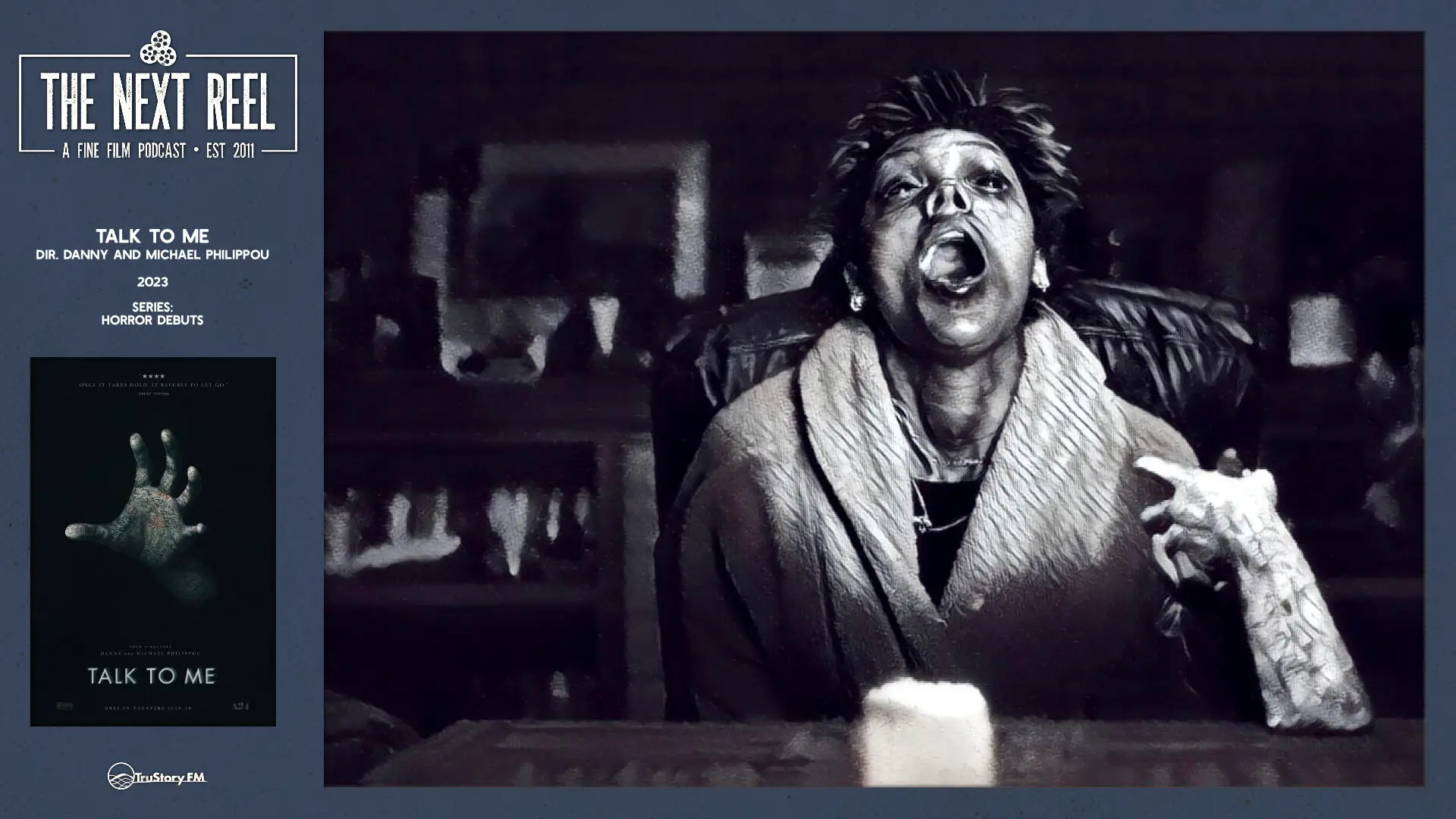
Talk to Me is over. “You have the tiniest hands.” Oh, man. Sometimes you pick a line and you think it’s gonna play, and it doesn’t play as well.
Andy Nelson:
Who says that, and who has the tiniest hands? I don’t even remember that line.
Pete Wright:
No, it was the conversation between, when they were in the pull-out bed, when the kid comes in and gets in bed with her. “Did the hand thing scare you?” That conversation.
Andy Nelson:
Ah, gotcha, gotcha.
Pete Wright:
Something like that. We’re talking about Talk to Me, the Philippou brothers. And, I mean, one of the, I was looking for my review on Letterboxd, and I’ll just say one of the reviews really frames it the way I think we should frame it, which is, “This was so scary. I’m glad Australian people aren’t real.”
Andy Nelson:
Is that your review?
Pete Wright:
That’s, uh, no, that’s not my review, but I do think it’s a good framing piece for this conversation. What is going on in Australia? Because then I watched Bring Her Back, and that’s just even worse. Deeply unsettling ideas in this movie. What did you think? What did you think of Talk to Me? This was definitely not the first time you’ve seen it.
Andy Nelson:
No, no, no, no. I’ve seen it a number of times. I really enjoy it. I am excited by what the Philippou brothers have been doing. Honestly, I am not somebody who had been familiar with them in their RackaRacka YouTube world, so I’m a little out of touch as far as how they actually got started and created their careers. But once they started with their films, starting with Talk to Me, I’ve just been very excited, because they feel like some new, unique voices in the world of horror, as far as the two films that they’ve made now. And I mean, this is a film I really enjoy. I love the journey the characters go on, the fact that it is a story about grief and addiction, and, you know, peer pressure. Like, you’re seeing a lot of things that people will go through in high school. You’re seeing things that people go through when they’re dealing with the death of a loved one. And I think they handle that blend of the horror with kind of the human side of the story incredibly well.
Pete Wright:
Yeah. Hey, this is part of our, we’re throwing this in as a part of our horror series, right?
Andy Nelson:
Horror debuts.
Pete Wright:
Horror debuts.
Andy Nelson:
You’re the one who picked it.
Pete Wright:
I did. Congratulations, me. I’m doing great.
Andy Nelson:
And I had a question for you for that, because I’m just curious. This is the end of our season, adding on one final episode, one new episode to the Horror Debuts series, which we did a few years ago. Every prior entry, when we first did that, had been directed by a woman, or a directing pair, one of which was a woman. This is the first all-male directing duo in this series. And I guess I’m curious from you, from your perspective, if you have any sense, you know, it’s a story about, primarily, our protagonist is a female. Does it feel like this is a film where we feel like, oh, it should have been a woman directing this? Does it feel like we’re suffering with the whole male gaze thing by telling this story through the eyes of two men, as opposed to female directors?
Pete Wright:
I don’t think so. I don’t think this is that kind of movie. I think they made, I don’t think there’s that much of a male gaze going on in this movie. Do you? Did I miss a big angle?
Andy Nelson:
I don’t think so either. I was just curious, specifically, just because of what the series had been up until this point.
Pete Wright:
Yeah.
Andy Nelson:
And so I was wondering, but I also think that largely, the way that these two male filmmakers tell the story is that they find a way to center it on the grief, the self-destruction, without ever feeling like they’re turning it into something male gazy, as far as, you know, I mean, even in the moments that are, I guess you would say, more intimate between characters, it’s not really ever about sexual tension or anything like that, right? The only tension, really, the only moment that we have of sexual tension in the film turns into horror, as there we have this ghost that is sucking on Daniel’s feet, as it turns out, not Mia.
Pete Wright:
Yes. Yeah, no, I think you’re right, and that doesn’t feel really male gazy to me, the foot sucking. Maybe for some it is, I don’t know. I think they’ve actually created, I mean, the movie is so really dedicated to the meta discussion of
Andy Nelson:
Yeah.
Pete Wright:
coming of age, of agency, of kids doing the things they want to do when they want to do them, the way they want to do them, and the conflict that exists between parents and children, and what parents want of their kids, and count on their kids for, and developing responsibilities. And I think Mia’s story, of not just that agency angle, but coming to continued grips with the death of her mom, living with her dad, trying to figure out what their way forward is, and really counting on Jade’s family, Jade and Riley and their mom, as kind of an island for her grief, is really the important message. It doesn’t really end up being so much a story about using sexuality as a kind of language of coming of age in this movie. It’s too busy doing other stuff, is what I’m trying to say.
Andy Nelson:
It’s not, it follows, or something.
Pete Wright:
Right, right. So, premise, have you ever grabbed the cursed hand?
Andy Nelson:
No. It was never at any parties that I attended.
Pete Wright:
Well, I mean, this is probably later. The death of the psychic happened much after you were at those parties. Just as an aside, was there ever a cursed object at any of the parties that you attended?
Andy Nelson:
I don’t know, did I just go to all the wrong parties? Should I have gone to more parties that ended up having cursed objects? Or is that a win or a loss? I don’t know which side I fall on here.
Pete Wright:
I also had no cursed parties. I think there was one point when I was very young that they tried to make me go in the bathroom and say “Bloody Mary” in the mirror, and I probably didn’t do it. I don’t remember. Maybe I just blacked out and actually saw dead people. But that’s the idea behind this movie. We have a cursed hand, the hand of a gypsy psychic or something, that is inside the crusty clay exterior, and when you hold the hand and say, “Talk to me, I let you in,” it lets the spirit of the dead into you, and you see the dead people. And I think the premise of the movie is pretty straightforward. This is one of those movies that I think is playing the hits very, very well, right? The cycle is, you let the dead in, you have the conversation with the dead, and then you are confronting things about yourself along the way. Things go haywire, and at the end, it has a very grim ending. So the movie is playing the hits, but it’s doing it in exactly what I would say is the perfect way, because the journey that these kids go on, and the way the movie ends and loops back in on itself, is the novelty that makes the movie worth watching multiple times. And I think Mia’s story and the performance is one that is truly magnetic, and I just love watching these kids go through this stuff. I think it works very, very, very well.
Andy Nelson:
That’s sick of you to say it that way.
Pete Wright:
I like watching children suffer. But you knew that about me by now.
Andy Nelson:
Yeah, I mean, the performances are fantastic. I think they go down this really dark road of exploring Mia and her grief. They deal well with the idea of the inability for people to always talk to each other. Like, we have this issue between Mia and her dad. They’re not talking, they’re not communicating right now. It’s been, well, by the time we are starting, it has been a year since the death of her mother, her dad’s wife. And clearly, as it seems, they have had a very difficult time having any sense of communication since. And we finally get a moment in the film where he sits down with her and says, “I’m sorry, I have been withholding all this time the fact that your mother left a suicide note.” And what that has done is it has created in Mia’s head the possibility that it had been an accident, right? Like, she knows it could have been suicide, but she also thinks, ideally in her head, maybe it was just an accident, she wouldn’t have killed herself. In the script, they use that as an opportunity to play on how these ghosts feed on people and their doubts and everything. And, yeah, here’s a question that I think is a genuinely valid question in the scope of the film. Her mother, I think her mother’s name is Rhea, appears and has a number of conversations with her. Do you believe that is the spirit of her mother?
Pete Wright:
Yeah, I think you’ve just asked one of the several, I think, open questions that I don’t believe the Philippous want us to have a clear answer to. I do think it’s her mother, and I base that on our experience of the end of the movie, because the end of the movie is the loop where she dies, Mia dies, and comes back as one of the spirits that’s being called to talk to another kid in another party. And that consistency, that changes POV, and we go from Mia being a victim to Mia being called into action as the spirit, is what leads me to believe that everything that Mia saw, when she was talking to me, this is very hard to talk about, was an accurate representation of the world that she was living in at that point.
Andy Nelson:
And I guess that’s the question, is, obviously some of these spirits, maybe not all of them, but certainly a handful of them, seem to take a turn toward evil things. I don’t know if it’s the spirits themselves becoming possessed by demons, or if it’s just time that they spend back, I guess we’ll just say, in the land of the living, that twists them and turns them down darker paths. I don’t know. But that very first time that Rhea appears and is talking to Mia through Riley, she stays in his body longer than the prescribed ninety seconds. Then they’re supposed to disconnect the hand from the statue and blow the candle out. It takes well over two minutes before they’re able to do that, and they don’t blow the candle out. So, key problem. Does that cause Rhea to go evil and start pushing? Because, by the time, and again, this is heavy spoilers for people who haven’t seen it, you shouldn’t have been listening this far in the first place, definitely watch the movie first. But by the time we get to that point at the end where mom is guiding Mia as she’s taking Riley, right? She’s kidnapped Riley from the hospital and ready to throw him onto a freeway. And mom says to Mia, as again she’s guiding her, she says, “We’ll have him forever.”
Pete Wright:
Right. That’s the trick. I don’t think it’s just Rhea in Riley, right? Because they took too long. I think Riley lets in multiple of the dead. And one of them is a face-smashing one, right? And yeah, I don’t think Rhea is herself spiritually doing the worst of the worst stuff.
Andy Nelson:
Yeah, one of them is a complete crazy
Pete Wright:
I think it’s the others.
Andy Nelson:
No, but she’s the one who’s there telling her at the end to do this. Right? Like, we see her with her hand on Mia’s shoulder by the side of the freeway, guiding her along. So has she just been twisted? Was her spirit evil all along? Like, where, or do spirits just go bad when they enter the land of the dead?
Pete Wright:
Or it is a curse that they are there, right? Or, is it really, so interesting. So Mia, at the end, kidnaps Riley from the hospital. Jade sees Mia pushing Riley in the wheelchair, right, down to the highway. Rhea, or, you’re right, Rhea is the one who’s urging Mia to push Riley into traffic.
Andy Nelson:
Yeah, she’s guiding her along, right.
Pete Wright:
And then we see that it’s Mia that falls into the road and is struck and killed. Okay.
Andy Nelson:
Exactly.
Pete Wright:
Yeah, what is Rhea’s motivation?
Andy Nelson:
Yeah.
Pete Wright:
And because Rhea is doing some nonsense stuff, especially in the engagement with Max and Riley and Mia, and Rhea, like, saying he’s lying, that somehow he was complicit in her death. Did you have any, speaking of potential untruths, did you have any doubt that it was suicide? Did you think at any point that Max was complicit in her death, in Rhea’s death?
Andy Nelson:
I didn’t think that. I thought that it, I mean, it boiled down to that letter that he finally reads. And I was like, okay, that’s the proof that mom did kill herself. But he, in his parental thinking, during a very dark time for himself, decided, “I need to protect my daughter and not let her know that mom killed herself.” Not let her know that she went down this dark path, which, again, twists Mia into thinking, well, it could have been an accident. And that lets the ghosts, these spirits, twist Mia, and, I mean, including Rhea, when she’s talking, in that scene where Max is there, and Rhea’s like, “No, he’s lying, I didn’t do any of it.” Yeah, I just think that it was fully a suicidal instance, and I think that the spirits are using it as an opportunity. Now that they’ve spent enough time in Mia to be able to twist her, they are constantly twisting the facts and using whatever they need, as far as how they can get to her, to essentially get her to do the things they want her to do.
Pete Wright:
I think all of Rhea’s motivation is wrapped up in the fact that we agree that she killed herself. She was already in a place of being damaged and sort of cursed as a living person, and then she kills herself, and she is only that much more damaged. And I think that’s the piece that makes her, so I believe she is real, I believe it’s her doing, taking part in some of the worst of the worst and getting progressively worse, but doing it with the language of love. And I honestly think Bring Her Back actually is another sort of data point, it’s more evidence that these guys are making movies about mother trauma, right? And this is very much a part of that. And she is damaged. She had a damaged relationship with her daughter, she took her own life, and this is the curse that she’s living under, and it motivates her relationship with Mia, you know, in the afterlife.
Andy Nelson:
Well, yeah, but I don’t know. I’m so torn, because sometimes I think that can’t actually be mom, like, that can’t be mom’s spirit doing all of this. And sometimes I’m like, is it a malevolent spirit disguising itself as mom, because it knows how easy Mia is to manipulate by posing as mom?
Pete Wright:
But what evidence do we have in the film that that is something that they do?
Andy Nelson:
Just the fact that mom is telling her to do these things. Like, that seems so contrary to what a mother figure would do, that it seems much more in line with all of the evil spirits that we see that are tormenting Riley, when the spirit lets Mia in so that Mia can see what’s actually happening with Riley. And it’s like this freaky demon orgy, where they’re all ripping his body apart and everything. And I just feel like mom, whatever she is, seems much more in line with the demonic, cursed sort of spirits that we’re watching there, rather than the actual mother.
Pete Wright:
But see, I guess I see those as both being true at the same time, that it’s mother in a cursed state. Right? Like, she’s not well.
Andy Nelson:
Yeah.
Pete Wright:
She’s definitely not well. What got her there is not. Oh, dear.
Andy Nelson:
No, she’s, rather gross.
Pete Wright:
Yeah, they’re swole.
Andy Nelson:
Because many of the spirits who end up taking over bodies don’t seem malicious. Right? They seem confused. Like, this is in that ninety-second window where they let them in, and it becomes the party trick, where they’re all asking questions, and they’re watching these people, like, they have Daniel making out with the dog on the floor, right? They’ve got these things that essentially are party tricks. But it doesn’t seem to really twist until after somebody has been in your body for more than ninety seconds, and it allows, well, I shouldn’t say that. Most of the time it seems like until they’ve been in you too long, and it gives them, I think they say something even toward the beginning, like, the longer if they stay more than ninety seconds, they’re gonna want to stay, they’re not gonna want to leave. And maybe that’s the curse that these demons have, is they’re now drawn to that, the source of life, and want to kind of continue pursuing it.
Pete Wright:
Look, you’re a demon. Just walk with me here. You’re a demon. Guided meditation. Right now, you’re recently dead. Somebody says, “Talk to me.” You hear the voice in the void, in the blackness. Somebody says, “Talk to me.” And now you’re back, and you’re in the body of somebody who is super fit with great knees. Are you gonna really want to give that up in ninety seconds? I don’t think so. Yeah, that’s a curse. I think you’re gonna fight to stay in that young hunk. That just made a clip, didn’t it? God damn it.
Andy Nelson:
Yeah, but here’s the thing. It doesn’t seem like they get to stay. I don’t know, I guess, what are they actually wanting?
Pete Wright:
To live forever?
Andy Nelson:
But are they wanting to stay in the body? Because with Riley, they don’t. With Riley, they seem to pull his spirit into their world so that they can feast on his living soul. It’s kind of, I don’t know, that kind of is the depiction.
Pete Wright:
But maybe they’re taking the soul away so that one of them can take over, like a puppet, like a puppeteer. Take Riley out so they can move in.
Andy Nelson:
Do you think at the end, when we see that Riley’s okay, it’s actually one of these other demons?
Pete Wright:
I didn’t, before this conversation, but now
Andy Nelson:
I guess the bottom line is it’s a little unclear as to how this world works, but
Pete Wright:
But is that a criticism? Like, is that a criticism to the point where you’re downgrading it?
Andy Nelson:
No, not at all. But I do think it lets you ask a lot of questions of it. And I think, smartly, I mean, there is a story of how the brothers were, when they were initially trying to get funding for this, I believe it was a Hollywood studio that they were talking to, who said, you know, “We’ll fund the movie, we’ll release the movie and all this, but you need to give us a better backstory for this hand, so that audiences will understand what’s actually happening.” And they’re like, “Nope, peace out, we’re gonna go find another way to make this movie.” And I think that speaks to how many studios and people approach these sorts of stories. It’s like, “We want to make sure that people understand this.” And I think what they smartly figure out is, we don’t want people to understand it. There’s not really a clear way that it’s put together, so we’re just gonna make it really haunting by doing it this way. And in the end, I think it works better that they told it this way.
Pete Wright:
Yeah, I mean, the kids who are doing it sure as hell don’t understand it. They’re just trying to stay alive, trying to stay whole. And I do think having a lot of these questions be the kinds of questions that we can’t answer allows us to focus on what the movie is really saying, which is, let’s look at how these broken people are dealing with their grief, and let’s go ahead and use the language of horror to be the metaphor for things that are much harder to talk about. And I, for one, am down for those conversations. And I think any of the mechanics that try to describe why these specific paranormal events are happening, they’re just gonna go over your head anyway, they’re just nonsense. And what we’re looking at is a very troubled young woman who is trying to reconcile the fact that her mother took her own life, and wonder, did she have any part in the motivation that her mother took her life? Does she have to live with that kind of guilt and shame? And, you know, what’s her relationship with her dad gonna be like? And is she gonna be able to keep her best friend, because of what happened to her best friend’s little brother? And how is she gonna get on in the world after this? That’s the nuclear emotional bomb that this movie sets off, and how the hand works, and why the spirits do what they do, does not matter at all.
Andy Nelson:
Yeah, I agree. All right, we’re gonna take a quick break, but first, you can find the show on YouTube, and you can join us live when we record. We’ll even take your questions in the post-show chit-chat, and members get the full post-show conversation and always know what to listen to next. Subscribe to The Next Reel on YouTube, the link to this episode is in the show notes.
I want to ask you a question about the ending. Can I ask you a specific question about how we should read the ending? Because in the scope of the film, this is something that I do struggle with, and I am never quite sure if this is one of the issues that becomes one of the things that makes it harder for me to rate it higher. Who gets off the easiest at the ending? You know, the way that we see the ending, it’s a little ambiguous how Mia ends up in the road. Does she throw herself into the road? I don’t think it’s mom. Probably not Jade. Is Riley, in some capacity, conscious for a second, and does it? I think it’s just Mia. But if Mia is the character who, I guess we’ll say, is our change character in the story, is it kind of too late in the story to have our change character actually make a change? And then, of course, it leads to death anyway. And the other question is, is there some reason that it changes the outcome in the story? Or does this feel like a little bit of a filmmaker cheat? Why, by throwing herself into the road and killing herself, does that suddenly release Riley from the demons holding him? Right? Like, I don’t know if I understand exactly how that works, or why it plays that way, you know? Does it make sense to you?
Pete Wright:
No, it does not, because, I’ve watched the movie, I think this was the third time I’ve seen this movie, and I’ve never actually looked at it from that perspective, from Riley’s perspective, because I’m kind of infatuated with Mia as a change character, getting her last act of change being not to do what her mother is asking, right? Like, she spent the whole movie chasing around the spirit of her mother, to build, presumably, the relationship she didn’t get to have when her mother was alive, and then running from these spirits and trying to fix Riley and all that stuff. And at the very end, as gruesome as it is, she does not do the last thing. She does not throw Riley in front. Instead, she throws herself in front of the truck. She loses her life. And I just, forget about Riley, because I think hers is a last act of kind of bravery, and then she resurfaces and discovers the other side of this whole spiritual exchange. And how does Riley get liberated? I can’t answer that question, I don’t know. Why is that liberating? Was this an effort for her mom, the spirit of her mom, to take over Riley as the easiest way to get in, to just kill Riley once and for all, and then when Mia kills herself, she becomes the vessel? No, was her, ooh, oh man, what, oh yeah, I don’t know, I can’t explain it, everything I say is just gonna tie me in more knots. It’s gonna get really ugly.
Andy Nelson:
Yeah.
Pete Wright:
I don’t know. Do you have a hypothesis here?
Andy Nelson:
I don’t, and that’s honestly one of my struggles with the film, is, I feel like by ending the film the way they do with Mia, I mean, honestly, I love the ending. I love how we end up following Mia through kind of the spirit realm, returning to the hospital to see, okay, Riley, it’s been clearly a passage of time, has happened, because Riley is better and talking about, “Oh my god, I’m so behind on my classes,” and all that. Her dad apparently didn’t die, and he is in the hospital, and he’s hopping in an elevator to leave. She doesn’t get to leave. And then, as you said, she goes down the dark path, leading to, she is now on the receiving end of the hand, at a party. And I just feel like by ending it that way, it’s great to follow Mia and see exactly what’s happening here, but at the same time, I’m like, okay, but how does that resolve the story? And I just don’t know if I understand why suddenly it’s okay, you know? And I guess that ends up being a struggle I have.
Pete Wright:
Yeah, yeah, Riley’s just fine. That’s crazy. I’ve never thought about that. A little embarrassed. Never noticed Riley was fine.
Andy Nelson:
But again, you see, when she goes into the hospital, you see he’s fine, right?
Pete Wright:
Oh, yeah, but I just never thought, like, why is he fine?
Andy Nelson:
Or are you not noticing that? Like, how did that happen?
Pete Wright:
How did that happen?
Andy Nelson:
Yeah, yeah, right. The only thing I can think of is that, in some capacity, Mia is actually the one who is more connected to the spirits than Riley is. And by ending her life, they don’t have that connection to kind of keep coming back to where Riley is trapped. But I don’t know, I struggle with that.
Pete Wright:
But Riley was the one who didn’t get the candle blown out. Riley’s the one whose door is open.
Andy Nelson:
Yeah, why, right. So I just don’t know if it makes that much sense to me. And I struggle with that a bit as a story element. So
Pete Wright:
Again, one of those questions that’s on the list of questions we don’t get to know the answer to. It’s one of the lesser satisfying unknowables. This one, I do kind of want to know.
Andy Nelson:
Yeah, because it ends up being my biggest struggle with the film. I feel like it’s maybe an easy way out for the filmmakers to just give us the ending that they wanted with Mia, but we end up, we kind of skirt the realities of what happened with Riley.
Pete Wright:
Yeah, exactly.
Andy Nelson:
So, what do you think of the kangaroo, and how metaphorically it perhaps ties into the story? We have a scene early in the film, when Mia, she’d picked up Riley and is driving him home, and they find a dying kangaroo in the middle of the road. She has all intentions of killing the kangaroo, but can’t. She stops, can’t put it out of its misery, and leaves it dying in the road as they drive away.
Pete Wright:
Well, it was sad. Sad for the kangaroo. I’m a sucker for kangaroos. Yeah, I mean, it’s one of those that’s not, I don’t know if the movie is trying to tell me that, because she is dealing with this kangaroo problem, that there is a parallel between what she’s dealing with, with Riley. Right? At the end of the movie, are we to believe that because she couldn’t put the kangaroo, she would have rather killed herself than kill the kangaroo out of mercy? Right? She didn’t, and that’s why she can’t kill Riley. Is that, do you think that’s a perspective we should be taking?
Andy Nelson:
Well, I mean, this is another thing the Philippou brothers won’t talk about. They say, “Oh, that means something, but we’re not gonna tell you.”
Pete Wright:
Yeah.
Andy Nelson:
Kangaroos are creatures of action and forward motion, and by not being able to put it out of its misery, Mia goes to show that she is a creature of inaction, right? She’s just kind of letting things stay as they are and suffering because of it, I suppose you could say. She also, I don’t know, is she trying to put Riley out of his misery? I don’t know. But regardless, I think that there is an element of her inability to kind of move through her grief in a healthy way. And I do think that there is a mirrored shot at the end of the film, when we see her dead on the road, that mirrors the shot of the kangaroo on the road. And so I do think that there is an intention of us seeing the connection between the kangaroo and her, as far as a creature that is in misery and needs to be released.
Pete Wright:
Right. Right. That, you know, it’s almost more of a statement of inevitability than anything else. Like, two points meet at this at the right time and the right place, and both of those points happen to be kangaroo and car, and Mia and truck. Right? There is a sense of inevitability in the cycle of life and death that the movie is putting forward, that this is what happens when you find yourself locked in a pattern of grief stasis. Yeah, and you said it, like, she can’t move through her own grief healthily. This movie is entirely about not moving through your own grief healthily. And ultimately, her act of big change is losing her life as a result of it. That’s not a healthy model of dealing with grief. But I didn’t think much of the kangaroo.
Andy Nelson:
Well
Pete Wright:
In terms of a mental model of kangaroo.
Andy Nelson:
I mean, it shows up at the hospital, right? So I feel like there’s definitely something.
Pete Wright:
Oh yeah, you’re right. It comes back. It does come back to the hospital. Okay.
Andy Nelson:
Yeah, so I don’t know. She’s an interesting character, you know, Mia, because in many ways, she does a lot of things through the course of the story that make her not likable. And if it wasn’t for the fact that she’s only doing it because of the grief that she’s going through, she’s a pretty antagonistic character, right? Like, she’s kind of pushing people into doing things. Like, she’s very much the peer pressure model that we see. Like, Riley wants to do this, his sister says no, and Mia’s the one who’s like, “It’s fine, we’ll just, instead of ninety seconds, we’ll do sixty seconds.” And then, you know, she’s constantly pushing and pushing and pushing. Same thing with Daniel, when he is driving her home, she’s just like, “I just need, I can’t be alone tonight.” Like the whole thing, she is her own nemesis, right? She is the problem that we see. And it’s interesting, because we only really like her because of the grief that she’s going through, and because she’s struggling.
Pete Wright:
Because we feel sorry for her.
Andy Nelson:
Yeah, it’s an interesting way to make your protagonist.
Pete Wright:
Yeah, you’re right, you’re absolutely right. And I’m okay with it. I’m okay with it because I like watching her process. Right, I like watching her get herself into trouble, because after every one of these things, she’s taught a valuable lesson. When Jade’s mother hauls into her in the hallway of the hospital, that is a very satisfying sequence. Because Mia deserves all of it. She deserves all of it. She is at the root of this maladaptive behavior and its impact on others. That’s her lesson, right? Is that she has a large, outsized sort of gravitational pull, thanks to what she is going through, and she’s not dealing with it in a healthy way. I think that’s cool. I think it’s cool to watch her process. And I do, I feel sorry for her. They nail it.
Andy Nelson:
And I think, honestly, I think in many ways, there’s a benefit to having your protagonist like this in a horror film, especially when they end up not getting a positive resolution by the end of the story. Like, it works really well in the scope of how they integrate Mia’s journey into horror. And it becomes a dark journey, as we watch her go further and further down this slippery slope, to the point where she ends up, I mean, essentially, let’s just say how everyone else viewing this is seeing it. She goes down this dark journey until she finally kills herself, just like her mother. That’s really what these other people are gonna be saying and seeing.
Pete Wright:
That’s right, you’re right. That’s the outside perspective, is, isn’t this sad, that this is two generations of people not able to.
Andy Nelson:
Yeah, nearly killed her father, yeah.
Pete Wright:
Yeah. Can we talk about the prop, about the hand itself?
Andy Nelson:
Yeah, yeah.
Pete Wright:
What’d you think of the actual hand? I think what’s interesting, the design of the hand, the graffiti on the hand, I think it’s more than just the, what was the show? Was it Friday the 13th, about the, or Warehouse 13, or one of these shows that’s just looking for cursed objects? The hand kind of fits in the warehouse, and its design is doing interesting work for the film. How’s the hand hit you as a cursed prop?
Andy Nelson:
I actually really love it. I think it’s exactly the sort of thing that you would see in Ed and Lorraine Warren’s room, that they have locked up of all their creepy objects that they’ve found over the years.
Pete Wright:
Yeah, totally.
Andy Nelson:
Right, it’s exactly that sort of thing. What I kind of love about the mythology of the hand is that apparently, they hired an artist to make this hand, and just the bend in the hand, everything about it, is just really kind of creepy, and it just makes it that much more disturbing. They hired this artist to make it, and as soon as they finished it and delivered it, they quit, and walked away, and they wouldn’t say why. And I was just like, okay, that adds to the mythology of this crazy, creepy hand, because that just makes it all the more dark and disturbing. So yeah, I love that. And then they made, I think, six copies of it, just in case, they assumed that at some point in the course of the production that they would break one, and they never did. So they ended up using the same one creepy hand for the duration.
Pete Wright:
And now they’re left with six creepy hands that are sitting in a warehouse somewhere.
Andy Nelson:
Six.
Pete Wright:
Yeah, in a way, probably Ed and Lorraine’s place. I think the graffiti is doing some interesting kind of work for the photography. Like, it just looks so good and so haunted. It makes a great hero object for the posters. Right, like you see that first poster of the hand kind of pointed off, gently towards you but inviting you, and I just knew I wanted to see that movie. And I think it made, it looks like a real human hand of a dead person. Even though it’s plastered, it looks like, it’s that just the perfect tone and color. And I’ve, you know, I’ve frozen the thing, I’ve looked at, in the film, I’ve just looked at the, I don’t know, hieroglyphics of the graffiti on the hand, it implies such a journey that this thing has been on, to get to our characters who introduce it to us. What is it, Joss and what’s her name, Hayley?
Andy Nelson:
I believe it’s, what’s their name, but yes.
Pete Wright:
What’s their name? Yeah. Like, you can sort of read the story of the movie on the hand, and I think that’s a really neat artifact from this thing.
Andy Nelson:
In a movie like this, you need that. Right? You have to have the thing that really works. And they found the perfect thing that, like you said, it just visually fits, always. It’s just fantastic.
Pete Wright:
Yeah, it’s more than just a cursed book, you know, a leather-bound book. This hand has story in a way that a cursed book does not, weirdly enough. It’s the perfect mystery fetish item. And speaking of the rest of the effects, let’s see, Rebecca Buratto, Paul Katte, and Nick Nicolaou won a great award for best hair and makeup, and it is that mostly that headbanging sequence. That headbanging Riley sequence is messed up. It is just so visceral, so brutal, so damaged, and so real. It is practically real. It’s what I would believe I would see if I were standing in the room.
Andy Nelson:
Yeah, and it’s horrifying. And then when you see him in the hospital with the kind of physical effect makeup work that they did on him, actually in the scene too, the physical effect work that they put on his face, to have him start pulling his own eyeball out. Like, that was a physical thing that they had put together. It’s some really disturbing stuff that they captured. And again, the Philippou brothers, their YouTube world, they had already shown that they have a good handle on how to integrate digital visual effects with their footage, physical effects, all of that, to kind of craft this world. Something that totally tricked me, when I watched this, is again how they are blending practical and digital so seamlessly. When the dog is kissing Daniel, and Daniel’s laying on the floor, that is two different things cut together. So you’ve got Daniel kissing a puppet, and then you have the dog licking an ice cream cone. And it’s not something that I have been able to parse, that it’s two separate things. It just looks so good.
Pete Wright:
That’s crazy. I didn’t know that. That is crazy. I mean, you don’t see any of the ice cream at all. They got rid of all the ice cream.
Andy Nelson:
No ice cream at all. Right.
Pete Wright:
That dog would be a mess of ice cream.
Andy Nelson:
So I just think that speaks again to these sharp filmmakers who had YouTube as their playground, and just kind of were coming up with things, and really kind of created their look, their style, everything, before they even were jumping into feature films. And I think that’s a smart way to go these days.
Pete Wright:
I just went back on this ice cream thing. Why didn’t they let him lick an ice cream? It seems like you’re about to do this grotesque thing with this dog, but we’re gonna make it at least pleasant for you, here’s some mint chocolate chip, go to town. I want you to make out with this mint chocolate chip. They should have let him do that. Why is a dog getting all that?
Andy Nelson:
The questions that you ask. I’m gonna write a sternly worded letter.
Pete Wright:
You should.
Andy Nelson:
Get to the bottom of this, yes.
Pete Wright:
This should go, this should be part of production code somewhere. If you’re gonna make somebody French kiss a dog, and you’re gonna key it with a double, it better be ice cream.
Andy Nelson:
It better be ice cream. Yeah.
Pete Wright:
All right.
Andy Nelson:
Everything should just be ice cream. Anytime you’re doing anything in an interactive way on film that’s gonna get removed
Pete Wright:
Yes, make it ice cream.
Andy Nelson:
Just make it ice cream. Everyone’s gonna be so much happier.
Pete Wright:
Let people enjoy themselves.
Andy Nelson:
Yeah.
Pete Wright:
Ah, goodness.
Andy Nelson:
Well, to the YouTube end of things though, what do you think of this new generation of filmmakers, like the Philippou brothers? You’ve got, I mean, we’re in a world of horror right now with Iron Lung, Obsession, Backrooms, all the rage as far as what these YouTube filmmakers are delivering to the box office and showing that they can take the box office by storm. And then you go back even further to things not necessarily horror, but like Bo Burnham with Eighth Grade, things like that. These people are proving themselves in this space before they even step out into making these films. I mean, what does that say as far as the YouTube sensibility? Is it just that they’re popular because they already have built-in audiences? How is this gonna be different? Do you see any sense as to why this is a positive shift, or do you see it as a positive shift for the industry?
Pete Wright:
Well, I see it as a positive shift for filmmaking, for sure. I think that anytime you get an opportunity to reduce gatekeeping, right, in this process, it allows more messages to be told, more films to be made, more books to be written, more consumed by people, where you don’t have these traditional gatekeepers, and it allows sort of a training bed for figuring out how to tell stories. And I think that’s one of the great benefits of YouTube and Vimeo, and people who are picking up cameras and making movies in their backyards and beyond. The trouble is going to be figuring out how studios continue to relate to and allow authenticity through this new sort of class of filmmakers. I shouldn’t say new, this sort of class of young filmmakers who are pushing aside the gatekeeping and just doing it themselves. The more of that, the better, I think. And what we have in studios that are adapting to these young filmmakers is stories that are really interesting. Of course, I still haven’t seen Obsession or Backrooms, Andy. I went to see Masters of the Universe. I’m fundamentally broken, but I’ll say it again, I haven’t seen Backrooms and Obsession, and I’m going to see a Steven Spielberg movie this weekend. I think that’s interesting. If I didn’t have to do it for a show, I would prefer to go see Obsession and Backrooms this weekend, but I’m instead doing Disclosure Day. That says something to me, that I think my interest is tuning toward these young, agile filmmakers, at a time when the guys who made the box office as I know it in my life are actually of less interest to me right now.
Andy Nelson:
Well, I’ll tell ya, I don’t know what the projections are for Disclosure Day, but I went and looked to buy some tickets ahead of time, and there were so many open seats in all of the different screenings I was looking at.
Pete Wright:
Yeah.
Andy Nelson:
I’m like, well, I guess I can just wait till I get to the box office to buy my tickets to skip the processing fees, ’cause why bother buying ahead? I don’t know. I mean, that might be speaking to the fact that Spielberg, as an older filmmaker, may be something that isn’t appealing so much to younger audiences right now.
Pete Wright:
Yeah, I mean, it’s pretty
Andy Nelson:
Even if Disclosure Day is an original story.
Pete Wright:
Yes. Yeah. But it’s projected at, like, what, 35, 38, and I’m kind of tempted to take the under for opening weekend. Will it end up doing well? Probably, but it doesn’t have any of the major box office stars, I mean, Emily Blunt is great, but it doesn’t have the major box office stars, and it doesn’t have any of this young artist’s YouTube pull. These people have audiences already. The studios are going to increasingly need to make the case that they have the resources to woo that audience, because these young filmmakers are not going to need them to the same degree that they have. This is sort of the sea change that the last twenty years has wrought, and it’s fun to see, because these movies are doing so well.
Andy Nelson:
Yeah, it’ll be interesting to see how well these filmmakers do as they continue, and if they do as well if they step out of horror into other genres. Like, is the popularity, is their success because of the genre, or is it just because of the work that they do?
Pete Wright:
Yeah, well, again, Eighth Grade was a transcendent film. It was a great, great film from a YouTuber who’s a fantastic storyteller.
Andy Nelson:
I just don’t think it was quite at the success level as these horror films was, right?
Pete Wright:
No, but it does demonstrate a capability. Great stories come from all kinds of places.
Andy Nelson:
Yeah, yeah.
Pete Wright:
And right now we’re getting them from small screens. And that’s pretty great.
Andy Nelson:
Yeah. Well, we’ll see how all of this shakes out. I’m very curious to see where things go from here with these filmmakers, because, I mean, at least with the Philippous, we’ve had the chance to see where they can go, with Bring Her Back, which is equally disturbing.
Pete Wright:
Oh god, it’s messed up.
Andy Nelson:
I am curious to see where Cooper and Markiplier and Kane go from here.
Pete Wright:
For sure.
Andy Nelson:
Any last thoughts with this one?
Pete Wright:
It’s a great movie. I really enjoyed my time with it, and I strongly encourage people to watch these as a double feature, Talk to Me and Bring Her Back. If you just want, just one hell of an evening.
Andy Nelson:
If you want a double whammy of grief, yeah, right, I guess. I will just say, as a last thing, Sophie Wilde, who plays Mia, and Joe Bird, who plays Riley, are both just fantastic in the film. They both deliver excellent, excellent performances. Solid performances all around, but those two in particular, I think, for me, were the standout performances.
Pete Wright:
Oh, and fun, I’ve just gotta give a shout out to Miranda Otto, who probably had a day on the shoot and was awesome. Comes in and, I think she’s fantastic. It was really neat to see her in this little movie. My goodness, it was great.
Andy Nelson:
Yeah, yeah, she does great. All right, well, let’s move into the back half, but first, let’s take a quick break.
Pete Wright:
The Next Reel is a production of TruStory FM, engineering by Andy Nelson, music by Tzabutan, Tilman Sillescu, Oriol Novella, and Eli Catlin. Andy usually finds all the stats for the awards and numbers at The-Numbers.com, BoxOfficeMojo.com, IMDb.com, and Wikipedia.org. Find the show, and the full archive, at TruStory.fm. You can follow us from there too. Plus, you can find out how to become a member and go further with every episode. Check out our merch store at TheNextReel.com/merch. And if your app allows ratings and reviews, please consider doing that for our show.
Okay. Sequels and remakes, what, are there, is there what? There’s more?
Andy Nelson:
There are more. Indeed. In fact, what strikes me as crazy, August 2023, the Philippou brothers said they already finished shooting a prequel short film, which explored Duckett’s backstory, which led to the intro in the movie that we see. Apparently the production was completed consecutively with this film, and they shot it in the screenlife storytelling style, all through mobile phones, social media, and everything. They said they intend to release the project in the future. Apparently some of the footage ended up getting used in the Talk to Me marketing. They ended up getting removed from the internet due to complaints and concerns about their content, which makes me really curious to see exactly how dark they went there. All we know at this point is they said the sequences will be officially released at a future date. I have no idea when or what the plans are, but apparently it is sitting out there waiting to get released. As for the sequel, that same month, August 2023, they confirmed the plans to do a sequel with A24 called Talk to Me 2. Terrible, I hate it when they do that.
Pete Wright:
Mm-hmm, that’s terrible.
Andy Nelson:
It’s been in development since, with Danny and Michael Philippou returning as co-directors, and Danny and Bill Hinzman returning as the screenwriters. That’s it as far as where we are at this point. There has been no further updates, but it still is listed as an upcoming project for the Philippou brothers. No idea what the plans are. From what I could tell, there wasn’t even any updates as far as casting or anything. So I think it’s just something that they’re still developing.
Pete Wright:
It’s all Mia’s world in the afterlife. We just get to see her answering calls at parties.
Andy Nelson:
She’s like, “Oh, I just sat down.”
Pete Wright:
Yeah. Yeah. Perfect.
Andy Nelson:
Right.
Pete Wright:
I will say that, for anybody who read that Bring Her Back was ever intended to be a sequel, it was not, it is not. But it is in the same universe, apparently, that the Philippous believe that these stories happened on the same plane, planet, country, and that’s even more messed up. This is a horrible world that they live in. The Philippou cinematic universe is horrible, and maybe don’t go to their hospitals.
Andy Nelson:
Well, I mean, it’s like the Stephen King universe.
Pete Wright:
Yeah.
Andy Nelson:
There’s a lot of bad stuff that happens in that.
Pete Wright:
A lot of bad stuff happens in Derry, y’all.
Andy Nelson:
It is all in Maine.
Pete Wright:
Yep.
Andy Nelson:
Don’t go to Maine if you’re in Stephen King’s universe.
Pete Wright:
Nope. All right.
Andy Nelson:
Or Colorado.
Pete Wright:
How’d it do at award season?
Andy Nelson:
This one did well for itself. It had lots of award nominations and wins. At the Australian Academy of Cinema and Television Arts Awards, the AACTAs, it won Best Film, Best Direction. Wilde won Best Lead Actress. It won Best Screenplay, Best Editing, Best Original Score, Best Sound, Best Hair and Makeup. Major success. Terakes was nominated for Best Supporting Actor, but lost to Hugo Weaving in The Rooster. And Jensen was nominated for Best Supporting Actress, but lost to Deborah Mailman in The New Boy. The New Boy also beat it for Best Cinematography. At the Australian Film Critics Association Awards, it was nominated for Best Film but lost to Of an Age. Same thing, Best Director, lost to Goran Stolevski for Of an Age. Wilde again won Best Actress. Bird was nominated for Best Supporting Actor but lost to Rob Collins in Limbo. Miranda Otto was nominated for Best Supporting Actress, but lost to Deborah Mailman in The New Boy. It lost Best Screenplay to Of an Age and Best Cinematography to The New Boy. Over here in the States, at the Saturn Awards, it won Best Horror Film. Wilde, this was weird, she was nominated for Best Supporting Actress. Supporting Actress? Are you kidding me? She is the movie. Why would you put her in Best Supporting Actress? Makes no sense to me. She lost to Emily Blunt in Oppenheimer. And Best Direction, it was nominated but lost to James Cameron for Avatar: The Way of Water. Then, of course, we have the Fangoria Chainsaw Awards, nominated for Best Director but lost to Lee Cronin for Evil Dead Rise. Wilde was nominated for Best Lead Performance, but lost to David Dastmalchian in Late Night with the Devil. Best Makeup FX, nominated but lost to Evil Dead Rise. Best Screenplay, lost to Late Night with the Devil. Best Supporting Performance, Bird, lost to Alyssa Sutherland in Evil Dead Rise. And last but not least, Best Wide-Release Film, lost to Godzilla Minus One. Interesting spread of the movies that they’re up against.
Pete Wright:
It is a really interesting spread, and I think the biggest win in all of these awards is that they’re in conversation with movies like Late Night with the Devil and Godzilla Minus One and Oppenheimer and Avatar, right?
Andy Nelson:
And Evil Dead Rise, yeah.
Pete Wright:
Like, right. I mean, it’s just really, it’s really neat to see these guys sort of transcend a lot of noise to be in that conversation.
Andy Nelson:
And to do so well at the Australian Oscars. Like, crazy for a horror film to just take such a lead.
Pete Wright:
How’d it do at the box office? Australia has numbers, right?
Andy Nelson:
Sometimes they do. For the Philippous’ debut horror, they had a budget of four and a half million, or four point eight million in today’s dollars. The movie debuted October 30th, 2022, at the Adelaide Film Festival in Australia, then was released in Australia July 27th, 2023, and the US July 28th, 2023, where it opened opposite Haunted Mansion and Teenage Mutant Ninja Turtles: Mutant Mayhem. This landed in sixth, partially because nothing could break the number one, number two hold by Barbenheimer. This went on to earn $48.3 million domestically and $43.6 million internationally, for a total gross of $94.7 million in today’s dollars, making it A24’s highest grossing horror film. That lands the film with an adjusted profit per finished minute of just under $950,000, and earned back more than 20 times its budget. All told, that’s an incredibly strong debut for these brothers.
Pete Wright:
It is an incredibly strong debut for anyone, my god. What a fantastic play. I think it’s a great movie. I kinda low-key love that its rules are fuzzy, and that the lessons we learn are lessons for us to interpret. There’s a lot of meat on these bones, and I’m so glad it’s on the list. And they’re about guaranteed that at some point we’re going to be talking about Bring Her Back.
Andy Nelson:
Oh, goody, goody, dental trauma.
Pete Wright:
Yeah. Mm-hmm.
Andy Nelson:
Fun times. Yeah, I really enjoy this film. I always kind of struggle a little bit with some of my questions that I have at the end, but largely it delivers a great story while actually genuinely taking on grief, addiction, peer pressure, some real issues, in an honest way. So, definitely enjoy this one.
Pete Wright:
Yeah, yeah.
Andy Nelson:
All right, that is it for our conversation about Talk to Me, and that is a wrap on Season 15. We will be taking the month of July off, then returning August 6th to kick off Season 16 with a brand new series, Platformed Lives, where we look at people whose existence has been shaped, sold, or surveilled by the systems built around them. We are starting with Peter Weir’s 1998 film The Truman Show, in which a man slowly discovers that his entire life has been a television program, and everyone around him has been in on it from the start. It should be a great start to a great season. And remember, members get all episodes a week early for all five shows in The Next Reel family of film shows, not to mention member bonus content for some of them. Learn more at trustory.fm/join. That’s T-R-U-S-T-O-R-Y.fm/join. And now let’s do our ratings.
Pete Wright:
Letterboxd.com/thenextreel, that’s where you can find our HQ page, where we log all the reviews and ratings for the movies we watch across The Next Reel family of film shows. Andy, what are you gonna do?
Andy Nelson:
I do really, really enjoy this film, but I do always end up having some issues with the end. And that’s kind of where I end up sitting with it, is I struggle a little bit by the time I hit the end, and I’m asking myself, well, why this? Why is that? How did this happen? So for this, I always end up kind of four stars and a heart.
Pete Wright:
I am there too, four stars and a heart. And I’ve always been four stars and a heart, and my first log on this was four stars and a heart. It’s a great movie, I love watching it, and for some reason, that’s just where my heart lands. Four stars and a heart. Maybe because of, oh boy, I don’t even know that I can explain where the stars fall. Maybe now it’s that ending that you have cursed me with, that you have talked to me the ending, to me, and you let me in, to understand that Riley, wither Riley, Andy, wither Riley.
Andy Nelson:
Yeah. I let you in, Pete. Yeah, right. Well, that averages out to four stars and a heart, which you can find over on our account on Letterboxd at @thenextreel. You can find me there at @sodacreekfilm, and Pete, that’s @petewright. So what did you think about Talk to Me? We would love to hear your thoughts. Hop into the ShowTalk channel over in our Discord community, where we will be talking about the movie this week.
Pete Wright:
When the movie ends…
Andy Nelson:
…our conversation begins.
Pete Wright:
Letterboxd, give it, Andy.
Andy Nelson:
As Letterboxd always do.
Pete Wright:
I’ve got one that’s more of a, what would you call this, like, what was the thing, the more you know, da-da-da-da, on TV? Do you remember that?
Andy Nelson:
The little interstitial that NBC, yeah.
Pete Wright:
Yeah, a little interstitial learning.
Andy Nelson:
PSA, yeah.
Pete Wright:
Yeah, this is four stars. It comes from MJsays. “As someone who was born and grew up in South Australia, I can confirm that this is an accurate depiction of what kids there do for fun.” Dun-dun-dun-da. What do you got?
Andy Nelson:
The more you know. This is why we haven’t had enough cursed parties that we’ve gone to, Pete, because we don’t live in South Australia.
Pete Wright:
Yeah, that’s the truth.
Andy Nelson:
Now we know. And knowing is half the battle. Yo, jo. There’s another one. There’s another one. I’ve got four and a half and a heart by zoë rose bryant, one of many, or at least two of zoë’s posts. zoë says, “Unfortunately, even after all that, I still want to touch the hand.”
Pete Wright:
Yes, that’s good. That’s good. It’s true. You want to touch the hand.
Andy Nelson:
Yes, you do.
Pete Wright:
All right. That’s fun. Thanks, Letterboxd.