Pete Wright
I’m Pete Wright.
Andy Nelson
And I’m Andy Nelson.
Pete Wright
Welcome to The Next Reel. When the movie ends,
Andy Nelson
our conversation begins.
Pete Wright
Quiz Show is over. Mercy, what a grueling line of inquiry. Yeah, I didn’t even need to write it down because that’s a line I use in life all the time.
Andy Nelson
It’s one of the funniest lines specifically because of how Martin Scorsese delivers it. God, he’s so stupid good. It is stunning.
Pete Wright
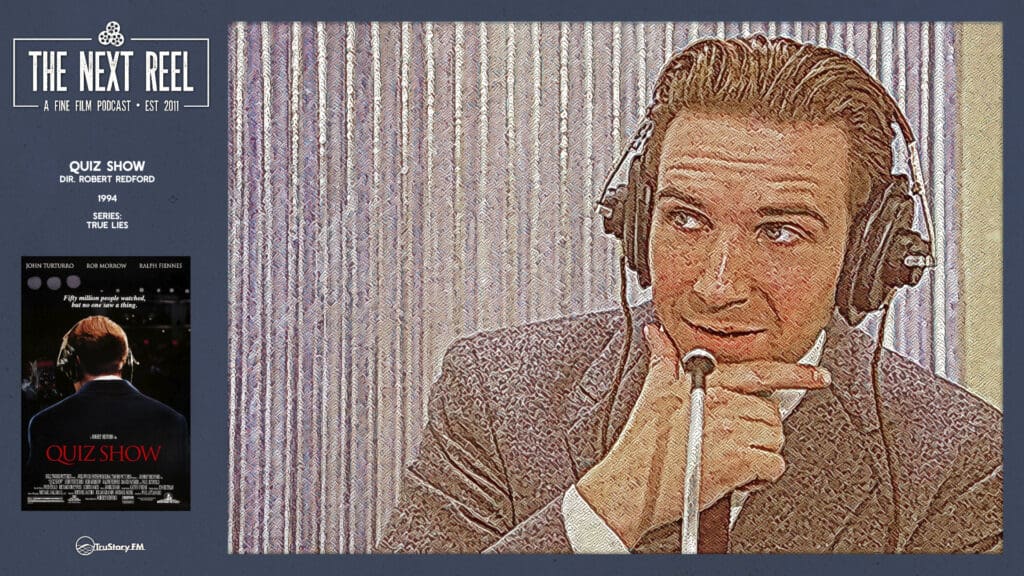
He’s so funny. Yeah. Quiz Show. Andy, we’re talking about Quiz Show. Yeah. Next in our True Lies series. Yeah. Our True Lies Series. Stories of people who get wrapped up in their own fraud. And so far we’ve talked about Can You Ever Forgive Me, Lee Israel writing notes from famous authors, we’ve talked about Shattered Glass, Stephen Glass. We’ve talked about Richard Gere pretending to be Clifford Irving, writing a book about Howard Hughes that Howard Hughes did not endorse. And we’ve talked about The Informant as our bonus episode with Matt Damon being awfully too happy for everything going on around him. Now we’re talking about Quiz Show. We have had, I think, central problems with all of these sorts of movies in this series. And it was my hope, it was my grand hope that coming into Quiz Show, we might find a movie that fixed some of those problems. So I am very excited to hear your take on this film. And your watch of it this time. I know we both have seen it many times, probably. Yeah. And so how did it hit you this watch? Just light me up. Give it to me.
Andy Nelson
Well, I mean I think you’re right. I mean it’s been an interesting series because we’re watching stories about fraudulent people and it makes it a little harder to connect to the films because these people are stealing, they’re cheating, they’re committing fraud in many different ways and lying to those around them. And it makes for frustrating protagonists to follow. This film, I’ve always found it to be a fascinating and an excellent film. I think that the casting is brilliant, and I think Ralph Fiennes playing Charles Van Doren brings so much to it as far as the internal struggle and what he’s working through, that yeah, to your point, this is the first one that I’ve really found that I connect with more. I watch his struggle and I can see what he’s working through and it makes for me of the ones we’ve watched so far the most compelling of the bunch. I really enjoy this film and I enjoy watching his journey that he has, this struggle that he has as he recognizes what he does is wrong, that he’s cheating on this game show at the behest of all of the people who produce the show who are behind the show. I mean he’s doing it because they told him to, essentially. Right. Institutional cheating. Exactly. And so he’s just kind of going along with it. And I think that really boils down to this man who I don’t know, might recognize by the time we get to later in the film that maybe he’s more morally bankrupt than he ever had hoped to be.
Pete Wright
So that’s one of, I think, the central questions of the movie because the others are driven I think what maybe with the exception of Stephen Glass, which was driven largely by ego, but they’re all driven by need, the economic need, sort of the desperation of need. They aren’t getting work. They’re set up as people who aren’t able to work in a complicated economy of creatives. A couple of authors. Then we have Stephen Glass as a writer for The New Republic, who it seems like maybe the most vilely driven by inner demon. But here we have a character. It’s the first one in our whole series that I think I can be genuinely sympathetic toward. Because maybe because the vaunted academic character is something we’re familiar with. It’s easy to see that character in life. It’s also easy to see because it starts so genuinely, right? It starts with him really just wanting to see how he does on the quiz show to see if he can keep up with these people who are just presumably incredible trivia heads. And that slope of him descending into ego from when he realizes what’s going on to when he begins to rationalize how it’s okay, is incredible just character writing for me. I think he is extraordinarily portrayed as this guy who I can feel naturally slip into this. It’s not out of desperation, it’s not out of anything other than the fact that the system encourages him to play this way, and it kind of starts to feel good. And when he’s looking at his new apartment, when his lifestyle starts to change. It starts to feel good. And that feels maybe the most natural of a transition of any of the characters we’ve talked about so far. It is the softest edge of a transformation.
Andy Nelson
Absolutely. And I think what we’re also getting with this film that we don’t get in any of the others is a sense that there’s much more to this story than just these guys cheating on this quiz show. As you mentioned, like this is an institutional problem and this is something where the CEOs, the power, the people in charge, even to the point of the government when they’re doing the committees investigating all of this. They have no problem lying, covering things up. And that speaks to the way that these institutions work and are created and how it’s so much easier for them to just live in a world of lies and just not worry about it because that’s how they get things done versus the actual humans that are that they’re using I guess we’ll just say as pawns, these players and everything. I mean, even the people that are working for them, right? David Paymer’s character, Hank Azaria’s character, like they all are looked at as usable in many ways. And they’re the ones actually who, well, speaking specifically of the players, like they’re the ones who actually start feeling guilty about what they’re doing, and they’re the ones who finally tell the truth and come clean in a way where they’re feeling like by telling the truth it’s actually going to absolve them of the crimes that they committed and maybe realizing that it doesn’t. But I think that for me, what I took away most from this watch of the film is that comparison between those two sets of people. The head of NBC, the head of Geritol, these people who have no issue with just totally telling lies. Even again, Paymer and Azaria as their characters take the rap for doing all of this just specifically so that they can then down the road kind of continue their careers in television. That’s pretty shocking to see and then to see where we are today.
Pete Wright
What do you think of their central premise, right? Because this movie is built on or the story, I should say, is built on this premise that it wasn’t fraud against the American people because it was entertainment. The people just want to be entertained.
Andy Nelson
Let me think of that. Well, I mean I think that’s an interesting angle that they can certainly take, but the problem is when they pitch it as something that’s more than just entertainment. I mean they’re pitching this as a show with smart people in a contest, in a challenge, and they’re completely scripting it. And we see the same thing happen on Real World and any of these reality TV shows where the producers are essentially scripting the conflict into the actions that’s going on so that you get more drama because that’s what sells. I mean, but I don’t think we would have that happening if this hadn’t happened first and they recognize that that’s what the TV viewers want. But at the same time, in a show like this where it is all about selling your smarts to people, people like I mean as Stempel’s wife says I was one of those suckers that believed you, you know, to her own husband, she says that. And I think that’s an important part. Like these are people who are buying into the truth that they’re seeing on television at this time.
Pete Wright
Yeah. As we were watching it this round, it occurred to me for the first time, I wonder, just in terms of armchair historian, had NBC and Geritol sold the program to the public as we’re quizzing really smart people. We’ve given them all a thousand questions and answers and they’re put in this hot box of pressure just to see if they can recall to compete to get to twenty one. Because these questions are not easy. If they told the public they had given them the questions, do you think the public would have found it as compelling under the auspices of that honesty and do you think the winners would have felt the same degree of shame?
Andy Nelson
I think about this weirdly a lot in context of the movie White Men Can’t Jump. Because in that movie, Rosie Perez wants to be on Jeopardy. And one of the things that she’s been studying and working hard to know a lot about is foods that start with the letter Q. And that ends up being one of the categories that leads to her victory. And I can’t help but feel like it’s one of those things that and I don’t know the context of how Jeopardy works. Like when you’re a new contestant, do you say these are things I’m really good at? And then they’ll kind of pull from those to put them on and use that to kind of shape who’s gonna be the winner and whatnot. But it felt exactly like what we see here where they’re essentially picking stuff that they know and so that they can drive the story. So they can say, okay, now we want to make it so Van Doren ends up winning. If they were telling people, well, we’re giving them the questions and letting them figure out the answers, I think that just takes away any interest in it. Like it’s like, well, I mean, how hard is that then? Like all you have to do is go do some research for a little while. Go spend an afternoon in your library and you can get all of the stuff that you want to answer all those questions. So suddenly that becomes much less satisfying. And if you know that both players are getting all the questions beforehand, then like where’s the they’re both always going to get the answers right? Like it takes all the steam out of the entire point of the show.
Pete Wright
Well, that’s when it becomes like the game becomes can you provide enough steam to give them enough pressure so that it’s actually a test of memory. And to say we’ve given you a thousand questions, we’re gonna pull 15 of them for this game, good luck getting all those answers memorized in an afternoon. Right. Exactly. Like I just think there are ways to present it honestly, and I do wonder how they do that for Jeopardy. That would we’ve got people in the community who are Jeopardy champs. We’ve got Jeopardy champs we could call and ask. Believe it or not, that might be a fun thing to answer because I don’t know how it works. Maybe especially in light of the quiz show debacle of the fifties. Anyway, that part makes it a really interesting narrative because it becomes such a betrayal that NBC and Geritol pulled against the American people. As you said, I’m one of those suckers. That first tentpole moment when we watch Stempel take a dive against Marty when the answer is Marty, and he knows the answer is Marty. And I hate the movie Marty. Did you get any sort of subversive satisfaction out of that? Did you remember going in that it’s one of Pete’s least favorite films?
Andy Nelson
I enjoy Marty quite a bit. And I think you’re I don’t know. I think that you need to rewatch that one. It’s a great movie and it’s interesting and I think it just speaks to a point in time when culturally everybody knew what Marty was and everybody was talking about Marty, and I think that’s interesting because it speaks to how I mean it’s certainly society’s shifted today. Like I don’t know if every single person that you talk to would be able to name the best picture from two years ago, you know? I think that society’s a little different now. But I think back then, like these big milestones in various different pockets of culture, I think everybody probably was paying attention at the time. And so I think that and I totally understand their like the producer’s point. Like think about the drama and the fact that it’s such a simple question and that’s the one that ends up stumping you. And but, you know, for Stempel I can see why it’s such a frustrating thing ’cause it’s like, why would I not know that? You know, it can be so frustrating. Like, let me lose on a what did he say on something about biochemistry or something? Right. Yeah, like I was like, okay. Like and maybe if they did, maybe he wouldn’t end up having made such a stink about the whole thing, but who knows.
Pete Wright
Well, and the sweet, sweet irony that Marty is about an unglamorous guy just looking to find some dignity and that it’s Stempel in this movie who’s struggling to find some dignity. And the irony that we know Stempel is a guy who has very little dignity, right? Like his entire motivation after he does take the fall is to get back on television and to whatever he can to get back on television. He is completely all of the controversy and the inauthenticity of the charade that he’s been a part of is completely invisible to him because all he wants to do is get back on television. What a fantastic sort of avatar for the kind of ego we’re talking about at play in this movie. He is sort of the biggest branch off of the ego tree. And the rest of the movie is watching as Van Doren his own branch blossoms, right, on the ego tree. Do you like the ego tree? I think we should both have ego trees. Anyway, I think that is a really beautiful moment when they turn off the air conditioner and he starts to sweat and he pats his brow, he doesn’t wipe his brow. Those sorts of tools of entertainment leading to him taking the fall on this ridiculous quiz show is I think just great, great filmmaking. And pulled from history. I mean, it’s not like they just said you know, for the movie, we’re gonna use Marty as the movie. I think that was the real movie in Goodwin’s book that he took the fall on.
Andy Nelson
Yeah. Although it’s not completely true that that’s where he took the fall. I mean there are plenty of little bits and pieces that are reworked or compressed and everything in this and that’s one of them because my understanding is that he does take the fall and get that wrong. Van Doren then answers another question and then Stempel answers another question and they end up tied at twenty-one and they have to play another game the next day to kind of do a competition and that’s the one where Van Doren ends up winning. But yeah, and so again, it’s just story compression and things like that. And so yeah, but I think for dramatic purposes it served its purpose.
Pete Wright
Yeah, I mean those are the things, I think the little bits of historical pastiche that we forgive because the rest of the movie kind of embraces the story so well.
Andy Nelson
Yeah, but don’t ask any of the people involved because a lot of them were upset with how things were portrayed, but it’s like, you know, it’s this is always the battle of reality and a real story versus how it’s depicted in a story in a film like this, in a fictionalized version of this. And I think if you look at the messaging and the themes, I think it’s getting it across. But I think if you’re one of those people and it says, well, you’re selling me incorrectly, then I can see why people would be upset.
Pete Wright
Well, this is a good enough time to talk about that as any. Tell us a little bit about some of the specific frustrations. Who felt wronged the most?
Andy Nelson
Well, I mean I just mentioned some of the stuff. Like I think Van Doren felt a little upset about some of the elements, the way that things played, although he said he really liked the line when Stempel calls him Charles Van Effing Moron. He enjoyed that quite a bit. I think that Albert Freedman who Hank Azaria plays was upset with how much they made it look like he was involved in the whole thing. He wasn’t probably as involved as the film made him out to be. That was one reason that he was upset with it and also the fact that this sort of stuff had been going on since the radio days, and when people were coached and everything. And so you can see why these people were frustrated. Also I think one of the biggest ones was there was a specific Congressional Committee consultant named Joe Stone who actually spent four years investigating this scandal because they compress like three years of scandal into one season. Like they make it very small. He was very angry that they really focus on Goodwin and Goodwin and they it’s based on Goodwin’s book. Goodwin paints himself as kind of the man putting all of this together and bringing it forward. Goodwin and Goodwin ended up accepting most of the credit when the movie was released, but in fact he didn’t start getting involved until years after the show had already stopped and all of this information kind of already came to him. Whereas Joe Stone had been working on it this whole time and wasn’t even mentioned in the film at all. So that’s an example of somebody who I think was perhaps most rightly wronged, or feels like he’s right in feeling wronged. You know, but again, it’s for me, I think the context of the themes and the messaging of the story actually still comes across. And I think that’s the line that they’re walking.
Pete Wright
And tip of the hat to Hank Azaria, right? First of all, second appearance in this series. Yeah. And I just reflect time and time again, he is one of the most valuable utility players in just about every movie we see him in. The fact that he can go from these two movies together playing very different characters, none of them cartoonish, all the way to what was the Miami one where he plays Agador, the manservant. Birdcage. Birdcage. I mean extraordinary and I just I want to celebrate him whenever we can. What a fantastic performer.
Andy Nelson
Which was between this and Shattered Glass. So yeah. Yes. He’s always fantastic.
Pete Wright
Yeah, I think what we’re getting to, and I think one of the central sort of theses of the movie is that corruption doesn’t actually need overt villains. No one in here is a villain. It’s just a bunch of people who have something to gain by not asking questions. And it’s only when somebody sits down and thinks, wait a minute, do I have a question about our process here? Do things fall apart? So when you say this has been going on since the radio days, it does make me wonder what the broader story is of the sort of cultural ethic of these game shows over the years. And in the radio days, how much easier would it have been to pull this off when no one can see what you’re looking at as you’re answering questions? I don’t know, but that’s a story I’d be very interested in. In the context of this one, no one’s asking questions about process, no one’s asking questions about class as casting. This whole case that there’s always a Jew, then a Gentile, that Stempel makes? It’s a fascinating question that just goes into the artifice of the quiz show that I think the film portrays very well.
Andy Nelson
I think that, yeah, the film tackles that’s what I find so interesting, is it looks at so many different things, right? Like there’s those race elements that we see. There’s the world of fame and notoriety and the draw to it and kind of like how it can change against you and rear its ugly head. There’s family dynamics that we have between Charles and his father. And I think that we’re seeing so many different ways to kind of view the story and what they’re trying to say. Big business, mass media, I think are huge ones and what’s so fascinating specifically about this game show and it’s pitched several times is how inspiring it is for young people to want to actually get educated, get better educated to learn more so they can be like these people. And so they’re selling like this pitch of making education exciting as entertainment and what happens when they do that and how it can perhaps not necessarily work out as well as they want.
Pete Wright
Right, and what a ju that story is such a juicy bit of bait to someone like Charlie Van Doren, right? Who is an academic who is standing behind the podium and the quiz show is asking him to put on a bright red cape and be a hero. That is tantalizing to a guy like this. Which leads us, I think, to my favorite relationship in the movie which is the father-son relationship. Charles Van Doren and his dad, Mark, played by Paul Scofield. The scene of the family at dinner when Dick Goodwin is sitting at their afternoon late afternoon picnic meal and they’re having their just battle of fantastic wit. Around like I wish to God my family was that full of that kind of wit. Like just everybody was fast.
Andy Nelson
Or that you knew that much of Shakespeare, so you could just quote it back and forth like that.
Pete Wright
Like it was nuts. I’m not lying, Andy. I went on to my books app and I downloaded the complete works of Shakespeare after this. Again, I keep saying and I realize how many times I must have done that. Every time I see this movie, I’m like, you know, I’m gonna read Shakespeare now. I know it, I know I’m Shakespeare since high school. Yeah. I’ve got to do it again. It’s not going great but that sequence I think is another one of those tentpole moments because especially it’s a tentpole moment for Goodwin, right? For Rob Morrow, who I think is very good in this movie, and I very much enjoy watching him in this. This is one of those sequences because he also aspires to that level of intellect and he’s constantly talking about it as first in his class at Harvard Law and he wants wants to and finds it fairly easy to fit in at this table and you can kinda see how a guy like him is also invested in maybe not asking questions because his ego gets in the way. Like at what point does he say, hey, I’m gonna keep poking at this versus I think I’ll just pour another glass of wine and enjoy the company. So that table scene is full of such glorious, complex family social relationship that I think it really showcases a bunch of incredible performers at their best in just this like top level class A intellect. And it’s just juicy. It’s just juicy.
Andy Nelson
Well, and I always, you know, you can’t have that scene without pairing it with the subsequent scene when Charles comes to Mark’s classroom and has the moment where he finally tells the truth to his father that he has been one of these people who has been accepting the answers and cheating on this show. Yes. And they use a few lines thrown back and forth to kind of like, you know, Charles throws a line at his dad as a jab and his dad responds immediately with like your name is mine or whatever that line is and it just it digs and it hurts and like there’s such power in that scene but I love how it’s portrayed is like he still is a father, and when Charles says, Will you be there with me? And he’s like, Of course. And I think that speaks so much to the disappointment and the frustration and rage that a parent can have with their child yet still show love and compassion and help as needed. And I think that is I mean, it’s just powerful. And you know, Paul Scofield is so great in so many things. A Man For All Seasons, if people haven’t seen it, you need to check that film out. Oh yes. But he’s just man, the way that he carries every moment in this scene is just I mean, just amazing. Absolutely worth the idea of casting him for this.
Pete Wright
You know, you say those two are paired together. I think there are probably there are four scenes. There are four. Let’s I’m just gonna say there are only four. There’s the dinner scene. There’s also the let them eat cake scene where the two have a scene together, drinking milk and eating cake off the same plate, that is so sensitive and sweet as we have Charlie trying to make sense of the shame that he’s starting to feel and navigate how he’s gonna tell Dad. Then we have the reveal, and I think that classroom scene is so dynamic. If you’re going back to rewatch this movie, watch the blocking of that scene because Mark is standing at the front as a professor and Charlie, young Charlie, is like running through it feels like he’s running through the chairs, like he’s in a video game. He can’t sit still, and it feels like every jab coming from his dad makes him get up and get a new seat. He’s so it is just really perfectly blocked. But the final scene after the testimony, at the very end, and we’ll talk about the testimony specifically in a second, but they’re all in the press gaggle outside and one of the reporters asks, you know, are you aware that the trustees this is after Dad says, I just can’t wait for Charlie to get back to his teaching and one of the reporters says, Are you aware the trustees are meeting to talk about, you know, pulling Charlie? That’s the first time you see Mark Van Doren truly crushed. Yeah. No answer, no words, yeah. No answer, no words, and everything about his identity and his relationship with his son is tied up in the fact that his son is a fellow professor and or instructor, whatever they called him. That was incredible, incredible just performative turn for Paul Scofield in that very little that very brief moment. One of my favorite things in the film.
Andy Nelson
Yeah, it’s powerful. It’s powerful watching him go through that. All right, we’re going to take a quick break, but first, you can find the show on YouTube and you can join us live when we record. We will even take your questions in the post-show chit-chat. Live, everyone is welcome, and then members get the replay and the extended cut. Subscribe to The Next Reel on YouTube. The link to this episode is in the show notes. We’ll be right back. Robert Redford, Andrew, at this point, did you really think of Redford as an alpha director? I mean he’d been directing for a while, but Redford’s directing was always few and far between.
Pete Wright
I don’t know if I ever thought of him first as a director, but I think because he’s so careful with what he chooses to direct, I think that it’s pretty clear it’s stories that he is interested in and passionate about. And I know he kind of was brought on to this as director. I don’t think it was a project that he had brought forward. But clearly, I mean, as somebody who grew up watching all of this, I think that he was just fascinated by the story and wanted to tell it. You know, I had done my Robert Redford chronological watch through his filmography, both as actor, producer, and director, and that’s the last time that I had watched this film. And I mean, you definitely see a filmmaker who works the way he does as an actor, like picks projects deliberately. I mean, not always. I don’t think Indecent Proposal fits this, for example. But I think he’s a filmmaker who is passionate about projects that are reaching to do more, whether it’s kind of like has a message as far as like the politics of the day or some sort of theme that he really resonates with. And I think when he’s picking films that he directs I think that very much is true. And I think there is something with his fixation on American institutions and the quiet failing that sometimes they have as we kind of watch here and see what happens with the television industry. And he’s a director who’s very restrained in how he tells his stories. I don’t think he’s somebody who really, when you watch his like the camera, for example, isn’t a very active camera in much of his films. But I do think that he works in things that fit in context of the story. Like in this one, having the dolly in zoom out or dolly out zoom in, whichever direction it’s going, but when we’re looking at the back of Charles Van Doren inside that little booth and we have that moment with that fantastic shot. Like that, you know, is a great surprise to see in a Robert Redford film, but it works in context of the story really well.
Andy Nelson
Yeah, I talk about a single shot that became the iconic avatar for the film. I mean it’s the poster, the landing zone of that shot is the poster, the I mean it’s extraordinary and perfect in that moment. I had forgotten that he directed Indecent Proposal.
Pete Wright
No, he didn’t direct it. He just acted in that way. Oh he was just
Andy Nelson
Oh right. He was the millionaire, the industrialist. Well it’s interesting because he seems so interested in like the quiet failure of American institutions. And I was thinking about this movie watching this against Network, right? Network is maybe the loud rage against the institution of television, the fraudulence of television and this movie is like the simmering quiet agony of television. But both of them are about institutions that are failing and somehow, failing someone somewhere by what they’re doing. And you know, I think you look at his just sort of, I don’t know, obsession with American myth. He is a truly American filmmaker, right? He’s interested in American stories and what it means to be an American. And I don’t say that with any sort of spark of pride in it, right? It’s because he’s looking at sometimes the American myth and where it has gone sadly wrong. Sometimes where it’s gone right, but mostly where it’s gone wrong. I think as a filmmaker, his aesthetic is really well attuned to that. Maybe it’s because of all those years in Park City.
Pete Wright
Well and you can see so much of it in like All the President’s Men and The Candidate and Ordinary People and even I mean it wasn’t as well received, but The Conspirator, like Lincoln’s assassins and everything? And that it’s a fascinating glimpse into what he’s passionate about. And I enjoy seeing him tell the story. And I think he’s somebody who has always recognized, you know, these American systems that he loves and is passionate about and knows people are also love and are passionate about. But also we’re all incredibly frustrated with how they’re broken and would love to see how we can get it fixed, right? And is there a way to fix some of these things as far as the political system and everything. And I think that’s a powerful element that he brings to so many of his projects.
Andy Nelson
So let me ask you, under the chapter head, Defining Complicity Sucks, do you think Redford lets Van Doren off the hook too easily? And we should probably talk a little bit about the congressional testimony at this point, but I think that the movie clearly sympathizes with Van Doren. Handsome Ralph Fiennes. I’m not sure it completely earns the sympathy or whether it’s that discomfort that is actually the point. He is a guy that by the end of the movie you just kind of want to punch in the neck. That’s just that is the that’s the privilege argument that we’re re-watching here as the film ages. Do you think he lets him off too easily?
Pete Wright
I don’t think so. And I think what is fascinating about it is they do make him sympathetic and we sympathize with this guy, but we also I mean we’re sympathizing with all of these people and that’s what’s interesting and you know, as I was watching this, I’m like, who am I watching as the protagonist of this story? Should I be looking at the especially because we start everything with Herbert Stempel and he’s kind of our entry point into this. And we see finally Charles watching Stempel, and then finally we’re kind of looking at Charles’s story. But I’m like okay, Herbert Stempel is an interesting protagonist because he’s hard to like, and that makes for an interesting antagonist in Van Doren because he’s very easy to like. Or is it flipped where Van Doren is the protagonist and Stempel is the antagonist? Or is Rob Morrow the antagonist? Like how is this story structured? And Paul Attanasio, who adapted the story into the screenplay, said it’s kind of a changing protagonist over the course of the story is the way that he did it. He said there isn’t a central protagonist. And I guess I can see it that way, but I don’t know. The way I read the story myself is that Charles Van Doren’s our protagonist, Stempel is our antagonist. They both have interesting journeys over the course of it. Like watching Stempel in that final moment after Van Doren’s statement and then as he leaves is powerful. But for me, I think what makes all of that work so much is that we have grown to maybe not connect with why Charles Van Doren has made these decisions. I mean, we get this point. This is what’s so fascinating about Charles Van Doren. We get a moment where the head of NBC comes into him. This is after he’s already left the show. And then you have Barry Levinson playing the Today Show host who comes in and offers him a contract to stay with the network. You have the head of NBC come in to talk to him and say, we want you to keep working with us, but you’ve got this legal form that you need to sign. We don’t see him sign it. That seems like a moral choice because he’s just like, well, if I sign this, it doesn’t it seem like that I am because they haven’t even mentioned me, it doesn’t it seem like I’m calling myself out. And then we find out later that he did sign it, right? Like he’s actually working for them. Because it seems like this big moral choice and we don’t know. It plays so well. And then it’s just like God, he makes such bad decisions and that’s what I love about him is like he feels so human, you know? And all of that I think plays so well. But what really sells everything for me as the film not taking it too easy on him is the fact that he tells the truth and then three congresspeople are like, I have to commend you for being honest and like you just want to punch these people. Yeah. And I’m like, are you kidding? Like that’s what was frustrating. But then you have that fourth one saying, look, I love that you’re telling the truth, but you shouldn’t be commended just for telling the truth. It’s ridiculous. And then everybody in the place erupts in applause. And Van Doren has to listen to that. And I think that’s the moment where the film says no, you can’t sympathize with this guy. We’re all on the side of the people applauding. He may have told the truth, but it doesn’t absolve him of the crimes. And I think that is what the film is saying.
Andy Nelson
I like that. And I think that feels better than just, oh look, another handsome white man got off with without any scratches. I think he has scratches. I struggle at the end of the movie with figuring out how big a crime this was, right? Like, do you get a sense from all of the congressional conversation, that nobody quite knew what they were doing or like why what they were working toward together, other than just general admonishment for doing this whole thing.
Pete Wright
That is the line that plays with how power what happens when people who have power get involved, right? Like as far as Goodwin is concerned, he wants to bring down television. He wants to prove that it’s a systemic institutional lie that these people have built into their system and the whole thing needs to be brought down. Geritol doesn’t want that because of the amount of sales that they have. And what do you say? They’re up fifty percent since the start of having Van Doren on the show and the head of NBC doesn’t want it. And he plays golf with the guy who’s the head of at the congressional committee. And that’s all they talk about is like, oh you were stuck in the sand for days. You know, and like the way that they have that conversation really shows how power when they get involved, it’s like they’re gonna spin it however they want and other people are just gonna have to buy it. And both the head of NBC lies and says, I’m the head of this thing. I’m not paying attention to all this. I’m like macroscopic guy and these people are making these decisions. It was all the producer. Like he’s the one who was behind all of this stuff. And of course they already know that’s Dan Enright and David Paymer’s character. And they already have talked to him and know he’s gonna follow orders and do what he needs to in order to have a future in television. Same thing with Geritol, Martin Scorsese’s character. How would I know any of this stuff? Yet we’ve seen them. We as the viewers have seen them in on these phone calls. So we know that they are very much privy to all this and pushing these decisions to happen.
Andy Nelson
It is interesting as I think about this series again. This hammers home one of the central points of all of the movies we’ve talked about that everyone in here is actually really talented and smart, right? That Charles Van Doren is legitimately a brilliant guy. And left this quiz show scandal and went on to Encyclopædia Britannica where he ended up writing many books, editing many books. He was there for twenty three years, retired in the eighties, died in two thousand nineteen, which is not very long ago. I would have expected it to have gone sooner. But he went on to a successful career as a vice president at Encyclopædia Britannica. Same thing with Lee Israel, very talented words. Same thing with Clifford Irving and Stephen Glass, all incredibly talented storytellers, caught up in the wake kind of of their own success, and pulled under. There is nothing in here that reeks of an air of desperation on the part of Charles Van Doren. His life was fine. And this just pulled him, this ego pulled him under. And I think that I think you’re right. I think the end that end result when that last senator says I’m not going to congratulate you for being honest, it’s a key that unlocks the understanding of who this guy was at that time of his life, that he was probably a good person truly buried under the weight of a million tiny bad decisions that led him to that chair. Yeah. Every time I think about that and I say it, I just look at myself and I think, okay, well I’m a white man in his age. Like how much am I absolving him because he looks like me? And let me be clear, he doesn’t look like me. He’s very handsome.
Pete Wright
That handsome strapping Ralph Fiennes. He even looks good when he’s covered in iodine and killing zombies. But you know what?
Andy Nelson
Even Charles Van Doren’s a very handsome guy. He was a very handsome guy at this point.
Pete Wright
Yeah, it’s a fascinating story. It’s a fascinating film, and it is a dark glimpse into you know, an important part of American history that in many ways you can see how it ended up influencing not just where TV shows and game shows and things like this would go, but where news would end up going and how media would reshape, especially with at this same time, like following the Korean War and then the Vietnam War and going into everything with Richard Nixon and the reshaping of how they would shape things that we would end up seeing and I think yeah, it’s a dark story, but a really fascinating one. And I think it’s interesting to look at like who actually is struggling with the lies versus like who is just treating it as a business decision because I think that really speaks highly to the path of how things move forward.
Andy Nelson
Absolutely. Before we move into the last part, I just have to say this is a movie with so many faces. Like I could not believe every time I’m watching another scene, I’m like, here’s another scene with like all these people I recognize, like the congressional hearing, like so many faces up there. The poker game, so many faces. Ethan Hawke shows up as one of Mark Van Doren’s students. And yeah. It’s just it’s crazy the people that we see throughout this film. Just so many amazing actors, directors, playing actors, like they’re all just all over the place in here.
Pete Wright
Calista Flockhart shows up as a student too.
Andy Nelson
Calista Flockhart, that’s right. Calista Flockhart and Ethan Hawke, those were two I had to pause and go back and explain to my wife the connection because she doesn’t remember faces. And it that Ethan Hawke happens so fast. Yeah, right. You gotta be on top of it. But he definitely that he has a line. Yeah, yeah.
Pete Wright
Exactly. Yeah, it’s crazy. All right, well let’s move into the back half, but first we’re gonna take a quick break.
Andy Nelson
The Next Reel is a production of TruStory FM. Engineering by Andy Nelson. Music by Tzabutan, Bixby, Oriol Novella, and Eli Catlin. Andy usually finds all the stats for the awards and numbers at the-numbers.com, boxofficemojo.com, imdb.com, and wikipedia.org. Find the show and the full archive at trustory.fm. You can follow us from there too and learn about membership. Check out our merch store at thenextreel.com slash merch. And if your app allows ratings and reviews, please consider doing that for our show. All right, Andy. This was a tough award season for this movie to be up against some really good movies.
Pete Wright
Yeah, it was. And it didn’t help that this film was very slow at the box office, which we’ll talk about here in a minute. But yeah, we did well in the awards circles. Six wins with thirty-six other nominations. Over at the Oscars, it was nominated for Best Picture, but lost to Forrest Gump. Best Supporting Actor, Paul Scofield was nominated, but lost to Martin Landau in Ed Wood. Redford was nominated as best director, but lost to Robert Zemeckis for Forrest Gump. And Paul Attanasio was nominated for best adapted screenplay, but lost to Forrest Gump. At the BAFTAs, Scofield was nominated for supporting actor but lost to Samuel L. Jackson in Pulp Fiction. Attanasio did win best adapted screenplay, and it was nominated for best film, but lost to Four Weddings and a Funeral. We talked about this with Shattered Glass. This one was also nominated for a Political Film Society Award, the Expose Award, which it did win. And I always enjoy these, the 20/20 awards. This was a set of awards twenty years after the previous awards, so 2015. It was nominated for five awards. Best picture, lost to Pulp Fiction, Best Director, lost to Quentin Tarantino for Pulp Fiction. Best Supporting Actor Scofield, but lost to Samuel L. Jackson in Pulp Fiction. Best adapted screenplay lost to The Shawshank Redemption and best production design lost to The Hudsucker Proxy.
Andy Nelson
You know, it’s funny as I armchair recast this movie about the only other person I can think of off the bat to play a compelling Mark Van Doren is actually Martin Landau. Can you see it? I could see it.
Pete Wright
A young a young Martin Landau? Like the yeah, I mean I don’t know, at this age. Oh Mark Mark Van Doren, sorry, yeah, yeah. Mark Van Doren, yeah. Who was who did I read that they’d asked Paul Newman, which I would have been a cool get, you know, working with Redford, but he declined. I think he was working on Nobody’s Fool at the time.
Andy Nelson
I don’t know. There’s something about the height of Paul Scofield as that tall, lanky teacher just fits the type for me. Yeah. Ugh. All right. Well talking about the box office. Let’s talk about the slow slow news.
Pete Wright
Well for Redford’s story about this notorious game show scandal, he had a budget of thirty-one million, or sixty-six point three million, in today’s dollars. The movie premiered in New York City September 14th, 1994, then opened wide on the 16th opposite Timecop, Princess Caraboo, and Blue Sky. It started in 15th place, then as it expanded, ended up as high as fourth place. Still, even with its Oscar nominations, it never really took off, only earning back $24.8 million domestically. And it had a tough time overseas because Redford was immediately jumping onto another project and couldn’t go promote it. And so it didn’t get as good internationally, but it still did okay, earning 27.4 million. Which means all told it brought in $111.7 million in today’s dollars, proving a success for everyone involved with an adjusted profit per finished minute of $341,000, actually making this the biggest adjusted profit per finished minute earner in this series.
Andy Nelson
I expected this to be much worse news.
Pete Wright
It was a slow mover, but it still did well. And it’s a series of small films.
Andy Nelson
Yeah.
Pete Wright
Shattered Glass, very independent. Same thing with Can You Ever Forgive Me? The Informant, it’s Soderbergh but I think it was a smaller Soderbergh and I think it got a lot of buzz in the comedy circles and everything, but it just didn’t make as much money back. And The Hoax was also very small. Big Eyes, we’ll talk about that next week as far as how it did.
Andy Nelson
Well, I’ll tell you, this is one of my all-time favorites. I mean, I really adore this movie. And I love that it gives me such characters that I really appreciate being forced to reckon with their privilege. And this one captures intellectual privilege in a way that the others haven’t yet. And so I’m so glad we were able to shoehorn it into the series.
Pete Wright
Yeah, I really do enjoy this film. Every time I watch it I am reminded of how great it is. I think it’s an interesting film on this watch about it’s not exposing just the corruption, but documenting how the corruption of the system really trains everybody to just kind of go along with it, teaching them who’s gonna be protected? Who are we gonna sacrifice? And then how easy it is for truth really to just end up being another performance.
Andy Nelson
Yeah.
Pete Wright
Yeah.
Andy Nelson
We talked about the we joked about the fact that Mira Sorvino had one insightful thing to say in the film that was sidelined. That’s not actually a joke. Like, it is unfortunate. You want to talk about the absence of women’s perspectives?
Pete Wright
Yeah, I mean just a quick note about that, but that is a frustrating element. I mean we’ve got really three women. We’ve got Dorothy Van Doren as Mark’s wife, Charles’s mother who shows up with some witty moments at the dinner, Mira Sorvino as Sandra Goodwin, and we have Johann Carlo as Toby Stempel, who actually has the most going on in the story, and I really enjoy her performance, particularly when she is made aware that Herbie had been had known the answers and she feels like she had been suckered just like the rest of America. But yeah, very small otherwise, very kind of disappointing how few roles for women there are here.
Andy Nelson
Well and I think it’s an important note that all of the women knew right off the jump what was going on with these guys. And it feels like the film was like, shh, we’re gonna let this play out. Right. We don’t want you to just ruin it for everybody. Let the men watch themselves fail, which is a strategy in and of itself. So yeah, right, right, right. You know, is what it is.
Pete Wright
And I just have to call out just the credits, the fact that we have like a slow-mo of just a crowd of audience members just applauding and laughing. Like I think that’s just brilliant because it just it makes it sink in how artificial the whole thing really is. Yeah. It’s kind of a dark, dark bit of credits.
Andy Nelson
Well, that’s it. All right. Great movie. Loved it. Great movie. And that is it for our conversation about Quiz Show. Next week we are looking at the final film in the series, the True Lies series, the story of artist Margaret Keane and her second husband Walter, who took credit for her paintings in the 50s and 60s. It is Tim Burton’s 2014 film, Big Eyes. And now let’s do our ratings.
Pete Wright
Letterboxd.com slash thenextreel, Andy, that’s where you can find all of the ratings and reviews of the shows that we participate in here at The Next Reel family of film shows and I want to know what are you gonna do for this movie?
Andy Nelson
I really enjoy this film. It’s one of these interesting films that I always think is like it’s not a magnet film. It’s not something I’m always drawn to. I always enjoy it when I re-watch it, but it’s not something I feel the need to jump in and revisit too often, so it’s hard to say five stars. Last time I watched it, I gave it four stars. I you know, I think I could go up to four and a half, I think, is where I’m gonna land with this one. Four and a half stars and a heart.
Pete Wright
I think on this watch, just the joy I have talking about it, the fact that I think it holds up so very well, I’m gonna go all the way. I’m gonna go all the way to five stars and a heart. This is one of those pinnacle movies for me. I just deeply enjoy it.
Andy Nelson
Yeah, you said it was one of your all time favorites, so I’m not surprised. Not surprised. Well that averages out to four point seven five, which rounds up to five stars and a heart. You can find the show on Letterboxd at the next reel. You can find me there at Soda Creek Film and Pete at Pete Wright. So what did you think about Quiz Show? We would love to hear your thoughts. Hop into the Show Talk channel over in our Discord community where we will be talking about the movie this week. When the movie ends, our conversation begins. Letterboxd give it, Andrew, as Letterboxd always doeth.
Pete Wright
All right. I’ve got one. It’s long, so I’m going to excerpt it. Oh, okay. I’m going to give you an abridged one. It is a heart. From the one and only Mike Flanagan. Thanks to the wonderful people at American Cinematheque. I was incredibly fortunate to see a pristine 35mm print at the Aero with Rob Morrow in attendance. This is from 2024. One of my all-time favorite films, Quiz Show, hasn’t aged a day since its debut in 1994. And then he goes on to talk about all the stuff we just talked about in one very long paragraph. Skip, skip, skip. Television or no, this is a story about personal values, how easy it is to compromise them, and how the bright lights of show business can blind even the most upright of people, making it easy for them to lose sight of who they are and what they hold dear. I would argue that Paul Attanasio’s script is one of the finest ever written, not only for its impeccable structure and precision with which it explores its themes, but for dialogue so electric and beautifully crafted that conversations feel like tennis matches, or boxing matches, or even, at times, a proper duel. One of the very best films of nineteen ninety four, or any year, for that matter. I appreciate it more every time I see it, and experiencing it in thirty five millimeters with Rob Morrow, seated just a few rows away, will be a memory I’ll always treasure. I imagine I would treasure a memory like that too.
Andy Nelson
Here, here. Thank you, Mike Flanagan.
Pete Wright
Yes. I am gonna read Colin the Dude’s four stars, no heart, the only best picture nominee to use best pictures as a plot point. That’s actually really lovely. Far too few films use Best Pictures as a plot point.
Andy Nelson
Isn’t that the equivalent of saying the name of the film in the film? Which they do say. I know. I didn’t have to complain about this one. I thought it was I thought it was used well.
Pete Wright
Yes, it was. All right. Thanks, Letterboxd.