




When A Great Story Stops Adding Up
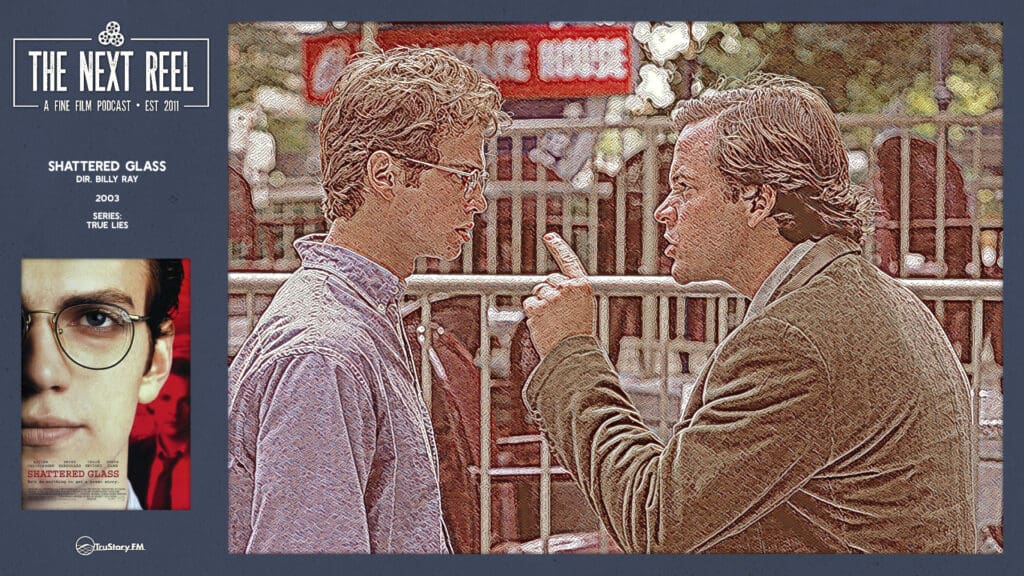
A charming voice, a confident newsroom, and a process built on trust—until the seams start to show. Shattered Glass (2003), directed by Billy Ray and starring Hayden Christensen, Peter Sarsgaard, Chloë Sevigny, and Rosario Dawson, is a biographical drama that turns journalistic verification into high-stakes workplace pressure. The conversation pulls in key context: the film is adapted from H. G. Bissinger’s Vanity Fair article, and it lands in a moment when print credibility and online reporting were colliding in messy ways. The film’s setup centers on a rising young writer at The New Republic whose work draws scrutiny, forcing editors and reporters to ask what counts as proof—and what happens when the system assumes good faith.
Join us—Pete Wright and Andy Nelson—as we continue the True Lies series with a conversation about Shattered Glass.
Why Shattered Glass Feels So Unsettling
The discussion starts with a gut-level reaction: this movie can feel physically uncomfortable, because it plays inside a world where trust is currency. Pete connects that discomfort to personal experience in journalism, and why stories like this land as more than “just scandal.”
The Protagonist Problem
Andy digs into the film’s structure: it drops viewers into the story as if earlier chapters already happened, which can scramble who the audience is meant to follow. That choice fuels a larger debate about whether the script frames Stephen Glass as the entry point—or whether Chuck Lane is the real center of gravity.
Process, Proof, And The Cost Of Trust
The conversation keeps returning to mechanics: fact-checking, documentation, and the risky moments where a reporter’s notes can get treated like evidence. There’s also a detour into bylines, credit, and responsibility—how collaboration gets acknowledged (or doesn’t) when a story goes out under one name.
Key Discussion Points
- The film as a “third act” story, and what’s lost by skipping an origin arc
- Why Hayden Christensen reads as disingenuous from the first scene—and whether that’s the point
- Peter Sarsgaard’s performance as the engine that holds the tension together
- The newsroom’s social dynamics: likability, mentorship energy, and peer pressure
- How the film portrays the fact-checking pipeline—and the holes inside it
- Online reporting as a pressure test for legacy print authority
- A subtle directing idea about shifting camera stability and whether it registers
- The film’s scale and feel: tight, talk-driven, and sometimes “small-screen” in presentation
- Parallels (and contrasts) to Can You Ever Forgive Me? in the True Lies series
- A brief connection to Spotlight and the question of institutional blame over time
Pete and Andy don’t treat Shattered Glass as an easy rewatch—they treat it as a provocative one, especially if the listener is interested in how workplaces decide what’s true. The result is part performance deep-dive, part craft talk, and part uneasy reflection on what a “great story” does to the people who want to believe it.
We have a great time talking about it, so check it out then tune in. The Next Reel—when the movie ends, our conversation begins!
🎬 Watch & Discover