Pete Wright
I’m Pete Wright.
Andy Nelson
And I’m Andy Nelson.
Pete Wright
Welcome to The Next Reel. When the movie ends.
Andy Nelson
Our conversation begins.
Pete Wright
The Hoax is over. “You are exhausted from your lies.” She’s good.
Andy Nelson
She is, yes.
Pete Wright
She’s good. She’s really good. She’s got a little bit of Melania Trump in her. A little bit. I think that’s on the brain with the Melania movie I’m never gonna see.
Andy Nelson
Yeah. Right, right, right, right.
Pete Wright
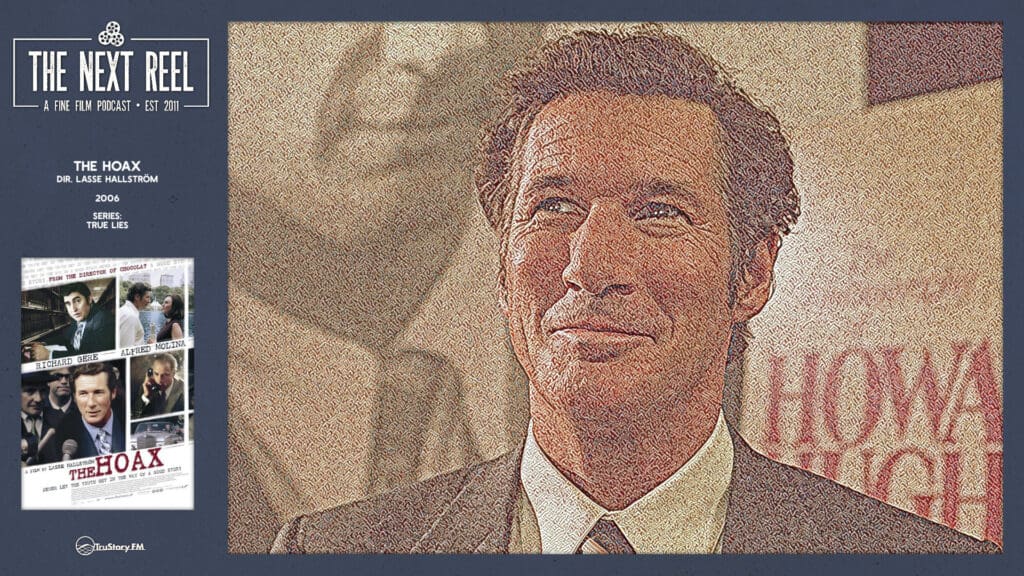
This is The Hoax. We’re talking about The Hoax. I don’t know if you’ve heard The Hoax. Richard Gere is in it. He’s really quite good. Alfred Molina, outstanding. And it’s a continuation of our True Lies series. As we keep that train chugging down the tracks. And we are talking this time about the grand con of an author who decides that he can write a book about Howard Hughes because Howard has been quiet for fifteen years in his reclusion. And so he thinks he can get away writing a major biography of this guy who’s still alive. And it’s incredible. It is an incredible story.
Andy Nelson
It’s an interesting one. It’s funny though. Like this movie, let me tell you about the last time I watched this movie, Pete. I put it on and I start it and I make it maybe halfway through and I realize, oh, I’ve seen this movie before. It’s never stuck with me. It’s funny how this actually is now the third time I’ve watched this movie and I remembered nothing about it other than the helicopter bit that starts the film and then we have later in the story returning to that moment. But it’s a film that’s always slipped out of my mind. And I don’t know if it’s Lasse Hallström, the director, and just kind of his storytelling style that has never quite worked for me with this one or what, but it’s just something that has never taken hold. And I think that’s interesting. Because I mean on rewatch I did find I enjoyed it. It’s an interesting story, but it’s just yeah, it’s a weird one for me.
Pete Wright
Yeah, no, I have no motive to push back at you on that. I actually think that you’re right on, and I don’t know why. It’s like the experience of eating a great meal and feeling hungry again 30 minutes later. Like I don’t understand it. It is also, I think, in the spirit of True Lies. It’s a little bit of a strange one because it’s kind of a clean credibility heist. It’s not like our author, the whole premise is that our author thinks he can get away with writing this biography of Howard Hughes. But it’s not as if he’s faking the information about Howard Hughes. He’s not making up anything about Howard Hughes. It’s all based on rigorous research. And in fact, imitation, trying to really embody Howard Hughes, that he thinks he can get away with this. The only thing he’s counting on is that Howard Hughes won’t talk.
Andy Nelson
Yeah, he’s really relying on that for sure.
Pete Wright
That is a massive splinter of idiocy that takes place in this movie. And I find myself not being able to quite get past the real assertion that he thinks he’s going to tell this whole story and no one from the Hughes organization is going to raise any red flags, that he’ll be able to carry off this credibility con. And that is extraordinary when I’m watching it. And I finished it and I was already very excited to move on to watching our next movie. I don’t know why that is. It’s especially because Alfred Molina is so fun to watch, right? I mean, I think he is. When I’m in the movie, everybody in here is. It is just great.
Andy Nelson
Yeah, well.
Pete Wright
I don’t know if we need to litigate why we’re both so wishy-washy on this movie, but.
Andy Nelson
Maybe not everybody. Not everybody, but I think not everybody’s actually given a great part is part of the problem. And I think that’s part of the thing. But it is an interesting story and I think they’re working at doing some things with it that could make it play, like this idea of this writer who’s kind of not doing great, he’s kind of failing in his career, and so ends up concocting this idea to say Howard Hughes reached out to me and he has authorized me to work on his autobiography with him. And I’ll be the writer. And then he pitches it to the people at McGraw Hill who buy into it and because his lies are good enough that even though there’s always some little hints of doubt that they have, and I mean they’re certainly trying to do their due diligence as far as making sure they’re proving it, but everyone’s kind of buying into these lies. And I think there’s an interesting element to that story, but I don’t know, for me, I feel like the story starts going down some interesting roads looking at our protagonist in Clifford Irving, Richard Gere’s character, in how he in some ways kind of starts adopting Howard Hughes elements in his own life. I mean he’s recording these, I don’t know if this actually happened, but he’s recording, like as they go through whatever they find as research from talking to Eli Wallach’s character, who is somebody who had worked with Hughes for a long time and had written his own book and they kind of steal it and make a copy of it before returning it without him ever realizing so that they can pull a lot of information from that. So they’re trying to get all this information and he starts recording himself doing a Howard Hughes imitation to kind of get a feel for his voice as he starts then writing it. I don’t know if he was actually doing but that, but that’s like a fascinating step into kind of just the mental space that somebody like Howard Hughes was in, this recluse who had his own mental issues that he was dealing with. And now this guy is starting to do it as he’s writing it and starting to adopt some of these elements. Like he’s starting to kind of concoct these, all these lies that he’s having, we start seeing them. Like he’s having these delusions. And so you start wondering like how far down this road did he go? And I like for me that was the most interesting part of the film. And I just don’t think it ever completely decided that that’s the story that we were going to tell.
Pete Wright
Yeah. It is interesting and you ask a really important question because I think this movie lives in a very fuzzy gray area between what is true in the large and invented in the details, right? Well here’s what I think I know. I think I know that Clifford Irving and Richard Suskind really did concoct the fake authorized biography of Howard Hughes in 71. And they relied on the fact that he was so reclusive. We get that. That we know that Irving really did forge Hughes-related letters and handwriting samples to convince the publisher McGraw Hill that the project was legitimate. We know McGraw Hill really did buy it and that they were looking at numbers up around seven hundred and fifty thousand dollars, which was enormous money at the time. After it was even announced publicly, they made a very big deal about it. We know that Edith Irving really did go to Switzerland and participate in the Swiss banking portion. All of that is true. We know that Howard Hughes did eventually come out and publicly deny involvement and collapse the project entirely, and that real people went to jail. Right, both Irving and Suskind, did go to jail for a while. We also know that the movie leaves out, apparently, a large part of the story itself, that the real life story was written in Ibiza. I don’t know why he spent a lot of time in Ibiza.
Andy Nelson
He had a home there. Like that’s where he lived part of the, yeah.
Pete Wright
Yeah, well that’s where most of it happened.
Andy Nelson
Yeah, right.
Pete Wright
But and so maybe that made the hoax I just don’t know what role that played in making the hoax more feasible. Maybe it’s just distance is easier. We know that even Irving himself said that a lot of the character dynamics and incidents and things that are fictional. The movie showcases like Irving and Suskind fighting and Suskind getting drunk and hiring the woman in the bar to seduce him and that was apparently faked. The movie’s idea that Hughes’ team shipped him a box of files and dirt on Hughes and Nixon was made up for the movie. That’s a really big deal in the movie. Like that’s a really big, culturally resonant point to have made up for the movie. The Watergate Nixon stuff is, the premise is that the writing of the book unearths this connection between Hughes and the unions and all of the things that Nixon is dealing with, and that all of that in the movie is presented with such this dramatic flourish. And apparently that causal chain that is sort of presented in the movie is not as strong as I think maybe the filmmakers wanted it to be implied. That’s what I, those are all the gray area things, which I think are really important in the degree to which I take this movie as a true lie story.
Andy Nelson
Well yeah, and I think a big part of the trick of telling a story like this is, these are stories about real people and you’re gonna be running up against any story that’s based on real people. The screenwriter, the filmmakers, the producers, the production company, everyone is gonna wanna find ways to tell the story to make it dramatically interesting so that they can sell it as a movie. And inevitably that means that there are going to be changes. And are the changes made for the better or not. Like did they help it or hurt it?
Pete Wright
I just want to ask you that question because I think it’s a really good one. Do you think the political connections to the writing of this book, the connections to Nixon, make it better?
Andy Nelson
That to me is the most interesting part of this film. Like that’s the reason that I find this interesting because you’ve got these massive power players. Ostensibly using this situation. Like the way that the film portrays it is Howard Hughes doesn’t want to come out and talk to the press and take Irving to court. This is Irving’s pitch. Because he is gonna owe millions of dollars because of the whole thing that’s going on with TWA. Like that’s kind of his pitch, is this is why I’m safe. This is what happens when you’re dealing with people with massive amounts of money and power and influence and control. The pitch is that Hughes’ people ends up sending this box of material to Irving that he supposedly wants included in the book. And it’s all about these donations and everything that he has made to Richard Nixon and his brother and all of these other people showing how corrupt the system is to bring Nixon down. That’s kind of the pitch that we get with the arrival of this box. And what Irving realizes is that Hughes wants to take down Nixon because Nixon is not helping him with this TWA thing. Like he’s stopped providing any governmental support. And so now this is his way to get back at him. What ends up really happening is it’s just his way to get Nixon back on his side and suddenly Nixon starts helping Hughes again. And so Hughes just then he goes back to denying the whole thing. Like the whole thing is just this power play amongst these massive people and Irving is just a pawn in the middle of it. Like that I found as the most interesting part of the story. And it’s treated as such a minor part at the end as we kind of come to it in Act Three. And I was just like I don’t know. That’s what made the whole thing interesting for me. Now when you come and say that it sounds like that might not have been as dramatic or as important an element in the realities of everything going on there. I think that’s kind of interesting and in a way I guess disappointing because I think that they introduce something that’s really interesting and then to know it’s like maybe not actually even that big part of the story, then it’s like, hmm, well, okay, then I like this even less.
Pete Wright
Yeah, I, that’s my biggest problem with it is that I actually think there is enough story in here about the core sort of A story itself, about the fact that this guy was able to successfully con an entire publishing infrastructure to give him directly massive amounts of money to write a book that is ostensibly based on truth, right? If he had just pitched it as a biography it may have actually outlived him or as a piece of his work. He’d written a whole bunch of books. The guy was actually a prolific author. And this one, because he pitched it as an autobiography, because he pitched it as having access to this reclusive loon, everything fell apart. There is something to the fact that this guy could actually write a book, that he could do the research, that he had partnership with Richard Suskind to create compelling cases for why this guy exists and, you know, his cause celebrities in the world, I think he could have made a good book. He probably couldn’t have sold it. And that’s the most interesting story to me, right? That I thought it was fascinating when there’s a whole sequence where he’s met with Howard Hughes’ Goon Squad, right? They’re his personal secret police, which was largely invented. It is not real. It’s presented as a framing device around Irving’s paranoia, and eventually it is, I think in the film, it outs itself as saying this was fake.
Andy Nelson
It doesn’t immediately. It doesn’t immediately.
Pete Wright
It doesn’t immediately. It’s at the very end that you see it’s a trick of the camera where it’s revealed that he’s talking to someone who’s not there. My goodness. It is so frustrating as a viewer to see that when so much of what I embodied as truth in this movie is a rug pull. I think there was enough story. They added too much thriller sauce. And that was the stuff that I think they got me hooked on. And I think that’s problematic.
Andy Nelson
Well I think that’s funny because I don’t think there’s enough story here with him and the book that he’s telling. It’s like, okay, he’s just another shyster who’s pitched to these people to do this thing. And I just don’t, I think that’s what I find the least interesting in the story. And the whole thing with his delusions and everything, like the way that he starts falling down this rabbit hole of becoming Hughesian in his own mind, he starts seeing himself as more grandiose and bigger than he really is. And like all of that sort of stuff I found much more interesting. And I like those thriller elements. I mean, yeah, it falls into Beautiful Mind a little bit as we kind of go down that rabbit hole, but I just didn’t think that the other story was as interesting. Like I just kind of like, okay, yeah, he’s just making all this up and here we go again. And I don’t know, I just didn’t like it as much. I think that’s my problem.
Pete Wright
Do you think that we’ve oversaturated, collectively, you and me, our ability to watch these movies without being woefully too cynical. Or is this, are we numb?
Andy Nelson
Well, I mean I think there’s some of that because these are, I mean it’s a series that’s by design gonna be difficult because the protagonists are just hard people to like. I think that’s just part of the design. But I also think like just based on my previous experiences with this particular movie, like I just don’t think this movie holds up as well. Like I don’t think it’s as strong a film. And I think that there are interesting elements here, but I and I think the performances are great. I just don’t think that I don’t know. I don’t know the book and I guess that’s part of it. And so I don’t know how much they felt that they needed to change. And I just don’t think that for me that they ended up finding the story that ended up making it work for me.
Pete Wright
We have been talking about a number of consistent elements that exist in these movies, and I want to just pick up the thread of a couple of these things with you before we move on. First of all, the origin story versus the third act problem that we have been given in the past. Shattered Glass gave us the third act frustration where we didn’t see enough of Stephen Glass in order to feel for him as the movie ended. Do you feel like this movie gives us enough origin story to satisfy Clifford Irving’s motivation?
Andy Nelson
Well, I mean, we definitely get it. It’s in here. We see him getting frustrated that his book is getting rejected. I mean everybody just hates it. So even after being told that it’s oh this is just a formality that we have to go through this process, but you’re totally getting published. Like he’s told all of these things, and then it’s totally not getting published. And so.
Pete Wright
Based on one review.
Andy Nelson
Yeah, based on one review and then the fact that I don’t know if it’s McGraw or Hill who read it, but whoever that guy was, he read it and also just was like, nope, we can’t do this. And so he’s feeling very frustrated and so I don’t know. I guess I’d say we’re seeing it. We’re seeing more of it. But I do think it’s interesting because when you read about Clifford Irving, he is frustrated himself that the film portrays him as this kind of struggling, failing writer with all of this. And I think that’s, I don’t know. I well, I mean, to that end, it makes you wonder like what would be the motivation otherwise to have him in a film decide to do this just for the excitement of being able to get away with it. Like, I don’t know. But as it stands, the film gives him the origin. Like we have all of that set up. I don’t think it’s that interesting, but we do have it. So as opposed to Shattered Glass, I think we’re getting a more full rounder story of Clifford Irving here.
Pete Wright
So you already teased the next question, which was the spectrum of motivation, right? Because Lee Israel in Can You Ever Forgive Me?, the whole thing started out of financial necessity, right? She needed money for medication for her cat. Mark Whitaker, his motivations were, I don’t even know. The bloom and onion of lies they’re just stacked one on top of another. But ultimately it was theft. He was taking money, it was economic.
Andy Nelson
But that was more greed rather than need.
Pete Wright
Yes, right, right. Greed. Where does the motivational thread for The Hoax lie with you? This desperation versus ego versus greed versus love. How do you classify Clifford?
Andy Nelson
I think that we’re in a place where I think we definitely are seeing a greedy person who wants the money, but I don’t think it’s just about money for him. I think it’s also about his social status. Like I think there’s a sense to just being more important and being in this place where he’s recognized as a successful great writer. But I think also it boils down to a psychological need that he ends up having. And this is where I think the story is more interesting, is that psychological need to do it. And I think that having him the way that it portrays him, almost needing to know that he’s been able to pull it off, right? Like I think that’s kind of where it ends up being most interesting for me. And but and that’s what’s interesting, because it doesn’t set it up that way. And that’s I think the problem of the story because they set it up like a financial, I’m a failed writer, and I need to come up with something great so that I can sell my next book. And it doesn’t sell the psychological, but that ends up being the one that actually is the most interesting.
Pete Wright
All right, we’re going to take a quick break, but first you can find the show on YouTube and you can join us live when we record. We’ll even take your questions in the post-show chit chat. Live, everyone’s welcome, and members get the replay and the extended cut. Subscribe to The Next Reel on YouTube. The link to this episode is in the show notes. We’ll be right back.
Pete Wright
Lee Israel, we thought was caustic and hard-edged words that we used about Lee, not a sympathetic protagonist. Stephen Glass was largely insufferable, super annoying, creepy friendly. Mark Whitaker keeps us very much at arm’s length. I don’t think we generally like him as a person either. The thing that’s different about The Hoax is that Richard Gere is enormously charismatic and he portrays part of the con centers on the fact that eventually his charisma plus his tenacity allows him to sort of convince everybody that this thing is real. But do you ever find yourself thinking, okay, compared to the other three that we’ve already talked about? Yeah, I think he’s sympathetic.
Andy Nelson
Well, again, and this is tricky because I feel like the filmmakers don’t find much sympathy with him as a character. And I think that’s why they largely went down the greed road more and the want to prove that he could do this. And I think Richard Gere pulls that off. But I think the mental state of him is the part that I think is more interesting. And I just, yeah, I don’t know how you read it.
Pete Wright
It is a complex sort of melange of feelings toward this character because the first half of the movie I find that Gere is able to convince me that he’s a character worth watching, but never quite worth liking. I find his enthusiasm for committing this crime. There is a sequence where he’s explaining it to Suskind and he’s saying, you know, we’re gonna get away with this because. And he lists all the reasons this is going to work. But the premise of all of those reasons is that he wants to get away with a crime and he’s super enthusiastic about pulling off this con on the world. And that enthusiasm is off-putting. Everybody else, whatever you say about the end result, they got there for a different reason, right? Whether it was financial or ego or mental health or whatever. This guy got there just because I think he wanted to see if he could pull off this con. And I find that maybe the least likable reason to do it.
Andy Nelson
Yeah. Right, yeah. It’s the most despicable reason to actually do it.
Pete Wright
One of those things that makes these movies hard is because if this had been presented as a work of fiction, I may have liked it more.
Andy Nelson
Yeah, and I think that they could have played around with it to kind of give us a little bit more with how they did the script. This is one especially like when you look at what Soderbergh did with The Informant! as far as changing the style and doing this real kind of satirical comedic style to tell the story. Like this is one that really could have done something more and taken it deeper down this road of his mental state. And as we kind of explored that, we could have gone and done something much more interesting. But I just, I just don’t know if it gets there. And he has this false bookend moment that we have starting with the helicopter as we’re waiting for this potential Howard Hughes helicopter to arrive on the rooftop here, it’s like, did we need to start with that? It doesn’t really set anything up that’s that interesting or exciting. And so I think that he cast Richard Gere, which is a great choice because he’s very charismatic, but I also struggle to like him. I mean he’s cheating on his wife and his logic is all just, the way that he sells everything and then we are watching him tell these lies to his wife and it’s just like it’s just frustrating because it’s very hard to ever really care much about him as a character. Like of the characters, Alfred Molina as Suskind I liked much more. That for me, I don’t know. I don’t know if you could have made the story work, but tell it from Richard’s perspective. Make Richard the protagonist as this character who’s brought down by the charm of his friend and who ends up getting trapped in it because of that.
Pete Wright
I hadn’t thought of that, Andy, but that may be your greatest gift of podcasting about movies. I would have vastly preferred to see that movie. That perspective shift, I think, unlocks so much because you get a character who is allowed to openly feel regret for his own actions and to be motivated by his need to be in this relationship with his friend, but also his need to be a good person and realize that he’s gone too far down the road. And that at one point he looks at his friend and says, I want co-credit. This is very similar to what we looked at in Stephen Glass, where we wanted a shared byline. And the primary author says, no. It’s sort of a disgusting act of ego that we get to watch. I think the perspective of Richard Suskind would have been, and especially as played by Alfred Molina. I’m 100% with you. He’s my favorite thing in the movie. I think he is capable of portraying that sort of weirdly jailed emotional nuance would have been much easier to watch.
Andy Nelson
Yeah, yeah.
Pete Wright
I have made a point in all of these movies that I do love research porn and forgery porn. And we do get some of that. It is remarkable to me how easy it is for people to just forge stuff in this period, to get away with making passports and forging handwriting that fools people. Which just makes you think, oh, we’re, how many other tent poles of society were built on handwriting experts saying, yes, that’s the real deal when it wasn’t?
Andy Nelson
Yeah. I mean entire industries have that issue. I mean, any of these collectible issues as we kind of dealt with in Can You Ever Forgive Me?, like that’s a huge thing is authenticating signatures and everything. And then in this like authenticating the voice of Howard Hughes with the previous person, the last person who had worked with him, like what was it, fifteen years before or whatever that was, yeah, who had like fifteen years prior had been the last person to actually have interviewed Howard Hughes and he reads the manuscript and just is like, oh man, this is that’s absolutely Howard’s voice. This is genuine material. Like that’s again being able to pull that off. And I think that’s what’s interesting. And again, I think that speaks to an element that we’ve mentioned, but we haven’t touched on that much. But it’s the desire of this system to buy in, right? Like this entire system wants to believe it. This publishing machine wants these lies to be true because they want this product because they see millions of dollars on the other end of it. And I think that’s, I don’t know. Another fascinating element of the story is that con that they buy into. And I don’t know if they’re doing their own con, but in some way they are, because they’re trying to find these authenticators that will prove that these lies are true. And it’s like it makes you wonder, does Hope Davis like, they waffle back and forth so often in the story about should we trust Clifford? Is he telling us lies? Oh no, it’s not a lie. Oh, maybe it is a lie. Oh no, it’s okay. It’s not a lie. Like that happens so many times in the story. It makes you wonder if in their heads they just didn’t believe it, but they just were happy to have proof that it was okay.
Pete Wright
Oh yeah. Yeah. Well you see it every turn and that’s why when I say that I think getting rid of the political stuff that there is enough movie. What you’re describing is what I want more of, right? I feel like they just teased at the McGraw Hill mechanism of performative complicity, right? They just wanted and needed so badly for these things to be true that they were willing to do anything. And they needed it to be true not because they needed to trust their author. They needed it to be true so that they could justify this massive investment and what hath capitalism wrought again? It is this institution that needs to swallow itself in trying to make the unreal real. So I find it extraordinary. I think if you apply the Soderbergh approach of lampooning these institutions, I think you could have had a really funny movie that deals with the business side being as ridiculous as the actual con artist. I think you’re right on that they are conning themselves. You start to wonder who’s exploiting whom. At some point, they end up being the grand exploiters. And it’s gross. Like it’s just gross. And I think everybody in that office is actually really good. Now you said a minute ago, 30 minutes ago, that not everybody in the film was appealing to you. Who did you have trouble with?
Andy Nelson
Well, and again, I don’t necessarily think that it’s the performers themselves. I just don’t think the script is strong for Julie Delpy is my primary frustration. She’s a great actress, has done a lot of great performances. And here it’s just like she’s just, you know, treated as this side character that he sleeps with. And I think it was actually his former wife that he was reconnecting with. And I just, it just they didn’t give us enough of that story to really to do much. And because of that, she’s just really flat. And I just was like, I wanted more of that relationship and more of that. The draw to her and everything. Because really all we have as a connection is when she comes in that first time, we get kind of just ridiculous, I didn’t like the filmmaking of it, but just the freeze frame photo flashes on her when it just kind of slow and it turned black and white and everything and I’m just like, okay, is, does he know this person? Is she some princess that he’s infatuated with? Like what’s the connection here? Is it just like oh I’m gonna sleep with that woman, sort of thing. And then it turns out they’ve known each other. And so that whole thing, I just I didn’t like the way that their story played. And so that for me is the most frustrating of all of them.
Pete Wright
Yeah. I agree with that. I think she was underused. She was overcast for being so underused. And I don’t know, it’s not the first time we’ve seen that challenge. I do think that I didn’t have a problem with how she was revealed. I thought that these sort of provocative tension of he’s either going to sleep with her or he’s already slept with her and he’s nervous about being in the same space as her was enough for me to wonder what’s gonna happen next. So I didn’t have that problem. The fact that she only got one scene with him later is problematic. Like she did not have enough to do. And I guess they needed her to have this other person who could reveal that he was a con. But it’s frustrating to reveal that he was a con. And he’s so egotistical, he was so proud of the con that he was telling people in his life that he was doing this, that way too many people knew for it to be beyond the shadow of a doubt.
Andy Nelson
Yeah. Yeah, and so Delpy really feels like more an instrument for Irving. And to a certain extent Edith also feels that way. Marcia Gay Harden’s character feels that way largely until the point where he’s slept with, until she gets that letter. She gets the mail and sees the letter from Julie Delpy’s character to Clifford. Like from that point on, Marcia Gay Harden became more interesting. Before that, like I was just kind of bored with her. She didn’t do much for me. And even Hope Davis, I like Hope Davis a lot, but she definitely feels like, I mean, it’s not that different from anyone else in the office, but they feel like instruments of Irving’s stress. And that’s largely what we get with the female characters in the story. They’re just, I would have liked to have seen more with them.
Pete Wright
Yeah, I agree with that. Hallström. Lasse Hallström. Where do you stand on the Hallström canon?
Andy Nelson
An interesting director. I find a lot of the films to be enjoyable and worth a watch. But at the same time I think that he hits these points with some of the films, especially most recent, the more recent films, as ones that I just find a lot less I don’t have as much interest in even watching them. But like I think the first part of his career I found more interesting. My Life as a Dog, What’s Eating Gilbert Grape. I mean Something to Talk About was okay. It wasn’t like a favorite of mine. The Cider House Rules I really enjoyed, show a lot. But then after that, like The Shipping News, Salmon Fishing in the Yemen and The Hundred-Foot Journey, I’ve just I don’t know, I’ve never been drawn to checking those ones out.
Pete Wright
A Dog’s Purpose? I couldn’t I couldn’t do it.
Andy Nelson
I am trying to remember that one. A Dog’s Purpose.
Pete Wright
That’s the one with Josh Gad and Dennis Quaid.
Andy Nelson
Oh, wow, yeah.
Pete Wright
I don’t remember which one played the dog. Maybe it was Josh Gad.
Andy Nelson
I yeah, I don’t know.
Pete Wright
Is that telling?
Andy Nelson
I well in Hachi: A Dog’s Tale, I think is just one of my favorite dog movies. Like that’s just a fantastic one that is absolutely worth talking about. And I mean, but it’s such a surprise that suddenly he’s directing The Nutcracker and the Four Realms because it’s like, okay, that’s just a sign that you’ve kind of fallen off the map. And this one from last year, The Map That Leads to You, I didn’t even hear about that one. Did you?
Pete Wright
I didn’t. And it’s on me, but I haven’t heard of the people who are a part of it. I don’t know what that’s about. That seems like at this point in Lasse Hallström’s career, what is this movie doing?
Andy Nelson
I think it was a straight to Amazon Prime rom, like a romance drama sort of story. So probably not as much something we’re gonna be drawn to, but.
Pete Wright
Yep, that makes sense. But it’s over six, right? It’s over a six on the IMDb six star rule. So it is watchable, apparently.
Andy Nelson
Yeah, so I mean I like Hallström, but I also don’t know and it I think this story fits into kind of the Hallström groove as far as being drawn to stories about people. Like it’s very much a filmmaker who tells stories about people and that. And this kind of fits right into that. I’ve never really found much in the way of Hallström’s style as far as the look of the stories. I think Hallström is just kind of somebody that tells the story the way that he feels the story needs to be told. But again, like things like the flash and stuff at this, which felt a little more playful cinematically. I just also don’t think it worked into the story as well.
Pete Wright
Yeah. Yeah, I agree with that. And I, this is I think this is all me. I watched this with my wife who had never seen The Aviator. I watched this thinking, I think this movie wants you to have seen more about Howard Hughes. And I forget when, you know, when this came out, maybe Howard Hughes was more in the, I don’t know, the gestalt? People aren’t talking about Howard Hughes that much anymore.
Andy Nelson
Well The Aviator did come out two years before this did, so yeah.
Pete Wright
That’s what I’m saying.
Andy Nelson
Yeah.
Pete Wright
Like, does this presume you’ve seen The Aviator too much to care about Howard Hughes so much that we care about this story, that we care about Howard Hughes’s sort of vacant role, his negative space role in this movie.
Andy Nelson
Well, it does make me think that this film may not have gotten made at all if The Aviator hadn’t played, had hadn’t been a success a few years earlier. Because I don’t know if the public had as much the modern public had as much knowledge about who Howard Hughes was, what he did, his role in so many different parts of society and all of that. And so I think that this film does kind of in some ways rely on the fact that we’d all seen The Aviator and had a sense as to just how reclusive and peculiar Howard Hughes was so that we could immediately understand that. Because I don’t think that it really, I mean, they talk about him enough where you can kind of if you didn’t see The Aviator or you didn’t know anything about Howard Hughes, I do think they talk about it enough so you get a sense, okay, it’s just this reclusive guy who has contracts with TWA and the government, ties to the government and stuff, you know. But so I don’t think it’s necessary, but I do think that those help.
Pete Wright
Well, and there are some great sequences of Howard Hughes looming over sequences in the movie, right? When he goes to the press reveal and he has to stand up and talk about it. There’s this big Hughes picture behind him. Really, I think they do use Howard Hughes well. Side question, have you ever seen the Spruce Goose?
Andy Nelson
The actual one? I’ve never seen it.
Pete Wright
Yeah. Andy, next time you come, we should go see it because it’s here.
Andy Nelson
Oh, it is? I thought it was in LA. I guess I just assumed it was because that’s where.
Pete Wright
When I saw it, it was I think it was, I was a kid and we went the first time I saw it, we saw it. I think it was still in Los Angeles. But it is at the Evergreen Aviation and Space Museum in McMinnville, Oregon right now. And it is a very cool display. It’s like the Spruce Goose, and under its wings are dozens of other airplanes that are museum caliber airplanes. It’s very cool. So, you know, for my locals, go see it because it’s an amazing piece of engineering, the Spruce Goose.
Andy Nelson
Hmm, interesting. I mean your point about Hughes is interesting because the way that the film kind of creates this presence of him without him actually being a character in the film. It does work as far as I think that is a nice connection the film makes to Clifford as far as this presence that is kind of becoming a part of him, or he’s maybe wanting it to become a part of him and he’s trying to absorb some of the craziness of it and all of that to give more of that essence to the writing, which apparently he did well. But I think that it does start kind of create that shadow world that he’s living in here. And especially when we get in, and again, I like it so much, those moments where we’re getting his goons taking Richard Gere and flying him to Bermuda or Nassau, I think is where they take him to grill him and all of this sort of stuff, throw him out of a hotel window, all of that sort of nonsense that ends up being fake. But the way that Hughes ends up becoming a character in the film without actually being a character in the film, I love that. I think that’s a great way to tell this story of this person who’s actually trying to tell people that he’s working with him.
Pete Wright
Yeah, yeah, I think, yeah I think the highlight for me, especially knowing how much was movie fabricated, was Gere’s performance and effort to embody Hughes and start to sound like Hughes on tape. Those sort of performative tricks I thought were outstanding. I loved watching Gere just do that work. How well does that necessarily help the case of the movie? I don’t know, but I was in it for that stuff.
Andy Nelson
Yeah. Yeah, it’s pretty interesting. It did make me wonder if his trip with Suskind to Nassau earlier in the film when Hughes also ended up coming down, forcing everyone to have to leave the hotel and go to a different place, because according to the story, Hughes kicked everyone out of the hotel so that he could have it all to himself and only on the top four floors is where he actually stayed. And they ended up in some little, you know, small hotel off to the side. It makes me wonder if that actually happened. And that was the, because the movie portrays that as the instant that he kind of clicks and goes, oh, this might be the story that I can fake.
Pete Wright
But seems so weird because this is an example of Howard Hughes actually not being reclusive, right? Because he actually comes to this resort and kicks everybody out. Which implies Howard’s there. So Howard exists. He hasn’t died. He’s actually there. And that’s when Clifford Irving decides, oh, I’m gonna write a book because he never comes out.
Andy Nelson
Well, but he never speaks to anybody. So yeah, I mean I can see your point, but that’s one of those where it’s kind of wishy-washy in the way that they’re handling it.
Pete Wright
Wishy washy is the word.
Andy Nelson
Yeah, yeah. Well, yeah, I mean it’s an interesting movie, I think. I don’t know. I’d be curious if people revisited this one. What works more for them? Is it the story of Clifford and the publishers and that’s the story that they want, or more of Clifford going down this Hughesian rabbit hole and becoming more like him and having all these delusions of his own. Like what version of the story works best in people’s minds? I’d be curious to find out what people thought.
Pete Wright
Yeah. And and how much does it matter to others more than, you know, because to me it did end up mattering. It did end up being important that the stuff that I did find myself really liking was the stuff that was mostly fabricated. That’s frustrating when this is presented as a true lie story.
Andy Nelson
But see, then that’s what’s interesting because you know, this is what makes that even more frustrating because Clifford Irving, the actual authority, came out and said, why did they make up the sending this box of files to me? But this is Clifford Irving who made up this whole book. So can we even trust that to be a fact? Like, see, that’s another thing.
Pete Wright
That’s a good point.
Andy Nelson
It’s like, I don’t know. I mean, it seems like it, it makes sense. So I don’t know. The fact that he already has proven to me that he’s not to be trusted makes me not trust anything that he says.
Pete Wright
Yeah. Yeah, I think that’s it.
Andy Nelson
So and it’s interesting for filmmakers telling these stories, they’re like, they’re probably just like him. It’s like, hey, he’s a fabulous, he’s making all this stuff up. We can do whatever we want, because even if he says that it didn’t happen. Who are we to say that it didn’t?
Pete Wright
Well, okay, wait a minute, because that’s a really good point. I think when you go back and watch Shattered Glass, by the time you get to the end of Shattered Glass, what you get is a presentation of what we know from outside investigation to have happened, right? Whether you trust Stephen Glass or not, the experience of Stephen Glass’s impact on the publication is the story. And that I feel like I can trust more than I can trust anything in The Hoax. Does that make sense? Right? I think that, from that perspective, as a filmmaker, is the obligation to take this story and make it more fabulous? Or is it to just tell the story and the impact on the people that these lies had? And I, that’s what I mean by like The Hoax had a massive and very expensive impact on the publisher. That was the story, is the relationship between the publisher and the fabulous writer that Irving ended up being. Not this the sort of made up Hughesian stuff. It just went too far. I think it actually would have been even better had we not heard Hughes at all. Like the movie ends with the last time Hughes made any sort of public presentation by way of a speaker phone in front of Congress and I think it might have been better had we not heard Hughes there. Had it just all been the relationship between this liar and the company that bought it. There is a lot of story in there that I think is fascinating, and I think the movie does itself a disservice by making more stuff up.
Andy Nelson
Or did they?
Pete Wright
Damn it, Andy!
Andy Nelson
This story along with Can You Ever Forgive Me?, are both based on books written by the character, written by the person. So how are we to trust them? And I’m not saying I’m not saying that Shattered Glass or The Informant! don’t have their own issues and inconsistencies with the actual truth of the stories, but they are based on writings by outside people who did work looking at the stories to figure it out. Whereas Clifford Irving wrote this book.
Pete Wright
Yeah. Yeah. And you’re absolutely right. By the end of The Hoax, and Can You Ever Forgive Me?, the books, you’re presented with this argument. Do you believe these people who made everything up before then to get to the point of writing this book and now be truthful?
Andy Nelson
Yeah.
Pete Wright
Oh my God, Andy.
Andy Nelson
See, I know. It’s an Ouroboros.
Pete Wright
Yeah.
Andy Nelson
Yeah, we’re trapped in it.
Pete Wright
It is. That’s where we are.
Andy Nelson
All right. Well, it’s about time for what we call the back half. But first, let’s take a quick break.
Pete Wright
The Next Reel is a production of TruStory FM, engineering by Andy Nelson, music by Tzabutan, The Magnetic Buzz, Oriol Novella, and Eli Catlin. Andy usually finds all the stats for the awards and numbers at the-numbers.com, boxofficemojo.com, imdb.com, and wikipedia.org. Find the show and the full archive at trustory.fm and you can follow us from there too and learn about membership. Check out our merch store at thenextreel.com/merch. And if your app allows ratings and reviews, please consider doing that for our show. All right, Andy, how’d it do award season? Get any love?
Andy Nelson
Not much. Tiny tiny bit. One win with three other nominations. At the Golden Camera Awards in Germany, Richard Gere won Best International Actor. At the Satellite Awards, Gere again was nominated for Best Actor in a Motion Picture, Musical, or Comedy, but lost to Ryan Gosling in Lars and the Real Girl. Alfred Molina was nominated at the London Critics Circle Film Awards for Best British Supporting Actor of the Year, but lost to Tom Wilkinson and Michael Clayton. And last but not least, at the AARP Movies for Grownups Awards, Gere was nominated for Best Actor, but lost to Chris Cooper from Breach. Coincidentally, directed by Billy Ray.
Pete Wright
Oh, love Billy Ray. How did it do at the box office? Did it get any numbers love?
Andy Nelson
Well, for his true-ish life tale, Hallström had a whopping budget of $25 million, or $38.2 million in today’s dollars, which kind of seems insane for a movie like this. The movie opened April 6th, 2007, opposite only one other new release, Tarantino’s and Rodriguez’s Grindhouse. Even with that, this could not crack the top ten, landing in sixteenth place, where it stayed for three weeks before slowly fading. In the end, the movie earned $7.2 million domestically and $4.6 million internationally for a total gross of $11.8 million, landing as a box office loser. The film ended up with an adjusted loss per finish minute of nearly $175,000, the third of Hallström’s films to lose money after his huge success with Chocolat. At least his next one would break the curse, that of course being Hachi.
Pete Wright
Yeah, wow. That’s not even an on-the-fence kind of loss. That’s serious. Okay, well, look, I’m not gonna say this is a bomb of a movie for me personally. I think it’s interesting, but maybe only as interesting as it is as a part of this series. I think it is an important movie to the series because it’s not necessarily asking whether Clifford Irving is this lying monster, but it’s telling us, look, there’s a whole ecosystem that is inviting Clifford Irving to become a monster and to embrace doing things that he maybe knows aren’t right. I’m, of course, giving him more credit than he deserves as a way to segue to next week’s movie, which I can’t wait to talk about. Oh my God. Because it is a perfect tie-in to this one. So I’m glad we talked about it, even if I didn’t love it. And there’s a lot going on that I appreciate.
Andy Nelson
Yeah, it never sticks for me. Even on a third watch. I think it’s because the way I see it, it seems less interested in who Clifford is than how long he can keep his lie going. And for me, and again, is that the difficulty of the premise of these stories? You know, like do we want to know more of who Clifford is. Like it starts getting into that. And then I think it just never quite gets there. So it’s well acted. It’s an interesting kind of credibility caper, I guess you could say. There are some real moments that seem like the complicity. Like I like where we’re getting into that. I like the deeper psychological and political versions that it touches on, but it never quite actually gets to do any of them, I didn’t think.
Pete Wright
Yeah, yeah.
Andy Nelson
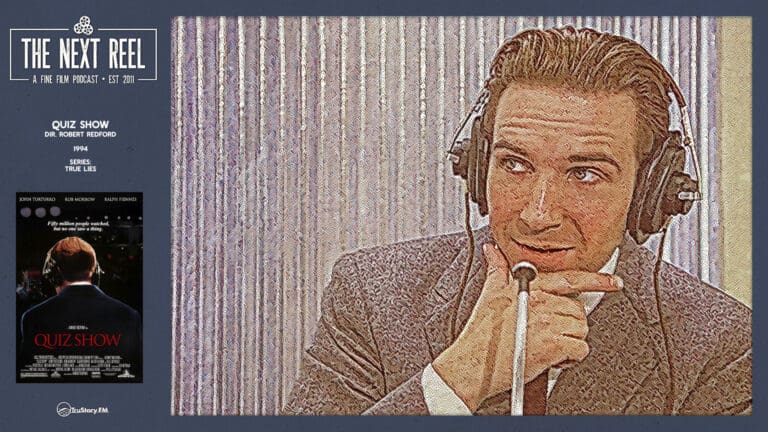
So all right, well that is it for our conversation about The Hoax. Next week, as Pete was alluding to, we are looking at Quiz Show, the story of the 21 quiz show game fixing scandals in the 1950s. Directed by Robert Redford, starring Ralph Fiennes, John Turturro, Paul Scofield, Rob Morrow, and David Paymer. And Martin Scorsese, actually. All right, let’s do our ratings.
Pete Wright
Letterboxd dandy. Letterboxd.com/thenextreel is where you can find our HQ page for all the reviews and ratings we’ve done. What are you gonna do for this one?
Andy Nelson
You know I fluctuate with this one, I struggle with the film so much. But I do think there are great elements, namely Alfred Molina. And I mean I think Richard Gere is delivering a strong performance. I’m going to say two and a half right up the middle. And no heart, I think, is where I’m going to land with this one. Too often too forgettable.
Pete Wright
I think you and I are in similar space, but I am going to give it three stars, no heart.
Andy Nelson
Okay. Well that averages to two and three quarters, which will round up to three stars, no heart. And you can find the show on Letterboxd at TheNextReel. You can find me there at SodaCreekFilm and Pete at PeteWright. So what did you think about The Hoax? We would love to hear your thoughts. Hop into the Show Talk channel over in our Discord community, where we will be talking about the movie this week.
Pete Wright
When the movie ends.
Andy Nelson
Our conversation begins.
Pete Wright
Oh Letterboxd giveth, Andrew.
Andy Nelson
As Letterboxd always doeth.
Pete Wright
Okay. We should just say, as a note, one person has this movie as one of their top four in Letterboxd. Just one person. They count themselves as a fan of this movie.
Andy Nelson
Yes.
Pete Wright
Which seems like a small representative sample.
Andy Nelson
Yeah, seems about right.
Pete Wright
Yeah. What did you come up with?
Andy Nelson
I went with a two-star, two-stars no heart by Stringer Bell, just because it feels like my thoughts. Saw this at the world premiere in 2006 and never thought about it again. It’s a film that goes 30 in a 100 zone. Meh.
Pete Wright
Do you think that’s really Idris Elba, Stringer Bell, writing that?
Andy Nelson
Is Stringer Bell, I guess I don’t know the Stringer Bell reference.
Pete Wright
Oh, Stringer Bell was Idris Elba’s character in The Wire.
Andy Nelson
Oh, yeah. I still need to watch that show.
Pete Wright
Oh, Andy.
Andy Nelson
I have a whole story with that. We don’t need to get into it right now, but yeah.
Pete Wright
Okay, I’ll just say turn on the subtitles, because man, those Baltimore accents are tough down on the waterfront.
Andy Nelson
Yeah, yeah.
Pete Wright
All right, well I’ve got a three and a half star from JBird who gives us a little poetry. Irving thinks he’s such a curator, hoping his book would be greater. So he’s caught in a lie because he would try to write about The Aviator.
Andy Nelson
Aw.
Pete Wright
And scene.
Andy Nelson
Little limerick, there you go.
Pete Wright
Yep. Thanks, Letterboxd. You’re the best.