Pete Wright:
Okay, everybody, sit. We have one hour. In a few minutes, three men are going to sit at microphones and answer questions about Facebook. They’re under no oath whatsoever. That’s the good news. Steve Sarmento, Tommy Metz III, Justin Jaeger. Ground rules. Nobody says “algorithm” more than 40 times. If anyone asks whether you’ve seen The Social Network, the answer is yes, it’s better, and we’re moving on. And Tommy, we have hired an agency to make you more likable. Please let them work. And for the record, when I say no, that’s the end of the debate.
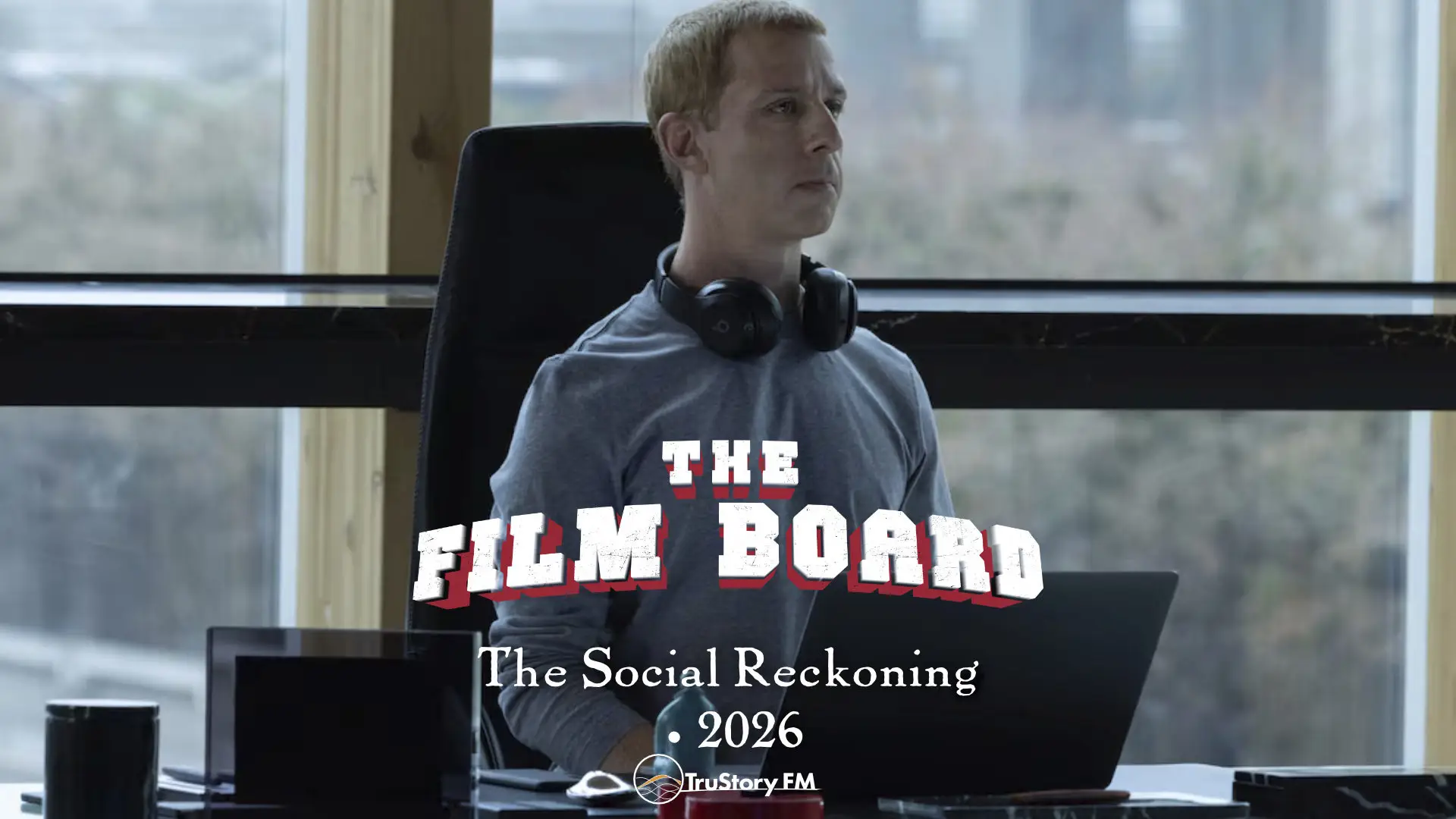
I’m Pete Wright, and this is The Film Board, our monthly round table on new release films just hitting theaters, part of The Next Reel family of film shows. This month it’s The Social Reckoning, Aaron Sorkin’s companion piece to The Social Network. Mikey Madison is whistleblower Frances Haugen, Jeremy Allen White is The Wall Street Journal’s Jeff Horwitz, and Jeremy Strong is Mark Zuckerberg, who has also hired an agency to make him more likable. It did not take. Sorkin spends two hours arguing that nobody at Facebook had a hand on the wheel, and then he ends on an afternoon somebody finally grabbed it, and yoink! We have thoughts. Full spoilers ahead, including the film’s recreation of January 6th. So, yay!
Hello, everybody. Hi, how are we doing? Are we socially reckoned? Do we feel good? JJ, Steve, Tom?
Tommy Metz III:
Excited to be here.
Justin Jaeger:
Yeah, yeah.
Tommy Metz III:
Thank you for having us.
Pete Wright:
Let us commence with the official airing of initial thoughts, as we do, the Tommy Hansom Memorial Segment. Tom, I’m going to let you kick it off. It’s your segment, your special day. Here we go.
Tommy Metz III:
Oh my god, that’s exciting. I had a lot riding on this movie. No, that’s not the way to say it.
Pete Wright:
Like you got a Kalshi on it or something?
Tommy Metz III:
This movie was never going to get a fair review from me, for a number of reasons.
Pete Wright:
Is that what we’re doing?
Tommy Metz III:
Number one, I knew it couldn’t be The Social Network, which is one of my favorite movies. Number two, I love Sorkin and am able to really look past Sorkinisms, and I am able to do that for a lot of this movie. And number three, investigative reporting, alongside courtroom thrillers and submarine movies, is one of my three favorite genres, where even when it’s bad, it’s good. So there was no way that I was going to step away from this movie and go, “Boo.”
Are there things to boo in this movie? Absolutely. Does Sorkin need someone behind him to be like, “You’re Sorkin-ing a little bit too much”? At times, yes. But I really enjoyed this movie, and I thought it really achieved enough of what it meant to do.
Pete Wright:
Okay.
Tommy Metz III:
Yeah, that’s a good opening.
Pete Wright:
Okay, all right, I’ll take it. Mr. Steve, what do you got?
Steve Sarmento:
I really enjoyed this very special, extended, Facebook-centric episode of The West Wing. It really felt like that. I’m right there with Tommy and agree with everything he has said. This really just felt like a super long TV episode in Sorkinism, which I revel in, as cornball and cheesy as he can be and as Sorkin-y as he can get. I’m all on board for that stuff, and I know it’s not for everybody. But if you’re really nostalgic for some West Wing, have watched all of them numerous times, and you want a little bit more, this will be right up your alley.
Pete Wright:
Okay, so we’re up Steve’s alley. Justin “JJ” Jaeger.
Justin Jaeger:
Well, my guess would be that we’re all going to be emotionally in the same boat on this film. I want to leave some room for some dissent, but in general, with potentially differing levels of Sorkin affection. And this puts the movie in a very interesting place for me, because I’ll see anything that Sorkin does. I enjoy what he does. I really like this movie, but I don’t know that I’m going to recommend it to anyone.
I think that’s a good point you make, Steve, about it being a long TV episode. It’s not really a powerful, life-changing movie, but I super liked it. I just don’t know how it’s going to resonate with others, and that might be part of the conversation. In the theater with me, there were very few people. It was me and the crickets for the most part. But again, I really liked it, and I am all about the tricks in Sorkin’s bag. I don’t mind all of his Sorkin-ness. I’m here for it. I buy the ticket for it, and I liked the movie because of it.
Pete Wright:
One, I’m in the bag for the movie already, for all the reasons you said. And I do think it’s funny that we find a way to apologize ourselves out of the Sorkin-shaped wet paper bag by saying that we liked this movie, but we also really liked The West Wing. The West Wing is pinnacle television. It’s some of the best entertainment made on the platform. Studio 60, same thing. I am an unapologetic fan of the movie, and I will recommend it to people.
In fact, when you look at the movies he has done that have straight up pissed me off in some capacity, it is because he Sorkin-ed it too hard for the big screen. He did the time compression. He merged characters and merged facts in a way just to make it Sorkin-y dramatic, and it hurts the story. And I think, weirdly, this movie does the best at keeping his damn hands off the most important facts of the history, and allows the story to sift through. He still compresses time a little bit, the way he does. He still invents some things for dramatic reasons. But the salient facts of what happened with Haugen and Facebook are intact in this dramatic presentation, in a way that he did not do for Steve Jobs, and did not do for the first Social Network. All of those things had massive problems because he made them hyper-Sorkin dramatic. This movie gets a lot of the stuff right, and I kind of appreciate that.
I think my biggest problem is the movie’s about three years too late. He’s just told us a story about something we all already know and are already heartsick about, and I kind of wanted something that would go the extra mile and give us an opportunity to change the way we think about things. It really is just preaching what we already know, and the people who are still on Facebook are still on Facebook.
Justin Jaeger:
Yes.
Pete Wright:
Let us begin with our principals, Mikey Madison and Jeremy Allen White, on the Frances and Jeff side of the story. I will preface my own perspective by saying I’m so in the bag for this cast that it’s hard for me to come up with something deeply critical about their performances.
Tommy Metz III:
A lot of bags.
Pete Wright:
And so, apart from the fact that Jeremy Allen White is not playing a hunked-up Hutt in the Star Wars universe, I am delighted to see them on screen. How believable did you find these people in embodying these roles? Treasure.
Justin Jaeger:
Well, I’d like to ask a question first about Jeremy Allen White, because when it comes to shows and streaming stuff, I don’t follow a whole lot of appointment television. I’m much more on the movie side of things. So I do not have the reference for him from The Bear.
Pete Wright:
Okay.
Justin Jaeger:
I really liked him in this role. My question for the board here is, is this what he does, or was this an acting job? Because I really enjoyed him here. I really believed him as this investigative reporter.
Tommy Metz III:
I would like to say this is what he does.
Pete Wright:
Yes.
Justin Jaeger:
Perfect.
Tommy Metz III:
This is him as a chef. This is him as Bruce Springsteen.
Justin Jaeger:
Okay.
Tommy Metz III:
He’s got one lane, and he does really well in it, and he fits Sorkin’s universe and speed really, really well, because he’s a real grounded force. Especially because Mikey…
Pete Wright:
Mikey Madison, yeah.
Tommy Metz III:
Mikey gets to play a little bit more frenetic. And he doesn’t match her energy, which is smart, because you need to keep the movie going. So no, this is his lane.
Justin Jaeger:
So it was a good cast, because it works for what they were trying to accomplish. I was fully bought in. I just didn’t feel qualified to make statements about his acting job here. I’m just happy to see him on screen doing this, because he was appropriately put there.
Tommy Metz III:
Yeah. They both did a great job, were grounded, made sense. I was insulted by Sorkin’s choice, which must be a made-up choice, of “How am I going to put Mikey in these slinky dresses?” It’s so dumb, and the dresses are like… she’s like, “Oh, so people think I’m on a date.” What date?
Pete Wright:
Yeah, that’s…
Tommy Metz III:
It was like lingerie. I hated that. But I liked her performance. I liked all the performances throughout the movie, except for one big one, which I liked until I realized, “Oh, that’s all he’s going to do.” But we’ll get there.
Pete Wright:
Yeah. One of the interesting things about the original story that I did not know until researching this: in the movie, her cinematic character is set up as somebody who discovers that this friend of hers, as set up in the prologue, has been radicalized while she is working at Facebook. And the truth of the events is that Haugen recognized that her friend had been radicalized because of Facebook, and then decided to go to work there.
Tommy Metz III:
Wait, in order to figure out what happened? Oh, wow.
Pete Wright:
What does that change do to you right now? Yes. She is a data scientist and an engineer, and she had worked at Google. This will make, I think, only one person on the panel’s eyes light up: she was behind the Google Plus Circles algorithm. And there’s Tom’s face.
Steve Sarmento:
Yep.
Pete Wright:
Well, I don’t know what that is. Anyway, she’s a data scientist and engineer, and she went to work there specifically to try to understand what radicalized her friend.
Tommy Metz III:
So she was the investigative reporter before he was the investigative reporter.
Pete Wright:
Isn’t that fascinating?
Tommy Metz III:
Wow.
Justin Jaeger:
Okay, so I don’t dislike that that aspect of the story was shifted. But what I do dislike, then, is how much Sorkin chose to hammer home the fact that Frances loved her job. That seems like laying it on thick for the purposes of the story when it isn’t rooted in the truth.
Steve Sarmento:
But it is.
Pete Wright:
It very much is.
Steve Sarmento:
In her testimony, she speaks about it. She is not about destroying Facebook. She believes that Facebook can be a tremendous force for good and wants to see it corrected. So it’s not about taking down Facebook.
Tommy Metz III:
So she did fall in love with it after she got there?
Steve Sarmento:
Well, no, I think she always…
Pete Wright:
I think it’s more than that. She loves the idea of a connected world. That’s why she’d been working on social products, not at Facebook, but at Google and other places, which led her to Facebook. So when she says she loves the product, she loves all of the products, and she loves Facebook as well.
Justin Jaeger:
Hmm. Yeah, that’s interesting. I was going to bring up that script point anyway, that I felt it was overdone, but I understood how it was used for a purpose to tell the story. So it’s more of a highlight of the fact that it sounds like it was anecdotal, from the testimony, and Sorkin decided to make it a major element of the story he told here. And with the fact that there’s that investigative part of her joining, the shift feels a little bit disingenuous. But I can live with it, if that point is somewhat true in terms of the actual human who is played in this story.
Tommy Metz III:
And it’s so clear why he did it, because it sets up dramatic tension.
Justin Jaeger:
Yeah.
Steve Sarmento:
Oh, yeah.
Tommy Metz III:
Otherwise, it’s two people on the exact same mission.
Pete Wright:
Yes.
Tommy Metz III:
And then who needs it?
Justin Jaeger:
Exactly, yes.
Pete Wright:
Yeah. It fits. There was another side of her characterization that I did have trouble with, which I cannot verify, which is how many times she has to tell Jeff that she thinks he’s stupid. That was just sort of overwrought. We’ve been to that well too many times; let’s give her something else. And I haven’t seen any footage of her that would indicate that, as a real human being, she believes people are as stupid as this version of her character seems to think they are. For somebody who celebrates connecting people so much, that bit of forced antagonism felt like a little bit too much Sorkin.
Justin Jaeger:
How much do we think Sorkin actually spoke to Haugen?
Pete Wright:
I don’t know.
Justin Jaeger:
In regards to this. That’s the point of talking about her testimony as anecdotal, or bringing up an element of her testimony to make a major story point here. It’s not a biopic, right? We don’t have to ask that question. But how does Sorkin create the script? Is he taking the elements that make for the best story and just going with it, or does he actually want to talk about Frances Haugen as a person?
Pete Wright:
Yeah.
Steve Sarmento:
No, I don’t think he’s interested in characters so much as he is in caricatures, to make story points. He’s here to make a point. So he’ll take the facts and structure them in a way that gets to the conclusion he wants people to come to. “I’m going to put the smart people saying the smart things. I’m going to set up this character to be the moral compass. I’m going to do those things so that everybody walks away with the conclusion or point I want them to have.”
Tommy Metz III:
If I had to guess why it’s maybe overdone, it’s because this is a new trick he’s doing. His usual trick is he’ll have the smartest person in the room say a bunch of smart things and then trip over something. Like in Studio 60, which you brought up…
Pete Wright:
Yes. Yeah.
Tommy Metz III:
When we meet Jordan McDeere, she does this huge monologue, and she goes, “Okay, we have to go talk about this in my office.” And then they walk out, and she goes, “I have no idea where my office is.” He feels the need to undercut smarty-smart with a little bit of vulnerability. Instead, here he’s doing it the other way, making the smarty-smart point out how smart she is compared to everybody else. And I think maybe it’s like a kid with a new toy. He thought that was the way he needed to undercut the exposition, the dry talking, which I wish he would do less of. I’m there for the dry, really fast patter. But I just wonder, because I’ve never seen him use it this way.
Pete Wright:
Yes.
Tommy Metz III:
And I think maybe he was like, “Well, this is just people sitting in a room, taking pictures of a computer screen, talking to each other. This sucks.”
Steve Sarmento:
Yeah.
Tommy Metz III:
“So I need to juice things up.” And it seems like that was the way he chose to do it.
Pete Wright:
I think that’s a really astute observation, Tom, and I hadn’t quite thought about it that way. But one of the reasons I think he can get away with it, as many times as he does, is that Jeremy Allen White is such an austere performer that all of her barbs just bounce off of him.
Steve Sarmento:
Yeah, yeah.
Pete Wright:
And that makes it funny. That’s the tripping-over-a-desk thing: nothing can get through, because he is demonstrably a proficient political investigator, he knows the story he’s looking for, and he’s just going to keep going till he gets it. And I don’t think he really cracks, even when she says she’s moving to Puerto Rico. I don’t think he ever cracks his overall gestalt of “I am who I am, and I’m going to get this story.” I think he made some really strong choices.
Steve Sarmento:
Well, I think we need to set him up as the audience surrogate to a certain degree, because there’s a lot of technology that needs to be explained. I think almost to a fault, we make him this Luddite: “I can’t even use the GPS in my car. I’m going to use a paper map.” So he’s on one end of the spectrum. We know that she is working at Facebook, very intelligent. So how do we get that dialogue, those explanations, to come down to where anybody coming to watch this movie is not going to feel out of their depth? We need to have him be that leveler, so it can come down to such a base level.
That’s the tricky balance Sorkin’s trying to work out. How do I manage this relationship so I can get the information to him in a way that’s digestible and understandable for the audience, so it doesn’t seem like I’m pandering or talking down and oversimplifying things? How does this feel real within the scene? I feel like that was his solution. And then, to Tommy’s point, “I’ve got to juice this up a little bit, because it’s just info-dump type stuff.”
Pete Wright:
Okay, well, that’s an excellent segue you just walked right into, because I want to hear your collective assessment of how well this movie compresses and presents some ultimately complicated algorithmic data, and what was actually going on at Facebook, because it’s not necessarily intuitive. Sure, they’re just taking pictures of computer screens with a dumb phone. But do they try to elevate the act of research to Girl with the Dragon Tattoo sexiness, which is, as you know, the very sexiest you can make research?
Steve Sarmento:
Mm-hmm.
Pete Wright:
Does this get all the way up to that level of sexy? Your thoughts. Did you understand what was going on before you went into the movie, and how well do you feel like you understand it now that you’re out of it?
Tommy Metz III:
I understand the nuts and bolts more. I knew what had happened, and I had read some of the actual Facebook Files when they came out, before my subscription ran out, because I had a free account for a little bit.
Pete Wright:
Yeah.
Tommy Metz III:
But I didn’t know the hard stuff shown in black and white in this, like when he goes back and shows the actual smoking gun. I thought he did a really good job of it. And I like the slider of the dates. It was almost a little too much, but I love that. I love nonlinear things. For her to say something like, “Okay, look into something called the MSI…”
Steve Sarmento:
Yeah.
Tommy Metz III:
MSI? Was that it?
Pete Wright:
MSI, yeah.
Tommy Metz III:
MSI. And then you just sit there with it, waiting to hear what it is, and you’re going back and forth. The way he mixed up the order of the story made incredibly dry stuff into a political thriller, which made it really interesting to me. This movie desperately wants to be All the President’s Men, and it’s not, but boy, did he give it a good try.
Pete Wright:
It was a good swing.
Tommy Metz III:
With just pictures of stuff and stolen documents, he really made it work. And I love the three big parts, and always going back to what’s his name…
Justin Jaeger:
Yeah.
Tommy Metz III:
What’s his name? Mark Zuckerberg. Nice, Tom. Mark Zuckerberg going through that training. I thought it was all a neat counterpart. It’s all talking to each other.
Steve Sarmento:
Yeah.
Justin Jaeger:
Well, the way I was going to answer your question, Pete, is that I don’t think I understand the specific tech terms or the nuts and bolts. But the thing I liked most about the film is that I got the gist of what they were trying to say, so that I could take the leap to where MSI was going to be harmful before they actually set it on screen.
Pete Wright:
Mm-hmm.
Justin Jaeger:
So I didn’t necessarily have to understand how these meaningful social interactions were going to be used negatively, even as they were trying to convince themselves into it with anniversaries, weddings, and stuff like this. I could hear the tech talk, the specific terms I didn’t know before, and think, “Wait, there’s a flip side to this that is going to be dangerous.” And they hadn’t taken that leap in the film yet. Then the movie caught up with me as an audience member, and I really like that. I don’t walk away from the film knowing anything specific about the Facebook Files other than MSI, which is really cool that you read those, by the way, Tommy. But I get it. I get the danger, and I wish they would have gotten it too.
Pete Wright:
In real life?
Justin Jaeger:
Yeah, yeah, that’s what I’m talking about.
Tommy Metz III:
Well, some of them did.
Justin Jaeger:
Right.
Tommy Metz III:
And then the debate was over.
Steve Sarmento:
Right.
Pete Wright:
I don’t know if you heard. At some point, the debate is always over. Sorry, Steve.
Steve Sarmento:
No, it’s fine. I basically just knew the headlines. I hadn’t really read into a lot of this. I knew there’d been a leak, all of that. Okay, big corporation bad. But to JJ’s point, I don’t need a lot of technical knowledge, and I got enough more information to know that it wasn’t just “We have a feeling this is bad” or “We’re seeing some trends.” There were some very explicit decisions apparently made on some very factual data, and they willingly went in the direction of profit over people. It articulated the complexity, the multiple layers, the multiple facets to this. It wasn’t “We made a choice and accidentally things got out of control.” They were aware things were going in the wrong direction and continued to ignore that.
So it added another layer of information, but it also increased my interest in going back to this, because I was always concerned it’s a bunch of tech stuff I’m not going to understand. And I thought, no, these seem to be pretty fundamental decisions being made with some data that I could probably wrap my head around. For me, this was peeling the curtain back a little bit and saying, “This is worth digging into.”
And I think that’s what Sorkin wants from the audience on this, although, to Pete’s point, we’re a little late for it: to get people thinking that there’s something going on and they should be more active in this, more aware. We should be asking some questions, interrogating these corporations, and holding them to account a little bit more than we are.
Justin Jaeger:
Three years ago, yeah.
Steve Sarmento:
Yeah.
Pete Wright:
Right, right. Well, to what degree do you open up any feed right now, see something that has been reshared by someone else, and think to yourself, “I wonder how many times the algorithm magnified this share so that it lands on my feed”? Just being able to present what was going on, the complexity of what they decided to do inside Facebook, in a way that lets me see those patterns more clearly, is very effective structurally for the film. That is a huge win. Is it Dragon Tattoo sexy?
Justin Jaeger:
Agreed.
Pete Wright:
I don’t know that it’s there yet. But I did not hate watching research happen in this movie, and there are movies where I hate watching research happen. So call it a win.
All right, the other side, as we bounce around. I just want to echo Tom’s point: I actually loved the timeline jumping, where they would slide the years around. That is a huge innovation in filmmaking and on-screen graphics for me, and more people should do it. It was great. And just give me a damn map. Okay.
Anyhow, the other side of the film centers around Mark Zuckerberg preparing for congressional testimony. In real life, there was no testimony happening that day. There was testimony that did happen in November of the same year. This was a manufactured session, a composite of multiple days. This is the grandest of Sorkin’s time and event compression to make a point. It did not take me out of the movie. I thought it was a very effective use of time. But the pairing is interesting here, where we have Frances and Jeff on one side, and Zuck and Charlie on the other side. I pair the Bill Burr character, Charlie, with Zuckerberg. Is that a fair pairing, the angel-and-devil-on-your-shoulder kind of relationship?
Tommy Metz III:
Yes.
Pete Wright:
All right. Let’s start with Zuckerberg. What’s your perspective on this Zuckerberg?
Tommy Metz III:
I already leaked it a little bit at the beginning of this podcast. I was thrilled at first by his portrayal, by the way he was sitting, by the way he is just an automaton. I was really excited, and I was like, “Oh, this isn’t just Logan Roy from Severance.” Nope, from Succession. This is somewhat Logan Roy, whatever his character was. My apologies.
But then he didn’t do much with it. I got a little let down. There was too much air and not enough of him changing things up, where I was like, “Remember Jesse Eisenberg, that hyper fast-talking guy? Why has he become lobotomized?” I didn’t find enough. Those were really interesting parts, but I was really there for the other people around him. Maybe it’s on purpose, I don’t think it is, but he’s kind of a boring center of this movie. It’s like he’s doing a cameo in his own film, which is weird.
Justin Jaeger:
Well, the interesting thing is, you mentioned earlier that these are caricatures, not characters, and I think that’s really what shows up here with Zuckerberg. I don’t pay a lot of attention to this human in real life. I think he is ubiquitous because of his status as a multi-billionaire owner. What does Teddy say in the film? “We’re five times larger than the largest economic country,” this kind of thing.
Tommy Metz III:
“Or post-government.”
Justin Jaeger:
Right. Oh gosh, that statement. Yes, I’ve heard that.
Pete Wright:
Real quote. Real quote.
Justin Jaeger:
I’ve heard that quote before.
Tommy Metz III:
That’s incredible. Can I please use that on the record?
Pete Wright:
Please use that on the record.
Justin Jaeger:
Right, I love that too. But the point about Zuck in particular is that I haven’t paid a lot of attention to him. You could give me five different portrayals and five different caricatured aspects of his personality, and I’d be like, “Oh yeah, this, and this, and this too.” So I’m kind of in a similar place to you, Tom: it felt like more of a magnetic nothingness for everything else in the film to revolve around. And I think that’s fine, because I don’t have very many opinions about him as a person.
Pete Wright:
Yeah, it’s funny that the ideological center of this movie is the immovable object, which is Mark Zuckerberg on that pedestal. I don’t know. Steve?
Steve Sarmento:
Well, yeah. Tommy, I think this isn’t his story, and that may be the disappointing thing. That character has a small arc, as we get to, “No, we are not deciding. We are not the referee. We are the public forum, the open space. We’re not fact-checking things. That’s not our job.” And then later on, it’s like, “What do you want to do? We’ve got January 6th.”
Tommy Metz III:
“Take it down.” And he finally says, “Take it down.” Yeah.
Steve Sarmento:
“Take it down.” And it’s, “What are you going to do? Well, it’s a sitting president.” So we get that pivot, but that’s really all he’s about. We’ve got to have some truth to that character, about who he is, what we see from his public persona and testimony and all that. But again, I think it’s Sorkin using that character to make the point: this is what happens when you just rely on “Let freedom go, and things will shake out. People are good people. It’s not our role to decide who gets the microphone or not.”
So we get a performance that, when you compare it to The Social Network, is a completely different story. That one is about boy loses girl, boy tries desperately to get the girl back, and he just happens to be Mark Zuckerberg.
Tommy Metz III:
Sure.
Steve Sarmento:
Versus this, which is Aaron Sorkin’s story about a variety of things having to do with accountability of corporations, free speech, hate speech, all that. So if you go into this thinking, “Oh, it’s the sequel to The Social Network,” or “I’m going to learn more about Mark Zuckerberg and this era in his life,” he’s a minor part of it. He’s more the reaction to the things going on around him, and we’re just there to see him react to those things. That’s the function of that character. It’s really more Sorkin’s attempt at All the President’s Men, and the journalistic side of it.
Pete Wright:
It’s interesting to think about this Zuckerberg. In many respects, I’m very glad Eisenberg did not come back and recreate his performance, because…
Steve Sarmento:
Oh, no, yeah.
Pete Wright:
Zuckerberg is one of those humans who has epochs. He has these eras of his life where he is an objectively different person. This was his buttoned-up suit, congressional hearing era, but then he went into his gold chain MMA era.
Steve Sarmento:
Yeah.
Pete Wright:
Where he’s just radically different.
Tommy Metz III:
That’s a really good point.
Pete Wright:
So I actually think Strong’s performance here was quite good for the Zuckerberg of this story, of this time. And the fact that he didn’t move is what allows us to ultimately have the breakdown in the war room, which we’ll talk about in just a minute.
Because I think what Steve gets to, what we’re all getting to, is that the argument the movie is building toward is: does any one person have control over the algorithm? And ultimately he keeps trying to say no. “We’re the public square. We don’t put our thumb on anything. We let people say what they want.” And on the title cards at the end, before the credits, Facebook revisited its decision to fact-check political ads and chose not to fact-check anything. That’s the gestalt of Facebook. And yet every time we meet Zuckerberg, he’s putting his thumb on the scale some other way.
Steve Sarmento:
Mm-hmm.
Pete Wright:
This is a tale of two very different ideological, or technological, approaches to what Facebook is supposed to stand for. And that leads us to the January 6th recreation. This is the thing I’ve been most interested to see how you guys would approach. I did not know it was coming.
Tommy Metz III:
I didn’t either.
Pete Wright:
Completely out of the blue.
Tommy Metz III:
That first shot of the weird rumble and the boots on the ground, and then it goes away. I was like, “Uh-oh.”
Pete Wright:
Yeah. I thought the sound broke.
Steve Sarmento:
Yeah, yeah.
Tommy Metz III:
I thought the sound broke. I was like, “Is there another projectionist?” Because I didn’t know it was leading to that. But I really liked it. I thought it was extremely effective, and I thought he did a really good job recreating something that was a living nightmare to watch in real time.
Pete Wright:
Okay, interesting. All right. Other takes on January 6th at the end of this movie? Again, the movie builds toward this one argument and ends with a six-minute recreation of this event.
Justin Jaeger:
Well, and I want to hear contrary opinions on this, but this is a creative leap for the film, because we have no idea what it was really like at Facebook during this. Even if there are whispers of a war room or this kind of stuff, this is a creative view of what could possibly have been there. The thing I struggle with is that, because of the specifically non-emotional response of Strong’s portrayal of Zuckerberg, I feel like Sorkin’s trying to tell me something about Zuckerberg’s influence on that event, and I don’t know that I agree with what Sorkin is saying.
So in watching those six minutes, we’re focused on Zuckerberg making this decision, and we’re being fed a lot of opinions from either side, but we have no clarity on what leads him to say, “Take it down.” We have no real guidance about what it means for Zuckerberg to be alone with Charlie at the end of it. It’s a creative, fictional portrayal, and I think Sorkin is trying to tell me something, and I don’t know that I agree, especially considering what you brought up about the decisions that were made after the fact, and the fact that Zuckerberg still stands behind Trump at inaugurations and that stuff. So this creative leap that gave us that scene, I like it in the film, but I don’t know that it’s accurate.
Steve Sarmento:
Well, I don’t know that Sorkin cares about accuracy at this point, because, as you said, he’s trying to make his point.
Justin Jaeger:
Good point.
Steve Sarmento:
And he’s hitting on a very sensitive, emotional topic and an event in history. And he prefaces it, I don’t know how much prior, when Charlie basically says to Zuckerberg, “Are you not fact-checking political ads because you don’t want to offend politicians? Because if they get into power, they’re the people less likely to hold you accountable,” and all of this with Section 230. So he’s architecting his argument very clearly. What is the ultimate conclusion? What happens? We see this horrific event of chaos, and yes, Facebook was very much part of that.
Was the war room accurate? We will never know. But to Sorkin’s point, these are the people who should be held accountable, because these groups were able to organize and communicate. I’m sure there’s evidence that those things were happening live on Facebook all the time, the communications going on between these groups. So there are certain things we can know. Why decisions were or were not made, we can’t know.
To me, that’s where some people will walk away from this movie a little bit like, “Well, this is just manipulation. This is Sorkin fabricating things to get me to feel a certain way.” And you’re either on board for it or you’re not. I wasn’t expecting it, but looking back, I can see it from the beginning of that testimony prep scene. We’ve got the one aide who’s always on his phone, checking something, talking about something going on. So ultimately we see that he’s watching January 6th slowly unfold. Was it necessary to have all of this on that day? No. But again, it works to Sorkin’s point, as Pete talked about with the Steve Jobs movie: we can condense time, take things that happened at different points, put them in the pressure cooker, and really explode the event when it needs to happen.
Pete Wright:
The presentation of January 6th, and the fact that we get the slow push on her friend as she walks inside the Capitol building…
Steve Sarmento:
Yeah.
Pete Wright:
…is a reminder that it is the button on the other end of the film’s framing mechanism. What Sorkin is saying is, at the beginning, here’s how one person gets radicalized. That’s what we get on the street side, when she calls the cops DEI hires and is arrested because she threatens them. That’s one individual. Then we have movie, movie, movie, movie, movie. And then we have January 6th: this is what it looks like when a whole lot of one-people get radicalized, and the movie is how it was done. So the algebra of the movie makes a lot of structural sense.
The challenge I have with it being January 6th specifically is that the event has so much emotional weight. It’s a black hole of emotional and political weight. And I wonder if the movie-movie-movie part, which ultimately was very good, loses its thread with these watercolors of January 6th imagery at the end. It’s not earned by the story we were trying to tell in the first place. Because, like you said, this was completely manufactured. He could have picked any other situation at the end of this long day to show how people are radicalized, and he chose January 6th, this incredibly complicated day. He chose not to mention Trump’s name at all. He chose not to put in any specific MAGA signage, even though the whole thing is a dog bullhorn for all of these complicated feelings.
Steve Sarmento:
Yeah.
Pete Wright:
And I couldn’t help but wonder if those last six minutes work as a disservice to the story he’s trying to tell, which is that social media breaks cultures. And yes, January 6th is an example of that, but it’s also an example of so much more crap.
Tommy Metz III:
It is. But what other flashpoint would you use as an example of a culmination of radicalization? I know it doesn’t have to do with just Facebook, but Facebook was such a massive part of it. And they do a good job of showing with the MSIs that these reshares are forcing you into this bubble through the algorithm.
Pete Wright:
Yeah.
Tommy Metz III:
And then that woman, who’s harassing the cops and then shows up at the Capitol, she really is, and I think this is okay to say, like the little girl in the red coat in Schindler’s List.
Steve Sarmento:
Mm-hmm.
Pete Wright:
Yes.
Tommy Metz III:
It’s putting a human face on a massive thing, where all we’re seeing is graphs and charts going up and down and up and down.
Pete Wright:
Yeah.
Tommy Metz III:
This is a way of charting it, and then leading to an event everyone remembers. So for me, it worked. I understand what you’re saying. It also kind of makes me both want and not want a movie just about January 6th, because there’s so much to it.
Pete Wright:
Yeah.
Tommy Metz III:
But I completely understand, and am personally fine with, his choice to have that be the through line and the culmination. See where we’ve come.
Pete Wright:
Yeah. And this is where I’m of two minds, because the other side of the January 6th imagery is what’s going on in the war room. I couldn’t help but think about the movie we did last month, Primetime. We had a great scene in Primetime where Robert Pattinson’s Chris Hansen goes into complete vapor lock and falls down on the kitchen floor in this house.
Tommy Metz III:
Oh, that’s right. Yep.
Pete Wright:
He cannot function. And I think Strong gives us the Mark Zuckerberg version of Chris Hansen on the kitchen floor, in the war room.
Tommy Metz III:
Yeah, yeah, yeah.
Steve Sarmento:
Yes.
Pete Wright:
And without the January 6th imagery, I don’t think we would have that. His performance in this movie demonstrates that this human being is radically unequipped to handle the things he’s handling right now. He goes completely blank, cannot function, and takes way too long to take any action, because he’s not a leader, he’s a performer. That’s exactly the point I think Sorkin was trying to make. And maybe he needed the weight of January 6th to give Strong something to respond to at that level. I was blown away by that moment in the war room. I thought that was fantastic.
Justin Jaeger:
I agree. The part I struggle with is that I feel like that moment gives the story the idea that, oh, Facebook eventually did the right thing. And my point, with the note at the end, is: no, it’s still wrong. In that dramatic moment, as an audience member, I’m like, “Oh, it took this much, and then they finally made the turn.” No. They haven’t made the turn. It’s still bad.
Pete Wright:
Yeah.
Justin Jaeger:
That’s the part I struggle with in that scene. I feel like Sorkin shows us what he thinks should have happened, albeit sooner. But the reality is it didn’t happen that way. It’s much worse than what we saw there.
Pete Wright:
Yeah.
Justin Jaeger:
Whether it was on January 6th, or with all the other data they have, or any other event we want to use, it’s significantly worse in the way they are interacting with people and allowing bad stuff to happen.
Pete Wright:
It’s so interesting, the choices they make around what they’re able to present on screen, given what a hotbed of currency they have to deal with in their relationships with Facebook legal and Meta legal, trying to actually get this movie made. Bill Burr’s character, Charlie, was inspired by, and was originally going to be an interpretation of, the real guy, Roger McNamee. McNamee was an early investor in Facebook and a real consigliere to Zuckerberg, and they fell apart. They broke. McNamee ended up writing a book called Zucked or something like that. He just does not care for him. And McNamee is actually on as a producer of this film, I think.
So he was on board with being portrayed in this movie by Bill Burr or whoever that actor would have been. But the studio attorneys said, “You can’t do that. That’s the one you can’t do.” I’m interpreting now, but I think Zuckerberg’s real relationship with McNamee is so fractured that this movie would have cratered under the legal pressure, the post-government legal pressure Facebook would have put on the studio. And so they caved right there, around that person in this movie. I thought that was really interesting. And it does make me wonder what else they had to cave on to get this movie out the door. What else haven’t we seen? What else has the legal-industrial-complex algorithm removed from this experience?
Steve Sarmento:
Well, it also frees Sorkin up to use that character as the moral voice at Zuckerberg, whether or not the real McNamee played that part.
Pete Wright:
Yeah.
Steve Sarmento:
“We need this voice present,” and if it’s too far afield from McNamee and what his stance or relationship was, there may have been legal action on his behalf. Just as we have that balance on the journalistic side, the stoic “I’m doing this” and the “But this is what’s going on,” we’ve got the same thing here: Zuckerberg going, “No, this is where we are,” and Bill Burr all up in arms, “You can’t be doing this.” He’s trying to be that moral compass for him. So I just look at that choice as: I need a character who may represent several different people, so I can throw this specific talking point in there to make my larger argument in the story.
Tommy Metz III:
Apart from characterization, can we talk a little bit about the filmmaking? We talked about the nonlinear stuff. As was very astutely already said, this felt like TV at times. It looked like TV at times.
Steve Sarmento:
Yes.
Tommy Metz III:
This was a weird step back for him. Sorkin has been really good as a director, especially with The Trial of the Chicago 7, handling huge numbers of characters in one room with large background court scenes. There were parts of this movie that did not feel real. Everything in Puerto Rico, like the restaurant, didn’t feel real.
Steve Sarmento:
Yeah.
Tommy Metz III:
He doesn’t know how to introduce a new area other than panning over five or six people and then landing on your primary. So it looks like you’re only seeing a world from one direction the entire time. It doesn’t feel real. The beach scene in Puerto Rico, if you look…
Justin Jaeger:
There is always a party in Puerto Rico. No matter what time, no matter where you are, there is music, there is drink, there is dancing.
Tommy Metz III:
Every hotel, and they’re all dancing to a different rhythm. They’re all dancing to a beat that has never been beaten.
Pete Wright:
Pura vida.
Justin Jaeger:
People are everywhere.
Tommy Metz III:
I saw one guy with two frisbees in his hands. It was a simulacrum of life. Whoever his first AD was did not have a handle on this scene. It seemed like they thought the only way to make things seem real is to pump a thousand people in, but give them nothing to do. So they’re just party people. I bet if I go back and watch this movie, I’ll see dozens of examples of two extras talking at each other at the same time instead of having a conversation. It just felt really weird, because he’s usually pretty good at this kind of stuff. A lot of the stuff that wasn’t hotel rooms, offices, and that big war room, when it became normal life, it didn’t feel like he was really confident.
Justin Jaeger:
Offices, yeah.
Tommy Metz III:
And how do you introduce Puerto Rico? She goes out on her deck, and she’s just smiling up at the sun.
Steve Sarmento:
Yeah.
Tommy Metz III:
Did you forget what it’s like to be alive? He made the easy parts hard, which was just really rough for me.
Steve Sarmento:
Mm-hmm.
Pete Wright:
There’s a wonderful interview with him, I think it was a Sunday morning interview, where he talks about how he’s very uncomfortable shooting anything that doesn’t have four walls. He is at his most comfortable in a room: a conference room, a courtroom, a hotel room.
Steve Sarmento:
Yeah.
Tommy Metz III:
Interesting.
Pete Wright:
Get outside of that, and he’s like, “I just want to put walls on it, because that’s my native filmmaking language.” And you just described exactly the result of that.
Tommy Metz III:
Yeah, that’s a good point.
Steve Sarmento:
Well, even the titles. We get “Prologue: White Girl Wasted,” and I’m like, “Oh, this is like a West Wing episode.”
Pete Wright:
Yeah.
Steve Sarmento:
And then we get “Part One: A Cassandra,” then “Meaningful Social Interactions,” then we’re going to get blame for this. These feel like episode titles.
Pete Wright:
Oh, and he loves one-pixel hairline underlines.
Steve Sarmento:
Yes. It’s like he wrote these four sections and put them together, and it feels like this could have been a miniseries on network TV.
Pete Wright:
Or separators. Exactly the same way he did Steve Jobs. Here’s three different days.
Steve Sarmento:
Right. And then even when Frances is coming out of giving her testimony, we get that freeze, the transition to black and white, and then we get all the information. That just felt so TV.
Tommy Metz III:
That’s crazy.
Steve Sarmento:
It just felt that way in so many things. The other piece that really stood out, and this is Sorkin-y and cornball, but it’s how he architects things: “I’m going to introduce something for the punchline or payoff or whatever you’re going to call it.” The whole ridiculous “What’s that basketball player doing?”
Justin Jaeger:
You didn’t like that?
Steve Sarmento:
“Why is he clipping his fist in the air?”
Justin Jaeger:
I loved that.
Steve Sarmento:
And then at the end, she has her moment. I thought, “Okay, yes, it’s setup and payoff.”
Justin Jaeger:
See, I liked that.
Steve Sarmento:
It’s fine. It’s fine. To me, it’s overly emotionally manipulative. “If you didn’t get it, this is her big moment.” It was a little bit too much, personally, for me.
Tommy Metz III:
JJ, say your part, and I think I’m in the middle.
Justin Jaeger:
Well, see, I loved that. I was going to do a compare and contrast, because I actually liked it. I thought it was confusing when it became Chekhov’s gun at the beginning, but at the payoff I was like, “Great.”
Steve Sarmento:
Yeah.
Justin Jaeger:
But I didn’t like that they paid off a similar thing in the notes afterward, where you have all these very serious notes, and then they say Horwitz can now use the GPS in his car. I don’t need that.
Steve Sarmento:
Yes, no, I agree.
Justin Jaeger:
But I actually liked the fist pump. I chuckled a little bit. It made me feel good, so I was with it. Where are you in the middle, Tom?
Tommy Metz III:
I’m in the middle because when she gave that speech, I didn’t see it as Chekhov’s gun. I just thought, “What are we doing? What is this TV?”
Justin Jaeger:
Right.
Tommy Metz III:
“What is this ball bouncing?” I was like, “Why is she an alien? She’s never seen a sports person pump a fist?”
Justin Jaeger:
Yes.
Tommy Metz III:
I was like, “Oh, that just sucked.” I hated the speech, and then it was a really awkward “I’m just a girl in the class who never wanted to be called on,” and I was like, “This is rough. Is this for the trailer? What is this for?”
Steve Sarmento:
Yeah.
Tommy Metz III:
And then when she pumped her fist at the end, I smiled and cheered. I was like, “Sorkin, you’ve done it again.”
Pete Wright:
You got me.
Tommy Metz III:
I hated the setup because I didn’t understand it, and I loved the payoff. I got chills. I was like, “Oh wow, I’m glad. I loved that moment.” That’s why I’m in the middle: hated the setup, loved the payoff. There was just such a better way to do it than her being like, “Hey, these men running up and down this shiny room.” All right, it’s basketball. Everyone knows what happens.
Pete Wright:
I think I’m right there too. I did see it as Chekhov’s gun. It’s like when you’re about to have surgery, and they say, “Okay, we’re going to start pushing the anesthetic. You’re going to get very sleepy.” And in my head I go, “No, I’m not. Screw you. I’m totally staying awake.” And you count down, ten, nine, and you know it’s coming, and eventually you’re asleep and they have you. I knew the payoff was coming, that the whole Judd Nelson-on-the-football-field fist pump was going to happen, and I said, “You’re not going to get me.”
Tommy Metz III:
Oh wow.
Pete Wright:
And he totally got me. I love-hated it the whole time, or I hate-loved it. It’s dumb. Anyway, is there anything you really wanted to talk about that we have not addressed, before we get to the most important part of the show?
Justin Jaeger:
I just want to say one thing about stakes in this movie, because one of my biggest criticisms, one of the things that was hardest for me, about Oppenheimer is that I struggled so much with the stakes of what was the basis for that film.
Tommy Metz III:
The security clearance.
Steve Sarmento:
Yeah.
Justin Jaeger:
That Oppenheimer is losing his security clearance. That’s literally how the story was set up. I am a huge Nolan fan, I get it, but that didn’t feel like enough stakes to bring me along. So I’m in a weird place on Oppenheimer, because I was bored by the entire film.
I think Sorkin did an amazing job of setting the stakes of what mattered here. Talking about scale, and dollars, and people, and relationships: it was all stuff that mattered to me. Walking out of this film, that was the most dynamic thing, and I love this film. Like I said at the beginning, I don’t know who I’m going to recommend it to. I don’t think everyone is going to love it. But when you’re talking about a real story, whether it’s accurate or set up for dramatic effect, this movie sets the stakes in a way that made me appreciate it so much more than these other movies people have out there that I was bored by. So if you’re into the historical nature of that, I think this is going to be a good movie for you.
Tommy Metz III:
Nice.
Pete Wright:
That’s an interesting point. And I think it goes along with my take too, the idea that this is actually hands-off the facts in a way that allows the impact of the story to settle in at a deeper level, certainly than some of the other tech-adjacent stories he’s done. Do you watch this and think it might change your behavior in what you interact with online?
Justin Jaeger:
Yeah. When I was walking home, I was thinking about it. The specific thing I want to bring up to address that is that we all know people who have been radicalized by content. So the central mechanic of the story, Haugen going down this path because she wanted to know what happened to her friend: I know people who have changed, and who have become confusing to those of us who knew them before the change. I’m not singling out Facebook as the reason, but social media, and the way information is shared, is a huge part of it. So I’m definitely thinking about changing my behavior, about changing the things I pin up on the corkboard, to make sure I’m not part of the problem, whether I use the corkboard or not.
Pete Wright:
Tom? Steve?
Tommy Metz III:
For me, I gave myself an attaboy, because I’ve never learned how to do social media. I don’t have Instagram, and Facebook baffles me. I use it. I reshare when my friends are on something and want to promote it, and I’m like, “Yep.” I just have that one arrow button. I go bing, bonk, and that’s it. So this affirmed that I shouldn’t actually dig deep and learn how to do things. I’m just going to stay in my lane.
Pete Wright:
Tom is playing Jeff Horwitz on today’s show.
Tommy Metz III:
Yes.
Steve Sarmento:
Oh, yes.
Pete Wright:
Steve?
Steve Sarmento:
So in the midst of all of this, around 2021-ish, I decided to take a break from Facebook. I stepped off and logged off and everything. Then a couple of months later, I tried to get back in, and because I was logged out everywhere, my two-factor authentication didn’t work. It was like, “Oh, you need to log in? Use the thing in your app.” Well, I deleted my app, because a friend of mine said it’s very invasive as an app. So I couldn’t do that. And it was like, “Okay, what you need to do is take a photo of your driver’s license and send it to us to verify your identification.” And I’m like, “No, you do not need my driver’s license.” So I have not been on Facebook for about five years, and I have not missed it at all. Am I on Instagram? Yes. It’s a very different beast, but I’ve seen it change over the years.
So I feel like a bit of an outsider when it comes to the types of content that are there, because I felt it having a negative impact on my life, which is why I walked away. There were never any productive conversations. It’s easy for me to stand aside and say, “Yeah, this thing is really messed up. Look at what it’s doing. People need to get off it.” But that wasn’t a choice I willingly made. The technology made that decision for me, which I’m thankful for, because I would have gone back on.
But if this movie can get people to think about it, or at least to look into some of the things Frances has said or written about… I just recently listened to a podcast interview with her from around the time the files first came out, and she’s recommending very simple things that are easily manageable, but still no steps are taken. Unfortunately, this movie reminds me so much of The Big Short, back from 2008, where it’s like, “Here’s the banks, and all of them went to jail.” No, actually nobody went to jail. Well, actually, one person went to jail.
Tommy Metz III:
One guy. Yeah.
Steve Sarmento:
And people were outraged, and it’s 20 years later…
Pete Wright:
Yeah.
Steve Sarmento:
…and nothing’s changed. I fear it’s the same thing. Although perhaps some high school social studies teachers will bust this out to talk about the 2020s, just like they would with All the President’s Men about Watergate. “Here, kids, let’s learn a little bit about the history of social media from back in the day.” They can trot this out to make that point.
Tommy Metz III:
These hungover teachers. “All right, it’s film day.”
Steve Sarmento:
Yes, exactly. “There’ll be a quiz at the end, okay?” I think it’s a valuable artifact of that. Is it going to inspire and motivate a lot of people to change their habits? Probably not, because the algorithm really keys into our human nature so well. But if it gives people a moment to think, or at least to talk with friends or family members, like you, JJ, I think that’s something worthwhile.
Pete Wright:
Yeah.
Steve Sarmento:
I don’t know that I can recommend this to people unless I know they’re a big West Wing fan, because I think there’ll be too many things that get in the way of them getting the key points. But at least it’s out there for those who are interested.
Pete Wright:
Well, and we’re all of a generation that was around when you got your first invitation to Facebook.
Steve Sarmento:
Yeah.
Pete Wright:
And our kids are in a different space. Their interests are different, their motivations are different, and their understanding of this stuff is different. And maybe we won’t have to work so hard, hopefully. Oh, I don’t know.
Anyway, this has been great, but now, of course, we have to rate it over at letterboxd.com/thenextreel. That’s where we go to apply our stars and our hearts to the films we’ve talked about across The Next Reel family of film shows. What are you going to do, JJ?
Justin Jaeger:
I give it four stars and a like, with the total caveat that it’s for me. I know it’s not going to be for everybody. It isn’t going to be a widely appreciated film, but I’m so thankful I watched it, and I will watch anything Sorkin does, because it’s very interesting. So, four and a like.
Pete Wright:
All right, Tom.
Tommy Metz III:
Yeah, I agree with everything JJ just said, and I can’t give it four, because I gave Primetime four, and I think Primetime is an overall stronger movie, in tone and stakes and all of that. So I’m going to give it 3.5 and a heart. That might move up to four if I rewatch Primetime and don’t like it as much. For some reason, I want to put this movie in a dogfight with Primetime. What a weirdo.
Pete Wright:
All right, Steve.
Steve Sarmento:
Well, Tommy, I see where you’re coming from on that, and everybody has their different attitudes about stars. I’m going to go with four, like JJ, because I think it’s the Sorkin-est Sorkin that can Sorkin, and he’s doing a great job of that. For me, it’s like a guilty pleasure. It isn’t for everybody. But if I look at how awesome Sorkin was at doing what he wanted to do, as flawed as that may be compared to what other filmmakers or storytellers try to do, he’s excelling at it. Mission accomplished; he did it very competently. There’s a little bit of cheese in here, a little bit of corniness, a few groaners, but overall I really, really enjoyed it. Four stars and a big old heart.
Pete Wright:
I’m right there too. I think four stars is a safe place for this one to land. It is Sorkin. I go in thinking, “I hope I get a Sorkin movie,” and then I get a Sorkin movie. What am I going to say? I quite enjoyed my time with this. And unlike the rest of you, I am going to recommend this. I’ve recommended it to a bunch of people already.
Tommy Metz III:
I’m recommending it.
Pete Wright:
Unlike Tom, who specifically said he’s never recommending this movie to anybody.
Tommy Metz III:
Yeah.
Pete Wright:
I think this movie is worth seeing, even if you’re, let’s just say, a massive Facebook user. I think it does a really good job of illustrating the importance of algorithms in our lives, even if you have no understanding of the social ecosystem. Algorithms matter, and we need to understand what it looks like when somebody has their thumb on the algorithm. So take this as a good explainer video. Yes, it’s a big thumb.
So that’s where I am: four stars. That means, in spite of Tom’s best efforts, Tom notoriously not recommending this film to anybody and trying to tank the average with his 3.5, we still come out to a 3.9 average, which rounds up to a four. Ha ha, Tom. I’m sharing this all over your Facebook page.
Tommy Metz III:
Boy, oh boy. I think you’re radicalizing me.
Pete Wright:
That’s what’s happening right now, times 30.
Look, now we have to talk about coming attractions. What’s happening next month? This movie is pretty new to me, so I’m not going to introduce it. Who knows the most about Paper Tiger?
Tommy Metz III:
Oops. I definitely suggested it. I’ve seen the trailer. I don’t remember what it was about, but it’s a crime movie. It has Miles Teller and a bunch of other great people, and I think Scarlett Johansson is in it. It looks really gritty. It looks very Scorsese-ish, and I think it could be really cool. People who have seen it at festivals, I don’t remember which one, I don’t have any proper nouns for this, but they’ve seen it at festivals and said, “Wow, this is potentially a really, really great movie.”
Pete Wright:
Oh, do you remember what the festival report was for The Finest Hours?
Tommy Metz III:
So I’m excited for it. Hey, shine your lights on the festival, like she does.
Justin Jaeger:
Like she said.
Pete Wright:
All right. Thank you so much, everybody, for hanging out and joining us for this conversation. If this conversation sent you down a rabbit hole, or reminded you of other films circling the same ideas, we do a lot of that work across The Next Reel family of film shows, where we dig into films and filmmakers that built the language this movie is speaking. You can find everything we do as part of The Next Reel family at thenextreel.com. And if this is the first time you’re here because of this movie, stick around. We only do this once a month, and we’re picky on purpose. Meeting adjourned.