Tommy Metz III:
Hello and welcome back to All the Feelings: Still Adulting. I’m your co-host, Tommy Metz III. And who’ve I got over there?
Pete Wright:
Oh, you’ve got Pete Wright. He’s here and ready to serve.
Tommy Metz III:
Yep. This is 1107, and we’re talking about something that we definitely have to talk about. It’s not something that makes us feel like big strong boys. It doesn’t fill our faces with the flush of youth, but it is something that is very important to all of the adulting process. And it’s so important, we decided a long time ago to both tackle the same issue and not make a mistake. And not accidentally overlap.
So what are we talking about, Pete? We’re going different directions.
Pete Wright:
Yeah. Saddle up and pass the inhaler, Tom. We’re talking about medications and prescriptions.
Tommy Metz III:
That’s right. Prescriptions and medications. It’s coming for us all, and hopefully we can learn and laugh about it with all of you. Let’s crack open whatever day it is on your week-long pill container. Who wants to go first?
Pete Wright:
That’s gonna be me.
Pete Wright:
Tom, how often do you spend time in the pharmacy? How often do you find you have to go? Does Ralph’s have a pharmacy? Do you go to your Ralph’s, or do you have to go someplace else?
Tommy Metz III:
Oh, Ralph’s has got my pharmacy. Yeah. They’re great. They’re very sweet. They started this automatic refill thing. I used to call in and do refills, but now it’s automatic, so I don’t get to pick when I pick up my pills. I just get texts and they’re like, “Pills again.” And I try to let them sit there for a while because I don’t want to be Johnny Pills a lot.
But there is one of the pharmacists — there’s a team back there — and when I go up, she says, “Hello, Mr. Tom.”
Pete Wright:
Oh, that’s cute.
Tommy Metz III:
It’s sweet, but also — like, I don’t live in a small dairy town. I don’t know if I want my pharmacist to know my name.
Pete Wright:
You just pull her aside and say, “I need you to call me, from here on, no matter what you see on the prescription — just call me Mr. October. That’s how I’d like to be known.”
Tommy Metz III:
Got it. Okay. I like Mr. October.
Pete Wright:
It was a bit that didn’t work.
Tommy Metz III:
Okay. What I do is I pick up all of my pills for the year in October, and I just have so many pills.
Pete Wright:
Oh, see, you put a hat on it.
Tommy Metz III:
So I guess the answer to your question is more often than I would want, because they’re sort of spread out.
Pete Wright:
That’s good. Yeah.
I’m in the middle of a Nightmare Pharmacy Loop. I get the text too. Sometimes I acknowledge it, push one to confirm, and they send me another text that says it’s ready. And then after what seems like about three hours, they say, “Are you still coming?” And if I say yes, they give me like six days. But at first it feels like there’s this urgency — get over here, a pharmacist is just waiting to talk to you. And I hate that feeling.
I’m in the middle of a nightmare pharma loop because the pharmacy for some reason needs to do a pre-authorization with the doctor, and the doctor needs to approve and send a fax. And the fax has to go back to someplace else, and they’re doing all this dance, and I’m just not getting my medication. Yeah.
Tommy Metz III:
Wait, really? A fax? Why?
Pete Wright:
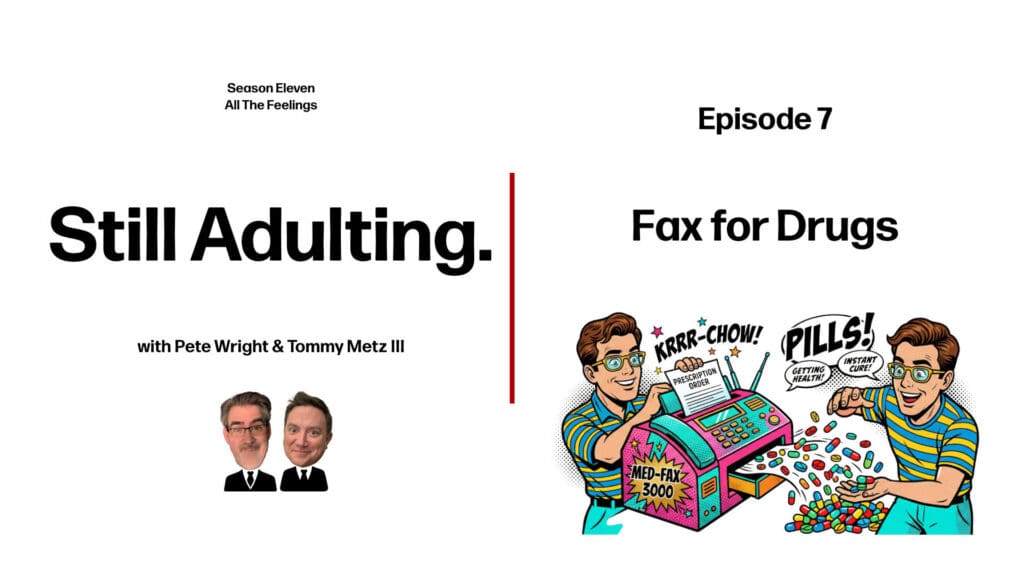
It’s a fax. Yeah. For drugs.
Tommy Metz III:
Okay, all right.
Pete Wright:
“Fax for drugs” should be on a shirt.
I actually just switched to Amazon as a result. There is no problem — they just send me my drugs in the mail, and I’m very happy with that. There’s no texts, or there is a text if you want it, but it’s just through my Amazon account. It’s amazing.
Anyway, the reason I’m talking about that is because the situation — if you know people who take more drugs than I do — is not easy. Dealing with the trifecta of insurance, pharmacy, and your physician — physicians, plural — it’s hard to do this.
Tommy Metz III:
Yeah.
Pete Wright:
So no judgment. Whatever you do to make it work is awesome.
Here’s the thing I find interesting. The World Health Organization and the CDC both report that roughly half of all patients with chronic conditions do not take their medication as prescribed. Talk to me about that. That is over half.
Tommy Metz III:
Wait, over half? Huh.
Pete Wright:
One in five new prescriptions are never filled at all.
Tommy Metz III:
Oh. I don’t understand.
Pete Wright:
I don’t understand that either. It surprises you?
Tommy Metz III:
Yes, it does. Yeah.
Pete Wright:
It surprised the hell out of me. So it turns out there are many reasons why this happens. The biggest one — this is not a clever name; whoever came up with it was just reading words — they call it the asymptomatic problem. The biggest driver isn’t cost or forgetfulness or anything like that. It’s that most chronic conditions produce no symptoms.
Tommy Metz III:
Sure. It’s like the blood pressure effect. You can’t really feel your blood pressure. They call it the silent killer.
Pete Wright:
Yeah. Silent killer. Hypertension, high cholesterol, your blood sugar — none of these hurt. Right up until the moment they do, and then they kill you.
So that’s one of the reasons people don’t take their pills. They feel like they don’t need them. And every day you skip a pill and nothing bad happens, your body is suddenly actively lying to you about what it needs in its silence. It is complicit in you deciding not to take it.
The other side of this is that some people take their medication, which gives them the strength to feel they don’t need their medication anymore.
Tommy Metz III:
Sure. Yeah. That can be a big thing in mental health medication — you take the pill and it makes you feel like you don’t need the pill anymore.
Pete Wright:
Right. And so this is all wrapped up in the term adherence — the stickiness of the practice to the desired outcome. The practice of taking pills to improve your health in some way, shape, or form.
And non-adherence, if there is any lesson here, is rational-feeling in the moment, even when it isn’t ultimately.
So there are other reasons people don’t take their pills. Fear of side effects. Do you have side effects that you’re aware of on your medications?
Tommy Metz III:
I’m going to be talking about one that I took before — maybe you have taken too — where the side effects were the feature, not the bug.
Pete Wright:
Okay. Yeah.
Tommy Metz III:
Like, it was all side effects. That’s all it was.
Pete Wright:
I had one that I was taking regularly and we were trying to get me off of it. And the side effect of getting off of it was vastly worse than any of the side effects of being on it. When you try to get off of it, there is a non-zero chance that you will feel as if you are getting electrical signals to your brain — like you’re being electrocuted internally.
Tommy Metz III:
Wow.
Pete Wright:
Yeah, that can be uncomfortable. Uncomfortable electricity in your brain.
Tommy Metz III:
Wow.
Pete Wright:
So yeah, the fear of side effects. Research shows that patients often worry more about the side effects than the disease itself, and they attribute completely unrelated symptoms to the act of taking the medication, which is incredibly destructive for conditions that we have pharmaceutical cures for — the things you should actually be taking the medication for.
Then there are some emotional reasons people don’t take their pills, like: taking a pill every day means admitting that you have a condition every day. It is a psychological toll that we do not talk about enough — they certainly don’t talk to you about it at the little window at the pharmacy. And that is really important, because you are in a state of denial when this is hitting you.
Tommy Metz III:
That’s interesting. I never thought about that. Because every morning you’re like doing a little failure swallow.
Pete Wright:
Yes, right. And that’s a choice. Looking at it that way is ultimately a choice, and requires a reframe.
Cost is obviously real and significant and worth naming, because — saying the loud part out loud — our health system in the United States is fundamentally broken. The fact that we’re in this back-and-forth with insurance and physicians, and nobody likes each other, it’s just a really ugly playground. Some people are genuinely rationing or skipping their medication because they cannot afford to fill them.
And then finally, executive function. A refill requires multiple steps across multiple systems — phones, texts, apps, pharmacy, insurance. It’s not one task. It is like sixteen fax machines, some Morse code, and all of those things require your executive function to be on lock. And if any of the medications you need involve helping you focus and getting your executive function locked down, just getting the drugs themselves is an exercise in meta-terror. Because you aren’t medicated to give you the skills you need to get the medication. Horrible.
Tommy Metz III:
Can I share a really quick story that this makes me think of?
Pete Wright:
Yeah, totally. Go ahead.
Tommy Metz III:
I went — and I won’t say what the medication was, it wasn’t anything very interesting, but it’s something I’ve been taking for a long time — and I went to a new pharmacy. Either way, they gave it to me in the bag and I paid for it and I left. When I got home, I looked at the bottle and it was enormous, and each pill was the size of my dog Foster, and they were bright red. None of this is what the pill usually looked like. None of that.
So I went back to the pharmacy and I said, “Did they switch the medications?” She was like, “What do you mean?” And I said, “Well, here’s what you gave me, and here’s what I was trying to get filled.”
The pharmacist — and this was the first and last time I went to this pharmacy — looked at the bottle, looked at the pills, her eyes got very big and then very small, and said, “Huh. You know, let me just double-check this.” Went back and then gave me the pills that looked like what I was expecting.
To this day I do not know what they gave me, but they gave me fifty of them, and her eyes went crazy big — as if they had just given me fifty cyanide pills.
Pete Wright:
I think that is fascinating, and it’s a thing I’ve heard a lot. If you dive into the customer service Reddit feeds about certain pharmacies, it is really, really dark. There are people who have some truly damaged relationships with their pharmacies because of exactly this kind of thing.
Let me tell you what the internet says might have been what you got. Rifampin, or Rifampicin — 300 milligram capsules — fits the description. Large, distinctly red-maroon capsules that are quite recognizable. They are used primarily to treat tuberculosis and meningococcal prophylaxis. A pharmacist would be quite nervous about a dispensing error like this because it’s given to close contacts of meningococcal meningitis cases as a short prophylactic course. Giving it to the wrong patient could mean someone who actually needed it didn’t get it in time.
It also has significant drug interactions — it can dramatically reduce the effectiveness of many medications, including birth control, anticoagulants, and HIV drugs. And it turns bodily fluids orange-red, which can be alarming, and stains contact lenses.
Tommy Metz III:
Oh my God. They really pulled the ripcord at the very end there.
Pete Wright:
So they were trying to food-color you, and they didn’t quite get there.
Tommy Metz III:
Okay. Yeah.
Pete Wright:
I’m glad you caught it. You could be very, very tan right now.
I mean, the idea that there is just so much room for error is really horrifying. And once you’ve been burned by your pharmacy letting you down — by giving you the wrong medication — it’s hard to build trust again. And that is yet another reason people don’t take the drugs they need.
The emotional truth is that a refill is a repeated act of acknowledging dependency on something that you likely didn’t choose. I’m on blood pressure medication. After I had COVID, my blood pressure went through the roof and we could not figure out how to bring it down. I’m on a little pill every day just to keep my system from totally overstressing. And I absolutely hate that that’s where I am right now. It makes me feel like a certain guy I never thought I would be. And yet I am dependent on it right now. I have a new doctor who says he thinks we can get me off of this slowly, but right now I’ve got to stay on it. We’ve got to figure this out the right way.
I think there is a story we tell ourselves about adulting — about what it means to be a competent adult — that never has a lot of room for “oh, I need this pill on a schedule, indefinitely.” Like it’s all heroic moments where we’re buying and selling real estate. I don’t know what adults do. But it never really includes, “Hey, let’s slow down and do our pill regimen.” And yet everybody I know has the day-by-day pill container to keep track of it.
I think it’s worth sitting with it. Not to wallow — just to be with it. Because modern medicine exists for a reason: to keep us healthy and chugging along, to live vital lives and continue to contribute as long as we can on this mortal coil.
I have a next-door neighbor. I talked about my bowl — I made a bowl on a lathe out of wood because my next-door neighbor is a true artisan. And he is also on a drug for his blood cancer that has kept him alive six years after they said he would be long gone. As a dear friend and my next-door neighbor, I am deeply grateful for these medicines, these pills, that keep him alive and thriving.
Tommy Metz III:
Just because you got a bowl out of it.
Pete Wright:
It’s because I got a bowl. I mean, what else is there to live for?
Tommy Metz III:
The Pharmacy Question, by Pat Adams. She said at the pharmacy counter, “My husband’s Viagra needs renewed.” She asked the man if they sold it there. He told her that they certainly do. She asked if he had ever used it himself. He told her he had, and was a big fan. She asked, “Can you get it over the counter?” He said, “If I take a lot, I probably can.”
Pete Wright:
My medicine cabinet is a timeline of everyone I was definitely going to become. There is vitamin D from when I was going to get serious about my health. And there’s melatonin from when I was absolutely going to fix my sleep. And in the back — behind the dental floss that I only recently figured out how to use every day — is a prescription bottle with seventeen pills in it from a doctor’s visit I barely remember, for a version of me who apparently did not finish the job. Now the label has rubbed off. I don’t even know what it is.
I know. We’re probably all right there.
But here’s what I’ve been thinking about lately. Every time I pick up a new prescription, the pharmacist slides this document across the counter — and I use the word “document” loosely. It is a broadsheet. It is a manifesto. It is, I believe, longer than the Magna Carta and considerably more frightening, because at least the Magna Carta never warned me about spontaneous tendon rupture. The attendant looks up and asks, “Would you like to talk to a pharmacist? Do you have any questions?” And I say no. I have never said yes. I have never read a single word of that paper. I fold it in half, I put it in the bag, I carry it home, I shred it to hide all the evidence. And then I just start taking the drugs. Every single time.
And here’s the thing. I used to feel really bad about that. Like I was failing at some basic adult responsibility. The scroll exists to inform me, I’d say to myself. Except it turns out the scroll was never really for me.
The first patient package insert the FDA ever required was in 1968. One warning, one drug. It said: don’t overuse this inhaler. That was it. What we have now — the pages, the side effect avalanche, the “if you experience suicidal thoughts while taking this antihistamine” — that grew out of something called the learned intermediary doctrine. This is the legal argument that a drug company’s duty to warn runs to your doctor. Not to you. Because information is too complex for your regular feeble person brain to parse.
So the paper isn’t for you. It’s a legal shield. The pharmacist asking “any questions?” is not the beginning of a conversation. It’s the end of a liability chain. You are a final checkbox in a liability chain — the last place the responsibility lands before it becomes yours. And we all play our part so perfectly, every single time. No questions. Fold. Bag. Shred. Drugs.
Honestly, that might be the most efficient performance of adult competence I have ever witnessed. We are very good at pretending we have it together, even when the system was designed, from the beginning, to never actually need us to.
Do you want a little more All the Feelings in your life? Just like your pharmacist, I don’t really need an answer. Become a Feeling Friend today. You’ll get a private, members-only podcast feed with extended versions of every episode, member-only extras, and our full trailer archive. Basically: more show, fewer ads, and good weird stuff we can’t always fit in public. It’s $35 a year, $25 to renew, and directly keeps this season of All the Feelings going. Head over to allthefeelings.fun and join us today.
And now, on with the show.
Tommy Metz III:
Pete, we’re talking about pills, pills, pills. And because of the subject matter, I wanted to start off this segment in kind of a time-release capsule kind of formula. I want to give you two instances over time from my life where I had slightly more traumatic experiences with medication. And this will all lead to a point, maybe.
The first real pill I remember taking was probably in the fourth or fifth grade. My dad had suffered a seizure in bed one night, and I had already been experiencing what I was calling dizzy spells, where I would sort of lose focus. And so they were worried that whatever my dad had might be hereditary, because I would have these dizzy spells a lot when I was exposed to strobe lights. I feel like strobe light technology was everywhere in my generation — you’d walk into any Spencer’s Gifts and there were just constant strobe lights.
Pete Wright:
Big sleepover energy, yeah.
Tommy Metz III:
And I had a strobe light, which was terrible because I was also on medication. Either way, no one ever used the word around me back then, but I assume what they were worried about was that I might have epilepsy.
Pete Wright:
Epilepsy, right.
Tommy Metz III:
And so I did a bunch of tests and it ended up with me taking a daily medication called Tegretol. These were small and pink — not huge and red. And I would have to take it at lunch. Why was this slightly traumatic? Because it became a joke from some of the other kids at my school lunch table. They would call them my birth control pills. “Hey, Tommy’s taking his birth control pills.” These are the same wonder-kids that came up with the moniker Tom W. Metz the Turd.
Pete Wright:
Oh, yeah.
Tommy Metz III:
The real brain trust at that lunch table.
Pete Wright:
Yeah.
Tommy Metz III:
So that sucked. That’s number one.
Number two: when I turned thirty, my body was like, “You know who’s had it a little bit too easy this whole time? You.” And for no reason, I developed severe cystic acne.
Pete Wright:
At thirty.
Tommy Metz III:
I talked to my doctor and I was like, “Why?” And they’re like, “We don’t know.” It was localized to a few parts of my face. It wasn’t all over the place, but it was pretty severe. When I hadn’t seen people in a long time, they would see me and go, “Oh my god, what happened?” Like, it didn’t look like typical acne — it looked like a chemical burn.
A friend of the show, JJ Jaeger, put it in a really honestly sympathetic way when he said he was so sorry because it looked like it hurt all the time. And it kind of did.
I don’t have a lot of pictures of me during that time — I’m not sure if I did that subconsciously or maybe everyone just cropped me out — but I know it happened.
Either way, I had a dermatologist. We tried a bunch of different pills and ointments. And I think I saw a witch in the forest at one point. But we finally chose what the dermatologist called, quote, the nuclear option.
Pete Wright:
The nuclear option is Accutane, Tom.
Tommy Metz III:
Accutane. Were you on Accutane? You were. We’ve talked about this.
Pete Wright:
Yeah. Personally. Because yeah, it destroyed me.
Tommy Metz III:
Okay.
Pete Wright:
Yeah.
Tommy Metz III:
Yeah, this drug is no joke.
Pete Wright:
No joke.
Tommy Metz III:
It dries you out something fierce. Sometimes when I would smile — oh god, it’s so gross — I could feel my skin crackle. And there were so many warnings about the side effects. Vision loss, liver damage, behavior changes, birth defects. I think there was something called the bleedies. Like, it was just horrific.
Pete Wright:
I had the bleedies. I bled from my ears and my eyeballs.
Tommy Metz III:
Are you serious?
Pete Wright:
I would literally cry blood in the mornings. I was so dry. Every pore was so dry. Yeah.
Tommy Metz III:
Okay. Well, I didn’t have anything that big.
Pete Wright:
It is that serious of a drug.
Tommy Metz III:
It is. I have a sense memory of when I would open a new container of it — I would hear those radiation clicks that a Geiger counter makes. I know that’s not true. But it just felt so dangerous and weird.
Pete Wright:
Totally get it. Yes.
Tommy Metz III:
But it worked, and it never came back. Like, I was on it for a while and then it worked and that was it.
Pete Wright:
Cystic acne is scared of Accutane. It’s like its only predator.
Tommy Metz III:
Right. It’s kryptonite — it’s kryptonite for your face holes.
Pete Wright:
Yeah, yeah.
Tommy Metz III:
Well, that’s a partial walk of my medicine misery. Other than Accutane, do you have something that you either are on or were on that you feel comfortable talking about? It doesn’t have to be about side effects.
Pete Wright:
When I was a young man, I had a condition that I don’t remember why I needed this particular drug for. But I went to the doctor and he said, “You need to take this five times.” And he showed me the pill, and the pill was about an inch and a half long, and I said, “I’m not swallowing that.”
Tommy Metz III:
Oh, horse pill.
Pete Wright:
I was fourteen, so I was in the office with my dad. And he said, “Oh no, you don’t take this with your mouth.”
Tommy Metz III:
Oh. Downstairs. Yep.
Pete Wright:
It was a suppository, Tom. And it was very traumatic for me as a fourteen-year-old. They did the first one in the office just to demonstrate how far up there you’ve got to go.
Tommy Metz III:
Yeah, yeah.
Pete Wright:
But then I had to do the others at noon or something. So I was going into the school bathroom for a week doing the old self-insert.
Tommy Metz III:
We both had lunchtime weird.
Pete Wright:
Yeah. Nobody witnessed me doing it.
Tommy Metz III:
Why was everything at lunch?
Pete Wright:
I don’t know.
Tommy Metz III:
I’m glad you thought to go to the restroom and not just do it at the lunch table.
Pete Wright:
Excuse me, everybody. I’ll use my right hand.
Tommy Metz III:
Yeah, I’ll trade you my sandwich for your Cheetos. Yeah.
Okay. So we both had our experiences, and I’m sure everyone out there has theirs. Feeling Friends and non-Feeling Friends alike — if you ever want to share any of your pill-traumatic or medicine-traumatic stories, hit us up at allthefeelings.fun.
Pete Wright:
Just tell us about your medical nooners. We’re down for lunchtime medical trauma.
Tommy Metz III:
Yeah. And then we’ll shred them.
Now, I’m not going to go through the tips and tricks for how to remember to take pills as an adult — those are all easily found online. Although I did look at an American government website for the National Institute of Health and Aging and saw their list of tips and tricks. There are just two I want to bring up.
Pete Wright:
Okay.
Tommy Metz III:
Number one — this is a government website — it says: “Follow directions. Don’t take a larger dose or all the medication at once, thinking it will help you more.”
Wow. That is the opposite of your thing, which is: don’t even get it filled, then take a huge amount all at once.
Pete Wright:
My God.
Tommy Metz III:
Another one on this government list: “Turn on a light. Don’t take medication in the dark. You could take the wrong pill.”
I was going to dunk on that for being a really dumb tip, but then I remembered a true story from my life. I once had a headache in the middle of the day and I walked into the bathroom without turning on the light and took two Tylenol. And it turned out I had accidentally taken two Tylenol PM. And that made my day different. I remember looking at the bottle after I’d swallowed it and going, “Oh no.” Like a real slow-motion thing.
So I guess I should have used that tip. Okay. Moving on.
What I do want to talk about is kind of the other side of the coin from what you talked about. You talked about the idea of people not taking their pills enough. Well, there are two growing fields in medicine that are tackling the other side of that problem.
One is called inappropriate polypharmacy. And one is called deprescribing. Have you heard of either of these before?
Pete Wright:
No, new to me.
Tommy Metz III:
Okay. Inappropriate polypharmacy is the use of excessive or unnecessary medications, often from multiple different sources — you have a bunch of different doctors and sometimes different pharmacies prescribing different medications all at once. And it increases the risk of adverse drug effects, including falls and cognitive impairment. This is especially important in how it affects people with what’s called MCC, or multiple chronic conditions, which happens more as we get older — you just start taking a bunch of pills.
And it’s actually leading to a new field within that same National Institute of Aging: deprescribing. It’s the opposite of prescribing. It’s really examining the combinations of medications in older adults and how they can cross-pollinate. It sounds like a real pullback from the old approach that we got into in the eighties and nineties — just throw pills at it, and when those pills give you a problem, put more pills on top of those to address it, and then more pills.
Pete Wright:
All the pills, all the time. Yeah.
Tommy Metz III:
And then sometimes the pills actually create problems that were never there.
Pete Wright:
That was what the movie Wall Street was about — “Pills is good,” right? I’m sure that was the speech.
Tommy Metz III:
They said, “Pills is good. Pills works.”
Pete Wright:
More pills.
Tommy Metz III:
They’ve actually opened a U.S. Deprescribing Research Network, made up of doctors and scientists and nurses, working with older adults to do a deep dive on how to streamline the medications that can best help and not crash into each other. And a lot of it is devoted to Alzheimer’s and dementia care.
This is really important because there’s one study — done on 1.2 million community-dwelling older adults living with dementia — that found they were prescribed psychotropic or opioid medications at rates that far exceeded use by older adults without dementia. You can understand why, but that can cause serious side effects like falling, overdosing, memory problems — which is already the thing — and serious liver and kidney impacts.
I like the idea of this approach. My segment is not disagreeing with yours. The pills are important. Pills is good, pills is smart, pills are what we need.
Pete Wright:
Yeah.
Tommy Metz III:
But there are times when the sheer amount of daily medications that older adults — like me, and like family members I know — are taking is staggering. When I’m visiting family for a long time and I see them sitting at the table measuring out their medications for the week, it’s like a hobby. It is a real time commitment.
Pete Wright:
Yeah.
Tommy Metz III:
And I’m already taking five pills a day.
Pete Wright:
Five a day.
Tommy Metz III:
Granted, one is for mood, one is for anxiety, one is for allergies, and one is finasteride — which is for hair loss. So I’m not taking five hardcore pills.
Pete Wright:
Yeah.
Tommy Metz III:
I take finasteride because I had always heard it’s your mother’s father where you inherit the hair you’re going to get. And my grandfather — the late Jeep — he was bald since birth.
Pete Wright:
Yeah.
Tommy Metz III:
Like, he just scared hair away.
And so when I first moved to LA, I had a friend who was getting — actually, can I tell this story real quick?
Pete Wright:
Of course.
Tommy Metz III:
I like the idea of medicine looking at itself and saying pills aren’t always the answer.
Pete Wright:
Yep. And there is nothing more gratifying than going to a new physician who sees my pill regimen — and I only talked about one, there are some others, always things in the background — and having them say, “Hey, I see that you’re on this thing, and based on the whole picture I’m getting from you, I think there’s a route to getting you off of it if you want that.”
Tommy Metz III:
Sure.
Pete Wright:
To have a physician tell me we can wean you from things that you previously thought you needed, and do it in a healthy way, is enormously gratifying. Because my assumption is always that they’ll only want to throw pills at me, not take them away.
Tommy Metz III:
That makes you feel like an individual. You feel seen, even in an office that can feel like a conveyor belt of patients.
Pete Wright:
Yep. A hundred percent. Yep.
Tommy Metz III:
A friend of mine, an actor, had representation, and his manager said — and he told me he says this to all of his clients — “Even though you don’t need it, go on finasteride, go on Propecia. You just want to save what you have. You’re an actor.”
But this was back in the day before Hims or Hers or whatever it’s called, where now they’re just throwing hair pills and other pills all over the place. Back then you had to go to a doctor and get a prescription. It was very expensive — we didn’t have a generic version yet. So my friend would get it illegally. He taught me how. You would get the pills directly from India. Actual finasteride pills — we hope.
Pete Wright:
Oh dear.
Tommy Metz III:
And I started doing it because he was like, “Why not? It’s really cheap.” But it was illegal. And the thing is, you had to pick them up at the post office. You couldn’t have them shipped to your place.
Pete Wright:
Brought to your house.
Tommy Metz III:
Correct. And so me — not understanding that there were actual drug crimes going on — I was convinced every month when I had to pick them up: “Here’s the one. This is the sting operation.” I would sit outside the post office for a couple minutes and just see if there was anyone walking in and out with an earpiece, sweeping the area. Because I thought the police were doing a stakeout to catch me and my hair pills.
Pete Wright:
Oh my God.
Tommy Metz III:
I was going to outfox the fox. I was checking to see if someone was sweeping the same part of the sidewalk over and over again, or doing the whole clever earpiece surveillance thing.
Pete Wright:
Yeah.
Tommy Metz III:
So I was a part of a real drug kingpin operation at a younger age. Which is exciting.
Pete Wright:
All hair-related crimes.
Tommy Metz III:
Yeah. A very long hair-related con. And now someone on the internet is like, “You want hair pills?” And I’m like, yeah. They go, “Okay, here’s a bunch we found.” And then they just show up.
Pete Wright:
This might be hair pills, it might be something else. We don’t know. Look for the red ones.
Tommy Metz III:
Yeah, exactly. Now, interestingly, the hair pills are very large and very red.
Pete Wright:
Oh no.
Tommy Metz III:
[laughter]
Pete Wright:
Thank you all so much for joining us for this episode. This week’s tune is “Save Yourself” by Wavehaven, Frank Bentley, and Anthony Mario. Coming up next week, Tom — what do we got?
Tommy Metz III:
We have another grab bag, but they’re kind of connected in a nice way. We both know what we’re going to be doing, and there will be no overlapping, because that’s never happened. You are going to be talking about learning new things as an adult, memory and how that all works, and I will be talking about — do you make time for hobbies? Do you make time for joy? What do you do as an adult, or do you just sit in a rocking chair?
Pete Wright:
It’ll be very exciting. I’m going to introduce my bowl.
Tommy Metz III:
Oh, the aforementioned bowl. The garage bowl.
Pete Wright:
Mm-hmm. Yeah. I’ll bring it as a show and tell.
Tommy Metz III:
That’s very exciting. Okay. Until then, my name is Tommy Metz III.
Pete Wright:
And I’m Pete Wright. Thanks for being here. We’ll be back next week with All the Feelings: Still Adulting.