Pete Wright:
Hello everybody, welcome to All the Feelings: Still Adulting. I’m Pete Wright, and that’s Tommy Metz the Toid.
Tommy Metz III:
Hey everybody. Take a look at me, I’ve got street credibility. It’s me — and that was from Wham. We’re so excited that you’re joining us. This is episode six of season eleven. And all of you that bet on — Kalshi, or whatever it’s called — that I would use something from the rap lyrics, enjoy your money. Anyways.
Pete Wright:
From Wham, no less.
Tommy Metz III:
From Wham, of course. The OGs.
Pete Wright:
Notorious hardcore street rap.
Tommy Metz III:
Yeah. They pretty much invented it.
Pete Wright:
“Wake Me Up Before You Go-Go.”
Tommy Metz III:
Yeah, exactly.
Pete Wright:
Let’s do a podcast.
Tommy Metz III:
And what are we talking about today?
Pete Wright:
What are we doing?
Tommy Metz III:
Today, it’s the one thing that unites all adults. It’s work stuff, job stuff. Not that much fun.
Pete Wright:
Yeah.
Tommy Metz III:
Or it’s great. I mean, if you love what you do, you don’t work a day in your life. Pete, you said that once.
Pete Wright:
I did say that once. Maybe I’m the one who invented that.
I think about often — we’re watching a show right now as a family, and the show is Alone: Arctic Edition, or whatever it is. Do you know the show Alone?
Tommy Metz III:
I know of it. I tried to watch one because someone said I’d really enjoy it, and they had to kill an animal and eat it.
Pete Wright:
It’s a reality show.
Tommy Metz III:
And I was like, nope. I would like Alone, but with a microwave. Like, if there was some sort of option, I would maybe watch the show. But no, I can’t do it. Why do you bring that up?
Pete Wright:
Well, there is some real exuberance from people who like to shoot squirrels with arrows. It’s tough to acclimate to. But I do think those people also never work a day in their lives. They’re just really into surviving. And that’s a skill, Tom. I’m so far from that skill.
Tommy Metz III:
That you have in spades.
Pete Wright:
None. None of it.
Before we get started, can I do a little bit of follow-up?
Tommy Metz III:
The scores.
[Segment: Follow-up]
Pete Wright:
I’m going to do this out loud and for you because it is follow-up on our tipping conversation.
Tommy Metz III:
Oh, this is from a listener.
Pete Wright:
Yeah, a listener and a friend of the show and another podcaster on TruStory FM who wrote in. The one and only, the great Ethical Panda themselves — it’s Matthew Fox.
Matthew wrote: “Great episode. As someone born and raised in New York City —”
Tommy Metz III:
Hi, Matthew.
Pete Wright:
“— the idea that any home project doesn’t start with a call to the landlord horrifies me. I’m very much with Tommy on that one.
More importantly, I wanted to add a note about your tipping conversation. Mainly, that tip culture is still alive and well in the hospitality industry and winds up being a tax on disability. As someone who travels for work mostly in my wheelchair, I’m tipping all the time. The bellman who helps get my bags to my room, the valet parking because self-park means trying to navigate my wheelchair and all my stuff across the parking lot. I’m more likely to take a taxi than public transportation. There are just so many ways that being disabled leads to more tips.”
And I have to admit, I never considered that.
Tommy Metz III:
Right. That makes a ton of sense. It’s like being followed around by a doorman everywhere.
Pete Wright:
Yeah. Everywhere. I still contend that the tip machines are bogus, but I really respect this perspective because I never considered it. And as always, Matthew’s comments make me think about the world in a different way around every corner.
Tommy Metz III:
Of course. Yeah.
Pete Wright:
And it just makes me think about my role in tipping culture in this context.
Tommy Metz III:
Sure. But I do like thinking about all of those people that Matthew is dealing with. And tipping every time, looking at Matthew and saying, “Okay, now I’m going to ask you a question.” Because they don’t have the machine.
Pete Wright:
Because they don’t have the machine.
Tommy Metz III:
They don’t have the machine. So it’s like, “Well, I’m going to ask you a question. How much was all that worth to you?”
Pete Wright:
Wouldn’t it be just gross if they had a little machine on a handle and they just whipped it out and pointed it at Matthew and said, “Now this machine’s gonna ask you a question?”
Tommy Metz III:
Yeah. My Flavor Flav clock machine that’s around my neck is gonna ask you a question.
Pete Wright:
Well, thank you, Matthew.
Tommy Metz III:
Thank you, Matthew.
Pete Wright:
It’s lovely to see that comment. Really appreciate you listening to our fair show here at TruStory FM.
Tommy Metz III:
Yeah, we appreciate it. And it really is food for thought. It is like a tax.
Pete Wright:
It is. Yeah. What are we doing? Anyway — shall we talk about work?
Tommy Metz III:
Yeah. Do you want me to go first?
Pete Wright:
Go for it, Tom. Take me to work.
[Segment: Quote of Inspiration]
Pete Wright:
“You start with an idea and work hard to expand on that idea until it’s a reality. That’s what makes you more aware of your own capabilities.”
Tommy Metz III:
Famed liar, Stephen Glass.
[Segment: Work-life balance]
Tommy Metz III:
Pete — work-life balance. You’ve heard of it.
Pete Wright:
No.
Tommy Metz III:
No. Well, you’ve heard of it. You can hear of things that you’re nowhere near close to achieving. Like, I’ve heard of Everest.
Pete Wright:
Okay. All right. You got me.
Tommy Metz III:
In order to back us into this topic, I want to tell a story. There was a time when I was growing up and I decided I wanted to try to achieve a different type of work-life balance.
Pete Wright:
Right.
Tommy Metz III:
And the results were — what’s the word for it?
Pete Wright:
Harrowing?
Tommy Metz III:
Harrowing. Drink.
When I was in college, I had been working all summers at Interlink, which was a company down in Denver. A former co-worker of my dad co-founded the company with his wife. And so my dad glad-handed with him and got me a job. And so this was kind of a very big-boy job. I was commuting to Denver, doing basic assistance stuff — answering phones, helping out departments — and then also they hired me to make their corporate video. You know, the video that new employees come in and sit through.
Pete Wright:
Yeah.
Tommy Metz III:
And it was terrible. Either way, it was a lot of work and the commute was long. Other friends of mine were working shorter gigs, working in malls. And for once in my life, I was like, you know what? I kind of want to try that. I want to try something where it’s impossible to take your work home with you. And instead you just go, clock in, clock out. So I wanted to try a normal retail job.
And so, being a real movie head, I wanted to apply to work at the Video Station. Do you remember the Video Station? It was the coolest video rental place in Boulder. The Video Station. It was really, really cool. Everyone was a member there, and it was one of those smarty-pants places — like the kind of video stores we still have out here in Los Angeles where things are categorized not under Horror or Comedy, but under Irony. It’s really hard to find things. And so I applied — and I didn’t get it. I just assumed I would get it because I was such a jerk. But every film major in Boulder worked at the Video Station. There wasn’t room for me.
Pete Wright:
Right.
Tommy Metz III:
But now I had it in my head — I want to work at a video store, because you get a discount and get to bring videos home. People know what videos are, right? VHSs, then DVDs. This is a very antiquated topic.
Pete Wright:
I hope so.
Tommy Metz III:
So then I applied to Hollywood Video — huge step down, very corporate. They were already staffed. Not great, Pete. But instead of pivoting, I really dug in and was like, I need to get a job at a movie place for this summer. This would have been junior year, living in the beach house. So I went with a movie store. Actually, wait. I’m gonna make it a game.
Pete Wright:
Okay.
Tommy Metz III:
I want to see if you can figure out what the name of the store was. This was not a real chain. This was, I believe, a one-off. Okay?
Pete Wright:
Okay.
Tommy Metz III:
So — before I got there, the whole design was a video store just for children. They only had family films, children’s films. And for a reason that was never explained to me, it was cow-themed. It had that kind of marbled black-and-white print all over the walls. And before I got there, apparently employees had to wear cow costumes to work. Those are your clues. Do you have any idea what this place might have been called?
Pete Wright:
Was it near Crossroads Mall?
Tommy Metz III:
Near Crossroads Mall. Does that help?
Pete Wright:
Ah, man.
Tommy Metz III:
You’re never gonna get it unless you think about it in a pun way.
Pete Wright:
I don’t have it.
Tommy Metz III:
Okay. I’m not making this up — it was called MOOVies. Exclamation point.
The best part is, by the time I got there, it was a failure. Not making enough money. So they ditched the costumes and the kid-only theme. They actually even had a section devoted to softcore pornography. But they kept the name and the cow print on the wall. So you would walk into MOOVies and there was just no explanation. It was just movies. Hello. Would you like to watch us slowly go out of business?
Pete Wright:
Oh my God.
Tommy Metz III:
So I got a job there. And because of the staff at MOOVies, I rocketed to the top because I wasn’t tripping over my own feet.
Pete Wright:
You must have rocketed to the top within like days of the entire Crossroads Mall being demolished.
Tommy Metz III:
Pretty much. It wasn’t in Crossroads, but yes, it was near there.
One of the things I remember about MOOVies is they had what was called the SMILES program. It was an acronym. I don’t remember what all of them stood for. But like — S was maybe “say hello,” and M was maybe “suggest a movie.” I was probably I for “eye contact,” because they don’t know how to spell. And you would get these letters, and once you were seen doing them enough by your manager, you would get a letter to wear around your lanyard. And once you got the whole SMILES thing, you would get a raise. So I worked really hard — I was a real corporate good boy, saying hello to people, suggesting things, doing the entire SMILES thing — and getting letter after letter. This is over the entire summer. Letter after letter.
And I finally got the last S, and I was so excited. You know what I got wrong, Pete? There was no raise.
Pete Wright:
What?
Tommy Metz III:
I just assumed that if you achieved SMILES, you got a raise. Instead, you just had all the letters in your lanyard. The end. That’s it. No promotion, no benefits, nothing. Just a bunch of letters around your neck.
Anyways. So that didn’t go great.
There’s more to talk about MOOVies, but I’m going to save those for another time because I feel like my entire life story can be baked into the MOOVies experience.
But I’m going to stop there, because that was me trying to say I was working too hard and I wanted to take some time off — and it destroyed my work-life balance. Because I was working more for less money at a stupider job that went nowhere.
Pete Wright:
Yeah.
Tommy Metz III:
And then at the end of the summer, they did offer me assistant manager. And I said — I’ll do you one better. I quit and went back to school.
Pete Wright:
And then did they say, “Go hard, move hard, play hard?”
Tommy Metz III:
Yes. There was a lot of that. Yeah. There was a lot of cowabunga.
Pete Wright:
Yeah.
Tommy Metz III:
Anyways. So — work-life balance. Do you remember when grind culture or hustle culture really started to take over?
Pete Wright:
I feel like it was kind of a 90s thing?
Tommy Metz III:
Yeah. It was in the nineties and early 2000s, where apparently the rise of venture capital financing helped technology companies in Silicon Valley — Google, Facebook — really explode. And then they were really pushing the idea of, stay at the office all day. “Look, we have a ping-pong table, so never go home.” And then LinkedIn, Twitter, Instagram showed up, and the hustle culture narratives just exploded. All of a sudden it was very performative to talk about how hard you were working.
Pete Wright:
Yeah.
Tommy Metz III:
It was like being followed around by a bunch of Nike ads all the time. Like they were feeding off people’s insecurities about how hard they were or weren’t working.
Pete Wright:
Yeah, right.
Tommy Metz III:
And then things changed.
Pete Wright:
Yeah.
Tommy Metz III:
What happened, Pete? Do you remember? There are two things that come up on this podcast all the time. Number one is my supermarket, Ralph’s. Number two is — something happened in culture that gave workers time to reevaluate their work-life balance.
Pete Wright:
Was it 9/11?
Tommy Metz III:
It was — well, probably. I’m talking more about the pandemic. Because with the pandemic came the Great Resignation. Like all of a sudden —
Pete Wright:
Oh. Yeah. You already had me living in the past, Tom. I was living in the 90s and I thought 9/11 was going to be current for your story.
Tommy Metz III:
My apologies.
Pete Wright:
I regret that.
Tommy Metz III:
No, you were right. I mean, people are always thinking about quitting. But the pandemic — there was so much financial uncertainty that people sort of found out that hustle culture maybe wasn’t worth it.
In fact — you want a statistic?
Pete Wright:
Yeah.
Tommy Metz III:
In 2022, a survey of 2,000 US workers by Prudential showed 70% of US workers had prioritized or were considering prioritizing their personal lives over their jobs and careers. This was unprecedented. 20% said they were willing to take pay cuts if it meant they could have a better work-life balance.
Pete Wright:
Yeah.
Tommy Metz III:
So really, everything just hit the brakes. Not for everybody — there will always be grinders out there. But for so many people it was like, what are we doing? And they started to take a real hard look at capitalism.
And that’s when more and more studies started coming out. The GAO — the Government Accountability Office — revealed that working long hours can lead to stroke, coronary heart disease, type 2 diabetes, and increased alcohol consumption. And I know I’m one of those, Pete.
Pete Wright:
Probably. If there’s a checklist, I’m checking a few boxes.
Tommy Metz III:
It’s kind of like a sad bingo card.
Now I wanted to switch to us, because you and I are in different situations than a lot of people. A lot of the work that I do is at home in my apartment, or can be. It’s all sort of remote by design.
Can I ask you — how do you approach your work-life balance? I think I know part of it, because there are certain days of the week where it’s harder to get a hold of you. And I was wondering if you are purposefully unplugging. Can you tell me a little bit about ways you manage not to go nuts? Because the worry is, if your office is your home, you can feel like you’re always at work.
Pete Wright:
Yeah, no, I think that’s really true. And it’s funny that you say it that way — that I’m harder to get a hold of on certain days — as if that is so provocative to imagine that it’s just me taking time for myself. So not true.
Tommy Metz III:
Oh, really? Because I feel like the weekends is what I was talking about. I will reach out to you about something podcast-wise, TruStory FM, something like this on the weekend. And I usually won’t hear back until Monday, which is totally fine. If it’s pressing, you’ll always get back to me. But it’s never pressing.
Pete Wright:
I do try to do that. And I think that’s a life hack I’ve learned, because I had clients who would take advantage of it — clients who would write because they’re working on the weekends. And I never want to habituate that relationship where they think I’m okay with responding to every non-emergency text.
And if you write me about non-work stuff, I usually respond very quickly. But I’ll table work-related stuff for work hours. I’m not good at it, because in secret, what I’m really doing is taking time Saturday and Sunday to catch up on the stuff I didn’t actually finish during the week.
Tommy Metz III:
Oh! You’re just tunneling under.
Pete Wright:
I’m constantly editing shows.
Tommy Metz III:
Yeah.
Pete Wright:
Yeah. I’m just pretending it’s made-up invented time that I have elsewhere. My work-life balance is so fragmented. I’m able to do things like go to lunch with old friends, have coffees, take time during the day — but during normal days, I have to use that work time on the weekend. It’s a luxury, not a curse.
Tommy Metz III:
Right.
Pete Wright:
When I’m working at night, it’s usually because I played at some point during the day.
Tommy Metz III:
Okay, but you recognize that. That’s one of the things — I have two different friends who will remain nameless — sometimes their hours are crazy and their work is crazy, but what they’re not aware of is the amount of social media time they’re also doing. And you have to really work on being aware of, okay, I relaxed during this time. This one-hour-long project took two and a half hours because I was also messing around on the computer. But if you don’t recognize that, then it just feels like you’re always working.
Pete Wright:
Yeah. That’s true.
Tommy Metz III:
I started this whole thing by saying how different we were, but it’s not feeling that different than having a boss that calls you all the time. When I was working in Hollywood in development, the hours were twelve-hour days a lot of the time. They start way too early and no one seems to want to go home. So you’re just waiting until your boss goes home and everyone’s just having a sit-off. Like there’s no work being done.
Pete Wright:
Well, I think the curse of working in the kind of business I’m in — working for clients — is I went from having one boss to having like twelve.
Tommy Metz III:
Right. Yeah.
Pete Wright:
And they’re constantly all day thinking about their business. And I’m thinking about their business maybe one-twelfth of my time. And their expectation is that I’m thinking about them as much as they’re thinking about themselves.
Tommy Metz III:
Yeah.
Pete Wright:
And that becomes a real curse to work-life balance. Because when I’m trying to disconnect, when I’m trying to play or relax, it’s hard to shut out the signal — the constant drone of, what should I be thinking about right now to move client work forward?
Tommy Metz III:
That’s coming from inside the house.
Pete Wright:
It’s really hard to disconnect.
Tommy Metz III:
That’s coming from inside your head.
Pete Wright:
Inside the house. In my head.
Tommy Metz III:
That’s what I deal with. I don’t have a bunch of clients reaching out, but I’m my own worst client. There are times when I will — and, physician heal thyself, I just talked about how important it is to recognize when you are playing — I catch myself sometimes playing a video game or reading, and I’m like, I’m nervous. I’m just sitting here marinating in a low-level anxiety. Why? Because I know I have stuff to do and I don’t want to do it and it’s going to be hard. And instead I’m doing this, which makes it feel like procrastinating instead of a break. Give yourself a break.
One of the things that I have learned to do over the last few years is — if I have writing to do, or even just thinking, something I need to do — I leave my apartment. But I don’t want to be like everyone else and go to a coffee shop in Los Angeles. Instead, I just go right out there. I’m lucky enough in my apartment to have a deck.
Pete Wright:
Yeah.
Tommy Metz III:
And just leaving the room that I’m in — the room that has all of the fun stuff I want to do instead — it feels like, in a weird convince-myself way, I’m going to work. Even though my kitchen is visible from my office. It’s enough to just separate it. There are no remotes near me. It just feels like, okay, this is time to do it.
And it’s lovely because I’m across the street from the park. There’s always people running around, so there’s enough life that you don’t feel cooped up. And I have a high wall on my deck because I’m on the ground floor. A friend of the show, Jared Clavens — Mandy’s husband — helped design these stands where I can put a dog bed on top, and then I put Foster on the dog bed so he can peek out over the wall. He’s tall enough to look out. So he just sits out there with me and watches all the squirrels and people run around.
Pete Wright:
That’s so sweet.
Tommy Metz III:
And then every once in a while he jumps to his feet and it’s like, “RAHRR!” And I’m like, what? And I look — and there’s a dog like two blocks away. I’m like, you’re such an idiot. I think he gets bored.
But that makes a big difference for me. It keeps me just focused enough. And then when I’m done, I can come in and do whatever I was doing. Yeah.
Pete Wright:
I want to go back, because I talked a little bit about my schedule — when I’m available, unavailable. I just want to walk through how you think about work-life balance in terms of your day. What does the daily routine of Tom Metz look like?
Tommy Metz III:
It changes every day. It depends on what I have. And a lot of times, unfortunately — and I’m getting better at it — it’s nothing, nothing, and then a zillion hours, because I keep pushing things and pushing things. I’m getting a lot better at chipping away at stuff every single day if it’s stuff that isn’t on a tight schedule.
Pete Wright:
Oh, that’s the worst.
Tommy Metz III:
What’s that word? Being vigilant, I guess. Yeah, on your own thing.
Pete Wright:
Yeah.
Tommy Metz III:
But yeah — I know now what works for me. I need to get out of the apartment. That makes a big difference.
Pete Wright:
Yeah. For me, I still maintain a pretty standard schedule. I get up at six, I spend about a half hour reading my news feeds — mostly nerd news, tech news.
Tommy Metz III:
Wirecutter.
Pete Wright:
Yeah. I’m not really into straight-up political news. I kind of tune that out.
Tommy Metz III:
Yeah, mental health.
Pete Wright:
I get up around 6:30, I walk the dog — we have a lovely time looking for squirrels and skunks and raccoons — and I’m sitting down at my desk around 7:15, 7:30. Usually my first recording is around nine o’clock, and I’ve got to be ready for those. Then I float my lunch. But generally I’m working in the office until around 4:30, 5:00. That’s when we sort of convene in the kitchen. My wife works at home too, so she’ll be on the couch or in her office upstairs. We’ll convene and kind of make dinner, and she’ll take the evening dog walk. I might get a few more things in during the evening. But maintaining at least some semblance of structure —
Tommy Metz III:
Structure.
Pete Wright:
— helps remind me at night to watch a reality show. To tune out.
Tommy Metz III:
Yeah, shut it down.
Pete Wright:
And I also have, for the day job, a lot of movies to watch for all the film podcasts we do. So evening is when I put on the headset and watch movies too.
Tommy Metz III:
Because I am on a lot of those podcasts — some of the movies — I have to make sure that I don’t accidentally think about watching a movie as homework. Because if my back’s against the wall and I’ve lost too much time, watching a movie is pleasurable all the time, no matter what. Even if it’s homework.
But if you’re running out of time, then you’re watching an establishing shot of a church and you’re like, “I got it! It’s a church! Let’s go!” Is the synopsis on Wikipedia? I gotta go, because I’ve screwed up my day too much. Yeah. These are champagne problems.
Pete Wright:
Yeah, right.
Tommy Metz III:
These are the champagne problems of a buckle shuffler.
I did want to ask — because you were nice enough to write what Matthew Fox did write — if people out there have tips and tricks, please write in. Because I didn’t want this to be a lookup on the internet. All the tips and tricks are pretty much the same as you’d think of.
Pete Wright:
Yeah.
Tommy Metz III:
But I looked at a bunch of lists, and on each list it also said, “Have a job that you love.” Okay. On it, idiots. Like, what — I’ll just go out to the job tree. Fantastic. Have a job that you love.
Pete Wright:
Yes.
Tommy Metz III:
So if you have any tips or tricks out there, please write in and we’ll share them with people. Because this is something that is never going to go away. And it’s good that people are being more receptive to the idea that maybe grind culture isn’t the way. Instead, you should go to work and then be done with it. And that maybe is the key to happiness.
So yeah, please write in. And extra credit if it’s cow-themed. If any of the tips have to do with cows.
Pete Wright:
What would I give?
Tommy Metz III:
That’s the key to happiness. More cow-themed. Yeah.
Pete Wright:
Having more things that are cow-themed makes all of us a little bit better.
Tommy Metz III:
Yeah. More cow-themed. Every career, every work-life balance — you need a balance between work and cows. And go ahead and open a softcore porn section.
Pete Wright:
Yeah. Right underneath Old Milky White painted on the corner.
Tommy Metz III:
You deserve it.
[Feeling Friends segment — see note in spot-check list re: attribution]
Tommy Metz III:
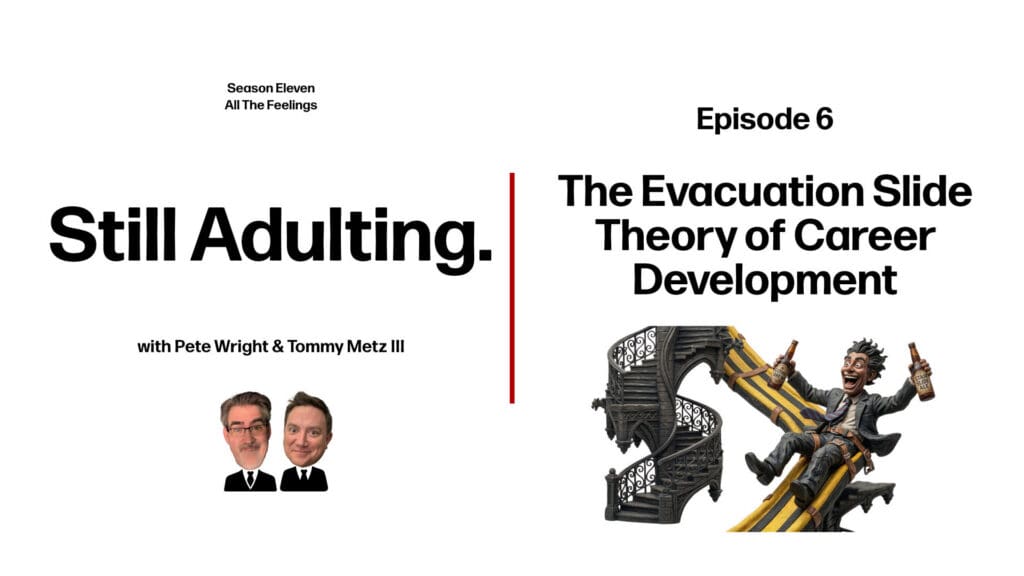
And then there’s the story of the man who decided his dream career of flying in the clouds had turned into an earthbound nightmare, and how he slid out of his job in epic fashion.
“Absolute garbage. Steaming hot trash. So unorganized. A literal suckfest.” These are some of the words currently used on the rating site Trustpilot.com to describe the airline JetBlue.
And on August 9th, 2010, thirty-eight-year-old veteran flight attendant Steven Slater would surely have concurred. His JetBlue Flight 1052 had touched down in New York City, when a passenger stood up to retrieve her bag from the overhead compartment while the plane was still taxiing. Slater, after announcing over the loudspeaker that passengers must remain seated, approached the woman. According to the flight attendant, when he reached her, she pulled the bag sharply out of the compartment, striking him in the head and drawing blood.
And after working in the aviation industry for over twenty years, something inside the flight attendant just snapped. He decided he was through working with the airline and dealing with unruly passengers. And he wanted a change in his life.
So that night, he sat at his kitchen table in his home in Belle Harbor, Queens, and wrote a letter of resignation that was later described as a textbook example of professionalism and restraint.
Oh wait — that’s not quite right.
No — after being struck by the suitcase, Mr. Slater charged up to the front of the airplane, called the passenger an M-Fer over the loudspeaker. He then quickly grabbed a beer from the service trolley, chugged it, grabbed two more, and then waited for the exit door to be opened to leave the plane.
Oh wait — that’s just not quite right either.
Instead, as the plane came to a halt, Slater wrenched open the exit door, deploying the evacuation slide. And, beers in hand, waving goodbye to the passengers, he slid out of the plane and out of his career as a flight attendant forever.
Slater, who was later arrested and charged with reckless endangerment and the world’s most adorably named crime — criminal mischief — later told ABC News: “I saw this delicious ray of golden sunlight coming through the porthole, and I knew that the beach was just over there and my car was in the parking lot. I think at the end of the day I wanted to know that I wasn’t coming back. So I took a good look and I said, ‘You know what? It looks a lot better out there than in here.’ And anyway — I went. And the rest is history.”
That’s the type of work-life balance we should all aspire to.
Ready to disembark on a journey of exciting member-only bonuses? Then return your podcast tray table to its full upright and locked position, and fly on over to allfeelings.fun and become a Feeling Friend today.
Trade in some of your miles — or just pay $35 for the whole season — and then fasten your seatbelt for members-only episodes, extra audio on each and every episode, access to our award-winning trailer archive, early access to everything, and so much more.
Captain Uncle Pete and I love to podcast, and it shows. But we could really use your help to keep this entire operation aloft. So fly on over to allfeelings.fun and become a Feeling Friend today.
Now sit back, relax, and enjoy the rest of the show.
[Segment: Quote of Inspiration]
Pete Wright:
“The day you take complete responsibility for yourself, the day you stop making any excuses — that’s the day you start your way to the top.”
Tommy Metz III:
Famed murderer, O.J. Simpson.
[Segment: Quitting your job]
Pete Wright:
Tom, let’s talk about exits.
Tommy Metz III:
Okay, I like it.
Pete Wright:
When is the last time you quit a job?
Tommy Metz III:
The last time I quit a job, I think I was working at this company in Denver, and I decided I wanted to take a break and work for a cow-themed movie place.
Pete Wright:
Right up until it was demolished?
Tommy Metz III:
Yeah. The last like four jobs that I’ve had — I was quit on. It was the opposite of Brokeback Mountain. They could quit me.
Pete Wright:
Okay.
Tommy Metz III:
They wished they could quit me, and they did.
Pete Wright:
So you were fired.
Tommy Metz III:
Correct.
Pete Wright:
Okay.
Tommy Metz III:
Well, one was when I was working for a radio station, writing bumpers. So the little things that sound like — “KF-103!” — and you make a little joke.
Pete Wright:
Yeah.
Tommy Metz III:
And then I was doing that for months and they just stopped asking me. I said, “Oh, what’s going on?” And they said, “We decided we can just do it ourselves, so we let everybody go.” And to this day, I’m like — did they let everybody go?
Pete Wright:
Really?
Tommy Metz III:
Or was it just me? They ghost-quit me.
Pete Wright:
Yeah. That’s fascinating.
Tommy Metz III:
Yeah. And it was a dumb job anyway.
Pete Wright:
Well, what’s really interesting is that you and I are possibly the least equipped to have a conversation about quitting jobs. Because the last time I quit a job was also about twenty years ago. I’ve let go of clients before, but that’s a very different kind of experience. It’s just not the same as saying “I quit” and walking out the door.
Tommy Metz III:
Right.
Pete Wright:
And so I wanted to talk about what modern quitting looks like, because I think it’s fascinating and it’s changed a lot since we had the opportunity to quit stuff.
Tommy Metz III:
Really? What a nice way to say — what I was given was a letter that said, “Dear Tom, we would love to give you the exciting opportunity to stop arriving here.”
Pete Wright:
Yeah. “Wanna beat traffic? How about quit your job right now? We would love for you to have a better morning.”
Tommy Metz III:
Okay, go ahead.
Pete Wright:
So I’m thinking about what quitting actually does to your brain. We want to talk about how you change as a function of leaving a thing that you’ve been doing and have committed yourself to in some part.
So the first issue is what your job means to your identity. Because you have an identity that is highly tied to the work that you do during the day, like it or not. We can say, “My job hasn’t changed me.” Your job changes you. It changes who you are at a very fundamental level.
Psychologists James Marcia and Erik Erikson have done a lot of work on this — thinking about how work changes our identity. And this is back in the ’60s. Man, we’ve been talking about this a long time. This describes what happens when we commit to a role or identity — a career and a title and a professional self — and how often do you eat business cards at networking sessions, all without ever really asking whether that identity fits who you are?
Tommy Metz III:
Interesting.
Pete Wright:
These guys said that when you quit, you’re doing something called identity foreclosure.
Tommy Metz III:
I like it.
Pete Wright:
What a word. You are really foreclosing. You’re letting go of this thing and letting it just sit and rot to trash. Walking away.
Tommy Metz III:
Yeah.
Pete Wright:
All I think of is the financial crisis, and Phoenix, and abandoned homes just gone to rubble. But that’s exactly what they’re talking about. And at times, you borrow this identity at work and it starts to feel like you. And the moment you consider leaving, you’re not just leaving the job — you are threatening to evict this self that you have been for potentially years.
Tommy Metz III:
Sure.
Pete Wright:
And that is hard for people to acknowledge, and they do not acknowledge it well.
Tommy Metz III:
It feels kind of akin to moving — they say moving from one house to another is one of the most traumatic things you can do. It’s a psychological moving.
Pete Wright:
Yeah, for sure. And people who over-identify with their role — who have taken on the work as their personal identity — those people tend to experience career dissatisfaction. Again, according to James Marcia and Erikson, that dissatisfaction is not seen as a sign to leave. They’re upset with the way their job is going and they look at it not as a sign to leave, but as a personal failure, which actually makes them less likely to quit.
Tommy Metz III:
It’s your fault. Yeah.
Pete Wright:
Yeah.
Tommy Metz III:
It’s easier to assume that you’re the villain in the room than to make such an enormous change to your life.
Pete Wright:
Right. And if you love your job, you feel like you owe something to it. I know I’ve told this story before, but this is the true symbol that it was time for me to go in that last job — it was when I got the “You’ve been here for five years” email. It said, “We really appreciate you. We love you. You’re the best.” And then: “This email box is unmonitored. No replies will be accepted.”
Tommy Metz III:
Thanks, Robot. Yeah.
Pete Wright:
Right. Like — that’s a sign that I’ve given maybe too much of myself to a company that has not really given much back.
So the next piece is that leaving is an experience of great loss. This is the part that nobody really talks about in exit interviews. Researchers have found that leaving a job — even voluntarily — triggers a genuine grief response. There is a clinical term for it: job loss-related complicated grief, or JLRCG. It presents with many of the same markers as bereavement — difficulty accepting a new reality, identity disruption, loss of purpose, a persistent sense of yearning for the role you left behind.
University of Michigan psychology professor Richard Price put it quite plainly: some people have jobs, other people have careers, and some people have callings. And when they lose the latter, they lose a part of their life. They don’t just lose a paycheck.
Tommy Metz III:
Man.
Pete Wright:
This whole thing makes me very sad.
Tommy Metz III:
It’s a bit dark. You don’t like to think that jobs and careers are that important to the balance we’re talking about. It’s supposed to be work, life, balance.
Pete Wright:
Right.
Tommy Metz III:
And this sounds like it’s the other way around.
Pete Wright:
Let’s talk about the taxonomy of quitting, because I have more research but it’s made me too sad. I want to just talk about what quitting looks like today.
There are five general categories — ways people quit. If you’ve ever done it, you probably already know which one you are. Can you name any of them?
Tommy Metz III:
Quiet quitting. That came up when I was reading about work-life balance — the difference between grind culture and not. But I might not exactly know what it means. Is quiet quitting just sort of stopping showing up? Is it ghosting a career?
Pete Wright:
Yeah. But there is another kind of quitting that better describes what you’re talking about. This is more of a slow fade — where you continue to show up, but you are not paying attention to the work that you’re doing.
Tommy Metz III:
You’re doing worse.
Pete Wright:
You’re doing other stuff. Your head is not attached to the role. That’s quiet quitting. You fill a space and you might meet some staffing quota, but you’re not really useful. You mentally quit maybe months ago. Your body is catching up. Your badge might still work.
Tommy Metz III:
Right.
Pete Wright:
The second one is the opposite of quiet quitting — the rage quit.
Tommy Metz III:
I like this.
Pete Wright:
I feel like the rage quit’s been around a while.
Tommy Metz III:
Sure. This would be like Jerry Maguire taking the fish.
Pete Wright:
Yeah. Super emotionally satisfying, professionally inadvisable, but it does make for wonderful stories later. That’s the rage quit.
Tommy Metz III:
Especially if you’re a flight attendant.
Pete Wright:
Exactly.
Then there’s the loyalty trap exit — this one is where you wake up and realize you stayed maybe years longer because you love your colleagues, not the job.
Tommy Metz III:
Oh, yep. I’ve done that.
Pete Wright:
Right. You don’t quit the work — you quit protecting the people from the work.
Tommy Metz III:
Huh.
Pete Wright:
And that is a really complicated emotional tightrope. When the work is bad for you, but you feel trapped because of the people. The next one is the graceful wind down. And I actually lived this one.
Tommy Metz III:
Oh.
Pete Wright:
I feel very, very lucky. My last job that I quit — it’s like a fairy tale quit. I was working as a director at a company and I had this opportunity to transition. My boss knew I was going to go freelance and needed a little time to set things up, and literally advised me to slow fade. To just take some time, get yourself going, burn out your vacation, and we’ll set a date — wink wink — about three months out.
Tommy Metz III:
That sounds like you’re being put down. Like Of Mice and Men. Like Lenny — look out in the field, look at all the beautiful rabbits — and then you’re fired.
Pete Wright:
A little bit. That’s really horrible. I had never looked at it that way.
Tommy Metz III:
He was Old Yeller-ing you.
Pete Wright:
You know what? My position was already fairly useless in the company. They didn’t need me anymore. But what really happened was I got a really graceful wind down. I got to accomplish all the goodbyes I needed. I got to hand over all the processes, policies, and budgets I was dealing with. And I had time to build up a new body of work before I actually left.
Tommy Metz III:
Well.
Pete Wright:
And then there’s the last one — the layoff masquerading as a quit. The company has made it absolutely untenable and you have the dignity to leave before they push you out.
Tommy Metz III:
So it’s like the reverse of quiet quitting. They’re quiet quitting you because they’re just making it worse and worse.
Pete Wright:
They’re quietly quitting you.
Tommy Metz III:
Got it.
Pete Wright:
Yeah. So the real emotional truth is that quitting requires you to make some sort of statement about who you are. You have to make a stand that says, the employer and I are no longer in alignment — not the way we were when I took the job. And that’s okay. It’s okay. Recognizing that you no longer fit the space is a major gift you give to the rest of your life.
Tommy Metz III:
Sure. Well, I like that there are so many fun options for quitting. I would have thought letter — and instead there are five different fun options where people are sliding down slides, making cakes, doing all sorts of things.
Pete Wright:
Yeah. You could do that. You could just be real quiet. The one we didn’t talk about is just picking one or two people in your office and stopping speaking to them, but overtly. Like, in meetings, if they ask you questions, just don’t answer them. But only them.
Tommy Metz III:
Every career should have an exit door with a slide. And if it doesn’t, you should bring your own. Just take a dip out a window. I think people will know I’m not coming back.
Pete Wright:
Oh my god. I can just imagine. I get up for work every day, I put on my slacks and my buckle shuffle shoes — and I strap on my personal inflation slide to my butt and just walk around.
Tommy Metz III:
So my slide, just in case today’s the day. I don’t feel like doing this report — exit slide — bye, Pete.
[Outro]
Pete Wright:
Thank you all so much for joining us for this episode. This week’s tune is “Working for a Living” by Ben Bostik. Tom, what do we got coming next week?
Tommy Metz III:
Well, from work to health, Pete — we’re talking about what’s the best part about getting older and being a still adult? All damn pills, baby.
Pete Wright:
All the pills.
Tommy Metz III:
So we’re gonna be talking about medications and prescriptions and also preventative care — in a horrible Hail Mary to not have quite as many medications and prescriptions. We’ll see how it goes. But we’ll be dealing with all of that next week.
In the meantime, thank you so much for joining us and downloading this episode. I’m Tommy Metz III.
Pete Wright:
And I’m Pete Wright. Thanks for being here. We’ll be back next week with All the Feelings: Still Adulting.