*This transcript is produced using transcription software and reviewed for quality. Despite our best efforts, some passages may be incomplete or contain errors due to audio quality or software limitations.*
Megan Hunter
Welcome to It’s All Your Fault on TruStory FM, the one and only podcast dedicated to helping you deal with the most challenging human interactions, those involving high conflict situations. I’m Megan Hunter and I’m the co-founder of the High Conflict Institute along with Bill Eddy and also ConflictInfluencer.com, where we focus on all things educational, whether it’s training, classes, courses, methods, and programs, all to do with high conflict. So welcome, listeners. And today we’re going to be talking about something that doesn’t get nearly enough attention, but we hear you screaming for this kind of help. What happens to our bodies when we’re dealing with high conflict situations, right? With someone who’s blaming, who has big emotions, who tells us it’s all your fault? We know these relationships can be emotionally exhausting, but what about the physical toll on our bodies?
Can chronic stress make us sick? And what can we do to protect our health, especially when we can’t avoid the person causing the stress?
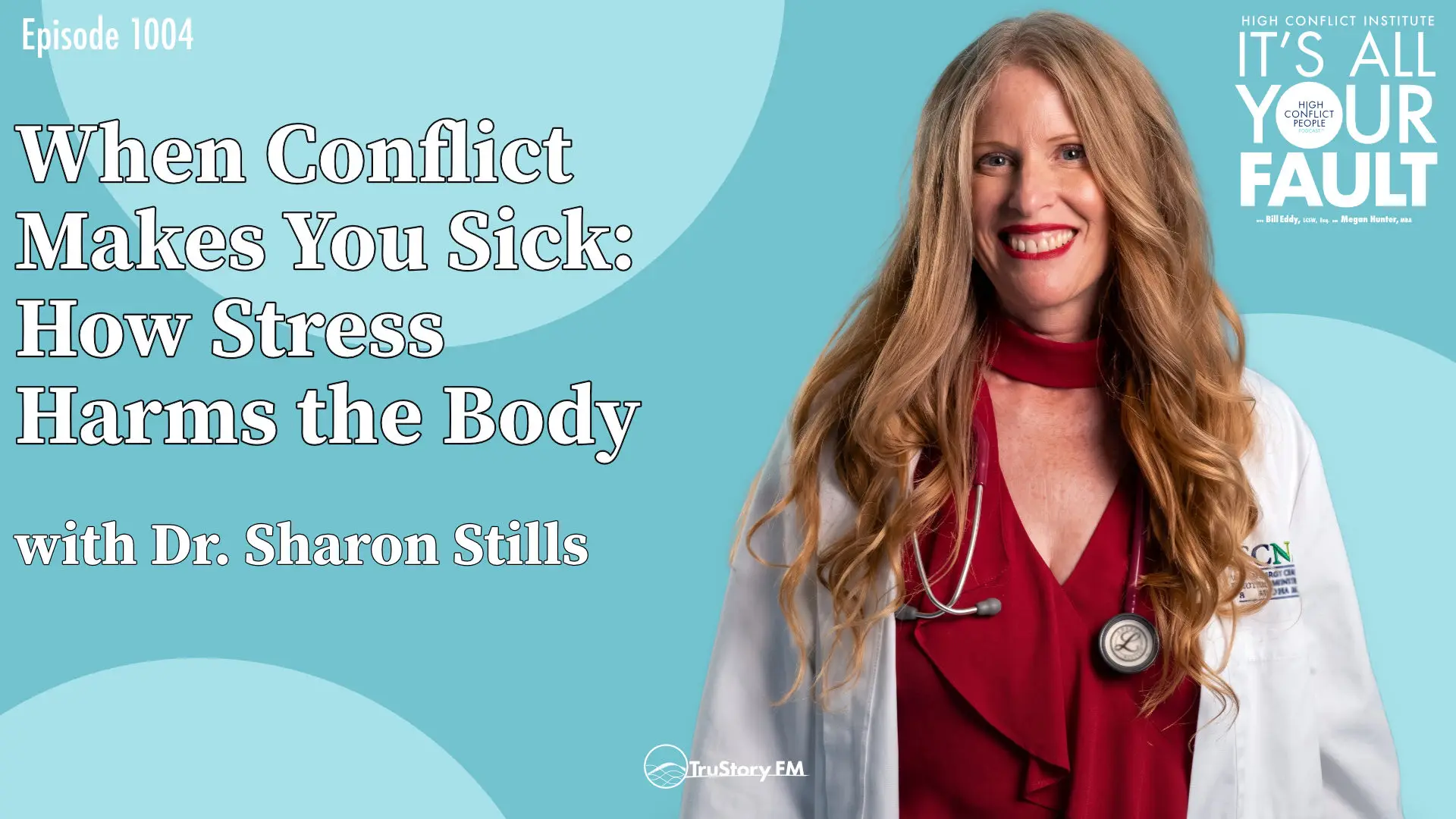
Bill is sitting this one out today, my co-host. But I’m delighted to welcome Dr. Sharon Stills, a naturopathic physician and wellness expert. So let me give a little background to our listeners. And I first wanna say, listeners, welcome again to those of you who are eating pasta today. I’m just back from Italy, so I’m thinking pasta still. All right, so Dr. Stills is a naturopathic medical doctor, international speaker, and wellness expert who has spent more than 25 years helping people uncover the root causes of their health challenges and reclaim their well-being. Known for her integrative approach, she combines modern diagnostic science with natural healing methods to address chronic illness, hormonal imbalances, and the effects of stress on the body.
She’s also the host of a global annual Meno(Pause) Summit, which I’m passionate about, and she’s passionate about helping people take control of their health and thrive, and not just survive. And she does this at her Lasting Wellness Center, which is a 7,000 square foot facility right here in Scottsdale, Arizona, where I live. It’s just down the street from me and I’m so excited to go visit you at your center. So welcome, Dr. Stills.
Dr. Sharon Stills
Thank you. It’s my joy to be here.
Megan Hunter
Great. So let’s talk about the physical impact of stress. You and I have talked a bit about what high conflict is, and our audience, our listeners, are very familiar with the impact of high conflict. But what we hear from people often is that if you have a one-time interaction with high conflict behavior, which may be a big extreme reaction, someone blaming you for something that you didn’t even do, maybe it’s a one-off, right? It may be that one client, that one patient, that one neighbor, one time, you know, that probably causes us some kind of stress response. But it’s probably one and done and it’s gone. What we hear from people is it’s the repeated kind of daily interactions of these high conflict interactions that really take a toll.
And the phrases most commonly are, I dread seeing this person because I’m exhausted from the chaos, right? So you don’t have to be a high conflict expert, but I know you are a wellness expert and stress and fatigue expert. So tell us, what is the impact of chronic stress on our bodies over time?
Dr. Sharon Stills
Well, how long do we have? So first I’ll start by saying that for, you know, the last 25 years I
Megan Hunter
Yeah
Dr. Sharon Stills
often say stress conflict is the root cause of 99.99999999999 percent of all disease and imbalance in our bodies. And yeah, I’ve been saying this since I was a baby medical student back in the late 1990s, the late 1900s, I guess we could say. So it’s interesting as you were, you know, giving your intro, I was thinking there’s words that you’re using, like conflict. You use the word chaos. And these are words that I actually use in my medical practice when dealing with chronic illness, because one of the things we do is we do computerized regulation therapy, thermography. And this is a diagnostic from Germany.
And what we’re looking at is how your nervous system is regulating your organ function, and your lymphatic function, and the health of your teeth and your sinuses and your major organs. And one of the things we look at, I look at, is the chaos index. So there is a very big relationship between chaos in your life with a person in this instance and chaos in your body. And then with conflict, I do a lot of work with patients dealing with cancer. And so it’s very multifactorial how to heal and reverse a cancer, but one of the things, on the emotional perspective, and even the psycho-spiritual perspective, is what is the conflict that has energetically set up shop in that organ? For instance, I had a patient the other day who was diagnosed with breast cancer, and she has a conflict of whether or not she wants to have a child. And so we see that conflict can affect, you know, so you say what’s the impact of stress on the body?
I mean, it’s, as I said, how long do we have? Because it is intimately in there. Now, it doesn’t mean that a cancer also doesn’t develop because of toxicity or poor lifestyle or poor nutrition or many other hormonal imbalances. But the emotional, the conflict, the stress piece is always a piece of the puzzle. If we go through how does stress affect the body, because that was your actual question, we can just think about, like, just kind of scanning the body.
So like if we think about the brain, if you’re under high stress and you’re secreting stress hormone like cortisol, it’s going to affect your hippocampus. And that is where we have short-term memory. So it can affect your memory, it can affect your cognition, it can affect your moods. If you have conflict, often it will interfere with your ability to sleep well. Maybe you can’t fall asleep, or maybe you fall asleep, but then you wake up in the middle of the night and you’re thinking about this person or this situation. And so if we’re not sleeping, we’re not draining our brain. If we’re not getting into that deep sleep, then our glymphatics, which are the lymphatics of the brain, are not draining, so then we’re getting brain fog and neurological issues and potentially down the road can be a Parkinson’s and Alzheimer’s, you know, could be a more serious diagnosis.
So stress affects our brain in a very, very profound way. And unfortunately, not in a positive, profound way, but it has a lot of negative impact.
Megan Hunter
Yeah, and I’m thinking that’s just so fascinating because what comes to mind, speaking of the brain, is that, you know, we know we’re stressed out if we’re waking up in the night and thinking about this situation. You know, we commonly hear from our clients and listeners that they’ll wake in the night and think, how do I answer that text message that I got from that person? And it just starts perseverating, you know, and it goes round and round and round. And so this is what people are dealing with constantly. And so we might think I’m stressed right now, but are we thinking about those longer term effects, right, that could show up down the road, like Parkinson’s, like Alzheimer’s, and the things you’ve mentioned? I can imagine that living chronically with stress and not addressing it will likely lead to or contribute to.
I’m not a medical professional, but contribute to these maladies you’re discussing.
Dr. Sharon Stills
Yeah, one of the things that we do here as part of our, so we do computerized regulation thermography. We also do heart rate variability testing from Russia. And one of the things I see, like, a hundred percent of the time, and I don’t say that lightly, is someone who has a chronic illness or is headed towards a chronic illness, they are always dysregulated in their parasympathetic and sympathetic nervous system. Typically it’s sympathetic overdrive and they don’t know how to engage their parasympathetics ’cause they’re just stuck in that cyclical stress cycle. And so usually then the treatment is calming the sympathetic, but not entirely turning it off, right? Because there are times when it’s appropriate that we go into sympathetic mode. It’s there to protect us and save our life.
It’s the ability to be able to regulate. And to be able to, if you step off a curb and a bus is coming, you want your sympathetics to jump in and get you back on the sidewalk and to safety. But then you don’t want that to then be with you for the rest of the day. You want to be able to then regulate and go back into parasympathetics. And so that bus coming, stepping off the sidewalk, that could be someone who you are in high conflict with. And so to me the effects are, you know, that’s just the brain. I mean, we can talk about the gut and digestion. If you are awake thinking about that text or how you’re gonna respond to it.
Well, the sympathetics are the fight, flight, freeze, where the parasympathetics are the rest and digest. So again, the body doesn’t know, right? Our sympathetic nervous system evolved from keeping us safe from the saber-toothed tiger that was trying to eat us. And the body doesn’t know the difference between a saber-toothed tiger trying to eat us or a text message that is blaming us or, you know, causing grief in our lives or causing conflict. And so we go into that stress mode, and, you know, it even goes into that mode from maybe there’s a nice text message and even that, you know, just text messages piling up or emails piling up or the to-do list piling up. So we can also be in conflict with ourselves and our lifestyle. And so I think it’s important to not only learn how to deal with conflict with another person, but to look at what is that reflecting within me and where am I in conflict with myself and not living in harmony.
Megan Hunter
Do you find that it’s difficult to lead people into this self-awareness?
Dr. Sharon Stills
I mean, people when they come to me, they know that that’s part of the deal if we truly truly wanna heal. And I just wanna finish my, ’cause I realized I didn’t complete that thought, is that if you are busy in sympathetic stressing about something, then your body thinks that’s survival. And so it’s not really that concerned with digesting your chicken and broccoli from dinner, and so then our digestion gets compromised. So conflict is, you know, we’ve got the brain, we’ve got the digestion, we’ve got the cardiovascular system. I mean, I can go through, we don’t have the time, but I could go through every single system in our body, even our bones. If we are in high conflict, we’re getting into an acidic state and we’re not getting mineralized properly.
And so we’re gonna start to have bone loss because we’re gonna lose minerals. So it is, you know, our muscle tension if you’re in high conflict. You’re not breathing, you’re tensing, you’re clenching, so chronic pain is a factor in this. Your immune system gets deregulated. So chronic conflict and stress is going to lead to immune dysregulation, which can show up in different ways. It can show up as you’re sick all the time, or it can show up as autoimmunity because your immune system gets confused and now you start attacking your own tissues rather than bacteria and viruses and cancer cells and so forth. Your colon, the ability to eliminate, if you’re not digesting, you’re not eliminating properly, so then you’re auto intoxicating yourself.
So it’s profound. And it’s not, I don’t want anyone listening, like, then turning the blame on themselves, right? Like we’re all human here. We’re all, you know, being in the human condition is not for the fainthearted. So but it’s to start having that awareness of how we can start to help ourselves.
Megan Hunter
Yeah, that’s so true. And I think of people who have had trauma throughout their life or a lot of loss and they’re kind of trapped. Some get trapped in that trauma cycle. I refer to it as the React brain. They spend a lot of time in that React brain. And that’s where we do hear about more chronic medical conditions such as, you know, irritable bowel syndrome, a lot of things that people are going to medical doctors for and maybe not getting the stress relief and maybe the trauma treatment that they need. So we think of people in that area of the spectrum who, I can imagine if they’re in that reactive mode a lot of the time, they are going to suffer consequences today and down the road.
And that was really fascinating about the bones. I really hadn’t heard that before.
Dr. Sharon Stills
Yeah, I mean, if we think about the mind-body complex, like it’s always connected. And so sometimes the body, the physical stuff, is affecting us a little more. So it’s like when someone comes to me, it’s all fair game, because if we wanna have healing we need to figure out what is causing the stress in your body. And often the stress is emotional, it is psychosocial, and then, you know, which came first, the chicken or the egg. Now, sometimes you can come in with sleeping issues, right? And you are up at night and you are stressing about your boss or your companion or your neighbor and you have lost your hormones, you’re perimenopausal, you’re menopausal. So you’ve really lost your resilience.
And so I balance the hormones for you. And boom, lo and behold, you know, two days later, Dr. Stills, I am sleeping like a baby for eight hours. And so you have more resilience, you can get into that sleep, you can function better, you can handle these situations better. So I like to look at the physical body because sometimes it is just a physical issue. You need that push. But when things that I know make sense, like, again, a menopausal, perimenopausal woman who doesn’t have progesterone. And we know that progesterone is crossing the blood-brain barrier and affecting the GABA receptors, hitting them, which is our most inhibitory neurotransmitter. So I know that’s a big piece in not sleeping, or we’re looking at four-point salivary cortisol, circadian rhythms, and we see you have a high cortisol in the evening and we need to bring that down with maybe some melatonin or Seriphos and meditation and legs up the wall and good light hygiene and all the things that we’re doing.
So it’s very multifactorial how we heal and what’s most important for you and how it’s affecting you, because we know in trauma, like, two people can go through the same event. And one can carry that trauma forward and the other one it just kinda rolls off their back, and we’re, you know, we’re all here to have different experiences and learn different things. And so we have to, you know, it’s why everyone is treated so individually in my practice.
Megan Hunter
Yes, we all are unique, but stress can get to all of us. So if someone’s in this high conflict type of relationship and it’s kind of chronic, you know, people think about this and stew about it for a long time and they try the things that they know to do, which is, for some, there’ll be avoiders. There’s the conflict avoider community, right? And they just kind of let it sit and fester, and some are able to sort of process it themselves and make sense of it, while others will just sit on it and, you know, get the ulcers, right? Like we said in the old days. Others are going to be more confrontive about it. And they’ll think, if I can just go have a sit-down with this person, I can explain and we can just hash it out. Well, if this individual has the pattern of a high conflict personality, hashing it out is going to be really hard on you.
It’s not going to get hashed out. It will just be a hash. And it will be very stressful. And these are, I think, some of the most stressful relationships on earth, are high conflict relationships. And, you know, we do hear from people that, you know, they come close to, you know, thinking about taking their own lives because they’re so exhausted from this person in their life. And you know, I know you’re not a psychologist, but if you can help them with the stressful pieces that have to do with their body and thinking of things differently and what powers they do have over their own lives, I can imagine that would be really helpful for them. Others, it’s just more of a minor annoyance. Regardless, they’re going to be stressed.
So can the body recover from such big stressful events such as these, who are like, this just isn’t worth it anymore?
Dr. Sharon Stills
Yeah, I mean, the body is quite miraculous and there’s always, you know, it’s never too late and the body always has the potential to recover. I mean, I have a prescription pad, but I, you know, everything I do is natural, so I don’t really write for pharmaceuticals, but I will often prescribe getting a divorce, finding a new job, you know, loving your challenging relative from the other side of the road. This is medicine too, right? Like understanding how something is affecting you so deeply, and you cannot change another person, right? So like you’re saying, you know, if you wanna hash it out, and I do believe keeping things inside is never a good idea, because the emotions affect the physical body. So the kidney stores fear.
The liver stores anger. The lungs store grief. The stomach and spleen store worry. The heart and small intestine store joy. So if you are not processing your anger, well, then it’s just clogging up your liver. And then you’re gonna have liver issues. And so we’ll see that when I put patients through a liver supportive cleanse or program, that I’ll let them know, like, you haven’t been voicing, you haven’t been giving voice to your anger, and there’s a good chance we’re gonna see some of it emerge as we’re cleansing out and supporting the physical organ.
Same with crying and the lungs and the colon. And so we need to go back and reprocess emotions, even if it’s not with the person who’s caused the grief, but our experience of it, and giving a voice to what we’ve been storing inside is really, you know, important psychological work.
Megan Hunter
And are you seeing then people feeling better and reversing some medical problems?
Dr. Sharon Stills
Oh yeah, absolutely. I mean, you know, it’s easy to take a vitamin. It’s a little more challenging to do the emotional work, but when you do both, you get very, very good results. So we see everything reverse, from something like ulcerative colitis to end stage cancer and everything in between. So there’s nothing that’s off limit. You know, often what’s limiting is, is the patient willing to go there? Are they willing to do the emotional work? I find people tend to be like column A or column B. Sometimes we’re more apt to do all the diet changes and all that, but don’t wanna talk about the emotional stuff, or we’re very into the emotional stuff, but we still wanna go and eat Taco Bell.
And so, you know, as I said in the beginning, it’s really a marriage of looking at everything when we’re working on healing, you know, a chronic illness.
Megan Hunter
Absolutely. A couple of thoughts. One is about fear associated with the kidneys. Help me understand that a little bit more, because what we teach at High Conflict Institute is that the high conflict pattern of behavior is a fear pattern, right? It’s people who are kind of constantly in a fear cycle, and being around other people, depending on what’s happening, puts them in that fear mode. So I’m thinking, wow, if the kidneys store fear, this has to be pretty hard on kidneys for these folks.
Dr. Sharon Stills
Yes, so this is from traditional Chinese medicine philosophy. So the kidney and the bladder are paired organs and the kidney energy is fear, and a lot of it is, which is interesting what you’re saying, it’s fear of partnerships, family issues. Our kidney energy also is referred to as our Jing, and that’s our life force. And so it doesn’t surprise me. It’s our, you know, it’s our second sacral chakra, right above the root chakra, which has to do with survival and feeling safe. So this is getting more into creativity. And so our endocrine organs, like our adrenals, which, you know, get shot from the stress, like the adrenals are the first to go down with the ship.
Also, like our teeth, like our front teeth are associated with the kidney and the bladder. And so if you have root canals or you have metals or you’ve had implants that are titanium, that will affect the kidney energy. So there’s a lot of pieces that are kind of playing into it. But this is all Chinese medicine philosophy. And so, yeah, fear is, you know, fear, stress, they’re the robbers of good health. They, you know, they’re thieves of our joy and feeling our best and our vitality.
Megan Hunter
Unfortunately. So the other kind of nagging question is about menopause and hormones, and knowing how, you know, I’ve been through it myself and I know how up and down it can be, and you don’t even realize that that’s what’s causing it until you finally have one day of peace. And you think, wow, I’ve been a little bit of a wreck for a while. I kind of wonder if some people come across as high conflict when actually it’s maybe the hormones. Thoughts?
Dr. Sharon Stills
Yes, absolutely. I mean, someone who’s high conflict ultimately is hurting, right? And this could be from an early, you know, I find most of our pain and our struggles come from, you know, our early childhood experiences and when our brain is deciding what is or isn’t safe in the world till the age of 7. Where we’re developing our own inner critic, our own viewpoints, our own belief systems. And so, you know, having compassion and seeing the hurt child within, you know, usually is a piece of why someone is in such high conflict. They’re in high conflict with themselves. That being said, when you pour that with nutrient deficiencies and lack of sleep and lack of movement and lack of community and lack of connection and lack of purpose,
and a toxic load and an imbalanced gut microbiome and toxins in the teeth and a constricted fascial sheath that’s not allowing the lymphatic system to run and flow, there’s a lot of conflict in the body. And then you take away hormones and it’s like, you know, how are you not in, how are you not a high conflict person? Because our hormones are, you know, they are very impactful on whether we’re gonna explode over something or not, or how we’re gonna see it. So I, you know, I always say it’s a myth that there’s a magic bullet. Everyone’s always like, Dr. Stills, you know, what’s the pill I need, what’s the magic vitamin I need to take? And I’m like, I wish it was that easy. But I do have to say, after all these years, that what I have found the closest thing to a magic bullet in naturopathic medicine and European biological medicine and just healing in general is getting a woman’s hormones balanced, because one of the things I hear, and it’s always the same words, oh my God, Dr. Stills, I feel like myself again.
And all of a sudden, and, you know, then I have, like, husbands, I have, like, a huge husband fan club. Not that we don’t treat men too, because we do, because men go through manopause or andropause and they need support just as much. But the partners are like, thank you. And that’ll be part of my checkup. You know, what does your husband or your wife have to say? And they’re like, we love you, Dr. Stills. Thank you for giving me my partner back. She’s so nice to me now. So it is a huge piece.
It really is.
Megan Hunter
Yeah, yeah. And I think, you know, you don’t have to end the relationship. Maybe get your hormones checked. That’s probably a good place to start.
Dr. Sharon Stills
Yes, that is words that I say in private practice, like, you know, have you really grown apart? Is he really driving you crazy? Let’s put that decision on the back burner for right now. Let’s get you balanced and then we can revisit that decision. And not always, but more often than not, it’s like, oh, I’m so glad I didn’t leave, you know, like, no, I still love them. Like it really was a neurochemical imbalance from hormones and neurotransmitters.
Megan Hunter
Hmm. Yeah. So I guess in thinking of this whole topic, and this conversation is really taking time to consider ourselves, our body, our mind together, and pay some attention to our bodies. I think so many of us are going through life, I’m sure you see this every day with people, that we’re going through life just hardcore. And if someone in high conflict is involved in our lives on a daily basis, it is going to be very stressful unless you learn some self-regulation techniques. And you go see a specialist like you, Dr. Stills, to, you know, to get other things checked out and just to make sure those things are all in balance.
I think overall, if we have conflict in our lives, it’s worth taking the time to process it every day. Let’s say you’re a divorce attorney or a therapist who’s working with high conflict clients and it’s, you know, there’s some countertransference happening. You’re taking all of this in every day and you’re having to control your emotions while you’re doing so, and you have a million things to do, and yet people grabbing your attention constantly and making big demands. And that’s what high conflict folks do a lot, is make a lot of demands of those around them, and that can cause stress. So I think taking that time, I would build it into my calendar if I had a lot of high conflict clients or patients, is to build that in, maybe a couple of times a day that I’m gonna take five minutes to do whatever my stress relieving exercises are and just acknowledge that this stuff is not easy, right?
And I can’t be my best self to help someone until I’ve taken this time to help myself.
Dr. Sharon Stills
Absolutely. And there’s so many little things, from, you know, taking three minutes to box breathe or throwing your legs up the wall, or we have our 60-second dance party buttons in our office that, you know, we’ll just dance it out ’cause that’s a great way to move the stress, or shaking is a good way, or you know, just sh, like if you see a baby, right? Like when babies are crying really hard and then when they’re done, they do that inhale and then the exhale, like the short, you know, through their nose and then they exhale. That’s how they’re regulating their nervous systems and coming back to balance. Yeah, there’s lots of little things you can do for yourself to just start. I think what I find is it is more beneficial to do little things throughout the day than to say, well, I’m gonna go to an hour yoga class
once a week or even every day, because then, we always say, like, I teach mindfulness-based meditation, stress reduction, and we always like, it’s easy to be the monk in the monastery on the mountain, you know, be the monk in the high conflict world. And so it’s easy to take an hour and go listen to singing bowls and breathe and meditate. And I’m not saying that’s a bad thing to do ’cause it’s a great thing to do. But what’s more important and more valuable and more healing to the body is to be able to integrate that into your daily life, so that you’re not letting it all build up and you’re recognizing in yourself, you know, like I’ll recognize and say, okay, give me five. I’m not answering that. I gotta go move. I gotta go breathe.
I gotta go scream. I gotta go dance. I gotta go chant. I gotta go do something. So, and to have that introspective being able to recognize and then do something, and you know, we don’t have time to do things for a half hour, but, you know, a couple of minutes will really shift your heart rate variability.
Megan Hunter
Nice. So Dr. Stills, I know you have this amazing facility you’ve been working on and launched. So tell us what’s in there before we wrap up.
Dr. Sharon Stills
Oh my goodness. I mean, we do a lot of things here, from hormonal balance to regenerative medicine to oncological patients, long COVID, all sorts of things, neurological, autoimmunity, and acute flus. But we wanted to build a wellness playground, not only for diagnostics but for therapeutics. So we have everything. And because of my studies overseas in Europe, I’ve brought in a lot of things from overseas. So we have a pelvic floor magnetic field chair from Switzerland. We have hypoxia training from Germany. We have oxygen bathtubs.
We have halotherapy, which is salt therapy with fibroacoustics. We have intravenous lasers, we do EBOO, which is ozone dialysis. We have photomodulation helmets to help drain your brain, decrease stress. So I wanted it to be somewhere where you can come and really regulate your nervous system, and from the design to, from the moment you walk in, it’s designed to do that. We’ve cleared all the EMFs, it’s a very safe healing space, and so I love to shop, so I shop for devices that are gonna help my patients. So we probably have about 60 different therapies we offer. So those are just some. And I created a live Zen garden that you can go and rake in, and that’s how I like to regulate.
So if I have someone who’s being cranky or something and I need, you know, I’ll go and rake ’cause that’s my therapy. We also have a meditation room. So I’ve created spaces to do just what I’m talking about. So I’m a big believer in practicing what I preach.
Megan Hunter
Hmm, that’s the way for sure. And I know people come to you from all over the country and I would guess maybe around the world, and we do have listeners all over the place. So if this has tickled your funny bone a little bit and got you interested, you’ll find all of Dr. Stills’ links in the show notes, and her website, her Linktree, the menopause mastery class, all kinds of things. So go look there. You’ll love it. So thank you so much, Dr. Stills, for joining us.
I know that our listeners will benefit from this. I feel calmer talking to you already. So it’s worked. Just your calming tone of voice.
Dr. Sharon Stills
Yay
Megan Hunter
So thank you very much.
Dr. Sharon Stills
Yeah, thank you for having me and thank you for the work you do. It’s very important work out in the world, and very important, and, you know, is for people to heal themselves and to learn how to navigate conflict. ‘Cause we all have it. You’re not gonna be human and not come up with conflict. It’s a guarantee. So thanks again for having me.
Megan Hunter
You bet. Yeah, it’s a guarantee like death and taxes. You’re gonna have conflict as well.
Dr. Sharon Stills
Exactly.
Megan Hunter
Well, until next time, everyone, thank you for listening. If you’re looking for training or consultation about a high conflict event for your organization, any kind of training, visit us at HighConflictInstitute.com. If you’re looking for help in your personal life, visit us at ConflictInfluencer.com. Keep learning and practicing skills. Be kind to yourself and to others while we all try to keep the conflict small and find the missing peace.
It’s All Your Fault is a production of TruStory FM. Engineering by Andy Nelson. Music by Wolf Samuels, John Coggins, and Ziv Moran. Find the show, show notes, and transcripts at trustory.fm or HighConflictInstitute.com slash podcast. If your podcast app allows ratings and reviews, please consider doing that for our show.