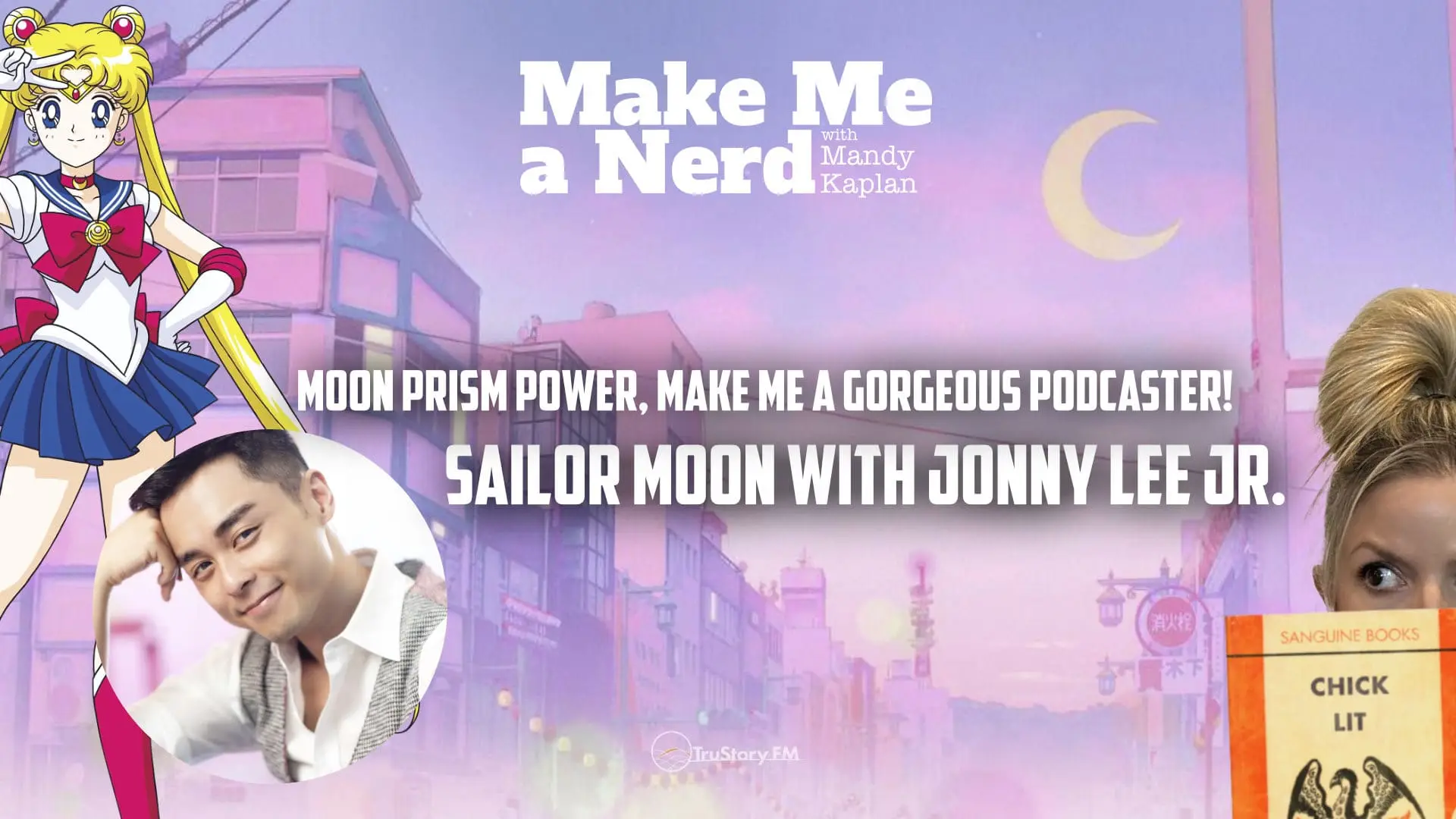
Mandy Kaplan:
Hello everybody and welcome to Make Me a Nerd. I’m Mandy Kaplan, a mainstream mom who just talked about her chili in the crock pot. I have been afraid of nerd culture my whole life. Not anymore, folks. I’m here to figure it all out and see what I’ve been missing out on. And if you are new to the podcast, I bring on a guest who nerds out about something, whether it be sci-fi, fantasy, anime, video games, podcasts, romance, and they try to recruit me to the nerd squad. And this is one of my favorite people in the world and one of my very first guests on Make Me a Nerd. I’ll say he’s a super gay nerd. I love him so much. Everybody, Jonny Lee Jr. is back.
Jonny Lee Jr.:
Hi, everyone.
Mandy Kaplan:
Now, no judgment, but you failed to make me a nerd about Zelda, because I could not grasp it. I couldn’t.
Jonny Lee Jr.:
That was a technical feat for yourself, I would say. To be able to just play a little bit, I feel like that’s a feat in itself when you’ve never played video games before.
Mandy Kaplan:
A technical failure. You’re too kind, but I have watched TV before, so this should go a lot better.
Jonny Lee Jr.:
Yes, it will.
Mandy Kaplan:
But everybody can go back and listen to my absolute failure at playing Zelda, if you would like, early on in the library. So we are doing Sailor Moon. Can you talk about your history with it and why you love it?
Jonny Lee Jr.:
Yeah, so growing up in the nineties, growing up in America —
Mandy Kaplan:
Oh, I just did a spit take of my water. Oh God, you’re so young. Okay, go ahead. Go ahead.
Jonny Lee Jr.:
Well, growing up in the nineties as a millennial, I was surrounded by a lot of just American cartoons because, growing up in New York and New Jersey, it was just what was accessible to me. But every time I would go back to Taiwan every summer to visit my family, I would be inundated with all this Japanese animation. So one summer, I can’t remember what age it was, I think maybe around eight or nine, maybe a little younger, who knows. But I was in Taipei and my cousin, who is a year younger than me, she showed me Sailor Moon. And I was like, what is this cartoon?
I was really drawn to the art style and the design of the characters. I was like, wait, these girls look super cool and cute. What is this about? And then I tried to watch an episode in Japanese, understood nothing. But I was like, this is kinda cool, what’s going on? And then when I got back to America that year, I think DiC Animation licensed the show and dubbed it and they aired it on TV, but only at 6 a.m. in the morning. So every day I would wake up —
Mandy Kaplan:
And this was before DVR or streaming, it was like you had to be there.
Jonny Lee Jr.:
Before all that, yeah, I was in elementary school.
Mandy Kaplan:
You woke up early?
Jonny Lee Jr.:
I woke up at 5:30 a.m. every day to watch it at 6 a.m. to just see what it was about. And I watched it in English and just immediately fell in love with the story, because it was just so different from anything I’ve ever seen. Because we had Dragon Ball Z, which was super fun, but this was a different story. I was always drawn to more female-driven stories as a child. And so being that there was a team of five women being badasses, I was like, I need to watch this and love it.
Mandy Kaplan:
Yes. Now I’ve already outed you on the podcast, so that happened. But I’m curious, a lot of my questions or observations as I watched, I think, eight episodes were about the gay appeal of Sailor Moon. And it is covered in rainbows and dance and fashion and it felt to me like a calling card. It was just like, if you’re a gay kid, get on board. Was that an appeal for you or am I reading into it? Did you not know you were gay back then?
Jonny Lee Jr.:
At that point I don’t think I really knew anything.
Mandy Kaplan:
It’s personal. You don’t have to —
Jonny Lee Jr.:
I wasn’t really thinking about sex at all or sexuality. But there was something about it that did draw and basically reinforce these sort of gay ideals and ideas that people have nowadays. Like the idea of a strong woman, I think, is very much a gay thing. Obviously it’s a feminist thing, but I think a lot of gay men love strong women.
Mandy Kaplan:
No, totally.
Jonny Lee Jr.:
I’ve definitely met lots of gay people who love Buffy, Xena, stuff like that.
Mandy Kaplan:
Yes. You’re so young. I’m like Ethel and Judy and Barbara. That’s who I go to. Yeah.
Jonny Lee Jr.:
Musical theater. Yes, those as well. But I want to say in terms of stories about strong women, physically strong women, I think that really appeals to a lot of gay men in particular. I don’t know why. But to me, it was something that was a draw.
And actually, watching it, I didn’t realize how queer the show was until a little later on. And it became even gayer as you go down into maybe the third season where you have some characters who are actually lesbians.
Mandy Kaplan:
It felt like it was embracing gay culture in season one, which is all we watched, but I was hoping it really made a point of it later. It was hinting at, this is all okay and whoever you are, we embrace it, we love it, just be yourself. But I wanted it gayer.
Jonny Lee Jr.:
Yeah. I know so many LGBTQ people that grew up watching this show because it was their only avenue to see representation in a cartoon. It’s crazy.
Mandy Kaplan:
Yes. And also you said something that struck a chord, that you don’t know why gay men gravitate towards these strong, fierce women. But I think, speaking as a gay man myself — it is that look at them, they are the weaker sex, yet they are not inhibited by that. They just sing or speak their piece and they’re gonna go out and change the world. And as an actual gay man — I’m sorry I took that on — but it’s like you want to just speak your piece. You just want to say your truth.
Jonny Lee Jr.:
And you know what? I do want to say that’s probably true in that, as a man growing up, I was being told by the world that women are weaker. But in my point of view, I don’t think so. I never thought that. I always thought women were stronger.
It’s just societal. And every single time I saw a Superman thing, I’d be like, this is boring. Who cares? Men are always depicted as these strong, awesome people. I’m like, they’re not. But women are never depicted that way. And when I see an example of that, it’s so good. It fills a need in me. I don’t know why.
Mandy Kaplan:
Well, I think it’s the fear that we are less than. And then here we are seeing someone who’s like, no, fuck that. I’m not. And it’s empowering to everybody.
Jonny Lee Jr.:
Yeah. Most definitely.
Mandy Kaplan:
So when you said Sailor Moon, I said sure, having no idea what it is. And I hit play and I was like, oh wait, I’ve seen this before. I’ve seen this artwork and these characters. It is maybe the most successful anime merch in America. Is that accurate?
Jonny Lee Jr.:
Nowadays no, but in the past, yes. I would say in the nineties and early 2000s, the biggest properties were Dragon Ball Z and Sailor Moon.
Mandy Kaplan:
I definitely have heard the phrase Dragon Ball Z, but I don’t know what that is.
Jonny Lee Jr.:
That’s another anime that’s targeted for boys. So Sailor Moon was targeted for girls and Dragon Ball Z was the equivalent for boys.
Mandy Kaplan:
Oh, okay, so secret fighters of this looming evil —
Jonny Lee Jr.:
Well, different story. Because you’ve watched One Piece and read it, it’s more similar to One Piece. It’s about a younger boy who actually in Dragon Ball Z he’s an adult, but it’s similar to that story. It’s a group of people adventuring and doing really awesome superpowered stuff. Sailor Moon’s more of an everyday story.
Mandy Kaplan:
And I never would have watched or read One Piece. And that’s why I treasure this podcast. Because I actually love One Piece. And who knew I would? But had you just said to me as my friend — full disclosure we’re friends — had you said, oh, hey Mandy, you should read One Piece, I would have been like, oh hey, no, thank you. Not my thing. Anime, not my thing. But now I’m pretty much a convert. I’ve done two episodes about One Piece. I love it.
Jonny Lee Jr.:
It’s so good.
Mandy Kaplan:
Yeah. So this journey is really making me a nerd. And I have so many nerdy observations. And as I went, I was like, maybe I’m actually a nerd. And I should stop saying I’m not a nerd. I mean, I’m a cat lady.
Jonny Lee Jr.:
You’re coming out as a nerd.
Mandy Kaplan:
Yes, I’m a crazy cat lady and a lover of musical theater and rainbows and all of that feels like it’s in here. So my initial impression, pressed play, watching, I got Jem vibes. Were you a Jem fan? That’s my generation.
Jonny Lee Jr.:
I remember Jem. It was on in the eighties and it’s a very vague memory. I do remember watching it. The earring that she would press and then transform into a rock star.
Mandy Kaplan:
She was truly outrageous. Truly, truly outrageous. Sing along with me, everybody. Yeah.
Jonny Lee Jr.:
I really enjoyed Jem because of the transformation. And I think that’s why I also liked Sailor Moon, because transformations for some reason are so cool to me.
Mandy Kaplan:
Well, these stories are ubiquitous, the Hannah Montanas and the Supermans and these secret lives.
Jonny Lee Jr.:
Secret identities, yeah.
Mandy Kaplan:
I seem like a normal person during the day, but little do you know. There’s something so wish-fulfillment appealing about that. That by night I could be a Broadway star. But by day no one suspects.
Jonny Lee Jr.:
And you don’t know who I am during the day.
Mandy Kaplan:
And then talk about wish fulfillment. So the story of the pilot and the show is that this middle school girl, whose name I can’t find on my page —
Jonny Lee Jr.:
Usagi Tsukino, or Tsukino Usagi if you say it in Japanese.
Mandy Kaplan:
Thank you. Usagi, they call her. She finds out she is empowered with special powers by a crystal and she can fight crime. And as the season unfolds, we learn more about who’s trying to take over the world and destroy her and destroy the positivity. But she finds this cat, Luna, and Luna can talk. Now, that is my ultimate wish fulfillment. If my cats could talk, Jonny.
Jonny Lee Jr.:
Of course it is. Oh my goodness. That would be insane actually. They would probably be pretty bossy.
Mandy Kaplan:
You happen to know my cats. They might not even be pleased with me. You invite people to sing and dance in our living room for rehearsals, it is unacceptable. Screw you, Mom. But I love that Luna the Cat is large and in charge.
Jonny Lee Jr.:
Yeah, she’s great. She also has a human form too.
Mandy Kaplan:
What?
Jonny Lee Jr.:
Yeah, there are three cat characters in the entire show. There’s Luna, Artemis, and their daughter Diana.
Mandy Kaplan:
And they have human forms.
Jonny Lee Jr.:
They do. Human forms because they’re from an alien planet.
Mandy Kaplan:
Okay. We met Artemis at the very end, right? She meets this other cat and she’s like, oh, there’s more than one of me.
Jonny Lee Jr.:
Yeah.
Mandy Kaplan:
So, okay. I said to Jonny, let’s do Sailor Moon. And he said, great, watch the following essential 14 episodes. And I quote, “It’s only four and a half hours.” And I was like, I don’t have the bandwidth or the time. But then you very sweetly, because Jonny is the nicest person on the planet, said, well, here’s the short version, medium version, long version. And I did the medium version. So I feel proud, but mildly ashamed I didn’t get through all of them.
Jonny Lee Jr.:
Nice. It’s all good.
Mandy Kaplan:
And then we are in the pilot. We’re learning, we’re meeting all the characters, we’re getting a sense of the world. A lot of rainbows, a lot of posing and freezing, which I love. And it feels like it wants to be a musical.
Jonny Lee Jr.:
Hey, let me tell you something. Do you know what SeraMyu is?
Mandy Kaplan:
No.
Jonny Lee Jr.:
Okay, so SeraMyu is a short form of Sailor Moon musical. There have been, I think, over 40 Sailor Moon musicals, live action, in Japan. They do it every single year. And every year, it’s a different iteration with a different story, different music.
Mandy Kaplan:
And have you seen these live or bootlegs or —
Jonny Lee Jr.:
I’ve never seen them live. I’ve seen bootlegs, and I tried to go see the North American tour last year, but I did not get a chance to.
Mandy Kaplan:
There’s actually a tour?
Jonny Lee Jr.:
Yeah, they toured it last year, worldwide.
Mandy Kaplan:
What kind of music is it? Is it musical theater-y or pop or a blend?
Jonny Lee Jr.:
A blend. It sounds more like Japanese pop music more than anything. Like the opening theme song of Sailor Moon — a little bit techno-y, a little bit nostalgic, pop from the nineties type music.
Mandy Kaplan:
Did it come to Los Angeles and you missed it? Or was it somewhere else and you couldn’t get there?
Jonny Lee Jr.:
I think it was in L.A. I can’t remember. I know by the time I tried to get tickets, it was sold out.
Mandy Kaplan:
Wow, don’t they know who you are?
Jonny Lee Jr.:
Yeah. I know, right? WTF.
Mandy Kaplan:
What the F? We said it at the same time. I’m a super fan, come on.
Jonny Lee Jr.:
Yeah.
Mandy Kaplan:
Well, I’m a super fan too. It really is right up my alley. And I kept imagining myself at ten watching at six in the morning eating my breakfast or something. My Pop-Tarts. Very dangerous with the frosting. But it’s nostalgic and warm and fuzzy, but also action-packed and so bright and colorful. I really vibed. Instantly I vibed.
Jonny Lee Jr.:
Oh yeah.
Mandy Kaplan:
Thank you. I can’t believe I said vibed. That’s what the kids say. It was so lit. It was fire.
Jonny Lee Jr.:
Oh my god, I sold it.
Mandy Kaplan:
Moving on to episode two, which is actually episode eight, “Computer School Blues.” Her mood swings, Usagi’s mood swings, are so extreme. And animation allows her to cry with the tears spouting out like a sprinkler and then get mad and her face turns red. But I have to say, pretty realistic for a fourteen-year-old girl.
Jonny Lee Jr.:
Oh, most definitely. And it’s kind of interesting because, if you think about any of our superhero stories, our main characters are never as ditzy or stupid as Usagi actually is. She’s actually one of the only characters I’ve ever seen that’s an actual idiot. And they say it in the show too.
So in Japanese you have three alphabets. And she only really writes in the form that doesn’t use Chinese characters because it’s easier. And people are always like, why can’t you write the Chinese characters? Are you dumb? And yes, she is, but she’s so pure-hearted and great that you can’t help but love her.
Mandy Kaplan:
Right. And she believes in justice and wants to fight for the little guy and does it. I adore her. But watching that I felt for my mom. I need to call my mom and say I’m sorry for who I was when I was fourteen. Because it’s brutal.
Jonny Lee Jr.:
As a teenage girl. Yeah.
Mandy Kaplan:
But I also like the portrayal of these girls. She’s nuts with her emotions, but the others are a little more reserved, and I feel like it’s a lovely portrayal of that age and their insecurities. They can be black and white about stuff. I like the way these kids are portrayed.
Jonny Lee Jr.:
Yeah. They go through a lot of really interesting stuff. So when it was licensed by DiC in America, they —
Mandy Kaplan:
What is DiC? You’ve said that a couple of times.
Jonny Lee Jr.:
DiC is an animation company that mainly did a lot of stuff in the eighties and early nineties. They licensed Sailor Moon, but they also had some really big properties. I can’t think of anything off the top of my head, but if you Google and look at their Wikipedia page, you’ll see they were a really well-known company.
One of the deals in America in the early nineties was that cartoon animation had to have stuff that could teach children. It had to be educational. So Sailor Moon had to implement something called “Sailor Says.” And every single episode, at the end, they would have a little tag that was like, Sailor Moon says you shouldn’t do this. And it would somehow relate to that episode, which was actually kind of cute and really well thought out, because the lessons are there. Why not just summarize it and tell the kids this is what you just watched?
Mandy Kaplan:
Yes. Well, I just Googled — I saw Mighty Morphin Power Rangers and I moved on. Because I watched a little bit of that with Casey when he was little. And this is not that. This feels like a higher quality, more meaningful thing.
Jonny Lee Jr.:
Well, it’s interesting because I think the reason why Sailor Moon became as big as it was is because it’s the first ever, I think, version of a super sentai, which is Power Rangers, show with women. All women. Because if you think about it, Power Rangers and Sailor Moon, same thing. Five characters that are fighting evil, and they all fit into an archetype and have a color code to them.
Mandy Kaplan:
Yep. And evil that exists only in their lair in the sky where they’re wringing their hands — I’m doing some physicality for my podcast that nobody can see. But there’s an evil person going, yes, go back down and find out what she knows. And that was very Power Rangers. I actually wrote that in my notes, that it hearkened to that for me.
Jonny Lee Jr.:
Yeah. Monster of the day.
Mandy Kaplan:
Yes, monster of the day with an overarching evil lord sending those monsters. But Power Rangers did not have Tuxedo Mask. Can we stop down on this? Can you explain to the people who Tuxedo Mask is while I try not to touch myself?
Jonny Lee Jr.:
Okay. Tuxedo Mask, otherwise known as Mamoru Chiba, or in the original English DiC dub, Darien, and also known as Prince Endymion, is Sailor Moon’s main love interest.
Mandy Kaplan:
Why so many names?
Jonny Lee Jr.:
Because they have past lives, they have translations, all these things. But Tuxedo Mask is Sailor Moon’s main love interest. He’s mysterious, because you always gotta have a mysterious character. You find out about him later on. But he’s just the main heartthrob for any girl or gay boy who’s watching it.
Mandy Kaplan:
Or menopausal woman.
Jonny Lee Jr.:
Or yeah. He’s just that guy that everyone just loves.
Mandy Kaplan:
I love him so much. He’s so hot. But because I bounced around on episodes, I was confused because in one episode, I’m like, oh crap, he’s trying to destroy her. And then on the next, I’m like, oh, he saved her. And then on the next, I’m like, nope, wait, he hates her. So they have a very Sam and Diane vibe.
Jonny Lee Jr.:
Yeah. I think in the anime, not the manga, but in the anime, they had a relationship between Usagi and Mamoru that was very like they would butt heads. He’d call her Odango Atama, which is “dumpling head,” and in the dub I think they say “meatball head.” I could be wrong. You watched the current dub, right? The one that’s on Netflix.
Mandy Kaplan:
Yes.
Jonny Lee Jr.:
Yeah, that’s a different dub completely than I watched when I was a kid.
Mandy Kaplan:
Oh, really?
Jonny Lee Jr.:
Yeah, so the one I watched as a child, the names were different. Usagi’s name was Serena, Rei is Raye, Ami is Amy, and then we have Lita, and then Venus — I can’t remember her English name. It was something weird. But they gave them all English names.
Mandy Kaplan:
Was that to appease Americans, give them English names to grab onto?
Jonny Lee Jr.:
Yes, it’s regionalization for the American audience. Which was great for a child because I was able to receive it and understand it way better.
Mandy Kaplan:
Right. But also a little sad. Usagi is just as easy to say as Serena, so why can’t we just call her Usagi?
Jonny Lee Jr.:
Well, nowadays they do, so that’s a good thing.
Mandy Kaplan:
That’s interesting. Carrying on.
Jonny Lee Jr.:
The relationship between Usagi and Mamoru, how they butt heads at the beginning — I think that was created to cause some tension in there. Because why would you think he’s Tuxedo Mask, even though he is Tuxedo Mask? But it’s fun to see them in real life not liking each other. It’s kind of like that She Loves Me, You’ve Got Mail trope, where they hate each other but really are in love with each other.
Mandy Kaplan:
Yes. Absolutely. And it’s appealing. They can stretch it out over seasons and episodes. I liked that chemistry a lot. Although Usagi falls in love with every boy.
Jonny Lee Jr.:
Every boy. And that’s actually most of the characters. You only saw Sailor Venus for a split second, but that character actually becomes the craziest boy-crazy character ever.
Mandy Kaplan:
Like a blanket Cupid vibe.
Jonny Lee Jr.:
No, like a little bit dumber. She actually becomes like a literal dumb blonde.
Mandy Kaplan:
Oh. Well, that hurts me. So I read a story called Nana for my manga episode with the author of The Manga Bible, Helen McCarthy. Nana bothered me in that she just flipped for every man that entered her sphere. Every boy was like, now I have to throw away all of my goals and dreams because I think this boy is cute.
Jonny Lee Jr.:
The country Nana, not city Nana, right?
Mandy Kaplan:
Yes. But I feel like that’s how Usagi is too. And I didn’t see enough episodes to know if the other girls are too. Is that a cultural statement about the age? I mean, Nana’s 19 or 20 and Usagi’s fourteen, where I feel like, yeah, I get it. I remember I wanted to die for every boy I had a crush on.
Jonny Lee Jr.:
So I want to say that this was never a big issue in the manga. Because the manga is such short-form storytelling, you don’t have time to do all these boy-crazy stories. I think the prominence of it in the anime is actually because of the male directors and writers of the show. Because if you actually watch the whole show, and I didn’t realize this until I was an adult, there’s a lot of things in the show that reinforce female stereotypes because they’re being written by men.
Mandy Kaplan:
Interesting.
Jonny Lee Jr.:
So having a lot of these middle school girls being boy-crazy comes from that, in my opinion.
Mandy Kaplan:
Interesting. Shots fired. Creators, come at us.
Jonny Lee Jr.:
Shots fired.
Mandy Kaplan:
Okay, so you also brought up something which I forgot to ask you about, so I apologize. This was a manga before it was a TV show?
Jonny Lee Jr.:
Yes and no. Pretty much it came out simultaneously with the manga. It was published by Kodansha and also animated by Toei Animation, which had an agreement together. Pretty much they would release a manga chapter and then release episodes at the same time. So this was the first time, I think, in Japanese history that they had a manga and an anime being released at the same exact time, which caused issues, being that manga releases are much slower than anime.
And so if you take the first arc in the manga, I think it’s only about 11 or 12 acts, and they stretched it out to 46 episodes in the first season.
Mandy Kaplan:
Of course.
Jonny Lee Jr.:
So that’s why I was like, skip all these things and watch these few episodes to get the whole gist. Because everything else is filler. It’s all just the girls doing random things, doing fun things, and fighting a monster at the end.
Mandy Kaplan:
Yes. Which is enjoyable, but I did at some point get a little like, is every episode formulaic? I’m ready to shake it up. They all felt a little formulaic.
Jonny Lee Jr.:
Yeah.
Mandy Kaplan:
But Jonny, it’s so interesting that you say they came out at the same time. That’s like a dream as an avid reader. I just read the book The Correspondent. It’s a very zeitgeisty novel right now. It’s beautiful. Everybody should go get it. And they just optioned it, Jane Fonda’s gonna star. That movie’s not gonna come out for three years.
So to have something that you’re like, I read the issue and then tomorrow I get to see the episode, that would be incredible for someone who loves to read and loves to see the adaptation.
Jonny Lee Jr.:
Yeah, it’s really fun, but there is a detriment to that. So take for instance One Piece. You know how One Piece has literally thousands of episodes. It’s because the anime caught up with the storytelling in the manga. So they had to basically pad it as much as possible. So if you take a One Piece episode later on in the show, literally the only plot you see is about ten minutes. The rest is review. That’s insane.
Sailor Moon never got to that point, but I would imagine it probably would have, because it’s just not sustainable to create a manga and an anime at the same exact time.
Mandy Kaplan:
Yeah, I would imagine it would be impossible. But is Sailor Moon done?
Jonny Lee Jr.:
Sailor Moon is done. The manga ended sometime in the mid-nineties and the anime as well at episode 200. In 2016, I think, for one of its anniversaries, they decided to redo the entire show and release a new anime called Sailor Moon Crystal, which is more based on the manga.
And the first two seasons are garbage, in my opinion, because the manga storytelling is too quick. It doesn’t give you the time to learn and know these characters for you to care as much. And there are some weird things that Naoko Takeuchi, the writer, did in the story that weren’t my favorite, but it was kind of interesting.
Mandy Kaplan:
Well, after this we’re gonna plow on with some of our episodes. Episode 10, “Cursed Bus.” This is where I noticed, and I’m sure she did it in episodes prior, but she can transform herself. She can say, make me the form of something else, and become a different character. And she calls out, “Make me a gorgeous flight attendant” in this episode. And I loved it. I thought that was hilarious that this young girl wants to be gorgeous.
But then I noticed she says it every time. “Make me a gorgeous newscaster.” “Make me a gorgeous doctor.”
Jonny Lee Jr.:
Gorgeous. Always gorgeous. That’s the goal.
Mandy Kaplan:
And then somebody calls her out on it. And I was so happy when another character said, why do you have to be gorgeous all the time? I don’t remember who called her out on saying she wants to be gorgeous, but I did bump on that as a woman and thinking young women are watching this and that their hero Usagi’s priority is being gorgeous. I found it to be a slightly harmful message.
Jonny Lee Jr.:
I actually agree, but I think that is an after-effect of the genre itself. So Sailor Moon is part of a genre called mahou shoujo, which means “magical girl.” And it came about originally in the seventies with this cartoon called Cutie Honey.
Mandy Kaplan:
Ooh. Taylor Swift would have something to say about that. You can call me honey. All right.
Jonny Lee Jr.:
But Cutie Honey was the first magical girl show, but was targeted towards men. It was about an android woman who would basically transform into anything she wanted. She could become biker honey, which is a motorcycle biker, or reporter honey. So the idea came from Cutie Honey. And the reason why it was for men is because every single time she transformed, her clothes would rip off and she’d be fully naked, and then the clothes would be stitched onto her. So men loved it.
Mandy Kaplan:
Of course.
Jonny Lee Jr.:
So I feel like that’s the reason why in Sailor Moon we have the disguise pen, which actually disappears from the story after the first season.
Mandy Kaplan:
Oh, really?
Jonny Lee Jr.:
Yeah. That device is not used.
Mandy Kaplan:
It was fun to see her jump in and be gorgeous newscaster and infiltrate the bad guys that way.
Jonny Lee Jr.:
Yeah, she hardly used it after the first season.
Mandy Kaplan:
All right. And so “Cursed Bus,” episode 10, was where I actually had the thought of, yeah, I’ve only watched three, but they’re all the same. So I’m just putting that on the record. I’m putting that on blast.
Then we watched episode 13, “The Mysterious Sleeping Sickness.” And it hit me that Usagi explains the premise of the show at the top of every episode. And I thought, why? And then I realized I do the same damn thing on my podcast.
Jonny Lee Jr.:
Well, this is the reason why. And I didn’t realize this until I was watching a bootleg fansub of the show that was recorded on TV. All the commercials that were presented during the airing of the show were for five-year-old girls. It’s because the show’s target demographic is five-year-old girls.
Mandy Kaplan:
Five-year-olds?
Jonny Lee Jr.:
Yes, it’s for literal children. But the thing is, it touches topics that children don’t understand.
Mandy Kaplan:
I’ll say. Now psychologically, and I’m not being facetious, even though I always am, what does that mean to you? Are you like, oh wait, why do I like this show? Or is it that Sesame Street vibe of appealing to adults and children?
Jonny Lee Jr.:
Well, I think entertainment’s different depending on what country you’re in, and I think children’s entertainment in America is a little bit too much about learning and teaching, like Sesame Street, as compared to anime in Japan. A lot of the shows in Japan for five, six, seven-year-olds are about the fun of it. It’s for the fun of it, not to learn anything. It’s just have fun. And if you learn something watching it, then cool. But it’s really about the capitalism of it all, to make products and toys to sell to these kids.
Mandy Kaplan:
But you also said when DiC got it, they said you have to make a “Sailor Says” — an educational segment.
Jonny Lee Jr.:
That was for America only.
Mandy Kaplan:
So in Japan, it’s cool to just entertain and then try to sell products. And in America, I mean, God, I’m torn, because in America we want to entertain, give you a little lesson, but sell products.
Jonny Lee Jr.:
Well, I think that came from the late eighties, early nineties, America becoming this giant superpower. And then we had a lot of conservative women being scared about the future of their children. Remember the whole Tipper Gore thing with the CDs? And I’m kind of like, they’re cursing, who cares? But that was within the whole zeitgeist of the care and fear for what your child is watching or intaking.
Mandy Kaplan:
Which as a parent I fully understand. And there were things that we would absolutely just say, nope, you’re not old enough. But for me it was always violence. It was like, you can watch people swear, you can watch people be sexy, but I don’t want you watching people blowing each other’s heads off.
Jonny Lee Jr.:
Yeah. And that’s more of an American thing, the violence. And there is technically violence in Sailor Moon, but it’s not as extreme as other shows, especially video games.
Mandy Kaplan:
Yeah, it’s nothing. I just watched Legend of Vox Machina on Amazon for the podcast. It’s like a D&D campaign brought to life in a cartoon. And it is very violent. And Sailor Moon is nothing in comparison. This is charming. The violence never gets scary. I mean perhaps if you’re five, but —
Jonny Lee Jr.:
There are moments, yes. If you enter season three, some of the monsters are legitimately terrifying looking because if you read the manga, it’s actually very violent. Monsters with their faces melting off.
Mandy Kaplan:
Oh. Okay, so here’s a question. The manga is violent. Who is the manga geared towards?
Jonny Lee Jr.:
The manga is more towards middle school girls.
Mandy Kaplan:
Middle school, the same age as our characters. So then — you don’t work for the company that said, let’s make it an anime show geared towards five-year-olds. But I marvel at that choice.
Jonny Lee Jr.:
I feel like that’s just the sort of marketing strategy where you choose one demographic and sell to that demographic and usually more demographics will buy into it. So it’s a smart way to do business, in my opinion. Just be like, hey, I think this seven-year-old girl will love this show. Let’s make sure all the toys, all the merchandise is for her. And then you’ll have some 40-year-old man be like, I want this Sailor Moon pen, and they’ll buy it.
Mandy Kaplan:
Well, also, if fourteen-year-olds are buying the manga and reading the manga, and then you make the cartoon series for five-year-olds, now you have two demographics. You’ve doubled your audience. But if you made the show for the same demographic, it’s just the same people.
Jonny Lee Jr.:
Yeah. And I think for manga, they tend to write more sophisticatedly. Is that a word? Sophisticatedly?
Mandy Kaplan:
It is now.
Jonny Lee Jr.:
They do tend to write more in-depth just because they want to tell a story. So One Piece is targeted towards kids. But it deals with a lot of socioeconomic stuff that you really have to look at deeply to understand. And that’s the same thing with Sailor Moon. It really talks about society, a lot of different types of relationships, but you have to go underneath and see the subtext of it all. Some kids it’s just over their heads, but an adult will get it.
Mandy Kaplan:
Right. As they should be. You don’t want a six-year-old wrestling with social injustice.
Jonny Lee Jr.:
Yeah.
Mandy Kaplan:
But —
Jonny Lee Jr.:
But as an adult watching it back, then you realize that it’s actually kind of really cool. You’re like, oh, I love this as a kid, but there’s more to it than I actually thought.
Mandy Kaplan:
And do you still watch it now?
Jonny Lee Jr.:
So I watched the new anime, every single episode till the end. And occasionally I’ll maybe rewatch a couple of my favorite episodes, but I haven’t done a full rewatch of the show since maybe 2003, I would say.
Mandy Kaplan:
Oh, okay. Wow. And are there spin-offs and other adaptations other than the one you’ve mentioned?
Jonny Lee Jr.:
Yes. There’s the musical, the two animes, and there’s also a live-action adaptation that was a TV show in Japan. Similar to Power Rangers with real people, and they would transform. You can see the hilarious transformations they made for these girls. It’s insane. Just imagine a regular Japanese girl in front of a blue screen spinning and their hair becoming ridiculous colors.
Mandy Kaplan:
I have questions about the hair colors. They’re primary colors, and I didn’t know if that was cultural or just to keep the show exciting.
Jonny Lee Jr.:
In anime in general, a lot of creators use very differentiating colors to make sure you can see the difference between the characters, but also it’s more fun and you can color-code it. So Mercury’s power is based in water, so she has blue hair. Mars is fire, so she wears red, has this dark purple hair. The purple hair doesn’t really match the fire, but she has a really awesome look in my opinion. But yeah, it’s all color-coded. It’s all for variety and being able to tell the characters apart.
And what’s really funny is that a lot of Western viewers assume that these characters are white. But in any anime, unless specified, they’re always Japanese.
Mandy Kaplan:
That’s another question though. Their eyes are gigantic, which is an aesthetic of anime that I’ve seen.
Jonny Lee Jr.:
Yeah. But do you know where that’s from? The origin of the anime art style is from Snow White. They derived the entire style from Disney’s Snow White. Snow White had an innocent face, bigger eyes. And as this style evolved they became bigger and bigger.
And they realized with this type of style, it allows you to have these big, expressive emotions animated. You can laugh at the silly faces they make or see the real emotion, tears coming out of these giant eyes. And as time went on, styles have changed. If you look at current anime, the eyes are a little bit smaller than they were in Sailor Moon.
Mandy Kaplan:
Is that considered culturally insensitive in any way?
Jonny Lee Jr.:
I don’t think so because as an Asian person, we don’t think our eyes are small or anything. Obviously there are people with monolids or epicanthic folds that do have smaller eyes, but someone like me growing up, out in the world, it was always like, why are your eyes so small? I’m like, my eyes are bigger than yours, what are you talking about?
It’s never been an issue. I mean, there are beauty standards in Japan where they do want bigger eyes in general. And the eyes being blue and other colors — that’s not a typical Asian trait. There are certain Asian groups that do have different colored eyes, but it’s very rare and not predominantly in Japan. That is more so for variety and being able to tell characters apart because if you look at a black-and-white image of Sailor Moon and her mother from her past life, they look exactly the same. They’re just color-coded differently.
Mandy Kaplan:
Okay. I mean, it makes good sense. It’s practical, which I enjoy and respect.
We are heading into the home stretch with our final thoughts, if you can believe that. But first, I need to tell everybody that Make Me a Nerd is a production of TruStory FM, engineering by the peerless Pete Wright. My theme song is “Wonderstruck” by Jane and the Boy. And if you are willing to go on Apple Podcasts and leave me a five-star review and make a comment, I would be eternally grateful. I can read those comments on the show and get you involved in the conversation. Make suggestions for what you want me to try next. And if you’re feeling extra supportive, please go to makemeanerd.com/join. Hitting that button will get you your episodes ad-free and early, and my eternal gratitude.
Jonny, this is flying by. Episode 32, “Umino’s Resolve.” These characters are finally in different clothes. The teacher’s always in the same suit and the girls are in their school unis, which I understand, but I was like, yay, we’re seeing different clothes.
Jonny Lee Jr.:
Right. And I remember watching it as a kid, I would also note that. And then I found out it’s budget. It’s a budget thing. They can’t do anything about it.
Mandy Kaplan:
Yep. Makes sense. And then Luna makes her big announcement. And one of the girls says, “This story just keeps getting weirder.” And I thought, yes, I agree. What is happening?
It’s hard when you bounce around because I saw some of the bad guys and then there were new bad guys. And there’s one henchman with a long ponytail who sounds just like Sigourney Weaver.
Jonny Lee Jr.:
Ah, that’s Zoisite, and Zoisite is a man.
Mandy Kaplan:
Yes, but sounds like Sigourney Weaver. And —
Jonny Lee Jr.:
And that’s a gay relationship. Did you notice that?
Mandy Kaplan:
Yes! There were many points at which I thought, I feel like this show is part of the gay community and is embracing it. And then I met that character and I thought that for sure. But I don’t think anything for sure because it’s me and my guests will often be like, no, you’re an idiot. But I thought they’re trying to really lean into this androgyny and just being who you want to be.
Jonny Lee Jr.:
Totally. And in the original DiC dub, they actually made Zoisite a woman in the American version. They did not want to have a gay relationship in a children’s show, so they made the character a woman. Because Zoisite does present very androgynous, could be male or female. They decided to make them basically female in the American version back then. And I didn’t know this until later on. I found out and I was like, wait, they were supposed to be gay all along?
Mandy Kaplan:
Yeah, I mean, that’s what I took and I was happy about it. Also, side note, everybody goes, wait, the cat can talk? And I’m like, you just battled spaceships and weird aliens in the sky, and that’s what you’re shocked by? Everyone’s so shocked the cat can talk.
Jonny Lee Jr.:
The most unbelievable thing — an animal talking.
Mandy Kaplan:
And then in this episode, “Umino’s Resolve,” they show a lot of food. Bento boxes, lunches, kids eating sushi, and that’s my jam. I wanna know what everybody’s eating all the time. Does the show do a lot of food stuff?
Jonny Lee Jr.:
Occasionally they’ll show some food. It’s not one of those shows that’s predominantly about food. If you want to watch an anime about food, I’ll tell you about one.
Mandy Kaplan:
Okay. Let’s do it. You want to come back next week?
Jonny Lee Jr.:
Sure, why not? There’s a really great one that’s on right now. But seeing the little tiny foods in the animation, like little bento boxes, is always so cute and adorable. Because the idea of bento boxes in Japan is that the mother shows their love for their child in the effort they make in their bento box. So that’s why when you Google bento boxes, they’re these works of art.
Mandy Kaplan:
Oh, then my kid is screwed.
Jonny Lee Jr.:
It’s fine. Only if you were Japanese.
Mandy Kaplan:
Okay, thank God. No wonder I’ve messed up Casey so bad with his lunches. Well, I just made a note. I really do want to watch an anime about food, so let’s reconvene.
Jonny Lee Jr.:
I’ll text you.
Mandy Kaplan:
Please don’t forget. I’m sorry that I didn’t get through all the episodes that you wanted me to, but I thoroughly enjoyed what I did see and experience.
Jonny Lee Jr.:
I won’t.
Mandy Kaplan:
And one of the things I loved is when Sailor Venus is introduced, episode 33, “Enter Venus.” Her theme song is the Love Boat theme song.
Jonny Lee Jr.:
It is?
Mandy Kaplan:
Can you hear it? It is, and it’s very seventies.
Jonny Lee Jr.:
Yes, it is. The love of Sailor V. Yeah, it is the same thing.
Mandy Kaplan:
I loved it. And I thought, well, Jonny doesn’t even know that reference because he’s too young. But this whole show has a Xanadu vibe that I just thoroughly enjoy, even though I don’t necessarily enjoy the movie Xanadu. If you want to hear that episode, that’s on here too with Jonas Vale.
But it is rainbows and imagination and female empowerment and it’s just charming as hell, Sailor Moon.
Jonny Lee Jr.:
Yeah. And if you watch more of it, it gets really plot-driven in certain points. And the history that Naoko Takeuchi created with these characters — their past lives, future lives — everything is so intricate and very interesting and based off of a lot of Greek mythology as well. She was influenced by Greek mythology, Roman mythology, and just implemented that into her story.
Even the names — Sailor Mars, Mercury — the names of the planets are based off of Roman gods. So she took those ideals and intertwined them. If you look at their power sets, they kind of relate to certain things that have to do with the zodiac sign they’re born under or the planet they represent. Very, very cool. Very nerdy.
Mandy Kaplan:
Well, I’m glad you said that there’s more plot because that is, as I said, the one thing I thought — I’m feeling these are a bit rinse and repeat. So I would be more interested in the next season where there are cliffhangers and you need to know what’s gonna happen. I needed a bit more plot and a little less of the repeating.
Jonny Lee Jr.:
Yeah. The monster of the week. And that’s why I would say the new anime is not as good. Because it is just monster of the week. Every episode you meet a new character and then finally you hit the turning point of a story and you’re kind of just like, well, I’ve only seen these characters for five episodes. How do you invest?
Mandy Kaplan:
How do you invest?
Jonny Lee Jr.:
It’s kind of the problem with live-action One Piece season one. They plowed through that arc so fast. And I remember watching the anime and legitimately bawling my eyes out during a scene. And then watching the live action, I was like, I don’t feel much. But it was still good.
Mandy Kaplan:
I only watched, I think, the pilot or one or two. But I really loved the live action. I didn’t get far enough to know if it got the heart and the meaning.
Jonny Lee Jr.:
It does. Season two right now is excellent. My goodness. The heart is there. It’s just that introducing a whole arc of storyline within a small set of episodes is hard. You really can’t do it that well.
Mandy Kaplan:
It’s hard. And I guess it appeals more to a noob because I don’t know any different.
Jonny Lee Jr.:
Yeah. To me I’m just like, ah, you only made it to that episode. You could have gotten to so much more, so much better. But it’s all good.
Mandy Kaplan:
Strongly worded letters, my friend. They make a difference. I don’t know. Okay, text me the name of that food anime, and that’ll be our next episode. Thank you, thank you, thank you for doing this all the way from Taipei.
Jonny Lee Jr.:
Of course. I’m so happy to talk to you about my favorite show of all time.
Mandy Kaplan:
I really appreciate it. Oh God, it makes me so happy. Thank you. And thank you all for listening. Until next time.