Kynan Dias
Picture your fear. Now imagine it big—large, looming, giant. Whether it’s a slinky, black, oozy science experiment gone wrong, a beast from the forest that’s overrun its natural barriers, or an ancient sea beast emerged from the depths with its beady eyes aimed at the hearts of all your loved ones. But bigger. Enormous. Gigantic. Monstrous. What is it like to stand at the feet of the personification of your secret terrors as they indifferently regard you—if they even notice you at all? How does it make you feel? Small? Tiny? Insignificant? As it looms over you, towering—monstrous, colossal—do you hide? Where? In the giant’s own footprints? Do you flee? How do you outrun a continent? Do you form a plan? Somewhere in your infinitesimal body lies a brain. Or do you hope this Titan, this Colossus, this Brobdingnagian mass realizes the truth at the heart of your own fear: that you’re not worth even a swipe of the claw, a swing of a tail, a little puff of fire breath. You’re itty bitty, piddling, inconsequential.
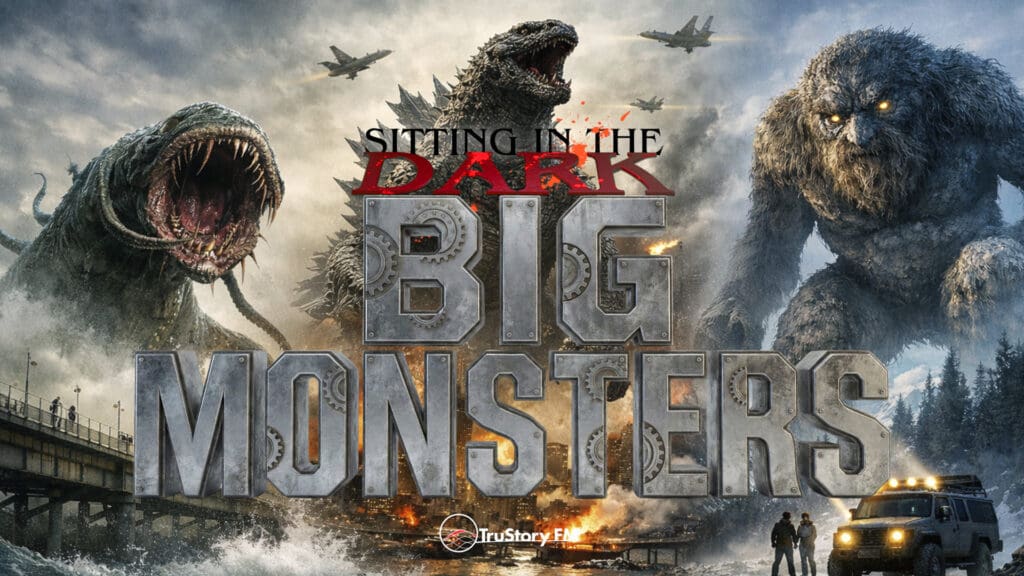
With that, from TruStory FM, this is Sitting in the Dark. Each month we explore horror films around a common theme, and this week we go big or go home—with big ol’ monsters. I’m Kynan Dias. As always, I’m joined by the towering intellect and joy of Chelsea Stardust. Hello, Chelsea.
Chelsea Stardust
Hello.
Kynan Dias
And our big bad voodoo daddy, Tommy Metz III. And I closed my thesaurus already, but we got the big, big, big—Pete Wright.
Tommy Metz III
Yep. Big. Exact big Wright.
Pete Wright
What are we doing right now? How did I get stuck with “big, big, big, big ol’”?
Tommy Metz III
Yep.
Kynan Dias
There you go. You know, large and in charge, Pete Wright.
Pete Wright
Everybody else got awesome stuff.
Tommy Metz III
Jolly Green. Jolly Green people.
Kynan Dias
Jolly green Pete.
Pete Wright
Jolly and green? Oh, I’m hanging up.
Tommy Metz III
Yeah. Ho ho ho.
Kynan Dias
Right, so this week we’re gonna be taking a look at three giant monster movies from the current era. We could go back sometime and do rubber suit monsters from the old days, but this week we have: from South Korea, Bong Joon-ho’s The Host from 2006; from Norway, André Øvredal’s Troll Hunter from 2010; and a much more recent Godzilla—Takashi Yamazaki’s Godzilla Minus One.
So before we get into the individual films and look at our axes to grind and what makes us fear the large: what do we think about the overall theme here with our three films? Anybody?
Tommy Metz III
I was excited for it because I’m not traditionally a big monster fan. If there’s giant monsters, I like them to be cosmic horror. I like them to not be quantifiable—more Lovecraftian. So, as a result, I don’t necessarily lean towards things like Godzilla. And so when a podcast tells me it’s my job to do it, I’m excited because it’s like I can re-engage with something that I had not engaged with.
Kynan Dias
I was thinking about your Lovecraft horror love, especially with Godzilla in this version of it.
Tommy Metz III
So—
Kynan Dias
Yeah. Very interesting. Pete?
Pete Wright
Big fan. Big. I’m big, big, big, big ol’ fan of all of these movies in particular. And I think the idea of using these giant monsters as metaphor for things that are out of our control and see us as inconvenience and fodder for destruction is useful metaphor for so many things that are happening broadly in the world today. And so I found it really exciting. And I like that we didn’t go with big guys in suits. It’s nice to watch how these movies have evolved to make use of the technology. So it was really fun.
Kynan Dias
Right. You know, I’m a little similar with Tommy in that I do avoid giant monster movies for a different reason. After 9/11, to get really serious with you, I just didn’t find that fun anymore. And I think that some of the more realistic Godzillas… you know, the American movie just called Godzilla—not the Matthew Broderick one, but the one from the 2010s—Godzilla destroys both of my hometowns, Honolulu and Las Vegas.
Tommy Metz III
Oh, it seems personal.
Pete Wright
It’s hard not to feel targeted.
Kynan Dias
Yeah, and I just… I don’t know, I don’t find those fun. Maybe eventually I can go back and look at that and detach yourself in the way that you’re supposed to do that. But I do not seek them out. So I did kind of force myself here to go and visit Godzilla again and see what that was like.
Why don’t we jump in—speaking of metaphors—Pete, we can start with The Host, which has this sort of cryptic title that must mean something as we examine it from Bong Joon-ho. Was this new to anybody?
Tommy Metz III
This is the one that I’d seen, yeah.
Kynan Dias
Oh, the one that you’d seen, yeah. Absolutely. I’ve seen this in the context of seeing it when it had first come out. I’ve also programmed it into one of my classes on international comedy, where we were looking at movies that are labeled comedies in other countries and then sometimes you bring them here and they are revered as super serious, not funny. Like the Romanian film The Death of Mr. Lazarescu, which is harrowing, and critics are like, “This is a really serious movie,” and then in Romania it is considered a knee slapper.
So here we watched it, and having seen that for my second time in a theater with people who are primed to see it as comedy: The Host is a very funny movie. It’s quite hysterical. Seeing it here in this context was a little bit different for me, maybe not with an audience.
But so this is Bong Joon-ho’s, I’d say, breakout movie in the West at least. And this is regarding a monster that is made when an American pathologist forces his Korean assistant to drop some chemicals into the sink in their lab. And they go into the Han River, and it comes out a monster that becomes larger and larger. It starts snatching people from the riverside, including the young girl of a family that’s headed by the father, Song Kang-ho’s character from Parasite. So true to Korean form, it becomes a revenge thriller where they’re both trying to save the little girl, but also, eventually, just kill it—for the sake of inflicting pain back at it. And so the monster becomes larger and larger.
So do we have any axes to grind here with Bong Joon-ho’s The Host?
Tommy Metz III
The first time I saw it—and I had seen it so long ago that I might as well have just said that I saw it for the first time—sometimes I have trouble following its swings of tone. That it is so comical. It’s filled with dunces. These lovable kind of Lebowskis just sort of shambling around. And then something really kind of upsetting happens. And I have… it’s a little bit of a whiplash for me. The fact that it never loses me, I never want to turn my back on it, means that it works. But it still takes a lot of getting used to: this kind of sappy melodrama mixed with this really intense medical sequence, which seems to come out of Jacob’s Ladder. It’s just a little bit of a tough watch at times for that reason.
Chelsea Stardust
I would agree with that. I think I saw this when it came out, but I haven’t seen it since. So along with what Tommy said, I felt kind of the same. I was like, oh, it does feel like I’m seeing this again for the first time. And I think it could benefit from the black and white treatment. I think the effects in some places are incredible, but my partner joined me for watching the latter half of it and there were some moments where he goes, “Woof, those don’t quite hold up like they used to.” And I almost feel like something like The Mist, and even Godzilla Minus One watching that in black and white—there are moments where that really can elevate it. And I thought, oh, this would be a great one to see in black and white to see how that would change.
Kynan Dias
There is something to the early parts of all of these films, these three in particular, that is in the Jaws mode or the Frankenstein mode of letting us imagine it, and then that works really effectively. And then, yeah, when we… all three of them seem at the end to be like, “Hey, let’s focus on the special effects.” And so I totally understand that.
Pete Wright
I think for me—if I were to really put on my patriotism suit—it’s a caricature of American representation in Korea, and specifically American military. You say they were pouring stuff in the sink—it’s the American military that was pouring stuff in the sink that went to the river. That is really, really important because this movie hinges on how Korean culture felt about Americans making… the American scientist, cross-eyed, drilling into Gong-du’s brain is funny and the point, if you’re Korean. And so on this watch it was the first time I felt like, oh, did he go too far on the lampooning of the American role in South Korea? They’re a little bit cartoonish.
For me: I’m with you, the CGI hasn’t aged great. I love the idea about seeing this in black and white. And that tonal shift—my goodness. But overall, I do love this movie, so all of these are just silly nitpicks anyway.
Kynan Dias
Yes. When I did watch it with students who hadn’t seen it before, and telling them this is a comedy—framing it in that class—the biggest laughs that we had were at the funeral scenes, which is just these family members crying, tripping on their own… like, weaponizing their own tears. And that didn’t happen to me when I first saw it either, when I’m thinking of it as a monster movie.
So, yeah, the huge tonal shifts. I think part of it is because it is so well made. And then also this last time watching it: part of it because now Bong has become a major, one of the ten most important filmmakers working today in the world. You kind of want to give it latitude and say, like, well, this must be something I’m not quite getting, right? Like, this is a master at work. But I totally understand how it’s taking swings that we might not be following with it.
Why don’t we talk of the American military version of this first, because the movie seems to present this idea that we’ll pick up in some of our other films: the first response to it is inadequate, right? Like the default response. The Korean response is non-existent, and then the American response is the one that’s gonna have to go and save it. And we start adding all of this truly anti-American ideas—Agent Yellow, this gas, the false flag operations—and none of it works. And so what do we think about that, of how that’s operating in our giant monster movie context?
Pete Wright
Well, I love it. Did you know this is based on a true story?
Kynan Dias
I know you were just saying, like, “Are they going too far,” but yes—most of this is based on a true story.
Tommy Metz III
What do you mean?
Pete Wright
Right? Okay, so—no, no. In 2000, there was a civil servant who was contracted by the U.S. military, a guy named Albert McFarland, who ordered 24 gallons of formaldehyde to be disposed in the sink, and it went into the Han River near Seoul. Like, that’s where this whole thing starts.
Tommy Metz III
Oh no.
Chelsea Stardust
How insane.
Tommy Metz III
Oh.
Pete Wright
That’s where this whole thing starts.
Tommy Metz III
Is that where he got the idea?
Pete Wright
Yes. Absolutely. It starts there.
Kynan Dias
Yes.
Pete Wright
And he’s like, “Look at what you have wrought, U.S. military.” Monster movie. Which I think is low-key genius. Like, that’s exactly what I want out of my metaphor in big monster movies. It’s based on… in fact. And I think that holds up.
Chelsea Stardust
Yeah. I also love that the two American actors in this—Scott Wilson, obviously, who a lot of people knew later on in Walking Dead, but was in In Cold Blood and Ninth Configuration, and then the actor from Silence of the Lambs, that’s the doctor—to see his great cameo in this. And I hope that’s— I was hoping someone would bring up that story because it’s insane.
Tommy Metz III
Oh right. He’s one of the butterfly scientists, or the bug scientists.
Chelsea Stardust
Yeah, yeah.
Kynan Dias
Yeah.
Pete Wright
Yeah. It’s so good because it is the flesh of American institutional failure, right? It reminds you what happens when that first domino gets pushed over. Eventually you end up with this multi-tentacle swinging monster—uvula monster.
Kynan Dias
Right.
Chelsea Stardust
Yeah.
Kynan Dias
The uvular monster, yes.
Tommy Metz III
And like Kynan was, you know, in his opening talking about what is it like dealing with this behemoth… behemoth?—of something that is large and powerful and a blunt object and doesn’t care about you. There are so many scenes of human Americans treating Korean civilians like that. When Agent Yellow is released and protesters start dying, and there’s just that shot of very impassive American officials just sort of watching, because these aren’t humans. Same with the medical sequence: the whole lead-up, they know there isn’t a virus, the whole thing is fake, but they’re still gonna drill in people’s heads because they want to lobotomize. I mean, there’s no humanity there. So it’s a nice parallel.
Pete Wright
Director Bong himself even said, “This is Korea’s first legitimately anti-American movie.” And he made it.
Kynan Dias
Yes. And so this is at a time when America is posturing, perhaps justifiably, against the Kim regime in North Korea. This is happening during the Iraq War. North Korea is being called part of the axis of evil, if we remember back then. And there’s very little talk about what does it mean for Korea there, right? In America it’s all, you know, Seoul is so close to the border and the war would destroy Seoul so quickly, and then what do we do in America? As opposed to: no, that’s the whole problem. Seoul would go first and be destroyed.
So, yeah, a lot of countries have dealt with this and just sort of accepted crimes that happen around military bases and been like, well, that’s the price we have to pay for safety.
Tommy Metz III
Like collateral damage.
Kynan Dias
Yeah, exactly. The collateral damage. And here, we’re comparing Korea as the host to the American virus, right? I mean, the country of South Korea is the host, and the American virus that’s there. And what are we willing to do to fight back against that, or do we just sit there and take it?
Pete Wright
Well, and the only institution that survives in this movie after the host sort of falls and the American virus has its way is family. The sweet Korean family, no matter how crazy it is—made up of a doofus and a child and an archer and an old man—that survives. That survives all of the destruction. And the last shot in this movie of the food truck in the snow is extraordinary—sort of a gentle period at the end of this whole story. And I think that’s really, really great.
Kynan Dias
Yeah, it is a shockingly nice image, I think, after how mean-spirited the rest of the movie can be. And we get some gallows humor about how the monster will kill people—the chase around the river, and it seems like it’s going for this person we can predict, but no, it’s gonna jump back and kill this other person, and that elicits chuckles. And then the general grossness once we’re in the pit, which also I think elicits some kind of squeamish thing. And then that snowy last shot of them, being lit, and maybe there’s the idea that there’s monsters out there still in the dark, but we’re kind of like, oh, it doesn’t matter because we found each other. It’s even more shocking.
Chelsea Stardust
It’s hopeful. Yeah.
Tommy Metz III
And in addition to family, it’s also culture because they are not family, they are adopted family. And so it’s their culture and they’re eating a very culturally specific meal. That’s a way to really show the difference between American and… the importance of all that. So it’s both of those wrapped up together.
Kynan Dias
Yes. And maybe Bong doesn’t feel the same way anymore. You compare this to the ending of Snowpiercer or Parasite. It is not… yeah.
So what do we think of our giant monster design here? Which I think this is the hardest one for me to pin down, obviously, because we see various versions of it.
Tommy Metz III
Which I love. This is probably my favorite of the monsters, and it does a really good job of showing the creature a lot without letting you fully understand or grasp it. It really reminded me of Cloverfield in that way. Cloverfield is constantly—you see so much of the monster, but it’s always in spotlights. In this, it’s not as much in spotlights as there’s always people running in the foreground. And so it’s, you know, there’s either structures or people. So it’s just too hard to understand what it is. And I dig that.
Kynan Dias
Yeah.
Pete Wright
But how cool is it that they expose it in full sunlight at the very beginning of the movie? Our first—it’s running in the daylight. There is no mystique about it, and you still have trouble putting your… putting your brain around it.
Tommy Metz III
But it’s still covered up, kind of.
Pete Wright
Yet still. Yeah. It’s like they are able to kind of play both cards. And I think that’s really great.
Tommy Metz III
Yeah.
Pete Wright
Apparently Weta called it “Steve Buscemi” as a nickname, which I think is really… I think is a great compliment to the monster.
Chelsea Stardust
That’s amazing.
Kynan Dias
Right.
Chelsea Stardust
Oh, that’s incredible.
Kynan Dias
You know, the poster shot is little tentacle things, and it doesn’t really prepare you for when you actually see it. It’s not a tentacle monster, I suppose, even though it has tentacles. It’s some other fishy land creature thing that can kind of just be anything you need it to be to scare the crap out of you.
Chelsea Stardust
Yeah, I love it. I think it’s great. I also love that it’s sort of—it’s obviously aquatic, but also can walk on land. So it’s this odd commentary on evolution too. And that it’s in the daylight. They’re not shying away from that, which is very brave and bold. It’s also very vaginal, which I’m into. So, like, all of those things. Multiple mouths and teeth. And also you’re looking at it and the mechanics of it, it’s like: wait, does it have—okay, are there legs? Are there arms? But the arms are like… not their fins, but are they? The design is insane.
Tommy Metz III
And the tail is able to do everything.
Chelsea Stardust
Yeah.
Pete Wright
I think its mouth has like treadmill teeth. Like they’re constantly rolling in on themselves.
Kynan Dias
Right.
Chelsea Stardust
And feels like Predator too.
Pete Wright
Yeah. It’s crazy.
Chelsea Stardust
Yeah. It’s a great mashup of things.
Pete Wright
But in that respect, I think it may be my favorite monster in the sense that it is the hardest to pin down. It’s the greatest mystery. I’m not watching for anything that I know. It’s not like I’m watching for how do they do the fins on Godzilla, because I know the fins on Godzilla. I’m looking at a monster saying, my brain cannot understand this silly thing. I can’t figure it out. That’s a neat experience.
Kynan Dias
Yeah, I’m gonna butcher the Korean, but it’s something like Gwoemul—G-W-O-E-M-U-L—which is what they call it online in fandoms. In Korean it just means “monster.” As if we couldn’t give it a name, so it’s not a graboid or a xenomorph. It’s just: monster. Look at it.
Pete Wright
Yeah.
Kynan Dias
Like it is just monster. Running orifice. That’s what it is. It’s kind of even backwards. You might think the tentacles are arms, but it turns out to be this prehensile tail. And its face certainly is butt-like. Or vaginal. Okay, let’s say vaginal.
Pete Wright
I do love how it moves. The way it swings, the pendulosity of it. That’s why it will always be uvula to me. I just think it looks so cool and has a very original feel to it. That’s what I’m trying to celebrate.
Kynan Dias
Yeah. So this one is a little bit different than Godzilla, which—clearly Bong and his filmmakers would know Godzilla, and they’re trying to be in conversation with that, using the genre and also working against the genre. But one thing that this movie does that Godzilla doesn’t do is we find its little house, its little lair. And that lair is so interesting. Because we get the idea that, yeah, this is a mutant, it is improvising its lair, and then decides to do that in this weird, concrete, man-made thing. And so it’s making us question: what would this be like if it were “in nature”? But it wouldn’t be in nature. It doesn’t exist in nature. What do we think about its living, or our ideas about its life cycle, or where it hangs out?
Tommy Metz III
That is an interesting point, that it’s not like it made a real cave for itself, and there’s no itself reflected on the walls like an alien, like you said, xenomorph. It’s a human creation. So it only just fits in a human… but also kind of like a lot of this movie is about economic inequality. And it’s like because it is almost a bastard of creation, it lives in the sewers, the sewers of the sewers, which is kind of the forgotten areas. And that’s the same place where those two brothers are found scavenging. It’s because they’ve been left behind by society as a whole. And so I guess that all does really track well, in a way that I didn’t think of until just now. And I’m gonna take credit for what you said.
Pete Wright
It is a circle of life kind of thing for this movie. It was born in a lab, in the austerity of a lab scenario. And it ends up in, I mean, they say sewers are really the labs of infrastructure. So it makes total sense that they would end there. But also a very cool sewer. This aqueduct area is really neat, and so much fun clearly to film there, to capture all these angles. It felt like brutalist—really neat to watch them capture the size of this human creation melded with the size of this beast that is also a human creation. Very cool.
Kynan Dias
Great. And then I just need to give some shout out to two of my favorite moments, which are about the female protagonists who have these “okay, we’re gonna be badass” things, and it works differently than our male protagonists who we’re never really convinced their plans are gonna work, and they kind of slip on themselves.
But when Bae Doona, as the archer sister, has her little moment, it is so cool. Even though ultimately we see that that doesn’t work. It’s just such a cool framed moment, and it’s this cheering moment.
And then when the daughter is trying to hatch her plan to get out of there, because you see this lair and you’re like, oh, there’s literally no way to get out of there, and she sort of figures that out. And then her heroism in eventually sacrificing herself for the young boy is really… yeah. I think surprisingly—
Chelsea Stardust
Yeah, the archery had to pay off. It had to pay off. I was like, for the love of God, please let this pay off. And they wait so long.
Kynan Dias
Wait for the last second.
Tommy Metz III
Yeah.
Chelsea Stardust
Because you know when they’re setting it up, you know this has to come back around, and finally when it comes through—
Kynan Dias
Right.
Chelsea Stardust
Also, that talk about tone: you’re on this journey with this father trying to rescue his daughter and she doesn’t—spoiler alert—make it. Brutal. So horrible. Still recovering.
Kynan Dias
Right.
Pete Wright
Yeah. The motivating singular functioning emotional pull in the movie is his love for his daughter, and then it is unrequited. It is crushing. But at the same time, we spend two hours with this chaotic, messy, imperfect kind of found family. And then that final moment where the arrow and the Molotov cocktail and Gang-du’s pole—they all work together. It’s a really satisfying genre beat that they actually are able to come together. And it’s so simple and predictable, and yet I’m here for it. I think it just really plays.
Tommy Metz III
It’s neat that everyone gets to play a part because when he is about to throw the Molotov cocktail and drops it, I was like, oh, give me a break. But then it lets everything build and build and it’s perfect. I love it. I wouldn’t have it any other way once you see that. But for a second I was like—
I remember that one guy asking, “Is all of your family so dumb all of the time?” That was one of my favorite lines of the movie because I was like, are they? But they end up coming through.
Kynan Dias
Mm-hmm.
Tommy Metz III
Speaking of upsetting things, boy did this bring back some COVID memories. It’s uncomfortably ahead of its time with some of the masks, with some of the talking about what’s real, what’s not. I mean, all of that stuff takes on a real new meaning.
Chelsea Stardust
Yeah. Triggered.
Kynan Dias
Right. And then it still ends with this misinformation idea from the news: like nothing really happened, don’t worry about it. Well, geez.
All right. Moving on to some nicer climbs: we have from Norway now, Troll Hunter by André Øvredal, which is a found footage movie with four or five title cards at the beginning explaining itself. But it turns out that this is over 280 hours of footage that some students from a university—Tomas, Johanna, and Kalle—have made, initially investigating an illegal bear poacher, or just some kind of gun nut who just hates bears. He doesn’t seem to do anything with them—
Pete Wright
Just leaves them there.
Kynan Dias
—but it turns out he just leaves them there. Yeah, I don’t know if that’s poaching exactly.
It turns out that this is uncovering a government conspiracy to hide the existence of trolls, which are part of Nordic folklore and culture. So they follow Hans, who is a government-employed troll hunter, as he takes them into the woods to teach them about troll science, and then also to take out some of the ones that have increasingly been moving past their normal bounds and into the human world.
So was this new to anybody, Troll Hunter?
Tommy Metz III
Hundred percent.
Kynan Dias
I had not seen it either. I had friends who saw it at Sundance, and I wish I could be in that initial audience of people who didn’t really know what to expect there.
So all right: before we get into the film, any axes to grind about Troll Hunter?
Pete Wright
Yes.
Tommy Metz III
I love found footage.
Kynan Dias
Pete says yes.
Tommy Metz III
Oh—sorry, Pete.
Pete Wright
No, go ahead, Tom, please.
Tommy Metz III
Mine is really pithy. I love found footage films, but they all are sponsored by Dramamine. And there were times when I was like, okay, I can’t imagine watching it in your weird Clockwork Orange headset, Pete, because I had to look away from my television from across the room and talk to my dog at times because—remember that one part where they’re running?
Pete Wright
Yeah.
Tommy Metz III
That being said, I want to get out in front and just say I fell deeply in love with this movie. I thought it was such an incredible fun experience—a mix of Blair Witch and Men in Black, which was really cool.
Chelsea Stardust
Yeah.
Tommy Metz III
Okay, Pete, I’m sorry, I don’t mean to step on your—
Pete Wright
Didn’t know that was gonna be largely my axe. The shaky cam was pretty tired by 2010 standards. I was done with Blair Witch style found footage the moment Blair Witch ended. It’s been done so many times.
I actually also really like found footage, and I just think there are ways to do it without aggressively making your audience sick—not for the right reasons. If I’m gonna be sick in a horror movie, I know what’s gonna get me there, and I don’t want it to be this.
I also think the student characters are a little thin. And I think this movie doesn’t handle the question “Why are they still filming?” well enough. There are sequences that take me out because I wonder what are they doing? We can talk about those moments, but that’s mine.
Chelsea Stardust
Thinking about when I saw this movie: I was at Blumhouse and obviously this is coming like three years after Paranormal Activity, so found footage is very hot at this time. Re-watching it: a lovely friend gave me a brand new 75-inch TV that I was able to watch all of these movies on. And as someone who gets motion sick pretty easily, I actually had no issue with that, oddly enough, which I didn’t think about until you mentioned it.
And I realized, oh yeah, this movie did not do that for me. I didn’t have to look away. Sometimes Blair Witch is kind of intense for some people, especially in the theater.
I saw this as a screener copy, maybe looking for distribution. And I frankly didn’t really remember seeing it because I had watched so many things working at Blumhouse.
This is André’s second movie, and I was in love with Autopsy of Jane Doe, and Scary Stories to Tell in the Dark—those are his movies after this one. This is the movie people most know of when he first came on the scene.
I will say: it took a while for me to figure out who the kids’ names were. They were saying Tomas and Johanna all the time, but I’m like, who’s filming? Whereas in Blair Witch you know who they are because they say their names constantly.
I think this movie is sort of magical, and I really loved paying attention to it while watching it this time, as opposed to being distracted the first time.
Super minor: found footage movies, for the most part, if you can get it to a tight 90—Paranormal is like 86 minutes or something—I felt like it got a little long. This is like an hour forty-three. You can trim. There’s stuff that could get trimmed. But I love the lore. I love Hans. I’m so here for Hans. Very minor. I love this movie. It was such a joy re-watching it. There’s a magic to it.
Kynan Dias
Yeah. All of my axes are the things that I think I’m gonna say every time we watch a found footage movie: the scenes that really work make you just notice the scenes that don’t work. So like the stuff around Hans the troll hunter’s cabin or his RV situation, or going to the diner and watching him eat his eggs—that feels so real. And then when you have any other issue where it’s like, oh, why would they be filming that? Why are we keeping these mistakes in there? That pulls you out.
They’ll do the camera tipping over, which is great, that would happen if you were filming. But now you’re saying you’ve edited this into a movie—why keep that shot in there, except that you know… So it’s maddening stuff, but that’s just inherent to the genre. I think everything except for Blair Witch, they don’t really answer that question.
Chelsea Stardust
Yeah.
Kynan Dias
All right. So: Troll Hunter. I’m not someone who really knows the lore of the troll, because as an American who is dumb, uncultured American, I think of trolls as the little troll dolls and they’re tiny little friends.
Pete Wright
Yeah, none of these had pink tall hair.
Kynan Dias
No pink tall hair, no gems in their bellies. And aren’t they supposed to give Elsa and Anna’s parents magic or something like that?
Chelsea Stardust
Yeah, where’s the gems?
Kynan Dias
So: any of you know the troll mythos? It seems to be well researched, and these people know what they’re doing. And I believe that in this movie even without knowing the mythos.
Chelsea Stardust
I just know from fairy tales.
Pete Wright
All I know was the bridge troll stuff. Under the bridge.
Chelsea Stardust
And like the bridge troll, like under the bridge—that’s stuff you hear when you’re a kid, like the fairy tales.
Tommy Metz III
Under the bridge, and maybe a riddle here and there, like you need a riddle to cross the bridge.
Chelsea Stardust
Yes.
Kynan Dias
Mm-hmm.
Chelsea Stardust
Or like a jump rope rhyme. That’s very basic, but I love how much I learn watching this movie.
Kynan Dias
Yes. The only one that I was really familiar with was the Jotunn, which are the giant versions, because I’ve just seen them in other games and stuff like that. But yeah, I really like that we have this kind of taxonomy of the different trolls. And I like that even our characters who are Norwegian and they kind of have an idea of the lore, they’re really good audience surrogates: okay, maybe I can believe in trolls, I need you to describe what any of the rest of this is. And he seems so bored. Hans is just like, oh, you people. Like there’s three different types of trolls, and one of them they develop heads and they just look like heads are just two little bumps and they’re not real heads.
Pete Wright
Decoy heads.
Kynan Dias
And the decoy heads, there’s only one eye.
Chelsea Stardust
The T… glies—
Pete Wright
Awesome.
Kynan Dias
Yeah, all of that’s so fascinating. And I like that they are so blasé with it. I think that really helps us a lot.
Tommy Metz III
His calmness and his “I’ve seen this” lets you laugh with the movie, but it’s also wonderful world building. It even made me feel like: I wonder if they were just there and they were like, oh yeah, those electric fences, those could be like… or the electricity lines. Like what if we just say those are electric fences? Because he’s so over it. He knows all the… It’s almost like they could just make things up as they went along. And it was thrilling. It was really, really fun.
Kynan Dias
Yeah. This actor, Otto Jespersen, who I don’t know, but in Norway apparently he is a famous comedian. So I don’t know how that would be for Norwegians, like if you recognize Zach Galifianakis doing this or whatever. But for us who don’t know him, he feels real. This performance is by far the most grounded thing in the movie. Anytime we’re on him talking, or he’s wielding his weapons, you’re like, I really believe this is found footage.
Pete Wright
Yeah. I think he’d be a Steve Carell comparison, right? Like that first time you see Carell in something serious after The Daily Show.
Kynan Dias
Yeah, yeah, yeah.
Chelsea Stardust
Or Adam Sandler. Yeah.
Tommy Metz III
Oh yeah, Adam Sandler, sure.
Kynan Dias
Yeah. So I like that the movie takes its time and doesn’t give us jump scares or trolls immediately.
So what do we think of the first troll encounter that we see in the woods there? I mean where we actually see the troll, because we have moments where we go in there and Hans yells, “Troll! Troll!” and they get out. But we actually see the three-headed troll come out of the trees. What were you thinking at that initial blush?
Chelsea Stardust
Tommy, you’re in front there.
Tommy Metz III
I went, “Oh no,” because they were monstrous, but they also looked kind of funny and they looked very trollish. And I was like, oh, I need to do kind of… in a very different way than The Host, I was like, oh, I need to change the way that I’m watching this movie. And I wanted to immediately—because I’m loving the world building—meet it. It’s not meeting me where I thought we were going. So I’m going to run to it and be like, these are the trolls. And there was just this shift. And then I was like, okay, I get it. It’s not what I was thinking. And I love it. You’re not making a kraken, you’re making this weird thing, but monstrous.
And then that one scene, when you’re looking around in that green infrared in the forest, and it’s like forest, forest, forest—oh no, that’s a leg—and you see him run. I was like, okay, I see now what we’re doing. They cannot be everywhere, and they’re everything. And so as soon as I got over that “oh no” moment, I was really happy with it.
Chelsea Stardust
Very similar, but it also reminded me: oh, we’re having fun. We are having fun here. I’m a big fan of Brian Froud’s artwork and it very much looks like his. There’s like a whimsy to it, I think. Whether or not that was used as reference, a lot of them look like his work. But yes: we’re having fun, embracing the fun.
And I thought it was bold to show it kind of early in the movie. Oh, we’re not hiding what this is, because we’re learning there’s all these different types, and I loved that. Give me a rich world, give me that mythology. I want it, because a lot of times they don’t give you that. So yes.
Kynan Dias
Right, because it’s a full body shot. We don’t see a hand or a tooth or an eye. We just see: oh, that’s a full shot of this… and it has three heads.
Chelsea Stardust
Whole thing.
Pete Wright
And I think at one point its nose waggles a little bit. That was my “oh no.” I was like, oh, really? And yet, we do get, I think, four major types of trolls. We get the initial three-headed troll. We get the bridge troll, which I think is where I come around to it.
When that bridge troll picks him up and puts him in his mouth and throws him against the railing, I was like, he just killed our protagonist. That is bold. And then he still gets up and goes down to get the blood before he explodes the troll. That told me that, okay, what they want to do is take something frivolous and make it gruesome, and you are in for that kind of a ride. And they had me.
I think the part that brings the “oh no” back is in the cave troll situation where the troll sits down and farts. I did come back a little bit with an “oh no.” It’s like: you just found the easiest one and you took that one, rather than maybe spend a few more minutes with it. What else could you do?
Kynan Dias
Yeah. I had the similar response when you first see them: oh, they’re goofier than you would think, but then they’re also pretty immediately scary again. And so it’s really interesting how the movie’s able to have it three ways. Like: this is goofy, this is funny, this is safe. Oh, these are cute. These are kind of Bambi-ish versions of trolls. They’re a little bit anthropomorphic. We see their foibles. But then also we are terrified of them. Somehow it’s able to do all three of those in a really cool way.
And I think it’s most apparent in the cave trolls, which they get closest to. Oh, they have their little fragile area here, and they’re just tired after a day of eating the blood of a Christian, and they sit down there in the living room like, oh, that’s really cute. But also, like a bear or a tiger, you cannot be around them.
So the movie ends up using this device to explain why we do need to kill these things: it’s because they have rabies. And what do you think of that reveal, that they all have rabies, so that’s why they’re leaving the bounds of their forests and attacking people?
Chelsea Stardust
It’s in the last like ten minutes of the movie they reveal that. And you know some things, because obviously Tomas is feeling sick. And she tries to offer him a glass of water, he’s like, no. So we tried to come to that. And I definitely didn’t see the rabies aspect coming. But they literally tell you at the end. I was like, it’s fine.
Kynan Dias
No, hydrophobic.
Chelsea Stardust
Yeah. It was… I didn’t see that coming.
Pete Wright
I really love it that it’s a veterinarian who’s in charge of the science with the trolls. I don’t know that I would have gone there if I were making this movie—that it would be some scientific industrial complex that is in charge of the TSS, the trolls. But that it’s this veterinarian who they can only meet late at night, I think is legitimately… I hope it was funny to a native crowd because I found it hysterical. I thought it was really, really great.
Kynan Dias
Yeah, I think the idea that it’s rabies is so interesting because instead of coming up with “troll disease” or some made up magical curse, it comes back to this idea of what people who live near the wilderness do have to deal with: real diseases that you get from real animals. So the movie doesn’t beat us over the head with it like The Host does. This movie doesn’t want to do climate change or encroachment or any of those things in a heavy way. But I think that just helps it make a lot of sense and brings it to this sense of realism even with these goofy monsters. Tommy?
Tommy Metz III
I really thought that it was… the only thing that took me back is I had already written in my head that it was going to be encroachment. When humans move in to the wilderness, animals end up in the suburbs attacking. That’s why cougars and coyotes and stuff are taking pets: they can’t live the way that they’re normally supposed to. And so because I had all that locked and loaded, and then they were like, “rabies,” I was like, or that. That’s fine.
Chelsea Stardust
I think it’s also—even though whether or not this was an influence—but it feels to me like it’s hearkening back to War of the Worlds where something like a germ can affect these. Like they get infected by something that animals carry because they’re preying on animals, and then how it’s affecting them. And then Hans says they all have it, apparently. And that’s also what’s gonna probably eventually kill them if he’s not already taking care of them, because it just keeps spreading.
But because he says all of them have it, we don’t really know how they behave if they don’t have it. Like, is that affecting their behavior? Is this how they always act? Aside from the fact that they’re sort of more prevalent.
And something I loved about the process of how they’re killed is that when they turn to stone, it’s like they were never there. There’s no body left behind. After they turn to stone and fall apart, it’s like they never existed. It’s wild to me.
Kynan Dias
Yeah, who wants some gravel he has in his hand.
And they’re able to bridge that pretty well. So there’s the veterinarian, and she says, okay, the sunlight is going to make them turn to stone, and sometimes it makes them explode, but that’s just their blood vessels. So yes, it feels magical, but I like that it can do both of those things.
And I love how you can look around your world and be like, what if it wasn’t something that broke that bridge because we built it wrong—what if a troll bumped his head on it? Or why are these rocks all over the place? Because they’re so dumb they just throw rocks at each other. It’s really fun.
Tommy Metz III
Yeah, it’s probably some sort of a troll. That’s great.
Pete Wright
And the act of hiding this by placing a dead bear and then getting the stilt with the bare feet to stamp bear footprints. One of the funniest moments is when they realize that the guy had the left and right barefoot prints backwards, and so they realized the bear was walking with his feet crossed. I was dying.
Kynan Dias
Right. And Tomas is trying to poke fun at Finn, the bureaucrat who’s in charge of the Troll Security Service, and he’s like, oh, that would be strange, this bear walking… The dead bears, and like we have to import them from Poland because we’re running out of them here. All that stuff is so funny. And I’m glad we have those moments. They don’t take away from the tone of the movie, which is still genuinely frightening, or at least chaotic.
Pete Wright
So the end of this movie, the clip of the Prime Minister talking: that’s the actual Prime Minister, right? Jens Stoltenberg from his press conference where it was just recut enough to make it look like he’s admitting trolls exist. And I think that is magical.
Tommy Metz III
It’s really well done, yeah.
Pete Wright
Well done.
Kynan Dias
Really well done. And apparently in Norway there’s enough troll culture, mythology is so built in, that there are places called “Troll…” so apparently that’s what he’s talking about, the actual place is Trollfjorden or Troll something, so they don’t have to edit it very much, apparently.
Now moving on to the granddaddy of a lot of this genre, who is Gojira. So we have Godzilla Minus One by Takashi Yamazaki. So this is Toho’s first Godzilla movie in almost a decade because of the American versions of Godzilla under the rights to Legendary. So there is a gap, even though there are 37 Godzilla movies to date. There’s a big gap of Japanese Godzilla movies between 2016 Shin Godzilla and this movie here. So in many ways they saw it as an opportunity to reboot, and I think pretty daringly basically remake the original Godzilla movie.
And so this involves a little bit earlier of a timeline than the first Godzilla movie from 1954. This is set at the tail end of World War II, featuring our character Koichi Shikishima, who is a kamikaze pilot who has chickened out and not gone to his death in his plane, and lands on the mythical Odo Island from the original film and discovers Godzilla there. And he is unable to kill Godzilla and so faces a lot of guilt, both with his kamikaze cowardice and also the idea that he didn’t fire on Godzilla when it was small. And now that it is turbocharged due to American intervention with the Bikini Atoll nuclear tests, now it is potentially unstoppable and it has its eyes set on Tokyo, which it has marked as part of its territory.
Pete Wright
You guys, let me just say: what would it be like if we, as Americans, really wanted to make giant radioactive bombs? Like if we really put our minds to it, because we’re doing a bang-up job accidentally creating monsters, but if we really put all of our weight—
Chelsea Stardust
Uh-huh.
Tommy Metz III
They’d all get like hooked on junk food and misinformation.
Kynan Dias
We’d really mess this up, yeah. They’d all be Homer Simpson of some kind.
Tommy Metz III
Yeah.
Pete Wright
Yeah, right.
Kynan Dias
So this was new for me. And I think some of you saw it for the first time as Godzilla Minus Color here for ours. So: anybody hadn’t seen Godzilla Minus One yet?
Tommy Metz III
Me.
Kynan Dias
Oh, Tommy too. Great.
Tommy Metz III
Yeah. This was brand new.
Kynan Dias
Okay, great. So we did watch the Godzilla Minus Color version. So do we have any axes to grind with Godzilla Minus One?
Pete Wright
I have one, and it’s me, because I was wrong. In the last part of the movie I was summarily corrected in the community and Discord, because they did actually release the color one first and then they released it without color after. I said it the other way around and I apologize for that. And for those of you who hated the black and white, I’m sorry that’s on me.
Tommy Metz III
My own axe to grind is also, like Pete just was: Godzilla Minus One. What that mean? I don’t understand the title. I don’t understand what the title means.
Kynan Dias
Well, the sequel is Godzilla Minus Zero, which they’ve planned. So it might… I don’t know. It feels to me like a T-minus-one situation. We’re counting down to zero. But I don’t know if I’ve seen a good answer for it anywhere.
Tommy Metz III
And as you know, I don’t like to look things up. I like to try to come up with my own or just ask you guys. What does that mean, Godzilla Minus One?
Kynan Dias
Yeah. In the Japanese, it is spelled out in English as minus one. So it’s Gojira minus one.
Tommy Metz III
Got it. Okay. My only axe to grind is like with a lot of some of these kind of movies, it gets a little melodramatic at times. But I think maybe once I know that, it’s part of its charm.
Kynan Dias
Mm-hmm. Yeah. Chelsea?
Chelsea Stardust
I fucking love this movie. I fucking love it so much. One of my favorite films of 2023. I saw it in the theater. I have no axe to grind. Probably because I found it to be… I’m a late comer to Godzilla in the sense that the only thing I ever saw as a kid that was Godzilla-related was Godzilla versus Bambi.
Kynan Dias
That might be the best Godzilla movie, actually.
Chelsea Stardust
It’s so good. But it wasn’t until later on—in like the last 15 years—that I really started diving into Godzilla movies. And I love this. I’m a big Mothra fan. Mothra is like my gal.
But seeing this in the theater… not an axe to grind at all. It was so—the sound design was so scary that I was in tears in the opening because I was so genuinely terrified. And the design, the boot-up of Godzilla, everything about this. I sympathize with Godzilla, which is real fucked up. But there are so many things I loved about this movie. I loved there—obviously we’re seeing the old Toho logos at the beginning, which is so cool. And seeing the protagonist really paying it—like most of these movies are about the monster, which this is, but really getting you invested in this sort of chosen family, kind of. And being on that journey with them makes the ending, makes everything so satisfying at the end, which a lot of movies just don’t do. These monster movies are so focused on the monsters that that takes a back seat. And this just did something very different, which is what they were trying to do, obviously rebooting this. I just love it. I will continue to think about if I have an axe to grind, but I do not.
Kynan Dias
That’s all right. We don’t need axes.
The only axe that I have is: as good as the sound design is here, I don’t quite understand why they have entirely gone away from the original Godzilla roar, which I don’t think is anywhere in the movie. The original roar is an unsettling made-up thing. They put a violin into an electrosphere or something and rubbed a rubber glove over it, just stuff you can’t actually recreate. That’s my favorite part of the Godzilla franchise because it does something to your nerves. It takes control of your body. They were doing that here with the sound design, which is excellent. But I kept thinking, okay, maybe the last thing we’re gonna hear is Godzilla do that, but it doesn’t.
But yeah: I think this is at least as good as the original Godzilla. That might be the best one until you mention Bambi Meets Godzilla, which is the best Godzilla movie. But it is at least as good as the original. It takes it very seriously.
I have to remind myself when I’m watching another Godzilla movie that they have entirely different aims from the original 1954 Ishirō Honda movie, which is a very serious movie about nuclear war and destruction and it’s very existential. And so the rubber suit ones after that, you know, Godzilla vs whoever, you just have to separate and be like, no, these are just gonna be fun. And that’s fine.
And I don’t know if I’ve seen an American Godzilla that really holds up to any of that. But yeah, this is at least as good. It takes it very seriously. The melodrama is overwhelmingly emotional. I was not prepared for that, that I would actually care about these characters. Because as good as the first movie is, there are no characters except for Dr. Serizawa, who invents the oxygen destroyer and considers killing himself in order to do that. I don’t know anything about the other characters. I’ve seen that movie like eight times. But this one: these are real characters, and I was not prepared for that.
Pete Wright
I am right with you. I love this movie. I’m definitely on Team Chelsea. I can’t think of an axe to grind. Like all the things that I think about—what would I sharpen as an axe? Oh, the domestic passages in the middle kind of sag? That’s why I love those parts. That’s why the other parts matter, because I get to know them.
I guess the ending kind of hedges its bets—oh, the reconstituting cells of Godzilla—but that’s the point of Godzilla. It is unstoppable, Peter, you tool.
So I can’t really come up with a viable axe to grind, but I do have one thing too that I found, which is confirmation from Yamazaki, who says that the title Godzilla Minus One refers to the idea that Japan, already reduced to zero by the devastation of World War II, is then pushed even further below zero to minus one by the arrival of Godzilla. It’s at its most vulnerable point in history and is then pushed further by another catastrophic blow that drives it even deeper into despair and destruction. That’s the director, Takashi Yamazaki.
Tommy Metz III
Oh.
Chelsea Stardust
Yes. I remember there was a definition of that, but I could not remember what it was.
Kynan Dias
Yeah, I couldn’t remember that.
Chelsea Stardust
And yes, now I’m remembering hearing that after you read it.
Tommy Metz III
Got it.
Kynan Dias
May I bring up something embarrassing? When I watched Godzilla Minus One, this is now officially the second movie that I have screamed aloud at. I didn’t think that was going to happen again. The first was the last jump scare in Carrie, which I felt very embarrassed about because once you know it’s there, you’re like, of course.
But this one was in the introduction to Godzilla because I think I’m so attuned to the idea that we’re going to wade into: here’s a footnail, here’s a scale left behind. And instead, we have this chaotic sequence where the mechanic and his crew turn and look, and they’re looking in the camera, it swings across the landscape, passes Godzilla because it doesn’t know what a Godzilla is, goes back, and Godzilla roars, and I screamed aloud in my own house.
Tommy Metz III
No.
Chelsea Stardust
Yes!
Kynan Dias
I screamed “Jesus Christ” in my own house. And again, I’ve seen dozens of Godzilla movies. It’s a really smart way of doing it, I think, for people who have built up expectations around what a Godzilla movie is—that they are starting from scratch.
So what do we make of the introduction to Godzilla here on this Odo Island?
Tommy Metz III
I loved it too, and I liked how it showed you a lot, but in a way that made it seem very realistic. And especially: my favorite Godzilla is a swimming Godzilla. That Godzilla, especially in black and white because I haven’t seen the color, I felt like unlike The Host, I can reach out and touch that Godzilla, that spiky monster. Not as much for me when he’s walking around in the city, because then it’s just a little too humanoid for me. But yeah: in the night scene and then during the day in the water, I thought it was extraordinarily well done.
Pete Wright
When he’s chasing the boat—when he’s chasing that boat—that is extraordinary. And I have to say, in the black and white too, I think the black and white enhances the scale as he mutates and grows. It makes it even more physical, more visceral. I thought that was amazing.
Kynan Dias
I went back and skimmed through the color version. I’m not sure. I’m of two minds because I do like this weird ethereal blueness to it, that its heat source is blue in the color version. But I think you’re right: in the black and white, it does feel more real. I hate saying it, but it does. It does feel more like you’re looking at every single ridge of it and every spine.
Tommy, you asked: why does black and white make the effects look so much better? Is it robbing it of some CGI sheen?
Chelsea Stardust
I also think it’s your focus. Like you’re looking at it as a whole as opposed to, oh, it’s this color that’s happening. I don’t know. That’s a great question.
Pete Wright
I think there is something that puts every element in the frame on an even playing field when it’s in black and white. When it’s in color, I notice differences in color before differences in shape. And when I just have to look at differences in shape, that Godzilla face and that boat are the same to my brain, and they get to live together in the frame. And I think in color I lose that.
Kynan Dias
Our cinematography teacher here at UNLV Film talks about color as part of the variables of light: it’s the one the audience notices the most. So it’s really the only one that you have to deal with in terms of continuity from shot to shot. He says an audience will notice if it’s a certain shade of green in this shot and a certain shade of green in the next shot. They won’t notice that necessarily with the quality of the light or the direction of the light. So there’s something about color that kind of hijacks our brain.
But on this Odo Island sequence, what I like is that we are with Koichi and he’s totally frozen by this. We already have this interesting but efficient way of telling his story that he was a kamikaze pilot and he’s being called out as a coward. But then we see him in action. And this is when he looks the smallest because we have these shots of him where they’re actually looking up at Godzilla. He’s totally dwarfed by that. And that’s not even his final form. It turns out it’s like, what could be even scarier than that? So there’s a scale to it, and he could touch Godzilla there, and that’s so horrifying.
Pete Wright
Do you know what I want to add to that, Kynan? I think you’re absolutely right. The other thing that’s so important on this watch is the fact that this is the Godzilla movie that focuses so much on the human story, and that Godzilla is just present in it, right? If I go back to other Godzilla movies, it’s Godzilla’s story and one brilliant scientist is a tool to fix it. But this one: Godzilla is just another feature of the war. And we’re really talking about a soul story coming to terms with the fact that he was unable to complete his mission, and he has dishonored himself forever by coming home as a kamikaze pilot. And I thought that was deeply sad. The movie’s footing from that opening sequence is sadness and melancholy. I’m positioned to just watch this guy get beaten up over the course of the movie, and he does, for two-thirds of the movie. He’s just beaten up one way or another. I think that’s one of the great gifts of the structure of the film.
Kynan Dias
Yeah. I wouldn’t say I’m an expert in Japanese cinema, but I try to be. There aren’t a whole lot of movies that I’ve seen—at least movies that have come to America—where the Japanese have a reckoning about their role in World War II. Oftentimes it’s really just elided and we see the suffering caused by the Americans, which is legitimate, but you know, like Grave of the Fireflies is like, we’re victims in all of this.
But this one is super interesting. I wasn’t sure what the movie’s gonna do: if at the beginning he’s this cowardly kamikaze, does that mean at the end he’s going to be like, hey, kamikaze are good? And they do something much more complicated and interesting than that about how do you reckon with that and try to get over your cowardice, but not be a kamikaze, which by modern Japanese standards is cowardly.
And the middle scenes, the domestic scenes—like, oh, just cut those out, there’s no Godzilla in them—they’re actually really interesting. His neighbor, presumably the mother of his childhood friends, slaps him and says, you, you’re a coward, this is why my children died, because you didn’t kill yourself in the war. And then that relationship growing into one of: violence is not the answer, but let’s still kill Godzilla. Complicated stuff that I wasn’t expecting in a giant monster movie.
Tommy Metz III
Yeah. I’ve never really—other than maybe Empire of the Sun—I don’t remember a movie really dealing a lot with kamikaze stuff. I’ve read about it in books: there were even kamikazes that would drive torpedoes. There would be a person inside a torpedo that would drive it into a boat, which I cannot think of anything more horrifying. And I don’t remember what book it was, but they would keep them, when they were getting ready to go, at a certain level of drunk, feeding them liquor to keep them a little bit not in reality of what they were doing. So I thought that was fascinating.
And then also, Pete, you saying Godzilla is just part of this war: he becomes—this is probably the most clichéd obvious thing to say—but he becomes the physical embodiment of war when he razes Ginza. Ginza is the one place that survived World War II unattacked. His heat ray makes a nuclear bomb go off, and he’s just this big, unthinking, unwieldy thing, not noticing what he’s doing. He’s just razing a city. And then we get the real human level when we see—my apologies, I don’t remember her name—we think, fly away to her death. I mean, yeah, it’s an incredibly affecting—
Pete Wright
It is a funny thing when you talk about the historical context though, especially as a Japanese film. It is a film about post-war guilt that is very careful about which guilt it examines. It doesn’t address any of the feelings against Japanese imperial aggression as it means to survive, to be a survivor of a military industrial complex that did execute that aggression. I remember when I was living in Korea, I had an incredible dinner with some very old folks, some grandparents, and they were talking about how grateful they were that America dropped the bomb on Japan. Why? Because right then Japan had invaded Korea and was sticking pikes in the graves of sacred ground. And so they said, you bombed Japan, we got our country back. That kind of emotional weight is not the weight of a Japanese Godzilla movie to tell. But it does architect the choices they make in this movie about addressing at least something that the war machine created that was vile. And I think that is a sensitive choice that I haven’t seen a Godzilla movie make before.
Kynan Dias
Yeah. There’s a sequence where we have all these former Navy folk who are signing up for this, and they’re like, we can’t guarantee that anyone’s coming back alive. And they’re like, if you need to go back and spend the rest of your time with your family—presumably Godzilla might come and kill you then with them—go ahead. And it’s not this rah-rah, like, oh, you were less than. It’s surprisingly sensitive.
And then the ending gets to have it every single way: oh gosh, all the Navy’s gonna die. That feels emotionally satisfying. Oh gosh, now here comes Shikishima, he’s gonna come and kamikaze it. Oh, that feels satisfying. Oh, he survived. That feels mostly sad. It just keeps hitting all of those notes so well.
Tommy Metz III
Yeah, when that plane just jams in Godzilla’s mouth, I was like, oh. I was expecting more of an Independence Day like fly down into his stomach, guiding around the teeth, and then it was just like clunk. Okay. I guess physics are real.
Pete Wright
That was so satisfying though, right?
Tommy Metz III
It was super, yeah.
Kynan Dias
Mm-hmm.
Pete Wright
The sound and everything was so good.
Chelsea Stardust
So good. And also I love the message of going kind of full circle to The Host, which feels hopeful at the end. This feels hopeful too. They were talking about the planes didn’t have an eject option, so you’re going down no matter what. They didn’t find a reason for it, and that’s revealed: yes, you have this, please use it because we want you to live. And I loved that. I thought that was so… again another hopeful moment in this monster movie.
Kynan Dias
Yeah, really beautiful. People were telling me, oh, I cried at the end of Godzilla Minus One. I didn’t believe them. They were saying it’s like a legitimate companion piece to Oppenheimer. We’re not saying that to be funny. These movies came out at the same time. I was like, no, you’re being insensitive, that’s impossible. But no, they were right. It’s a legitimate companion piece to the big questions there. The movie offers more questions than answers about the legacy of World War II. I was totally surprised by it.
Can we talk about the design of this Godzilla? Because it is the 37th Godzilla movie. I think in some ways it’s paying homage to the original and maybe feels more like there’s a person in there in a rubber suit, but it’s CG. And I do like what Tom was saying: on land it’s one thing, and in the water, in the Jaws sequences, it’s an entirely different thing.
Chelsea Stardust
I love them thick thighs. I love them thick thighs. Love it so much. I love the face. I love the detail. I love the eyes changing. I love all of it. I love this design so much. The spikes on the back, the power—it truly feels so powerful. Which they’re obviously trying to do in the American versions as well, but the power that this creature commands is incredible to me.
Tommy Metz III
I’ve seen so few Godzilla movies. Is that new, the thing of the plates gearing up and shooting out of the back when it’s time to do the heat ray, or has that always been a feature?
Kynan Dias
That is not in the ones that I have seen.
Pete Wright
I think it is not normal, it’s not standard, but I don’t think this movie invented it.
Tommy Metz III
Okay.
Pete Wright
And it’s interesting to look at the… I found a comparison of all the Godzillas. It’s really interesting to look at them, especially in line with this one.
One of the things they did in Godzilla Minus One, clearly— I haven’t read anybody’s intention about it—was to stay true to the overall shape of the man in the suit, right? And make it feel like this was the Godzilla that we’ve known all along. And that principle was deeply violated in the late 90s, 2000s Godzillas, because the 1998 Godzilla was much more of a T-Rex kind of head and it crouched and it’s very reptilian.
Chelsea Stardust
Yeah, it’s very reptilian.
Pete Wright
It totally betrays the spirit of what Godzilla was. And then, of course, Shin Godzilla, which has a very long tail and a lot of red in its chest. It looks very raw, kind of open, just covered in open wounds. And it looks good. But they all have that same feeling that you could see maybe a guy in a suit with his eyes right behind the eyes. This one really honors that and yet looks so much more threatening. It captures just about everything.
Kynan Dias
Yeah. It’s the first Oscar nomination for any of the Godzilla movies, and for visual effects, it’s the first one to win. And the design of the face, which you don’t really get to stare directly at until you’re in the water sequences, the jaw sequences, which I think are really interesting because we see him first as these spines that come up, which look to me like a coral reef that’s mad at you, and it comes up like that.
And then when you get its face, it has just enough articulation that maybe it doesn’t literally have angry eyes, but enough that it becomes personal. Like you stare right at Godzilla’s eyes and you’re like, oh, what have I done to make Godzilla upset with me? And I think they do a fantastic job of demonstrating its core power: it gets hurt and it comes back. It rebuilds.
There is one kind of lingering look at its face out of the water when it’s just flaming and the fire goes out as its skin comes back together.
Pete Wright
Yeah.
Kynan Dias
Really, really good. So I’m glad that I forced myself to watch another Godzilla movie. Anyone else have anything else about Godzilla Minus One?
Chelsea Stardust
Can’t wait for the sequel.
Pete Wright
Yeah.
Kynan Dias
Or how about this year?
Tommy Metz III
When does that come out?
Chelsea Stardust
I thought it’s this year.
Pete Wright
Yeah.
Tommy Metz III
Oh wow.
Kynan Dias
Mm-hmm.
Tommy Metz III
Oh, I do have one last thing to say. I don’t know which kind of subtitles my thing was set on, but it also talked about the music a lot. There was so much “resolute music.” Constant “resolute music plays” and “resolute music plays out.” And at one point the music was even “tenacious.”
Kynan Dias
Okay.
Chelsea Stardust
Oh, wild. Mine didn’t say that.
Tommy Metz III
I loved it. I think I maybe accidentally put it on closed caption, something like that, because it was describing all sorts of stuff.
Pete Wright
That’s good.
Kynan Dias
Descriptive, right.
Chelsea Stardust
Yeah, okay.
Tommy Metz III
Yeah, but it was resolute music. And then at one point I was like, tenacious, and I was like, “Fellas, it’s tenuous now.”
Kynan Dias
All right. So yes: any last ideas about our overall theme of the giant monster movies? Go big, go home.
Pete Wright
Yes. I think what’s so interesting about it is that the institutional failure in each of these movies—these are like blue-collar fights, right? Because who actually fights? They’re not really soldiers. Soldiers are present, but they’re not authorities, they’re not experts. They’re the food stand delivery family and his siblings, and a traumatized ex-pilot who has no authority in the rank at all, and a burnt out government employee with no support from the bureaucracy. It’s these lone guys standing up and fighting for what is right.
And I think that is such a representation of an indictment of governments and leaders: South Korea’s complicity with American negligence, Japan abandoning its citizens after the war, Norway… I don’t know, secrets, I guess—failures of bureaucracy.
Kynan Dias
What’s the failures of socialism, I think, of socialized Scandinavian bureaucracy?
Pete Wright
Yeah, right. And I think that is really consistent across all of these, and I don’t think I expected to see them, especially from such different cultures, to be so consistent—and consistently anti-American, that I expected—but to be so consistent an indictment of their own systems. That national identity is their monster. I really liked watching these together.
Chelsea Stardust
Yeah, I think that’s a good one.
Kynan Dias
All right. Well, next up to pick our curriculum for March is going to be Chelsea Stardust.
Chelsea Stardust
My birthday, and it’s my birthday month.
Kynan Dias
Birthday month.
Pete Wright
Oh, excellent.
Chelsea Stardust
Also, we’re doing this on Friday the 13th. Happy Friday the 13th to all who observe. That’s today.
Kynan Dias
Oh, you’re right.
Tommy Metz III
Oh, yeah.
Chelsea Stardust
So I decided to do—knowing what this one was—I’m going in the total opposite direction. Next one will be Sitting in the Dark on an ultra low budget. These are films that were made for very little money that I am a big fan of.
So not in any particular order: from 2012, Jeremy Gardner’s The Battery, which is gonna be a great segue to I think what Pete is gonna want to do next. 2021’s Hellbender by the Adams Family. And 2014’s Starry Eyes by Dennis Widmyer and Kevin Kolsch.
Tommy Metz III
Okay. I haven’t heard of any of these.
Pete Wright
Me neither.
Kynan Dias
Nope, sorry.
Chelsea Stardust
And I do want to say, because people—again, we’ll talk about it—I know Terrifier was made for 35K. I am aware. But we’re gonna go for ones that are maybe a little lesser known.
Pete Wright
Oh, totally. I mean, when’s the last time we had a threefer that we haven’t heard of?
Tommy Metz III
Yeah, I haven’t seen any of these.
Kynan Dias
I have not heard of them, yeah.
Chelsea Stardust
I’m so excited. I will text you where you can stream them.
Kynan Dias
Oh, great.
Pete Wright
Yeah, that’s great.
Tommy Metz III
Wonderful.
Pete Wright
Awesome, awesome, awesome. Well, Kynan, thank you.
Tommy Metz III
Thank you, Kynan.
Pete Wright
What an awesome journey.
Chelsea Stardust
Oh, so good.
Tommy Metz III
This was great.
Kynan Dias
Oh, thank you.
Tommy Metz III
Great choice.
Kynan Dias
So fun.
Pete Wright
Well done. And thank you everybody for downloading and listening to this show. We sure appreciate your time and attention. Make sure you do all the stuff you do with podcasts. And if you’d like to get longer ad-free episodes of the show, visit truestory.fm/join and subscribe. For a few bucks a month, you’ll have access to the beefier show plus all the triple secret Discord channels on the TruStory FM server. We would love to have you there. On behalf of Tommy Metz III and Chelsea Stardust and Kynan Dias, larger than life, I’m Pete Wright, and we’ll see you next month right here, Sitting in the Dark.