Pete Wright:
There is a man standing in a cane field at night. He is not asleep. He is not awake. He was buried on a Tuesday and his family wept, and on Wednesday somebody dug him up and put him to work. He does not eat, he does not speak, he does not run. He turns a wheel, and when he falls into the wheel, the wheel just keeps turning, and nobody looks up. Nobody is afraid of him. They are afraid of becoming him. That is the zombie.
Somebody owns him. That’s the whole horror. I mean, seriously, that’s all it ever was. Tonight, three films about the one somebody owned. This is Sitting in the Dark.
That’s so dumb. There’s not even anything funny about that. I had a whole sidebar about a second sales voice that came in. I just cut it on the fly.
Chelsea Stardust:
I thought it was great.
Pete Wright:
It was really good.
Kynan Dias:
That’s terrifying. Terrifying, yeah.
Tommy Metz III:
I loved it.
Pete Wright:
Terrifying, yeah, but I’m telling you, that’s what zombies were. It was early-stage capitalism at its most horrific.
Kynan Dias:
Okay.
Pete Wright:
That’s where we are with our zombie movies. Hi, everybody, this is Sitting in the Dark. I’m Pete Wright, here with Kynan Dias and Chelsea Stardust and Tommy Metz III. Say hi, everybody. Cue: go.
Chelsea Stardust:
Hi, everybody.
Kynan Dias:
Hey.
Pete Wright:
Well done, well done. And today we’re talking about zombie movies, but not the zombie movies you’re thinking about. We’re doing White Zombie from 1932. We’re doing I Walked with a Zombie from — what was it — 1943. And we’re doing The Serpent and the Rainbow, Wes Craven, from 1988.
And they all do zombies a little bit differently. And I don’t want to say differently from Romero’s zombies, because these guys were first, these early movies. And so I want to talk a little bit about that.
I have some history that I would very much like to share with you as a sort of table-setting for this conversation. Will you indulge me before we get into our first films?
Tommy Metz III:
Please.
Chelsea Stardust:
Yes.
Kynan Dias:
Hereby indulged.
Pete Wright:
Oh, you guys are the best. This is why I podcast with you people.
Tommy Metz III:
Have you said the name of this episode yet?
Pete Wright:
So here’s the thing. No, I have not. Would you like to do that?
Tommy Metz III:
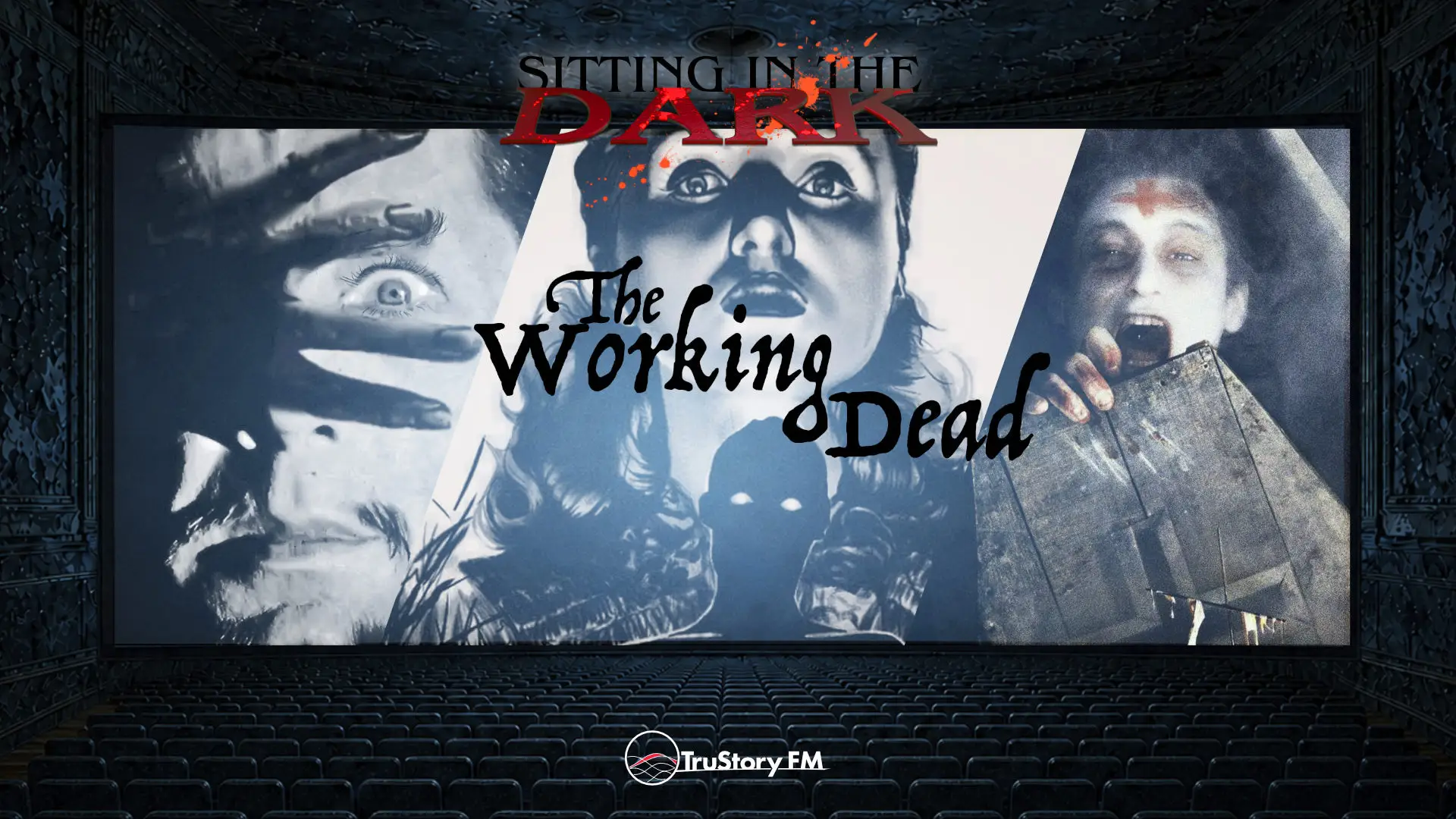
Okay. This is The Working Dead. I love it.
Pete Wright:
So here’s the thing: the zombie is a Haitian creation, and it was quite literally born on the sugar plantation. The word most likely comes from Central African roots carried across the Atlantic by — the Marines, American Marines, brought the word zombie here. In Haitian Vodou, a bokor is a sorcerer who is working for hire and can capture a part of a person’s soul and reanimate the body as a worker with no will of its own. And that’s where the horror is in this particular creature. Nobody in Haiti was afraid of zombies. They were afraid of becoming zombies, because among the enslaved, death was understood to be a release from capture. It was a release and a return to Africa. The zombie was the fate that denied the return — the spiritual return to Africa.
So it was a kind of slavery that extended past the grave. After the revolution of 1791 through 1804, when Haiti became the first Black republic, that belief persisted as a folk memory of the plantation, and the Haitian Penal Code of 1864 took it seriously enough to criminalize the use of any substance that produces, quote, a lethargic coma, treating zombification as a form of murder.
That’s right. Tom, you have a question in the class?
Tommy Metz III:
Wait, this was real? Wait, I’m confused.
Kynan Dias:
These movies are real.
Tommy Metz III:
We weren’t really making zombos, were we?
Pete Wright:
There you did it. That’s your first mention of the new, now-canonical term: zombos.
Tommy Metz III:
Zombos.
Pete Wright:
Well, that’s the belief system — that this was a thing.
Tommy Metz III:
That’s the belief system.
Pete Wright:
That was practiced by Vodou sorcerers in Haiti, and that started the lore of the zombie. Yes, that’s the idea that is believed for real.
Tommy Metz III:
What? Oh my gosh. Well, and it was just enslavement, and we were sort of putting a horrific —
Pete Wright:
How about I let you host this episode?
Tommy Metz III:
I’m sorry. It never occurred to me that this was — I really appreciate the history lesson. I thought that this was just sort of an allegory for enslavement.
Pete Wright:
Yeah, not an allegory yet. Right? The allegory happens to evolve. So zombies — zombification, the belief in zombies — reached the United States, as I said, by the Marines. The US occupied Haiti from 1915 to 1934. Note that date. 1932, when White Zombie came out, was nearing the end of the US occupation of the country.
A few of the earlier travelers sort of put the word into English. Lafcadio Hearn was writing from Martinique in 1889, and there’s a stray reference in Robert Southey’s work as far back as 1819. The book that made zombie an American word was William Seabrook’s The Magic Island, in 1929. Seabrook was a sensationalist and apparently quite a drunk. He went to Haiti looking for the occult, and he wrote a chapter called “Dead Men Working in the Cane Fields,” which described zombies laboring for the Haitian American Sugar Company — an American corporation. The first zombies an American public ever read about were working for an American business.
Tommy Metz III:
Yeah.
Pete Wright:
We’re great all over the world at all times, is I think what that screams. That chapter is the uncredited source of White Zombie. And that was written not as fiction, Tom. Fascinating.
Tommy Metz III:
Wow.
Pete Wright:
You’re fascinated. Look at you right now.
A Broadway play called Zombie opened in February of 1932, and the Halperin brothers had their film, White Zombie, in theaters by July. Zora Neale Hurston went to Haiti herself and published Tell My Horse in 1938, with a photograph of Felicia Felix-Mentor. And for the next thirty years, the movie zombie stayed Haitian. It was owned. It was put to work. Revolt of the Zombies. King of the Zombies. White Zombie. I Walked with a Zombie. They’re all about this zombie.
Romero sort of broke it in ’68. And you’ll note we’re not really talking about Romero’s zombies, inasmuch as we’re constantly going to be talking about Romero’s zombies. Night of the Living Dead never actually uses the word zombie. His creatures are ghouls. And his own stated source was not any zombie movie. It was I Am Legend, Richard Matheson’s book. And so audiences and critics actually share the responsibility for attaching zombie to them anyway.
By Dawn of the Dead in ’78, that name had stuck. Lucio Fulci’s Zombi 2 the following year completed the canonization of the term, and Return of the Living Dead in ’85 gave the ghoul creature its appetite for brains. 1985 was the brain-eating thing. It’s just crazy, the sort of arc of history that this creature has taken.
So I think it’s fascinating. I am on the record from episode one of this show as saying zombies are my jam, and I have been very excited to talk about them. I had never actually thought to explore zombies pre-Romero, or at least the non-Romero zombie. And whatever you think of these movies, I hope you find the journey interesting, because the creature itself is a fascinating cultural artifact for us.
That is the preamble. Thank you for indulging me. Any questions?
Tommy Metz III:
Okay.
Kynan Dias:
I would say overall, before we get into the individual films, I think you’re right in that in these three films we’re more sympathetic to the zombie itself, and we see it as being cursed or enslaved. We are with them — as opposed to even in Night of the Living Dead, once Barbra’s brother is a ghoul, it’s like, oh, never mind about that guy. He’s just a ghoul.
Pete Wright:
Right.
Kynan Dias:
Kill it with fire. Yeah, yeah, yeah. And in these ones, there’s a sadness to all of them, of what it is to become a zombie.
Pete Wright:
The zombie is victim, right? That’s what it means to be victim, which is interesting.
Now, I will say, when we started texting in our back-channel chat, I think it was Tom who said, “I’ve watched all of these movies, and two of them drove me crazy. I can’t wait to talk about them.”
Chelsea Stardust:
Ooh.
Pete Wright:
I can’t wait to hear what drove you crazy about these movies. And I wonder if that little preamble of zombie history has changed your collective insights on the movies. Shall we begin with White Zombie?
Tommy Metz III:
Please.
Chelsea Stardust:
Let’s do it.
Pete Wright:
The year: 1932. White Zombie. Victor Halperin directed it; his brother Edward produced it. They made it independently for about fifty grand in eleven days, on sets they rented from Universal — which is why, if you squint, not even very hard, you’ll see the big halls from Dracula; the hallways are all from Frankenstein. Bela Lugosi, also from Dracula, takes the job for somewhere around eight hundred bucks, and the movie makes money, and he’s pissed off about it for the rest of his damned life.
Sixty-seven minutes, this movie, give or take, depending on which public-domain print you ended up watching — and I am sorry about that. The thing I want to make sure we hold on to with this is that this was the first one. There is no zombie movie before this movie. Nobody had figured out yet what a zombie looked like, or what it wanted, or what it was even for. And I think this movie tries to answer all of that in about ten minutes and then just kind of wanders off and does something else. So we’ll see what happens.
Let us begin with axes to grind. What didn’t work, what worked, what’s too much. I think there’s probably plenty, so we’ll have to rein it in at some point.
Tommy Metz III:
I mean, these are films of a time. Not all of them, but White Zombie and I Walked with a Zombie in particular do feel exploitative and racist. And maybe why they made me feel crazy is I couldn’t tell if they knew that they were doing that. They’re filled with scenes of white people sort of chuckling at the strange drums in the night and these other rituals and things that we don’t really understand, but seem to be above or pooh-poohing — before we eventually fall victim to them. So I just never exactly understood where they stood.
That didn’t take away — I was able to turn that off, so I wasn’t just thinking about that the whole time. But there is always this part of some very well-dressed white person just sort of being like, how peculiar. It’s like, okay, this is horrifying.
Kynan Dias:
Yeah, that’s certainly there. I mean, I’ve seen a lot of movies from this era, and it is rare that you have any Black people at all. So when the coachman comes in and he speaks without some racist accent, I was like, oh wow, what progress this is going to be.
Pete Wright:
Yeah.
Tommy Metz III:
Right.
Kynan Dias:
And then, yes, it falls into everything that Tommy is saying, of this othering, this exoticism, et cetera, and putting white people at the front of it. That’s true of the first two, I think you’re right.
Chelsea Stardust:
I’ve seen all of these movies multiple times, but I guess this time watching it, I thought that the punishments were not enough for the men behind the mischief that’s happening. All three of these movies are about men who want women, to an extent, or have segments of that in their movies — and take away everything from them, all their agency and everything, because they just want these women, or the women don’t have choices in these movies.
Tommy Metz III:
Right.
Chelsea Stardust:
So I did not think the punishment was enough for the doctor, or for — they call him Murder — Bela Lugosi’s character. Not enough. It was not enough. But I’m sure they thought it was plenty back in the day.
Tommy Metz III:
Right.
Kynan Dias:
The axes that I have kind of become part of the movie’s charm for me. So whenever there’s a creaky sort of shot or a weird sound effect, they tend to — perhaps out of cheapness — repeat it, so then you hear it again, and it becomes kind of musical in some weird way. Like, we’ve seen this close-up before. I’m sure they got Lugosi in a corner and filmed close-ups of him for four or five of these scenes. But by the fourth or fifth time you see it, it becomes fun. It becomes hypnotizing, in a way that I don’t think the actual Universal horror movies do, because they are a little bit more sophisticated than this one. But yeah, all of that creakiness is so charming by the end of it.
Pete Wright:
I think that’s a funny observation, Kynan. I like it. I think you’re right. This movie does have a sort of charm in its creakiness, particularly at the end, as they’re full-on throwing themselves off of the cliff.
There is something interesting, though, when you look at the film as an exercise in exploitation and othering. One of the things that’s fascinating about this is not all of the zombies are Black. This is not about making the Black people monsters. The zombies are identified by their former stations. They’re his old rivals and creditors. They’re all converted into his workforce, because he didn’t just kill his enemies — he gave them staff positions. This is very much a movie about labor without consent, and not so much an explicit the-locals-are-monsters movie. And I actually think that’s a fascinating twist in 1932. From your early axes, it sounds like that may not have hit.
Tommy Metz III:
It didn’t hit as much for me, because — it’s a really good point. I wrote down a quote: “You could make good use of men like mine on your plantations.” It’s so slavery-coded —
Pete Wright:
It’s slavery-coded, but the slaves are not Black.
Tommy Metz III:
— that I overlooked that. Right. Yeah. That’s a very good point.
Pete Wright:
I think that is one of the things that is actually really fascinating. It’s coded, but was it coded in 1932? Would we have been astute enough to see that? It is possible that so much of the coded language before this was just because this was a Black island nation. Everybody who was a zombie was Black, but so were the people who were not zombies, and we just made it wrong because we took it and made movies about it. And the people making the movies were white. But the fact of the matter is, I think this movie is actually much more explicitly progressive, because of its kind of innocence in 1932, in that it portrays the monstrosity as the white business owner.
Kynan Dias:
Okay.
Pete Wright:
But he’s a monster not on racial lines. He’s a monster on capitalist lines.
Kynan Dias:
Yeah, that is a recurring theme that I think is so interesting in these early ’30s films, when we’re thinking about the Depression — what is horror to us. And part of it is we’re borrowing from public domain, like Frankenstein, Dracula, et cetera. But even when they start making their own movies, like The Mummy, they tend to be about rich people up on a hill, and their crazy, weird eccentricities trickle down into the village below and screw everybody over. And it’s like, oh yeah, that’s what people saw as horror in the 1930s.
Pete Wright:
Right. And in the ’30s they were trickling down on Eastern Europeans, right?
Kynan Dias:
Yeah, sure. And then in the ’50s it becomes more suburban, where the horror is your neighbors, and the weird things you can find — you start shrinking because you’re a weird guy. You meet the Fly, and he lives in the suburbs, that kind of thing. But yeah, here it’s very trickle-down. And so I just love that about this. Not to completely disentangle it from race, but the way that they portray these bad guys — they’re just sitting in their drawing room going, literally, what could we do to get more money out of human bodies?
Pete Wright:
Yeah, yeah. Which I think is an interesting take, because the film itself is not at all appalled by a mill full of zombie men, while it is completely disgusted by one white woman’s captivity.
Tommy Metz III:
And she just seems drowsy.
Pete Wright:
Right.
Tommy Metz III:
There’s no — she looks like she just took Benadryl. She’s not zombo’d out like some of the rest.
I think going back to me missing the whiteness of some of the zombies in this: I actually watched these out of order, and I watched I Walked with a Zombie first. And all three of these movies really share the zombie aesthetic of wide-open eyes without blinking. All zombies need Visine, stat. And so I think I sort of grouped them all in together with that.
Pete Wright:
Yes. It’s easy to do with these first two movies for sure. They share a visual aesthetic, and certainly a location aesthetic, a production-design aesthetic. That makes it easy. I think about that all the time. Bela Lugosi’s watching the guys in a mill, and we cut to wandering through the cane fields, and there’s a dog hanging from a tree. They could be in the same movie. So I definitely get that.
One of the things that this movie kind of captures is the space of deep uncertainty that came around with these capitalist endeavors in Haiti toward the end of the occupation.
Kynan Dias:
Yeah.
Pete Wright:
And this is sort of an exploration of the cancer that is the capitalist invading force on the backs of the military force in this country. I think there’s even more of a statement in this movie than the fact that we have this spiritual angle where we can take the souls of human beings. The larger message of the movie is: aren’t we just taking the souls of human beings by putting them to work anywhere, whether it’s using spirituality or not? So to me, this movie is kind of a fascinating exploration of that angle.
I don’t know how easy it is to finish a conversation about this movie without actually pairing it with I Walked with a Zombie, and so I’m great kind of weaving into that conversation — unless you have more to talk about specifically with this one.
Tommy Metz III:
I do. My favorite part of White Zombie is when he says to Beaumont, “You see, you are the first man to know what is happening.” And he’s talking about becoming a zombie. You can’t talk.
Pete Wright:
Yes.
Tommy Metz III:
You’re becoming a prisoner in your own body. That’s when we move from terror to horror. And that’s the most self-aware that this movie seems to be. It’s almost putting yourself in the enslaved — not mythos, but frame of mind. It’s almost sort of like physician, heal thyself. You’re putting yourself through what you’ve been putting other people through. Which is interesting.
And that’s one of the things that so few zombie movies — or walker movies, whatever — other than Return of the Living Dead, ever touch upon: their awareness.
Pete Wright:
Right.
Tommy Metz III:
Is there something behind those wide-open eyes? Because if there is, zombies are the most horrific thing in the entire world. And that’s what Serpent and the Rainbow does really well. We’ll get there. But I just thought that was a very deeply interesting part, in a movie that does just have people falling into mills and things like that. To put that in there — it’s like the movie was examining itself. Or capitalism was examining itself.
Pete Wright:
Yeah.
Chelsea Stardust:
Yeah, I love that moment. I also have that dialogue from that moment as an audio clip that I put on things.
Pete Wright:
It’s Chelsea’s evening meditation.
Chelsea Stardust:
I’m so glad you brought that up, because I also want to piggyback on something Pete said earlier. That’s a through line with all three of these movies: everyone is more scared of becoming one, as opposed to being killed by one. I think that switches when we get into the Romero world, because the idea of being eaten by one of these is very scary. But I love that through line here. And that moment is so great because you aren’t really thinking about that. And then the idea — which, again, later movies explore — of, do you feel what is happening to you? What do we know?
And I also love Bela Lugosi performing when he’s not Dracula, too. That’s one of my favorite Draculas, but to see him doing things — his look in this is wild. The eyebrows, the whole aesthetic he has.
Pete Wright:
He’s got a whole sadistic ringmaster vibe going on.
Chelsea Stardust:
Yeah, great Halloween costume. But I just wanted to circle back on that.
Pete Wright:
I think, Chelsea, you get to a really good question. That’s what I wanted to pivot to when we talk about I Walked with a Zombie. When you look at these movies, did you find you were able to get into what’s scary about them? Because when you come into them not thinking about this kind of zombie — how hard do you find it to find this scary?
Kynan Dias:
Yeah, that’s fair. Upon the first watch of White Zombie — and then thinking about it later — I am much more afraid of the zombie. I think because it’s Lugosi, and I’m like, I’m afraid of Lugosi and his little minions, et cetera. But then afterwards, thinking about it — honestly, going through your curriculum and then reevaluating White Zombie in my head, it’s like, oh yeah, that’s just tragic instead of scary.
Chelsea Stardust:
And the creator is scarier than the monster.
Kynan Dias:
Right, right.
Chelsea Stardust:
Like Frankenstein — he is way scarier than the monster. Just like this. Bela is so much scarier than what he creates, and it makes them sympathetic. And then of course the idea — which is the other through line — that this is all just because the doctor wants this woman, then Bela wants this woman. Everyone just wants this woman. It’s deeply ridiculous to me, and I was like, Jesus, guys, come on now. But that’s fine. Leads us into the next one — same situation.
Pete Wright:
Yeah. I think this movie — there’s a real buried-alive vibe in these movies, and I struggle with that as an idea pretty broadly. I don’t care for it. And we get it in some cases literally, but in this movie we start with that idea that we know people are buried, quote, alive, because their souls were taken, and we see them being dug up. And that, to me, as a physical expression of loss of control but maintenance of identity, is terrifying. It is terrifying to believe that there is something rattling around inside that is conscious, but the body cannot react, and the world just becomes inflicted upon it.
I find that notion really terrifying, even in a movie that ends up being sort of goofy under the weight of time. I think the idea is legitimately scary. And I think they get maybe progressively better at exploring that as we move to our next film.
Tommy Metz III:
Just as a side note, at risk of cross-pollinating podcasts: on Pete and I’s other podcast a zillion years ago, our anxiety podcast, we would each take a topic, and Pete did the second half of the episode, and it was about his fear of being buried alive. And I’ve been told by a zillion people it is the most half-listened-to episode of our whole [unclear].
Chelsea Stardust:
Oh.
Tommy Metz III:
Because he starts talking about being buried alive, and you could see the people just being like, nope, and just dipping out and not even listening.
Pete Wright:
Nope. Yeah, our listener attention drops like a cliff.
Tommy Metz III:
Yeah, it just went — yoink — down. I was talking about carbs or something dumb, and then he was talking about being buried alive, and everyone bounced.
Pete Wright:
Let’s talk about when that first shovel of dirt hits the coffin.
Tommy Metz III:
It was great.
Kynan Dias:
Oh my gosh.
Pete Wright:
Nope. Okay.
All right, so: 1943, I Walked with a Zombie. This is Val Lewton’s unit at RKO. It is the second movie they made, after Cat People, and Jacques Tourneur is directing again. The deal Lewton had with the studio was basically: keep it under $150,000, keep it under 75 minutes, and you have to use whatever title our marketing guys have already tested on the public. And then they handed him I Walked with a Zombie. I think that’s really funny.
Chelsea Stardust:
Hell yeah.
Pete Wright:
He hated it. And so, out of spite, I think, he tells the writers to go adapt Jane Eyre. And that’s what this is. Canadian nurse, Caribbean island, plantation owner whose wife walks around and doesn’t talk, and a walk through the cane fields at night — and I think that part is maybe the scariest thing of any of the three movies we’re doing tonight. Sixty-nine minutes, shot in three and a half weeks in the fall of 1942. And I guess we start where we always start: where are the axes you have with this movie?
Kynan Dias:
Well, I’ll start with backing up your idea about how much Lewton and Tourneur hated this title. The first thing we hear is the narration: “I walked with a zombie.” I never thought I would say those words. I never thought I would make a movie with such a title.
Tommy Metz III:
Yeah. It’s like a zombie Penthouse Forum. I can’t believe it happened to me.
Kynan Dias:
I’ve got no axes beyond what we were talking about — the general, sort of casual racism. But again, it has Black characters who are actually characters. That is a huge step forward. But then some of the ones who are not characters, who are more just extras — it certainly is like, ugh, this is a little icky.
Chelsea Stardust:
I’m going to piggyback, only because Kynan brought it up. I’ve seen this movie many times, because I love all the Val Lewton films, and Jacques, of course, because Cat People. But upon this watch — I find I can be really easy on stuff, so I’m like, I’ve got to have axes to grind. Got to try to have axes, Chelsea.
Pete Wright:
You can just like stuff, Chelsea, if you want.
Chelsea Stardust:
You can’t, you can’t. I feel the pressure of needing to have an axe about something.
Pete Wright:
Oh no — Tom says no.
Tommy Metz III:
No.
Chelsea Stardust:
I’d never thought about it before. You guys have forced me to think about it. I was like, oh, I’ve got to find something wrong with these movies.
Okay, so first axe: three and a half weeks. I’ve never had that many days of shooting, so you can go fuck yourself.
No, but only because Kynan brought up something interesting — I think this movie, upon this rewatch, romanticizes the experience with this voiceover, which was popular during this time. Rebecca has that in 1940, which is a couple of years earlier.
Kynan Dias:
Rebecca.
Pete Wright:
Yes.
Chelsea Stardust:
I think The Ghost and Mrs. Muir maybe does it, and there are a couple of movies that have this — usually women doing this sort of voiceover, leading us into the story and leading us out of the story. But this time it felt like they were romanticizing this experience. There’s a dreaminess to this movie, which is very — that’s Jacques, that’s what he does.
Pete Wright:
It does feel like you might have a close-up of a woman’s hand with a quill pen, writing the words she’s saying to a lover across the sea.
Chelsea Stardust:
Yeah, yeah, yeah. So it’s sort of like this woman telling this story of, oh, I had this experience — and it’s like, girl, this is a very complicated story of what’s happening with this family, and what’s happening to the wife, and the brother’s in love with her, and all this stuff. And the ending is really dark. I don’t know if I’m down with how this story, which I find to be incredibly tragic, is romanticized so much. But hey, that’s the gothic-ness of it all.
Pete Wright:
Is it still a throuple if one of the parties is a zombie? That’s what I kept thinking. Is that okay? Is that poly?
Kynan Dias:
It’s like a zrouple or something. You have to add a —
Chelsea Stardust:
Well, these movies do not do consent, so.
Pete Wright:
No, you’re right. That’s a great point. Other axes? Tom, do you have any axes?
Tommy Metz III:
No, I really like how it’s shot. I think the shadow work is amazing, and it’s constantly cutting the frame with branches and leaves and shadows. I thought that was all just really, really beautiful work.
Pete Wright:
Oh, this movie is gobo-thrilled.
Chelsea Stardust:
I love it.
Pete Wright:
So many patterns. And there are some really interesting pattern shots. There’s a shot where she’s coming down the stairs, and it’s shot through a cloverleaf stonework, and she’s wearing a dress with the same cloverleaf right in the middle of the frame. Beautiful. Outstanding.
Chelsea Stardust:
Awesome.
Kynan Dias:
Knowing Val Lewton, this particular producer — we teach in film schools a lot about how you can do things economically, et cetera. I had misremembered how much you do see of this world. The most evocative things that I remember are walking up and down that big staircase and the stuff in the sugarcane fields. But it’s a lot brighter than I thought it would be, seeing the plantation and all of that. I’m much more familiar with Cat People, which is very shadowy. So I was impressed by how much we do see of the world and the island. And then when we get into horror mode, that switch to black really works for me. They were not there the entire time.
Pete Wright:
I would like to make what you might think is an absurd connection between this movie and another, and I just want you to stay with me and ride this one out. That movie is Warren Beatty’s Bulworth. Go ahead, react.
Kynan Dias:
Okay.
Pete Wright:
So there’s an interesting thing going on. We just watched Bulworth for The Next Reel, and one of the things that movie does, as shorthand, is once we’re in the Black community, the Black characters have immediate authenticity and truth. They are the speakers of truth in that movie, and they give the white characters an agency with which they can bounce. They go and do things because we’re just supposed to trust the Black experience in this movie.
And I Walked with a Zombie does a similar thing, and it allows us to kind of push back on, again, the othering nature of this movie. Is some of that there? Sure. But this film is unusually attentive to Black life on the island. We get a lot of structure of what is happening on the island and the lifestyle. Unfortunately, it comes bearing the same curse as White Zombie: it is all used to just sort of explore a white woman’s romance.
Tommy Metz III:
Right.
Pete Wright:
Everything is around this nurse, who — the film wants us to believe this relationship is super noble. And it’s kind of complicated and not that noble, and maybe she needs to stay out of the business, nurse.
And so I think that’s actually really interesting, because once again we have this movie where, yes, generally the zombie sort of characters, besides Jessica, tend to be the native people. Was that presented as a racist sort of othering intent, or was it a natural consequence of the story that they’re trying to tell? Would we walk away offended by that, is I guess the bigger question.
Tommy Metz III:
There is some self-awareness in this movie also, when she’s being brought in the coach, and he says that the Hollands are an old family that brought colored folks chained at the bottom of the boat. And then she says, they brought you to a beautiful place. The scene could have stopped there, and you could have been like, this movie sucks. Instead, what does he say? “If you say, miss. If you say.”
Pete Wright:
Yeah, yeah, right.
Tommy Metz III:
That’s the movie being like, okay, creep — without being overtly messy about blaming who’s supposed to be our heroine.
Pete Wright:
Yeah. He might as well have said, “If you say, idiot.”
Tommy Metz III:
I mean, just — right. Yeah.
Pete Wright:
She’s bad at small talk, and he is self-aware.
Tommy Metz III:
Yeah. I appreciate that type of self-realization.
Pete Wright:
So I think that allows us to reflect on the end of the movie, where we get Mrs. Rand’s confession.
Chelsea Stardust:
Jesus, yep.
Pete Wright:
That she’s the hand behind it. She’s like the Wizard of Oz behind all this. I don’t know — right when the film is able to grant Vodou real agency, the white missionary comes in and claims that she manipulated their beliefs to get whatever the hell she wanted.
Tommy Metz III:
Right. She’s pranking them into boiling drinking water. Yeah.
Pete Wright:
The woman taking credit for something that the movie has spent 45 minutes convincing us was real. And I don’t think the movie is better for it. So I guess we’re coming back around to my axe: I think the movie is in genuine disagreement with itself. It’s trying to tell this story that could be really great, and they just let it go, and they make Mrs. Rand the puppet master inauthentically.
Chelsea Stardust:
Yep. I would second that.
Pete Wright:
Oh, I get seconds. I’ll take seconds.
Tommy Metz III:
Absolutely. No, that’s a real drag on the film, and I had forgotten about that part. I’m looking at it through my notes, and what I wrote was “What the heck?” And I just remembered — that’s what. Yeah. That’s a terrible reveal.
Pete Wright:
A couple of points. The walk to the houmfort — the almost silent walk to the houmfort. We asked that question of the last movie: what did you find scary? This one I thought was done very, very well. Haunted production design. Really great choice to have the hanging animal. And, oh my goodness, those eyes are just really well played. And the other was Ti-Misery. The ship’s figurehead in the fountain, full of arrows.
Chelsea Stardust:
Oh yeah.
Pete Wright:
I thought that again was — to your point, Tom — the haunted explanation of how everybody got here, as a living relic of what that means. How did this movie hit you all as an exploration of something to be scared of?
Kynan Dias:
The walks — when she’s walking with the zombie. It’s very interesting. They’re very brave, I think, for stripping away dialogue. Of course at the beginning she’s trying to have a conversation with this zombo’d woman, right? But later it really has this confidence of, no, we’re just going to use these two women as a conduit to look at bizarre imagery and hear bizarre soundscapes. I’m surprised how much they don’t interject with more voiceover or something — RKO saying, no, we have to keep people awake, or whatever. They really are trusting that we will just enjoy even just windscape, without over-explaining things and over-talking.
Chelsea Stardust:
And I love that she genuinely wants to help her. I think this is maybe the only movie of these three where someone really does want to help somebody, and you believe they’re not trying to get something out of it. They just want to help this person. And the houmfort walk I love so much. Onibaba comes to mind, with some of that imagery.
And Carrefour, who my heart goes out to, is treated as something scary. But at the same time — she’s frightened by him, but then he’s leading the way, and also there to help, because it’s revealed that they also want to help this woman, but Mrs. Rand kind of prevents that from happening. So you truly feel like, oh, maybe they clearly have something they can do to help her, but Mrs. Rand will not let it happen. And then that leads to the ultimate demise of two characters, the wife included.
So I just think that’s so beautiful — the wind going through the skull. It’s just beautiful filmmaking. And that’s where we get creepy, scary. And also, you see two women doing this; usually they’d have a man with them. I really like that. Women helping women — I’m always here for that. And then, of course, the other person stopping everything is a woman. So I find all that to be very fascinating within this movie.
Kynan Dias:
Yeah.
Chelsea Stardust:
Many layers.
Kynan Dias:
But then they hold on it long enough that you develop a sympathy for him that I hadn’t remembered — and maybe it’s because we’re watching it the way Pete curated it. It reminded me this time of The Cabinet of Dr. Caligari, with Cesare, the somnambulist. I’ve read people’s criticism about how we sympathize with Cesare, but I don’t know if I ever do. I think he’s just very scary. And so here it’s like, oh, we have both. He is this somnambulist. He is terrifying. He’s this guard that’s in these two women’s way in the middle of this walk. But they hold on it long enough that you’re like, oh wow, this was a person, or this is a person somewhere.
Pete Wright:
I started thinking here about the book of the vampire, and how these movies describe for us what we’re experiencing. In the first movie it’s done largely through conversation: welcome, stranger in a strange land, here’s what’s going on on this island. There isn’t a particular sequence or finding of some artifact that actually unlocks the entire secret for us. But in this movie, we end up with Sir Lancelot’s calypso. That was written for the movie. It was called “Shame and Scandal in the Family,” and in this case it doesn’t need to describe exactly how we make a zombie, but it does unlock the story of the family for us in a really, I think, interesting way. Just a guy singing on a river walk somewhere, in public.
I’m curious what you thought about how these two movies, before we get to Serpent, actually unveil the story of the drama and the fear by way of the book of the vampire. And Tom, you led the conversation on the book of the vampire early on. Did any of this hit you?
Tommy Metz III:
Yeah, I like the way of doing it. It felt a little on the nose when he’s singing right over their shoulder. But — “the wife fell down, and the evil came, and it burned her brain in the fever flame.” All of that was kind of a neat way to do it. And then for him to be immediately lambasted for it. I thought it was sort of a clever way to do it, in a movie that started with, as has been brought up, very maudlin voiceover in the beginning. There are a lot of other ways to do that.
And for the legend of the family to be known by everybody — I like the idea of that. It’s like what we talked about with The Ring: on an island, if you catch a cold, everybody catches a cold. It’s this singular, contained place where everyone will know everyone’s business.
Pete Wright:
Yeah.
Kynan Dias:
I don’t know music very well, but I have seen, just reading about these films, that this calypsonian, Sir Lancelot, was incredibly influential, apparently, on Harry Belafonte. I don’t know if that’s from just this film or in general.
Pete Wright:
Yeah.
Kynan Dias:
And then White Zombie, I’m going to say, of course leads to the band White Zombie, which I know nothing about. I apologize. I know Rob Zombie is a filmmaker and not a musician.
Chelsea Stardust:
There, great.
Kynan Dias:
Okay, great, good. But just thinking about how these two movies are influential in the music world — White Zombie has very little music, as is common at the time, but still the soundscape is so impressive. And both of them just create this mood, very differently. I Walked with a Zombie is dreamier. But just how they are atmospheres. You could just put them on, I think, and be like, let’s just be in these movies for a little bit, and not even worry about story.
Pete Wright:
Yeah, I think that’s really true. And apparently this song itself did become something of a bop in 1943, beyond the movie. There are people who know the song and not the movie. And I was not around.
So we go from this movie released in 1943 — if we’re talking again about context of history — nine years after the US occupation ended, and it is released during a war against fascism fought by a segregated army. That’s the context of this movie coming around, and it does start to feel a little bit like this movie might be trying to give us a structured intention of what this island life was really like, and an honorific of that. So I think that’s interesting.
We then move through — zip, zap, zoop — 1968. So we’ve been talking about zombies as employees. Then we have Romero making the ghouls. And then we get to 1988, after we, humanity, have already experienced and kind of forgotten the origins of zombies, and we get Wes Craven and The Serpent and the Rainbow.
This was four years after Elm Street. He was adapting Wade Davis’s book, which is a nonfiction book about a Harvard ethnobotanist who goes to Haiti to find the powder that supposedly makes zombies. Bill Pullman, obviously, is the scientist. Cathy Tyson is the psychiatrist who knows what’s going on. And, oh my gosh, Zakes Mokae — how do you pronounce it? I think that’s how I would say it.
Kynan Dias:
That’s how I would say it, yeah.
Pete Wright:
He’s the head of the secret police, and he makes zombies, and he is amazing, and probably the scariest thing in all three of these movies.
Kynan Dias:
Yeah.
Pete Wright:
Craven actually had thirty days scheduled in Haiti, and he got eleven. There were bombings, and extras went on strike, and a crowd surrounded the production and started throwing rocks at them.
Tommy Metz III:
Oh no.
Pete Wright:
And the government just said, we can’t promise that you’re ever going to get home. So they shot a scene at the airport on the way out and finished in the Dominican Republic. The first cut of this movie was three hours long, and who knows if that would have been a hit.
Why is this movie in this episode? I hope it’s kind of obvious. By 1988, the flesh-eating zombie had owned the world for twenty years. Return of the Living Dead came out three years before this. Wes Craven goes to Haiti to make this zombie movie where nobody eats anybody, and it seems like a choice out of time. And so I go back to you: axes to grind. How well does that choice to make a non-brain-eating zombie movie scare you — beyond a little casual genital mutilation?
Kynan Dias:
This is my first time seeing this. This is an excellent movie. It might be scandalous to say on this horror podcast, but it is now, of the films I have seen of Wes Craven, my favorite Wes Craven film.
Pete Wright:
Wow. All right.
Kynan Dias:
Acknowledging that I am too afraid to see Last House on the Left and some of the other ones.
Chelsea Stardust:
Wow. Oh, you don’t need to see that one.
Kynan Dias:
Okay, good. It looks too scary. It looks too gross. So I don’t have a lot of axes. I just have — Paul Winfield is such a likable actor that whenever he dies in a movie, it really kind of bothers me. When he dies in The Terminator and Mars Attacks!, I’m like, he’s just the nicest guy.
Pete Wright:
Oh, all the movies that he died in. I get it, yeah.
Kynan Dias:
And in this one he dies twice.
Tommy Metz III:
Yeah.
Kynan Dias:
So that for me was a little — oh no. Do we need that twice? But I love him so much.
Pete Wright:
That’s your big axe: your affinity for Paul Winfield is torn asunder.
Kynan Dias:
Yes.
Pete Wright:
All right, other axes?
Chelsea Stardust:
So, as many people know, I love Wes. We wouldn’t have so many of the movies we have without him. But the more I watch this movie, the more problems I have with it, unfortunately, which really upsets me. Pete, when you were giving the backstory — I think that messiness is clear in the movie. There’s so much going on. It’s very disjointed at times. Obviously it’s Wade Davis’s book adapted, but very much sensationalized, and Wade kind of has an interesting attitude about it. It’s like, well, you give me money and that’s fine. Do what you want.
This movie, in a big way, takes the Haitian spiritual tradition and makes it a monstrosity to American audiences. So it’s very much taking something sacred to them and turning it inside out, because of how much it’s sensationalized this book — and this book has caused its own problems. So now, as an American audience viewing this, it’s turned it all into monsters, which is obviously a problem. The movie makes the zombie evil, and takes a lot of liberties with the religion.
But on a superficial level — Bill Pullman’s character. I’m sorry: if you have experienced this genital torture, you go back? What? There are so many decisions that make no sense. When I first saw this movie, it blew me away and I absolutely loved it. But my journey with this film is complicated, because I think there’s amazing stuff. I love Bill Pullman. I love Cathy Tyson in this; she’s amazing. The acting all around is so good. But it feels a little messy to me.
I will say, to this day, it has great scares. It has such good scares. To this day, the bride with the snake — I’ve seen this movie so many times, and it still scares the shit out of me. I forget it’s coming. It scares me. The blood filling up the coffin. That’s Wes. That’s Wes doing what he does best. But you can see there’s a messiness to this movie that I didn’t used to notice, and now it’s hard for me to not see it. But this movie was a big deal for me when it came out, too.
And we’re, what, three years after Day of the Dead, which has a zombie learning, understanding, experiencing things. We’ve seen that; it has already happened. And also, yet again, another woman gets possessed without her consent, and ultimately the bad guys are humans, not the zombies. So — Tommy.
Tommy Metz III:
I think some of the messiness at times feels like a feature, not a bug, for me. It makes the movie feel a little unsafe, in a way that I kind of like. It’s such an alien world that if I turn off my exploitative brain and just sort of see the movie, it feels like it could be dangerous. I don’t know a better way to say that.
It’s not really an axe, but part of the messiness that I like and don’t like is that it’s also two movies. It’s about zombies, but it’s also about a guy who is able to go into your mind and make you see horrific things. And those are not the same thing. Part of me kind of wishes it was not the buried-alive part, and just the mad scientist who’s able to make you go insane by showing you things, taking and warping reality — because those parts are my most favorite parts. When he’s opening doors and then the physics change and he’s falling through because he’s upside down. When he’s running down the hallway and all of the arms go Freddy Krueger long and start reaching for him —
Pete Wright:
Cool sequence. Yep.
Kynan Dias:
Yeah.
Pete Wright:
Wes Craven classic.
Tommy Metz III:
Yeah, I wanted to see just more and more of that, and take time away from some of the other things. But again, that’s a good problem to have. I wanted to see more of the things that I was seeing.
Chelsea Stardust:
Yeah, because I get bogged down by the other things.
Tommy Metz III:
Right, yeah. They kind of get in the way, and I remember how much fun I was just having a sequence ago.
Chelsea Stardust:
Yeah, yeah.
Tommy Metz III:
And then when he goes back, I was just like, you’re getting on the plane? Are you a crazy person?
Pete Wright:
I still don’t believe you can sit down.
Chelsea Stardust:
This is insane.
Tommy Metz III:
I would never.
Pete Wright:
That’s my problem. Come on, man. You’ve covered a lot of my axes. I think the fundamental one for me is that the movie starts by claiming that zombification is pharmacological in nature, and then it’s also magic, kind of depending on what is scarier in the moment.
Tommy Metz III:
Yeah, it’s crazy.
Pete Wright:
From what I understand — though I have not read the book — Davis’s claim was that the powder works because everybody goes along with it, and they provide it meaning. And I kind of feel like the movie flinches from that argument. I don’t think the pharmacological angle of this movie is ever really, believably resolved. And they put guys in suits in a different location for that angle — and who ends up caring about that at the end of the movie? Nobody. Nobody cares about that.
I also think giving Bill Pullman the power to drag a guy under a linoleum floor and strap him to a chair — I’m not sure the Wes Craven-ness of the end of the movie meets the grounded, experiential part of the beginning of the movie.
Tommy Metz III:
Really good point, because it wants it both ways. From the very first description of the powder: “It’s a powder through the skin to the soul.” We just stepped from medicine to the supernatural.
Pete Wright:
Yeah, like that.
Tommy Metz III:
Through the skin to the soul. Oh, okay, yeah.
Kynan Dias:
Yeah. Reading just a little bit about Wade Davis, without reading his work — the criticisms of him — I wouldn’t be surprised if he takes this money and is like, hey, turn it into whatever. And maybe in the back of his mind, as someone who’s still an anthropologist, he was like, well, really that whole third act could just be in Pullman’s mind. Which I think is fair. It has this dreamy sort of feel to it that I love — people disappearing — and then, yes, to the messiness of it, his spirit animal from the Amazon, the jaguar, comes back, and all this stuff.
Tommy Metz III:
That’s right.
Kynan Dias:
I don’t know — maybe he’s just torture-crazy and none of this really happens, and I’m okay with that.
Pete Wright:
Totally. Is there a read on this movie where he’s buried alive and never comes up again?
Kynan Dias:
Right.
Chelsea Stardust:
Yeah, yeah.
Pete Wright:
Because that sequence is peak Wes Craven.
Chelsea Stardust:
Oh yeah, it’s great.
Pete Wright:
That is just terrifying. I guess one of my tiny axes is: what happened to the tarantula? Does anybody know what happened to the tarantula? Nothing, ever again. We get nothing about the tarantula after the close-up on his chest. It never crawls on his face. I wanted it on his face. I mean, I didn’t — but I did.
So, all right. The other thing this movie does: we’ve spent 45 minutes talking about zombies as labor payload. Nobody in this movie is put to work. Not once. They make the zombies specifically to terrify and to punish, and then to put away. So that whole labor argument is just gone. Half of the working-dead thesis holds up with this movie, and not the rest of it, because we’ve just kind of let some of that source ideology about the zombie go. And I still love zombies. I wonder, after watching this movie, how you could modernize the origin story of the zombie and still make it scary to today’s eyes.
Kynan Dias:
Yeah, I disagree with you disagreeing with your own thesis, Pete. I think this does work, because it turns out that we’re zombo-ing these people, as Tommy says, in order to quell revolution — in order to quell class struggle and rebellion. Sometimes it’s like, oh, this person can get in the way, so I’m going to turn them into a zombie, or I could use this person to crush the revolution.
And I really admire that about this movie. It might be exoticism, et cetera, but it shows Haiti as having different factions and different ideas, and there are intellectuals and revolutionaries and politicians and corruption and all that. So I think that’s part of the fabric of this one, where it has to be set in the time it’s set, because of the Duvaliers, and having these zombies be in the way of corruption.
Pete Wright:
Yeah, okay.
Tommy Metz III:
And it’s also kind of like what happens when unfettered capitalism moves on and leaves the horror that it brought with it behind.
Pete Wright:
Yeah.
Tommy Metz III:
And so what do you use that for? You use that as a power over the people. So now you’re not doing it for profit, you’re doing it for control.
Pete Wright:
Yeah. And who is in control. That’s a really good point, because this movie is talking about control of the local people by the local people, because the capitalist, colonialist fantasy is now gone. And so this movie is actually a sort of colonial fantasy about post-colonial exploitation. And you have to wonder how well the movie does at critiquing a system while running on that system’s old imagery — of these people taking advantage of one another, because there is no substance to the purpose of taking advantage of one another anymore. Yeah, I think that’s an interesting take.
All right. All three of these movies have an imperiled woman who is purposeless apart from being just an icon in peril. And we also look at who gets the doctor. There is always a doctor, and somebody gets it, and it’s not the person who needs it. And I think that all horror is based on sugar mills. That, I think, is what I get out of these movies.
Now that you have experienced this — and Tom, I’ll start with you — now that you’ve watched these three movies, which were the movies that drove you crazy, and has your opinion changed?
Tommy Metz III:
Very much so. The first two movies, White Zombie and I Walked with a Zombie, just because of that same thing I brought up in the beginning. I didn’t understand what the movie understood about itself and what it was saying — whether it knew it was being exploitative or not. And it was so busy Green Book-ing the entire thing, showing it all through the eyes of the white people. I was like, I don’t know what these are about.
Pete Wright:
That is the sickest burn you may have ever used.
Tommy Metz III:
But understanding more the political and historical and capitalist through line of all of it, and really believing — yes, these films are really saying things, and about things. You just have to do a lot of work to get there. And I appreciate that. That’s fine, especially for movies of a time. So yeah, those were the two that made me feel crazy, but I feel much more of a through line now.
Pete Wright:
Awesome.
Kynan Dias:
I think we just sort of have to be honest with ourselves. Sometimes we go back and look at old movies, and because they’re good, we want them to also be progressive. So we might be putting that on these things and saying, no, it’s so good, I want to love this — and so it’s woker than it actually is.
Tommy Metz III:
Sure. That’s interesting, yeah.
Chelsea Stardust:
Yeah, and I think recognizing that is big.
Pete Wright:
Well, I think to that exact point — just because of the lens through which we watch these movies — these movies were not trying to be progressive or woke. It’s incidental that anything progressive can be ripped from them. I think that’s a great point.
Kynan Dias:
I do want to talk about the endings. In White Zombie, you can get unzombified by killing the main zombie, basically — the queen zombie kills it — and then you’re out of it. And I Walked with a Zombie has this tragedy of, no, you cannot get out of this. You are a zombie forever, and so you have to just walk into the sea, or what have you. That’s the only solution. And The Serpent and the Rainbow has that kind of white-savior idea of, he can be both Harvard Med and learn from Haiti, and therefore beat Haiti from the inside out. I just think it’s an interesting comparison of what we’re saying the end of zombification is. I’m sorry — zombo-fication, as Tom says.
Pete Wright:
Yeah, I think that’s interesting, because at least at this point there is no canon for how to — there’s no silver bullet. There’s no holy water. There’s no sunlight. How else do you kill a zombie, other than letting him fall into the sugar mill? And I think that’s one of those things that the subsequent films, post-Romero, have sort of stripped away. Once you get rid of the spiritual element, where there is a belief system around the magic of becoming a zombie — and thereby there is magic to unbecome a zombie — then it’s just the murdery stuff, the gore. And it makes subsequent zombie films, done poorly, kind of empty around the character.
Because I think where subsequent zombie films evolve is to use the zombie as a way to discuss the plague humanity has wrought upon itself. It is a different discussion, and I find that really interesting. There are new things to talk about with zombie movies, using the zombie as a tool, that we don’t have in these movies at all. I guess my final sort of thesis card is: did we really sufficiently explore the ideas behind these zombie movies before we kind of tossed them into the sea? I don’t know.
Chelsea Stardust:
I meant to say this when I was talking about my axe to grind with The Serpent and the Rainbow. It’s funny, because I loved this movie when I first saw it — obviously I’m such a big fan of Wes. And then I had a whole new outlook on all of these movies, because at South by Southwest I saw Maya Annik Bedward’s Black Zombie.
Pete Wright:
Black Zombie, yeah.
Chelsea Stardust:
A documentary she made, which is literally digging into all of these movies, and it’s incredible. I think it’s just now coming to theaters, very limited — New York, LA. And The Serpent and the Rainbow was not an intense segment, but it talked about a lot of stuff in that. And because I had then learned so much — I was just very naive before, when I watched it in high school or in college — I learned a lot of things that definitely complicated my relationship with the movie a little bit. But I’m also educating myself about it, too. At the same time, I also take what Wes is able to do — when you see the Wes Craven come out in that movie, it is so special. And of course the moments we talk about are the horror moments that he’s so great at creating.
But I love the journey these three films take, and the through lines of all of them that are so consistent. I think pairing these three together was so great, Pete — just the conversation, how fluid it was from one to the next to the next. I think it was expertly done.
Pete Wright:
Awesome. Thank you. That’s very nice.
Chelsea Stardust:
Just saying.
Pete Wright:
Well, that allows us to pivot to next month’s discussion, and we turn to Professor Kynan.
Kynan Dias:
Well, here is what I’ve found: a subgenre that had a time and a place, that was in response to What Ever Happened to Baby Jane? And I don’t think enough people know about this, but it was called psycho-biddy — this genre of, oh, let’s get older stars, perhaps from Hollywood’s Golden Age, and let’s make them crazy or imperiled or both, and put people in a haunted house. And it’s, look at old women — how scary old women are. They are now fifty-five or fifty-six.
Chelsea Stardust:
Yep. Also known as hagsploitation — the incredibly —
Kynan Dias:
Hagsploitation. I was trying to think of which is the less offensive term for it.
Chelsea Stardust:
Not a great term.
Kynan Dias:
But yes, I’m going to call this Psycho-Biddy Cask.
So why don’t we do What Ever Happened to Baby Jane?, the 1962 Robert Aldrich film, and then see the movie that was, for all intents and purposes, meant to be the sequel to that — or an unofficial sequel that was supposed to still have Bette Davis and Joan Crawford, but they hated each other so much on What Ever Happened to Baby Jane? that it became something else — which is Hush… Hush, Sweet Charlotte.
Chelsea Stardust:
Yes.
Kynan Dias:
So, two Aldrich movies, which is why I was kind of like, oh, should we really do two that are so similar? But I think we should.
Pete Wright:
For sure.
Kynan Dias:
And so let’s jump forward then to 1972’s Whoever Slew Auntie Roo?, which has Shelley Winters in that role.
Chelsea Stardust:
Whoever Slew Auntie Roo? Yes.
Kynan Dias:
So let’s do those three, and ask yourselves: what’s so scary about old ladies? Why do we do that?
Pete Wright:
I love it. I’ve seen two of the three. I’ve never seen Auntie Roo. I’m really looking forward to it. What a great excuse.
Kynan Dias:
And in America, for whatever reason, it became Who Slew Auntie Roo? They didn’t think we could handle the “Whoever” of Britain.
Pete Wright:
Jeez. Okay, of course. Awesome. So that is going to be our October.
Kynan Dias:
October.
Pete Wright:
The scariest month, for scary old biddies.
Chelsea Stardust:
Great.
Kynan Dias:
Scariest month.
Chelsea Stardust:
Kynan, I am so — ooh, I already have my dissertation ready.
Kynan Dias:
Oh, okay, good, good, good.
Pete Wright:
Oh my god.
Chelsea Stardust:
I am so excited.
Pete Wright:
Here we go.
Chelsea Stardust:
You picked some great ones.
Pete Wright:
Awesome. Well, thank you all for indulging my zombie exploitation fetish. I really appreciate it. And thank you all for downloading and listening to the show. We appreciate your time and your attention. Don’t forget you can do the things you need to do when you listen to podcasts like this. Head over to thenextreel.com — that’s where you can find all of the shows of The Next Reel family of film shows. And you can become a member. You can become a super supporting member. You get not just this show, but all the other shows that are a part of The Next Reel family, and that’s a lot of movie podcasting. It’s good stuff. We try to do a lot of good work to give you movie commentary, and so we look forward to you becoming a member and joining the crew.
On behalf of Tommy Metz III and Chelsea Stardust and Kynan Dias, I’m Pete Wright, and we will see you next month, right here, sitting in the dark.