*This transcript is produced using transcription software and reviewed for quality. Despite our best efforts, some passages may be incomplete or contain errors due to audio quality or software limitations.*
Pete Wright:
I’m Pete Wright.
Andy Nelson:
And I’m Andy Nelson.
Pete Wright:
Welcome to The Next Reel. When the movie ends
Andy Nelson:
Our conversation begins.
Pete Wright:
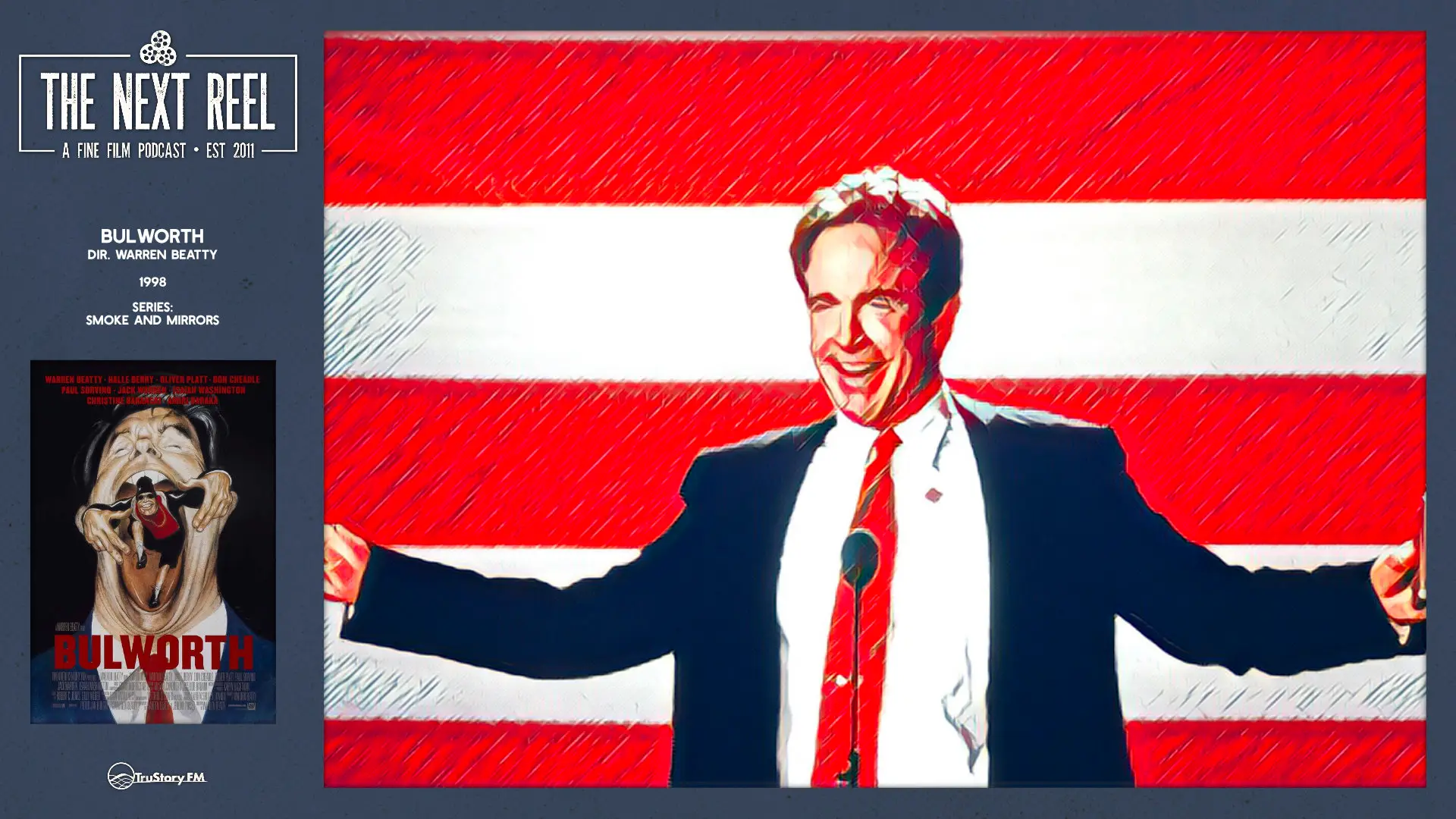
Bulworth is over. “All we need is a voluntary, free-spirited, open-ended program of procreative racial deconstruction.”
I left the bottom half of that line off, but I think people get it.
Andy Nelson:
Yeah.
Pete Wright:
Bulworth, man. Andy, wow. What a turn.
Andy Nelson:
Right?
Pete Wright:
This is a big turn for yours truly.
Andy Nelson:
I’m thrilled by that. I’m thrilled by that.
Pete Wright:
Yeah.
Andy Nelson:
This came out in ninety-eight. We both probably saw it maybe together in ninety-eight.
Pete Wright:
Yeah.
Andy Nelson:
And I loved it. It seems like, if memory serves, you did not love it.
Pete Wright:
Yeah, I think over the years, it must be that maybe I wasn’t aware enough in ’98 to understand what was happening in the movie, whether or not Beatty achieved what he was going for. This movie is a big swing, and I don’t think I got it, or I thought I was too cool to, and because I didn’t get it, I played off like I didn’t like it. Any one of those things could be true, the complexities of youth. But what I can say now is I smiled ear to ear at this movie. It is a big swing. There are places that are very dumb, but in the smartest of ways. And I think, you know, I have to applaud what Beatty was trying to do here. It actually plays.
The rapping white suicidal senator plays.
Andy Nelson:
The rapping white suicidal senator.
Pete Wright:
I’m sure all of those descriptors are out of order.
Andy Nelson:
But accurate. Accurate all the same. Accurate all the same.
Pete Wright:
Yeah.
Andy Nelson:
Yeah, this was a movie I remember really thinking fondly of when it came out. I enjoyed what Beatty was doing. I enjoyed what he was, you know, I mean, yeah, it’s a big swing sort of thing. And I do think that it is a film that, depending on your point of view or your state of mind, you might see more problems with it. And through today’s eyes, I think some people are probably gonna find more issues with it, with how some things are depicted.
But I think, in the scheme of things, what Beatty is doing here is really kind of working hard to push some big buttons and to kind of provoke thought in a very dark, satirical sort of way. And I think largely he succeeds. And that was — it’s very exciting to rewatch this and see how well it still worked.
Pete Wright:
So this is the last film in our Smoke and Mirrors series, and that was your series, and I wonder if you could just give me a recap of how you see these films fitting together, and particularly how Bulworth fits into this, to your concept.
Andy Nelson:
Yeah. I initially just picked kind of in chronological order, as far as the order of discussion. So Bob Roberts was first, then Wag the Dog, and now this. In retrospect, now that we’ve hit this point, I actually think it works pretty well, kind of the order that we ended up discussing them in. Because Bob Roberts, we’re — you know, it’s a mockumentary, we’re following the politician and we’re seeing how his message is getting interpreted by the people, by the media. We’re also getting a sense of kind of what the behind-the-scenes machinations are, that kind of set things in motion, as far as the releasing of the picture of the other senator, obviously the final moment. Things like that I think we’re seeing in Bob Roberts, but those aren’t the focus. It’s the man and his journey to win the election. Wag the Dog takes us inside the machinations.
We’re not following the president. We’re following the team that is working behind the scenes to fabricate as much as they can in order to keep him in office. And so now we’re seeing all the — how the machine is working. Bulworth is an interesting one, because we’re inside the system, but now we’re with a politician who — it’s almost like he has now opened his eyes, realizes just how broken the system is and how everything works in such terrible ways, and for various reasons ends up telling the truth, and by doing so reveals all the cracks in the facade and also exposes those who want to keep it that way, up to and including killing him in order to do so. So I think it’s a fascinating journey that we’ve taken, of just seeing the machine at work and how the people are reacting to it.
Pete Wright:
Yeah, I love the arc. I love the arc of watching a politician — you know, what it takes to get into office, what it takes to stay in office, and what it takes if you really want to get out of office in this movie. I think the arc of the series really plays, and in particular, what it takes for someone to discover his own sort of righteousness, his own, you know, the tools that he has to speak authentically, and what that does to the people who have to listen to him. I really enjoy that. Are there problems with the movie? Sure, but you know what? Weirdly, rapping white senator is not one of them.
I think that’s the thing I really hung my hat on, was how dumb I thought that was — dumb in heavy air quotes — and I realize only now it’s Beatty’s central tool. And the fact that he sort of embedded himself with the Fugees for two years to learn how to do this, while not telling them about the movie that he was making, is, I think, a fascinating experience to see. I don’t know that he needed it. I’m not sure how much it helped, but it sure makes a good story.
Andy Nelson:
It makes a great story. And I think there’s a lot going on in this movie. There’s certainly conversations to be had about race, about wealth. But one of the interesting things about this is this is a Democratic senator, right? And, I mean, on the flip side from Bob Roberts, who was a Republican senator, here we have a Democratic senator. And what we’re learning through the course of this film is it kind of doesn’t matter as much if you’re a Democrat or Republican, in 1998 at least, let’s just say — the point is they have the money. And this is why he’s so upset at the beginning, ’cause he’s kind of sold out, like he’s sold his soul to the devil. And everything is like — it’s all about getting the money that he needs to continue staying in office, and the fundraising, and all of these sorts of things.
And, you know, you’ve got Paul Sorvino from the American Insurance Federation, and this big lobbying organization that is giving him a lot of money, including a ten-million-dollar insurance policy. They’re just, you know, buying this senator to buy his vote. And we’re seeing exactly kind of how the machine works. It’s like party doesn’t matter so much as money. And I think that kind of becomes the central message of the movie that we’re looking at here.
Pete Wright:
The conceit of the movie, you said it — he hires someone to assassinate him at a specific time. And it buys him effectively a couple of days, you know, over the weekend, to get — and we cut very quickly to he’s getting off a plane and the assassination plot starts. He almost immediately starts dodging it. I’m trying to figure out structurally — when does his sleep-deprived, malnourished psychosis kick in, to unlock this side of him? It’s gotta be on the plane, I guess. Like, he gets off the plane and he’s already running for his life, sort of.
Andy Nelson:
It’s an interesting thing, because he knows that he’s — you know, he’s hired a hitman to kill him, basically. And he doesn’t know who the hitman is. He hired a guy who is hiring a hitman, is basically what happened. And so, yeah, he gets — I don’t know so much that he’s just running, but I think that it’s made him really jumpy. And I think that’s the way that it plays, is, it’s hilariously jumpy, because every single time that happens, I’m laughing out loud. When suddenly he’s just, like, wogging, you know, as through the airport, or kind of running away from one building to the other. Every time he hears a loud bang. And I think it ends up playing really well, and I think that’s the element of it that I suppose — I don’t know, that’s how I read it — is that it’s not so much he was like, why did I do this?
Because it’s not until really later, right, that he decides that he wants to cancel the hitman. Like, he’s not actively trying to cancel the hitman from the airport, for example. He still is keeping the assassination going, right? And so it’s just — I don’t know, I guess I would be that way too if I knew that someone was gunning for me. I’d probably be a little — or intentionally, if I was hoping to die, I would still be nervous about the fact that it was actually going to happen. And that’s how I read it.
Pete Wright:
Okay.
He has to be aware. It’s a — I guess it’s a trick, it’s not a MacGuffin really, but it’s a trick — that we have this character who is dressed in black, wearing sunglasses, carrying something tubular under his jacket. And he is the one that we, through Bulworth’s eyes, are asserting is the assassin, the would-be assassin, for the first half of the movie.
Andy Nelson:
Really, almost two-thirds, yeah. Quite a while.
Pete Wright:
Yeah, two-thirds of the movie. We are in a position of believing that this guy is the assassin, and we see him very early, right? It’s right when he gets off the airplane. We see him across the parking lot. And so here we are — the game is afoot. What we discover later in the film — and I’m sticking with the assassination arc before we get into the much more complicated race stuff — what we see at the end of the movie is that it turns out he’s just another paparazzo, and he’s trying to get — you know, how does the camera gambit work for you?
Andy Nelson:
I think it plays. You know, I mean, we’re gonna be spoiling this. There’s certainly a lot of spoilers that we’re gonna be discussing over the course of this, so if you haven’t watched it and you don’t want to be spoiled, watch it first. We find out that this guy is not the real assassin late in the movie, like about two-thirds through. We find out much earlier that Nina, who is hanging out with Bulworth, is the actual assassin that has been hired. Kind of — I mean, she’s not so much the assassin as the woman that this initial guy — that he talked to and paid to hire an assassin —
that guy’s just doing it himself, as we find out. He’s keeping the money, he’s gonna do it himself. He sneaks into Bulworth’s hotel room, he poisons the wine, he sabotages the railing over the balcony, things like that. Nina, he hires to just lure him up to the room so that he ends up dying in some capacity. We kind of learn all of this over the course of the story. So I guess the question is, once we learn earlier in the film that Nina has been hired by the guy to actually be part of the killing, does it still play that that guy is also an assassin?
Like, are we still thinking, is this guy a second killer that was hired? Like, how did you read that?
Pete Wright:
Well, I think that is a muddy part of the simplest of this movie’s dynamics. I think there’s a case to be made that everybody’s in cahoots, and that he might still be one of the assassins. I ultimately didn’t think that — I think they gave away the punchline, and that was fine. I think you just described part one of the Nina problem. And to me, Nina is a problem in this movie — not necessarily racially or culturally, but structurally, as a character, she is a problem. I love Halle Berry, and so she gets an enormous amount of credit, because Nina as a character is carrying — this is my premise — too much weight.
She has too many structural responsibilities to the film. Can we talk about this?
Andy Nelson:
I think that’s a fair point. We meet Nina early in the film when Bulworth goes to a church to speak at the church, right? She’s somebody in one of the pews just sitting there listening to what’s going on.
Pete Wright:
Provocatively sucking on a lollipop.
Andy Nelson:
Exactly. This is the one where Bulworth, being too tired, just decides to, like, start — he starts his speech, which is the same — what a terrible speechwriter, it’s the exact same opening line every time he gives a speech, which is kind of funny. He starts the speech and then goes off on his own and just decides to start saying it as it is. This is where he starts telling the truth to this crowd. It’s an African American church. And they react strongly to what he’s saying, like, are you saying that you guys don’t care about us? And he’s just like, isn’t it obvious?
Pete Wright:
Yes, we don’t care about you.
Andy Nelson:
And, yeah, it’s — I mean, it’s interesting, because you can say, okay, this is very truthful talk from a politician, but also it’s like bold and, you know, idiotic to just be doing this, because it’s gonna potentially ruin your career, is normally what would happen. And Nina’s there. Bulworth is rushed out with his team after Murphy pulls the fire alarm to get him to shut up. He takes them outside. There’s a huge crowd outside. They talk to a couple other women out there who they say, hey, you want a job? Come — you want to volunteer? Come along. Nina’s there too.
Her brother — there’s a whole thing going on with her brother. So Bulworth takes the other two girls and they go to volunteer at this party, and Nina also shows up there. So the question is, okay, because he was flirting with Nina outside the church — she was having none of it, her brother was definitely having none of it — at what point was she hired by this other guy to lure him to the hotel room? Like, it was a very happenstance meeting of these two, right? And so that’s the thing I struggle with the most, because she never feels — I don’t know, it just doesn’t feel like — it feels way too accidental for her to end up being in a position. Like, the only way that it would work is if this guy knew that she had kind of ended up in the volunteer circles, and then came to her and talked to her and said, hey, I need — I’m gonna pay you ten thousand dollars if you do this for me.
Like, that’s the only way in my head that I could see it really actually making any logical sense.
Pete Wright:
I actually — so in my head I’d written a little bit of that off, that the moment we meet her — you know, the camera meets her in the church — she’s looking at him not like one of the other two girls, right? She looks at him seriously, like she has a job. To me, she was hired while he was in transit, he was on a plane. But because his entire schedule is very public, she knew exactly where he was gonna go, and ended up being a young black woman in a black church. It’s a perfectly natural way to pick up kind of his track. I wrote that in my head in order to make sense.
Andy Nelson:
That makes sense. I can buy into that.
Pete Wright:
So the camera meets her again — I say this again — provocatively sucking on a lollipop. Why is that important, Andy? Well, I’ll tell you why, I’m so glad you asked. Because she is set up in that moment as the prize for Bulworth, the romantic prize in the movie. I think from that moment on, every one of their encounters further cements her as the prize for this guy — 23-year-old Halle Berry, 61-year-old Warren Beatty. She is the prize.
So she’s carrying the sort of rom-com weight of being the prize in this movie. That’s structural point number one. And you brought up point number two, she’s also the assassin — she is the mechanism of this movie, in addition to being the prize. So now she is part of two of these major mechanics. And the third, she has this conversation in the back of the limo where she describes how black political power collapsed when the manufacturing base left South Central. And that is a great point.
So herein is problem number three — structurally, she’s also the brain of the film. There is nobody smarter than her.
Andy Nelson:
There’s one other person who’s as smart, I would say.
Pete Wright:
What is it, Hobo, L.D.?
Andy Nelson:
L.D. No, not the Hobo. Yeah, Don Cheadle.
Pete Wright:
Oh, Don Cheadle. Right. Okay, you’re right, Don Cheadle. But on the Bulworth side, let’s say, right, the Bulworth camp early on, she begins defining his talking points by that speech, right? He uses her and goes to refine his talking points. So she is now the brain.
She is now the central mechanic. The movie doesn’t work if she doesn’t sit there and not pull the trigger on the gun she has. And she’s also the prize at the end. And I think all of those — each of those three mechanics are maybe a little bit weaker for it. I think the movie — I think Beatty maybe was trying to do too much with this one character. And, you know, once you add in the cultural stuff, the fact that it’s, you know, this is maybe the white-savioriest of the white savior stories, it ends up kind of weakening the overall Beatty’s overall Bulworth arc, to me.
Andy Nelson:
I think there’s definitely a point to that. I don’t know — in my view of the film, I don’t know how much it weakens for me, because I think, in some capacity, this plays like what we were discussing last week with Wag the Dog. And my frustration with Wag the Dog was that I struggled that there was nobody — like, people weren’t checking on the fact that Albania was actually being overrun, and all these things were happening, and you’re like, but that’s the satire of it. And you were buying into the fact that that’s just how the satire of it works. And I think, for me, that’s how the satire in this film works. And that’s why — yeah, I mean, it’s very convenient to have Halle Berry kind of fitting into all of those roles, but it also just plays into the satire of all of it.
And so I kind of look past some of the machinations that need to work in order for Halle Berry to check all of those boxes, and say, that’s just how it’s gonna need to work in this story. I think it plays. I think making all of these other people smarter than Bulworth, I think, works brilliantly, because —
Pete Wright:
That’s the satire.
Andy Nelson:
Because he just keeps stealing other people’s talking points, but it actually sells, and I think that’s what really makes that interesting. The love story element — and I think that’s where, for most of it, you’re gonna say it’s the Warren Beattiness of the story — is that Warren Beatty needed to be in the film where he still got the girl at the end. Like, does he need to get Nina at the end? Now, I’m gonna say, for the point of the story, in order for the ending to work the way it does, I think he actually does need to get the girl, only because I think there needed to be a coming together of the different groups, especially at that point when he’d finally had a very — like, two days’ sleep —
wakes up and is back to his original self, right? And he doesn’t seem to be kind of like — he’s not the rapper anymore, he’s not the guy spouting truths, he’s just himself. And so the fact that he wants Nina to walk out with him, I think, makes that work. Now, do they have to have the big kiss? They could probably have skipped that and just come out as, like, I don’t know, a united front. I’m not even really sure, but —
Pete Wright:
Two points on that, two questions for you. One, does the movie absolve itself of this issue by being aware of it? At one point he does say, this is ridiculous, I am so much older than you are, right? He says it out loud. Is that a way to absolve the movie of that weird, I think, dated age gap? And two — wouldn’t it have made, I would say, a better architectural and structural win for the movie if he had given her a job?
Andy Nelson:
Yeah, right. Like, you’re gonna be my new — I don’t know, I don’t know what a senator has, chief of staff.
Pete Wright:
I need you to be an aide.
Andy Nelson:
I mean
Pete Wright:
I need you to write scripts for me, you understand this stuff. Instead, he jams his tongue in her mouth, and I think that’s the thing that makes it creepy. That’s the thing that makes it read as super dated. And I’m all about finding romance around all the great, you know, dark corners of movies. I love kissing, kissing’s the best. I think this movie is less for it, because the story has — it’s like the perfect T-ball game.
There’s the ball, it’s set up, it’s right there, you just have to take a swing at it. And he whiffs it, at T-ball.
Andy Nelson:
I mean, great points, I think that they work really well. It’s tricky because they — again, they’re setting Nina up as a romantic interest just to get him up to the hotel room.
We’ve already kind of had Bulworth set up as a senator who can’t, you know, keep his pants on when he’s around beautiful women. Like, he apparently, according to his aides, when they’re talking, it’s like, all the women — this guy just won’t stop sleeping with all these women.
Pete Wright:
And I’m okay with all of that.
Andy Nelson:
Yeah, so we’re setting all of that up. I think you’re right, I think we could have had a stronger ending had he not had the need to make it romantic with Nina, but found a stronger way to do it. So I think you’re right.
Pete Wright:
Because that two days of sleeping — they’re like him reaching his final evolution. And that’s important, because when he walks out on those steps — we need those steps, we need something appreciably different — and that he asked Nina to come with him, and they walk down those stairs. Isn’t it a final-evolution thing, to have this senator who’s just gone through his great climb to the mountaintop and his return to the village, to say something new, and instead, again, jams his tongue in her mouth?
Andy Nelson:
Well, okay, and he could even have brought Nina and L.D., and given L.D. a job too. You know, I mean, I know L.D. already kind of has set up this whole thing where he’s now gonna clean up his own neighborhood and everything, but still.
Pete Wright:
Yeah, L.D. reached his final evolution too. He did it! There’s some great stuff in the Don Cheadle transformation. He’s so good at being this character.
So many of the cultural arguments — like, I do this really bad thing, I’m a kingpin, and then I wake up the next day and this white guy has just convinced me that I need to do better in my life. It’s pretty much straight across the bow. Like, I get it, it’s the simplest of the simple structural arguments, but these people are really good at conveying those messages, and I enjoy watching them. They’re super charismatic and funny.
Andy Nelson:
Yeah, they play really well.
Alright, we’re gonna take a quick break, but first, you can find the show on YouTube and you can join us live when we record. We will even take your questions in the post-show chit-chat, and members get the full post-show conversation, and always know what to listen to next. Subscribe to The Next Reel on YouTube — the link to this episode is in the show notes. We’ll be right back.
Well, I feel like we should talk about race. I feel like it’s a big — it’s a big thing to talk about, because this movie had some backlash when it came out, because some people felt it was
Pete Wright:
Wait, what? Is that important in this movie?
Andy Nelson:
Pushing the wrong buttons. But I think also there were people who said this film actually gets it, and there’s a story here that is worth telling.
And I think what Warren Beatty is trying to say here is that, obviously, there are race issues, and we’re gonna be struggling with that as a country for probably forever, unfortunately. But what the real issue is is the wealth issue, and the fact that the rich people are gonna do everything they can to stay rich, and they don’t care about anyone else, and it kind of doesn’t matter what color your skin is. And I think that’s an interesting point that he’s really pushing here, that it fits into a lot of the race conversations that we have going throughout the film. How does it play for you?
Pete Wright:
You know, again, this is a white savior movie that attempts to have its white savior cake and eat it too, by being super self-aware that this is a movie about a transformation arc of a white savior. And in doing so, it makes — just having black people in a movie does not make it racially aware. I think a lot of the black characters — I can totally see watching this movie and being heavily critical of how so many of their arcs are sidelined, or trivialized, or incomplete, or all that.
Andy Nelson:
Or even just written straight up.
Pete Wright:
Just, yeah, right. One of the things that makes that really hard is that there are a lot of them in this movie, right? Who are you interested in following — Hobo, guy, brother, pre-Grey’s Anatomy Isaiah Washington, Halle Berry, Don Cheadle? Who are you interested in tracking?
Because they introduce us to so many of them. Maybe you’re just interested in what’s-his-name from The Wire who’s sitting in the back of the C-SPAN truck. There are a lot of well-positioned black character actors in this movie, and maybe as a result of the sheer volume of them, none of them get any significant individual treatment. I have to look at the movie truly as a fabric, right, as a tapestry of these character experiences, and Bulworth constantly bouncing off of them. Or, because if you attempt to litigate at the character level, the movie loses, I think.
Andy Nelson:
Yeah, and I think that’s an interesting point. And I think it’s a struggle when you’re trying to tell a story like this, especially when it’s so satirical, to have just rich, robust characters across the board for every one of your characters. And especially in a film that’s called Bulworth, where we’re following Bulworth through the entire film, it doesn’t give us as many chances to really kind of get to know the other people that we’re following, as much. And I think that could be one of the frustrations with the film. I mean, we do get to know some of them, but, to your point, not nearly as well as we probably should. And I think that speaks to a frustration with it.
And I think it probably speaks to the fact that Warren Beatty co-wrote and directed the film and stars in it. This is Warren Beatty that we’re talking about — he is somebody who certainly likes the center of attention, as you know, and I think that’s gonna be what his focus is, right? And I think, especially when he’s directing himself, we’re just focusing on him primarily. But knowing that, I find that he is genuine in his attempts at really trying to get these messages across. He kind of makes it a bumpy ride by doing it the way he does sometimes, but I think that it feels genuine to me. And I think that’s what I appreciate about it, because I think he really is trying to get some of his own political beliefs out there, and some of the points that he feels about how the world of politics works and how it’s shaping our country.
And I think, importantly, he gives strong message moments to both Nina and L.D. that allow them to actually talk about the real issues going on in their neighborhoods, and the struggle that these black communities are having. And I think all of that is there, and he’s giving us a chance to kind of feel those frustrations. But because it’s the world through this rich white politician’s lens, I think we just have to accept that that’s the lens we’re gonna get for the film, and appreciate that he’s at least trying to tap into those truths through that lens.
Pete Wright:
Yeah, I think you’re right, I think that’s the trick. And does it get more complicated here, however many decades later, we are two middle-aged white guys talking about a movie where, arguably, the only character that we can truly relate to — let’s just say maybe it’s Sean Astin, silent in the back of a limousine — but it’s probably Warren Beatty, right?
Andy Nelson:
Yeah.
Pete Wright:
Like, that’s our avatar in this movie, and that’s problematic on a number of levels, to even have a conversation and not — and just to say aloud, I realize there are gonna be corners of this conversation that I don’t even know I’m missing. But I’m with you, I sort of have to stand with this being an expression of Beatty’s longtime advocacy, and also of him taking a swing by making a studio movie — essentially calling in a chit with Fox to make a studio movie that absolutely pans studios as giant businesses.
That’s a huge swing, reputational swing. And I think you can make the case that he paid a price for it, also, you know, changed directions. But I do think it’s important to note that he is trying to have a conversation through film.
Andy Nelson:
There’s a lot to that point. Because, you know, this is a film that I do wonder — like, how are people through today’s eyes going to see this film, this story about politics in the mid-nineties? I mean, the whole point, the opening of the film, is, like, politics is kind of boring right now. You’ve got Dole and Clinton running for office, and just a bunch of senators kind of just trying to hold their place, and it just feels very same-old, same-old. And that’s how the film starts, as we get kind of that message on screen. It’s like, it’s kind of boring.
Nobody’s that interested in the state of politics right now. Again, it’s because, generally, politicians aren’t telling the truth, or they’re painting truths in ways that work best for them, is probably the best way to say it. And, again, largely because they have to answer to all the lobbyists that they’re taking money from, that they’re buying their votes, and everything. And I think he’s making a lot of valid points. And even the points about Hollywood, I think those come across — yeah, they’re pretty ballsy to kind of come out and say some of these things. But also, I think, as somebody who had been in Hollywood by this point for decades, he’s taking his chance right now and just saying, I’m gonna just say whatever I can that feels truthful.
And, yeah, it may pinch his career a little bit, but for him, it was worth it.
Pete Wright:
Yeah, I’ll say that Hollywood dinner sequence — it did feel like Beatty had some things pent up.
Andy Nelson:
Yeah. You wonder why he directed so few times.
Pete Wright:
Yeah, right. ‘Cause every one of them was a catharsis in its own clever way.
Andy Nelson:
Right.
Pete Wright:
All right, can we can we talk about the team? I just mostly want to talk about Oliver Platt.
Andy Nelson:
Yes, God, Oliver Platt, man. I loved him in this so much.
Pete Wright:
Yeah, Oliver Platt has an arc just as robust as Beatty’s, like — he got his anxiety arc that leads him from just being an anxious chief of staff to snorting cocaine on a dance floor and just giving up. It’s delicious. His final turn with actual Larry King, I thought was incredibly well played, and the way he plays the chatterbox angle — like, when he just can’t stop, he’s just totally coke-addled and can’t stop talking about how smart he is, how smart his ideas were, that Bulworth is now parroting on TV — I thought was fantastic. It’s one of those performances that reminds you just how great Oliver Platt is as an anchor supporting-character role.
Andy Nelson:
This may be one of my favorite Oliver Platt performances. I just had so much fun watching him throughout, because he does the anxiety bit so well, and then building to the point where he is snorting coke — I just could not stop laughing at how he played that, and just where he took that, I just thought it was so funny. And to your point, when he makes that shift after the whole conversation with Larry King, where he kind of shifts into, that’s what I’ve been saying — basically taking the whole thing as if it was his idea all along — this plays so well. I had so much fun with Oliver Platt throughout this.
And, you know, I think that he works well in this role that carries a lot of manic tendencies.
Pete Wright:
Yes. Now the aide — the chief of staff — and the guy who works for him, who was that? Was that Joshua Malina?
Andy Nelson:
This is a weirdly frustrating film in the way that they do the credits, because the credits order — it’s just, like, all alphabetical, they just alphabetized the credits by last name. And so it’s difficult to figure out who specifically was who, because you’re like, well, I don’t know, I can’t see it based on the position they were in the film.
Pete Wright:
It’s Joshua Malina. Here’s why I want to bring up Joshua Malina. There has been some controversy about the Aaron Sorkin contribution to this script. I don’t know that there’s ever been a single credited line that r remains in this movie, but apparently he was on it. And one of the reasons that stuck out to me is because Joshua Malina was a central character in the Aaron Sorkin show Sports Night, which was awesome and canceled way too early.
Andy Nelson:
Wasn’t he also in West Wing?
Pete Wright:
Yeah, he was also in West Wing. You’re right. So there were two things.
There were two things, very sorry. He may be the Sorkiniest of Sorkins that made it to this. You’re right.
Andy Nelson:
Yeah.
Pete Wright:
But I needed an excuse to bring up sports night and you just deflated that.
Andy Nelson:
I know.
Pete Wright:
Yeah.
Andy Nelson:
Didn’t mean to deflate it, sorry.
Pete Wright:
It’s good.
Andy Nelson:
Yeah.
Pete Wright:
It’s all good. Sports Night, but also West Wing.
We’re fine. I think Joshua Malina is, again, he is another one of those fantastic character, comic character actors, and makes a great aide. He’s always kind of diffuse.
Andy Nelson:
The bit I enjoy the most with him is when Platt starts snorting coke, and he’s having that manic conversation with him, and he clearly wants to snort the coke too, and he’s just waiting for him to kind of hand him some. And he just — Oliver Platt just never does it. He never notices. It plays so funny. So, yeah, a lot of moments like that throughout the film. But he was great.
Pete Wright:
It does. It’s so good. Oh my god, it’s so good.
Andy Nelson:
Yeah.
Pete Wright:
Anybody else? Principally, or I think we’re good.
Andy Nelson:
I want to mention some of the crew, because aside from Warren Beatty, you know, co-writing and directing this, you’ve got Ennio Morricone doing the score. Obviously there’s a lot of rap music and hip-hop music that kind of comes in and plays throughout, but the Morricone score is great, and some great choral bits that kind of build, especially toward the end. And Vittorio Storaro ends up shooting it, and it’s beautiful — I just could not get over how beautiful the cinematography was in this, a lot of great kind of dark, shadowy things, some great green light highlights and things like that. It was just a really beautiful, beautifully shot film. And then Milena Canonero is doing the costumes, who clearly got to have a lot of fun once Warren Beatty changed outfits and was wearing his rapper outfit.
I loved all of that work.
Pete Wright:
Yeah, I think the use of color is really interesting. I don’t think he repeats a room color in that early half of the of the movie. Every time he goes in there is these really bold thematic colors. And so he’s just like walking from one Dr. Seuss book to the next. That really plays for me.
Andy Nelson:
Yeah.
Pete Wright:
The Morricone — I don’t actually have it in my head, I need to go listen to it. I was so taken by the rap stuff that I can’t hear any of what was left of Morricone.
What was left of Morricone in the movie? Ten minutes, tops?
Andy Nelson:
I’m curious how much there is, but it definitely plays most in the assassination plot, because you get a lot of the tense music as he’s seeing somebody and then, you know, darting off and stuff like that. So you get some tense themes in those bits. But toward the end, as he comes outside, there’s the romantic music that plays, and then the kind of more tragic theme that kicks in after the assassination. And so, yeah, I don’t know how much there is, because of all the other actual songs, but it’s in there. You’ll hear it when — you know, it’s Morricone, especially once kind of the choral bits play.
Pete Wright:
For sure. We didn’t mention Billy Baldwin is in this movie. This is a Billy Baldwin vehicle.
Andy Nelson:
Is this a reuniting of Billy Baldwin and Oliver Platt from Flatliners?
Pete Wright:
Flatliners. They are not in any scenes together.
Andy Nelson:
Weren’t they both in Flatliners together? Not that they’re in any scenes together, but — still, I have to shout out Jack Warden, who I always love.
Pete Wright:
It’s all right. They share a cast list.
Andy Nelson:
He’s just so great. I just love seeing him in projects. And he was fun as kind of one of the other one of the other people working for Bulworth.
Pete Wright:
Yeah.
Andy Nelson:
And actually I just have to shout out Laurie Metcalf and Wendell Pierce, as the C-SPAN pair. That duo, they were very funny together. I always enjoyed when we would cut inside the van as they were talking.
And she’s just like, so — is this — is this an Emmy?
Pete Wright:
Is this what you meant?
Andy Nelson:
Or is this an Emmy, you think? Emmy worthy, or what do you think we could get from this?
Pete Wright:
She is so good.
Andy Nelson:
They played really well.
Pete Wright:
When you when you meant when you said he mostly stays on message, is this what you were talking about? So good.
Andy Nelson:
Yeah, this is very funny.
Pete Wright:
Okay, just wrapping back around to the movie, because I think, as we get close to wrapping up, we have to talk about the end. Another controversial end to this movie, Bulworth — he — they come out of the house and they do the kiss and the tongue-down-the-throat thing. You get that.
Andy Nelson:
And the assassination attempt is done, because Nina comes out and says, it was me, I’m not gonna kill you. You’re good. So, as far as we know —
Pete Wright:
But we see the insurance lobby representative, Paul Sorvino, on a rooftop suspiciously on a rooftop above the gathering. And then Bulworth Nina gets in the limo, Bulworth walks to the limo, chest bursts, and he falls to the ground and dies.
Andy Nelson:
Falls to the ground. Maybe dies. We’ll we’ll get back to that, but yes.
Pete Wright:
Oh Andy, how dare you? How dare you light the beacon of hope?
Andy Nelson:
To see him
Pete Wright:
He falls to the ground limp. Let’s say limp. Camera cuts up to, again, the same location where the life insurance guy was, and he’s now gone. So how does it work for you, this ending, Bulworth getting shot?
Andy Nelson:
I think it’s perfect. I think it fits into exactly what his message was, you know. The whole point is these — it’s the big money, and these people are going to protect themselves, and they’re fine as long as these politicians are doing what they promise. And Bulworth had promised that he was gonna vote for this particular bill, and this guy was gonna give him a ten-million-dollar life insurance policy, all of these different things. The guy tries to give him a ten-million-dollar life insurance policy after Bulworth starts, you know, spouting off all these truths and everything. The guy’s like, fine, you play hardball, here you go, Bulworth rips it up. This guy is clearly pissed that he had a commitment from this politician.
So I think it just speaks to, again, the fact that when you have the money, you are expecting that when you’re buying these things, whether it’s a vote or whatever the case may be, that you’re going to get it. And I think it speaks to the fact that these guys will do everything they can to keep things the way that they want them to go. And so this guy’s totally fine killing Bulworth. And I think that just speaks to the message of the film. So, for me, it a hundred percent worked.
Pete Wright:
I’ll give you 98%.
Andy Nelson:
Wow. Okay. Okay.
Pete Wright:
And here’s the reason I’m on a very small fence on it. Because the movie is a mostly satirical look at a congressman who comes off the rails and starts speaking truth to power, and it’s very much a — what was his name? Who was in the movie that was truth in advertising — Volvo, boxy but safe, whatever.
Andy Nelson:
Dudley Moore
Pete Wright:
Dudley Moore. It’s very much a Dudley Moore thing. I couldn’t stop thinking about Dudley Moore, even though I couldn’t remember his name.
Andy Nelson:
They’re boxy, but they’re good.
Pete Wright:
But they’re good. So I’m thinking about that.
And at the end of the movie, when it’s at its most sincere, when we’re supposed to be learning the lessons of the satire, they shoot him. And I wonder if that moment is a rough moment, because the final, most authentic message of the movie is: you cannot speak the truth, because you will be killed for it.
Andy Nelson:
Yeah, and
Pete Wright:
That’s it. That’s really — like, that’s not comically sad anymore. That’s existentially sad.
Andy Nelson:
But it’s dark satire, and I think that’s why it works. ‘Cause we’re following that dark path.
Pete Wright:
Yes, and I think we followed the dark path a lot. I’m just saying there’s that two percent of me that says, is the movie — does it make that connection, that anyone who speaks up will be silenced? And, to me, again, 98% in favor, man, I think it does, it tells the story right. That 2% says, hey, there might be something that says otherwise — that there is another message out there that is, look, it can be hard to speak truth, but when you do, good things can come of it.
And it can end on a much more optimistic note, a note even of hope. And this movie ends on one of hopelessness. And that’s sad. The more I talk about it, the more I’m maybe at 97.
Andy Nelson:
Oh, okay. I think that it is exactly what the movie needs. I don’t think ending on a — if we’re — well, with the movie as it is, we’re talking about the kiss and everything. If you have that positive, happy ending there, then I think the fact that you’re ending also on a love-story note, I think that makes it harder to kind of keep any satire, anything that’s biting, anything that’s dark, with that world anymore. I think you’d have to really work on rewriting the whole ending to make that point. So for me, I think we need to have this real dark ending to look at — like, this is the end result of this.
We’ve built a system that is just not gonna let these rich people get out of the position that they’re in. And I think that’s the message of the story. And I think he learns it the hard way, and I think that’s why it ends the way it does.
Pete Wright:
Yeah, I think I just feel like, in that last moment, they pull the rug out from under me — probably in a satisfying way, but also in a way that says, you know, I just really was hoping for a movie that would tell me that people who fight for good and right and justice have hope of being able to live out their lives in goodness.
Andy Nelson:
Yeah.
Pete Wright:
Bummer
Andy Nelson:
Well, here’s an interesting question for you then. Obviously, since this movie came out in ’98, and since our other two came out in ’92 and ’97, nothing has changed. Really, nothing has changed with our system. Does this movie speak to the fact that nothing has changed? Or, if this movie had ended with a more positive message at the ending, saying things can change, but only if you help make them change — could it have actually contributed to our society actually making a change? Or, the way that the movie ends, does it just leave us all shrugging our shoulders, saying, well, what can we do about it? Nothing.
Pete Wright:
Yeah, that’s it. That’s the message that I worry about. I don’t know that any one single movie is one that changes the architecture of cultural history, but taken together, art changes things — it changes people, it changes the way we think. And this is one movie that I think had an opportunity, again, to potentially change the way we think, as part of a conversation of hope, that we do have a voice, and that voices matter, and that they’re not unilaterally silenced by the powers that be.
They don’t have to be. And there are other movies in that tradition that I think this movie could have hung with, because it tells a very dark story, a dark satirical story, and it could have left us with a glimmer of hope, that he walks away a different person, but he walks away.
Andy Nelson:
I mean, for a guy who looks at Network with such high regard, I feel like you’re wanting something more than what even Network delivered.
Pete Wright:
That’s mean of you to bring that up.
Andy Nelson:
I’m just saying Network also has a pretty bleak ending.
Pete Wright:
It is bleak. It’s super bleak.
Andy Nelson:
Yeah.
Pete Wright:
But I also think we didn’t have a character who was in the best of his wits. I also love Fight Club. Come on, believe me, the case you could build against me wanting this ending is vast.
Andy Nelson:
I think what’s happening is you’re turning into the 65-year-old Tim Robbins who says, I just have to start doing yoga and just be more positive about things.
Pete Wright:
Yes, I’m 65-year-old Tim Robbins now. We should all aspire to be 65-year-old Tim Robbins.
Andy Nelson:
Hear, hear. No, I mean, yeah, it’s a tricky line, but largely, in the scope of what the film is actually working toward and achieving, I think Warren Beatty does succeed. You know, it’s gonna be one of those things that I think, watching through today’s eyes, you’re gonna see some things that you’re gonna be like, well, okay, that doesn’t play as well. Even in ninety-eight, maybe it didn’t play that well, but I think largely the message is coming across, and I think largely it ends up — for me, it worked really well.
Pete Wright:
Well, Warren Beatty definitely agrees, although Jeremy Pikser — co-writing credit — does not. Jeremy Pikser, I think, is more along my line. Beatty says, in the Irish Times, there’s nothing in the film that’s not on purpose. He said he wanted the message to be King’s message — if you have nothing worth dying for, you have nothing worth living for. That’s Beatty on the ending.
Andy Nelson:
But Pikser didn’t like that, is what you’re saying.
Pete Wright:
No, Pikser was like, why would we wanna make a movie where we say, if you stand up and tell the truth, they’re gonna kill you? And there are — I think Pikser was not like me. I wanted him to just walk away, but Pikser was for the defense of stronger ambiguity — that the real fantasy that there is always, or even often, a happy ending for people who put their lives on the line for justice, leaving people to wonder if that’s the case. I did not walk away from this movie believing that Warren Beatty, or that Bulworth, was still alive. You tell me that there might be hope.
Andy Nelson:
We don’t end with him dead. Like, if the movie ended with him laying on the ground there, I think the probability would be I would walk away saying, okay, he died. The movie ends with a shot of Cedars-Sinai, like we’ve seen it before, because that’s where the guy who he hired to hire the assassin — that’s where he ends up after he has his heart attack. We cut to Cedars-Sinai, and we see the hospital there in the background, which tells me he might be alive. They brought him to the hospital, not the morgue, they’re trying to kind of get him working again, so we’ll see. And then we meet the homeless man outside again, who does his whole thing about — you gotta be a spirit, not a ghost, I think is what his whole message is.
And you gotta have a song, and then he kind of walks away. And so it was a message to us, he’s speaking to camera. I don’t know, I kind of read that as maybe Bulworth is dead, maybe he’s alive, but either way, this is where I get the positive message. This guy is looking at us and saying, you’ve got to be a spirit, you got to have a song — meaning you’ve got to start spreading the word, and you got to fight for your own truths. So I still see it as a positive ending there.
Pete Wright:
All right. I mean, certainly the insurance industry is getting a piece.
Andy Nelson:
Indeed.
Alright, well, let’s move into the back half, but first, let’s take a quick break.
Pete Wright:
The Next Reel is a production of TruStory FM, engineering by Andy Nelson, music by Tzabutan, Danny Shields, Oriol Novella, and Eli Catlin. Andy usually finds all the stats for the awards and numbers at The-Numbers.com, BoxOfficeMojo.com, IMDb.com, and Wikipedia.org. Find the show and the full archive at TruStory.fm. You can follow us from there too, plus you can find out how to become a member and go further with every episode.
Check out our merch store at TheNextReel.com/merch. And if your app allows ratings and reviews, please consider doing that for our show.
So you found the Barack fandom too, I take it.
Andy Nelson:
I just love this.
Pete Wright:
I got a big smile out of this.
Andy Nelson:
Yeah. The fact that Barack Obama actually in private, but somebody reported this, he actually said at one point that he talked longingly of going Bulworth, which I absolutely adore and I would love to actually especially today, I would love to have that happen. I would love to hear some more of what some of these politicians had to say, you know.
Pete Wright:
Do you think anybody in his camp came in and said, Mr. President, you’re already black? I think you may have missed the point of that movie.
Andy Nelson:
Oh my gosh. Too funny.
Pete Wright:
How’d it do, awards season-wise?
Andy Nelson:
Not huge, but enough notice. It had one win with twenty other nominations. Over at the Oscars, it was nominated for Best Original Screenplay, but lost to Shakespeare in Love. The Golden Globes, it was nominated for Best Motion Picture Comedy or Musical, but lost to Shakespeare in Love. Same thing with Best Screenplay, losing to that film. And Warren Beatty was nominated for Best Performance by an Actor in a Comedy or Musical, but lost to Michael Caine in Little Voice. At the NAACP Image Awards, Outstanding Lead Actress — Halle Berry was nominated, but lost to Angela Bassett in How Stella Got Her Groove Back. And Don Cheadle was nominated for Outstanding Supporting Actor, but lost to Morgan Freeman in Deep Impact, of all things. That’s just nonsense to me, but who am I? The LA Film Critics Association Awards, this is where it won its one award, for Best Screenplay. And the Political Film Society —
this has been an interesting series for that. This film was nominated for Exposé, which is — to a film that has an investigative depth into a subject matter and often exposes surprising information on the subject. There were four nominees — this film, A Civil Action, Four Days in September, and Regeneration — but they did not pick a winner. I guess in order for there to be a winner at the Political Film Society, a nominated film must receive a strict majority vote from participating society members. And so it has happened over the history of these awards where sometimes a certain film didn’t win, and so they just have nominees, no winner.
Pete Wright:
Wow.
Andy Nelson:
Yeah, weird.
Pete Wright:
Hardcore awards.
Andy Nelson:
I know, right?
Pete Wright:
People, if you’re gonna vote, you gotta commit. How’d it do at the box office? Did it make any money?
Andy Nelson:
Beatty’s political satire was made for twice Wag the Dog’s budget, or thirty million dollars, which is fifty-eight point two million in today’s dollars. The movie had a limited release May fifteenth, nineteen ninety-eight, opposite The Horse Whisperer, Godzilla, Quest for Camelot, and the limited releases of Plump Fiction, Clockwatchers, and Lawn Dogs. Plump Fiction — I don’t even remember that one, but there it was.
Pete Wright:
What is happening right now? Are you having a stroke? Is this a Bulworth moment?
Andy Nelson:
Right.
Pete Wright:
Blub blur bl
Andy Nelson:
The this went wide a week later and jumped to fourth place and it would end up staying in the top ten for three weeks, going on to earn twenty six and a half million domestically and two point seven million internationally for a total gross of fifty six point six million. That in today’s dollars. That wasn’t quite enough to end up in the green, unfortunately, and the film ended up with an adjusted loss per finish minute of $14,000. Still, it came really close.
Pete Wright:
Man, my kingdom for fourteen grand a minute.
Andy Nelson:
Yeah, no kidding, right?
Pete Wright:
Well, I’ll tell you, Andy, this was a massive turnaround for me. So many cultural challenges, but God, I enjoyed my time with this movie. Minute after minute, I really did. And I bought it — it’s only a little bit hard to find, it’s not streaming anywhere, but it came up for rental on one of the services.
Andy Nelson:
It is streaming.
Yeah, I rented it from Apple.
Pete Wright:
No, that’s what I mean. It came up for rental and buy on Apple. It was like $4.99 to buy, $3.99 to rent. I bought it, and now I love it. I’m gonna show it to others.
Andy Nelson:
So, $4.99 to license is what you mean.
Pete Wright:
Oh, stop it.
Andy Nelson:
I’m just saying you’re not really buying it.
Pete Wright:
You just stop that. Stop it. Stop it with your
Andy Nelson:
Physical media rules, Pete. Physical media rules.
Pete Wright:
Oh, God, you make me — this is it, this is the end of the show.
Andy Nelson:
I will say, this is a frustrating one. like this entire series, weirdly, where all of these films, they made it as far as DVD, but that’s it. They’ve never had any other life after that. So it is nice, at least these ones are the last two are available digitally to rent
Pete Wright:
Or to acquire a perpetual license.
Andy Nelson:
Until they decide you don’t actually have it anymore. Exactly.
Pete Wright:
I’m hanging up on you
Andy Nelson:
Well, I really liked this film. Yes, it has some issues, but I a hundred percent enjoyed what Warren Beatty was doing with it. I had a great time. And, you know, in the scope of Warren Beatty films, is this my favorite film that he’s directed? Do you remember all the films he’s directed? I’m trying to remember — there’s Reds, Dick Tracy.
Pete Wright:
And Bugsy?
Andy Nelson:
He’s directed seven films.
Heaven Can Wait, Reds, Dick Tracy, Bulworth, and Rules Don’t Apply.
Pete Wright:
Oh yeah.
Andy Nelson:
He did not direct Bugsy. That was that Levinson?
Pete Wright:
Probably. I think that’s why we were thinking about it.
Andy Nelson:
So only five films.
Pete Wright:
I need to — we need to watch Dick Tracy again.
Andy Nelson:
Yeah.
Pete Wright:
Because in terms of directorial swings, that movie, I have a high opinion of that movie.
Andy Nelson:
Reds, Dick Tracy, Bulworth, all of those — he takes big swings with all three of these films, I think.
Pete Wright:
Yeah.
Andy Nelson:
Heaven Can Wait, I think, is a fun remake, I think he has a fun time with that one, it’s nothing too complicated. Rules Don’t Apply — that was the one that kind of came out of nowhere in 2016, where he plays Howard Hughes. And then Lily Collins and Alden Ehrenreich.
Pete Wright:
Oh, yeah
Andy Nelson:
He’s the driver, and she’s an actress, and they fall in love, and Howard Hughes — they both work for him. I don’t know, it didn’t get great reviews.
It’s one I’m kind of curious of, though, because it’s the only Warren Beatty film that I missed, so maybe I’ll watch it.
Pete Wright:
I am curious too. Would that it were so simple.
Andy Nelson:
Would that it were so simple. Yes. Alright, well, that’s it for our conversation about Bulworth, and an end of our Smoke and Mirrors series. Next week we are kicking off a new series looking at the filmmaker Armando Iannucci, called Institutions Eating Themselves. We start things off with his 2009 film In the Loop, a scathing British-American satire about a UK cabinet minister’s offhand comment about the possibility of war spiraling into an international incident, as spin doctors, generals, and diplomats on both sides of the Atlantic scramble to spin it, weaponize it, or shut it down. It’s got Peter Capaldi at his most brilliantly foul-mouthed as spin doctor Malcolm Tucker, alongside Tom Hollander, James Gandolfini, and a murderer’s row of British comic talent.
That is next week. And now let’s do our ratings.
Pete Wright:
Letterboxd.com/thenextreel, that’s where you can find the HQ page that covers all the movies that we’ve talked about across The Next Reel family of film shows. Andy, what are you gonna do? Five stars and a heart.
Andy Nelson:
I really liked this film. I do have some issues with it. There are points where I think Warren Beatty takes the comedy into spaces where it’s more just kind of goofy, and I’m like, I think he’s kind of losing some of the satire, but largely I think he does a great job with that. I had so much fun, I’m gonna say four and a half and a big old heart.
Pete Wright:
Wow. Okay. Well, I went from a Letterboxd rating of “this movie is bad and stupid” to four stars and a heart, Andy. I had a blast
Andy Nelson:
Look at you
Pete Wright:
With this movie, I’m so glad we watched it. And I actually think it’s going to pair very well with Institutions Eating Themselves beginning next week.
Andy Nelson:
I think so too. Well, that averages out to four point two five stars, which rounds up to four and a half and a heart. You can find the show on Letterboxd @thenextreel. You can find me there @sodacreekfilm and Pete @petewright. So what did you think about Bulworth? We would love to hear your thoughts. Hop into the Show Talk channel over in our Discord community, where we will be talking about the film this week.
Pete Wright:
When the movie ends
Andy Nelson:
Our conversation begins.
Pete Wright:
Letterboxd giveth, Andrew.
Andy Nelson:
As Letterboxd always doeth.
Pete Wright:
Okay. I found one that is not going to raise our spirits. So with your permission, I would like to go first.
Andy Nelson:
Okay.
Pete Wright:
Because I think what this represents is how I was feeling before I watched it again.
Andy Nelson:
Oh, okay.
Pete Wright:
Right. This is a review from the talented Matt Lynch, from 2019. A mostly bad movie and an utterly fascinating artifact. What in nineteen ninety-eight actually did manage to seem simultaneously brazen and clumsy, still is those things, but today also appears much more unambiguously hashtag problematic. Possibly one of the most misguided things ever attempted, a vanity project not just for Beatty as a star, but as a socially engaged brand.
Not even Hal Ashby could have gotten this to work. Grim, from Matt Lynch. Not a fan. Gives it a heart. I actually am not sure if Matt is one of the heart, no-heart, and not-a-star person, but —
Andy Nelson:
No, Matt has given plenty of stars.
Pete Wright:
Okay, alright. So not a fan. I think — I was giving it — it’s a Casablanca movie, before today. If I’d given it any thought, I would have thought this. But I didn’t think about it until now.
Andy Nelson:
And then you watch it, you’re like, oh
Pete Wright:
So then I watched, I’m like, hey, this is much better than a Casablanca movie.
Andy Nelson:
Yeah. Well, I’ve got a four and a half and a heart. I just went right where I sat — by Kenneth Clark, who said, still trying to wrap my head around the fact that the wokest movie I’ve ever seen involves Warren Beatty smoking weed once and subsequently rapping for the remainder of the film.
Pete Wright:
Smoking weed once. We didn’t actually talk about the various and sundry moves that Berry and Beatty get into on the dance floor. The tongue-flicker move was one that I thought was interesting.
Andy Nelson:
I just feel like I missed out on ever doing that — it’s been a long time since I’ve been out on a dance floor, but I feel like I missed out on doing that when I was young. It’s like, is that — should I have done more tongue-flicking?
Pete Wright:
Yeah.
Andy Nelson:
Is that was I missing that in my youth?
Pete Wright:
Apparently. And also I don’t think we’re allowed to do that anymore. So not only did you miss out on doing it personally, but now you’re not allowed to go do it. You can’t catch up on that skill.
Andy Nelson:
Oh, okay, well it’s just
Pete Wright:
Now you’ll just be arrested. And you’ll definitely be blocked on Instagram
Thanks, Letterboxd.