*This transcript is produced using transcription software and reviewed for quality. Despite our best efforts, some passages may be incomplete or contain errors due to audio quality or software limitations.*
Pete Wright:
I’m Pete Wright.
Andy Nelson:
And I’m Andy Nelson.
Pete Wright:
Welcome to The Next Reel. When the movie ends…
Andy Nelson:
Our conversation begins.
Pete Wright:
Bob Roberts is over. “Don’t smoke crack. It’s a ghetto drug.”
Okay, Andy, Bob Roberts.
Andy Nelson:
Yes.
Pete Wright:
Hard to see this movie, turns out.
Andy Nelson:
It’s frustratingly difficult to watch. I actually bought the DVD so that we could have our conversation, so I was able to watch it there. And otherwise, it’s not streaming anywhere. I am really unsure as to why. It’s not streaming, you can’t rent it, it’s never been released on Blu-ray. When I went to Amazon to find it, you could buy it on DVD or Laserdisc, Pete.
I think those are the options right now.
Pete Wright:
Flip it every fifteen. Am I right? Flip it every fifteen?
Andy Nelson:
Oh my gosh. Good times, good times. Yeah, difficult to watch, which is weird, because it seems like with the way things have been going in our country in the last ten-ish years, this would have been a film that’s worth somebody picking back up and pushing out there, you know. And I’m not sure exactly what the status is with its distribution rights—Working Title is the company that funded it. So I don’t know what they’re doing with it.
Pete Wright:
I do—do you think it has—this is all armchairing, I haven’t found anything. I know he has some strong words about why the soundtrack wasn’t released, but do you think any of it has to do with Tim Robbins and his political leanings, and feelings about this movie being taken not as it was intended?
Andy Nelson:
You mean like Fight Club?
Pete Wright:
Nobody talks about Fight Club.
Andy Nelson:
Not the movie, but like the club.
Pete Wright:
The club, the actual fight club.
Andy Nelson:
Yeah. Like, is that something that would happen?
Pete Wright:
Yeah.
Andy Nelson:
I don’t know, because it’s a very pointed film, and I guess the question is, is the satire now so accurate that people aren’t watching it for the same reasons, or they’re not getting any of that out of it anymore? I don’t know. It’s weird. I don’t know why, because it’s not like his film Cradle Will Rock is easy to track down either.
Pete Wright:
No, that’s true. All right, well, set this up first for people who haven’t seen it, knowing how hard it is to see. And I’ll just say out loud—Tim Robbins has said on the record, if you want to watch this film, pirate it.
Andy Nelson:
That’s funny that he’s actually said that.
Pete Wright:
Yeah. So go ahead and set it up—why are we doing this film? And this is a new series, and it’s yours, so you should have the stage. The conch is yours, Biggie.
Andy Nelson:
That’s right. [laughter] Wow, where is this conversation going to end? Are you gonna be tossing a boulder onto my head after you’ve stolen my glasses? Holy cow!
Pete Wright:
You know what, both of us riffing on that gag in particular is showing that we’re real readers.
Andy Nelson:
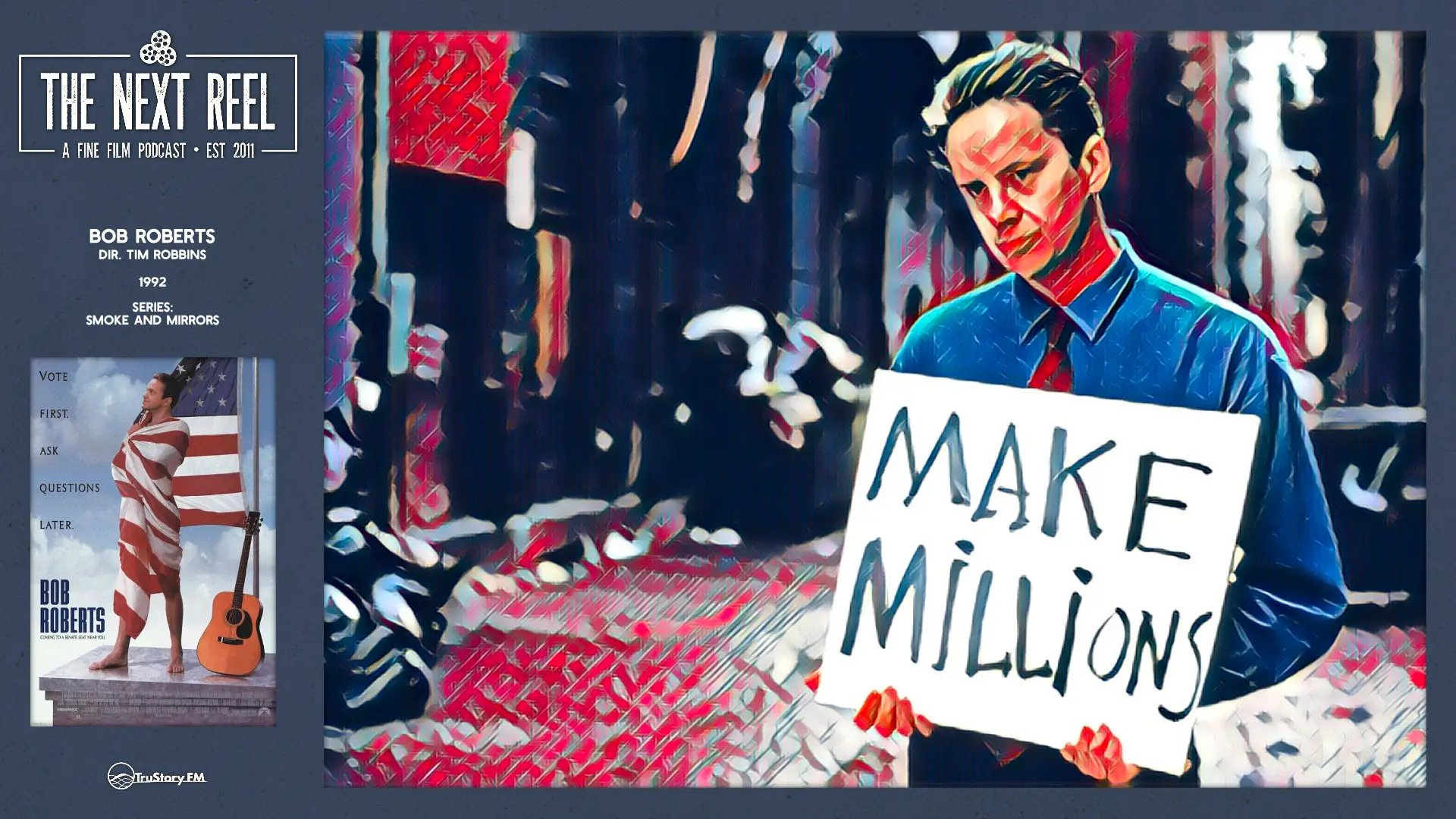
That’s right. Oh my gosh, wow. This is our Smoke & Mirrors series. This is a series where the target is really kind of how politicians manipulate the system and the media covering them, and how the media is also complicit. There’s one public face, and sometimes there’s something worse just out of frame. We’re covering this, Barry Levinson’s 1997 Wag the Dog, and Warren Beatty’s 1998 film Bulworth. It’s interesting that they all ended up being films from the nineties—when I built this series, I don’t know, as I was looking at the film options, they just seemed like really sharp and pointed films to discuss as it related to politics at the time, and all still feel relevant today.
And I think that’s the interesting element as we explore this series and these films—to really look at what still stands out as something that fits in today’s eyes. So anyway, that’s the series, and I think this film is a strong one to kick it off, because of the way that we’re painting a Republican Senate candidate running for office, and the manipulations that are going on behind the curtains that we’re not seeing—because again, this is a mockumentary, or a pseudo-documentary, however you want to define it. We have a documentarian who’s following Bob Roberts, the Senate candidate, played by Tim Robbins. And we’re seeing him over the course of the story—we’re seeing things that happen to be likely manipulations done by Bob Roberts and his campaign staff. Of course, they’re saying, oh, how dare you accuse us of doing these sorts of things. But that’s exactly the play. And I think the interesting thing that we’re understanding as we watch this is just how these people do these things.
What do we buy into as real, in a world right now of a constant barrage of things being called fake news, of a difficult time trying to figure out what is actual truth—I think this is a great film to kind of start things off.
Pete Wright:
Did you know before yesterday that this character was an SNL bit?
Andy Nelson:
No, I thought that was so funny. You sent me a video of this SNL sketch.
Pete Wright:
From nineteen eighty-six—it was from Season 12, Episode 7. Steve Guttenberg and the Pretenders were apparently the guests, and this was just a character of the right-wing folk singer at a book-burning campfire, singing these songs that were horrible.
Andy Nelson:
Yeah, yeah.
Pete Wright:
They’re horrible. Many of them were worse than the songs we get in the movie—I think they toned some of the rhetoric down for the movie. But it was Tim Robbins. It was his character. And I had no idea. This is one of the biggest surprise SNL spin-off characters to film that I can think of.
Andy Nelson:
Well, and you know, this is a character he had been wanting to make this film for six full years, and it took him all that time to get the funding to get everything put together so that he could actually do it. And it’s just—as a side note—interesting that it was finally a British company that funded him to make a story about American politics. He couldn’t get any money here in the States.
Pete Wright:
Yeah, and not Lorne Michaels.
Andy Nelson:
Yeah, and not Lorne Michaels, right. But I don’t know enough about the sketch—had he already come up with this character on his own, and this was his kind of thing, and he just brought it to SNL like, I want to do this?
Pete Wright:
This was his contribution to the show—that’s my understanding.
Andy Nelson:
Yeah. So it’s not like this is an SNL character like—yeah, McGruber.
Pete Wright:
Like McGruber.
Andy Nelson:
Yeah, there you go. There’s a pull for you.
Pete Wright:
No, I think that’s the important part. I think this was a character he came up with and brought to the show, and just gave it to the staff writers to beef it up, and the cast to beef it up. And it’s very funny. I mean, it is—and that is one thing you can stream.
Andy Nelson:
Darkly, darkly funny.
Pete Wright:
Yeah, darkly funny.
Andy Nelson:
Yeah, yeah. We’ll put a link to it in the show notes, so definitely check it out.
Pete Wright:
Yeah.
Andy Nelson:
Crazy.
Pete Wright:
I think my issue with the satire in this movie—and the reason, I love this movie, I think I liked it when I saw it originally—I think I liked it and laughed at it because there are things that are absurdly funny that you don’t have to understand to enjoy.
And I don’t think I understood a lot of it. And now it plays just as a documentary. The satire is really neutered because of the absurdity of our own political environment today. And that makes the movie—it lives in a very strange, very strange sort of liminal space, where its intention when it was made was maybe more powerful, more incisive, more absurd. It was lampooning the people that were doing things that were ridiculous in real life. And now those people are not doing things that are ridiculous—they’re just doing life. That makes it a little bit harder to watch, and the humor is much more sort of painful.
Andy Nelson:
But it’s interesting—and I suppose it makes sense—how much Tim Robbins got right in putting this together, because this was kind of what was going on at the time, right? He was seeing what was going on with the Reagan-era conservatism that was happening at the time. And then at the time the film was made and released, obviously George Bush Sr. was in office. You had Iran-Contra, which kind of spread across both of those, and that’s part of this film—we have that in here. There’s the culture war that was actually just getting ignited at the Republican National Convention, like months before all of this.
And so Tim Robbins taps into a lot of stuff that was very, very current at the time. He threads it really smartly through everything going on. And I have to just shout out how brilliant I think it is to take this character, the Senate candidate, and turn him into a folk singer—because he’s subverting all expectations of what folk singers were back in the sixties. That was definitely more of an aesthetic of the left at the time, in the sixties, with the hippies and all of that sort of stuff. And this became very much something that Republicans would weaponize—that nostalgia, right? And here we have this character in the nineties—because this takes place, what, nineteen ninety, nineteen ninety-one, right across the election line—and he’s using nostalgia of this type of music, this folk music, to actually sell his messages in the present day.
And so he’s weaponizing nostalgia for a return to normal, and the way that he sings his songs and everything, weaponizing all of that for kind of fear and grievance and greed and all of those sorts of things. I mean, he’s got his own “greed is good” message in here, right? I mean, the whole thing plays—and I think it’s incredibly smart to tell the story the way that he does, in this pseudo-documentary approach, where it just makes it feel real. Like we’re watching real news stories. We’re watching this candidate as he’s talking to fans, he’s talking to other political opponents or reporters or his staff or whatever—we’re getting a sense of this world, and it just feels real because of that documentary approach that he does.
And I think it’s incredibly smart. And to your point, I think all of that is what makes it that much harder to watch today—because the start of what Reagan and Bush and everyone was doing at the time, how all of that has kind of grown and changed and morphed into where we’ve landed now, and seeing this film now through today’s eyes feels kind of frightening, as to how—how have we known that this is how things are going, yet we’ve not been able to figure out how to actually change it or get out of it? And I think that’s the frightening part—the fact that this film is thirty-four years old now.
Pete Wright:
It’s interestingly—I mean, it is one of the best cases of history repeating itself in Hollywood that we have, right? Or it imitates life, kind of a thing. But it also gives me hope, a little bit, that we’ve had big feelings about the state of our economy, or the state of our body politic, for generations, since the founding of the country and before. And you know what—somehow humanity kind of wallows and trips their way through it. Some people are gonna make out really, really well by doing bad things, and some people are gonna lose out by trying to do good things, and it causes a lot of pain and strife, and at the other end of it, we’re gonna have new things to feel strongly about in thirty-four years. And the only promise that we have right now is that there’s probably gonna be thirty-four years from now.
And we’re gonna look back on this era and say, oh my God, can you believe how wrong—slash—right we got it? Can you believe that we’re living through that, right? I guess that is a weird, dark silver lining to watching this movie. And funny that it plays so much on music, because one of the things I read from Tim Robbins is that the reason he became political was nineteen eighty-four, when Reagan played “Born in the USA” across his rallies. That was such a misuse of the tone and tenor and spirit of that song, that music tied to political events became something he really connected to, and that becomes the heart of this character for sure in this movie.
Andy Nelson:
Interesting. Yeah, that’s an interesting point, because that hasn’t changed. You still have artists complaining all the time that, oh, I do not want that person—
Pete Wright:
That hasn’t changed.
Andy Nelson:
—using my music. I want to ban them from using my music. And then these people still use these artists’ music as much as they want. And it’s become a real sticking point.
Pete Wright:
Yeah, yeah. The cast—
Andy Nelson:
Oh my goodness.
Pete Wright:
What? A murderer’s row of a cast.
Andy Nelson:
It’s funny, ’cause you always hear about these movies that just have everybody in them, like JFK and those sorts of movies. And then this is a movie that you never think about, but—wow, okay. So Tim Robbins, Giancarlo Esposito, you’ve got Ray Wise, who I mostly know as Laura Palmer’s dad in the Twin Peaks series, but he’s been in plenty of other films too. Gore Vidal pops up in here. John Cusack, Peter Gallagher, Alan Rickman, Susan Sarandon, James Spader, Fred Ward.
Pete Wright:
Jack Black—first film.
Andy Nelson:
Jack Black’s first film. Tom Atkins, David Strathairn, Helen Hunt is in here. Lynne Thigpen.
It’s just—Fisher Stevens, Bob Balaban, Jeremy Piven shows up. I mean, it’s crazy.
Pete Wright:
So here’s my question for you. Two weeks before cameras roll, one of the major financiers for the film pulls out—or they threaten to pull out. They call and say, we’re not gonna actually release any of the funds to pay the people that you were using to make this movie until you get another star. And the cameos that you’ve booked don’t count. Do you know which name on this list was that star that he got to come in?
Andy Nelson:
Well, I know he got some additional funding from a star, and I don’t know if it’s the same person. Is it the same person?
Pete Wright:
It’s the same person, Andy.
Andy Nelson:
That’s fantastic.
Pete Wright:
It’s Alan Rickman.
Andy Nelson:
That’s amazing.
Pete Wright:
It’s amazing that of all these people that are already signed on for this movie, Alan Rickman saves the day.
Andy Nelson:
Comes in—not just to be this star that he gets to get the financing, but also contributes additional financing to help make it happen.
Pete Wright:
Yeah, he came in on scale and paid—he practically paid to do the movie. Not practically, he paid to do the movie.
Andy Nelson:
Yeah. He did. He did, right. Yeah.
Pete Wright:
He literally, functionally paid to be in this movie.
Andy Nelson:
That’s amazing. And, you know, I love it, because this is a fun role for him as kind of this behind-the-scenes man working in Bob’s camp, who we see has been involved in the Iran-Contra story, in the Phoenix Program. We see him in a congressional hearing, and we see how these sorts of things play—and it just works so well. And Alan Rickman just nails it.
Like, he is so great as kind of this slimy politician who’s working behind the scenes. I just really love what he’s doing as the campaign chairman in the film.
Pete Wright:
Me too. Now, that leads us to the final—I just want to unpack why the final act works, and I would like you to dissect it with me a little bit from the screenplay perspective, because I couldn’t help but think about where sometimes these movies go wrong—the satirical films go wrong, because they generally get too broad in the third act, right? They get too big. What we have in the setup to the big finale is Giancarlo Esposito’s character, Bugs Raplin, who is presented as a muckraking journalist. He’s not somebody that we’re set up to love, right? He’s trouble. He’s a fly in the ointment.
He’s not somebody we’re supposed to either take seriously or find congenial. I don’t think we’re supposed to find affinity to him.
Andy Nelson:
He’s like Jude Law in Contagion. He’s like the worst sort of media guy—I can’t even remember the name of his periodical that he works for—but it just sounds total like conspiracy-theorist, muckraking sort of nonsense, right? And he’s painted that way, but what’s fascinating is, when you listen to what he’s saying, you’re like, okay, he seems like a conspiracy theorist, but he might actually be right. This isn’t like chemtrails sort of conspiracy theories—this is actual things in there that relate to these political figures, sorts of things that you’re like, you know what, I think he’s right. But unfortunately, he doesn’t paint himself well.
Pete Wright:
Now, Robbins on Raplin says, “I didn’t want him to be a knight in shining armor. When you’re screaming the truth and everybody’s saying you’re making a big deal out of nothing, or you’re a conspiracy theorist, or you’re crazy, you’re a lunatic—that’s a difficult road.” And that’s the character that we have in Bugs Raplin. We’re supposed to not like him and carry the contrasting perspective—oh my God, what if he’s right.
Andy Nelson:
Yeah.
Pete Wright:
There is a setup at the end wherein Bugs Raplin apparently shoots Bob Roberts. There is early evidence that he did, which is then rolled back, and Raplin is released.
Meanwhile, Tim Robbins becomes a survivor-martyr. So without revealing the final punchline—how is it that this movie is able to—how did this final structure, these final beats, from Bugs Raplin’s increased fervor to Tim Robbins as a survivor, not become something that we’re sitting here saying “that was ridiculous”? Structurally, what do you see in how this thing was unraveled in the third act that keeps us hooked?
Andy Nelson:
Well, I think it’s just smart in the build-up, right? We meet—Terry has conversations with Bugs over the course of the story. We see him approaching, trying to get interviews, trying to push to get information out of Bob, time and time again. He’s always there, at every little press event, every little potential performance and meetup and everything. And so he’s a consistent character, and in that final scene where the assassination attempt happens, everything is just kind of going a little crazy at that particular moment. The camera work has gone a little rough, because the crowds are so intense right there.
Pete Wright:
Oh, it’s suddenly Brady—Reagan. That’s the attempt.
Andy Nelson:
Yeah, right. Yeah, it’s—everything has just gone into chaos mode. And I think, because everything has been built up in a way where we can buy into all of this—we’ve already had setups where you see other attempts with politicians, as far as trying to sell them as certain things. So, and this is without the reveal and everything, but we’re already getting setups about how Bob’s competition, right, Gore Vidal’s character, Senator Paiste, the incumbent—we have a whole thing where the media picks up a story of him out with this young girl, right, and they’re running with it. And he’s just like, this is a bunch of crap.
It’s my granddaughter’s friend. They cropped the photo—if you just look at the actual photo, you’ll see my granddaughter’s also sitting in the car with us. Yet it still is something that affects his points, right? And viewers of the film get a sense that, okay, this is probably something that the Roberts camp has done, specifically to try to taint the way that people view him—because at this particular point in the film, he’s the one who is leading, right? And so the Roberts camp is—this is our assumption, but the way the film paints it, the Roberts camp is trying to do things to get ahead. Paiste even says as much in one of their debates, and Roberts is like, how dare you come and accuse us of doing this?
You know, all of those sorts of things. So we’re already getting all of the different things that these camps potentially do to try to get ahead. We’re seeing a lot of that stuff build. So by the time we get to that point where we have this assassination attempt, nothing about it comes across as going too far, or pushing across the line where—oh, this just went too big and now the satire isn’t working anymore. It all feels very much of the world, and everything that has been set up before, up to this point.
Pete Wright:
I think that mirrors the setup of Bob in the beginning. I think you could ably make the case that in the first fifteen minutes—ideological issues notwithstanding—Bob is a likable guy. It’s not until one of his first songs that you realize, oh, this guy’s got some interestingly conservative views that maybe don’t align with reality at that point in the world, or only a very small fraction of people’s reality. And that pace of establishing Bob as this increasingly controversial candidate, up until the point where he actually engages in a debate on the air with a Black reporter—you would not be mistaken to think, oh, I think I’m supposed to like this guy, right? That’s insidious. By the time we get to the end of the movie, and he is shot, I think one of the grand narrative conflicts that we as the audience are meant to hold is, oh God.
How do I feel about this guy that has grown unlikable to me over the course of how he handles himself in public, has now been shot for his views? Do I need to feel bad about how I feel about this guy? That is a really neat sleight of hand that I’m supposed to feel structurally in this screenplay. So when we get to the final—the end, which is, you know, depending on your view, hyper-manipulative or just perfect icing on the cake—when he’s in a wheelchair performing, and we have been told time and again that he is a great victim because he’s now paralyzed from the waist down, and he’s tapping his foot to his own song. That’s the end. So does that give you a sense of resolution, of vindication, of “I’ve just been manipulated and now I don’t know what to feel”?
How does the foot tap—tap your foot?
Andy Nelson:
I remember when I first saw this film, it was like a jaw-dropping moment. It’s just like, holy crap. Because I don’t know if, up to that point, I’d been thinking that this had been something that him and his team had set up—I guess it just hadn’t crossed my mind. And so when I saw that, it was just kind of like that “whoa” sort of moment. And I think it still hits and plays that way—where it’s like, wow, okay. I don’t know, maybe through today’s eyes, this world’s a little more skeptical, and it’s more like, well, that’s no surprise. I feel like that’s probably how we’re looking at it now, which is interesting and telling. Especially, you know, this is coming after there have been several—we’ll just say—assassination attempts on President Trump.
And, you know, people called this film out as examples and proof that, oh, he’s just faked all of it. I’m not here to say whether he did or not. And even Tim Robbins, I think, was like, we can’t just be making these assumptions.
Pete Wright:
Yeah. The Butler shooting was real. Tim Robbins came out and said, “Butler was real, stop doing this to my movie.”
Andy Nelson:
Yeah, right, right.
Pete Wright:
We have to be able to separate reality.
Andy Nelson:
Yeah, and I think people want it to be fake. But what I also think is fascinating about the attempts—and that we don’t see in this film, but it’s something else that he certainly taps into here—the cultish followings that some of these politicians end up getting. Because after Trump’s assassination attempt, people would go around wearing bandages on their ear, right? That was a mark of pride that they would do. We have that same sort of mentality with many of these people who are following Bob Roberts in the film, and they’re standing outside his hotel rooms, the hospital rooms and everything. They’re like, oh, seven floors up, three rooms over—like, they know exactly where he is. They’re talking about him. And I think over the course of the film, we’re following a few of these, particularly Jack Black’s character and his brothers, Roger and his siblings.
And we’re getting a sense of the fervor that these people have in following these people. And the fact that—as we find out in the film, Giancarlo Esposito’s character is let go, he’s released, because they don’t have any evidence—there’s the wrong fingerprint on the gun, and it doesn’t make any sense for him to have been the assassin. He is released, yet he gets killed—presumably, we don’t know why or who, but presumably by some of these fervent followers of Bob Roberts—because, as they find out this news in the very last scene of the film, these people all cheer. They are thrilled with this news.
And so I think there’s a lot of interesting elements going into all of that, as we get to that—it just makes it play really, really well.
Pete Wright:
Yeah, yeah, I think so too. Should we take a break?
Andy Nelson:
Yes, let’s take a break. First—you can find the show on YouTube, and you can join us live when we record. We’ll even take your questions in the post-show chit-chat, and members get the full post-show conversation, and always know what to listen to next. Subscribe to The Next Reel on YouTube—the link to this episode is in the show notes. We’ll be right back.
Pete Wright:
I wanted to talk about the mayor’s wife and her three sons, and you wrote that this is the Dont Look Back pattern, and you went and watched Dont Look Back, and I feel like I need to be educated a little bit about Dont Look Back.
Andy Nelson:
I was very curious, because it’s just a very famous Bob Dylan documentary, directed by D.A. Pennebaker, who would also go on with his partner, Chris Hegedus, to make a brilliant political documentary, The War Room, following Bill Clinton’s campaign staff as he was running for election. That’s a fantastic documentary, well worth checking out.
Pete Wright:
They both came to speak to our class at the journalism school.
Andy Nelson:
And our class in the film school.
Pete Wright:
No, Andy—they spoke twice?
Andy Nelson:
They spoke two times.
Pete Wright:
How do they have the stamina?
Andy Nelson:
They’re very skilled.
Pete Wright:
I wonder who went second. Who got the really sloppy, exhausted talk?
Andy Nelson:
[laughter] That’s hilarious.
Pete Wright:
Yeah.
Andy Nelson:
So, Dont Look Back—obviously, early on in this film, we have Bob Roberts doing one of his folk songs. We have the full music video play, and it’s very much straight out of Dont Look Back. In this film it’s called “Wall Street Rap.” It’s a parody of Dylan, where he’s got the cards and he’s just dropping the cards as he goes through it all. We have that straight out of Dont Look Back—great parody. But there’s also this moment in Dont Look Back—I mean, it’s essentially following Bob Dylan and his team in London, as he’s going on doing some performances and stuff. Joan Baez is in it, Donovan’s in it. It’s less—I was actually expecting more music. I think I’m just so used to now, like, music docs where you just have all the music and then some conversations. This is really just following them as people, and you get a sense of what Dylan is like when he’s talking to the press, how his manager manages negotiations with getting payments. It’s actually a really interesting insight into these people at the time. But there is a scene in here where Bob—he finds out that the high sheriff’s wife is here to meet him.
And then, the high sheriff—so they go to meet her, and she brings her three sons, and there’s a scene that Tim Robbins pulls straight out of it, where she’s very excited that he’s here in her town, and making sure that he’s getting taken care of. She introduces him to her three sons. We have this scene play out, and it really feels beat by beat—where the mayor’s wife introduces Bob to her three sons, the oldest of which is Jack Black. And then, of course, we see them continue across the film. So it’s fascinating to see how much he tapped into what D.A. Pennebaker was doing in Dont Look Back.
And also, I think it’s just fair to say Tim Robbins has called out how much a fan he is of This Is Spinal Tap, and I think that’s part of the reason why he went with the pseudo-documentary approach for this.
Pete Wright:
I really love seeing Jack Black in this as his first film, and I think in the credits—do you remember their names? I think it was Calvin and Bert—
Andy Nelson:
He’s Roger. He’s Roger.
Pete Wright:
He’s Roger, but the brothers were Calvin and Bert. They’re not credited as Calvin Davis or Bert Davis, so I’m kind of guessing—but Matthew Faber and Matt McGrath played the brothers, and they went on to do good things. I don’t mean to diminish them, but Jack Black was the face—that’s the iconic one I remembered. I watched a conversation between Sam Harris on his podcast—
Andy Nelson:
Making Sense—most important—
Pete Wright:
He said he actually got his start on this movie too. He and Jack Black—this was both their first movie. I don’t know what Harris was doing on this movie.
Andy Nelson:
Interesting.
Pete Wright:
But they were talking about what their experience was, and Jack Black talking about it—it was like, this movie went to Cannes. “I was not invited to go to Cannes, but my dad was living in Cannes, so I went to Cannes and stayed with my dad, and I went out and hung out with Tim Robbins and the crew and did all the Cannes stuff. And then I went on for ten years in just a drought. I thought my life was set, and there was just nothing off of this movie. There was nothing.” And it really—it gets me wondering about the role of some of these movies. This movie has an ideology, right? This was a movie that has a real perspective, and I wonder how interesting it’d be to look at who else maybe was tainted by the Bob Roberts effect.
Andy Nelson:
I don’t know if it’s tainted so much—I mean, it’s interesting, because I do think that these types of films aren’t necessarily where you’re gonna be getting breakout stars, because, again, it feels like a documentary. And so I think it’s tricky. When somebody sees Susan Sarandon as a newscaster, they go, oh, that’s great, getting Susan Sarandon to be a newscaster.
Pete Wright:
Yeah, that’s a cameo.
Andy Nelson:
Yeah, that’s a cameo. But when someone sees Jack Black, they’re like, oh, he’s just grabbing real people off the street to do these things.
Pete Wright:
Yeah. Right.
Andy Nelson:
And you don’t think that this is an actor who’s cast to play the part. And I think that’s a really tricky line with that kind of pseudo-documentary type of thing. But Jack Black is great in the part, and he comes across as somebody who is a little bit psycho and a little too in love with his candidate.
And it’s frightening—by the time we see him at the end, he’s got the little target on his head, and it says “Bob” on there. He’s like, ooh, okay, he’s going down a dark road, this guy.
Pete Wright:
Yeah, you’re right, he does. I think the best thing to say about Jack Black’s performance in this is that I believed him.
Andy Nelson:
There, yes—exactly. Yeah, he plays it really well. But it’s interesting, because we do see alternate points of view over the course of the story, right? I think the first time is the news reporter who interviews him on Good Morning Philadelphia, and she’s pretty adamantly opposed to him—she says so before their conversation. Their conversation goes in a way where it comes across that they don’t agree at all, and afterwards she’s pretty angry. So we’re seeing it there.
I think the one that plays most interestingly—it’s Philadelphia, the whole thing is taking place in Pennsylvania, but it really comes across like an SNL sort of show. It’s called Cutting Edge Live.
Pete Wright:
Cutting Edge Live, right? C-E-L, S-N-L, please.
Andy Nelson:
Yeah, and I’m assuming that they’re parodying SNL here.
Pete Wright:
Yeah.
Andy Nelson:
But it was interesting, because we definitely see how things are changing in this—in the context of a story like this, where the corporate interests that run the network are fans of Bob Roberts. They want him to be on the show. They want him to perform on the show.
But some of the performers—John Cusack playing one of them—hates the fact that he has to work with Bob Roberts. He’s completely in disagreement with him. He refuses to do the ads with him. And then the floor director of the show sabotages it, because they’re letting Bob sing, and he’s making it a new song, and they’re not supposed to, and she’s very pissed off. And I think it’s Bob Balaban who’s the producer, who’s just like, no, this is great, this is what we want. And so she goes and pulls all the electricity, all the cables out, to sabotage the show. I think it’s fascinating how we’re also seeing some of the other side, and how people are getting frustrated with the popularity of this guy.
Pete Wright:
The way it’s planted, and knowing how Robbins feels about these things, because he’s an outspoken sort of advocate himself—it does feel like all of these events are us, as the audience, getting to check in with reality, right? Whenever we see the characters on Cutting Edge Live get to speak back and have their own bit of advocacy, right, it does feel like, oh, this is Robbins saying, don’t worry, don’t worry, because there is a force that exists to contravene, right—there’s a force that exists to stand up to what this character Bob Roberts is. And I think that works for the movie, because if you are politically one way, you feel like, oh, that’s me.
I’m seeing me—I’d like to be the one to pull the electricity. And if you’re ideologically leaning the other way, you look at that and say, God, those lunatics are throwing their shoes into the machinery, right? They’re the problem. And the movie really works either way, which is to its credit. Structurally, it’s very smart.
Andy Nelson:
Well, okay, so to that end—who is this for? Is this for a broad audience? Is the satire sharp specifically for left-leaning audiences? Can right-wing audiences watch this and appreciate it? Or are they seeing a guy who they can look up to? Where—how does the satire play for a broad audience?
Pete Wright:
Well, you know, I think, sort of pulling myself out of my own belief system, I think Bob Roberts represents somebody who is firmly able to speak truth to power, right? Bob Roberts is a character, and power in this case is the woke establishment that is taking over our country, our schools, our churches, our lives, and our banks and our financial institutions, right? And so in that regard, I think I have to imagine a right-leaning audience could laugh at this and say, yeah, aspirationally, those are the kinds of people we want. We want people who are going to sing about, you know, privilege, because it’s earned—it is earned privilege. On the other side, I think Robbins is making a case.
The satire exists for the other side that says, hey, this is lunacy—we have forgotten so much about who we exist to serve, and that is each other. And this movie lampoons the sort of selfishness that has crept into our politics and our finance and our church and all of this, in the guise of purity. And so I think, again, from my—I think Tim Robbins as a filmmaker wants this to work for everybody, and I think the satire exists maybe more for one audience than the other. How does that sound? Does that sound like a fair defense of Robbins’ intentions?
Andy Nelson:
I think it sounds like a fair defense. It is always a trick in satire like this, figuring out how it can be balanced. But I think you make a fair case for it. It’s interesting, because I can’t remember at what point we all, as audience members, started recognizing just how strongly left-leaning Tim Robbins and Susan Sarandon as a couple were. I feel like it was probably in the next film that he did with Susan Sarandon, Dead Man Walking—because I think it was when she won an Oscar. My memory might be a little fuzzy, but I think that might have been the Oscar speech that she gave, that kind of stepped into—you know, people always get pissed, like, well, why are they talking about politics in their Oscar speech?
Pete Wright:
Yeah, stay in your lane, you’re an actor. Yeah.
Andy Nelson:
And that might have been one of those cases.
I’m not a hundred percent sure, but that’s ninety-five, a few years after this. So at this point, we might not have recognized that Tim Robbins was so left-leaning. And so, to your point, this could have come across as something that audiences from either side could potentially still be getting something out of, even if one side is getting more of the satire than the other.
Pete Wright:
Yeah, I think—as you’re talking, I’m remembering, oh, right, I didn’t even know that the two of them as a couple were interested in social justice until the next movie. And that’s how their ideology sort of crept into my awareness. It was not this movie.
Andy Nelson:
Yeah, I think maybe. But it is interesting—where do you stand on Tim Robbins as a director? This is only one of three feature films that he made. He did this, he did Dead Man Walking, which we just said, and then Cradle Will Rock a few years later, which is also a political film. That one takes place—it’s like Orson Welles and his team putting on a play, as I recall, and it’s a very pointed glimpse into it. I’m trying to look it up real quick.
Cradle Will Rock—historical drama, fictionalizing the true events that surround the development of the nineteen thirty-seven musical The Cradle Will Rock, by Marc Blitzstein. It adapts history to create an account of the original production, bringing in other stories of the time to produce a social commentary on the role of art and power in the nineteen thirties, particularly amidst the struggles of the labor movement at the time, and the corresponding appeal of socialism and communism among many intellectuals, artists, and working-class people in the same period.
Pete Wright:
I haven’t seen it.
Andy Nelson:
Oh, interesting. Well, if you want to watch another film with a gigantic cast, check it out.
Pete Wright:
Yeah.
Well, all that being said, I can’t actually comment on Tim Robbins as a director, because I don’t know that I have the scope. I can tell you this is a competent film—this is a film that surprises me. And hearing him talk about it, talk about how, even though it’s in this sort of documentary style, it is meticulously planned. And yeah, there were some things that are notoriously vamped and improvised—most of the movie is well-planned, well-scripted, well-documented, and he apparently leads a very efficient set. So all that is to say—bully for Tim Robbins, I wish I had seen the other two films.
I mean, obviously I’ve seen Dead Man Walking.
Andy Nelson:
It’s a fantastic film. It’s absolutely one worth checking out if you haven’t. Very powerful, very powerful film.
Pete Wright:
And he’s done a bunch of—he’s done episodes in series, he’s done some TV movies. I just haven’t seen enough of them. What I can tell you is, as an actor, he’s one of the most interesting guys to watch perform on screen. I am a huge fan of his work on the big and small screen, and I think I sort of fell in love with him as a performer in The Player—because, of course, The Player is a movie about movies, and my God, that’s catnip, right? And I think it was just really, really well done. But then, obviously, Shawshank and Mystic River and—
Andy Nelson:
Well, we’ve talked about him. We’ve talked about both of those movies. We talked about The Hudsucker Proxy, Bull Durham. I mean, he’s been in a lot of things that we’ve discussed on the show. And I think especially in this window of time, right—definitely a lot of things here.
Pete Wright:
He’s—you know, I know people are talking about the show, for lots of reasons, but Silo—his performance in Silo is outstanding. He is a really compelling character on that show. So, yeah, big fan.
Andy Nelson:
Well, I really enjoy him directing, I think. He tells really interesting stories and chooses to focus on unique stories, and I like what he’s doing—even if it’s only been three times, I fit into his vibe as far as what he’s wanting to achieve with them. So, yeah, definitely enjoy his work. Did we talk about the soundtrack? I think it’s important to note the songs that he wrote—or his brother wrote. I think they co-wrote the songs, and then his brother wrote the rest of the music for the film.
Pete Wright:
Yeah. And then he killed it.
Andy Nelson:
Well, he very specifically did not want a soundtrack to get released. Or are you saying he killed it as a performer in the film?
Pete Wright:
No, both of those things. He killed it as a performer in the film—absolutely he did.
Andy Nelson:
Yes, a hundred percent.
Pete Wright:
He killed it. And—I’m agreeing with what you’re saying—he said, I don’t want a soundtrack release, because I don’t want people to be able to separate these songs from the context. And that matters a whole lot.
Andy Nelson:
The Fight Club mentality all over again.
Pete Wright:
Yeah, he Fight Club’d it.
Andy Nelson:
Yeah. He was concerned that people would listen to the songs without hearing them, and wanted to make sure that—there’s a message in these songs, they need to be just part of the movie. I think that’s fascinating. Yeah.
Pete Wright:
Yeah, you too.
Andy Nelson:
He kills it. Man, there are some songs—it’s the one where he’s singing the duet with, I can’t remember her name, Miss Broken Dove from nineteen eighty-nine. That song, I’m just like, man, this feels so authentic.
It’s crazy how much it works.
Pete Wright:
Who was Miss Broken Dove?
Andy Nelson:
Kelly Willis.
Pete Wright:
Kelly Willis.
Andy Nelson:
Yeah.
Pete Wright:
A specific shout-out to Kelly Willis, because Kelly Willis in this movie—I think it’s their second song that they do together, where we get cutaways to her singing, and she’s—you can almost tell she’s singing these words for the first time, and she is giving the most nuanced performance of “I’m uncomfortable doing this in real time” that I’ve seen. She is absolutely amazing in this movie.
Andy Nelson:
Yes, she does a great job. It really plays.
Pete Wright:
On rewatch, definitely watch Kelly Willis as Miss Broken Dove. She’s a standout, iconic performer who doesn’t want to perform what she’s performing.
Andy Nelson:
Yes, I love it. Yeah, the songs, I think, are just really pointed. Did you have any favorite songs, favorite moments from songs?
Pete Wright:
Do you know, I like the “Wall Street Rap,” because I like the Bob Dylan of it all, and it’s also, of course—not just Bob Dylan—what was the other one? Duh duh duh duh duh duh duh duh duh…
Australian group.
Andy Nelson:
Yeah, INXS—they also did their own riff on it.
Pete Wright:
INXS did their riff on it. That’s the one—everything starts with an INXS song for me, as a teenager, so that’s for sure. In terms of favorite songs, I don’t know, man—here’s the problem, the only song I can think about right now is the monkey song, which is actually from the SNL sketch, which people should watch.
Andy Nelson:
Oh God, that song—my jaw hit the floor.
Pete Wright:
Yes.
Andy Nelson:
I was like, oh my god. And I’m like, why does it still feel relevant that this song exists? It’s shocking.
Pete Wright:
Yeah.
Shocking. So right now, I would say that’s my favorite song, because that’s the most recent song I’ve listened to.
Andy Nelson:
It’s weird hearing an SNL sketch like that where the audience doesn’t even laugh. You can hear the audience’s shock in the audio.
Pete Wright:
Yeah, yes, yeah—palpable, thick.
Andy Nelson:
Yeah. Oh my gosh, I really enjoy the first song—it kicks off with, “Some people will work, some simply will not, but they’ll complain and complain and complain and complain and complain.”
It’s just like, yeah.
Pete Wright:
Oh my God, yes, yes.
Andy Nelson:
Yeah. Also the song about how his grandma—she just never wanted to invest her money—
Pete Wright:
Oh, “Grandma felt guilty about being so rich, and it bothered her till the day she died. But I will take my inheritance and invest it with pride, yes, invest it with pride.”
Andy Nelson:
Yeah, which I thought was genius, because we see Bob Roberts’ audience, and they’re all holding up “pride” signs. And I’m like, man, that plays so different today, because pride signs today, it’s a totally different thing. And here they are—they’re celebrating pride in their greed, right, as opposed to gay pride.
Pete Wright:
Yes.
Andy Nelson:
It’s an interesting shift in the way that pride is used with audiences.
Pete Wright:
It’s a really interesting sort of testimony to the power of language, and the flexibility of language to adapt to the cultural reality of the time.
Andy Nelson:
Yeah, yeah.
Pete Wright:
This movie is a bit of a time capsule in that regard.
Andy Nelson:
Yeah, it’s interesting how this is a story where we keep noticing what’s going on and keep making movies about it, and yet we are doomed to repeat it—because what this film also captures, and hopefully we’ll see across the course of this series, is how good they are at stealing our attention. And that’s interesting coming right off of the Platformed Lives series—you know, things that steal our attention. Oh, hey, I want to watch this 24-hour broadcast about Truman. These things that are designed to pull us away. I mean, I worked on a documentary, The Joe Show, about Sheriff Joe Arpaio, who did exactly this—he would do these awful, terrible things that would get some news, but then he would do something that was just so over the top and ridiculous, like, oh, I’m gonna make all my inmates wear pink outfits now. And the media would just run with that and drop the other story. And now we’re seeing this same pattern with these politicians—it’s very easy for them to manipulate the media to get them to change their stories.
So crazy. Crazy, crazy.
Pete Wright:
Things are going fine.
Andy Nelson:
Things are going great.
Pete Wright:
They have been going fine. They were going fine thirty-four years ago. We’ll figure it out. That is a message of hope.
Andy Nelson:
I love it. I love that you’re bringing that. So, all right.
Pete Wright:
Yeah.
Andy Nelson:
Well, let’s move into the back half, but first, let’s take a quick break.
Pete Wright:
The Next Reel is a production of TruStory FM. Engineering by Andy Nelson. Music by Tzabutan, Vens Adams, Oriol Novella, and Eli Catlin. Andy usually finds all the stats for the awards and numbers at The-Numbers.com, BoxOfficeMojo.com, IMDb.com, and Wikipedia.org. Find the show—and the full archive—at TruStory.fm. You can follow us from there too, plus you can find out how to become a member and go further with every episode.
Check out our merch store at TheNextReel.com/merch. And if your app allows ratings and reviews, please consider doing that for our show.
Okay—is there a Bob Roberts 2?
Andy Nelson:
There really should be. I’d be really curious what Tim Robbins would do with Bob Roberts 2 in today’s world. That’d be crazy.
Pete Wright:
Yeah.
Andy Nelson:
No, there’s not, but it’s interesting—the character, I mean, you already brought up the SNL sketch, and it’s just interesting—this character obviously did hit a little bit at the time, because The Simpsons had an episode called “Sideshow Bob Roberts” that was a partial parody of this movie.
Pete Wright:
Well, did that lead to any award nods?
Andy Nelson:
You know, it did okay for itself—four wins with four other nominations. At Cannes, where it premiered at the Directors’ Fortnight, Tim Robbins was nominated for the SACD Prize, but lost to Hsiao-Ming Hsu for Dust of Angels. That’s an award given by the Society of Dramatic Authors and Composers, to highlight a standout film-language or author-driven feature in the independent sidebar. At the Golden Globes, Tim Robbins was nominated for Best Performance by an Actor in a Motion Picture, Comedy or Musical, but lost to himself, in The Player.
That’s right, that’s right. I love that.
Pete Wright:
Awesome.
Andy Nelson:
The National Board of Review—it landed in the Top Ten Films.
The New York Film Critics Circle Awards nominated Robbins for Best New Director, but lost to Allison Anders for Gas Food Lodging. And the Political Film Society gave the film the PFS Award for Democracy. So, yeah, interesting awards.
Pete Wright:
The Award for Democracy.
Andy Nelson:
Right?
Pete Wright:
I wonder if they don’t give that award anymore.
Andy Nelson:
Right.
Pete Wright:
How’d it do at the box office?
Andy Nelson:
Well, once he finally got his funding, Robbins got $3.9 million to make his pseudo-doc, which is about $8.8 million in today’s dollars. The movie opened on eight screens, September 4th, 1992, on a very slow weekend, where it opened against the Matthew Broderick comedy Out on a Limb. Do you remember that one? I sure didn’t.
Pete Wright:
I do, viscerally.
Andy Nelson:
You do. And the single-screen release of the great documentary Brother’s Keeper. None of the films made it into the top ten, surprisingly. The film eventually expanded to just over 300 screens, and it did okay for what it was. The movie went on to earn $4.5 million domestically, and $3.5 million internationally, for a total gross of $18 million in today’s dollars. All told, the film landed with an adjusted profit per finished minute of $89,000—enough to end up in the green and make its mark, which is again why it’s strange that it’s so hard to find these days.
Pete Wright:
That’s crazy.
Andy Nelson:
Yeah.
Pete Wright:
It is just crazy that this is so hard to find. Why are people scared of this movie, Andy?
Andy Nelson:
I don’t know, but I’m definitely glad I revisited it. I remember watching it at the time and going, wow, that’s really interesting—that final moment of the foot tapping, I’ve never forgotten. But revisiting it, I’m like, man, he just got so much of it right. But again, it probably speaks to how things just haven’t changed in forty-plus years—it’s just ratcheting down all of the same patterns over and over again.
Pete Wright:
Yeah. Yeah, I just feel like I end how I began—I found it funny, and now it’s so right, and it just bought us nothing. I really would like it to be funny again. And right now, it’s less funny.
Andy Nelson:
Maybe forty more years, yeah, yeah.
Pete Wright:
Less funny to watch, yeah. I’d like this one to cycle back around when we’ve figured some more stuff out.
Andy Nelson:
I hear you there. All right. Well, that is it for our conversation about Bob Roberts. Next week, we’re looking at Barry Levinson’s Wag the Dog. If Bob Roberts is about faking an assassination attempt, Wag the Dog is about faking a war—same media machine, same appetite for a good story over a true one, just with higher stakes. And now let’s do our ratings.
Pete Wright:
Letterboxd.com/thenextreel—that’s where you can find our HQ page over on the Letterboxd platform, where we rate and review all the movies we’ve talked about on The Next Reel family of film shows. What are you gonna do?
Andy Nelson:
I’m torn. I’ve been dancing in my head since I watched this—four stars, five stars, four and a half stars, where am I sitting with this? It’s way up there. I feel like our conversation improved my opinion of it even just a little bit more. So I’m gonna say four and a half. I was sitting at four coming in. I don’t think it’s gonna be quite five, but four and a half, I think, is a great place for this one to land.
Pete Wright:
Yeah, I’m at four stars and a heart. Same reason—and it just feels like maybe the star fell because of how I feel about the world right now. I feel like maybe I’m punishing the movie for being too accurate.
Andy Nelson:
Yeah, yeah.
Pete Wright:
We’ll never know.
Andy Nelson:
We’ll never know. Well, that averages out to 4.25, which rounds up to four and a half stars and a heart over on our account on Letterboxd, which you can find at @thenextreel. You can find me there at @sodacreekfilm, and Pete at @petewright. So what did you think about Bob Roberts? If you were able to find it, we would love to hear your thoughts. Hop into the Showtalk channel over in our Discord community, where we’ll be talking about the movie this week.
Pete Wright:
When the movie ends…
Andy Nelson:
Our conversation begins.
Pete Wright:
Letterboxd giveth, Andrew.
Andy Nelson:
As Letterboxd always doeth.
Pete Wright:
So, you know, it turns out—this is the thing, I know that I’m not wholly original when it comes to perspectives on movies, but looking through Letterboxd made me realize, I’m really not wholly original in my perspective on this movie. There are a lot of people who are in that same really sad space.
Andy Nelson:
Oh, okay. Well, that is true. And it does seem like a lot of people have been watching it recently—there’s a lot of recent watches, with people recognizing how much this feels. Yeah.
Pete Wright:
Yeah, that’s interesting, isn’t it?
Andy Nelson:
Right, it is.
Pete Wright:
And I wonder—I mean, just looking at some of the reviews, especially from people who aren’t from this country, right—there’s an interesting bit of perspective from people who aren’t from today’s United States, and I don’t know that they like this movie as much, mostly because I don’t know that they see just how viscerally hard it is to watch. Anyway, I started—I went with Dan Gorman’s five-star and a heart, only because it so perfectly encapsulated my experience:
“Me in high school: ha ha ha, what incredible satire. Me now: sweating.”
It’s kind of it. It’s just kind of it.
Andy Nelson:
That’s the whole review, huh?
Pete Wright:
It’s the whole thing.
Andy Nelson:
Well, I was gonna say, yeah, it totally fits.
Pete Wright:
That’s the whole thing. What more do you need?
Andy Nelson:
It totally fits. That is—yeah. Although, I’m trying to remember, was I sweating at the time, like when I saw this? I guess maybe not quite as much, but it did make you go, mmm, yeah.
Pete Wright:
I was definitely not sweating at the time, because I was not tuned in really to the same level my parents were.
Andy Nelson:
Yeah, yeah.
Pete Wright:
Kenneth Clark has a review, a couple more down from this—it’s three and a half stars, it just says, “Luckily, this is just a work of fiction,” flat-emoji face. Well, I mean, that’s just—that’s my spirit with this. It’s a little bit broken.
Andy Nelson:
Yeah, I think that’s fair to say.
Pete Wright:
What’d you do?
Andy Nelson:
I also landed on three and a half and a heart with this. I looked for one that wasn’t focused so much on that. So—three and a half and a heart, by Sonny_Jim: “I miss peak Tim Robbins, nineteen ninety to nineteen ninety-five. I might even track down that movie where Einstein was trying to get him laid. Was expecting this to be a broader comedy, but geez, that ending curdles the blood.” It’s fun, and then it still can’t help but point out the realities—of the slap you get when you watch the movie.
Pete Wright:
Yeah. Yeah. How do you not—
Andy Nelson:
Yeah, very true.
But it did make me laugh, just specifically because of that Einstein movie, which was—
Pete Wright:
What was that Einstein one? Was that the one with Meg Ryan?
Andy Nelson:
It was Walter Matthau and Meg Ryan, yeah, yeah.
Pete Wright:
Yeah, Walter Matthau, that’s what I was trying to remember.
Andy Nelson:
Yeah, Walter Matthau plays Einstein.
Pete Wright:
That was a good movie. I think I liked that movie.
Andy Nelson:
I never saw it. What was it called, though?
Pete Wright:
I don’t have memories of hating it.
Andy Nelson:
It’s called something related, like some theory of something, right? Like—oh, no, IQ. It’s called IQ. There it is. Fred Schepisi directed it, nineteen ninety-four.
Pete Wright:
Okay. You know, there’s another movie of the era that I associate with it. What’s the line—”om ye beteme op te eaten”? Do you remember that line from that movie?
Andy Nelson:
I’ve no idea what you just said.
Pete Wright:
“Om ye beteme op te eaten.”
Andy Nelson:
Uh-huh.
Pete Wright:
I think it’s Dutch. It’s a Meg Ryan movie with Alec Baldwin.
Andy Nelson:
Oh, wow, okay.
Pete Wright:
And it’s a body-switching movie.
Andy Nelson:
I wasn’t going there. You know, I was thinking of French Kiss, which is Kevin Kline, Alec Baldwin, and Meg Ryan. No idea. No idea.
Pete Wright:
Prelude to a Kiss.
Andy Nelson:
Oh, yes, yes, right.
Pete Wright:
Nineteen ninety-two, a couple of years earlier. It has an awesome soundtrack—Annie Lennox does a version of the song “Prelude to a Kiss” that is crushingly beautiful. And that line is in it—”all the better to eat you with.” It’s a wolf, grandma-wolf thing. “Om ye beteme op te eaten”—it’s kind of a little romantic thing, and that’s the line I remember.
Andy Nelson:
“All the better to eat you with.”
Pete Wright:
This is the longest Letterboxd bit we’ve ever done. Do you want to talk about anything else?
Andy Nelson:
I don’t know. There was that Amazon bit—there was that Amazon bit we did where we read that, like, five-page diatribe on—
Pete Wright:
Oh my God, that was amazing.
Andy Nelson:
What was that? It was Foul Play, with Chevy Chase and Goldie Hawn, of all things.
Pete Wright:
How do you remember that?
Andy Nelson:
It’s because it was a strange movie to have such a personal and long piece.
Pete Wright:
Oh my god, that was all over the place.
Andy Nelson:
Anyway, for anyone who wants to listen, check out our Foul Play episode.
Pete Wright:
That’s like a twenty-minute Amazon review.
Andy Nelson:
It was a long one, yeah.
Pete Wright:
Wow.
Andy Nelson:
Very interesting, though. It was an interesting one.
Pete Wright:
We are different podcasters today.
Andy Nelson:
So true.
Pete Wright:
Thanks, Letterboxd.