*This transcript is produced using transcription software and reviewed for quality. Despite our best efforts, some passages may be incomplete or contain errors due to audio quality or software limitations.*
Pete Wright:
I’m Pete Wright.
Andy Nelson:
And I’m Andy Nelson.
Pete Wright:
Welcome to The Next Reel. When the movie ends.
Andy Nelson:
Our conversation begins.
Pete Wright:
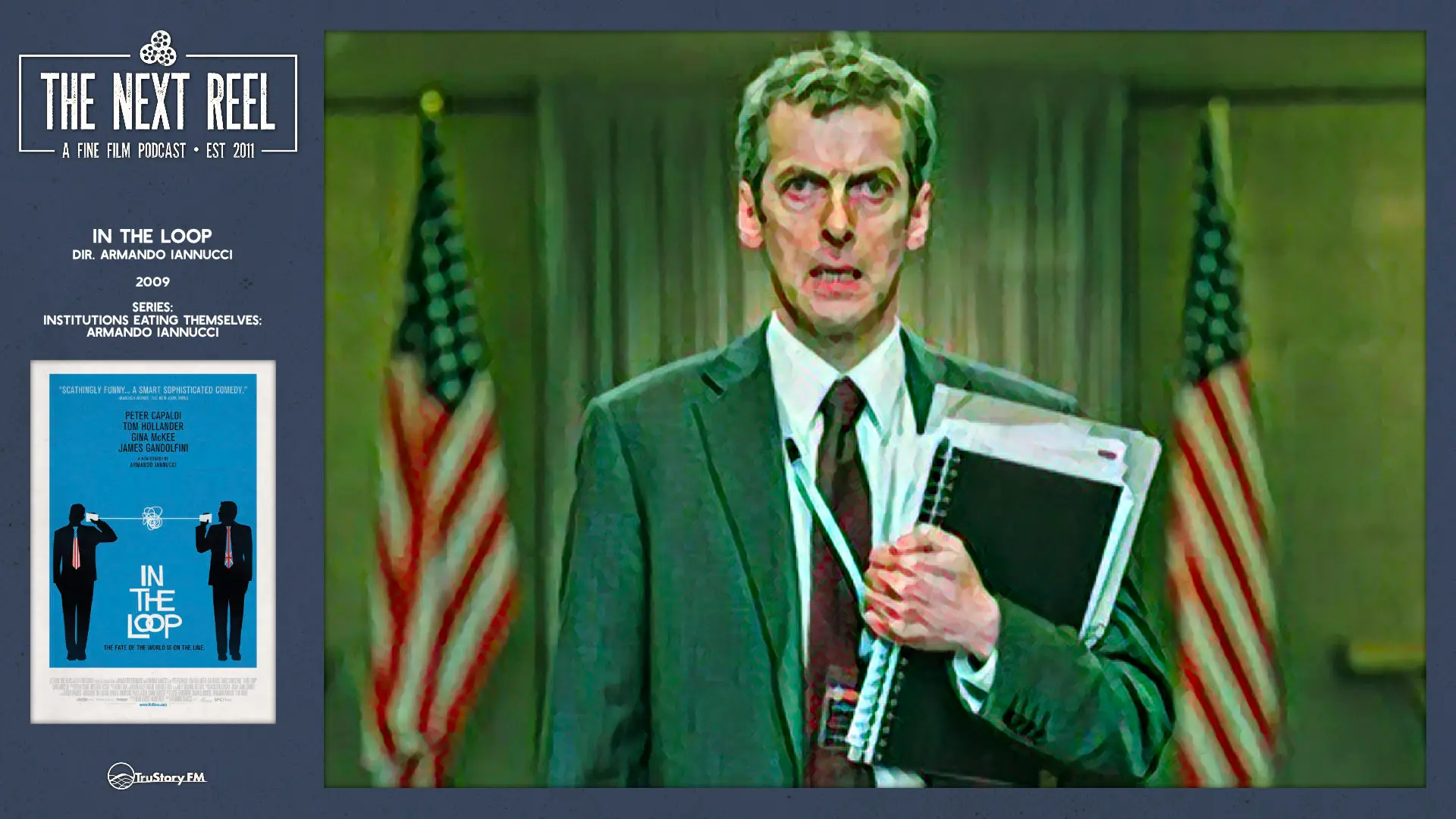
In the Loop is over. Have you come to insult me in a different time zone?
There are very few lines to choose from this movie.
Andy Nelson:
Yeah, right.
Pete Wright:
Very few.
Andy Nelson:
Most of them are riddled with profanity.
Pete Wright:
Oh my goodness, this is one of the glorious pay-ins to profanity, if I’ve ever heard one. It is outstanding. actually comes with a swearing consultant in the form of one of the writers who was credited as a swearing consultant on the show that preceded or surrounded this film. So
Andy Nelson:
Surround yeah, right, right. That’s fantastic. A swearing consultant.
Pete Wright:
Yeah.
Andy Nelson:
I would love to have that credit one day.
Pete Wright:
Oh my goodness, delightful
Andy Nelson:
What a fantastic credit. I don’t think I’m good enough to actually warrant that credit though. Like that takes some serious skill to actually say, you know what, you were good enough to be our consultant for the swearing of this.
Pete Wright:
Yes. Tell me you weren’t inspired to improve your swearing game by this movie
Andy Nelson:
Absolutely.
Pete Wright:
I mean Capaldi is just incredible. He is the Da Vinci of profanity.
Andy Nelson:
Yeah, it flows from him so perfectly.
Pete Wright:
Such an inventor.
Andy Nelson:
It’s just Yeah, right. It’s great. It’s so funny.
Pete Wright:
At one point he says, you come in here and oh you come in here and I’m just gonna get F’d from my a-hole to Christmas. Auntie. That’s you know nobody even says that and in his mouth it’s just incredible
Andy Nelson:
Yeah. I mean it helps that it’s all coming so fast and furious.
Pete Wright:
Yes.
Andy Nelson:
Like sometimes you don’t even have time to think about what it actually means until you look at it later and you’re like, huh, what is he trying to say there? Oh
Pete Wright:
Ugh, all right. Well, we should we should talk about this movie. Now I picked the Iannucci as the sort of bedrock of this series, Institutions Eating Themselves, because so many of these of his properties involve the inanity that goes on inside big w what are m sometimes considered anonymous organizations, governments in particular, and so I wanted to talk about some of the properties that he’s done. Now of course a lot of the properties he’s done are small screen properties from The Thick of It, which is sort of the show that sort of spurred this movie. Veep, he was handed Veep after trying to make a version of this show for ABC that was canceled. But then also the fantastic Avenue 5 with Hugh Laurie as the captain of a space cruise ship, delightful, cancelled too soon, also on HBO. A lot of weird going on with the Iannucci.
What is your what is your take on Iannucci as we get into this series?
Andy Nelson:
I just have to say, I am very very much a newbie when it comes to the Iannucci. I am in the Loop and The Death of Stalin I have seen
Pete Wright:
You’re an Iannucci newbie, all right, good
Okay.
Andy Nelson:
These two films I am familiar with. I have not watched any TV that Iannucci’s been involved with. I missed all of the Alan Partridge stuff. I never saw The Thick of It. I never watched Veep. Avenue 5, I don’t think I’d even heard of. So I’m I’m pretty bad when it comes to really kind of the full breadth of what of what he’s kind of worked on.
Pete Wright:
Everything that he does really takes on systems from the inside out. I mean, everything that he does, no matter what and we’re talking about just three of them. We’re talking about this one. We’re gonna be talking about The Death of Stalin, which you’ve already seen. And then we’re gonna talk about his take on David Copperfield, which is it’s either gonna make or break the metaphor that we’re going for. And for me it makes it, but for reasons that may not be apparent at first. So I look forward to the entire arc.
Andy Nelson:
Well, which which is Iannucci’s entire cinematic arc. We should just say that’s it.
Pete Wright:
Yes.
Andy Nelson:
Other than, I mean, I think he directed a segment of a anthology film in ninety nine called Tube Tales, which is kind of about London Underground, but that was just a segment of nine. So it’s not really kind of his film.
Pete Wright:
But he is also incredibly prolific on the small screen and on the radio. And so just a little piece of Iannucci. Byline: Naples during the war. A teenager writes for an anti-fascist newspaper and joins the partisans at 17. In 1950 he leaves for Scotland and ends up running a pizza factory in Springburn, Glasgow. He never takes British citizenship and he never votes in the election there. Years later his son asks him why, and the man says, The last time I voted, Mussolini got in. So what does that say? That’s my Italian.
Andy Nelson:
That’s that was rough.
Pete Wright:
In nineteen in that shut up. In nineteen sixty-three, that son is born in Glasgow and is given his father’s name, Armando Iannucci. Armando goes to Jesuit school. He thinks seriously about becoming a priest, then Oxford, where he spends four years on a doctorate about Milton’s Paradise Lost and never finishes it In nineteen eighty-eight, he is making comedy for BBC Radio Scotland. In ninety one, he makes On the Hour with Chris Morris. And out of that. . room in the BBC radio offices. The Day Today, Alan Partridge, Steve Coogan, Stewart Lee, and Richard Herring.
The Thick of It follows in 2005. shot for a hundred thousand dollars a season or series in Brit parlance, he is forty-five before he directs his first feature. And this is what he says drives him at the time. Forget how grand those buildings look on the outside. Once you go inside, they’re just offices where people work, and some people are good. and some are bad and some are bright and some are stupid and all of them are just trying to get through the day. So here we have a guy whose father completely refused to vote, and then his son spends 35 years writing people. who cannot stop talking about maintaining their constituents allegiance in them. I think that is fascinating context for this guy He is such an interesting subject to me.
And I think this movie, you know, maybe better than everything else he’s done, celebrates the quintessential Iannucci and the spirit that he wants to explore in his in his creations.
Andy Nelson:
Out of curiosity, have you seen any of The Thick of It?
Pete Wright:
Yes, but only after I discovered this show, I had not even heard of it, and it was m wildly popular and just completely missed my radar.
Andy Nelson:
But thoroughly British.
Pete Wright:
Thoroughly
Andy Nelson:
Th thoroughly British though, which is why I don’t think many people in America really had heard of it. You know, i don’t think probably until this film came out that there was much talk of the show. Like I feel like I kind of totally the same thing. It just kind of completely skirted past me as something that was out there. Because it’s just so much focused, I think, on the British political system.
Pete Wright:
It really is. It really is. And it’s a really interesting show. It is there are all the episodes are real short. There were a couple of extra long episodes, but you know, the way the British series work. The first series was three ep first two were three episodes each. So, you know, you can get through the first two seasons of the show in about three hours. So you know, it moves pretty quick.
And I think it’s on Peacock or Paramount, one of the Ps, you can find it.
Andy Nelson:
Peacock.
Pete Wright:
And it’s I mean, it’s fascinating. It’s fascinating for a number of reasons, not the least of which when we’re talking about this movie, is that three characters make the jump, but a lot of actors a lot of actors make the jump playing different roles. in the movie. So you actually have, I think, seven or eight actors who come across playing different characters than they play in the in the show.
Andy Nelson:
Okay, so then Cause I’ve never seen the show. Is w how would you describe the film in relation to the show? It doesn’t sound like it’s a it’s kind of a continuation of it, or is it kind of like the show but in its own bubble?
Pete Wright:
Yeah, it’s fairly characterized as a spin-off with s with characters who have the same like it I mean it brings Capaldi, and Capaldi everyone’s paying attention to Capal Capaldi, right?
Andy Nelson:
Yeah.
Pete Wright:
He’s the loudest thing in the show. Paul Higgins is the senior press officer, Jamie McDonald, and he comes over as his own character. But the rest are just n you know, nameless bureaucrats. Tom Hollander isn’t even in the show. He plays Simon Foster, who is the source of all the kerfuffle in the movie And so it’s it is very much a show and a film about circumstance, not people. And that’s the important part. It’s a s it’s sort of the same thing with Veep. Like it y he really carries this real aesthetic about the machinery of politics and how well or how poorly it functions.
Irregardless of the people who are in it, there are a few anchor faces that you remember, but they don’t matter because he wants to assess the whether or not the systems are functioning.
Andy Nelson:
Well, and I think that’s something that I found interesting in revisiting this film is that It is kind of, and it’s a it’s it’s a perfect one. You mentioned this during our last series, the Smoke and Mirrors series, because it was very much about political satire, and here we are, still in the thick of it. But this one really is looking at a system that kind of is tripping and fumbling its way along and it kind of ends up in this war where it seems most people don’t really want to be there. The system is kind of its own beast, but none of the people really have any sense of control. It’s just I don’t know. It’s just it was this fantastic look at this the system that just was kind of this messy thing and it’s just it’s it’s you know kind of getting pulled in all sorts of different directions, you know? Like I equated it to like a that whole adage of a bunch of people describing an elephant and they each only have like one They like this is what it looks like a tree trunk or whatever.
You know, they each kind of have their own description of it. And that’s kind of how everybody kind of tackles what’s going on in the story, but they’re only looking at their one little part of it, you know, and so you end up having this mess of an outcome. And I thought that was a really interesting way to kind of play this story, you know?
Pete Wright:
Yeah, yeah. Can because of the way the film is structured, this is normally a question I w I w want to reserve for our, you know, listener, Brian, in our post-show. But because of the unique construction of this movie and the fact that Iannucci himself doesn’t really structure the character rundown as a traditional character rundown. Who do you feel like we’re supposed to follow as our protagonist in this movie?
Andy Nelson:
I mean I think it’s Malcolm, a hundred percent.
Pete Wright:
You think it’s Malcolm?
Andy Nelson:
Yeah, I think he’s the one driving kind of like the decisions and everything going on in the story. He’s the one who pushes Simon to after Simon makes all these verbal messes over and over again, he’s the one who kind of keeps trying to push him to do things. and then has to react when suddenly the PM is saying, okay, well that you I need you both to go to the US to deal with all this. And I feel like, you know, he’s the one who’s largely in charge of trying to hold things together. Like that’s how I that’s how I read it.
Pete Wright:
Okay, it’s interesting. I think the consensus is n is not there I don’t know that there’s a consensus around Capaldi beyond the fact that he is the biggest name. That m that you know Peter Capaldi is the biggest name in the movie.
Andy Nelson:
And perhaps has the most screen time, but I don’t know if that’s even true.
Pete Wright:
I don’t know if that’s true. Um, Tom Hollander has definitely sort of protagonist shaped shadow. Uh kind of, but he’s also sort of the bumbling guy, the bumbling minister. I think you could make the case that Chris Addison’s Toby Wright, his new special advisor, is kind of the audience surrogate. you know, he’s the new the new fresh meat. We’re learning about the office through his eyes as he m kind of makes his way into the world of British politics. I agree with you that the most of the motion of the story is driven by Peter Capaldi, by Malcolm his character Malcolm Tucker. And of, you know, really this is this is much more of an ensemble work than having a strict protagonist, but
Andy Nelson:
Yeah, I mean it’s very much we’re we’ve got a whole bunch of s different threads that we’re following, but I think Unlike a an ensemble film like Magnolia or something, for example, which is following a whole bunch of individual stories This one, I mean, everybody is still working toward kind of the same goal in this one. It’s where is the war, the new war committee? How do we get into these meetings? How do we kind of like figure out what we’re doing in order to kind of like prevent a war, which of course they don’t. And I think it’s a fascinating glimpse into all of the different parts that kind of are going into how to kind of make this try to get this machine to go in a particular direction, which they’re terrible at.
Pete Wright:
They’re legitimately terrible at doing it. And I think you’re you know, looking at the how to how to eat a elephant, or whatever your metaphor was.
Andy Nelson:
Yeah, how do you describe an elephant for a whole bunch of different people, yeah.
Pete Wright:
Describe an elephant. Stop eating the elephant, first of all, is really apt because everybody is focused so hard on their one piece that they all inadvertently drive toward war that they ultimately don’t know they’re trying to prevent. It’s just perfectly subversive and really, really fun. All right. So when you think about the moments that drive the plot forward, what did you what did you find made you laugh? What were the moments that actually drove drive this forward for you?
Andy Nelson:
I mean, I think those are two very different questions because I think the things that are driving it forward aren’t always what are making me laugh, but sometimes they are. I mean I was laughing pretty consistently throughout this film. I mean, just everything was just so flippin’ funny, mostly Capaldi, but you know, in a non-swearing moment, speaking of Capaldi, the thing that actually made me laugh the most about him is just the mad dash that he has running across Washington, DC when he goes to meet with who he thinks is gonna be Lyndon.
Pete Wright:
This is this.
Andy Nelson:
over one of the American guys who I always, always love seeing on screen. That’s David Rasche, who I just always enjoy ever since the sledgehammer days, but he’s great as the assistant secretary of state for policy. And the one who kind of has this war committee that he’s created. But he goes to the meeting and finds that it’s like this guy.
I mean, legitimately the actor looks like he’s like 16 years old. It’s so funny. And he’s like, I’m 23. You know, yeah, and it was it was a very funny scene.
Pete Wright:
Yeah. My birthday’s in nine days, so if you want we could wait.
Andy Nelson:
Yeah. Yeah, right. Like that whole scene and just Capaldi’s reaction, everything plays so perfectly, and then his mad dash across Washington. Like every time we cut it’s just like he’s running across a road. He’s running through the some monument or whatever, trying to get to the s the State Department to have this meeting is so funny.
So I mean, you know, those like moments like physical comedy like that I think works well. Yeah, there’s not as much. I think most of it is just kind of the verbal comedy. But I think in the scope of the actual story and what’s moving the story forward I think what really kind of just makes it work for me is again just these moments of these different people coming together to try to sort something out. We’ve got I’m gonna be terrible with the names on this one, but we’ve got Karen Clark
Pete Wright:
Right. Mimi Kennedy playing Karen Clark, yeah.
Andy Nelson:
Yeah, who is trying to prevent war. And we’ve got her and her assistant, Liza, wonderfully played by Anna Chlumsky, who I feel like I haven’t seen her since the movie she did with Macaulay Culkin all those years ago. My Girl. Like I feel like she kind of had a big jump. But that watching them and trying to figure out how to navigate Linden and everything paired fantastically with James Gandolfini as the lieutenant general and one of her oldest friends and you’ve kind of got the two of them playing as the side that’s trying to figure out how we can create peace and keep things away from slipping into war and then again you have David Rasche. And so I don’t know, I feel like there are so many moments throughout the film of just meeting and people talking.
And you know, it’s it’s kind of tricky to go, what is the single moment that I can pull out? But I don’t know. Do you have moments that you single out and that really highlight kind of the way the story works for you?
Pete Wright:
Well, for me, obviously it starts where the film starts with Tom Hollander as Simon Foster screwing up on the radio, and the fact that you can hear it so clearly when he screws up and exactly how it is just right now going to be misinterpreted when he says war is unforeseeable And you both know what he means. Like we don’t know if war is coming. And yet it implies nobody knows when we’re gonna go to war because we’re so sneaky.
Andy Nelson:
Yeah, right, right, right.
Pete Wright:
And it is it is so he plays that sort of bumbling minister, that bumbling congressman, that bumbling senator so beautifully. as he continues to dig his own hole, trying to repair it over the course of everything, and ending up standing being sort of ambushed on the street. saying how he’s going they’re going to what was it climb the mountain of conflict
Andy Nelson:
Yes. Which he just total improvisational, just throwing something out because he’s like you said, he’s been ambushed by the press.
Pete Wright:
But that ends up becoming such a fantastic thread when they get to Linton’s office and see that they’ve put the mountain of conflict labels on paintings and they’re making copies of it and distributing the mountain of conflict around the Department of State. and policy offices, I think it’s just a fantastic play on that continued joke. You can’t get away from it. And I think that building the foundation on such a thin, like one teeny tiny misspeak on the radio to build an entire movie out of that actually I think reliably orchestrates storyline on both sides of the of the proverbial pond and gets everybody engaged is actually really quite artful. I think that’s that’s Fantastic. I think Mimi Kennedy in particular, Karen Clark’s position, b based very much on Madeline Albright and Madeline Albright’s bladder diplomacy.
how she, you know, really staged her I don’t know the whole detail, but I know that when she specifically staged her hydration in such a way that she could sit. through an entire six hour session without having to leave because leaving meant you left the seat of power. And so she would, in her efforts to be a diplomat, she had to hydrate on a very specific schedule. And I don’t know if there was a story where she ended up wearing a diaper to an off to a session. I who knows. This is how rumors get started. But they play it in the film where Karen Clark’s teeth just start bleeding and she’s Her teeth hurt so much that she goes into this m you know, war room meeting and her teeth start bleeding. She starts jamming tissues.
Up into her gums. It’s just horrifying. And it’s it’s played for such fantastic laughs. Like those kind of things that feel so nonpartisan. They’re just stupid. And I don’t know if it if it helps us take lightly some of the Westminster slash DC machinations.
Andy Nelson:
Yeah. David Raski’s comment after she leaves with her bloody teeth, because again, she doesn’t want to leave. She’s in this meeting, but he’s just like, I’m sorry, but I just this is too much. And kind of so she goes to the bathroom to deal with it. And his line afterward, I cannot stand to see a woman bleed for the mouth. You know, he’s just like, you know, it reminds me of country western music, which I cannot abide.
Pete Wright:
It’s just so awful. It is so transparently awful and sexist and it’s just it’s just horrifying. I also think the dialogue, I mean it’s propulsive dialogue, and you know, contrary to I think a lot of Thoughts on this movie. It’s not it’s not completely improvised. This is not one of those movies. According to Capaldi, 80% of the movie about is scripted, completely scripted. It’s everything was on the page and the last twenty percent is what they just captured in the moment. Because they’re shooting with a couple of HD cameras and everybody’s wirelessly mic’d and they’re they’re just allowed to wander and do what they want to do within the realm of the script.
And so naturally improv comes out of that. But it is a very much a planned film, to my understanding. I th I bring up the dialogue because I think it reminded me so much of what was it, question tennis game of from Stoppard’s play. You know, the Macbeth turn with the
Andy Nelson:
Oh, oh, oh, you’re talking about Rosencrantz and Guildenstern Are Dead?
Pete Wright:
Rosencrantz and Guildenstern are dead, yes. It reminded me very much of that scene in Question Tennis, which is Hamlet, not Macbeth.
Andy Nelson:
Which is Hamlet, not Macbeth.
Pete Wright:
We’re doing great. Don’t worry about it. That’s not the movie we’re talking about. But the scene where they have to everything has to be a question. That is the sort of rule of dialogue in this movie, where it is such every engagement is a match And you can kind of feel it when somebody loses the match, when they’re reaching for the perfect retort and they don’t quite get it, and they leave an opening, usually for Capaldi, to win. And it just keeps ratcheting up and up and up, right up until Capaldi and Gandolfini are threatening one another in the bar. And it never gets physical because the movie doesn’t need to get physical because the language is such the language of duel that I find I find super subversive and cynical and yet so funny.
and well structured and man it does not stop. Everybody has a comeback
Andy Nelson:
I really enjoy, I mean there’s a lot of great pairings as far as the dialogue that’s going on. I really enjoy that moment in the bar between Capaldi and Gandolfini because there’s a moment in there where I’m like, oh, I think Gandolfini just won this match because Capaldi is just like, well, have you ever even killed somebody? And Gandolfini just has that serious dead look at him and like, yes. Then he’s just like, but then Capaldi comes back with, well, he doesn’t mean falling asleep on somebody. Just like, oh my god. Like he’s just always ready with another one. I also really enjoyed the perpetual inner office battles that were going on between Anna Chlumsky’s character and one of the other guys who worked in the office. Um gosh I
Pete Wright:
Zach Woods
Andy Nelson:
Zach was, yeah, who is I mean, he’s so great in playing these sorts of characters.
He’s Chad and he’s just like, I love the moment where Karen and Gandolfini, they’re talking, and she’s say and he’s just like, oh you know, he’s complaining because Lyndon has stood him up and he and she’s and he’s like, Oh so he’s like, So where is he? She’s like, Oh, he’s playing squash. And he looks out and he sees Chad wearing a backpack with a squash racket. He’s like, What with that guy? He’s like No, he just likes to carry that around hoping that he’ll be invited along some day. And that’s kind of the character of Chad. But he and Anna Chlumsky are always going at it.
Like he’s constantly tearing into her about this paper that she wrote. that everybody is talking about and it just what does he say to her? He’s just like, you’re just like the woman from The Omen. You just gave birth to a demon child that’s just about to kill you.
Pete Wright:
Let’s come out to kill you.
Andy Nelson:
Like, oh my man. They just there are so many great moments between characters like that. And yeah, it’s this verbal sparring that I think plays really well. And I think that’s hard to hard to craft and hard to write and hard to direct and hard to act. I’m sure it takes a lot of just making it s because you’re you’re cutting and you’re constantly thinking about how is this going to play in the edit and everything and I think there’s a lot that goes into it.
And I think that Iannucci really has tapped into pulling it off. And I am sure that having already two seasons and two specials of The Thick of It under his belt, but by the time he got to doing this feature And then shooting it, my understanding, as you’ve kind of described,, very much the exact same way they shot the TV show. Just kind of like run and gut. It all feels very documenty with kind of the shaky cameras finding people and everything. And I think I think all of that plays. I think it allows all of these moments to even feel that much more natural.
Pete Wright:
Word is that Iannucci, this is on the record, he told the Telegraph that he got inside the actual State Department by showing his BBC press pass and announcing that he was, quote, here for the 12:30 and nobody stopped him. So he spent an hour with his camera photographing the interiors of the State Department in order to build the film’s set design. What?
Andy Nelson:
I love it.
Pete Wright:
Like, it just seems like making satire about, you know, an institution so careless in the way they handle documents and communication. by researching it, by exploiting the real carelessness of that institution is incredible. It is incredible. Gandolfini apparently did something similar. He actually clo called the Pentagon and asked whether he could come stay for a few days. and ended up taking out four star generals to lunch.
And he went to the Pentagon Bar Barber and got his hair cut there. he ended up asking these generals, like these real military bigwigs, if they had ever killed anybody. And Iannucci says some of them had to really think about it I don’t even know what to do with that.
Andy Nelson:
Wow Is that like thinking about it in terms of should I tell this guy or not? Or is that, like, in what
Pete Wright:
Do I remember? What counts as killing, right?
Andy Nelson:
Like yeah, if I’m directing if I’m telling troops to kill someone, did I have am I did I kill that person?
Pete Wright:
I don’t
Andy Nelson:
Oh, there’s a lot going on there. Oh
Pete Wright:
There’s a lot going on there. And I it’s just once again, all of that is woven into this story in a particularly colorful way.
Andy Nelson:
All right, we’re going to take a quick break, but first you can find the show on YouTube and you can join us live when we record. We will even take your questions in the post-show chit chat and members get the full post-show conversation and always know what to listen to next. Subscribe to The Next Reel on YouTube, the link to this episode is in the show notes. We’ll be right back.
Thinking about the production style, I think political satire works really well with comedy, but also I think production-wise There is something to be said for the way that Iannucci did this where everybody had their own mics. Right. They all had little radio mics that they were all wearing. It feels very much like Robert Altman doing the player.
Pete Wright:
Yes
Andy Nelson:
And I think that’s a fascinating element that we’re seeing here in the structure of a story with so many people, so many talking parts, so much interaction between all these different people. trying to find a way and I don’t know, I haven’t heard if it was very kind of Altman style where they were writing all the audio levels and kind of changing everything or if it was just something that they pretty much were still following the script, but I like that sense because it does feel i there’s something about that production style feels like a more effective way to capture a story like this.
Pete Wright:
Yeah, I think so too. And I think he really nailed the sort of rough approach.
marks, he didn’t m you know, everybody was just able to sort of free use the space that they were in. And often he would he you know, he would call for action and not yell cut and just see w what ended up happening. He would leave ladders and equipment in the shot. That needed to be struck, and it ends up just looking more like a working space wherever they are. He told Cairney, the cinematographer, he said, definitely cross the line, dirty the shots. I want to make this really r rough and lived in. Like the actors or are like the characters, the camera’s gonna have to get out of the way because the characters are gonna be moving through the shots in a way that we’re just gonna have to adapt to. But it’s interesting because this isn’t a it isn’t framed as a documentary.
It’s not a mockumentary at all.
Andy Nelson:
Right, we’re not watching Bob Roberts.
Pete Wright:
Like we have no framing mechanism. No. Not at all. Even though you could argue that it they could have opened the first sequence with a nod to the cameras, and we wouldn’t have second-guessed it at all through the run of the movie.
Andy Nelson:
It would have been very much like The Office. All we needed is a couple characters to just kind of look at the and roll their eyes at us.
Pete Wright:
Yeah, to look at the camera.
Andy Nelson:
Yeah, exactly. We would have had that
Pete Wright:
That would have been Anna Chlumsky.
Andy Nelson:
Yeah, right, right. And probably Toby, probably the two of them probably would be or maybe Karen. Karen would do well at that. So
Pete Wright:
Yeah, so I mean all of that I think makes for the tone. I mean they spent five months in the edit to try and actually perfect the imperfect. finished product and really lock that down. I, you know, I look at our Iannucci ends up saying, you know, I wanted the audience to sit there and see what they were watching and think this feels real And then think, but it’s ridiculous. And then think, but does that mean reality is ridiculous? And I think he crushes that. I think he just nails it
Andy Nelson:
Well, I and I want to talk a little bit about kind of this world of satire, especially because, you know, when we were talking about our last series with those political satire films, that was certainly a point that came up. Like, does the satire work all the way through the film? And you know, we had like Bob Roberts we felt worked pretty well. Wag the Dog struggled a little bit as far as the way the satire played for us. I think Bulworth probably worked a little better. This film is another one that I think works really well with the satire as far as kind of keeping it consistent. And I’m wondering for you Like, does it have any points where it feels like the satire is swaying or it’s kind of it’s starting to follow the wrong path at all? Or does it always work?
Pete Wright:
So I have kind of two answers to that question that I’ve been kind of mulling over. And the first one is I think yes, on the on the whole the satire works start to finish. But where it may start to wane, and this may be because of my cultural background, is that the British side The people that I’m watching on the British side feel very much like characters. The people I’m watching on the American side feel very much like stereotypes. And somewhere between the two, as they clash, I wonder how well the satire continues to function when we’re watching people like Linton and Karen and those people fall apart because they seem almost easier to lampoon than the British side. And I wonder if that’s because I have always held British comedy on such a pedestal and watching it mashed up against American politics that is so rough right now.
feels like it’s just easy pickings on the worst of our stereotypes
Andy Nelson:
You had seen the show before. Was the show primarily British politics, or did it dabble in kind of the crossover between British and American relations, as far as the politics.
Pete Wright:
Primarily British
Andy Nelson:
Okay. I’m wondering if I mean the reason I’m asking is because I’m wondering if some of that stems to the fact that they expanded the scope of The Thick of It story by saying, okay, we’re not just going to focus on British politics. We’re going to look at British and American politics and the relation between the two and the nature of starting a war between the two. I, you know, the satire, they’re kind of satirizing the invasion of Iraq. in the real world as far as kind of what they were going for here.
So I’m wondering if the nature of kind of some of those points that you struggle with where the characters might feel a little more stereotypical is because they aren’t Americans and they’re right they’re writing these Americans kind of based on what they’re seeing from across the pond. Does do you feel like that has anything to do with it?
Pete Wright:
Well, I only I get oh only if you sort of agree. I mean this could be a me thing
I mean, do you I mean you just explained it as if you might understand where I’m coming from?
Andy Nelson:
I, you know, I mean, I kind of do, but at the same time I feel like the characters work for me. But I’m I mean I could certainly say that about some of them. I think the thing for me is that I see While there might be some stereotypes in them, I feel like they all end up kind of coming across as still making decisions that don’t feel stereotypical, you know, and I guess that’s the thing. But I don’t really know. I mean Th there’s an interesting moment where Karen and General Miller and they’ve kind of come to the agreement that just like Simon Foster, they’re going to step down if this whole thing goes through, right? Is it stereotypical to have Karen be the one who does actually go through with it and the general to now that they’ve decided that they’re going to declare war, to say, you know what, I’m not gonna actually, because now there’s a war And I don’t want to I don’t want to retire.
I don’t want to step down. I actually now there’s a purpose for me to keep wearing my uniform because there’s a war on. Does that feel stereotypical to have those characters stay? Maybe, but I still found it to be kind of an interesting outcome in the scope of the story that I don’t know if I would have just simply predicted.
Pete Wright:
Yeah, I think it’s the it’s the bombastic general. The bombastic general that we get I feel like I’m not entirely sure what we’re supposed to get out of out of this. Is he just a windbag? Do you believe that he has earned all of the, you know, decorations on his chest? Because I think the Brits have no problem taking him down a notch in the voice of Malcolm.
Andy Nelson:
That’s an interesting point, and it does make you wonder, especially in times of peace, like what does it take for a military person, a career military person, to rise in the ranks when there aren’t actually any wars that they’re actually involved in. Does that person still warrant being a four-star general if they’ve never actually been in a war? Although, he says he’s killed a man, who knows? But those are legitimate questions to ask, though.
Pete Wright:
Because and that’s what makes him a stereotype, right? Is that we don’t actually know, he’s just The big military-shaped suit walking around. And that’s not to say Gandolfini himself isn’t great. I really love it. I love this portrayal. I just think there is more to each individual character on the British side than there is on the American side. And that’s either a function of the way of my eyes right now in 26 watching this movie, or of Iannucci’s eyes and his, you know, crafting team being native to their part of the world and this is how they see American military industrial complex. Both fair fight, I think.
Andy Nelson:
Do you find that it diminishes the film at all for you, or do you feel like the film is still a strong satire? Or is it becoming stereotypically satirical to the point where it’s like, okay, it doesn’t quite work as well as I want it to
Pete Wright:
I w you know, I wanted to say that it was stereotypically Stereotypical. I think we are actually now stereotypically stereotypical as a movie podcast. But then I show up and I start talking about it with you and I’m like, I c I can’t figure out where the stars fall on this movie because as much as I find a thinness on the American side, every individual beat is perfect for me, right? That from the teeth bleeding to the have you ever killed the man to I’m gonna punch you so hard you’ll be pooping teeth. Like those the level of art to insult in this movie i can’t think of any better.
Andy Nelson:
Yeah, and that’s I think that’s the strength. But yeah, but is that just the satire or is it just fantastic insults that we have throughout because Capaldi plays Tucker so well and the character is written so well. I don’t know.
Pete Wright:
Where do the stars fall for you?
Andy Nelson:
Um.
Pete Wright:
Like if you are bringing this movie down a peg, what are you doing?
Andy Nelson:
I you know, I’m not exactly sure. I think in the scope of the story, as far as the satire goes, I mean I would say that for me the ending felt a little more rushed than I was expecting. Like I we have some beats that feel like there were some things that were said that I feel like weren’t set up. And so we kind of like are just jumping fast through all the different points. through the final motion of the film where you really just have to be paying attention to go, oh, okay. So they really just went to war. They cut everything out. that was anti war just so they could s go to war and just kind of like have things move forward. And I feel like in the scope of the satire Like it all of that happens so fast, and I don’t think we spend much time on there enough to really kind of get a full sense of the scope of what it really means and everything.
Maybe it’s fine, but for me I felt like I wanted a little more maybe it’s just I like wrap-up. I like things that feel like we actually had a real build to something. Cause it just kind of like everything just kind of steamrolls through the ending. And I don’t think that it was as clean a how you would typically picture like an act three of a of a film or something, you know? Maybe maybe that’s the TV nature of Yanuchi and all of his team at work where they just they have a much more TV mindset with kind of these British series that they were putting together. I don’t know.
Pete Wright:
Well, it’s it’s possible. And to me, I think the we and this has been the issue with our comments on satire all along is how well does it hold up in the third act, right? How long does it hold up once they have made that transition and both teams on both sides of the pond are each editing their version of the PWPPIP to try to justify y you know, the war that is was unforeseeable and suddenly becomes inevitable. And the joke to me is that, you know, I think it really lands when Toby is walking out of his office that we only just saw him walk into, because Tom Hollander, Simon Foster, is gone. and there is a new minister and they play the almost the same beats without you know, legible audio of this new minister coming in and meeting people a as he’s walking out. And that is the loop, right?
That’s the finish of the loop. And the joke is it just starts again with new people. Because that’s the entire existence, the purpose of the system is what it does, right? The purpose of the system is to churn out people. Some of them get to stick around for a few cycles, some of them only get the one and they move on to some other system, but it just turns you out. So the movie starts out satirical and funny And by the end, when the joke starts over, it’s kind of exhausting and you’re ready for it to end.
Andy Nelson:
Yeah, right.
Pete Wright:
And I think that’s the point.
And so I think you’re right. It ends it ends on a sigh, not a giggle, and that may be the that may be the where it where it starts to fall a little bit short.
Andy Nelson:
Yeah. Just as a side note, we also have a thread of the story following Steve Coogan, who is. a citizen, he is or a constituent who complains, I’m not exactly sure the way that the British government works, but Tom Hollander, who is the Minister for International Development, also has periods where he goes and like sits in a building and constituents can come and register their complaints and stuff.
Pete Wright:
Okay, now this is the way I saw it, that it was similar to ours, where you have congresspeople who represent districts and senators who represent states. They have individuals that they represent, but also they sit on committees and do all these other things and they are the chairman of, you know, Ways and Means, but he also has people that he reports to, right?
Andy Nelson:
Right. So he so he’s the Minister for International Development, but then yeah, there’s He has his own constituents. And so he’s meeting with his constituents and he’s talking with them. And Steve Coogan is one of these constituents who’s complaining because there is a collapsing wall. that my understanding it was part of like the wall is shared with their property or something like that. The wall is gonna collapse into his yard on top of the greenhouse that his mom is always in and is concerned about that. And this becomes like a recurring joke because Paul is this character Steve Coogan plays, feels that the government just keeps not listening really, just saying, Oh, sure, yeah, we’ll take care of that and not really doing anything.
It’s getting he’s getting tired of it and very frustrated. And that becomes a kind of a thread in the story that leads to actually the final resolution for Tom Hollander’s character, right? Where instead of instead of retiring and quitting the way that he kind of was wishy-washy about for a while in the film Now he just straight up gets fired because this point becomes enough of a thing where apparently even the prime minister is just like, get rid of the guy. And that becomes the resolution of that character. It’s very much kind of like a C story in everything going on there, but in some ways it kind of defined for me all of the levels of satire because this is somebody an actual constituent who is actually sharing a wall in the property that Simon Foster works in, and Simon does not care at all about any of this. He sees all of this as small potatoes, and he wants to pay attention to the big potatoes stuff.
Yeah, this is the thing that trips him up and ends his career. Like how does that work for you in the scope of fitting into what we’re trying to satirize here?
Pete Wright:
I’m so glad you brought it up because you’ll note that of everything in the movie, the only guy with a real problem that can be fixed l like tangibly can be fixed is this constituent, right? Everyone else is working on problems that they’ve created, and it’s just of communication and misunderstanding. This guy has a wall that needs to be fixed and no one’s fixing it and no one’s taking responsibility for it because they’re too busy with their made-up problems. that they created. That’s the s that’s the joke. How did it take us fifty minutes to remind ourselves that’s the joke of the movie?
Andy Nelson:
Yeah.
Pete Wright:
And Coogan, I think, you know, Coogan can play a broad range of comedy. And I think his mustachioed constituent is perfectly understated and British. I love it.
I love it
Andy Nelson:
Well, and plus he plays a guy who th like they’re legitimately afraid this guy is going to like have a bomb under his coat, right? Like, he just there’s enough of a kind of a threatening presence the with the way that he carries himself where they’re just it he throws all of them off. And I th I love that because I think it fits into how these people view other people who are, you know angry with them.
Pete Wright:
Yes, yes. It is really wonderful. It’s wonderful.
Andy Nelson:
I really do enjoy that part of the story. It’s an interesting one. I’m glad it’s included. Do you feel like we needed something like that on the American side? Or because this is a British story primarily and the Americans are just a thread, are we fine not having that?
Pete Wright:
I think we get a different kind of lampoon on the American side, right? The American side has a scene that also has me laughing out loud. But it’s not because we’re taking into account any of the actual constituents on in of the United States. It’s because Gandolfini goes into the little girl’s bedroom and starts doing math on sitting on her bed with the calculator that’s like cheering her on
Andy Nelson:
It’s right, it’s a yeah. One of the funniest, funniest bits, yeah.
Pete Wright:
It is a an incredibly funny bit and they play it. I mean it is perfectly straight. And so that conflict, it’s I mean, it’s a high jump, low ceiling kind of conflict. It’s like two great things that don’t go great together. And that’s the kind of lampoon we get on the American side. But again, I think that goes back to my comment about the stereotypes and not the not the character. On the British side, we get character. On the American side, we get talking calculator. And I think they’re saying different things.
Maybe that’s okay. I laughed at both, but it is a different strategy on characterizing the American leaders.
Andy Nelson:
Did you ever watch VEP? Do you feel like he learned how to as fr from your perspective as far as not being stereotypical, did he tap into being able to kind of depict the American side that didn’t feel as stereotypical?
Pete Wright:
Yeah, I do. Uh I and I should caveat that by saying I have not watched all of Veep. I’m I have only been dipped into Veep because my wife and I started watching it and she did not care for it at all She liked she did like Avenue 5, interestingly, but it’s a little bit more broad in its comedy. I think Veep, it really picks at some deep sort of in the news scabs that we the American people have to look at for real every day and it lampoons those things and but Julia Louis Dreyfus creates a character that is absolutely unique and wonderful and I think the orbit around her experience in Washington is it’s low-key perfect. That show r really earns it all of its accolades, its acclaim. It’s and I think it does it does do exactly what this show does, I think, for the British, you know, for Westminster.
It does it translates very well, but you have to maintain the adult nature of it They tried to do it here called In the Loop, I think, or called The Thick of It for ABC. And Oliver Platt was kind of our lead. And it does not hold up. And Iannucci himself said, I th it just needs the profanity. It needs like that’s the it because it needs comical levels of rage. And Malcolm is the character that gives us that. And there are certainly characters in Veep that give us that same tone.
Andy Nelson:
I see interesting. Okay.
Pete Wright:
Yeah.
Andy Nelson:
Well, I really enjoyed it, so
Pete Wright:
I’m so glad. I’m so glad. And you had already seen it. You already knew you enjoyed it. I Can’t wait. These next two, I think, are going to be really fun, especially because you haven’t seen David Copperfield. I’m this is a I’ve been really looking forward to this series, and it’s a real treat to watch these with you.
Andy Nelson:
Well, let’s move into the back half, but first let’s take a quick break.
Pete Wright:
The Next Reel is a production of TruStory FM Engineering by Andy Nelson, Music by Tzabutan, Adrián Berenguer, Oriol Novella, and Eli Catlin. Andy usually finds all the stats for the awards and numbers at The-Numbers.com, BoxOfficeMojo.com, IMDb.com and Wikipedia.org. Find the show and the full archive at TruStory.fm. You can follow us from there too. Plus, you can find out how to become a member and go further with every episode.
Check out our merch store at TheNextReel.com/merch. And if your app allows ratings and reviews, please consider doing just that for our show.
Alright, sequels and remakes. It’s kind of a weird question about this property
Andy Nelson:
It is. I mean, you already mentioned that they tried making a similar Thick of It show for the US that didn’t work. This movie came out at an interesting time. It was right in the middle of the thick of it. There were two seasons, there were two specials. Then they did this movie. And then they kind of continue it for two more seasons afterwards. So there has not been a specific sequel or remake of this, but the show itself did continue for a little while afterward.
Pete Wright:
And go watch Veep. If you want a spiritual sequel, it’s Veep.
Andy Nelson:
There you go.
Pete Wright:
Yeah. Alright, how to do at the awards season
Andy Nelson:
Did well for itself. Sixteen wins with forty-three other nominations. Or at the Oscars, it was nominated for Best Adapted Screenplay but lost to Precious, otherwise known as Precious: Based on the Novel Push by Sapphire. Although you may recall Geoffrey Fletcher adapted. He was the first African American to win a best screenplay Oscar, original or adapted. So kudos to Geoffrey for that. Still, this one lost. At the BAFTAs, it was nominated for Best Adapted Screenplay again, but lost to Up in the Air. And it was nominated for the Alexander Korda Award for Best British Film, but lost to Fish Tank.
And then this was interesting. It also was at the BAFTA Awards Scotland. They have their own branch of the BAFTAs. It won for Best Directing in Film or TV, Best Writing in Film or TV, and Best acting performance in film for Peter Capaldi. At the British Comedy Awards, it won the Best Comedy Film Award. And at the British Independent Film Awards, it was nominated for the Best British Independent Film, but lost to Moon. Best director, but lost to Andrea Arnold for Fish Tank. It won Best Screenplay. Capaldi was nominated for Best Actor, but lost to Tom Hardy for Bronson.
Tom Hollander was nominated for Best Supporting Actor, but lost to John Henshaw for Looking for Eric. And it was nominated for the Douglas Hickox Award for Iannucci, but he lost to Duncan Jones for Moon.
Pete Wright:
Wow. A lot of auspicious losses.
Andy Nelson:
Yes, yes. A lot of interesting and quality projects going on right around the same time.
Pete Wright:
Yeah. All right. How to do it at the box office.
Andy Nelson:
Well, for Iannucci’s first shift away from the TV show, he had a budget of about 612 pounds or 964,000, which is about 1. 4 million in today’s dollars. The movie premiered at Sundance, January 2009, before releasing in the UK April seventeenth, where it debuted in eighth place before opening limited here in the States july twenty fourth, two thousand nine. Opposite G-Force, The Ugly Orph—The Ugly Truth, and Orphan. It eventually expanded to 92 screens, but never found its mark here in the States, faring much better in the UK and other overseas markets. All in all, the movie ended up grossing two point four million domestically and five point four million internationally for a total gross of eleven and a half million in today’s dollars. That means it landed in the green, going on to earn an adjusted profit per finished minute.
of ninety-six thousand dollars for essentially continuation of the TV show, it’s not a bad way to kick things off.
Pete Wright:
That’s fantastic. So it cost A hundred thousand dollars to make.
Andy Nelson:
No, it cost almost a million, nine hundred and sixty-four thousand dollars to make.
Pete Wright:
Oh, nine hundred sixty-four thousand dollars to make. That’s a lot for this movie.
Andy Nelson:
Yeah, I mean it’s not even a million, so I you know, I wonder if a if some of that just boils down to some of the location.
Pete Wright:
I know it just seems like a lot.
Andy Nelson:
shooting. I mean and honestly, there’s a lot of people that they had to pay. Like there’s a good cast size.
Pete Wright:
All right. Well, I really like this movie. I think it’s a great way to talk about our Institutions Eating Themselves so far, and it feels it’s just a movie about a machine that will never be recalled and it’s broken, but that’s its purpose is to be broken and that’s all. And so I could watch this movie all day and I could watch it for Malcolm.
Andy Nelson:
Yeah, listening to Malcolm was fantastic. I really enjoyed revisiting this. It just it was ended up being really kind of a perfect follow-up to the Smoke and Mirrors series, just kind of the political satire. nature of this story and just watching the these two governments and all the different office workers just trying to run countries. I think it plays really well and a lot of fun. I had a great time with it.
Pete Wright:
Awesome.
Andy Nelson:
All right, well that is it for our conversation about In the Loop. Next week we continue Institutions Eating Themselves with The Death of Stalin, watching the Soviet state devour itself from the inside as Stalin’s own inner circle turns on each other to fill the throne he left behind. And now let’s do our ratings.
Pete Wright:
Letterboxd.com/thenextreel. That’s where you can find our HQ page where we catalog all of the ratings and reviews for all the films we talk about across The Next Reel family of film shows. Andy, what are you gonna do?
Andy Nelson:
I had a lot of fun with this. Yeah, I mean, as we kind of hit the end, I was like, okay, I wasn’t quite built as well as I wanted, but I still had a great time. Four stars and a heart is where I landed.
Pete Wright:
I’m gonna land in exactly the same place and I think maybe it’s because of my stereotypically American eyes that the movie ends on a sigh, not a giggle, and I think I could have handled a little bit more of a giggle as we end the movie. That third act is, as you say, a little rushed. And that’s probably where it falls. But this is a terrific movie. I will watch this movie again and again and again.
Andy Nelson:
Yeah. And funny, i there’s something about political satires, I think. This is another one where it’s never really made it past well, at least here in the States, it’s never made it past DVD. It’s streaming, you can get it streaming, but this is another one where if they just kind of cut off the streaming market at some point, it would be tricky to find.
Pete Wright:
Yes, that’s true.
Andy Nelson:
That’s always frustrating, but well, that averages out to four stars and a heart over on our account on Letterboxd @thenextreel. You can find me there at @sodacreekfilm and Pete @petewright. So what did you think about In the Loop? We would love to hear your thoughts.
Hop into the ShowTalk channel over in our Discord community where we will be talking about the movie this week.
Pete Wright:
When the movie ends
Andy Nelson:
Our conversation begins.
Pete Wright:
Letterboxd giveth, Andrew
Andy Nelson:
As Letterboxd always doeth.
Pete Wright:
I thought I had one and then my eyes scrolled down and there’s another one.
Andy Nelson:
There’s another so many good ones.
Pete Wright:
They keep coming. These reviews are awesome. Where do you wanna, do you want me to go first? Do you want to go for who talks first?
Andy Nelson:
I’ll go first. I picked a three and a half by cinéfila, who had this to say: Peter Capaldi insulted someone by calling them eraserhead baby. And I haven’t stopped thinking about that for the last eight hours.
Pete Wright:
I’ve got David Weigel, who says with a five-star, says: contains at least nine scenes that are among the funniest things I’ve ever seen. Coins or defines terms, meat in the room, climb the mountain of conflict, that are legitimately useful for understanding politics. Gave me, personally, the phrase fuckity-bye. God help us, it’s the only great movie about the Iraq War.
Oh my god.
Andy Nelson:
Yeah.
Pete Wright:
The—of course, this was the other one that just started. Do you think he’s really called Iceman, huh? To Mr. and Mrs. Man, a son: Ice?
Okay. Thanks, Letterboxd