Pete Wright
I’m Pete Wright.
Andy Nelson
And I’m Andy Nelson.
Pete Wright
Welcome to The Next Reel. When the movie ends…
Andy Nelson
…our conversation begins.
Pete Wright
Catch Me If You Can is over. I am the second mouse.
Andy Nelson
Wait, wait, wait. Are you saying I’m the first mouse?
Pete Wright
You drowned.
Andy Nelson
Are you saying I drown?
Pete Wright
Yeah.
Andy Nelson
Wow.
Pete Wright
Yeah. I churned butter with my wee tiny feet, and I escaped, and you drowned.
Andy Nelson
He didn’t mention that the second mouse had to climb onto the body of his dead comrade.
Pete Wright
Right. The second mouse. It’s just a viscerally awful story. It’s awful. We’re still in our True Lies series. This is our second member bonus inside of the True Lies series. We’re talking about films built around real people who lied, fabricated, or otherwise constructed false identities, and what movies do with those stories. And this one—well, let’s be honest. I feel like at the end of the series, I’m just throwing you a bone by including this one on the list of things people could vote for. It’s like everything for you.
Andy Nelson
And everybody voted for it.
Pete Wright
I know.
Andy Nelson
So it’s a thrill. It’s a thrill that we get to add Catch Me If You Can to our list.
Pete Wright
It was easy.
Andy Nelson
We didn’t have to return to the Tom Hanks series to get it in here. Here it is. It’s actually a great series for this film because it’s an interesting one. And in the scope of our conversation about everything we’ve discussed in the True Lies series—with all the different liars and how difficult it can be for a film to make us identify with a protagonist who is just a terrible person—this is another one in the line that makes you find ways to connect with the character. And I thought that was great.
Pete Wright
Find ways to connect with the character. And the thing I keep jockeying around in my head is the fact that the protagonist, Frank Abagnale Jr.—when the movie was made, it was based on his biography. And it was after the movie came out that journalist Alan Logan spent years uncovering that just about everything in the biography was also fabricated.
Andy Nelson
Yes.
Pete Wright
I mean, he was definitely a check fraud—he was good at that. But he wasn’t really a doctor and an attorney and a Pan Am pilot. And I find that fascinating about this story, that he’s a fraud who had a movie made about him, and it turns out he’s only partially the fraud that he made himself out to be, which by definition makes him more of a fraud.
Andy Nelson
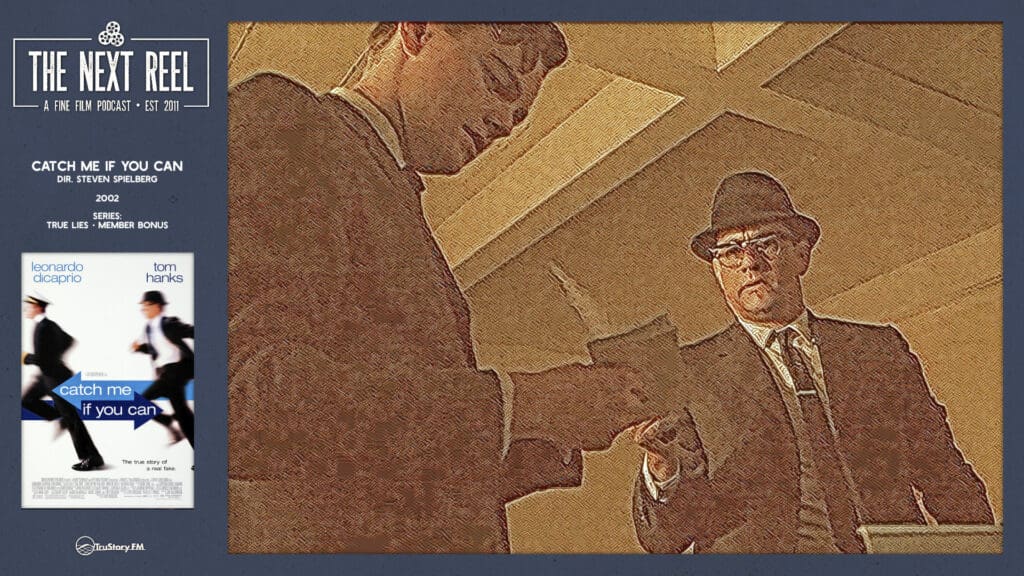
Exactly. That’s what’s so fascinating about it—this person has become such a hoaxer by duping everybody and getting them to make this movie about him. It makes me wonder, in the conversations he had on set—because he plays the French police inspector who is there when they’re arresting Frank—what were those conversations like? When Leonardo was inevitably asking him questions to probe deeper into the character so he could find it and perform it himself. Does he just recognize he’s telling all of these people more lies and going along with it? It’s crazy to me that all of this came out, that he is, as he says, the world’s greatest con man.
Pete Wright
Yeah, it turns out that’s his greatest con.
Andy Nelson
Yeah.
Pete Wright
Convincing everybody he’s the world’s greatest con man.
Andy Nelson
Right. Think of all the money he’s made from royalties from his book, speaking engagements, all of that.
Pete Wright
Yeah, it’s extraordinary. One thing I know about him—and one of the reasons I’m interested in talking about this movie—is that when all of this came out, and it says it in the title card at the end, he moved to Tulsa, Oklahoma, where he lived down the street from my parents. And it is a great shame on my part that I was not able to reach my mother in time to talk about Frank and Frank’s role in the neighborhood before this recording. I did call her multiple times. She apparently is quite busy. So I don’t have that story, but I’m deeply fascinated by the fact that Frank was a neighbor.
Andy Nelson
That’s really interesting. And now he’s living in South Carolina with his wife and children.
Pete Wright
Yeah, that’s right.
Andy Nelson
It’s a fascinating story. And all of the real story about Frank—we just have to acknowledge that it’s there, and then look at this film for what it is, because it’s a fascinating film. It does make me wonder, because Frank Abagnale did come out after the film was released—inevitably people want to know what they got wrong, what they changed—and he talks about all these things, like, well, they did this and they changed that. And it just makes me wonder if he’s keeping more lies going. He has to keep track of a lot of things to be able to say they changed something when in reality he probably also made that up.
Pete Wright
An extraordinary cognitive feat to carry around that volume of lies.
Andy Nelson
Oh, my goodness.
Pete Wright
Here’s the meta question I’ve been thinking about. Spielberg’s parents divorced when he was an older teenager, and that was a huge impact on him personally. Much of his filmography involves fathers and sons and parents and children in divorce situations—Indiana Jones, E.T., whatever. It’s like parents and children dealing with the complications of family. And this movie is pretty much Spielberg looking directly at the camera and saying, I’m serious, this is important to me. So I actually wonder—given the level of fabulism going on with Frank Abagnale—whose story is this more accurate to? Is this effectively The Fabelmans point five for Spielberg? Or is it more Abagnale’s story? I don’t think we can resolve that, but I think it’s a legitimate question.
Andy Nelson
You’re absolutely right that there’s a lot of Spielberg in it. But some of it is expanded because that’s one of the things Frank acknowledged—he says, I never saw my father again after I left. And I think it’s fair to say that’s probably true, something that actually happened. He had three siblings, I think, and his mom never remarried and didn’t have another child with anyone else. So I think those are things we can probably take at face value. And so it does make me wonder—with Spielberg pushing the angle of the father story and working that in, what are the reasons for that? Because this is Spielberg’s first time in his lengthy career of amazing films of actually making a story about a real person, which he’s done much more since then. But this is the first time. And he felt very like he had to be careful to be as truthful as possible with the elements in front of him. I think the line with a filmmaker is saying, okay, I need to be truthful with the story and the elements in front of me, but there are some elements I’m going to modify because I see things I want to pull forward and make more prominent. And who knows—perhaps that father-son connection is something that came out in the book more. Even though they never saw each other again, maybe he and the screenwriter recognized this is something clearly important to Frank, let’s find ways to build that up. And knowing Spielberg’s penchant for telling these stories about broken families and fathers and sons, I think that was something he really connected with—part of the reason why he wanted to emphasize those moments.
Pete Wright
Yeah, because that’s the story. And this movie, as a result, really is the American myth, right? It challenges the American myth of what success means. These guys who are pretending to be successful, and for so many people in their orbit, pretend is enough. And the myth of family—a family that pretends to be whole and dances around the Christmas tree and doesn’t care about spilled wine on the white carpet, even as the father’s business is failing and the marriage is falling apart because the mother has fallen in love with her husband’s buddy. It challenges some key cultural architecture of what this country called normal at the time, and really just starts poking holes at it left and right. And I think that’s one of the things that makes this movie work—because maybe not in spite of Abagnale’s abdication of reality, we actually get a movie that is easier taken as symbolic fiction than as biographical truth. And I really low-key love it for that.
Andy Nelson
And they were very careful in everything marketing-wise to make sure it was clearly marketed as “inspired by.”
Pete Wright
Yes.
Andy Nelson
Which, as we’ve now discussed, really didn’t matter, because Frank already just made it all up. Inspired by a man’s lies is really what this is all about.
Pete Wright
Totally. He just used Abagnale’s imagination and authorship to get the ball rolling, but this is Spielberg’s story.
Andy Nelson
I think so. What I love about it—in the scope of our True Lies series—is that this is not about somebody who steps into this purely for personal gain, necessarily. Some of the people, like Van Doren with the money and the notoriety, and Lee Israel with the money she desperately needs, and Stephen Glass with the notoriety and popularity around the office—this really is about a kid who learns to lie from his father who believes his own lies. All of the stuff the father is doing, he’s kind of creating his own world. And it’s all, in a way, because Frank Jr. wants to find validation from his dad, without seeing that it can’t happen because of who his father is—as much as he keeps trying.
Pete Wright
Yeah.
Andy Nelson
It’s really great the way they find ways to get us into this character and make it a character story, not a crime story.
Pete Wright
And it’s a character story on two ends, right? One is the Abagnales, Junior and Senior. And the other is Abagnale Jr. and Carl Hanratty—Tom Hanks in the role of this FBI agent—becoming, weirdly, a surrogate father figure who is believably present in ways that his own father could never be. They have their calls every Christmas, which never happened in real life. We’re firmly in the realm of Spielberg’s imagination here. They built a relationship in which the surrogate father is able to be present in Abagnale’s life in a way his father couldn’t, in spite of knowing the truth. He keeps showing up, and we think he keeps showing up just because he’s an FBI agent trying to throw Frank in the slammer. But actually the movie ends in one of the most relationship-hopeful ways. Whether you like it or not, the presence of both of these characters sitting across the table and working collaboratively together demonstrates the overcoming of the parent-child animosity and angst, moving toward a new kind of relationship—one that Abagnale would never have been able to accomplish, not least because his dad fell down the stairs and broke his neck and was not going to be present at all for Frank Jr. I think that is genuinely touching at the end of this movie. It is a beautiful Spielberg spell that I am under when the camera pulls out through the office on these two guys working together on check fraud. It feels so humane.
Andy Nelson
Well, it’s really the point of the story, I think, and that’s what’s so great about it. As you just said, we’re watching Frank Jr. constantly trying—he needs that attention, he needs that validation. His dad is never giving it to him. And he doesn’t recognize that Carl always is. Carl’s always there, for different reasons, but that end section—that last bit of the film—is so critical to completing this story. Because he finally recognizes, as Carl talks to him on the airport concourse, that no one’s here, no one’s chasing you—essentially saying, I’m validating you. You are a smart person. I need your skills. You’re working with me now. You don’t need to run. It’s okay. You can accept yourself because we’re accepting you. And then Carl trusts him and leaves, and sure enough, Frank shows back up. That’s the thing he’d been chasing his whole life, and he finally got it. So he’s going to be there now. It’s beautiful the way it’s crafted.
Pete Wright
And we get both sides, right? We get Hanratty in the office, scratching at the doors, wondering, is he gonna show up? Was I right?
Andy Nelson
Yeah.
Pete Wright
And it turns out he was.
Andy Nelson
Yeah.
Pete Wright
And that’s really beautiful. That is uplifting and sweet and nice—based on this fictitious version of an FBI agent and a fictitious version of a con man—and I like it quite a bit.
Andy Nelson
Yeah. I definitely think so. I had forgotten—it had been a while since I’d seen this—I had forgotten how funny the film is while still feeling so grounded. And in the scope of Spielberg’s career, this is easily one of his great films. It’s amazing how well it works on every level. I think a lot of people think of it as lighter fare from him, but I just don’t see it that way. The two core relationships—father-son, and Frank and Carl—they’re so honest and powerful. And then we also have this great moment with Brenda, Amy Adams’ character, where Frank genuinely wants to break free, and thinks that she might be the one who can give him what he needs, and doesn’t recognize that there isn’t any love—like he wants it to be love, but doesn’t recognize that it’s just another con. It’s just another need to find validation from somebody. The way Spielberg crafted it, I really am impressed with the film we got here.
Pete Wright
I want to talk more about the Amy Adams and Martin Sheen roles in the film, but sitting higher for a second—as two guys who did not live through the sixties, I’m curious your take on how Spielberg frames the sixties through the lens of this story and through the lens of the loss that these people are experiencing on an individual level. This starts right before the Kennedy assassination era and moves through a lot of upheaval. What was your experience with that?
Andy Nelson
Obviously it’s Frank’s life, so we’re living through all of that. But the way Spielberg portrays it—when you think of the cinematography, it’s very glossy, colorful, bright. It’s got this glistening feel to it, which taps into that sense of a more trusting time. And I think that’s the key part of it—the things Frank is able to get away with are because of the sheer trust that people put in him, especially once he recognizes, oh, if I put on this captain’s outfit, people just believe anything I say. I love that Spielberg did all of this in a very easygoing, colorful, jazzy sort of way—very light and carefree—because he’s portraying the time when you could get away with those sorts of things. And we end up tapping into all of that as we watch Frank. And it’s a great counterpoint to all the stuff that comes with Frank Sr. Every time we come back to him, everything’s more melancholic and darker.
Pete Wright
Yeah. Part of the premise is getting through the decay that comes through the sixties and into the seventies, because importantly, all the impersonations—the pilot, the lawyer, the doctor—are all aspirational figures of a kind of vanishing America, right? Where institutions were trusted and uniforms demanded deference. The fact that he was a pilot made him able to cash checks illicitly—what a weird, weird time that was. And in fact, his experience at the FBI in the seventies is the comedown from that high—that dream we’ll never have again. We will never have what existed in the sixties that allowed him to be successful, even as a check fraud. Even if you don’t apply any of the truth to the impersonations, we’ll never have that same innocence again that he was able to take advantage of so effortlessly. And that is such a part of the Spielberg story about dealing with what we collectively have lost—this sense of lost Eden, which I think is really illuminating.
Andy Nelson
Absolutely part of it. And you can definitely see that in his relationship with Brenda also, because she in so many ways represents something more innocent, more light and trusting and carefree—all of that is there. But then as he learns more about her, he also understands there’s a deeper side to her. It’s not just this carefree surface that he’s seeing. She’s already had an abortion. Her parents had kicked her out, and she’s trying to find a way back into that relationship with her parents. And that also speaks to another broken person in a family situation who’s trying to find a way back in—it’s an interesting connection for him to make in this film.
Pete Wright
Yeah, it really is. And the fact that she gets roughly twenty minutes of screen time and is presented as someone who is genuinely good—in a film full of people performing goodness—I think that’s one of those things that is so attractive for Frank. What he falls in love with is his vision of goodness that he can’t live up to. And it’s not a surprise at all that when he leaves out the window of Brenda’s parents’ house, she would turn on him. In spite of her love for him, she turns on him and makes sure the airport is staked out at the time she had agreed to meet him. Not a surprise at all, because she is good. She is not performing good.
Andy Nelson
And again, she’s trying to reconnect with her parents. That’s her whole thing. By doing this—we never see the resolution—but you can only imagine it’s a step she needs to take in order to keep whatever reconnective tissue with her parents has come out of their relationship.
Pete Wright
That’s an interesting armchair question—do you think if she didn’t have the parental complication, she would have snuck away to meet Frank and fly away?
Andy Nelson
I kind of don’t think so, because I agree with you that she is inherently a good person and recognizes she can’t go down that road.
Pete Wright
Yeah.
Andy Nelson
She’s a Lutheran after all, Pete.
Pete Wright
The Lutherans got lines, man. Lines which we do not cross.
Andy Nelson
That’s right. That’s right.
Pete Wright
And casseroles. So much Jell-O.
Andy Nelson
Oh, my goodness.
Pete Wright
Okay. So Martin Sheen—real quick. I do enjoy Sheen so much, because anytime you can sit somebody down and have a Lutheran dinner across from President Bartlet, I am in for it. What is so interesting about Sheen as Brenda’s dad—he’s an attorney, and he is circumspect of Frank’s history, and yet his tests are so easy to pass. Oh, you went to school at the same place I went to school. What was the name of this guy’s dog? Oh, the dog is dead. Oh well, I guess you’re telling the truth. Come on.
Andy Nelson
Do you think he didn’t believe it though?
Pete Wright
I don’t know if he didn’t believe it.
Andy Nelson
Oh, he totally didn’t believe it.
Pete Wright
Well, at the next dinner he sits him down and says, let’s talk about why you’re really here.
Andy Nelson
He totally didn’t believe it.
Pete Wright
And Frank says, I’m not a doctor, I’m not a lawyer, I’m just a guy who loves your daughter.
Andy Nelson
I’m just a guy in love with a girl.
Pete Wright
Yeah, right. Which is one of the moments Frank speaks the whole truth.
Andy Nelson
Segments of truth.
Pete Wright
I’m not all of these things. And I do believe he was there because he has genuine affection for Brenda.
Andy Nelson
I think he thinks he has genuine affection for Brenda. I think he wants so badly to have genuine affection for her. And he might, in some way. Because I think internally he sees it as a way out. He sees that they have a similar family need and he can fix that. And by fixing that he can hopefully stay. That’s why he has that phone call with Carl to say, hey, can we just call it good? Like, I’m gonna stop.
Pete Wright
I’ll stop if you stop.
Andy Nelson
One of my favorite moments in the film, because it just demonstrates he’s so young and naive and doesn’t have a clue about the scope of what he’s actually doing. So I think he really, really wants to be in love with Brenda because he thinks that if he goes this route, there can be some sense of validation. But I don’t think he recognizes yet that it’s still all fictional—everything is founded on a lie. And he finds out that when he finally tells her the truth, she just can’t cross that line. As you said, Lutherans got lines. She’s not gonna cross that one. And I think that’s what he recognized—as much as he wanted this to be real, it’s all been founded on this fantasy, and it’s his own doing. And I think when he’s talking to her dad, it’s a moment where I feel like he wants to actually tell the full truth. Like, he wants it out. And I think he kind of does, in a way, to lead into a potential conversation that could actually be a real moment to reveal everything. But the problem is Brenda’s dad says, you’re a romantic like me, I get it.
Pete Wright
Right, right.
Andy Nelson
Nobody can picture a story at the scope of what Frank Abagnale Jr. is actually doing and think, oh wow, you really are just a criminal.
Pete Wright
Right. That is what’s great about that, because I think the moment he says I’m not a pilot, I’m not a doctor, I’m not a lawyer—he enters into this riff. It’s like he’s suddenly a beat poet. And Martin Sheen hears “romantic” and it becomes a gag, not the truth.
Andy Nelson
Yeah. Yep.
Pete Wright
And I think that’s important. Martin Sheen is sort of the last boss fight before getting back to Hanratty, right? If you beat this guy, you’re kind of home free. But he keeps going, and his fatal flaw ends up being that he fell in love with this woman who thinks his name is Frank Conners—which he cannot change, because that’s how she met him.
Andy Nelson
You’re not Conners? Frank Conners? Yeah.
Pete Wright
And so another moment where Frank told the truth—there’s a scene where he’s on a call with Carl and he tells him exactly where he is. He says, do you want to come find me? I’m at this hotel. And Carl doesn’t believe him, because he can’t imagine someone would do that—would be so ready to give up, that he would let him off the hook like this. And the last one I thought was a lovely indictment of the national bar system—when Frank finally comes clean about how he quote-unquote conned the Louisiana State Bar. And his answer is, I studied for two weeks and I took the test and became an attorney.
Andy Nelson
Yeah.
Pete Wright
That’s all it takes. You don’t have to go to law school to become an attorney. You just have to demonstrate you understand the skills as testable. And he did that. I genuinely love that bit.
Andy Nelson
All of these things paint such an interesting portrait of this person who—we haven’t really mentioned—is like 17 to 20 through the course of this story. He’s so young. He’s still just figuring all of this out. And that’s what’s so interesting—it shows his naivete and his lack of understanding of the world. And the fact that, yeah, I kind of want this to end. I’ve created this situation—come get me, because I’m ready to call it quits. People don’t see things that way. Adults don’t see things that way that he does, because he’s so young.
Pete Wright
The final arrest in that small French town—I thought was fascinating on a number of levels, specifically around this truth situation. They have developed a sort of trust for each other, Carl and Frank. By the end, Carl walks into this office and the acceleration of Frank’s forgeries is notable—he now has an industrial set of printing presses running forged checks, which I think is outstanding. But this final beat where Carl says, if you go out there alone, the French are going to kill you. They’re gonna shoot you because you stole from them and belittled them and made them look like asses, and there is a real chance something goes horribly wrong. And Frank says, is this a con? Are you lying to me right now, Carl? And he says, I’m not lying to you. And then they walk out and there’s that moment where Frank looks around and says, good one, Carl. But it turns out Carl was not lying. That moment, I think, is the moment that establishes enough trust to lead to the final beat in the movie where Frank comes back to work with Hanratty and the FBI. He comes back because they established a sense of trust, and he knows that this guy, no matter what happens, is not going to try and con him. And he is tired, as you said. He’s ready to give it up. And I think those little beats really, really work.
Andy Nelson
You know, I was thinking about that quite a bit. And I know we talked about Spielberg’s technique of things happening just off screen—we added it to our glossary. And I think it’s a continuing thread of that style that Spielberg has, because he chooses not to show the police there. They all just conveniently pull up, and it felt very Spielbergian.
Pete Wright
Well, I think they were just out of view—they were standing by and had to floor it to drive that last hundred and fifty feet.
Andy Nelson
See, I see the door opening.
Pete Wright
Yeah.
Andy Nelson
Oh, those moments between the two of them are such fascinating beats throughout the film, as we see Frank on his journey getting deeper and deeper into this without always realizing he’s getting deeper and deeper into it. Like, he’s obviously committing the forgeries, but I don’t think he even recognizes how much of a problem this is. And it comes from the foundational relationship with his dad—it’s all about how you’re seen and how you’re portrayed. Like when his dad takes him out of school and has him pose as a driver so that the bank manager is gonna see him getting out of the car and hopefully give him a loan. And all of the lying his dad does through that sequence—like trying to get a suit for my kid because there’s a death in the family—it speaks to this world that Frank has created for himself: this is how I get accepted. I need to do all of this to actually be accepted. His dad never gives it to him. And those few scenes we have with Frank Sr.—they hit hard because of the way they built it. Like when he tries to give him the car and his dad’s like, I can’t take this. The IRS is gonna immediately see this as a problem. And he gives it back.
Pete Wright
Yeah. I’m taking the train home. I took the train here, I’m taking the train home.
Andy Nelson
Yeah. And then the last scene of the two of them in the diner—his dad’s calling after him as Frank Jr. goes running out. It’s heartbreaking because he’s never gonna get what he needs out of this man.
Pete Wright
Can we talk about Walken?
Andy Nelson
He’s just so good. And what a dancer.
Pete Wright
What a dancer. He’s just stupid talented. I never once fall out of belief for him as Abagnale Senior. His relationship with his son is extraordinary. The relationship he tries to maintain—willfully gaslighting himself that his son is becoming a pilot and a doctor, all the while knowing the truth, because he loves his son so much that he’ll never give him up. I was just so flabbergasted by how straight down the line Walken plays this and how strong he is when he is not in one of his modes—you know, the “what if I shove the watch up my ass” modes. I really adore this performance.
Andy Nelson
It shows exactly why he’s been in the business so long. Sure, a person can easily get pigeonholed, but it’s clear this is someone who has a wide range and ability to do a variety of stuff. And we see it here. It’s on display, and it’s just heartbreaking. It really just tugs at your heartstrings because you can see this is a person who just can’t get himself together. He never fixes his issues with the IRS. He can’t sort things out with his wife. And that’s the thing—Frank Jr. keeps pushing, like, oh, if I do all this, then you and mom can get back together. And his dad’s always like, no. He never recognizes that he’s the problem.
Pete Wright
Yeah, right. Again, here we are—gaslighting ourselves as parents. And he’s just very, very effective at it.
Andy Nelson
Yeah. But it is interesting because the film portrays the relationship between dad and mom in such an interesting way where Frank Jr. is clearly drawn to dad. That seems to be the need—to satisfy a relationship with dad—and part of it is because he’s angry at mom. He finds out early on that mom’s having an affair, and she asks him essentially not to say anything about it. And we keep coming back to mom. Like he goes to her house and sees that she’s now married to Jack and has a daughter. And there’s a real sense that his relationship with his mom is harder. He doesn’t have the same connection. And maybe he thinks if only he could bring them back together, maybe mom would be nice again. That relationship dynamic between the two of them is interesting, and I don’t know if Spielberg is making mom seem more villainous.
Pete Wright
I think it’s interesting. I mean, she eventually does seem villainous—there’s a sequence where Frank reacts as if she is the villain when Sr. tells him she got remarried, she married that guy, they had a kid, she’s not coming back. Because for much of the movie, Frank is flying around in defense of the parent relationship. But he keeps going back to dad to communicate with him, in spite of the fact that you can tell he really wants to go to mom. I think that is a complicated dynamic that’s hard to put words to, because of just how complicated he’s feeling about the divorce and his mom’s direct role in it. Is he really acting in protection of mom, or is he acting in defense of their marriage? That he doesn’t necessarily care about mom per se, but really just wants mom and dad to be together again.
Andy Nelson
Well, this is a whole other element of the story—the court asks him to pick which parent he wants to live with. And that’s just the worst thing you can ever do, putting that on a child. They’re gonna be carrying that guilt around with them forever. It clearly bothers him, because whatever choice he made—we don’t see him do it, we just see him running down the street madly—and that’s essentially his step into running away. Even though apparently in reality he lived with his dad for quite a while.
Pete Wright
Right, right.
Andy Nelson
And the divorce actually happened when he was twelve. So it happened much earlier. But I think the key there is just it’s portraying how complicated relationships are, and divorce makes it even more complicated. And then from a child’s perspective, trying to figure out what that means and how to deal with the relationships with each of your parents. And the burden that some kids carry of, it’s my job now to make everything better. I have to figure out how to fix this.
Pete Wright
Well, the inciting incident of him running away is being told to go into the other room and choose which parent he wanted to have custody of. That is an incredibly powerful scene. You’ve got divorced parents—did you get to do that? Have to do that?
Andy Nelson
No, because my parents were in no way wanting to make us feel like we had to pick. They created a situation where we would be able to be in both places when needed. We lived with our mom, but we were with our dad plenty—weekends, summers, holidays, all that sort of stuff.
Pete Wright
So you didn’t have the Abagnale curse. And I’m really sorry, because what could you have been if you could have been a fraud? What kind of fraud would you have been?
Andy Nelson
Right. Exactly. Where could I have gone?
Pete Wright
Opportunity lost. Anyway—very powerful sequence. I want to talk just a little bit about style as we get close to wrapping up, because this film is just style to the gills. I’d forgotten how awesome the opening credit roll is—the Kuntzel + Deygas credit roll that is so clearly a direct and loving homage to Saul Bass, these characters chasing each other through color and line. And obviously paired with the score. I think this whole movie is wrapped up in a crisp sixties suit. What’d you think?
Andy Nelson
Oh yeah. Just one of the best opening credits sequences ever. It’s such a delight. And paired with John Williams’s score—it balances so well. John Williams has always been a very jazzy composer, even if he doesn’t always get to do it. With the Boston Pops forever, and especially if you listen to some of his sixties scores, they are much jazzier.
Pete Wright
Oh, yeah.
Andy Nelson
Before he started jumping into the darker stuff in the seventies.
Pete Wright
Dude played with Mancini.
Andy Nelson
Yeah. And so the way he creates such a jazzy, airy, breezy score that fits for chases—but then still has the melancholy—that’s what makes it magical. When we get to those moments with dad, those heavier moments, it just hits so well. Everything is just perfect. And the cinematography with Janusz Kamiński is just beautiful. And this is Spielberg, so you get a cinematographer like Janusz Kamiński shooting it, and then you get those perfect Spielberg camera moves. A great example—when Hanratty is at Brenda’s parents’ house at the wedding and Frank has just disappeared out the window, and Carl comes into the room because he sees the dollars floating around in the wind. We don’t see Brenda in there. The room seems empty, but we hear her, and we see Tom Hanks’ back and the camera turns. And we see Brenda standing up against the wall, and there’s a mirror next to her, and in the mirror you have a reflection of Tom Hanks. So it’s a perfect way to craft a camera movement that creates a two-shot of these two characters. Just such great Spielberg work. It’s fantastic.
Pete Wright
God. It is just expert.
Andy Nelson
Yeah.
Pete Wright
It is just expert.
Andy Nelson
The only other note I had was that this is the same year he did Minority Report, which is also a father-son story.
Pete Wright
Oh yeah. That’s so funny. He’s operating at such different ends of the emotional and technical spectrum and they both just sing.
Andy Nelson
And what do you call Picasso’s blue period—is it the blue period?
Pete Wright
I think so, yeah.
Andy Nelson
So like, from the mid- to late nineties to the mid- to late aughts is Spielberg’s Tom period—because of all the work with Tom Hanks and Tom Cruise that he would do in that window of time. There was a lot of it.
Pete Wright
God, that’s a great point. The Tom period is perfect.
Andy Nelson
Yep. Well, this is a great one. I really love it. I guess if we don’t have anything else, we’ll move to the back half?
Pete Wright
The Next Reel is a production of TruStory FM. Engineering by Andy Nelson. Music by Yonnie Dror, Oriol Novella, and Eli Catlin. Andy usually finds all the stats for the awards and numbers at The-Numbers.com, BoxOfficeMojo.com, IMDB.com, and Wikipedia.org. Find the show and our full archive at trustory.fm. You can follow us from there too and learn about membership. Check out our merch store at thenextreel.com/merch. And if your app allows ratings and reviews, please consider doing that for our show. All right, sequels and remakes, Andy.
Andy Nelson
We did have a musical adaptation made of this film—same name. It premiered in Seattle, Washington, in July 2009, and then moved to Broadway in 2011, opening there and nominated for four Tonys, including Best Musical. I’ve never looked into it. I’ve never heard songs from it. I don’t know if it continued or just kind of faded away immediately, but it certainly is interesting to know it had enough legs to become a musical. And I wonder if Frank Abagnale Jr. is collecting royalties from that as well.
Pete Wright
Well, the original Broadway cast recording credits Marc Shaiman and Scott Wittman behind the music. It has been released—it came out in 2011 and it’s available on Spotify and Apple Music.
Andy Nelson
Oh, look at that.
Pete Wright
I’m gonna listen to it.
Andy Nelson
I think we both might.
Pete Wright
Well, I know I am, so really the uncertainty comes from you.
Andy Nelson
Okay. Yes.
Pete Wright
Oh my god, Tom Wopat is in it.
Andy Nelson
I don’t know who Tom Wopat is.
Pete Wright
Luke Duke? Bo and Luke Duke?
Andy Nelson
Oh.
Pete Wright
No, Tom Wopat is a legit Broadway musical performer.
Andy Nelson
Wow, really.
Pete Wright
Yeah. There are actually a lot of other people in here who are legit Broadway performers, but Tom Wopat.
Andy Nelson
He’s the one that catches your eye.
Pete Wright
You don’t shake a stick at Tom Wopat.
Andy Nelson
Gotcha.
Pete Wright
Yeah. Okay, where were we? How about awards? Did it win any? Was it even noticed?
Andy Nelson
The film had 16 wins with 46 other nominations. At the Oscars, Christopher Walken was nominated for Best Supporting Actor but lost to Chris Cooper in Adaptation. And John Williams’s score was nominated but lost to Elliot Goldenthal’s score for Frida. At the BAFTAs, nomination for Best Adapted Screenplay—lost to Adaptation. Walken did win Supporting Actor there. Nominated for Best Score but lost to Philip Glass for The Hours, and Best Costume Design lost to The Lord of the Rings: The Two Towers. The Golden Schmoes Awards—this was a fun one. Best Line of the Year: “Knock knock. Who’s there? Go fuck yourself.” It won. And Best Music in a Movie lost to The Lord of the Rings: The Two Towers. Best Supporting Actor of the Year—Walken lost to Andy Serkis in The Two Towers. Nice to see he was getting some awards. And Coolest Character of the Year—Frank Abagnale Jr.—lost to Gollum in The Lord of the Rings: The Two Towers.
Pete Wright
Ouch.
Andy Nelson
Last but not least—yeah, I know, right?—we always love talking about the AARP Movies for Grownups Awards. Walken was nominated for Best Breakaway Performance but lost to Richard Gere in Chicago. Spielberg was nominated for Best Director for both this and Minority Report but lost to Roman Polanski for The Pianist. And Best Movie Time Capsule—it won, beating Confessions of a Dangerous Mind, Far from Heaven, and Road to Perdition.
Pete Wright
Wow. Bummer about that Gollum stuff. Gollum was anything but cool. I’m sorry. He was amazing—incredible technological achievement—but he was not cool.
Andy Nelson
I hope this new Gollum movie does not make me not want to return to Lord of the Rings films.
Pete Wright
I know.
Andy Nelson
Like, why are they doing it?
Pete Wright
Real risk. Oh well. All right. How’d it do at the box office?
Andy Nelson
For Spielberg’s true-ish story about Frank Abagnale Jr., he had a budget of $52 million, or $91.5 million in today’s dollars. That makes this film in every way the biggest budget on anything in this True Lies series. The movie opened December 25th, 2002, opposite Two Weeks Notice, Gangs of New York, The Wild Thornberries, and Roberto Benigni’s attempt at Pinocchio, not to mention the limited releases of Narc, The Pianist, Morvern Callar, and Spider. Nothing could break The Two Towers’ hold on that number one spot, though, so this opened at number five. It would creep up to number two but never higher than that. Still, it stayed in the top ten for seven weeks and did well for itself. The film went on to earn $164.6 million domestically and $191 million internationally for a total gross of almost $625.9 million in today’s dollars. That’s a huge success for Spielberg, Hanks, and DiCaprio, landing the film with an adjusted profit per finish minute of nearly $3.8 million.
Pete Wright
I think about Minority Report as such a big movie, but man, both of these movies were legit slam dunks for him at the box office.
Andy Nelson
Yeah.
Pete Wright
That’s awesome.
Andy Nelson
Minority Report was the tenth highest-grossing film of the year. Catch Me If You Can was the eleventh.
Pete Wright
It’s just amazing.
Andy Nelson
That’s Spielberg for you.
Pete Wright
Well, I adore this movie for everything it promised it wanted to be, and in hindsight, everything it aged into. This is one of those movies that just ripened on the vine and is really, really worth coming back to. I’m so glad to have gotten it on this list.
Andy Nelson
I completely agree. In the gap of not watching it for a while, I had kind of diminished it in my head. But revisiting it, it just proved to me again that Spielberg is just a complete master. Doesn’t matter what genre he’s doing or what style—it’s just fantastic. Great cast. Everything about it was really solid.
Pete Wright
He is a complete master.
Andy Nelson
He is a master.
Pete Wright
He matters. He matters to me. He matters to you. He matters to all of us. We all matter.
Andy Nelson
All right. That is it for our conversation about Catch Me If You Can. Next month, we are going to be in the middle of our Thinking Machines series, so we are adding on to that. Members voted and we landed on John Badham’s WarGames. Now let’s do our ratings.
Pete Wright
Letterboxd.com/thenextreel—that’s where you can find all of our reviews and stars and hearts that we apply to the movies we talk about on this show. Andy, what are you gonna do with this one?
Andy Nelson
This is a difficult one for me.
Pete Wright
What?
Andy Nelson
I feel like four and a half—but I’m like, is there a reason I don’t want to go to five?
Pete Wright
Jiminy Christmas.
Andy Nelson
And like, why am I not saying five stars? I mean, I love this film.
Pete Wright
Yeah, it’s okay to say five stars.
Andy Nelson
I’m just gonna say five stars. All right.
Pete Wright
Oh my god, finally.
Andy Nelson
I know. I couldn’t figure out why I wouldn’t.
Pete Wright
Yeah.
Andy Nelson
It’s funny—with all that buildup, I’d love it if you went, oh, two stars.
Pete Wright
You can’t take my joke, Andy.
Andy Nelson
Two stars.
Pete Wright
Of course I’m five stars and a heart. I remembered it as a four-star-and-a-heart movie, and watching it again reminded me I’m the fool in this scenario. I love this movie. I love my time with it and it was great.
Andy Nelson
Yeah. Absolutely. Well, that is five stars and a heart. You can find that on our account on Letterboxd at thenextreel. You can find me there at sodacreekfilm and Pete at petewright. So what did you think about Catch Me If You Can? We would love to hear your thoughts. Hop into the Show Talk channel over in our Discord community where we will be talking about the movie this week.
Pete Wright
When the movie ends…
Andy Nelson
…our conversation begins.
Pete Wright
Let’s get it, Andrew.
Andy Nelson
As Letterboxd always doeth.
Pete Wright
Okay, I think we went for the top of the barrel.
Andy Nelson
We did.
Pete Wright
We just write off the top. I’m gonna go first because mine’s longer.
Andy Nelson
Okay.
Pete Wright
This is a four-star from Kat, who says: “Why does this movie’s poster read like a gay romantic comedy between a twink and a dad finding love in a business-financially-driven world?” Which is awesome until you get the edit—”I’m editing this review after eight years because I still get comments to this day. It had a different goddamn poster displayed when I reviewed. Go look up the alternate posters and guess which one. My God.”
Andy Nelson
This is so funny. And it doesn’t take long to find.
Pete Wright
Ten thousand, five hundred and twenty-three likes on that review.
Andy Nelson
Yeah. Go look at the posters. It’s easy to figure out which one it was.
Pete Wright
Yeah.
Andy Nelson
Which is funny, because I’ve never seen that poster before, but there’s a reason why.
Pete Wright
It’s a riot. What’d you end up with?
Andy Nelson
I ended up with Sophie’s four-and-a-half stars and a heart: “I like the part where they try to catch him.” Oh, so good.
Pete Wright
Ah, so good. All right. Well, thanks, Letterboxd.
Andy Nelson
All right. We’ve got a few comments here. Hi Brian. Thanks for tuning in. “How much is Tom Hanks’s Carl Hanratty also trying to live in an alternate reality—for example, with his daughter, his wedding ring, and office work?”
Pete Wright
Oh, that’s an interesting question.
Andy Nelson
Yeah.
Pete Wright
I think he’s absolutely living in a fiction of his own. I mean, the rest of the fabric of his life is uncertain. I don’t think we really know what is truth and what he’s presenting as an agent. He’s organized his entire identity around his work. And so all he’s organized around right now is catching Frank. So whatever other truths he has to tell about the rest of his life are kind of secondary. I mean, the wedding ring is a tell—just like Brenda and everybody else is performing goodness, he’s also performing husband and father, long after those roles have clearly lapsed, which is kind of what Frank is doing with his uniforms.
Andy Nelson
Yeah, right. It’s certainly made a point in the film, and it’s something we never really see him change. So it’s interesting—that’s just the lie he will always be living. Everyone does it.
Pete Wright
Yeah, right.
Andy Nelson
Does this movie play differently at all after The Fabelmans? I think we kind of covered that.
Pete Wright
Yeah.
Andy Nelson
And then a follow-up to that: “I think a lot of this is The Fabelmans, but even more in ‘print the legend’ mode—I kind of think Spielberg managed to identify with and split himself between both Frank and Carl.”
Pete Wright
Yeah, agreed, for sure.
Andy Nelson
Yeah. A little note: interestingly, 2002 is when Spielberg completed getting his college degree. And: “Is the two-mice-in-cream story kind of bad?”
Pete Wright
It is so bad.
Andy Nelson
“Is it meant to seem kind of trite and a weak expression of principle compared to Carl’s FBI values and rules?”
Pete Wright
I think that’s actually really funny because it’s a horrible, horrible story. We kind of covered that.
Andy Nelson
Makes for great Lutheran prayer though.
Pete Wright
It turned us.
Andy Nelson
Oh, I just think it’s funny because it’s one of those stories you listen to and you’re like, oh, okay. That’s a dark story—in some way it’s about coming out on top or pushing so hard that you make it, but it’s just a weird one to use.
Pete Wright
Yeah.
Andy Nelson
As regularly as he does.
Pete Wright
It’s really funny.
Andy Nelson
We talked about his wife cheating and her character…
Pete Wright
Actually, that’s a much funnier comment when read in full, Andy. “What did you think of Paula Abagnale cheating on her husband with James Brolin? Do you think the movie hates her character? Is it because the movie hates her character that they put her with James Brolin?” I think that’s the calculation we have to do in full.
Andy Nelson
All right, you’re right. Very funny. “Sometimes the FBI office at the end seems like a bit of a drab prison of conformity, no? Do you think that visual imagery is intentional?”
Pete Wright
I do. And that’s why we get Frank reacting to it that way. Like when he gets his office for the first time, he says, how long do I stay here? Forever—until we’re done with you, right?
Andy Nelson
Right.
Pete Wright
Yeah, it’s prison.
Andy Nelson
Definitely. “What did you think of the seventies game show framing device? Did it help with the storytelling or does it feel unnecessary?” I didn’t see it as unnecessary, because it sets this up as a story about this fanciful guy who does such crazy things that he’s even going on game shows to talk about how amazing his life was.
Pete Wright
Well, as it stands it’s a setup and not a framing device. But would you have preferred it be a framing device? Do you think it would be worth coming back to the game show at any point?
Andy Nelson
To see which woman got picked.
Pete Wright
Which one people chose, yeah.
Andy Nelson
Yeah.
Pete Wright
Because that would be funny. I wonder which would be funnier—if the true story is that somebody else got picked and he was able to just be a con again. That’s funny. They pick the tall, handsome one.
Andy Nelson
I guess I never really thought about that. Like, should they have come back to that? I don’t know. But it’s definitely food for thought. “This movie originally had Gore Verbinski attached to direct and James Gandolfini in the Hanks part”—thoughts? I mean, it’s crazy if you look at it—director-wise, David Fincher, Gore Verbinski, Lasse Hallström, Miloš Forman, and Cameron Crowe were all people considered to direct the film. And for casting—James Gandolfini was Carl, Ed Harris was his dad, and Chloë Sevigny was Brenda. I don’t know—do you think we got the right bits?
Pete Wright
Yeah, I think we got the right bits. I think what Walken is able to pull off as dad—I don’t know that Ed Harris could have pulled off the complexity of also being a con man in his own way. I think Ed Harris would have been more severe.
Andy Nelson
Yeah.
Pete Wright
And his lack of just inherent weirdness that Walken wears like a badge, I think would operate against him. Gandolfini—I don’t think he can do wrong. I think he would have been outstanding in the part. I’m also glad we got Tom Hanks.
Andy Nelson
Yeah, it’s always hard to picture these other alternate versions, especially when I think this version is just done so rightly. Everything just ended up working really well.
Pete Wright
Yeah.
Andy Nelson
“Do you think the scene where Leo and Walken both dance with Frank’s mother to the Judy Garland song is meant to seem a little perverse?”
Pete Wright
I did not get perverse.
Andy Nelson
Yeah, I did not read it that way.
Pete Wright
So Brian, that’s back on you, you weirdo.
Andy Nelson
That’s right. “Two weeks of study ain’t enough for the bar, lol. What do you think the movie’s attitude is toward imposter syndrome? It’s interesting how those anxieties seem to feed into the con games and the humor.”
Pete Wright
What’s most interesting about this is given the hindsight—everything is a lie anyway. So how much veracity are we to give to the fact that he says he actually passed the bar? There’s no record of him ever passing the bar, ever. When you look into what the journalist picked out, he never passed the bar. The fictitious character in the movie passed the bar—studied for two weeks and passed the bar. So I think those are two different operating principles we have to address. Fake Abagnale absolutely did it, because two weeks is more than enough for a guy who exists only in his own mind and hero complex.
Andy Nelson
Great point about that. And I just think the imposter syndrome is so much a part of the movie, obviously—it all taps into that.
Pete Wright
Yeah.
Andy Nelson
“The lighting—what do you think of Kamiński’s lighting? If the movie loses a half-star for me, sometimes the very theatrical lighting bugs me. On the other hand, it’s key to keeping a bit of sadness to the mood.” I didn’t have any problems with that. I really enjoyed it.
Pete Wright
I didn’t have any problems with it. What stuck out to me with that question is thinking back to the other directors you were listing and imagining what Cameron Crowe would have done with the lighting.
Andy Nelson
Yeah. Right.
Pete Wright
I mean, just armchair that and then you’ll give that half-star back.
Andy Nelson
“Thoughts on Tom Hanks’ accent. It works more than the Elvis accent, but it’s kind of bad, no?”
Pete Wright
You know, it didn’t stop me at all.
Andy Nelson
It didn’t stop me. There are times where I’m like, is that really how those people talk? But I’m terrible with accents.
Pete Wright
Yeah.
Andy Nelson
I’m the worst at that.
Pete Wright
That’s so funny.
Andy Nelson
“What’s your favorite scene of Leo escaping Hanks’ pursuit—the flight attendant distraction or the hotel room bluff?”
Pete Wright
Absolutely the hotel. A hundred percent the hotel. That is such a wonderful scene of cockiness, attitude, exuberance for his role—pretending to be an agent and having Hanks believe him. It’s not like DiCaprio doesn’t look like a seventeen-year-old. The guy looked like a seventeen-year-old from the day he was fifteen to the day he turned forty-nine. He has not aged. And so there is no reason he shouldn’t have been picked up on, apart from the fact that Leo has a way of playing ego so confidently that you just buy it. I think he was great.
Andy Nelson
Yeah.
Pete Wright
I love that sequence.
Andy Nelson
Everything about that is just played so well. His confidence—like, here, take my whole wallet. The way he does all that. Because that’s what sells. And it also speaks to how much he’s learned in such a short time.
Pete Wright
Yeah. And I will say, as of right now as we’re recording, Leo DiCaprio is 51. He only now looks 18.
Andy Nelson
“What did you think of Jennifer Garner’s big scene? It stands out to me more today than in 2002 with regard to how she’s also young and doing a performance.”
Pete Wright
Where was she in her career? She’d done Alias already?
Andy Nelson
She was still in Alias, I think, because Spielberg had seen her in Alias and wanted to cast her for this part.
Pete Wright
Yeah, it was kind of one of those things. You got a day?
Andy Nelson
Yeah, exactly.
Pete Wright
You want to come out and be a hooker for a day? I really, really like that sequence. It was a treat to see her face show up. And I think she’s really good—her confidence allowing her to be conned, that’s a neat trick he pulled off there.
Andy Nelson
She’s great. And it was also just a reminder of how many faces we see in here. Ellen Pompeo shows up in here. Elizabeth Banks shows up in here. Just a lot of wonderful faces.
Pete Wright
Ellen Pompeo was so great—”this is the best date I’ve ever had.”
Andy Nelson
Right.
Pete Wright
Outstanding.
Andy Nelson
Do you prefer Minority Report or Catch Me If You Can of the two that came out this year?
Pete Wright
Minority Report, come on.
Andy Nelson
Really?
Pete Wright
Yeah. But they’re both five-star movies for me, so it could be by a nose.
Andy Nelson
Yeah, it’s tough. I need to watch Minority Report again, because last time I watched I felt it was overlong. I should check it out again and see if I still feel that way.
Pete Wright
Interesting. Okay.
Andy Nelson
Flickchart Fights, Imposters Edition—The Sting, House of Games, Tootsie, The Hoax, Chameleon Street. The Sting—I’d probably pick The Sting. And that’s two five-star films for me. House of Games I haven’t seen, so I can’t speak to that one. Tootsie—just one of my favorites, I’d probably pick Tootsie over this. The Hoax is so close to the bottom—I didn’t like The Hoax. Chameleon Street—I would pick this over Chameleon Street, but Chameleon Street is also great.
Pete Wright
I would pick The Sting over Catch Me If You Can. I would pick Catch Me If You Can over House of Games. I would pick Tootsie over Catch Me If You Can. I would pick Catch Me If You Can over The Hoax and Chameleon Street.
Andy Nelson
Yeah. All right. Well, thanks everybody for tuning in.
Pete Wright
Awesome.
Andy Nelson
We’ll be back with another member bonus episode next month to talk about John Badham’s WarGames. Little Matthew Broderick.
Pete Wright
Mmm, doorhead.
Andy Nelson
Is that Ally Sheedy? Matthew Broderick and Ally Sheedy?
Pete Wright
Yeah, that was Ally Sheedy, right?
Andy Nelson
Yeah.
Pete Wright
I loved Ally Sheedy.
Andy Nelson
And what’s the actor’s name who played—I don’t know—the dad of the game? That actor—like he was one of those actors who was so familiar in my childhood—John Wood as Dr. Falken.
Pete Wright
You’re right. John Wood.
Andy Nelson
Yeah.
Pete Wright
I was thinking about Dabney Coleman, but Dabney Coleman is in it, obviously. I was also thinking about the other one where they had the walkie-talkies.
Andy Nelson
Yeah, and also—
Pete Wright
—Dabney Coleman wore the gray thing.
Andy Nelson
Also, it’s a great one with Barry Corbin.
Pete Wright
Yes, it is.
Andy Nelson
He’s got some great one-liners, as memory serves. So—
Pete Wright
Well, I can’t wait to talk about it because that’s where we get some deep NORAD stuff. And I’ve been there.
Andy Nelson
Yeah, right. Look at you.
Pete Wright
Yeah.
Andy Nelson
Look at you, Mr.—
Pete Wright
Yeah.
Andy Nelson
I’m going to show off and talk about how awesome I am.
Pete Wright
I’m gonna talk about big doors.
Andy Nelson
All right. See you, everybody.