*This transcript is produced using transcription software and reviewed for quality. Despite our best efforts, some passages may be incomplete or contain errors due to audio quality or software limitations.*
Pete Wright:
I’m Pete Wright.
Andy Nelson:
And I’m Andy Nelson.
Pete Wright:
Welcome to The Next Reel. When the movie ends…
Andy Nelson:
…our conversation begins.
Pete Wright:
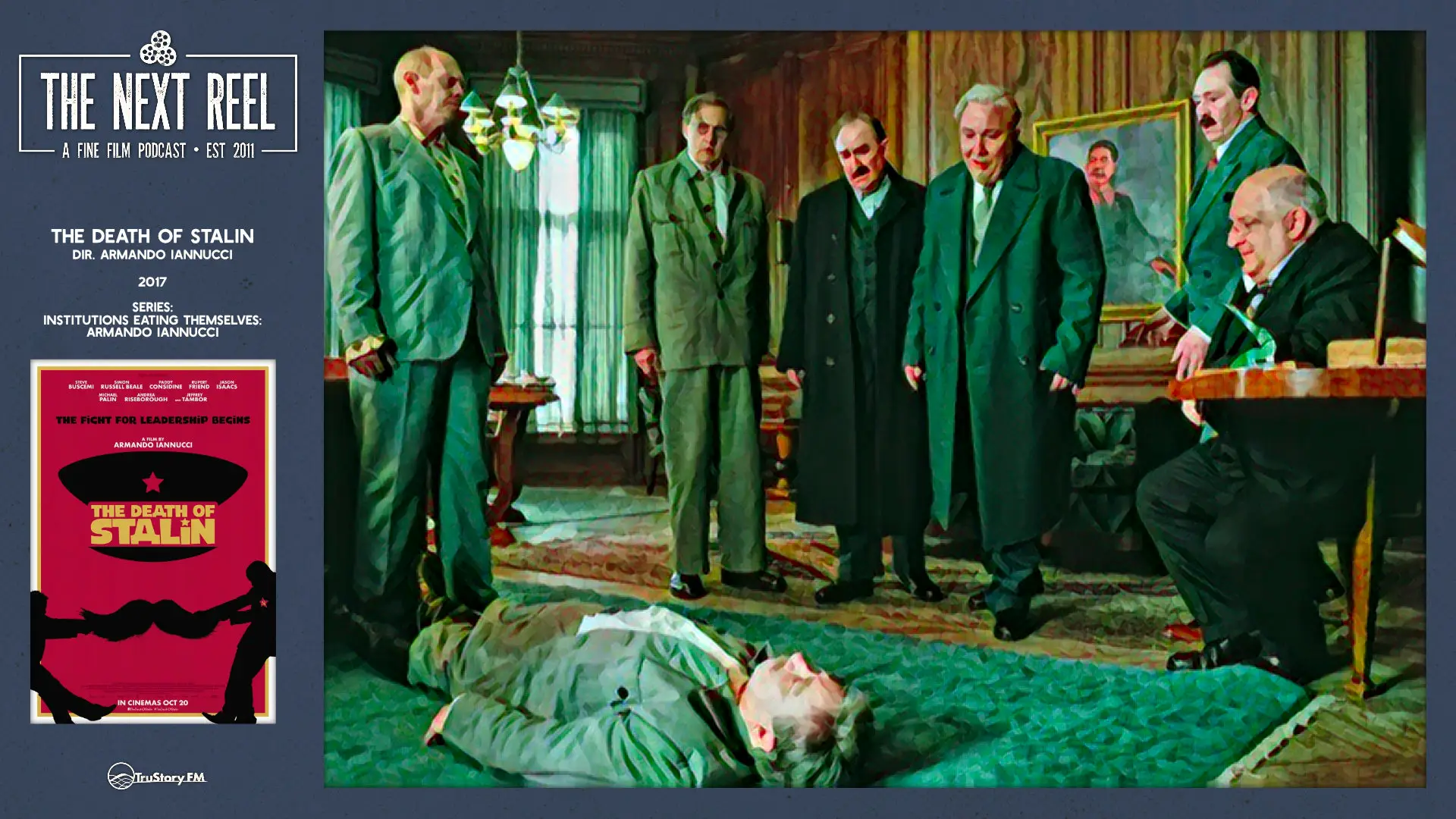
The Death of Stalin is over. “Don’t worry, nobody’s gonna get killed, I promise you. This is just a musical emergency.”
The Death of Stalin, Andy.
Andy Nelson:
I just have to say, Paddy Considine may be one of my favorite parts of this whole movie. He’s so funny in that whole sequence. Yeah.
Pete Wright:
The entire exchange with him on the phone in the beginning, in the control room, is outstanding. It’s like this movie’s Who’s on First? This movie, I really… I’m conflicted about this movie. And it’s only because of all of the… there is a non-trivial contingent of people who watch this movie and believe that trivializing the death of Stalin trivializes the atrocities that occurred at his hand and under his regime. As soon as I say those words out loud, there is nothing funny about this movie. I also find this movie incredibly funny. And I recognize that all of this is a judgment against my own taste, and maybe my class.
I am a classless, classless person. I don’t believe that lampooning a monster trivializes what that person did. I don’t think I believe that, as much as I’ve been thinking about it. But I also don’t want to come across as disrespecting those who believe very strongly that it does, whose families were directly affected by Stalin’s acts. So I kind of say that out front, because there’s a lot of really funny stuff in this movie to me, and I don’t think I’m gonna get away with not laughing about it.
Andy Nelson:
When you bring that up as a key point, I think immediately what comes to mind is Mel Brooks poking fun at Hitler, and with The Producers, with “Springtime for Hitler” and everything that he was doing there. And I think the way that Mel Brooks justified that in that film… and it’s entirely possible we talked about this back when we discussed The Producers on this show. We talked about both…
Pete Wright:
We’re very thorough, is what you’re saying.
Andy Nelson:
We talked about both of those versions, the original film and then the Broadway adaptation.
Pete Wright:
And we’re deeply thoughtful about such issues.
Andy Nelson:
They’re very tough, I guess. He said he justified making fun of Hitler by arguing that ridicule and comedy are the ultimate weapons to strip tyrants of their power and mystique.
Pete Wright:
Yeah.
Andy Nelson:
And deflating power through mockery, it could in itself be looked at as an act of vengeance. All of these different things.
And the same thing — Mel Brooks had critics and audiences that were upset with him, and World War II vets who were upset and called his work vulgar and inappropriate. And Iannucci pretty much said the same thing. He’s just like, I’m not trying to make a documentary here. And I also do believe, I kind of go along with Mel Brooks and his comment there that when you are making fun of something — and I mean, the comedy in here isn’t like, oh, this is so funny, that’s Stalin, what a guy. We’re not slapping our knees and wanting these people to be our new best friends because they’re just such funny people.
Pete Wright:
Not at all.
Andy Nelson:
Like, they’re terrible people, and it’s funny in the darkest of ways, right? And I think that’s the line that Iannucci is walking here. And I think it’s a difficult line to walk, but I think he does a good job with it. I think he handles it, and does it ably in a way that succeeds. And I mean, I absolutely feel the frustration for people whose families were killed or disappeared, or whatever, in the atrocities committed by Stalin and all of these other people. But I don’t think that’s the intent of the project.
And I think if anything, the design of it is to poke holes in these people themselves and the system they had built.
Pete Wright:
And I think if you look at the specific treatment of Stalin in the movie, he’s treated as a punching bag. He’s killed in humiliation. He falls in and sits for a long time in his own urine. None of that appears to be Iannucci actually playing the character with any perceived respect. There is no respect given Stalin in this movie. No respect given by the boobs who surround him. Every one of these people who surround him is, at one point or another, lampooned mercilessly.
So I think ultimately I stand with Mel Brooks in using comedy as a weapon. I think that’s an important perspective, because this movie — if you take it as someone looking at the situation with any sort of disrespect or disbelief, it’s not the same experience. I think this is a guy who takes this stuff seriously, and this, like Mel Brooks, is his weapon of choice. And as a result, to me, it’s very funny. But I’m with you — I really respect those who feel like this is disrespectful to those who suffered under the regime of Stalin. It’s not cool.
Not cool, he says.
Andy Nelson:
Totally not cool, man. Well, and it’s based on the French graphic novel La Mort de Staline. I’m sure you can say it with a prettier French accent than I just did. But the point is, the comic book writer who wrote it, he was trying to do something that was kind of a historical look into all of this, but in the process, he said that he found the events surrounding it horrifying as well as humorous, and decided to kind of write it that way. And so the source material is also put forth that way. And this is the sort of story you could very easily tell as a straight dark drama, just looking at all the same pieces that we watch here with none of the humor, and just done in the darkest way possible, where you’re just seeing how brutal these people are and how they operate.
And by doing that… I mean, I think we could probably end up having kind of the same sort of thing, and maybe some people would say it certainly is a more respectful look at everything. But I don’t know. I do think there is this dark, dark humor when you have Beria talking with Stalin about the names on the list, and he’s like, oh, I added this artist because I know you like him so much. He’s like, oh, it’s fine, just keep him on the list. He’s like, well, what about his wife? Add her too. They’re a couple.
And it’s kind of like a little wink in his eye. And it’s like there’s something really dark about them making these decisions about people’s lives, and the fact that they’re essentially talking about killing these people. But the way that it plays, it just… I don’t know, it makes them even more disgusting to me.
Pete Wright:
Yeah, yeah. And I think that’s a really good place to sort of start on the film, because — one of the reasons I wanted to talk about Iannucci is the way he approaches, you know, the name of the series. This is Institutions Eating Themselves. And what we had within In the Loop was a little bit more of a political romp that was talking about war through mistaken context on the radio, but the violence was off screen, so to speak — it was out of frame. This movie, he makes many of the same arguments about politics, the joke that is politics, and the lack of capability at the top, right? Everyone in here suffers massive groupthink under Stalin, and when he dies, they don’t know what to do.
They have real trouble figuring out what’s next, collectively. And also, the sort of gruesomeness is handled in the film where we don’t see a lot of the actual executions. We do see some, and most gruesomely, we see Beria at the end. And I think that is a different take for Iannucci to take, this sort of fanciful comedic romp through the disgusting bowels of politics, but also to be grimly violent on screen. And my first thought on this was, how does that change your relationship with Iannucci as a filmmaker, as you watch this movie with that specific difference in approach?
Andy Nelson:
I mean, it’s an interesting question. And I suppose coming after In the Loop, there’s an interesting element to it, because in some ways, In the Loop can be viewed as just as horrifying and disgusting as this one, because these are people who are working political day jobs who essentially start a war by the end of the film, right? And inevitably people are going to die, and it’s just kind of this — the war machine is cranking away. We’re not seeing that side of it, though. We’re not seeing all the deaths. We’re just seeing all the paper shuffling and the arguments and everything else that kind of comes along with that, and the political backroom dealings, etcetera. This is much more close to the actual front of things. And so we’re seeing the people die, and we’re seeing the darkness.
And I think it’s an interesting step for Iannucci to take, where now we’re moving into a space where the darkness is a big part of the story. And I think that’s — it would be a very, very heavy story to watch if the dark satirical comedy was completely stripped out of it. I think that by approaching it this way, it’s a smart way to look at it from Iannucci’s perspective, and through that satiric lens that he likes to use so much, because I think it gives him a chance to show how ridiculous these people are, and how this leader of theirs that they all quote-loved has died, but now they don’t really care — all they want is to fill the vacuum of power with themselves, right? And to that end, when it comes to anything that Stalin had said or done, they don’t really care if they continue it or not, unless it benefits them.
Unless by saying, well, this is what Stalin would have wanted — it’s something that benefits them. And I think that is… I don’t know, I just think it speaks well to how Iannucci decided to approach it.
Pete Wright:
Yeah, and I mean, the counter to that — they have no problem going both ways. There are points where he says, maybe the kidnappings and assassinations, maybe we just back off of those. Just back off, let’s just back those off a little bit. And that is so funny, because now they’re calling the other side — we’re like, you know, Stalin was a reformer, he broke up the past and rebuilt, and now we’re doing the same thing, so that’s okay because Stalin did it too.
Even though what they’re doing directly countermands what Stalin would have done. It’s ridiculous. That is one of the arguments about the violence on screen. And I think when you look at these two movies, In the Loop and The Death of Stalin, together, I think Iannucci is making a specific point, even if it’s unintentional. In In the Loop, we get a position that says, we’re distanced from the violence, so we don’t care about it, right? That is something we hear all the time about modern warfare. Modern warfare is somebody sitting in a trailer in Nevada somewhere, operating a drone that is killing people 5,000 miles away, right? We’re too distanced from violence, so we don’t care about it as much as we should. And I think what Iannucci has maybe unintentionally portrayed here is In the Loop as one of those perspectives, and The Death of Stalin as the other, where largely they also don’t care about the violence that they are handing down directly at the street level, hands on guns, doing it — and that there is no such thing, it turns out, as disassociation from violence.
We are associated from violence no matter how far the trigger is from the actual execution. And that’s one of the things that this movie — that the satire of this movie makes so black — is that we have direct authority over the violence and the executions, and it does not matter. It doesn’t matter. Nobody is touched in a particularly grim way once they have transcended into the positions of leadership in that vile, vile regime.
Andy Nelson:
Yeah, really interesting point. And I think it speaks to, again, just the way that the story is structured, and the way we’re following these people. We should just clarify — I don’t think the goal of this — I mean, Iannucci himself said it wasn’t set up to be a documentary. There’s a lot of historical inaccuracies throughout, as far as squeezing, changing, putting people into a role that they used to be but aren’t anymore, or they aren’t in a role that they used to inhabit, things like that.
Pete Wright:
Oh yeah, yeah.
Andy Nelson:
Changing the timeline. There’s a lot of things that they’re stretching and modifying, in order to squeeze all of this into kind of this window of time that we’re looking at, that all falls right around, and mostly after, the immediate death of Stalin. And I think that’s the focus. And I think it allows us to kind of capture the spirit of — we’ll just say the spirit — of all of the changes and the manipulations and the machinations that were going on over three-plus years, in order to kind of do all of this, but to kind of capture it into this kind of short time period.
And I think that the way that it’s portrayed works quite well. I don’t think we needed to have a realistic story showing us kind of the entire three-year drama, leading to Beria, who I think ended up actually in prison, not even executed, or maybe eventually executed.
Pete Wright:
Executed and burned.
Andy Nelson:
Yeah, right. So a little different, but the point of it is all here. And I think by changing the story, we’re in some ways increasing the level of the atrocities that are committed, and we see kind of exactly just how these people think. And I don’t know, watching it in today’s eyes… this wasn’t that long ago.
I mean, nine years ago this film came out. But it is interesting to look at this through today’s eyes, and just — I know a lot has happened in nine years.
Pete Wright:
A lot has happened in nine years, Andy.
Andy Nelson:
You’re right. But there’s a lot in here that feels like — I could see the government slipping into this mentality. I could see people where they stop thinking about people as people essentially, and just start thinking of them as things that they can manipulate and get rid of if they’re unhappy with, etcetera. There’s a lot of dark thinking that kind of goes along with that. But I can see that happening more than I probably could have at the time the film came out.
Pete Wright:
Yeah. When you look at the comedy — so much funny — how much of what makes the comedy in this movie successful do you think is the result of its Britishness?
Andy Nelson:
I don’t know if I can completely pare that down. I mean, obviously Iannucci’s from the UK, and a lot of the actors are as well. I think there’s only two US actors, is that right?
Pete Wright:
Jeffrey Tambor and Steve Buscemi.
Andy Nelson:
Steve Buscemi. Yeah. So everyone else is… and this is not a film where everyone’s talking with Russian accents, right?
Pete Wright:
Not at all.
Andy Nelson:
They’re just talking with their own accent. So you have kind of an amalgam of sounds coming from people.
And so, no, yeah…
Pete Wright:
Which is super intentional, right? There isn’t a Russian accent amongst them. And I think that’s super intentional for the comedy. And I’m curious what that does for you, because we didn’t have to think about it within In the Loop — everybody was speaking their natural accent in their natural habitat.
Andy Nelson:
I don’t… I guess it’s just an interesting point. I don’t know if it’s something that enhances it, or it just allows me to not think about bad accents, you know? It just lets the dialogue be what it is, with the voices of the people who are speaking them, without me constantly being distracted with that issue. Because that would have been an issue — some people probably would have been able to pull it off, but every single one of them speaking in a Russian accent, that would have been a little much.
Pete Wright:
I don’t think it would have been the same cast. I think they would have had to… I don’t think it would have been… I think you’re right, that’s the point. There’s way too much that would have — wouldn’t have played. I think there is something appropriate that Michael Palin is in the movie, because there is something about the sort of legacy of British comedy, and the legacy of the dryness of British wit, that makes this operate at a different level than just a lampoon. That is one of the things that plays for me. It’s a warm blanket of funny that hits me right where I grew up. It hits me right in Monty Python, right in Fawlty Towers, right in Kids… or my favorite sitcom.
Andy Nelson:
Obviously.
Pete Wright:
Yeah. I can’t remember, ’cause old. But that’s one of the things that I think is really fascinating about it — making these people who were tyrants speak in their traditional language and accent makes it funnier. It makes it less dark. It lightens every moment, because their delivery is so pat, it’s so dry. And I just… I don’t know how not to see this as so funny.
I don’t know how not to do it. I think not casting too many Americans is huge, because Tambor, in his role — as problematic as that dude turned out to be — is very funny, because he is so good at playing that rube. And my God, his ascendance into party leadership is made just epic by his inability to understand — or his… I guess, he understands exactly what he is being asked to do, and he has a great fealty to the party and the nation, but he has no clue where he is at any given moment, it doesn’t seem to me. And that’s where the gap comes in. And Buscemi is playing the guy in the room who kinda knows where he is — his accent, honestly, helps him stand out as something to be taken, maybe not completely seriously, but different than the rest.
Andy Nelson:
Yeah, I think that works. And it’s interesting that you bring this up as a point, because the more I stew on it, I do think there is an element to it helping the comedy. I mean, when you have Jason Isaacs coming in as the general of the Red Army, and he flings off his cloak, and the speed ramping happens with the camera, and you just suddenly are in slow motion as his name and title appear on screen — he’s just like this grand lion, it’s just incredible the way he’s portrayed. And so you kind of keep having these moments, and something about their Britishness does actually feel really right for so much of this. And actually, I’m glad you mentioned Michael Palin, because — as somebody who has given some fantastic monologues to crowds — I was thinking of, have we seen a bit in Life of Brian, when he’s up on the dais there calling out for people? There are moments that he has here that felt like he’s right in the same Monty Python shoes.
Like when he’s sitting at the table and he’s doing that, it’s kind of waffling, but he’s just kind of… he’s painting one direction of a thing, as everybody’s getting ready to vote. And then he’s like, but on the flip side, it could be this. And but then what about this? And he keeps going back and forth brilliantly. And that was just like exactly what you’re saying — that perfect dry British wit, in the way that he delivers it, plays perfectly, and then he finally makes his decision and votes. It was just brilliant. And I’m like, that was so fitting for that to fall into Michael Palin’s hands, because he’s just so good at exactly what he was asked to do as that character.
Pete Wright:
And yet — Khrushchev in an American accent — our actual General Secretary is lying in a puddle of indignity. I think him saying “get me a doctor now” is one of the great kind of bits of sort of spatial awareness, delivered in contrast to the rest of the sort of bumbling committee around him. I think it’s just really kind of perfect verbal chemistry.
Andy Nelson:
Yeah. What do you think of Andrea Riseborough and Rupert Friend as Stalin’s children? How do they play for you?
Pete Wright:
Well, Rupert Friend, okay — Rupert Friend, his approach to hockey is amazing. And we meet him at the hockey rink, and he’s drunk, and he really needs to have a new coach, and he decides to coach himself, so he gets out on the ice and says, “get it, now get it, now go get it, now get it,” pointing at the puck, as these absolute imbeciles are sliding into walls around him. And it is absolute vaudeville. It’s perfect.
I think his entire approach, the things that he’s really passionate about, with relationship to his father, are pitch perfect. And the fact that he gets a final speech where he gets to actually say the things — like, what does he say — “we’re all…”
Andy Nelson:
“We’re all like the cubs. He’s the great bear, and we’re all like his cubs.”
Pete Wright:
“The cubs of Ukraine, and the cubs of…” and he starts naming all of the peoples and the nations.
Andy Nelson:
In Georgia,
Pete Wright:
Yeah, and actually that gets some sympathy — is, I think, an interesting statement from the dais. I think Andrea Riseborough is also wonderful, because she gets to be our character of competence. She feels very strongly. And I think together, the two of them make for a wonderful sibling kind of foil against the party. I think the piano player too, Olga Kurylenko — she’s fantastic, and very… we see her very briefly in the context of the whole movie, because we get her at the beginning, she plays, she stands up to Stalin, but not after she’s offered money — like a lot of money — to sit and play the concert again.
So we know that she can be bought. She’s not cheap, but she can be bought. And I think that in itself is another sort of statement to what is happening in that country at the time, and for many, many years hence too, as the economy continues to crumble for the everyday people — certainly for artists.
Andy Nelson:
Yeah, and they all have interesting roles. They all have different interesting parts to play, kind of in the context of the story. And so much of it boils down to the relationships between the other characters. And I think that’s what’s fun to watch — the dance that all these different people have. Like, with Stalin’s two children, how they are all kowtowing to them initially, trying to make sure that they’re on their side, right? Like Khrushchev and Beria both absolutely want to do everything they can to make sure that Riseborough’s character is on their side. And it leads to some very funny conversations, because of the way the language is played — when Khrushchev is like, “don’t worry, I won’t let any harm come to you…”
“Harm? Like, why would you say there’s harm coming to me?” And it goes into this whole thing about like, “what do you mean?” And he’s like, “no, I shouldn’t have said harm.” “Well, you keep saying it.” And just the way that plays, I think, is… it’s so fun. It allows for these verbal battles and kind of this constant back and forth to play, which works so well.
Pete Wright:
There’s the other exchange, which is, “I promise you, if nobody’s gonna get to you — if they get to you, they’re gonna have to go through me first.” And she just rolls her eyes.
Andy Nelson:
Right, right.
Pete Wright:
It’s such a dig.
Andy Nelson:
Well, and then, of course, right when Jason Isaacs’ general comes in, he just totally punches Rupert Friend, right? And she just looks to Khrushchev. She’s like, “where were you? You said you weren’t gonna let anything happen.” So yeah, it all plays so well.
Pete Wright:
Yeah, yeah.
Andy Nelson:
All right, we’re going to take a quick break, but first — you can find the show on YouTube, and you can join us live when we record. We’ll even take your questions in the post-show chit-chat, and members get the full post-show conversation, and always know what to listen to next. Subscribe to The Next Reel on YouTube.
The link to this episode is in the show notes. We’ll be right back.
Pete Wright:
Let’s talk a little bit about some of the filmmaking choices. I think if you watch this in clips, you’d be mistaken — you wouldn’t be mistaken — you’d be… you wouldn’t be wrong to think it’s coming from a sketch show. This doesn’t have a particularly bold camera. It is really focused on the comedy, the people on screen, and the ensemble and their particular word battles. Your thoughts on Iannucci’s choices?
Andy Nelson:
I mean, I think that’s exactly what we’re looking at here. It’s very much the sort of structure to a comedy film, where all of the camerawork and camera movement is designed to allow the dialogue to live, to allow the characters to do what they need to do on screen, to kind of create this space where the story unfolds the way that it needs to. And so, I mean, there are some camera moves that are designed to just kind of move things through fairly quickly — the way that a camera might pan, like as soon as they finish executing people, and then the order comes in to stop executing people, and the camera pans to the guard running up to talk to the guy who’s got the gun, and you hear that, and then the camera just pans over to the next row of guys who are all just standing there looking at everything, and they’re all just like, “okay,” and then they kind of dart off. So there are moments where the camera movements kind of allow for us to kind of follow the story and capture the dark humor that’s going on.
But I wouldn’t say that it’s done — it’s all very straightforward. And I think that’s, in this sort of story, pretty key, to just kind of allow everything else to stand at the forefront.
Pete Wright:
Yeah, don’t let pomp and circumstance get in the way of wit. In this case, it is very, very dry, and the camera had to just let it go. And same thing for production design — there is nothing in here that takes me out of the film in terms of its sophistication of production design. They found some fine locations, the dacha and the house — they all feel perfectly appropriately Stalinesque. There’s nothing in there that had me believing otherwise. And yet, it never got in the way.
The sort of riches never got in the way of these guys effectively running around and playing a game of noises off, carrying his body room to room. I’m constantly focused on just the comedic action. I think that plays really well.
Andy Nelson:
Yeah, I think the music also works. I mean, the music largely is kind of… it fits the tone, but what I really like are the classical pieces. There’s I think three or four, very Russian — well, one of them’s Russian, Tchaikovsky — but the others just feel very much a part of the tone of this time. And so, like, we opened with that Mozart piece, and all of that also fits well for when we cut into a montage of them doing things like that. So all of the design fits this world.
Pete Wright:
How does it handle to your eye? I mean, in one regard, we’re operating at a scale of sort of global history and the impact of Stalin on the arc of European history. And on the other, it’s kind of an intimate movie — he’s brought the scale down to just the stuff that happens in this dacha, and once they go to Moscow, in the offices. I think that’s interesting, because In the Loop to me feels like a smaller movie, but the stakes are much, much higher.
Andy Nelson:
Higher because of the war, and kind of the conflicts between multiple countries.
Pete Wright:
Right, right. So they’re taking this sort of identity of smaller roles, right? Because we never really get higher than these sort of senators. And yet they have made a movie about global stakes, global warfare, global territorial dispute. And this movie is dealing with, by the end, hundreds of years of Soviet history, and yet it feels much more intimate than — this feels like just a very simple sort of character comedy. And I think that’s a really interesting thing that Iannucci has been able to do — to actually minimize the stakes, so that we focus just on these people and not sweat so much the global scale, even though we know, just because we’re aware of some sort of world history, hopefully, that this is a much bigger thing. I think that is a maturing of Iannucci as a filmmaker through his production work, his television work.
I think you can just see him getting progressively better at operating in constraints, and seeing where the story really lives, because there is a version of this movie that could have involved international leaders and others who have stakes in the leadership of the country. And it does not do that. It never brings up those sort of stakes. It’s always focused on the people who know, and the people who don’t, and the people who shouldn’t.
Andy Nelson:
Yeah, but at the same time, there’s… I think that’s why both of these films are very interesting, because we’re always looking at people doing their jobs. But in both cases, it’s like world-changing sorts of jobs that these people have, right? And I think in this film — I understand your point, it’s kind of just very specifically focused on this one little instance here, but what they end up doing in that is changing things on a massive scale, on the global scale, right? Because they’re changing the leadership of an entire country, and the potential direction of the entire country, and how that country is going to be treating people that they’re kidnapping off of the streets, or shooting because there’s a riot, or whatever the case may be. And so I think — you can say, yeah, there’s a smaller scale to kind of the immediate drama of what we’re looking at here.
But, to your point, maybe this is part of that — kind of Iannucci finding himself. It’s a small-scale story about this vacuum of power left in these primarily two people fighting for control over that, but it has such global ramifications.
Pete Wright:
Well, I think you already said it. What’s interesting about both of these movies is that none of the characters demonstrate any great awareness that they are participating in something with global stakes, right? From In the Loop onward, we’re not looking at characters who are particularly self-aware to the point where they know that what’s happening here is going to impact hundreds, thousands, millions of people — they’re aware of what’s happening to them in the next 45 minutes. I think that’s really interesting. And that Iannucci goes from here — coming from In the Loop — to this movie, which scales down to a cast that has a smaller sort of reach, and goes to David Copperfield after this, which is the story of an individual and his relationship to others that he comes across.
I think it’s an interesting thing to chart — Iannucci’s sort of awareness of self-awareness in his characters.
Andy Nelson:
That’s, yeah, very interesting. It’s an interesting walk through his work. I wonder how you would say that his TV projects fit into all of that. I mean, I’m not as familiar with them, but it seems like they’re all kind of fitting more in the In the Loop realm of things, but again, maybe I’m only thinking of Veep, and then the original show that was the source of In the Loop.
Pete Wright:
Right, right. It’s interesting, because the one that was, in many respects, the most off the rails, was Avenue 5, which was canceled after a couple of seasons. And that’s the one where we follow a cruise ship in space. It’s got a little bit of Mickey 17 to it — it’s that sort of absurdist space travel. And yet the political system, particularly dealing with wealth, is on full display. And I think that parallel of a cast that is completely isolated to this one location, or this one sort of facility, and has to deal with the complexities of an impossible situation — it directly mirrors The Death of Stalin.
Like, it could have been The Death of Stalin in space, with just, future people and Doctor House. So it’s — I think it’s a really interesting parallel. I feel like we’re getting this sense of what demons Iannucci is exercising through his work, because he has a really astute perspective on the nature of work and aspiration and achievement and drive. And I don’t think he has a terribly high opinion of it.
Andy Nelson:
I’m curious — I’m looking real quick, ’cause I’m trying to see if he has any projects that are coming, and I don’t see that there’s anything listed as in development for him. So that’s intriguing to me, that right now he’s not — I mean, officially listed as being involved in anything, you know?
Pete Wright:
Yeah.
Andy Nelson:
‘Cause I wonder, where does he go from here? Is it gonna be another TV project, or is he gonna jump into another film? And if so, what direction is that going to take? And is he going to kind of continue this path that he’s been going, that we’ve kind of been exploring over the course of this series? Or is he going to shift? You know what?
I take it back. I did hear that he has been tapped to co-write — not direct, I don’t believe, but to co-write — the next Paddington film.
Pete Wright:
Oh, dear.
Andy Nelson:
Little bit of a shift.
Pete Wright:
Yes. I can see it.
Andy Nelson:
Yeah.
Pete Wright:
I can see his touch.
Andy Nelson:
I actually can too. I think that actually kind of makes sense. I think it’s an interesting idea.
Pete Wright:
It is interesting when you look at the arc of these films too, because — In the Loop came out in 2009, The Thick of It was kind of contemporaneous to that. And then he was involved in — then there was Veep, right, for three or four years. And then The Death of Stalin in 2017. And then The Personal History of David Copperfield in 2019. The gap between Stalin and Copperfield will be interesting to watch. The gap between In the Loop and The Death of Stalin feels like the beginning and the end of his sort of Iannucci political cycle, and then moves into something more fantastical. I’m saying that now, recognizing I may contradict myself just next week.
Andy Nelson:
Right.
Pete Wright:
But it does feel like we’re kind of toward the end of an arc, and he’s now gonna be applying the same sort of skills and tools for storytelling to some different kinds of stories, and Avenue 5 is an example of that.
We’re just, one of two. Maybe Paddington will fit right in there.
Andy Nelson:
Yeah, it’ll be interesting to see how that works, when it comes time to seeing what he does with Paddington number four, if it happens. I’m very curious. And I think that he’s co-writing it with Simon Blackwell, who he’s been working with since The Thick of It. So the two of them are adapting the next Paddington movie. I guess we’ll see how it plays.
Pete Wright:
I didn’t even… I didn’t see the last Paddington movie. I didn’t see three.
Andy Nelson:
The second one ended so perfectly, I didn’t feel I needed to watch the third one. And I know they changed the creative team behind it anyway — I think the director went on to do Wonka, and only produced the third one. And so my interest kind of waned to watch it. But now that I know that Armando Iannucci and Simon Blackwell are writing it, my curiosity might be piqued enough to watch both of them. We’ve done the Paddington one and two as part of our series, so we’ll have to just kind of do these other ones.
Pete Wright:
We have to fill in the blanks.
Yeah, okay. Well, I think this film is delightfully subversive, and controversial for sure. Not a big fan of it in Russia.
Andy Nelson:
No, no. I enjoyed — one of the images that’s on the Wikipedia page is the marquee at a movie theater in Minneapolis, where they have on their marquee “The Death of Stalin.” Hopefully we don’t get poisoned for playing this.
Yeah, because Russia — they called it an unfriendly act by the British intellectual class, and part of an anti-Russia information war. So they were very angry about this. Even though — I was curious about this — the film was partly filmed in Russia. The Russians apparently weren’t so upset at the idea of them making a movie.
Pete Wright:
Yeah, huh.
Andy Nelson:
So I…
Pete Wright:
That’s just an amazing testament, maybe, to exactly what the movie is about.
Andy Nelson:
Yeah, yeah, it’s very interesting.
Pete Wright:
Yeah, okay.
Andy Nelson:
All right, any last thoughts on this one, or shall we move forward?
Pete Wright:
Let’s move it.
Andy Nelson:
All right. Let’s move into the back half, but first we’re going to take a quick break.
Pete Wright:
The Next Reel is a production of TruStory FM. Engineering by Andy Nelson. Music by Tzabutan, Louis Adrien, Oriol Novella, and Eli Catlin. Andy usually finds all the stats for the awards and numbers at The-Numbers.com, BoxOfficeMojo.com, IMDb.com, and Wikipedia.org. Find the show and the full archive at TruStory.fm. You can follow us from there too. Plus, you can find out how to become a member and go further with every episode.
Check out our merch store at TheNextReel.com/merch. And if your app allows ratings and reviews, please consider doing that for our show.
All right, Andy, how’d it do at award season?
Andy Nelson:
It did well for itself. It had 18 wins with 40 other nominations. At the BAFTAs, it was nominated for Best Adapted Screenplay, but lost to Call Me by Your Name. And it was nominated for Outstanding British Film of the Year — this one cracks me up, being a British Film of the Year — lost to Three Billboards Outside Ebbing, Missouri. I suppose specifically because McDonagh is from the UK, but obviously with UK financing. But it’s a very American story, so that makes me laugh.
Pete Wright:
That’s awesome.
Andy Nelson:
At the BAFTA Scotland, Iannucci won Best Director Fiction and Best Writer in Film and Television. And over at the British Independent Film Awards, it was nominated for Best British Independent Film, but lost to God’s Own Country. Iannucci was nominated for Best Director, but lost to Rungano Nyoni for I Am Not a Witch.
He was nominated for Best Screenplay, but lost to Lady Macbeth. Andrea Riseborough was nominated for Best Supporting Actress, but lost to Patricia Clarkson in The Party. Simon Russell Beale, who plays Beria, ended up winning Best Supporting Actor, and Steve Buscemi was nominated for Supporting Actor, but lost to Beale. Interesting that they were both nominated in the Supporting Actor category, neither of them in Best Actor. The film won Best Casting. It lost Best Costume Design to Lady Macbeth. It lost Best Effects to The Ritual. Best Editing, it lost to Three Billboards Outside Ebbing, Missouri. It won Best Makeup and Hair Design. It won Best Production Design. And for Best Music, it also lost to Three Billboards. So, some good wins in there.
Pete Wright:
Three Billboards was a good movie though. I mean, come on.
Andy Nelson:
It is a great movie. It is a great movie. I just — my brain doesn’t think of it as a British film, but that’s all about where the money’s coming from, you know.
Pete Wright:
Yes.
That’s right. That’s really funny, I didn’t make that connection at all. It’s a story about Missouri. How’d it do in the box office?
Andy Nelson:
Well, for this film, Iannucci had a budget of $13 million, or $16.4 million in today’s dollars. The movie premiered at TIFF, September 2017, before opening October 20th in the UK, and March 9th, 2018 here in the States, where it opened limited opposite A Wrinkle in Time, The Strangers: Prey at Night, The Hurricane Heist, Gringo, and Thoroughbreds. This would expand to just under 550 screens, and go on to earn $8 million domestically and $16.6 million internationally, for a total of $31 million in today’s dollars. All told, that lands the film with an adjusted profit per finished minute of $137,000. Definitely a step up from his previous film, though not as profitable overall. This one ended up earning about two times its budget back, where In the Loop earned back a bit over eight times its budget. So…
Pete Wright:
Yeah, I can kinda see it. I can see why this movie would have a different kind of following. It’s a bigger swing.
Andy Nelson:
And a harder one to market. I think it’s sad to say, but I think it’s also very true.
Pete Wright:
Yeah.
Andy Nelson:
This is a hard film to market to the general American public. I just don’t think people are lining up to watch this sort of film, which is sad.
Pete Wright:
Yeah, really sad.
Andy Nelson:
They’re going to The Hurricane Heist instead.
Pete Wright:
Well, I’m sure glad we talked about it. So far, I feel like I’m two for two on this series. I think the Nooch is outstanding. I really love talking about these movies, and I already can’t wait to watch it again.
Andy Nelson:
Yeah.
Really interesting glimpse into Soviet history, even if there’s a lot that was reworked. But I do think that, again, as I said, there’s a sense that it holds true to the spirit of what was going on, which is honestly very scary. And again, makes me glad that it was a dark satire that I could laugh at, because I think in some ways it ends up being more powerful.
Pete Wright:
I wonder what the Venn diagram looks like of people who don’t like this movie but are fans of Inglourious Basterds. I mean, you can make the case that Tarantino had his way with the history of Hitler too — completely revisioning history.
Andy Nelson:
Yeah, but I don’t know if I would call this like revisionist history, so much as just reworking it to fit the story better, you know?
Pete Wright:
Misogynist history? Is there a continuum?
Andy Nelson:
Massage… misogynist?
Pete Wright:
Yeah, it’s misogynist history.
Andy Nelson:
That’s a little different than misogynist. It’s massaginist.
Pete Wright:
See, that’s a joke Iannucci would get, I think.
Andy Nelson:
Yeah, that’s right. Oh my goodness. Hey, before we go, I want to play the IMDb game with you, with Steve Buscemi.
Pete Wright:
Oh, no. That’s terrible.
Andy Nelson:
Yeah, ’cause I think he’s so good in this film. And this is a film I’m like, man, I would have loved to see him get nominated for an Oscar or some bigger things, because I really enjoy what he does here.
Pete Wright:
How — he’s so good, how could I possibly… how could I possibly know? The only thing I can think of right now is, “hello, fellow kids.” And that’s not what he’s known for. 30 Rock.
Andy Nelson:
No, or — yeah, no TV, no TV. Four films.
Pete Wright:
No, okay.
Andy Nelson:
I will say two of them are very big from our college days.
Pete Wright:
Okay, well, I mean, we gotta do — oh, Tarantino, right? Reservoir Dogs. That’s gotta be it.
Andy Nelson:
Okay, okay.
Pete Wright:
Let’s say he didn’t win an award, but probably this one.
Andy Nelson:
Yep, good, okay.
Pete Wright:
Okay.
I have no idea. I have no earthly idea what the other two are. I’m really struggling. Can I get a hint?
Andy Nelson:
Okay, he is a — he kidnapped someone in one of them.
Pete Wright:
He can’t…
Andy Nelson:
And he’s working with a partner who is very quiet, hardly ever says anything. Very cold, very cold.
Pete Wright:
Oh, Fargo?
Andy Nelson:
There you go.
Pete Wright:
I need more temperature-related hints, apparently.
Andy Nelson:
Yeah, right, right, apparently. The last one — I would have not remembered he was in it, because I saw it once, and it’s just not something that I’ve stuck with. But I will say, let’s see, I’m gonna do what you did — I’m gonna go with some cast options and kind of work my way up to see if you can get it.
Pete Wright:
Okay.
Andy Nelson:
Bob Balaban.
Pete Wright:
Okay, next.
Andy Nelson:
Ileana Douglas.
Pete Wright:
Mm-mm.
Andy Nelson:
Brad Renfro.
Pete Wright:
Brad Renfro.
Andy Nelson:
I know, there’s a blast from the past.
Pete Wright:
Okay. Nope.
Andy Nelson:
Big name here — Scarlett Johansson.
Pete Wright:
Wait a minute. Wait a minute. Oh my God…
Ghost World. Ghost World. Thora Birch.
Andy Nelson:
Nice. Yes, that would have been the last name, and you got it.
Pete Wright:
Well, that was a lot of work that you had to put in.
Andy Nelson:
But you know what — but you did it, you did it, I’m proud of you. That was fun. It was interesting to look. And it’s nice to see that this film is one of the four that he’s known for, because I thought he was fantastic in it.
Pete Wright:
Yes.
One of these years we should do a series that is just top fours.
Andy Nelson:
Which would be fun. I just — that’s an interesting question, how often does that change for somebody?
Pete Wright:
Yeah. Maybe it’s something you can’t publish. Like it just has to be a point in time — this month we’re doing this one as it exists on January 1st.
Andy Nelson:
On this day.
Pete Wright:
Yeah, fascinating.
Andy Nelson:
That’s kind of fun, yeah.
Pete Wright:
Yeah, all right. Well, you think about that.
Andy Nelson:
Yeah, all right. Well, that is it for our conversation about The Death of Stalin. Next week, we’re closing our Institutions Eating Themselves series, looking at the films of Armando Iannucci with his 2019 film, The Personal History of David Copperfield. His spin on the Dickens classic, with Dev Patel narrating his own chaotic origin story, Tilda Swinton chasing donkeys off her lawn, Hugh Laurie tying his intrusive thoughts to kites, Peter Capaldi turning bankruptcy into performance art, and Ben Whishaw’s Uriah Heep making ‘umble sound like a threat. Lighter register for Iannucci, same eye for people scrambling to define themselves against the systems built to define them.
Pete Wright:
You haven’t seen that yet, right?
Andy Nelson:
I haven’t seen it yet.
Pete Wright:
Oh god, I’m excited about that.
Andy Nelson:
I haven’t. It’s also one of Dickens’ novels that I haven’t read. And it’s frustrating, because as soon as you announced this, I added it to my list for audiobooks on Libby. And why is that the Dickens novel that has a huge wait list? I just got notified this morning that it became available to me. So there’s not gonna be a chance I’m gonna finish it in time, unfortunately. But I was hoping.
Pete Wright:
Oh, triple speed that puppy.
Andy Nelson:
I was hoping, yeah.
Pete Wright:
Triple speed it. It’ll still take you two straight days when you triple speed.
Andy Nelson:
Yeah, it’ll be — yeah. Yeah, they’re not short books, but yeah, yeah.
Pete Wright:
All right.
Andy Nelson:
And now, let’s do our ratings.
Pete Wright:
Letterboxd.com/thenextreel. That’s where you can find all of the movies that we have talked about across The Next Reel family of film shows. Out of five stars and a heart for true love, what are you gonna do for this one?
Andy Nelson:
The first time I watched it, I gave it four stars and a heart. And I’m like, is it four stars? Is it four and a half stars? I think I’m gonna go four and a half stars, because, like you — I’m just laughing so much through this thing. It’s so dark. It is such a dark, dark story. There are some things in here that I’m like, man. There’s information about Beria, as far as his penchant for little girls and things like that — that just is super, super awful.
But I don’t know, it just worked really well for me. So I’m gonna say four and a half, at a heart.
Pete Wright:
I am right with you, although no half stars, so I have to angle down just a little bit. Four stars and a heart for me, which is the same thing I gave In the Loop. This is a fantastic movie, and I think — where it falls apart a little bit is in that third act, when it just becomes almost more chaos than comedy. Not quite. It’s just pitch perfect as an approach to a very dark point in history. And I could watch it again and again.
Andy Nelson:
Yeah, yeah. It’s an excellent film.
Pete Wright:
Yeah.
Andy Nelson:
And I look forward to checking it out again. All right, well, that averages out to 4.25 and a heart, which rounds up to four and a half stars and a heart. You can find the show on Letterboxd @thenextreel. You can find me there at @sodacreekfilm, and Pete @petewright. So what did you think about The Death of Stalin? We would love to hear your thoughts.
Hop into the ShowTalk channel over in our Discord community, where we will be talking about the movie this week.
Pete Wright:
When the movie ends…
Andy Nelson:
…our conversation begins.
Pete Wright:
Letterboxd giveth, Andrew.
Andy Nelson:
As Letterboxd always doeth.
Pete Wright:
It always doeth. What did you do this week?
Andy Nelson:
Always.
There were so many that are just great quotes from the film, and it’s just fun to kind of read through and just remember all the funny lines. But this is a moment that we specifically talked about that I wanted to bring up, because it works so well. Patrick Willems, four stars, says, “Jason Isaacs’ introduction deserves its own Oscar.” A hundred percent on that. That moment is just so fantastic.
Pete Wright:
This one, I went low, and I haven’t gone low in a while, and many of the low ones are not in English, which I think is telling in its own right.
Andy Nelson:
Oh, okay.
Pete Wright:
But this one is in English, and describes a point that I think we tried to make but did not complete. Half a star from Mick S, who says, “This is just way too English. Disrespectful to how funny Russians actually are.”
Andy Nelson:
Oh, okay.
Pete Wright:
No, no, let me just say — I’ve hung around with my share of Russian people, and you don’t need to know detail about that, but I’ve just hung around.
Andy Nelson:
There’s a whole story there, Pete.
Pete Wright:
And that is legit. Like, the Russian people — and I think, were it not for this particular context of the story, the Russian people get Iannucci’s style of humor. I bet they’re fans of David Copperfield, is what I’m saying.
Andy Nelson:
Maybe not this one so much, but…
Pete Wright:
Maybe not this one, but I’ll bet if they had seen the others, they would like the Nooch. That’s what I’m saying.
Andy Nelson:
Maybe they liked In the Loop, because it was just making fun of Americans and British people.
Pete Wright:
Yeah, right, right.
Andy Nelson:
And then when this came in, now they’ve just — they’re gonna just dismiss him permanently.
Pete Wright:
Yeah, that’s actually a really funny point, because this movie — we didn’t make this point, but this movie makes fun of the Politburo and Stalin and all of that mishegas, just as much as it’s making fun of British people, right? Just by making them portray some of these characters reminds you of how the British are lampooned in their own press.
Andy Nelson:
Yeah, right.
Pete Wright:
Yeah, all right. Well, I’ve had enough of this. Thanks, Letterboxd.