*This transcript is produced using transcription software and reviewed for quality. Despite our best efforts, some passages may be incomplete or contain errors due to audio quality or software limitations.*
Pete Wright:
I’m Pete Wright.
Andy Nelson:
And I’m Andy Nelson.
Pete Wright:
Welcome to The Next Reel. When the movie ends
Andy Nelson:
Our conversation begins.
Pete Wright:
The Personal History of David Copperfield is over. “Did your mother sneeze when you were christened?”
Andy Nelson:
Miss Peggotty.
Pete Wright:
All the great Iannucci dialogue, and none of the profanity.
Andy Nelson:
Right. It’s a little bit of a different Although I will say, the Dickensian dialogue certainly can feel like profanity. It’s like a vic Victorian level of profanity, the way that some of these things come across. It’s brilliant
Pete Wright:
Oh, true, true, true. This was your first shot with this particular movie as we end our Iannucci trilogy. And I’m very excited. I have to say, I’m excited because I did read your review and that you didn’t crap all over the movie because I love it so much. It makes me very happy.
Andy Nelson:
Well good. I’m glad to I’m glad to please you. It’s I mean, I have long been a fan of Charles Dickens’ works. I should say I’m not like a scholar of this forks. I’ve read very few of them, but I do enjoy the ones that I’ve read, like or that I’ve seen adaptations of, like Oliver Twist, which we’ve talked about Oliver. I think that’s the only Dickens story we’ve talked about on the show.
Pete Wright:
I think so too.
Andy Nelson:
Nicholas Nickleby and Christmas Carol, of course, is probably the one that I’ve seen the most adaptations of, in addition to having read it. And then Bleak House is probably my favorite of his books and Hard Times.
And then I just finished A Tale of Two Cities, which was much more violent than I mean I shouldn’t have been shocked it takes place during the revolution
Pete Wright:
Yeah, that came out of came out of left field for you then, did it?
Andy Nelson:
Yeah, but it’s just like, man, like how many people have had their necks on the guillotine in this story? This is insane. So yeah, pretty bleak, but anyway, I so this but I had never read David Copperfield, and this was a first for me. And, you know, I understand with adaptations that they’re cutting a lot out of the story. I mean I don’t know, the it’s a pretty fairly thick book. It’s you know the audiobook is 34 hours long, and here we are watching a two-hour adaptation of it. So they’re obviously really slimming down the story quite a bit.
But honestly, it still feels like it just has that sense of kind of Dickensian storytelling with the sense of social classes in Victorian England and the struggle of our young protagonist trying to find his place. Right. And so I thoroughly enjoyed it. I had a great time with it. And on top of all of that, on top of the Dickensian side of the story, which I really enjoyed. Like Iannucci was doing some fantastically creative things with the presentation of the story. And I was spellbound by the way that he structured everything with this. It was just, it was a beautiful production.
I had so much fun watching what he was doing with this movie.
Pete Wright:
Ugh, I stand relieved. Oh man, I was ready. I was thinking. Am I gonna show up and just have to fight with Andy for an hour? This is gonna suck
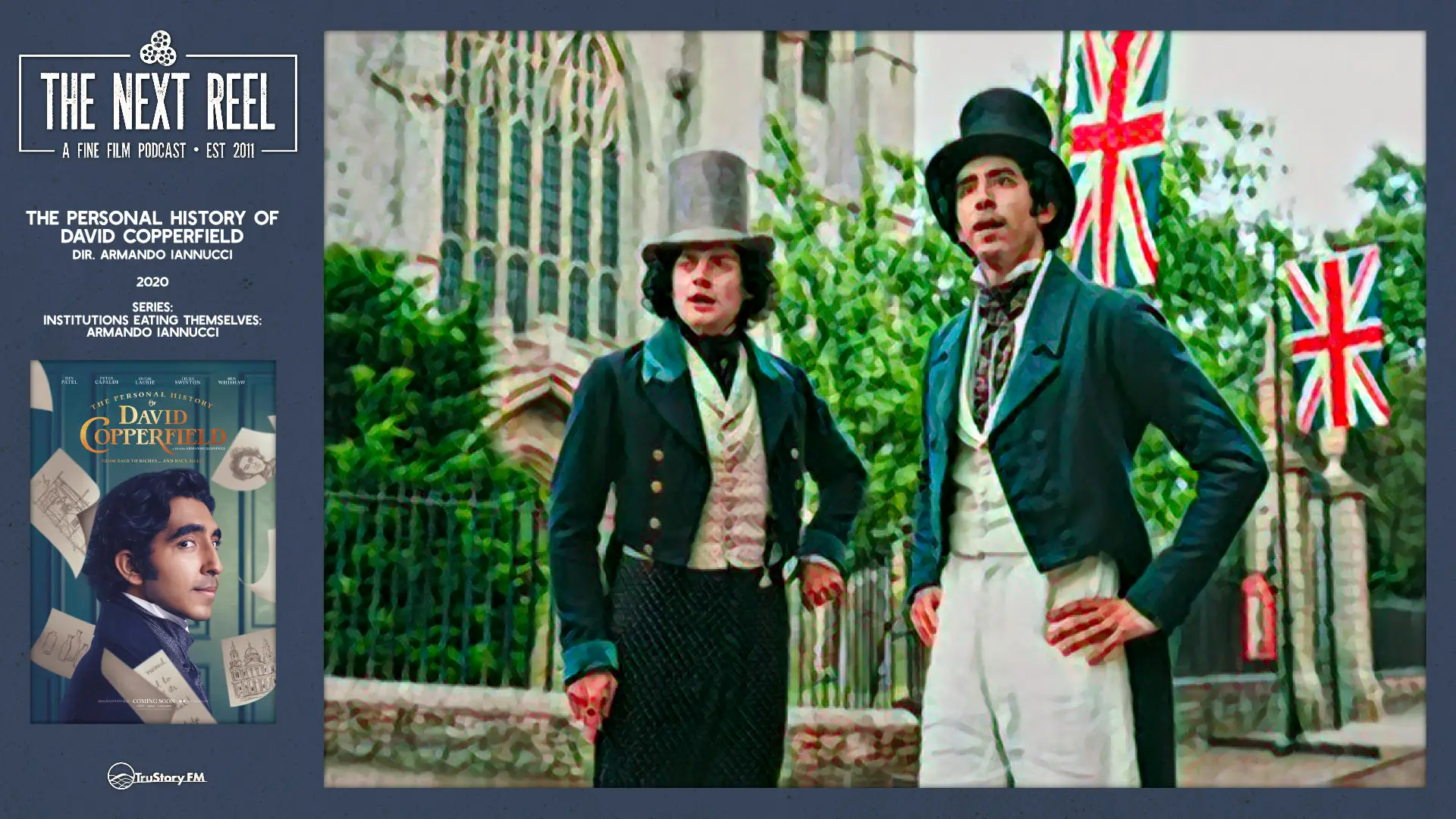
I you know, so this comes as the you know, I have it as part of the Institutions Eating Themselves. And I think at first glance you look at this movie and you think, okay, this is a bit of an outsider’s an outside swing in this particular trilogy. But I think it holds up for what Iannucci was doing. You know, Russia bans The Death of Stalin. His next move is Dickens. It is a fascinating sort of homage to this writer that Iannucci describes as the man who made him want to start writing in the first place, right? He had reread this book ten years prior. And he just had a sense for how he could make it and how unbelievably current it was for being written at the time that it was written.
So as soon as Stalin rapped, he knew what he was doing next and, you know, spoke to most of the crew and brought them over from Stalin directly. His vision to have Dev Patel, an Indian man as David Copperfield, sets the tone for what is a remarkably understated and radical way to cast this movie in particular. And I think you know, from my view, where we look at In the Loop, which is all about people, you know, who belongs in the room where decisions are made and The Death of Stalin, which is, you know, at its base, it’s pretty much how quickly can people get out of the room? Right? It’s just horrible. Now we’re looking at The people that are served by the people that he has just made two movies about and It this is a movie that it through adaptation addresses what it means to be proper British.
That I think speaks volumes for this adaptation. And maybe I love it more in the context of the two private prior feature films that Iannucci has made I don’t know that I can separate them cleanly in my view, but I adore this movie, warts and all, if there are warts, I don’t know what they are, but I do think, you know, when we started this series, I was talking about the fact that Iannucci’s father, you know, lived in Britain for fifty years and never once voted And this story is about a boy who grows up sort of writing his own passage. And I think that is, you know, i in that little bit we get some sort of Iannucci’s, you know, owned story in David Copperfield. Maybe that’s why he loves it so much. Maybe that’s why he ends up loving Dickensian stuff. I don’t know, but it’s it works on me.
Andy Nelson:
Well, and I think to the scope of what you were talking about with how it fits into this series, Institutions Eating Themselves. There is a really interesting element in the scope of especially how Charles Dickens would portray the social classes and the struggles of the poor and here we have these child laborers working in a bottling factory that David Copperfield is sent to as a young boy of, I don’t know, six or seven years old, maybe, by his new stepfather and his terrible stepfather’s sister, and he is forced to work in this modeling factory. And we’re seeing this and I should mention it’s a factory owned or at least in the film owned in the book co-owned by his stepfather. So we’re getting a sense of the rich and how they see and treat the poor and how they choose to take on society in a way where We are better and we are going to put you in your place and do what we need with you. To the point where they have rules in the factory where if you break a bottle, that’s half your day’s pay that we’ve just docked you for. And so you can see how these institutions are set up in a way to grow for these rich people.
But at the same time are very destructive for actual societal growth and the way for any of these people to kind of get a leg up.
Pete Wright:
That is such a powerful sort of tentpole moment in the film, right? Where we get David, Davy, taking agency in his own future, in his own career, right? He has spent years and let’s just say, you know, Dickens did not take a shortcut on this experience of young David. Like there’s a lot of book, as I remember, that is about him growing up. This movie gives us a cut and he goes from child who can’t reach the switch to essentially young adult who’s managing children.
Andy Nelson:
Yeah, Dev Patel, right? That’s where Dev Patel steps in, right?
Pete Wright:
Yes, Dev Patel steps in.
Andy Nelson:
Yeah.
Pete Wright:
And so that moment when Dev Patel is, you know, decides to react in anger, allows himself to react in anger and start shattering the jars and really, you know, wreaking destruction on this bottling factory is a signal of the blight of right British capitalism, you know?
Crony capitalism. And it works so very well in this movie because he’s also showing children how much power they have over the people who seem so powerful, that he has ultimate control because he’s the one holding the bottles that are so valuable I think that is a fantastic sequence and it’s played very well in the film. And for my time, it allows us to move into the Dev Patel era of the movie. So structurally, I know that there are Dickensian purists who believe it moves too fast. And I think this movie moves at a breakneck pace. But for my movie, I need to get this into the adult lessons learned section of the movie pretty quickly.
He is effectively pacing this transition.
Andy Nelson:
That’s a great point because and you know, as I was saying, like the audiobook alone of this runs 34 hours. It’s a lengthy, lengthy story. And so we’re cutting 32 hours of story out of this essentially to get this two hour film. And so, yeah, so we’re going to have to condense a lot of sections. And so we move quickly through his lessons in the bottling factory because we do need to get to those other parts of the story. And D Dickens stories are often so journey focused and picaresque in the way they move from beat to beat as far as like, okay, we start the story just kind of in the big scope, we’ve got the young kid and then he gets sent off to the bottling factory and he grows up and he quits and he goes to live with his aunt and then she puts him in boarding school. And then he’s gets a job.
And then and so you kind of get these little pieces of him kind of moving around and kind of changing from poor to doing okay for himself and poor and you kind of get that roller coaster ride of his life over the course of the story. And that kind of is a you know fairly common structure with these. And I’m sure there are a lot of amazing lessons that David Copperfield could be learning and we could be experiencing along with him in those sequences. But To your point, this is a movie. We’re not watching a you know twenty part miniseries of this. There have been longer versions of this that have been told and this that’s not what we’re getting here. We’re getting a tight two hour movie, and so it has to move.
Pretty fast. And yeah, it’s a breakneck pace, but because of the creative way that he chooses to tell it, I don’t know, for my money, like the way that he starts on a stage reading his life story and then it transitions to suddenly like the theater or like the front row of the theater and the and the dais on which he’s standing are like in the middle of a field outside of his house and then he turns and he walks to the house and that’s where he’s born.
Pete Wright:
So good
Andy Nelson:
Like We’re seeing like he’s stepping through all of that. And all of that, I think, is designed in a way to do incredibly creative transitions to help that story move. So we don’t feel that it’s just clunky. And so I’m sure that Dickensian scholars would have preferred a more thorough telling of this story. But for a two-hour telling of what we’re getting here I think he does an incredible job of crafting it and designing it.
Like we get projections on walls of like memories and scenes that plays as he’s talking or thinking about something to show exactly like those things. So we don’t have to stop and cut to them and everything. It’s just all in frame. And it’s just, it’s so creatively told.
Pete Wright:
There are so many things I wanna dive into. I think you should have stopped talking earlier because I’m gonna forget stuff.
Andy Nelson:
You know, I’m sorry.
Pete Wright:
Fur first the framing mechanism, right? And this’ll this should be quick because I don’t have any complaints. This movie offers us a framing mechanism where he’s reading his own book on a stage and it begins and ends with that. And there are voiceover transitions in the voice of David Copperfield and I don’t have a problem with it at all. Why does it work?
Andy Nelson:
It is a framing mechanism designed to fit into, I mean, my understanding is how the book is told, kind of that first-person sort of telling. And so we’re stepping into his framing of who looking back at who he is and describing his life, right? And so all of that makes sense. He’s talking about when he was born and we see him looking at himself as a baby and he’s talking to us on screen and we’re getting all of that as a sense. We have moments where we start getting a sense that he’s gonna be a writer. And it shows him doing something and there’s text getting written across the screen. So we’re seeing how where he is now shapes how he’s thinking about and hence how we’re thinking about his life as he grew up.
Pete Wright:
Well done. That’s what I wanted to that’s what I wanted to have you say. It’s a very interesting exploration of the sort of Bildungsroman, right? The novel of formation or novel of education that the original book is. This is, I think, a very pure movie version of that. And I think Inucci has a real sense for it. So I think that those transitions, what he does to be able to allow us to distill the key lessons that he sees this character earning through the course of the book and making them cinematic on screen is very effective.
We get to see that he learns what it means to take agency as a young man in that bottling factory and then we move on. We get to see as he meets and has a relationship with Mr. Micawber, one of the central journey educators in the book, he gets to have that experience with this guy and understand what it means to transcend the shame of poverty through tiny exchanges with this guy over the course of his life. We get to see somebody it through Steerforth who is living with the shame of wealth, the shame of success, and the unsettling experience of his own identity that causes him to do crazy stupid stuff and get to see what David learns from that experience and how he can be a positive influence as best he can on those people too. I think that’s one of the things that the movie does so effectively is it actually distills for us the key lessons of the book and still makes it feel like a fluid whole So that’s that first point. And now the second point I’ve already forgotten.
So does that give you anything to think about
Andy Nelson:
Well, I do think that there’s there are interesting elements and we do see some moments. One of the areas that I felt like might have moved too quickly in the story is as we’re looking at some of the elements of David’s own growth, sometimes it goes pretty fast as far as lessons that he’s applying and learning and stuff. And the moment for me that stands out is one That I think I was like, I’m not sure how I’m buying into the way that this is playing right now. And it’s when he first goes to the boarding school. You know, he comes into the room and he meets all the boys, specifically James is the one who’s James Steerforth, the main boy that it he ends up befriending. And also we have Uriah Heep. That’s where we meet Uriah Heep, who wonderful Ben Whishaw is very dark.
Pete Wright:
Incredible
Andy Nelson:
But at that time, like we don’t necessarily know unless we’ve read the book, we don’t have a sense of who Uriah is. And so The sense is, oh, should I feel bad for this character? Everyone kind of mistreats him. I feel a little sad that maybe he’s not, you know, he is looking for something more. And I wasn’t really sure what to read of Uriah Heep. And Steerforth instantly starts saying, oh, what did you meet Uriah? What did you think of him? And there is a turn that David does that happened is kind of out of the blue, where he suddenly starts using what we’ve seen him do so often, where he picks up on people’s idiosyncrasies, the way they say things, the way they do things, and he’s always scribbling these things down because it just sticks in his head so much, which I really enjoyed that as a character trait of him.
But he instantly starts like making fun of Uriah and making fun of other people and just so that he can fit in, right? You get that sense that he’s trying to fit in with these with these new boys at this new school. And we see in the background Uriah kind of passing by and he overhears all of this and so That was a sequence that I did feel maybe was rushed through a bit where I was like, I felt like I didn’t necessarily completely connect with how David decided to start doing all of that and didn’t sense enough of the guilt that he maybe had or did it ever show that he was feeling guilty about any of these sorts of things? You know, it didn’t that’s some of the stuff that didn’t come across quite the same way. I mean, did you have any issues with any of that?
Pete Wright:
Well it’s interesting to me. I mean I think I, you know, in reading about some of the stuff that Iannucci was thinking about when he was you know, writing this thing and researching Copperfield, you know, he’s dealing with things like i imposter syndrome, right? That is a uniquely modern sort of emotional context that he is giving us in eighteen forties context. And I think that suddenly makes a lot of sense because we’re dealing with David Copperfield who is struggling with how he fits in and how he is perceived and the shame that he feels from his own upbringing. And it’s causing him to make decisions that are that are otherwise not sort of purely generous. And i all of that comes from a modern emotional context applied to this character who was likely experiencing those things, but, you know, Dickens was not writing about it in the same language.
And so that for me, I felt like we’re seeing this guy who’s making decisions and doesn’t feel shame about them at that point because he doesn’t even understand what he’s doing yet. All he knows is This makes me feel better when I’m making decisions that allow me to fit in. And that to me actually makes a lot of sense. It’s how bullying behavior is born. It’s how Uriah is already in the position that he’s in this boarding school. It is what Fuels Uriah to make the decisions that he makes going forward and to transcend his own station to become you know, if there is an antagonist in this book, it is, you know, Uriah in this particular storyline.
And this we get this story, this origin story in a scene when he makes it to this school. That’s again pretty efficient character building and filmmaking, you know, to take what took, I don’t know, a hundred pages to actually turn into an emotional beat that we get in over the course of two minutes.
Andy Nelson:
Yeah, but again, like I because it was just like two minutes, I did feel it was a little too speedy. So that’s you know, if I’m gonna have complaints, if the movie’s gonna lose stars, it’s things like that where And I get it. You know, he’s trying to get us through this story quickly and kind of make these things happen in a in a way where he can still tell the story in a two hour span. But I just felt like that was a point in the film where I could have used a little more time. I could have felt a little more with what Copperfield was actually going through in these moments.
Pete Wright:
Let me let me ask you a question though, because I think this is interesting, and it’s one of the things that we’ve sort of danced around these last two movies. Do you think this movie, for what it is trying to do, is too short?
Andy Nelson:
I mean, I think again, because I feel like this scene could have used a little bit more to just kind of get me through some of that stuff, yeah, I’d say Yes, it’s too short. Is it only like five or ten minutes too short? Could I’ve just used a couple more scenes? Maybe that’s what it would take. It’s not a lot. I think that there’s a version of this that is like a 10-part miniseries or something like that, where we’re getting a much more robust version of this story. Like I think that’s out there. But I think for the version that we’re getting told here, I think it largely works.
I just think that there could be a little more to it.
Pete Wright:
Well, I asked the question almost as a transitional beat to get us to talking about Mr. Dick because, I think, with Hugh Laurie’s character, we actually get more of Mr. Dick in this movie than we do of Uriah Heep on the emotional scale.
Andy Nelson:
Possibly yeah.
Pete Wright:
And I think that’s important because I think Iannucci is really making another statement there about, you know, what he sees as an experience of mental illness. And He gives us time with Mr. Dick and our relationship with Mr. Dick to understand it more clearly. So That seemed like a filmmaking, an editorial choice, whereas, you know, you could go and say, okay, we’ve ha got enough of Mr. Dick.
His buffoonery is We’re done. We’ve learned all we need to learn. Let’s take some, let’s cut Mr. Dick and give it back to Uriah Heep. Or we just need a more girthy movie. Because the thing moves so fast. While I love the movie that we got, would I like to spend more time in this space? Yeah. Ten minutes, fifteen minutes, I would spend that time.
I just wonder if there’s a case to be made of cutting other stuff that you weren’t as crazy about or felt like we had enough of, or if we just need a little bit more movie.
Andy Nelson:
Yeah, I have a hard time imagining anything being cut and leaving it effective enough. You know, like I think that all of the beats we have, whether it’s with the Yarmouth crowd in their upside down boat house, Mr. Dick and Aunt Betsey and kind of everything going on at her place everything with Mr. Micawber like there’s enough of all of those stories to kind of get me the sense of what’s going on in their worlds. How David is connected to them, how all of them are shaping each other over the course of the story. So I think all of that’s there. I think for me, because of I think Uriah is the one that I felt got a little bit of a short shrift. And I would say maybe because of that ends up feeling more like a plot device character.
Like we need to just get him in here and turn him into the villain so that he can take over the accounting firm and slowly work at destroying David Copperfield’s life and all of those around him, you know?
Pete Wright:
Right.
Andy Nelson:
And that’s hard because in the scope of a story, when that’s the plot, essentially, like that’s kind of becomes the driving force of the last act of the film, it really does leave our it leave that character as just kind of a little more of a stereotypical villain.
Pete Wright:
Well, and what’s interesting about the character itself is that this interpretation of the character is different than we’ve seen in other adaptations and in the book, right? He is cast as, you know, roughly David’s age and that is of great intention, I think, in the movie, to watch these guys as peers develop and learn their own lessons. And he’s not a sort of Victorian evildoer from the start, right? Like you put somebody like Bob Hoskins in the role and you get somebody who is who you know is the villain from the beginning. And when we meet him we see that he is he is sort of lampooned by he by the other students. We feel sympathy for him because he is in that cast, right?
He’s in that group of people of like age, but of a very different station. And so as he develops, I think for me I have sympathy for him because I can relate to him in a way that I can’t relate to an overweight, evildoing attorney, you know, from the start. I don’t see him as a villain. I see him as a character who needs pity and love and he doesn’t get it He gets people who are trying to make excuses to not spend time with him. He gets I mean all of these all of these sort of the machine of social distance creates the Uriah Heep that becomes the antagonist later. And I think that is a really interesting interpretation of who this character is.
Andy Nelson:
I agree, but first let’s take a quick break. You can find the show on YouTube and you can join us live when we record. We’ll even take your questions in the post-show chit-chat and members get the full post-show conversation and always know what to listen to next. Subscribe to The Next Reel on YouTube. The link to this episode is in the show notes. We’ll be right back. I just want to say, I think when it comes to Uriah, like the trick is it’s just a very short time to feel pity for the character. Like there’s not a lot of time, right?
And like that’s I think the thing that I Like I never got a sense and I don’t know. I’m not exactly again, I don’t know how it plays in the book, but like I get I get a sense that Iannucci and Simon his co-writer are Trying to get us to feel pity for Uriah when we see these things happening to him. We see him passing in the background as he overhears David making fun of him. But I never get a sense David ever feels pity for him. You know, and I kind of was like, maybe that would have helped if David was the one who was feeling pity for him, felt bad that he was doing these things, did them anyway, just so that he could, you know, get popular with all of the boys at the boarding school. You know, he goes to the tea to have with Uriah and his mother after the invite and these sorts of beats, but it always just feels It there’s never a sense of pity within the story.
Pete Wright:
I think that’s a good point. And I think that’s a single scene fix. And it’s the scene at dinner. Where I think if you squint just right, you can make yourself believe that he is feeling us feeling pity or feeling at least empathy for Uriah just by the fact that he chose to go to dinner in the first place. Right? He let he let that His better angels take hold and he went to the dinner with this with Uriah and his mother. That scene itself, the way it plays out, does not feel like he understands the plight of Uriah he and Uriah comes on hard when mom leaves the room and turns the tables immediately, right?
That suddenly we know Uriah is a is an evildoer even as a young man.
Andy Nelson:
Yeah. I guess that my sense of it is that it still I don’t know if that’s the scene though. Like do you get a sense that’s the scene where we’re seeing the wheels in Uriah’s head turning and putting a plot together. And why specifically against David, if David is the one who I shouldn’t say specifically. He seems pretty hell bent on taking down anyone, but Pete Wright:
Yeah, he’s already, I think, already calloused. And so when mom leaves the room and he leans in to David and says, you know, I’m gonna I’m a gonna. That’s the sense that we get that Uriah is already too broken as a young man and too fueled by vengeance that he is going to be driven to take down a cast and David just becomes the newest sort of vessel for his anger.
Andy Nelson:
But why? Like why is there is that turn? If David is the one who actually shows I guess we’ll just say maybe from Uriah’s perspective, a sense of sympathy in that he’s the one who comes to tea, right? Nobody else comes to tea. Even Agnes kind of pushes it off and says, No, I had a thing planned.
Pete Wright:
And Agnes is our white dove in this in the movie, in the story.
Andy Nelson:
Yeah, right, exactly. And so David is the one who comes to tea and who sits down, and he calls him by his first name Uriah, which makes Uriah incredibly happy, yet he seems still ready to take him down, as opposed to David being the one that he doesn’t want to take down until later he finally decides he’s going to.
Pete Wright:
Well, I still I mean I go back to that to my initial perspective that I don’t think Uriah is specifically targeting David Copperfield. I think Uriah is targeting an entire cast of young men at a boarding school who he sees to have you know, shorted him and what they represent, and David is one of them. That feels to me like he’s just generalizing his hate.
Andy Nelson:
I don’t feel like he targets anybody at the boarding school. Like it weirdly seems like he’s targeting Mr. Wickfield. Right? He gets a job at Mr. Wickfield’s firm and takes over. And I shouldn’t say he’s targeting Mr. Wickfield. I mean he is in the sense that I’m gonna take over his firm without him being aware because I’m gonna get him drunk all the time.
Pete Wright:
Yeah, because it’s because he has a way to do it. This guy is just a useful tool.
Andy Nelson:
Yeah. Right. But then who he specifically targets is Aunt Betsey, because he basically takes all of their money. And Aunt Betsey and Mr. Dick have to then move in with David at in his flat in London. That’s why I guess to me it seems more specifically targeted to David and not so much anyone else in the boarding school. Like He’s not targeting James and his mother ever, right? Like the only one in the film that we see targeted specifically is Betsey and the Wickfields.
Pete Wright:
I don’t remember the part in the script when he’s when mom leaves the tea table, but I could have sworn he says something about Steerforth. But more as a representation of all y’all. I’ma gonna get mine. There will be a come-uppance.
Andy Nelson:
Yeah.
Pete Wright:
I can’t answer that question
Andy Nelson:
Okay, yeah.
Pete Wright:
But I get you I mean your point is well taken. I get it. And I and I think you’re right. That this is a area where stuff moves pretty quickly, and it’s not as maybe as clear as, again, the Mr. Dick section, where we get a character who is clearly portrayed, clearly represents, you know, a particular emotional perspective, mental health perspective, and David is uniquely positioned to be able to help him address his impulsive thoughts of Charles I
Andy Nelson:
Yeah, that plays that plays in a fun way. I do enjoy that. I think that’s that you know it’s great with Hugh Laurie of course playing the role, but then the whole idea of, you know, this person who’s suffering because as soon as Charles I’s head was chopped off, all of his crazy thoughts flew out of his head and into Mr. Dick’s head. And that played pretty funny. And then the whole gag with the kite, like I really enjoyed those sequences in the film and the way that it worked, I thought was very touching. It was nice to see David and also Agnes kind of becoming friends with Mr. Dick and helping him try to figure out how to work through these issues that he was having.
And I think it plays really well.
Pete Wright:
Yeah, and you know, it’s it is another interesting sort of counter presentation. Mr. Dick, of not putting him in any sort of institutional setting, right? Because you normally would expect especially Dickens, like the Dickens can go dark
Andy Nelson:
Yeah. Yeah.
Pete Wright:
Right. There’s so much mud and a lot of gruel. And Mr. Dick ends up in a room full of light and pieces of paper representing his impulsive thoughts. And it is it is beautiful in its way.
Also the you know, the Betsey and Mr. Dick sequences are those that tend to lean toward i if there’s a dance with terry gilliam, these sequences are those. This starts to feel like Baron Munchausen a little bit to me with the flamboyant characters and the beautiful production design and the sort of mechanic, I think, you know, the running through the parlor screaming kite is something we took on in our house after we watched this the first movie. Just when you’re in a hurry, you just stream kite And everybody knows to get out of your way. It ends up being a beautiful, fun, sort of frivolous presentation and not demeaning to what this guy is going through. And I don’t I honestly don’t remember the presentation of Mr. Dick in the in the book, but my sense memory of it is I don’t think it was as kind.
Andy Nelson:
Interesting.
Pete Wright:
Which I think maybe is credit to Hugh Laurie as much as it is to Inucci. I mean, Hugh Laurie presents as a jovial, kind, troubled man.
Andy Nelson:
He does a great job. And we haven’t really brought up Tilda Swinton, but she might have been my favorite performer in the entire film.
Pete Wright:
Okay.
Andy Nelson:
I just the way that she played, I mean it helps that Betsey Trotwood is already an incredibly quirky character. Like every time she’s just screaming about donkeys cutting across her grass. Like I was just in stitches. Like the way that she played that was so funny. And it’s just like the sense of panicked frustration that somebody with their donkey was cutting through and she would go out and she would like she threw that lady off her donkey like It was hilarious to watch how she would react to these things.
Everything in the opening scene, when I mean, you know, your opening quote from the movie is a brilliant line from her when she meets Miss Peggotty. And all of those interactions around the birth of young David and how she’s so convinced it’s going to be a girl and then she’s horrified to find out that it’s a boy and just like
Pete Wright:
And leaves. It’s so great.
Andy Nelson:
leaves. She’s just like, forget this. Like it just like is great. And so Tilda, I think, she’s the sort of performer who can just tap into so much of the insanity of a character like this and the manic nature of a character like this while still making it somebody that you absolutely fall in love with. Like and I think that can be a tricky line sometimes with these sorts of crazy characters, because I mean she is way over the top, but she does it is somebody you fall in love with.
Pete Wright:
Was the sunglasses bit? Like, or is it just that she needed glasses? She had trouble seeing, but when he meets her, when he runs up to the to the across the field to see her, she’s wearing sunglasses that I couldn’t I wasn’t quite sure if I got the joke, that she couldn’t see without her like reading glasses or her other glasses. Or that she chose to wear sunglasses that were so dark that she couldn’t see as a result of having them on.
Andy Nelson:
I don’t remember. I’d have to watch that scene again and see how it played.
Pete Wright:
There was somewhere in there where she, you know, she gives what she believes is an ointment. And it turns out it’s salad dressing. And he says, So is there somewhere is there lettuce with ointment all over it?
Andy Nelson:
Right.
Yeah, right, right.
Pete Wright:
And I just those little beats, she is I mean, she delivers that bit of comedy effortlessly. She’s so good in this movie.
Andy Nelson:
Yeah, she’s great.
Pete Wright:
Yeah.
Andy Nelson:
We haven’t really talked about Dev Patel, our lead. I mean, how does he work for you as the driving force of this film, David Copperfield?
Pete Wright:
Well, I think he’s fantastic. I think it was a really, really good choice to have him in here. I’ve loved Dev Patel as long as I’ve been watching Dev Patel. This seemed like such a weird casting choice for this character and ends up being the driving force of decisions that, you know, are not spoken of in the course of the movie as any sort of casting advocacy, but it is all the result of having Dev Patel playing a Victorian otherwise a Victorian white British character, played by this Indian man. I think he has the sensitivity and the curiosity and the demeanor to be able to carry this absolutely perfectly and To me, I forget the casting choice almost immediately because you just realize, wow, look what happens when in a title role, you give it to a guy who is just perfect at delivering the emotional core of the character, and you let that drive a hundred percent of the other casting choices, right?
Making Mr. Wickfield an old Asian man and his daughter a young black woman. Like those choices we never have to worry about thinking about it after the moment we see them, that these people don’t look like Victorian British stuff we would see on BBC four, maybe, but it just becomes natural so fast
Andy Nelson:
Yeah
Pete Wright:
So that was a lot. And that didn’t quite answer your question just about Dev Patel. I really, really like him.
Andy Nelson:
I really enjoy him too. And I think that there’s a sense that he taps into with these stories. These I’m gonna say stories that tackle literature in a creative way. Because I’m also thinking of Henry Sugar, the short film done by Wes Anderson that’s an adaptation of Roald Dahl. Which is not just that I should say, he’s in several of the short films in that kind of series that he made. But they are very literate stories in the way that, you know, you’re telling these stories and as the story is being told it then jumps back to a different time and now we’re in kind of this flashback. But then from that flashback we go into another flashback and another flashback and you kind of get these stories that kind of fold in upon themselves that are told in such creative ways.
And that’s exactly what fits here you know, we already talked about, but like how he is stepping into his own backstory and he’s walking through and we’re seeing these moments unfold throughout his life. And I think Dev Patel has found a way to just so naturally tap into stories that are being told like that while still keeping it full of humanity because it could very easily fall into a rigorous technical exercise when you tell a story that way, you know? And so I think Dev has such a warmth to him that it’s easy to connect to this character, even when such cinematic tricks are happening as the story is being told.
Pete Wright:
Yeah, yeah. Yeah. I don’t ever find that the cinematic tricks get in the way of his expression of who this guy is. That’s craft of performance.
Andy Nelson:
Yeah, I agree quite a bit.
Pete Wright:
I thank I just have to can we can I do a callback to just a few minutes ago?
Andy Nelson:
Sure. Yeah.
Pete Wright:
Great, thanks to online-literature.com for the quick research. The stated reason that Heap hates David is Agnes. He tells David directly that because it will hurt, he says, I call her mine, you see, Master Copperfield and it turns out his relationship with Wickfield, his ability to get a grip on Wickfield, is the lever to pull that he can get Agnes. And Da—he sees David as both the rival and the one person in the house who is likely to notice and be able to get his attention. That’s the stated reason. The real reason is class.
They taught us all a deal of humbleness. Father got a monitor medal by being humble, so did I. I stopped at the humble point of my learning. People like to be above you, says Father. Keep yourself down. I am very humble to go the present moment, Master Copperfield, but I’ve got a little power So he was, quote, resolved to recompense himself by using his power. So both. It was a girl and it was jealousy.
Andy Nelson:
Yeah, yeah. Interesting.
Pete Wright:
Now the big question is, did all that come across in those couple of sequences?
Andy Nelson:
A little bit. A little bit. It’s tricky. The Agnes part of the story is tricky because at this point, like David has never seen Agnes as a romantic interest. As he said, he sees her kind of as a sister. And so to have Uriah jealous because David spends more time with Agnes, I guess I can see, but I just it never felt like a romantic rivalry, ’cause by that point in the story David was completely obsessed with Clara. And so or not Clara, Dora. Clara is
Pete Wright:
Dora, yeah.
Andy Nelson:
Yeah, Clara’s his mother, which I’m getting confused of because Morfydd Clark plays both.
Pete Wright:
Morfydd Clark plays them both, right?
Andy Nelson:
Yeah.
Pete Wright:
Another really interesting character choice. Like there isn’t even a wink that’s happening.
Andy Nelson:
I was gonna ask you about that, and it’s entirely possible like in the story or like in the book. Charles Dickens may talk about how when he first meets Dora she reminds him of his mother or something. Like I’m not sure if there’s something in the text But that was the only thing that made sense to me as to why he would cast Morfydd Clark it as both his mother and then his love interest. You know, especially because his mother, as we find out, after he had been sent off to work at the bottling factory, she ended up getting sick and dying and he wasn’t invited to the funeral. And so he’s always had this kind of loss, this feeling of loss, having lost his mother and not been able to ever see her again. So I don’t know exactly what the reasons were. Did it sounds like it kind of played for you though
Pete Wright:
Yeah, it played for me. I think it’s, to me it just reads as, look at what David is still saddled with on top of all the other stuff that he’s kind of dealing with as his in his journey through the universe, he’s also dealing with the ghost of his mother, who you know, by her marrying Murdstone or Mudstone, whatever his name was, like sh he she essentially she’s selling David out Right, for her needs. And she might feel bad about it. She might cry on the other side of the door as he’s beating David, but she still did it. She still did it because she felt like that was the need. And David can’t let go of that and happens to fall in love with exactly the same person in the form of Morfydd Clark.
Andy Nelson:
The same person, but see this is where it like the casting choice kind of falls apart for me because she is so not the same person.
Pete Wright:
She’s not the same person.
Andy Nelson:
Like Dora talks with her little dog and does her little things with her dog and is a very, very quirky character. And I never had a sense that mom was the same. And so it’s not like Oh, I fell in love with you because you remind me of my mother. Like that doesn’t ever even come up as a line, right? It’s just it I don’t know. It played and this is mean to say, but it played more for me like Well, we want to cast Morfydd Clark, but we don’t want to give her such a small part.
Let’s give her two parts. You know, and it’s like I don’t know. I guess I’m saying it didn’t work for me that well.
Pete Wright:
Okay. That’s what it sounds like to me.
Andy Nelson:
Yeah
Pete Wright:
In the term in terms of calling spades.
Andy Nelson:
Yeah. That being said, I thought she did a great job in both parts.
Pete Wright:
Yeah.
Andy Nelson:
Like I really enjoyed her as Dora. She does that part well. And it’s a little heartbreaking watching that final scene with her as she’s pulling herself, she’s extracting herself from David’s story, from his life. Like it is really heartbreaking.
Pete Wright:
Yes, yeah, for sure, for sure.
Andy Nelson:
Yeah.
Pete Wright:
All right, I love it
Andy Nelson:
It’s a really good movie. It’s well told and it’s you know it’s in the scope of Dickens’ stories, I think that it’s that did a good job with it. So yeah. I do have a question for you though. This is going to be a weird one.
Pete Wright:
Okay.
Andy Nelson:
If you were to say Charles Dickens What would you say are Charles Dickens for IMDb known for as
Pete Wright:
Oh my god. What are you doing right now? Charles Dickens?
Andy Nelson:
I know. Right. I know. His there have been according to IMDb, there are five hundred and six adaptations of his works with eleven upcoming. Clearly an author who is tap been tapped into a plenty of times, plenty of times.
Pete Wright:
Jeez, Andy. Okay. I mean at this point I feel like I’d be just like naming books.
Andy Nelson:
Well, that’s essentially what it is. Like which but which adaptations, which versions would you say, oh yes, I could see why that might be one that is known for?
Pete Wright:
Well, I mean, I feel like there’s gotta be a Christmas carol up there somewhere.
Andy Nelson:
There is, and it’s a version I never I’ve never heard of.
Pete Wright:
Muppets. Muppets Christmas Carol.
Andy Nelson:
It no. You almost wish that it is. I’m just gonna tell you this one. It is a version just called Carol. Self-centered Solomon Lynch takes a journey through his past, present, and future, but it takes more than Christmas spirit to set things right in this story of hope, faith, and redemption. Never heard of this one. 2024 and yeah directed by George A. Johnson. Anyway, it looks like a did it even get a theatrical release?
It’s not something I heard of at all. But anyway, that’s the one that is the Christmas Carol adaptation. The one. There’s only one Christmas Carol adaptation on the list.
Pete Wright:
Okay, Oliver
Andy Nelson:
There is a version of it, but it’s not — I’m gonna say it’s not that musical.
Pete Wright:
But it’s not that one. Oh, what was the other what was the other one? It was another What was it called? Oliver and Oliver and Company? Was that it?
Andy Nelson:
Oliver and company, yes, that’s the one.
Pete Wright:
That was like nineties
Andy Nelson:
The Disney version from 1988. 1988. Yes. Billy Joel. Billy Joel’s in that one
Pete Wright:
Right, right. Okay. There’s gotta be a I’m just I’m saying a tale of two cities, but I can’t think of a single adaptation of it.
Andy Nelson:
That is not on the list.
Pete Wright:
Okay. Where do we stand on great expectations? Probably up there, somewhere.
Andy Nelson:
Okay. I will tell you, the last two are versions of Great Expectations.
Pete Wright:
There are two great expectations.
Andy Nelson:
Two great expectations on the list. One is from 1946, David Lean’s version, and the other one, I’m gonna let you guess, because it’s probably one you’re more familiar with.
Pete Wright:
The all I mean, I the only one I think I’ve seen is the one with Gwyneth in it.
Andy Nelson:
Yeah, that’s the one.
Pete Wright:
That was When was that?
Andy Nelson:
Ethan Hawke, Gwyneth Paltrow.
Pete Wright:
Like another eighties?
Andy Nelson:
Nine no nineteen ninety-eight.
Pete Wright:
I don’t I mean, I think what we’ve discovered is that I think from nineteen eighty-one through ninety-nine are the same year.
Andy Nelson:
Yeah, right, right.
Pete Wright:
So that’s fine.
Andy Nelson:
It’s all the same. Gwyneth Paltrow, it’s got Ethan Hawke’s got Robert De Niro.
Pete Wright:
Who directed that? Someone we love.
Andy Nelson:
Alfonso Cuarón directed that.
Pete Wright:
Cuarón, yeah, right, right, right.
Andy Nelson:
Yeah. Hank Azaria is in it. Chris Cooper Anne Bancroft. Kim Dickens. It’s a
Pete Wright:
Stacked. I could watch that again.
Andy Nelson:
That’s a good version.
That’s a really good one. I like that quite a bit.
Pete Wright:
Yeah. Well, five what did you say how many at previous ones are there? Five hundred
Andy Nelson:
Five 506. 506 with 11 more coming. So yeah.
Pete Wright:
That is a hell of a series for us.
Andy Nelson:
Yeah, we got let’s tackle Dickens. We could just make an entire podcast of Dickens adaptations.
Pete Wright:
It’s just Dickens adaptations.
Andy Nelson:
Oh my god. If you’re excited about that, let us know.
Pete Wright:
But we’re never reading the books.
Andy Nelson:
Oh.
Oh man. Alright. Well let’s move into the back half.
Pete Wright:
Okay, that was mean.
Andy Nelson:
But first, yeah, that is mean. That is mean. But first, let’s take a quick break.
Pete Wright:
The Next Reel is a production of TruStory FM engineering by Andy Nelson, music by Tzabutan, Marko Maksimovic, Oriol Novella, and Eli Catlin. Andy usually finds all the stats for the awards and numbers at The-Numbers.com, BoxOfficeMojo.com, IMDb.com, and Wikipedia.org. Find the show and the full archive at TruStory.fm. You can follow us from there too. Plus, you can find out how to become a member and go further with every episode.
Check out our merch store at TheNextReel.com/merch. And if your app allows ratings and reviews, please consider doing that for our show.
All right. I don’t know. I mean, after a 506 previous, clearly something is happening, probably, for another adaptation of this thing.
Andy Nelson:
There might have been a few. Yeah, there’s no sequels or remakes to this particular story, but The book has had this is the most recent adaptation of at least 18 radio, TV, or film adaptations of Dickens’ novel. And then there was this which helped me parse this because I don’t know if I can fully understand exactly what they’re meaning by this. It was the first theatrical film production of Dickens’ novel in fifty years and the first on-screen adaptation in nineteen years.
Pete Wright:
What? What
Andy Nelson:
Theatrical film production, so I’m guessing, okay, so this is the first time they made a movie of it in fifty years, and the first on-screen adaptation in nineteen.
Pete Wright:
Okay.
Andy Nelson:
Does that mean
Pete Wright:
So that’s small screen because there was the series?
Andy Nelson:
Yeah, right. Because they’re on screen.
Pete Wright:
Okay.
Andy Nelson:
So 19 years ago would have been the last time that there had been a an adaptation of this. I think that’s what that means.
Pete Wright:
Yeah.
Andy Nelson:
A little clunky the way they wrote that.
Pete Wright:
And how many years since the first talkie of it? Yeah, I mean I feel like that’s a that’s a very strange way to put it.
Andy Nelson:
Right, exactly, exactly.
Pete Wright:
How’d it do it award season, this one?
Andy Nelson:
That did pretty well for itself, nineteen wins with thirty-three other nominations. At the BAFTAs, it was nominated for Best Casting, but lost to Joker. At BAFTA’s Scotland, something that we’ve been talking about quite a bit in this Iannucci series. Tilda Swinton was nominated for Best Actress, but lost to Marli Siu in Run. And then at the British Independent Film Awards, it had eleven nominations. It won Best Screenplay. It was nominated for Best British Independent Film, but lost to For Sama. Dev Patel was nominated for Best Actor, but lost to Josh O’Connor in Only You. Tilda Swinton was nominated for Best Supporting Actress, but lost to Ruhtxjiaïh Bèllènéa in The Last Tree.
Hugh Laurie won Best Supporting Actor, it won best casting, nominated for Best Cinematography, but lost to Beats. It won best costume design and production design, and then lost best editing to For Sama and best makeup and hair to Judy. So Yeah, it’s kind of all over the place as far as how it did, but I think it’s fair to say people recognized that there was some great stuff going on in this film.
Pete Wright:
It’s such an interesting film. This is one of those that I think had a pretty divisive public score on Rotten Tomatoes and a very high critic score, lower public score, if memory serves. How did it do at the box office? Did that shine through at all?
Andy Nelson:
Well, this is an interesting one. Iannucci had his biggest film budget yet of fifteen point six million or nineteen point three million in today’s dollars. The movie premiered at TIFF September 2019 before, here it comes, the unfortunate release plans of early 2020. That’s right. This opened January 24th, 2020, in the U OK in the UK, where it did okay, but there’s a definite slowdown over the next few months because of COVID. By the time it opened in the States on August 28th, 2020, opposite The New Mutants, Tenet and Bill & Ted Face the Music, it did well enough to land in fifth place, but that Still, it was pretty meager. All in all, COVID definitely affected the box office numbers for the movie. It went on to earn one point nine million domestically and twelve point eight million internationally for a total gross of eighteen point one million in today’s dollars. Still pretty good considering the state of the world, but not enough to land in the green.
In the end, it ended up with an adjusted loss per finished minute of ten point one thousand dollars. A hit for Iannucci and his team behind the movie. But the failure was hardly their fault.
Pete Wright:
Yeah, yeah. I yeah, that’s I don’t know. I wonder if COVID had a play in the reviews somehow because we had it was the split ninety-two percent critics, fifty-five percent audience
Andy Nelson:
Wow! That is a much harder split than I would have expected.
Pete Wright:
Yeah, me too
Andy Nelson:
Fifty-five? Cow. What like I don’t get that. I don’t understand why people were so harsh.
Pete Wright:
I don’t either.
Andy Nelson:
Did only Dickensian fans go watch it?
Pete Wright:
Dickensian fans and people with some pretty critical perspectives on race in casting.
Andy Nelson:
Like
The yeah, well yeah, yeah, okay.
Pete Wright:
He says delicately. Yeah. Yeah. So I don’t know, but it is, I think, harsher than it deserves to be. I think this is a fantastic movie, and I really I love that Iannucci made these movies. I you know, this I think this movie came out at the same time the first episode of Avenue 5 hit TV and or hit HBO, which only got two seasons, sadly, but it was another one that dealt with some of these very similar issues. Who deserves to be where they are?
Imposter syndrome, and it again is Hugh Laurie at his daffy best. And so yeah, I mean I think it’s i it is interesting that his that Iannucci’s has sort of turned back inward and smaller screen and live stage and we haven’t seen another feature from him since. I hope to see more
Andy Nelson:
Well, and even coming up, I mean, next is Paddington 4, which he and I think Simon are co-writing, but I think that’s it. I don’t believe that he’s attached as director. I mean, I don’t know. My sense was he made this one and Hugh Laurie and Ben Whishaw and Peter Capaldi who have all been in the Paddington films are all like, hey, you would be great. Come on over and do this. So I’m certainly more interested in checking it out now that I know they’re all involved, but I’m pretty sure At this point when we first looked, I don’t I didn’t think that he had anything on the slate on the big screen as director.
Pete Wright:
Yeah, I don’t see it. Nothing since the last few episodes of Avenue 5 that he directed.
Andy Nelson:
Yeah.
Pete Wright:
Yeah.
Andy Nelson:
Well, too bad.
Pete Wright:
Yeah, hope to see more.
Andy Nelson:
I think that He’s a really interesting storyteller and I enjoy ha whether it’s an original story that he’s coming up with or something that is an adaptation, I think that he is tapping into some unique stories and looks at society. And I really enjoy it. So I’m very much excited to see more of him and hopefully we’ll have more Iannucci films that we can add to the series down the road.
Pete Wright:
Excellent. Me too. I’m thrilled.
Andy Nelson:
Yeah. One thing I forgot to ask you, Pete. Why do you think they changed the title? Because the book is just, from my understanding, just David Copperfield.
Pete Wright:
It is. That’s my understanding too. Wow. Did I just gaslight myself into believing that because of this is the title?
Andy Nelson:
It no, it literally is. I’m looking at it. It’s just Copp David Copperfield, so
Pete Wright:
Okay. So the thing that I remember about the book is that one of the one of the pieces that feels different to me about the movie is that he sort of amplifies the writing part of this, that what we’re watching is David Copperfield collecting and writing down the stories of his life. And the book is just him sort of narrating the stories of his life. He’s not really a writer, per se. And so I think The Personal History of David Copperfield, I think, leans into that character exposition, that the character is giving his personal history through his language and his words, and that’s about the best I can do.
Andy Nelson:
Interestingly, this is one of Dickens’ stories that like many of them were published in monthly installments, right?
Pete Wright:
Yeah, serialized
Andy Nelson:
From May 1st, 49 to 1849 to November 1st, 1850. And when it was published, it was called The Personal History, Adventures, Experience and Observation of David Copperfield the Younger of Blunderstone Rookery.
Pete Wright:
Okay, I think Iannucci did Dickens a grand favor. I take back everything I said.
Andy Nelson:
Yeah, right.
Pete Wright:
Iannucci was trying to rewrite history and make it better.
Andy Nelson:
Yeah. When they actually first published it as a single text, it had the title cover was simplified to just The Personal History of David Copperfield. So there you go. So it originally was that. And then since then it has just been simplified even further to just David Copperfield. I think that’s actually pretty interesting. And so it’s I don’t know, I guess a nice tone a nice sense that he went back to kind of that original more of the original title, you know?
Pete Wright:
Yeah. I love it. I think it’s great.
Andy Nelson:
And actually on BBC in the early 90s, there was a ten part series that was called The Personal History of David Copperfield. So Who knows? Maybe Iannucci was a fan of that radio show and liked the way they played with the title. Anyway. Just things to share, things to share. All right, well that is it for our conversation about The Personal History of David Copperfield. Next week we kick off our next series, Radicalized. It is a look at white supremacy in America across three very different lenses. A fictional reckoning with the consequences of that choice in American History X, a horror story that pushes it to its extreme in Get Out, and a true story tracing how we got here from the nineteen seventies to today in The Order.
We are starting with American History X next week, one of Pete’s favorite, favorite films.
Pete Wright:
I hate ya.
Andy Nelson:
And now let’s do our ratings.
Pete Wright:
Letterboxd.com/thenextreel. That’s where you can find our reviews and ratings for all the movies we’ve talked about across the suite of The Next Reel family of film shows. Andy, what are you gonna do for this one?
Andy Nelson:
I really I had such a great time with what Iannucci is doing here. I think I prefer some other Dickens’ adaptations over this one. That being said, I now want to read the book and then revisit the film just to kind of see how it plays. I think that Iannucci did a fantastic job of translating it. I still had some issues with points in it. So I’m gonna say four stars and a heart is where I land with this one.
Pete Wright:
So you’re four you’re three for four. All three movies are four stars in a art for you, I think, right?
Andy Nelson:
I think I think The Death of Stalin, I might have done four and a half.
Pete Wright:
Oh, okay. All right.
Andy Nelson:
Yeah.
Pete Wright:
That’s right. That’s right. I so I did four stars and a heart for both of the earlier two movies and then I went back and I reread my first review of this movie and I’d given it five stars in a heart and it feels really mean to go back and give it four stars now. So I’m gonna stick with five stars in a heart and I’m just gonna leverage past Pete’s exuberance. I’m just gonna go ahead and love this movie. That’s what I’m gonna do.
Andy Nelson:
There was nothing wrong with that. Nothing wrong with that.
Pete Wright:
Absolutely.
Andy Nelson:
Well that averages out to four and a half stars and a heart, which we’ll find over on our account over on Letterboxd @thenextreel. You can find me there @sodacreekfilm and Pete @petewright. So what did you think about The Personal History of David Copperfield? We would love to hear your thoughts. Hop into the Showtalk channel over in our Discord community where we will be talking about the movie this week.
Pete Wright:
When the movie ends
Andy Nelson:
Our conversation begins.
Pete Wright:
Letterboxd give it, Andrew.
Andy Nelson:
As Letterboxd always doeth.
Pete Wright:
Alright, I mine is of light substance. If you have any substance to yours at all, you should go first.
Andy Nelson:
Mine is pretty light, also. I just I just have to say, I am you’re pleasantly surprised by how many of these comments are people who just really want more Dev Patel in their lives, whether in film or personally.
Pete Wright:
Oh no
Andy Nelson:
Like there’s a lot of
Pete Wright:
Oh no.
Andy Nelson:
Dev Patel love throughout all of these comments. It’s really funny.
Pete Wright:
Yes. So what are you gonna do?
Andy Nelson:
Oh, okay. Well, I was gonna do Rosie’s three and a half. Dev Patel, if you read this, I’m free on Thursday night and would like to hang out. Please respond to this and then hang out with me on Thursday night when I’m free.
Pete Wright:
Okay, well that was mine too, goddammit.
Andy Nelson:
Okay.
Pete Wright:
Because I think we celebrate the same thing. But I will say then Robin’s four-star asterisk places a tiny piece of toast in Tilda Swinton’s lap.
Andy Nelson:
That was very sweet of Mr.
Pete Wright:
Yes.
Andy Nelson:
Dick as he gives her seashells and then that tiny piece of toast.
Pete Wright:
The tiny piece of toast.
Andy Nelson:
It was great.
Pete Wright:
Great movie. Thank you. Thanks, Letterboxd. You’ve been great.