Show Intro:
All the Feelings presents
Topic Card:
Still Adulting
Show Intro:
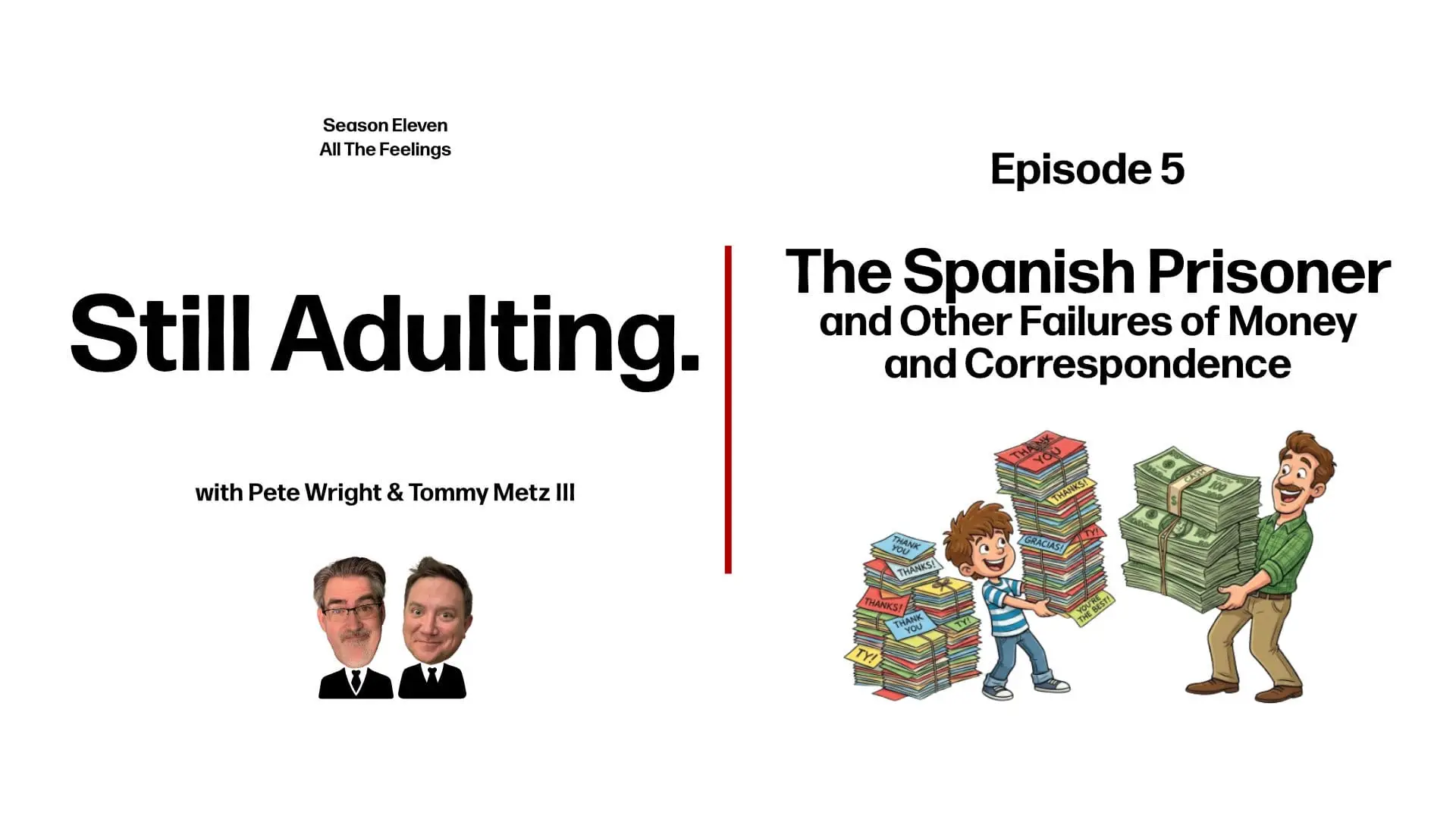
This episode
Topic Card:
Money Lending and Thank You Notes
Tommy Metz III:
Hello, and welcome back to All the Feelings: Still Adulting. I am one of your hosts, Tommy Metz III, and with me is — who?
Pete Wright:
Pete Wright.
Tommy Metz III:
Ugh, he’s right.
Pete Wright:
Yeah, I know. Hi everybody. Welcome to the show. It’s episode five of this fine season — a grab bag of topics around adulting.
Tommy Metz III:
That’s right.
Pete Wright:
Tom — “Adulton.” What — that was fantastic.
Tommy Metz III:
Adulton? Oh my gosh, I see your bindle.
Pete Wright:
Yeah. Well.
Tommy Metz III:
You got a little corn husk in your mouth.
Pete Wright:
I need to know, Tom — just as a check-in — how are you feeling about the lessons learned so far this season about your journey with adulting? Have you learned something? Do you feel like you’re a better person for these conversations?
Tommy Metz III:
Absolutely, very much so. But I’m so dumb that I’ve learned it, but it hasn’t sunk in. I was doing laundry — this is an absolute true story. It’s on the second floor of my building even though I live on the first floor, because the first-floor washer doesn’t work very well. I took all of my clothes and put them in the dryer and was like, oh, I’m such an idiot. I went all the way downstairs and back into my apartment and pet my dog and opened my cabinet to get the fabric softener, which I threw away weeks ago. So it’s like I’m learning, but it’s still a growing pains situation.
Pete Wright:
It takes a while for these things to install. I’m excited about today — mostly because this is one where I have a topic I truly don’t execute well, and you have a topic I don’t have any experience with. So this was a lot of research and a lot of emotional prep for me. I’m ready to go.
Tommy Metz III:
You’ve been sort of dreading this topic.
Pete Wright:
And I think with that, I think you’re going first.
Tommy Metz III:
I’ll take it away. All right, here we go.
Show Intro:
Subset One
Topic Card:
Lending Money to Friends
Tommy Metz III:
Pete, I have a short tale to tell you about a family member of mine. And Pete, I have to warn you ahead of time — this tale involves heroin, okay. Everybody drink.
Pete Wright:
Oh, I’m so glad.
Tommy Metz III:
If I don’t say heroin once an episode, an angel loses its wings. Here we go.
This involves one of my 900 cousins that live in the South. This cousin will remain nameless, but I can reveal that she is a she, and something happened years ago to her while she was attending a Christian university. She was approached by someone at the school and they started up a friendship of sorts. And this new friend, after a few weeks, asked for a favor. He needed to borrow some money. Apparently a family member of his in another state had passed away, and they had left some valuables to him in their will. He said he needed to borrow money from my cousin to have the valuables shipped to him, and then as soon as they arrived he’d have them appraised and would be able to sell them and pay my cousin back — with interest — once he sold the goods.
He only asked for a small amount of money because he was able to front the rest. But then, in a turn of events that can only be described as harrowing, he saw her the next week and reluctantly explained he had mistaken the amount needed to cover the shipping — it was much higher than he originally thought. But on the good side, the valuables, it turned out, were also much more valuable than he had originally been told. And so, hat in hand, he asked my cousin to loan him a considerably larger amount of money — with the promise that the windfall he would be receiving was big enough to pay my cousin back double what she loaned him. Everybody wins, Pete. There’s not a downside to any of this.
My cousin was reluctant, but incredibly kind. And this is just this weird part of the story — it’s a Christian university, so it was probably a very trusting, virtuous place. And she loaned him the rest of the money and waited for news about the shipping.
Pete Wright:
How many commas are we talking? Can you give me that? How many commas in the number?
Tommy Metz III:
Thousands. Like — I think maybe fourteen, fifteen hundred dollars if I remember correctly.
Pete Wright:
Okay. All right, good.
Tommy Metz III:
So not like a zillion dollars, but for a college student, an enormous amount of money. That was sort of like her savings.
Pete Wright:
Yeah. That’s money.
Tommy Metz III:
She was helping someone out, and to be honest, she was going to get a reward in effect, and she wanted some of that money to help cover whatever. Bibles? I don’t know.
Anyway — the valuables came in, the guy appraised them, they were worth a ton of money, and she got double her money back. And that’s it. So Pete, what’s your — oh no, that’s not how it went.
Pete Wright:
Which is not how the story went, I imagine.
Tommy Metz III:
No. You can probably guess she never saw the young man again. It turned out he was apparently not even a registered student there. He just picked her out of a group.
You know what just happened here — this scheme, this scam — under another name. I know you know what it is.
Pete Wright:
All I’m thinking about is the prince. The Nigerian prince.
Tommy Metz III:
It’s the exact same thing as the Nigerian Prince. But this is the Spanish Prisoner.
Pete Wright:
The Spanish Prisoner, of course. Yes.
Tommy Metz III:
For those who don’t know, this is one of the oldest cons in history. It dates back to the early 19th century. The original scam is called the Spanish Prisoner because it involved getting a mark to loan funds to release a rich man imprisoned in Spain, with the promise of a great reward once the man was released. But of course there was no Spanish prisoner in the first place. A more recent version of this con — like you just said — is the Nigerian Prince Scam, where you help free someone from Nigeria and you’ll be handsomely rewarded. And then it turns out there is no prince.
Pete Wright:
Yeah. There is no Nigeria — wait, no.
Tommy Metz III:
There is a Nigeria, but there’s just no prince. Why am I telling you this tale, Pete?
Pete Wright:
I’ll bet it has something to do with — no, there will be no rhetoricals today.
Tommy Metz III:
That’s just — I’m going to stop asking you things because you’re better at this than I am. No, I’m just telling you this tale because this is an extreme case of lending money to friends or family gone horribly wrong.
And I don’t believe most of us are going to be at risk of being befriended and scammed by faux Christian loan sharks — that’s not what this segment is about. But lending money to even your closest friends can be very risky, both financially and emotionally. And that’s what this segment is about: the idea of, as an adult, lending money to friends or family.
When I say it’s risky — to wit: in 2022, Bank of America interviewed all of their customers, and more than half of their consumers had seen a friendship end over money owed. Over half. And more than two in five — so about 43 percent of Americans — said they would be willing to end a friendship for not being paid back. And nearly three-quarters of that group said $500. That’s the line.
I don’t like that. But I also don’t like the idea that lending money to friends is so — I guess I just have to go with harrowing. Of course it’s hard to say no to a friend in need, and therein lies the trouble.
So before we go any further, I’m going to roll the dice and put the mic to you again, even though you’re more articulate and better at things. Have you lent money to friends or family in the past? And if you have, or if you haven’t, do you have any hard and fast rules about it? And let’s say this isn’t money for a dinner — this is more like hundreds of dollars.
Pete Wright:
I have never lent money to friends or family. I have been on the receiving end of a loan from family. In college, I got myself into some credit card trouble, and I needed to fix that quick. I moved to Korea, where I could make some good cash and had a favorable tax advantage, and my dad loaned me the money I needed to pay off those debts, and I paid him back. It involved — I literally gave him my car. I said, sell my car, it’s all yours.
Tommy Metz III:
Wow.
Pete Wright:
Because I was not needing it. I was in Korea. And that was what got me to Korea.
Tommy Metz III:
And then he went to sell the car and it turned out there was no car.
Pete Wright:
All the other Korea stories are amazing.
Tommy Metz III:
It was the Spanish Prisoner car.
Pete Wright:
The Spanish car.
No — and so the lesson I got out of that as a twenty-one-year-old was: dear God, man, don’t get yourself in that situation again. It’s the worst.
Tommy Metz III:
Did it put a strain on you and your father? What was the emotional cost like?
Pete Wright:
Yeah, it did. There was always that giant number hanging over my head until I paid it off. And I hated that because it was wrapped in — or I should say, it pulled the veil back on a great both insecurity and shame for having let myself get into this situation, and a little bit of like — what didn’t you teach me that allowed me to get into this situation?
Tommy Metz III:
A little bit of spiteful feelings.
Pete Wright:
Yeah, a little bit of spite. And I — at the time — felt like, I guess we’re in it together.
Tommy Metz III:
Like you both contributed to this problem, in effect.
Pete Wright:
Yeah, which — let me say again — is not true. It was all me, and I was narcissistically deflecting the real issue. Not great. I paid that off over a couple of years, and it was a significant amount of money. And I was just very lucky to find a position that would allow me to do that.
Tommy Metz III:
Years. Wow. In another country.
Pete Wright:
In another country.
Tommy Metz III:
That’s pretty severe. Well, I wasn’t going to tell this story, but my story pales so much in comparison to yours that I want to tell it now. I once had to borrow money in college from my dad because I got in trouble with Columbia House. That’s how old I am. They would send you a mailer and you could pick six albums for a penny, but then you had to buy full price later. And then they would just send you albums and it was impossible to return them, and you didn’t want the albums they sent.
Pete Wright:
Yes.
Tommy Metz III:
And I just completely ostriched it. I had a pile of — these were cassettes, yeah. They just kept sending me, and it was like, it was probably just sounds of the forest. Like, bird calls. And finally they sent me a letter, and that’s when I learned what collections departments were. They were like, hey — remember the physical property we kept sending you? You have to pay for it.
And I finally had to ask my dad. This was like, maybe $200. It wasn’t a lot, but I just didn’t have any money at that point. Anyway, that was a big lesson.
Okay. I have actually lent a fair amount of money to friends — never to family. Especially during the first decade or so after moving to LA. And I’m going to go ahead and say, to take away any suspense, I’ve always ultimately been paid back. Not when I was exactly supposed to be, but eventually, and we’ll get to that.
There was one big hiccup. A friend had been falling behind and he was using a paycheck advance — where you pay a commission to a company because you just need the money a little bit early? And he was paying interest to one of those companies because his bills and rent just weren’t lining up. He had a steady income, it just wasn’t lining up.
Pete Wright:
Oh, that interest. That interest is — what’s the word?
Tommy Metz III:
Harrowing. That’s it.
And so I became his occasional check advance company, but I just wouldn’t charge him anything for it. There was no commission. I wasn’t making any profit. It was a very steady schedule. I had the extra money to help him and I didn’t want him throwing money away to make his life work.
But it’s an important thing to know — it wasn’t a ton of money, and he had a weekly paycheck coming in. So it’s not like I was just giving money away.
Pete Wright:
Just money in, money out, money in, money out. You were a bank. The Bank of Tom.
Tommy Metz III:
I was, yes. So that’s the obvious rule number one: don’t give out money you can’t afford. It’s not selfish to tell a friend that money is tight right now — it’ll save strife for the friendship in the long run.
I looked up posts on Reddit about lending friends money, and a lot of people were talking about how they were accidentally wallet-scoping their friends who they’d lent money to. Meaning — they couldn’t help but notice if the friend was going out a lot, or buying a TV, feeling like: you have the money to do that and you haven’t paid me back. And that’s a really gross way to feel about your friends. But they were just having trouble not feeling that way.
There was once when I had lent a different friend a considerable amount of money — we’re talking about fourteen, fifteen hundred dollars. They had a really bad string of luck and just needed some funds to get back on track. In theory it was the same thing: I just need this to cover, and within two weeks I’ll have my normal money back. Unfortunately, things just kept happening. Cars kept breaking down, things kept breaking. All the proposed deadlines were missed over and over.
And I have to be honest — it got scary for me. I had to move funds around. I started putting things on my credit card. I started doing my own check advance.
Pete Wright:
To make sure you could pay your bills.
Tommy Metz III:
Correct. And by “move funds around” I mean South Korea. Like, I started putting things on my credit card.
Pete Wright:
Yeah.
Tommy Metz III:
Ultimately it was all paid back and the friendship wasn’t affected, but it did make me internally change my way of thinking. And I came up with a new rule. This is the rule everybody says — all experts say it.
Pete Wright:
Twenty-one percent interest, annualized.
Tommy Metz III:
You can call it a loan, but if it’s with a friend, just be prepared for it to be a gift. Only loan out the amount of money you’re willing to lose. If the friendship is the real priority, you have to be able to say: I’m saying goodbye to this money. Week in, week out, I could lose some of that smaller amount. The larger amount — I could not. If you have that kind of rule, it can keep the emotion out of it. And that’s what makes the whole thing so hard — emotion is what makes it so hard.
Is that why you had such a difficult time with it? Because you went through that with your dad?
Pete Wright:
Yeah, of course. I don’t think I had a sense of the gift-loan balance. What I probably wanted was for it to be a gift, and he did not. And that might — thanks, Dad.
Tommy Metz III:
You kept being like, “Wow, thanks, Dad.” And he’s like, “Yeah… thanks.”
Pete Wright:
Right. We’re good, right? No, really, we’re good? And you get receipt after receipt.
I don’t think I’m an ungenerous person. If somebody were to come to me and say they’re in real dire straits, I need a loan — actually, now that I say this, oh my goodness, I have given a loan. Just now I remembered.
Tommy Metz III:
What? Since we started talking?
Pete Wright:
No, it was years ago. We had a colleague — a podcaster — who ended up in some real dire straits with medical debt. We stepped up and just considered it a gift. We said: this is what we have to do to help you pay your rent this month so you have a place to heal.
Tommy Metz III:
Right.
Pete Wright:
And that was but that’s the only time I’ve ever done it. Don’t get the wrong idea — I’m still a real selfish SOB.
Tommy Metz III:
All the Feeling Friends just immediately start ripping up their asks.
Pete Wright:
Do people come to you? Like Tom, I need some money, give me some money and a cookie?
Tommy Metz III:
Not for a long time, but during the first ten years or so in LA, I was lucky enough to have a little bit more. I lived very cheaply. I didn’t have dependents, I didn’t have a girlfriend. The money was — I had enough. So I had made it clear to people that I didn’t want them to throw their money away on a check advance if we could come up with a steady thing.
Pete Wright:
So it sounds like there’s a little dance you’re going through with people. When you see people in your immediate circle who are struggling, you start a conversation: that’s crazy, let’s be better about this — maybe if I can help you, that would be a way to do it.
Tommy Metz III:
I try to. I’ve had people who could have benefited from that say no. At one point I got frustrated because I thought maybe it was about pride.
Pete Wright:
Yeah.
Tommy Metz III:
And I don’t care about pride if you’re not eating well enough. But it might not be pride. It might just be that the knowledge of going down this road can be scary for a friendship. It may just not be worth it.
Another thing — this reminded me of when we talked about bereavement a while back. If someone is in trouble, either because they lost someone or have medical issues like you brought up, if you can’t stretch it money-wise, there are other ways to assist. You can bring them dinner, help take care of their kids if you’re able to — watch their kids for a night so they can pick up more shifts at work. There are other things to do.
But overall, the main rule is: consider it a gift, and you’ll be fine.
Pete Wright:
I love it. And I just need to say this out loud — you are just such a generous spirit. That is — your reputation is one of generosity. It’s really delightful to hear you talk about this stuff this way, because that’s just totally how I think we all in your circle have seen you since we met.
Tommy Metz III:
Well, that’s nice. Well, I’m mainly trying to get as much good feeling around me as possible, because I am still on the run from Columbia House. I didn’t pay for a single Wham album. So when Columbia House breaks down my front door, I’m coming to all y’all, and you’re helping me pay off my cassettes, one excess cassette at a time.
Pete Wright:
There is now one investigating agent left for Columbia House. And I don’t know if he’s surviving on loans from friends and family, but by gum, he’s going to find your place.
Tommy Metz III:
It is, yes — it is like the lamest “Catch Me If You Can” scenario in the entire world.
Pete Wright:
Tom.
Yeah.
What kind of letters does Dracula get from his admirers?
Tommy Metz III:
Fang mail!
Pete Wright:
What do snakes write at the bottom of their letters?
Tommy Metz III:
With love and hisses.
Pete Wright:
Where do ghosts mail their letters?
Tommy Metz III:
The Ghost Office.
Pete Wright:
Here’s the thing to know about me. And I say this with full awareness of what it probably reveals about my character.
I have a box of thank you note cards in my desk drawer. They have been there for years. They are still in plastic wrap. Not because I haven’t needed them. I have needed them many times. Beautiful dinner, generous gift, a kindness I absolutely intend to acknowledge. The cards just sit there, pristine and accusatory, sealed inside their little cellophane tomb, waiting for a version of me that apparently does not exist.
I knew this was expected of me. My parents tried to instill this in me. They had cards and stamps and the true infrastructure. They modeled the behavior. I observed them modeling the behavior. I did not absorb it. Like a lot of things in adult life, I watched it happen and somehow assumed the skill would transfer by way of osmosis. It did not.
Now, I want to be fair to myself here, because it turns out this is not a new problem. Humans have been anxious about correspondence for a very, very long time. The Victorian era was so consumed with letter-writing anxiety that publishers printed entire etiquette manuals just to manage the social pressure around proper correspondence. Comprehensive rule books. And the rules? Magnificent, deranged. Black ink only — the color “most durable and tasteful on all occasions.” Red ink: never. Blue: possibly. And that’s just the ink. We haven’t even gotten to paper thickness. Nothing, the guides warned, looked more “mean and untidy” than thin paper, because apparently your envelope was also a moral statement.
My personal favorite: an 1890 etiquette book declared that bad spelling was not a faux pas, not a slight rudeness.
Show Intro:
An offense against society. An offense against society.
Pete Wright:
So if you’re sitting at home feeling guilty about your unmailed thank you notes, congratulations — the Victorians also considered you a criminal.
But here’s the part of history nobody talks about. Before 1840, if someone sent you a letter, you paid for it — not the sender. The recipient covered the postage. Which means that for centuries, getting a thank you note was essentially receiving an invoice for someone’s gratitude. Someone chose to thank you, and then charged you for the privilege. Just let that settle in. The entire social contract of correspondence was: I appreciate you, and I will be billing you accordingly.
It was only when the postage stamp was invented — and suddenly the sender paid — that thank you notes exploded in popularity. Which tracks. It turns out acknowledgment flows more freely when it doesn’t cost the recipient anything.
And that, I think, is the point. The thank you note was never really about paperweight or ink color or the precise width of your mourning border. It was about saying: I registered what you did. You exist to me. Your effort didn’t vanish into the void. The card is just the container. The content is: I see you.
Want to pay to be in a club just like those kooky proper Victorians? Just become a Feeling Friend today. For just $35 — $25 renewing — you can become a valuable supporter of All the Feelings without writing a single letter. Plus, you’ll get access to your very own members-only podcast feed, chocked full of extended editions of our episodes, member-only episodes, our trailer archive, so much stuff. So jump in now, support the season, and know you’re also supporting Pete and Tom and our stash of exotic inks and nibs that we’re likely never going to use. Visit allthefeelings.fun to learn more, and thank you for your support. And on with the show.
Show Intro:
Subset Two
Topic Card:
The Fine Art of Correspondence
Pete Wright:
Tom, it’s my turn.
Tommy Metz III:
Oh, boy. We’re gonna get into it.
Pete Wright:
Here’s what’s going to happen right now. First off, I’ve prepared for you a quiz to test your knowledge of the rules and etiquette of correspondence — of the thank you note. Now, that’s just one thing, because I don’t know if you know any of the rules. This might be a complete slam dunk for you before we get into the content proper.
This quiz was also my first experience vibe coding.
Tommy Metz III:
What’s that?
Pete Wright:
Do you know what that means?
Tommy Metz III:
No. Vibe coding.
Pete Wright:
This is why I’m so excited. I opened Claude, my AI coding assistant of choice.
Tommy Metz III:
I’ve heard of Claude, yeah.
Pete Wright:
And I said, hey Claude, let’s make an app. And we made a little web app that takes all of my research and distills it down to true-or-false and multiple choice questions. And, dear listener, if you are a member and you were watching the live stream, you would see Tom is actually looking at this app right now, and we’re going to go through it together.
Tommy Metz III:
Yeah, it looks for real. Okay, I’m excited.
Pete Wright:
Are you ready?
Tommy Metz III:
All right. Ready.
Pete Wright:
All right. “All the Feelings: Still Adulting — Thank You Note Etiquette, a Quiz Tommy Absolutely Did Not Study For.” True or false, Tom: if you thank someone in person when opening their gift, you’re off the hook. No written note required.
Tommy Metz III:
I’m going to say true — you do not need to write a note.
Pete Wright:
Let’s see what the vibe-coded quiz says. Correct! If the gift was opened in front of the giver and you thanked them verbally, etiquette gives you a pass — though sending one anyway never hurts.
Tommy Metz III:
Okay, so far so good.
Pete Wright:
We’ll talk about that in a moment. You receive a beautiful wedding gift from your aunt Carol, who lives across the country. What’s the ideal window for sending a thank you note? A: within 24 hours. B: within two weeks. C: within three months. D: you have a full year — it’s a wedding.
Tommy Metz III:
There’s something about a full year that rings true, but — I’ll say within three months.
Pete Wright:
Not quite, Tom. The answer is B. The standard guidance is within two weeks — one week if you can manage it. The “you have a year for weddings” thing is a myth that has ended many a family relationship.
Tommy Metz III:
Two weeks. And that’s the myth that I brought up — I thought there was something about a year.
Pete Wright:
True or false: a heartfelt text message is now considered fully acceptable etiquette for thanking someone after a job interview.
Tommy Metz III:
I’ll say false.
Pete Wright:
Correct. A text is still too casual for a job interview. Email is the acceptable modern minimum, and a handwritten note can actually tip the scales in your favor.
Tommy Metz III:
Also — how did I get my interviewer’s phone number? That’s the main reason. That seems like I’ve done too much investigation.
Pete Wright:
Yeah. You don’t text until after you have the job. You deliver a flower to their mailbox and wait by the mailbox.
Tommy Metz III:
Yeah, only in your mouth.
Pete Wright:
Number four. You had a lovely dinner at a friend’s home. What’s the most appropriate way to say thank you? A: a quick text that night — timeliness matters most. B: an email the next morning. C: a handwritten note within a few days. D: nothing — you brought the wine. That’s basically a note.
Tommy Metz III:
I’ll say what I do: nothing, because I brought wine.
Pete Wright:
Not quite, Tom. For a dinner party at someone’s home, a handwritten note is still the move. The wine was great and necessary, but it doesn’t count as correspondence.
Tommy Metz III:
Oh. What if the wine was called “Thank You Very Much for Dinner, I Love You, Angela?”
Pete Wright:
Correspondence is not food. That’s the lesson here.
Tommy Metz III:
That’s a good point. Okay.
Pete Wright:
How about this one — true or false: if too much time has passed, it’s better to say nothing than to send a late thank you note.
Tommy Metz III:
From now on, I’m going to answer as I do, not as I think. True. I think there’s a statute of limitations and you’ll just come off as a weirdo.
Pete Wright:
False! This is a common paralysis trap. A late note is always — always — better than no note. The longer you’ve waited, the more it will mean to the recipient.
Tommy Metz III:
Huh. Yeah, I guess that makes sense.
Pete Wright:
Think about that. Which of these does not need a handwritten thank you note by modern etiquette standards? A: a wedding gift. B: being a house guest for a weekend. C: a casual coffee paid for by a friend. D: a baby shower gift.
Tommy Metz III:
C, with a bullet.
Pete Wright:
A casual coffee.
Tommy Metz III:
If I got a letter saying “thank you for the coffee you bought me,” I would freak out.
Pete Wright:
We would not be friends anymore. That is the correct answer. A casual coffee is low-stakes enough that a verbal thank you or a quick text is fine. Everything else — get out those note cards. Next question.
Tommy Metz III:
Got it.
Pete Wright:
According to research, people who write gratitude letters feel better afterward, even if the letter is imperfect.
Tommy Metz III:
True. I would think so.
Pete Wright:
True. And this is the cruel irony. The thing we avoid because it feels awkward is the exact thing that puts us in a better mood. We are biologically outsmarting ourselves.
Tommy Metz III:
Huh.
Pete Wright:
You interviewed for a job at 2 p.m. When should your thank you email arrive? A: within 24 hours — the next morning is fine. B: within 12 hours — waiting in their inbox the next morning. C: within a week — you don’t want to seem desperate. D: from the parking lot immediately after — show enthusiasm.
Tommy Metz III:
I would do B — within 12 hours, waiting in their inbox the next morning. That’s what I would do, and have done.
Pete Wright:
The answer is correct, Tom. Outstanding. Twelve hours is the modern rule. If you met them in the afternoon, it should be waiting for them the next morning — though please don’t send it from the parking lot.
Tommy Metz III:
Yep.
Pete Wright:
Two more. In the Victorian era, the recipient of a letter paid the postage, not the sender.
Tommy Metz III:
Didn’t we just talk about this?
Pete Wright:
This is the point of the quiz, Tom. Were you listening to the Feeling Friends segment?
Tommy Metz III:
I see. Yes, got it. True — the recipient paid the postage.
Pete Wright:
Absolutely true. And last: what does the word “thank” actually derive from? A: the Latin “gratis,” meaning freely given. B: the Old English word for “think.” C: the French “remercier,” meaning to repay. D: the Norse word for debt.
Tommy Metz III:
I’m going to say C — the French, meaning to repay.
Pete Wright:
Not quite. It comes from the Old English word for “think.” So a thank you note is literally just: I had a thought about you, and it was a good one. Before today I would have said Latin, “gratis” — I’ve always associated those.
Tommy Metz III:
Oh, that makes sense.
Pete Wright:
So here we are. Now let us see your final score.
Tommy Metz III:
How’d I do?
Pete Wright:
Six out of ten. You are, quote, “well-intentioned but imprecise. You have the feelings. The execution is a work in progress.” Welcome to the show.
Tommy Metz III:
Thanks, vibe coding. That was exciting.
Pete Wright:
That was a great experience. I can’t wait to do it again. Tom — let’s talk a little more about today’s etiquette, because in addition to the quiz questions, I learned some stuff. I’m not good at correspondence. It just never installed for me. I’m not fast at it. And I think etiquette has changed in ways that let me off the hook in some interesting ways. But I also miss opportunities to deepen relationships because I’m not performing my gratitude well enough. And I say that intentionally, because it falls into the paralysis of perfectionism for me. It’s not that I don’t feel grateful. I feel very grateful when people do nice things. The problem is that I feel so grateful that I always think I should express it perfectly. If I can’t express it perfectly, I just don’t do it. And from the outside, that looks like I’m not grateful at all. That’s the seed of the cruel irony.
And believe it or not, there is research that says — they should have called it the Pete Problem and they didn’t. They named it something different. A study published in Psychological Science found that people still struggle with thank you notes specifically because they feel awkward about expressing gratitude in a way that will be appreciated by the receiver. We’re so worried about the landing that we never take off.
What’s your experience with thank you notes? You probably do this really well.
Tommy Metz III:
I did, and I have stopped. It’s been replaced by a thank you text. But I used to really pride myself on this — whenever I’d make a short film, I would write a handwritten card to every single person on the crew and cast. When I started Young Storytellers, I would write notes to all twelve mentors, plus the school liaison, plus the principal. It was kind of part of my identity.
And then my handwriting got worse and worse, my hand started hurting, and that coincided with looking around and seeing no one else was doing this. And I got a slightly different version of that same paralysis. I got self-conscious: am I coming off as a weirdo? Because — when was the last time I got a card for anything? Never. So why am I working so hard? Because it kind of takes forever.
Pete Wright:
I’m so glad you brought up handwriting, because that was my next point. Handwriting shame. My handwriting is just bad. It’s always been bad.
We had a mutual friend who was in the architecture program and his handwriting was exquisite. That architecture handwriting.
Tommy Metz III:
I love a good handwriting. When you look at a handwriting and think, that could be a font — that’s actually legitimately attractive to me.
Pete Wright:
Me too. And I tried to do that, but it’s like you start a thing and you don’t finish it and it only gets halfway instilled in your identity. So my handwriting is a mix of perfect consonants and very sloppy vowels. I go back and forth between capital letters and lowercase letters. It’s chaos. My handwriting is an agent of chaos.
And here’s another thing about those kooky Victorians. They had an entire industry of anxiety built around this. Victorian letter-writing guides warned that anyone could read a letter and make inferences about its author. The paper you choose was a moral statement. Bad spelling was an offense against society. They were teaching you how to be a better correspondent, and how to judge others who were not.
Tommy Metz III:
Missing the point completely. I love Victorian society. What a nightmare.
Pete Wright:
And they were probably using quills, which makes all of it even more deranged. So correspondence is a legacy anxiety we’ve inherited from about 150 years of being told our penmanship makes us look like criminals.
Tommy Metz III:
Yeah.
Pete Wright:
All right. Let’s talk about the etiquette today, because from an adulting perspective, I think that’s really useful. When the rules are unclear, anxious people generally do nothing. That is a strategy, and it is not a good one.
The short version: less than a decade ago, expressing gratitude with anything other than a handwritten thank you note was considered less than gracious. Less than a decade ago. Today, etiquette has blissfully evolved. A text, an email, a phone call, or saying thanks in person can all communicate sincere gratitude, depending on the situation. The goal now is matching the method to the moment. Is your method of gratitude matching the moment of gratitude?
Tommy Metz III:
What does that mean?
Pete Wright:
A rubric. Email is acceptable for a casual coffee or a meal, especially if the invitation itself came by email. For dinner parties, for big favors, for actual gifts, for being a house guest — handwritten is still the gold standard. Weddings always warrant a card. Baby showers and job interviews are also still in card territory.
And hiring managers apparently do notice. One survey found that 63 percent of recruiters said they were more likely to hire someone angling for a higher salary who sent a thank you note than someone who wanted slightly less money but didn’t bother. A thank you note is literally worth a salary negotiation. Just sit on that for a minute.
Tommy Metz III:
I guess we’re still rewarding thank yous. At one point I got confused because someone had sent me a really nice thank you note, and I started to write a thank you for their thank you note. And then I was like — wait. Therein lies madness. We can’t just keep going back and forth.
Pete Wright:
Thank you notes all the way down.
Tommy Metz III:
Yeah.
Pete Wright:
Timing: within two weeks is the general guidance. One week is better. If you’ve missed the window, send it anyway. The late note is always better than no note at all. I wish that had been instilled in me better, because I’ve got about 42 years of thank you notes I feel like I could still get out the door. Never too late.
Tommy Metz III:
Friend of the show Nikki Small — I’m going to call her out. When we were on a cross-country driving trip a zillion years ago, her car broke down. We ended up being pushed and pulled and helped out by the world’s most amazing park ranger, because we were just stranded on this mountain. And for years, Nikki is still planning on writing this park ranger. Who is — I mean, the park is probably gone, everything’s changed, it’s so long ago. But I always think about that. And she’s like, oh yeah, it’s on the top of my list. It’s been a decade.
Pete Wright:
That’s outstanding.
I want to go back to the origin of the word. “Thank” comes from the Old English word for “think.” That’s a meaningful insight I’ve never considered. This is just: hey, here’s a kind thought that crossed my mind. Something I need you to know I’m thinking about. That’s the whole thing. It’s just: I thought about you. I registered what you did. And this card — or text, or email — happens to be the delivery mechanism. But the feeling is already there.
The more I think about that, the easier it might be to instill a little bit more handwritten effort. I’m going to have to practice the handwriting. People are going to think I’m collaging from a ransom note.
Tommy Metz III:
Well, you actually touched on this when we talked about maintaining friendships. You put a call out to listeners saying: just pick someone — even the hard one — and say, I’m thinking about you.
This also reminds me of when we talked about what makes a good house guest, and I was worried about having too many cabinets open. And you said: a house guest is the gift of yourself. The gift of opening yourself up and saying, I want to spend time with you. If the “time” is just a card, it’s the exact same thing. It doesn’t matter. It’s the fact that you’re doing it, not what’s inside of it. Not how many cabinets are open, or whether your E is literally backwards like a cartoon character.
Pete Wright:
Yeah. I do substitute — because of modern password standards — I substitute exclamation points for I’s and the number sign for sevens.
Tommy Metz III:
Oh, you write in leet speech.
Pete Wright:
I handwrite in Markdown.
Tommy Metz III:
Nobody knows what that is, but you do.
Pete Wright:
People like to have me around at parties.
Tommy Metz III:
I think from now on, instead of thank you notes, you should send everyone a vibe-coded quiz. “How thankful am I: Very, or Really a Lot.” And they have to choose.
Thank you all so much for joining us for this episode. This week’s tune is “Postcard Weather” by Low Light. Coming up next week, Pete — what are we talking about?
Pete Wright:
Oh, it’s another hodgepodge, another grab bag. It’s a real cornucopia. We’re talking about work-life balance and, maybe ironically, how to quit your job.
Tommy Metz III:
So that’s when work-life balance doesn’t work and you throw in the towel.
Pete Wright:
Until then, I’m Pete Wright.
Tommy Metz III:
And I’m Tommy Metz III. Thank you so much for downloading. We will see all of you next week with All the Feelings: Still Adulting.
Pete Wright:
It’s like when people ask me, “Your friend Tom, tell me about him.” I say: oh, he’s somebody who has abdicated any relationship with cozy.
Tommy Metz III:
That’s how you start.
Pete Wright:
Yeah. He doesn’t like cozy. He hates being soothed.
Tommy Metz III:
Anything that’s soothing, I don’t like it. I want everything to be rigid and crunchy and cold as ice.
Pete Wright:
I will soothe all day. I love soothing, being soothed. I’m like the Heat Miser and you’re Mr. Freeze.
Tommy Metz III:
Does that make us symbiotic or the opposite of symbiotic? It makes us — Jack Sprat and his wife.
Pete Wright:
Yes.
Tommy Metz III:
But we also live in a shoe. Just as a sidebar. That’s elective.
Pete Wright:
Would you start this goddamn show.
Tommy Metz III:
Okay, here we go.