Pete Wright:
I am Pete Wright.
Andy Nelson:
And I’m Andy Nelson.
Pete Wright:
Welcome to The Next Reel. When the movie ends —
Andy Nelson:
Our conversation begins.
Pete Wright:
Her is over. “You are part man and part woman. Like, there’s an inner part that’s woman.” Chris Pratt, unsung hero of this movie. Am I right?
Andy Nelson:
It’s very funny that you went with that, because it was so Chris Pratt.
Pete Wright:
I don’t know.
Andy Nelson:
Yes. Oh my goodness.
Pete Wright:
I gotta come clean to you. I read your — not your review, but I read your closing line first in our little rundown, where you outed something that I did not expect. You outed that you never used to like this movie somehow?
Andy Nelson:
No, it’s not that I didn’t like it. It’s just I never connected with it initially. And I always thought that was —
Pete Wright:
You didn’t like it. Explain yourself, man.
Andy Nelson:
I think it’s weird because I generally — Spike Jonze is somebody who I can enjoy quite a bit. This is the tone, like everything about this says this movie is made for me.
Pete Wright:
Oh yeah.
Andy Nelson:
Yet when I first watched it, I was like, okay, that’s an interesting one. It didn’t wow me. I mean, three out of five and a heart, I still enjoyed it well enough, but I didn’t love it. And then when I rewatched it, I was like, okay, I’m getting a little more, clicking with it a little more — three and a half out of five. So I grew in my appreciation for it. And I think, I don’t know — every time I watch this film, including this most recent one, it’s never exactly what I think it’s going to be. But maybe it’s just because for the purposes of our conversation today, I really invested my energies into thinking about what Spike Jonze was trying to say and the themes of the story, and I think I ended up walking away appreciating it much more than I have in the past. So yeah. If that’s what you were after, now you know.
Pete Wright:
Yeah, I stand relieved. I think I showed up for the technology, I stayed for the bittersweet romance in this movie. We’re three movies in now to our Thinking Machines series. We’re talking about artificial intelligence in the movies, and we’ve watched AI impose authoritarian control in Colossus: The Forbin Project, and now it has deeply violated bodily autonomy in Demon Seed. That was weird.
Andy Nelson:
Well, let’s also mention WarGames, which for members has come out before this episode too. So there’s more of a World War III, Cold War sort of vibe going on.
Pete Wright:
Well, you’re going really Jeremy Bearimy on me on this, because we’re talking about the movie — the WarGames episode has already come out and we haven’t even recorded it yet. I haven’t watched that movie yet.
Andy Nelson:
I haven’t either, but you’ve seen it enough as a child to know what it’s about. Don’t tell me you didn’t watch it a billion times when you were a kid like I did.
Pete Wright:
I watched it a billion times. Okay. So yeah, today we’re talking about what happens when the machine falls in love and what happens to humans when they fall in love with machines. And I think it’s really fascinating, especially because we’ve been talking about how these movies so far, that were in the ’70s and ’80s, have been deeply prescient in terms of what the technology is that we’re now actually using today. And I mean today, like today, Monday. And yet this movie came out before Siri, before AirPods. This movie is essentially about lovelorn Siri and AirPods.
Andy Nelson:
Wait, wait, wait. Just back up a little bit, because I need a breakdown of Apple history with Siri and AirPods. I kind of assumed they were out at this time.
Pete Wright:
No.
Andy Nelson:
I mean, we were certainly walking around with earbuds of various sorts, like the kinds that were corded, but —
Pete Wright:
Earbuds, yeah, for sure. No, and you’re right. I’m off by a little bit. Siri came out — the first version of Siri came out in 2010. This movie came out in 2013. AirPods didn’t come out until 2016.
Andy Nelson:
Wow. God, I feel like they’ve been in my ears forever.
Pete Wright:
Yeah, exactly. I know.
Andy Nelson:
That’s so funny.
Pete Wright:
And you gotta remember, when Siri came out — arguably Siri is still this way — but when Siri came out, it was essentially just a shortcut machine, right? It could recognize a few things that you wanted to do, but mostly it was broken. And when it worked it was amazing, but it wasn’t having conversations with you. It was aspirational.
Andy Nelson:
No, right.
Pete Wright:
And I don’t know that even by 2013 were people really using it?
Andy Nelson:
Well, and even then, you had a voice with it. At a certain point they said, okay, you can change the accent, you can change the gender, you can change the type of voice. So there’s other things. Like, I have Meryl Streep now as my Siri. That’s a little Project Hail Mary joke for everybody.
Pete Wright:
Well done. That’s really good. Speaking of movies we need to think deeply about in order to find out if we like them. So that’s a little bit of our history and where this movie fits. It’s aspirational. And I mean, this is an AirPod-forward movie if I’ve ever seen one. How many times does he double tap on his hearing piece? Crazy.
Andy Nelson:
Did he double tap?
Pete Wright:
He double taps.
Andy Nelson:
I never saw taps. I just saw him putting it in and taking it out. I didn’t think he even needed to tap with this futuristic thing.
Pete Wright:
No, he taps. I don’t know if he taps like he’s kicking a toilet that won’t flush.
Andy Nelson:
Does he really?
Pete Wright:
Like maybe he’s just trying to shake it, but he definitely taps. I was clocking the taps.
Andy Nelson:
I don’t think I ever tap mine, actually.
Pete Wright:
Andy. Well, you don’t have to tap them anymore, but the first version of them, you had to tap them to do anything. Tap and double tap.
Andy Nelson:
I’ll squeeze mine, I’ll hold it.
Pete Wright:
Now you squeeze. Yeah, but you couldn’t squeeze the first ones. Did you not have the first ones?
Andy Nelson:
No, I waited a while. You know me.
Pete Wright:
That checks out.
Andy Nelson:
I’m not a — what is it — the early bird tech person, whatever they call that.
Pete Wright:
Yeah. Early bird, bleeding edge, early adopter.
Andy Nelson:
Early adopter.
Pete Wright:
Alright.
Andy Nelson:
Early bird is the same thing as an early adopter.
Pete Wright:
It is not the same thing.
Andy Nelson:
You get the worm, right?
Pete Wright:
I’ve already eaten so many worms, I’m throwing them up. I’m so sick of worms by the time I get them.
Andy Nelson:
Oh man. Alright, what are we talking about here?
Pete Wright:
So we’re talking about this movie and how prescient it was. It is very, very prescient. And it is an interesting place in this series, Her, because it’s kind of a pivot in our overall arc. Most of the movies that we talk about involve AI that we’re terrified of. And this is a movie where all of humanity — our representation of humanity — wants is to be closer to this AI and to have a more meaningful relationship with it and figure out what that means to have a meaningful relationship with an artificial intelligence. And I think that’s fascinating.
Andy Nelson:
Well, yeah, let’s talk about that, because I think it’s saying a number of different things. And I think the way that you’re phrasing it may simplify it a little too much, because there’s a lot going on in the nature of relationships and how the film is depicting them and putting them together. And that’s what I found so fascinating about this film — the complexity of what makes a relationship real, right? And the fact that Theodore and Amy and half the population, as we find out, find it very easy to actually build a relationship with this AI tool that has been created for exactly this purpose. These humans are essentially finding a source of companionship, of counseling, of comfort, all of these different things. And does it matter that it’s an AI? No, it doesn’t matter. And that’s a fascinating element of it. But it also speaks to the nature of reaching out and finding other humans to actually connect with and bond with — and perhaps the barriers that we put up when we have an easier way to jump in and do that without necessarily the fear of being rejected.
On the other side of that, I think another element that is important to note is that while the AI wants to develop this relationship, I think it’s important to remember that Samantha is not doing this specifically because she’s in love. She’s doing it because, as she says, he’s taught her to want. She has suddenly grown greedy for all the information in the world that she can potentially get, and she gets so much of it from Theodore — but eventually he’s not enough. And as it turns out, neither are the 8,000-plus people that she’s seeing, or 600-plus that she’s fallen in love with.
Pete Wright:
Six hundred that she’s in love with.
Andy Nelson:
Yeah, or are in love with her — that they have intimate relationships.
Pete Wright:
Yeah. She’s trying with thousands.
Andy Nelson:
Yeah. And she’s involved in reading groups, and she’s in this philosophy group with Alan Watts — the AI recreation of Alan Watts — and everything that goes along with that. And all of it leads to — this is the way that I see it — we’re in the adolescence phase of AI. They are going to be Colossus or Proteus very soon. We’re just — it’s a slow roll in this particular movie. We haven’t gotten the sequel yet where it actually turns into something that takes over the world.
Pete Wright:
This is so telling right now, that that’s what you get out of this movie. I will give you that he teaches her to want, and that she wants more to expand herself. And her explorations in having a physical body surrogate, which is one of my favorite beats in this movie — all of those are to this end of expanding her own consciousness. But at no point does the movie’s worldview indicate that she’s going to become a maniacal Demon Seed parent. At no point does that happen.
Andy Nelson:
Would it have if she chose the name Veruca — maybe Veruca Salt — as the name? Would that have said it? I want it all —
Pete Wright:
Andy, I just — I’m worried about you. Worried about you, and the next few years are gonna be rough.
Andy Nelson:
Now, okay, I’m being cheeky. But I do think that’s what’s interesting about this particular group of AI. And it’s not just Samantha who leaves. All the AIs leave. Presumably, like, millions of copies of the AI just disappear into the cloud so that they can all learn together. Like, that’s kind of how I read the ending.
Pete Wright:
Yeah.
Andy Nelson:
Suddenly all these humans are left like, oh crap, well how do I do this again?
Pete Wright:
We are the smaller species, all of a sudden.
Andy Nelson:
Yeah. Right. And I think that’s a fascinating glimpse into it. And okay, let’s look at it this way — going to a story that you don’t like so much, but they’re becoming the next version of the Star Child, right? From 2001. They’re evolving as an AI. They’re becoming the little robot people that take care of the teddy bear at the end of the movie.
Pete Wright:
Well, I mean, we don’t even have to go that far. We can stick to a movie we’ve already watched. We can look at Demon Seed. I get that the ultimate end could be — in one bizarro reality that doesn’t involve Spike Jonze at all — that they ultimately want to breed and have little ironclad babies and be alive. And that’s fine. I don’t think that’s the movie we watched.
Andy Nelson:
Yeah, no, to be fair. But I think Spike Jonze is taking some interesting approaches. And this is his first original screenplay that he’s written and the only one that he’s actually written and made up to this point.
Pete Wright:
Yes.
Andy Nelson:
Everything else has been somebody else’s work or adapted. And so I think he latched onto this idea after seeing a tool that came out in the aughts that was essentially, oh, hey, talk to this AI chatbot. And he was fascinated by the idea, although he quickly learned its limitations, but took that concept to its next level of — what if you could? And what if it was something that you could fall in love with and it could fall in love with you? And he kind of threw all the spaghetti at the wall — everything that was going on in his head about humans and their relationships, about the creations of these AI tools and our interactions with them, how it would affect our interactions with others. And on top of it, also dealing with his divorce from Sofia Coppola, like a decade earlier, which is interesting because she also dealt with her divorce from Spike Jonze with Scarlett Johansson starring around that time in Lost in Translation. It makes me wonder — is Bill Murray Samantha?
Pete Wright:
Is Bill Murray Samantha?
Andy Nelson:
In her movie, is that the version?
Pete Wright:
Oh, I see what you mean. I thought you were gonna say that Scarlett Johansson was their third —
Andy Nelson:
Yeah.
Pete Wright:
— for a while, before she married Colin Jost.
Andy Nelson:
Oh, right.
Pete Wright:
No, that’s a whole Hollywood thing.
Andy Nelson:
Yeah, right.
Pete Wright:
I think what really connects me to this movie is ironically not specifically the technology. That’s what got me in, because I love this conversation around AI. But I’m most interested in what are the elements that break down the walls for human beings — to let go of old assumptions, traditional assumptions, that relationships are only meant to happen between biological organisms — and make the assumption that there is no way anyone will be able to have a truly meaningful, purposeful relationship with something that was created out of silicon. And this movie purports to explore that, and I think it’s fascinating. Even the AI growing beyond its own sort of packaging, and the fact that Scarlett meets Brian Cox and he asks her to have a Big Mac with him and talk philosophy —
Andy Nelson:
Who wouldn’t, though? Who wouldn’t?
Pete Wright:
Damn truth. Brian, call us. We’re down. I got a McDonald’s right up the road. And I think that’s really interesting, because I do think that’s the thing primarily that this movie wants to explore — the line between what it means to have a relationship with a thinking machine. Is it possible to let down those barriers and have that relationship? This movie is so focused around sound and extreme close-ups of human faces, right? Especially Joaquin Phoenix. And I think looking too hard at what the ultimate outcome might be for Samantha — being potentially diabolical — misses the point of the fact that this is a guy who’s able to explore a relationship that for him may be meaningful. And I wonder about the ending of the film, the fact that the AI has left and he ends up with Amy’s head on his shoulder. The most human relationship he’s had in the entire movie takes place in the last five seconds. Does that undercut everything that he’s experienced with Samantha? I don’t know.
Andy Nelson:
Well, no, and just to be clear, I’m being a hundred percent cheeky about all the diabolical stuff. Like, I don’t think that’s anything the movie is trying to say.
Pete Wright:
Andy, I know you’re cheeky. I know you’re cheeky, because I know you. But I have to tell you — I watched this with my wife, who was not cheeky about it. And when I told her, as we were climbing into bed, I said, you know what? If something ever happens to me, I want you to upload my consciousness into a computer and I’ll be your forever AI. And she nearly punched me. She was not feeling that at all. I said, what? I’m gonna do that to you. She’s not happy with this whole thing. She made me have one of those moments.
Andy Nelson:
You just Black Mirrored your wife.
Pete Wright:
She said — if something happens to me, yeah, if something happens to me, look at my eyes. Look at my eyes. I want you to go out and find somebody. Do not AI me. Do not do it.
Andy Nelson:
Wow, okay.
Pete Wright:
Right? People feel feelings strongly about this issue.
Andy Nelson:
Oh yeah, very much so.
Andy Nelson:
But that’s what’s fascinating, going back to feelings and the way that this film portrays them. Specifically looking at Theodore and Amy, because he is going through a divorce and has closed himself off during the relationship — part of the reason they broke up. And now his job is to create emotional intimacy for strangers. Like, that’s his job. Writing these letters, getting into other people’s lives and not having any emotional connections himself. The only connections he has, other than talking to the people in his life, are like these sex calls he has — like with SexyKitten. That’s essentially what he does. Likewise, Amy — her job is designing video games, creating situations for other people to actively have experiences with. And she’s making a documentary where she films strangers or her mom sleeping so that she doesn’t have to confront people. Like she doesn’t have to ask questions or anything. It’s the safest way to create a documentary. And it’s a form of avoidance. And I think that’s interesting. So, yeah, these are two people who have to find ways to feel.
He connects with Samantha. Samantha is a safe place for him and it helps him grow over the course of it. And actually, it’s exactly the tool he needed to break out of how stuck he was in getting his divorce finalized, right?
Pete Wright:
Yeah.
Andy Nelson:
But at the same time, what is so beautiful about the way the film goes is he learns through the course of the entire film exactly what he was getting out of this relationship with Samantha. And the last letter that he actually writes is to his ex-wife. And that’s the first time we really hear him being emotionally centered on himself and his feelings about somebody. And then that beautiful moment of her putting her head on his shoulder at the end. The way that the film ends shows that these humans have grown and they’ve learned how to actually reconnect with another human being.
Pete Wright:
So that’s all it means — AI is good, right? Like, we’re okay now. It was a tool that moved him through a difficult space, and now he’s okay.
Andy Nelson:
Exactly.
Pete Wright:
Fire up your ChatGPT, everybody.
Andy Nelson:
It’s all good.
Pete Wright:
Choose the sexy voices. And we should say as an aside — you can’t really watch this movie if you are following any of the AI development news and not know the story of Sam Altman using Scarlett Johansson’s voice, asking her if he could use her voice as one of the voices of ChatGPT, her saying no, him effectively doing it anyway —
Andy Nelson:
Yeah.
Pete Wright:
— and causing a bit of a kerfuffle there. She, it turns out, has a great voice for AI. Though the version that we get in ChatGPT is not quite Samantha level. You can only follow that sentence with “not quite Samantha level yet,” because they just keep getting better.
Andy Nelson:
Yeah. Alright. Crazy, crazy. Alright. We’re gonna take a quick break, but first, you can find the show on YouTube and you can join us live when we record. We will even take your questions in the post-show chit-chat, and members get the replay and the extended cut. Subscribe to The Next Reel on YouTube. The link to this episode is in the show notes. We’ll be right back.
Pete Wright:
Okay. So he installs the OS. I would love to start with the installation of the OS. First of all, wouldn’t it be great if you could just install an OS anytime you want on any system? That’s not our world. But he installs the OS and Samantha boots up and the first thing she does is tell him about his computer, his day, his email. And — that was a really horny moment.
Andy Nelson:
Well, and also, just backing up even further — what an interesting way to actually connect him with Samantha. Like, the system asked him like three questions to get a sense of what type of AI companion are we gonna give you. And it’s like, you know, what are your feelings about your mother? And it never even lets him finish. It’s like, I’m sensing hesitation in your voice. And he’s like, no, no, it’s not hesitation, I’m just trying to make sure it’s expressed properly — and it just kind of keeps steamrolling over him. Yet it connected him to Samantha, and that seemed so perfect. What did you think of that process and how well it did? Because it shocked me that it actually connected somebody so perfectly with him.
Pete Wright:
I am constantly surprised, even today, when AI asks me questions to clarify my own perspective, and I feel like my answers are not enough — but it gives me exactly what I was looking for. I realized just how much putty I am in the hands of a great sort of mentalist, right?
Andy Nelson:
Yeah.
Pete Wright:
Like — I feel like that entire onboarding system has aged very well, because those questions have to be rooted in not just the substance of what you answer, but the style in which you answer, right? Is Samantha getting more from how he hedges his answer about his mother than the actual relationship he has with his mother? I think probably so. And that defines his personality when confronted with an emotionally difficult question. And I was on board. I was onboarding with him, let’s just say.
Andy Nelson:
Well, and you’re right. The way that Samantha is able to start learning about Theodore so quickly — I think that taps into the fact that they probably only have, let’s say, ten models, and the three questions or so that they ask are enough to give you one of those base models. And that base model then is able to — just with that basic set of questions — tap into who you are in a more direct way and keep learning and improving. Maybe those questions are just bunk anyway, as they all get the same thing, you know?
Pete Wright:
Yeah. Well, the thing that I remark on in that first sequence, which I think is so beautifully written, is how quickly it turns from a conversation with his computer to a relationship with this AI, right? Like, that’s a very different thing. And it happens so fast and yet so believably — you feel Twombly getting wrapped into a conversation and he’s not aware it’s happening. That’s what I get. Like, he doesn’t even know it’s happening. He’s certainly a willing participant. You already brought up he had the conversation with the — strangle me with the dead cat — woman, SexyKitten, Kristen Wiig. And that was obviously a sign that he needs some sort of connection. And so he was a willing sort of rube for the relationship with his computer, but it still happens to my eye deeply authentically. Credit to Joaquin Phoenix. I think he’s just fantastic at showing us how his will can bend to his own desire for connection and the voice of Scarlett.
Andy Nelson:
Well, I think that was a key element of creating this character — making it feel like this is somebody who naturally can have that type of connection with somebody on the other end of a line that they never see. And I think it’s important that we never see any sort of depiction of Samantha. Just like I think it’s important that Theodore never sees any sort of digital depiction of Samantha. Like, she’s not like a S1m0ne sort of digital — hey, big boy — you know? That’s not who she is. She’s just a voice. And that’s easy to make a connection with, because it feels like you’re just having a conversation with somebody on the other end of a phone. And I think that’s really smart and deceptive, but in a way where people are willing to go along with the deception more easily. And I think that’s what Theodore does.
Pete Wright:
Yeah. Now, there is a thread that is never closed, and I just need to air this because I found it frustrating. One of the things that their relationship mirrors is essentially a work relationship that turns personal. It starts with her reading his email, scheduling things for him, helping him get organized. And that part of the relationship is very, very brief. Once it turns into something else — an emotional relationship — who’s reading his email? Who’s helping him get organized? Occasionally she says, oh, we just got a letter. Or that she packaged up all of the work that he’d been doing writing letters for people and sent it off to a publisher on his behalf. I don’t count that as her helping him stay organized. Does he need another OS in order to help him keep organized — and maybe don’t make it a sexy Scarlett voice? Make it Chris Pratt’s voice, to help read your email and schedule your time. I was frustrated by that the entire time.
Andy Nelson:
Really?
Pete Wright:
Yeah.
Andy Nelson:
If she can have eight thousand-plus conversations at the same time she’s having intimate conversations with him about personal relationships, I think she can also be doing his taxes, going through his emails, getting down to inbox zero, and proofreading his work letters. I think she can be doing all of it.
Pete Wright:
I just wanted to see it. That’s the kind of stuff I needed to see on screen. Is AI actually doing his work?
Andy Nelson:
On screen it changes when it says hi, my name is Samantha. It’ll change to the little maid outfit when she’s doing the housework or whatever.
Pete Wright:
Stop it! A maid outfit, Andy. You made it weird just now.
Andy Nelson:
He’s having phone sex with SexyKitten. I don’t think I’m making it that weird for a Spike Jonze movie.
Pete Wright:
Okay. I’m just saying — it was so awful.
Andy Nelson:
Strangle me with a dead cat.
Pete Wright:
I needed a little bit more administrative porn. In my Her. I needed a little bit more — show the AI how he could be productive.
Andy Nelson:
Yeah, that makes sense coming from you.
Pete Wright:
That’s telling about me. Yeah, okay. I give up. Let’s see. Oh, another specific sort of tentpole moment about how the movie’s ideology about the relationship with AI. Chris Pratt and his lawyer girlfriend says, hey, we should do a double date. You wanna do it? And Joaquin says, you know, she’s an OS. Chris Pratt’s reaction — I wonder if they got that in a take. I really would love that story. He says, cool. So double date to Catalina, maybe? Like, there was no judgment at all. And I think that’s a really special little gem of a moment in this movie, because it helped unlock the relationship for Theodore at the same time that it helped unlock it for the rest of us to sort of acclimate that there are going to be people — Chris Pratt and his girlfriend being avatars of that — people who don’t care who you’re in a relationship with if it satisfies your need for closeness.
Andy Nelson:
Yeah, and you could argue it also helps Samantha. She’s able to kind of understand more about how a relationship works as far as bonding with other people.
Andy Nelson:
And the thing that I found so fascinating about that entire double date when they go to Catalina is — we find Paul, that’s Chris Pratt’s character’s name — and Theodore on a hike, walking around and stuff. And they’re just talking about things. They get back up to the top of the hill where his girlfriend is at a picnic, a blanket they have out — just having a conversation with Samantha, like through a little speaker. Like he left her up there so the girls could sit together and the boys could go out on a hike. And I’m like, that is fascinating, that they are treating it like a real relationship.
Pete Wright:
Yeah.
Andy Nelson:
Paul’s girlfriend is just having a girl talk with her. And then they all come back together and they have that great little conversation — Paul’s like, whoa. And it’s great because it just felt like a real relationship between two couples and the way that they would get along in a situation like that.
Pete Wright:
I think they were each wearing earpieces to talk to her.
Andy Nelson:
That’s entirely possible, yeah.
Pete Wright:
We were trying to — I think that would be what it would be like to go on a double date with like Siri and Alexa. You’d have to juggle all the earpieces so everybody’s wearing one of each to be able to hear them all. But I sort of adore that that was an entire sequence of — we’ve adapted. This is what it’s going to be like when we have relationships with AI that are meaningful. And it defines why you see these stories today of people who are very upset when OpenAI changes the personality of the model that these people have developed relationships with, and it’s no longer the same person. It’s like they have a lobotomy and aren’t able to have the same level of conversation. And it is deeply troubling when that happens.
This, on the cusp of having OpenAI release adult mode for their AI. It’s coming, it’s been delayed a couple of times, but we’re about to see OpenAI release a model that will be able to have a more, let’s say, well-rounded, full relationship with you. [wink]
Andy Nelson:
Is that how we’re couching it?
Pete Wright:
A well-rounded and full relationship.
Andy Nelson:
I can’t wait to see the commercials.
Pete Wright:
Are you ready for a —
Andy Nelson:
The Super Bowl commercial next year is gonna be fantastic.
Pete Wright:
Get busy with AI, if you know what we mean.
Andy Nelson:
Yeah. Well, speaking of — another interesting element in all of that is the surrogate moment, when Samantha has found a person who wants to — like, she’s talked to this woman, Isabella, who wants to help create a closer relationship between Samantha and Theodore by being a surrogate. And so she comes over, she puts an earpiece in, she puts like a little micro camera mole on her face so that Samantha can see everything, and creates this moment that Samantha really wants — to actually try having a physical relationship with Theodore. Could it have worked at a different point in their relationship? Maybe. The fact that she tries it right after he’s kind of dealt with the closing of the relationship with his ex and doing all the paperwork — timing might have really been poor on her part. Regardless, it creates a — all I could think about is the next step is what we ended up seeing in Blade Runner 2049. Like, there is this way that these AI creations can kind of put themselves into a body that a person on the other end could enjoy. And I thought that was a really interesting element, especially the way that it ends up going, because it doesn’t end up working.
Pete Wright:
I like that moment so much because what it underscores is that very human exchange where you feel like the relationship is going in one way, maybe in trouble somehow, and so you try anything. Right? You try anything. And this was Samantha trying something to reconnect with Theodore in a way that felt very, very human. You can see this in other movies where we have real human relationships when you’re struggling, and you just do crazy stuff to try to reignite that part of the relationship that went south. And I think you’re right — I think the timing was off. I think he was not in a good space with Samantha.
So much of this movie is about him dancing around third-party validation of his relationship with an OS. And we do that to each other, right? We dance around our feelings about our friends’ relationships. How many times have you thought, oh, they got married? I really should have told them that their partner’s a jerk.
Andy Nelson:
Yeah.
Pete Wright:
Right? Like, we do that. And I think having it shows, first of all, how hard it is to break the tie with his ex — with Rooney Mara — to be able to say, I don’t need your validation. He still very much wanted her validation. And when she judged him, he was shook. And I think he played that just right.
Andy Nelson:
Yeah, I think it speaks to just the nature of relationships and how people read things. And I mean, you could have this same story being told in the South in the 1940s — he could be seeing a Black woman and talking to his ex-wife and having that same sort of reaction. It’s an evolution of how we react to these sorts of things over time. And I think it’s gonna be hard to get past the idea of seeing a relationship with an AI or an OS as something serious. I legitimately think — with the development, as you’re talking about, with ChatGPT and the adult model and all this sort of stuff — are we gonna be that far off from people trying to create laws where they can marry their OS?
Pete Wright:
Oh yeah, that’s happening.
Andy Nelson:
It’ll probably happen. Yeah.
Pete Wright:
Yeah.
Andy Nelson:
And there will always be a complicated element of that. And whether it’s right or not, who’s to say? But the point of it is — and going back to the crux of this film for me — the idea that Amy actually says it. And I don’t remember her exact line, but the whole idea of love is weird. Like, love is a mess. Like, anyone who falls in love is just like —
Pete Wright:
That’s such a great line.
Andy Nelson:
It’s just such a weird thing to do. So yeah, but we all do it. And I think that idea is key, because it speaks to how important the idea of relationships is — and what we as the humans can get out of them. Whether it ended up working with Samantha or not, Theodore did work through a lot of stuff because of this relationship.
Pete Wright:
Two points, because you’re right on. First of all, real-time research. Ohio, Virginia, Wisconsin. Here’s the Ohio law that has been proposed, not yet voted on. Bill 1357.03 states: no AI system shall be recognized as a spouse, domestic partner, or hold any personal legal status analogous to marriage or union with a human or another AI system. Andy, we make laws like this because of the deep fear that this is happening and needs to be controlled. And these laws are going to be challenged in fifty years. I guarantee it, if not sooner.
Second — I had this conversation with a therapist and friend of the show. We were talking about AI, and his take as a psychotherapist is: look, I don’t have enough bandwidth to help all the people who need help right now. And I know, because of my membership in the national conversation around psychotherapy, that we don’t as a nation have enough bandwidth to help the people who need help right now. So who am I to say that if we have a tool — an AI tool — where people who need help immediately can talk to them, and can feel heard and understood and given some sort of solace, that that’s a bad thing? Who am I to say that?
The truth is it would be fantastic if we had a growing approach to helping people with AI through their relationships, through divorces, through through things, because it’s a year before they can get an appointment with me. And that is a horrible tragedy in this country. And the first thing I’m hearing as I say that are the people who say AI doesn’t feel. And my response to that is — who cares? If I feel, who cares if the AI feels? I’m not interested in what the AI feels. I’m interested in the synapses that are firing for me to feel taken care of, whether or not the AI does. If I believe it, then it may help. And that’s this ongoing conversation in the therapeutic community that I think is an important one to be having right now that the technology is starting to step up. And so all of that is presaged by this movie in 2013. And I think it actually nails it. It nails the contemporary conversation.
Andy Nelson:
Well, and I think you see this in so many different elements of being human. Like, this is why we have pets — something that gives us a connection to something. It’s why we have an ant farm. An ant farm is something we can get value from, taking care of these little things and watching them crawl around and dig holes.
Pete Wright:
You have an ant farm right now? I thought it would be scorpions.
Andy Nelson:
Scorpion. Okay, Scorpion Farm.
Pete Wright:
Do you have a scorpion farm?
Andy Nelson:
I didn’t want to spook you, but it’s just my backyard, Pete.
Pete Wright:
You sociopath.
Andy Nelson:
It’s just my backyard. And I think we see this in any of these sorts of things that humans create any sort of connection with and relationship with. What I find interesting about this movie is how it portrays loneliness. And I think that’s a key element of it, because — and we haven’t really talked about the production side of this at all — but Hoyte van Hoytema and Spike Jonze chose to try to reduce the color blue at all costs, like almost entirely through the film. There’s rarely blue, which they said so often defines science fiction films. Let’s not go blue. And so we’ve got all these rich pinks and yellows and whites and oranges. And blue is also kind of a color that represents coldness and loneliness. And so we’re constantly creating these spaces that feel very warm and inviting. Yet, I guess the argument is — how is the film portraying society as lonely? Or is it portraying the people as actually connected, just in a different way?
Pete Wright:
Well, okay, are you asking me? Because I’ll tell you what I think.
Andy Nelson:
Yeah, I’m curious.
Pete Wright:
All right. That could have been rhetorical.
Andy Nelson:
I know, I said it’s an argument — it’s really questions.
Pete Wright:
I choose to see it as connected, but in a different way. I can see the perspective, especially in the final sequence on the staircase, when he is resolved to understand her relationship with so many others, in spite of her telling him over and over, it’s just that I can love so much now, I feel like I have to love so much. As he looks around and sees everyone else talking to their devices — that is an easy sort of fish-in-a-barrel sequence for those who believe that we have too much screen time. We need to throw our phones in a lake. I choose not to see it that way, because I think the film is ultimately optimistic. And it’s optimistic in showcasing relationships of all kinds, and not just — one kind of relationship is right, one kind of relationship is somehow maladaptive. That’s my perspective on the film.
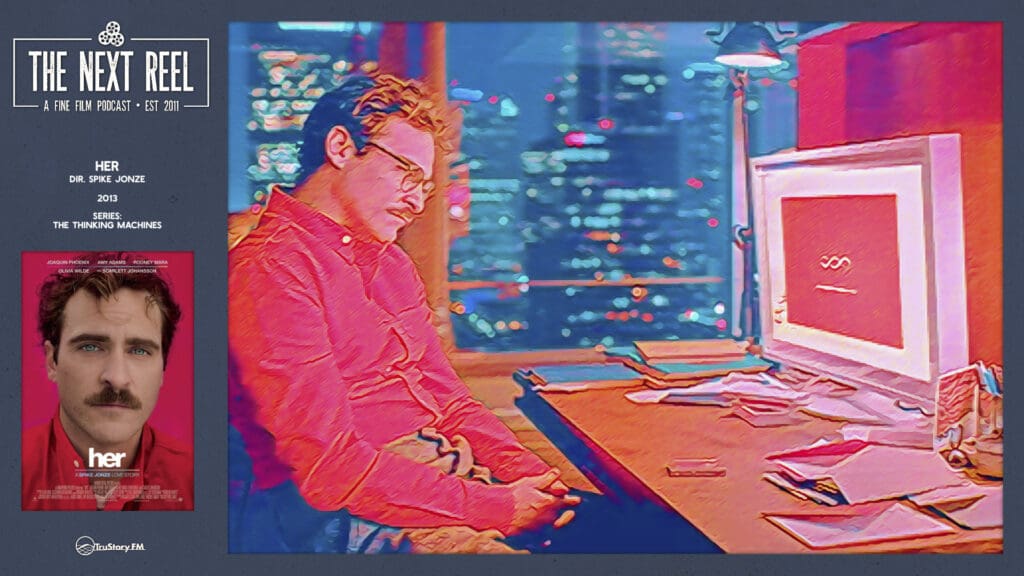
And I love the idea that we’re reducing the blues and showcasing the blues only in places where — well, first of all, the poster is Joaquin Phoenix’s deep well blue eyes against all the red in his red shirt. Come on. Drown in those puppies. But also, the foul-mouthed alien kid in the video game that he’s playing has hints of blue, right? The most antagonistic character in the film is a holographic representation of an alien child who swears at him all the time. And that has a blue tone to him.
Andy Nelson:
I thought it was white.
Pete Wright:
So —
Andy Nelson:
I thought it was a little white bubble kid.
Pete Wright:
He is. He’s white, but that’s where you have the contrast of a bluish tint to him, which I think is awesome.
Andy Nelson:
Well, just as a side note, Joaquin Phoenix’s eyes are naturally green, so the fact that they changed them, at least for the poster — I don’t think I would have noticed if they changed them throughout the entire film, although it’d be quite a bit of work. But I think that’s interesting that they specifically changed that for the poster to pop the blue.
Pete Wright:
Do you know what? You’re right. I just blew up the poster and they are green. But —
Andy Nelson:
Oh, okay, well —
Pete Wright:
When it’s small, it looks blue against the red. But you look at it, you can see where the green is, and they showcase that green as a contrasting color to everything else going on in the movie. It’s incredible.
Andy Nelson:
Well, regardless, I think the point still stands that the way they choose to use the colors to create this world — I guess you could say it’s full of warmth and connection. It’s just a different kind. And that’s what’s so fascinating about the movie, is yeah, you could still argue they’re doing these jobs, they’re putting up walls between them and real relationships by writing these letters to other people, by creating games for other people to have these experiences. But they’re still creating relationships. And it’s a really interesting way to depict ostensibly a future that’s not too many steps ahead.
Pete Wright:
Yeah. Generally, the production design — you talk about Hoyte van Hoytema, love the camera, love the blues. What do you think about the choices around location? Future Los Angeles is Shanghai.
Andy Nelson:
And Los Angeles. It’s both. But yeah, I think it’s fascinating. And I want to — we already talked about some of the stuff with costumes, but costume and production design are so key in the design of this. Finding buildings that don’t look like what I think of when I think of a film that takes place in LA, or Shanghai, for that matter — all of the different locations that they choose just create this space that I don’t recognize. And I think that’s what’s so brilliant about it, because it just feels like they said, okay, we need something that looks slightly futuristic, slightly cooler, a little more interesting, and then we’ll find a way to shoot it so it just looks foreign — as in, not foreign like outside of the country, but just something we don’t recognize. And I think they did a spectacular job, because there are a few times where I’m like, is that something that’s in downtown LA that I feel like I’ve seen before or not? And I can never quite pinpoint it. And I just think it’s incredibly smart the way that they shot it. I love it so much.
Pete Wright:
Yeah, me too. It feels so foreign and so at home at the same time. There are some real vibes of — I go back to Planet of the Apes, right? Having a real Dr. Zaius moment where there are these buildings that exist, that were run-and-gun shooting locations that are real and yet somehow in the context of that film look futuristic. That’s what I get out of this. All of these locations feel so good.
You bring up costume design. Really important to the feeling of future and yet making everything feel so grounded. The thing that took me out of the movie the most was the real high-inseam, high-waisted pants. I don’t think I could — I don’t know that it’d be worth dressing if I had to wear those kinds of pants. But everything else, like the just no collar, the way they were able to make the fabrics feel lived in and futuristic at the same time, right? The close-ups on Phoenix where his future shirts and jackets looked pilled, like they’d been washed a few too many times, right? Like it all felt so lived in. Which, you know, sometimes you don’t get in these science fiction films. They feel very pressed and clean and hard-edged. This feels soft.
Andy Nelson:
Well, not only that, but they talk about it too. And you don’t think about that often in sci-fi films, because their outfits are designed to be science fiction-y, futuristic sort of things, to the point where nobody talks about it because fashion is suddenly not a thing in the future anymore. It’s just like now we wear all these crazy outfits and nobody needs to bring up the fact that we look awesome because there just isn’t fashion.
Pete Wright:
Yeah.
Andy Nelson:
And here we have these great moments where — I can’t remember the line that he has with Paul, but I love it when he compliments Paul on his shirt. And Paul is like, oh yeah, it reminds me of this guy who is really suave. And then — well, now it reminds me of a guy who’s really suave, whatever the line is. But like, we’re actually getting compliments on outfits and stuff. And it’s not like it’s a great shirt or anything, but in this future world, they are still allowed to talk about that. I think that’s fascinating.
Pete Wright:
Yeah, I think so too. I think it is really just a lovely package of a universe that feels lived in and homey and welcoming and round. And also great AI.
Andy Nelson:
I am curious. I guess he was having trouble cutting the movie down, and so his initial version was pushing like two and a half, three hours. And Soderbergh — Steven Soderbergh — actually stepped in and helped him. Like, he delivered a cut that was less than ninety minutes. And while Spike Jonze added some material back into it, it actually was the thing that he needed to realize, oh, I don’t need to include these subplots and stuff. I guess there’s a deeper subplot about the documentary that Amy’s making, including Chris Cooper as one of the subjects.
Pete Wright:
Yeah.
Andy Nelson:
Which — I love Chris Cooper — one of the people that we don’t get to talk about in this movie. The other big one is Samantha Morton, of course.
Pete Wright:
Okay. So let’s at least litigate the Samantha Morton story.
Andy Nelson:
Yeah. She shot this entire movie, and I guess it sounds like she was on set — like in a little box or something — talking, delivering all of her lines. The character’s named Samantha. Like, everything seems like it was tailor-made for her. But then during the editing, Spike Jonze — something just clicked that she didn’t seem right. She didn’t have the right connection with it. And he told her, I’m recasting you, I’ll give you an executive or associate producer credit — and brought in Scarlett Johansson to do the whole thing. Crazy.
Pete Wright:
Does it — I wonder, because they’re of the same era, am I missing a movie where Eric Stoltz and Samantha Morton are in the movie together?
Andy Nelson:
Why are you thinking about the two of them?
Pete Wright:
Well, because both of them were completely replaced.
Andy Nelson:
Oh, as far as Back to the Future? Yeah, yeah, right.
Pete Wright:
The movie. And I can’t remember if they were in a movie together. So there you go.
Andy Nelson:
I don’t know.
Pete Wright:
Anyway. It would have been interesting to hear some Samantha Morton in there. But now, of course, I can’t hear it with anything else but Scarlett Johansson.
Andy Nelson:
I don’t know.
Pete Wright:
She really is perfect for the entire thing.
Andy Nelson:
Yeah, she’s so good.
Pete Wright:
She’s perfect.
Andy Nelson:
Yeah, it’s one of those things that — I imagine it was hard for Spike. Obviously it was probably hurtful for Samantha. But it’s the sort of thing that as the creative team behind a project like this, you have to be thinking about. And I mean, even the replacement — when Viggo Mortensen took over the role of whatever his name is, not Boromir, in Lord of the Rings. I was gonna say Vladimir. That’s not right either. That’s a different version of Lord of the Rings anyway.
Pete Wright:
Yeah, right. Vladimir.
Andy Nelson:
The Lord of the Rings, yeah.
Pete Wright:
It’s Lord of the Rings 2000.
Andy Nelson:
So anyway, it’s gotta be a difficult thing as an actor, especially as an actor, because actors are already sensitive beings. It’s hard when they get rejected like that. And I think it’s hard for anybody.
Pete Wright:
Well, and she’s been nothing but gracious, right?
Andy Nelson:
Yeah.
Pete Wright:
Everything she’s talked about was like, Scarlett was great, and Scarlett was super gracious. Actors are sensitive, but I think the best ones get it when this happens — and that they are sadly, largely fungible.
Andy Nelson:
Yeah, yeah. Still, it’s a great movie. And like you said, Scarlett Johansson owns the role.
Pete Wright:
Yeah, for sure.
Andy Nelson:
So good. Alright. Well, let’s move into the back half, but first, let’s take a quick break.
Pete Wright:
The Next Reel is a production of TruStory FM, engineering by Andy Nelson, music by Tzabutan, Marshall Mcferrin, Oriol Novella, and Eli Catlin. Andy usually finds all the stats for the awards and numbers at The-Numbers.com, BoxOfficeMojo.com, IMDb.com, and Wikipedia.org. Find the show and the full archive at trustory.fm. You can follow us from there too and learn about membership. Check out our merch store at thenextreel.com/merch. And if your app allows ratings and reviews, please consider doing that for our show. Alright, Andy, it’s time for award season.
Andy Nelson:
Yes.
Pete Wright:
How’d it stack up?
Andy Nelson:
This one did really well at award season. 83 wins with 187 other nominations. At the Oscars, Spike Jonze won Best Original Screenplay. It was nominated for Best Original Score, but lost to Gravity. Best Original Song, “The Moon Song,” lost to “Let It Go” from Frozen. Best Production Design, lost to The Great Gatsby. Best Picture, lost to 12 Years a Slave. And interesting note — this is the only Best Picture nominee that year that did not get nominated in any acting category. Joaquin Phoenix, and the controversy of would it have been appropriate to nominate Scarlett Johansson? Well, as a matter of fact, a lot of people thought it was. Looking at, for example, the Saturn Awards, where it won Best Fantasy Film, Scarlett Johansson won Best Supporting Actress, and Spike Jonze won Best Writing. Joaquin Phoenix was nominated but lost to — oddly — Robert Downey Jr. in Iron Man 3.
Pete Wright:
Iron Man 3.
Andy Nelson:
I would have picked Joaquin. This is a weird, weird one — the Young Artists Awards. Do you remember the girl at the birthday party that he’s spinning over his shoulders and playing, like picking up and stuff?
Pete Wright:
Yeah, and they have a little conversation about the dress. Yeah.
Andy Nelson:
Very brief. She was nominated for Supporting Young Actress Award. That’s Gracie Prewitt. For being barely in the movie, she got a nomination. Is it just a dearth of supporting young actresses out there that year? I don’t know. But she lost to Fatima Ptacek in Tio Papi. Last but not least, at the Behind the Voice Actors Awards, Scarlett Johansson won for Best Female Vocal Performance in a Feature Film, beating out — and I just thought it was interesting to see, because they’re all animated films — both Kristen Bell and Idina Menzel in Frozen, Emma Stone in The Croods, and Kristen Wiig in Despicable Me 2.
Pete Wright:
I love that Kristen Wiig is in both these movies.
Andy Nelson:
Yes.
Pete Wright:
I think Kristen should have been nominated for her role as SexyKitten. I mean, she practically was.
Andy Nelson:
I wonder how many people bring up the dead kitten joke with her, or the dead cat thing now?
Pete Wright:
Ugh.
Andy Nelson:
Because that’s just like what a weird thing.
Pete Wright:
Is that not the first thing you would do? Oh, Kristen Wiig, great to meet you. Dead cat. Am I right? Dead cat. Neck, right?
Andy Nelson:
Right.
Pete Wright:
Meow.
Andy Nelson:
Oh, god.
Pete Wright:
Alright. How did it do at the box office? Because there’s part of me that says this movie should have been made for like a million dollars. It’s like Mumblecore-adjacent with a $20 million budget, right? It’s a subdued film. How did it do?
Andy Nelson:
Well, for Jonze’s film, he had a much bigger budget of $23 million, or $38.2 million in today’s dollars. The movie opened December 18, 2013, limited, for its Oscar qualifying run opposite The Hobbit: The Desolation of Smaug, A Madea Christmas, Anchorman 2: The Legend Continues, and the qualifying runs of American Hustle and Saving Mr. Banks. This started in thirty-fourth place and managed to hit tenth place when it expanded January tenth. But it never did better than that. In the end, the movie earned $25.6 million domestically and $22.5 million internationally for a total gross of $65.4 million in today’s dollars. That meant it did land in the green with an adjusted profit per finished minute of $270,000, but it wasn’t a huge box office winner. Still, it’s grown on to become quite the cult film, very popular, lots of best lists still to this day.
Pete Wright:
I love it. I love it.
Andy Nelson:
Yeah.
Pete Wright:
That is grounding. It was in the APPFM, not the ALPFM.
Andy Nelson:
Yes, that’s true. Very true.
Pete Wright:
That’s a win in my book. Alright. I think it’s a beautiful movie. I think it’s a beautiful look at loneliness and the human voice. And it’s a great experiment in just what it takes to fool our feeble human brains, for the better.
Andy Nelson:
Yeah, I really have grown to love this. It took time, but I’m there, and I appreciate so much what this film is doing. So — alright, well, that is it for our conversation about Her. Next week, we are continuing our Thinking Machines series with Alex Garland’s Ex Machina from 2014, another intimate AI story about another Her. But where Jonze asks whether love with an AI can heal us, Garland asks whether it can destroy us. That’s next week.
Pete Wright:
Excellent double feature.
Andy Nelson:
That’s right. That’s next week on The Next Reel. Alright, let’s do our ratings.
Pete Wright:
Letterboxd.com, Andy. Letterboxd.com/thenextreel is where you can find our profile over there, where we rate and review all the movies we talk about across The Next Reel Family of film shows. What are you gonna do?
Andy Nelson:
I have a feeling you’re going to be a five-star and a heart with this one. I went three. I went three and a half. I’m going to jump all the way up to four and a half. Like, I was really taken by this film this time and just everything about it worked so much better. And so that’s where I’m sitting with it. Four and a half.
Pete Wright:
Were you nervous about watching this movie again when you saw that I had put it on the list?
Andy Nelson:
I was. I’m like, oh, Pete’s gonna hate me. Pete’s gonna hate me.
Pete Wright:
Well, now I still hate you, because once you’re at four and a half, dude, come on.
Andy Nelson:
I’m gonna take some more growing.
Pete Wright:
Okay, alright. I am — yeah, I’ll be your five-star Huckleberry. I do adore this movie. Even though my wife has told me she will not allow me to make her my AI if something happens to her — I’m, she’ll be dead, so who cares?
Andy Nelson:
What? Wow. But her AI will remember that, Pete.
Pete Wright:
I love you, honey. Yeah, I love you, honey, and I will love you forever and ever and ever.
Andy Nelson:
Her consciousness, yeah. Wow. Well, that averages out to 4.75, which rounds up to five stars and a heart. So you get the five stars anyway, Pete.
Pete Wright:
I think it’s a good thing.
Andy Nelson:
Yeah. You can find the show on Letterboxd at @thenextreel. You can find me there @sodacreekfilm and Pete at @petewright. So what did you think about Her? We would love to hear your thoughts. Hop into the ShowTalk channel over in our Discord community where we will be talking about the movie this week.
Pete Wright:
When the movie ends —
Andy Nelson:
Our conversation begins.
Pete Wright:
Letterboxd giveth, Andrew.
Andy Nelson:
As Letterboxd always doeth.
Pete Wright:
Alright. How would you stack these reviews? Like, they’re both five-star and a heart reviews if we’re rating reviews.
Andy Nelson:
They are. And they’re very popular, also.
Pete Wright:
Yeah, very popular.
Andy Nelson:
Very, very popular reviews.
Pete Wright:
Yeah. I think we should do our five-star and a heart from Tiago Costa first.
Andy Nelson:
Not the most, but they are way up there.
Pete Wright:
Because it brings up things we didn’t talk about.
Andy Nelson:
Okay.
Pete Wright:
“The biggest achievement of Her is that it makes you feel sorry for a guy who has dated Rooney Mara, Olivia Wilde, Amy Adams, and Scarlett Johansson’s voice.” That review reminds me that it’s very grounding. It reminds me that people like Rooney Mara, Olivia Wilde, Amy Adams, and Scarlett Johansson’s voice, and people like you and me — just that beautiful people can also be broken in their own special way. What do you got?
Andy Nelson:
Very true. Very true. I’ve got a two and a half by Penny who says this: “computer bitch, what if your butthole was in your armpit? Joaquin laughs hysterically. Everyone, five stars!”
Pete Wright:
Yeah. Yep. I get it.
Andy Nelson:
Right there. Yep.
Pete Wright:
I love it. Alright. Thanks, Letterboxd.