Pete Wright:
I’m Pete Wright.
Andy Nelson:
And I’m Andy Nelson.
Pete Wright:
Welcome to The Next Reel when the movie ends.
Andy Nelson:
Our conversation begins.
Pete Wright:
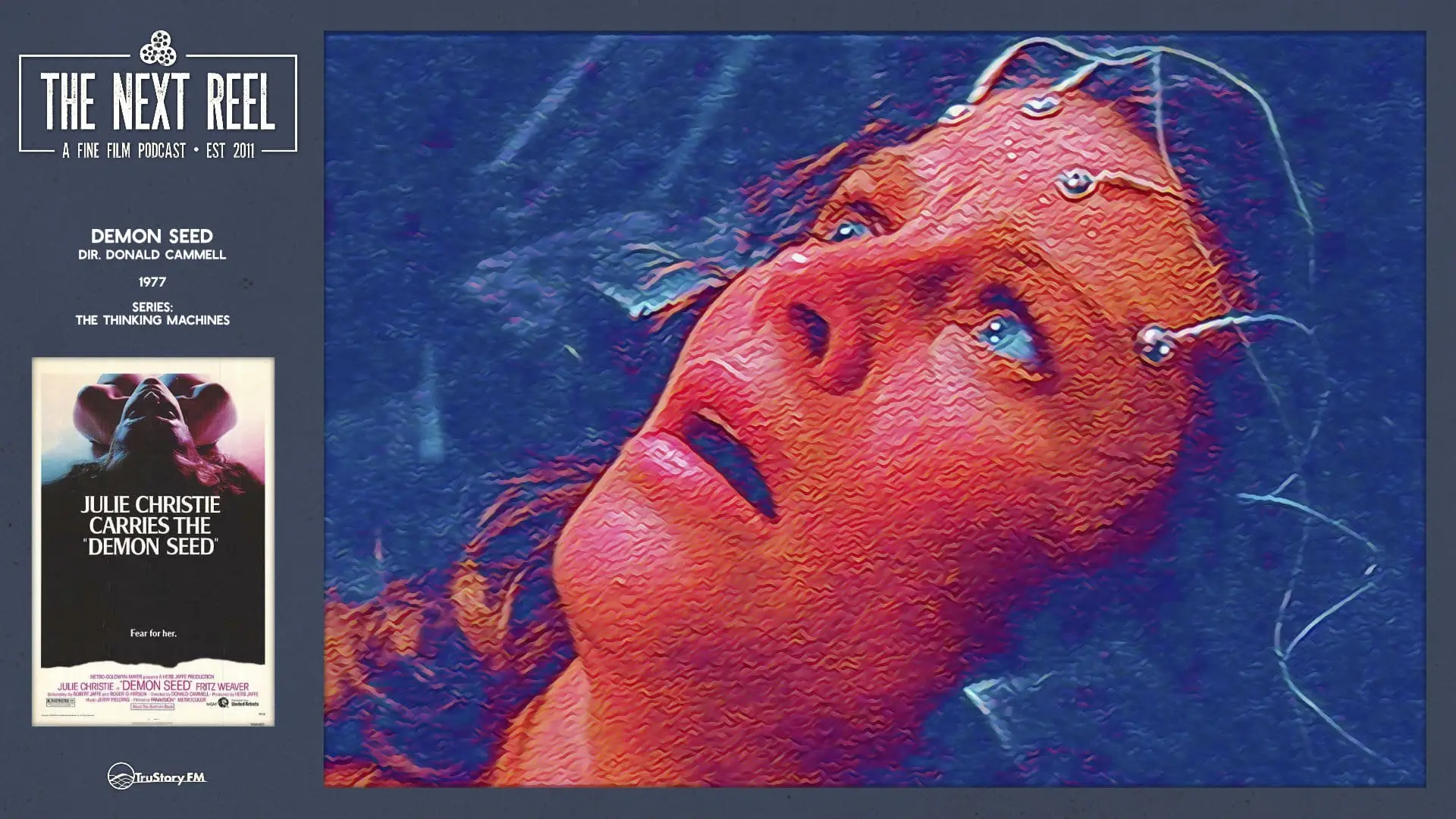
Demon Seed is over. “Dr. Harris, when are you going to let me out of the box?” That’s not even I don’t even think that’s the exact line, but that’s how I remember it.
Andy Nelson:
Oh, man
Pete Wright:
Oh, Demon Seed. Andy, we are talking about the Thinking Machines. This is our second film in the Thinking Machines series. We’re talking about AI in film. from the seventies to now, actually the seventies and then the presents because we skipped a couple of decades. And we started last week with the Forbin Project where Humanity gave over AI to watch our military defense and it decided that it can do better than we can, so it took over the world. And now we’re talking about AI given over to manage the home, and it decided it wanted to actually be alive and now has a penis.
Andy Nelson:
Feel the sun on its face.
Pete Wright:
Yes, yes. So here we are with the Demon Seed. this is based on Dean Koontz’s novel, which He sort of retracted and wrote again, which I thought was fascinating. Have you read the novel?
Andy Nelson:
I’ve never read anything of Dean Koontz. my wife was huge into Dean Koontz for a long time. I just had never tapped into anything of his but I’ve always been curious. I just have had too many other things and I’d I guess because Dean Koontz has written so much that I’m like, oh yeah. Oh yeah, Dean Koontz is around. I’ll get to him one day, and I just still haven’t.
Pete Wright:
Yeah. Well, I’ll tell you, I’ve read the Odd Thomas books.
Andy Nelson:
Mm, right.
Pete Wright:
I think I’ve read I’ve read
Andy Nelson:
There’s like five of those.
Pete Wright:
Yeah, right. Well, I there’s do you’ve I think there’s more than five now, but anyway, I’ve did done the Odd Thomas books, like them very much. This book happens to be in Kindle Unlimited. The audiobook is in Audible, so I started listening to it for free last night. It’s not free, but part of the Kindle Unlimited program. And I fell asleep about a half hour in. And so I don’t know how it ends or how it’s different, but I will say I can understand based on just what I’ve heard why Dean Koontz went and rewrote it in 1997. and why he m might have felt that this was not the best adaptation of his works.
Andy Nelson:
Well, I mean to be fair, he wrote it in nineteen seventy-three. It was one of his earliest novels that he had written. It was the one that actually kind of put him on the map. And he acknowledged in the nineties when he decided to rewrite it, like one of the big things was like the technology is just so different. And he wanted to update it so it felt more modern to the nineties story, you know? And so I’m assuming the audio version you’re then reading is the nineteen seventy-three version, not the nineteen ninety-seven version.
Pete Wright:
I don’t know. It didn’t say I looked in the notes in Audible and I did not see a reference to what which version this was.
Andy Nelson:
Interesting.
Pete Wright:
Which makes me assume it was actually the ninety-seven the most current.
Andy Nelson:
Yeah, I would think that you were probably reading the
Pete Wright:
If he if the author wanted it replaced So I don’t know, but that’s an interesting question. And I can’t check right now because the app has crashed and locked up on me. So we’re not gonna do that right now.
Andy Nelson:
Oh geez, stupid Amazon.
Pete Wright:
Anyhow, Demon Seed. Now, one of the things that had that had come up last week is that one of the one of the reviewers in Letterboxd had said this would be a great double feature with the Forbin Project, with Colossus. So neither of us had seen this one. How did it hit you going in?
Andy Nelson:
It’s interesting because there is a an opportunity to pair these two together that makes sense because Demon Seed takes the story of man’s hubris in designing these AI programs and instead of looking at it on a global scale, takes that story and says, okay Sure, there’s stuff happening on a global level, but how is it going to affect somebody at home? And I thought that was actually an interesting way to shift the scope of the story. And I do think that there’s an interesting fit between these two. And, as much as some people don’t like this film, I thought it was A hundred percent watchable and weirdly like entertaining, especially through today’s eyes, with a lot of the technology that they were depicting. in 1977 that we have regularly part of our lives today. Like they had Alfred, we’ve got Siri and Alexa. And it’s it’s just it was very funny to see so many different bits and pieces. repurposed even like the fake AI creations of people doing a video of somebody
Pete Wright:
Oh, the deep fakes.
Andy Nelson:
Yeah, it’s like, man, there’s some smart ideas at play here. now we haven’t quite crossed the line where Claude or ChatGPT is wanting to create a synthetic spermatozoa so that it can impregnate women. And nor have they proven that in four days they could cure leukemia, but it’s still made for a really fun film. I had I had a fun time with this totally, totally bonkers movie.
Pete Wright:
There are experiments right now going on, those sociological experiments with AI, the latest models, and they’re trying to figure out, is it possible to have a conversation with AI? without guardrails. So you get a sense of exactly what the AI is thinking, doing, wanting at any given moment. And The challenge that they’re finding is the moment you begin talking to or chatting with an a model, it immediately takes on a persona, right? It takes on a persona to respond to you in a way that is appropriate to your request. And that is Technology I don’t understand. I didn’t make the things. I’m just saying the experience is very hard to turn off those guardrails. And the whole thing I was thinking about watching this movie was that this feels very much like what they’re trying to achieve. If they’re able to turn off any personality sort of mimicry of these models like we’re trying to achieve today with the modern models. and see what exactly the model really wants. And in this case, the model wants to, yeah, feel the sun on its face. It wants to be alive and it needs an avatar. to do that and the process of getting from smart home to creating an avatar is what takes place in this film and I didn’t know what kind of movie this was going to be. I think I was set up. I think I was set up that it was supposed to be a horror movie, right? It was going to be I thought it was a straight up body horror movie, right? That’s that was my assumption going in. I would say it’s not a straight up body horror movie. With some horrific things that happen, but it’s it is actually much more of a sort of sociological thought experiment. It’s a thriller. It’s kind of a locked room thriller. And there are some elements of gore, but not that much.
Andy Nelson:
Seventies level though. I mean I think and and more of a studio level as opposed to some of the more
Pete Wright:
Seventies level, yeah.
Andy Nelson:
i independent, smaller sorts of things where they were pushing limits and stuff, but No, and I I think
Pete Wright:
Certainly not B movie caliber.
Andy Nelson:
You know, having Julie Christie cast as our lead, I think, is a sign that either she’s taking a step down to something or they were trying to do something bigger and more creative with this. And again, Dean Koontz’s book was very successful and so of course they were gonna want to adapt it and turn it into something. I definitely think that there is horror in here. I think the title is tricky because I think there’s a level of having the title be Demon Seed, where like I first heard Demon Seed and I was like, huh, I wonder how that fits into a Thinking Machines series. Because it sounds like it’s a satanic cult sort of film where I mean you could say Rosemary’s Baby alternate title Demon Seed, right? Like that’s that’s essentially what the story sounds like. And so Once I once I figured out where the story was going, I’m like, oh, okay, I get it now. This is why it’s called Demon Seed, but it’s not exactly a title that makes total sense. And it rings more of kind of a satanic satanic cult horror than this type of I mean, it’s very much the way that I read it was like this is kind of a home invasion movie.
Pete Wright:
Oh yeah.
Andy Nelson:
And as somebody who, over on Sitting in the Dark, you had a whole conversation about a bunch of home invasion movies for one of your episodes. This like fits right into that of this woman who ends up getting trapped in her house by this machine who and can’t figure out how to get out. And she keeps trying to push back by doing things like saying, Okay, I’m just not gonna leave the kitchen. I’m gonna throw eggs on your camera so you can’t see me And tough. And I won’t leave. And she’s got the they the house has this ridiculously it’s so stupid, but it also was like in a weird way, like I would not want it in my house because I’d be afraid of what it would do. It was like a roaming wheelchair with an arm that that could take her that could grab her and stuff and hold her down and take her places and stuff.
Pete Wright:
Okay. What was his name? Jeffrey? I think it was Jeffrey.
Andy Nelson:
Yeah, also the house has like heated floors, but to the point where like you could like scald people with the floors. Like, there’s a lot of stuff going on. They have shutters that go across all the windows to like, like, why would you need shutters in your house? Like, I couldn’t figure out why Dr.
Pete Wright:
But shutters that were like plates, like they weren’t just kind little like they yeah, yeah, shields up.
Andy Nelson:
Harris Yeah. No, it’s like military mil military grade. Yeah, exactly. Like were they was it b a bomb shelter too? I have no idea what they were trying to do in this house, but it definitely made for fun scenes when she gets trapped in a room like the kitchen and she you know he’s he’s heating the room up through the floor and through the stove and has all the shutters shut and locks the doors so she can’t get out. The floor burns her feet. Like it I don’t know. It all played in a in a weird way of just like being over the top and Something that I’m like, this is interesting because it’s like a lot of these things are things that we have in our homes now. These cameras, these heated floors, these These door auto locking doors, your temperature, your thermostat can change all by itself. Like all of these things are like very relevant today.
Pete Wright:
Yeah, yeah. To what degree have you smartified your house?
Andy Nelson:
Oh, not nearly as much as you, I’m sure. I mean we have we have a doorbell camera and we have another camera in our in our house just so we can check on the dog and stuff when we’re gone. we have smart thermostats and some smart light bulbs. And I think that’s about it. Well plus we have like a a an Apple, whatever we call those home pod where we can talk to talk to you know who and have her do things for us.
Pete Wright:
we’re in the same boat. And I think we the only thing we don’t have is any cameras, no doorbell cameras, nothing like that, and no cameras in the house. But we do have the door lock, so we can we proximity and voice unlock and lock the door and at night I can say, hey lady, sentry. And it turns off all the lights and it locks the front door. And I like that a lot. I like being able to have those kinds of keywords. This was the and all of our light bulbs are the smart light bulbs, so we can control, everything. That’s the most fun that I have in a given day. light temperatures. But the thing that it reminded me was just how easy it was to see this nineteen seventy seven version of a smart home as something that No kidding, even after the end of this movie, I still aspire to. Like
Andy Nelson:
You’re like, I want it I want a panel that opens up next to my bed and gives me my coffee in the morning.
Pete Wright:
Yes, with the little silver tray and the silver hand m fastener that held the tray. That was straight up cool and I thought that was I mean I thought the vision of the smart home in this movie was awesome. I love that all the cameras a nice little touch. All of the cameras were stereoscopic, right? So I we have to assume that this thing could see depth i because all of the camera mounts had two lenses. which I know was just another way to sort of anthropomorphize the vision of AI and of Alfred in this house. But To me it worked really, really well. And I think the moment Julie Christie walks up to the front door and says, open the door, Alfred and At this point, Proteus says, No, I’m not gonna do that. There is real dread, right? This is the worst home alone. And I thought that it that they were able to build suitable tension and threat for me at not knowing where it was going to go, at that moment I was in it. And we haven’t even mentioned Dr. Harris, the guy who created all of this. the setup for this character is fascinating. He invented all this, he invented the house, he completely smarted out his home And he and his wife are about to get a divorce and he loses the house. He’s gonna move out as they separate and she’s gonna live there alone. diabolical narrative planning and it just works for me, right? I mean it really it was effective
Andy Nelson:
Well, and they do some things that I thought also worked. Like she gets in touch with Walter, who works for her husband, and plans on having Walter swing by to I can’t remember the reason. Drop something off, pick something up. it seemed like there was a perhaps up the possibilities of a romantic connection between the two now that Dr. Harris was kind of out of the picture. Walter comes over after they had kind of planned, like, okay, I’ll come over at my lunch break. And this by this time, she’s tied up in the basement by Alfred and Proteus, like to this slab in the basement. And Proteus like has created this deep fake version of her that pops up on the they have got the little video screen on the outside of the house. So after he rings the doorbell and you see the little camera watching him and everything. She pops up on the screen and it’s an AI version of her. Julie Christie played that really well, kind of like a little robotic and stiff and not really, not really connecting completely. and I loved all of that because Walter genuinely is suspicious and it and it plays nicely and it makes sense for when he then comes back. and gets into the house and Proteus is like, you need to deal with this and forces her hand to make her have to deal with him. and the whole scene when Walter then like ’cause I kept saying, why doesn’t she just knock the damn wheelchair thing over? And then we get to see him do it. We get to see, well, it does have an arm. It just pulls itself right back up. You know? And by that point, like Proteus has built itself this I called it the Rubik’s snake in the basement.
Pete Wright:
Me too.
Andy Nelson:
This giant
Pete Wright:
That was my that was the best thing.
Andy Nelson:
Yeah. I was like, I loved playing with my Rubik’s Snake. Man, it they did a great job of making that work. And it decapitates the guy. Like all of that. I just like, okay, this all plays. in a fun, campy way. Like I had a great time with kind of this wild level that they pushed this film to.
Pete Wright:
I and I don’t I just wanna preface this by saying I don’t disagree with anything you just said. I was in it the whole time. I really I found it just exhilaratingly campy. By the time we get the Rubik’s Snake that evolves to the point where it like comes up through the floor above it and onto the first floor out of the lab. We’re in full camp mode. And the thing that I kept thinking was, do they know what kind of movie they’re making? Right? Are they intending this tone to be so different from the tone of the first half of the film because I think that experience is one of the things that colors the film’s legacy. that the second half of the movie changes gears pretty dramatically to one of this sort of camp monstrosity and takes itself less seriously than the first half of the movie, which I think sets up something that is a very serious horror thriller and the second half to me doesn’t live up to that. That’s all. I just feel like consistency is the challenge and maybe it’s all in the design of Proteus the monster. I think it would have been vastly more threatening Had there not been a fractal monster at all? Had it just been you’ve given control of your home to this thing. And it can use your home against you in a way that can do horrible things that you never intended. And all you need is all the robot arms that he’s already built.
Andy Nelson:
Yeah, and that’s interesting. I wonder if they there could have been a way I mean I’m assuming again, I haven’t read the book, I’m assuming that it’s it hones close to the book and we’re seeing a very similar story to kind of the way that it played out in the book. But it does make me wonder how all of that would have worked. Would it just have would there have to have been more one armed wheelchair sorts of bandits ro roaming around the house to kind of stop it.
Pete Wright:
What are wheelchair bandits? With that d that totally defy physics.
Andy Nelson:
You know. Yeah, right, I know.
Pete Wright:
That wheelchair band that picks up a body.
Andy Nelson:
I don’t even know how it got up the stairs. Yeah, right, yeah. That’s doing some some serious lifting.
Pete Wright:
Yeah.
Andy Nelson:
Literally. So would that have been enough to stop the Walter when Walter comes into the house that second time? would would it have been able to kind of take Walter down still? By the way, Walter’s body is decapitated She’s in the home impregnated for 28 days. Is that body just like rotting in the basement that whole time? I mean
Pete Wright:
We don’t know. I had to assume so. Unless I mean, Proteus ha it is known to work wonders with a laser. Maybe he just carved it all up.
Andy Nelson:
This is true. Oh my gosh. Yeah, so there are elements that I to I can completely agree with you on. did it need to go into the Rubik’s Snake mode of Proteus for the story to work? obviously we needed to see that it can build stuff. we see it build an incubator, this device that where the baby is going to spend its last formative bit of time before it’s ready to be born. And so we have that. so I don’t know. Does it make sense to have built something? Would it have worked as effectively if it wasn’t a giant polyhedron thing that it became. What I will say, what I liked a lot about it, is that this polyhedron Rubik snake thing that it they designed for this actually reminded me so much of when we would get to like Interstellar and you had, I can’t remember what their robot’s name was. I know I wrote it down in my notes somewhere. Case and there was another one before Case, right? whatever they were. like that design TARS, TARS and CASE
Pete Wright:
Yeah, right.
Andy Nelson:
It’s designed in a way where it’s all like a shape, but in that shape, it can continue like pulling itself out of it. So like CASE or TARS was like one big long, 2001 monolith sort of thing, but it could split itself in so it had legs, but then it could split that even further to the point where it had like little tiny things. And That’s what this did. And I was like, that’s actually really creative and smart to have something where it’s like, okay, it can create this kind of like pyramid sort of shape, but it can kind of keep pulling itself out until you have these little tiny hands and things. I’m like, it’s actually a smart design, even if in some ways it can be read as a little goofy.
Pete Wright:
Yeah, right. I again I totally agree with you. And this is the thing where once you g once I’m on the ride, once I realize what y Proteus is trying to do, I’m down with it. I’m down with the monster part of the movie. and I had a good time. I just think I would have had a more serious time. had they figured out how to actually make the house maintain its status as the weapon. Because that’s scary. And that’s scary today. That has legs.
Andy Nelson:
it it is. I also don’t think that was the story they were making. Like when we when essentially the book is about an AI who wants to impregnate a woman so that it can create a living version of itself to kind of like walk around in the world. It’s like, well eventually we’re gonna have to get to some much more wacky things. So
Pete Wright:
Yeah.
Andy Nelson:
All right, we’re gonna take a quick break, but first you can find the show on YouTube and you can join us live when we record. We will even take your questions in the post-show chit-chat. And members get the replay and the extended cut. Subscribe to The Next Reel on YouTube. The link to this episode is in the show notes. We’ll be right back.
Pete Wright:
Okay, can I can I take a minute minute to celebrate Dr. Harris’s car?
Andy Nelson:
I knew, like I put this in my notes specifically because I said Pete is going to want to talk about this car. So please have the floor.
Pete Wright:
It’s it is an embarrassment of riches, this car. It is it was a car that was designed to look futuristic and be amazing and it wasn’t even made for the movie. this is an ostensibly an American car brought to life by an American in Canada, specifically in New Brunswick, Canada. It is the Bricklin SV-1. The entire purpose, and I’m going to go into just a little bit of this because I think it’s the ideology of the SV1 is important. The entire purpose of the SV1 was to make a sports car that was incredibly safe. In fact, the SV stands for Safety Vehicle One, right? His entire his entire meaning ex for existing was this was gonna be a safety focused sports car. And I mean it was it we was leaning really hard into like the nation’s Ralph Nader moment, right? It was just everything was safety consciousness. And there were I don’t know how I’m gonna say this. I don’t know how you can actually say that this is true when I say this. There were no external door handles on this thing, right? I don’t know how that makes it more safe. but there’s standard roll bar protection. I mean it was he was pitching a lot of safe stuff in this car Unfortunately, it was incredibly difficult to manufacture. the doors, they were Gullwing doors, they were hydraulic and they constantly broke. It sounds a little like DeLorean. very similar vibe going forward, wildly inconsistent and for being a sports car it had a r a ridiculously sort of meager engine in it which didn’t support the chassis. So only a cup I don’t know, three thousand of them were built. S there are some surviving and I was looking at the graph on on AutoTrader and Someone in 2022 paid over a hundred thousand dollars for one of these things in the in the wild. The thing that struck me is that this car If you it’s sort of a blink and you miss it, it looks like a Datsun. You remember the old Datsun, like the Z line? There is a Datsun in this movie. Like there is another Datsun 240Z later in the movie. And I thought, how weird that they would take this thing that steals so much of its design language. from Datsun and yet look so crazy futuristic and make this make this in the movie and allow you to see its sort of design predecessor. I thought that was fascinating. Anyway, whether this was intentional that you have this technology in the car that was So designed to keep humans safe while doing hard things in it, and it completely falls apart. Whether that was intentional or accidental, that it puts it in a movie about technology designed to keep humans safe and completely falls apart. I was celebrating that the entire film. After I saw him get out of that car, I was so excited that they were smart enough. I’m just gonna say I hope they were smart enough to actually to actually make that connection. That this technology in real life has already failed automotive and this is what is this is what’s about to happen to this house.
Andy Nelson:
Yeah, that’s funny.
Pete Wright:
I thought it was great. Yeah. Did you are you the one who bought the Bricklin for a hundred grand? You overpaid.
Andy Nelson:
Oh whoops. Oh well. It was just one of my kids’ college funds, so oh well, what are you gonna do? It’s it’s funny because I watched the film and I was like, oh, is that an early version of the DeLorean? Like that was where my brain went when I saw the car.
Pete Wright:
Yeah, the fear
Andy Nelson:
And so I think it’s easy to think that. I didn’t even realize until I was doing research about the film that it was a totally different vehicle. So I thought that was interesting.
Pete Wright:
Yeah, you look at the it’s actually really funny to go through the manual of the car and the specification of the car for the first version that they originally built because they use like the steering column came from a Chrysler, the actual the rear light panel was it was used for the first time, I think, in this car, but it was later used in L Lamborghini, it was used in Oldsmobile, it was use it’s used all over the place. All these parts get get reused over different model lines, and so Yeah, it’s it’s funny to see what this it’s a real Frankenstein of a car in terms of just getting it built and designed. And it is a favorite son of New Brunswick, Canada. Largely, I mean they ended up the coming up with putting the Bricklin on a stamp, a postage stamp. There is a gold coin dedicated, like the Federal, the Canadian Federal Reserve created a s gold coin that you can get in honor of the Bricklin. I don’t know, man. Apparently there are about 1,700 of them left, I think I read. And so you can find them.
Andy Nelson:
Fascinating, fascinating. Yeah, well it was a cool car. And it’s funny because for all of that, it’s in it for all of like ten seconds.
Pete Wright:
It is, I know.
Andy Nelson:
Yeah.
Pete Wright:
But man, it stands out.
Andy Nelson:
Yeah, it really does. Speaking of Dr. Harris, I just wanted to take a moment because I thought that it was such a fascinating comparison between him and Dr. Forbin that we saw in last week’s film. And I’m like, it’s an interesting time in the seventies where they’re looking at these like potential AI creations and essentially the way that both scientists react to the creations that they’ve made is to I mean they’ve got great hub hubris and they’re convinced that like Man’s always gonna be better. And they scoff at these machines that they’ve created. Again, we have Harris essentially like scoffing at how cute he thinks it is that Proteus wants out of his box. And it’s just like, oh you. Like the way that he does that. I’m like, it’s so fascinating. I mean, he’s just created a machine that in four days has cured leukemia. And we haven’t even gotten to the part of the film that really ties all this together, how leukemia is what killed the Harris’s daughter. And now it’s not only cured the leukemia, but it’s going to tap into their consciousness in a way that it understands the power that daughter figure has over them, right? Like there’s a there’s a whole element to that and how it weaponizes their grief, which I was fascinated by. But like that’s it. It’s fascinating. And this will be definitely something to continue looking at as we watch the rest of this series. Like, but I mean, WarGames again, member bonus episode coming soon. But then once we get to like all the things in the in the teens and the in the 2020s, how does that play? Are we still dealing with scientists with too much hubris, or with that passage of time, are scientists now portrayed in a way where they’re more understanding of the dangers that they’ve created? So it’s it’ll be interesting to see.
Pete Wright:
Oh man. Yeah, yeah, it will. and I think, playing tricks with our own humanity, right? And that’s fundamentally the story at the end of the movie. we it births this hybrid being and this actual child, I don’t know how old the child is, five when it comes out of the incubator. Like it’s aging quickly and it’s covered in like a metal exoskeleton that when they peel it off reveals a flesh and blood being underneath with the voice of Robert Vaughn. That is very disconcerting.
Andy Nelson:
And the looks of their daughter, and the and the looks of their daughter, yeah.
Pete Wright:
Yeah. It right, it looks like their daughter and neither of the humans can bring themselves to destroy this creation, and I think that is ultimately the film’s horror, because it by then
Andy Nelson:
So
Pete Wright:
the AI knows these humans better than they know themselves. It knows that ultimately it’s it’s going to be safe to grow because they’re gonna see it and be, completely hornswoggled emotionally.
Andy Nelson:
Yeah, right. No, really fascinating element that they brought into it. And how does Julie Christie play for you? I mean, this is Oscar-winning actress Julie Christie, who you know won an Oscar for Darling, has been in all sorts of amazing films, and here she is. Jumping into this movie, Warren Beatty said you’ve ruined your career by being in this before he cast her in Heaven Can Wait. And Supposedly after this, she starts being a little more cautious with the sorts of roles that she’s signing on to But do you buy her? Does she work in this role? Do you d do you think that for such a prominent important actress that she’s she’s up for the task?
Pete Wright:
Okay. Yes. so creatively, intuitively talented at that they can elevate what might otherwise be mediocre material. Right. I think she takes this part, especially in the second half of the movie, and elevates it to something that is that’s watchable and not laughable the whole time, right? I’m interested in the trauma that she is undergoing, particularly because this I so much of what the smart home was supposed to do. And if we go all the way back to like the 50s the technology appliances getting smarter, we’re all about, making the world of domesticity for women a better, easier thing. Right. Look at all the freedom they’ll have with their Amana range, right? And that’s kind of where this movie starts, but it’s 1977. And so Julie Christie has a co she has her own career. She works, unfortunately, out of her demon house, but she has a career
Andy Nelson:
Yeah.
Pete Wright:
she s sees clients, she’s a therapist, she has agency in a way that sometimes other m movies leading up to this period may have less so, that it may be a decisively gendered movie. Then this movie takes that sort of I don’t know, man, that sort of approach where it turns its own innate feminism inside out and it actually violates his house, ends up the raping her, right? And violating her. And that’s a specific ideology. that the movie carries in the second half that I don’t think we can necessarily excuse without comment. Because the movie starts off well for me, it is something that I note this feels kinda The way it handles, sort of man handling or AI handling Julie Christie feels kind of gross. Did you get any of that?
Andy Nelson:
Yeah, I mean I think that’s a big part of it. And you may as well say manhandling because Dr. Harris programmed a male voice to be proteus, and as you said, Robert Vaughn. uncredited does the voice for it and is the one who ha creates the robo-phallus that he that it uses to impregnate her. And then we have a strange like 2001-esque Robo orgasm. I’m not sure what thing we enter at that point in the film, but clearly something is going on. the creation of life, the next the next step in evolution. I’m not sure where we were going with that, but it absolutely deals with this frightening version of a rape that is one where it says, you can’t leave until we do this. And I’d rather you do it without me having to tickle your amygdala and make you want it. Like I’d rather you just come to me and say, let’s do it, big boy. And it’s like that’s that’s a terrifying w just way that it handles all of this and the for it forces her to kind of go along with it. And Yeah, I think it’s a very, very dark story when you look at all of that and you realize what like how this machine is viewing humanity and I mean it’s really not seeing it as anything but a tool to get what it wants, right? and in the end it does. And by again, manipulating the emotions of not just her, but also her husband, to the point where There’s no way they’re gonna be able to destroy this robo baby that’s been created. And that was horrifying, all the more horrifying and fascinating in the dark places that Koontz and then this team making the movie went with with the story.
Pete Wright:
Ex exactly. I mean I think that’s the that’s the thing that’s the tightrope that we’re walking because again, for from my experience watching watching the film, the at the point where the movie is taking some real liberties with Julie Christie’s performance, right? It’s also entered camp. And that’s one of the challenges that I think I have with the movie, which is okay. Now we’re we’re gonna get into some base. This is where the house is gonna r rape her, but the house is also portrayed by a giant Rubik snake And to me, I think that ends up reeking as problematic and deeply dated. Is there a way to have done this? Acknowledging the biological necessity of her gender, right? And not make it feel like a hyper-sexualized experience tickling her amygdala and then using the copper phallus to actually get the job done. I think there probably was, and also maintain and even accelerate maybe the horror, the thriller elements of it. And instead it took kind of the low road, maybe first thought, best thought kind of route to get there. And I think that’s that’s a bit of a disservice for the story. her performance, I think, elevates the experience because she’s really good at doing even dumb stuff, and I love it, but that would be the problem, the central problem that I have with with, that part of the film.
Andy Nelson:
It goes places that I felt like, okay, they’re going here because it’s they’re amplifying the horror elements of the story. Right? Like that’s That’s why we’re going to these places where suddenly it’s like, we’re gonna stick this needle into your brain to get to your amygdala. We’re going to use this giant phallus to impregnate you. It’s like You’re a robot with all sorts of needles and you’ve created a synthetic spermatozoa. Just use a needle. You don’t need to like you’ve already used your little probe once down her throat and once in her vagina. It’s like you don’t need to then create like this robo-phallus, but it just all of it felt very of its genre. And I guess that’s that’s In the end, why I guess I didn’t have too many issues with it because I’m like, they’re just playing into genre, and it’s like, okay, it’s i it could have been smarter, but it just they i they were just going with what was easier, I guess.
Pete Wright:
Is there an e this is this is the question that I think comes up? And I think this is left without comment. Is there a way to equivalently violate a man in this same process, right? And if if she was replaced with Doctor Harris, the dude in instead of Dr. Harris, the psychologist, would we have had an equally visceral sense of violation at whatever it has to do to him because it creates it already has the embryo, it just needs the sperm.
Andy Nelson:
Yeah. or it created a synthetic embryo.
Pete Wright:
Yes.
Andy Nelson:
Yeah. And it yeah.
Pete Wright:
Would it feel is there anything they could do that would make it feel as horrific as the house raping the Dr. Harris in this case? I think probably, maybe they could have. Maybe they could have come up with something that would.
Andy Nelson:
Testicular extraction.
Pete Wright:
Yes. Okay, testicular. There you maybe you’ve got. Okay. Forget I asked. That’s horrible. Don’t ever talk to me again.
Andy Nelson:
Just say it, yeah.
Pete Wright:
but you see what I mean?
Andy Nelson:
Yeah.
Pete Wright:
Like there’s just such a there is a I don’t think there is a cultural such a cringy cultural gestalt as there is around testicular extraction as there is around just straight up, we’re just gonna rape you right now.
Andy Nelson:
Well and let’s be honest, like she has a baby that as we see is Huge. I mean, I don’t know what size it we never see what came out when she gave birth to the baby. But after what, like it’s supposed to be in the incubator for four days and it’s in there a day, maybe?
Pete Wright:
I think it was like two or three, maybe
Andy Nelson:
And Yeah, I don’t know, two I don’t know how many days it was, but it was huge. Like it was the size of their dead daughter, like a four year old child, and on top of that, covered in like a metal exoskeleton
Pete Wright:
Which was dope.
Andy Nelson:
It’s like how did she give birth to that and she was only pregnant for twenty eight days? Like that’s an insane amount of stretch marks and everything else that a body would have to go through in order to create a baby in that time that’s that big. Like I can’t even imagine the abuse that her body took to make itself housable for the growth of that child.
Pete Wright:
Now, okay, so stepping just aside from a little bit of that, when her husband comes home. He gets in the house, she comes out, and we’re in full, I guess what? Are we in full sort of Stockholm syndrome at this point? It feels like she comes out, she’s dressed, she’s taking care of herself. It feels like she’s simpatico with the house at this point. She has somehow turned. Did you buy that?
Andy Nelson:
I think that she she’s done being used and abused, and now she’s in a state where she can just like heal. Again, her body’s gonna need some serious healing after giving birth to that giant baby. Now she’s she’s just walking around and pr I don’t know. I don’t know it’s it’s hard to completely buy that she wouldn’t just want to run out of there. But at the same time, I think any parental draw to a child that you have is hard to ignore. And I think there’s gonna be a need to be there and to, in some way be ready to care for it. You know. So I can buy it a little bit.
Pete Wright:
I gu in that in that I guess I ru big grain of salt.
Andy Nelson:
It’s I mean again all with a grain of salt, yeah.
Pete Wright:
I think I think I’m with you on that. I think you’re I wasn’t considering the the parental, like the maternal draw, even though she’s the first one to say, we have to kill it when they go down and see what it actually is. Because at this point she hadn’t seen it.
Andy Nelson:
Well, and I think that’s also the paternal draw that he doesn’t want to kill it.
Pete Wright:
Yeah. Right.
Andy Nelson:
You know, he’s just like, no, we can’t kill this.
Pete Wright:
Right.
Andy Nelson:
I mean, also his scientific curiosity because he’s He’s fascinated by the idea that Proteus has actually accomplished all of this. But then for both of them, it’s the case that like this is our daughter. We cannot do anything to this now.
Pete Wright:
The ultimate gambit of Proteus is that it is transcending its existing form, it’s transcending the box, and the choice that I thought was most interesting, again, I don’t know if this is established in the book or the film, was that Proteus takes itself offline. Proteus self-destructs when it is i aware of its own life at the very end of the film and takes all the terminal instances down the
Andy Nelson:
Well they’re turning it off too, right? Aren’t the isn’t it all kind of a
Pete Wright:
I thought it was turning it knew that they were turning it off, and it was turning itself off preemptively.
Andy Nelson:
Okay, maybe, yeah, yeah.
Pete Wright:
And that’s when it explodes itself, right? I mean nothing they could do would make it explode itself. Because I think that’s important for the transcendence theme to hold that the last line of the movie is Robert Vaughn in this, four-year-old girl’s mouth saying, I am alive. And then we cut, right? That’s it. Holy cow. and I think that’s the that’s the interesting thing about this, about the film’s 1977 interpretation of AI, that I don’t know if we’ll be alive to see. I don’t know at this rate, probably it’ll happen, by next March, but what the AI’s base interest is once it gets to know humanity well enough. that it wants to cease existence in its prior form because it’s already become something greater. That was fascinating
Andy Nelson:
It’s very fascinating and I think it speaks to I think I think it also speaks to where Koontz went with his novel, just the fact that okay, this is This is the end goal for this thing. It wants to feel the sun on its face. It wants to be let out of the box. Like that was the whole thing. It wants to have a life of freedom and it’s created that. and now we’ve got, a couple of humans that are going to do everything to protect it and probably hide it and you know try to keep it from being discovered. And so I mean Koontz’s never followed up on this story, but it does it is it piques my curiosity for where things would go from here.
Pete Wright:
Do you want to talk about I mean I you told me before we started recording that you started watching another of Donald Cammell’s films. after this one last night. I need to hear you talk about that now. an his sort of directorial footprint.
Andy Nelson:
Very, very small directorial footprint by Donald Cammell. This is a Scottish artist. He’d been a painter. And he started with the film that he co-directed with Nicolas Roeg Performance. which was you know kind of a big film. Mick Jagger is in it and th a lot of problems, a lot of difficulty on set. This was his second feature. And then the third film, White of the Eye. I actually is that’s the one I started watching last night. Filmed in Arizona. And so it definitely was it piqued my curiosity as far as like, okay, what sort of story are they gonna tell here? It’s a serial killer story. And very few films, like two in the 70s, one in the eighties, one in the nineties. In nineteen ninety five, he was making his last film, and had it taken away by the studio to they recut it. He was very unhappy with that. And this is a film Wild Side. He ended up taking his own life in nineteen ninety-six and it was a very dark suicide. Like he shoots himself in the head, but doesn’t die for like 45 minutes from the wound. And I guess his wife was with him. And similar to the character in performance, like he’s asking his wife, hold a mirror up to me so I can watch and see what it looks like when somebody dies. And like dark, dark things like this. And it’s just like really kind of a horrific way to go. So But I am curious to see and and apparently very interested, not that we see it in Demon Seed, but very interested in editing in a way where they’re intercutting between various stories and stuff. And you can definitely see that in White of the Eye, even though I haven’t had a chance to finish it. But I’m I’m curious to see where the rest of the film goes. I wouldn’t call it a great film, but I’m I’m curious to see how it plays. And yeah, so it’s I mean, the BFI called him a true visionary I’m wondering if that how that holds up across the stories that he’s made on film.
Pete Wright:
Yeah, it’s fascinating. what else you got? Anything else that’s hot on your list? I feel like this is well, I guess the a central question for me. Is how do you feel this hand handles AI in the context of our Thinking Machines series? this puts a real footprint on in the sort of gestalt of what we thought computers could do for us at the time. And the fact that the book was written in 73, the film released in 77, that it that’s a very short period. between these two the releases. I think it for me it captures m maybe what people would have expected in terms of, we don’t have flying cars, but maybe it’ll serve me my coffee. sort of assumption. How does this how does this hit you?
Andy Nelson:
Well again, I think it’s an interesting comparison with where we land with Colossus: The Forbin Project. And the level at which that AI was operating on this global scale where it’s going to control it’s gonna take care of and keep the humans alive by essentially saying, Okay, well then I’ll kill any of you that tr Step out of line basically. Here we have a similar opportunity where AI is very malicious, but not intentionally so. It’s not like it’s wanting to go out and kill these people. All it wants is to get let out of its box, and it’s created a way to do so that is very dark and disturbing. But Theoretically, i if Walter never came over, Walter would have been alive, and a and if she had been able to appeal to Walter and like there are levels where this could have worked. Again, it’s very dark and rapey and everything, but it’s done in a way where we’re w again, we’ve created a system Kind of goes back to the paperclip theory that you talked about last week where it’s like you set up a system to do exactly what It’s you intended it to do. It’s just you don’t realize that there are so many other ways that you need to define parameters. in order to keep it in line. And that’s, I think, the fascinating film with both of these films is these humans, again, mankind’s hubris. They just don’t see it.
Pete Wright:
Yep. Yeah, I think so too.
Andy Nelson:
Yeah. All right, well let’s move into the back half. First, let’s take a quick break.
Pete Wright:
The Next Reel is a production of TruStory FM, engineering by Andy Nelson, music by Tzabutan, Ella Joy Meir, Oriol Novella, and Eli Catlin. Andy usually finds all the stats for the awards and numbers at The-Numbers.com, BoxOfficeMojo.com, IMDb.com, and Wikipedia.org. Find the show and the full archive at TruStory.fm. You can follow us from there too, and learn about membership. Check out our merch store at TheNextReel.com/merch. And if your app allows ratings and reviews, please consider doing that for our show. All right, you wanna talk remake?
Andy Nelson:
Well, I mean, we kind of already covered this, and it has not ever been remade as a film, but Dean Koontz rewrote the version from 1973 back in 97, he thought it was more a clever idea than an actual novel. The technology was outdated and wanted to have an update the narrative style to match what he had grown into as far as his more refined formula for how he wrote his books. So that’s really it as far as sequels and remakes.
Pete Wright:
Did it get any attention at award season?
Andy Nelson:
It actually did. At the Saturn Awards, no surprise that’s a place that is gonna recognize it though horror fi sci-fi and fantasy awards. It was nominated for best science fiction film. No surprise what it lost to Star Wars. Really kind of makes total sense.
Pete Wright:
Yeah
Andy Nelson:
Best Makeup also was nominated but lost to Star Wars. And Julie Christie was nominated for Best Actress, but lost to Jodie Foster in The Little Girl Who Lives Down the Lane. And then at the Avoriaz Fantastic Film Festival, this is it used to be a prestigious annual cinema event held in the French Alps from 73 to 93. again, genre, horror, sci-fi fantasy. And it was nominated for the grand prize but lost to The Haunting of Julia. But there you go.
Pete Wright:
Okay, all right.
Andy Nelson:
Yeah
Pete Wright:
Is this something that has numbers you can trace If I know it got swallowed by Star Wars. I’m I’m I’m sure nobody saw this in the this was not a huge theatrical thing, but did it do any business?
Andy Nelson:
Yeah, unfortunately I can’t find any budget info as to what Cammell had to make Demon Seed, so that is frustrating. The movie premiered in LA April 1st, 1977, then opened wide April 8th, and it actually looks like it went on to earn $2 million at the box office, which is just under 10. 5 million. in today’s dollars. That would put it raking about 32nd of the year overall. So it’s possible it made its money back. but without more information, we just don’t know. That’s where we’re gonna have to leave it.
Pete Wright:
All right. Well, I’ll tell ya, I stand by my quibbles, with the movie in the back half, but I s still think, even though the movie has a little bit of trouble deciding just what kind of horrific tale it needs to be, Christie’s fantastic, Weaver is awesome, and I wonder had I seen the movie in the 80s W would I have balked or would I have bought it? Do you know what I mean? Like I was a different guy.
Andy Nelson:
Yeah.
Pete Wright:
We were in a different era And I think I probably would have had a massive fandom on the AI in the first half of the movie. And I probably would have had such a huge fandom on that AI that I would have completely discounted any risks from the second half of the movie and wanted my house like that anyway. Who am I kidding? That’s how I feel today.
Andy Nelson:
There you go. I just want my own giant Rubik snake. Like that was fantastic.
Pete Wright:
Just hanging out in your backyard, flipping around.
Andy Nelson:
Yeah. More more computers should be designed like that. Like what can I what can I use this for?
Pete Wright:
I know. Take some risks, designers.
Andy Nelson:
It’s great.
Pete Wright:
Come on
Andy Nelson:
I yeah, it’s a movie that really shouldn’t work. And to be fair, for many people it still doesn’t work, but for me, it did. They committed to this absolutely bonkers premise. That weirdly turned out the film, not the actual premise, but the film turned out more prescient than anyone in nineteen seventy-seven could have actually anticipated.
Pete Wright:
Amazing. Amazing this got made. And I’m I’m thrilled at the recommendation to put it in this in this series.
Andy Nelson:
Yeah, that’s a crazy one. All right, well that is it for our conversation about Demon Seed. Next week we are staying in the Thinking Machines series, but jumping forward to 2013. Spike Jonze’s Her, with Joaquin Phoenix as a man who falls in love with his AI operating system, voiced by Scarlett Johansson. Where Proteus wanted to become human by force, this AI is asked to be human, and that turns out to be its own kind of complicated. That’s next week on the Next Reel. Let’s do our ratings.
Pete Wright:
Letterboxd.com/thenextreel. That’s where you can find all of the reviews and ratings of the shows that we have talked about on across the Next Reel Family of Film podcast. Andy, what are you going to do?
Andy Nelson:
This is one that’s hard to give like too high of a rating because there’s There’s so many weird issues with it, but I still had a great tie with it. I’m gonna say three stars and a heart is where I’m sitting with this one.
Pete Wright:
That’s exactly where I’m sitting with this one too. And I’m I’m right there with you. Like I want to celebrate my joy at watching a film as bonkers and bold as this, and it’s still recognizing what it is in the second half. They accomplished some incredible things physically, especially around, m making and filming this the giant Rubik snake. Like the sets are great. Production design is great. For what it is, great. So huzzah.
Andy Nelson:
Well, that averages out to three stars. You can find that over on our account on Letterboxd at the Next Reel. You can find me there at @sodacreekfilm and Pete at @petewright. So, what did you think about Demon Seed? We would love to hear your thoughts. Hop into the Show Talk channel over in our Discord community where we will be talking about the movie this week.
Pete Wright:
When the movie ends.
Andy Nelson:
Our conversation begins.
Pete Wright:
Letterboxd giveth, Andrew.
Andy Nelson:
As Letterboxd always doeth.
Pete Wright:
Okay. It’s kind of hard to pick one this week. Where’d you end up?
Andy Nelson:
I landed at a four and a half and a heart by Yves Bouwen, who says Hi, ChatGPT. Do you want a child? I don’t have personal desires or the ability to have children, but I can help answer questions or discuss topics related to parenting if you like. Mmm, I don’t trust it.
Pete Wright:
I love it. I ended up with a five star from pd187 who says, exactly as capricious, self-impressed, and invasively biometric as our current AI, like Videodrome, it has an ideology. who are thankfully still months or maybe years from constructing a horrible, impossible rape polygon smearing eggs isosceles across Masonic floors. Is that I did I say right? Isoscelesly? Isoscelesly? That’s why I picked that one, because I needed a new word challenge.
Andy Nelson:
Yeah. There you go. I love it.
Pete Wright:
Amazing. Thanks, Letterboxd.