Pete Wright:
I’m Pete Wright.
Andy Nelson:
And I’m Andy Nelson.
Pete Wright:
Welcome to The Next Reel, when the movie ends.
Andy Nelson:
Our conversation begins.
Pete Wright:
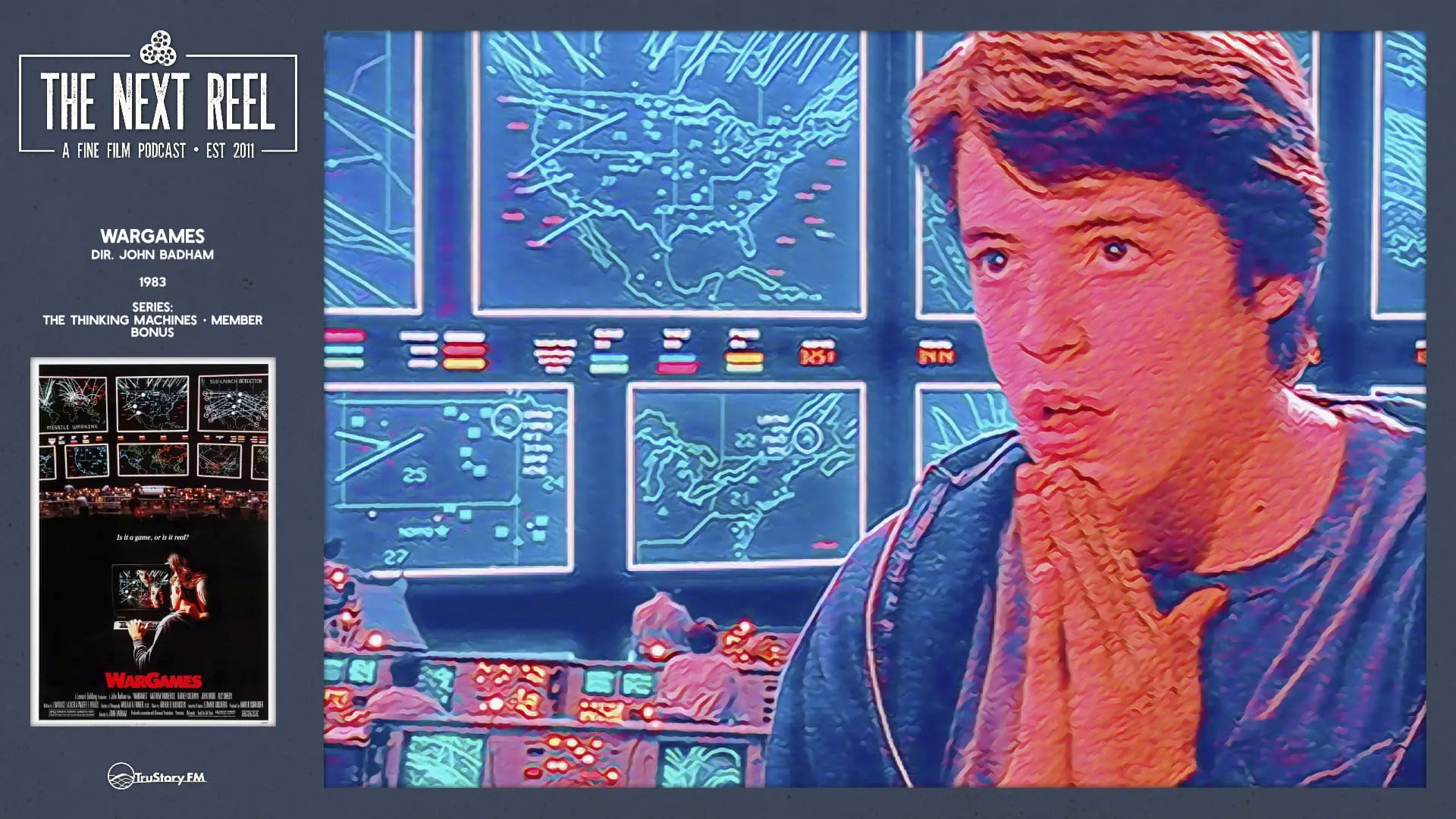
WarGames is over. “Hello, Joshua.” Hi Andy, we’re talking about WarGames. I’m very excited about it.
Andy Nelson:
Yes, I am excited about this one too. This was a fun one to revisit because I hadn’t seen it in a very long time.
Pete Wright:
Very long time. And when you say that, let me just ask you this.
Andy Nelson:
Yes and no. As soon as they played, I’m like, oh yeah, I totally remember this. But there are also sequences in this that have never left my brain, that have been burned in my entire life.
Pete Wright:
Me too. But the beginning of the movie — there’s a lot of military stuff in the beginning that I did not — I mean, it was just like I haven’t seen this movie.
Andy Nelson:
You mean the whole Michael Madsen, John Spencer opening?
Pete Wright:
Yeah, that’s the one. I haven’t seen that.
Andy Nelson:
So I don’t think I remembered it until he pointed the gun at him. Until Michael Madsen points his gun at John Spencer and is like, turn the key, sir. And I’m like, oh, okay, I do remember this.
Pete Wright:
Dark, dark stuff going on there. Okay. So let’s break down where we are. Hello, members. This is a member bonus episode. We’re talking about WarGames because we’re in the middle of our Thinking Machines series. We have talked about Colossus: The Forbin Project — that’s, you know, giant computer in a mountain, might sound familiar today.
Andy Nelson:
And the Cold War.
Pete Wright:
And the Cold War, right. We talked about Demon Seed, which is — computer has a baby with a lady.
Andy Nelson:
And that’s all.
Pete Wright:
Yeah, that’s pretty much that. We know more, but we don’t talk about it.
Andy Nelson:
Nudge nudge, wink wink, know what I mean?
Pete Wright:
So nudge, nudge, wink, wink. So we’re talking about WarGames. Here’s the reason I’m excited to talk about WarGames — it wasn’t on my initial list when I came up with this series. Maybe it could have been, but I’m glad that it ended up there, because this one has a change character in AI. One of the change characters is WOPR — Whopper.
Andy Nelson:
Whopper. Like the burger, yep.
Pete Wright:
It is a maniacal militaristic machine that actually learns a moral lesson. It teaches itself a moral lesson through training. And I have to admit, I kinda like that.
Andy Nelson:
Yeah, it’s an interesting film. I mean, there are examples of films where the antagonist is essentially the one who is your change character — they learn to grow or whatever. I mean, that’s always the case in a romantic comedy or something, where the two people who are so completely different somehow we know they’re meant to be together, and they learn to be together. That’s exactly the sort of thing we get here.
Pete Wright:
But we haven’t yet had it in the form of a computer.
Andy Nelson:
We haven’t yet — not at least in this series, which is interesting. So it’s fun to see how it plays here. But it’s also interesting because — and we’ll definitely talk more about this — this is one of those movies that when you watch it, you realize this script works really well for 1983. And then you look at it through today’s eyes and you’re like, okay, I can see how screenwriting has advanced and how things have changed. The fact that this was nominated for an original screenplay Oscar says a lot — we’re not necessarily nominating things like this today. I think it’s a little — it’s not as complex, I guess.
Pete Wright:
Okay, break that down a little bit further for me. I’m really interested in your thoughts on this. What was going on culturally that caused this film to be something of such intensity that it ends up getting nominated? And to what degree does that have on amplifying a more simple script?
Andy Nelson:
The big thing going on with this script — and this movie at the time — is this movie came out at the exact perfect time for this to hit. This was the era of The Day After and Threads and these other stories of nuclear war and the devastation. This was the period when home computers really started booming — modems and BBSs — and especially video games with ColecoVision and Atari and Commodore 64s, and even just the stand-up video games you’d find everywhere, like we see David playing when he first shows up. All of this is becoming a reality. And this film tapped into cultural fears of nuclear war. It tapped into adult fears of having zero framework for what their children are capable of. And the same thing with the military — just not understanding how some of this stuff worked, and the trust that they put into these systems that didn’t have — I mean, we talk a lot about guardrails. This is a good example of them clearly not having enough guardrails to really think through all this stuff.
So I think that’s why when this film came out it was such a big hit. They were able to tap into all of those different things that spoke to people. I think there are a lot of other reasons this film probably ended up getting a Best Original Screenplay Oscar nomination — a lot of it boils down to the fact that it felt cutting edge. This is the first time in a film that you hear “firewall.” This is the first time you see hacking and the way that he’s using the modem. Just the fact that people are capable of doing these sorts of things was new to so many people, and it was essentially cutting edge — they were doing stuff that wasn’t fantastical. I think that’s one of the reasons it opened people’s eyes. I mean, this movie opened the president’s eyes to what could actually potentially happen. It felt just right on the nose as far as where things were at that moment.
Pete Wright:
I think it was right before this that Secretary of State Alexander Haig first discussed publicly the levels of nuclear war and preparation for nuclear war — and that gives us the DEFCONs in this movie. NATO was stacking Pershing missiles all over Europe at the time, and it was just a couple of months after this movie was released that the Soviet Union shot down Korean Air Flight 007 — which I think we’ll call that a big deal. And so I absolutely agree with you there. I remember the bedroom stuff, right — thinking I need more computers in my life. That modem was amazing. I wanted to have all that stuff. Because we had a computer, we had an Apple II, I loved it, and it wasn’t connected to anything. I was just giddy with anticipation of those sounds. Those sounds I wanted in my life something bad.
Andy Nelson:
And when you got it, it was a thrill. When you would dial in and you’d get that beep-boop, it was just like, oh, I’m actually connecting to something out there in the world. And then you start chatting in these rooms. It was a thrill. I don’t think today people understand how amazing that was.
Pete Wright:
Yeah, because now it’s just everywhere. Too easy, kids today. What was your first computer? Do you remember?
Andy Nelson:
Mine was a Commodore 64.
Pete Wright:
All right. I had a Commodore 64, but it was like a loaner from a friend of my dad’s. We had the Apple II and then switched — I couldn’t believe it — to the IBM PS/2.
Andy Nelson:
Oh.
Pete Wright:
So I was out of the Apple world for some years, and I did not care for it.
Andy Nelson:
Even then, you were like, I just feel something wrong in my life.
Pete Wright:
Even then I knew. I know.
Andy Nelson:
You’ve just heard the opening stretch of our member bonus conversation about WarGames — part of our Thinking Machines series, where we track the movies that asked what happens when the machines start thinking for themselves. And just like that login screen David Lightman probably shouldn’t have found… you’ve hit an access point. What’s in the public feed is the free sample. The unguarded backdoor. The rest of the conversation — where we dig deeper into the film, the filmmaking, and what it all means — that’s in the member feed. To get in, head to trustory.fm/join. Membership gets you monthly member bonus episodes like this one, including special series picks voted on by members; early access to ad-free episodes across the whole Next Reel family — The Next Reel, The Film Board, Sitting in the Dark, Movies We Like, and Cinema Scope; additional pre-show and post-show segments on select episodes; and access to members-only areas in our Discord community, plus the ongoing film talk in our showtalk channel. It’s $5 a month or $55 for the year. Head to trustory.fm/join — that’s T-R-U-S-T-O-R-Y dot F-M slash join. A strange game. The only winning move… is to join. The Next Reel — when the movie ends, our conversation begins!