***This transcript is produced using transcription software and reviewed for quality. Despite our best efforts, some passages may be incomplete or contain errors due to audio quality or software limitations.***
Andy Nelson:
Hey, everybody. This is not the regular episode you were expecting in your feed. You’re probably getting another episode in your feed as well, but this is actually a member bonus episode. And it’s here because we said, you know what, let’s let people who aren’t members get a taste of what the members are getting. So, with this episode, we’re probably gonna be dropping a few others, just to give you a sense as to what you could be getting if you say, you know what, I’m going to become a member and support The Next Reel.
Pete Wright:
That’s right. Consider this our pledge drive. For a couple of episodes, a couple of weeks running, we’re gonna be dropping some of our member content that usually goes just for members, and we’re gonna drop it to everybody, as just a way to appreciate all of you as listeners, and also to say, hey, if you’ve thought about it, now would be a great time to get that membership started.
Andy Nelson:
That’s right, you can just go to TruStory.fm/TNRmembership. Or you can—
Pete Wright:
—just go to TruStory.fm/TheNextReel, and you’ll find it, it’s right there, you can’t miss it. There are lots of ways to get there.
Andy Nelson:
So many ways, so many — poke around on the website, there’s all sorts of — believe it or not, there is a page for every episode. It really shouldn’t come as a surprise, but if you wanna also look at the website, it’s there too.
Pete Wright:
Yeah, it’s there. And you don’t have to be a member.
Pete Wright:
I’m Pete Wright.
Andy Nelson:
And I’m Andy Nelson.
Pete Wright:
Welcome to The Next Reel. When the movie ends—
Andy Nelson:
—our conversation begins.
Pete Wright:
Relic is over. She forgets things. You know what she’s like.
Trailer:
When was the last time you spoke to her? It’s been a few weeks. Fran? Mom? Edgar? Mom? She called me a few weeks ago. I think she was scared. She thought someone was coming into the house. Tea? Do you know where you were, mom? I suppose I went out. What’s this? I was on the property when your grandfather inherited it. His mind wasn’t there in the end. You can’t put Gran in a home. She can’t live on her own anymore. She has to be watched. Everything alright, Gran? I thought this was where it got in. Who? Whoever it was coming into the house. Mom, what is it? It’s here under the bed. There’s nothing under the bed, ma’am. Will you check for me? I’m here to help you, mom. I can see you. This house seems unfamiliar.
Pete Wright:
Alright, Andy, we’re talking about Relic, 2020. Emily Mortimer is in it, and it’s a delightful, charming movie about women across three generations coming to terms with one another, and aging, and grief, and loss, and ultimately love. Relic.
Andy Nelson:
There is definitely a lot of interesting stuff to talk about in this film, and we’re gonna be jumping in and talking through quite a bit of it. This film was rated R, and it is rated R because it has some horror violence, some disturbing images, and it has some language — a lot of language, some of it, I guess you’d say, is offensive language.
Pete Wright:
It might have less language than you’d imagine, you know, if you’re just counting.
Andy Nelson:
Do you wanna watch this movie and help us out? When you look into the show notes on your little podcast or wherever you’re listening to this, you will see some links there at the bottom, and we always put options of places you can click to go and watch this movie. If you see Apple or Amazon links, you can click on it and go rent it or buy the movie, and we will get a tiny bit in return. It’s a great way to support the show, just click on that. It doesn’t even cost you any extra money — just click on it, and we get like a tenth of a penny.
Pete Wright:
A taste. Just a taste. We’re up in our game in the merch store — head over there, TruStory.fm/TNRmerch. And we’ve got shirts, stickers, mugs, masks, pillows. And we’re working on the shirt for this very movie as we speak. Well, I mean, as we speak, we’re actually speaking in the podcast, so immediately after we speak, there shall be work done on the shirt for this film.
Andy Nelson:
I wanna make a shirt with that fantastic stained glass window, so good. Love that. We are starting to feature audio reviews from you, our dear listeners — we would love to start doing this, we want people to get on the ball, send your thirty second audio file to reviews@trustory.fm. Watch the film, get it sent in, generally a couple weeks before the episode is supposed to go live, and we might just put you in the podcast.
Pete Wright:
Letterboxd.com is our favorite social media service. It really is — it’s social media, but just for movie lovers, most TV lovers are even shunned from this place, that’s how much it loves movies, it’s just the movies. If you too like movies, you can get a 20% discount on upgrading your membership to Pro or Patron, just use the code NEXTREEL at checkout, we’ve made it easy. We created a redirect — if you go to TheNextReel.com/Letterboxd, that’s Letterboxd with no final E, the code will already be applied, and you can get your 20% off. It works for renewals as well.
Andy Nelson:
And to the point about recording your reviews early, on Letterboxd in our HQ, we actually have a list there of all of the movies we’re gonna be talking about over the course of this entire season, which goes from now all the way through the end of June in 2022. So you can get ahead, look at all the movies we’re gonna be talking about, get a head start, and send us those reviews.
Pete Wright:
We’re wrapping up our listener questionnaire — it’s a quinquennial questionnaire, but we’re now wrapping it up, we’re at the end of the questionnaire cycle. We need all of your feedback. Head over to TruStory.fm/TheNextReel, and you’ll see this big questionnaire button — if you click on it, you can fill out your responses to the questionnaire. Let us know what you think of the show, of all the shows of TruStory FM Entertainment, and help us get better and learn more. We appreciate you.
Andy Nelson:
One lucky listener will get a free year of membership, so it pays to get that filled out very soon. And, hey, if you are hearing this, it’s because you’re a member — this episode is for you, you are supporting us. We really appreciate it, throwing some of your hard-earned dollars our way so that we can keep making these episodes. We love doing the regular shows, but we love doing our member bonus episodes, our Flickchart re-rankings, the Retakes — we love doing all of this stuff. So thank you so much for supporting us and helping us out. And if you’re not on Discord yet, hop in there, be a part of our community there — we would love to hear from more of you in that community.
Pete Wright:
Andy, I hadn’t seen this movie, Relic, before I watched it. First time.
Andy Nelson:
So it’s interesting how that works, isn’t it?
Pete Wright:
It’s really something. I think I would like to open with our perennial question, my favorite question — what did Pete think of this movie?
Andy Nelson:
I think you struggled with this one. I don’t think you had as strong a connection to it — maybe pacing, maybe some of the peculiarities of the story, but I don’t think it was as strong for you.
Pete Wright:
What gives you that idea? Is it the way I’ve been talking for the last several minutes about the show?
Andy Nelson:
I’m just trying — yeah, using my Sherlock Holmes detective—
Pete Wright:
—doors of—
Andy Nelson:
—detection? Listening to clues in your vocal folds as you maneuver them up and down to create the words that are describing your feelings of this film.
Pete Wright:
Well, then let me tell you this. I really liked this movie.
Andy Nelson:
Okay, good.
Pete Wright:
I really liked it. You’re wrong. You’re wrong. I did not feel — reasons being deceptive, I was being deceptive, I played you. I played you, I just played you. Let me tell you, I like this movie to the point it has such a mood to it, man. Oh god, it’s so moody. And when I’m watching it, I had my headphones on — I’m watching on the TV, and I have my headphones on, and my wife and daughter were quilting, spread out on the floor in the living room, and they were watching me, and occasionally I would catch them looking at me, and they’re staring at me, and I realized I’m literally picking at my skin, causing, like, wounds on my skin during some of the sequences of the third act of this movie. It is creepy, creepy, moody, dark, compressing — it is all of those things, and I had a really fascinatingly good time with the movie.
Andy Nelson:
Did they have to stop you from putting the knife in your cheek? Is that where the—
Pete Wright:
—no. My son — it was, he was so mad, he comes downstairs, I did not hear him, because I had my headphones on. And it was when she’s crawling around and the walls are getting smaller, and around every corner the daughter is crawling around — amazing — and I just feel this little tickle on my head, and I nearly crap myself, like he’s behind me. I was on the couch, he comes up behind me and tickles my head. And I was like, oops, crap my pants. It is a moody, creepy movie. What’d you think? This was your first time too?
Andy Nelson:
This was my first time.
Pete Wright:
Oh, Andy, you love this movie, this is catnip for you.
Andy Nelson:
I so loved this movie. Oh my god, I could not get enough of this — the mood, just the tension, the way that Natalie Erika James, the director, built the whole — just the tone of the story, and did some of the most effective horror directing, that was so creepy. I’ve seen things like that where you’re looking at a frame and the character turns, and then something in the background all of a sudden moves that you didn’t realize was there. But the way that she did it, in putting this film together, it was almost so subtle that it made it — and it wasn’t buried under, you know, musical stings, things like that.
Pete Wright:
No.
Andy Nelson:
It just made for moments that just kept making this film feel freakier and freakier, to the point where I’m like, this has to be one of the most effective haunted house sorts of films, is really what it felt like. It felt like this possession that I never could quite figure out, and it was incredibly effective. I loved it.
Pete Wright:
It is, in tone and texture, what I expected out of James Wan’s latest, Malignant. Can you imagine if he had treated that property with this kind of sensibility? I can absolutely see that. And I feel like that’s the kind of moody broodiness that I wanted in the movie. I thought it was absolutely fantastic. And it’s another metaphor movie — what’d you learn about that movie?
Andy Nelson:
What an interesting thing, and I was very proud of myself — unlike Babadook, which I didn’t connect with initially when I first watched that movie.
Pete Wright:
You’re a hot mess on Babadook, I just don’t even—
Andy Nelson:
—I don’t even know, I think I just shut my brain off by that point, I’m like, what is this craziness? With this film, it was like, oh, okay, I think we’re dealing with grandma’s dementia or Alzheimer’s or something like that, where she’s clearly not all there. And I found it to be so effective, the way that James kind of constructed this, where we see things — the way that it’s perceived as these shadows in the house, or whatever it is that there’s something that is connecting to Edna, our grandmother character. And the way it’s portrayed, and building to that ending, which I just found so haunting and powerful and poignant and heartbreaking — I was really surprised by how effective the metaphor worked in this particular film. And it leaves it open, in a way, kind of like the Babadook, where it’s a similar sort of feeling where you’re like, this is something we’re gonna just be having to live with now. And I found it, in that sense, more effective than the Babadook.
Pete Wright:
I do too. And I don’t think its messaging was quite as heavy-handed, even though I feel like I got it early enough — really, the moment you get the call that grandmother’s wandered off, and the daughter has to go, you know that there’s some sort of — we’ve hit that kind of degenerative phase. And then you see the state of the house, you kind of get the picture early on. And then the conversations about the granddaughter moving in, and, frankly, the conflict between the daughter and the granddaughter about their relationship with grandma, and that kind of power struggle — it just feels so familiar and familial to me, so natural, that by the time we get to the horror elements and you realize that this is very much that sort of horrific psychosocial manifestation of Alzheimer’s, and the heredity of it — this is a really unique and special way to tell that story and teach the concepts of that kind of grief through these women, that I thought was just terrific, terrific, and terrifying for each of them to come to terms with it in their own way. I don’t wanna skip so far ahead to the very end of the movie, but seeing the three of them lying in bed together, as the daughter reaches up and sees the spot on mom’s shoulder, as a way to final-frame the movie, I thought was the smartest way to touch us as we leave.
Andy Nelson:
Yeah, right — well, this is gonna be a continuing thing that they will have to be dealing with in their family. And it was heartbreaking and powerful. But I think for so many people who are dealing with family members who are going through dementia or Alzheimer’s, including James, who dealt with this with her own grandmother, which kind of gave her the idea — it’s, you know, when you have these people in your life who are so important to you, and then all of a sudden they’re not remembering who you are, and these situations happen, it feels like a horror movie, it feels like something has taken over them that is keeping them from having those connections anymore.
Pete Wright:
Yeah, yeah, I think so too. She uses space well to tell these stories. The scene that really stands out to me — we sort of joked about it earlier — about grandma eating pictures, right? First of all, the metaphor of digesting those memories so that they are inside of us, and also nothing is — I think that hits me really hard, that’s an impactful statement. And then burying them so we can’t find them again, or burying them so we — we know that we’re going to be able to find them somewhere, but then we can’t trust that memory. The way she uses the frame and sets it — for example, that straight shot on the two women on their knees with a big green bush behind them — I felt like I was with them, I felt like I was sitting on the ground watching them from a distance. It’s rare to feel that in touch with the movie experience. But that moment, the emotion of the moment, the practicalities of the moment and the setting, and the way she set up the camera — it was great, it was really important.
Andy Nelson:
There were a lot of moments like that in the film that highlight a lot of these elements, and the connection between, and the disconnect between, people. There are some great shots of Emily Mortimer’s Kay as she is looking at her mother, who might be in the foreground but out of focus — so they’re in the same frame together, they’re sharing the same space, but there is a disconnect, mom’s out of focus. And you see things like that, and it’s really creative the way it works. Or one of the most off-putting moments to me is kind of showing how backwards grandma is in a certain way — where I think it’s Sam who comes into the room, she’s trying to find grandma, and she walks in and sees her standing there, and it looks like something’s not quite right with her, she’s staring into the wall, like she’s looking into the corner or something, and it feels like you’re looking at her back, the way she’s standing. And then as Sam calls to her, you see her arms move around what it seems like to her back, pull her hair to the side, and you realize, oh, you’re staring at her front. It’s just very off-putting how she happens to be standing, because it looked like they positioned her in such a way where it really felt like you were looking at her back. And then all of a sudden it’s like she pulls her hair apart and there’s her face — what the heck just happened there? Moments like that just really throw you. I have never seen that in a film, but it was so effectively done, it was flawless.
Pete Wright:
It really was. I think the thing that sticks with me is how beautifully all of these elements tie into the overall setting. Can we talk about the house a bit?
Andy Nelson:
We should.
Pete Wright:
The house is a gorgeous house, and the decay is really special — in particular, the black mold, this insidious black mold that is everywhere, and you find it on everything. And if anybody’s ever had an experience with black mold and abating black mold from your house, you get it — that’s a thing we deal with here in the Pacific Northwest, and it’s rough to get rid of, and incredibly damaging to your health, especially, I think, neurologically — I don’t know a lot about it, but I know that my level of understanding is, don’t get black mold. This movie oozes black mold, and they never actually talk about it, but to me that sets the sort of character picture that there’s going to be a lot of damage, and the house is sort of eating itself from the inside out, and that is absolutely the experience of Edna, as a relic — everything in this movie is just aging so fast, from the people, but quite specifically to the house they are all living in. It was amazing.
Andy Nelson:
Well, and it sets it up in a really interesting way, I think, with that story that I guess Kay had had when she was younger — she’s talking to Sam about this time when I think it was her grandfather who they had found in this old shack, who had come out here and died here and kind of rotted here, discovered very late. Because we kind of see her have that dream at one point — we see that she was looking through Edna’s things, she sees that Edna had sketched it. So it was this element that was part of their past, and I find it so interesting the way they set that up, where — is it like a spirit of grandpa who’s doing all this? Who knows? But when they tore that old shack down, that cabin, they kept that window as a relic of that — and that’s that wonderful stained glass window in the front of this house. But it’s almost like those memories are part of the rot, and that’s part of what’s kind of causing all this — because I love it when you see the window, and you see the rot coming around the window and everything.
Pete Wright:
It really feels the rot change, because you really get that focus on the window at the very end, and the rot is almost taking over the whole window. But I think I wasn’t paying enough attention to the window in the beginning of the movie — is it cleaner?
Andy Nelson:
I don’t think it’s nearly as rotted out as it is later, but I’d have to go back and look to spot-check it over the course of the film to see how that grows.
Pete Wright:
Right, I mean, I think that transference of energy — the grandfather was the sort of relic number one, and he was neglected and died and rotted, and that energy of the window gets transferred to the house, and is inherited by the space and by everyone in it.
Trailer:
Wait, what’s this? Oh, that was on the property when your grandparents inherited it. My great-grandfather lived there. By himself? Yeah, there were all these stories — apparently his mind wasn’t all there in the end, and nobody knew how bad it was. I don’t think he was cared for like he should have been, you know. I was happy to see it go. Mum used to threaten to lock me in it when I was being a brat. Is that the same window as the one on the door downstairs? Yeah, yeah. When they tore it down, they saved some of the windows and used them to build into this place.
Andy Nelson:
Yeah, yeah.
Pete Wright:
And it—
Andy Nelson:
—makes you wonder — did grandpa go through some sort of dementia as well, that kind of led him to this place where he got lost? No one found him, he died, and they found him all those days later, after he had kind of completely rotted away. Is that another element we’re meant to assume here? So that’s part of the rot — it’s more kind of, I guess you could say, the genetic rot, where they have this in their genes that is gonna lead them to eventually go down that dark road. But I find the way that the house is designed so much a part of it, because of that window and the rot. And then you get into the labyrinth, as they called it, which is a really terrifying location — it’s kind of in the back of the bedroom, it just seems like a closet. But as Sam finds out, it just keeps going, because it’s kind of that storage place of all those old memories, and they’re kind of at that point, metaphorically, deep into the lost places where grandma had been. But it’s an interesting setting and setup, because, as you learn, Sam finds out that they have some neighbors who have a son who — I don’t know, has Down syndrome, something like that — and he had come over.
Trailer:
Alex, what happened between Jamie and Gran? They were playing hide and seek, and it was Jamie’s turn to hide. And he hid, I guess, in a cupboard with a lock on it. Well, she came along and locked the closet and left him there. I think she forgot they were playing. He was trapped in that cupboard for hours. When he didn’t come home, I went over there to check on him, and Edna said she hadn’t seen him, but I could hear him screaming from upstairs. He had paint under his fingernails, just from scratching the door. So we’ve been keeping our distance a bit. Yeah, yeah, of course, I get it.
Andy Nelson:
And that’s kind of where some of this starts, and where, I guess, you could say, almost like where that labyrinth really starts to grow, as it becomes this place to get lost in for grandma, right?
Pete Wright:
Now, inside the labyrinth, there are Post-it notes everywhere, and it’s describing what’s happening as it’s happening to her, and you see the walls are closing in. Is it your understanding that the son, the neighbor boy, wrote that — wrote all those things — or was that written by grandma?
Andy Nelson:
I just assumed it was Edna, grandma — I thought Edna had been writing notes for herself at some point, earlier on, before she got too far gone, she started writing notes for herself.
Pete Wright:
But — so, that’s the part where you can kind of see, okay, maybe that’s heavy-handed, because all of the things on all of the Post-its could figuratively describe the experience of Alzheimer’s, and literally describe the experience in this supernatural giant closet.
Andy Nelson:
Yeah, right, there’s a lot of craziness that ends up happening in there — I don’t know, it’s horrifying, but I also find there to be an interesting strength there, because of the way that even that Post-it note story thread resolves itself, as they finally get out of this labyrinth of grandma’s that they have been trapped in, and they go back for her.
And I don’t wanna jump just to the end right now, but as far as the sticky notes — we get that last sticky note that, now that grandma’s kind of falling apart, she gestures to, and it’s “I am loved.” And I think that’s the moment you realize this is a story about a person who is lost in themselves, they can’t find a way out anymore, but at least there’s that moment where they do realize it — there’s that Post-it note that shows you, she’s — there’s still enough there for her to recognize, in this one moment, I am loved. And it’s a very powerful moment.
Pete Wright:
Well, and it sets up perfectly the — I think that’s what I mean to say — where we’ve been talking about the experience of Edna going through this, but the other side, the horror movie part of it, is when we switch perspectives to the daughter and granddaughter, and we get — they sort of embody that personification of fear of Alzheimer’s, fear of the disease, fear of what it does to people, fear of the experience of not being remembered — that manifests in the movie as grandma turning into this horror creature that chases them through the halls and across the stairs, and it’s a great character design. I think it’s really lovely what happens to grandma, as her bones start breaking and then coming back together, and she’s kind of stumbling all over herself that way. And them having to literally break through walls in the house to escape their own terror of what is happening in their family.
Andy Nelson:
Yeah, they’re completely lost, it’s like a nightmare scenario that they’re stuck in where they just can’t get out — everything is closing in on them, they’re feeling trapped, and it becomes a moment where they do have to break through that wall. And I think, in this case, I found the way that the metaphor played very effective, because I can see them having to deal with this, where they’re trapped and have to find a way out of their own potential downward spiral into this, to get out so they can break free and get away from it. But, again, the strength of the story is the fact that Kay stops and says, I have to go back — I can’t leave her.
Pete Wright:
Okay, that was the neutron bomb of the movie for me. That, I think, if I didn’t like the movie, it would be because that twist didn’t happen — because I was ready for this to be, let’s escape the monster movie, I was ready for that to happen. And this still could have been a glorious metaphor to aging and dying and Alzheimer’s and all that. But when she says, I can’t leave her, and the daughter is saying, it’s not grandma, it’s not grandma — but then we go back into ritual mode, and it ends up being at once horrible, because we’re looking at the grotesquery of pulling the skin off, which, as I understand it, is a nod to a Japanese funeral rite. Right? That there is this sort of ceremonial disrobing — and as she’s pulling piece by piece the skin and hair off, revealing this dark-skinned, lizard-looking version of grandma, it becomes one of the most beautiful exercises of embracing the end that I’ve seen in, you know, much more literal, non-science-fiction horror films. It’s beautiful. This is the first time I’ve had an experience with a straight-up horror movie that I’ve wanted to recommend to my mother.
Andy Nelson:
That’s saying something. That is saying something.
Pete Wright:
It’s saying something.
Andy Nelson:
And it’s funny, I just watched the Japanese film Departures right before this, without any context at all between the two.
Pete Wright:
What’s Departures about?
Andy Nelson:
I don’t know. I’ve not heard of that one. The long and the short of it, it’s about a guy who returns to a small town, needs a job, and ends up working at an NK agency — that’s the company that basically does these funeral rites. And he ends up in this position where all of a sudden he’s having to participate in these very specific rites they would perform with a dead body, as far as washing it and disrobing it, and the way they would treat it and everything. So it was really interesting to have just watched—
Pete Wright:
—did your homework?
Andy Nelson:
I know, it’s like I did my homework.
Pete Wright:
You didn’t even need to tell me — you had no connection. You could have laid into that. I was preparing for Relic, Pete, so I watched Departures. It’d be fine, I would not question you.
Andy Nelson:
That’s funny. So it was interesting, watching as Kay has that realization as she starts peeling off the layers to find that inner core of her mother, and make that connection — it was so beautiful and so heartbreaking.
Pete Wright:
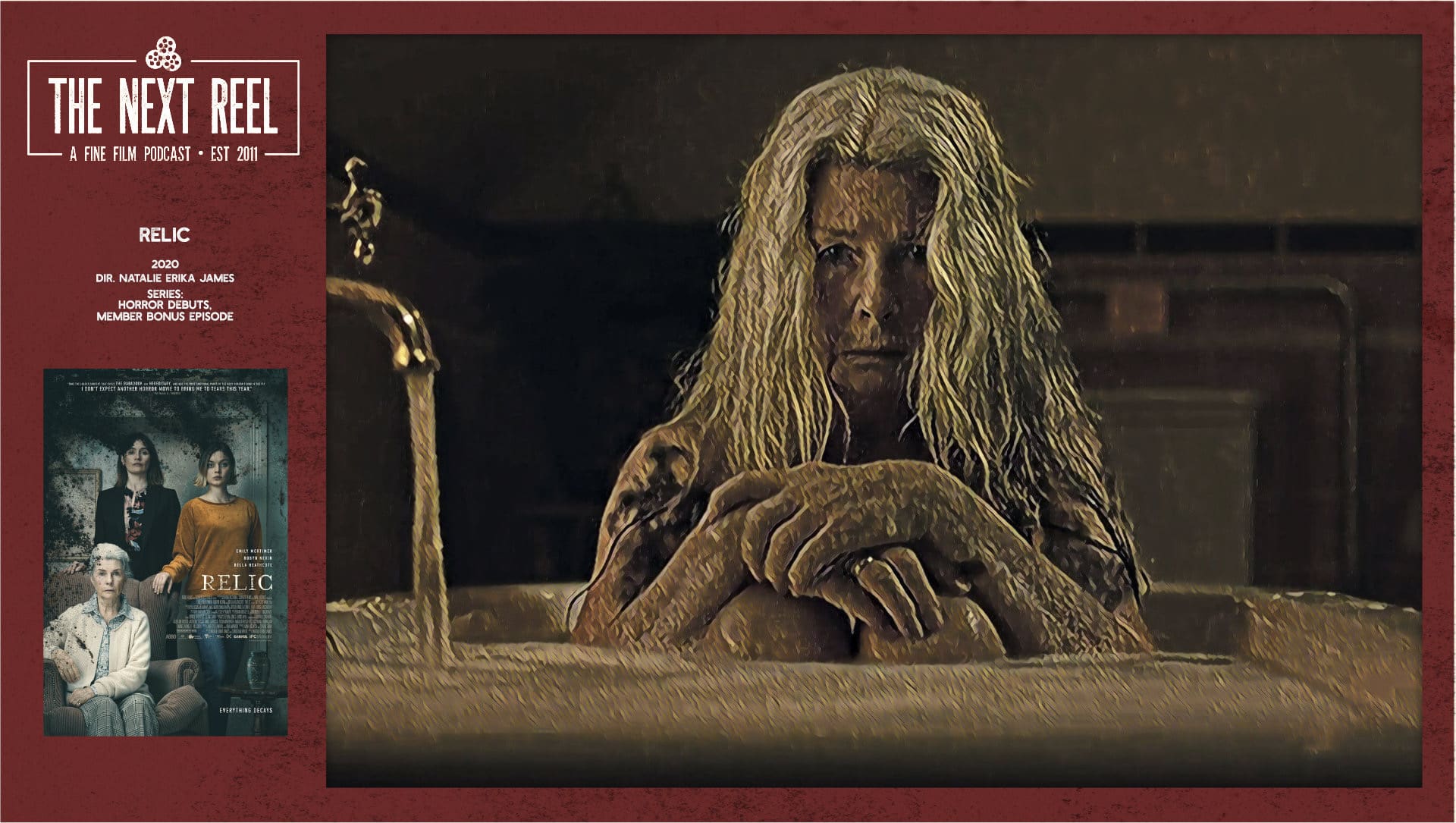
Let’s talk about self-abuse — grandma with the knife, and the bath, and the water, and the stabbing of the face and the chest, and all of that. There is a whole sequence, kind of in the middle of the film, where we get this experience of grandma unveiling the horror that she’s going through, that she’s living through, and it manifests through her doing a lot of self-harm.
Andy Nelson:
It’s tough. Again, I think a lot of it speaks to just things that people have to deal with, with family members when they get old. When she’s in the bathtub, and you see that grandma, she has rot all over her, and as she’s kind of scratching at and pulling at the skin on her chest, it’s like, ugh — but what I love about it is it’s so effectively done as a horror movie, especially after that open, right, where we see her — we see the bathtub overflowing, we watch the water as it comes down the stairs, we end up at the Christmas tree, we see grandma standing there naked. And then she turns toward us, toward the camera, and behind her there’s a shape that moves. And then we cut, and we find out that it’s later, and the mom and daughter are on their way, because grandma’s missing. I was like, what an effective way to set up a story about possession of some kind — we don’t really know what it is, but it feels like grandma’s been possessed. And that’s really where the bulk of the film is — we saw a shape at the beginning, we see shapes off and on throughout the film, always popping up in the background, very effective way that James does that, some of the most effective stuff I’ve seen. But we see those moments, and then we come to realize it’s not this kind of demon, or creature, or grandpa, or whatever it was that had possessed her — it’s just the disease, and the disease has now gotten into her, it’s taken root, and it’s put her in this place where she’s wandering off and has no idea where she is, and comes back and thinks everything’s fine. It sets it up in such a wonderful way where it all makes sense.
Pete Wright:
Totally, totally. It’s incredible just how everything pieces itself back together. And on my first viewing, all of that stuff, even from the first vision of the dog, the rotting dog, and all that stuff, feels incredibly creepy and very horror-movie-tropey. And by the time the movie is over, and you realize what it was saying, everything immediately falls into place, and it makes — I’m really looking forward to watching this again, because knowing what I know now, I feel like you can watch the movie with a degree of sympathy and empathy for what these characters are going through, every single one of them, in a special way. The effects work, I think, too, was really great, and I know, when you talk about James and what she was looking to do, a lot of the stuff is practical, moving walls, that kind of stuff. And then we get to the final creature, which was an animatronic, with moving chest for breathing, and eyes, and all that — it really worked for me, it sold it. And I know she had said, in a recent interview, that we knew that if we couldn’t get that right, it doesn’t matter the message, it doesn’t matter the rest of it — if we couldn’t get that right, the most important bit of the movie would have been flat. I think she’s right, and it totally worked for me — there was nothing in here, none of the effects did I have any sort of question about.
Andy Nelson:
And they’re working on a low budget, right, it’s a small amount of money — even with some big producers behind it, I think they smartly said, okay, we can’t put a ton of money into this, because it’s gonna be a smaller type of horror film. And James even talks about that, with the sets we were just talking about — how they had these elaborate big sets they were planning, and had to whittle those down in order to stay within budget, and still find a way to deliver the effect they wanted, which they did. Same thing with those types of effects, where you have this creature version of Edna at the end of the film, that had to be completely believable, and it was. I think they smartly spent their money in ways to make all of this completely fit within the film and be believable, 100%.
Pete Wright:
And the labyrinth too — sometimes you watch these things where you turn the corner and you’re practically in the same corner with some books moved around, but I never got that question, where I was trying to figure out the layout of the labyrinth. And I did go back and watch the labyrinth a couple of times, because I was really interested in how she got in there — what were the rules that they set up, they cut to the door and how she keeps the door open, what is the rule around the door, was it that the door actually closed behind her at some point that we didn’t see, and therefore she was now in the world of the labyrinth? I really wanted to understand that, until I got to the end and realized, oh, that doesn’t matter at all.
Andy Nelson:
Right.
Pete Wright:
So let it go. But it is a fascinating set piece that I never question.
Andy Nelson:
And when grandma gets in there too — speaking also of just the effects, the way she would move in there, and the confrontations they had — I found it to be incredibly effective, just kind of all of that. They found a way to capture all of this, and it works very well. Okay, Creswick.
Pete Wright:
Yeah, I just wanna talk a little bit about Creswick, because they’re in Creswick, right — come to Creswick, she has that line in the movie. The town of Creswick. And then there’s a short film.
Andy Nelson:
Yeah, the short film that James had done — three years before this, I think. I find it to be, again, another effective short film — a young person who comes to visit his father, who builds furniture and keeps hearing sounds, and she goes into the place where he makes furniture, and things are on, and all this stuff, and then looks at the furniture dad’s making, and it’s like all sorts of it starts getting wackier and wackier, some of the furniture he’s making, H.R. Giger kind of stuff, crazy, crazy furniture. And then you get that end piece — I don’t wanna spoil it, but it was a very surprising, terrifying end. But I feel like there is something — which I probably didn’t think about when I watched the short — but now, seeing this, I can see exactly where James was going with that. And I find that to be, again, another effective use of creating that mood and that idea of this monster that has taken over your parent.
Pete Wright:
Yeah, I watched — I don’t think you had watched Creswick, but I don’t think you’d watched Relic before, when you sent me the link to Creswick.
Andy Nelson:
Right, I had already seen Creswick.
Pete Wright:
So I watched Creswick, and I expected there to be, like, a more literal tie-in, but it really is a metaphorical tie-in — I don’t get the feeling that there’s any other connection than this is the spiritual sort of inspiration for the longer film.
Andy Nelson:
You know, to that end, maybe her next one, because she did a short film right after Creswick called Drumwave, and that one is a young pianist who is forced to confront her fear of motherhood when she marries into a remote island community with bizarre fertility rituals. She’s already working on the feature version of that — I think I saw that she got some financing approved for that and had been moving forward, which makes me wonder if the feature version of Drumwave is basically going to be a more literal interpretation, a longer-form version of that short film rather than this one.
Pete Wright:
Yeah, that’s interesting. I’m really loving, as we’re doing these horror movies, I think there are more of them, maybe, than in other genres, of filmmakers making short films that really demonstrate how good they are at establishing mood and murk, on low budget, in short bursts, and getting financing to go make their bigger movies a reality. This has been a real treat, to be able to see the seed films that lead to these bigger films.
Andy Nelson:
Have you seen Clickbait at all, the Netflix show?
Pete Wright:
No.
Andy Nelson:
So she co-wrote this with Christian White, who also co-wrote — or wrote — the short Creswick, and I think is also gonna be working on Apartment 7A with her as well. But also, he’s the creator of Clickbait.
Pete Wright:
Yeah. That’s really interesting.
Andy Nelson:
I don’t think I have — I mean, Clickbait, it’s a Netflix — I’ve seen—
Pete Wright:
It’s pretty new, right? It was just this year?
Andy Nelson:
It’s very recent, I don’t know exactly when, but it was just last month, or by the time this comes out will have been — late August is when it was released on Netflix.
Pete Wright:
Family man Nick Brewer abducted in a crime with a sinister online twist. Those closest to him race to uncover who is behind it and why. Well, it’s a 98% match for me.
Andy Nelson:
7.3 on IMDb, it’s a popular one — I’m curious to check that one out now.
Pete Wright:
Me too.
Andy Nelson:
You know, I will say, just as a last note on this, before we start moving on — I always love the idea of haunted houses, unfortunately I so often find myself disappointed in haunted house movies.
Pete Wright:
Why is that? When is it that the haunted house movies let you down?
Andy Nelson:
Because I think they end up needing to make the ghosts turn into something, like the haunting — which is just such nonsense, the remake. I go back to something like the original The Haunting, or The Innocents that we’ve talked about on the show before, or The Changeling, which is possibly one of my favorite haunted house movies — there are certain ones that work really well, and I find it’s when it’s less overt, like, oh, there’s a ghost running down the hall or something, that they work better. Or in cases like this, where it’s this more metaphorical sort of house.
Pete Wright:
Well, and you know what’s interesting about this one is that the house — I mean, we’re really inside her mind with the house, right — the house is largely not a part of it, this experience would possess her, her surroundings, based on the rules of the movie, if she was in my house, right? I get the feeling I could walk into my closet and go forever if she were hanging out on the couch. And I think that’s what I like about it, because the house is — they did wonderful things with the house, but in terms of the narrative itself, the house is kind of irrelevant.
Andy Nelson:
Well, except for the fact that the house represents the memories. And I don’t think, if she were in your house, it’s not gonna be the same — she has these dark corners and these labyrinths within her house because of her time there, because of her memories of having been there so long, all those little bits and pieces that get buried deep in there, because she had been there so long, because of the connections to grandpa and that window and everything. So I think it had to be this house in order for this to work — if they had moved her to the nursing home, I don’t think you would have had the same story you get here.
Pete Wright:
Yeah, that’s probably true. But I do like the fact that the house itself is a manifestation of memories, but the house itself is kind of irrelevant — it’s not like The Haunting of Hill House, where the house is a character. I kind of tire of that a little bit, I think.
Andy Nelson:
Yeah, no, and that point, I think, does make sense.
Pete Wright:
Okay.
Andy Nelson:
Well, we are going to be right back, but first, our credits.
Pete Wright:
The Next Reel is a production of TruStory FM, engineering by Andy Nelson, music by Sivan Talmor and Yehezkel Raz, Oriol Novella, and Eli Catlin. Andy usually finds the stats for the awards and numbers at The-Numbers.com, BoxOfficeMojo.com, IMDb.com, and Wikipedia.org. Find the show at TruStory.fm. And if your podcast app allows ratings and reviews, please consider doing that for our show.
How’d it do at award season?
Andy Nelson:
It did okay for itself, considering — oh, pandemic times, and the fact that it’s a quieter type of horror film. It had five wins, 23 other nominations. At the AACTAs, which again are Australia’s Academy Awards, it had six nominations — Bella Heathcote was nominated for Supporting Actress but lost to Essie Davis, who we just talked about in the Babadook, in the film Babyteeth. Best Direction, also lost to Babyteeth. Best Sound, lost to The Invisible Man. Best Hair and Makeup, lost to True History of the Kelly Gang. Best Film and Best Screenplay, also lost to Babyteeth. I really need to see Babyteeth now.
Pete Wright:
Babyteeth.
Andy Nelson:
Yeah, I feel like I had heard of it at one point, Ben Mendelsohn’s also in it, but now I’m incredibly curious about that film. At the Sitges Catalonian International Film Festival, James won Best Director, and the film tied Best Screenplay with Comrade Drakulich. And it was nominated for Best Motion Picture in the Fantastic section, but lost to the film Possessor.
Pete Wright:
Alright, you already told us this had a limited budget, and yet, Andy, Jake Gyllenhaal, and the Russo brothers producing — come on, they didn’t have a little extra coin to throw at this movie?
Andy Nelson:
You know, I wish I could tell you. James was working with a low budget, that’s what’s kind of out there, that it was a low budget film for her debut. And, as you said, obviously found some strong support with Jake Gyllenhaal producing, with the Russo brothers coming on as executive producers. I couldn’t find anywhere online where it actually reported the actual budget. It did sound like Screen Australia gave them a start with a million Australian dollars — who knows where it went from there, though, so I just don’t have a lot. The movie did premiere at Sundance 2020, where IFC Midnight then went on to pick it up a few months later — obviously COVID affected the release strategy. They did release the film 07/03/2020 in drive-ins, opposite The Outpost and The Truth. Then it upped to 69 theaters that were still open, I guess — I didn’t remember any theaters being open, but apparently there were some theaters still open July 10th. They obviously were expecting more money to come in from streaming, because it was a day-and-date release with video on demand, and that’s the same day it did debut via streaming in Australia, James’s home country. This movie went on to earn a hair over $1,000,000 domestically and $1,800,000 internationally — I’ll say that’s a strong turnout for COVID times, giving it a total gross of $2,900,000. I just don’t know if it made any money back, but it certainly showed people what James could do, and was what she needed to get her next feature, Drumwave, going.
Pete Wright:
That’s amazing, people were still going to the movies in July.
Andy Nelson:
I do think theaters were open still, but 69, at least.
Pete Wright:
Well, this was a fun watch — can’t wait for mom to see it, and I know it’s one that I’m gonna see again.
Andy Nelson:
Yeah, me too. This is one I would definitely consider just picking up, because it’s just such a ride through, just a haunting mood. I really loved seeing what James did here, and it got me excited to watch anything else she does.
Pete Wright:
Alright, Andy, then let’s go to Letterboxd — how are you gonna review this one?
Andy Nelson:
Boy, I tell you, I am really torn on this, because part of me wants to just say it’s a five-star film. Is it four and a half? I’m gonna say five stars — screw it, five stars and a heart.
Pete Wright:
Really?
Andy Nelson:
I just — from the opening frames to the end, I just was in love with it. So there you go.
Pete Wright:
Wow.
Andy Nelson:
I know, I’m not expecting it, I may be going big, but you know what, that’s me with this show — so often I’m just like, screw it, I’m going big.
Pete Wright:
Go big or go home. Go big or go home. I don’t know that I’m — I was with you, I was thinking, yeah, four, four and a half stars is definitely the highest so far of the horror movies, I think, that we’ve watched. But is it a five-star film for me? Where would the stars have fallen, Andy? Where would they wither, the stars?
Andy Nelson:
Right, exactly.
Pete Wright:
Curse it.
Andy Nelson:
That’s always the question.
Pete Wright:
Curse it, I’m gonna do it too, I’m gonna say five stars — I’ll say five stars, I’m gonna give it a heart with five of the stars, and we’ll see, I got stars to spare from the other movies that didn’t get five stars, in my limited bucket of stars.
Andy Nelson:
That’s right, you’re star-stealing now.
Pete Wright:
So we’ll see, I might have to shave off a star later in order to make room for another movie, but I’m gonna give this a five star, I really enjoyed it.
Andy Nelson:
Yeah, strong film. I’m glad the members picked it for us to talk about, and so thank you members so much for picking this film. We will be getting a list up in our Show Talk channel some point soon with the poll for our October member bonus episode. But for now, that’s it for this one — it was a great addition to our Horror Debuts series. I’m thrilled that we got a chance to talk about this, because I don’t know if I had this film — I’d heard of this film, but I don’t know if I had it on my list of films to watch.
Pete Wright:
Yeah, I definitely didn’t — this was completely out of the blue. What a delightful watch this was. So what did you think about it? We wanna know. Head over to the Show Talk channel on Discord, we’ll be talking about this movie this week. When the movie ends—
Andy Nelson:
—our conversation begins. Letterboxd giveth, Andrew, as Letterboxd always doeth.
Pete Wright:
I drew the most popular review this week — can I go first?
Andy Nelson:
Oh, please do.
Pete Wright:
Order of popularity, order of popularity — this is Josh Lewis, who has 894 likes on this review. I don’t know what the third word is, what would you call — oh, MFers. Yeah, MFers, okay.
Andy Nelson:
Yeah, the hard time with that one.
Pete Wright:
Well, usually isn’t there usually, like, an apostrophe in there somewhere?
Andy Nelson:
It’s like Dr. Husser — it’s like Dr. Husser. It’s like you, muffers.
Pete Wright:
If you MFers trick me into watching one more of these droning, underlit, vaguely art house slow burn dramas that graft some haunted house movie vocabulary onto a theme and call it a day — a thousand ellipses — watching that final shot, all I could think about was how pissed these filmmakers must have been that the title Hereditary wasn’t already taken. LOL.
Andy Nelson:
Yeah, there is — I get that, truth in that, Hereditary, I can see why. What do you got?
Pete Wright:
I have a one-and-a-half-star film by Todd, who says, “Gran? Gran? Gran? Gran?” — as a quote, by everyone in this movie. “This film moves slowly while doing nothing of significance. I’ve already forgotten it.”
Andy Nelson:
Oh, there it is. Oh, I know.
Pete Wright:
Thanks. Does this speak louder to us because we have a deep-seated anxiety about actually contracting Alzheimer’s ourselves? Maybe, that we’re — I don’t know — not able to face.
Andy Nelson:
Yeah, that very well could be. But as you look through it, there are certainly a lot of people who say, what is this, snooze, this is so boring, everything is very expected. And I’m just like, not for me, I loved it.
Pete Wright:
I know. To them I say, just you wait, just you wait.
Andy Nelson:
Thanks, Letterboxd.