***This transcript is produced using transcription software and reviewed for quality. Despite our best efforts, some passages may be incomplete or contain errors due to audio quality or software limitations.***
Pete Wright:
I’m Pete Wright.
Andy Nelson:
And I’m Andy Nelson.
Pete Wright:
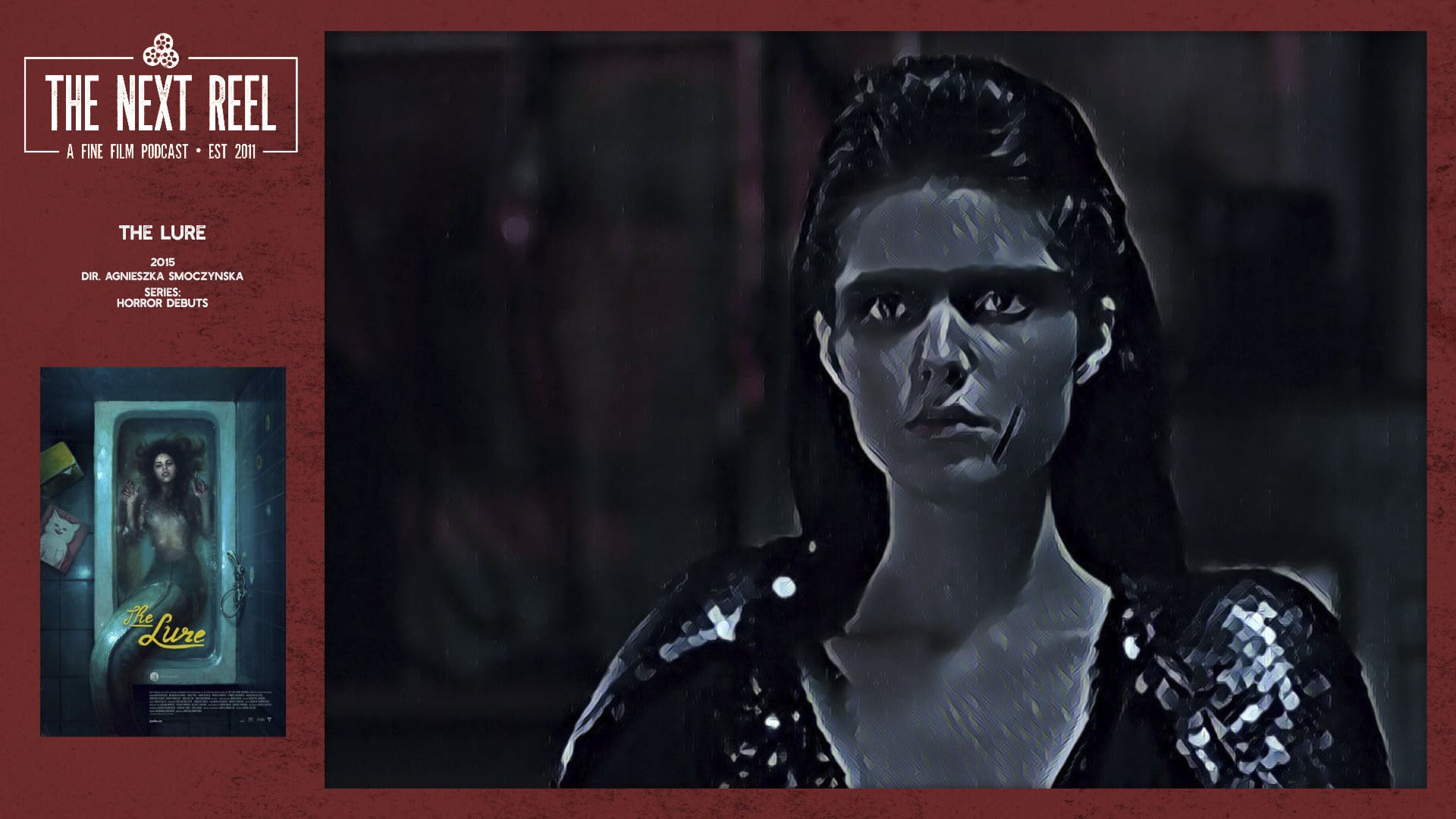
Welcome to The Next Reel. When the movie ends, our conversation begins. The Lure is over. The city will tell us what we lack. This was your first time with this movie?
Andy Nelson:
Yes. My first time with the mermaid sisters.
Pete Wright:
Okay, I’m very excited to see what you think about this. This movie is bonkers. This is bonkers. And I’m trying to remember, when did we talk — it was a trailer pick. It was a trailer pick by me, on—
Andy Nelson:
—was it you?
Pete Wright:
2017, 01/19/2017.
Andy Nelson:
Oh, wow.
Pete Wright:
Yes. And I don’t know if you remember, but I was pretty excited about this movie. I think I had yet discovered my, you know, deep love — as you know, I love horror movies now, I had yet to discover that in myself, but this movie, for some reason, really intrigued me. And then I watched it, and now I’ve watched it twice. And I want to know, Andy, what do you think I think of this movie? It’s way too easy.
Andy Nelson:
Low-hanging fruit. Is it? I don’t know, I was thinking about this, and I’m like, I don’t know where he is gonna land with this movie, because it is kind of a bonkers movie. I really struggle with calling it a horror film. I think that there are some horrific elements in it, certainly, but when it comes to the genre mashup, I think that the musical aspect kind of washes over the horror, and it just becomes a little bit more of kind of a dark fantasy story, I guess, kind of a dark fairy tale. I guess I’m just gonna say, I think you like it. I don’t know, I just really don’t know. I walked — when I finished this, I just said, I have no clue where Pete is gonna fall with this one. Such a — well, it’s such a bonkers movie, I can see people going many different ways from this one.
Pete Wright:
I think you’re a bit meh on the movie. I think that ultimately you’ve landed — but I think what you just described is a complete projection, and I think you just described it for yourself. I think you had trouble with the genre mashup, and that you feel like it was trying to do too many things, and as a result it didn’t successfully do any of them.
Andy Nelson:
Well, I guess we’ll find out here in a little bit.
Pete Wright:
No, I can’t wait. But you’ll have to wait. For now, the movie was not rated when it was released here in The States, but it is full of sex and nudity. It has some moderate violence, moderate alcohol and drugs, moderate frightening and intense scenes. Oh, and did I mention the nudity part? Because there’s a lot of it. It’s like, you know—
Andy Nelson:
—a lot of nudity. But you know what?
Pete Wright:
Don’t worry about it, because by the end you’re not even gonna notice anymore there’s so much nudity. It’s like just a nudity film.
Andy Nelson:
It’s just a nudist camp type of movie. There you go. Alright. It’s time for our questionnaire.
Pete Wright:
You know what, it was time for a questionnaire when we started this, and now we’re almost finished with it. So if you haven’t had a chance to, head over to TruStory.fm/TheNextReel and check out the annual questionnaire, please do. It helps us learn a little bit more about you, your listening habits, what you like, don’t like about the show. It helps us refine what we’re doing and hopefully make it better. To top it off, one lucky listener who fills out the questionnaire will get a free year of membership in our supporting member program. They’ll get access to all those fancy benefits just by filling out a little questionnaire. And it’s almost over. Almost over. Promise.
Andy Nelson:
So close. So close to being over. And then we’ll stop talking about it for another year.
Pete Wright:
I’m sure we’ll find something else to talk about, though.
Andy Nelson:
We’ll fill this spot with more air. We are going to feature audio reviews. We want to start including little bits, little snippets from our listeners as to what you think of the movies that we are talking about on this show. Please send us your clip, we wanna hear your thoughts. Just send it over, about a thirty second-ish audio file, to reviews@trustory.fm. Watch the film, record your little review, and send it over to us. We just might showcase it on the show. Remember to get it in quick though, we record about two weeks early — the earlier the better, and it’s more likely to end up in the show.
Pete Wright:
To that end, our watch list — if you don’t know what we’re watching in two weeks, you can just head over to our HQ profile over on Letterboxd. You can get there really quickly, just Letterboxd.com/TheNextReel. If you wanna get a discount on your own Pro or Patron membership over at Letterboxd, you can use the discount code NEXTREEL, or just visit TheNextReel.com/Letterboxd, and you’ll get that 20% off. This works for renewals as well.
Andy Nelson:
We just keep coming up with more stuff for merch. I know we’re already, you know, stewing over all the different ideas we can do for our Horror Debuts series. We have something up there for every movie from our last series, the eighties comedy with Coolidge and Heckerling. We already have something up for Messiah of Evil, and we already have something up for Relic, which hasn’t even — or, episode hasn’t even released yet, or actually by the time this drops it probably will have. But everything’s getting in there, so we’re having a great time putting stuff together. Check it out at TruStory.fm/TNRmerch. You can get shirts, stickers, mugs, face masks, pillows. The list is kind of endless. So head over to TruStory.fm/TNRmerch.
Pete Wright:
And finally, wanna watch this movie and help us out at the same time — if you see an Apple or Amazon link, it’s an affiliate link in our show notes, and if you click on it, it’ll take you to those sites where you can rent the movie, buy the movie, watch the movie. But just know, when you do that, we get a little taste off the top from those companies.
Andy Nelson:
Win-win. Thanks, everybody. Hey, we need your support. We don’t sell your information. We don’t want to, you know, turn into one of those shows that has all of those connections that are digging deep into the web of all of your information that you have permeating online. We just want to do this in as clean a way as possible. And so to do that, we need your support — please become a member and support this show.
Pete Wright:
Members get all sorts of fun stuff, there’s lots of voting, there’s a lot of voting. Speaking of, we just crested our two hundredth episode of the Saturday Matinee, as you listen to two—
Andy Nelson:
—hundredth episode.
Pete Wright:
Feels like we just started, Andy. Just started that show. And we haven’t actually — as I’m recording this, we haven’t recorded that show, but I’m gonna tell you in the past for the future that I’m pretty excited about my game related to things that exist over the number 200. Pretty excited about it. You can vote on our Saturday Matinee polls to choose the list topic based on the movie that we’re talking about this week — for example, if you were already a member, you could have voted on the list topic for The Lure already.
Andy Nelson:
Pete, I’m gonna test you real quick. What, the longest living mammal can live up to two hundred years — do you know what that animal is?
Pete Wright:
Is it some sort of a whale?
Andy Nelson:
It is, it is a bowhead whale.
Pete Wright:
A bowhead whale.
Andy Nelson:
It’s the bowhead whale. Alright, the record age for a bowhead whale, two hundred and eleven years.
Pete Wright:
Can you imagine seeing two hundred and eleven years of ocean? What a horror show that would be.
Andy Nelson:
Yeah, well, it’s only been getting worse.
Pete Wright:
Right, like a bowhead whale says something like, I remember the days when, and you’re like, crying.
Andy Nelson:
That is so true. So true. But aside from conversations about things that are over 200, members also get access to all sorts of other episodes. In fact, if you’re tuning in as a non-member, you’re likely gonna start getting some member episodes dropping into your feed, just to get a sense as to what members get. Because the Relic episode, which is members only, is gonna be dropping into the feed. We’re gonna drop one of our Flickchart re-ranking episodes in, so you can hear what that episode’s all about, maybe our Retake episode. These are things that members get, and we’re gonna give you some experience with those and maybe whet your appetite a little.
Pete Wright:
Members also get to vote on what we’ll be talking about in all those member bonus episodes. Did you say that already?
Andy Nelson:
No.
Pete Wright:
Didn’t, well, do. They do get to vote on that, which is really fun, and it gives us a nice influx of member ideas when our ideas get crusty — it’s nice to have somebody jump in and say, hey, guys, do this. So that’s very exciting.
Andy Nelson:
Definitely helps. And members can also watch the livestreams as we record the shows, and then, of course, they can jump back into the livestreams really anytime they want, to any of our previous shows.
Pete Wright:
They also get access to our super secret members only channels in our Discord NextReel server.
Andy Nelson:
And now members get stickers. That’s right, just every so often, just as a random little surprise and a way to say thank you, members get a few stickers from our merch store. Another way to say thank you for all of your support.
Pete Wright:
And best of all, you don’t have to listen to this ever again — become a member, you’ll get a very custom version of this show without us talking about it, in your very own bespoke members feed of all the Next Reel shows.
Andy Nelson:
At TruStory.fm/TNRmembership, you can learn more about the different tiers. The most it’ll cost you is $5 per month or $55 per year.
Ad:
Meet Xenia. You are being very polite to someone who is attempting to kill us. Her wife, Saffron. You can plan all you want, but what matters is what you do when your plan falls apart. And their best friend, Goldie. Glad we didn’t miss all the fun. Swords in hand, they defend their city from the worst of humanity. I am Lord Buxton Blue. Vicious Swa. The Franconian Rake. Herr Hague. Equity Electric. Follow their adventures on the Swashbuckling Ladies Debate Society audio drama podcast. Available now at trustory.fm/swashbuckling.
Pete Wright:
Alright, Andy, let’s do the big reveal. First of all, did you like this movie, or was I right on the money?
Andy Nelson:
I liked this movie.
Pete Wright:
You did?
Andy Nelson:
I was exactly right on the money. As far as the genre mashup, I struggle — I don’t know, I struggle with the idea of doing a horror musical, because I feel like when you throw musical into the mix, it pulls some of that horror element out, it feels like it dissipates the scares. And so that’s why I feel like if you’re gonna call it something scary, I feel like kind of a dark fairy tale works better, in my eyes — kind of a dark musical fairy tale is where we landed with this. And I’m okay with that, and I really enjoyed the way that they did that. So, yeah, I ended up having a lot of fun with it. I’m really enjoying the way that we’re watching these horror films right now, where the filmmakers are finding ways to use horror as a metaphor and to craft these stories. So, yeah, all in all, I enjoyed this one.
Pete Wright:
I did too. I found this movie super rewarding, and I struggle a little bit with some of the critical commentary on the film, because I’m right with you, I don’t think it’s a horror movie. I think there are some gruesome elements, but they’re quick, largely, and there are some difficult elements, but again they sort of keep the movie moving through this dark fantasy — it is so bonkers. It’s like a recipe of something that you would never think to make on your own, in your own kitchen, but seeing somebody else make it, I found it a lot of strangely fun. I found it a lot of fun. The problems that I have with it — and I was really struggling with this — the problems that I have with it are not structural problems in the movie. I don’t have a problem with a lot of the things that other people are really critical about, of the narrative. I don’t think there’s anything personally wrong with the narrative. The things I have problems with are taste things, right, they’re things that I don’t have a taste for, and it’s really hard for me to be critical of a movie about just something that I just don’t choose to listen to, this kind of music for example. I’ve been listening to the soundtrack for the last couple of days, and it’s not my taste — I’d rather listen to other things, but it’s not bad, it’s just not for me. So I think the music in the context of the movie is great, but it’s not something that has me tapping my toes along later. So things like that, we can get into more of that.
Andy Nelson:
Yeah, we’ll get into that, because I have my own issues with the music too. I think sometimes it works better than others, but we’ll get into that. Yeah, to that end, with our conversation about the Babadook, with our conversation about Relic, I feel like there is this interesting trend right now about using horror films to craft these metaphors. And I guess, for a long time, if you look at horror films, it always has been — maybe not always quite so metaphorical, but certainly an element designed to tap into some of our greatest fears. And to that end, I guess there is a little bit of metaphor in a lot of horror, right — like the idea of the unknown, and learning to confront these sorts of things that are the dark corners of our lives. And I think that’s an interesting element that has become really obvious in these last few films, that I really enjoy, because they’re really tapping into this idea of this awakening sexuality in young girls as they start maturing and go through puberty, becoming women. Weirdly, as I was watching this film, I kept going back to this other film that very much dealt with the same thing about girls becoming — you know, moving through puberty to become women — called The Fits, which is absolutely not a horror film, but another very metaphorical film about this idea of coming of age. And I found that to be an interesting aspect in this film, that I think was done pretty interestingly, especially, I guess, kind of horrifically, when you first see these mermaids who are very virginal young girls, who, when they’re adopted by this music group, are introduced to the club owner, and they’re naked, but they are like Barbie dolls. They have breasts, but their crotches are, like, it’s just all seemed shut. It was really kind of almost more horrific to see it that way.
Pete Wright:
The most horrific. That was the most horrific.
Andy Nelson:
It was so wrong, and I’m like, this is so strange. But I could understand why they did that, because, obviously, the fish element of the bottom half of a mermaid is where they ended up having kind of their sex organs. But it also spoke of this idea of a young girl growing and becoming a woman, and I was like, there’s a really interesting idea here that just struck me as I was watching it.
Pete Wright:
Yeah, yeah. And jump from that — I’ll jump forward to the sort of the finale, where we get to the actual transformation, where one of the girls decides, I want to be a human girl. That metaphor plays out in a bit of a gruesome way. And I think the metaphorical part is, oh my gosh, one day I’m a young girl, and the next day I am a sexual human. And that plays out on the operating table when they somehow find a willing transplant of a young woman who wants to become a mermaid — it’s very confusing — and they sever the tail, the bottom half of her torso, and the bottom half of the torso of this human girl, and they swap them and surgically give the mermaid girl legs and sex organs.
Andy Nelson:
And the other girl gets a tail. Who knows if she’ll be able to use it, or if she will transform into a woman. But our mermaid girl also loses her voice, which is — and that is one of the clear nods to the Hans Christian Andersen Little Mermaid, right, because I believe that was a trade-off — or was that only in the Disney one, where she loses her voice?
Pete Wright:
That was Hans Christian Andersen.
Andy Nelson:
I haven’t read that before. And so, growing up, becoming a sexualized human being comes at a cost, right, and we see it on this operating table that’s filled with ice, like at a fish market.
Pete Wright:
So gross. It’s fantastic. And then she has to live with those consequences, and I think that is a great payoff in a movie that is ostensibly, or calls itself, sort of trucks in horror tropes. That’s a bit of a gruesome scenario that plays out so well for this coming-of-age story in the movie that is its primary metaphorical language.
Andy Nelson:
Well, yeah, I think so too. And there’s a really interesting element to that whole idea of these two sisters — how, on the making-of, they talk about how one sister represents the animal instinct, kind of that awakening sexuality, which you really see in Golden throughout this film. And Silver represents all the emotions and that need for love, and that kind of that whole side of it where you need to have that person in your life, and you need to please that person. She’s, of course, the one who does fall in love with Mietek, who is in love with this other woman suddenly at the end of the film, which ends up turning her to sea foam. And we kind of go with that whole Hans Christian Andersen end of the actual story, where The Little Mermaid ends up turning to sea foam and everything. Although it’s interesting, because that story is so much — there’s more to The Little Mermaid story, it’s kind of a much darker story for The Little Mermaid, because — with the whole thing with the sea foam, I think she becomes a spirit of the air and actually ends up going up into the air, and she actually has a chance to get her soul back if she can do good deeds for mankind for three hundred years. It’s such a dark story that is in no way in any favor of the female character. It really is just a very misanthropic view of kind of the male world, of wanting the female to be perfect, is kind of really where it ends. And so to that end, I enjoy that, in this particular film, we have a much different view of that. And I think Agnieszka Smoczyńska, our director, kind of found a way to flip all of that on its head and really take it from the woman’s point of view. And we really get this stronger story, I think, than the other mythological version of the mermaid from Hans Christian Andersen’s tale. And I like that.
Pete Wright:
There is this bee metaphor — story, I guess it’s a little bit even more literal, but it’s also a story of immigration, right, of immigrants, and the mermaids as immigrant peoples who are disrespected, used for — in this case, for who they are on stage, parading them out as in this nightclub’s freak show, or, you know, the sort of sex acts, oddities of nature. But they say once in the movie, do you wanna stick around here, or, you know, before we swim on to America, right? This is their immigrant journey to America in the eighties, and they sort of get stuck here in their little exploration of Poland. And how well does that story work for you?
Andy Nelson:
I think that’s actually a really fitting story also, especially — well, I’m sure it’s always been happening, but it seems like a much — a very current idea, the idea of immigration, and how immigrants are trying to find this, quote, better place somewhere else, and end up oftentimes getting wrapped into and then abused in the sex industry. And for two characters who are mermaids, they don’t have the view of body shame as many other people do — they’re just used to walking around naked all the time, because it’s just like there’s nothing, it’s like a fish — a fish isn’t wearing clothes, they’re just a fish. So they’re just being mermaids. But for us, they just happen to be naked. And so that ties them into this place where they’re used very much for their sexuality for these stage shows, because there’s something weirdly appealing about them, even though the way that their tails are designed — I’ll just say, it’s kind of a horrific view of the mermaid, because there’s nothing sensual about the bottom halves of them.
Pete Wright:
It’s not like they’re—
Andy Nelson:
—slimy, long, almost weirdly masculine and erect is kind of weirdly what they end up looking like, which I think is kind of funny, as another way to subvert that whole view of them as kind of these sexual beings. But I think that idea of this immigrant story is really interesting, especially because it is in this alternate eighties Poland — which was very, in eighties Poland, it was communist Poland, and the way that the society was more misogynistic, I think, is another thing that they’re bringing up here, as kind of part of that whole thing with these immigrants and the women.
Pete Wright:
There’s a lot going on, right? And the fact that it’s set in the eighties — it’s set in the eighties for some purpose. Does that matter?
Andy Nelson:
That came from the filmmaker Smoczyńska and her writer, Robert Bolesto, who very much grew up in that era, and grew up in this world. And the two singers who were kind of writing all the music for this, and really their whole story kind of was created because of this story of the two sisters, Barbara and Zuzanna Wrońska. I’m not exactly sure if I’m saying that right, but they grew up in this world, in this actual club where they’re filming here, the Adria, which is really interesting. And they all, as kids, remember it being such a colorful place because of the shows they were watching and everything — they referenced a show called the Academy Pana Klexa. And it was kind of a surreal kids’ program, very colorful, magical. And a lot of adults who have seen this said, that’s not what eighties Poland looked like. And so they purposefully said, well, it’s what we remember from it as kids, because for us it was colorful, but also it is kind of an alternate world that they’re creating here. And I guess the reason that they’re doing it is because of the way that communist oppression was pushing down on people in the eighties, and this also was a way to subvert that, to show this kind of alternate way to get through those things.
Pete Wright:
Yeah, I feel like thinking about the eighties in regard to this movie is overthinking their intention in the movie. And I think you said it — this movie’s color is because it’s pulling through the eyes of children at the time, who had no sense of what was actually going on, or limited sense, limited understanding, right. However, I wanna sort of catch that — but that’s what it felt like to me, that that in and of itself is enough to create a fantastical universe in which mermaids are able to come ashore and create a universe in which no one is terribly surprised that mermaids exist, right, that’s the thing that caught me. This entire experience, even the unveiling of the mermaids in the dressing room, no one would seem surprised that mermaids exist. They seem surprised that there were mermaids here, but not that they exist. There was never a question. So this absolutely, to me, is an alternate universe that is worth exploring on that level alone, that they’ve created something in terms of world building that is interesting. And it all starts from them, I guess, luring the bandmates to the edge of the water in the very opening sequence.
Andy Nelson:
You can see where they’re also drawing references from Homer’s The Odyssey, with the sirens and that whole idea. And this is something I think is really clever for the movie — the idea of sirens, and that siren song that these sirens, which are essentially mermaids, would sing out in the ocean to draw sailors to them, and then they would eat the sailors. A very dark way of viewing this mermaid lore, that they really bring in here with the idea of these mermaids singing to draw men to them so that they can then eat them. It’s a really interesting element that they include here, to give it, I guess, that’s where the horror tone comes from. Right, because when they’re mermaids, or when they’re even angry, they have insanely sharp mermaid teeth—
Pete Wright:
Yeah.
Andy Nelson:
—appear, and they look like you don’t want to mess with them. So it’s an interesting element that they add. I do question — how does Krysia, the — I don’t know, I look at the band, and I just kind of keep in my head calling it mother, mom, dad, and son, even though my sense is they’re not actually any of them really related, but I just kind of think of them as a family band. Anyway, Krysia is the, quote, mom of the band. And she sees that these mermaids are pulling the two men from the band into the water, and she shrieks, almost like a banshee cry, that clearly stops everything from happening. And then somehow, the next we see them, they’ve essentially adopted these mermaids into the group. So that’s an element that I really didn’t quite understand — what was it that stopped all of that? Did she have enough willpower to flip the tables on them? I wasn’t sure.
Pete Wright:
Yeah, a hundred percent question there. I was able to kind of let that go, and I’m not usually able to let that kind of stuff go. But my headcanon says it’s because the girls also found themselves wanting to come on land — they maybe thought they wanted to dine on these fine people, but then they changed their minds. Or maybe they wanted to explore. Yeah, there’s also something charming. You know what they are?
Andy Nelson:
What?
Pete Wright:
They are the Quakers of the mermaid world. I feel like this is that period.
Andy Nelson:
I should just help you — go ahead, tell me more about the Quakers.
Pete Wright:
They’re on their journey to step out of their shells, experience the world before they come back to their world. What’s that TV show?
Andy Nelson:
The Quaker? Oh, they’re Amish — it’s Amish. This is Rumspringa.
Pete Wright:
Amish. Yeah, the Amish — what was the TV show, Amish—
Andy Nelson:
—Paradise? I don’t know.
Pete Wright:
But that was a Weird Al song.
Andy Nelson:
No, there’s that TV show — what is that TV show?
Pete Wright:
Where it’s been—
Andy Nelson:
—it’s the Amish — there in Amish—
Pete Wright:
Amish Paradise.
Andy Nelson:
Yes, but Breaking Amish was a reality show that followed Rumspringa — the Amish — that followed the Amish kids. I don’t know why I got Quakers.
Pete Wright:
I don’t either. I think the Quakers would write if they had phones.
Andy Nelson:
If they actually listened. But this is their Rumspringa.
Pete Wright:
It’s mermaid Rumspringa.
Andy Nelson:
Yo.
Pete Wright:
I feel like if that doesn’t get on a shirt, we’re in trouble — a mermaid with an Amish hat, it’s Amish Mermaid Rumspringa. I was gonna say something else — it is a bit of a charming play, right at the beginning of the movie, where we have these mermaids who are trying to lure these guys to the edge of the water, and these guys are also playing music and essentially luring the mermaids out of the water, right? It’s a lure-off.
Andy Nelson:
Yeah.
Pete Wright:
This is a lure-off, and the mermaids lose in the beginning. The mermaids have better teeth—
Andy Nelson:
—that’s true—
Pete Wright:
—for it, but they actually lose. I think they kind of fall in love with the lure of land and want to explore. And I think that’s a charming setup for me, and I like it.
Andy Nelson:
And I hadn’t really thought about it, but it is in the title, and that’s an interesting element — that we’re really watching the story of these two young girls that have been lured to a world that’s really different from their own. The lure of a cigarette, the lure of their first drink, of falling in love, of having sex for the first time — all of that is right there in the American title, which I think is pretty interesting.
Pete Wright:
Totally. So I feel like we have to cross, at some point, the bridge of the music. You said you have some issues — this is a movie musical, you — this is a horror movie musical, so you’re watching this movie, don’t be surprised when everybody breaks out in song and dance, they will absolutely do it. Sometimes it will be in the club, and there will be a club sing scene, and that feels very appropriate, and then they’ll hop in shopping carts and they’ll be at the mall doing an absolute bonafide movie musical number, out of context with the rest of the narrative, singing about what it means to be in a city. There are a number of those in the movie, and it sounds like you had some issues with them.
Andy Nelson:
Oh, well, just to clarify, they’re not out of line with the rest of the movie in terms of a musical — because there are other musical numbers throughout the film, it just happens. I mean, this is a musical, it just happens to be — there’s the musical element where they are in the mall, singing and dancing in shopping carts, and then there’s the club musical element where they’re just performing in clubs and everything. So you get a lot of both of that, there’s a lot of music in this movie. My issue with it — in general I like the performances, I like what they’re singing and everything, but I also find that it’s very repetitive. And I don’t know if that was an intentional way to create that lulling sense of a siren song, but I felt like, especially as a non-Polish speaker reading the lyrics, it was like, are they just repeating their stanzas over and over again, because it felt like I just read this, and I just read it again — like, they’re just singing the same lines over and over again. And that, for me, was a little repetitive in the way that I generally approach what I like in musicals and singing.
Pete Wright:
It does have a little bit of that La La Land thing going for it — there’s just kind of a musical idea or theme that you hear several times. But I do think, to that point, it works. It works because the movie is already bananas, it’s just bonkers. It’s very eighties synth, it’s eighties euro synth, which has its own bit of identity. And I think you’re right, the ideas in the lyrics are super repetitive, I found the same thing. But I found myself really fascinated by the experience of watching this kind of movie. I think, in large part, “Once More, with Feeling,” which was a Buffy the Vampire Slayer episode that was a musical — I actually think Buffy the Vampire Slayer did it better, I think the music was better, the music was much better. And I like the idea of taking ostensibly a tame horror property and making it something more frivolous like that. I like these properties, and I’m a sucker for musicals, so I think I’m already going into it with that bias. I think, to your point, does the music soften the horror part or the dark fantasy part, or does the dark fantasy horror part lessen the value of the music? I think that’s a right concern to have, and that’s why I think the sweet spot for this movie, the audience for this movie, might be pretty small — for people who really love both sides of it.
Andy Nelson:
Yeah, I think that people are gonna be drawn to this film’s originality, because I think there’s a lot of that in this film. I don’t know if a horror fan is looking for just a straight-up horror film, I don’t know if they’re gonna be completely satisfied.
Pete Wright:
Well, because when you watch this movie for the first time, did you know it was a musical movie?
Andy Nelson:
Well, yeah, because I’d seen the trailer, and the trailer emphasizes the singing and everything else that’s going on. So I kind of had a sense from the trailer, and probably if you listen to that SatMat conversation, because I feel like I was there — it very much is about that mashup of the horror, kind of the fairy tales from Hans Christian Andersen, this idea of music and that kind of eighties club feel. It’s kind of a mix-up of all that sort of stuff, which I definitely find appealing. And actually, I really enjoy the fact that it’s blending all of that stuff together. I don’t think it works as well as a horror film because of that. I don’t think the music — I honestly think I just don’t connect with how the music was written. I think they could have found ways to expand on the lyrics a little bit more. I think the way the music sounds is fine, I just feel like the lyrics just get repetitive. But I do think that you’re right, for some people they’re gonna have a hard time because of that strange blend.
Pete Wright:
I think there’s so much opportunity that comes from this kind of a blend. And I think that’s the problem that I have with the music too, I think that’s what I’m hearing you say, but check me when I start lying — it’s that they have this opportunity to move the story forward through music, if you’re gonna do a musical, and the lyricist just didn’t have it, right, just didn’t have a complete sense of how the music could be used to drive the story forward. And as a result, it ends up on the simple side of structure. So I feel like for me, to my taste, this was a missed-opportunity element of the movie, even though I also like it.
Andy Nelson:
Well, and it sounded like something that was, even for the two women, the sisters who were writing all the music, the Wrońska sisters — again, I’m not sure how to say it — they very much were musicians, they grew up in this club doing performances, their parents were performing, and they’ve essentially always been performing. This was their first time doing it for a film. And in the conversations in the behind-the-scenes, they talk about the complexity of having to — you know, they’re not just writing for an album, now they’re writing for this story where everything has to tie together and connect in different ways. And it sounds like, as Smoczyńska and her writer were putting this together, they actually started crafting it with the music, with the sound designer, and really built the whole sound world of the film first, to figure out the story and everything. And it sounds like, perhaps in the process of that, the music got so funneled down into the specifics of those moments that they weren’t able to get past it to give us a little bit more.
Pete Wright:
Yeah, they needed to write the Wall, right, they needed to write an early Decemberists album, right — they needed to write something that had its own momentum, its own sort of inertia, to keep the story moving forward.
Andy Nelson:
Even The Little Mermaid — I mean, any of those sorts of things, that’s not — a whole — that’s a musical.
Pete Wright:
We’ve done it already.
Andy Nelson:
The songs — right, it’s using the songs to advance the story. And as you said, the songs here just — but again, this is the way I have to look at it, and I’m like, maybe this is what they were going for, because that’s what it felt like to me — it’s so repetitive that it becomes lulling, like a siren song. And that’s just in my head, I’m like, maybe that was the intention that they did with it. It just feels so repetitive that my brain just kind of, all of a sudden, am hypnotized by it, because it’s not moving the story forward, but it is generating kind of a tone for me. So maybe that’s the intention.
Pete Wright:
Okay, I get that — that may be one of those, like, I do, where it’s a bridge too far in terms of headcanon.
Andy Nelson:
I — well, I’m totally headcanning, I’m sure I am, I’m sure I am. Alright. But — and then there’s Triton.
Pete Wright:
Okay.
Andy Nelson:
Triton and his music, which is a different whole—
Pete Wright:
—different — Triton is a metal artist. Yes.
Andy Nelson:
Kind of like — yeah, not quite death metal, but very, very thick.
Pete Wright:
At one point — one of them was ripped out, the other one he ripped out himself. Weird. He’s a guy with issues.
Andy Nelson:
Did you have any confusion or issues with the way he was set up and introduced in the story?
Pete Wright:
I didn’t. I did — I don’t think I did. Why?
Andy Nelson:
Well, because he randomly just appears — like, we’ll be having the story, there’s drama between the sisters, I think the first time we see a shot of him, it’s when — I don’t know, something had happened between Golden and Silver, and Golden walks out of the club and goes out into the alley. Or it might be when she first meets the pop, I think. But suddenly we just see a shot, just a quick shot of this shadowy male figure who’s kind of just looking around, menacing, and then he kind of disappears in the shadows. And I was like, okay, who is that, like, demon creature? It looked like somebody who, as you find out later, had had horns and they had been removed. And then it happens again later in the film, and then we finally see him at the bar, and they actually talk to him, and we learn that he kind of says, like, you’re of my blood or something. And so I’m like, oh, so he was a merman, blah blah, and then later you hear them call out that he’s Triton. I’m like, okay, well, now all that makes sense. But it was just a strange setup, it’s like just these shots of him — was it just meant to say he’s kind of watching them and seeing what they’re up to? I wasn’t really sure.
Pete Wright:
I didn’t get that, I guess. I’m gonna take a step back — I didn’t have any confusion, I feel like I bought into it. It was confusing a little bit, because my more recent experience with Triton is he’s the king, and they are the daughters of Triton, right — we’ve, that, again, has settled mermaid science for me. And so it took just a minute to think, oh, they’re not directly related, but he is another of their people, some sort of royalty with horns, I gathered, and I was okay letting that kind of wash over me, so to speak. And we need a character like that, right — we need a character to come in, the sage wisdom character, we need the old wise character to come in and give them guidance and tell them something that they don’t know already, that will move them forward into the next complication. And we got that, we got that with him. He explained the sea foam bit, and it was all fine. And she needs to eat somebody before dawn.
Andy Nelson:
Well, what’s great about him is it’s not just that sage wisdom, it’s also just flat-out honesty. Like, when she comes and sings with him at his club, which, first of all, his — the person that he’s singing with seems completely upset about, which I thought was kind of funny.
Pete Wright:
Yeah, she’s not keen.
Andy Nelson:
No, not at all. But then Golden is all excited, and he just looks at her and is like, you really need a lot of work, and just walks off. I was just like, he is just gonna just say it like it is.
Pete Wright:
Yes, yes, I find that delightful, I thought that was really great. So, okay—
Andy Nelson:
—some of the stuff — I’m trying to get a sense of, like, the mermaid-merman powers, I guess we’ll call them. We — they speak through telepathy, we see the two sisters having, like, whale-slash-dolphin squeak, where they’re communicating with each other, which I thought was actually pretty interesting, I liked that. But then there’s also a moment when Silver — she sees Krysia performing on Mietek through the keyhole in the bathroom, and she seems very upset about this, and the pipes rupture and start spraying water everywhere. And I was very confused about that — is this some power that suddenly we’re meant to feel she has with water? What was that all about, or was it just kind of a metaphor of her being upset right there?
Pete Wright:
I think it was a metaphor of her being upset right there. It’s weird, I didn’t think beyond it, but you’re right that the timing is rough — that’s a rough signal, because it implies something that is not implied or explained anywhere else.
Andy Nelson:
No, and it never happens again.
Pete Wright:
It’s just—
Andy Nelson:
—it’s the one time where I was like, okay, do they have power over water? It just threw me a little bit. That would be cool, though.
Pete Wright:
That would be cool. Yeah, that would be cool.
Speaking of fantasy moments, there was that moment where we go for a deep swim, in the swimming, in the tub.
Andy Nelson:
Bathtub, right.
Pete Wright:
Yeah. I think the movie does these — what I can only describe as — it’s a movie that sets me up to expect anything. We now have a mermaid musical horror film that explores this sort of deep fantasy, sort of psychedelic universe, as he climbs over the bathtub and falls into the deep ocean.
Andy Nelson:
And this speaks to the nature of musicals, and that’s what I was saying — I feel like there are other scenes that really feel like musical moments, when you hop into a bathtub and all of a sudden it’s like you’re in a giant endless thing of water, in all directions, and they have this magical moment together. That felt very much like a musical fantasy, where it’s just, again, we’re in the lyrics, we’re in the song, as this moment happens, where they’re just fooling around in the bathtub. There’s another moment where Golden is walking around, and she’s very much pining, she’s staring at — I don’t know, it looks like a flat-screen screensaver in the bathroom of ocean images, and then all of a sudden she’s singing, walking around, and everybody is frozen, and she’s just kind of walking and singing — that, again—
Pete Wright:
—which was really cool.
Andy Nelson:
Yeah, very cool moment, very much kind of a musical type of moment that you would have. Same thing, although I found it much more confusing after they’ve dumped the girls — they, quote, killed them, and I wasn’t sure what I was supposed to read in this whole thing — the dad figure, I think he’s just named Drummer in the credits, he punches them both in the face, apparently they’re dead, they wrap them up in carpets and toss them into the river off the bridge. They’re all upset, they come back to their house, and it’s like, are they drugged, are they dying — the songs, again, a musical sort of song talking about being poisoned, I’m like, okay, so are they poisoned? And then there’s a woman walking around injecting them, hooking them up to, I don’t know, drugs of some sort — is she supposed to be the representation of addiction? This is where all of a sudden those musical songs start losing me a little bit, because I’m not sure what’s happening. Am I just meant to think that they’re all just so depressed now, because they’ve killed the mermaid sisters, that they’re all shooting up and passing out? I don’t know.
Pete Wright:
Yeah, or was it an experience of shooting up, or were they — was it recovery, like, they had already come down and they were being weaned off of whatever they were experiencing. I was very confused by that. That’s a sequence that is a little bit baffling.
Andy Nelson:
Well, and then — is the woman who’s walking around, is she the one who dad is with at the wedding? All of a sudden I started getting really confused as we move into some of these elements later in the film, because everything has to speed up to get us to this wedding. I got very confused by some of these moments.
Pete Wright:
Well, there is this regret and grief that is explored in all of these sequences in a way that narratively is unclear, but emotionally, I feel like, is. I don’t think they intended to kill the girls — I think that is a piece of regret. I think the Krysia breastfeeding fantasy is a maternal regret — she had taken a real love to these girls, you could see that in the very beginning. These are her friends’ kids, right, she was trying to introduce them and make them her own. And I think she was in real grief, and I think that was a really dark place for them. So coming to terms with that grief is what this whole sequence is about, and it doesn’t feel as well executed.
Andy Nelson:
Yeah, it’s a little confusing trying to figure out exactly what the intention was with the story at this particular point. I guess I can understand if that’s what we’re meant to take out of it — they’re coming out of this place of addiction that they had been in. And dad — again, I just keep calling him dad, I don’t think he is — he leaves, he packs up his bag and walks out. And I think that’s that whole thing that happens when you come out of these situations, you’re like, I have to get myself out of this, and he leaves. And again, he’s with the same woman at the wedding, I swear. He might be right. But it’s confusing. It obviously, something happens that breaks them. Not to mention the fact that when the girls do come back, they say, hey, no harm, no foul, and then they bite dad’s thumb off.
Pete Wright:
Yes, there is this sort of animalistic thing that’s on display here. But also, if we’re gonna stick to the coming-of-age metaphor, there is this experience of youth having to sort of spit in the face of elders in order to sow their own. And in this case, here’s the lash out, right — this is the, literally, I really am sorry you punched me in the face and thought you killed me and then dumped my body in the ocean, and I’m gonna bite your thumb off because I want you to know who really is in power. But also figuratively, you were a parental figure, and here, I spit at thee. I bought that. I bought that, I’m glad it didn’t go any farther than that — had they gone in and just massacred them, that would have been ill-placed.
Andy Nelson:
In the sense of what we do get with the two of them — I guess it seems like, again, it didn’t seem like an issue for them, they’re like, hey, it’s cool, still gonna bite your thumb off, you know. It’s almost like, in that sense, it was almost like a Godfather type of punishment — it’s like, no, it’s fine, we’re okay, we took your thumb.
Pete Wright:
And now we’re fine. One day, I’ll make you an offer you can’t refuse — I’m gonna ask you to hitchhike—
Andy Nelson:
—and you won’t be able to do it.
Pete Wright:
So then we have the end.
Andy Nelson:
Well, but before that, we didn’t really talk about this bit with this lesbian cop, which, again, I think is an interesting element that speaks to Golden and the idea of this animal instinct, this sexuality, this awakening. It was a very interesting sequence — another fantasy dance bit, right, fantasy kind of musical bit. She’s outside, and this cop wants to take her in, because she pretty much has a pretty good reason to believe that one of these mermaid girls likely killed this person in the car.
Pete Wright:
Oh, yes, the death of the German.
Andy Nelson:
Everything points to mermaid murder. And it’s actually just murder, but it’s M-E-R, hyphen—
Pete Wright:
—B-E-R, I see what you did there. And let me just say for the record that the title of the track on the soundtrack is “Biting the German to Death.” So—
Andy Nelson:
Fantastic. So there ends up being this draw between Golden and this police officer, and they start singing and dancing about all this, everything that had happened. But clearly they are drawn together, to the point where this cop is saying, I’m gonna take you to Disneyland, in the song and everything. And I love the little dance that she’s doing with her little finger guns and everything — it was a very eighties kind of bit that was very comical. But it also leads to a bit in the bed, where I found it kind of compelling, because she was not put off by the fishiness of her — she was licking the scales, and it all seemed very okay. And I was like, okay, there’s something interesting about this that was, obviously, worth exploring. Although, again, I wasn’t really sure how it ended, because then we see the cop kind of pull the gun on Golden again, and then we kind of cut away. And I’m like, okay, so are they getting together, or is Golden now eating the cop? Obviously the cop didn’t shoot her, I wasn’t quite sure where we go, because we cut away. But I did find it to be kind of a compelling, again, another look at exploration.
Pete Wright:
Which takes us to — I guess I would throw in here that it sort of feels like time has passed in a strange way, right — like, how long were they in their drugged state, how long did it take the girls to recover? Because, at some point in there, and if I’m to point out a structural issue that is not taste-related, it did not take quite enough time for Mietek to fall in love with somebody else.
Andy Nelson:
That was very rushed — all of a sudden it’s like, who is this girl that he just met, they fell in love, now they’re getting married, all of that was super fast. And I get it to a certain extent — we’re obviously also, aside from dealing with the bodies, we’re also waiting for Silver to recover from her surgery, right, so there’s quite a bit of time that obviously happens as she’s trying to heal from the operation.
Pete Wright:
And clearly, in some sort of physical therapy — we see her in the wheelchair, and then she gets up on her treadmill, and time has passed in order to get her there. And it sounds pretty hand-wavy to say, don’t worry about it, but it is what I’m thinking about at this point in the movie.
Andy Nelson:
Oh, absolutely. And that’s why it feels like we move through the first bulk of the film, almost like the first two and a half acts, really — it feels like the time works really efficiently, and I’m understanding the story. By the time we get to everything, after they’ve dumped the two girls into the river, they go through their drug-induced bit, Silver decides she wants surgery, and then the wedding — that stuff all happens so fast that I feel like they really rushed a little bit in the script to get through all of that. Because it’s like, where did this other woman come from, especially because Mietek doesn’t seem like — he seems like he’s just kind of playing around with all the women that he meets, he seems not interested in settling. And so it struck me as strange that all of a sudden, oh, he’s met this woman, now they’re getting married, wow, now we’re at the wedding — it just all happened so fast.
Pete Wright:
Yeah, I agree with that. He also — we never really got a sense for him in studio, right, he’s like a session nightclub musician. And so I saw him in the studio and thought, well, this is a change of context — are they gonna show us some new side of Mietek that is going to lead us in some interesting places? And it didn’t. And I’m sure in the broader scope of this musician’s life, there are experiences in a bonafide studio and not just in a nightclub, but changing context for just that, I struggle with, because it begged me to want to see more about his life and didn’t end up giving me anything more than just this rushed new relationship to a woman that he marries inside of three minutes.
Andy Nelson:
Right, it all just had to happen so we could get to the sea foam bit — that’s really where the story felt like they just needed to hurry it along, so that we could close out that whole sea foam storyline that they had created.
Pete Wright:
And to that effect, the sea foam bit is pretty cool, it was so awesome — as an old softy like yourself, you have to have fallen for that moment. Oh, I love — she puts her head on the chest.
Andy Nelson:
Or she’s contemplating his neck, she’s looking at it with her giant — bangs out, she’s ready to do it. And then she just can’t, and she looks at the sun and watches the sunrise with her true love. And beautiful, beautiful effects work here, as his body kind of turns from one side to the other, and the camera kind of moves from looking over his right shoulder to his left, and we see that all he’s got is just foam covering his whole front. That was just flawlessly executed, it was beautiful. It was haunting and heartbreaking, because, obviously, for Golden too, who then goes into fits and attacks and rips his throat out.
Pete Wright:
It’s awesome, it’s awesome, and it boils down to a simple opportunity for Golden to exercise vengeance in this state of wildness that we know she’s capable of, because she bit the German to death, and she now gets to exercise it for the person who is most important to her, her sister, Silver. And then she’s gone, she’s back into the ocean, on her way to America. Who knows.
Andy Nelson:
Maybe. Maybe she kind of grows up into Madison — this is her journey to go meet Tom Hanks. I like to imagine she’s just a young Madison.
Pete Wright:
God, they should have showed more teeth than Splash. Am I right?
Andy Nelson:
If there’s anything they were missing.
Pete Wright:
I really like that. I have to say, you made a nod to the effects work — I would just like to add the open throat work, after it’s been ripped out, with the slight bubble right in the middle, that made me think of the Jurassic Park cup of water on the dashboard, like, it’s a perfect ring of blood coming out of his, just pooling in his neck. That was a great bit of gore. Just great.
Andy Nelson:
And just the fact that we haven’t even brought up the fact that these fish tails, they look so good — it’s insane, like, when she, after she eats the German and she’s dragging her body across the sand to get back into the water, that was just so awesome.
Pete Wright:
Cannot agree more.
Andy Nelson:
All of that, yes, I mean, it was, like, massive — I heard differing things, between, like, fifty and ninety pounds of stuff, and they had some pedals in there to operate it, so they were really trying to do all of it. They did a few CG enhancements, but for the most part it was really there.
Pete Wright:
It was just flawlessly executed, it was really great. Any performances you wanna highlight specifically?
Andy Nelson:
Well, the two girls playing the mermaids, I thought both of them were great — that was Marta Mazurek and Michalina Olszańska. I hadn’t seen either of them before, but I really thought they carried the idea of no shame in being naked really well, like, they just never realized — I was really impressed with how they did that. And then also Kinga Preis, who actually — she was in In Darkness, which we talked about a few years ago—
Pete Wright:
Right.
Andy Nelson:
—in our Agnieszka Holland series. She has a face that is mesmerizing, and watching her—
Pete Wright:
—sing, her eyes, god.
Andy Nelson:
Yeah, yeah, well, and just all the different hairstyles that she had — she just always captured the attention, you know, she is the sort of person that you would watch on stage. I thought she was just—
Pete Wright:
—well, and they all do their own singing, let’s just get that out of the way, they sound great.
Andy Nelson:
They do their own singing on screen, it’s not like they’re doing it afterward in the studio.
Pete Wright:
Right, right, yeah, they sound terrific.
Andy Nelson:
Yeah.
Pete Wright:
Okay, so this is a horror debut, right, talked about it as a horror debut.
Andy Nelson:
Yeah, it is, Agnieszka Smoczyńska’s debut film. Quite a story to do. She had been doing a lot of shorts for quite a while, and then she ended up after this doing, like, the Field Guide to Evil, Fugue — she has a couple others that she’s working on, Silent Twins and Hotspot. And I didn’t watch any of her shorts, they had a couple of them that were on the disc, but I just didn’t get a chance to look at them.
Pete Wright:
Have you seen anything else that she’s done?
Andy Nelson:
No, I haven’t.
Pete Wright:
Just assured nothing.
Andy Nelson:
I haven’t seen the Field Guide to Evil, that was one of those anthology films, which I always love, I really love them, I don’t know why. I just haven’t — I think that one, there came this influx of so many horror anthology films, like with the VHS films and the ABCs of Death, and whatever — there were so many that I just kind of started losing track of which ones are out there. So I don’t think I’d even heard of this one.
Pete Wright:
I haven’t heard of anything else that she’s done. And I thought this was, in the words of the once and future king, Steve Sarmiento — I have to tell you, this was an enormously capable film, competent film. There’s a lot going on in this movie, and for us to have as few critical points as we do, in this bonkers universe, is a real testament to her as an able director.
Andy Nelson:
Yeah, especially because I think — I’d have to go back and look, but I think this is the first film in this particular series where the director wasn’t also writing the script, or at least co-writing the script. But it sounds like she was very involved. So it sounds like when she and Robert Bolesto — it sounds like they had worked together on the shorts and stuff, and so they already were familiar with each other and had that working shorthand. But I also love this idea that he actually came up with this idea of doing a story of these two sisters growing up in this club and that whole life, and they were like, well, one of them was like, yeah, sure, and the other’s like, I don’t know about that. And so he came back to them a few months later and was just like, what if they were mermaids? And everybody was like, that’s the way to do it.
Pete Wright:
Nailed it.
Andy Nelson:
Yeah, and I just love that — you always hear those sorts of jokes in the writer’s room, right, like, now what if that character was a duck? And in this particular case, it’s like, that is what you needed to really make a film that stands out. So I think Smoczyńska really found a way to connect to this story, because she also grew up in kind of this environment, where her parents did run kind of a place like this. So she grew up in the same world, and speaks to that. So I think there’s a lot of connection that all of the people involved had to this world.
Pete Wright:
Yeah, well, it’s fascinating. And, boy, I’ll tell you, I liked it. I like my experience with this movie. And it’s bonkers, but it was worth it.
Andy Nelson:
Indeed, indeed, I’m right there with you. Well, we will be right back, but first, our credits.
Pete Wright:
The Next Reel is a production of TruStory FM, engineering by Andy Nelson, music by Ryan Preset, Oriol Novella, and Eli Catlin. Andy usually finds all the stats for the awards and numbers at The-Numbers.com, BoxOfficeMojo.com, IMDb.com, and Wikipedia.org. And for this one, he had some help from FilmNewEurope.com. Find the show at TruStory.fm. And if your podcast app allows ratings and reviews, please consider doing that for our show.
Alright, Andy, how did it do at awards season?
Andy Nelson:
At the Polish Film Awards, it did pretty well for itself, considering the genre mashup that it was. For the Discovery of the Year, Smoczyńska won Best Director. Kinga Preis was nominated for Best Supporting Actress, but she lost to Anna Dymna in — I don’t know how you say this in Polish, I’ll just say the English translation — Eccentrics, or the Sunny Side of the Street.
Pete Wright:
Wow. Oh, wait, just try it, just try it.
Andy Nelson:
Well, hold on, sound also was nominated, but lost to that same film. I don’t know, that was a mess, I don’t know why I let you talk me into trying to do the bad thing. Translation — also, Eccentrics, or the Sunny Side of the Street. I don’t know if that’s a mistranslation, either way I struggle.
The Polish Film Festival, Smoczyńska was nominated for her debut feature film and won. It also won for Best Makeup, and was nominated for Best Film but lost to the film Body. It did debut at Sundance, where it received the Special Jury Prize for World Cinema Dramatic, and they had this to say, for its unique vision and design — this is for a film that really captured our imagination, though, very verbose thoughts on the film. It was nominated for the Grand Jury Prize for World Cinema Dramatic, but lost to the film Sand Storm. At Fantastic Fest, it won a special mention for Fantastic Spirit. And at Fantasia Film Festival, it won the Cheval Noir Special Jury Prize for being a timeless cinematic fairy tale and instant cult classic. And this is peculiar to me — it was nominated for the Best European-slash-North-or-South-American Feature, for the audience award, but lost to Hunt for the Wilderpeople, which I don’t think came from Europe or North or South America.
Pete Wright:
Just check out — did Europe or North or South America put a lot of money into Wilderpeople?
Andy Nelson:
Maybe that’s why, I don’t know, that’s crazy, but yeah, there you go. Alright.
Pete Wright:
Well, it seems like you might have had a little bit more luck with the numbers this time around — how’d you do at the box office?
Andy Nelson:
Yeah, Smoczyńska had €1,380,000 to work with, which is about $1,760,000, $1,900,000 in today’s dollars. The movie premiered in Warsaw 12/16/2014, before playing in Sundance January 2015. It had a lengthy festival run before finally opening in the US 02/01/2017, opposite A Dog’s Purpose, Resident Evil: The Final Chapter, and Gold. It never played on more than seven screens though, and it only earned about $102,000 domestically and $7,000 international. Very small gross, which is about $117,000 in today’s dollars. That was definitely a loss for the film at the box office, leaving it with an adjusted loss per finished minute of $19,400. That being said, it is a clear voice from a unique filmmaker, and has already started building a new audience with its Criterion release.
Pete Wright:
I’m so glad Criterion picked it up.
Andy Nelson:
It seems like the sort of cult film that they would want to jump on.
Pete Wright:
Yeah.
Andy Nelson:
Because there’s a lot of stuff to talk about, as we’ve just shown.
Pete Wright:
Yeah, yeah. I think it’s interesting, as you’re writing this, we’ve got Brian in the chat room who said, I liked it okay, it’s bonkers, I would have liked it even crazier even more, I think — even crazier, even more, more music, more mermaid hotness.
Andy Nelson:
Yeah, I could see that. I can see that. Alright, I, however, thought it was just enough crazy, and it was fine, and we should come back around and rank it at some point, don’t you think?
Pete Wright:
Yes, we should. But first, here’s the trailer for next week’s movie, Saint Maud.
Andy Nelson:
Saint Maud, have you watched it? We wanna know what you thought. Send us your thoughts in a thirty second audio clip, just use your voice memos app, it’s super easy, and then share it with us — you can send an email to reviews@trustory.fm. You know, thirty seconds, that’s about right — if you can get your thoughts in a concise thirty seconds, a tight thirty, as they say in the biz, we’ll put it in the show, we wanna hear what you think. Again, reviews@trustory.fm. Here’s the trailer.
Trailer:
Dear god, your presence graces the air, and soon, everyone naughty. Hi, are you Maud? Yes. Hi. It takes nothing special to mop up after the dying. You’re prettier than the last one. But to save a soul, that’s quite something. Bless Amanda’s body and bless her mind, which is shrouded in darkness. When you pray, do you get a response? Just like he’s physically in me, it’s how he guides me. My little savior. Hey, I thought that was you, what are you up to? I’m a private carer. You’re still nursing? What? They know what happened. I just wanna see you loosen up. I’ve got more important things on my mind. There’s my little face. Maud. He isn’t real. Nothing worthwhile comes easily. You must be the loneliest girl I’ve ever seen. I’m ready and open, I feel fuller of your love than ever before. I have a responsibility. Oh, yes, of course. This is life and death on another level. What if I’m getting it all wrong? All the good girls go to heaven.
Pete Wright:
Alright, Andy, Letterboxd, how does this shake out for you at the stars office?
Andy Nelson:
The stars office. Well, you know me and stars, I can be very—
Pete Wright:
—I know, you talk about them like they’re an unlimited resource. They’re pretty much just an infinite resource.
Andy Nelson:
I like to give everything five stars, that’s my new motto — everything in is five stars, moving forward.
Pete Wright:
All fives with Andy Nelson.
Andy Nelson:
But I’m coloring my stars now, I have a whole new scheme.
Pete Wright:
Oh, for crying out loud.
Andy Nelson:
No, but, you know, I have a range of films that I generally really like, regardless of how many stars they have. And I think for me, this ends up being a three and a half star film. I think there’s some really creative work going on in here. I’m giving it a heart, because I genuinely enjoyed the film. It has some story issues, I think it could have been a little cleaner, the music could have been a little more or less droning at times. But I still really am impressed with the world that Smoczyńska and her team created here. So, three and a half with a heart.
Pete Wright:
I feel like I have introduced, in my life, more criticism of the actual structure and the transitions in the final act, or into the final act, that are more troublesome than my ultimate blindness to all things negative about this movie would indicate. I came in with a heavy pro-Lure bias. It’s probably not as strong a film as I’d really want it to be, but it’s still satisfyingly bonkers. I’m gonna raise you three and a half to four stars, and I will also give it a heart.
Andy Nelson:
Oh my, four stars, that’s heart.
Pete Wright:
But get that heart in there quick, before the girls eat it.
Andy Nelson:
Oh, that’s true, that’s true. Well, maybe we need extra hearts, just so they can sate their appetites.
Pete Wright:
Now there are unlimited hearts in the world, Andy. Now there are unlimited hearts.
Andy Nelson:
That’s right. For crying out — unrelated, what did you think of the original title, Daughters of Dancing, or Córki Dancingu?
Pete Wright:
Oh, I prefer The Lure, I prefer The Lure. In other words, it sounds like a reality show, a knockoff reality show. It does, like Daughters of Dancing with the Stars.
Andy Nelson:
Wow, yes, and now I can see that. Tell me you didn’t get that — somebody’s working on it already.
Pete Wright:
Yeah, it’s already in the workshop. Okay.
Andy Nelson:
Holy cow. Well, what did you think about The Lure? We want to know. Just hop into the Show Talk channel in our Discord server, where we will be talking about this movie this week. When the movie ends—
our conversation begins.
Pete Wright:
Letterboxd giveth, Andy—
Andy Nelson:
—as Letterboxd always doeth.
Pete Wright:
These are good, these are good. I think this kind of movie is what Letterboxd was made for — I don’t think Matt Buchanan knew it at the time, but The Lure really helped.
Andy Nelson:
It allows for some certainly juicy comments, for sure.
Pete Wright:
I can’t wait to hear yours, I have no idea where you’re going. I today locked the most popular review on Letterboxd for this movie, and it comes from Lucy May, who is a delightful video editor in her own right, and as she calls herself an accidental film critic, you can find her at Vimeo, vimeo.com/lucymay. She gives this movie four stars and says, “the two mermaids, hissing and singing and chewing on human body parts. Me with my camera out: you’re doing amazing, sweeties.” I love Lucy’s reviews, they’re all short and sweet, just like that, and she’s a great follow on Letterboxd.
Andy Nelson:
Oh, that’s so good. So I have this — it is by Lily, not quite as popular, but Lily gave it three and a half stars and said this: “can you tell my kids that this was The Little Mermaid?”
Pete Wright:
I just also scrolled to the one that you were gonna do, but it was too long, from Leticia Fernandez, with four stars: “the—” and over.
Andy Nelson:
“Eat the man, eat the man, eat the man, eat the man.”
Pete Wright:
It goes forever. Why is that not the most popular review of this movie?
Andy Nelson:
So many funny reviews here.
Pete Wright:
Yep. Thanks, Letterboxd.