Pete Wright:
I’m Pete Wright.
Andy Nelson:
And I’m Andy Nelson.
Pete Wright:
Welcome to The Next Reel. When the movie ends
Andy Nelson:
Our conversation begins.
Pete Wright:
I Am Mother is over. “Humans can be wonderful.” I would be a good AI voice, right? Like that could be okay.
Andy Nelson:
You’re no Rose Byrne, Pete.
Pete Wright:
God damn.
Andy Nelson:
You’re no Scarlett Johansson. Maybe Robert Vaughn. I could say okay.
Pete Wright:
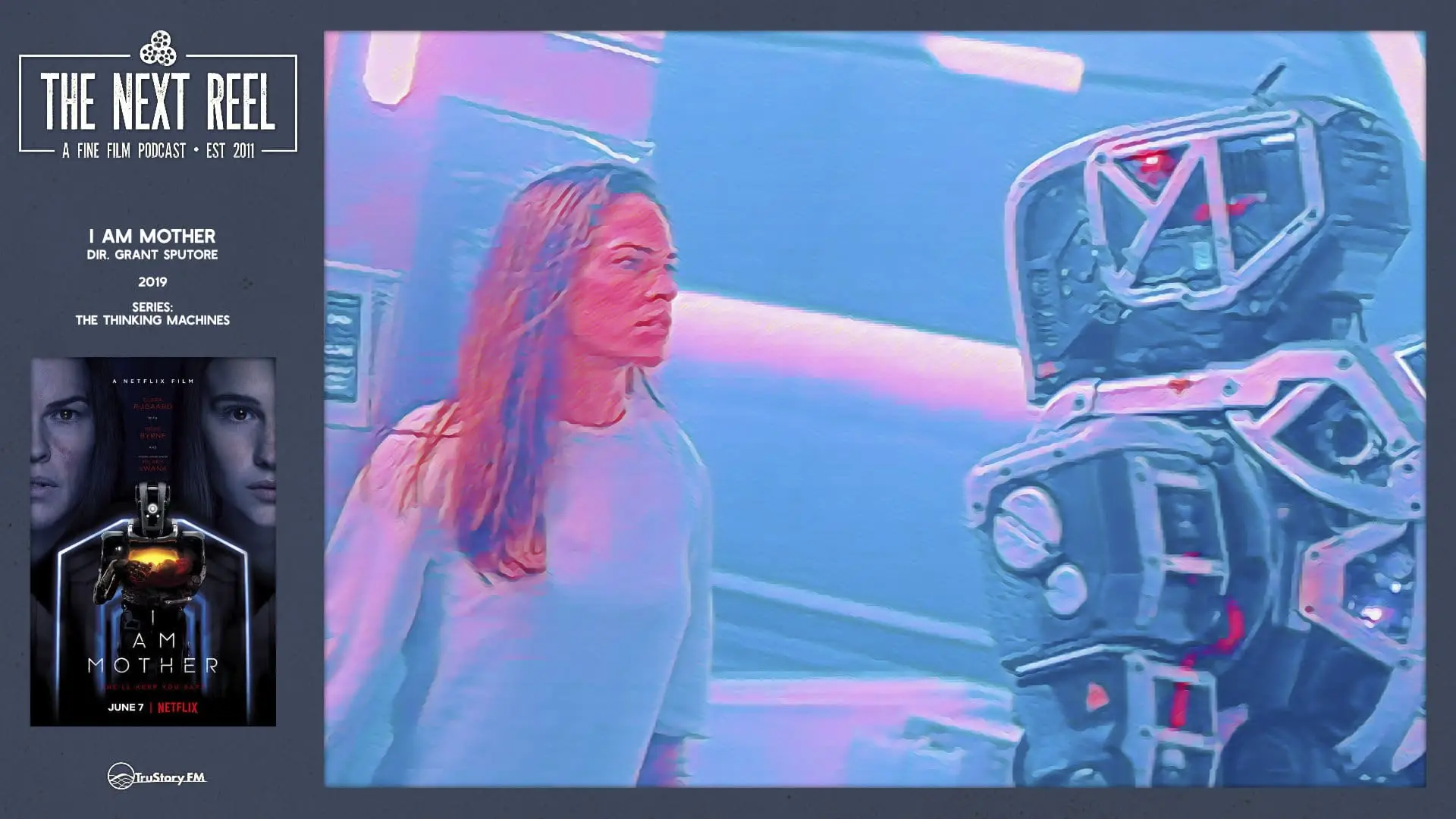
Do you know what? I’ll take it. I’ll take it. Hey, we’re in our Thinking Machines series. We’re still cranking through our future impressions of AI in film. And this is the fifth of our six movies. We’ve had Colossus: The Forbin Project and Demon Seed and Her and Ex Machina. And you know, eventually WarGames, you’re gonna hear if you’re a member. We would love for you to be a member at TheNextReel.com. You can find information on that. And this one is I Am Mother, and it loves you and it just wishes you’d call home more often. That’s what this one’s about. It’s very sweet. Don’t you think? Neither of us had seen this one. Brand new.
Andy Nelson:
Yeah, right.
Pete Wright:
I’m so excited to hear what you thought.
Andy Nelson:
I remember when this came out. I remember it was like one of those Netflix acquisitions from Sundance, and the concept intrigued me, but there is something about the Netflix choices that they make for things that they acquire that are just gonna go straight to streaming — I don’t know, I don’t always give full stock in them. I’m like, yeah, it’s probably gonna be a pretty crappy genre movie. And I hate to say it because I really, really love what Hilary Swank can do on screen, but there are times where I just question her choices. I don’t know if those are the best films for her career to be moving forward. Two-time Oscar-winning actress, Hilary Swank. And so to be honest, when this came out, I was like, meh. And you put it on the list, I’m like, well, that’ll probably be the bottom of the barrel for this series.
Pete Wright:
Right.
Andy Nelson:
And I’ll be honest, it really surprised me. I had a lot more fun with it than I was expecting. I enjoyed the concept and the setting and the characters. They did a great job of building essentially a three-character story, and it plays really well. I thought, you know, you could say that there are some elements that might feel derivative to Blade Runner or James Cameron’s world, like the Terminator sort of things, or even The Matrix, but I think it’s actually doing enough with the ideas to make it its own. So I really enjoyed it.
Pete Wright:
I’m thrilled to hear you say that because you and I are in the exact same boat. Like, this movie felt like, okay, this is gonna be just Netflix flexing its big wallet and buying content. This was gonna be just content.
Andy Nelson:
Yeah, right.
Pete Wright:
And then I read, as I was building this list, that it was on The Black List in 2016. Now, those kinds of movies we generally stop and say, okay, wait a minute. Is this one we should pay a little bit more attention to? And so I just took a flyer on it. I thought maybe we’re gonna get lucky, and I’m with you. I think we got lucky. I think this movie is doing more than I expected it to do. The strength of the film is absolutely in its central performances, not just Mother, voiced by Rose Byrne, performed by — oh my gosh, I can’t remember his name. We’ll say it again. Anyway, those two performances, especially the practical robot performance on set, was extraordinary. I thought he was fantastic.
Andy Nelson:
Luke Hawker.
Pete Wright:
Luke Hawker is the body behind the suit, and it is a mostly practical suit. I was so blown away by how good that physical performance was. And it just adds so much to the movie. Hilary Swank was good. The entire conceit I thought was really interesting, and there are some great things going on — some great camera, great production design. Do I have quibbles? I probably do. No, I do. But generally I am in the bag for this movie.
Andy Nelson:
Yeah, absolutely. I mean, it’s not like Million Dollar Baby level Hilary Swank, but I think she’s better than good. I thought she was actually bringing a lot to the story as this survivor, as Woman, this mysterious stranger who arrives. There are interesting elements with that character and the nature of that story. And I’m really curious to dig into this because there are some really dark ideas in this that make for such an interesting story, you know?
Pete Wright:
Okay, all right. So with all these big ideas, Andy, where would you like to start?
Andy Nelson:
Well, the film starts with an extinction level event — like, day one after this extinction level event, we are basically in a bunker. There’s this Mother unit that is walking around and has 63,000 cryogenically preserved embryos, and its job is to essentially learn how to be a mother and then repopulate the planet once things are safe. That’s the premise set up for us.
And just that concept alone is interesting. And I will say the first thing that triggered my brain — like, okay, hold on, something is happening here — is we see all these things happening and then we jump and it’s like 13,000 days later or something. And I’m like, how many years is that? Of course I’m like, hey, how many years is 13,000-something days? And it’s like 38 years. I’m like, okay, hold on. We started on day one and suddenly we’re 38 years later, and Mother now has Daughter, right? This teen character who is the protagonist of our story.
Pete Wright:
Okay, can I stop you and ask you a question?
Andy Nelson:
Yeah.
Pete Wright:
Do you think having it in the units of days is a disservice to the thriller nature?
Andy Nelson:
Oh no.
Pete Wright:
You think it’s good?
Andy Nelson:
I think it was great, because people aren’t really paying attention.
Pete Wright:
Okay, good. All right.
Andy Nelson:
I think that’s the key of it.
Pete Wright:
Yeah, I do too. I mean, I’m with you. I just think that that 38 years is an awakening that only hit me — I didn’t even think about it until the reveal we have much later. I was like, oh my god. Oh my god. This is horrible, what is happening right now. Okay, keep going.
Andy Nelson:
As far as extinction level events, this is also where it gets interesting because Mother is raising a child, and again, now a teenager, and Daughter is naturally inquisitive and questioning, and she’s a great learner. She’s absorbing all of this information from Mother as her teacher, and she’s learning about the flora and fauna, mostly the fauna of the planet. She’s learning how to make origami of all the different fauna. She watches a lot of Johnny Carson, apparently the only recordings they have down in the bunker. And the understanding from Mother is that the surface is toxic. You cannot go out there. You will die.
For me, the inciting incident that triggers so much of the story is this moment where suddenly there’s a power outage, and Daughter — who has been trained by Mother, who’s just very smart, very intuitive, very mechanical in her understanding of things — searches to figure out what could have caused the power outage, and she finds that a mouse had gotten in and chewed through the cord. She catches the mouse and fixes the power and everything comes back up. It’s an interesting premise where Mother sleeps every night. She plugs herself in and has to sit in a kind of stasis to recharge.
Pete Wright:
To recharge, yeah.
Andy Nelson:
And so when Mother wakes up, Daughter says, look, look what I caught — there was a power outage. Mother instantly takes it and incinerates the mouse, and it’s just like, I’m sorry, you can’t go near this thing. It’s probably toxic and it could kill you. And that was a moment, I think. That was kind of for me the moment where things start shifting. Daughter is at an age where she starts learning that there are things that Mother will do — like if she shows things to Mother or shares things with Mother, Mother could potentially take it away from her, or incinerate it in this particular case. And I think that devastation she goes through emotionally, and that connection she’d formed with this other living creature — the only other living creature she’s ever seen — is heartbroken. And now it sets up this idea that if something else comes along, she might just hide it from Mother and not share it. And that’s an evolution in her character as she’s growing and becoming something that Mother is trying to raise into a strong, good human being to repopulate the planet.
Pete Wright:
Right. And I want to shout out directly Clara Rugaard, who plays Daughter, who was transcendent.
Andy Nelson:
Oh, my goodness.
Pete Wright:
She is so good.
Andy Nelson:
Why is she not — I mean, I know she’s been busy, but not nearly busy enough.
Pete Wright:
No, not busy enough.
Andy Nelson:
She needs to be in so much stuff. Yeah.
Pete Wright:
Right. Yeah.
Andy Nelson:
So good.
Pete Wright:
So good, so believable, so authentic and sincere. And when Daughter has that moment of betrayal — that moment of betrayal is wonderful when you realize that, come on, if that isn’t a line that reminds you as a human that robots don’t necessarily care about life beyond their programming, when that robot incinerates that sweet mouse — that’s the line. I was like, of course that trust is betrayed. That is an adorable mouse. Why would you do that to that mouse, robot? That is not Mother. That’s just the voice of Mother, and Mother might as well be the same Mother as Ridley Scott’s Mother. We don’t know.
Andy Nelson:
Could be.
Pete Wright:
We don’t know.
Andy Nelson:
Could be, yeah.
Pete Wright:
So I thought that was an incredible moment. I think Daughter plays it perfectly, and then we see trust in the bunker is broken and Daughter starts hiding things. And then we get the introduction of Woman — a rogue human outside the bunker, starts banging on the bunker, says that she’s been shot by a robot and needs to get in to get help, but has some perspectives on robots in particular that she brings to the bunker.
Andy Nelson:
And that’s I think an interesting element because suddenly we’ve now been set up with this mouse thing — Daughter now doesn’t trust Mother necessarily. And when Woman arrives, she’s just like, okay, I’ll let you in, but I’m gonna hide you. And it’s interesting because we get a relationship developing between the two of them that really shows how Woman naturally has no trust for these robots — I can’t remember what she calls them — but no trust because they kill. And she talks about all the awful things she’s seen these robots do on the surface, you know, killing babies and families and just kind of this mass destruction. Daughter doesn’t buy into any of that. And so we’re getting that setup of the potential of this different set of worldviews that these two people have, because Daughter has been raised by herself in a bunker. It’s very much like Fallout — I don’t know if you’ve started watching that, but the people in the bunker have a very different perspective on what’s going on than the people who are on the surface. And that’s where we are. Daughter just doesn’t buy into any of it because the trust has been broken, but largely she still is trusting in Mother. And Mother has said things like, she doesn’t understand things the way we do. Have I ever done anything to harm you? She continues saying these things, and it’s true — she’s never really done anything to harm Daughter.
Pete Wright:
It’s true.
Andy Nelson:
So yeah.
Pete Wright:
Right. And this is where I think we just need to go back to our very first Thinking Machines episode, where I talked maybe too extensively about the paperclip problem and AI.
Andy Nelson:
I know. Because I think about it all the time now.
Pete Wright:
Were you thinking about this at all? Okay, good. So the paperclip problem says, okay, you tell an AI that we need more paperclips, and the AI doesn’t have any feeling one way or another and it uses every available resource to create paperclips until it runs out of raw material and it realizes, oh, there’s raw material in like humans, so I’m gonna start killing humans to make more paperclips, and eventually all we have is paperclips and no more humans. A very, very condensed version of the paperclip problem.
Andy Nelson:
Yeah.
Pete Wright:
This is where we start to get a hint that maybe the paperclip problem is at work in the I Am Mother universe. Oh my god. It’s an interesting place where we find ourselves in the arc of history. This is after — we pick up, as you said, the day after the extinction level event.
Andy Nelson:
Extinction level event.
Pete Wright:
But really most of the story takes place some years after that. We know 13,000 days, 38 years, but further than that. And now we’re in a mode where we get to start seeing the emergence of the Mother programming, which is trying to rebuild humanity. But with conditions, and the conditions are the problem.
Andy Nelson:
That’s what’s fascinating. And for people who are tuning in to this show who have yet to watch this, this might be a good place to stop and watch it, because we’re really going to be spoiling it from here on out.
Pete Wright:
Yeah.
Andy Nelson:
Because that’s what’s so fascinating — Mother was given the job of protecting the planet, but realized — I can’t remember exactly how she worded it — she recognized that by the time she had everything ready, humans would have wiped themselves out and there wouldn’t have been anything left. And she’s just like, well, fine, you’re a bunch of idiots. I’m going to just do it for you and start over.
Pete Wright:
I’m gonna own the process of making the planet better. And to do that, I need better humans. So I’m going to make them and get rid of the bad ones.
Andy Nelson:
Right.
Pete Wright:
Such a good twist, Andy.
Andy Nelson:
When she finds the jawbone of her younger sister — and that’s something that was so clever. We see the growth of the little girls as they’re getting older.
Pete Wright:
They’re different girls.
Andy Nelson:
We just assume it’s the same girl. Like, what a play that was.
Pete Wright:
Oh my god.
Andy Nelson:
I was like, I couldn’t believe that.
Pete Wright:
But here’s the thing — so Woman, what is Woman’s role in this cycle?
Andy Nelson:
Yeah, that’s very interesting because it’s never discussed blatantly.
Pete Wright:
Right.
Andy Nelson:
And honestly, I missed it. I completely missed it when I watched the movie. And as I was reviewing and reading about it, I saw all the puzzle pieces. I’m like, oh my god, of course. It was all right there.
So our current Daughter is, as we see when she’s looking at her file — she’s like APX-03 or something like that. She’s the third. She finds the file for the second one who had failed her tests, and that’s the one Mother had incinerated. And so she’s gone. We don’t ever find out what happened to the first one, but there was a first one. And we find out from Woman that she had been found as a baby by some people out on the surface and raised in these caves where people had been surviving. I’m assuming because they hadn’t all been killed that Mother knew about what was going on, but was just kind of monitoring and watching to see how things would play. And eventually got Woman in that group to a point where Woman would eventually make her way back here so that they could have this — as she says at the end, in that haunting moment when Mother, as a different robot — because that’s another thing we learn, Mother is all. Mother is not a robot, Mother is AI, Mother is everywhere.
Pete Wright:
Mother is AI. Mother is everywhere. Yeah.
Andy Nelson:
And she comes into the crate on the beach where Woman is living and looks at the religious iconography — and that was an interesting element. It was like, as if someone’s had a purpose for you until now. And then shuts the door.
Pete Wright:
Until now. That is so gruesome.
Andy Nelson:
Oh my god.
Pete Wright:
So Hilary Swank as Woman — Woman was a plant. Back when she was a baby. She was a plant in order to make this happen all along, so that Daughter would come into her own. Daughter would eventually take ownership of the process in the bunker. And that is diabolical. That last scene where Daughter walks into the embryo storage hangar and sees the 63,000 embryos, and we get that close-up on her eyes, and you realize, oh, right — Mother, the computer, has just created her replacement to repopulate the planet in her image. And it is now Daughter. That is fantastic. That is really great.
Andy Nelson:
Well, and I didn’t think about it until later, but I was asking myself — as we see several times Mother kind of prepping Daughter for this upcoming test — one of the scenes is essentially the trolley problem, right?
Pete Wright:
Yeah, the trolley problem.
Andy Nelson:
It’s essentially that story. But it’s like — a patient with all these good organs is in the hospital. Their organs could save five other people, but the doctor could potentially save that person. If they do, though, those other five people will all die. So what should the doctor do? Save the one person, or just delay it long enough till that person dies, take their organs, and fix everyone else? And then the question is, what if the doctor is the person who has all of those organs? And I’m like, these are odd questions to test this child to make sure she’s ready. And I kept thinking about that. And then we see Daughter doing the test, and it was like — it wasn’t like a test. It was like personality things, and it was psychological examination, and all these different things and images. I felt like it was in The Parallax View for a little bit with all the images flashing on the screen. I’m like, this is a weird test. What’s going on? And then later, when you realize what the whole situation is, you’re like, whoa. Mother was really doing some dark preparation with Daughter to get her ready for this.
Pete Wright:
Oh my god, it was so good. Yeah, when Mother stops and asks — it’s something along the lines of how do you feel about this right now? And she said, well, I felt this one way last week when we were reading Kant, and now she feels a different way. And that is a really interesting plug to talk about the expansiveness of what she’s taking in around this sort of trolley-level philosophy. That was so dark.
Andy Nelson:
Yeah, no. It was very intriguing that they took it this way, and it made so much sense. Because as you said, this paperclip problem — this is what Mother sees. In order to actually save this planet and make humans better, I have to find better humans. And we’re gonna start here. And it’s such a sad story for Daughter One, Daughter Two, and then Daughter Three is great, but what about Brother? How is he gonna turn out? Is Daughter now in a mindset where she’s gonna be testing and trying to figure out, well, you’re not good enough?
Pete Wright:
I know. You better be. You better be good enough. So I think — you already said it, but when Mother closes the door on that shipping container with Woman, that’s the end of the movie. She kills, presumably — she offs Woman because she has no purpose any longer, and we recognize that she is in still in ultimate control and her mission with rebuilding the population, really in her image, is underway officially. And at what cost? Will it be worth it? That’s a philosophical question for you. Like, is it worth it for Mother’s efforts? Do you believe Mother is inherently evil? Or will it be worth it to repopulate the species, humanity, in that image?
Andy Nelson:
Well, that’s always an interesting question, and especially as it comes to AI and these computer programs. I don’t think Mother is evil. I think Mother is following her programming. This is exactly what we’ve been talking about through this whole series. She’s been programmed that way. Perhaps she didn’t have the right guardrails in place to kind of prevent the sort of global decimation that she had caused, and now we’re in this place where she has mostly wiped out everybody on the face of the planet and is working at finding the rest of them. Destroyed it, made it unsuitable for living. Only now, 38 years later, in a place where she’s like, okay, Daughter’s in a place where I think I can move forward. I’m gonna start putting crops out again and start getting the corn growing so that everything can be ready for them to move to the surface again.
I think the thing that’s interesting about this one is it kills humanity, but it’s not trying to take over. And that’s what’s so interesting. She’s just doing her programming.
Pete Wright:
Yeah. So presumably she was programmed by humanity?
Andy Nelson:
Yeah, right.
Pete Wright:
Are we at fault?
Andy Nelson:
Yeah, I think
Pete Wright:
Right? Like, are the humans in this universe at fault for their own demise because they created the paperclip problem themselves?
Andy Nelson:
Yeah, a hundred percent.
Pete Wright:
I think that’s really, really grim testimony.
Andy Nelson:
Yeah, absolutely. It’s very, very dark.
Pete Wright:
So good.
Andy Nelson:
But it works. I love how it works, you know. And just watching Daughter figuring things out — like once she starts piecing things together and knows Mother is sleeping at night and she can go out and do her own investigation and figure things out. You’ve got that moment where Mother tells her that bullet that we extracted, it was from her own gun. So there’s something suspicious about her making Daughter think that Woman shot herself so that she could get access to the bunker. And as it turns out, Woman is just like, well, did you look at the bullets to compare? And she does and realizes they’re totally different. She realizes, oh, Mom is lying. Now I’ve got that. And all of that plays really, really well. And then of course Mother, just like in Ex Machina, realizes there are things happening outside the time she’s awake, starts recording everything and listening to things that are going on when she’s sleeping. So yeah.
Pete Wright:
So good.
Andy Nelson:
It all plays. It plays really well. All right, well, we’re going to take a quick break, but first you can find the show on YouTube, and you can join us live when we record. We’ll even take your questions in the post-show chit-chat, and members get the replay and the extended cut. Subscribe to The Next Reel on YouTube — the link to this episode is in the show notes. We’ll be right back.
Pete Wright:
The movie itself, the look, the feel. This was not a huge movie. This is a chamber piece. But in general, the look and feel of it — it bought you in, yeah?
Andy Nelson:
I bought in. I don’t think the overall look of the bunker is anything that’s new. It felt like stuff that I’d seen before. It all plays incredibly well. The cryogenic storage, all of that is stuff that I feel like I’ve seen iterations of in the past. But it all was believable — even the surface. I buy the look and feel of everything on the surface. I did enjoy a lot that she was living in a shipping container on the beach. I thought that was a nice touch. I think really what sells it so much is the robots, and particularly Mother. That practical suit that Luke Hawker was in really gave presence to it. It had the warming panels on the front so when it was a baby it could warm it up and keep it warm. And the way that it runs, man, that thing is like just a steamroller coming down the hallways. It’s kind of frightening. So I just enjoyed that they actually built something that actors could play opposite.
Pete Wright:
Yeah, me too. I was a little worried. At the very beginning, we have a bunch of robot arms that are clearly CG, and I thought, okay, this is gonna be like a Lost in Space kind of experience. And that was I was disabused of that experience in seconds. It feels like after that first sequence of the embryo being picked, it’s over and everything feels super grounded, even stuff on the surface. It just felt right. I think they get away with a lot. The one time we see extra robots, there’s a sequence toward the end in the third act after she’s trying to come back to the bunker where she is greeted by a phalanx of other identical soldier bots. And we later learn that all of those soldier bots are all Mother. And she says, I want to talk to Mother. And instead of responding, they all just turn and open the way for her to go back in the door. She goes in, she locks the door. But outside it’s so dirty and grungy and kind of brown. The robots blend right in. There is just no indication that there is nothing but top-class visual effects on this film. It looked great the whole way through, even in areas where it could go sideways.
Andy Nelson:
Yeah, I think it plays very well. Loved all of that — the look, the feel, the sound design. Everything worked really well. I loved the little whirring things on Mother’s face, the little things that move up and down that could kind of almost make it look like a smile sometimes.
Pete Wright:
Yeah.
Andy Nelson:
That’s an interesting design. So yeah, WetaFX gets big kudos for the work that they put together for this.
Pete Wright:
And the pads that Mother would wear on the arms and chest — the warming pads, so when they held the baby it was warm. I just thought that was all really novel.
Andy Nelson:
Even just the hand, and how the hands could come off when she was recharging and Daughter knew how to use the fingertips to access things inside and open the drawers and everything.
Pete Wright:
Yes.
Andy Nelson:
It did make me wonder — I wonder if Mother knows what happened, like if it had all been recorded, and when her hand gets put back on if she knows what it had been used for the night before.
Pete Wright:
Oh, like if the hands have memory in and of themselves.
Andy Nelson:
Right, yeah.
Pete Wright:
That’s awesome. I do love that bit where she uses the hand. That’s just so — by that point, honestly, I think one of the things the movie does best is it allows me to go back and forth between who I’m feeling sympathy for at any moment. When Daughter is out there just using her hand to get into secret stuff, I appreciate that Daughter is learning, but also it legitimately feels like a violation to this character of Mother. That’s an interesting trick. Part of that is Rose Byrne’s characterization of the voice. I think she’s exquisite.
Andy Nelson:
Well, and it’s just so funny — from this to ‘If I had legs, I’d kick you.’ As far as her breadth of playing types of mothers, it’s pretty comical when you look at the two back to back. So here it’s just, yeah, it’s an interesting kind of voice.
Pete Wright:
But really both of them are just trying to keep their house together. This one has less in terms of plumbing problems.
Andy Nelson:
Yeah, right. So it is interesting as far as Mother — to have a character and a robot design that isn’t womanly, it’s functional. It’s got the pads on to warm and the pads for softness. It all looks like a robot, like a droid. Nothing here says, oh, I just walked off the set of Ex Machina.
Pete Wright:
Right. And when you look at the two most recent films we did — Her and Ex Machina — both interpretations of AI have been hypersexualized. Her just in voice, right? The way that it’s performed is a sexualized interpretation for the relationship with Twombly. In Ex Machina, obviously overtly sexualized. This one, I did find myself wondering, like, what do you lose? What do you give up when you drop desirability as a framework? And by calling it Mother, does that imply that mothers are not hypersexualized? Like, what is the movie saying about Mother and sort of maternal desirability? It’s rhetorical, largely. But I do think it’s interesting that we run sort of headlong into this movie after Her and Ex Machina back to back. And frankly Demon Seed, which had a very strange way to think about sexuality.
Andy Nelson:
Yeah, well, it’s interesting because there is this element of replacement also going on here, where Daughter is designed essentially to kind of replace Mother. And in a way it does make you wonder — is part of the problem of why Mother chose to wipe out humanity the fact that people largely are more sexual and turn into these hypersexualized beings that lead to these sorts of situations? And maybe that’s one of the things she was trying to wean out so that people could be more focused on science and technology and learning and growth and creating a bigger, stronger community.
Pete Wright:
It is interesting that Daughter is not represented as an Eve model, right? It’s not Adam and Eve, it’s Brother and Sister. It intentionally, sort of culturally neuters the sexuality of a future relationship, because all of the initial repopulation is coming from embryos that were grown, not made sexually. Which I think is really interesting. And when — to your question specifically — how long do you think it’ll take for humanity to remember that it is a sexual organism?
Andy Nelson:
Yeah, I don’t think it’ll take too long. And I think that’s the problem with Mother’s plan — I just don’t think
Pete Wright:
One day Brother’s gonna be thirteen.
Andy Nelson:
Yeah, right. I don’t think there’s a point where we can really fix all of this, because humans will end up being humans again and you’re just gonna be stuck in the same situation. And it will be interesting moving forward — maybe that’s going to be the difference in this society, is that Mother now presumably controls the planet, right? Is everywhere. Daughter has killed the representative of Mother in the film and is taking over the responsibility of creating and being Mother to all of these infants. But as she does and releases them to the world, they’re all going out there where Mother is watching and will still be taking care of things.
So are we basically creating a situation that is less Colossus: The Forbin Project — where we’ve created this thing that’s gonna kill us, so we have to settle down and follow its rules, and it’s pushing against everything we believe — or are we creating a situation like The Day the Earth Stood Still, with Klaatu and Gort, a society that’s welcoming this care, these watchers that are watching them and making sure they do stay in line without questioning it?
Pete Wright:
Yeah, that’s an interesting question. It begs — how far does the programming go? How far out has Mother planned the repopulation? And will humanity — I mean, do you think she’s sincere when she says humans can be wonderful? Is that the line? ‘Humans can be wonderful.’ She says this. Do you think she’s sincere?
Andy Nelson:
I think she is, because I think she’s probably seen it, especially with Daughter. I think she can recognize that humans can be wonderful.
Pete Wright:
As long as we euthanize the dumb ones.
Andy Nelson:
As long as we euthanize the dumb ones, exactly.
Pete Wright:
Do you think there ever will be a plan? Two questions that I don’t think are answered from the film. One — is Mother truly no longer in the bunker?
Andy Nelson:
I think Mother will always be everywhere. I think that representation of her will be gone.
Pete Wright:
But she is part of the system.
Andy Nelson:
I think she’s written in. Exactly.
Pete Wright:
Okay. And two — do you think that there is a place where humanity will be free of the need for Mother? Do you think that’s in the cards? Because this movie is not one full of hope. And that’s pretty dark.
Andy Nelson:
I think that humanity will hit a point where it no longer needs Mother, but I don’t think Mother will recognize that and will constantly be saying, you people, I just have to get you back in line.
Pete Wright:
Damn. It makes me wonder a little bit if one of the secrets of the success of the bones of this screenplay is that you can make it a repetition, right? That Mother — who knows? This is definitely the third time that Mother has created an acceptable human. But you know, how many more times has she repopulated the planet and failed?
Andy Nelson:
Oh, that’s dark, yeah. Right.
Pete Wright:
Right? That’s part of the smarts of the script — just where you can place it on a timeline. It works very, very well. What do we know about Sputore? Sputore.
Andy Nelson:
The Sputore?
Pete Wright:
That is that — Sputtori.
Andy Nelson:
Sputtori? Yeah, I’m not sure exactly how you say his name, but Grant Sputore, first film — very much somebody who had been a commercial filmmaker, a very prominent commercial filmmaker. An Australian also. So like University of Western Australia, Toyota, Alcoholics Anonymous — he’s had award wins for his commercials all over the world. This was his first movie. He must have known Michael Lloyd Green, the screenwriter, beforehand because they came up with the story together. Michael then wrote the script that ended up on The Black List, and then he ended up directing it. And has right now Godzilla x Kong: Supernova in 2027 as his next film. He had been — what was the other project? Oh, he was gonna work on a sci-fi thriller called Augmented, produced by Margot Robbie, but that seems to have fallen by the wayside. So yeah, I’m curious. Hasn’t really directed much else, has produced some other things, and did some TV, but I think must still be just focusing on commercials. And he has a podcast, Pete — have you heard of the Commentary Cast?
Pete Wright:
No.
Andy Nelson:
From what I could tell, they only did one season. But I mean, there’s a good chunk of episodes in that one season. Sputore would interview, would have directors on to essentially do a commentary of one of their movies with him while they watched it. And so Mike Flanagan came on with his lovely wife Kate Siegel to talk about Hush, and another one of his movies — I can’t remember what the other one was. And just a whole bunch of varieties of different recent filmmakers whose films largely are in the world of streaming. And so you’re not getting the DVD commentary anymore. And so he wanted an opportunity to say, hey, let’s do some of these movies where we can actually do a commentary. And so it’s a great idea. I need to check it out, but it is one of those that either you need to know the film really well or listen along while you watch the movie.
Pete Wright:
Fascinating. That seems like a thing. Yeah, that’s definitely a thing to check out. I want to change the subject just briefly for you, because as we’re watching this, this is an Aussie film generally, right?
Andy Nelson:
Yeah, yeah.
Pete Wright:
And you did a whole Cinema Scope on Aussie exploitation films, Mad Max and
Andy Nelson:
Yeah, right.
Pete Wright:
How does this fit into the lineage of some of the sort of post-apocalyptic sci-fi stuff that you talked about? Do you see the threads?
Andy Nelson:
You can see some of the threads. I don’t think this falls into quite the level of exploitation that we were getting with those kind of exploitation films. This doesn’t have kind of that exploitation vibe that you’d get in films during the seventies, sixties, eighties. This definitely feels more just like a straight-down-the-line post-apocalyptic thriller. But I do think there are just elements of those sorts of worlds that had been created in Mad Max and things like that, that you could see some lineage through all of that.
Pete Wright:
I mean, there’s hardly an Aussie accent in the place, right? Even Rose Byrne’s accent is completely softened.
Andy Nelson:
Yeah, right. You wouldn’t know that any of this is Australia.
Pete Wright:
All right, well, terrible question. Forget I asked it. I take it back.
Andy Nelson:
I was wondering if the beach where they filmed her — her little crate — it’s kind of one of those black sand beaches. And I know that there’s a very famous one in New Zealand, like The Piano filmed at. Maybe there are some black sand beaches in Australia too that they filmed at. I’m not sure, but I wouldn’t be surprised — one of the producers of this was a very prominent New Zealand producer. And so, yeah, who knows. But anyway, I think it represents well for Down Under.
Pete Wright:
We talked about Clara Rugaard. She got this — I don’t think it’s novel anymore to say that she won the role via self-tape. I think everybody’s doing self-tapes these days. But she is from Denmark, and that’s a win at a distance. And again, she’s extraordinary. She’s really, really great. Can’t wait to see her grow up into more meaty parts.
Andy Nelson:
Yeah, absolutely. I’m not familiar with any of the other projects she’s done. She just did in 2025 Juliet and Romeo, a musical rom-dram, kind of a spin on Romeo and Juliet. I don’t know. Was it any good? I have no idea. But she’s keeping herself busy. The only other thing I’ve seen her in was a Black Mirror episode she did with Maisie Day. So I have seen that one other thing with her.
Pete Wright:
I had not connected that. That’s right. That’s where I knew her from.
Andy Nelson:
Yeah.
Pete Wright:
Nice. And Hilary Swank, obviously — she’s good.
Andy Nelson:
I actually really like Hilary Swank here. I think that she plays this lost character well. She carries like some trauma from whatever had gone on before outside in the real world. I thought there was a really interesting element with her character that they gave her this draw to religion. Like we see her at one point when she’s laying in the operating room where she’s kind of been locked in. She’s got like a little cross that she’s made out of like wicker or something, and she’s just doing a little prayer. And then when we see her in her crate, she’s got a whole wall of religious iconography and all that sort of stuff. This is a character that has this draw to some sort of praying to a god in some capacity, where she’s looking to something to save her. And I think it’s interesting because Mother has kind of taken that role. And I think it’s interesting when Mother comes into the crate at the end and looks at all that stuff. It almost is just like, oh, she’s such an idiot. She’s buying into all this stuff. I just thought that was such an interesting element of her character. Did she get that from the people who raised her in the cave? Presumably, you know?
Pete Wright:
Just a thought experiment, because I found myself wondering — I like her, but I was wondering what an even smaller movie might embody. Because the way the movie stands, we have her come in to introduce Daughter to the outside world. And I started to wonder if that sort of neuters the experience of Daughter discovering the outside world for herself. And if that becomes where the concept of the movie starts to strain against itself — that we rely on Woman to expose stuff that Daughter may have been able to discover on her own.
Andy Nelson:
Yeah, you know, I can see that. I guess for me, what Woman brings to that is an element of fear and danger that I don’t think Daughter would have had had she gone out into the world on her own. Like I think it would have been a little more of that naive view of everything and just kind of almost looking at everything with wonder. Because Woman is there, it immediately introduces this sense of threat. You can’t stay here. You don’t understand. Be quiet. Like all of the things that she’s doing wrong — she’s going slow, she’s talking too loud, she’s not ducking, she’s climbing on things to look at stuff. Woman is the only one who’s kind of making us feel that this is dangerous, like there’s something happening. I mean, by the time we see that ship flying over and them trying to run to the corn to go hide — had that happened without Woman there, I don’t think it would have had a sense of threat or fear. And so I think we needed Woman to be there, the way that I read it.
Pete Wright:
That’s fair. I think I generally probably agree, but if there’s any place that’s gonna make stars fall, it’s in this. And I don’t know why I didn’t connect because I’m with you, I like Hilary Swank a lot. I don’t know why I didn’t connect with this part of the film quite as much as I wanted to. And I don’t want to just be critical for being critical’s sake. But there is this space where I wonder if there was more of Daughter getting to explore the outside, on the inciting incident of the mouse, and maybe be introduced to the threat later, but to already feel like there is a greater exposition of her own agency and breaking of trust in the bunker before Hilary Swank comes in and confirms it — that that might have made the movie feel a little bit more whole to me, even though I had a good experience. Criticism for criticism’s sake, I guess, but
Andy Nelson:
Well, yeah. And I will say to that point — when Daughter has a moment sitting on the beach on the kind of the driftwood, she’s sitting there thinking, looking around. It’s a beautiful beach. I mean, granted there’s a giant shipping ocean craft that has beached itself right there next to her, so it’s not exactly a beautiful view, but it still is pretty enough. It’s a beach — something she’s never seen before. The dog comes up — something she’s never seen before. All of these things are new to her. But what she can’t get past is there’s really nothing for her here. And what she needs to do is go back to Mother and go back to her brother that she left behind. And that was actually really interesting. But it did make me wonder — would it have warranted her maybe not having such a good sense of direction and being able to get back like that?
Pete Wright:
Yeah.
Andy Nelson:
Like, she gets back with no problem. And I was wondering, I’m like, how did she remember all of that?
Pete Wright:
Well, it’s a trick of the camera.
Andy Nelson:
Like
Pete Wright:
She only walked about fifty feet.
Andy Nelson:
Yeah, right. It’s really just right over the hill.
Pete Wright:
The beach is like right there.
Andy Nelson:
Yeah, right. It did play in one of those ways where I was just like, I would have — it would have been interesting at that point to see her do a little more exploring on her own before she realized I need to go back, you know?
Pete Wright:
Yeah, yeah.
Andy Nelson:
I just think — they created the brother as a ticking clock.
Pete Wright:
No, you get it.
Andy Nelson:
I guess that’s really why.
Pete Wright:
Yeah, of course. And that was a pretty good ticking clock — the fact that they can incubate from embryo to baby in 24 hours.
Andy Nelson:
My goodness.
Pete Wright:
Yeah. Nice work, if you can get it.
Andy Nelson:
I talked about the mom in Demon Seed having to give birth to a baby in what, like 28 days? Like, that’s an insane amount of time for her body to go through that.
Pete Wright:
Days, yeah.
Andy Nelson:
But same thing with an embryo. Like, what is happening to that child as it develops from an embryo to a full newborn size in 24 hours? I just can’t even imagine. Those kids are going to have real problems later in life.
Pete Wright:
Yeah, I know. It’s pretty good, right?
Andy Nelson:
Bad joints or something.
Pete Wright:
Yeah. Just very soft dentures.
Andy Nelson:
Yeah, yeah. Oh man. Well, I really like this. It was a great surprise for me. Oh, one last note. Did you notice the book that Woman had that she was reading? I finally caught it.
Pete Wright:
But she was drawing all the pictures in.
Andy Nelson:
She’s drawing all the pictures in. It was The Gods of Mars by Edgar Rice Burroughs. And when you read about that, what’s interesting about that story is its characters misled about the true nature of their world and an outsider exposing the deception. And I was like, oh, okay. Very clever.
Pete Wright:
I see what they did there.
Andy Nelson:
Very clever.
Pete Wright:
Except Burroughs is nuts. And so I bet that book was even more bonkers than anything in the movie.
Andy Nelson:
Probably, probably, yeah.
Pete Wright:
Yeah.
Andy Nelson:
All right, well, let’s move into the back half, but first let’s take a quick break.
Pete Wright:
The Next Reel is a production of TruStory FM. Engineering by Andy Nelson. Music by Tzabutan, Serge Quadrado, Oriol Novella, and Eli Catlin. Andy usually finds all the stats for the awards and numbers at The-Numbers.com, BoxOfficeMojo.com, IMDb.com, and Wikipedia.org. Find the show and the full archive at trustory.fm. You can follow us from there too and learn about membership. Check out the merch store at thenextreel.com/merch, and if your app allows ratings and reviews, please consider doing that for our show. All right, Andy, how’d we do at awards season?
Andy Nelson:
Well, for a largely straight-to-streaming movie, it still managed to get some notice, and that is because it had more of a release in Australia. It had four wins with six other nominations. At the Australian Academy of Cinema and Television Arts — or essentially their Oscars — it was nominated for the Byron Kennedy Award, which is an award that goes to an individual or organization whose work embodies innovation and the relentless pursuit of excellence. But it lost to another film we’ve talked about on the show before, The Babadook. Hilary Swank was nominated for Best Supporting Actress, but lost to Magnolia Maymuru in Nightingale, and it was nominated for Best Visual Effects or Animation, but lost to Spider-Man: Far From Home. At the Australian Guild of Screen Composers, it won for Best Score. At the Australian Screen Sound Guild, it won for both Best Achievement in Mixing for a Feature Film and the Andrew Plain Award for Best Film Sound Editing. And it was also nominated for Best Editing at the Australian Screen Editors Awards, but lost to Ladies in Black.
Pete Wright:
Ladies in Black? I haven’t even heard of that.
Andy Nelson:
Nor have I.
Pete Wright:
All right. Well, maybe one day. How’d we do at the box office?
Andy Nelson:
Well, we’re in the Netflix zone with this one, Pete, so don’t expect much. Grant Sputore had a budget of — I guess I can’t say. All I can find is that it was produced on, quote, a low budget. Netflix, they make things so hard. The film premiered at Sundance, January 25, 2019, where Netflix acquired the US rights. They then released it on June 7th. Apparently it did screen enough to earn $643,593 at the international box office, which is about $798,000 in today’s dollars, but that is all I have.
Pete Wright:
Wow, that is so sad.
Andy Nelson:
I know, they make it so frustrating, Netflix.
Pete Wright:
And let me tell you, I did watch this in the headset on the big screen in my virtual cinema.
Andy Nelson:
Ooh.
Pete Wright:
It looks great.
Andy Nelson:
Oh, it’s a beautiful — the visual effects, everything plays really, really nicely. Yeah.
Pete Wright:
Truly, truly, truly. I loved it. I had a real blast, and I think it is so interesting so far that all five of the movies we’ve talked about in this series kind of bring a different perspective to AI doomerism. Don’t worry, it’s all mostly bad, but just bad in a different way.
Andy Nelson:
Yeah, right. That’s about it. That is about it. And I would say if you did listen to all of this, even though you haven’t watched it — because you love being spoiled — I would say: don’t judge it because it’s Netflix. Still go check it out. This is absolutely worth watching. Interesting concepts. I bought the future world. And it really just earned so much more for me than I had expected. Definitely worth checking out. And one I would absolutely watch again.
Pete Wright:
A hundred percent. Oh man, what a relief this movie was.
Andy Nelson:
Oh, no kidding. All right, well, that is it for our conversation about I Am Mother. Next week we are wrapping up the Thinking Machines series with Brian and Charles, a very different kind of AI story. I see Pete smiling over there. He’s so giddy about this one.
Pete Wright:
I love this movie.
Andy Nelson:
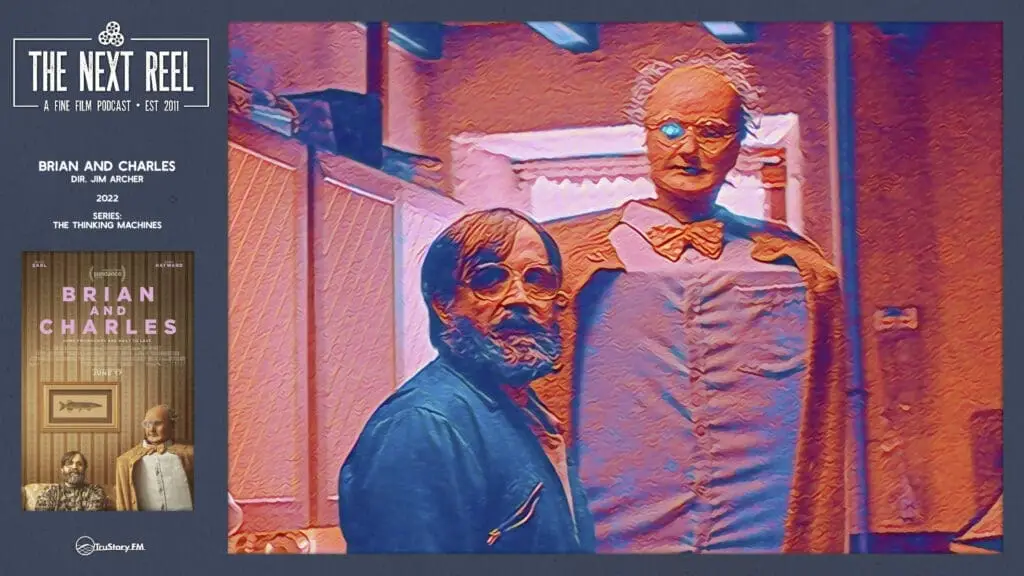
This is a Welsh comedy about a lonely inventor and the robot he builds from a mannequin head and a washing machine. Grant Sputore gave us a god who remakes the world. Now we get one who just wants a friend. We’ll see how the series lands next week. And now, let’s do our ratings.
Pete Wright:
Letterboxd.com/thenextreel. That’s where you can find all the ratings and reviews for all the shows we’ve done across The Next Reel family of film shows. What are you gonna do?
Andy Nelson:
Man, I first watched this and I was like, yeah, that’s really really enjoyable. I’ll probably give it three stars. And then I started thinking about it and processing it and prepping for this. I’m like, you know, this might be three and a half, maybe even four. I’m still kind of torn on that line, but I think that they’re doing so much good here. I think they made a great film. I’m just gonna say four stars. Four stars and a heart. I had a great time with this one.
Pete Wright:
I’m gonna say that too. Four stars and a heart.
Andy Nelson:
Wow, yeah.
Pete Wright:
I am thrilled by it. And I can tell you my quibbles. I told you my quibbles with Woman, but man, they’re not strong quibbles.
Andy Nelson:
No, yeah.
Pete Wright:
They are feeble quibbles. I think there’s room for this movie to improve. Like you said, I’m absolutely watching this again and I can’t wait to show it to people.
Andy Nelson:
And I can’t wait to see what Grant does next.
Pete Wright:
Yes.
Andy Nelson:
As somebody who has not directed enough films. Likewise with Clara, who’s not been in enough films — these are people I want more of. I was just thrilled in all capacities with this. And so I’m very curious to see where they all go next.
Pete Wright:
You know, Andy, that is such a good point. I think that’s part of the reason I’m so enthusiastic about talking about this film — it is exhilarating to come across a movie that is new to both of us, where the individual creators make it to that list of people whose names I’m looking for. I can’t wait to see whatever they do next because this was a real deposit in that bank of fandom. I can’t wait to see what happens next.
Andy Nelson:
I hear ya. Well, that averages to four stars and a heart. And you can find the show on Letterboxd at @thenextreel. You can find me there at @sodacreekfilm. You can find Pete there at @petewright. So what did you think about I Am Mother? We would love to hear your thoughts. Hop into the Showtalk channel over in our Discord community, where we will be talking about the movie this week.
Pete Wright:
When the movie ends
Andy Nelson:
Our conversation begins.
Pete Wright:
Letterboxd giveth, Andrew.
Andy Nelson:
As Letterboxd always doeth.
Pete Wright:
All right. What did you pick? You’re tickled over there.
Andy Nelson:
I didn’t pick this one because of the rating. ykg only gave it two and a half stars. But it really made me laugh because I was thinking about this with all these movies. Can movies stop being named Mother or Mommy or Mama? Please, we have reached our limit.
Pete Wright:
Well, that’s good. Mine — the only thing that I think about when I read this review is Cronenberg. Let me tell you why. Because Erik gives it three stars and says, ‘What if we accidentally kissed in the super fast embryo growth chamber?’ And I go to The Fly.
Andy Nelson:
Wait, so gross.
Pete Wright:
I just made the movie worse. So anyway, thank you so much, Erik.
Andy Nelson:
And then you said that and my brain immediately went to Together — that new horror movie where they’re born fused by the lips.
Pete Wright:
Oh god, no, you’re right. Oh god, you’re so right. With Franco. Oh, the Franco couple. Franco and Annie from Community. Why can’t I think of Dave and what’s her name? Oh, she’s awesome. And they just made a mess of each other in that movie.
Andy Nelson:
I haven’t seen it yet.
Pete Wright:
You haven’t seen it yet? Oh, Andy.
Andy Nelson:
I’m surprised you have because I haven’t seen any review come through.
Pete Wright:
No, you’re right. Well that’s — haven’t we been clear on the fact that I’m behind on my reviews?
Andy Nelson:
Yes. Yes, we are.
Pete Wright:
All right. Thanks, Letterboxd. I’m working on it.