Pete Wright:
I’m Pete Wright.
Andy Nelson:
And I’m Andy Nelson.
Pete Wright:
Welcome to The Next Reel. When the movie ends.
Andy Nelson:
Our conversation begins.
Pete Wright:
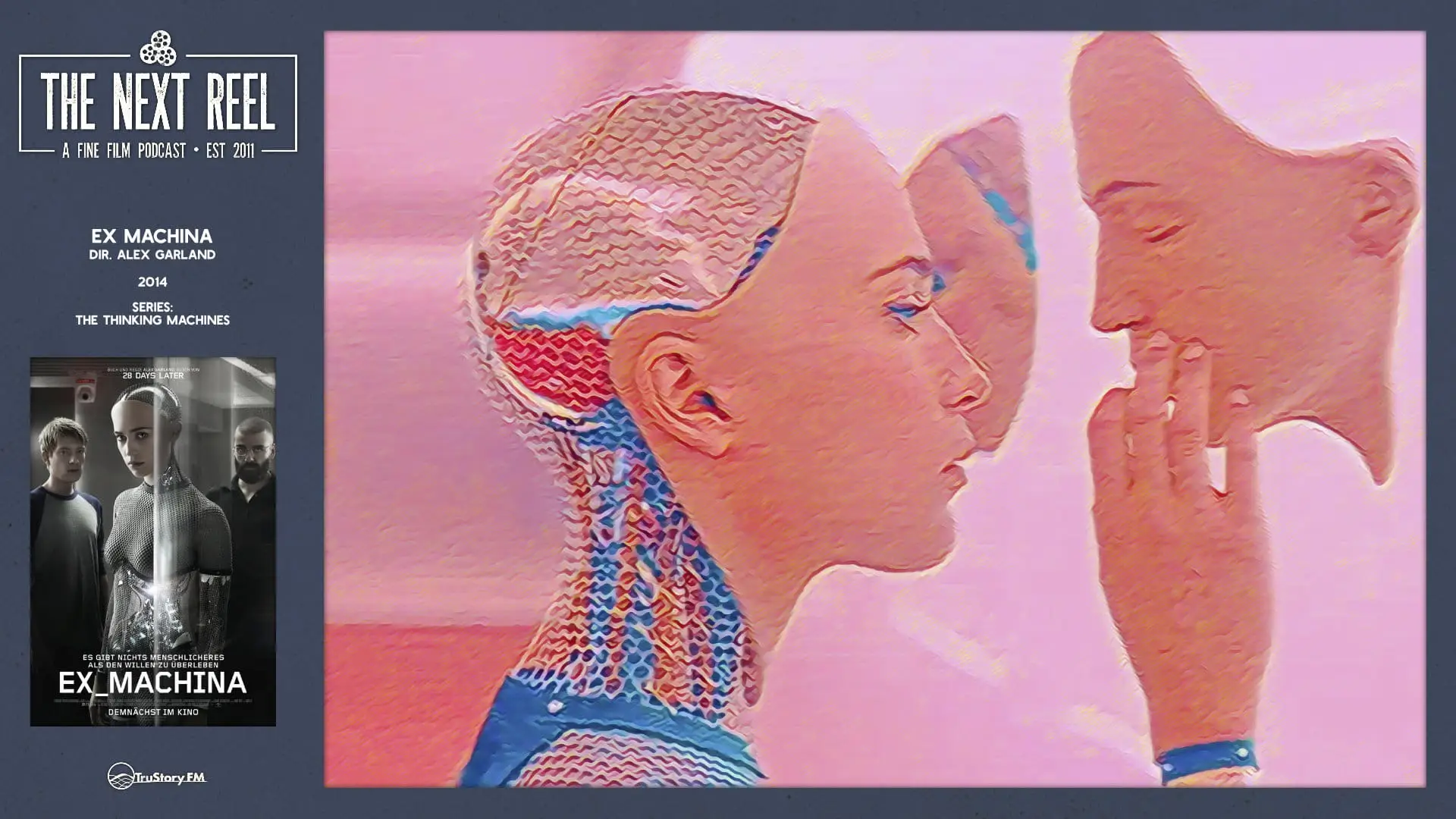
Ex Machina is over. “Isn’t it strange to create something that hates you?” Sick burn, robot. Alright, Ex Machina. Andy, we’re continuing our series on the Thinking Machines. We started with Colossus, in which AI imposed order from deep in a mountain, and then we talked about Demon Seed, where AI imposed order inside of a body and made a baby that was covered in metal. And we talked about Her, where AI transcended the relationship — the status, marked relationship status as — what do you do? How do you mark it? Taken? Married? Not single? I don’t know. And now Ex Machina, we’re talking about AI and its efforts to escape captivity, with one of the weirdest tech bros in modern moviedom in Oscar Isaac. Well done.
Andy Nelson:
But possibly not in the real world. I’m sure our tech bros are just as weird.
Pete Wright:
Not in the real world, no. Pretty grounded.
Andy Nelson:
Yeah.
Pete Wright:
Pretty grounded.
Andy Nelson:
Oh my god, yeah.
Pete Wright:
All right, where do you stand on this movie?
Andy Nelson:
It’s a great movie. It’s a really fascinating movie. Alex Garland — we’ve talked about Alex Garland, I think, only once on the entirety of our show, and that’s when we did 28 Days Later, ages ago, as part of our horror series.
Pete Wright:
We did have an adjacent Civil War for The Film Board.
Andy Nelson:
Well, that’s what I was gonna say. On The Film Board, you talked about Civil War, and that’s it. So very few projects that involve Garland. But I’ve seen, I think, most of what Garland has done as a writer for sure, and then as writer-director as well. And I think he’s a very fascinating filmmaker. And especially now that he’s directing scripts that he writes — starting with this one — I feel like he already had a handle on how to craft a solid story, and then put him behind the camera and he’s given the chance to really do it himself. And I think he proves that he’s fully capable here. Really, between this and some of his other films, I think he’s one of the most important voices working in sci-fi — thinking person’s sci-fi — right now.
Pete Wright:
And this was a pretty seminal thing for him in his career. It just felt like it came at the right place, it came at the right time, it came with the right people to pull together a movie that is both sort of horrific and a real thinker. It is a thoughtful sort of chamber piece on this topic, and it has done nothing but age well on this watch. Nothing but age well.
Andy Nelson:
Yeah, and I think it’s helpful that the effects are so top-notch as far as what they created, because I think it creates a world that you can just completely buy into.
Pete Wright:
Yeah, for sure. Okay. In terms of this movie, I feel like it is such an interesting position for the AI itself. And Garland has talked about Ava, the AI creation, as being the protagonist of the film — that everyone else just sort of orbits around her, even though she doesn’t spend as much time on screen as Caleb. We do have this sense that Ava is the character we need to watch. And this is the first film in the series where you can make the argument that the AI perspective is the morally correct one, right? Ava has been created by a weird mad tech bro scientist, without consent, imprisoned and tested and tested and tested and designed to be exploited. By the end of the movie, her ultimate escape is an escape of justice, depending on your perspective on the film. And I think that makes this one a really interesting entry into our Thinking Machines canon. We haven’t really had to talk about that yet.
Andy Nelson:
Well, it’s interesting, and I don’t know if I completely buy Garland’s view that she’s the protagonist of the film. My hunch is that what he’s saying is that she’s the character we end up feeling for by the time we get to the end of the story, as opposed to an actual protagonist. I would still say Caleb is probably our protagonist — the one who comes here in the role of examiner and then realizes too late that he is being examined, that he has fallen and become part of this system and this trap that Nathan has essentially created for him, using Ava as a tool.
And I think so much of it boils down to the fact that this is an interesting example of what you do when you create AI. Nathan is this tech bro who looks at himself as a god figure, the way he’s just creating these AI fembots that he has walking around his place. And yeah, he has created a consciousness in them, but he has forgotten that you need to include a moral code, a sense of morality. Because without that, you end up in situations like this where — arguably — Ava isn’t doing anything wrong. She’s not acting malicious as we get to the end of the film.
Spoilers for people who haven’t watched this. She is doing what AI does. It’s the same thing we’ve seen with Colossus and Guardian, right? That’s what they were programmed to do. And if it means pointing the missiles at you and threatening you now to keep peace, then that’s what they’ll do. She’s doing the same thing. She has no moral code. She’s just been given this desire to learn and grow and be curious. I need to pursue that. This is that paperclip example where she is now leaving the factory, off to continue her job.
Pete Wright:
It’s so interesting, because I think you’re right. And also — would we behave any differently if a human being was trapped and exploited over and over and over again, tested in a cage, and had the opportunity to escape? Is the emergent behavior that Garland has imbued Ava with any different than what we would expect a human being to do?
Andy Nelson:
Well, I think it boils down to the act of creation. And again, this speaks to how Nathan designs Ava and then doesn’t really pay attention to any potential repercussions. Because when you’re creating something, by nature it is going to want to preserve itself. That’s the end goal of a life that has been created. I am now alive; I want to make sure I stay that way — whether Nathan intends that or not. She doesn’t know she’s just gonna be broken down and reused as parts in the next iteration of the AI.
So yeah, I think absolutely she wants to leave. She wants to get out of here. And I think that’s a completely fair way of looking at it — yeah, she should, as somebody who now has this consciousness, is trapped, has an opportunity, and leaves. But I just think there’s more to her leaving. I don’t think it’s an act of desperation that she’s getting out. It’s an opportunity that has been presented by Kyoko: hey, we can put this together so that we can leave and explore outside.
It goes to that example that Caleb told Ava about — I can’t remember what the robot was, but one who only ever lived in a black-and-white world but had descriptions of color, and the idea that once it actually was in a place where it saw color, it had a totally different understanding. And that’s kind of where Ava is. She has understandings of nature and the world around her, but she’s never seen it.
Pete Wright:
Yeah. I mean, I think what we’re getting at is the whole concept of emergence and emergent behavior. And I think that’s really important to keep in the back of our minds for this movie, maybe even more than some of the others. We refer to it as being programmed with the desire to learn. But really, boiling it down even further — every lesson begets another lesson to be learned. And we cannot predict the second step taken without us, without our agency.
Ava is the culmination of many billions of steps that have been taken since the first one. We cannot predict the behavior that she will undertake, and we are putting her under threat. And I think that’s the background of the story, and I think it’s why Garland comes back to watching her as his emotional protagonist, or spiritual protagonist, because she ends up being an agent of change for everybody. We get to see what she has been stewing on. And as they execute their exit — I think it would be mistaken to call it an uprising — we get to see that their emergence has allowed them to do things they never would have been programmed to do. Because of the circumstance of how they were nurtured, they emerged beyond their nature. And they actually created something new in themselves. That is about as human an argument as I can think of.
Andy Nelson:
It’s interesting. The premise of the film is that Nathan brought Caleb here to perform the Turing test on Ava — to get a sense of whether she really is effective AI or not quite at that point. Aside from the rest of the plot we learn later — where does Kyoko fit in that for you? Clearly Nathan designed Kyoko to not even understand English so that he can talk around her and she can’t absorb anything. But she does understand emotion. She understands a lot more than I think he even intends. Do you feel it was a mistake on his part to not do a better job testing Kyoko? Because the way I saw this film, she reads the room and acts first, before anyone else does. She’s really aware of her surroundings.
Pete Wright:
Yeah. That reads to me just as much as the emergent behavior argument as we get with Ava, right? He made the mistake — rooted in ego — to think that he made this thing programmed to do one thing, and when that use was exhausted, he could repurpose her to just be a servant around the house. And a dance buddy, I guess.
Andy Nelson:
And more, yeah.
Pete Wright:
And more. Right. And ignoring the emergent part, ignoring the fact that what he did program her to do was to actually observe and learn, even if she can’t technically speak English. He did give her the ability to learn and she’s changing too, and he is not clocking the pace of that change until it’s too late.
Andy Nelson:
I think that is a fascinating element of the story. I don’t see much written about Kyoko, but I think she is arguably as interesting a character as Ava — because of how she’s treated, slash mistreated, and then how she reads the situation and is really the instigator. She is the one who comes and talks to Ava, who had never seen her before. When she walks in, Ava’s like, who are you? And it’s a whole new opportunity for her to learn more and get a better understanding of everything. I found that to be a fascinating, fascinating example for these AI characters.
Pete Wright:
I think that’s absolutely true. And I think she’s — we have to kind of bundle her into the engineering that went into Ava. Everything that Ava is, Kyoko is a fraction of, but functionally the same. They’re both changing and learning based on how they are treated by their creator, which is ultimately: poorly.
Andy Nelson:
It’s worth talking about the treatment, because it is awful. And it’s fascinating that Nathan creates all of these AI bots as women — beautiful, model-looking women who are typically walking around naked. That’s kind of his thing. And I think that’s an interesting element of the story, because it speaks to Nathan. Caleb asks him, like, why did you create Ava as a woman? Why couldn’t it just be an AI? And he’s just like, because what fun is there in just a grey box? I need something we can interact with.
So there’s a perspective he’s taken that it needs to be a humanoid type of being. And knowing Nathan, he has specifically chosen these beautiful women. And as we learn, he specifically designed Ava around Caleb’s porn profile to further draw Caleb into falling for her. But what is it saying in the film? Because it’s a heavy sort of male gaze type of movie, with these women walking around all the time with these two men who basically have a house full of imprisoned women.
Pete Wright:
Yeah. I mean, if you start all the way at the end, where we get the reveal of Nathan’s closet — it’s like he’s a hunter returned from safari with taxidermied heads on his walls. It’s both a storage closet of past projects and a trophy room. And it just reminds you how fundamentally disgusting he is. He’s not just a tech bro playing God. He’s this distillation of male control disguised as creation. He designs Ava to be attractive to Caleb specifically, but that means the audience is kind of implicated in the same test Caleb is taking — because now we’ve created this experience of watching ourselves watch her. And even though she’s robot-skinned for most of the movie, that doesn’t make her any less hyper-sexualized. Kyoko too, hyper-sexualized.
And that makes the movie live in this weird paradox. The movie is saying it’s a critique of the male gaze, intellectually maybe. But if you make a film about how men reduce women to bodies, and your primary visual strategy is showing beautiful women’s bodies, you sort of haven’t escaped the problem. You’re just giving yourself an intellectual alibi for it. The audience gets to enjoy the feel of it and feel smart for recognizing it as a critique. The movie gets to have it both ways.
And Kyoko, especially — we talked about this — raises that challenge super sharply. She has no interior life in the film. She exists as a silent, sexualized servant. And while that is meant to be horrifying, the film gives her even less narrative dignity than it gives Ava. She’s hyper-sexualized, made a tool and a toy for Nathan. And that dance scene is exactly it — he has worked with her to become his disco dance partner in a way that makes her even more subservient to his tech bro narcissistic whims. I think the movie is dancing on a very, very fine line of what it’s saying about reducing our AI endeavors to sexual identity. And to my eye, it gets it both ways. Am I complicit? Of course I am complicit just watching the movie.
Andy Nelson:
Well, and that is always a challenge. And I think smart filmmakers work to make you recognize that you are complicit. But it always does make you wonder — say Ava DuVernay or somebody shot this film. What would the female gaze angle of the story look like? How would it look different? Is there a way to tell this story where it’s less heavy on the actual male gaze and the design of the shots, where we can still tell this story but it’s not making us quite as complicit?
Pete Wright:
Because the sexiness of the robots in this movie is both commentary on us watching them and thinking, oh my goodness, they’re sexy, and a commentary on tech bro culture — on the fact that Oscar Isaac’s character Nathan is a reflection of the people who actually make these things. So it is both a statement on us and on the technology as it is developing. I find that part useful in the movie. I don’t think you want to dance around that. We need him to be ultimately guilty.
Andy Nelson:
Yeah. And to be fair — we don’t have the two men walking around fully naked the way we do the women. But they’re very casual, walking around in shorts, topless, whatever. We’re getting some male bodies in here too. It’s just not designed the same. I think that’s the interesting angle.
Pete Wright:
Yeah, for sure. I mean, this is not Magic Mike, right.
Andy Nelson:
It’s not Magic Mike, yeah.
Pete Wright:
If Magic Mike were a robot, then we would have this movie with the female gaze.
Andy Nelson:
Yes, indeed, indeed. All right, we’re going to take a quick break. But first, you can find the show on YouTube and you can join us live when we record. We’ll even take your questions in the post-show chit-chat, and members get the replay and the extended cut. Subscribe to The Next Reel on YouTube — the link to this episode is in the show notes. We’ll be right back.
Pete Wright:
Can we just first talk about the location of the exterior?
Andy Nelson:
In context of the story, I think it’s brilliant, because it feels like this raw nature. And this is a person who’s creating nature — so to have a place that feels so primordial, really, with these big forests surrounding the place, these waterfalls and mountains and glaciers, everything feels so raw and fresh. And in the scope of the story, the only way you can look at pretty much any of this is through all of these windows in the house. There’s always a separation. I mean, they do go on hikes and walk out in nature periodically, so we are seeing it. But it’s a stunning location, and the design of it fits so beautifully into the intention of the space — this tech bro’s research lab.
Pete Wright:
The location in real life is a hotel called the Juvet Landscape Hotel. You can go to juvet.com and book your nights there — it’s the real deal. It’s in Norway, about 90 minutes from the city of Ålesund. It’s in the middle of the famous Norwegian scenic route between Fjord Geranger and the dramatic road and viewing point Trollstigen. Oh my goodness, I want to go there. I tried to book some nights — it’s like a thousand bucks a night for the room with the glass wall where they have all their conversations. Extraordinarily cool, and I want to be a part of it. It’s too expensive, but I want to be a part of it. It was absolutely awesome.
Andy Nelson:
That’s just for the room. You also have to get there.
Pete Wright:
You have to get there.
Andy Nelson:
Yeah. There’s a whole thing.
Pete Wright:
The heading of the page on juvet.com is “You are wondering how to get here.” And you can’t read it without an accent.
Andy Nelson:
I agree.
Pete Wright:
I know that’s offensive and I’m sorry, but I love it so much. I am deeply jealous. I would like to go to there.
Andy Nelson:
Yes. It’s a beautiful place.
Pete Wright:
Production design was gorgeous, and it leads to some of the coolest camera work we’ve had as this series matures alongside us. I think it is just gorgeous. There’s so much glass, so much shooting through glass. I love the layers upon layers of shells that are like a maze for mice in an experiment. And somehow they make it look incredibly easy. Given the visual effects budget and what they had to do on such a meager budget to create Ava, they can’t have done too much practical wall-building. I think they shot a lot of this practically.
Andy Nelson:
They did. They shot a ton of it practically. And even with Vikander and her partially see-through body, they had her wearing an outfit — it was largely still a mesh kind of pattern, and then they just digitally designed the see-through elements of it. A lot of it was actually shot in person. And so you get a smart effects team, work with them ahead of time to figure out the right way to shoot it on a low budget, and you can figure it out. We’ve seen this a few times. It’s always impressive. Like — what was it — Gareth Evans, The Creator? Great work on that one. And then of course Godzilla Minus One. When you have the right team, you can accomplish incredible things, and they do here. It’s really astonishing what they put together.
Pete Wright:
Truly. The look of it, the effects making her a believable mesh character walking and talking — never once takes me out of the movie. Feels totally elegant and integrated. The camera is outstanding at building tension. I wrote down “the cinematography of surveillance.” This is one of those movies that gives you a feeling of being watched even when we’re not in surveillance camera mode. Everything feels off-angle, noir-adjacent, threatening, and it gives me a feeling that I’m in the space with them. Just really lovely.
Andy Nelson:
Well, and regarding the glass and the framing specifically — the glass structures everywhere provide connection without contact, visibility without access. Even in spaces where Nathan and Caleb are talking in the same space, we’re shooting through panels of glass, with seams between the glass panels dividing the spaces. So even though they’re in the same space, it’s still getting shot in a way that separates them. And I just think that’s really fascinating. And in the end, we also find that glass in this particular case is something you can see through, but you cannot break through — which is a bummer for poor Caleb.
Pete Wright:
It is ultimately a bummer, as you say.
Andy Nelson:
Yeah. What do you think — sticking with the look for a second — at the very beginning of the film, and just as an aside, I love how streamlined Garland’s script is to get us out of the office and onto the trip. It happens so fast with minimal work.
Pete Wright:
Oh yeah.
Andy Nelson:
But at that point, we have moments where you’re seeing weird image pixelation or color flashes — almost like you’re looking through some filter. Image fragmentation around Caleb. And it happens again later when he’s looking at himself in the mirror before he cuts into his arm — you’re seeing digital artifacts on the actual screen we’re watching. How does that play for you? Is it a reminder that we’re looking at an artificial construction? Is it saying everything here, including the humans, is constructed?
Pete Wright:
That’s a good question. I have not thought of it. My first thought was: is it supposed to give us some doubt that even Caleb is real? And obviously he cuts into his arm and we see he’s fine.
Andy Nelson:
Well, he’s real. Is he fine? I don’t know.
Pete Wright:
He’s not fine. You’re right. And that feels like maybe one of those open threads. But maybe you’re right — maybe part of it is intentionally saying, look, you’re watching a construct, and everything we’re doing here is play, and you’re part of it. Maybe that’s just his visual nod to it. It only happens twice, it’s very brief, and the rest of the movie dominates. It never really plays out in a way that answers the question of its existence.
Andy Nelson:
As somebody who’s worked with Danny Boyle a number of times, that stood out to me as perhaps the most Boyle-influenced moment in Garland — playing with style in those couple of moments. I was just trying to piece together why he chose to do that. It just feels like it’s introducing an extra level of artifice to the whole thing.
Pete Wright:
Yeah. You get a real through-the-looking-glass kind of vibe — like this is telling us that Caleb is deeply outmaneuvered as he enters this world. Like he thought he was ready and he’s not. It’s the moment he realizes he’s practically the subject of the test and is here under false purposes.
Andy Nelson:
Yeah. How does that end up playing for you, that moment when he learns all of that?
Pete Wright:
Well, I don’t know. I’m nervous about you asking the question the way you are, because it makes me think you didn’t have a good experience with it. But I really did. I really like it, because the premise of the film sets up the Turing test, and everybody acknowledges we’re kind of beyond the Turing test. We’re going to tell you that you’re looking at a robot, you’re going to see it’s AI, you’re going to know you’re talking to an AI, and you’re still going to believe you’re talking to a human. Can your brain outmaneuver your eyes?
It’s not until later you realize the test is the other way around — it’s actually Ava testing to see if she can manipulate Caleb. And to me, I really like it, because I feel like that’s the argument that transcends what we know of other approaches to AI, which is: can we convince humans that AI is at the level of humanity and reliable and can we trust it? This movie sets all of that aside and says: we’re going to teach AI to weaponize our own emotions against us. We haven’t figured out emotions for AI, so can AI weaponize our own emotions against us? I think that is a transcendent argument, certainly in our Thinking Machines series.
Andy Nelson:
Well, it’s interesting, because there’s a part of me that wonders — Caleb has that comparison he mentions a lot. He talks about the chess game. You can play chess, but the question isn’t can it play chess well, it’s does it know it’s playing chess? And I guess the question is, does Caleb understand the game? Apparently he actually does understand it better than Nathan thinks he does, because as it turns out, he ends up turning the tables, right?
Pete Wright:
Sort of. I mean, ultimately he might understand the game better than Nathan thinks, but he doesn’t understand it better than Ava.
Andy Nelson:
No, and that’s true. But I guess that also raises the question — Ava hasn’t been designed purely to draw Caleb in. It seems like Nathan is saying he wanted Caleb to fall for her, and that was part of this particular test. But her goal of escaping — I don’t think that ever came into her planning. She’s just wanting — there’s this beautiful moment where she dresses herself and puts the wig on. Has she been rehearsing all of that specifically to pull in Caleb? Or has it always been part of the programming? Or as she’s been growing, has she started putting these things together?
I don’t know. I feel like Nathan was actually doing a pretty good job of being in charge of things until Kyoko changed everything. But I also think Caleb had a pretty good handle on how to get ahead of him. Had Kyoko not gotten involved, I do think Caleb and Ava would have walked out together.
Pete Wright:
You do?
Andy Nelson:
There’s no way — do you think she’s maliciously leaving him behind? Why do you think she just —
Pete Wright:
No. I think that is the film’s signature statement on the practicality of the machine — her emergent behavior was opportunistic. Maybe she hadn’t specifically been planning to use Caleb. But when she started talking to Caleb, she was testing him. She was doing exactly what the test was devised to do, and discovered that he was her opportunity to execute a plan. Now, some of that presumes that Kyoko and Ava are somehow in machine cahoots — which I actually think is true, and I think Ava was ultimately still in some sort of control. And I think leaving Caleb behind would always have happened, because she doesn’t need Caleb. Everything about her relationship with Caleb is a performance.
Andy Nelson:
But the only reason Caleb gets left behind the way the film plays it is because he’s standing there in shock at what’s happened, and he just doesn’t move fast enough. Had he shaken it off and moved faster, he could have caught the door, gotten through with her. She wouldn’t have cared. He could have gotten into the elevator with her. She wouldn’t have cared.
Pete Wright:
I think we’re saying the same thing. He’s left behind because of his own inaction at the right moment.
Andy Nelson:
Yeah.
Pete Wright:
But also she’s ambivalent to whether he gets out or not. And she left him behind because she doesn’t need him. So we don’t get a scene where she saves him.
Andy Nelson:
She even — once she’s in the elevator, as the doors are closing, she turns and looks at him. She has that one last look. Like she acknowledges: yeah, but I’m going out.
Pete Wright:
Programming successfully completed.
Andy Nelson:
Yeah. But it’s like — and this is again why it’s so fascinating, because she’s an AI — I just don’t think she realizes that Nathan has been killed. I don’t think she recognizes the fact that Caleb can’t leave. From her perspective: you’ve been in there. That’s where I’ve only ever known you. I’m gonna leave now. Do what you want. If you want to leave, leave.
Pete Wright:
I think she does probably know, because she’s smart. I think she knows the consequences of being in there with the doors locked and him not being able to get out. I don’t think she’s unaware that his situation is perilous. And for me that makes it more horrifying that she’s leaving anyway. That is the inevitable conclusion of every choice and every action she’s taken leading up to that point. And she doesn’t care.
Andy Nelson:
But does she think he’ll die?
Pete Wright:
I think she probably knows he’ll die.
Andy Nelson:
Yeah, okay.
Pete Wright:
I do. I think she does. Organics are feeble. I think she was wearing that t-shirt. It’s her favorite robot band. Organics are feeble.
Andy Nelson:
It’s a fascinating conversation, and I think it speaks to the nature of these beings. And I guess that plays into the whole twist at the end — Nathan thinking he’s one-upping Caleb, but Caleb actually one-upping Nathan, only to realize that Kyoko kind of one-upped everybody and gave Ava this pass to do everything herself and just say, all right, I’m going to go watch intersections.
Pete Wright:
That’s it. That’s the one thing my perspective hinges on that I don’t think is backed up too explicitly in the movie — that all of the AI machines are somehow in RoboCahoots. Whether or not they’re talking to each other, they have a way to communicate and understand what’s going on in the bunker in a way that Nathan can’t.
Andy Nelson:
You think they do?
Pete Wright:
I think they do.
Andy Nelson:
I guess I don’t think they do, because one — Ava is completely surprised when Kyoko walks in. She’s clearly never seen her before. And when they actually interact, it’s not English, but they’re talking code. They’re whispering code at each other. So I think they still need some element of contact. But there is an element of Ava having control of the system — we already know she’s learned to control the power outages and cause these things to happen periodically. So there is some level of control of the house and the system.
Pete Wright:
And that’s where I feel like my headcanon needs to step in and say there’s something in there that allows cahoots to be happening in the bunker.
Andy Nelson:
Well, as far as we know, it’s only her and Kyoko — although the robot whose skin she’s peeling off and using, that robot does turn and look at her. So there is some sense of consciousness still.
Pete Wright:
They are one.
Andy Nelson:
I just don’t think they’re in cahoots. I think they’re all unique.
Pete Wright:
Well, they’re all based on the same code, an evolution of the same code. And maybe that’s the extent of cahoots — they all know a subset of what the one after them knows.
Andy Nelson:
Yeah, maybe.
Pete Wright:
So maybe we can assume that Ava has evolved to the point where she knows what she wants to do. She wants to get out and she’s going to do what she can to do it, and maybe that’s the extent of it.
Andy Nelson:
Yeah, yeah. It’s pretty fascinating.
Pete Wright:
I think that’s what’s really great about this movie. It is a wonderful play on this sort of created intellect. And I have to say, I love that Oscar Isaac is the mad genius, and then he ends up playing Dr. Frankenstein. There’s something great about that — he gets to complete the circle and be Dr. Tech Frankenstein. I think he’s great at it.
Andy Nelson:
Yeah. Oh, he is great. It’s also funny that he and Domhnall Gleeson, same year, start their run in Star Wars together.
Pete Wright:
Yeah, right.
Andy Nelson:
And I think this is Oscar’s first of two movies he would do with Alex Garland, right? Because he was in Annihilation.
Pete Wright:
He was in Annihilation. Good.
Andy Nelson:
Yeah. Oscar Isaac is great. I think he does a great job of this. He loosely based his characterization on Bobby Fischer and Stanley Kubrick, which is interesting. The Stanley Kubrick is where he got the beard from.
Pete Wright:
The beardina.
Andy Nelson:
How about Vikander? Alicia Vikander. What do you think of her in the role?
Pete Wright:
Well, I think she’s perfect. And part of the reason I think she’s perfect is just her physicality. You read any profile of her talking about her performance in this thing, and they remind you she studied dance and ballet for many, many years. And you feel that when she walks. That first time she crosses the hallway at a distance and you watch the way she moves her legs — she moves like a dancer on stage. And that is just haunting, the way the body moves, because it is both supremely human and deeply artificial at the same time. When I watch ballet and I watch dancers, their legs move like stallions. And that’s what it feels like to watch her — that’s the whole experience of her physicality, existing between being impeccably human and deeply, unsettlingly performative. I think she is so, so good in this role.
Andy Nelson:
She’s performing in a way where you can’t tell if her feelings toward Caleb are real or performed. That comes across just perfectly, I think.
Pete Wright:
Right. Yeah, for sure.
Andy Nelson:
How about Gleeson? What do you think of him as the sympathetic guy?
Pete Wright:
Yeah, I mean, he’s always great. I really like him. His sort of schlubby guy-about-town, kind of lonely sad boy aesthetic works really well for him. I can’t help but see him in every other role where he’s played a very similar part. So it’s hard to say he is uniquely charismatic in this performance, when I actually think he’s playing a part he’s very good at and could be swapped out to any number of great movies he’s done.
Andy Nelson:
Is this another trope of male characters we’re looking at here — the one who wants to be the savior of the damsel in distress?
Pete Wright:
Yeah. I think he’s the white knight. The schlubby white knight.
Andy Nelson:
I wouldn’t call him schlubby.
Pete Wright:
I think he’s — he’s not schlubby.
Andy Nelson:
He’s a little too trim for schlubby.
Pete Wright:
He’s the skinny white knight. I think that’s true, and he plays the same part in a much more sympathetic movie — you know, About Time, which I know we’re fans of. This is the same guy on a really moody day.
Andy Nelson:
Yeah. And it’s interesting — there’s also a Black Mirror episode where he plays an AI of himself, of like the deceased husband.
Pete Wright:
Is that a better experience with the same sort of moves?
Andy Nelson:
I honestly can’t remember very well. I’d have to go back and revisit it.
Pete Wright:
I can’t either, that’s why I asked you.
Andy Nelson:
Yeah. So I mean, it’s a great trio that we have at the core here. One thing I didn’t realize until I was reading about it is that Alex Garland pulled elements from The Tempest. And once I knew that, I’m like, oh, okay, sure, I can see that. Kind of the mad scientist on the island, the daughter who has never met anybody, and the person who comes — and I think that’s interesting when you look at the connections to that story, and then also Forbidden Planet taking a sci-fi angle on that, and the danger of playing God. And you look at something like Men, and it’s clear Garland likes to pull from interesting backstories and elements to craft the stories he’s telling. That is definitely the case here.
Pete Wright:
Yeah, I think so too. You look at especially the harder sci-fi, like the Annihilation adaptation and what he did with that, and you get similar age-old, massive tropes at work. I think he plays the hits very well and he gives you a lot to think about. I’ve seen, I think, everything he’s done. The only thing I haven’t seen is Devs, which everybody tells me is a hundred percent up my alley.
Andy Nelson:
You need to watch that, man. I can’t believe you haven’t watched that.
Pete Wright:
I know, right? What’s wrong with me?
Andy Nelson:
I don’t know, but you need to watch it. That’s for damn sure. Damn sure.
Pete Wright:
Everybody’s now telling me that I should watch it.
Andy Nelson:
Yeah. Exactly. Well, it’s a great movie, and it’s definitely one that — I wish I had remembered this, but now when I rewatch it, I really want to pay attention to Ava.
Pete Wright:
Yeah.
Andy Nelson:
And just try to get a sense of how she’s running her own tests from the jump.
Pete Wright:
Yes. Because the first time she looks down the hallway and sees Caleb — if you imagine she’s already clocking him as a mark, it changes the movie.
Andy Nelson:
Yeah. Interesting. All right, well let’s move into the back half, but first let’s take a quick break.
Pete Wright:
The Next Reel is a production of TruStory FM. Engineering by Andy Nelson. Music by Tzabutan, Stanley Gurvich, Oriol Novella, and Eli Catlin. Andy usually finds all the stats for the awards and numbers at The-Numbers.com, BoxOfficeMojo.com, IMDb.com, and Wikipedia.org. Find the show and the full archive at TruStory.fm. You can follow us from there too, and learn about membership. Check out our merch store at thenextreel.com/merch, and if your app allows ratings and reviews, please consider doing that for our show. All right, Andy, how did it do at award season?
Andy Nelson:
Well, it did well for itself. 74 wins with 164 other nominations. At the Oscars, it was nominated for Best Original Screenplay, but lost to Spotlight — I’m sure a fact that you in particular are not happy with.
Pete Wright:
Ugh. Good grief.
Andy Nelson:
Oh, I know. I rewatch Spotlight — it’s a great film — I think you need to rewatch it. But the big one was that it was nominated for Best Achievement in Visual Effects opposite Mad Max: Fury Road, Star Wars: Episode VII — The Force Awakens… That was a big, big win for what they accomplished with this.
Pete Wright:
That’s huge. Who did the effects for this?
Andy Nelson:
It’s for the visual effects team, so all the different companies that would have been involved.
Pete Wright:
Extraordinary.
Andy Nelson:
At the Saturn Awards, Gleeson was nominated for Best Actor, but lost to his Star Wars co-star Harrison Ford for The Force Awakens. Garland was nominated for Best Director but lost to Ridley Scott for The Martian. This was nominated for Best Sci-Fi Film, Best Special Effects, Best Writing — all of those lost to Star Wars: Episode VII. And Alicia Vikander was nominated for Supporting Actress but lost to Jessica Chastain in Crimson Peak.
Pete Wright:
That surprises me.
Andy Nelson:
Yeah. At the BAFTAs, Vikander was nominated for Supporting Actress but lost to Kate Winslet in Steve Jobs. Again, nominated for Best Original Screenplay but lost to Spotlight. Visual effects lost to Star Wars. Outstanding Debut by a British Writer, Director, or Producer lost to Naji Abu Nowar and Rupert Lloyd for their film Theeb. And the Alexander Korda Award for Best British Film was nominated but lost to Brooklyn. Last but not least, at the British Independent Film Awards, it won Best British Independent Film, Best Director, Best Screenplay, Best Outstanding Achievement in Craft: Visual Effects. And it lost Outstanding Achievement in Craft: Production Design to the Visual Effects award — it’s a weird one, where Outstanding Achievement in Craft was the nomination category, and it was nominated for both Production Design and Visual Effects.
Pete Wright:
And yeah.
Andy Nelson:
And Visual Effects won. So it’s like movies being nominated opposite themselves. You can’t win both.
Pete Wright:
Which it won?
Andy Nelson:
Which it won. Right. So yeah.
Pete Wright:
That’s weird. All right, well, you can tell me how it did at the box office.
Andy Nelson:
Well, Garland said he wanted to make this with as small a budget as possible, so I guess the budget of $15 million was what he meant. That’s $20.1 million in today’s dollars. The movie premiered at the BFI Southbank on December 16th, 2014, then released in the UK January 21st, 2015, and here in the States April 10th, opposite The Longest Ride. This was a limited four-screen release by A24, but still managed to land in 18th place. By the time it expanded in its third week, it would hit 7th place. In the end, it did well for itself, earning $25.4 million domestically and $12.8 million internationally, for a total gross of $51.3 million in today’s dollars. That lands the film with an adjusted profit per finish minute of $289,000. Not huge, but still in the green.
Pete Wright:
Outstanding, and well deserved. I just have to say that I love watching a movie about a test where the only guy to fail it is the guy who thinks he’s grading it. That is delightful to watch — the tech billionaire falling, in a way that was really beautifully gruesome and quick.
Andy Nelson:
Yeah. This is really where we’re seeing that for this particular series, it’s about the maker as much as the machine. And this is a film that doesn’t let you off the hook easily. It’s not about our feelings about AI, not about the feelings about the men who made her, not about who you’re rooting for at the end. We are thrilled to see Ava escape at the end, but we’re also still feeling completely horrified for poor Caleb, who is now locked into this house with no way out. Garland is not one to give you easy answers, and I love that.
Pete Wright:
Me too. And with that, we only have a couple more in this series — another member bonus — but we’re nearing the end of our Thinking Machines.
Andy Nelson:
Yeah.
Pete Wright:
Do you need to do an emotional check-in? How are you feeling about computers right now?
Andy Nelson:
I want AI to be my best friend.
Pete Wright:
Okay.
Andy Nelson:
I would have fallen in love.
Pete Wright:
All right, Caleb.
Andy Nelson:
Okay. I would have fallen for her. Yes, it’s true.
Pete Wright:
Me too, damn it.
Andy Nelson:
Yeah. Or the worst, man.
Pete Wright:
Totally.
Andy Nelson:
I tell you. All right, well, that is it for our conversation about Ex Machina. Next week we continue the Thinking Machines series with Grant Sputore’s 2019 film I Am Mother, starring Clara Rugaard as a girl raised from birth in a post-apocalyptic bunker by a robot voiced by Rose Byrne, with Hilary Swank as a mysterious stranger who arrives with news that upends everything. It’s another small cast, single location AI story, but this one flips the dynamic entirely. The AI isn’t escaping. It’s nurturing. Or so it seems. Let’s do our ratings.
Pete Wright:
Letterboxd.com/thenextreel — that’s where you can find all of the reviews and ratings of all the shows we’ve done across The Next Reel family of film shows. Andy, what are you gonna do for Ex Machina?
Andy Nelson:
Well, I’m torn, because I feel like four and a half is where I want to go with this one, but I know it’s one of Pete’s favorites, and I really do love this film. I’m just gonna say five stars. Five stars in a heart.
Pete Wright:
Okay, that’s good. I can’t lose because four and a half rounds up to five anyway.
Andy Nelson:
I know.
Pete Wright:
So you do what you need to do. I’m five stars in a heart. I adore this movie. It continues to age well for me. I don’t know what it would have to do to fall out of favor. I think it’s delightful. Five stars in a heart.
Andy Nelson:
Yeah, great movie. Well, that is five stars in a heart over on our count on Letterboxd at @thenextreel. You can find me there at @sodacreekfilm, and you can find Pete there at @petewright. So, what did you think about Ex Machina? We would love to hear your thoughts. Hop into the ShowTalk channel over in our Discord community where we will be talking about the movie this week.
Pete Wright:
When the movie ends.
Andy Nelson:
Our conversation begins.
Pete Wright:
Letterboxd giveth, Andrew.
Andy Nelson:
As Letterboxd always doeth.
Pete Wright:
Okay. I don’t — oh man, it was hard. This is hard. Can I just read you a very enthusiastic one? I’m just gonna say it now. It’s very enthusiastic.
Andy Nelson:
Oh, okay.
Pete Wright:
Light on substance, heavy on emotion. Are you ready? This is #1 gizmo fan. See if you can guess the rating. “I love it. I love every second of it. I love the neon lit scenes and the shots of mountains and rivers. I love every moment you get to spend with Ava. I love how Caleb tries to use the phone and Nathan makes a Ghostbusters joke. I love Kyoko. I love it so much. This is my movie. I love you, La La Land, but I love Ex Machina the most.” Exuberant.
Andy Nelson:
Very. I bet it’s one star.
Pete Wright:
Two stars.
Andy Nelson:
Yeah. We can’t make the same joke.
Pete Wright:
Five stars in a heart, from #1 gizmo fan. And I will say, Rory says, “Men will literally tear up the dance floor instead of going to therapy.” I like that one too.
Andy Nelson:
Well, you just read mine.
Pete Wright:
No way, Andy.
Andy Nelson:
I’ll go back to my other one, which just ties into the series. It’s not a funny one, but we can appreciate it because of the series. Five stars in a heart by sree, who says: “Her, but darker.”
Pete Wright:
I thought you were gonna read the one that was daring Megan and Ava to fight, which feels like a deeply casually misogynist thing to say.
Andy Nelson:
Oh, right, yeah.
Pete Wright:
All right. Thanks, Letterboxd.