Pete Wright:
I’m Pete Wright.
Andy Nelson:
And I’m Andy Nelson.
Pete Wright:
Welcome to The Next Reel when the movie ends.
Andy Nelson:
Our conversation begins.
Pete Wright:
Brian and Charles is over. Just start at the beginning and use your imagination, I suppose. Oh Andy, Andy, now come on. Now look, I’ve read your notes already, and this is what I’m gonna say. After all of the of the just crap AI that’s trying to take over our world, our politics, our warfare, our relationships that we’ve been talking about in our Thinking Machines series. In spite of your feelings about the documentary style production, was this not a perfect damn mint at the end of this heavy meal, this movie? Come on.
Andy Nelson:
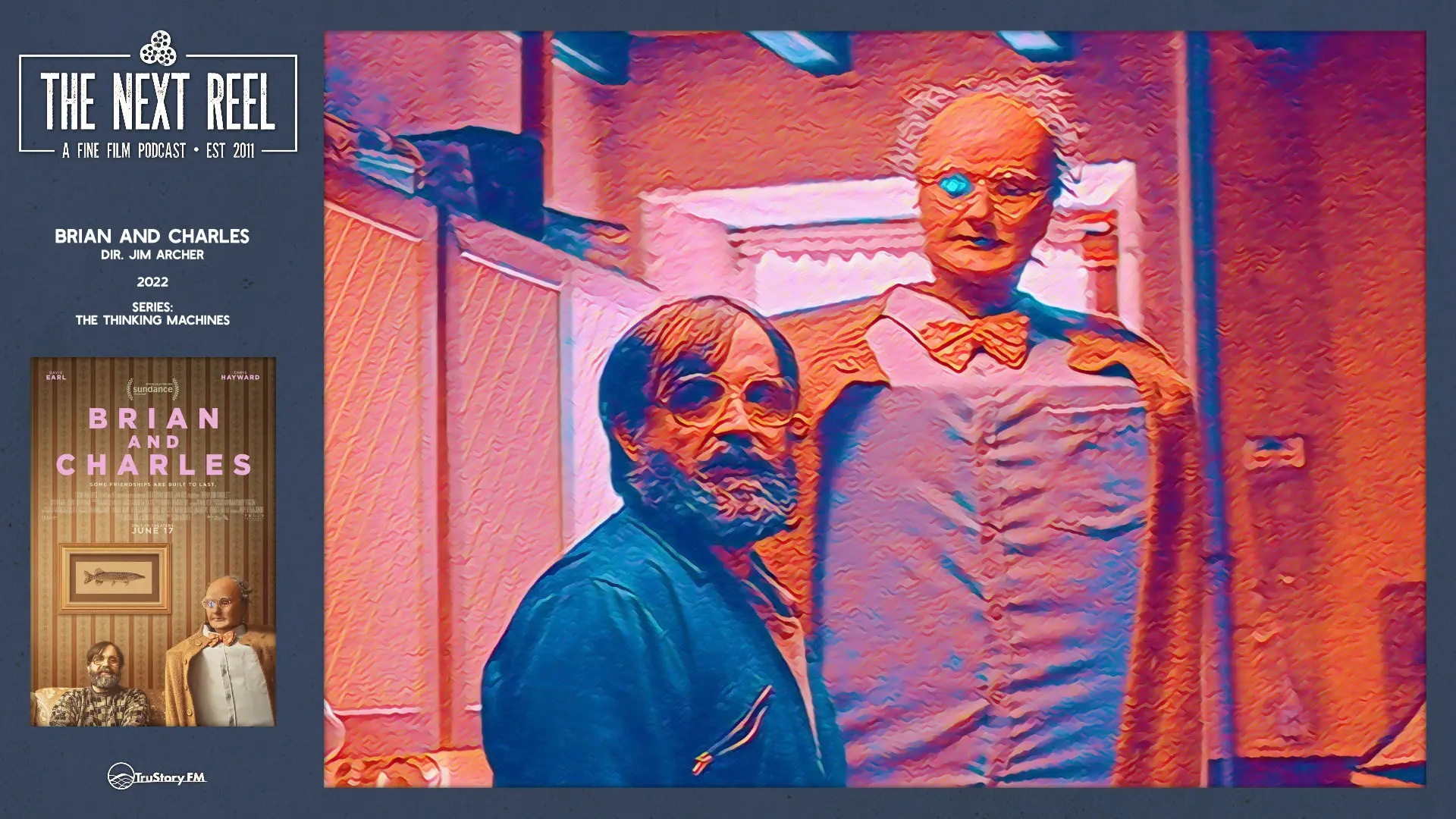
No, it was very sweet. It was a very sweet, charming, small-town sort of movie. It had a nice vibe to it. And a lot of that I think goes to how they crafted Charles Popescu, our AI robot here, which is one of the most adorable creations because it’s so haphazardly structured.
Pete Wright:
Yes.
Pete Wright:
This is a movie that commits to the bit in every way, and I adore it. I really adore it. I think it is so heartful. It is a movie about relationships, about men and friendships, and about the sort of found family. I’m a sucker for found family stories. It is about this Welsh loner who builds a robot and an AI out of a washing machine and a mannequin head, and it’s a journey about them building each other up and filling holes in each other’s lives and then having to let each other go. And I think that is really special, even though I recognize this movie is playing the tropes around every single corner. It’s doing it in a way that I find so just heart forward and loving and funny, and it is a great representation of some of the best of British comedy.
Andy Nelson:
Well, I think we’re maybe stretching it a little bit going that far.
Pete Wright:
I stand by that. We’ll talk about why.
Andy Nelson:
Yeah. I definitely can see why it’s an easy one for people to connect with and fall for. At the same time, it also feels like a first film, and it feels like there are a lot of elements in it that perhaps could have been reworked or strengthened to actually make a better film.
Pete Wright:
It’s a f it’s a first film and we’re just gonna pick it pick it apart. I get it.
Andy Nelson:
Yeah, yeah.
Pete Wright:
I see the vibe we’re going for today.
Andy Nelson:
That’s that’s how the world works. You put something out there, it’s now our job to tear it apart.
Pete Wright:
Yeah. Okay. I get it. I get it. The movie was based on a stand-up bit the guys had done on the road for a long time.
Andy Nelson:
And that’s specifically the writers who are the two actors, the lead actors, right?
Pete Wright:
The writers. Yeah.
Andy Nelson:
David Earl and Chris Hayward. Okay, interesting.
Pete Wright:
Yeah, and they they I think they approached Jim Archer. about the idea of doing a short. And they did this short that was from 2017 and it was shot again across some of the most beautiful parts of the UK in northern Wales. It yeah, I think it captured the did you watch it?
Andy Nelson:
The short film? No, I didn’t look for it. I assumed it was probably out there somewhere, like on YouTube or something.
Pete Wright:
Yeah, it’s on YouTube.
Andy Nelson:
You found it?
Pete Wright:
Yeah.
Andy Nelson:
Okay. We’ll make sure we put a link in the show notes for people if you want to check out the short film.
Pete Wright:
For sure. It’s it’s worth watching. It you can tell the seed of the of the thing. And and of course the character all of these the characters, I think Brian and Charles are well developed in the short. Like you totally get a sense for it. But you can also sense that somewhere and I think this I’m I’ll put words in your mouth. Somewhere between the short and stretching the short into a feature film, you can feel the sinew under pressure. Because the short is is a little bit more of a I s I think grief heavy watch for me, like it’s it’s much more of the lonely man story and the frustration. They they lean in on the frustration of Charles wanting to wanting to explore and be in everything Brian does and Brian just leaves him in the middle of the of everywhere. But there’s none and he Charles finds his way back like a lost dog. And there is an adorable kind of homecoming, but most of the film is is based on the hard stuff, the short film. And I think the longer f the full-length feature, you get more of the joy and the wonder and the comedy of them being together.
And the pacing feels really good right up until kind of the second half of the middle and things start to kind of languish a little bit in there and you start to see some of the some of the tropey characters that fill the rest of the town and And you’d you just kind of m maybe think maybe this movie could have picked up the damn pace a little bit and that this is where the short was super successful and that it knew where to end.
But the ending of the movie I think is actually really special of the feature, and that’s not something you get in the short. That is a brand new artifact of the feature. So it is a roller coaster of a paced experience and it is held together by the relationship between these two guys and without it I think it would be a very frustrating movie and you know, I’m sold on it, but I sort of see the seams.
Andy Nelson:
Was the short film done in kind of a docu-style?
Pete Wright:
Yes.
Andy Nelson:
okay, also.
Pete Wright:
Yeah
Andy Nelson:
Yeah. Which, you know, I mean, there are charms with it. And I think what makes this film so charming, as you were just alluding to, is this the two characters, Brian and Charles. And the relationship. Like that is what makes this film work. Once you get past that relationship and you look at, okay, how did Jim Archer and these writers expand this into a feature length story, that’s where you really start seeing, as you said, you start seeing the sinew. You start seeing all the connective tissue because it’s just not for me, it wasn’t crafted incredibly well. The mockumentary I don’t I’m never sure if it like mockumentary feels wrong in this sort of stuff. It’s just a docu-style.
Pete Wright:
Yeah.
Andy Nelson:
You know, they’re they’re just following this guy. It seems haphazard at best as far as when they’re doing it and when they’re not, and kind of forgetting that, oh yeah, it’s a documentary crew who’s supposedly here filming all of this. So that’s that’s a frustrating element, including a moment that I really didn’t understand where it was going other than it was designed to point out again, one of the other issues that I have is the supporting characters. who are just stuck in trope land completely. You’ve got kind of the villainous family of essentially what they’re made out to be is what you expect of like the rural crass drinking hillbilly, you know, sort of guy who’s just ready to beat up on everybody and pick on everybody, he and his terrible wife and their two terrible daughters. Like you’ve got that terrible group of of the family. There’s one mockumentary moment. I’ll just call it mocumentary for sake of ease.
Pete Wright:
It seems like you’re you’re swimming upstream not to.
Andy Nelson:
I know. But you’ve got that one moment where it’s like the documentary crew is like watching them from afar, filming them like from behind a fence or something. And then the family, and this is when you have Brian kind of talking about them as to like why they’re just such a you know frustrating people into the town. And then they kind of turn and look like they see the camera. And they’re all like looking at it and they’re like all gonna approach it and stuff, and the camera’s like hiding and stuff. And it’s like what okay, what was What was the point of showing it in that way? Because now it looked like the family was c on their way to confront the camera team. But then it cuts and it just goes to something else. And I was just like Okay, where why is that the way we chose to show to introduce the family? Because it just it creates a situation that never ends up becoming any anything.
Pete Wright:
I don’t understand that. I admit I don’t understand that because it shows the family noticing the s the sort of staged environment and it shows them provoked and aggressive and this is a family that moves toward everything they see i in a a m mood of trying to destroy it, which is ultimately their relationship with Charles, trying to burn him up in a fire. The fact that they would move in an aggressive, sort of threatening way toward the camera crew feels exactly on brand.
Andy Nelson:
Right, but it’s just it then it cuts and it’s just gone. And I’m like, okay, so why why is that how we left it?
Pete Wright:
Well, because what what was your expectation? Like what would have you expected to have happen there?
Andy Nelson:
I would just have expected them not to recognize that the camera was there and we would have just seen them because they were just like walking along the street, or I can’t remember, but they were on the street doing something. And so it just felt like we were observing them doing something. But the fact that there is that clear recognition from them of the camera people filming them. that then just it ends. Like if if it just it created a situation that isn’t ever dealt with. I don’t know.
Pete Wright:
Well, I mean it dep it depends on what the what the objective is. Like I can see your Down a rural road and you have aggressive people and you point a camera at them and start filming them. It doesn’t matter if you’re a documentary crew making a fake movie. or not, I can see how these people would approach that camera aggressively in the spirit of stop filming me, right? I’m gonna take your camera, I’m gonna break it.
Andy Nelson:
Right, but we don’t even get that.
Pete Wright:
I know we don’t, but that’s I think part of the subtlety of the movie. Like they have to they they hold the kind of really aggressive moments for later. This is like a tease. This is like, here’s who this family is. Every member of the family is like that, whether you’re talking about the sisters or the dad or anybody. They’re all like that. And for me that plays. Like that just sets the mood of who our antagonists are. Now, I I do agree that our antagonists are kind of r right off the back of the box. Like there’s they they exist just as a threatening environment. They’re sort of the joker. Like there just doesn’t feel any background. They just show up to be mean and mm you know, to what degree that works for you, I think that is that is an open question. But I didn’t I didn’t have a problem with the documentary parts of that relationship.
Andy Nelson:
Okay, well regardless, the documentary element is incomplete. Like it just drops it as needed, you know, and then it picks it back up and suddenly they’re suddenly you have Brian kind of turning and looking at the camera again. But there are whole sequences, especially like around the bonfire, where it’s just it’s filmed as if we’re just, you know, people like it’s just a, you know
Pete Wright:
So proscenium, yeah.
Andy Nelson:
behind the fourth wall, yeah, and we’re just watching the action take place.
Pete Wright:
Right.
Andy Nelson:
And and I think that makes it a little rough when it’s meant to be one style and they just don’t feel like they’re sticking with it all the way through.
Pete Wright:
I wonder, and I don’t want to discount anything you’re saying, but I wonder if this is an artifact of maybe the fact that I’ve seen it like three times now. And I’ve just sort of aged into what the documentary is trying to do versus I mean, you only watched it the once, right?
Andy Nelson:
I’ve only seen it the once, yeah.
Pete Wright:
Just Yeah. I wonder if that’s a if that’s a thing because I feel like I’m seeing things a little bit differently. the implicit kind of promise of the documentary style is that And and this is just for when filmmakers choose to make a film like this, is that it’s showing you real people in real situations. And I think one of the things that the movie is trying to do is challenge that and make the documentary style unreliable because Charles breaks that promise all the time. Like the film is not showing you real things because the robot is a fable. Like it is absolutely not real. Brian is constantly sort of communicating to us through the documentary that everything’s fine when in the background everything is not fine. Everything is never fine. And I think the gap that exists between what our assumptions are about documentary style And what we’re actually seeing on screen lies the absurdity. And that’s the thing that I find funny Right. That’s in service of their relationship.
And so I think they could have just showed this as a, you know, made this as a movie about a guy and his robot. But I think that creating the distance between us by putting the the camera in between us and the story and acknowledging the camera is there, I think is it makes makes it funnier. and that’s the part that I think makes it profoundly sort of British. Like you see the absurdity in the situation, and everyone is taking it completely seriously. And doing it in a way that I think I think maybe maybe only the Northern Welsh can, right? Like this is this is one of the most beautiful places on the planet, and this guy’s living there completely alone And I think the documentary camera actually s serves that as part of his kind of the natural absurdity of his life.
Andy Nelson:
and I certainly agree with that. And I think that’s an element that we get by having the docu-style of this project. It’s just then Keep it up. Make sure you’re doing it all the way through because you’re not and it becomes inconsistent. There are plenty of times Where like when he goes over to Hazel’s house and you know, Hazel’s mother is there and like nobody’s really reacting like there’s a camera. Charles, here’s a perfect example, is, you know, after reading the dictionary, is pointing out every single thing that he’s seeing and kind of defining it. doesn’t point out that there’s camera right there. You know, and like these are moments that would have worked well to kind of further cement the fact that they are creating this docu-style project. We only, as I recall, have one actual interaction between Brian and the camera team. Which is actually really funny because he’s trying to remember what it’s even called. He’s like, what is it? Artifi like and like they’re like artificial intelligence.
Pete Wright:
Yeah.
Andy Nelson:
It’s like artificial yes. And then they keep going, AI, AI. It’s like, yeah, yeah, yeah. oh, AI, AI, yeah. Like it was really funny. That made me laugh quite a bit because he’s, I mean, he’s this clearly mad genius inventor who’s just actually created this AI robot. And has no clue. And I like that was genuinely adorable about Brian.
Pete Wright:
Yeah.
Andy Nelson:
But like have more of that then. Like give us more of those moments, you know? And I think That’s I think what would have helped sell the whole conceit of this is actually if you’re gonna go that route, then just go that route, do it whole hog and actually make it completely play all the way through as opposed to sometimes feeling like, okay, well, play this scene as if, you know, you’re not really worried about the documentary group.
Pete Wright:
Don’t you think though, and have I mean like I feel like when I’m behind the camera shooting a documentary There’s a point where I just I just want to capture people pret like not acknowledging the camera. And so there’s a certain pacing to the acknowledgments of the camera that where it starts And there’s a lot of acknowledgement, but by the end, on the platform they’re saying goodbye, they’re s accustomed to the camera being kind of a a part of their lives, and maybe they really are able to just ignore it And n not have it be a part of their constant sort of like body awareness And that was okay for me. That felt like as if I were directing a documentary like this, I would be thrilled at having them stop acknowledging the camera. That’s where the story is, is when you can just capture that. So I, you know, for me, I feel like if they’d gone too much into that, and I will acknowledge, like that final scene on the platform, it’s it’s just a movie, right, at that point. It’s just a movie. Like there’s it doesn’t feel like there’s a documentary kind of wish to it at all, except for maybe the very last kind of moment as the train pulls away. But to me that’s okay. Stylistically, that feels of a piece with the universe they’ve created.
Andy Nelson:
Yeah, I guess I just I i if you’re gonna go that route, I think they just should have made it a little stronger. And it just feels a little they you know it didn’t go as strong as they could have. And I guess that’s that’s largely my frustration with that technical choice that they made.
Pete Wright:
Look, if if that’s your only kind of technical issue with the film, I count that as a huge win because I was nervous. about showing you this movie because I do love it so much. And so I feel like I feel like that’s a win.
Andy Nelson:
Yeah, I mean unless you’re talking about the acting, the craft of acting and script writing as far as technical, because that’s my other big it gripe with this one.
Pete Wright:
Okay, lay lay into that then. What could you possibly this is such a sweet movie? What could you have possibly to say wrong about that?
Andy Nelson:
Well, we’ve already talked about it, but it’s just really the characters are very, very thin. And even Brian is thin and to a d you know, to a certain level where it’s a little frustrating, the film starts, interestingly, with him kind of confessing how he’s this lonely man, right? I mean, I was a bit low is the opening line. And then he proceeds to talk about like why he w like was in kind of this down place and he’s just like, Oh yeah, I’m just gonna decide I’m gonna start inventing stuff. that becomes like a setup for to show to kind of have this montage of all this great stuff. I mean, he really reminded me of the dad in Gremlins with all his bonkers tools.
Pete Wright:
Oh, great comparison.
Andy Nelson:
Like he’s got the he’s got the
Pete Wright:
Yeah
Andy Nelson:
plunger with a water bottle attached to it and Hazel’s like, what is that for? He’s like, it’s a portable, what did he call it? A portable plunger. Oh my God. It just every like it all made me laugh so much. The plunger refresher pole with a drink in it.
Pete Wright:
Yeah. Well and the a the cuckoo glock with wings on a bike that just was on fire the next cut.
Andy Nelson:
Yeah, right. Yeah, exactly.
Pete Wright:
I just perfect. It’s perfect.
Andy Nelson:
So that sort of stuff, like, was really funny. But we spend so much in the comedy of all of that even with Brian, it’s like I wanted to get I wanted to explore a little more of his actual loneliness. Like why, you know, why is life so sad and lonely for him here? I mean, we get the setup the again, very tropey of He clearly likes Hazel, she clearly likes him. They pass that one time in the street. And they have that awkward exchange and then they part ways, we’re like, okay, well this is obviously the two characters who are meant to fall for each other because they’re both awkward and they both like each other. But we’re just not digging deeper. And I think that’s in a documentary style. Again, I was hoping that we could have gone a little more into the importance for him of of finding this connection with with Charles. And then even once he has it, why in s in many ways he’s kind of like Okay with just not worrying about him too much. Just like just stay here. You know, I got things to do. You don’t need to come And and like Hazel was underdeveloped. We already talked about the villains and that family being completely underdeveloped. Largely the villagers as a whole were just very exactly what you get out of a tropey you small small Welsh countryside town, you know, the cute little shop owner who gives credit but doesn’t want, you know, doesn’t like this one guy. And it’s like it all just felt very tropey. It’s all sweet, it and it all plays, but I think that’s my frustration.
The relationship that does develop the best is Charles and his yearning for growing and figuring out what life is all about. And that I think is what makes this movie is how just fantastically crafted Charles is.
And from the moments of first kind of being being made and kind of like the little hiding and the awkward movements of peeking as he’s looking at at Brian and everything to To wanting to like when Brian would say, You stay here, I’m going into town, and then Charles would be like Well, I might have forgotten something, so I j I may have to just go there just to get what I forgot in town, but that’s the only reason Like that sort of thing was so funny. Like it was so perfectly crafted for this this new being that is Excited and wants to get out and stuff and has that one of the first questions is like, is the tree the farthest thing? Or is there anything beyond? Like, it’s just, it’s so well as you know, ideated as far as the way they put all that together. And like that’s the stuff, like that relationship, especially as Charles then grows, and you can really see it becoming a a story about a father and child as the child is learning and growing and wants to test the bounds and push the limits and starts breaking the rules all the way up to the point where it’s like ready to leave the nest.
Like that was a great story. Like that was the story. And I felt like they spent too much time on some of these other elements that didn’t help that core story.
Pete Wright:
Your point about when Charles says he may have forgotten something — I laughed to that point where I thought I was crying because I felt like they were in my house listening to me talk to my son when he was about 13. Like it was so perfect. I just have to hang a flag on that. That moment is exceptional. For me, I think I got lost so much in the journey of both of these guys because they both have a change arc, right? For Brian. Everybody else is is exists for him to bounce off of, right? For him to to show to move from the lonely guy, the accidental inventor. on the hill into a guy who didn’t even notice that he has his own relationships in town. People know him. He just doesn’t know it, right? He had put that up. that block up in in front of him. And he works with people. He goes into their homes. He’s he helps them but he doesn’t know how to how to let them in. It’s his relationship with Charles that allows him to see how to to open himself up to friendships elsewhere. Friendships that are flesh and blood friendships.
And Charles gets the AI arc, which is, hey, I’ve just been invented. And now I want to see the world and take everything in. And we’ve seen that happen multiple times already in this series. We saw it in her. We saw it in I Am Mother. Not really I Am Mother. Demon Seed for sure. Good God, that was gross. It we’ve seen it Ex Machina, right? That’s that is one of the tropes of the series of sort of addressing thinking machines.
And I like this one because this one feels the most sort of authentic to, weirdly, the human experience of wanting to see the world and to be able to do it in a in a humane, authentic, sweet way. It’s different than the other things we’ve we’ve looked at. It’s different because it is the perspective of exploring and not subsuming. Right. Not I want to learn everything so I can have some sort of control and authority of the human population and its choices. It’s I want to explore because of wonder, because of just quote, wonder. And that’s that is a legitimately different perspective that this movie offers that I think the others the others haven’t yet tapped into.
And so I was so lost in that parallel journey that everything else just felt like they existed like bumpers in a pinball machine for our characters to bounce off of on their journey toward change. And I you’re you are not wrong about the thinness of those characters, and I’m okay with it
Andy Nelson:
Well, and I think this is definitely one of those films that people are going to either connect with because of that relationship between Brian and Charles. Or they will run into some issues because they aren’t connecting as much with the relationship with Brian and Charles and all of the rest of the thinness really shines through. You know, and I think that’s kind of a line that people will have. ‘Cause it this is also one of those kind of quirky stories that Some people just aren’t up for, you know, quirk, weird things, you know. The fact that you’ve got this weird little robot that does jigs and and everything. I mean some people are just l gonna look at it as so dumb because it’s like this this seven foot tall. Man with legs, a giant washing machine body, a little mannequin head with a little one blue glowing eye I mean it’s it’s so bonkers, but it plays. And like the way that Charles would get excited, like wiggling his legs all around constantly.
Pete Wright:
huh.
Andy Nelson:
Like I loved it. Those are the things that for me, yeah, and it is a little right, which barely
Pete Wright:
It is mouth His mouth was like just plastic, but you could see the m like something move underneath it that just moved the lips but the mouth never opened.
Andy Nelson:
Right, just Yeah, it’s it’s adorable.
Pete Wright:
It’s so like its amateurishness is a sign of its competence.
Andy Nelson:
And I think that’s that’s what makes this special, is is that element of the story. And you know, I mean, I will say, I mean, I again, not having watched the short film. But I think that it shows that Jim Archer, maybe at least paired with these two writers, I mean, they know how to put a story together.
Pete Wright:
Yeah.
Andy Nelson:
there’s room for improvement, but I still think they they latched onto an emotional core with the main characters that delivers. And I think that’s what is nice to see for this first film, you know, and smartly filming it in just beautiful countryside also helps.
Pete Wright:
Yeah, doesn’t hurt, right? I at one point I had I had the I wanted to test you on your Welsh.
Andy Nelson:
Oh God
Pete Wright:
because of the wonderful locations that they use to film this thing. And so I thought maybe we could just take a a second.
Andy Nelson:
Cause that’ll that’ll be fun and embarrassing.
Pete Wright:
This is gonna be good. So I just want you to r read the following. It’s I’ve put it on screen now so everybody can see. These are the locations across Snowdonia
Andy Nelson:
Snowdonia. Snowdonia.
Pete Wright:
No, you get that one, you don’t get credit for that one.
Andy Nelson:
Oh, I should.
Pete Wright:
That’s just normal letters. That’s normal letters in a row.
Andy Nelson:
All right, the it goes Snowdonia, CWM
Pete Wright:
Nope.
Andy Nelson:
I Quim?
Pete Wright:
I guess?
Andy Nelson:
Quim pen.
Pete Wright:
And let me just assure you, I don’t know the answers to this
Andy Nelson:
Oh, okay. I thought you I thought you at least figured it out. Okay.
Pete Wright:
I just know in Welsh you don’t spell words that you don’t know how to say.
Andy Nelson:
Quim CWN. It works in English, right? Quimpenmachno linguinant isbiti ifan. Trefriu Betwis e Coed e Langernew Langer Langerneu
Pete Wright:
Lingrano. Oh, Welsh is the best, isn’t it?
Andy Nelson:
I you know, considering I have Welsh blood in my body, I should actually perhaps learn some of this. None of that, none of that made any sense. It’s like reading Gaelic. It’s all the same.
Pete Wright:
Yes It is all the same. It is very challenging, but beautiful landscape. It’s just gorgeous. And I think it was used so effectively. It was the background, it felt like of that classic Windows XP screensaver or w wind wallpaper, you know, that’s what it felt like, the hill with the tree on it, except for only if it was gray and raining all the time.
Andy Nelson:
Yeah. Of the hill, the green hill, yeah. Right, right, right. Well, you know, and I think that’s actually an interesting and smart choice as far as choosing a location like this. With an inventor who’s just like this country garage inventor who actually is the one who comes up with this AI robot, as opposed to Some tech bro that we saw in Ex Machina who’s doing it, you know, where that you can see that making sense. The fact that this is a person who lives in a rural community tinkers in his garage and I mean when when he’s before he invents Charles he’s talking he’s showing us parts like oh this could actually be a foot Look at this belly button. Like he’s showing us things that could potentially go get integrated. And it’s just all junk. And I think that’s what makes this so interesting is because it taps into a different mindset. We’re in a rural kind of that mindset of people who are just like, yeah, I’m just gonna Try it out and see how it goes. I have nothing else going on in my life right now, so we’ll see what works. And I think that countryside element I think taps into so much about the whole vibe of what we end up getting with the movie.
Pete Wright:
I’m really glad you brought up Ex Machina the that parallel again because It’s really funny, the inventor lives in a very remote location and invents in a in his isolated laboratory. you could make the case that Brian and Charles is literally just lampooning Ex Machina. Right? It the parallels are are that close. I love the fact that he’s the accidental inventor, Brian, and that they do not spend any time on the technology itself Right. There is no sense that they’re going to explain how he came up with this world-changing AI personality. in Charles. It’s not a part of the conversation. And because of that, as an audience, we don’t spend any time trying to answer questions that would have taken us out of the movie and the relationship between the two of them. And I think that was very smart storytelling.
Andy Nelson:
Yeah. No, there was one moment where I was a little nervous because he reaches in and he pulls out like a glowing blue orb and he’s like, Well, his spleen is working.
Pete Wright:
Yeah.
Andy Nelson:
And I’m like, I’m like, oh do, is this the is this the secret mechanical thing that he’s come up with that is actually going to be the thing, the brain of the thing? But it looked like later it’s just some sort of little glow orb that he has a few of them around where he just kind of lights his place with these little weird glow orbs. So
Pete Wright:
Yeah.
Andy Nelson:
At least that was my impression, so I was worried for a second.
Pete Wright:
I was too, and I you know w the worst that could happen would have been he tries to explain how the technology comes together. At no point did he. And it was sweet. And it was like, you don’t need to know documentary crew. And that’s another one of the gaps between, you know, documentary and the movie. Is that The first thing you ask if you’re holding a camera is, Now wait a minute That’s I know that’s not a spleen.
Andy Nelson:
Yeah.
Pete Wright:
What the hell are you doing to make this technology? And at no point did they do that. We live in that gap of sweet uncertainty.
Andy Nelson:
Yeah, right, right. All right, we’re going to take a quick break, but first you can find the show on YouTube and you can join us live when we record. We will even take your questions in the post-show chit-chat. And members get the replay and the extended cut. Subscribe to the NextReel on YouTube. The link to this episode is in the show notes. We’ll be right back.
Pete Wright:
So I note you were as surprised as I was that the turtles got play in this movie
Andy Nelson:
Not just the turtles, but just like a lot of music. I’m like, okay, this is clearly a very low budget project, but like the happy together playing in the movie, like that’s maybe that song is cheaper to license than I realize, but like they had it in here and I’m like, that’s a like a a very well known song, I would think that they’re paying some big bucks for that. And it wasn’t the only song that they had. They had like, you know, five or six different songs throughout. And so That did surprise me that they actually sunk so much money into their music budget. I mean it worked, but yeah.
Pete Wright:
Oh, it totally worked. It makes me wonder if there’s like a because I think didn’t didn’t this movie get some money from BFI? Like it makes me wonder if BFI has like a stock library. If you get If you get to d get a grant, you get to use their library and it includes the turtles. That would be yeah
Andy Nelson:
They just they’re just one of the this is awful for the turtles. It’s like yeah, we ended up stuck in the stock library for BFI grants.
Pete Wright:
Yeah.
Andy Nelson:
Oh my God, that’s hilarious.
Pete Wright:
yeah, that’s it’s it’s pre It’s pretty incredible, just in general. I think the I think the movie is has a a very sweet sound to it. And I you know, even more than that, like you you get a sense that the score is i i is sh very attuned to the landscape. Like it feels like, you know it could might as well have been Vangelis to me in in some m ways. Like it just feels like a real throwback tying man to land to to Britain. In a very special sort of sonic landscape. That’s it. It’s a sonic landscape.
Andy Nelson:
Did you did you stay through the credits to hear Charles’s rap?
Pete Wright:
I don’t think I’ve ever stayed through the credits. What am I doing?
Andy Nelson:
Ha how like oh my gosh. Charles does a whole rap during the credits about his journey.
Pete Wright:
I have here’s the problem. I have only ever watched this movie with people. And the people that I watch movies with are terrible credit watchers.
Andy Nelson:
Clearly, you need
Pete Wright:
This is horrible.
Andy Nelson:
You need to just go put it on and enjoy it. It’s it’s pretty silly. It’s a whole little bit that he does at the end. about his world tour that Emmy Award-winning composer Daniel Pemberton came in and helped put that together for them. So again throwing more money at the music for this.
Pete Wright:
Yeah.
Andy Nelson:
It’s it was pretty impressive. But I think you’d enjoy it. Especially because the credits, like at least the first part of the credits, is actually like some photos of Charles on his world tour, which is fantastic, in front of the Leaning Tower of Pisa, eventually in Honolulu. The Honolulu stuff, like the fact that he could never say Honolulu Like, I don’t know. I don’t know if it reminded me of my childhood or someone I knew, but Honolulu is one of those weird words where it’s like, Honoloiloi? How do you like the way that he would always say it wrong, I’m like, that is so classic genius like it, because it’s it as a kid, it’s a tricky word to get out of your mouth properly.
Pete Wright:
Yes, yes it is. And and get out of his head and heart, Charles. Like The fact that he was so attuned to this one place, maybe because the word was such a curiosity to him, but his obsession with it was, I think, very, very special.
Andy Nelson:
The fact that he tries to run away and has already created a hula skirt for himself to wear.
Pete Wright:
Yeah.
Andy Nelson:
Says a lot. It says a lot.
Pete Wright:
Yes, yes.
Andy Nelson:
That was that was comical. Yeah. Very comical. I will say, I mean, again, we talked about the villains, but it was surprising that they turned them So villainous to the point where it’s like slave labor is the way that they end up portraying the way they’re treating Charles when when Brian comes over to try to get them to give him Charles back. They’ve got this huge chain strapped on Charles, like to so that Charles can’t run away. Charles is like leaking grease or something out of his mouth. Like it’s They portrayed a pretty dark vision for Charles at that particular moment, you know?
Pete Wright:
They really do. I it I mean, does that do you find that jarring that it went this that this sweet movie with such a adorable like loneliness emotional arc goes to slave labor, concentration camp vibes and burning creatures in a bonfire.
Andy Nelson:
It did go pretty dark. I think because of generally l how playful the film was in so many levels, it never felt as as dark or dangerous as perhaps I don’t know if they wanted it to, but it just never quite got there. Again, that might be the docu crew style kind of keeping us distanced from it, but it never quite was quite as like that could have been a really emotional tragic moment when he discovers that Charles is being used for slave labor and everything. I think part of it is also just the way it’s constructed because He goes over to their house just to kind of ask them if they’ll let Charles go, right? And and they’re like, no, why would we let him go? We’re gonna, you know, he’s ours and we’re gonna burn him at the bonfire. And he’s like, oh, okay, well, all right. And just kind of leaves. And so the whole thing kind of felt like it, like it almost would have been better had he like snuck over at night or something. Charles was chained up outside their house and he had a conversation with him but couldn’t free him or something where it could have carried a little more weight and emotion, you know?
Pete Wright:
How much do you think Charles weighs?
Andy Nelson:
Well, based on Eddie, the villain, I mean Eddie frickin picks him up over his head and practically like bench presses him to throw him onto the bonfire. I would assume he weighed a lot more than that, considering he’s theoretically made of a washing machine, but
Pete Wright:
Right. Yeah, there’s a lot of odd distribution of weight too. And he’s seven feet tall.
Andy Nelson:
Yeah, yeah
Pete Wright:
I think one of the most most sort of damaging kind of emotional beats with the villain family is that they made the daughters so villainous too, right? They made these like these ostensibly sweet British girls horrible. They made the you know, they made them the real architects of Char how they use Charles, right? They kick him, they make him do horrible things. They you know, Daddy, we want some. It had some real Wonka vibes. I want it now, Daddy.
Andy Nelson:
Yeah, that’s exactly how they played, which Which did feel off.
Pete Wright:
Yeah.
Andy Nelson:
Like it just didn’t feel like like nothing about that felt really I don’t know, authentic, because it’s just like or i it they just felt like they were crafted that way just to make all four of those people as bad as they could be.
Pete Wright:
I thought it worked for me. I thought it worked because that it showed just how bad they are because they made these they made the choice to make the girls. so bad, right? I for me that totally played. I’m clearly in the bag for this movie.
Andy Nelson:
I know, you clearly are.
Pete Wright:
What are you gonna say?
Andy Nelson:
Yeah, I know.
Pete Wright:
Yeah.
Andy Nelson:
I will say I did quite enjoy the fight at the end.
Pete Wright:
Yeah.
Andy Nelson:
And again, you know, spoiling this movie for people who haven’t seen it, but But the fact that Charles r or Brian returns to his inventor table to come up with ways to actually face Eddie for, you know, in a in a potential fist fight and then to have his his shover device that he’s created Was so funny. the super shover. That that came out of nowhere. I was not expecting that at all. And then to have Charles show up and just like be shooting with the cabbage shooter. at all of them. Like that all played. That all played really well. And I liked that. And so again, yeah, the village sh kind of shows up and we’re We’re finally done with you. You stole my Christmas tree. Like you have that whole final confrontation and it’s like, okay, yeah. Very much expected material at this point in the story. But it plays. It plays, it does its job.
Pete Wright:
Okay, it does its job. I’ll I’ll take that
Andy Nelson:
Yeah, no, it’s well what do you think of the we haven’t really talked about the actors and we mentioned that they were the writers, David Earl played Brian and Chris Hayward. was inside the suit playing Charles, couldn’t see a thing, and had to be led around by hand. I mean, how do those two core performances deliver for you?
Pete Wright:
Well it’s taking Charles first, only because we spent so much time talking about the performance in the suit in Mother I Am Mother. and how extraordinarily physical that was, I think that once again, Brian and Charles could be set up to be mocking that movie just because they put a guy in the suit that they did, he can’t see, he’s so clumsy, he’s constantly running into things, and it was it was perfect. It it was exactly the kind of unpolished physical performance that you you want. The voice was handled off screen, what they call it, a combination Speak & Spell and HAL 9000. It’s exactly what it sounds like. and it was perfect. And I think that combination of performance worked so, so well for me.
And I think maybe it’s because it’s the antithesis of every AI we’ve seen so far in this little series And that’s one of the things that makes it so joyous because it’s so different from every interpretation of what AI does for us. and does to us in the movies that we’ve seen. I it was relief. Brian’s character, I mean, I felt like the performance just nailed the British loner. It was very sweet. a and I found an affinity to him, maybe because it’s, you know, men of a certain age, but I looked at that character as something that I could relate to. And that’s a huge accomplishment in a movie that’s all about a guy who can’t relate to anybody, and his his central journey is learning how to relate. I felt like his his performance r really captured exactly what I needed to see out of this central character.
Andy Nelson:
Yeah, I think that he does feel very much like like both of them feel very much like indie first time. timers like I’ve seen nothing either of them have ever been in before. But I do think that David Earl particularly brings a lot to the table as Brian. Just making like I buy that he is this small town lonely guy who’s just existing essentially as kind of like the local handyman helping people when their plumbing’s fixed or needs to be fixed or whatever. and just is a tinkerer. And that, you know, again, I would have liked the script to give us a little more into his story, but the fact that he plays it so well and I it’s so easy to buy into, I think shows what that David is bringing quite a bit of heart and personality to the story that make it work really well. And I can’t say enough good about Chris. I Chris Hayward as as Charles Popescu is just top notch.
Pete Wright:
Yeah. I think they both are. I think one of the things I like so much about about the performance of Brian is and you know I think you you make a good point. There’s a lot we don’t W we don’t know because it is kind of a first-time feature, but and I haven’t seen anything else that he’s done, but I do absolutely buy that his performance captures I’m a lonely guy and there’s a camera crew in front of me and I it’s gonna be awkward on a human level. It’s gonna be weird, and I’m proud of the stuff I’m about to show you, and I don’t know how to talk about it all, and we’re just gonna get through it together. That felt super authentic to me. It didn’t feel like It it didn’t feel like a guy who was a a first-time actor. It felt like a a strange loner in the in the in northern Wales just trying to show off how he gets by.
Andy Nelson:
Yeah. Yeah. It’s an interesting movie. I I
Pete Wright:
Yeah.
Andy Nelson:
And honestly, like as the end of this series, I think it makes sense. And I think that’s what I enjoyed because We’ve had such a variety of AI throughout this Thinking Machines series with taking over to run the earth properly or nuclear war or trying to control things. Like this is this is a story about just a a relationship between essentially kind of a father and son and watching this being that you’ve created. We’ve talked about this with Ex Machina. Like you’re creating these beings. You need to be responsible for them in some capacity. And in that movie. you know, certainly w we weren’t seeing that responsibility. Here we have Brian being responsible and helping raise Charles and teaching him in certain ways and eventually getting to a point where saying, Okay, well, it’s time for you to go on your adventure. I’m not going with you. It’s you, it’s a world ticket. You’re gonna travel the world, you’re gonna see things, you’re gonna learn. And like that is, I think, in the scope of our series, it gives us the warmest resolution of all of them.
Pete Wright:
And you like that?
Andy Nelson:
I do like that. It’s nice.
Pete Wright:
Okay.
Andy Nelson:
It’s nice to have kind of that tone, you know. In in some ways it reminded me of The Wild Robot. I don’t know if you saw that film, but like it’s very much again, it’s as like a parent-child story.
Pete Wright:
Oh yes, very much. Yeah.
Andy Nelson:
And and that’s what we have here with the end of it. And as is Brian learns to let go and push his little fledgling robot out into the world.
Pete Wright:
Off to Honoloiloi. I think it’s great. I’m very, very excited that we got it got to shoehorn it into this list. And it makes for a a pretty pretty darn good Thinking Machines cap.
Andy Nelson:
Indeed. All right, well, let’s move into the back half, but first, let’s take a quick break.
Pete Wright:
The Next Reel is a production of TruStory FM, engineering by Andy Nelson, music by Tzabutan, Itay Kashti, Oriol Novella, and Eli Catlin. Andy usually finds all the stats for the awards and numbers at The-Numbers.com, BoxOfficeMojo.com, IMDb.com and Wikipedia.org. Find the show and the full archive at TruStory.fm. You can follow us from there too, and learn about memberships. Check out our merch store at TheNextReel.com/merch and if your app allows ratings and reviews, please consider doing that for our show. All right, Andy. How did it do in awards season?
Andy Nelson:
Yeah, it was okay. It definitely had recognition. Six nominations at the BAFTAs. It was nominated for Outstanding British Film of the Year, but lost to The Banshees of Inisherin. I can certainly understand why that one would have won. The British Independent Film Awards, Rupert Majendie, the producer, was nominated for Breakthrough Producer, but lost to Nadira Murray for Winners. And the two writers were nominated for Best Debut Screenwriter, but lost to the writers for Blue Jean. At the Sundance Film Festival, it was nominated for World Cinema Dramatic, but lost to Utama. At the Festival Européen du Film Fantastique de Strasbourg. I love their award. It’s the Golden Octopus. It was nominated for the Golden Octopus for Best International Feature Film, but lost to Attachment. Last but not least, at the Casting Directors Guild Awards, it was nominated for Best Casting in an Independent Film, but lost to Boiling Point. That was a fantastic, fantastic film, so I can see why.
Pete Wright:
Banshees of Inisherin, can we just take a moment and say how incredible it is that this movie was in the same conversation as The Banshees of Inisherin for Outstanding British Film of the Year.
Andy Nelson:
I know, that’s pretty pretty good.
Pete Wright:
It’s in the same lineup
Andy Nelson:
Yeah. Not too shabby.
Pete Wright:
That’s crazy. All right. how to do at the box office. I’m sure you were able to find, as an independent film and budget hunter, I’m sure you were able to find all kinds of great detail on how this movie got made.
Andy Nelson:
Well, what I did find is that Archer had an extremely low budget for this film. Again, who knows what they spent
Pete Wright:
Extremely low, you say.
Andy Nelson:
Who d who knows?
Pete Wright:
What specificity
Andy Nelson:
Yeah, I know, right? What that is though is a mystery. The movie premiered at Sundance January 23rd, 2022, then had limited release June 17th, opposite Lightyear. It somehow managed to just crack the crack the top ten. I think is still that kind of post-COVID figuring things out, but still was only in theaters for two weeks. In the end, it earned $430,000 domestically and $432,000 internationally for a total gross of $932,000 in today’s dollars. But without the budget, we just don’t know how it did. All we can do is hope.
Pete Wright:
Oh man. What do you think it took? As a producer of these kinds of projects, what do you think it cost him to make this?
Andy Nelson:
I mean the fact that the total gross isn’t even a million I could see them doing this for under a million, but I think it would be a tight million, you know? And so I think if anything, they just broke even.
Pete Wright:
That’s okay. That’s okay for me. My heart my heart will sleep soundly tonight.
Andy Nelson:
There you go.
Pete Wright:
Just just imagining breaking even on a movie like this. I wonder if it had come out in a a different period, right? Had it come out in twenty nineteen, for example, would it have had a longer run in the theaters, would it have had more attention? Would it have had whatever. It was a complicated time for movies, for this movie to be even shot. Like if anything, I think the budget might have ballooned just because of when they were making it.
Andy Nelson:
Well, and I know that they they had to postpone production because they set they were set to start production. Right when suddenly all the quarantines hit and everything shut down.
Pete Wright:
Everything shut down. Yeah
Andy Nelson:
So yeah.
Pete Wright:
Yeah. Well, again, I look at this movie as much less of a grand finale of our Thinking Machines epic series. It’s it’s more of a grace note, right? It’s just a a it’s the whipped cream on top. It is simple and it is full of heart and it hits me in just all the right places.
Andy Nelson:
No, it’s a it’s a very quirky film, fairly simple, but if you can get on its wavelength, I think there people will enjoy it. So Well, that is it for our conversation about Brian and Charles, and that is the end of our Thinking Machines series. Next week, we return to one of Pete’s favorite writer directors to explore one of his earlier films. That’s right. We are returning to our David Mamet Directs series and discussing House of Games, starring Lindsay Crouse and Joe Mantegna in the story of a psychiatrist who gets drawn into the dangerous world of a con man. And now, let’s do our ratings.
Pete Wright:
All right, Letterboxd, Andy. Letterboxd.com/thenextreel. That’s where you can find all of the ratings and reviews of all the movies we’ve talked about across the Next Real family of film shows. What are you gonna do? You said you loved it. You said it had a lot of heart. I’m guessing two stars.
Andy Nelson:
I this was one where I was tottering between three and three and a half. but I think because I love the Charles so much, I think it’s easy to just say three and a half in a heart with this one.
Pete Wright:
All right. Well, it should be no surprise that I’m a big fat sucker for this, and I’m gonna give it a big fat five stars in a heart. and I don’t care what people say about me on the street. I don’t care. I’ll take it. I love this movie.
Andy Nelson:
Excellent
Pete Wright:
I’ve seen it twice in the last couple of months and The first time I saw it was right after we put the series together, I got very excited before we talked about it and I just needed to see it. In the last year I’ve seen it three times and I just can’t get enough of it. I think it’s delightful.
Andy Nelson:
Well, yeah. If you’re on the vibe with it, you’re gonna absolutely love it. That averages out to 4.25, which rounds up to 4.5. We still are at the 4.5, Pete.
Pete Wright:
That’s right.
Andy Nelson:
Look at that. You can find the show on Letterboxd at @thenextreel. You can find me there at @sodacreekfilm and Pete at @petewright. So what did you think about Brian and Charles? We would love to hear your thoughts. Hop into the Show Talk channel over in our Discord community where we will be talking about the movie this week.
Pete Wright:
When the movie ends
Andy Nelson:
Our conversation begins.
Pete Wright:
Letterboxd giveth, Andrew.
Andy Nelson:
As Letterboxd always doeth.
Pete Wright:
Okay. I’ve got one from friend of the review section, anna nomaly. That I know I have picked before, who gives it three and a half stars and says Many smiling-while-crying emojis will be used by those who have a tendency to anthropomorphize inanimate objects and by those who melt over the Marcel the Shell with Shoes On trailer every single time it plays. And anna nomaly goes dark and hard on people and their emoji use from time to time. So
Andy Nelson:
I love it. Love it. I have a three and a half by josettea. That bitch is NOT making it through TSA. Love it.
Pete Wright:
Yeah, it’s rough. hollie amanda. The bible says adam and eve not florence and the washing machine. I don’t like there’s layers I don’t even understand of that one. But it’s four stars and a heart, so I’m here for it.
Andy Nelson:
Yeah. And we’ve heard this one I think through or variations of it through all of these, but Mark Marshall’s four and a heart. Men will literally make a best friend out of a washing machine before going to therapy.
Pete Wright:
Yes.
Andy Nelson:
Like
Pete Wright:
Yeah.
Andy Nelson:
Common thread, yes.
Pete Wright:
That construction. Yeah, that construction is men will literally X before therapy.
Andy Nelson:
Yeah. Yep. Yep, exactly.
Pete Wright:
Got it.
Andy Nelson:
Yep.
Pete Wright:
Nailing it.
Andy Nelson:
Yep.
Pete Wright:
Men will literally direct write and direct a movie like Brian and Charles before going to therapy
Andy Nelson:
Men will literally podcast about the movie Brian and Charles before going to therapy.
Pete Wright:
Before going to therapy. I think we’ve got it. I think we’ve learned how to use it. Let’s stop. Let’s say it’s getting uncomfortable. Thanks, Letterboxd.