***This transcript is produced using transcription software and reviewed for quality. Despite our best efforts, some passages may be incomplete or contain errors due to audio quality or software limitations.***
Pete Wright:
I’m Pete Wright.
Andy Nelson:
And I’m Andy Nelson.
Pete Wright:
There’s a lot of enthusiasm in your side. A lot. Welcome to The Next Reel. When the movie ends—
Andy Nelson:
—our conversation begins.
Pete Wright:
The Babadook is over. That’s the end of the internet.
Trailer:
You alright? Yeah. Yeah. No. I’m fine. You don’t have to be fine, you know. Just a bit stressed at the moment. All children see monsters. Not like this. I want to report someone stalking me and my child. You can’t get rid of the Babadook.
Pete Wright:
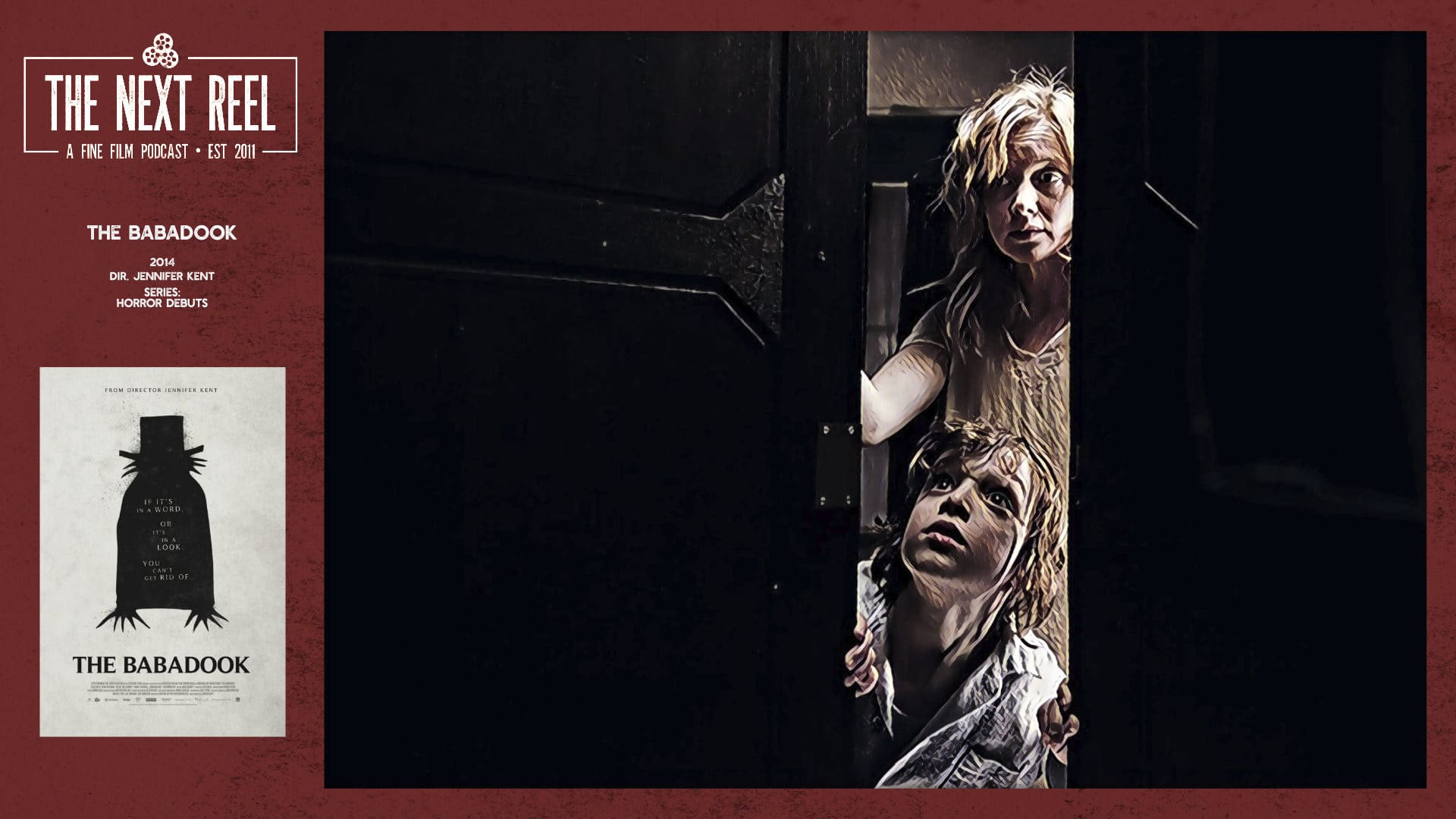
The Babadook. This is number four of our Horror Debuts series. Jennifer Kent. Jennifer Kent, talking about Babadook, and we’re still trucking through our Horror Debuts. And so I guess you could say this movie feels like the spiritual sequel to Goodnight Mommy, or prequel. One of the two.
Andy Nelson:
Very much so. It’s another story dealing with grief, dealing with kind of a family in crisis trying to figure out how to get through these elements that are happening. So, yeah, I think there will be a lot of conversation about that as we continue talking about Babadook.
Pete Wright:
So I have to ask, because I forgot last time to ask this, and I would like to get you to weigh in on the central question of our conversation — did Pete like this movie?
Andy Nelson:
And remind me, had you seen this before? Had you seen — because you hadn’t seen any of our Horror Debuts series before.
Pete Wright:
Right, I had seen this.
Andy Nelson:
You had seen this one. Okay. I had seen this one as well. I think that you think it’s okay.
Pete Wright:
Okay, go on.
Andy Nelson:
Well, I think that there are elements that you enjoy, as far as the depiction of the Babadook in that side of the story. I think maybe you think it’s a little heavy-handed with its treatment of the message or the metaphor. And I’m debating what you think about the kid and the — just like the relationship between mom and son. I don’t know. I’m torn on that. I don’t know.
Pete Wright:
Andy, I can’t wait to see how this plays out. I’m telling you, this is this is a real cliffhanger.
Andy Nelson:
It’s something, that’s for sure. The Babadook is unrated, but it does feature moderate violence and gore, a lot of it having to do with a young child, a six year old, and his relationship with his mother and friends and family and neighbors. Mild profanity and some severe frightening and intense scenes, including, you know, the Babadook running around.
Not the not the one spewing rainbows. This is the one that’s just spewing black.
Pete Wright:
I’m gonna need to hear about the rainbow one, in more detail. Also, coarse overhead lighting.
Andy Nelson:
So be forewarned, we’re talking about all of this on the show today. I don’t know how many of you check, but we do release show notes with all of the movies that we talk about. And in those show notes we have links to the movie, and if there’s an Apple link or an Amazon link, you can click on those. They will take you to their site, and you can rent or buy the movie. When you do this, we get a tiny piece of that profit, and it helps us out.
Pete Wright:
Especially the Babadook. He actually called and he said, baba merch taste. He’s really specific, but he wanted you also to know about our merch store. We’re putting more and more stuff in the merch store. If you haven’t checked it out, TruStory.fm/merch. You can get shirts, stickers, mugs, mask, pillows — not even logo stuff, like, you can get the new Next Reel logo, you can get the logos for the shows, but you can also get our tie-ins, our movie tie-in merch, which is fun. We’re having a great time doing it, and we’re putting more and more up every week. So TruStory.fm/TNRmerch.
Andy Nelson:
Have you seen the Babadook? We wanna know what you thought about this movie, or any of the movies that we’re gonna be talking about moving forward in our current season. Just record your thirty second audio file and send it to reviews@trustory.fm as soon as you watch the film, and it just might pop up on the show. So make sure you’re paying attention to the movies that we’re gonna be talking about through the rest of the season, which you can find over in our profile page on Letterboxd.
Pete Wright:
Profile page on Letterboxd? Andy, that’s crazy, we’re on Letterboxd too? We’re on Letterboxd, we have a profile page, we have an HQ page over at Letterboxd.com. We love Letterboxd.com — a fantastic way to keep track of the movies you watch and your feelings about them, and the feelings from other movie lovers. They’re fun and funny and insightful. It’s a fantastic, fantastic community. And Letterboxd has partnered with us to give a little bite off the price to upgrade to a Pro or Patron account over Letterboxd — get rid of the ads, support their development. Great service, great team. If you wanna get that discount, visit TheNextReel.com/Letterboxd, or just use the code NEXTREEL at checkout, and you will get 20% off either of those upgrade plans. This also works for renewals.
Andy Nelson:
We are still in our questionnaire phase right now. We’re trying to get feedback from all of you as to what you’re thinking about changes we’ve made, how you’re enjoying the show, where you listen — just trying to get a sense of your habits. We’re gonna keep that poll open through the end of this current series, so you’ve got three more weeks to hop in there and fill it out. We would love to know what you think about this show and the other shows under the TruStory FM Entertainment banner. Just go to TruStory.fm/TheNextReel — right at the top of the page is a big yellow banner with the questionnaire button, just click on that, fill it out, we really do appreciate it. And remember, one listener who fills out the questionnaire is gonna get a free year of membership.
Pete Wright:
Hey, everybody, we need your support. We don’t sell your info, we don’t partner with any super invasive tracking services to track your listener behavior like some podcast networks do. We just need your direct support. So to do that, we invite you to become a member.
Andy Nelson:
Members get to vote on our weekly Saturday Matinee polls to choose the list topic based on the movie that we’re talking about each week. If you were a member, you could have already voted on the list topic for the Babadook already.
Pete Wright:
Members also get early access to every episode, in their very own bespoke personal podcast feed once they sign up. And there are so many bonus episodes, it’s bananas. It’s bananas.
Andy Nelson:
Past bonus episodes, current bonus episodes, you get all of the bonus episodes. There are the monthly member bonus episodes, where we’re filling in gaps from past or current series. There’s a monthly Flickchart re-ranking episode. And this season we have the new Retake episode, where we are walking through the series that we just finished, talking in kind of a macroscopic view of all the points that we gleaned from that particular series.
Pete Wright:
And members also get to vote about what we’ll be talking about in our member bonus episodes that fill in holes from past series. It’s a fun little perk.
Andy Nelson:
Members can watch the livestream as we record the shows, and can access the livestreams from any of our previous shows anytime they want.
Pete Wright:
And members get access to the super secret members only channels in our Discord server.
Andy Nelson:
And now members get stickers. That’s right, we are gonna be mailing stickers to members, here and there — we’re just gonna send them out and surprise you. It’s just another fun way to show that we appreciate you supporting us.
Pete Wright:
And best of all, you don’t have to listen to this every time. That’s right, we cut all of this out in that member’s episode that you get in your bespoke personal podcast feed.
Andy Nelson:
At TruStory.fm/TNRmembership, you can learn all about our membership tiers. The most it’ll cost you is $5 per month or $55 per year.
Ad:
Meet Xenia. You are being very polite to someone who is attempting to kill us. Her wife, Saffron. You can plan all you want, but what matters is what you do when your plan falls apart. And their best friend, Goldie. Glad we didn’t miss all the fun. Swords in hand, they defend their city from the worst of humanity. I am Lord Buxton Blue. Vicious Swa. The Franconian Rake. Herr Hague. Equity Electric. Follow their adventures on the Swashbuckling Ladies Debate Society audio drama podcast. Available now at trustory.fm/swashbuckling.
Film Clip:
Where’d you get this? On the shelf. If it’s in a word or it’s in a look, you can’t get rid of the Babadook. If you’re a really clever one and you know what it is to see, then you can make friends with a special one, a friend of you and me. His name is Mister Babadook, and this is his book. A rumbling sound, then three sharp knocks. That’s when you’ll know he’s around. You’ll see him if you look. Babadook. We might read another one tonight. But you said I could choose. This is what he wears on top. He’s funny, don’t you think? See him in your room at night. Mom, does it hurt the boy?
Pete Wright:
The Babadook. The—
Andy Nelson:
—Babadook, dook, dook, some call it.
Pete Wright:
Was this a real thing, the Babadook? Is that like a character I should know before this movie? The rainbow spewing one?
Andy Nelson:
No, no. The rainbow spewing one comes because of this movie, and because of the way that it had been adopted by the LGBTQ community.
Pete Wright:
Okay, alright, good. Alright, we can talk about that.
Andy Nelson:
I — you’ll find memes and images of it where it’s the Babadook, but then he’s got the big rainbow, it looks like a stream of rainbow vomit coming out of his mouth. There’s all sorts of memes and images that are very LGBTQ positive.
Pete Wright:
Yeah, kind of blew up from this movie.
Andy Nelson:
Yeah. Yeah. But it was not—
Pete Wright:
—this was not, like, based on an ancient Australian children’s book or—
Andy Nelson:
—No, not like a children’s book. Correct. No, not like, you know, the Gollum, or one of these other sorts of creatures that had been around before. The Babadook — well, my understanding is that it actually does translate, I think in Hebrew, to “he is coming for sure” or “he’s definitely coming.” But I don’t know if that was the intention, because also, you know, people have pointed out that Babadook is an anagram of “a bad book.” So there’s all these different things that kind of have been pulled from it. I think that largely Jennifer Kent kind of came up with this creation on her own, as her little monster, that very much, if you watch her short film Monster, you’ll see she was really pulling a lot from her own imagination, because it’s very similar to that one.
Pete Wright:
Interesting. Yeah, and I have to say, just leading in, I really enjoyed Monster. And I enjoyed Monster in some ways that were, I found, better than the film, the Babadook.
Andy Nelson:
Interesting.
Pete Wright:
Okay, come clean. Oh, okay. I watched this with my son, and this is part of our horror exploration — I got him to settle in with me and watch it. And in that respect, it was a fascinating experience watching this, because, you know, it’s not gory horror, it is sinister in just the look and feel of the movie. It’s not a—
Andy Nelson:
Yeah. And no one dies.
Pete Wright:
Yeah, no one dies. The dog. Which was the scariest part of the movie for him, for sure, was that experience. And the fact that so much of the deeper lessons of this movie are worn so heavily on its sleeves, like, you have to reach — well, not very far at all. You don’t even have to get up to reach for the meanings of this in this movie. It’s so apparent what she is talking about in this film that it made it an enjoyable experience to talk about the film afterward, because it was a great way to talk about the use of metaphor and symbols to talk about things that you’re not literally talking about — until, in this movie, you kind of literally are. And so I thought that was a fun experience. So in that regard, as a teaching tool, this movie is sort of an ABCs of horror watching, or of movie interpretation. Now personally, I felt like it was too much. It was really heavy-handed. It didn’t make me work at all for some of the messaging in the movie. It is a movie about grief and addiction and trauma. And the Babadook and her relationship with the Babadook is so literal a transformation that I found it a little bit tedious. Now, I think as a filmmaking exercise, she’s a competent filmmaker for sure. I didn’t hate this movie, but I was surprised at just how many people love this movie when I did not connect with it as well as I’d hoped. And I would like to say, per our discussion before our housekeeping, Andy, you nail me every time.
Andy Nelson:
Not quite. I feel like I’ve been maybe fifty-fifty at best, since — well, this is—
Pete Wright:
—pretty good. I’m listening to you in the beginning and I’m thinking, okay, yeah, he gets me. He had me at hello.
Andy Nelson:
So interestingly, I watched this with my daughter. It’s funny, at the end of the film we get to the end of it, and she’s like, I don’t get it, I don’t think — horror movies don’t end like that, I don’t understand what it was doing. And so we had a little conversation about it and stuff, and I don’t think she walked away appreciating it. But what’s funny about that is when I first saw this film, I don’t think I was really thinking about it at all. I think I just watched it and didn’t process it, because I’m like, that was an odd film. I don’t know what people like about it so much. Without ever processing the fact that there were any metaphorical elements to it at all, I was just like, that was a strange little movie, I don’t know why people love it so much. And so my initial takeaway was very much like my daughter’s, like, I don’t get it. And then I kept reading people saying — you know, all these people who loved it talk about it being metaphorical. And so I started thinking about it, I’m like, okay, I guess I totally missed, or I just wasn’t thinking about it, I wasn’t putting myself in a place to even open myself up to that. My first viewing was very much just a face-value sort of movie, which I didn’t really appreciate very much.
Pete Wright:
Well, that really surprises me knowing you, that you were able to get away with watching this movie on Facebook. That surprises the hell out of me.
Andy Nelson:
I know. I know, me too. And I just don’t know if it was just because on that first viewing — mother and son, super annoying pair, I had a really hard time dealing with them. So part of me was just like, when is the Babadook gonna kill these two? I think that was probably my initial thoughts about this particular movie. And so, watching it again — I mean, as I watched it again, I’m like, wow, I don’t know how I didn’t see any of this that first time, because it’s pretty apparent. But I didn’t find it a problem that it was so apparent. I think my challenge is still the depiction of the mother and son as being such a pair that are so difficult to connect with through the film. Because we’re walking into this situation seven years after there had been this horrific accident that decapitated dad in the car, and it was on the day that the son was born. So she has this thing about that day, but it’s taken seven years to get to this point. And at this point, he hasn’t been raised well because of her. She is a mess because of all of this sort of stuff. So I get where we are, but it also makes them very difficult characters for me to connect with. And then as I start thinking about them, like, why has this taken her specifically seven years to get to this point? Why has — her family has not been pushing her, you need to go to counseling, this is affecting how you’re raising your son. It — I start going too far down this road, and then I have to step back. And this is where I think there certainly is a connection to Goodnight Mommy here, because there’s a depiction — there’s this element of depicting poor parenting in films, in particular, in these cases, horror films, that I think is worth talking about, because part of it we have to acknowledge, it’s part of the story. We can’t necessarily judge the script or the filmmakers for including it, because they are purposefully putting it there, because this is a person who is making bad choices. But I do think that there is a line for the character traits that we can buy and those that we don’t. And I think that becomes, for me, a connecting point with this film — where is that line that allows you to connect with somebody who — and I suppose it’s the sympathy versus empathy thing.
What does it take to connect with this character, even though you can very quickly come to judge her right at the start of the film?
Pete Wright:
That’s an interesting thing, that you had that reaction to their relationship, that parent-child relationship. That for me was my favorite part of the film, their relationship, because I felt like I could feel her parental fatigue with him. I don’t necessarily know that I want to weigh in on why it took seven years for it to come to this sort of peak, but I do think it’s important to note that the movie depicts triggering events in a way that I think is interesting. And that for her, there is some triggering event that leads to things boiling over the way they did for her, in terms of grief, in terms of making these decisions to sedate her son, and this effort with — you know, this example of adults exuding power over children, by them having a conversation together about the doctor and the mother having this conversation about giving drugs to their child just so she can sleep, and so that he can sleep, but really so that she can sleep. That level of sort of manipulation, how parents can become addicted to their children’s medication.
And I don’t mean by taking their medication, but to their children when they’re on medication.
Film Clip:
I think it may have been a febrile convulsion. That’s when the brain overheats. It always looks worse than it is. I’ve never seen anything like this. We’ll have to wait until the tests come back. All his other results are normal. He’s obviously suffering a high level of anxiety, very committed to the monster theory. That’s an understatement. All children see monsters. Not like these. And it’s getting worse, he’s becoming aggressive. I could see a psychiatrist, I can refer you, takes a few weeks to get in. That’d be great, but can you just give me something for now, just to make him sleep, and just until we get an appointment, please. I haven’t slept in weeks, and neither has Samuel. And when we go home tonight, this whole nightmare will start up again, and I’m really not coping. I can give you a short course of sedatives, just until the tests come back. Most mothers aren’t too keen on them, unless it’s really bad. It’s really bad.
Pete Wright:
Those sort of behaviors, I think, are alluding to the complexity of being a parent. And when she reacts in rage, those extremes, the way she does to her child — I could relate to that. I could relate to those feelings of frustration — not frustration even necessarily at my child, but frustration at me for not being able to handle this better, and it erupts in ways that are completely unintended. And, you know, I feel like now I’ve been a parent for a long time, to two kids who are effectively grown, and we made it through the hardest times. I’m not gonna say I didn’t understand where she was coming from in this movie — it was extreme, in horror movie extreme, compared to my experience, but I knew where the seeds were planted. And so I thought, for me, that centrally became the thing I was sort of hanging my hat on. I really didn’t care so much about the Babadook story, insofar as I really appreciated the parenting story.
Andy Nelson:
Okay, well, I mean, and I’m not saying I don’t appreciate it. I think that it is a strong depiction of this weariness — she’s a very weary parent, and he is clearly a kid who — I mean, it’s interesting, I think there is an element of autism perhaps in Samuel.
Pete Wright:
But he might be on some sort of spectrum.
Andy Nelson:
He’s on some spectrum. Some people online have talked about that, who come from families with autistic children, and say he very much is depicted in that same way that they have come to experience.
Pete Wright:
I couldn’t find anything with her talking about that in writing the movie.
Andy Nelson:
I haven’t seen anything either. I’ve just read that some people from autistic homes have said he feels very much like he’s displaying some of those traits that they have recognized. Who knows if it was intended or not, but it comes across like there is something there in the way that he reacts with people. But also it does feel like this is a kid who hasn’t been controlled well, and parented well, I should say, as far as how she’s handling him. And I think that’s a really interesting story. I like the way that the nightmare kind of comes to life. I find myself questioning a lot of it — like, what are we meant to assume with the appearance of this book? Is — is their entire situation, does that all become metaphorical and is not really happening? Is all of the stuff with the book, is it all in her head? There’s so many things that you start questioning. Or is it just the movie itself that’s the metaphor? I don’t really know. But I kind of like the way that it is depicted. And I guess, specifically, because the way that it ends, where you have this creature locked up in the basement that she has found a way to manage — for me, that became the strength of the whole Babadook story,
Pete Wright:
the way—
Andy Nelson:
—that she was kind of managing at the end. I thought it was really interesting. And so to that end, I think there are a lot of elements in here that work. I don’t necessarily think it’s as strong as a lot of people say, at least for me, but I did find it interesting. But case in point, it’s a film where it does make you connect with a parent and a child who aren’t necessarily role models that you very easily can connect with.
Pete Wright:
Yeah, I would — yes, I certainly would say that there’s just not a role model. I think she’s more of a vessel for past experience, right. A vessel that — I can, whether or not I connect, I certainly relate. Are those two different things?
Andy Nelson:
Well, no, that’s — yeah, that’s that whole sympathy-empathy thing.
Pete Wright:
Yeah, yeah. And so to your point about the end — I mean, the fact that this thing, this thing in the world, in the universe of the film, is a real tangible sort of terrestrial thing that she is able to conquer, and it lives in the basement and eats worms, and she is able to tame it — and then we’re back in that metaphor relationship of whatever it represents, her rage, her guilt, her shame, her fear, her grief, her addiction, all of those things are manifested in this real beast. The real beast that put the book back together and put the book on her stoop. And in the universe of the movie, I see that very much as a real thing that she tamed. And the metaphor is so heavy-handed that, in the experience of watching the movie, I find it kind of exhausting. It’s the experience of talking about it afterward that I think is more compelling than the movie itself.
Andy Nelson:
Well, and I can see that. And I guess it depends on how much you’re just watching the film knowing that it’s basically her grief that she’s dealing with, because I think there’s an interesting horror element that comes through, with this really creepy nightmarish creature. It is a monster movie. It’s incredibly effective — like, the way that they film it, the way that the Babadook appears, it’s a terrifying creature. And I am very compelled with the tools that Kent used with her team to make the way that its movements looked and everything — it really just feels incredibly creepy. I can’t get enough of seeing the Babadook on screen. And I don’t know, I guess I give it a lot of flack because I’m just kind of waiting for those moments, because it’s exciting to see those parts.
Pete Wright:
Yeah, yeah. I — this movie — I know this is not true, I’m about to say a thing that I think is objectively not true, but I don’t know the answers. Somebody said online, on the Internet once, that, you know, after some number of days without food, eventually a dog will turn on its owner and just try to eat you. And I went and looked that up, and dog trainers from around the world say that’s — you gotta understand the mind of a dog, that rarely happens when dogs do that. But that has become a usable metaphor for me, to exemplify that sort of boiling point. Like, eventually we turn on ourselves. Eventually, without proper care and feeding, we turn on one another. And I think this movie sort of exemplifies that, right? These — this parent and child who have no one else but each other.
They turn off everyone else, whether it’s their friend from work—
Andy Nelson:
By choice.
Pete Wright:
By choice, right, they turn off everyone else externally, and now all they have is one another, and they turn on each other too, right? Eventually they just boil over.
Andy Nelson:
Well, I’d say mom boils over, I wouldn’t say he turns on her.
Pete Wright:
Yeah, I think that’s probably fair. He’s protecting himself, right?
Andy Nelson:
Well, he says he’s protecting her too. Right? That’s his whole — and to that end, it’s very interesting how that does connect to Goodnight Mommy.
Pete Wright:
Exactly.
Andy Nelson:
These are kids in this place that think there is a monster in their presence, and they are doing what they can to fight against this monster to get their mom back.
Pete Wright:
Yes. And here, she really isn’t, by the end — it feels like she’s really not his mommy anymore. And he’s, I think, trying to get her back into herself.
Andy Nelson:
Right. She’s been basically the Babadook — I mean, the way it’s depicted on screen, the Babadook goes into her and kind of possesses her. And she kills the dog, and she goes after him, and he stabs her, all of this sort of stuff, and shoots her with his little arrow gun, or his crossbow, I guess.
Pete Wright:
So crafty. Hits her—
Andy Nelson:
—with the ball, the catapult that he’s created. All these things he does, before he finally kind of gets her to a place where she does exorcise this demon out of her by vomiting up this blackness. And that is really the point where, I guess, in her mental state, she’s able to kind of come back to her senses and realize what’s happening, and is fighting against this grief that is overtaking her and causing her to enact violence upon her son.
Pete Wright:
So all of that, while it feels heavy-handed, that’s just really a small complaint that I have of this movie, that otherwise I enjoy the experience. I think it’s shot beautifully, I think it is such amazing use of frame, right, of negative space, in this really largely constrained to this sort of single location in the house. We do go with her to work, we see a little bit about what she does, and the fact that she’s a caretaker at work for people in need, for the elderly and infirm. And then we get a little bit of an experience outside her house. But largely this takes place in the house, and I think it’s just beautifully presented. And like you said, the character design of the Babadook, I think, is fantastic. And the fact that it was all shot very practically, right, we don’t have them reacting to CG monsters. We get a real commitment on the part of the filmmaking to a real, tangible shape of this monster at the end that we even never really see in its entirety. In that regard, this is the perfect monster movie, because we see it as depicted in the book, but at the end we never get to see it. We see its wings, we see its kind of hat, and then it falls, and it’s not itself anymore — it’s, we get a really obscured reveal, and I like that too. There’s just — I think there’s a lot to like about it, even if the story is heavy-handed.
Andy Nelson:
Yeah, we see the face in the shadows in the closet, we see the shape of it hanging behind the police officer, it pops up throughout, and I do really appreciate the way that she did that — or on the ceiling, stuff like that, where Kent was using some old older film school techniques to allow for its movement to kind of have that creepy feel to it, that works really well. And she had referenced Lon Chaney, in that last film of his, London After Midnight, where he’s kind of got those big eyes and that big mouth full of fangs, with a big top hat, and his hands — it was kind of a vampire movie that she referenced as kind of a look. And I think if you look at old stills of that, you’ll really see that in the shape of the Babadook and how she had kind of created this.
Pete Wright:
I think the movie also peppers us with symbols that I — I know I didn’t catch nearly enough of them, I’m sure, because I think this is the thing that Jennifer Kent really likes to do. But some of them felt like they weren’t necessarily tied into the narrative itself. So when she’s chewing on glass in the soup, where did that come from?
Film Clip:
Don’t eat it. The Babadook did it, mom. Go and watch your Davy Day, and I’ll make something else. The Babadook did it. Just go and watch your Davy Day, Samuel.
Andy Nelson:
That was something I was very unsure about — like, because Samuel seems kind of guilty, did he put something in her soup, to kind of — was he testing her in some way? Did I miss—
Pete Wright:
—did she scoop around his soup? Did she not find any glass in his soup, or was it just in hers?
Andy Nelson:
I don’t recall if she found any more or not. But I was trying to remember, was this the same day that he had smashed his cannonball, or his catapult, through the window, and did glass end up in the soup, and I just wasn’t paying attention. I missed exactly what had happened there. Or is that just something that she’s imagining, and he’s reacting because she’s acting weird about the soup? I wasn’t really sure exactly what happened. And later she pulls something out of her mouth, and I’m like, was this glass that was stuck in her gum? Was it a rotting tooth?
Pete Wright:
Well, that to me was a tooth, because there were a number of times, like, when she’s in the car driving around right before the accident, she’s massaging her cheek, which indicated to me that she was having jaw pain. And then once the Babadook was in her, she was able to muster the strength to yank her own tooth.
Andy Nelson:
But again, I wasn’t sure what the message was there.
Pete Wright:
Right.
Andy Nelson:
Was that a reference to the pain? I’m not exactly sure what was happening with all of that.
Pete Wright:
Well, and so that’s what I mean by the symbols. You start looking at glass, and broken glass in particular — usually it’s a sign of either a broken heart or transformation, right, spiritually it’s generally a symbol of rebirth, of coming through trauma. And I thought, okay, well, now it’s literally a symbol that defines the experience of the movie. So it’s another one of those examples of, you know, here we are, telling me what the movie is about in these symbols, quite — it could be taken sort of quite literally. And again, heavy-handed, if you’re just watching it as a spooky monster movie, glass and soup is a creepy image, and that’s great. And it’s a disservice to the movie, because it wasn’t directly connected enough to the story. It’s not like we have any indication that that’s what the Babadook does, right, is trying to plant glass in food to make you hurt yourself.
Andy Nelson:
And same thing with the bugs behind the fridge.
Pete Wright:
Oh, what were the bugs all about?
Andy Nelson:
Because is that just like her mind? I feel like all of it is kind of the deterioration of her mental state, is really what we’re in — we’re in this shell of her brain as things are falling apart.
Pete Wright:
Well, they’re falling apart, but didn’t she — I mean, she pulls the refrigerator out and pulls the wallpaper off, and then there’s the big hole, and then the officers come in, or the agents, and the hole is patched, right, there is no more hole.
Andy Nelson:
Even patched, yeah.
Pete Wright:
It’s just wood.
Andy Nelson:
There was no hole. And she said, oh, not a hole, it was a tear in the wallpaper, they’re coming from behind the wallpaper.
Pete Wright:
Yeah, trying—
Andy Nelson:
—to sell it. But, yeah.
Pete Wright:
Don’t know — indicates to me, what you were saying, that it’s in her mind. But the glass seemed real enough, and the tooth seemed real enough.
Andy Nelson:
But see, that’s the thing, because the Babadook seems real enough too. But again, the whole idea is that none of this is real — we’re just watching this metaphor, and really, that’s all it is. And that’s, I suppose, where, you know, it’s an interesting film, because it’s not ever set in the real world. It is just a metaphorical story about a creature that happens to be a depiction of her grief. And so all of these elements are just other elements of her grief — her broken, as you said, what was the glass, like, broken heart, things like that. And the bugs were probably — I don’t know what the symbology of bugs would be, but something like there is an infestation, like, eating away at her from the inside, type of thing.
Pete Wright:
I have this real anxiety around the things I hand down to my children. And I don’t mean, like, photos and albums, I mean my own anxieties — I don’t want to be a role model for my kids of the stuff that I’ve been dragging around. And I know to some extent that’s impossible. This movie, in that regard, really is the depiction of my anxiety around this. Because at the end, when the kid looks to her after she feeds the worms to the monster, the kid looks to her and says, can I ever see it? And she says, maybe one day, when you’re older — well, of course you’re gonna see it when you’re older, kid, because we all have it, and I’m gonna be giving it to you as my great, you know, inheritance, which is my grief that you’ll also have to live with. I think that was a terrific punchline to this movie, right?
That this is that exploration. I thought that was awesome.
Andy Nelson:
I think that all of this is why, for some people, they really can connect with the film, and they enjoy this intense ride for what it is, this depiction of grief as a nightmare creature that you have to learn to deal with. And some people say, oh my god, this is so heavy-handed. It’s like, yes, I get it. I get it, I get your point. And it’s an interesting way to tell a story that does split the audience very much so. And I think that’s very interesting, because I can certainly see it both ways. I think for me, I side with the version where I’m like, you know, it’s — I haven’t seen it told quite so on its sleeve before, and I kind of enjoy how they’re using it, like, how Kent and her team are allowing the story to unfold in that way. So I kind of like it. I guess that heavy-handedness, it doesn’t end up bugging me, and I don’t have as much of an issue with it.
Pete Wright:
I think it would bug me a lot more if I didn’t like how the film was constructed. I have such a good time, like, in the camera, and just looking at the transitions — when she transitions from waking to sleep, right, when she has that experience where she’s up, and then suddenly the camera moves all funny, and the light changes, and—
Andy Nelson:
—it goes into what feels like a time lapse, right?
Pete Wright:
Yeah, yeah, yeah, feels like something—
Andy Nelson:
—where time lapse over, like, five to ten seconds, over, like, ten hours.
Pete Wright:
Yes, yeah, absolutely. And it goes so fast, and suddenly we’re there. Or when she falls into her bed, the first one, she’s kind of falling in the bed, comes up to meet her. I thought those little tricks and tropes were so entertaining, just visually — they were candy. So there’s a lot to like about, I think, the visual experience of the film.
Andy Nelson:
And that speaks exactly to that whole idea of we’re living inside this woman’s head, who is — I mean, she is exhausted, right. She just can’t, like, her sense of time, her sense of space, it’s all kind of mushed together, because she has no — she’s not getting any sleep.
Pete Wright:
Yeah.
Andy Nelson:
When you see those things, that’s probably how it feels to her — she lays down to sleep, and she feels restless for about ten seconds, and then suddenly her son’s jumping on her, saying, mommy, it’s 9 o’clock. It’s like, what the hell just happened? And I thought that was a really fascinating way to depict those things and put us into her head.
Pete Wright:
Completely, completely. If — I mean, again, to that experience of the relationship of her, frustration and rage with her son, her frustration and rage with not being able to sleep, I absolutely relate to that. That is right over home plate for me, it was perfectly depicted here.
Which, I mean—
Andy Nelson:
—fits into a story where we’re in her head, dealing with her grief, her battle with her own grief. So I think that this is a film where film as metaphor ends up allowing all of those things to really work, in context of this story as it’s being told. And to that end, weirdly, it feels very much like a Stephen King sort of thing. I feel like — and that’s something I find really interesting with the Babadook as a creature, as I’ve been kind of re-exploring so many Stephen King stories as of late, I find that he really enjoys those things. These creatures that are a kind of metaphorical depiction of something the characters in the story are dealing with. So I feel like there’s a real element of that within his work. And I like the way that hers feels right at home with those.
Pete Wright:
Yeah, I’m actually rereading The Shining right now, and I’d forgotten just how much of that very child relationship and the struggles, and the broken arm, Danny’s broken arm, and the — all of those things are very much at play in that book. That is a great comparison, I had not made. Yeah, very, very Kingdom.
Anyway, alright, you wanna talk a little bit about any performances that really light you up? What you think about the kid and his ability on screen? I know you have your annoyances with the parent-child relationship, but the kid—
Andy Nelson:
—well, they — I struggle with both of them, but I think — and this is my battle with the film, because I think I’m intended to struggle with both of them. And so I just have to get over my own issue and say, you know what, I have to find — and now I’m gonna forget which one is which, sympathy or empathy — I have to empathize with these characters, I can’t sympathize, because I haven’t gone through it, but I can empathize with them even though I may disagree with choices. And so to that end, I think Essie Davis as Amelia and Noah Wiseman as Samuel are giving really strong performances here. I never doubt for a second anything they’re going through, I think they both play it incredibly well, and I really enjoy it.
And I do think — I don’t know, part of me sometimes struggles with Samuel, because he is so obnoxious, and because it’s like he so clearly is a problem child. But then I’m like, but that’s not the actor, that’s not — there’s nothing wrong with that. That’s how Jennifer Kent wrote the character of Samuel, as a kid who has had seven years living with mom as she has slowly been kind of descending to a place where she’s just not able to actually provide any parenting at all. And he’s largely on his own, making his own weapons, teaching himself magic from videos, or talking, saying too much to other kids about the state of things. And so I can’t fault him for any of that, because I think that’s just part of the character of Samuel. And to that end it’s really interesting, because Danny Pintauro, he was six when he was in Cujo, and I thought he was fantastic in that film. Noah Wiseman also was six. And Jennifer Kent had talked about how she actually had auditioned a lot of older kids to play it, but she said that they just read older, they felt like they were too mature to be really going along with any of this sort of stuff. And so that’s when they started looking at younger kids, and that’s when she clicked with Noah Wiseman. And I buy it with him, as much as sometimes I can struggle just with the character, because I find the character a lot of work, but I think Noah Wiseman is doing a great job in the role.
Pete Wright:
Yeah, I mean, I have already said it, I don’t have as much of a problem with the obnoxious part, because it feels so real to me. It feels like such a lived-in experience.
Andy Nelson:
Well, that’s why I have a problem with it, because it feels so real, and I’m like, I cannot do—
Pete Wright:
—that’s what it feels like. I was just gonna say, this makes you sound old.
Andy Nelson:
It may, and they’re right.
Pete Wright:
I’m a grumpy old man.
Andy Nelson:
Take it, kiddo, I’m done.
Pete Wright:
Yeah, right, right. So I really feel like I can relate to this experience, and it just feels like there’s nothing sort of joyous about their experience living together until, I guess, the end, when she’s finally able to realize that she has to make room for her life for all of these elements of her life together, including her child. And so, to me, I think their performances on screen were fascinating and terrifying, and I think really lend a lot to the metaphorical part of the movie. I think they did a fantastic job. I was really surprised that the kid, frankly, was able to pull that kind of frenetic energy and consistency in this movie. And I feel like he’s a great child actor — he did a great job being obnoxious, that’s a role.
To your point, that’s the role he was hired to play, and I think he did it. I think what they had to do to get his reactions, and to not put him in a place that would cause him actual trauma by just making this movie, is equally fascinating. And the care that it sounds like Jennifer Kent went through, to make sure that he was able to give reaction shots to mom screaming at him those horrible things, saying those horrible things to him while not being her scene partner, saying things that would scare him relatively, while still being able to bring him to the level that matches hers — I think is really interesting.
Andy Nelson:
Yeah, I like that Kent thought about that. She said, I didn’t want to destroy a childhood to make this film. And I think that’s important, which I don’t know how often you hear directors who have children in horror movies really taking that into account as they go through the motions with that.
You hear the horror stories of, like, Monster Squad, for example, when they did it — there was the girl who was genuinely scared of the vampire character, and they purposefully didn’t let her see the vampire character until the moment when he turned around and picked her up, so that they could get an authentic reaction from her. And I’m like, that may not be the best approach to actually directing a scene like that. I mean, I get it, you got genuine fear out of that child when she saw the vampire character pick her up. But at the same time, this is a kid, and you have to take that into account, I think, as a director, when you’re making a film, so that you’re not leading to trauma in a young person.
Right? And so I think that’s a very critical thing. And so, yeah, she had, in those scenes — they would be yelling stuff at Noah, like, I’m gonna take your Legos and throw them in the river, to get the reactions that they needed out of him—
Pete Wright:
Yeah.
Andy Nelson:
—as opposed to hearing the sorts of abuse that she was hurling at him later in the film.
Pete Wright:
But she said she was gonna go do, like, a mafia thing — she was gonna put him in cement first, and then throw him at the river. Just awful to do to Legos first. I get why he was wound up about that.
Andy Nelson:
Yeah, but you see a kid who’s, like, the way that he’s having a major fit in the back seat of the car, having convulsions — there are some moments in this film where he’s doing stuff and I’m like, he is really good, it’s a strong performance. And I get it, it can be a challenge to go along with that, especially if you’re not somebody who is used to dealing with kids. But yeah, there’s a lot to that performance.
Pete Wright:
Truly. You wanna talk a little bit about—
Andy Nelson:
—Jennifer Kent’s start? I find it so interesting, because she actually started as an actor, going through school with Essie Davis — they actually went to school together. And then she kind of lost interest in acting, it kind of petered out, it didn’t have that interest, and she was more interested in the filmmaking side. She actually wrote a letter to Lars von Trier and asked if she could assist him on the production of Dogville — this was in the early aughts. Interestingly, he accepted. I’m like, why didn’t I ever think about that when I was in film school, can I be your assistant on this movie? So she went and worked on it, and she said it was basically her film school, and she said that her key lesson that she took away from it is learning how to be stubborn, which I found really interesting — because you wanna be able to stick with your guns. And so that really is how she kind of got her start in telling these stories and everything. And she had, for this particular script, I think she went through a number of different drafts of it, trying to figure out the tone and the feel and everything. And she was citing a lot of horror movies from the sixties, seventies, and eighties as the influence for this particular film. And then a lot of it came from — she had a friend, she said, I have a friend who’s a single mother whose son was traumatized by this monster figure that he thought he saw everywhere in the house. So I thought, what if this thing was real on some level? So I made Monster, that’s her short film, about that idea. But I couldn’t leave it alone, I kept coming back to it, and that led to The Babadook.
Pete Wright:
I really enjoyed Monster. And I think it is so efficient in the way it gets to the point that — I found it just such a wonderful little bite-sized nugget of filmmaking. In some respects, it just sort of gets over all of the heavy-handed metaphor part that I struggle with, for just, like, we’re just living in this world, and it’s super literal, and mom’s a badass.
Andy Nelson:
Yeah, mom’s a badass, and she puts the monster in its corner, and then takes care of it, and says, look, I’ll still give you some milk when you need — but it’s interesting how much of the Babadook came from that monster, like the long skinny fingers and stuff. It’s like she really had this creature in her mind, which I find really interesting.
Pete Wright:
Truly. Okay, so do you wanna dive into the rainbow, the Babadookie rainbow?
Andy Nelson:
A few years after the film came out, I think this started on Tumblr — there was somebody who said, whenever someone says the Babadook isn’t openly gay, it’s like, did you even watch the movie? And it really kind of turned into this whole conversation between all sorts of people on Twitter, on Instagram, and all this stuff. And it became this idea of the Babadook represents kind of the LGBT community. This person, Lanstagram, said, “a movie about a gay man who just wants to live his life in a small Australian suburb. It may not be just a movie to you, but to the LGBT community, the Babadook is a symbol of our journey.” And that really turned into this whole idea of this kind of character that became a meme, and a character that represents homosexuality and queerness. And I find that so interesting. Now there’s also kind of a whole thing of people kind of at this point saying, you know what, it’s kind of run its course, it’s hit a point where everybody knows about it. So now it may not pop up nearly as popular anymore, but it was a thing for a good while, and may still be. But I find that to be a really interesting thing, that I know I knew nothing about until I started reading about it, and I found this article on Vox called “How the Babadook Became the LGBTQ Icon We Didn’t Know We Needed.”
Pete Wright:
I think I need to know more about the characteristics of the Babadook that make him the LGBT icon. Because I usually find myself — I like to think of myself as a pretty sensei guy when it comes to these things, and I’m able to relate. And this, I can’t yet. I’ve read some of the reviews — some of the Letterboxd reviews was the gay man in a top hat kind of a thing, but the top hat is not an overtly gay symbol.
Andy Nelson:
The whole idea of it was that — I think it just became something that people were sharing, and it became, I don’t know, a lot of fun and conversation. But there were people who were trying to look more into it. There was somebody who was trying to figure it out, there was a meme that was posted where somebody tweeted, “Babadook, I’m a terrifying monster that destroys families that try to suppress me.” “Gay people.” “Oh my god, same, drinks later?” And so it became this idea of this dark scary creature that is going to destroy you, but really, it’s not.
Pete Wright:
You know, duh, of course. Yeah, I was looking at it as the monster, like, the character itself. No, no, no, no, it’s yet another example, another vessel of representation. I get it, okay.
Andy Nelson:
Another metaphor.
Pete Wright:
No, you helped me. Look at what you did, there you go, you helped me cross the bridge, Andy.
Andy Nelson:
Thank you, that’s what I’m here for.
Pete Wright:
Wow.
Andy Nelson:
So, yeah, and here’s another one. “The Babadook’s queer legacy, and our infatuation with it, borrows on all these ideas — the desire to go with and improve upon the joke, the increased earnestness around that joke, and the resulting amplification of the absurdity of a homosexual Babadook living a life of queer defiance by terrorizing a white Australian family.”
Pete Wright:
Okay, that’s funny. Yeah, that’s funny.
Andy Nelson:
Yeah, so, I — it’s funny because, I would never have seen that if it weren’t for articles on the Internet that kind of talk about this sort of thing. So I find that really interesting in that. I haven’t seen Jennifer Kent comment at all about that, but I find the way that people are able to find these interpretations, I find it makes the story more rich and the exploration of the films that much more exciting. Alright, well, enough of this. We will be right back. But first, our credits.
Pete Wright:
The Next Reel is a production of TruStory FM, engineering by Andy Nelson, music by Ty Simon, Oriol Novella, and Eli Catlin. Andy usually finds the stats for the awards and numbers at The-Numbers.com, BoxOfficeMojo.com, IMDb.com, and Wikipedia.org. Find the show at TruStory.fm. And if your podcast app allows ratings and reviews, please consider doing that for our show.
Okay, so we’ve already talked about Monster as a prequel. When do we get to see what happens to the Babadook in the Babadooks?
Andy Nelson:
Babadooks. That—
Pete Wright:
—probably has an image that you don’t need, but I’ve been working on that joke all night. So, Babadooks Bigelow?
Andy Nelson:
There’s a whole other career out there for the Babadook. Jennifer Kent actually holds the rights to this film, and she has been asked about sequels, and she says, I will never allow any sequel to be made, because it’s not that kind of film. I don’t care how much I’m offered, it’s just not going to happen.
Pete Wright:
Wow, she puts a pretty fine point on it. Wonder if that’s true. That makes me think, it makes me want to come up with a number. Like, everybody’s got a price, right?
Andy Nelson:
Well, I guess you’d have to get that much to find out.
Pete Wright:
Okay, well, everybody’s gotta have dreams. That’s right. How did you do at award season?
Andy Nelson:
Really well, this film, you know, definitely struck a chord. 56 wins, 64 other nominations. Over at the Saturn Awards, one of our favorites, the Academy of Science Fiction Fantasy and Horror — this film was nominated for Best Horror, but lost to Dracula Untold, which surprises me, because I don’t remember hearing good things about it, but maybe I need to see that one now. Essie Davis was nominated for Best Actress but lost to Rosamund Pike in Gone Girl, which I don’t know, I guess, are they putting that in horror as far as why it was nominated? Not quite sure there. And Best Performance by a Younger Actor for Noah, but he lost to Maisie Williams for Game of Thrones — again, interesting, because I guess in that category they don’t split across film versus television. Yeah, yeah. Fantastic Fest — this film won all the awards it was nominated for in the horror features category, that was Best Actor, Best Actress, Best Picture, and Best Screenplay. And at Australia’s Academy Awards, the AACTAs, it received the Byron Kennedy Award, and it won Best Film, tied with Russell Crowe’s The Water Diviner, which he was directing. And Jennifer Kent won Best Direction, Best Screenplay. It was nominated for Best Editing, Best Production Design, and Best Lead Actress for Davis, but in all those cases lost to Predestination, in the case of actress Sarah Snook.
Pete Wright:
Yeah, absolutely okay with that.
Andy Nelson:
I like the production design — if there were a creature design award, then certainly, but overall production design, I think Predestination.
Pete Wright:
Agreed. And how about at the box office?
Andy Nelson:
Kent had a total of $2,000,000 to make her movie. I’ll point out, everywhere online that’s listed in US dollars, not Australian — I think the Australian budget originally was two and a half million plus, they did end up raising 30,000 more through Kickstarter just to build the sets. So I assume that this has all been rounded, and what we’re left with is approximately $2,000,000 in US dollars. That puts the film at a total budget of $2,160,000 in today’s dollars. The film premiered at Sundance in 2014, then opened in Australia 5/24/2014. It played at a lot of other festivals, then opened 11/28/2014 in theaters and digitally in the US, opposite The Imitation Game and Wild. Perhaps because it was released day and date on streaming platforms, this film didn’t do that much business in the US, only earning $964,000 domestically. Internationally it earned almost $9,350,000, and I’m assuming that a lot of that was probably the Australian box office. All told, it earned $11,100,000 in today’s dollars, so it still ended up with an adjusted profit per finished minute of $95,500.
Pete Wright:
Well, that’s something. Yeah, that’s something. I don’t fault it for that. I didn’t hate the movie, I think there’s a lot to really like about it. I stand by my first surprise, I am surprised that this movie is so loved by so many when I just couldn’t connect with it quite so deeply. But I think there’s certainly a lot to talk about and a lot of solid filmmaking to be admired.
Andy Nelson:
And just as an interesting side note, they actually released — you could actually buy copies of the actual Mister Babadook children’s book. They made gorgeous copies, they had extra pages and everything. It was a pop-up book too.
Pete Wright:
Right?
Andy Nelson:
It was a pop-up book, oh, absolutely, and they ended up doing a few runs at it. The first run, because they were selling them for between 80 and $100 per book, and they sold thousands of them. So when I calculated it out, it was like $7,750,000 or something like that, just on the first run of pop-up books.
Pete Wright:
Wow.
Andy Nelson:
So I don’t know what their production costs were, but obviously they found a strong niche in something else, another way to make a little extra money on the side.
Pete Wright:
That’s fantastic. Yeah, that’s crazy. Well, we’ll be right back, we’re gonna talk about our ratings and reviews. But first, here’s the trailer for next week’s movie, The Lure.
Andy Nelson:
Have you watched The Lure? We want to know what you thought — this one seems to divide people, so we’re really curious. Send us your thoughts in a thirty second audio clip, and we just might get it in the episode. Send it to reviews@trustory.fm.
Pete Wright:
Okay, Andy, where do you land in Letterboxd? How do you possibly put stars and hearts against the Babadook?
Andy Nelson:
My initial review of this was two stars, no heart. I’m glad I rewatched it, I actually found more to connect with in the film this time. I still don’t think that I loved it, I think I’m probably at three stars and a heart with it. But, you know, I think that’s definitely a sign that I’m finding more with it, and it certainly is an interesting movie worth watching and talking about.
Pete Wright:
I was actually wondering if you were gonna land at the three star. I definitely started at the three star, and my question was whether or not I was gonna go to three and a half. I didn’t have a huge window there. And, yeah, I think I’m fine at three, honestly. I feel like we got what we needed to get out of talking about the movie. It’s a solid and competently made film by a strong filmmaker with a terrific eye. But I will give it the heart — I will give it the heart because I really enjoyed watching and talking about this movie with my son. It was worth it.
Andy Nelson:
It sounds like you had a better conversation with your son than I had with my daughter. Her reaction was, okay, yeah, that was kind of end of that discussion.
Pete Wright:
Well, and I should say, during the movie, he would lean over to me and say, okay, my heart is pounding, what is going on right now? Not quite like A Nightmare on Elm Street, like, ’19, is it? There’s some pieces that are damn thrilling in this movie. Use of light and shadow, it’s got some good scares.
Andy Nelson:
Yeah, yeah. So what did you think about the Babadook? We want to know. Hop into the Show Talk channel in our Discord community, and we’re gonna be talking about it this week. When the movie ends—
Our conversation begins. Letterboxd giveth, Andrew, as Letterboxd always doeth.
Pete Wright:
You’re sort of insufferable about Letterboxd today, so you should probably go first.
Andy Nelson:
I have a four star, on Letterboxd, written by Simon Ramshaw, who saw this the year it came out, 2014, and had this to say about the film: “Ba ba dook dook dook, push pineapple, shake the tree, ba ba dook dook dook, scared the shit out of me.” There you go.
Pete Wright:
Wow, that’s right. I don’t even — I don’t actually wanna follow that.
Andy Nelson:
I just said it, Pete, how can you follow?
Pete Wright:
I never, you know, with Letterboxd, we always go either popular, or, you know, most activity, right, or five star or one star. I decided to go with a new metric, which was the first review ever captured on Letterboxd, because I think it really speaks to the tone and tenor of the quality of the community that Letterboxd has always been trying to achieve. Do you know what I mean? The high-class, high-quality review and insightful thinking about cinema that Letterboxd celebrates. And so I give you a four star review by Maya Oleren, who says, “beautiful but scary as—” so that was review number one, really setting the bar. Setting the bar right here. Thanks, Letterboxd, you’re doing great.
Andy Nelson:
I’m gonna throw this review in here too — this is by Matthew Buchanan. Mister Letterboxd himself.
Pete Wright:
We should only review Matthew Buchanan. There’s just a new rule — if Matt Buchanan has reviewed a movie that we talk about, we have to talk about it on the show. One of us has to pick the Matt Buchanan.
Andy Nelson:
That’s right. Matthew Buchanan gave it two stars. “Starts out well, bearing a little Black Aussie humor and employing the kind of abrupt cuts between scenes that push the narrative along briskly, while also conveying that something’s a little off-kilter. Essie Davis and Noah Wiseman are perfect as sparring widow and son. But as the tension builds and the central premise is revealed, there isn’t enough in the mechanics of the story to justify where it ventures thematically, and the ending feels hackneyed and expected. Plus, not actually very scary.”
Pete Wright:
Dang, why did we do a whole podcast about it?
Andy Nelson:
When there was that.
Pete Wright:
Thanks, Letterboxd. Matthew Buchanan.