*This transcript is produced using transcription software and reviewed for quality. Despite our best efforts, some passages may be incomplete or contain errors due to audio quality or software limitations.*
Pete Wright:
I’m Pete Wright.
Andy Nelson:
And I’m Andy Nelson.
Pete Wright:
Welcome to The Next Reel. When the movie ends.
Andy Nelson:
Our conversation begins.
Pete Wright:
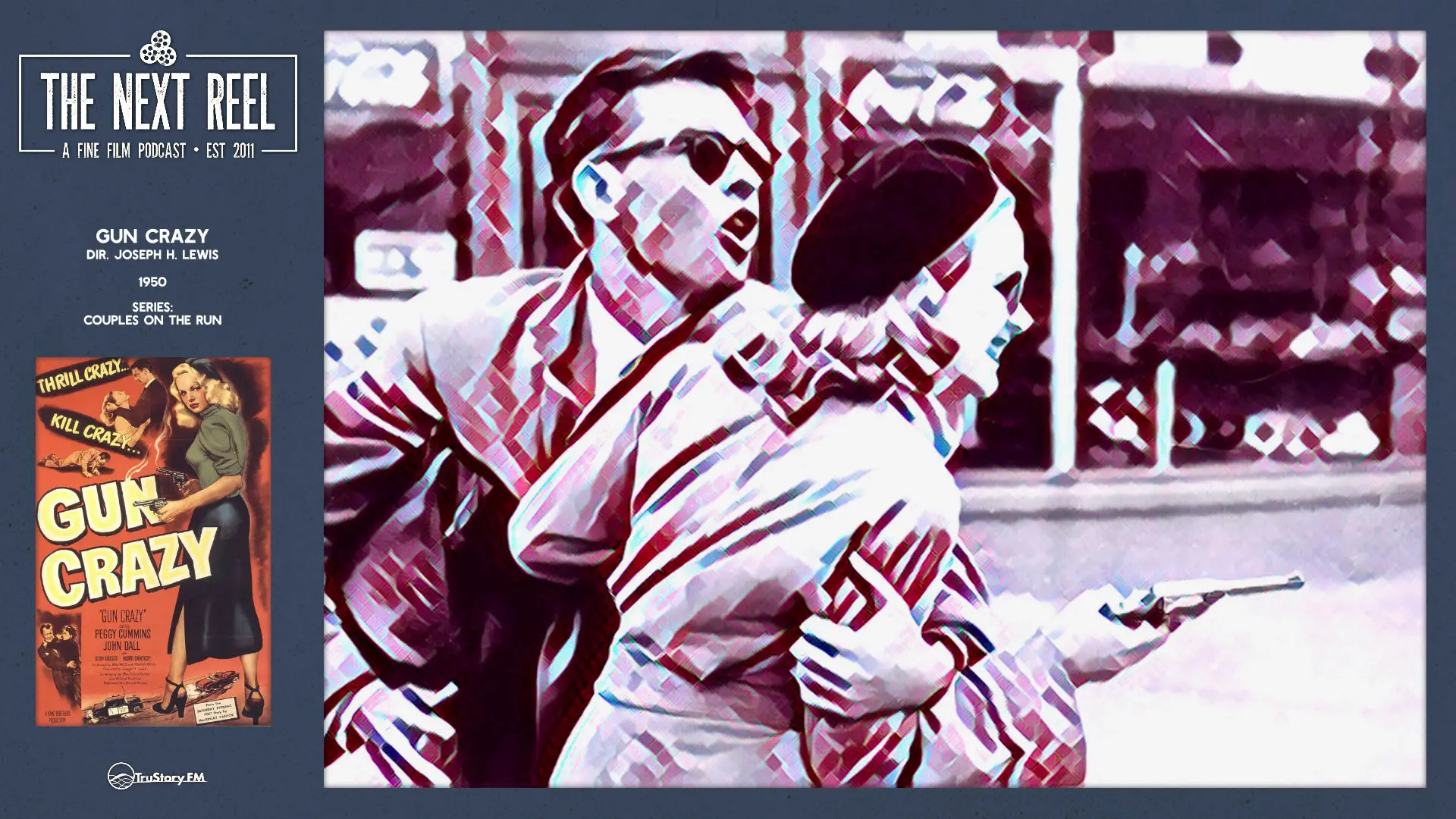
Gun Crazy is over. “I’ve been kicked around all my life, and from now on, I’m gonna start kicking back.”
Andy Nelson:
Hmm.
Pete Wright:
That’s where we are. Andy, I had never seen this movie.
Andy Nelson:
I know. It’s exciting that you finally checked it off your list.
Pete Wright:
Well, it is exciting because I feel like I’ve now seen source material to one of the most cited long take clips in YouTube and awards show history. So that’s good. I’ve got that off my list. I somehow think I expected something more controversial than what I got. Like I thought this was a movie that was so in the bag about guns that it was why suburban moms in the 1980s started going crazy about guns. It turns out you go crazy about guns because you go crazy about guns. But this movie, I thought, was the impetus for more of that, and I had always heard like it was a movie to protect your kids. Protect your kids from Gun Crazy, y’all. I didn’t get that. I didn’t get that movie.
Andy Nelson:
Yeah, it’s interesting. Do you know where that thinking came from with this?
Pete Wright:
No. It’s just ever present.
Andy Nelson:
It just was there. It’s just in the back of your head. What you don’t realize is that your parents would whisper that to you as you were drifting off to sleep.
Pete Wright:
Yes. Yeah.
Andy Nelson:
Gun Crazy.
Pete Wright:
Fear. Fear. Gun Crazy.
Andy Nelson:
Stay away. Stay away from Gun Crazy.
Pete Wright:
Yeah.
Andy Nelson:
Maybe they just really hated it and they were trying to protect you.
Pete Wright:
Totally gaslit. It’s funny because I can’t imagine my dad ever hating this movie, right? Like this movie is practically made for him.
Andy Nelson:
Oh.
Pete Wright:
Oh god, he would have loved it.
Andy Nelson:
Well, this is an interesting one. I did want to chat with you a little bit because, you know, over the course of planning our season, you did include a film noir, like a return to our film noir series with Night and the City. You had a one-off dip back into film noir. And then you picked this film specifically to dip into the Couples on the Run series. And I was really curious about that, because I don’t know if you even knew that this was kind of considered a film noir, or if you just picked it because it was kind of like this Bonnie and Clyde-esque story about these people and their couple on the run dynamic. And so I was curious now, having seen it, knowing that it does really land very squarely in film noir, especially more so than any of the other Couples on the Run films that we’ve talked about — do you feel that the film noir genre gives it a dynamic different than any of the other films that we’ve discussed in our Couples on the Run series?
Pete Wright:
Yeah, I guess I do. No intentionality on my part around the noir because I didn’t — you know, what did I know? Nothing. I knew this movie was supposed to be controversial and it fit very well as sort of an antecedent film in our Couples on the Run series. Isn’t it nice to fill in a hole? I was thrilled that it was noir, mostly because I’m very into — I’m in a run of noir right now. I’m watching Spider-Man: Noir. I just did Brick on the Movie of the Year podcast last night. There’s a lot of language that I feel like is just surfacing right now. I’m in a noir wave. So this was delightful to watch in that regard. I think the tropiness of the characters, the tropiness of our femme fatale, the tropiness of the noir relationships and the helpless sap who’s drawn into this world of crime he would never have done on his own — I think all of that is made so much more melodramatic thanks to the noir treatment. So yeah, I’m in the bag for that stuff.
Andy Nelson:
Yeah, and I think in the scope of our Couples on the Run series, this one does feel the most like a couple that doesn’t necessarily — like they’re almost fated to end up doing this together, even though he tries several times to get out of it. He wants to get out. He doesn’t like this life. He feels uncomfortable living this life of crime, and she kind of keeps pulling him back in. She uses her wiles. She seduces him into this world over and over again to the point where he just really can’t leave. He can’t escape this lifestyle. And I think that’s an interesting element that we have here because in many ways it feels different than the other Couples on the Run, because like you said, had they not run into each other, he would never have ended up in this life of crime. She possibly would have. Maybe she could have convinced Packy to kind of head off and do this sort of thing, but who really knows? And I think that’s what’s interesting — there’s this draw between these two that in many ways, as in the world of film noir, just feels like a dark fate for the two of them.
Pete Wright:
Yeah, I think I lean even harder on that point than you do. I think she would not have ended up in a life of crime, any more than I think he would have. The movie is using guns as a way to give them a meet cute and unlock a part of themselves that was latent all along, and only together are they so combustible that they end up in this sort of horror show of crime that they, for most of the film, enjoy together. That’s the part that I think is fascinating to me. Like, I don’t think that him going away to reform school actually reformed him at all. I think what that did was offer him a four-year reprieve of natural instinct, and he was going to be there anyway. My god, the first time back in town he’s showcasing his collection of weapons to his buddies who are in law enforcement, and they’re all celebrating this case of guns. And I think that’s just a sign that this guy is who he is, and there is one weapon that he didn’t have in his collection that unlocked that part of his personality, and that was her. It was a her-shaped weapon. And I think that’s the interesting sort of combustion of this movie to me — that it’s a lovely little diabolical romance where these two people are inevitable together.
Andy Nelson:
That’s a great point because when you think about it, yeah, he went to reform school, but then — and you didn’t mention he went into the army. And what did he end up doing in the army? He was training soldiers how to use their guns. And he was bored. Like, his favorite thing in the world is guns, but not when that’s what he has to do with it. He was just tired because it’s the humdrum same old same old. And it wasn’t until they go to this carnival and he sees Laurie and she’s shooting. And I gotta say the sexual tension through that whole sequence is just fantastic because the way that Lewis, Joseph H. Lewis, the director, directed these two actors to just always have this sexual draw with each other was palpable. And I just love the way that you feel — the minute he sees her shooting, like he is hard and he is ready, and they are destined to come together.
Pete Wright:
That was a weirdly, overtly sexual way to put it.
Andy Nelson:
It was exactly — do you know what the director said? Let me find this quote.
Pete Wright:
Please. Please tell us.
Andy Nelson:
This was in a 1981 interview with author Danny Peary. Director Joseph H. Lewis described how he instructed lead actors John Dall and Peggy Cummins. “I told John, ‘Your cock’s never been so hard,’ and I told Peggy, ‘You’re a female dog in heat, and you want him, but don’t let him have it in a hurry. Keep him waiting.’ That’s exactly how I talked to them and I turned them loose. I didn’t have to give them more directions.”
Pete Wright:
Oh my god. It was a different era.
Andy Nelson:
But you feel it. Like these two people are just like — they always want to get it on. And I just feel like the gun becomes that connection between the two of them. But what’s interesting, and I think what’s unique about the way the story plays, is we learn early on with a very interesting flashback when he’s a kid, played by the wonderfully young, at the time, Rusty Tamblyn, who of course would become Russ Tamblyn — and I mean, he’s been in so many things, West Side Story and The Haunting. But of course it’s hard not to just instantly think of Twin Peaks with him because he was so great in that show. But we see that he kills a little chick, which is horrifying, right? He shoots a chick and we see a dead chick on the ground. And he resolves at that point to never kill again. And that’s the thing. He loves the guns, but he hates the killing. So we now have this bifurcation because it’s a weapon of destruction. And then we have Laurie, who, as she says, she gets so tense — I can’t remember her words, but she gets so tense and scared of the situation that she’s like the only thing she can do is protect herself by killing these people. Which she ends up doing a number of times through the film. And that kind of creates this rift between the two of them. That’s where the rift is because they both love guns, but there is this draw to the darker side of crime that she ends up being pulled consistently toward, that he doesn’t get pulled toward.
Pete Wright:
I struggled a little bit because of his connection to the guns. I struggled a little bit believing that his relationship with the dead chick was supposed to be more illustrative for him as a character. You know what I mean? Like, that’s something that could be read one of two ways. One, your point — it becomes a lesson that he learns and imprints all his life that he hates killing. The other way is, you know, sometimes kids when they see death for the first time, they freak out. And it doesn’t have anything to do with his relationship to guns and willingness to use them to inflict harm on people. He joins the military, right? Like he teaches people to take life with guns. And so I struggle a little bit connecting the chick experience to anything more than the child awakening to loss of life.
Andy Nelson:
Yeah, it depends on how you read the entire courtroom sequence, right? Because if you read that where his sister comes in and says, Judge, he loves guns, he needs guns, he doesn’t have a father figure, it makes him feel like he’s a man — whatever it all is. His two best friends come in and say the same thing. They talk about that whole thing where he refused to shoot at the mountain lion. So they have all these stories about how this is a guy who has this passion for guns and shooting and being a great shot, but doesn’t have a passion for the actual killing. And he says something when he’s talking about the military about why he wasn’t drawn to it — I can’t remember exactly, but maybe he was trying to allude to the fact that it was that side of it where he had to do the fighting. Maybe I’m misremembering that. But then we see when he’s trying to shoot the police who are behind them chasing them, and he talks about that feeling he has and how he ends up shooting the tire, but what his struggle was was that it would have been so easy to shoot the policeman who was driving the car. Maybe that’s what he learned as a child — that it’s so easy to take a life with a gun, and he’s drawn to it, but he has to push himself away. So maybe it’s just his moral integrity that’s keeping him pushing that down in himself, as he tries to explain to her. And Laurie doesn’t seem to have that issue.
Pete Wright:
No. She has no problems at all. I mean, it does feel like the movie is hinting at, or pushing toward, that he has this ideological worldview. And I wonder if the one act of him taking a life — and I believe this is the only time he takes a life after the chick — is when he shoots her. That had he not been shot, that would have unlocked sort of his final evolution of just being kind of a lovable bad guy and suddenly not having trouble. I mean, if he can shoot his own girlfriend, then would he be able to shoot anything? I kind of wonder if that’s the trajectory of the character. I’m probably reading much more Natural Born Killers into my read of this movie than it deserves — which is effectively this movie, but with a lot more blood.
Andy Nelson:
Yeah, and media.
Pete Wright:
Yeah.
Andy Nelson:
And bad Australian accents. There’s a lot of that too.
Pete Wright:
How dare you. How dare you.
Andy Nelson:
Well, okay. So it’s interesting because in the scope of our story, I think there’s something there when it comes to overcoming that — whatever it is, his fear of killing, his fear of who he’ll become when he kills — he does finally shoot Laurie. But the question at the end is, like, why does he actually do it? I think it’s specifically to stop her from killing the people that he loves, his two friends who are out there along with the police coming to stop all of them. And so that act proves that he has finally gotten over that and has changed — and maybe for the better, but it doesn’t matter because it immediately gets him killed. I think that’s the irony of the story, that he’s finally able to get through this struggle, this internal battle with what the gun represents and killing and everything, and ends up killing the woman that he loves, killing the demon that is driving him into darkness, and ends up getting killed as well because of it. I think that’s fascinating.
Pete Wright:
Yeah, I do. I think that’s the nut of it. And I don’t think the movie is — I mean, it reads weirdly not anti-gun to me. Like the movie seems much more like, get your own emotional health in order and mental health in order because guns are awesome. And as long as your mental health is in order, you should be allowed to do whatever you want with them.
Andy Nelson:
So this is a really good endorsement that the NRA should take up, right?
Pete Wright:
I do think there’s a sponsorship opportunity in this movie.
Andy Nelson:
Like, guns are great when they’re in the hands of somebody who has gone through the proper tests and rigmarole to make sure that they get a license. That shows —
Pete Wright:
I mean, doesn’t this just remind you how archaic that position is? Because effectively that is the position of the NRA and has been for decades, and this movie is sort of the quintessential positioning statement for it. Here’s a kid, he made a mistake with a gun and shot a chick. He’s never gonna do that again. Let’s give him a career with guns.
Andy Nelson:
Yeah, although I don’t think the NRA is saying that you need to have your mental health checked first. I don’t think they care.
Pete Wright:
No, I don’t think they care that much.
Andy Nelson:
I don’t think they care, yeah.
Pete Wright:
Yeah.
Andy Nelson:
I think what’s great about these two characters is Annie is a great counter, and in many ways a great femme fatale for our protagonist, because she never wavers. She’s always kind of true to herself. But what’s interesting is that she drives Bart into this life of crime with her, and they end up just robbing banks and stealing from any store they can get their hands on where they can grab some quick cash. But it becomes clear that she doesn’t want the money, right? For her, it’s the act. And this is what’s great about the movie, and what I love about her as a character — she sells him because he’s easy to dupe on this “let’s just kind of get this last bit of money, like we just need one more and then we can retire” pitch. But we know, and he just can’t see it because he’s the protagonist in the film noir, he can’t see that she will never be satisfied, that she’ll never be able to settle down and retire. That’s just not who she is. She’s gonna have to keep going. And he just goes along with it. That’s his tragic downfall — he cannot see past her flirtatious wiles, the way that she describes things to him. She’s really good. She’s a pitchman.
Pete Wright:
Well, she really is, and that’s how we meet her — as a performer. The rest of the movie after she leaves the circus, the fair, right, is a performance. It’s her performing agency, performing authority over others with this tool that she has shown extraordinary ability with. But it is all a performance, and that’s why she’ll never be satisfied. She can never get enough of being on stage.
Andy Nelson:
Well, geez. One of the first big bank robberies we see, they’re wearing their cowboy costumes.
Pete Wright:
They’re wearing the cowboy costumes, I know. So one of the criticisms of the film from the feminist perspective is that this is, you know, a serpent and Eve story — that the woman is diseased, that she is the one who inflicts the disease of crime on this poor, unwitting Adam. What’s your take on this as a moral reckoning — her position as a moral reckoning in the movie?
Andy Nelson:
I mean, that’s definitely an element of the story there. Although I think you’re gonna be able to say that with a lot of film noir, right? Like it kind of ends up being the nature of what the femme fatale role is.
Pete Wright:
It’s kind of the definition, yeah.
Andy Nelson:
Yeah, right. The deadly female. And in fact, this movie, when it was first released, was called Deadly Is the Female. So it’s pretty much exactly what the story is about. Is it a complaint to register with it? You know, at the time I think it fits right into what they were doing with these darker noir sorts of stories. Through a modernized lens, yeah, you’re definitely going to see that as a perhaps complaint or something that you can register with the film. But at the same time, as we’ve both kind of said, it’s very likely that neither of these two people would have ended up going down this road if they hadn’t had that fated meeting at the carnival.
Pete Wright:
Yeah. That really, really hot meeting at the carnival. That sexy, sexy, hot meeting at the carnival.
Andy Nelson:
Do you like how they’re lighting candles on each other’s heads with those little crowns?
Pete Wright:
Yes. Yeah, that may be the hottest of the heat at the sexy carnival.
Andy Nelson:
Oh yeah. We should talk about that carnival shootout, but first let’s take a quick break. You can find the show on YouTube, and you can join us live when we record. We’ll even take your questions in the post-show chit-chat, and members get the full post-show conversation and always know what to listen to next. Subscribe to The Next Reel on YouTube. The link to this episode is in the show notes. We’ll be right back.
Pete Wright:
All right, so you want to talk about the carnival shootout? You want to talk about the actual shooting of the shootout?
Andy Nelson:
Just the whole — we’ll just call it the meet cute.
Pete Wright:
Yeah, it is, that’s what it is. It’s a total meet cute.
Andy Nelson:
Yeah. I mean, his two friends know it is because they’re like, you know what?
Pete Wright:
Right.
Andy Nelson:
We’ll just meet you at the next stop. Good luck, right?
Pete Wright:
Yeah, I think this is a meet cute between two people who have the same condition. And she got there through her professional sharpshooting instead of teenage burglary. And the fact that she had her own path to guns and that he had his own path to guns is definitional in their successful relationship in this meet cute, because they recognize something in each other. It’s a meet cute — that’s what a meet cute is. It’s adorable in its own way, but the fact that it involved guns doesn’t change the nature of the encounter on film. It’s a love story about two people with a weird pathology about guns, and it just so happens to be a good fit. And I think that works really well. The other piece is the meet cute comes in the form of a competition, and she loses. Did she lose on purpose?
Andy Nelson:
Oh, no. No. She was too pissed when she missed.
Pete Wright:
Yeah, okay. All right. But don’t you think that would have been kind of cute?
Andy Nelson:
To have made it extra cute?
Pete Wright:
Yeah.
Andy Nelson:
Extra meet cute. But it’s interesting because she’s here in this carnival working with Packett. Because he’s holding something over her head — the fact that she killed somebody down in, I think it was St. Louis.
Pete Wright:
Oh, that’s right. Yeah, she’s already got her ticket punched.
Andy Nelson:
Yeah, she’s already a criminal and she is being essentially blackmailed into the circus, which is a fantastic way to get your entry into this life. Sorry, I’m blackmailing you, babe. You gotta come with me and do my gun show.
Pete Wright:
You gotta join the circus.
Andy Nelson:
So that’s how she gets into this. And so she already is holding a very dark past. And then she and Packett see how great he is and pull him along, which I thought was an interesting way to kind of continue that next thread. Let’s bring him on and have him be part of the show.
Pete Wright:
Yeah, and that was weird because — well, the Packett relationship, because he had her kind of over a barrel, was interesting. Who was it who really wanted him to be a part of the gun show? She did. And Packett was like, yeah, I think I got a place for him. But then there’s this weird, very brief dalliance with Packett being a bad guy and lying to him about his relationship with her. And that doesn’t go very far.
Andy Nelson:
That’s one of those moments where I think Packett has an idea as to what the relationship is and why he’s blackmailing her — because he wants her. That’s where that whole story goes. Like, she’s mine, back off. Yeah, you can’t have her.
Pete Wright:
Yeah. But it is a brief aside because it really is just the incident that allows the two of them to just be gun crazy and run away together.
Andy Nelson:
Right, and we see Bart take his gun out and actually shoot not at Packett, but next to Packett, right? Shooting the mirror next to him. So we’re seeing that he’s threatening. Now the interesting element — and I don’t know if this is a problem with the story per se, but it’s definitely an element that seems like something they could have done a little more with — is Packett was keeping her there because he was holding this blackmail over her head. He never uses it. Right? Like once they leave together —
Pete Wright:
As far as we know.
Andy Nelson:
Well, he does later. We see in the paper that he is the one who tells the police that they’re the ones doing all these crimes. So he does finally get back at them. But there’s never a connection to that previous crime. It’s never reported in the paper that she was also found guilty of this other thing. It’s never brought up again. So is it just a fear of Bart and her coming back to get him? I mean, I don’t know why, by this point, if he’s telling the police it was them, why he’d care.
Pete Wright:
Or is it some sort of optimism that she’ll come back one day?
Andy Nelson:
Interesting.
Pete Wright:
You never thought of that, did you? It turns out Packett’s a romantic.
Andy Nelson:
She really does still love me.
Pete Wright:
Yeah. Yeah. So I don’t know. I think it ends up being not a whole lot more than what it really is on screen — it’s an excuse to give them a way to run away from the circus and start their life of crime together. Adorable.
Andy Nelson:
Yeah, I think so.
Pete Wright:
So this movie is Trumbo-shaped. Dalton Trumbo.
Andy Nelson:
Mm-hmm. It is, yes it is.
Pete Wright:
I would love your thoughts on the Trumbo-shapeness of this, because I don’t know that I have enough of an appreciation for it. I know that Trumbo — that the King production team, Frank and Maurice, regularly employed blacklisted writers. Trumbo was a blacklisted writer. We’ve mentioned this before on the show. And the Kings paid whatever the going rate was for talented writers that nobody else would hire. And Trumbo was one of them. And as far as I know from watching Bryan Cranston play Trumbo, he wrote a lot of stuff in a bathtub. I need to know just how much more I need to be appreciating this movie for its Trumbo-shapeness, because I don’t know that I get it.
Andy Nelson:
Well, I don’t know if I can specifically pull out what makes it Trumbo. But the film was based on a short story by MacKinlay Kantor from 1940, originally published in the Saturday Evening Post. He wrote the screenplay, and my understanding is that in the short story, the characters have different names. She disappears from the scene after the first few pages and lures him into a life of crime. There’s the flashback to his childhood, he loses his father. In the story, he ends up arrested at home alone, not with her. But she drew him into the story. And so I guess the story makes him more the gun crazy one in the short story. When Kantor wrote the screenplay, it was largely based on the original short story. And my understanding is that when Trumbo came in, they really pushed to bring in this romance between the two more and kind of have that a bigger part of the story — to bring the doomed love affair to the forefront of all of that. And so that’s the work that Trumbo really did on this. And again, he wasn’t credited in this. It was Millard Kaufman who was credited. Millard Kaufman was a screenwriter who had written things like Bad Day at Black Rock and created Mr. Magoo. And he was one of these people who was like, yeah, you can use my name. He was totally okay lending his name to the script for his buddy Dalton Trumbo. And then I think it was him — when was it that he said that the WGA should recognize that Trumbo actually worked on this? I can’t remember, but eventually —
Pete Wright:
Like ’92, yeah.
Andy Nelson:
Yeah, it was right in the nineties. It was way down the line that came out. So that’s essentially the story.
Pete Wright:
This is one of those things that — I’m reading about the film this morning, and it seems like a lot of the critics who are in big favor of this movie now, 75 years later, are saying that the Trumbo stamp is that this is an indictment of the carceral state, it’s saying things about gun culture that I’m not sure it’s saying from the perspective of him as a political martyr. The fact that he’s a political martyr is biographically interesting, but critically from the perspective of the film, pretty minor. I think this movie is a solid meet cute doomed relationship, lovers on the run crime film, and I don’t see a whole lot of what Trumbo did to this story to elevate it to something that should be transformational beyond its sort of B movie noir roots.
Andy Nelson:
Yeah, I don’t know if I can dig much out on that either. I mean, I don’t know enough of Dalton Trumbo as the writer, especially when he was credited as Dalton Trumbo, and in the period when he was using pseudonyms all the way up to kind of that Spartacus period when Kirk Douglas refused to take his name off the script and essentially helped break the blacklist. I don’t know enough about Trumbo and what he was doing to really get a sense as to how much of this was intentional. Was he trying to weave different political messages into this? Or was it largely just the Kings, the producers of the film, telling him, this is the story we want — we want a doomed love affair, build that in?
Pete Wright:
I think the only thing I can compare it to at this point is the other Trumbo film that we’ve talked about, which was Johnny Got His Gun. And that was much more of a sort of austere anti-war film. It had much more of a statement than I think this movie ever really does.
Andy Nelson:
Yeah, I have to think that as a blacklisted writer working in the industry secretly under a pseudonym, he’s probably just doing the work to get money to keep his family going. Like, I don’t necessarily think he’s trying to sneak in political messages in every single project he was doing. He’s getting hired by these guys to write a script, not getting paid his usual wages. He’s getting paid just kind of day wages that the Kings would pay people, and taking the job and doing the work. That’s how I read it, again, without knowing enough of his specific history.
Pete Wright:
Okay. I think we’re in violent agreement on that point.
Andy Nelson:
Yeah. And I think it would be something we’d probably need to research a little more to actually have more to say.
Pete Wright:
Well, and certainly see more Trumbo films. My catalog of Trumbo films is short and sweet, right? We’re just scraping the surface with these films. There’s certainly more to watch. Maybe it merits a series. But based on this movie, I think you nailed it. I think this movie is overly exaggerated as a Trumbo think piece, and it’s not that for me.
Andy Nelson:
Yeah. But I still think it works. I think it plays well. I think there are interesting things to say within the film. Yeah, I mean I guess the question is, does it feel like it’s trying to poke in some sort of political direction because of Trumbo? I don’t know if I think so either.
Pete Wright:
All right, so where do we think of Joe Lewis?
Andy Nelson:
I really like how Joseph Lewis directs the film. I think he is doing some fun things with the camera. I love the start of the film — kind of the moody, rainy street with young Bart breaking the window and stealing the gun. I love Laurie’s intro coming in and shooting her gun. I absolutely love the time spent in the car, and that’s not something you always get in movies that are spent in cars a lot, but he comes up with some really interesting shots to capture the tension, especially as we build toward the end. In their final escape, there are some fantastic shots like low under the driver, essentially shooting through the steering wheel, capturing just these really tight shots of them really kind of trapped inside these spaces. And I just love how he crafts all of that. I think the meat packing plant robbery plays really well. It is always kind of a thrill to see how all of the different pieces work to make that happen, building to the moments when Laurie kills several people. And again, the way that he constructed the oner when they have the bank heist all shot from the backseat of the car, redesigning the car to have kind of a sliding seat, a saddle in it to move the camera forward and backward.
Pete Wright:
Literally an English saddle on a greased two-by-eight or something, two-by-six. Like that’s awesome.
Andy Nelson:
Right.
Pete Wright:
More greasy wood in cars, I say.
Andy Nelson:
Like all of these things. I just think that — and again, like that direction that I read that he gave to the actors. I think this was a director who maybe at the time was not getting his due as far as what he was putting into the films. But I think over time people recognized that this was a director who had a confident sense of how to craft a story that was simple in its construction, but well told and moved things along at a great pace. Like, this film just feels breakneck and it just never slows down.
Pete Wright:
Oh yeah.
Andy Nelson:
I just think it’s fantastic.
Pete Wright:
Well, and it culminates. A lot of people talk about the oner in the car, which is great. It’s, you know, three and a half minutes, whatever, and it’s awesome. Lots of improv between our actors, and apparently nobody was told that they were making a bank robbery movie, and so that’s all very exciting. But that scene sort of pales visually in comparison to the climactic scene in the fog, which I was blown away by. It just looks so good and tells such a story of such depth as these characters are dealing with, you know, the grief at the loss of their friendships and the chase and the oh my god, what have we done? He’s sitting here thinking, what am I doing with this woman who’s about to kill my friends? And the ultimate noir grief that comes from our principal characters both dying in a heartbeat — it’s really terrific filmmaking. It is absolutely punching above its class.
Andy Nelson:
That whole sequence, the escape into Madera National Park — which, you know, again, plays as a space from his childhood. He’s returning to his childhood again, right? He’s going back to where he came from, a place that he knows very well. His friends also know it very well, and they try to make a run for it. I think it’s fascinating how much she is breaking down by this point. Like, she’s constantly falling. From the time in the meat packing plant, she is stumbling a lot. And I think that is fascinating direction on Lewis’s part — to kind of have her at this point where she is now unable to keep up with this energy. She falls in the creek as they’re running through it. She stumbles through the grass. She’s constantly falling and tripping, and she can’t sustain anymore. And I think that’s an interesting breakdown of her as they get to that final hideout in the clump of cattails out in the middle of that swampy bog that they end up in. And I think it plays so beautifully. And as you said, when they come to and it’s like the morning and it’s just that fog over everything — the way that I think of it is just like this weird liminal space that they’re in. It doesn’t even feel like they’re in this natural world anymore. It feels like they’ve left. I mean, production-wise, it feels very much like a studio suddenly, as opposed to the forest.
Pete Wright:
Yes, so we’ll put that aside, because you’re right. Yeah.
Andy Nelson:
But it feels like they’ve entered purgatory, like this judgment space. And I just think that’s a fascinating way to build to that finale. It’s magical the way the film ends.
Pete Wright:
I totally agree. I think that’s a real hit. And so there are these moments in this movie that, from the perspective of just raw filmmaking and taste on screen, I think highlight Lewis’s eye and Russell Harlan — certainly a cinematographer who went on to do other absolutely beautifully crafted and lensed films, To Kill a Mockingbird and Red River and Hatari! Like, the sort of duo and what he does to bring Lewis’s vision to screen is exemplary. And these sequences elevate what is kind of a simple story to something that makes it a much better film. Those moments I don’t find terribly consistent — this is a movie with just really strong beats and strong scenes, and sometimes it moves back into sort of pedestrian proscenium lensing. But overall, the use of depth of field on these scenes is really cool. And using the frame, I love that you pointed out using the frame as a sort of visual metaphor for their entrapment — that is incredibly strong in this movie.
Andy Nelson:
Especially because we do spend so much time in the car. Like, once they’ve met, that’s the bulk of where we have their conversations, right?
Pete Wright:
Yeah. They’re living in the car.
Andy Nelson:
Yeah, he says, let’s get married in the car. Like, it’s always the car. And I think that’s a fascinating element of this — that so much of it is in a car, and I think they’re doing a great job of making it look interesting. So yeah, I’m all for the production on this. I think it’s just beautifully crafted and designed. I think it fits this world going from a space of the two of them cross-country on this mad lovers’ crime spree, building to this foggy no man’s land where the two of them have this final confrontation. And just a further proof that it’s this destructive obsession that they are both pulled by and they can’t escape. And it’s very fated. Everything about the whole thing is just so fated. I just love that. And also, their entire plan after the meat packing plant is we’re gonna go our separate ways for a good couple of months or whatever. And that way we’ll have a better chance of escape because they’re not looking for single people. They’re looking for a couple. And they could have probably done that, but they can’t, right?
Pete Wright:
Because they’re inevitable.
Andy Nelson:
Because they’re inevitable. It’s like they’ve got a giant, invisible rubber band attached to the two of them. They start driving away, they make it a couple hundred yards from each other, and they both stop and go back to meet in the middle. He abandons his car in the middle of the road, and then they just take off together. I think that says so much — that they just cannot be apart once they’ve come together. It’s the permanent path to destruction that they’re on.
Pete Wright:
It is also a delightful reminder of how far we’ve come in terms of finding criminals and tracing them. Like, my kingdom for an iPhone in this movie. Cameras, you know.
Andy Nelson:
Yeah, all that, all those things. Right, right.
Pete Wright:
Yeah.
Andy Nelson:
What do you think of Peggy Cummins and John Dall as our two leads?
Pete Wright:
Okay. I’m glad — this was my next thing. I think Peggy Cummins is great. I love how Peggy Cummins is a diminutive person. She’s a small person and she plays about a hundred and fifty feet tall. I think she’s really, really great. The challenge I have is not in John Dall as a person or as an actor, but as his casting as Bart. I don’t know that I have landed on whether I believe him in this film. I don’t know that he has that sort of — and maybe this is the point. So I’m just gonna say it all out loud and I may begin contradicting myself. I don’t believe that he has that sort of leading man charisma that brings me to believe Annie’s affection toward him right away. Let’s just go back to the hot, super sexy shootout under the tent. And maybe that’s the point. The point is that she is so attracted to his great big gun that it doesn’t matter that he’s kind of a derpy guy. But I struggle with seeing him as anything more than a derpy guy, and I never quite land on — is this the guy? Is this Clyde in my Bonnie and Clyde? Does he have that sort of strength to be a part of this couple as a man of action? I don’t know, what do you think?
Andy Nelson:
Well, I think part of it fits the story of this is a guy who maybe was never cut out for the life of crime, even if he is cut out for a life holding a gun, right? And so that could potentially be what they were going for. I think it’s interesting because there’s a contemporary film review of the time that basically said both of the actors look more like fugitives from a 4-H Club than from the law. Which I think is funny, but I also think it speaks to the fact that perhaps at the time, people were expecting criminals to look more like criminals and beautiful people to not be criminals. And I think that feels very kind of cute and dated, you know, that beautiful people can’t also be criminals. But I think there’s an interesting element to the fact that these two people, for me, end up working really well in their roles. I buy John Dall playing this man who has this insatiable draw to the gun — to shooting it, to being a great shot and all of that. Does he fit the life of crime? I don’t think that’s something he ever fit, but I think he adopts it because he’s drawn to her because she’s also so good with a gun and can’t let go of that. So I guess I buy him because of that.
Pete Wright:
Yeah, I sort of contradict myself around every corner because I think you’re right. I think what I’m looking for is like a Jimmy Cagney kind of screen presence. But I don’t think I ever really even got that. Oh, I so — Double Indemnity, right? Like, there’s a guy in insurance who has no right being as charismatic as he is. And I guess I kind of wanted that. And what I got was derpy guy.
Andy Nelson:
That’s funny. It’s really funny.
Pete Wright:
And it’s amazing to me that I’m comparing Fred MacMurray to that because, you know, Fred MacMurray —
Andy Nelson:
My Three Sons, yeah.
Pete Wright:
Being My Three Sons’ dad — he has no right being charismatic on screen. And yet there we are.
Andy Nelson:
Right. It’s right there. That’s very funny. Does it play differently for you because of their relationships in the story? Because Bart is painted as a solid hometown guy. I mean, he’s had this kind of struggling childhood. Their parents died, his sister raised him. The judge refuses to let his sister and her new husband adopt him and instead sends him off to reform school. But he’s got two best friends who seem like great guys. They all reconnect when he comes back to town. One’s a new sheriff, one is the head of the newspaper. Like, everyone seems great. His sister has three kids. There is this sense of small town Americana that Bart is kind of a part of. It feels like this is his world. Does that affect how you read anything with him because he ends up going down this other path? Does that feel like more the derpy guy who doesn’t end up fitting?
Pete Wright:
Yeah, I mean, maybe that’s the derpy guy that a lot of derpy guys grew into as old men — derpy guys who just, for the sake of a butterfly flapping its wings in New York, didn’t end up going down a life of crime because they had, you know, fifty guns in their houses. There is a part of this movie where, in another universe, this movie is a guy who’s a fanatic about guns and just stays on the gun show circuit, never commits any crime, and ends up being something like, you know, the Truman Show for gun lovers. It’s just a guy who’s always on stage and does a great thing and never commits crime, and has great family relationships and friendships that bolster him and prevent him from making those kinds of decisions that would lead him down that road. And by this exact same argument, Annie never stops in that fair city and never gets off stage because she’s just good at guns. I don’t know that it plays any differently. I think it just really cements the fact that in this universe, in this movie, it’s the combustibility of them together that he gets none of when he’s just in his hometown alone.
Andy Nelson:
Yeah.
Pete Wright:
That part’s really good.
Andy Nelson:
Here’s a question for you. I’m curious about your read on a sequence in the film. They go back to Bart’s older sister, Ruby, right? They’re on the run. There’s nowhere else to go. They go into Ruby’s house unannounced and essentially take them hostage and say, we need to hide out here, so you’re going to let us for a few days. She has to tell the neighbor’s kids that her kids are sick so they can’t come play — all the shades are drawn, all this. When his two friends realize what’s going on and come over and talk to them, Bart and Laurie realize they have to run. And so Bart talks to his friends and tells Laurie to get in the car. He goes outside to get in the car with Laurie. She is holding the baby as a hostage and says they’re never gonna shoot us if we have a baby. He refuses that and takes the baby, puts it in the outside crib. He’s like, where’s my sister? She’s like, oh, I locked them in the garage.
Pete Wright:
We’re gonna leave the baby in the outside crib.
Andy Nelson:
Do you think that Ruby is alive? What do you think happened with Ruby and the other two kids? I’m just curious because Ruby’s a mother who lets Laurie take the baby. Like, how dark do you think Laurie is? Do you think she just locked them in the garage? We don’t hear her pounding. There’s no sign of a panicked mother freaking out because these crazy people are about to steal her child.
Pete Wright:
Andy, what’s wrong with you, man?
Andy Nelson:
I’m just saying, what’s going on? Like, that’s a dark part of the story.
Pete Wright:
Who made it dark? You made it dark. I never imagined that, and now it’s all I can think about. You think she killed the family and took the baby, and now there’s a dead family in the garage and a baby in an outside crib? That’s horrible. Why would you plant that in my head?
Andy Nelson:
It’s a dark situation going on at the Flagler’s house.
Pete Wright:
All right. I don’t actually think it got that dark. I really do think that if it were that dark, I think they would have given us more visual clues that that’s what happened.
Andy Nelson:
Production code, man. I don’t know if they can.
Pete Wright:
Production code. I just think they found a way.
Andy Nelson:
I locked them in the garage.
Pete Wright:
Is that — yeah. Maybe that was actually just needed to be codified in the production code. No locking in the garage. Or, we know that’s what we say about bodies.
Andy Nelson:
That’s when we slit their throats. Okay. Alright, it’s just me. Just sick little me. Well, you know what, I think that’s probably about it. Should we keep moving on forward?
Pete Wright:
Let’s leave it on that note. Good. Well done.
Andy Nelson:
On that happy note.
Pete Wright:
Everybody be thinking about the dead family in the outside crib.
Andy Nelson:
That’s right, I know.
Pete Wright:
And now a break.
Andy Nelson:
That’s right. Let’s move into the back half. We’ll take a quick break.
Pete Wright:
The Next Reel is a production of TruStory FM. Engineering by Andy Nelson, music by Tzabutan, The North, Oriol Novella, and Eli Catlin. Andy usually finds all the stats for the awards and numbers at The-Numbers.com, BoxOfficeMojo.com, IMDb.com, and Wikipedia.org. Find the show and the full archive at TruStory.fm. You can follow us from there too, plus you can find out how to become a member and go further with every episode. Check out our merch store at TheNextReel.com/merch, and if your app allows ratings and reviews, please consider doing that for our show. Alright, it’s award season, Andy. Does Trumbo in a bathtub get any nod ever?
Andy Nelson:
This was definitely not the sort of film that was gonna get anything at the time of its release. However, with time and recognition that this does stand out as one of the stronger film noirs of its time — 1998, certainly, it was placed on the National Film Registry as a film that is culturally and historically significant. So that is, I guess, a strong recognition that there is more to this film than just a bunch of people shooting guns and killing people in garages.
Pete Wright:
Okay. Did you find any information on the budget? How did it do at the box office?
Andy Nelson:
Well, for Lewis’s crime noir film, he had 30 days and a budget of $400,000, which is about $5.2 million in today’s dollars. The movie opened January 20th, 1950, under the title Deadly Is the Female, and then over a few months they realized we need to change it. Let’s call it Gun Crazy. And then it started releasing as Gun Crazy. But unfortunately, that’s about as much as I have. I have no idea what it opened opposite. I have no idea how well it did, though I should say it didn’t do, because one of the claims of notoriety is that in the entire body of work produced by the King Brothers, they say this was only one of two of their films that actually lost money. So that’s all I could find. Still, considering that this is treated as a bit of a cult film these days and has been more prominently recognized, I would say it’s possible that it flopped and then built an audience and ended up finding a way to make a little bit of money. But again, that’s sheer speculation on my part.
Pete Wright:
Well, here’s something we don’t have to speculate on. It’s a return to one of our favorite websites on the internet. What better case to visit the Internet Movie Firearms Database than a movie called Gun Crazy? Andy, do you know how many guns were used in this movie? This is a quiz. Did you count?
Andy Nelson:
I didn’t count. I think that she is using — wasn’t she using an English gun, and he was using — or no. He had the case of English guns, his English dueling pistols that we see at the beginning.
Pete Wright:
That’s one.
Andy Nelson:
I know she has one gun and then he has one gun but changes to another gun, I think. But that’s all I remember.
Pete Wright:
There are a couple of guns in there, yes.
Andy Nelson:
Yeah, that’s all I remember.
Pete Wright:
Yes? Okay. So the police were using the Thompson M1928, which was a Tommy gun. So that was awesome. The English dueling pistols — we see those in his case twice, once when he returns to his friends, and the second time when he’s cleaning them in the hotel room. The two of them are using the Colt Official Police, which is called Colt Official Police during their crime spree. I guess Bart and the police use the Smith and Wesson Model 10 at one point. And then they both use the Colt Police Positive — she uses it in nickel with a pearl handle, and he uses a standard black. And then of course we have the Remington .22 caliber pump action rifle, the Colt Detective Special snub nose, and Winchester Model 1912 shotgun, which is in the window of the hardware store that he breaks in for the Colt 1917 pistol. That’s it. There were nine guns in Gun Crazy. That, it turns out, is the line. In order to be considered fully gun crazy, you need nine guns.
Andy Nelson:
That’s the line.
Pete Wright:
Yeah.
Andy Nelson:
Okay, good to know. Good to know what the line is.
Pete Wright:
Yep. That’s it. I’m glad we talked about it. This is a movie that was not as overtly controversial as I expected it to be, because my parents were gaslighting me in my dreams. It was a solid movie with some outstanding visual elements. I’m glad we talked about it and got it on the list.
Andy Nelson:
Yeah, I absolutely love this film. I think this is a great example of what film noir really represents. You’ve got the man who’s kind of drawn to this woman who’s a great epitome of the femme fatale. And when they are drawn together, neither of them can escape, and it’s a dark destiny that they have. So yeah, great movie. Glad we had a chance to add it to the conversation. All right, well, that is it for our conversation about Gun Crazy. Next week, we close out Season 15 with a return to our Horror Debuts series, looking at the Philippou Brothers’ 2022 Australian horror film Talk to Me — a debut that announced two filmmakers with a genuinely unnerving sensibility built around a deceptively simple premise. What if you could contact the dead, and what if it felt incredible? It is unsettling in all the right ways. All right, let’s do our ratings.
Pete Wright:
Letterboxd.com/thenextreel, Andy — that’s where you can find our HQ page and all the reviews of the films that we talk about across the Next Reel family of film shows. What are you gonna do for this one?
Andy Nelson:
This is a film that I just — since I rewatched this last year and then just rewatching again, I’m just like, this film is just so strong. I really love it. 4.5 and Heart is where I sit.
Pete Wright:
Wow. Well, that puts me in a weird bind. Because I feel like your enthusiasm buoys mine. I came in with a three and a heart, but maybe I should be a four? Four just seems a little high for me for this movie.
Andy Nelson:
Okay.
Pete Wright:
What am I gonna do? Besides, if I go a three, then it rounds up to 3.75, and then it ends up being a four anyway, and then I feel like both of our needs are met. I’m gonna go three stars and a heart. It’s a good movie. It didn’t change the way I live my life day to day.
Andy Nelson:
Okay, okay. Well, I’m glad it’s not setting you on a path to go out and go gun crazy yourself.
Pete Wright:
Or garage crazy, for all we know.
Andy Nelson:
Or garage crazy. Right. Well, as Pete said, that averages out to 3.75 and a heart, which rounds up to four stars and a heart. That will be over on our account on Letterboxd, which you can find at @thenextreel. You can find me there at @sodacreekfilm and Pete at @petewright. So what did you think about Gun Crazy? We would love to hear your thoughts. Hop into the Show Talk channel over in our Discord community where we will be talking about the movie this week.
Pete Wright:
When the movie ends —
Andy Nelson:
Our conversation begins.
Pete Wright:
Letterboxd giveth, Andrew.
Andy Nelson:
As Letterboxd always doeth.
Pete Wright:
What was your strategy this week?
Andy Nelson:
I just was looking for one that I thought, okay, yeah, I could read that one. I’m okay with that one.
Pete Wright:
So the bar was pretty low.
Andy Nelson:
The bar was pretty low. Yeah, I guess so.
Pete Wright:
Okay, go ahead, bring it.
Andy Nelson:
Well, I wanna know — like, how did you play with yours? Where did you —
Pete Wright:
It’s rare that I go for — usually I go by activity. I want to see what the cool kids are writing. But this time I went low. I went one star and ended up with an ideological complaint.
Andy Nelson:
Oh, interesting.
Pete Wright:
Would you like to hear my one star first? Is that what you’re saying?
Andy Nelson:
Yeah, because I lost my —
Pete Wright:
Okay. Liana gives it one star and says, “Ugh, another noir fetishizing firearms. Hard pass. This film thinks it’s edgy, but it’s just another cog in the problematic machine. The leads have chemistry, but at what cost? The title says it all — gun obsession isn’t crazy, it’s a societal disease. Lewis tries to critique but ends up glamorizing. Maybe groundbreaking in ’50, but in 2024? Yawn. One star for unintentional camp value. F guns and f this movie.” Now, I read that because its partner review from ellaspanger45 immediately below that one — one star — says: “Needs more guns.”
Andy Nelson:
Even in here, people just can’t agree.
Pete Wright:
Right. So that’s where we are, society.
Andy Nelson:
Wow. Wow. Not enough guns. Too many guns. My gosh.
Pete Wright:
All right, did you find yours?
Andy Nelson:
I found mine. Four stars and a heart by sarah, who’s taking the approach of looking at it through different eyes. “My favorite romantic comedy! Top five meet-cute scenes of all time!”
Pete Wright:
That’s good.
Andy Nelson:
Little genre twist for ya.
Pete Wright:
Yeah, it’s important to do that sometimes. This is one of those where I’d like to see it re-edited with the meet cute trailer treatment.
Andy Nelson:
Right.
Pete Wright:
He found her at a circus. All right. Thanks, Letterboxd.