*This transcript is produced using transcription software and reviewed for quality. Despite our best efforts, some passages may be incomplete or contain errors due to audio quality or software limitations.*
Andy Nelson:
He’s an interesting guy.
Pete Wright:
I know you think that. I know you think you think that.
Andy Nelson:
Oh, I do think that.
Pete Wright:
But then you see the one with John Lithgow.
Andy Nelson:
We’ll skip that one.
Pete Wright:
No. Gonna say that that’s triumphant I will never
Andy Nelson:
say that. I will say that.
Pete Wright:
You and I both know that’s totally bogus, no matter how often you say it. No, it’s terrible.
Andy Nelson:
That’s
Pete Wright:
garbage. It torpedoes the catalog. That’s the problem.
Andy Nelson:
That’s we’re not gonna
Pete Wright:
let you Wait. What is I don’t even know what it is. Splint split personnel no. Split Raising Raising Cain.
Andy Nelson:
Yeah. Yes. Yeah. Terrible. We’ve we’ve discussed how bad that is on the show before.
Pete Wright:
I don’t think it can be discussed too much. Can I tell you what I have done? I had a couple of catch ups. First of all, you know what I saw today, which I totally missed in the whirlwind of vacation? I saw Pacific Rim.
Andy Nelson:
Hey. Wow. Welcome to Right. Welcome to the summer. Live in the now.
That’s right.
Pete Wright:
You know what? I I had a good time at that movie. Okay. I I felt like you know what? Can I tell you what I felt?
Here’s a brief review. I have two movies with brief reviews. Reviews. Pacific Rim was a story that or was a movie that told the story of a part of the timeline that I think should have been a sequel
Andy Nelson:
Okay.
Pete Wright:
And seen. You know what I mean? Like, there was there was a lot of exposition in the beginning, like, a ton of exposition, and I don’t think it really helps because the most interesting stuff I was most interested in was the the discovery and the building of these things. They just kind of and action. I felt like there was a lot of I could have used a more gentle entree into the universe.
Andy Nelson:
So Yeah.
Pete Wright:
But it was really fun for what it was. I had a a great time watching giant robot boxing robot monster boxing. And I kinda felt bad for the monsters. They just
Andy Nelson:
Yeah. They well, they I loved the look of the monster.
Pete Wright:
Oh, yeah. No. Very you know, that’s what it it was like just enough Pan’s Labyrinth, and I was okay with it. Just enough Guillermo.
Andy Nelson:
That’s it definitely was. It definitely was.
Pete Wright:
Yeah.
Andy Nelson:
You know, I had fun with it, but Yeah. I I thought what’s his name? Charlie Hunnam was completely forgettable. Shouldn’t have been in there. Yeah.
Know. And I don’t know. It’s fun, but nothing to write home about for me.
Pete Wright:
Yes. Alright. And so we’ll move on to Oblivion. Believe it or not, I hadn’t seen that one either.
Andy Nelson:
Wow. You are catching up on things.
Pete Wright:
I’m totally caught up. And I quite liked it. It made me wanna go see Moon again.
Andy Nelson:
Oh, that’s right.
Pete Wright:
You don’t have any other points? Talk about a movie that has exposition in it. Man, wow. Two two ten minute doses of exposition. One in the beginning, one in the middle.
Somehow, I think it kinda works. Like, I had a I I really enjoyed I enjoyed I
Andy Nelson:
didn’t have really too many problems with it. I thought it was a fun movie.
Pete Wright:
Yeah. No. It’s good. Yeah. Yeah.
Okay. That’s it.
Andy Nelson:
What do you
Pete Wright:
do you have any follow-up?
Andy Nelson:
Well, I I saw some fun I don’t know if fun’s the right word, but some some good little indie films. You know, I some friends and I, we went and saw Still Mine, which is the new film that’s slowly being released across the country. I it kind of went all indie, you know, art house sort of this week. It’s a if you’re if you saw Amor and you need more stories about old people romance, go see Still Mine. But but the I don’t know if that sells it really well.
But
Pete Wright:
God, we that’s a series. Old people romance movies.
Andy Nelson:
That’s right. But James Cromwell is in it. He’s the lead. And Geneviève Bujold is his wife. And they’re great I mean, great screen chemistry.
I really enjoyed them. And it’s I guess it’s based on a true story about this this old guy who really wanted to kind of stick it to well, he wasn’t really setting out to stick it to the the government. He was trying to build a house on his own property, and they started coming after him for not, you know, not having his wood inspected and not this and that. And he’s trying to build his house so that it’s ready by the time his wife gets out of the hospital and just going through all the the rigmarole of battling with the the government as far as all of the paperwork. I there’s a lot of applause in the theater because people are just so pissed off at, you know, the way this government guy was reacting and and seeing James Cromwell stick it to him was was pretty great.
So we saw that, And then we saw a nice little foreign film called A Hijacking, which is another film about some Somali pirates hijacking a boat. In this case, a Danish boat.
Pete Wright:
You go a cinematic double dipper.
Andy Nelson:
I tell you. I know. Seeing that and then it got me all amped up for seeing the
Pete Wright:
Captain Hanks.
Andy Nelson:
Paul Green Grass Tom Hanks movie. Yeah. So they did not have the giant hoses on the side of their little boat.
Pete Wright:
Oh, the fire hoses.
Andy Nelson:
Yeah. The giant hoses.
Pete Wright:
Well, that probably made that probably made the difference.
Andy Nelson:
Probably. They had a little a little fishing vessel compared to Tom Hanks’ boat. So
Pete Wright:
Well, you know, budgets.
Andy Nelson:
I don’t even know what to say. It’s called Bad Milo!, and it’s an exclamation point on the end. So Bad Milo!.
Pete Wright:
And you should know that the trailer we posted on the website at thenextreel.com is the red band trailer for Bad Milo!.
Andy Nelson:
Yes. It is the red band. You can see the non red band over on the iTunes movie trailer page, but the red band is up on our page. Embrace your inner demon is the tagline for this film. This film From
Pete Wright:
from the colon up. That’s right. I I went there. You you did. It
Andy Nelson:
looks like it’s produced by the the Duplass brothers who are kind of have been storming the indie scene in the last the last, I don’t know, few years or so. They’ve been Mark and Jay Dupless have been kind of everywhere, it seems, in all the indie circles. This film is a horror comedy about a guy who learns that, you know, he’s having these awful digestive problems, and he learns that these problems are caused by a demon living in his intestines. And this demon starts coming out and and getting back at the people who torment him. And it just looks it looks like a wacky, crazy version, like this monster almost looks like ET in some freaky way.
It’s just the weirdest looking movie, and it just had me laughing. And I I’m quite looking forward to it. Patrick Warburton is in it, Peter Stormare, Steven Root, and Ken Marino is the is the lead.
Pete Wright:
It’s it’s like Office Space if there were a demon.
Andy Nelson:
Yes. It’s in that vein. Yeah.
Pete Wright:
The fact that Stephen Root is in it makes it so much better.
Andy Nelson:
Yeah. It’s like some backwoods hippie or something. Don’t know.
Pete Wright:
I was skeptical about this one. Not like last week’s EGA. I was skeptical about this one, and you you came through. I think it looks I think it looks funny. I’m looking forward to it.
Andy Nelson:
It does. It it’s it’s you can start streaming it August 29 on iTunes, and it’s gonna open theaters October 4.
Pete Wright:
Wow. Love that. Mhmm. Well, okay. So mine I’m really, really excited about this.
I remember when I was when I don’t know. When do you read when did you read this short story? Never. You’ve never what?
Andy Nelson:
I never I don’t think I ever have.
Pete Wright:
It’s wicked short. It’s very easy.
Andy Nelson:
Yeah. Maybe I did. I I honestly don’t remember. Alright. I didn’t even remember it was based on a short story.
Pete Wright:
The short story by James Thurber is it’s fantastic about this the the story, The Secret Life of Walter Mitty is a fantastic story about this this man who has these alternate fantasies, fantasy worlds in his head, and so whatever context he enters, he’s suddenly in this alternate universe. I remember when I was in, I think I must have been in, don’t know, eighth, ninth grade when we read it, and I came in and I read it to my dad who was sitting on the couch. He had his arm back over the couch, he was, I don’t know, he was kind of mad at something, I don’t know. So I read this story, I wasn’t really paying attention to context, I’ll never forget, he looks over at me and he says, Life. That’s pretty much it.
Andy Nelson:
Thanks, dad. Yeah.
Pete Wright:
Yeah. Wisdom from Pete’s dad.
Andy Nelson:
That’s awesome. That
Pete Wright:
is awesome. In 1947, they they made this thing a movie, it was it it wasn’t filled with that that sort of malaise that I think you you get when you’re, sort of a middle aged man kind of dealing with that piece of life. And it was a Danny Kaye kind of a with lots of singing. Yeah. And pleasantries and funny, and it it just didn’t really satisfy on the level of of communicating what the short story was.
And so that is why I am so excited to post on the blog, my trailer of the week, The Secret Life of Walter Mitty, coming out on Christmas Day, 12/25/2013, directed by and starring Ben Stiller as Walter Mitty. And it the trailer is beautiful.
Andy Nelson:
Yeah. It really is
Pete Wright:
really stunning what they appear to have done, taking this man and making him a hero of his own mind. Find it really I’ve watched it a number of times, I think it’s just it’s really mesmerizing.
Andy Nelson:
I guess there’s a couple versions of the trailer.
Pete Wright:
Yeah, that’s what I heard. Didn’t Steve had written it? What did he say? That the one he saw was there was something about the car at the end. It was the blue car versus the red car.
Andy Nelson:
Right. You’ve got the two cars, the blue or red. And I can’t remember what the other version that he said was.
Pete Wright:
Yeah. Yeah. I think that was the only difference that he said. There was a funny tweak at the end there. Other let’s see.
What else has he this is a movie that was written by Steve Conrad who has done he did The Pursuit of Happiness with Will Smith and Son. He also did The Weatherman with Nicolas Cage and wrestling Ernest Hemingway. That was with Richard Harris and Shirley MacLean and Robert Duvall.
Andy Nelson:
I loved that movie.
Pete Wright:
Right? I am really looking forward to this movie. I feel like it’s it’s got a good pedigree. And I I’m a big fan of Ben Stiller. I think he’s great.
So
Andy Nelson:
Yeah. He’s when has he directed last? I mean, I don’t it’s kind of few and far between, isn’t it?
Pete Wright:
Yeah. Let’s see. His last Looks like Tropic Thunder. Which was boldly funny.
Andy Nelson:
Yeah. I really enjoyed Tropic Thunder.
Pete Wright:
Let’s see.
Andy Nelson:
And then Zoolander.
Pete Wright:
Zoolander. Yeah.
Andy Nelson:
Some TV movies like the Station.
Pete Wright:
The Cable Guy. Cable Guy.
Andy Nelson:
That’s the one.
Pete Wright:
Tropic Thunder. Yeah.
Andy Nelson:
That’s the Reality Bites. Yeah.
Pete Wright:
Yep. So, you know, I I I think I may be alone. Did you like Zoolander? I loved Zoolander.
Andy Nelson:
I I I really did not love it.
Pete Wright:
I it is funnier every time I see it. Let’s do quotes from it. Just be me.
Andy Nelson:
Once, and I’ll tell you the one quote that I do say from it because I did find it funny was I’ve got the black lung pop. Other than that, I didn’t like the movie at all.
Pete Wright:
They’re breakdance fighting. Dammit, Derek. I’m a coal miner, not a professional film or television actor.
Andy Nelson:
I can’t it’s I know this could go on all night. I know.
Pete Wright:
Moisture is the essence of wetness, and wetness is the essence of beauty.
Andy Nelson:
Oh, and scene.
Pete Wright:
Good job. I resent that. I resent that cut. It’s a walk off. Oh.
The fact that Billy Zane is even in that movie makes me just giddy.
Andy Nelson:
Now for No. Our feature
Pete Wright:
That was my that was my stinger. And I think it was actually the I’m loving it. I know. No. I was I was trying to do a stinger.
We’re gonna be Yeah. Yeah.
Andy Nelson:
Shh.
Pete Wright:
Curse you. Let’s talk about this movie tonight. I’m really excited about this. We’re doing we’re continuing our in our never ending series of Couples on the Run. Tonight, it’s Kids on the Run, a special subgenre of the Couples on the Run parent genre.
This is Night of the Hunter, and this is one I had not seen. That’s right. And you say that it is one of your all time favorites.
Andy Nelson:
I I do well, I don’t know if that’s exactly what I said.
Pete Wright:
But I You said all time ever favorites.
Andy Nelson:
I will die for this film. I I don’t I don’t think it was quite there. But I do really, really enjoy this film. And it’s a film that I I don’t know. I kind of take differently every time I see it.
You know, the funny thing is this is a film I saw back in college in my film noir class. The more I watch it, the less I feel there’s much film noir in it. It certainly kinda has the harsh look to it. It has, like, the the the light and the shadow and everything.
Pete Wright:
And the title.
Andy Nelson:
Yeah. And, well, and the title and Robert Mitchum. And Robert Mitchum. There definitely are things going for it that put it into that that genre. But when you watch it, it really isn’t a a noir.
And and so so I don’t know. I find it less and less noir the more I watch it. But the more I watch it, the more I really love it and just find this connection to something about the fairy tale aspect of it. And it’s it’s a film that I I don’t know. I I feel is almost like it’s almost like a like this delicate little film, and I I it’s almost like an eggshell, one of those, you know, ornate Russian eggshells.
And I always feel like I need to be very delicate with it because there’s something about it that I just feel Charles Laughton was going for something very specific with this film. And I think he created kind of an almost anomaly of a film back in 1955 that obviously didn’t it didn’t do very well, and I don’t think people knew what to make of it at the time. I think as time has grow gone on, I think more people have found an affinity for it and have connected to it. And I’m one of those people, and I’ve I really have kind of connected to this film. I enjoy it.
I’m I can’t wait for my children to get old enough where I feel like I can actually show it to them and probably scare the bejesus out of them. But it’s but I feel like it’s this delicate film because Charles Laughton was going for something so different, and people didn’t get it. And it’s like, I I feel almost a little protective of it.
Pete Wright:
You know, it’s funny that I I really like the way you talk about it. Right? I I think that’s I I think you’re right, and I I have a feeling that’s how the film is gonna age for me. So there are an awful lot of layers to this film, and so many things that really jump out at me as interesting to talk about. Is, First of all, it is really beautiful.
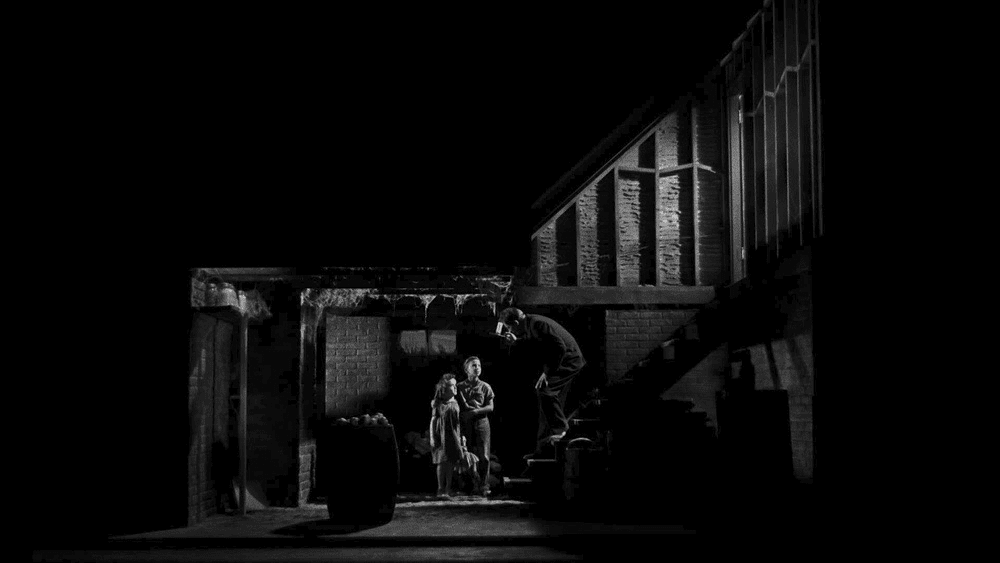
It’s a beautiful sort of stage play on screen. The sets are interesting, like you say, it’s just sort of fragile. Everything looks like it’s held together very delicately, And you just kind of get a sense that you’re in the universe until Laughton does this neat trick where he pulls back and does this super wide scene. Several times he does it, looking over across the farmland and the bike going across farmland. He pulls back and does this sort of cross section of the house, know, where you’ll see the characters going downstairs into the cellar, you know, but you see kind of the whole side of the house as if it’s been And cut it gives you this sense that everything is just sort of, you’re you’re able to pick apart, not just the the the nuance of of each role in the film, which I I think is fascinating.
But even the physical layer of the film, that you can move it around and look at it from so many different angles, that I think is just really wonderful. Another sequence that sticks out for me, and I’m sure we’ll talk about this in more detail later, as the kids get away, and I’m going to let you do a debrief of the, or a synopsis of the plot here in just a second, but as the kids get away, they make it to the river and they head down the river, and we get this sort of respite from the chase. And we get it from the perspective, not necessarily of the kids or, you know, or Powell, the crazy preacher, but from bugs and woodland creatures. And it is such a it’s kind of a sweetly jarring sequence right in the middle of this otherwise really darkly scary chase that I found myself really attracted to it.
Andy Nelson:
Yeah. It’s almost strangely the nature in the film is watching over these children and guiding them safely down the river
Pete Wright:
Right. Or That’s the sense you get. Well, let’s let’s do would you do just do a little synopsis of the storyline? It’s a fairly simple story and just get us started.
Andy Nelson:
Sure. We meet Robert Mitchum’s character, Harry Powell, I believe is his name, who is a a he’s put in prison for stealing a car, but he also talks to the quote unquote lord about these women that he kills. He he kills women, like widows, and steals their money and makes off. And so he’s in jail. He hears about this this his cellmate has stolen $10,000.
And this it takes place in, you know, post depression, but kinda that early thirties. And he hears him talking about how this $10,000 that he stole and he hid, and he the this guy gets executed. The preacher is released, and he goes after the widow of this this man who’s in prison and basically marries her under the guise of I was a former prison preacher. He the kids are kind of on to him, particularly the son, and can tell that he’s after the money. And eventually, basically, the preacher kills the wife.
The kids go on the run because the money is hidden in the little girl’s doll. And then they are rescued by this woman who lives on the river kind of taking in orphans, and she basically helps them, you know, through the you know, escape from this guy who’s pursuing them. I guess that’s kind of the long the long and the short of it.
Pete Wright:
Yeah. Think that’s both long and short. I wanna talk about the kids first. Yeah. Because so many mean, the way you set it up for me was that this was a couples on the run from the perspective of the kids.
I mean, is, but that’s that’s the way it’s it sounds like that’s the way you remember the film when you talk about it to others. I think that’s
Andy Nelson:
Well, it it’s a Couples on the Run film. It’s it’s these two kids who do have to go on the run. Now, they’re only running for it’s about two thirds of the way into the film where they actually go on the run, and they have to escape the preacher who’s now pursuing them because he wants the money. But it really is a story about them just dealing with this, and really, the story is the boy’s story. It is told from essentially, from his point of view.
Although one could argue it’s kind of told from Lillian Gish’s character’s point of view since she does open the film. She with these kind of, you know, these stories that she tells to the kids from the Bible, and it ends with her as well. But I think the large part of it is from the son’s point of view, the son being Billy or sorry, John Harper played by Billy Billy Chapin, and and his sister Pearl Harper, played by Sally Sally Jane Bruce. And I think they were, like, 10 and five at the time that that they made this film. And Billy Chapin really has to carry the the bulk of the film on his shoulders because it really is from his perspective.
And I think that’s looking at the film from a kind of a kid’s perspective as this I mean, I think Charles Laughton described it as a, nightmarish mother goose tale. I think that fits. And so when you see it as kind of a kid’s story and it’s from the kid’s perspective, it really kinda to me, it makes more and more sense the more I watch it that this really is the boys’ film, and this is kind of his vision of everything that’s going on. And and even some of the way that some of the sets are built and made, it almost films feels like a kid’s perspective of this is how the world is, like the basement, which feels very tiny for a basement. But from a kid’s perspective, you’ve got this giant looming man over you in this little confined space.
I I I I think that it works really well from from that look.
Pete Wright:
I I you know, I do too. And I think I just wanna add just because it just jumped out at me. He was that Billy Chapin, you know, the movie came out in 1955. He was born in 1943. Okay.
Was 12. When you look at his first acting performance was in 1944, Casanova Brown, and he was in 12 or 13 other shows or films before he did Night of the Hunter in ’55.
Andy Nelson:
Yeah. He was a very, very busy child actor, and he actually retired from acting a few years after this.
Pete Wright:
In ’59. Yeah.
Andy Nelson:
I think I think what I heard is he kind of hit that point where he was in those early teen years and really couldn’t quite, you know, just it it was those awkward years, and he couldn’t get the roles. And he, I think, ended up getting you know, having some drug or alcohol problems and
Pete Wright:
Right.
Andy Nelson:
And and quit the business. And from what I’ve what I’ve read is he’s, you know, fine. He’s retired, and he’s still living in Southern California doing something. I don’t know.
Pete Wright:
You know, it’s his performance, I think, is the it it to me, it’s a Keystone performance. Right? Because this kid is betrayed every which way from Sunday. Everyone in the film on some level betrays him until he meets
Andy Nelson:
Ms. Rachel. Ms. Rachel.
Pete Wright:
It is even when you watch each of these successive betrayals, first his father betrays him by dying in front of him.
Andy Nelson:
Or getting arrested.
Pete Wright:
Or getting arrested. He watches his father get arrested and then he and his sister make that promise, they swear that they’re never going to reveal the secret of where the money is, and his mother loses it and betrays him. And the preacher who comes to him is a, know, comes to him in the form of a savior figure and turns out to be a dark sort of nemesis figure. And the uncle who says, Anytime you need me, you come to me. When he desperately needs help, the uncle had already betrayed him to the bottle was drunk and passed out.
It’s just one after another of watching this kid get just kicked every which way. And finally, last one when his sister betrays him. And you realize that the sister has been, she’s only five and she doesn’t know any better, but he expects so much more of her. The way he plays each of those betrayals, I think in a film of this nature, of this period, is really sophisticated, and it’s a real pleasure to watch. And I have to imagine, when you say he’s fine, he’s retired, is he really fine after this Chased chased by a demon preacher.
Andy Nelson:
Yeah. No kidding. No kidding. But and and speaking to that, I think you’re right in in how how he sees everything and how he grows to understand things. Because even though his sister does betray him, it’s him who finally catches on to that.
And and when the preacher is getting close to getting the sister to reveal, he says, I’ll tell you where it is. And the preacher’s like, you know, didn’t I tell you to shut up? And he’s like Right. Pearl Pearl swore. You I I don’t wanna make her tell.
I’ll tell you. And just that, like, level of maturity where, you know what, she’s she’s only five. She swore. I don’t want her to have to break her promise. I will break my promise, and I’ll tell you.
He’s he’s all of a sudden kind of becoming the man that he has to become. And then when he, when uncle Bertie is passed out drunk and and and John stands up and he says there’s always the river, you can see that he’s kind of there’s been a little bit of a transformation there in him, and he’s kind of stepped up to this point where I’m now gonna have to be the one in charge of this family,
Pete Wright:
and there’s a little bit
Andy Nelson:
of that growth in there. And I I really enjoy that performance from Billy Chapin in this.
Pete Wright:
Well, I do too, and forgive me, I don’t have the script open, but the line at the end, it’s Ms. Rachel’s line at the end when talking about the, as she’s looking off into the somber middle distance and she talks about what the kids are.
Andy Nelson:
Yeah, she says, abide and they endure.
Pete Wright:
Yeah, it makes it a very powerful statement and bookend to his performance and little John has been able to do over the course of this film. And watch not just the people that he loves betray him, but his symbols betray him too once the church has betrayed him in the form of this Harry Powell.
Andy Nelson:
Well, and then even his own emotions end up betraying him to a certain extent, and that’s something I really love about the end of this film, how the parallels between the torture and the torment of this young boy seeing his father get arrested, and and he’s been holding this secret and keeping it, and he’s been fighting all the way down the river into miss Rachel’s arms and everything, only to see the preacher get arrested who is a horrible person and rightly should get put away. And then when he sees him getting arrested, he breaks down again because it’s it’s all it’s come full circle and he’s back to that emotional state that he was with with his father. And he’s just like he’s just screaming and he’s he’s pounding the doll on his chest saying, take it. I don’t want it anymore. I don’t want it.
I can’t do it. It’s like you finally get that breakdown from him that you’ve needed. And then he’s not even able to testify against him because he’s finally kind of gone out of that, I need to be a grown up mode, and it’s almost like he’s reverted back to the kid that he needs to be.
Pete Wright:
Is that that’s your sense of it? I I I think I may have had a different take on it, that that it wasn’t so much that that he’s reverted to a kid, but that he’s come to a new sense of awareness and maturity. Here I am, like armchair screenwriting. But there is I got this sense particularly at the close of the court sequence when he just wouldn’t look at him. He just wouldn’t look over there and acknowledge that Powell was the assailant was that he had reached that point of exhaustion and the maturity to move on.
Okay. And I sort of prefer it that way. I prefer watching him actually grow up. I feel like that’s the journey that he needed to go on for me as a viewer. I needed to see him accomplish this.
Yeah. And I feel like that final sequence of gifts at the end in back in miss Rachel’s house cemented that for me. Sure.
Andy Nelson:
I I can see it that way. I think I could buy that. I I don’t know. I guess I’ve always just seen it because it comes right after the scene where he, you know, he breaks down Yeah. And he’s you know, it’s that.
And then it’s I don’t know. It just there’s that that nature of a a child just unable to acknowledge something. I I guess that’s how I always took it, but I can see it your way too. I I could actually I’ll have to watch it again and and think about that.
Pete Wright:
Yeah. You know, I it’s it yeah. I I I do too, obviously, having only seen it once. That’s just my initial take. But But again, it was the same thing that we’ve talked about a number of our film noir films, acknowledging that this is not necessarily a film noir.
As a viewer, I tend to be the one to need to see that sense of growth and accomplishment, and sometimes that’s what leaves me profoundly let down. So I’m always biased towards seeing it end in a more positive note. I need this kid not to be catatonic.
Andy Nelson:
Well, don’t think he’s catatonic. I just think it’s I just think it’s one of those one of those moments where it’s just it’s a painful part of his life that he just he can’t go back to that place because it took him to such a horrible, nightmarish journey. And he needs to be in a place where he can kind of let go of that for a while.
Pete Wright:
Absolutely. Alright. I’d buy that. Let’s talk about the reverend.
Andy Nelson:
Good old Mitchum. Robert Mitchum. He he’s he really is pretty terrifying in this. But the thing that I think is really interesting is that Charles Laughton and I haven’t read the book that this is based on, The book by oh, is it Davis Grubb?
Pete Wright:
Davis Grubb?
Andy Nelson:
Yeah. I haven’t read the book. I guess it’s really I I actually it had been really hard to to find.
Pete Wright:
You can find it now.
Andy Nelson:
They back finally yeah. In 2005, they just just republished it. So I I wanna pick it up.
Pete Wright:
Yeah. We’ve got a link to it on the website. Yeah.
Andy Nelson:
But the I’m not quite sure, you know, how the reverend was written. If he kind of went from this evil to kind of this almost kind of comedic monster type of thing. I don’t know how it was in the novel, but I really like that Charles Laughton did that. And I’ve always fluctuated with that. And I I guess I should say I really like that on this viewing.
Because I there are some times where I watch this, and I’m like, it is just so absurd how Robert Mitchum acts sometimes in this film. As much as I like his performance and as as as horrible horrible as of a person as I feel his character is in this film. But there are moments where it’s like this over the top kind of just crazy monster. And when you put it in the perspective of, this is all kind of a a children’s fable and it you know, a lot of those kind of Grimm’s fairy tales and things like that had kind of this darkness mixed with the the the kind of lightness and the comedic sort of things happening. Put putting it in that context, I can see Robert Mitchum and his kind of his crazy howls when he’s when he’s screaming after them in the river as that he watches them float away or when miss Rachel shoots at him and and he goes howling and yipping off to the barn.
There’s a couple moments or even just his kind of crazy Frankenstein walk up the stairs toward them. Yeah. All of those moments are it’s it’s almost like this heightened emotional level of this monster in a kid’s movie. And I think because of that, I really I I really liked it this time, and I really connected with that that place where Charles Laughton was wanting Mitchum to go. Because there are plenty of other times where he is just really terrifying.
I mean, when he’s sitting and they’re having that dinner table conversation and the kids are wanting to eat and he’s just like, you can eat after you tell me where the money is. And he’s showing the little five year old his Switchblade and just like and I can’t remember what he starts saying to her, you poor, horrible, little wretch of a thing or whatever. I mean, it it’s really terrifying that this is this monster talking to these young children this way.
Pete Wright:
It is. And I think his rage o meter has a very low ceiling, and you’re right, he goes from zero to insane very, very quickly. What I love so much about his performance, and particularly for Robert Mitchum, it’s such a crazy performance for him, is that this character of Harry Powell is a textbook sociopath. Mean, he’s nuts. And he is justifying and rationalizing his own lack of moral center or sort of social conscience, right, with these conversations to God about how God has led him to these places where he’s been enabled to kill these women.
He is a To see this character in the vestments of a priest coming to kind of unleash this sociopathic wrath on these little kids, think is really interesting. But at his heart, he’s a buffoon. He’s goof. He has, You can see when he’s pushed into a corner that he’s missing that sort of frontal lobe piece that allows him to respond appropriately. He hits that rage point and loses control.
And in some cases, it causes him to howl in anger like he does when he’s stuck in the bog as the kids are going down the river. And in some cases, like you point out, he howls like an animal because there is no other way for him to respond. He has no other mapping in his conscience. I think that’s really interesting. It’s a it’s a layer of complexity that I did not expect, in this film.
It it really surprised me, and I it it’s the thing that I think makes it, imminently rewatchable.
Andy Nelson:
Yeah. And and Robert Mitchum, apparently, you know, hearing or some stories that people had talked about with Mitchum, you know, he was a kind of a Hollywood bad boy. I mean, he had, you know, he had been arrested for marijuana possession. He had, you know, worked on films high. And this was a film where they said, you know, he did not he was completely clean when he was making this film.
I mean, this is their words. I don’t I don’t know. But they said he was he was completely clean when he made this film because he had such reverence for this script. He really felt that this script was was just a different level of work for him. And he really wanted to make sure that he was putting his all into it and doing it right and doing it justice.
And apparently, when he saw the finished film, he started crying. And and I don’t know if it’s Charles Louden or somebody asked him. He’s like, what’s wrong? And he said, you know, I just didn’t know that I could be so good. And I think that speaks to I mean, probably during one of his crazy howl or something.
Pete Wright:
Man, I crushed
Andy Nelson:
that howl.
Pete Wright:
Am crazy.
Andy Nelson:
Look at me playing bad. But but, I mean, it but there is this level of of something going on with him in this film that is you’re like, you’re right. It’s imminently rewatchable. There’s always gonna be pleasure in in turning this on and seeing Mitchum, whether it’s the wrestle between the right hand, left hand, love and hate.
Pete Wright:
Oh, that’s that is insane. Yeah. It’s crazy.
Andy Nelson:
Yeah. It’s just like that. And even when he’s talking to John about and they actually come clean and he’s just like, yeah, he admits he wants the money. And this whole little conversation they have because John sees right through him. And there’s this glint in his eye when John makes the mistake of of saying, I’ll never tell you.
I won’t tell. I won’t. And basically admitting that he knows what he’s after and he knows where this money is. And just like the glint in his eye as he continues talking to to John, it’s just I mean, there really is a lot of interesting stuff going on with Mitchum in this film.
Pete Wright:
It it that is absolutely the truth. I wanna can you talk a little bit more about the love hate sequence? Can you describe that his his little story?
Andy Nelson:
Well, I I just think it’s a I think it’s become a famous a film moment where maybe not even moment, just but it’s just very famous that this character symbol.
Pete Wright:
It’s an icon it’s sort of in the in the film iconography.
Andy Nelson:
Right. Of this man, this preacher, with love written across one hand and hate written across the other. And he tells this story about love and hate in this biblical context about the old brother’s love and hate and how hate would go after love, and he was getting him down. He’s getting it down. Oh, but love comes back up, and love say love wins.
And just the way that he does this with this, like, little hand wrestle in this in the He does. Spoons shop, it’s just it’s it’s crazy, and and it totally mesmerizes everyone there. And then it totally mesmerizes the audience because it’s just this crazy little thing that he’s doing.
Pete Wright:
It does, and the way you do it is almost exactly how he does it. It’s just like talking to himself and finger wrestling his own hands. It’s that, and it has become this legend in this class of film. A lot of people have seen a lot of pictures of other people who have tattooed love and hate across their fingers. I’m not sure if this is the one that started it, but it sure seems you know, early enough.
Andy Nelson:
See yeah. Right. Yeah. It sure does.
Pete Wright:
Okay. You have other stuff on Mitchum and Powell?
Andy Nelson:
You know, I don’t think so. You know, other than Mitchum, you know, like I said, he was kind of a notorious character in Hollywood. And from from what I read, he got along with pretty much everybody on the set. He actually even really kind of worked closely with the kids in that scene I mentioned, the dining room scene, kind of even doing some of his own directing with them, you know, under Laughton’s supervision, of course, but just kind of helping them understand what he was doing, like, with the knife and stuff and working with them. My understanding is he got along great with everybody except for the producer, Paul Gregory.
And my understanding is is there there was some real bad blood apparently between the two of them, and to the point where Mitchum went off and, like, peed on Gregory’s car at one point because he was so so pissed at him for something.
Pete Wright:
Not to coin a phrase. Yeah. That was good. Yep. Really funny.
Yep. So, like, can we talk about Shelley Winters?
Andy Nelson:
Yeah. Shelley Winters. This is a tricky role for anyone to play, I think. This level of or this place that this character has to be in to succumb to somebody like the preacher, I find really fascinating to watch.
Pete Wright:
Yes. I I think that for me, what was so stunning about her turn is that she ends up playing a a character that is at once believable and yet has to play this transformation really quickly in the film, right? I mean, she’s, from the point that she is introduced after the initial arrest of her husband, to the point where she is at the bottom of the lake, it happens pretty quickly. She is lost, found, born again, and done away with over the course of about a half hour of I screen think she does a great job. I was thinking about it comparing it to, Oh, please Carrie’s mom.
Yeah. Hyper Laurie. Yeah. I I mean, it was it was sort of one of those, like, crazy performances that I think she just nailed. I I felt like I I really bought her as the the sweet, doting wife gone I feel
Andy Nelson:
clean now. My whole body’s just quivering with cleanness.
Pete Wright:
With cleanness. Yeah. That was a very powerful sequence.
Andy Nelson:
It’s the thing there are two sequences that I think really define her role in this film for me. The first one is the scene when she comes to bed. It’s their honeymoon. It’s their wedding night. They just drove up to town to get married and and came back, and it’s it’s nighttime.
She comes to bed to to hop into bed with him. He raises his hand as if he’s going to take her, but then he points to the window and says, oh, can you get the window? And then and then there’s this whole conversation where he’s just demeaning her for basically wanting to have the honeymoon, you know, jump in the sack sort of thing. You know? And and he just he totally demeans her and the whole thing.
He makes her look at herself in the mirror, and it’s just it’s it’s just you watch this woman just get broken to the point where after he breaks her and he goes back to bed, she just lays her and she says this little prayer to herself, help me to be clean so I can be what Harry wants me to be. And I I it breaks my heart watching that scene because to see anyone in that place where they they end up with a person who just who demeans them so much that they are now praying to say, let me just be what they want me to be. Oh, it just it it just terrifies me, but especially because she has these kids. And what is she doing as a mother? Right.
She’s just not doing a good job. And it’s it’s
Pete Wright:
just Well, and and that’s the transformation because early in the film, we just seen her say, I can do this alone. And she was she was, you know, really, you know, kind of just standoffish and said, I don’t I I can I don’t need a man?
Andy Nelson:
And it speaks to the horror of the preacher that this is this is how he doesn’t just kill widows. He basically, you know
Pete Wright:
Charms them. Charisma. He out charisma.
Andy Nelson:
Them. Yeah. And then he he crushes them and destroys them and eventually kills them. I mean, it’s just it’s a terrible thing. And then the other moment is when he does kill her.
Not not just for the way that it looks, because that is just one of the most beautifully beautifully haunting scenes. The way that Mitchum stands, everything about it, and the way she accepts her fate, again, as a as a as a parent, it’s just it breaks my heart that she’s at this place where she’s willingly going into this situation, letting herself get killed, even though she has these two kids. And it’s just it’s horrifying that she does this. But that’s the place that she’s in, and she accepts it, and he kills her.
Pete Wright:
Yeah. That’s another one of those diorama like pullback sequences right before that that the the murder, and it’s it’s another really stunning sequence. Absolutely. And then he does off with her and puts her in the drink. And that’s
Andy Nelson:
that’s one of those just images that I think sits with you, her in the bottom of the river.
Pete Wright:
Her hair Yeah. The way it is flowing with the the kind of weeds underwater as you see her. And it is a long sequence as
Andy Nelson:
As Uncle Birdie’s Uncle Birdie
Pete Wright:
is fishing and can’t quite catch the jeep. And eventually he does catch the jeep and discovers her sitting on the bottom Yeah. Anchored to the jeep. It is a it’s it’s a pretty disgusting discovery.
Andy Nelson:
Yeah. And they didn’t go light on it either. Laughton made sure that that slit across her throat was visible. I mean, it’s not like in your face visible, but you can see a kind of a gash across her throat. And, you know, he just didn’t go easy on on the audience with that, and it’s it’s pretty terrifying to see.
Pete Wright:
It is. Terrifying and subtle. And there’s a lot of the terror in this film that I think is is really subtle. It’s not grotesque. You think that there and maybe it’s because I’m conditioned to expect so much more kind of brutality, but it really is a cerebral sort of brutality.
It is very much a psychological thriller in a very pure sense.
Andy Nelson:
Mhmm. Yeah.
Pete Wright:
Who else is on your list?
Andy Nelson:
Well, I think we absolutely have to talk about Lillian Gish. Yeah. Who I mean, jeez, talk about somebody who’s who’s been around. You know, she she died in 1993, I think a few months before her hundredth birthday. And, I mean, she basically was there at the beginning of film.
She was in four or five of D. W. Griffith’s films, and she continued acting all the way through 1987 in The Whales of August. And I think she either won an Oscar or was nominated for that. And so she’s been around for a very long time and is a great actress.
Charles Laughton really wanted this film to kind of harken back to the silent days of cinema and the techniques that silent filmmakers used so much so that he actually screened as many D. W. Griffith films as he could before he started production. He wanted to just really have that vibe and look at the techniques that they were using. And you can see some of them like the iris, that great iris that they do as the preachers after he’s killed the mom, as he’s walking up to the house and you got the iris down onto the window revealing to the audience where the children are.
Great silent film technique. And also just a lot of the look. You got a lot of that expressionistic look at everything. But Lillian was somebody that he kind of thought he’d love to have in this film. Wasn’t sure he’d get her because she I think she had kind of gotten sick of of filmmaking for a little while and was doing some TV and and theater.
And somehow, they got in touch with her, and she really enjoyed the script and wanted to be in it. She brings this level of humanity. And and speaking of the love and hate hands, she really is kind of the love in this film, and she represents the good in the world, whereas Powell represents the evil in the world. And from her speech at the beginning talking about the quotes from the Bible and the fruit, you know, the good fruit from the good tree, the bad fruit from the bad tree, you clearly have her being the good fruit from the good tree and him being the bad fruit from the bad tree.
Pete Wright:
Yeah, she is symbolically, you know, really the guardian angel of the piece, and you can see that it’s not just her taking in these kids, it’s her taking in all the kids that show up. These kids who don’t know where their parents are, or they do know where their parents are, but their parents can’t afford to take care of them. You get these little sort of cultural, sort of textural elements where we see just the impact that she makes on the community. That was one of those things I thought was a really powerful sort of storytelling technique, right? To give us a sense of where she is in this universe, to illustrate her walking to and from the grocery store, right, to the market, and have these little stops along the way where the mom comes out, the waitress comes out and talks to her and says, Make sure you come to dinner.
We see the older girl, Ruby, talking to some older boys, and we see her kind of coming of age herself, and we see all of these elements to give a sense of the kind of guardian angel that Lillian Gish’s character, Ms. Rachel Cooper, is, and it ends up being a a very quick and efficient way to get us bought into her role because she comes into play very late in the film.
Andy Nelson:
Yeah. Even though she’s introduced right at the beginning, interestingly, in a very angelic sort of way Yes. That guardian angel, her in the sky, kind of over the over the stars as she’s telling these stories to these little floating kid faces.
Pete Wright:
Right. Right. And then we don’t I’m glad you said that because we do see her very first, but only for a couple of lines. Right? And then then she’s gone for you know, until the kids head upriver or downriver.
Andy Nelson:
Yeah. Right. Until they until they end up at her shore.
Pete Wright:
So I I thought that was a a really useful kind of way to to get her in. And and then you’re bought in, and then you you just sort of believe in her role, you you have this sense of trust. Even though that trust is tested, I think, a couple of times, or at least in one sequence when the Reverend just shows up, you can see just how devout a protector she ends up being as she kind of leads an inquisition against Harry Powell and and discovers that that he is in fact not not the daddy, not the preacher, and takes over.
Andy Nelson:
And it’s great how she does that where unlike the other adults in the film, like missus Spoon or mister and missus Spoon, really, and and even, you know, the the kids’ mom, she believes the kids. All these other people buy into the preacher and and every all these lies that he keeps spinning, especially missus Spoon. She totally buys into it. And
Pete Wright:
I love her name. Icy Spoon.
Andy Nelson:
Icy Spoon. Isn’t that great? The moment that I that always strikes me just like it’s such a a frustrating moment in the film because the kids are hiding in the basement and he, you know, he the preacher’s figured out they’re in the basement, but they won’t come out. She comes over and it’s like this moment where kids, as as much as they know they’re running they’re at a point where they basically have to run for their lives, because this other adult authority figure comes in and is just like, stop this nonsense. Come up here right now.
They do it.
Pete Wright:
You know? It’s surprised like me. That was the one point where I thought that’s not gonna be believable to me because my instinct is to say those kids are gonna use this as an opportunity to get away. And yet somehow at the end of that sequence, because of her sense of authority on screen, I bought it.
Andy Nelson:
Exactly. And that’s the thing. It’s just like when that there are those certain authority figures for kids that even though your life depends on it, if they tell you to come and you shouldn’t, you’re gonna come because they told you to.
Pete Wright:
And you know what? Think it’s in the back of my mind, thought, what if I was John in this case? I’d be thinking, wow, the preacher’s in trouble too. You You get in a fight on the playground, everybody gets busted. Right.
That’s the sense that I had. No matter how powerful a sociopath Harry Powell is on screen, he still was in some way, shape, or form under the thumb of Ms. Rachel Cooper, the guardian angel. It’s very powerful.
Andy Nelson:
Yeah. Absolutely. Fun
Pete Wright:
way to play that.
Andy Nelson:
And she totally reads him right from the start, which is great.
Pete Wright:
Yeah. Yeah. It’s great.
Andy Nelson:
And that’s a great moment with John and her when when John is like, he ain’t my dad. And she looks at him and she totally knows it. She’s she’s right there with him. So yeah.
Pete Wright:
Yep. Yep.
Andy Nelson:
Great stuff.
Pete Wright:
What else?
Andy Nelson:
Peter Graves. Brief but awesome. Exactly. Brief but awesome. It’s it’s always fun to see Peter Graves in whatever it is that he’s up to.
Pete Wright:
What was the deal with the conversation that he has in prison? So they’re in the jail, he’s, what I gather, pretending to be asleep at this point. But you get the sense that he has been talking in his sleep, and that the preacher, who is his cellmate, has been trying to coax the location of the money out of him in his sleep. But Peter Graves, as Ben Harper, is somehow aware that this is going on, and so the preacher is this fantastic sequence where the preacher is hanging down like a child off the top bunk, upside down, and Peter Graves hauls off and decks him in the face, knocks him off the bunk It’s just perfect. And then they proceed to have this conversation where he says over and over, You keep talking, preacher.
You keep talking, preacher. Then stuffs something in his mouth.
Andy Nelson:
As he stuffs something in
Pete Wright:
his mouth so he won’t talk in his sleep anymore. A great little moment. Yeah. It was great. It was great.
I I love that sequence, and then we don’t hear much from from old Ben Harper after that.
Andy Nelson:
Yeah. He gets hung. Yep. And, yeah, it’s it’s a great you know, just there’s something about Peter Graves that I think just his presence, I think, lends enough to the to the screen for the short time that he’s in it just to you can really sense this connection between him and the kids, especially John when he comes running home after he stole this $10,000. And I I don’t know.
I just I I really think that Laughton cast well for that role.
Pete Wright:
Me ask you though. Maybe it’s because the beginning of the film happened too fast and I missed something. He runs back and says, I gotta hide this money. Swear to me you won’t tell where it is. And he’s got blood on his shirt.
Right?
Andy Nelson:
Right. Yes.
Pete Wright:
And so he’s arrested and taken away and he is hung because of
Andy Nelson:
because he had killed two men. In his attempt in his in his robbery.
Pete Wright:
Correct. Important do you think it is how important is how we feel about him and his and the justice that occurred there in our viewing of the film?
Andy Nelson:
You know, I mean, that’s that’s something that I was really paying attention to this time because these kids are I mean, it’s it’s, you know, post depression, everyone is in bad place or most people. And it was very interesting to me that as I was thinking about this, I’m like, god, you know, this this kid is, you know, essentially keeping his bank robber murderer father’s money safe when he’d be better off just giving it back. But he’s just listening to his father, and it’s just one of those situations where the father wasn’t a good person. I mean, was clearly a criminal. He paid for his crimes by getting hung by the neck until he was dead.
And and I think that there’s some of that emotion maybe in the kid when he, you know, kind of explodes at the end and and and just can’t handle dealing with this issue with the money anymore. But but to me, it seems less about, you know, the son doing that because he morally, he knows that it’s wrong what his father did, and, you know, more it’s just that he just can’t deal with this this trauma that he’s been going through because he’s protecting the money. You know, I don’t know. I I think that it’s a very interesting place when you put it in context of the depression and how how the world was working back then. And he wants his family to have a better life, but they’re really not going to if they’re living off of this stolen money.
And in the end, it’s probably better that John ended up getting rid of the money so that he was able to move on to a better place in his own head.
Pete Wright:
Yeah. I’m torn on that one, and I think we’re on the same page on it. To me, there are two sort of justices here. The first one is the practical legal justice that he killed two men while robbing a bank, and practically and legally, that was the law of land at the time and in the universe of the film, and so I buy that. But it seems to me that Laughton and James Agee, certainly Davis Grubb, though I also haven’t read the novel, are making a point in that sequence in the prison when you have Peter Graves making his case, a sober approach to why he did it, because he was sick and tired of watching kids on the street who can’t eat.
And that to me, it seemed like they made such an obvious case through Peter Graves at this sense of higher justice that he did what was right for his family at the time because of the context and what he was dealing with on his farm, that that should be important for us. And and the fact that that they freed themselves from the money that was, you know, blood money at the end, as you say, and and he ended up and that John ended up and Pearl ended up being protected in the in the end anyway, I think, is a is a testament to that second justice.
Andy Nelson:
Yeah. It is interesting, though. I I I really felt this film tied itself well with the period in in just in little ways that I didn’t I maybe I just hadn’t caught before, but just so much of the dialogue, the slang that people use, I mean, it’s just all through it, it’s just really bad grammar. Yeah. It’s just and it’s like, god, this really does feel like nineteen thirties river folk kind of just talking, and this is kind of the the way that people lived.
And in some way, I think that they’re I mean, I I think that they would acknowledge that robbing the bank is is probably a bad thing. But on the other hand, it’s like times were so tough back then. Maybe killing the people was bad thing, but getting the money from the bank and just trying to create a better life for your kids. I think a lot of people back then would probably say, you know, I can totally see where he’s coming from. Exactly.
Yeah. Yeah. Yeah. It’s it’s a it’s a tricky, it’s a tricky little bit of a psychology game plan there, you know.
Pete Wright:
You said at the beginning that this film did not perform very well.
Andy Nelson:
This film, I there’s no numbers on it. I I found that it cost about 800,000 to make, which, you know, if if people are interested in our little movie breakdown, I actually have gone through, and I’ve adjusted it all for inflation. So eight I love that
Pete Wright:
so much.
Andy Nelson:
Oh, yes. Me and all the geeky things I do. $800,000 in $19.55 dollars is a budget of about 6,800,000. So, you know, it’s a decent, kind of low budget film, kind of budget. They, that’s all I found, though.
I couldn’t find anything on how much it actually made. All I know is that from everything I’ve read, the studio that released this, oddly, I I think it was United Artists and or MGM. I wanna say it was the same people who did the killing and did a really bad job releasing it. I could be wrong on on the studio, but they they paired it with another film when they released it, kind of a double feature on the back end of it, and it just it didn’t have what it needed to draw people in and people just didn’t click with it. It did horribly.
And it’s it’s just really too bad. It took a long time. I think it was TV when it started playing on TV that people started finding it and realizing there was more to it.
Pete Wright:
Well, it’s a relief that they did Yeah. Because this this film is it’s really it’s worth taking a closer look at. This is one of those that I think you you don’t wanna get lost in the in the void. It’s it’s worth watching. Yeah.
It’s it’s scary. It’s a good couples on the run film from the know, from a a new angle, a new direction. I’m glad we I’m surely glad we did it in this series.
Andy Nelson:
Yeah. It’s a shame that it did so poorly that Charles Laughton was never given the chance to direct again, And he he really took it personally that it it did poorly. People didn’t like it. And he ended up dying, I think, about seven years after it. I’m not saying that it’s what killed him.
Pete Wright:
But It was a seven year.
Andy Nelson:
Yeah. Seven
Pete Wright:
year Long seven year slow demise.
Andy Nelson:
But it did it did really take a toll on him. He really was wanting it to be something special. And I think he’d be happy now that people have have latched onto it, but at the time, I think it really it really got to him. So Should
Pete Wright:
we you you have others.
Andy Nelson:
I I have a few
Pete Wright:
last things. Few notes.
Andy Nelson:
And I’ll be real quick. Stanley Cortez, beautiful cinematography all the way through this. He he did the The Magnificent Ambersons with Orson Welles and aside from a bunch of other wonderful films. And Cortez said that he there’s this great quote, something about how light and shadow are these undefinable things that very few people understand. And he said, of all the directors he had ever worked with, only Orson Welles and Charles Laughton really understood the way to work with light and shadow.
So that’s a nice little a nice little testament to Charles Laughton and his direction in this film.
Pete Wright:
Oh, yes.
Andy Nelson:
And Walter Schumann and his wonderful music in this film. I really, really enjoy the score. I enjoy the themes all the way through this and the the songs that pop up throughout. These kind of lullabies and hymns that really fit. He’s most notable, I think, nowadays or maybe maybe not, but he’s most notable for the music that he did in Dragnet.
Pete Wright:
Yes.
Andy Nelson:
He wrote the theme for Dragnet, and from that, his his theme plays in everything all the time still.
Pete Wright:
I, you know, I wasn’t paying enough attention on this viewing to the to the score, so it’s not particularly memorable for me right now. But the the songs that the children sing Yeah. The little tunes that are sung around town are so haunting that those you you really can’t forget. I think there’s just a sense that that music and him is is a character in this film, and I I I imagine a lot of that credit goes to Schumann.
Andy Nelson:
Yeah. Absolutely. Yeah. So much so that Laughton, several times over the course of the production, felt that he needed to have the composer on set while they were working to help kind of get a a sense of the vibe of what was happening and to help them shoot it. So it’s pretty interesting little relationship that Laughton ended up developing with some of his crew members.
Pete Wright:
That’s very cool. That is very cool.
Andy Nelson:
Harry the the character of the preacher, Harry Powell, is actually based on a real serial killer.
Pete Wright:
Well, that’s charming.
Andy Nelson:
Yeah. Harry Powers was a convicted serial killer. And back in 1932, he was hanged. He was putting out ads, these lonely hearts ads, finding widows and actually killing them. And it’s just horrific stuff that ended up happening.
But, he was known as the Bluebeard of Quiet Dell, which I think is interesting that at the end of this film, all the the people in the in the crowd at the corridor are screaming, Bluebeard. Bluebeard. So
Pete Wright:
I’m not gonna lie to you. You sounded like Kermit the frog yelling Bluebeard just just for a second. Yeah. Little bird. Bluebeard.
Andy Nelson:
Bluebeard.
Pete Wright:
That is actually fascinatingly dark. I did I didn’t I didn’t catch that.
Andy Nelson:
I’ve never known that until this my latest bout of research on this. And then the last little bit, and that we should post links to these, but there are three books about the production of this film that are out there. Heaven and Hell to Play With, the filming of the Night of the Hunter by Preston Neal Jones, The Night of the Hunter in the BFI film classic series written by Simon Callow, who’s not only an author but an actor, and The Night of the Hunter, a biography of a film by Jeffrey Couchman. So there’s a lot of people who’ve done a lot of studying of this film. And the Criterion Blu ray edition of this actually has this film that they have put together, I think, in about 2003 called Charles Laughton directs The Night of the Hunter.
Laughton, when he was filming this, wasn’t cutting. He just let his film go, and he would talk to the actors and say, okay. Let’s do it again. And so there was tons of footage. Well, all this footage ended up in, I think, The U USC or the UCLA archives.
That’s where it was. And this guy ended up compiling all of this this footage and basically making it an incredible behind the scenes documentary of a film getting made. Basically, you watch through the whole process of the film from the beginning to the end, and you hear a lot in directing. You hear the actors working with their lines, playing their scenes, and he gives a lot of backstory. It’s a it’s an absolutely great documentary.
It’s almost three hours long. It’s really long, but it’s really engrossing. So
Pete Wright:
Oh, that’s great. Alright.
Andy Nelson:
Lots of things I recommend checking out.
Pete Wright:
Make sure we have that link in the notes.
Andy Nelson:
Definitely.
Pete Wright:
Definitely. And now I think we I think we need to get to flick charting.
Andy Nelson:
I think we do.
Pete Wright:
Excellent. You can find us at flickchart.com/thenextreel. And while you’re there, well, can friend us, you know, if you’d like. That’s always that’s always fine. I not many people do, but you can also find our our Flickchart.
Just go into the nextreel.com, and and you’ll see the the golden the road to our Next Reel top 100. We’re not quite there. We’re very, very close.
Andy Nelson:
I thought we were there.
Pete Wright:
Well, actually, I guess technically we’re there. We hit it last week with the Wolverine, includes of the actual films we’ve done. Right. Right.
Andy Nelson:
Can take out the film board films where where
Pete Wright:
So this week, technically, we will be at 101. Will take us to 101, and I’m gonna I’m gonna go ahead and call it, I think Rush, 1991 Rush by Lily Finney Zanuck is gonna fall off our top 100 tonight.
Andy Nelson:
I sure hope so. Oh, yeah. It is. I I almost I I 100% guarantee.
Pete Wright:
Alright. You ready? I’m ready.
Andy Nelson:
The knight of the hunter or moon?
Pete Wright:
Oh, man.
Andy Nelson:
I’m totally knight of the hunter. I I’ve gotta be hard pressed to Wow. Yeah. To pick moon over that. Moon.
The knight of the hunter is just a visual feast.
Pete Wright:
Okay. Okay. But it was hard. Just I
Andy Nelson:
I get a hard time with that one. Yeah. Oh, well, now we get this one will be hard for me. The Night of the Hunter or The Social Network?
Pete Wright:
Oh, Social Network.
Andy Nelson:
I’m so I I feel guilty picking The Social Network.
Pete Wright:
I would You feel guilty?
Andy Nelson:
I do. I honestly would would watch The Night of the Hunter. I think I would watch it gosh, would I watch it more on the Social Network?
Pete Wright:
Let me just say that. I’m gonna put it to you this way. If you were to get everyone remaining who works on the Social Network together and everyone remaining who worked on Night of the Hunter together in a room like dodgeball. I think if you were going to feel guilty, I would feel guilty more about the social network because that’s gonna be a bigger crowd. You’re hurting more feelings.
Andy Nelson:
Are you saying just because Robert Mitchum is dead that it’s okay to
Pete Wright:
be dead? Say it like that. That’s cold, man. When you say it, it sounds really horrible.
Andy Nelson:
Oh, yeah. Yeah. Okay. Alright. Gosh.
I you know, I’ll I’ll pick social network, but I’m not gonna like it.
Pete Wright:
Uh-huh. Yeah. Well, now you know how it feels.
Andy Nelson:
The Night of the Hunter or the Town. I’m totally going to Night of the Hunter on this one.
Pete Wright:
Yeah. I’ll go Night of the Hunter on that one. Sure.
Andy Nelson:
Easy. The Knight of the Hunter or the Natural? I
Pete Wright:
I’m Knight of the Hunter on this one. I I you know, I honestly, I could go either way. It surprises me that you’re Knight of the Hunter on this one. Really? Yeah.
It does. Thought you were gonna go all Man Tears. I’ll I’ll go Night of the Hunter on this one.
Andy Nelson:
The Natural isn’t the Man Tears one for me.
Pete Wright:
Oh, well, maybe they alright. That’s Field of Dreams. That’s Dreams.
Andy Nelson:
The Natural is my crazy ghost film. I’ll never get that out of out of my head.
Pete Wright:
Okay. Well, I’m fine with Night of the Hunter on this one.
Andy Nelson:
Alright. The Night of the Hunter or Zero Dark 30? I have go to Night of the Hunter. I I find it much more watchable. Zero Dark 30, I think, is a great film, but it’s a hard film to watch.
Pete Wright:
Okay. I don’t wanna be all complacent on all of these, but
Andy Nelson:
I know.
Pete Wright:
I’m gonna I’m gonna get this one. I’ll I’ll do this one too. I’m fine with that.
Andy Nelson:
The Night of the Hunter or True Romance?
Pete Wright:
I’m still going Night of Hunter. Man, with the way you play it, it could’ve have gone all the way to the top.
Andy Nelson:
Yeah. I
Pete Wright:
I It could’ve. I I mean, I’ll go Knight of the Hunter too. So so that puts it ahead of true romance but behind The Social Network?
Andy Nelson:
Yeah. Which is exactly where it’s ended up. Number 27.
Pete Wright:
Okay. Alright.
Andy Nelson:
That’s that’s pretty good. That’s pretty good. Yeah.
Pete Wright:
Well done. What are we doing next week? Do we even know? It’s been such we’ve been juggling.
Andy Nelson:
We we’ve been juggling. I I think we should go with our original plan, though.
Pete Wright:
Wait. What? Which one was that? We’ll we’ll we’ll have to talk about it off the air. So we’re not gonna tell people what we’re doing now?
Andy Nelson:
Well, not if we don’t know what we’re doing.
Pete Wright:
Because this will be our last night of the hunter. Right? Or, I mean, our last Couples It on Run is what you’re telling
Andy Nelson:
is the last Couples on the Run. And then we start a whole new series.
Pete Wright:
Oh, I don’t even wanna talk about it yet. I’m too excited.
Andy Nelson:
It’s another series that somebody has asked for. Yeah. Yeah.
Pete Wright:
We’ll give them a shout out next week. That’s right. Okay. So right. I don’t think there’s any reason for people to be listening anymore.
Do we have any other announcements? Nope. Yeah. People should have already turned it off by now. Yes.
There’s nothing useful that comes after this.
Andy Nelson:
Nothing at all. We’ve covered all of the important stuff and even some meaningless stuff. And now we’re just blabbering. Blabber. Blabber.
Pete Wright:
Tonight’s winning lottery numbers
Andy Nelson:
will