*This transcript is produced using transcription software and reviewed for quality. Despite our best efforts, some passages may be incomplete or contain errors due to audio quality or software limitations.*
Pete Wright:
That is the subtlety of magic that you don’t even know what happens until it’s already happened. It’s subtle and beautiful.
Andy Nelson:
I think magic is always happening in your house. You live in a house of magic.
Pete Wright:
I do, a bit. Unfortunately, that comes at great cost. Magic is electromagnetic radiation.
Andy Nelson:
So, you kind of look like that guy in Robocop.
Pete Wright:
We’re all very pasty. How are you doing, Andrew?
Andy Nelson:
I’m fantabulous.
Pete Wright:
Are you? I love hearing that. It’s Andy Nelson over there. I’m Pete Wright. This is The Next Reel.
Thank you so much everybody for hanging out with us talking movies. We’re doing what are we going to be talking about later? We’re doing Couples on the Run.
Andy Nelson:
That’s right. This is the start of Couples on the Run series this year. We had so many that we’re going to make it or an annual at least it’ll go on for a little while.
Pete Wright:
We certainly have enough movies for it.
Andy Nelson:
We certainly do. Yes, we do.
Pete Wright:
Because it turns out if they’re not heist movies or magic movies, every other movie is a Couples on the Run movie. Every one of them.
Andy Nelson:
There are a lot of couples who spend time running Running. In
Pete Wright:
So, we’re gonna be talking about the fantastic Midnight Run-in just a few minutes. Very excited to talk about that film. In the meantime, do have any announcements? I don’t think we have any announcements, but we do have trailers.
Andy Nelson:
Yeah.
Pete Wright:
I’m going go first.
Andy Nelson:
Why don’t you?
Pete Wright:
So this trailer actually hit a couple of weeks ago, but it’s one that I’ve been at odds with for a while. I don’t know if I’m excited about it or if I’m not excited about it. This is the first of what I assume to be many Steve Jobs movies, Jobs, starring Ashton Kutcher as Steve Jobs, written by Matt Whitley, directed by Joshua Michael Stern.
Andy Nelson:
You think it will be the first of many?
Pete Wright:
Well, know it’s the first of at least two. Wow. Yeah. Aaron Sorkin is writing another one. They got the rights to the Jobs biography and so they’ve got Aaron Sorkin writing that.
So, you know, that one is the one that, you know, got a lot more press. Aaron Sorkin got a lot more press than this one initially. Think they, you know, they got a lot of momentum because of Ashton Kutcher for a little bit and then it kind of went away and we weren’t really hearing much of it. People saw him and thought, Well, no, he doesn’t really look like Jobs. He’s kind of awkward.
Or, Oh my gosh, he looks exactly like Jobs, but he acts all weird. And so, this is the first trailer that hit. And now that it’s sort of settled on me, you know, I think I’m more excited about this movie than I was. Yeah. They’re taking on a really large part of his life in this movie.
Mean, they’re taking from sort of the beginning to the end, I think, at least it looks like.
Andy Nelson:
It sure does.
Pete Wright:
And I wonder, what I’ve heard is the other Jobs movie, they’re taking a much finer kind of piece of view of his life. It’s not an entire biopic. It’s more of a snapshot. And so it will be interesting to see how they handle this. I think the trailer portrays more of Kucher as Jobs.
And, you know, I think he does a pretty good job, but I feel like the jury’s out. It’s hard to get a real vision for what he brings to this character in these clips.
Andy Nelson:
Think he looks great in it. I am going to have a hard time not comparing it with Pirates of Silicon Valley that came out, the TV movie that came out in the late nineties with Noah Wiley playing Steve Jobs. I just I really was fond of that. Thought that was a great story of the two competitors, Steve Jobs and Bill Gates and Anthony Michael Hall playing Bill Gates.
Pete Wright:
I just loved that pairing. I loved how
Andy Nelson:
they played it. I really enjoyed that story And I thought Noah Wylie did a great job. I think Kutcher looks good in the film and I think he could pull it off. It’s always, you know, it’s kind of tough to judge by the trailer, but, you know, I’m excited to see it. Think it’ll be an interesting story, albeit one that’s been told before and is going to be told again.
Pete Wright:
Yeah. You know, it’s a funny thing. This could be that role for Ashton Kutcher, right? The one that Yeah. Hits I mean, right now, he’s a pitchman, and I think some of his movies are funny.
But he’s not one that I’ve historically taken very seriously.
Andy Nelson:
No. He’s kind of a celebrity who appears in movies.
Pete Wright:
Yeah. Celebrity for celebrities’ sake. I would be very interested to see if this is the film, you know, that takes him to that next level. Yeah. Yeah.
Alright. Your turn. I’m excited about your movie.
Andy Nelson:
I’m very excited. We haven’t talked about this, since the trailer. The trailer came out of, you know, a month or two ago actually, and we just haven’t talked about it yet. But, the movie comes out in September and it’s Riddick. It’s the next in the Chronicles of Riddick.
I guess
Pete Wright:
you can’t even say that
Andy Nelson:
now since the second movie was called The Chronicles of Riddick, it’s in this Riddick, I guess now a trilogy of, Pitch Black, Chronicles of Riddick, now just Riddick, directed by David Twohy. And the story of Riddick, this interesting character that Vin Diesel plays. And and, I really enjoy the first two films. I there’s something really fascinating about this world that Twohi’s created and this character of Riddick that Diesel plays. I have so much watching the films.
The second film isn’t as good as the first movie. It has a lot of problems, but he expanded the universe so drastically in the second film that I give him a
Pete Wright:
lot of credit for that. And even with its problems,
Andy Nelson:
I have just a lot of fun watching that second film. This film looks a little more like he’s going back toward what he had in the first film. It looks a little more, of a smaller story with Riddick and a group of people trying to catch him and, just kind
Pete Wright:
of focusing on that story as then they they all end up having to
Andy Nelson:
work together to, you know, prevent themselves from getting eaten by, I don’t know, what sort of lizard creatures that are crawling out of the ground. But it looks like it’s going be a lot of fun. I’m very much looking forward to it and it opens in September.
Pete Wright:
I am also very excited about this one. This is an interesting one. Did you see have you seen any of the other Riddick properties? Dark Fury, which
Andy Nelson:
was Yep, in the I’ve seen Dark Fury. That’s a nice little one, too.
Pete Wright:
That’s a nice little one and the games, too, I think. You know, one of the things I like so much about the Riddick kind of universe is how tightly that’s all, you know, all of these different properties are tied into one another. I think all three movies, I think, stand really well together. You’re right about the second one. I had problems with that one too.
But overall, you know, I just this is an anti hero I really love, this character of Riddick. I think Vin Diesel does a great job in this film, or in these films. I have just so much fun watching these movies. They’re great escapist media.
Andy Nelson:
They are. They’re a lot of fun. And it’s also nice to see Katee Sackhoff, from Battlestar Galactica
Pete Wright:
Yeah, right?
Andy Nelson:
Most recent show, popping up in the movie. So, you know, it’s just gonna be a lot of fun. I mean, violent, they’re just kind of crass, fun sci fi, and I really have fun watching them.
Pete Wright:
I love it that his superpowers that he can see in the dark. How innocuous is that? And yet, he’s terrifying.
Andy Nelson:
That’s right. Riddick. You think they could just flip up his glasses and blind him when they’re out in the sunlight.
Pete Wright:
Yeah, and yet he’s Riddick.
Andy Nelson:
That’s right.
Pete Wright:
Very much looking forward to those two movies. It’s been a little while since they’ve been out, they’re worth checking out. Think they’re going to be good films.
Andy Nelson:
Definitely.
Pete Wright:
And now, we should jump into Midnight Run,
Andy Nelson:
Let’s do it. Do you need to go through any of the Where People Find Us stuff?
Pete Wright:
I probably do, I can’t remember. Well, I didn’t this time. So let’s just say before we start talking about Midnight Run, head over to thenextreel.com, and you can find all of our past episodes. You can subscribe to the show. It’ll take you either over to iTunes where you can subscribe for free and leave us nice comments and many of five, Many reviews of five stars would be very helpful to us.
We thank you very much for those. Or you can subscribe on your other device, the RSS feeds available on the website. Let’s see what else. You can catch up with all of our Film Board episodes over there as well, our monthly film board special event episodes. We have one coming up we need to talk about.
Have we picked that one yet?
Andy Nelson:
I don’t think, It’s
Pete Wright:
still a secret. It’s still a big secret. That’s what we’re going to say. It’s a secret. The next secret film board event is coming soon, so stay tuned for that.
Andy Nelson:
That’s right. Alright, let’s talk about our movie.
Pete Wright:
We’re talking about Midnight Run.
Andy Nelson:
Yes, we are.
Pete Wright:
This is the fantastic Robert De Niro and Charles Grodin. This is nineteen eighty eight’s action comedy film from Martin Brest. And what do we think of this? It’s an action comedy, a 1980s action comedy. And it I has all the trappings of a 1980s action comedy.
Andy Nelson:
It does, but it handles it better than I think some of the others did. Wanna read this line before we get into it. This is from the Box Office Magazine’s review of Midnight Run. And this is just one paragraph that
Pete Wright:
I can’t I can’t wait to hear this.
Andy Nelson:
I think says it all. Another totally swell action comedy from the director of Beverly Hills Cop. Midnight Run holds, among its litany of virtues, a dexterous mixture of railery and ruckus, a pitilessly propulsive Maximum Overdrive road story, and the most inspired odd couple casting since Dan Aykroyd’s Joe Friday teamed with Tom Hanks’ Pep Streebeck in last year’s Dragnet.
Pete Wright:
Really? Really?
Andy Nelson:
So, we should talk about this dexterous mix of Railri and Ruckus.
Pete Wright:
Yeah. Were you moved to that level of fanaticism?
Andy Nelson:
I do think it is a totally swell action comedy.
Pete Wright:
It is. I think that that paragraph really sort of sells it well in the beginning, and at the end it comes off the rails a little bit. This is a swell action comedy. Think it is Oh, swell. You know what this movie strikes me about this movie?
This is a movie that celebrates the supporting cast. Know what Yeah. I the best lines, the most interesting comedy. I mean, for me, the real highlights in this movie are Charles Grodin and Joe Pantoliano. I mean, those are the guys that are they are the funniest.
They’re the most interesting. When they come on screen for some reason, when when when Eddie Mascon, Joe Pantoliano Pantoliano’s character, Eddie Mascon, starts screaming into the phone, I’m laughing. It doesn’t even matter what he says. Charles Grodin is absolutely fantastically soft spoken, sarcastic, and is just a wonderful character. Robert De Niro just doesn’t, should not have done this film.
Andy Nelson:
What? You’re No, kidding
Pete Wright:
I’m not kidding you. I think he’s terrible in this film. He’s terrible. Oh my goodness.
Andy Nelson:
Think he’s so great in this film. I love Yeah. Him in the
Pete Wright:
He is so lucky to be surrounded by people like Charles Grodin, Yaphet Kotto, Pantoliano, Dennis Farina. I think they all pull it off in spite of Robert De Niro. Wow. I know. Really?
I didn’t expect are you kidding? I didn’t expect that. I didn’t expect to be that guy.
Andy Nelson:
I didn’t either. I really like him. I think you’re wrong. Wow. I love him in this movie.
You’re just great. I think he plays it really well as this gruff guy who is dealing with a, you know, a frustrating, situation from his past and is disgruntled. I really like how he plays off of Charles Grodin. I think they work really well together.
Pete Wright:
I thought I would agree with you. And in fact, when we decided to do this movie as part of this series, I thought, well, was one of those things. I totally remember this movie as a really fantastic couple on the run buddy movie. Know, Robert, we should talk about the story. You want to just do a little backstory because for people who haven’t seen this movie in a long time, what is it about?
Andy Nelson:
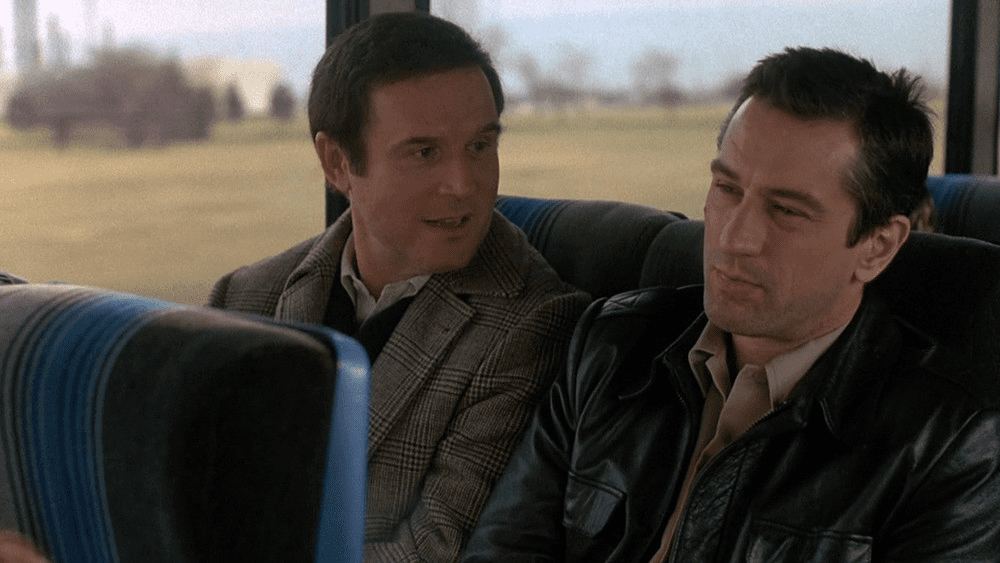
Robert De Niro plays Jack Walsh, a former cop who has now become a bounty hunter. He needs to find and return a former mob accountant, Jonathan the Duke, Mardukas played by Charles Grodin, who embezzled 15,000,000 from the mob represented by Dennis Farina playing, Jimmy Serrano. So Jack Walsh finds the Duke and starts bringing him back. Although due to the fact that the Duke won’t fly, he has to travel across the country, and he has to get him there by the end of the week. He’s in, being pursued by a rival bounty hunter, played by John Ashton.
Fantastic. He’s Marvin Dorfler in the movie, and he was in Beverly Hills Cop. He’s also pursued by a very persistent FBI agent, Alonzo Mosley played by Yaphet Kotto, who’s just great in this movie as well. And he has to try to beat them to get the Duke across the country. And that’s essentially the long and the short of the story.
Pete Wright:
Right. It’s not a not a terribly complicated story, I think, to its service. The film tells a simple story of these two guys running across the country. They have to get their, you know, the ticking clock is the bail. And, you know, it’s a good, it’s a simple story that’s funny in most places and everybody except De Niro really pulls it off.
That’s my pitch on this movie.
Andy Nelson:
I want to talk to the nineteen eighty eight Pete who liked it.
Pete Wright:
You totally should. Who liked De Niro. You should talk no, no, no. Now don’t go Andy?
Andy Nelson:
You totally thought you liked it. You remembered it that way. I want to talk to that piece. It’s Where is that piece can that come out and
Pete Wright:
not here. Stop it. He’s not coming out.
Andy Nelson:
I won’t let him.
Pete Wright:
Andy, the thing is, the the here’s the thing. I think what we got with De Niro in this film is, Untouchables De Niro trying to be funny. That’s what I think we got. And that’s what he I mean, he’s just coming off this movie. Look at that.
Did you see in the little trivia bit here in your, did you uncover in your exhaustive research on this film? De Niro was actually going for Tom Hanks’ character in Big. Saw that. Big could have been De Niro?
Andy Nelson:
Would have been
Pete Wright:
Talk about shaking your fragile worldview.
Andy Nelson:
Would That have been would really been a problem for me. Oh my goodness.
Pete Wright:
I wanna talk to the nineteen eighty eight Andy who could have ended up with a big with Robert De Niro. I mean, you could end up it could be right now. You could have Robert De Niro posters all over your man cave instead of Tom Hanks. Know you do.
Andy Nelson:
Can you imagine Robert De Niro in the piano scene? I’d just see that.
Pete Wright:
Stomping up and down on the black keys.
Andy Nelson:
Jumping up and down on the trampoline.
Pete Wright:
Yeah, exactly.
Andy Nelson:
Oh my.
Pete Wright:
Right? And that’s what I feel like we got. I think that’s what we ended up with. I think it was step. Now, I also think that part of the I don’t know, maybe this performance could put him in the 2×4 club you know, Oh, my other
Andy Nelson:
wow.
Pete Wright:
Think where that really serves him well, sort of at his expense, is Grodin’s portrayal of the Duke as this guy who cannot help but befriend everybody. Like, he can’t help it. He’s just a guy who gets to know people. And he’s just this sort of magnetic, like, he’s just drawn to people. And here he is being dragged across the country.
And still, you you see these little bits where he won’t take the opportunity to run away. He just comes along and does his thing, and he inspires these great little conversations. In spite of De Niro’s woodenness, he ends up, I think, pulling off a great performance.
Andy Nelson:
Wow.
Pete Wright:
I’m sorry. I can’t can’t I own it. I’m sorry.
Andy Nelson:
That’s okay. I’ll forgive you. I’ll forgive you. Well, Charles Grodin. Let’s talk about him.
Pete Wright:
Can we?
Andy Nelson:
I think we’re done talking about De Niro.
Pete Wright:
Yeah. Yeah.
Andy Nelson:
Charles Grodin. I really miss seeing Charles Grodin. Like, he’s kind of retired from acting.
Pete Wright:
Had a talk Because
Andy Nelson:
this character, this way that he does this kind of, this this article I found, it says he’s trademark mixture of confusion, condescension, and fussiness. I think that that kind of describes him well. There’s something about him that I find so fascinating to watch. I I love seeing Charles Grodin, and I didn’t realize that he had even retired. I guess I just hadn’t been paying attention to the fact that he’s not around.
But I found myself, as I watched this, I’m like, man, I wish he was in more films because he is just great in this.
Pete Wright:
Yes. Yeah. Oh, he’s terrific. Yeah. And, you know, I think he went off and did a talk show, for a while.
Andy Nelson:
Yeah, was like a news anchor on sixty Minutes two I for a mean, pretty interesting. I think now he just kind of wants to raise his kids. And actually, there’s been talk about a Midnight Run too, with that De Niro has been kind of pushing with I can’t remember the guy’s name. Let me see if I can find it here. The guy who wrote what’s his name?
Dowling. Tim Tim Dowling. Tim Dowling. They hired him to write the sequel to it where it would be, you know, Robert De Niro would be reprising his role and Charles Grodin’s son would be somehow involved or his character’s son.
Pete Wright:
Mhmm.
Andy Nelson:
And yeah. But Tim Dowling wrote Role Models and Just Go With It, so I don’t know if that bodes well. I got to say, I think they should just drop the whole idea.
Pete Wright:
Right. Well, I mean, they’ve tried and the TV the film has already been sort of had a triple play follow-up on, with direct TV, specials. Another Midnight Runaround and the epic, finale, Midnight Run for Your Life. And, you know, I haven’t seen any of them. None of the actors were in them, but the characters were in them in those films.
So, you know, it’s Dan Hedaya.
Andy Nelson:
Dan Hedaya. Know, yeah.
Pete Wright:
Just didn’t take off.
Andy Nelson:
George Gallo wrote the script for this. And I think this is an incredibly smart script, especially for this type of film, this kind of buddy, you know, couples on the run story, you part of this series. There’s a lot of these out there, and they’re not all done with this much level of kind of focus on the characters. And I think what you said, the the supporting characters, you know, Charles Grodin, Robert De Niro, I think all of the characters, I and I shouldn’t say Grodin and De Niro, should say Walsh and the Duke, all of them are written really well. And you have moments like, you know, the big, you know, chase through the desert, but you also have this, I find incredibly touching moment where Walsh goes back to his ex wife’s house because they’re broke and they need some money so that they can, you know, keep on this trip.
And he ends up having this really touching scene with his daughter that he’s kind of had to abandon years ago because of this ordeal that he got into with dirty cops back in the day. And I, you know, that moment was heartbreaking when his daughter comes out and is trying to give him all of her allowance, for a little bit of money to help him, even though they haven’t seen each other in nine years. I mean, it was heartbreaking. You know, that sort of moment you don’t have in a typical Couples on the Run sort of film. If Michael Bay had been making a Couples on the Run film, you’re not going to have that.
They would have cut that out and put in an extra car chase or something.
Pete Wright:
Right. You know, which is interesting that Gala would go on to do, you know, to work on the Bad Boys movies. You know, I think you’re right. You know, not to belabor De Niro, but when you look at those scenes, like the scene with his daughter and frankly the closing scene in the airport when Grodin hands over the travel money. Have his gift.
Right. Not a payoff, it’s a gift. You know, those are sequences that I am sitting there watching them and thinking, I bet Andy is crying right now. I’ll bet this movie this is like man drama that brings Andy to tears. Right?
Am I right? I wasn’t quite there. But this is one of those things, and some of the reviews that read, you know, kind of held up those scenes as, you know, they were, as you say, they were the kind of special bits, the nuggets in this film that really set it apart from a typical, you know, movie like this. And that, in particular, those moments are well earned by the rest of the film, by the rest of the caper. And I’m not sure I agree with that.
You know, I think the third act, when you start seeing the overkill of Cop Cars, you know, when the chase becomes Cannonball Run, it ends up getting a little bit out of hand. Maybe this is history or, you know, recent history talking, you know, when you see the sort of more sophisticated action films that attempt to take more of a realistic kind of protocol approach to law enforcement, that it ends up looking just downright goofy. And I admit it, I have a hard time watching it. It sets off the action as more dated, you know, and I wonder what it would look like, how you would take this film, this script, and make kind of a much more kind of approachable and realistic, you know, movie. Would it still hold up if it didn’t have that?
I mean, what do you think? Was that sort of caricature of law enforcement and the chase something that added to the film? Or did you find yourself distracted by it as well?
Andy Nelson:
You know, I wasn’t distracted by it. I mean, it’s definitely there. It’s definitely obvious. You know, I picture the big chase at the end of, The Blues Brothers where it’s just cop cars literally falling from the sky. There are so many cop cars.
And that whole level of of comedy in the chase. I it definitely feels dated to me, but it doesn’t bother me. I guess I just kind of went along with it as far as the period and everything. You know, honestly, I’m trying to remember if I’ve seen a recent comedy because the what you were comparing with is modern, the more action the serious action films.
Pete Wright:
Right. Right.
Andy Nelson:
You know, that but I’m trying to think of a modern kind of a comedy that has those chases in it. Honestly, I can’t think of one, I mean, I’m sure there’s one out there and I’m just not thinking of it, but that has a big chase like that.
Pete Wright:
What’s your memory of Beverly Hills Cop? 1984, this is the film that Martin Brest had done just immediately before Midnight Run. What’s your memory of the kind of police action in this film?
Andy Nelson:
You know, I mean, it was that film always kind of stuck out for me as playing the line between kind of trying to be serious cop stuff, and then also having a lot of the the kind of this sort of comedy, the same sort of comedy. Over the top, not quite believable, but we want to get the laughs out sort of comedy. And I don’t know, I guess it’s never bothered me. It just kind of seems to become that part of the genre, part of that action comedy genre Just or
Pete Wright:
comes with what you expect. I remember, you’re right, I mean, I remember it kind of walking that line too. I don’t remember the kind of volume of goofiness in that movie and I think this one sort of is Midnight Run ends up being kind of Beverly Hills Cop with its hair all let down, you know? I mean, it just sort of lets it go. But I don’t think it holds up to your comparison of the Blues Brothers, which I think took more ownership of the goofiness just by the That’s sort of caricature of the main almost the point of that film.
Right, it was I was only comparing
Andy Nelson:
it in the sense that, you know, it had that, you know, a lot of more cop cars than it should have.
Pete Wright:
But see, that’s my point. That, what we get with the Blues Brothers is a movie that absolutely understands its identity, and what we get in Midnight Run is a movie that sometimes forgets.
Andy Nelson:
See, I don’t know. I mean, I guess I can agree with you, but because of the nature of it being an action comedy, you’re going to have to have that stuff in the chase scene in order to kind of keep the comedy side of that going. I think if it was just a straight up serious chase scene, all of a sudden, the tone of the film is going to be shifting too drastically, and you’re going to lose that sense of fun, and it’s going to feel disjointed.
Pete Wright:
I, no. I totally disagree with that. I mean, there were moments that are head slappingly just out of context. And there are other moments that I find, you know, amusing. You know, the, what’s his name?
The other bounty hunter?
Andy Nelson:
Marvin?
Pete Wright:
John Ashton. Marvin Dorfler.
Andy Nelson:
You
Pete Wright:
know, the scenes with Marvin Dorfler in their sort of mini chase on top of the larger scale chase, I think, is particularly funny. I think, you know, Dennis Farina and his goons, you know, the Serrano goon squad, are particularly funny. I think you look at the contrast that you get with all of the goons in the Goon Squad and Philip Baker Hall, who is, you know, he ends up being this little tiny component of the mob as this straight man. And I think the whole of mob ecosystem that they build in this movie works really, really well. It just becomes a circus.
I lose track of what credibility the film builds in the first two acts in humor that they already established that they can deliver. It’s a smart script. It’s otherwise well architected. And then it just comes off the rails for me.
Andy Nelson:
Okay. I mean, I can totally see your point. I can totally see your point. I guess for me, it’s never really bothered me and I’ve always kind of, you know, went along with it. Excuse me.
And I think it’s not as big a problem. I don’t know. Maybe for something, just feel a little more disjointed. But for me, it just feels like it’s part of the flow of the whole thing. So, I kind of get the vibe the whole time, so it doesn’t bother me.
Pete Wright:
Alright. No, you got the vibe. That’s
Andy Nelson:
for sure.
Pete Wright:
Here’s the thing. So, you teach this screenwriting gig, right?
Andy Nelson:
I do.
Pete Wright:
So, you get a student who comes in. You’ve never seen Midnight Run. And they hand you the script. Midnight Run. A young George Gallo hands you the script.
And you read it. What grade are you going to give it when you get to that third act and you read the whole thing? Just reading the script. You don’t see it. You don’t know the actors.
What are you going to say?
Andy Nelson:
Geez, that’s, you know, I would like it. I mean, the elements of the story that are that work, I mean, the com here’s the thing, is like that big chase scene, that’s gonna be harder to put on the page anyway. And a lot of that was probably coordinated with the stunt team trying to figure out this elaborate thing. So you’re not gonna see that on the page so much. So I can just discount it.
Pete Wright:
You just got out of a very difficult part of the question.
Andy Nelson:
I know. I’m alluding you. Yeah. The thing that I would be attracted to in this script is this balance between the the typical genre story that we’re having with this action comedy and this couple on the run trying to get away from everybody as they cross the country, along with the character moments that you wouldn’t normally see in a film like this. And I really enjoy the character moments all the way through.
And I think that the dialogue, regardless of what you think of the actors, I think the dialogue that’s written for all the characters is really clever. I think it works really well in context for each of the characters. And I feel that the relationships that develop over the course of the film are natural and make sense and and are original. And because of that, I would probably give it a good grade. I think that it makes a lot of, the whole thing makes a lot of sense to me.
And the way that it works, it just feels fresh. And even still, I watch it again. And it’s funny because I hadn’t watched it in quite a long time, and I was actually perhaps a little more reticent to watch it than you because I think in my mind, I had put it in that camp where it was much better than it probably was. But then when I watched it again, I I felt actually, again, like it was it was a pretty fresh script. I really enjoyed the story.
I didn’t find anything, really lacking. And felt that I really connected to the characters and the relationship between Walsh and the Duke really worked for me. And all of the moments between them, all the way through the script, show a very fascinating relationship developing between this character who’s this stubborn by the books bounty hunter and by the books cop, who really got screwed over when he was working back in Chicago, and this criminal who really is in the wrong line of work, he should never have been working for the mob in the first place because he’s too good of a guy, and he only embezzled funds so he could donate it to charity. And you get those two characters together and you can see how this criminal ends up in a way transforming this cop into actually becoming, you know, kind of a better person and opening up and all that. And I really enjoyed the characters in this story.
Pete Wright:
Yeah. Yeah, I appreciate hearing that. And I think you’re right, there is a lot that we need to hand over to Martin Brest, the Martin Brest special, which is just throw more cop cars at any given scene. But I think one of the things that he does, that he ends up doing exceptionally well in this film is really leveraging the growing bond between these two characters of, you know, Walsh and the Duke. I think that plays really well on the page and on screen in these characters.
So, these actors really bring that to life. The other scene that I don’t want to let us, kind of, let go of is the train scene, when they start talking about whether or not they could ever be friends.
Andy Nelson:
Yeah.
Pete Wright:
Which I think is a real highlight of the film. And, they end up talking about, you know, could they be friends in another life? You know, as it comes to pass, it ended up being a scene that was almost entirely improvised, not even on the page. And I think shows there is such rich material in the bond of these two characters that when you get these two actors in that boxcar, they’re really able to bring that to life in a, like you said, in a very special kind of an original way.
Andy Nelson:
And not only that, but the thing that I like about these characters and the way that the actors portrayed the characters is they’re intelligent characters. You don’t have either of them as kind of this run of the mill typical ex cop who’s just a bully. There actually feels like, and maybe it’s just me, but it feels like there’s a level of intelligence behind the things that Walsh is thinking and the way that he works. And his backstory, I find very interesting with the the whole dirty cops and everything. Likewise with the Duke, he’s just he he’s a smart guy.
And and Charles Grodin even talked about how so many films that he had done before this, he was never allowed to they were all of his the characters were what he says a little below where my intelligence is. But I could make Jonathan Mardukas as intelligent as I could be. There wasn’t any lid on this character and often there is in the characters I play. He’s a very resourceful bright guy. The question became, am I as smart as him instead of do I have to cut off part of my intelligence to play him?
And I think that really shines through. You get real intelligence and just fascinating conversation coming from these two because it is clearly two intelligent men, like the scene on the train where well, and I’m thinking of the boxcar or the the dining car where he’s he’s talking to him about his wife. And, you know, there’s just seems like there’s some there’s real empathy between them, even if De Niro is a bounty hunter taking him in.
Pete Wright:
Yeah, you know, and I think to De Niro’s credit as well, is, you know, being able to play this character that is, you know, it’s a comic character, but not a, you know, it’s a comic movie, but not a comic character. And there are some, you you get some of these kind of more slapstick moments the first scene, you know, when he drops the lockpick and dodges a shotgun blast through the door. Yeah. You know, I mean, kinds of things happen in this film because it’s that kind of film. Yet, you know, that we have these, hooks, these more sort of emotional hooks to grab onto, that kind of get us through the movie, the dining car, you know, over the fire in the boxcar, all the way to the closing scene, which I think, again, is a real highlight.
Andy Nelson:
Yeah.
Pete Wright:
Okay. The F word is used exactly 119 times Is it really? In this I
Andy Nelson:
hadn’t found the count, but it certainly is prolific.
Pete Wright:
It actually feels profane. It is a lot. And I found that. And you know, I know how to swear. I do it a lot.
I don’t have a great vocabulary anyway, so sometimes I just fill in the blanks with profanity. And yet, even I found the swearing distracting in this movie.
Andy Nelson:
See, it didn’t
Pete Wright:
bother me. See, it didn’t bother you? What is it with you? You’re numb to the world, man.
Andy Nelson:
I guess I am. Throw another saw
Pete Wright:
No, I found it a little bit distracting and out of character for most of the characters. Felt like there were, I think, Pantoliano and absolutely Farina pull it off, but there is so much swearing in the film that that, so much of of the f word in particular that it becomes a a joke in itself. And I don’t know if it was I I can’t figure out if it was some sort of a cultural statement, if he was trying to make a point with it, because started feeling like a blunt instrument. That’s how it hit me.
Andy Nelson:
And when you say the F word, you’re not referring to fistophobia.
Pete Wright:
No. That the I’m A sure that’s
Andy Nelson:
new word that we get in this film.
Pete Wright:
I assumed that was a PH.
Andy Nelson:
Oh,
Pete Wright:
Prithystophobia. Prithystophobia. Okay. So what else do we love about this movie? Let’s see.
Hang on. I gotta get back to my I production list.
Andy Nelson:
Love the score for this film. I’m so
Pete Wright:
glad you brought that up. Danny Elfman.
Andy Nelson:
Danny Elfman did such a great job with the music in this film. It’s got this great kind of, you know, just driving energy. It also has this theme that is really kind of just this kind of melancholy and pensive. And it really gives you a sense as to who Walsh is. This kind of, you know, bounty hunter who’s just unhappy with the line of work that he’s stuck in because of all this stuff that happened.
And that melancholy tune that we hear right at the start of the film really brings that home. And then just the driving energy that takes over from there, think is just is is just such a great, great just melody to to see us through the film. And I mean, this is one of the early pieces that that Danny Elfman did when he started composing. I think it’s within the first couple years, if I’m not mistaken. And I think that he really knocked it out of the park.
Pete Wright:
I agree with you. I it, you know, I like it. It was very much of the time. You know, it felt sort of contemporary to other movies at the time. I found it, you know, I guess I expect more Oingo Boingo and less Eric Clapton.
And in this, in particular, this film, I found highly derivative score. The score was highly derivative of Lethal Weapon. That doesn’t mean it was bad. I like it as well. Think what you bring up is right on.
It’s a good score. There’s so much originality in Danny Elfman’s work. I think what we’re seeing here is, you know, going back to where he started, know, as writing scores, I think he’s, you know, we get to see kind of where he was still a little bit shaky in finding his groove.
Andy Nelson:
Well, but you listen to his variety of music that he’s written over the years.
Pete Wright:
But he hasn’t written many of these. Like, you listen to the other movies that he’s done, and this movie kind of stands out.
Andy Nelson:
Well, it stands out. It’s not a wacky, crazy Danny Elfman. But it definitely has kind of a little bit it has some of the fun, and I can see where you’re going with the Eric Clapton comparison. That really actually makes a lot of sense. Because I think Lethal Weapon came out the year before.
Pete Wright:
It came out the year before. And, you know, I’m sitting here, you know, as I say that, obviously, the production of the movies kind of overlap. I’m not in any way saying No, no, no. I don’t think it was trying
Andy Nelson:
to It be probably had a contemporary vibe of the Yeah. You know, I don’t know. I find it just really fun and very easy to listen to and it just amps me up when I hear it. Love it.
Pete Wright:
No. I, you know, I totally agree. I you know, what’s interesting about Danny Elfman? So he did, Midnight Run was 1988. It was a big, big year for 1988 was a big year for him.
And just look at the other movies that Danny Elfman did. Just that year alone. Beetlejuice, Midnight Run, Big Top Pee Wee, Hot to Trot, and Scrooge.
Andy Nelson:
Yeah. Right? ’19 A lot of stuff.
Pete Wright:
Lot stuff. Midnight Run is, it’s, this is the, one of these things is not like the other.
Andy Nelson:
Hot to trot, I think, is closer to Midnight Run than the other three.
Pete Wright:
You think? I think the other three end up being far more, sort of, of the Danny Elfman sort of musical gene that we get into the 90s when we get into Batman, Nightbreed, Dick Tracy, you know, obviously the Tim Burton partnership.
Andy Nelson:
Right.
Pete Wright:
And, you know, Army of Darkness.
Andy Nelson:
That’s right. He did the March of the Dead.
Pete Wright:
But this guy, he’s done, oh, an awful lot of movies. Yeah. You know, haven’t heard I actually there are some that I haven’t haven’t heard, although you just saw Silver Linings Playbook.
Andy Nelson:
A
Pete Wright:
couple of Elfman cuts on there.
Andy Nelson:
Yes. I liked them. They were
Pete Wright:
very good. Have you heard Hitchcock?
Andy Nelson:
I have not heard Hitchcock.
Pete Wright:
In any case, he’s yeah.
Andy Nelson:
Yeah. He’s
Pete Wright:
That’s where we go. He’s good. It was good.
Andy Nelson:
He did real steel for Pete’s sake.
Pete Wright:
He did. Exactly. Great score. Great. It was a great score.
That’s the
Andy Nelson:
truth. Yep.
Pete Wright:
Alright. Most of even the movies that sucked that he was on, he he actually he’s he’s a credit in most cases.
Andy Nelson:
He he is one of those composers that can, can be the one glowing ember in a pile of rubble as far as bad film.
Pete Wright:
Well, that’s the truth. Alright. Let’s see. Now I got to go back. I got to hit the back button.
We got to get back to the thing. So now we’re talking about, let’s see. What do we know about the cinematography and the editing of these guys? I don’t know who this I’ve never heard of this Donald Thorin. What has Donald Thorin done
Andy Nelson:
Donald for me Thorin. I don’t know who he is either, actually.
Pete Wright:
Let’s he’s oh no. We might have to edit this. Why? Because he’s done everything. He’s done movies we like.
Andy Nelson:
Oh, well he’s definitely continued working with Martin Brest instead of a woman.
Pete Wright:
That’s right. And you know, I know one of our favorites, Tango and Cash.
Andy Nelson:
Dudley Do Right.
Pete Wright:
Ace Ventura When Nature Calls.
Andy Nelson:
Little Big League.
Pete Wright:
He did Shaft.
Andy Nelson:
Purple Rain.
Pete Wright:
There you go. Don’t even talk to me about Purple Rain. It’s my favorite movie of all time.
Andy Nelson:
I don’t doubt that. Yeah. So, he is a prolific DP who
Pete Wright:
I can’t even that’s a name I’ve never put with movies.
Andy Nelson:
It looks like he has retired as of 2003, but his two sons are also cameramen. So there you go.
Pete Wright:
Alright. No. Thank you.
Andy Nelson:
On the film was Chris Lebenzon, who we’ve talked about before. He edited Sweeney Todd, the Demon Barber of Fleet Street.
Pete Wright:
Right.
Andy Nelson:
He’s actually edited every Tim Burton film since 1991. He is another Tim Burton latches onto people.
Pete Wright:
That’s Don Thorin Jr. Is that who you’re talking about there?
Andy Nelson:
No, now I switched to Chris Lebenzon.
Pete Wright:
Oh, Chris Lebenzon. Here’s the thing about this film in particular, and I think why, I would not associate any of these names with this movie because I found otherwise the, in general, the cinematography and editing ended up being pretty safe. Didn’t find
Andy Nelson:
anything Yeah, that there’s was nothing too crazy about But, you know, it’s an action comedy. You’re not looking for something that really stands out or anything, you know?
Pete Wright:
I do know. I do know.
Andy Nelson:
You do know. Yep. Alright.
Pete Wright:
Okay. Then what well, you’re gonna say something. Go ahead. I’m gonna change the subject, so get it
Andy Nelson:
I was gonna change the subject too. Alright. You first. I was gonna say, the film was nominated for two Golden Globes.
Pete Wright:
Yes.
Andy Nelson:
For in 1980 or the 1989 Golden Globes Best Motion Picture Comedy or Musical, and Best Performance by an Actor in a Motion Picture Comedy or Musical, Robert De Niro. Your favorite. Charles Grodin did win an award at the Valladolid International Film Festival wherever that is. Yes. And, it won in the top 10 films of the year in the National Board of Review.
That’s all. Yeah. Your turn.
Pete Wright:
No, no. You know, think some of the, you know, Ebert, I think he calls it a comic thriller. I didn’t get so many thrills out of it, just action and cop cars. But I think he points out in his review, something that really sticks with that we’ve already talked about, but the fact that, you know, he says, quote, It’s rare for a thriller to end with a scene of genuinely moving intimacy. Yeah.
But this one does. I think that’s really true. The movie, ends up, it ends up paying off in some really interesting places, places that I just, you know, sequences that I don’t expect even after, you know, having not watched it in, in many years, I found myself genuinely surprised by the more sort of emotional moments that come throughout the film and end up making some of the goofy stuff tolerable. How’d it do in ye olde box office?
Andy Nelson:
It did pretty well. I see it had a budget of $30,000,000 Somewhere I saw that they spent about $15,000,000 on prints and advertising, so about $45,000,000 It made domestically about $38,000,000 internationally about $43,000,000 so about 80, almost $82,000,000 total. So, you know, it made its money back.
Pete Wright:
And I note you have updated the cost per minute breakdown.
Andy Nelson:
I certainly have. The midnight run on our list of films falls at number 30, having made per minute. It was, let’s see, one hundred and twenty seven minutes long. It made $288,296 per minute.
Pete Wright:
Does that did that surprise you at all?
Andy Nelson:
Not really, I guess. Is there anything surprising
Pete Wright:
about that? I never thought of it
Andy Nelson:
as like a huge moneymaker. I never thought of it as a big box office loser. It just kind of seemed like one of those fair to midland sort of movies as far as how it fared at the box office.
Pete Wright:
I this is not obviously adjusted for release date.
Andy Nelson:
Yeah, none of these numbers have been adjusted for inflation.
Pete Wright:
So it’s hard to compare. Our ranking is, it’s interesting to me that you get movies like Bull Durham that, you know, it beat Bull Durham just barely.
Andy Nelson:
Yeah, it came out the same summer. Although, Bolder was a shorter film, so hence it made more money at the bottom. Or it made more money per minute.
Pete Wright:
Yeah. I found that interesting. All the President’s Men, these movies that I sort of hold up on a little bit of a higher platform that were of the same or earlier period ended up doing not as not as well as this film. So that’s that’s something. Yeah.
Alright. What else you got? You got another thing.
Andy Nelson:
You know, I had another thing, and I closed my tab. I I you know, just real quick though, Martin Brest, who directed this
Pete Wright:
Yeah.
Andy Nelson:
Very strange career, a guy who hasn’t really done a whole lot of films. He his first feature, I believe, was ’79 Going in Style. I think he did a couple of shorts before that. Then Beverly Hills Cop in ’84, Midnight Run-in ’88, Scent of a Woman in ’92, Meet Joe Black in ’98, and then the poor guy wrote and directed Gigli in 2003, or Gigli, however you say it. Yeah.
The horrible bomb that that really I I don’t I don’t know if I could say it killed his career, but it seems to have killed his career. He hasn’t done anything in ten years. I did read somewhere that he said that, you know, making films was never that interesting to him and that he’s just directing commercials now. I don’t know if that’s that’s rumor or what have you, but that’s what I I heard. And and considering his last last film was such a bomb, and
Pete Wright:
before that, Meet Joe Black. You? You saw Geely?
Andy Nelson:
I didn’t see it.
Pete Wright:
Geely? You didn’t? Well, it’s fascinating. You saw him on the IMDB page. Did you read the description of the film?
It really describes it. I had never read it put quite this way. The violent story about how a criminal lesbian, a tough guy hit man with a heart of gold, and a retarded man came to be best friends through a hostage.
Andy Nelson:
Wow.
Pete Wright:
I think that insults everybody. Like, every stereotype that is in this film is insulted in that one sentence.
Andy Nelson:
Sounds pretty terrible. Terrible.
Pete Wright:
Yeah, I don’t know. It’s kind of unfortunate because, you know, I did like Meat Joe Black, said of a woman I liked quite a bit.
Andy Nelson:
I never saw all of Meat Joe Black. I wasn’t very impressed with what I saw. And it certainly really did not do well at the boxing No. Because it was a big, big failure. But, you know, it does have a lot of fans.
It has a lot of people who really enjoy it. So, know, more power to them.
Pete Wright:
Yeah, I didn’t love it, but I liked it. I’ve watched it. I have it. But where do you stand on Scent of a Woman? That’s kind of a classic.
Andy Nelson:
I like it.
Pete Wright:
It’s not your favorite.
Andy Nelson:
It’s there. It’s, you know, it’s one of those movies that I’ve never quite gotten into like other people have gotten into. I can certainly appreciate it. But, yeah, I just find it, you know, it’s it’s there.
Pete Wright:
Alright. I’m a little sorry to hear you say that. Wish you’d be more effusive on the the film. But, no, I think it’s, I I thought it was a great movie. And I so that, I think, is, you know, that’s just this is the, there’s gotta be a new, a new word in there that we’re we need to coin for for these directors who are inspired and then disappear.
Andy Nelson:
Just kind of drops off
Pete Wright:
the map. And, of course, Beverly Hills Cop. Again, that it’s a that’s a classic in the genre and sort of speaks for itself.
Andy Nelson:
Yeah. Alright. Did you know this is this is my little thing that I I just found again. The taxi driver who at the very end of the film won’t give Jack Walsh a ride as he’s leaving the airport because he doesn’t have he only has thousands as I recall. Right?
Pete Wright:
Mhmm.
Andy Nelson:
You do a change for a thousand. Yeah. And the taxi driver drives off. That taxi driver was in the movie Taxi Driver with De Niro playing a taxi driver.
Pete Wright:
He was also in The Untouchables, and he was never touched once.
Andy Nelson:
Yeah. No one touched him.
Pete Wright:
There are two other casting potential casting bits of gossip that surround this movie that I think are interesting. Know, we already talked about what it would have been like if Robert De Niro had ended up in Big.
Andy Nelson:
Oh, know, right.
Pete Wright:
In this one, you know, they, one point, were looking at changing up the gender role of the Duke character and Cher was in talks to play the Duke character, which did not end up working out. But then they offered and had talked to Robin Williams about taking on the role opposite of De Niro. You know, that one’s a more compelling pairing, but really this is one of those casting discussions where I think they just nailed it with Charles Grodin.
Andy Nelson:
Yeah. I definitely think so. And, you know, it was only, what was it, a couple years later, that would have been two years later that Robert De Niro and Robin Williams did pair up together.
Pete Wright:
Yes.
Andy Nelson:
Do years you later? It was nominated for best picture. Robert De Niro was nominated for best actor.
Pete Wright:
Yeah. Oh, man. Why can’t I picture it and not think This is one of
Andy Nelson:
those movies I can remember the the poster, and I don’t remember a single thing about the movie.
Pete Wright:
It was just Awakenings. Awakenings. Yeah. With the
Andy Nelson:
Oliver Sacks based on Oliver Sacks’ book.
Pete Wright:
Man. See, when I the reason this is the problem. Because this was not okay. When I think of Awakenings, I think of the one where he was the clown.
Andy Nelson:
Oh, Jack. What’s that one called?
Pete Wright:
Where he had the nose thing?
Andy Nelson:
Yeah. What
Pete Wright:
was that?
Andy Nelson:
It’s not Jack. Jack is the one where he ages really quickly. Right. It’s,
Pete Wright:
Pat Adam. Bicentennial Man.
Andy Nelson:
No. It’s Patch Adams.
Pete Wright:
I know. I know. You liked Bicentennial Man though, right?
Andy Nelson:
You know.
Pete Wright:
Alright. Enough about that. So, anyhow, was that is interesting. So I’m glad the gents got to work together, even though the movie was also rather unremarkable.
Andy Nelson:
Yeah. Clearly, since I don’t remember a single thing about it.
Pete Wright:
Good film. Final thoughts?
Andy Nelson:
You know, for me, revisiting this movie, I really found myself just loving it that much more. And I would say that it’s one of those films that I would love to, you know, keep watching again and again because I just I found it so enjoyable and I really love the characters. And, oh, it just makes me want more Charles Grodin in more movies.
Pete Wright:
That is absolutely my lesson in this film. I learned that I miss Charles Grodin greatly. He is fantastic in this film. And, I regret a little bit that this I feel like my memory has been violated, about this movie. I really quite like it.
But, you know, I stand by my initial impression that this film is a film that celebrates supporting cast and at the expense of, our protagonist, Robert De Niro. Pantoliano and and, Grodin are real highlights for me.
Andy Nelson:
Yeah.
Pete Wright:
That’s it. That’s what I got. Alright. So, now you know where I stand with the movie, and I know where you stand with the movie. And I think we need to probably flick chart this, baby.
Alright. Let’s do it. Let’s do it.
Andy Nelson:
Alright. Go ahead. Midnight Run or Sweeney Todd?
Pete Wright:
Sweeney Todd.
Andy Nelson:
Midnight Run.
Pete Wright:
Really?
Andy Nelson:
Yeah. I just I I really enjoy it.
Pete Wright:
That much?
Andy Nelson:
I well, I’m for Sweeney Todd.
Pete Wright:
Sweeney Todd much? They eat people, Andy. How does that compare with Midnight Run, an action comedy?
Andy Nelson:
Know, I think I could go with Sweeney Todd on this one. I I really do enjoy both of the films quite a bit. I mean, I’m talking about two movies I like.
Pete Wright:
So Yeah.
Andy Nelson:
You know, I’ll I’ll go with Sweeney Todd. I’ll give you that one.
Pete Wright:
Alright. So I’m ready to I’m ready to give. I’m feeling flexible. Go ahead.
Andy Nelson:
Midnight Run or Klute?
Pete Wright:
I’m really interested in what you think of this. I was going say Midnight Run.
Andy Nelson:
Midnight Run or Prometheus?
Pete Wright:
Dang. Midnight Run. It’s totally Midnight Run. Yeah. It’s Midnight Run.
Andy Nelson:
Prometheus had so many problems.
Pete Wright:
It had a lot of problems. It does. Man, I thought this was gonna be harder.
Andy Nelson:
Go. This is a really funny poster that came out for Midnight Run. It’s in Spanish. Alright, are we doing? Midnight Run or Alien three?
I’m still doing Midnight Run.
Pete Wright:
See, if I were doing this alone, I would probably say Alien three, but I’m feeling gracious. Go ahead. Midnight Run. Not even going to fight that one.
Andy Nelson:
Midnight Run or Indiana Jones and the Last Crusade?
Pete Wright:
I
Andy Nelson:
have to go Indiana Jones. Really? Yeah.
Pete Wright:
Oh, good. I was trying to come up with my argument as to why. I’m It’s Indiana Jones.
Andy Nelson:
It’s Indiana Jones. It’s hard to put it on
Pete Wright:
top that. What if it had been Crystal Skull? Did I
Andy Nelson:
run or Driving Miss Daisy?
Pete Wright:
Driving Miss Daisy.
Andy Nelson:
They’re such different films, but
Pete Wright:
Substance. It’s about substance at
Andy Nelson:
this point. Yeah, Driving Miss Daisy. I think I would agree with you. So, it’s 36 out of 63.
Pete Wright:
That feels about right.
Andy Nelson:
Nice little palindromical result. I just made that word up.
Pete Wright:
I think you did.
Andy Nelson:
So,
Pete Wright:
cool. Yeah. Good job. You done?
Andy Nelson:
That’s it. Yeah. I I’ve hit it all.
Pete Wright:
Alright. So I’m gonna talk to you another time.
Andy Nelson:
Alright, man.
Pete Wright:
Alright. Good night then.
Andy Nelson:
Okay. Fine.
Pete Wright:
So you don’t have to cut mean.
Andy Nelson:
Don’t make me pull out my f my f word, something. I I lost it there. And flop.