***This transcript is produced using transcription software and reviewed for quality. Despite our best efforts, some passages may be incomplete or contain errors due to audio quality or software limitations.***
Pete Wright:
I’m Pete Wright.
Andy Nelson:
And I’m Andy Nelson.
Pete Wright:
Welcome to The Next Reel. When the movie ends—
Andy Nelson:
—our conversation begins.
Pete Wright:
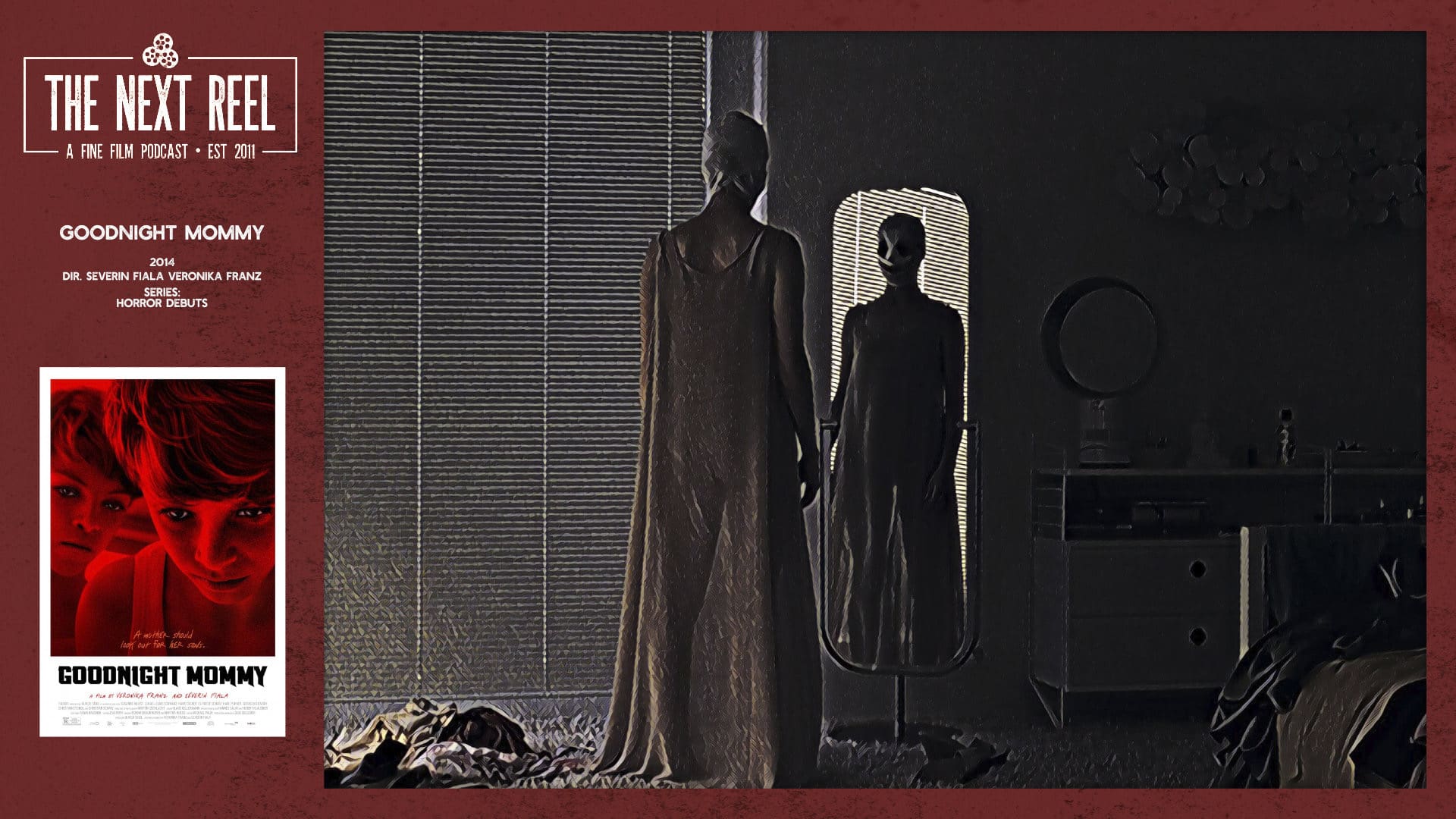
Goodnight Mommy is over. Please prove you’re our mom. Oh, Andy, we’re in our Horror Debuts, and this time we have a debut of… is it an aunt-nephew? Nephew-aunt duo? What’s going on?
Andy Nelson:
I think that’s really interesting, I’ve never heard of that before. Severin Fiala, he is the nephew of Veronika Franz and her husband, Ulrich Seidl. Veronika had worked as a film journalist for a while before, then for her husband, who was a filmmaker — she had co-written some screenplays with him for some of his projects. He did a trilogy called the Paradise Trilogy. She worked on those, she worked as an assistant director. And her nephew, Severin, had gone to film school, and at some point, I think he babysat a lot for their kids and stuff, and they realized how much of a similar passion the two of them had for horror films. And that kind of led them on this path. Although, actually, I should say this isn’t their debut feature film — initially they did a documentary before, but it is their debut narrative film. The documentary they did in 2012, a couple years before this, was about Austrian actor Peter Kern, who was kind of a controversial actor and filmmaker who had worked with Rainer Werner Fassbinder in German cinema, a little bit of a crazy person, and they followed him for two years and made a documentary about him called Kern. And then from that, they went on to make this, their narrative debut, Goodnight Mommy.
Pete Wright:
Alright, well, this is my favorite part of the show now that we’re in this Horror Debuts series. It’s the part of the show where Pete asks Andy to predict whether or not Pete liked this movie. That’s right, it’s a segment called Guess If Pete Liked This Movie. Because, you know, horror movies, they’re my jam now. I’m a big fan of horror movies.
Andy Nelson:
That’s right.
Pete Wright:
So what do you think, Andy, after watching Goodnight Mommy, do you think Pete liked this movie?
Andy Nelson:
I think you definitely liked this movie. I’d venture to say that, you know, you being a photographer yourself, you have a passion for imagery, and the way that Fiala and Franz used the camera in this film with their cinematographer, Martin Gschlacht, I’m gonna guess, I found to be incredibly compelling. My hunch is that something drew you in and worked very well in context of this very horrifying story about a family dealing with grief, I guess we’ll say. So that’s my sense.
Pete Wright:
Fascinating. This is gonna be a great conversation, and I can’t wait to talk to you about you talking about me after this.
Andy Nelson:
Goodnight Mommy was rated R for disturbing violent content and some nudity. Hey, if you’re looking for a way to help us out, just look in the show notes, and if you see an Apple or Amazon link to this movie you can click on it, that will take you right to their site, and you can rent or buy the movie. And when you do this, we get a tiny piece of the profits from that rental or purchase. It’s a great way to help us without having to do anything other than just say, hey, I’m gonna watch this movie.
Pete Wright:
You know what else you can do? Speaking of things you can do for which we get a little taste off the top — it’s merch. We’ve got merch over in our merch store, TruStory.fm/TNRmerch, shirts and stickers and mugs and all that kind of good stuff. All the merch from our last series, the eighties comedy with Coolidge and Heckerling, is now up on the store, and we also have the merch from this series jumping into the store right now. You gotta get your Point Dume shirt. Celebrate the holidays with your Point Dume shirt. Priceless.
Andy Nelson:
We want to hear from you. We’re gonna start including some audio reviews from you, our listeners, into our shows. When you watch these movies, generally try to watch at least a couple weeks ahead, because then you can email us a thirty-second audio file to reviews@trustory.fm. Soon as you watch it, get it sent to us, and we just might showcase it on the show. You gotta remember, get in quick though — we record probably about two weeks ahead of the public release, so make sure you’re getting them to us so we can include them. Again, it’s reviews@trustory.fm.
Pete Wright:
But, Andy, how would I possibly know what movies you’re talking about that far ahead of time, you might be asking. And to which I would jump in and say, Letterboxd.com/TheNextReel. That’s our HQ page, you can jump over there and follow us, and you can see we have a list of all the movies we’re talking about for the entire season. So you can build your own Letterboxd list and keep up with the movies before we talk about them. That way you can send your reviews in. And if you really fall in love with Letterboxd — they’re fantastic, and they gave us a little bit of a code so you can jump in there and upgrade your account from free to Pro or Patron if you use the discount code NEXTREEL. You can get 20% off either of those levels. This works for renewals as well, so for all of you current paying Letterboxd fans, you can get a little bit off the top too. NextReel at Letterboxd.com.
Andy Nelson:
We are doing our semi-annual — semi, you know, every five years or so — questionnaire, trying to get some feedback from our listeners as to what’s working, what’s not working. We’ve been making some changes to the show, and we’d love to hear from you as to what you’re thinking. Just go to TruStory.fm/TheNextReel, you’ll see a big questionnaire button right there at the top of the page, click on it, fill it out. We really appreciate it. And to top it off, one lucky listener who fills out the questionnaire will get a free year of membership. This applies to people who aren’t members yet, and it also applies to people who are already members — we will just extend your membership for a year. Get it in, it’s gonna be up there for a little bit longer. We appreciate it.
Pete Wright:
Quinquennial, I think is what it is. The quinquennial questionnaire.
Andy Nelson:
That doesn’t even sound like a real word.
Pete Wright:
It’s a real word. Every five years — I think the last time we did it was probably about five years ago. I say we lean in on the quinquennial questionnaire. It just feels good.
Andy Nelson:
Weirdly, it does sound alliterative, I guess, is what I’ll say. Hey, we need your support. We don’t sell your information. We’re trying to make a show that relies on member support to continue growing, so that you don’t have to worry about all these different companies that are getting all of your information. We don’t like that. We just want to have a show that feels at home and safe. So to do that, we need your support to become a member.
Pete Wright:
Members get to vote on our weekly Saturday Matinee polls to choose the list topics for the movie we’re talking about this week. What is it this week? Charming, elderly people?
Andy Nelson:
Cantankerous and cute senior citizens.
Pete Wright:
Oh, cantankerous and cute — so charming. They’re not charming, I think, is the most important part. If you were already a member, you’d be in there voting on Goodnight Mommy right now. You’d already be there voting. But if you’re not a member, you don’t even know where to go.
Andy Nelson:
Members also get early access to all of the episodes that we release, and all sorts of bonus episodes. We’ve got just such a variety of bonus episodes, I feel like almost half of our output is bonus episodes just for members. That is a huge perk.
Pete Wright:
It’s a huge perk, and our ideas for bonus things tend to outpace the growth in membership, which isn’t good for us. We’re doing a lot of stuff over here. We could really, really use your help. I don’t mean to beg, but if I need to get down on a knee, I’ll do it. Like, for example, our Retake series is out. We’ve got our monthly Flickchart re-ranking episode, where we do just kind of clean up our Flickchart list. If you miss the Flickcharting that we used to do in the main show, that’s where you find it. And we’re Flickcharting by series in our Retake episode — that’s another brand new thing. That didn’t exist last year. It’s a new thing for members.
Andy Nelson:
The Retake episode, we’ll talk through the entire series — it’s basically kind of a step back to look at the whole series once we finish it. That’s only for members. So if you wanna hear that episode, you need to get your membership. We also do a monthly member bonus episode that fills in a gap from either a current or a past series, and those are always fun. It’s a nice way to kind of jump back to stuff we’ve talked about in the past, or add on to something we’re looking at right now.
Pete Wright:
We livestream this to an unlisted YouTube stream every time we record, and members are sent that right before we record. But you don’t have to be able to show up right when we record it to watch it — if you wanna catch up with the show as we record it, become a member, you’ll have those links, and you can jump back and watch any of the livestreams as they were recorded. Completely unedited nonsense, lots of stuff that was cut, and it might actually be an incredibly boring exercise. But it’s there for you as a perk.
Andy Nelson:
We also have a great Discord community of film lovers who love talking about movies that they watch and sharing their thoughts with each other. We also have, in that Discord community, some channels that only members can access, and those members are able to have conversations with just other members. It allows for a place that feels more your own, and that’s something you get when you become a member.
Pete Wright:
And now members also get stickers. I’ve got stickers right here, a big stack of stickers ready to put in an envelope with your name on them. Just sign up, become a member, you’ll get a handful of stickers right in the mail.
Andy Nelson:
We all love stickers. Best of all, this whole thing that you just sat here listening to — you don’t have to listen to this anymore. That’s a big perk right there.
Pete Wright:
That’s the biggest of all. TruStory.fm/TNRmembership to learn more about our membership tiers. It’ll cost you $5 a month or $55 a year. Again, TruStory.fm/TNRmembership.
Ad:
Meet Xenia. You are being very polite to someone who is attempting to kill us. Her wife, Saffron. You can plan all you want, but what matters is what you do when your plan falls apart. And their best friend, Goldie. Glad we didn’t miss all the fun. Swords in hand, they defend their city from the worst of humanity. I am Lord Buxton Blue. Vicious Swa. The Franconian Rake. Herr Hague. Equity Electric. Follow their adventures on the Swashbuckling Ladies Debate Society audio drama podcast. Available now at trustory.fm/swashbuckling.
Pete Wright:
Oh, Andy. Oh, sweet, sweet Andy. Goodnight Mommy — how’d it do for you?
Andy Nelson:
I loved it.
Pete Wright:
You know, I’m torn on this movie, because — you described, in our game show segment, “all things that were true save one” — and I’m excited to have this conversation with you, but I had to withhold some of my notes from our document and only put the loving things in there, because everything you said was awesome, right? I adore the camera in this movie, I thought it was gorgeous. It was just gorgeous. And the production design, and the house they picked, I loved everything about that. Every shot was luscious for me. And the lines — I mean, they just have such attentive production design and cinematography in this movie. So in that regard, it was wonderful. I thought at points that I wanted it to be like that ride at Disney World, Soarin’ California — you know, the one where you’re looking — yeah, that one. I wanted that in this location. I thought it was just that beautiful, I wanted to be moving through it because it was just luscious. And so that was all great. We should say from the outset, if you’ve never listened to the show, why’d you start with this episode? We do spoil the movie. And this is one that if you haven’t watched, you might wanna actually go watch it before I say anything more. So now would be the time to move along. Move along right now.
Andy Nelson:
Right now, we’re about to spoil the whole movie for you. The whole movie. Yeah.
Pete Wright:
Okay, and now I shall begin doing it by saying, I feel like I was spoiled so soon in the movie. I knew it. I knew the whole movie at… I don’t know how far in is the juice box scene? Ten minutes? When she’s pouring the juice, I thought, oh, I get it, there’s only one brother. That’s what’s spooky about this movie. Thank you.
Pete Wright:
And once I had committed to that line, I watched the movie like a jerk, and so I found so many of the shocking things that come later in the movie a punchline to what is otherwise such an austere narrative that I was kind of bored. It is a gorgeous movie that I was unmoved by, and that hurt my own feelings. I didn’t wanna be that guy, but I was generally unmoved. I hang my head in shame.
Andy Nelson:
It’s an interesting reaction to have, because I was right there with you — I figured it out way too early on. I don’t know if it’s the fault of the filmmakers or the fact that I’ve seen too many horror movies involving twins, because so often the case is one of them is not really there. So it really, I mean, very early on — even in some of the early shots when it’s just the two of them walking through the corn and stuff like that — the way that the camera would position itself sometimes, where you’d see one brother and then the camera might turn in an interesting way to then, all of a sudden, oh, we’re actually following both brothers. I started asking myself, are both of them here, or is it just one of them? And then by the time we get inside and mom is serving drinks and Elias says, “why didn’t you give Lukas anything?” — mom answers, she said he didn’t ask or something like that.
Pete Wright:
Yeah.
Andy Nelson:
But I immediately was suspicious. She had only set one plate. The whole thing was set up in a way where I pretty much knew also. For me, that didn’t spoil anything, because then I was able to step back from the idea of a surprise — that there is only one brother — and look at it as a study in the psychology of this kid who clearly is in a place where he has created his twin brother as still being alive, as a coping mechanism.
Pete Wright:
Like an avatar for his grief.
Andy Nelson:
Right. It’s a coping mechanism to kind of still get by all of the trauma that has gone on in his life. So for me, it became this interesting exploration in the psychology of the situation, and why he was acting the way he was, why mom was acting the way she was. And I found it to be equally as thrilling as it would have been if I had been surprised. And I will just say, I watched this with my whole family. I was the only one who actually caught on that the brother was in fact dead, so for everyone else it was a great big surprise, which allowed for a great conversation afterward. But I did find it interesting that for all of us, it still was a very effective film, even with me figuring it out ahead of time.
Pete Wright:
I think that’s fantastic. First of all, that it was not a surprise — I think that is, I guess, the curse of watching too many movies. So it’s fine, that’s our cross to bear, for sure. I wonder — I started wondering if I could change my perspective on the movie, and as I’m watching it, thinking, okay, what if the filmmakers did not intend for that to be a reveal? What if they were making it for me, and they knew that I would already, like you just described — what if they intentionally knew that I was already gonna figure it out so early on? Does that change the tone of the movie? Does that change the lens through which I watch the movie? I think it potentially could. It didn’t, and I’m open to watching it again, because the experience of watching it was gorgeous, I just got tired of it too early. And by the end, I don’t think I was completely bought in to the way the boy was acting as believable. I’m not connected with A, B, C, leading to G in a believable manner. It felt a little bit sudden, many of his moves — they were too sudden for me, and so I struggle with that. But does it change if I go in as a knowing observer? Does it change that second viewing? I’m really curious about that.
Andy Nelson:
Well, and I think that’s interesting, because, like you, I had similar thoughts. As I was watching this, I started thinking, were the filmmakers intending for me to figure this out so early?
Pete Wright:
They sure showed their cards fast, right?
Andy Nelson:
Well, it felt that way. It felt like it was played pretty early. But then I was able to watch it, and I’m like, you know what, I don’t think they did, but I can see how they were designing so many pieces in here. It’s kind of that sixth-sense factor, where you want to be able to watch it after the fact and still see that it all works. Like, mom is only ever interacting with Elias.
Pete Wright:
Mhmm.
Andy Nelson:
She’s never interacting with Lukas. So to that end, it worked really well. But it does make you kind of look at it and question, as you’re watching — is this actually working? What in here, are they slipping at all? And why am I already in this place where I’m thinking about all of this? So to that end, there were elements where I’m like, well, maybe they could have found a way to work it a little better, but I guess I just ended up buying into it, because I found it to be — well, there were a couple things. I found it to be a really interesting exploration in grief, especially in a situation like this. I just wanna talk about this now, because this whole idea of lullabies and comfort for children is obviously such a huge element of this film. We start with — I’m guessing it was a German TV show of some sort, I don’t think it was something the mom had done, as we find out later she was like a TV hostess — but it was some old German show. The woman is singing “Lullaby and Goodnight” to a group of children. Later in the film, the boys are watching, on a video camera, an old video of their mom singing them their favorite lullaby — this was before she had gone for her plastic surgery. And at one point we hear Elias playing it on the piano. The idea of a lullaby is something that is a parental thing that the parent provides for the kids, to calm them, to make them feel safe and comfortable before they go to bed. The title, at least the English version of it, Goodnight Mommy, it feels like it has a little bit of that feel. And I feel like there’s this sense of this brother who is so broken by the loss of his brother that he needs this comfort desperately. Up until the point where mom left for her plastic surgery, she had been providing that for him — she had been setting the table for Lukas even though he wasn’t really there anymore, providing comfort for him that gave him the stuff he needed to kind of still survive in some way. Why he wasn’t in grief counseling, I don’t know, but it is what it is. Obviously the parents also went through a separation because of the accident, so there was a lot of stuff going on in their lives. But I think it’s interesting that this is a kid who needs this. He absolutely needs a coping mechanism, that he’s created Lukas in his head. His mom has been going along with it. And then she has this plastic surgery, and it puts her in a place where she’s not in a space to provide that comfort anymore. I’m sure she’s dealing with a lot of pain and difficulty going through the surgery, having herself all bandaged, feeling different, looking different, pain constantly, all of that sort of stuff. And this kid still needs the comfort, but is no longer getting that lullaby. And I think that’s what kind of pushes him over the edge and breaks him. So because of that, I am able to kind of buy into everything that ends up happening in the film. It certainly is extreme in every sense of the word, what this kid ends up doing to his mother. But in a world where this kid needs this comfort, it’s almost like instead of a lullaby, he’s now getting a Grimm’s fairy tale at bedtime — this mom who’s acting different, walking around bandaged all the time and not really being there. She’s almost like a monster. I found it to be such an interesting twist on the way that lullabies comfort, and what ends up happening when this kid ends up getting something much darker instead.
Pete Wright:
Yeah, I really like that perspective, and I totally get it. And I think when you look at it from the mom’s side — well, I should take a step back, I feel like the movie is trusting me as the viewer to fill in a lot of holes, and I like that. I like that experience, it’s not spoon-feeding me anything. For example, my take is that there was this accident, but why did the mom need plastic surgery? Why did she leave for plastic surgery? In my head it was something related to the accident — that there was something she had to have done rehabilitatively, or something. That felt to me like a connective piece to the accident where Lukas was lost. And so she is demonstrating her grief too, the way she walks through the house, the way she’s sort of surgical in her movements. She’s grieving as well. And when you look at it — this could be an example of when these two grieving partners are not looking out after one another. She is, in her grief, abandoning Elias when he very much needs it, and there is a price to be paid for that. And so I feel like when her bandages finally come off and she opens the door to his bedroom and says, “well, what do you think,” after the boys have already started saying, “prove you’re our mommy, where’s our mommy” and they don’t buy it — her demeanor changes pretty dramatically once the bandages come off, you can kind of see her turn around a little bit. She’s trying to reconnect, but by then it’s totally lost, and Elias is gone for her. So I like looking at it that way, that I have to be able to rationalize her grief too, because I’m a parent. And so I’m on team mom the whole time. By the end of the movie, I’m… he’s a bad seed.
Andy Nelson:
Rough. Well, I mean, he certainly is going through things, that is for sure. But team mommy, on that side of things — she’s not providing for him anything. He is clearly grieving, and she’s not helping. She’s not saying, you know what, I’m going through a lot right now, I hurt all the time because of my face — let’s get you over to dad’s. That’s never an option. I don’t know why.
Pete Wright:
She comes home, right, at the beginning of the movie, and he’s just hanging out alone. Where’s — what sign is there that there has been a caretaker with them? Did I miss it? Did I miss a babysitter? No.
Andy Nelson:
Yeah. It’s a little peculiar.
Pete Wright:
It’s so peculiar. Like, of course this kid has gone completely wild — he’s like, “where’s the conch,” you know, he’s gone feral. She’s been gone, and he’s been grieving. So you can make the case that he was already lost before she even came home. So it’s rough. And I think that’s one of the pieces I think is set up maybe poorly in the script — that we don’t have enough structure around this family to believe where things went wrong. And that’s one of the pieces I don’t connect with, because you’re absolutely right, she’s not doing her part, but where’s dad? Should we know — she’s talking to people on the phone, where are the other sort of resources that come into play? At least tell us. At least tell us why there’s no other framework, because if I’m left to fill in the holes, it just looks empty.
Andy Nelson:
It looks a little strange. But to that end, it could be that we’re so focused on kind of the children’s perspective that maybe there was somebody at the house, we just didn’t see them when mom comes home. Who knows. But again, it might have helped to just have even hints of that, so we had some sense of, oh, there had been a structure here, we just — it didn’t matter to the kids that there was a structure there. Another element that does confuse me a little bit with team mom, and this really troubled my family, was when mom walks out of the house — naked into the woods, or not naked, but she kind of takes her clothes off as she walks. And then we hold on her face, and the camera does this thing where basically it goes into kind of fast motion, and mom is moving her head around, but at a speed that is insanely fast, and it looks like it’s just this blurred thing. We can’t tell what her face actually looks like as she moves it in this horrific kind of way. It’s an interesting element to include. I just assumed they went into fast motion as mom was kind of stretching her face and remembering what it was like to just be a person, not all bandaged up. But I can certainly see why, like, my family, as they were watching, thought she was actually some sort of a monster creature. They said, “oh, she’s not really their mom, something else is actually going on with this person here.”
Pete Wright:
Yeah, that’s a great point, because there are definitely enough supernatural twists, like hints in this movie — that being a big one — that you can imagine why it’s so hard to look at the movie through the lens of grief. It really does look like she’s been replaced on that first viewing.
Andy Nelson:
Yeah, it’s a strange — what are the other moments that you would say felt like there was a supernatural element?
Pete Wright:
Well, it’s mostly around the Lukas appearing, disappearing, camera tricks, that sort of stuff. I feel like if you don’t already know about the brothers and then you see this thing in the woods, it’s hard to look at the thing in the woods metaphorically. It looks like a literal exercise in some sort of supernatural possession. And so I can totally see why, by the end of the movie, that’s very confusing. And I think you could make the case that, given all of the things that the boys are telling her at the end — like, where’s your mole, and all this stuff, all the things that are inconsistent that the boys are rightly picking out — you can kind of make the case that she was replaced even up to the very end of the movie. I could totally see somebody making that case, and they wouldn’t be wrong.
Andy Nelson:
She doesn’t know Lukas’s favorite — well, I guess her, his favorite lullaby. She puts on a fake mole just to — I mean, I can see that, like, later from her perspective, she’s trying to provide them with some sense of comfort, the fact that she used to have a mole, so she puts it on there before they wipe it off and she’s like, “well, they had to remove that.” Which I thought was so interesting, because she’s—
Pete Wright:
—hoisted by her own petard, I know.
Andy Nelson:
Exactly. So it’s a very interesting element. Another interesting element that I found was the cat. The whole idea that they go into one of the creepiest cellars I’ve ever seen. Who is actually taking care of this cellar? Why is there a cellar full of people’s bones? I don’t know what’s going on here. I was thinking maybe it was some sort of a crypt.
Pete Wright:
I don’t know. I thought it was related to Nazis, I thought it was a Nazi, like—
Andy Nelson:
Well, it was a chamber — cemetery, like, they walk through the cemetery and then they come upon this type of cellar. And I was like, maybe this is where they put bodies at one point, that were kind of homeless or unidentified, and they just kind of kept them in there.
Pete Wright:
I don’t know. Bodies.
Andy Nelson:
It’s a creepy, creepy place, and I don’t know why it would be an unlocked door to get into a place like that. But they go in because they hear a cat meowing, and they find clearly just an unhealthy cat that they decide to take home and keep for themselves. And then this cat — question mark — dies in their house. Or did mom kill it? Which is kind of what they think, that she found it and killed it and hid it behind the furnace. But it’s possible, like, after you watch the movie, did they kill it and come up with this whole thing? What actually happened to this cat? Or did it just die because it already looked pretty unhealthy?
Pete Wright:
It looked pretty unhealthy. I think you could make the case for any one of those three paths. I think you could. To me, the cat died — it went and crawled away into a dark place and passed away of natural causes. That’s what I saw, and Elias told a different story in his head. And then I don’t, for the life of me, understand why he took the next actions that he took. He put it in the glass case — like the fish tank — and filled it with water, like a weird art project. I don’t get it.
Andy Nelson:
Yeah, well, he’s trying to push at his mom, or at this creature that he thinks is his mom — he doesn’t think it’s mom at this point, and he’s testing her. He thinks that she killed it, and so he’s basically putting it on the table in the living room as a showcase, saying, “I know what you’re up to.” And she, obviously, doesn’t take it that way — she thinks that he is dealing with his own issues in a really dark way. But again, this is one of those moments as a parent when you say, I need to take my kid in for some counseling. You don’t ground him and put him in his room for doing that. And then you also don’t leave it there — it is there through the rest of the film, and I’m very unclear why they decide to leave it there.
Pete Wright:
Because she pours the cockroaches on it — that’s what she’s pouring into it, right, at the end?
Andy Nelson:
Yeah, she’s drowning the cockroaches, which makes them come out. But then later, it is still there, and they pour the gasoline in there and light it as part of their whole thing when they’re getting ready to burn the place down.
Pete Wright:
I can’t even — I can’t rationalize that set of activities. That’s one of those things that is just, I don’t understand how you got there from here. And the mom would end up being like — if, in my head, she’s still mom, and she’s misunderstood because of her own grief — but then why does she… it’s such a petty thing to start putting the cockroaches in the dead cat water. I don’t understand why she would possibly do that, to your point. That’s the place where you call in external resources, and I think making the case that she’s so grief-stricken that she can’t call any outside support is beyond credulity for me.
Andy Nelson:
Well, and so this is what I find interesting, because I don’t know — maybe I stop worrying about how much I buy into some of those elements, and I just say, okay, it’s a decision that she makes. Clearly she’s in a place where she’s in a lot of pain. We’ve seen her unwrap her bandages — Elias was watching as she was unwrapping her bandages, and you could see from behind how puffy her face was, her eye as she turns to look is incredibly bloodshot. She is a very broken woman trying to find herself again. So I imagine she’s on painkillers, going through a lot as she’s trying to heal and deal with the pain of having her face reconstructed in some capacity. So I can see, to some extent, being the sole caretaker of this kid who’s just acting out and doing all sorts of crazy stuff, getting incredibly frustrated and doing this as a way to say, “stop it, it’s the wrong thing to do.” It’s not good parenting, I’m not saying any of that. But what I am saying is that it makes for an interesting character moment, that further pushes him to believe that his mom, who was this caring woman who would sing lullabies and talk to his brother and all this sort of stuff, she’s past that line, and she’s like, “I’m not gonna play these games with you anymore, I’m not gonna keep saying that Lukas is here, we’re moving on.” I don’t have it in me to do it right now, because I’m in so much pain and I just want this to stop. And for me, I’m able to look past any sense of “but why didn’t she call somebody,” “but why would she be so vengeful to pour his cockroaches into the water” — all these things, and just kind of go with it. So for me, I found it to be just interesting. I can still see the problems with it, but I was able to more easily go along with it.
Pete Wright:
Well, and I think part of the challenge that I have with it is that — and I’m all about believing in fantastical things in the second, third act of a movie, if the first act sets it up well enough, gives me something to buy into, to believe. But if this movie had me questioning so early in the movie, I just got into a habit of questioning through the entire thing. And by the end I’m like, okay, they’ve glued her to the ground, now they’ve lit her on fire — I couldn’t get there from the first frame of the movie. As much as I really enjoy the filmmaking of it, I didn’t enjoy the storytelling as much. I enjoy thinking about it, and the discussion of the relative perspectives on grieving, much more after the movie than I enjoyed actually watching it. Because I just wasn’t in your headspace, I just didn’t get there. Okay, so — when do we talk about the Red Cross people though?
Andy Nelson:
Well, not yet, not yet. I wanna talk a little bit more about this exploration of this family because I think it’s interesting. So we have a point where the two brothers — we’ll just say it’s two brothers for the time being — they decide she’s not her mom, we need to figure this out. And they tie her to the bed while she’s sleeping, they tie her to the bed, make it so she can’t move at all, so they can get information out of her and try to prove, one way or the other, that she is or isn’t mom. Lukas, of course, is the broken part of Elias’s brain saying she’s not her mom, she’s an impostor, and we need to call this out. And we start seeing the cracks in what’s going on here, because Elias gets to this point where he’s starting to beg her to, “come on, just please tell us you’re our mom, prove it to us.” I mean, at that point, had they already tied her to bed — I can’t remember at this point in the conversation, had they already taken the magnifying glass and burned a hole in her cheek? I can’t remember. At this particular point, before we get to the end — are you buying into what’s happening at this point?
Pete Wright:
The extreme interrogation techniques? That’s part of the problem, is that I’m emotionally not. I’m not believing that this kid goes that far, and I know I have to be able to suspend that disbelief to buy into the movie. And because the movie didn’t set me up well enough in the beginning, I couldn’t. Now, if I get rid of all of my reaction — because I belabored that too much in this conversation — I think it is an intense sequence, and it’s set up well, just in isolation. And I think if I were to watch a clip of it, starting from that conversation where he’s just sort of begging “please prove you’re our mommy,” to when they go the extra mile and start doing the magnifying glass on her face and she’s screaming like that — and there’s this strange thing where they put something in her mouth and start, like, flossing it somehow. I don’t even know what they were doing with her face there.
Andy Nelson:
They were cutting her gums. They held her mouth open with like a stick so she couldn’t close her jaw, and then they took, I’m assuming floss or some sort of thing, and they were putting it between her teeth and cutting into her gums. I don’t know if they were trying to remove her teeth or just cutting her gums.
Pete Wright:
What comes up with that? That’s like the weirdest torture I’ve ever seen. I’m gonna pain-floss you. I can’t even with that. But it’s just horrible, and it actually feels kind of childlike — like, “this is a thing I hate doing, so I’m gonna do it real hard to you.” I could buy that, I could make that connection. So I feel like it is an intense sequence, and in isolation it’s… ugh, it’s revolting, in the right ways. How about that?
Andy Nelson:
Well, I mean, yeah, because it gets to a point where — this is where Lukas comes in, because she’s talking to Elias saying, “just come on, I’m your mom, let me out,” and he’s starting to buy it, he’s starting to think about cutting her free. And that’s when Lukas comes in and starts pushing — he’s like, “what are you doing, ask her what her favorite song is, or what my favorite song is.” And that’s where he starts pushing, and she gets things wrong, and it completely works against her, because that’s when they tape her mouth shut, and it just kind of goes from there to the point where eventually they glue her mouth shut, which is horrifying, only to have to cut it open later to talk to her some more. But it’s a kind of horrifying evolution of what they do, leading to all of the stuff at the end. I think what happens here is — that’s probably about the point when she doesn’t know Lukas’s song, she’s put on a fake mole, and I think he’s kind of crossed the line of, “you’re not my mom, you’re an impostor, you’ve either done something to my mom or have her somewhere, and I have to prove that, because I need my mom back.” And I think for me, I’m able to buy into all of the crazy path we end up going with at the end, because he’s in this place where he’s trying to get his mom back, and he doesn’t think this person is her. So if it’s not his mom, then in his brain he’s like, “I’m doing what I have to, to get my mom — to find out what happened to my mom so I can get her back.” And I don’t think he intentionally sets her on fire — he sets the blinds on fire, he sets the couch on fire, he sets the tank on fire. And then all of it leads to mom bursting into flames when the tank bursts and the whole house going up. It’s crazy, but in my head I’m able to ride that train with him.
Pete Wright:
I wonder — and this is only in hindsight, I didn’t think about this at the time — but I wonder, because I’m so firmly on team mom, if actually she does know the favorite song, and in fact it’s Elias who doesn’t know the favorite song. She’s the mother — it is quite possible that she knew it more than Elias did, and he just is so wrapped up in his own narrative at this point that he just goes the whole distance.
Andy Nelson:
That’s entirely possible. It’s interesting.
Pete Wright:
There are a few things, again, that take me out of it in that last sequence — if he’s really not there, what is happening when Elias takes an arrow out of his belt and gives it to Lukas, who is not there? Does the arrow — is he actually taking the arrow out of his belt and handing it over, does it disappear there, can nobody else see it? Because at that point Lukas takes the arrow, puts it in a little crossbow, and is holding it over mom at that point. That’s then tested when he takes the candle and is standing over by the curtain, and Elias says, “what is Lukas doing right now,” and she says, “I can’t see him.” Then Elias goes over and takes the candle from Lukas, and takes — what’s happening to the candle? Is the candle suddenly in Elias’s hand? Suddenly everything’s on fire. So somehow fire transitioned hands in there. So I can also see why, if you’re not in the movie like me, those things end up being things that you poke at, and I can totally see where if you’re in the movie, that’s not even a question.
Andy Nelson:
It’s a Fight Club scenario. It’s like, how much of this is in his head? For me, it’s like the character of Lukas is in his head — when Lukas is holding the crossbow, that’s all in Elias’s head, and Elias is there with the crossbow, which probably speaks to — and again, she throws the blanket on them to get away. But again, when she actually does see them and she runs, and they’re at the top of the staircase, there’s no arrow getting shot at her or anything like that. I feel like it’s all in his head, and he — yeah, I mean, he was lighting stuff on fire.
Pete Wright:
The candles, fact all over the place.
Andy Nelson:
Yeah, so I just think he picks one up and sets it on fire. I don’t think there’s a problem with that transition from hand to hand. It’s not like there’s a floating candle there or something. I kind of buy into the whole thing that it’s just all in his head, and he’s seen everything that his brother’s doing. I get that.
Pete Wright:
Okay, now — Red Cross people?
Andy Nelson:
Oh yeah, because this is what leads to mom’s mouth getting glued shut as opposed to just taped shut. It also shows us just how soundproof their house is.
Pete Wright:
Amazingly soundproof, so much glass. It must be triple, quadruple-pane glass in that house. I’ve never seen any Red Cross people so aggressive in my life. They just walk in that house — they open the front door and walk in. “Hello? Hello?”
Andy Nelson:
“Hello?” Focus, guys.
Pete Wright:
“Hello, hello.” There is a massive cultural disparity between me and those Red Cross people. That is not okay at all — if there is no door on the house, it’s not okay to just walk in.
Andy Nelson:
It was very strange — their whole logic and reasoning of, well, the door is open, so someone’s home, so we’ll just wait for them. It’s like, who are you people? Never is this an okay thing, especially the Red Cross. Just because you’re the Red Cross doesn’t give you the right to kind of trespass because you’re, quote, a good person. It was such a strange thing, and all of us were like, what are these people doing? And then the fact that they’re totally okay sitting there with a young boy while waiting for his mom to come home — that, everything is wrong with that scenario. You don’t do that. Super weird, and it was the strangest of scenarios. I don’t see anything wrong with the way it’s put together story-wise in context of the film, but from my perspective, I was like, who are these people? If they ever did this to me, I would be calling the police.
Pete Wright:
Well, and here’s my problem with it story-wise, and it allows me to talk about my favorite concept in all of storytelling — is it Watsonian, or is it Doylist? You know what I’m saying. If it’s Doylist, this is coming from the perspective of the screenwriter, who’s pushing something into the story because they need it to build to something else that comes later. If it’s Watsonian, it’s happening in the story because it’s driven by the actual narrative itself, and it makes internal sense for this thing to be happening. And my perspective on this is that the Red Cross people walking into the house and sitting at the table is Doylist. This is the screenwriter saying, we have to have these people in the house so we can build toward the intense moment when mom breaks the tape and is able to scream and have the Red Cross people just barely out of the house and not able to hear her. We need all of them in the house to build tension — will she only get help? We need it. And it doesn’t make any other sense to me, internally, beyond that. Now, if I am completely wrong, it’s because I am so culturally shocked that people just wander into the house. If that’s a thing that happens in Austria, I stand corrected. But the way I look at it, this felt manipulative on the part of the screenwriting and not on the part of the narrative.
Andy Nelson:
And I think the logic is completely sound, I don’t see any issue with what you’re saying there.
Pete Wright:
And what if you call the Red Cross, to that — what your people are doing.
Andy Nelson:
To that end, I mean, yeah, it certainly makes me look back at it and question it some more. It’s like, well, that is pretty manipulative, to create the scene that way just so it allows for more tension to arise. It would have made more sense if it had been, to that end, the priest — if they had run into town to tell somebody, “our mom’s not our mom,” and they talked to the priest, who takes them home, not to the police, which makes sense, that’s what he should have done. “Hey, I found your kids.” And then mom has — she says something, he’s like, “what was this all about?” I can’t remember what she says, like he’s still dealing with the grief of the accident.
Pete Wright:
This has all been a bit much, right.
Andy Nelson:
Right.
Pete Wright:
Which calls to tone, right, that the priest probably knows — this feels like a small country kind of village sort of place, right, that the priest, I’m sure, knows everything that has happened.
Andy Nelson:
Well, although it does feel like she is new to town — it feels like they had not really lived here much before, it was a little unclear. But again, this speaks to the way the story is put together, where we’re not necessarily given all of that information, we’re just kind of left to divine it from the story as it goes along — how long have they been here, things like that. To that end, I was totally fine with all of those elements, I thought it was pretty interesting the way it was put together. But it leaves these moments, like, what is the story with the priest, has he talked to the mom before? She doesn’t say much, but just references, you know, it has been much, dealing with the accident and the separation. So you get that sense. So it is pretty interesting.
Pete Wright:
It is really interesting.
Andy Nelson:
But that would have made more sense, to have them talking to the priest. I guess that was my point.
Pete Wright:
It’s a great point. And talk about a character that is underused for the narrative — it just makes so much more sense for me to have the priest somehow asserting himself a little bit more. So I filed that under missed opportunity.
Andy Nelson:
Now I have a question for you. The title in German — I guess it’s High German, which is the dialect of German they speak more in Austria — was “Ich seh, ich seh,” I’m not sure if I’m saying it right, but that’s the title in German. When you have that as the title, does that change how we read or see the film? Do you get anything different from that as the title, or does it not change anything at all?
Pete Wright:
I don’t know, I guess maybe it’s sort of leveling up the twin factor. And I guess this is related — forgive me if it’s an aside — the picture that they find of her and that other woman dressed like her, she was a twin too, right? Is that what you get? They ask, “who is this woman,” and she demurs a little bit and says, “it’s just a really good friend, we used to wear the same clothes.” But to me it seemed like a parallel that was playing out there, that she somehow had a twin and maybe somehow lost her.
Andy Nelson:
I didn’t read it that way, I thought it was a friend. I could never see the picture close enough to identify if they completely looked the same. But my sense was the kids thought it was this other woman, not their mom, who had taken over mom’s place.
Pete Wright:
Well, and that’s yet a fourth potential narrative — that maybe it was a twin, her twin that came back and took over the thing. So lots of different possible ways. Anyway, I felt like “Ich seh, ich seh” is more of a play on the twin relationship and what we are supposed to, as the audience, see, and I prefer that. I don’t like the title Goodnight Mommy, I think it’s dismissive of what’s actually going on in the story, and it’s lazy. It’s lazy retitling.
Andy Nelson:
I don’t have an issue with it — I kind of like the English titling, because at least it does have a sense of this whole lullaby connection that I was talking about earlier. So to that end I kind of like Goodnight Mommy. Maybe they could have done something more with lullaby in the title. But “Ich seh, ich seh” is an interesting title, but I don’t think I get a lot out of it other than, as you said, there’s kind of perhaps a twin factor, but it doesn’t tell me anything about the story. So I guess I end up not being completely sold on either of the titles.
Pete Wright:
I think Mommy Dearest has the corner on the word “mommy” in the title. I just don’t like using “mommy” in the title. I don’t know, I think it’s—
Andy Nelson:
Goodnight Mommy, as it was in England? Yes, Goodnight Mommy.
Pete Wright:
So, no.
Andy Nelson:
Yeah. What did you think of the twins though — Lukas and Elias?
Pete Wright:
They’re great.
Andy Nelson:
Do you like them?
Pete Wright:
Yeah, I think they’re terrific. I think they were great, and I have no problem with any of the casting, but I think the twins had a heavy load to carry, and I think they did great.
Andy Nelson:
Yeah, Susanne Wuest, as the mother, or Mutter — I thought she was really great, especially having to go through half of the film with bandages on your face, that’s quite a challenge, I thought, that she pulled off quite well. It’s interesting, speaking to the casting of the twins — Veronika and Severin actually had narrowed their twins down to three potential pairs, and in their casting sense, they really felt like whichever one they picked, that’s gonna really shape a lot of how they treat them in the story and what they show them doing. So they really thought about it — there was a smarter pair, but they were less athletic, there was a pair that was more athletic but seemed a little more devious, and then there was this pair that we got. Thinking about the other options and what they would have provided for us, I really feel like they picked the right pair. I like the way that this pair plays everything, because I don’t feel like they’re too devious. I like the fact that they’re outdoors doing stuff all the time, but they also seem very clever. I thought it was really smart casting with this pair of twins.
Pete Wright:
Well, and I think it would have been easy to go with a more devious portrayal, but that also gives away too much, or maybe masks some of the more significant issues of the psychology going on, and it just makes it about evil kids, and you don’t want that, right? You want to walk away being able to talk about it and not just “bad seed” it.
Andy Nelson:
Right, exactly. A lot of great moments throughout the movie between the kids doing stuff like having burp fights, and actual fights where—
Pete Wright:
—they’re fighting—
Andy Nelson:
—fighting, where you’re seeing what hurts, things like that.
Pete Wright:
Mhmm.
Andy Nelson:
Swimming in the lake. What is that blobby, hard mud stuff that they’re walking on at one point? I was like, is this a real thing? I don’t even know what it was.
Pete Wright:
No.
Andy Nelson:
But it was such a peculiar environmental thing that I’m assuming was really there, that they just captured because it was there. I was mesmerized watching them walk on this giant blob of, like, hard mud. It was really weird.
Pete Wright:
Yeah, there is a lot of weird going on in their homeland. It was a lot of wonderful exploratory stuff, and, again, captured so beautifully. I love the way they captured the lake, the low angles on the surface of the lake as the ripples are going through the pond. I thought that was just beautiful.
Andy Nelson:
Well, the cinematography throughout really set up this world so perfectly. One of my favorite moments was when they’re walking through the corn, and it’s a high shot looking down on the corn, and you only see a little pocket of movement here and then there, and as you realize later, you’re like, oh, it’s just one kid walking — but the way they set it up is like, well, there’s one thing there, and there’s a thing there, it could be two kids moving opposite each other. So they set it up in a really clever way, and even when you get in there, you see just one kid walking, and then the way the camera moves, suddenly you’re like, oh, there’s actually two kids there. I didn’t see that, the other kid, at first. It’s really clever, just the way they constructed so many of the shots throughout the film.
Pete Wright:
I don’t know how — it was just really beautiful, beautiful photography.
Andy Nelson:
No, I mean, it’s an interesting film, I really enjoyed it. I see so many of the problems that you have with it, it’s all there, I don’t have any complaints about them though. And that’s what I find interesting, is I’m able to just kind of go along with it and see this dark, twisted story about this kid who can’t deal with his grief, and it takes him down this dark, dark path. Let’s talk about the end real quick before we wrap up, because I found that to be interesting. He accidentally sets the house on fire, and as we saw, he had locked all the doors. I don’t know if he doesn’t know where the keys are or what, but as we get to the end, and we see mom burst into flame, we cut to later, when the fire trucks are there putting the house out, and it’s a wide shot, and we see in the back of the house a woman in a dress kind of walk out and then walk off into the woods. And as we come to join her, we see that it’s mom, and it’s her ghost, I guess, her spirit, and she joins both of her kids out there.
Pete Wright:
Right. So the way I watched it is that Elias got exactly what he needed psychologically, which is he is now living with his dead brother and now his dead mom, and it’s the perfect version of both of them. But the way you just said it made me think — did Elias die too?
Andy Nelson:
Well, that’s what I’m getting at, because I’m like, maybe he also died — maybe he couldn’t get out of the house because he had locked everything up, and who knows where the keys are at this point, but maybe he’s trapped in it and maybe he dies too, and now it’s the mom and the two sons, reunited together.
Pete Wright:
Which is exactly what he wanted all along. That’s unsettling. Speaking of unsettling — the length that they give you to stare at their faces in that final shot is rough. That’s a long time staring at that happy trio.
Andy Nelson:
Yeah, I liked it.
Pete Wright:
I know, really — it’s unsettling, that’s disquieting.
Andy Nelson:
Yeah, well, I don’t know, I found it to be a really interesting ending. Honestly — I mean, you start going through all these things in your head, like, were both kids there, was this all in her head — which I don’t think was the case, but it’s something that went through my head, because we do only see the one ghostly figure walking away. But I don’t know, I found it to be a very unsettling film that — I don’t know, it was certainly something fascinating to watch and include in our series here.
Pete Wright:
Well, as usual, your enthusiasm for so many of these points that I’m looking at way too critically, I think, does improve with conversation, so I’m rethinking how my perspective on my rating and review goes. We’ll see — I mean, you say all the problems are there and you see them, but I have to ask you, Andy, are they really there?
Andy Nelson:
Alright, everybody, we will be right back, but first, our credits.
Pete Wright:
The Next Reel is a production of TruStory FM. Engineering by Andy Nelson. Music by ANBR, Tom Goldstein, Oriol Novella, and Eli Catlin. Andy usually finds all the stats for the awards and numbers at The-Numbers.com, BoxOfficeMojo.com, IMDb.com, and Wikipedia.org. Find the show at TruStory.fm. If your podcast app allows ratings and reviews, please consider doing that for our show.
Pete Wright:
Sequels and remakes — Andy, tell me, tell me, Brian Cox is gonna be in this with Naomi Watts. Naomi Watts in more horror remakes. That’s what the world needs.
Andy Nelson:
That’s right. Variety reported just earlier this year that Naomi Watts is gonna be starring in and is executive producing a remake of Goodnight Mommy for Amazon. Matt Sobel is on to direct the film. Veronika Franz and Severin Fiala are both on as executive producers. I don’t know what the status of this is other than it had been announced — I think April is when they announced it. I’m assuming it’s been underway, but I don’t know much more than that. I’m not surprised it’s being remade, but part of me just kind of wishes that people would watch this one.
Pete Wright:
Yeah, it’s the Force Majeure problem, right? The original was great.
Andy Nelson:
Yeah, like, why bother going in and redoing it? And Matt Sobel — I don’t know much about Matt Sobel, he directed Take Me to the River, which, in 2015, I’m not that familiar with it. He directed… Brand New Cherry Flavor is a movie of his that just came out.
Pete Wright:
Netflix, yeah, just came out.
Andy Nelson:
The Netflix show, right, or — I was thinking Amazon.
Pete Wright:
No, it’s Netflix.
Andy Nelson:
And currently filming this, is what it says on IMDb, so I guess we’ll just wait to see how it shakes out. I’m not sure what he does as a director, so I’ll be curious to see if it’s at least cinematically as well-constructed as this one is.
Pete Wright:
How about awards season, Andy, did you hit anything of note?
Andy Nelson:
This was very popular in award circles. 22 wins, 36 other nominations. At the Academy of Science Fiction, Fantasy and Horror Awards, the Saturn Awards, which is one of our favorites to talk about, it was nominated for Best International Film but lost to Turbo Kid, and the twins were nominated for Best Performance by a Young Actor but lost to Ty Simpkins in Jurassic World. At the Austrian Film Awards, which is right at home, where the film was made, it won all five of the awards it was nominated for — Best Feature Film, Best Director, Best Cinematography, Best Makeup, and Best Production Design. So it just kind of cleaned up with all of that. At the European Film Awards, Martin Gschlacht, the cinematographer, received the European Cinematographer Award, the Carlo Di Palma award, and this is what they had to say: the photography in Goodnight Mommy is extremely consistent and suggestive, every frame is created in the atmosphere of the film and strengthens its dramaturgy, these pictures are testimony to the huge visual sensitivity of the cinematographer, they are an excellent example of the use of composition and light and offer a new, very modern understanding of the art of cinematography.
Pete Wright:
How nice is that? That’s a lovely compliment.
Andy Nelson:
I wish more awards had little write-ups like that, that was just great. Veronika and Severin also were nominated at the European Film Awards for the European Discovery, but they lost to the film Mustang. Interesting note — with all of these awards that they received, 16 of the 22 wins went to the writer-director pair. So clearly people saw a lot in this film, in how they wrote it and how they directed it.
Pete Wright:
Of course this makes me want to look up Turbo Kid. “In a post-apocalyptic wasteland of 1997, a comic book fan adopts the persona of his favorite hero to save his enthusiastic friend and fight a tyrannical overlord,” from Francois Simard, Anouk Whissell, and Yoann-Karl Whissell. And it stars Munro Chambers, Laurence Leboeuf, and guess who is playing the tyrannical overlord, Andy?
Andy Nelson:
I’m gonna say it’s — oh, why am I blanking on his name — Leon. No, he played Leon.
Pete Wright:
Nope, Gerard Depardieu. Michael Ironside. That is not the name you expected there.
Pete Wright:
Nope. But it’s the name you now know had to be there all along.
Andy Nelson:
Wow, we need to put Turbo Kid on our list, pronto.
Pete Wright:
That’s right. Alright, how’d it do at the box office?
Andy Nelson:
It’s frustrating, sometimes these foreign films are very difficult. I couldn’t find any budget information about Franz and Fiala’s film, except that it was low budget — that’s all I could find. Oftentimes that’s when people just don’t release their numbers — these independent production companies sometimes don’t want people to know that their movie actually didn’t make any money, who really knows. Regardless, the movie did debut at the Venice International Film Festival on August 30th, 2014, before its Austrian release on January 8th, 2015. This movie had a very slow release schedule around the world, finally having its limited US theatrical debut September 11th, 2015, on five screens, opposite The Perfect Guy, The Visit, 90 Minutes in Heaven, Sleeping with Other People, and The Beauty Inside. It eventually did hit 90 screens, but it never did that well at the box office. The movie ended up only earning $1,180,000 domestically and $1,020,000 internationally, for a total gross of $2,400,000 in today’s dollars. Without the budget, though, I really have no way of knowing if the film was profitable or not. But I guess you can say, hey, at least it did well enough to draw people’s attention that they could say, let’s remake it. I guess that’s a win.
Pete Wright:
Which of course makes me look up 90 Minutes in Heaven, just to see if they’re playing the game wrong, and it turns out that’s not what it’s about at all. Don’t go there, if you’re thinking what I’m thinking — don’t go to that, wrong direction, very different. Well, I’m glad to have talked about it, I’m glad to get it rated, it’s absolutely a worthy entry into our Horror Debuts series, and I’m thrilled.
Andy Nelson:
Yeah, I had a great time with it. I was questioning my sensibilities of deciding to watch it with my whole family, because of my young — but I said, you know what, we kind of just told them there might be some stuff in this that we’d say cover your eyes for. But they both did okay, and it made for a really interesting conversation, as they came to realize at the end that there was only one twin, and the other one was just dealing with his grief. I thought it was actually a very fun conversation, so I’m glad I watched it, and it piqued my curiosity to continue watching what Veronika and Severin continue doing with their filmmaking careers. And if people want to hear more conversations about other stuff that Veronika and Severin have done together, they should listen to the Trailer Rewind episode where they talked about The Lodge.
Pete Wright:
Of course. That’s these two. Of course, absolutely. Hey, speaking of curiosity being piqued — we’re gonna come back and talk about our ratings, but first, you gotta check out this trailer for next week’s movie, A Girl Walks Home Alone at Night, by Ana Lily Amirpour.
Andy Nelson:
Have you watched it? We wanna know what you thought. Send us your thoughts in a thirty-second audio clip, and we’ll get your review in the episode. Just send it to reviews@trustory.fm.
Pete Wright:
Alright, Andy, how are you approaching Letterboxd? Five stars and a heart? No clue.
Andy Nelson:
Nope. There are clearly issues with the film, but I’m able to just have a great time and enjoy what is being presented here by the filmmakers, despite some of these story issues that I have. Generally, when I find a film is in that kind of zone, I end up between three and four stars. And for this one, just because of the construction, how beautiful the film is — everything in here is just mesmerizing to look at, just incredibly well-constructed — I’m gonna say four stars and a heart.
Pete Wright:
Four stars, okay. Yeah, I’m not quite that high, but again, my new baseline is three stars because of the IMDb six-star rule. This is absolutely over the hump — even though I found it kind of boring through most of it, I’m gonna give it three and a half stars, because it’s beautiful, and that extra half star is the Andy Nelson star, because I really enjoyed talking about it, and I think you have to, in order to be able to talk about it, you gotta see it. And I don’t think you can really go wrong watching this movie if you know what you’re getting into, and there’s certainly a lot to talk about. So, three and a half.
Andy Nelson:
Yeah, three and a half.
Pete Wright:
I’ll even give it a heart.
Andy Nelson:
Hey, alright, I just wanna say, in context of watching this with my kids and telling them when to cover their eyes — there was also a point when my wife decided she needed to cover her eyes, and that was when the kids put the bug on mom’s face, and it was rough. The cockroach decided to crawl into mom’s mouth. That was the moment she about lost it.
Pete Wright:
Was that a some sort of a dream sequence? I was wondering, because the payoff to that is when they cut open her stomach in the dream and they all come out. So they were both dreams, right?
Andy Nelson:
I don’t know if the first one was a dream or not, or if they were really doing that — that was a dark thing. What’s interesting is in the trailer, they cut that in a way where you see that happen, and then the kids leave, and then it cuts to mom opening her eyes and crunching something, which is a totally different moment in the film. But that’s like an effective use of trailer cutting, when they can take a couple of things like that to create something that completely doesn’t happen in the film. So I loved this trailer, this trailer, when I saw it, sold me on the movie. I just never ended up seeing the movie until now, so I’m glad I finally did. Really interesting movie, and I am thrilled that we now have it in the library of films we’ve talked about on this show.
Pete Wright:
The Next Reel Memorial Library, where you can’t watch the movies, but you can talk about them a lot.
Andy Nelson:
That’s right. So what did you think about Goodnight Mommy, or, if you prefer, Goodnight Mommy? We want to know. Just hop into the Show Talk channel on Discord, where we’ll be talking this week about this movie.
Pete Wright:
When the movie ends—
Andy Nelson:
—our conversation begins. Letterboxd giveth, Andrew, as Letterboxd always doeth.
Pete Wright:
Okay, my strategy changed this week, I’m gonna let you go first.
Andy Nelson:
Okay.
Pete Wright:
Okay, yeah.
Andy Nelson:
Alright, well, mine’s very short and to the point — five stars by Migs, who says, “happy Mother’s Day.”
Pete Wright:
That’s it?
Andy Nelson:
That’s the review. Who watched it on Mother’s Day, I might add.
Pete Wright:
Oh, outstanding. You know what, perfect Mother’s Day film. Would like to say, don’t do that to your mother, or with your mother.
Andy Nelson:
Only if you have twins.
Pete Wright:
I decided — I don’t know why I decided to do this — but I ended up somehow in the popular reviews section on this movie, so I looked at what is the most popular review, because we talk about Letterboxd all the time, and we think, hey, Letterboxd is amazing, you can share your well-thought-out, well-penned critical perspective on film, and you can pay for a subscription, and we have a partnership, you can use NEXTREEL, we talk about this all the time. So I thought, what’s the most popular review of this film? And here it is, from Igor Stinojevic. It’s unstarred, but it has 1,004 likes — the next most popular review has 480 likes. 1,004 likes. Here it is: “I know they’re just children, but youthful ignorance is no excuse for wearing Crocs.” They wear the hell out of those Crocs. But the second review, the second most popular, 480: “the most frightening thing is how pushy Red Cross people are.” To our point. So true.
Andy Nelson:
Red Cross.
Pete Wright:
Yeah, anyhow. Thanks, Letterboxd.